Front matter (continued 4)
Reading edition
Eight impulsive Welwyn hands closed upon Tilly's two.
"We'll see you through, Sis," said Percy reassuringly. His eye swept round the board in presidential fashion. "Those in favour?"
Four hands flew up.
"Carried unanimously!" announced Percy; while Tilly, reassured, ran round the table showering promiscuous embraces upon her relatives.
"There's the front-door bell, 'Melia," said Mrs. Welwyn, whose provident instinct never deserted her in her most exalted moments. "It may be a new lodger. Run down and see."
Amelia obeyed, and the rest of the House of Welwyn went into Committee.
"I say," remarked the far-seeing Percy; "may I enquire who is going to open the front door to our guests this afternoon?"
The Committee surveyed one another in consternation.
"None of us can't do it, that's quite plain," said Mrs. Welwyn. "They would think we had n't got a servant."
"They would be right, first time," confirmed Percy.
"The old family butler must do it," said Mr. Welwyn with a dry chuckle.
"You certainly overreached yourself in the matter of the butler, Sis," observed Percy.
"We could get the charwoman, or borrow the girl from the Rosenbaums," suggested Mrs. Welwyn.
"But I said a butler, Mumsie," objected Tilly dismally.
"Oh, dear, so you did," sighed Mrs. Welwyn.
Tilly pondered.
"I know what we can do," she said. "Percy must meet them, quite casually, outside in the Square, on his way home from the City--"
"And let them in with my latch-key--eh?" cried Percy. "That's the ticket!"
Mrs. Welwyn, greatly relieved, smiled upon her fertile offspring. Mr. Welwyn coughed gently.
"The word 'swank,'" he observed, "is unfamiliar to me; but as we have decided to incorporate it in our plan of campaign, may I suggest, Percy, that you allow your guests to ring the front-door bell before overtaking them?"
"Righto, Dad," said Percy. "But why?"
"Well," continued Mr. Welwyn diffidently, "it has occurred to me that when you have ushered the party into the hall, you might call down the staircase into the basement, distinctly but not ostentatiously, to some one--James, or Thomas--you can address him by any name you please--that there is no need to come up. You see the idea?"
"Dad," declared Percy, shaking his parent affectionately by the hand, "you are a marvel! Why, 'Melia, what's the trouble?"
Amelia, wide-eyed and frightened, was standing in the doorway.
CHAPTER XVIII
DE L'AUDACE, ET ENCORE DE L'AUDACE, ET TOUJOURS DE L'AUDACE!
"Daddy," announced Amelia in a stage whisper, "there's a man downstairs."
"What sort of man?" enquired Mr. Welwyn, rising from his seat and edging carelessly in the direction of his bedroom door.
"A rough-looking man."
"Tell him," said Mr. Welwyn with his hand on the door-handle, "that I am not at home. Percy! Quick! Keep that fellow out!"
But it was too late. A stranger stood in the midst of the House of Welwyn.
He was an elderly, undersized, seedy-looking individual, with a blue chin, a red nose, and a faded theatrical manner. In his hand he held a blue-grey slip of paper. He smiled amiably upon the shrinking figure of the master of the house.
"Don't trouble to exit on my account, sir," he remarked wheezily.
"Who are you?" stammered Mr. Welwyn. "What is the meaning of this intrusion?"
"Name of Welwyn?" enquired the stranger briskly.
"Yes."
"Loosius?"
"Yes."
"Then," announced the stranger, proffering the blue paper, "I must arsk you for your hospitality for a short time--a mere matter o' form, of course--until this small account is settled. It's Gandy and Cox," he continued chattily: "seventeen-seventeen-six; and I 'm put in possession until it's settled. In other words, 'ere I am, and 'ere I stays until I gets what I came for."
Depositing his frayed headgear upon the piano, the emissary of Gandy and Cox was upon the point of selecting a chair, when he became conscious of a sudden pressure upon the nape of his neck.
"Outside!" intimated Percy's voice.
"Pardon me," replied the visitor without moving, "but you touch me at your own risk. I'm put in by the law."
There was a stifled cry from Mrs. Welwyn and the girls.
"The warrant was signed and 'anded to me this morning," continued the representative of Justice, "at ten-thirty exact. It is now in the 'ands of your Pa, young ladies--"
"Law be damned! Out you go!" shouted Percy, whirling the speaker round towards the door.
"Reflect!" urged the broker's man, gently resisting Percy's efforts to eject him by leaning back and digging his heels into the carpet. "What's the good? If you dot me one and fling me out, it merely means fourteen days without the option for assaulting a sheriff's officer in the execution of his duty, on top of the distraint. If you don't believe me," he added, clinging affectionately to the leg of the piano, which he was passing at the moment, "go and read the warrant."
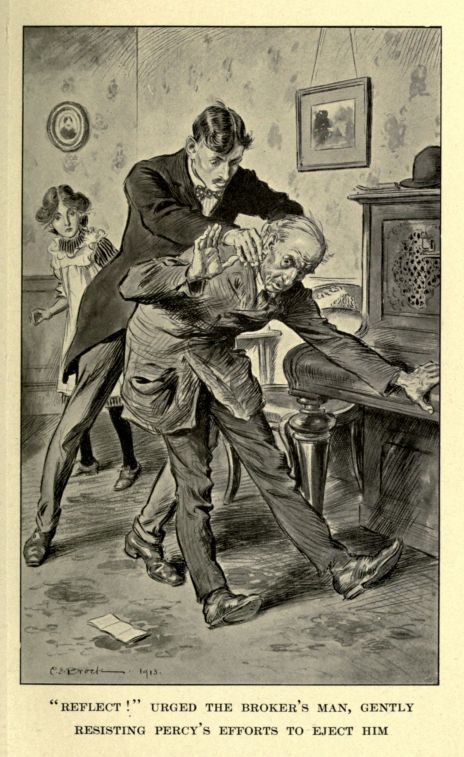
"REFLECT!" URGED THE BROKER'S MAN, GENTLY RESISTING PERCY'S EFFORTS TO EJECT HIM
"He is right, Percy," said Mr. Welwyn. "Leave him alone. A sheriff's officer!" he muttered brokenly to himself, as his son relinquished his endeavour to speed the parting guest. "And I was once Fellow and Tutor!"
"A broker's man!" wailed Mrs. Welwyn, putting an arm round each of her daughters. "And I brought you up respectable, dearies!"
"A broker's man!" echoed Tilly, "and Lady Adela coming here this afternoon!"
This was too much for that unpolished but chivalrous youth Percy. Something must be done, for Tilly's sake.
"Dad," he said desperately, laying a hand on his father's shoulder, "ain't you got no money nowhere?"
Mr. Welwyn shook his head helplessly.
"Mother?" said Percy.
"I've got about fifteen shillings," said Mrs. Welwyn, brightening up at the prospect of action. "How much did that insect"--she indicated the minion of the law, now warming himself at the fireplace--"say it was?"
"Seventeen-seventeen-six," replied the insect, with the air of one letting off a telling repartee.
"There is n't so much money in all the world!" whispered Amelia despairingly.
"I've got six-and-threepence," said Percy, diving into his pockets.
A thought occurred to Mrs. Welwyn.
"Father," she enquired of the motionless figure on the sofa, "did n't you tell me that Gandy and Cox's bill was only a matter of seven pounds?"
"It was, it was," said Mr. Welwyn, "but--I ordered a little more, to keep them quiet."
Mrs. Welwyn, admirable woman, wasted no time in useless reproaches. Instead, she turned once more upon the broker's man.
"Now, look here," she said; "I want to ask a favour of you. We're expecting company here this afternoon. Will you go away, and come back in the evening?"
"And find the front door bolted!" replied the broker's man affably. "No, I don't think! I prefer to remain. I've been in this profession for some time now--ever since I abandoned the profession, in fact--and I know a thing or two. I'm sorry," he added, "to disoblige a lady, and I hope you won't take offence where none was intended. Try to look on the bright side of things. I might 'ave been a auction."
Percy broke in upon these comfortable words.
"Look here," he said; "will you go away for a quid?"
"There is nothing," replied the visitor, "that I should like at this present moment better than a quid; but I'm afraid it's my duty to stay. I shan't do nobody any 'arm, beyond taking a inventory of the furniture. You'll find me quite a confidential family friend in a day or two, I should n't wonder. Oh, dear, 'ere's another of 'em coming to 'ave a go!"
He closed his eyes resignedly. Before him stood Tilly--small, slim, white to the lips, with all her world tottering on the brink of the abyss. In her hands she held a cigar-box.
"What is your name?" she asked.
"Surname," replied the broker's man pedantically, "Stillbottle. Christian ditto, Samuel. Net result, Samuel Stillbottle."
"Have a cigar, Mr. Stillbottle," said Tilly, with a ghost of a smile.
Mr. Stillbottle helped himself without comment. He was a man for whom life held few surprises. "Thank you. But I won't go, mind you," was all he said.
Next moment Tilly motioned him to a chair beside the table, and set the decanter and a glass beside him. "Have something to drink, Mr. Stillbottle," she said.
"I shall be pleased to do so," replied Mr. Stillbottle graciously. "Without prejudice, of course," he added, filling his glass.
By this time the others, astonished and interrogative, had gathered round Tilly.
"Tilly," burst out Percy, "what's the good? He won't go--don't you think it!"
"Young man," corroborated Mr. Stillbottle, "you are right. I won't. You 've done it in one."
Tilly took an arm of Percy and another of her mother and drew both in the direction of the sofa. Her breath came fast.
"Listen," she said rapidly--"you too, Dad! We will have our tea-party. We won't throw up a single item in the programme. We'll entertain the Mainwarings, and we'll show them that we know how to do things in proper style, and we'll make them all enjoy themselves--even Sylvia--and I'll get my Dicky yet!"
She paused, and surveyed her mystified audience with shining eyes.
"But, Sis," enquired the dubious Percy, indicating the fully occupied Mr. Stillbottle, "what about Rockefeller over there?"
The indomitable Tilly laughed.
"He is our old family butler!" she said simply.
CHAPTER XIX
SIDELIGHTS ON A PUBLIC CHARACTER
Mr. Samuel Stillbottle, notebook in hand, with a look of professional severity upon his pinched features, slowly circumnavigated the drawing-room, making an inventory of the furniture. He was followed, step for step, by the deeply interested Caution and Cure, who, finding the bonds of discipline unusually relaxed, owing to the preoccupation of their elders, had seized an early opportunity of escaping from the region belowstairs in which they were supposed to be enjoying their afternoon siesta, in order to pursue their acquaintance with the gentleman whom they had christened, on sight, "the funny man." They had encountered Mr. Stillbottle in the kitchen, and had conceived a liking for him at once. As appraisers of character their point of view was circumscribed and their judgment immature; but Mr. Stillbottle's performance at dinner had won their unqualified respect and admiration. They had accordingly decided to spend the rest of their lives in his company, and with that intent in view had laboriously scaled the staircase, and were now doing their best, by a series of ill-timed demonstrations of cordiality, to obstruct their new friend in the execution of his duty.
"Chesterfield sofa--two castors loose--one-fifteen," murmured Mr. Stillbottle, plying his pencil. ("Run away, that's good children.) Me'ogany whatnot"--he slipped his hand round behind the piece of furniture in question--"with deal back, two-ten. Armchair, with off 'ind leg cracked, twelve-and-six. (Run away, that's little dears. Run away and drown the kitten, or give the canary a shampoo; but don't stand there starin' at me like a pair of images. I don't like it, so don't do it.) Now for the 'arpsichord!"
The harassed Mr. Stillbottle began to examine the Welwyns' piano. The Cure turned to The Caution.
"Funny man!" she reiterated ecstatically.
"Yesh," assented The Caution, who suffered from a slight palatal affection. "Funny man! Lesh fight him a little bit!"
As an intimation that the approaching combat was to be of the friendliest description, he first smiled seraphically upon Mr. Stillbottle (who was looking the other way at the moment), and then dealt that gentleman a well-directed blow in the back of each knee simultaneously with his pudgy fists. Mr. Stillbottle, who, owing to his ignorance of infantile patois, was entirely unprepared for this onslaught, promptly fell head-first into the arm-chair with the damaged hind leg, reducing its value by a further one-and-ninepence. Before he could extricate himself his enraptured admirers had conceived and partially put into execution the happy design of tickling him to death.
"Now, look 'ere," he exclaimed indignantly, when he was sufficiently recovered from the suddenness of this outrage to resume an upright position, "you must drop it! Pop off! I won't 'ave it! If I ketch 'old of either of you--if I ketch--all right, say no more about it! I believe that little girl 'as got the evil eye," he muttered weakly to himself. Mr. Stillbottle's nerves were not in good order, and The Cure had regarded him with unwinking steadfastness for something like five minutes. "Go and play over there," he urged, almost piteously, "and let me do my job. Now, where was I? Ho, yes--the pianner."
He submitted that venerable instrument to a further scrutiny.
"Collard and Collard," he observed. ("A very appropriate title, too, for this 'ouse!) Date, about seventy-four or five, I should say." He lifted the lid and struck a few inharmonious chords. "Not been tooned since bought. Loud pedal broke, and ivories off three keys. Mouse-'ole in the back. Say thirty-five bob, or two p--Will you drop it?"
Mr. Stillbottle made this request from the floor, upon which he had suddenly adopted a recumbent attitude. The Caution and the Cure, having decided to initiate their idol into what they had always considered the most consummate jest in existence, had placed a heavy footstool close behind his heels; and Mr. Stillbottle, stepping back a pace in order to view the tout ensemble of the piano, had carried the joke to a successful and rapturous conclusion.
Amid appreciative shrieks of merriment from the twins, their fermenting playfellow rose solemnly to his feet, and was pausing dramatically for the double purpose of recovering his breath and deciding upon an effective scheme of reprisal, when he became aware that the door was open and that the master of the house was smilingly contemplating the entertainment.
"You three appear to be having a romp," said Mr. Welwyn genially. "You are evidently a lover of children, Mr. Stillbottle!"
Fortunately for the delicate ears of The Caution and The Cure, Mr. Stillbottle was still incapable of utterance. By the time that his two admirers had been escorted to the door by their progenitor and bidden to return to their own place, his power of speech had returned; but perceiving that the time for explanation was now past, the misjudged romper decided to postpone the refutation of the libel until some other occasion.
"Be seated, Mr. Stillbottle," said Mr. Welwyn politely.
Mr. Stillbottle selected the sofa, which it will be remembered had been marked as high as one pound fifteen.
"I hope you had a comfortable dinner," continued Mr. Welwyn.
"Thank you," replied Mr. Stillbottle briefly--"I 'ad."
Mr. Welwyn produced half-a-sovereign.
"I make a point of being punctilious over money matters," he said, handing the coin to the broker's man. "When our little--er--contract has been carried to a successful conclusion I shall be happy to hand you another."
Mr. Stillbottle pocketed the money.
"When may I expect the other?" he enquired.
"If all goes well, about six o'clock this evening."
"I see," said Mr. Stillbottle comprehendingly. "Carriages at five-forty-five--eh?"
"Precisely," said Mr. Welwyn. "You have hit off the situation to a nicety." He laughed, in high spirits. His resilient nature had entirely recovered from the humiliation of the morning. "Meanwhile"--he produced a sheet of note-paper--"I shall be obliged if you will kindly commit these notes to memory."
Mr. Stillbottle laboriously perused the document.
"Lord love a duck!" he observed in a dazed voice--"What's this?"
"A list of--let us say, your entrances and exits this afternoon," explained Mr. Welwyn smoothly. "You understand theatrical terms, I believe."
He had struck the right chord. Mr. Stillbottle's rheumy eye lit up.
"Entrances and ex-- oho! Now I begin to take you," he said. "We 're agoin' to do drawing-room theatricals, are we? Kind o' benefit matinée--eh?"
"In a sense, yes," replied Mr. Welwyn. "Are you endowed with the dramatic instinct?"
"Come again!" said Mr. Stillbottle politely.
"Could you play a part, do you think?"
"Could I play a part?" repeated Mr. Stillbottle witheringly. "Could a duck swim? Why, I was in the profession, off and on, for a matter of fourteen years."
"In what capacity?" asked Mr. Welwyn, much interested.
"Well, I've bin a good many things," said the versatile Stillbottle, putting his feet up on the sofa. "I've bin a guest in the palace of the Dook of Alsatia; I 've bin the middle bit of the sea-serpent--what you might call the prime cut--in a ballet of fish; and I was once the second wave on the O.P. side of the storm what wrecked Sinbad the Sailor."
Mr. Welwyn smiled sympathetically. Here was another rolling stone.
"What made you abandon such a promising career, Mr. Stillbottle?" he asked.
The late prime cut of the sea-serpent shook his head gloomily.
"The old story," he said--"professional jealousy. It started with my bein' cast for the front legs of a elephant in a pantomime. That was the stage-manager's bit of spite. My usual place is the 'ind legs--and that takes a bit of doing, I can tell you. (The 'ind legs 'as to wag the tail, you see.) If I was to tell you the number of 'ind legs I'd played, you'd be surprised," he continued, plunging into an orgy of irrelevant reminiscence. "Why, I recollect in eighty-four, at the Old Brit., 'Oxton way--"
"But what was the matter with the front legs you were speaking of?" enquired Mr. Welwyn opportunely.
"The matter," replied Mr. Stillbottle testily, "was that they was n't 'ind legs. Not bein' used to them, I stepped in wrong way round on the first night. We got shoved on the stage somehow, but every time we started to move I ran straight into the 'ind legs. In the end we broke the elephant's back between us. What was more, we spoiled the Principal Boy's best song. The audience was much too occupied watchin' a elephant givin' a imitation of a camel to listen to 'er. Besides, she was sittin' on the elephant 'erself at the time, and bein' rather stout, 'ad 'er work cut out to 'old on. She got me fired next day. Said I was n't sober."
"That was a libel, of course," said Mr. Welwyn soothingly.
"In a manner of speakin'," replied Mr. Stillbottle guardedly--"yes." He took up Mr. Welwyn's sheet of note-paper again.
"What is all this?" he enquired rather querulously. "Stage directions, or cues, or what?"
"Everything," said Mr. Welwyn. "Your lines and business, in fact."
Mr. Stillbottle nodded comprehendingly, and proceeded to read aloud:--
"When front-door bell rings, answer door and show party up, asking their names and announcing them distinctly."
"You can do that?"
"I'll 'ave a dash for it, anyway. Then: Bring in tea and put it on tea-table."
Mr. Stillbottle's unsteady gaze wandered round the apartment until it encountered the table.
"Tea-table, left centre," he remarked to himself. "Then, at irregular intervals, come in and make the following remarks to me:--that's you, I suppose?"
Mr. Welwyn nodded, and Mr. Stillbottle read the paper aloud to the end. Then he slowly folded it up, and remarked, not altogether unreasonably, that he was damned. He added a respectful rider in the French tongue, to the effect that Mr. Welwyn was très moutarde.
"You understand," said his employer with great seriousness--he had crossed the Rubicon now, and was determined to risk nothing by imperfect rehearsal--"you must use your own discretion as to when you come in with your messages. About once every ten minutes, I should say."
"Don't you think, governor," suggested Mr. Stillbottle, almost timidly, "that that last stretcher--the one about the shover--is just a bit too thick? Suppose your guests start askin' to see the car--what, then? You'll be in the cart, you know!"
"It is all right," said Mr. Welwyn. "I am giving the car up, on account of recent taxation, and so on. It is in the market now, and may be sold at any moment--to-day, perhaps."
"I beg pardon," said Mr. Stillbottle humbly. "I see I can teach you nothing." Then he added, conversationally: "Did you ever know a Captain Slingsby, by any chance?"
"No. Who was he?"
"Another of the lads, like yourself. I thought perhaps you might have been workin' with him at some time. I came acrost him once or twice. He was a pretty tough nut. His line was to dress up as a curate and get himself adopted by rich widders; but he was n't the artist you are, sir. He 'ad n't your education, I should say. Are the whole family in this, may I enquire?"
"Er--yes," replied Mr. Welwyn helplessly.
"Ah!" Mr. Stillbottle nodded his head. "I thought somehow that I had come on a happy visit to the Nut Family as soon as I got acquainted with your two youngest. Well, it's a pleasure to work with people at the top of their profession, and I'll see you through."
Mr. Welwyn thanked him, almost inaudibly.
"But when do you suppose," pursued Mr. Stillbottle, transferring his feet from the sofa to the floor, "that I shall get out of this Dramatic Academy of yours? I 'ave n't come 'ere for a course, you know. Are you going to touch the tea-party for the money, or let me distrain on the furniture, or what?"
"I can't tell you at present," said Mr. Welwyn; "but I will endeavour to arrange something by the evening."
"Well, let me know soon, ole sport," said Mr. Stillbottle--"that's all. I 'ave my arrangements to make, too, remember. My word, look at Mother!"
This interjection was occasioned by the entrance of Mrs. Welwyn and Amelia, dressed for the party. Mrs. Welwyn was arrayed in a quieter and more tasteful fashion than might have been expected. Her costume, which had been designed and constructed by her eldest daughter, would have struck an impartial critic as one which made the very best of her age and figure. Amelia wore a short white frock, with a blue sash. Her long coppery hair flowed to her waist, and her hazel eyes were aglow with excitement.
"Father dear, what do you think of the way Tilly has turned me out?" enquired Mrs. Welwyn gaily.
For the moment her troubles were behind her. For once she was suitably--and to the outward eye expensively--attired; and the knowledge of the fact had induced in her humble but feminine soul that degree of minor intoxication which the materially-minded male usually achieves, more grossly but less extravagantly, by means of a pint of champagne.
Slowly gyrating for the delectation of her husband, Mrs. Welwyn unexpectedly encountered the unsympathetic gaze of Mr. Stillbottle. She blushed red, and ceased to revolve.
"Oh, that you?" she exclaimed, in an embarrassed voice.
"Yes, it's me--what's left of me," replied Mr. Stillbottle lugubriously. "Wearing me out, this job is."
He displayed his paper of cues.
Mrs. Welwyn regarded him severely.
"It's time you dressed yourself," she said. "I have put my son's evening clothes out for you--in the bathroom," she added pointedly. "You had better go and put them on. He is bigger than you, but you'll manage."
Mr. Stillbottle acquiesced.
"Very good," he remarked graciously. "Wardrobe mistress must be obeyed, I suppose. I'm beginning to warm up to this part. I shall surprise you all yet."
"I hope not," murmured Mr. Welwyn devoutly.
"Did you tell him about the name, Father?" prompted Amelia.
"No, I forgot," said Mr. Welwyn. "Mr. Stillbottle, I think this afternoon that we had better address you by some other name than your own."
"What," enquired Mr. Stillbottle, with a touch of hauteur, "is the matter with me own little patteronymic?"
"Just to sustain the character, you know," urged Mr. Welwyn.
Mr. Stillbottle sighed, in humorous resignation.
"All right," he said. "Confer the title."
Mr. Welwyn turned to his wife.
"What do you say to 'Howard,' Mother?" he asked.
"Nothing with an H in front of it for me, dearie, if you please," announced Mrs. Welwyn firmly. "I can see enough rocks of that kind ahead of me this afternoon as it is."
"Why not 'Russell'?" suggested Amelia. "Russell Square, you know."
Mrs. Welwyn stroked her resourceful little daughter's hair gratefully.
"That will do finely," she said. "You are Russell," she announced briefly to Mr. Stillbottle.
The newly christened infant acquiesced listlessly, and rose from the sofa.
"Now I must tear myself away," he said, "to don me trunks and 'ose and get up this patter. I'm a slow study. No promptin', I presume?"
"No," said Mr. Welwyn.
"Gaggin' permitted?" enquired Mr. Stillbottle, without much hope.
"Certainly not."
"Very good. So long, everybody. Exit Russell, door in back."
With a theatrical gesture, the ci-devant impersonator of elephants' hind legs disappeared. The Welwyns regarded one another apprehensively.
"Oh, dear!" said Mrs. Welwyn.
"We must make the best of him, Martha," said her husband. "After all, we did not invite him here of our own accord: he has to be present in the house in some capacity. Still, I admit he is the weak spot in our enterprise--the heel of Achilles, so to speak."
But Mr. Welwyn was wrong.
CHAPTER XX
REHEARSED EFFECTS
"Has Herbert," enquired Mrs. Welwyn, taking a deep breath, "hurt Horace?" She choked. "Oh, dear!"
"Very good, Mumsie," said Amelia encouragingly. "Go on."
"But it puts me out of breath so, child, as soon as I begin to think of it," complained her pupil. "I shall never learn."
"Yes, you will," said Amelia confidently. "H's are just a matter of proper breathing, Daddy says. Now try the next sentence, and remember there's a trap in it!"
Miss Amelia seated herself upon the floor, clasping her long black legs with her arms and resting her chin on her knees.
"Now," she said, with a little nod.
Conscientious Mrs. Welwyn, having audibly recharged her lungs, now began to emit another heavily aspirated sentence.
"Hildebrand," she announced, "has hit Henry hard hintentionally. There, that's done it!" She sighed despairingly.
"And I warned you, Mother," said Amelia reproachfully. "That last word is put in on purpose to trip you up."
"Yes, I know," replied her mother with an apologetic smile. "And it always does. You can't teach an old dog new tricks, ducky, and that's a fact. I have always been common in my talk, and common in my talk I always will be. All I can promise is that I will do my best this afternoon; and I hope, for all of your sakes, that your old mother won't go and disgrace you."
Little 'Melia's reply to this humble aspiration was an embrace which entirely disorganised the hooks and eyes at the back of Martha Welwyn's festal garment. While the disaster was being repaired, Tilly entered briskly. In her hand she held a printed card, bearing the legend
APARTMENTS
in staring letters. This she dropped behind the piano.
"Hook me up behind, 'Melia, will you," she said, "when you have finished Mother? No, I'll do Mother and you do me. Your hair-ribbon is wrong. Let me get hold of it."
The Welwyns, mère et filles, formed themselves into a voluble equilateral triangle.
"I found that 'Apartments' card lying on the hall table," said Tilly with a shiver. "I suppose Russell took it out of the drawer when he was making his inventory. A nice thing if they had all marched in through the front door at that very moment! Still," she added cheerily, "there's no harm done. Am I all right, do you think?"
"Tilly, you look lovely," said Amelia.
"One thing about being a dress-designer," admitted Tilly, kissing her little sister, "is that you can design yourself a dress. 'Melia, you look a little duck. Mother, your hair is n't quite right. Let me pull it out a bit here."
She tweaked the coiffure of her much-enduring parent into position, whistling blithely. Her cheeks were pink, her eyes sparkled. She was determined to look her best for Dicky that day. And to do her justice, she did.
"Tilly dear," remarked Mrs. Welwyn dubiously, "can we all get round that table for tea?"
"Gracious!" cried Tilly, observing the heavily loaded table for the first time. "You are never going to plant everybody round that, like nursery tea?"
"Ain't we?" said Mrs. Welwyn blankly.
"Certainly not," replied Tilly.
Swiftly she sketched out the fundamentals of that meal which combines the maximum of discomfort with the minimum of nourishment--afternoon-tea as consumed by high society in the present period--and in three minutes the great round table, tipped onto its edge, was trundled rapidly into Mr. Welwyn's bedroom, to the surprise and discomfort of Mr. Welwyn, who was dressing at the time.
"Now a small tea-table," commanded Tilly.
"There is n't such a thing in the house, love," panted her overheated parent.
"Yes, there is," said little 'Melia, the ever-ready. "In Mr. Pumpherston's room. He keeps a text framed in fir-cones on it."
"You're right, dear; I had forgotten," admitted Mrs. Welwyn. "Well, Pumpherston is going to get bounced this evening anyway, so we might as well have his table now as then. Come with me and get it. He's out."
Left alone, Tilly flitted about the room, reviving its faded glories as far as she was able by deft touches here and there; straightening curtains, patting cushions, and confiding to various unresponsive articles of upholstery the information that her Love was like a Red, Red Rose.
"Tea-table here, I think," she said, pausing. "Probably Lady Adela would have hers nearer the fire; but then Lady Adela's drawing-room carpet has not got a hole in it. Come in!"
The door opened, and an eerie figure appeared. It was Mr. Russell--né Stillbottle--in his shirt-sleeves, wearing an insecurely fastened dickey. His black trousers, being much too long for him, presented a corrugated appearance. In his hand he carried a great bunch of pink carnations.
"These 'ave just been 'anded in, Miss," he announced. "No name, and"--with a slight note of congratulation in his voice--"nothing to pay."
Tilly thanked him, and, taking the flowers, buried her face in the heart of the bunch. When she withdrew it she found that Mr. Stillbottle was still present.
"If you could find him, Miss," he said deferentially, "I should like to 'ave a word with the Chief Nut."
"Who?"
"The old feller that's running this fake."
"Oh, my father?" said Tilly, biting her lip. "He is dressing, I think." She tucked three or four carnations into her belt and began to arrange the others in a bowl.
"Then, perhaps," said Mr. Russell, "you could advise me on a purely personal matter."
"Certainly," replied Tilly absently. Dicky's gift still claimed all her attention.
"It's these trousers, Miss," explained Russell confidentially. "They are the pair supplied by the management; and between ourselves I don't think they suit me. Brother Perce may 'ave a faithful 'eart, but 'e 's built all wrong. These trousers are six or eight inches too long in the leg. I feel as if I was wearin' a pair of concertinas. Now--"
This sartorial jeremiad was cut short by the entrance of Mrs. Welwyn, who, travelling full-speed astern and towing Amelia and the tea-table of Pumpherston in her wake, butted the double doors open, and backed heavily into the orator. Mr. Russell, looking deeply injured, retired to complete his toilet.
"That's better," said Tilly, when the small tea-table had been placed over the hole in the carpet, and the tea-tray had been placed over a hole in the tablecloth. "Is everything ready?"
"Yes," said Amelia.
"What about the babies?"
"I have washed and dressed them," said Mrs. Welwyn. "Melia will fetch them down for a few minutes about a quarter-to-six."
"That's all right," said Tilly approvingly. "They are darlings, both of them, and I should like to have them down all the time, but it's too risky. What time is it now?"
"Ten minutes to five," said Amelia.
"Mercy!" exclaimed Mrs. Welwyn, greatly agitated at the proximity of her hour. "Where shall I sit, Tilly dear?"
"On the sofa, Mumsie; and don't get hot, because you are looking very nice," said Tilly soothingly. "Hallo, Dad--just in time!"
Mr. Welwyn in a frock-coat, looking quite the scholar and gentleman, had entered from his bedroom.
"I perceive the feast is spread," he observed jauntily. "Mistress of Ceremonies, how do we dispose ourselves?"
"Mother here," replied meticulous Tilly--"on the sofa with the 'Morning Post.' I picked it up off the floor of the railway-carriage this morning. Don't read it; just be glancing at it carelessly. Father, sit by the fire with a book. Here's one. 'Melia, you had better be on a footstool at Mother's feet, with your head against her knee. Don't fall over her when you get up, Mother. And don't come forward more than three steps to meet Lady Adela: you 're as good as she is, remember. Say it's very sweet of her to come all this way. And if you call her 'your Ladyship,' I shall walk straight across the room and kill you--see?"
"Yes, lovey," sighed the flustered Mrs. Welwyn. "What do I call her?"
"Lady Adela--not Lady Mainwaring, mind!"
"It sounds so familiar, starting Christian names right off," objected Mrs. Welwyn feebly.
"Never mind; you've got to do it," said Tilly ruthlessly. "I shall be here by the tea-table, and if any of you get on to thin ice I shall drop a teaspoon. Do you all understand?"
"Yes, Tilly," replied a respectful chorus.
"Very well, then," replied the Mistress of Ceremonies. "Now let me see you all in your places. Attention!"
Tilly clapped her hands, and her well-drilled retinue froze into their appointed attitudes.
"Don't hold the 'Morning Post' as if you were trying to lick butter off it, Mother," said Tilly. "'Melia, pull up your stocking. Dad, you are splendid, but you are laughing. This is a serious business, remember. Now, all keep like that for two minutes, to see if--Mercy on us, here they are!"
But she was wrong.
The door creaked, and swung slowly open, to admit the attenuated figure of Grandma Banks, who in the most unconcerned fashion possible hobbled across the room to the fireplace and seated herself in the vacant armchair opposite to her son-in-law, with every appearance of having come to anchor for the evening.
――――
Grandma's descendants gathered into a panic-stricken knot in the corner.
"She can't stay!" whispered Tilly frantically. "Mother, get her to bed."
"My dearie," responded Mrs. Welwyn helplessly, "you know what she is when she smells a rat!"
"Try, anyhow!" urged Tilly, glancing feverishly at the clock.
Mrs. Welwyn approached her aged parent much as a small boy approaches a reputed wasp's nest.
"Mother," she said nervously.
"Eh?" replied Mrs. Banks, looking up sharply and scrutinising her daughter over her glasses. "What 'ave you got them things on for? Goin' out somewhere? At your age, too!" she added irrelevantly.
"Yes--no--yes," stammered Martha Welwyn, who tampered with the truth with difficulty. "I've arranged for you to have your tea in your own room this afternoon, Mother."
"Why?" enquired Mrs. Banks at once.
"You are not looking very well," interposed Mr. Welwyn rashly.
"I'm eighty-one," retorted the old lady with great spirit, "and as 'earty as ever I was, Welwyn. I shall 'ave my tea in 'ere."
"We rather want this room this afternoon, dear," resumed Mrs. Welwyn gallantly. "Father has some people coming in on business."
"Is Father going to get a job of work to do?" riposted Grandma Banks, in tones of gratified surprise.
Mr. Welwyn blew his nose sheepishly, and the clock struck five. Tilly came forward and knelt by her grandmother's chair.
"It is very important for all of us, Granny," she pleaded, "that Father should have an undisturbed talk with these people; so we thought we would keep this room clear this afternoon. You don't want to be troubled with strangers, do you? Nasty, loud-voiced people."
"I likes people with loud voices," replied the old lady cantankerously. "I can 'ear what they says."
"But they're only going to talk business," urged Tilly. "Come along, there's a dear old Grandma. You'll be much more comfortable in your own room. There's a nice fire there, and I'll bring you in a lovely tea. Take my arm."
By this time Mrs. Banks had been raised to her feet, and now found herself being gently but inexorably propelled in the direction of the door.
"You don't want me, that's the truth," she observed, getting reluctantly under way. "You 're ashamed of your old Grandma, that's what it is."
"Nonsense, darling," said Tilly. "You know how fond we all are of you. But you would only be tired out by a lot of people."
"No," persisted the old lady, "you don't want me."
She hobbled through the door on her grand-daughter's arm, still speaking the truth.
"Poor old Granny!" Tilly's voice said very gently. "I promise to make it all up to you some day."
The bedroom door on the other side of the landing was heard to open and shut, and there was momentary silence. Then the front-door bell emitted a majestic peal. The sound thrilled the Welwyns like a tocsin. Tilly darted in.
"Get to your places," she whispered.
The troupe hastily resumed their proper poses, and a tense silence ensued.
Mrs. Welwyn took a deep breath.
"Has Horace," she enquired in a hoarse and hysterical whisper, "hurt Herbert? No, but Hildebrand--"
"They are in the hall," hissed Amelia.
"They are coming up," said Mr. Welwyn calmly.
Suddenly Tilly's fortitude deserted her.
"I can't bear it!" she wailed, and bolted incontinently through the inner door into her father's room.
"Tilly darling, don't leave us!" was the agonised cry of Mrs. Welwyn and Amelia....
Next moment Mr. Welwyn, finding himself alone in his own drawing-room, rose to his feet and, as rapidly as was compatible with the dignity of a scholar and a gentleman, joined the panic-stricken mob in his bedroom.
Almost simultaneously the door onto the landing was thrown open, and Mr. Stillbottle's wheezy voice announced:--
"Lord Mainwaring, Lady Mainwaring, and party!" Then in a surprised and informal tone:--
"Hallo! Stage clear?"
CHAPTER XXI
UNREHEARSED
Mr. Mainwaring, Lady Adela, and party--the latter comprised Sylvia, Connie Carmyle, and Dicky--came to a standstill in the middle of the vast and empty drawing-room and looked enquiringly about them. Lady Adela, upon whom the labour of climbing the staircase had told heavily, first deleted from her features the stately smile which she had mechanically assumed before crossing the threshold, and then began to sit down upon the piece of furniture which Mr. Stillbottle had recently valued at twelve-and-six-pence.
"I would n't set in that chair, mum, not if I was you," remarked a husky voice in her ear. "The off 'hid leg is a trifle dicky."
Lady Adela, suspended in mid-air like Mahomet's coffin, started violently upwards into a vertical position, and then, having, on the advice of the officious Mr. Stillbottle, selected the sofa, took in the drawing-room with one comprehensive sweep of her lorgnette.
Mr. Stillbottle withdrew, doubtless to con his lines.
"H'm," remarked Lady Adela. "This is evidently not one of the rooms that has just been in the hands of the painters and decorators."
"Dick," enquired Sylvia, who had been superciliously inspecting the mahogany whatnot with the deal back, "who was that furtive Oriental person who slipped past us on the staircase? Not another future relative-in-law, I trust."
"The stout nigger gentleman, you mean?" said Dicky, with unimpaired good humour. "I fancy he must have been calling on Mr. Welwyn about his studies. I have a notion that London University is somewhere about here."
"What a jolly old-fashioned house this is," said Connie from the window-seat. "How nice and shady this big square must be in summer."
"It is a fairly shady locality all the year round, I fancy," observed Sylvia sweetly.
Kind-hearted Mr. Mainwaring coughed, and looked unhappily towards his son. But Dicky did not appear to have heard. He had just discovered his carnations.
Lady Adela took up the tale.
"There was a small but ferocious-looking creature with red whiskers," she announced, "hanging over the banisters on the top floor. Who would he be, now?"
"Don't ask me, Mum," said Dicky. "I've never been in the house before, remember, except downstairs. Probably a paper-hanger, or--"
He was interrupted by the entrance of a stately procession headed by Mrs. Welwyn, the rest following in single file.
Tilly effected the necessary introductions prettily and with perfect composure; and presently the company assorted itself into what we will call Tableau Number One. Mr. Welwyn led Lady Adela back to the seat which she had vacated.
"Most of the furniture in this mansion of ours is Early Victorian," he announced with a ready laugh; "but I think you will find this sofa comfortably Edwardian, Lady Adela."
Lady Adela, favourably impressed with her host's appearance and manner, smiled graciously and once more cautiously lowered herself onto the sofa. Here, in obedience to an almost imperceptible sign from her husband, the quaking Mrs. Welwyn joined her, and announced, in a voice which she entirely failed to recognise as her own, that it was very sweet of them all to come so far.
Amelia ran impulsively to Dicky and kissed him. Mrs. Carmyle, Sylvia, and Tilly fell into a chattering group round the tea-table. Mr. Welwyn and Mr. Mainwaring shook hands warmly and exchanged greetings. The tea-party was launched.
"How many years is it, Welwyn?" asked Mr. Mainwaring.
"Let us not rake up the past, my dear Mainwaring," said Mr. Welwyn. "More years than we care to count--eh? We'll leave it at that. But I am delighted to meet you again. I wonder how the old College prospers. Foster was your tutor, was n't he?"
"Yes," replied Mr. Mainwaring, pleasantly flattered to find that a man who had been two years senior to him should remember so much about him.
"Mine, too," mentioned Mr. Welwyn, as if determined to put his guest at his ease.
"He's a bishop now, I hear," said Mr. Mainwaring.
"Eheu, fugaces!" sighed Mr. Welwyn. "Come and sit by the fire."
"I think we had better have tea, Tilly," said Mrs. Welwyn, as per programme.
The Welwyn family, recognising a cue, began to bestir themselves for Tableau Number Two.
"I seem to hear it coming up, Mother," replied Tilly.
She was right. Portentous rattlings and puffings were now audible without. Next moment the doors were bumped open and Mr. Stillbottle appeared, carrying the tea-pot on a tray.
Apparently something was on his mind. His appearance was that of a righteous man deeply wronged. His was the demeanour of a British artisan compelled by forces which he cannot control to perform a task not included in his contract.
A moment later the situation explained itself. Behind Mr. Stillbottle, clinging affectionately to his flowing coat-tails, marched The Caution and The Cure. They were dressed in white, and looked exactly alike except that The Caution wore abbreviated white knickerbockers and The Cure a little white skirt. Their socks were white, their sashes and chubby legs were a radiant pink, and the angelic countenance of each was wreathed in smiles.
The procession drew up at the tea-table, where its leader proceeded to deposit the tea-pot. For a moment there was a pause in the conversation, while the hearts of the Welwyns stood still. The Twins, uncontrolled, sometimes erred on the side of originality.
"He's the Queen," explained The Cure, indicating the flinching figure of Mr. Stillbottle.
"Yesh; and we're holdin' up of his train," added The Caution.
Next moment Connie Carmyle had captured them both.
"You darlings!" she cried, and carried them off to the window-seat. The situation was saved.
"Little pets!" observed Lady Adela, smiling.
Even Sylvia forgot to pose for a moment. Tea was served amid a hum of cheerful conversation. The children had evoked the maternal instinct, and all was well.
Only Mr. Stillbottle remained cold.
"You oughter 'ave kep' them locked up somewhere," he announced severely to Tilly; and left the room.
"I don't see your son here, Mrs. Welwyn," said Lady Adela. "We had the pleasure of his company for a few minutes on Saturday."
"He will be here any minute, your--Lady Adela," replied Mrs. Welwyn with a jerk. "He is usually kept in the City till close on five, poor boy."
"That aged retainer of yours seems to be a bit of an autocrat, Tilly," said Dicky, taking Mrs. Carmyle's chair at the tea-table.
"Yes," agreed Tilly, feeling rather miserable at having to talk to Dicky in this strain; "but you know what old servants are. In their eyes we never grow up."
"Has he been with you for long, then?" enquired Sylvia, with a deep appearance of interest.
"How long has Russell been with us, Mother?" said Tilly, noting that Mrs. Welwyn's conversation with Lady Adela was beginning to flag.
"I can't remember, dear. It seems a long time, anyhow," replied Mrs. Welwyn with sincerity. "Ah, here is Percy. Come in, my boy. Just in time to hand round the cakes!"
"You can trust little Perce," observed that engaging youth, entirely at his ease, "to be on the spot at the right moment. How de do, Lady Adela? I hope this finds you as it leaves me."
He shook the very limp hand of Lady Adela, and having bestowed an ingratiating smile upon Sylvia, proceeded amid a slowly intensifying silence to offer a humorous greeting to Mr. Mainwaring. Finally he turned to Dicky, and slapped him boisterously upon the shoulder.
"Well, my brave Ricardo," he enquired, "how goes it?"
"Percy, dear old thing," responded Dicky promptly, with his most vacant laugh, "how splendid to see you again! Come and tell me all about your club run on Sunday."
He drew the flamboyant cyclist to a place of safety, and Tilly breathed again.
"There is sugar and cream in this cup, Lady Adela," said Amelia, with a neat bob-curtsey.
"Thank you, little girl," said Lady Adela, taking the cup and smiling indulgently. ("Like a Duchess out slumming," Amelia told Tilly afterwards.) "What pretty manners!" she continued, turning to Mrs. Welwyn. "Where do you send her to school? I used to find it so difficult--"
"She has left school," replied Mrs. Welwyn. "I suppose we ought to send her somewhere to get finished later on, but there--we can't do without her, and that's the truth. Can we, dear?"
Martha Welwyn put an arm round her little daughter. She was talking with greater freedom and confidence now, with her aspirates under perfect control.
"I can quite understand that," said Lady Adela affably. "I dare say you find her indispensable."
"I should think so," replied Mrs. Welwyn, lowering her guard. "What with all the staircases, and a basement kitchen, and separate meals--"
Tilly dropped a teaspoon with a clatter on to the tray.
"I'm so sorry, Sylvia," she said. "Did I make you jump?"
"No," responded Sylvia absently. "I was looking at your butler. He seems to have something on his mind."
Mr. Stillbottle, who had entered the room two minutes previously, and had been awaiting an opportunity of gaining the ear of the company, took advantage of the partial silence which now ensued.
"A person has called, sir," he announced to Mr. Welwyn, "for to iron the billiard table."
Mr. Welwyn broke off his conversation with Mr. Mainwaring.
"Thank you," he said in an undertone. "Let him do so by all means."
"Yes, sir," replied Mr. Stillbottle, turning to go.
"Tell him," added Percy, highly pleased with the manner in which the little comedy was unfolding itself, "to see if any of the cues want tips."
"Very good," said Mr. Stillbottle, in a voice which plainly asked why Percy should "gag," when he might not.
The door closed once more, and another hurdle was negotiated. The Welwyns heaved little sighs of relief: Russell's was an unnerving presence. But Tilly glanced at the honest, laughing face of the man who loved her, and felt suddenly ashamed.
"Quite a character, that old fellow," said Mr. Welwyn breezily. "Incorrigibly idle; painfully outspoken; a domestic tyrant of the most oppressive type; but honest as the day. I must get some one to put him in a book. Lady Adela, you have nothing to eat."
Mr. Welwyn deftly changed places with his wife, who gratefully engaged in a conversation with Mr. Mainwaring; and the rest of the company performed one of those complicated evolutions which children call a "general post," and which affords persons of mature years but intellectual poverty the inestimable boon of being able to employ the same topics of conversation several times over. Tableau Number Three was now set.
For a moment Dicky and Tilly found themselves together.
"Tea, old man?" asked Tilly, offering a cup.
"Thanks, little thing," replied Dicky, touching her hand under the saucer.
"Did you send these?" Tilly looked down at her pink carnations.
Dicky nodded, and his gaze became suddenly ecstatic.
"Tilly," he said in tones of exultant pride, "you are looking perfectly beautiful."
"This is a strictly business meeting," smiled Tilly; but her heart bumped foolishly. For a moment nothing seemed to matter save the knowledge that Dicky loved her and she loved Dicky.
The next event of any importance was the discovery that Mrs. Carmyle, engrossed with the twins, had had no tea. There were cries of contrition from the Welwyn family, and Connie was hurried to the tea-table, followed by the desolating howls of her youthful admirers--howls which increased to yells when Mrs. Welwyn announced that it was time for them to return whence they came. However, they were pacified by an offer from their new friend to accompany them part of the way; and after submitting with a sweetness as adorable as it was unexpected to an embrace from Lady Adela, they left the room clinging to Connie's skirts, having contributed to the programme the one unassailably successful item of the whole afternoon.
Amelia went with them, but returned almost immediately.
"Mrs. Carmyle is telling them a story in the dining-room," she said to her mother. "They are as good as gold with her."
"Dear Constance! She is a fairy godmother to all children," remarked Lady Adela, who was feeling quite remarkably beatific.
"Yes--children of all ages," corroborated Dicky, catching Tilly's eye.
"I declare," cried Mrs. Welwyn suddenly, as this pleasant episode terminated, "I had almost forgotten. Tilly dear, you had better take your grandmother's tea in to her."
"All right, Mother," assented Tilly blithely. The party was shaping into a success.
"I am so sorry, Lady Adela," said Mr. Welwyn, picking up the new topic with the readiness of a practised conversationalist, "that you will not meet my wife's mother this afternoon. She spends a good deal of her time with us. A dear old lady--quite of the Early Victorian school."
"She is not unwell, I hope," said Lady Adela politely.
"A slight chill--a mere nothing," Mr. Welwyn assured her; "but at that age one has to be careful. The doctor is keeping her in bed to-day. I regret it, because I think you would have enjoyed a conversation with her. She is a mistress of the rounded phrase and polished diction of two generations ago. So unlike the staccato stuff that passes for conversation nowadays."
"Too true, too true!" agreed Lady Adela, eagerly mounting one of her pet hobby-horses. "She sounds most stimulating. It is unfashionable to-day to be elderly. My daughter informs me that no one--not even a grandmother--should have any recollection of anything that happened previous to the period when people wore bustles. All time before that she sums up as the chignon age. No, there is no sense of perspective nowadays. We are all for the present."
"Admirably put, dear Lady Adela," cooed Mr. Welwyn. "I remember--"
What Mr. Welwyn remembered will never be known, for at that moment the door opened, slowly but inexorably, and Grandma Banks appeared. She advanced into the room with a few uncertain and tottering steps, peered round her, and nodded her head with great vigour.
"I thought so," she observed triumphantly. "Company! No wonder I were sent to bed."
There was a paralysed silence. Mr. Welwyn was the first to recover his presence of mind. He advanced upon his infirm but irrepressible relative shaking a playful finger.
"This is very, very naughty," he announced reproachfully. "What will the doctor say?"
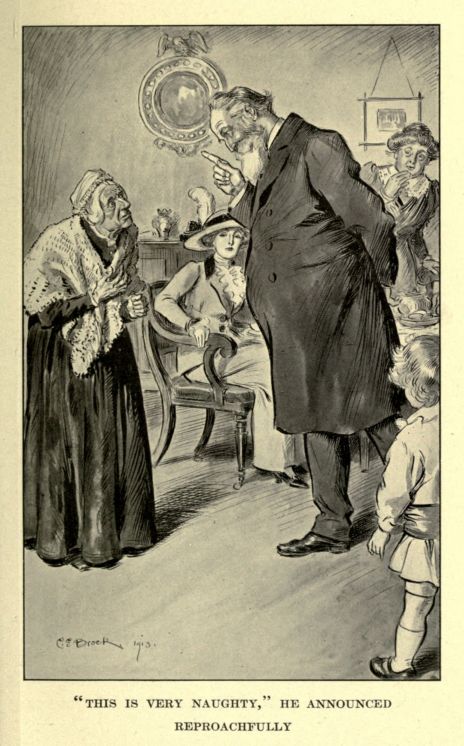
"THIS IS VERY NAUGHTY," HE ANNOUNCED REPROACHFULLY
"Eh?" enquired Grandma.
"You were told to stay in bed, you know, dear," said Mrs. Welwyn, coming to her husband's assistance.
"I were n't never told no such thing by nobody," replied the old lady explicitly.
Tilly, avoiding Sylvia's eye, decided to make the best of the situation.
"Well, now you are here, Granny," she interposed brightly, "you must come and sit snugly by the fire and have some tea. 'Melia, bring that little three-legged table and put it by Granny's chair, and bring a footstool."
The Welwyns, swiftly taking their cue from Tilly, bestirred themselves in fulsome desperation, and in a few minutes Grandma Banks, a trifle flustered by her sudden and most unusual popularity, found herself tucked into her armchair by the assiduous efforts of the entire family.
"This is my grandmother, Mrs. Banks," said Tilly to Mr. Mainwaring, who happened to be sitting nearest.
"I trust, Mrs. Banks," began Mr. Mainwaring with a deferential bow, "that you are not allowing your sense of hospitality to overtax your strength."
"Eh?" enquired Mrs. Banks, as ever.
"She is rather deaf," explained Tilly in an undertone. "Don't strain your voice by talking to her too long."
"The gentleman," announced Grandma unexpectedly, "shall talk to me as long as he likes."
"Aha, Tilly, old lady! That's one for you," cried the watchful Percy, and the Welwyn family laughed, hurriedly and tumultuously. Grandma's octogenarian heart glowed. Social success had come to her at last. She began to enjoy herself hugely. Tilly cast an anxious glance round her. Grandma's entrance had sensibly lowered the temperature of the tea-party, and worse threatened. Already Lady Adela was exhibiting a tendency to edge towards the fireplace. It was only too plain that she contemplated yet another "cosy chat." Tilly decided to fall back upon the one trustworthy person in the room.
"Granny," she said, taking Dicky by the arm and leading him forward, "I want to introduce Mr. Dick Mainwaring. You have heard of him, have n't you?"
Mrs. Banks surveyed Dicky over her spectacles.
"Yes," replied Mrs. Banks with deliberation, "I 'ave 'eard of you. You and our Tilly are walking out."
Dicky assented with a happy laugh, and dropped into the only chair in Grandma's vicinity. Tilly breathed again: Lady Adela's further advance was checked. The party settled down once more, and talk broke out afresh.
Grandma Banks, whose conversational flights were not as a rule encouraged by her relatives, availed herself of her present emancipation to embark upon a brief homily to Dicky.
"I tells you this, young man," she said in a hectoring voice, "you've got a treasure in our Tilly. Don't you forget it."
"I made that discovery for myself a long time ago," said Dicky. He smiled up at his treasure, who was sitting upon the arm of his chair.
The treasure's grandmother, having in the mean time been supplied with refreshment by Amelia, took a piece of bread-and-butter and rolled it up into a convenient cylinder.
"Yes," she continued, dipping the end of the cylinder into her tea, "she takes after her mother, does Tilly. She may get some of her looks from her father's side, but when it comes to character, she's a Banks." Her aged voice rose higher. "Always been respectable, 'as the Bankses," she announced shrilly. "Very different from--"
At this point not less than three persons enquired of Lady Adela if she would not take another cup of tea; and in the hospitable mêlée which ensued Grandma's further utterances were obscured.
Percy was holding Lady Adela's cup, and Tilly was re-filling it, when the door opened and Mr. Stillbottle made his second entrance. As before, he came to a halt immediately on appearing, and coughed in a distressing fashion without making any attempt to deliver his lines.
"There is that quaint old retainer of yours again, Tilly," said Sylvia.
Tilly turned quickly.
"Well, Russell?" she asked.
Mr. Stillbottle, ignoring her entirely, addressed himself to the master of the house.
"A message has came through on the telephone, sir," he chanted, fixing his eyes upon an imaginary prompt-book on the opposite wall, "askin' for you to be so kind as to attend a meetin' of the Club C'mittee at three o'clock on Toosday next."
"I think I am engaged," replied Mr. Welwyn, with an anxious glance in the direction of his mother-in-law (who was fortunately busily occupied in masticating a cylinder); "but say I will let them know."
"Right," said Mr. Stillbottle, and departed.
The Welwyns, who during the time occupied by their butler's second "turn," had been inclining uneasy ears in the direction of the open doorway, surveyed one another in a frightened fashion. All was not well on the second floor: evidence to that effect was plainly audible.
"Great bore, these committee meetings," commented Mr. Welwyn. "I expect you have your fill of them, Mainwaring."
"Alas, yes!" said Mr. Mainwaring. "They are all the same. Everybody sits and looks portentously solemn--"
"All sorts of non-controversial business is brought forward as a matter of pressing importance--"
"Everybody disagrees with everybody else--"
"And ultimately everything is left to the Secretary, who arranges matters quite satisfactorily without any assistance whatsoever!"
The two elderly gentlemen laughed happily at their own spirited little dialogue, and Mr. Welwyn rose to lay down his cup. It was a tactical blunder of capital magnitude. Lady Adela, left momentarily unguarded, immediately slipped her moorings, rose to her feet, and sailed with great stateliness in the direction of the fireplace.
"I am going to have a chat with your dear mother," she observed graciously to Mrs. Welwyn in passing. "Dick dear, let me have your chair."
Dicky, feeling that it was not for him to participate in a battle of giants, obeyed, and Lady Adela sank down opposite Grandma Banks. Simultaneously sounds of further disturbances penetrated from the regions above, and a small lump of plaster fell from the ceiling. Grandma, still intent upon a hearty and unwholesome tea, made no acknowledgment of Lady Adela's presence until Mrs. Welwyn effected an introduction.
"Mother," she explained, "this is Lady Adela, Mr. Dick's mother."
Mrs. Banks nodded curtly.
"It is very kind of you, Mrs. Banks," intimated Lady Adela in the voice of one who meditates producing soup-tickets later on, "to make this special effort on our behalf. I hope we are not too much for you."
The relict of the departed Banks poured some tea from her cup into her saucer, took a hearty and sibilant sip, and replied:--
"Very few folks 'as ever bin too much for me. I 'ear as 'ow you have come on business."
"We told her," Mrs. Welwyn explained to Lady Adela, who was watching Grandma's performance with the saucer with hypnotic fascination, "that you and Mr. Mainwaring were coming to-day to have a talk about Tilly and Mr. Dick. That is what she meant by business, I expect."
But the explanation fell on inattentive ears.
Lady Adela's gaze had now risen from the saucer to the ceiling, which was vibrating madly, apparently under the repeated impact of one or more heavy bodies. The rest of the company had given up all pretence at conversation some time ago.
It was Dicky who supplied a line of explanation.
"Mrs. Welwyn," he said gravely, "your paper-hangers seem to be skylarking a little bit--what?"
"That's it," agreed Mrs. Welwyn, transparently grateful. "But what can one do?" she continued, speaking with pathetic solicitude in Lady Adela's direction. "You know what paperhangers are!"
"A playful race! A playful race!" cooed Mr. Welwyn helpfully.
There was another heavy bump overhead. The prism-decked chandelier rattled, and the ceiling shed another regretful flake.
"Sounds as if some one had tried to walk up the wall and failed," observed Percy, with that courageous facetiousness which comes proverbially to Britons at moments of great peril.
"How exasperating it must be for you all, Tilly," said Sylvia sympathetically. "I wonder you don't go and live somewhere else while it is going on."
Tilly, whose powers of endurance were fast coming to an end, made no reply. Kindly Mr. Mainwaring bridged the gulf of silence.
"It is extraordinary," he began chattily to the company at large, "how completely one is at the mercy of the British workman. Once you get him into your house he sticks. I suppose the title of arch-limpet must be awarded to the plumber; but I should think the paperhanger--"
He was interrupted by the querulous but arresting voice of Grandma Banks.
"What's that?" she enquired with ominous distinctness, "about plumbers?"
"I was awarding the palm for general iniquity, dear Mrs. Banks," explained Mr. Mainwaring smilingly, "to the plumbing fraternity. Plumbers--"
Mrs. Welwyn made a hasty movement, but it was too late. Grandma's bowed and shrivelled form suddenly swelled and stiffened.
"Ho, was you?" she enquired with rising indignation. "Then let me tell you that my late 'usband, Mr. Josiah Banks, what was very 'ighly respected in 'Itchin--"
Tilly dropped two teaspoons despairingly, and there was another and more timely bump overhead.
"Percy dear," interposed Mrs. Welwyn hastily, "don't you think you had better run up and see what those wretches are doing?"
"Righto, Mother," said Percy, rising with alacrity.
"My late 'usband--" resumed Mrs. Banks, crescendo.
"It certainly is an extraordinary noise," remarked Mr. Welwyn loudly. "They appear to be on the staircase now."
"Sliding down the banisters, no doubt," said Dicky. "Playful little fellows! Shall I come with you, Percy?"
Percy Welwyn paused, a little embarrassed.
"Don't trouble," he said. "You see--"
He paused again--fatally.
"My late 'usband," proclaimed Grandma Banks on the top note of her register, "was a plumber 'imself."
Next moment the double doors burst open, and Mr. Mehta Ram, frantic with terror, hurled himself into the room.
CHAPTER XXII
THE REAL TILLY
Mr. Mehta Ram promptly fell at the feet of Mr. Welwyn, and attempted, in true Old Testament fashion, to embrace that embarrassed scholar and gentleman by the knees.
"Keep him out!" he shrieked. "Great snakes, I implore you! Lock the door!"
In the absence of the snakes this office was performed by Percy and Dicky. Directly afterwards there was a rush of feet down the staircase, and a fusilade of blows began to rain upon the panels.
"Open the door!" commanded a voice, in a frenzied Paisley accent. "I'm wanting in! Tae break his neck," it added in explanation.
Dicky and Percy promptly put their backs against the door. Mrs. Welwyn crossed hastily to her husband's side.
"It's that Pumpherston," she announced in a low voice. "What are we to do?"
Mr. Welwyn addressed the suppliant at his feet.
"Come, Mr. Mehta Ram," he said, "don't be frightened. He can't get in. What is the trouble?"
Mr. Mehta Ram lifted his face from Mr. Welwyn's boots and addressed the company at large.
"Mr. Welwyn, Mrs. Welwyn, and general public," he began--the latter designation was apparently intended for the Mainwaring family, who, with the exception of Dicky, had ranged themselves into a compact group on the further side of the room--"I appeal to you as British subject--as a member of that great Empire upon which the sun never sits--"
"Sets, old comrade!" corrected Dicky from the door.
"Shed your tears!" commanded Mr. Ram, disregarding the interruption. "Give us a look in! I am in jeopardy--in a damtight place! My adversary knocks upon the door--the avenging Pumpherston! He arraigns me of petty larceny. He accuses me that I have confiscated his table. But I am innocent! I make my defence! I throw myself--Ah-a-a-a-a-h! Help!"
The other door--that leading into Mr. Welwyn's bedroom, which itself communicated with the landing outside--burst open, and a small, red-whiskered, and intensely ferocious gentleman bounded in. It was the avenging Pumpherston.
Mr. Ram bolted across the room like an obese rabbit, and took refuge behind the hostile but protective form of Lady Adela.
The avenger paused, obviously nonplussed by the size of the assembly.
"I beg your paurdon," he said awkwardly. "I wis not aware--"
He turned, to find Percy and Dicky standing beside him, one at each shoulder.
"We were half expecting you, Mr. Pumpherston," said Dicky, with a friendly smile. "But if you and this gentleman are playing hide-and-seek, the den is upstairs."
"I beg your paurdon," repeated Mr. Pumpherston, whose bellicosity was fast evaporating, "but yon fat heathen has robbed me. He has lifted a piece of furniture--Heh! Let me get at him!"
With a convulsive bound he wrenched himself free from his interlocutors and made a dash for the door. But he was too late. Mr. Mehta Ram, keeping under the lee of Lady Adela and the furniture, had made use of the brief respite afforded by the recital of his assailant's grievances to effect an unostentatious departure, and was now halfway up the staircase again. The baffled Pumpherston followed him with a long-drawn howl.
"Come on, Percy!" said Dicky.
The pair raced out in pursuit, banging the door behind them. Presently from abovestairs came the sound of renewed conflict; a few dull thuds and muffled crashes; and then--silence.
――――
Lady Adela rose to her feet in awful majesty, and addressed the stunned and demoralised remnants of the tea-party.
"Is this a private asylum," she enquired in trumpet tones, "or is it not?"
Grandma Banks was the only member of her audience who replied.
"My late 'usband," she whimpered--"my late 'usband, Mr. Josiah Banks! Greatly respected in 'Itchin--greatly respec--"
Tears coursed slowly down her furrowed cheeks.
In a moment Tilly was kneeling beside her, with her arms round the frail old body, whispering gently and caressingly into her ear. There was a long silence, and Sylvia began to pull on her gloves.
"I think we had better be going," said Lady Adela.
"I suppose so," said Mrs. Welwyn helplessly.
But Lucius Welwyn made a last effort. All seemed lost, yet his inherent polish and savoir faire rebelled against such an inglorious and ignominious end as this.
"I must apologise most sincerely for this contretemps, Lady Adela," he said with a ready smile. "Those fellows are two disciples of mine. Law students--British Museum--and so on. They come here periodically to receive instruction from me in my library upstairs"--Lady Adela looked up and regarded him steadily, but he continued with perfect coolness--"but I fear that on this occasion racial animosity has proved stronger than academic unity of purpose. You will understand, I am sure."
"Perfectly," replied Lady Adela. "Come, Sylvia."
Sylvia was quite ready, but at this moment the door flew open once more, and Dicky and Percy reappeared, flushed, panting, but triumphant.
"It's all right, Mrs. Welwyn," announced Dicky reassuringly. "The brunette gentleman has bolted himself into the bathroom, and we have locked up the blonde in a broom-cupboard. Hallo, Mum--going?"
"Yes. Come, Sylvia."
"Certainly, Mother," said Sylvia.
Dicky's ear caught the danger-note in his sister's voice. He stood transfixed, with dismay written across his frank but heated features.
"I say," he stammered. "Mum--Sylvia--what does all this mean?"
"Good-bye, Mrs. Welwyn," said Lady Adela calmly. "Thank you for--ah--entertaining us. I suppose one can get a cab here?"
She shook Mrs. Welwyn's nerveless hand and turned to Mr. Mainwaring, who stood awkwardly smoothing his hat.
"Are you ready, Abel?" she enquired.
Suddenly Tilly Welwyn rose from her knees by her grandmother's side, and, to employ a dramatic expression, took the centre of the stage. She stood face to face with her departing guests, her head thrown back and her hands clenched--a very slim, very upright, very dignified little figure.
"Sit down, please, everybody, if you will be so kind," she said quietly. "I shan't keep you long."
Lady Adela, looking like a boa-constrictor which has been challenged to mortal combat by a small and inexperienced chicken, stood stockstill, with her head oscillating from side to side in a slightly uncertain fashion. Then, recovering herself, she fell back in good order upon her supporters.
The Welwyns, closing loyally upon their small champion, spoke in anxious undertones.
"Don't chuck up the sponge, Sis," whispered Percy encouragingly. "We'll pull you through."
"Don't lose your head, my child," counselled her father. "You may make things worse."
"Tilly, dearie, can you ever forgive me?" was all Mrs. Welwyn said. She forgot, in her selfless grief for the destruction of her daughter's castle-in-the-air, that she herself had predicted its fall.
Little 'Melia said nothing, but passionately squeezed her sister's hand.
"You are all dears," said Tilly in a clear voice, "and I love you for the way you have stood by me to-day; but I want to speak to the others just now."
She took a step forward towards the Mainwarings, who were grouped beside the tea-table. But before she could speak, Dicky, who had been hovering silently on the outer wing of his own party, crossed the floor and joined her.
"I'll come and stand over here, Tilly," he said, "if you don't mind. There's a nasty draught in that corner."
Tilly smiled faintly.
"I would rather you did n't," she said, with the suspicion of a tremor in her voice. "Please go over there."
Dicky responded by standing-at-ease, military fashion.
"Carry on," he said briefly.
"Please, Dicky!" urged Tilly, "It only makes it harder for me."
Dicky glanced at her white face, and retired one pace backward.
"That is my limit," he said.
Meanwhile Lady Adela had come to the conclusion that all this was very emotional and undignified.
"Miss Welwyn," she enquired, "what does this mean?"
"I will tell you," said Tilly. "But first of all I must say one thing. I did not try to trap your son, as you seem to think. We fell--we came to care for one another quite naturally. I made no attempt to catch him. I knew nothing whatever about him. It--it just happened." She turned wistfully to Dicky. "Did n't it?" she asked.
Dicky nodded his head gravely.
"It just happened," he said.
"And since we cared for one another--or thought we did"--continued Tilly with a little choke, "it never came into my head that anything else could matter. But last Saturday, when I went to stay at your house, and saw your grand ways and your grand servants, and all the commotion you made about Members of Parliament, and county families, and all that--well, I began to see rocks ahead. I felt common. My courage began to fail. I began to be afraid that you would not take kindly to the Family--"
"It was n't you that was afraid, dearie," said a respectful voice behind her. "It was the Family."
"I saw, too, Lady Adela," continued Tilly, "that you were against me--dead against me--and that as soon as you got hold of a decent-excuse I should be bundled out of your son's life, like--like an entanglement. That put my back up. I had meant to be perfectly straight and unpretentious with you, but when I saw what you were after, I determined to fight. So I have deceived you."
"We all have," murmured a loyal chorus.
"You have been done!" proclaimed Tilly defiantly. She was fast losing control of herself. She felt dimly that she was behaving in an hysterical and theatrical manner; but when one's world is tumbling about one's ears, one may be excused for stating the truth rather more explicitly than is usual. "Yes--done!" she repeated. "I will tell you just exactly who we are and what we are. Father is a gentleman, right enough"--her voice rang out proudly--"as well-born a gentleman as any of the land; but he has followed no regular profession for twenty years, and he lives on Mother. Mother keeps lodgings. This house is a lodging-house, and those two men you saw were lodgers. Percy works in a wholesale haberdasher's in Holborn. I do a little dress-designing. 'Melia helps Mother with the lodgers. So you see you have been imposed on: we work for a living! But you must n't blame the Family for what has happened. It was my idea from start to finish: the Family only backed me up. And they did back me up! No girl ever had such a splendid father or mother, or brother or sister." Tilly stepped back into the heart of her bodyguard, feeling for friendly hands. "I 'm proud of them," she cried passionately, "proud to belong to them! I'm proud that my name is Tilly Welwyn, and I never wish to change it for any other. We Welwyns may be nobodies but we stick together. There! You may go now."
The drawing-room door creaked and opened, but no one noticed.
"I have told you everything, I think," said Tilly, more calmly. "I know now that I should have told you in any case. That's all.... No, it's not."
She swung round towards the doorway, and pointed to the grotesque figure of that earnest student of the drama, Samuel Stillbottle, who was myopically deciphering a small but tattered document, all but concealed in the palm of his hand.
"We're paupers!" she cried. "We're in debt! We're broke! There's a distraint on the furniture; and that creature"--Mr. Stillbottle, hazily conscious that a cue was coming, furtively thrust his manuscript into his waistcoat pocket--"that creature is a broker's man! Oh, Mother, Mother, Mother!"
In an instant Martha Welwyn's arms closed round her daughter.
"There, there!" she crooned. "My lamb, my pretty, my precious, my dearie--don't you cry!"
There was a deathlike stillness, broken only by Tilly's sobs. The Mainwarings stood like statues. Mr. Welwyn sat on the sofa, his head bowed between his hands. Grandma Banks slumbered peacefully. The bewildered but conscientious Stillbottle seized his opportunity, and cleared his throat.
"The shover, sir," he announced huskily, "is below, a-waitin' for--"
Next moment a hand like a vice closed upon the herald's collar, and Dicky Mainwaring's voice remarked concisely into his ear:--
"Go to the devil."
Mr. Stillbottle, utterly dazed, raised his head and surveyed the company. Then he smiled apologetically.
"Wrong entrance," he observed. "My error! Exit hastily!"
He turned, and shuffled out.
CHAPTER XXIII
THE REAL MR. WELWYN
"There is an evenin' paper--"
quavered Mr. Stillbottle blithely, with his feet upon the kitchen hob,--
--"which is published in the mornin'!
Twinkle, twinkle, twinkle, little Star!"
He unfolded the early edition of the organ in question and devoted himself to a laboured perusal of the list of probable starters for the Lincolnshire Handicap, now looming in the immediate future; for he was anxious to ascertain whether his premonitions as to the identity of the winner coincided with those of the prophet retained by the management. Apparently they did; for presently the paper was laid aside with a contented sigh, and the student of form resumed the hoary lay which anxiety connected with the investment of his newly acquired capital had caused him momentarily to abandon.
"Twinkle, Star!
Tiddley Wink!
Twinkle on till you dunno where you are!
Oh, we 'll make things warm for 'Arcourt,
If 'e ever comes down our court!*
Twinkle, twinkle, twinkle, little St--"
Conscious of a draught upon the back of his neck, the vocalist turned uneasily in the direction of the door. It had opened some six inches, revealing to view a pair of cherubic heads, set one above the other. Each head was furnished with a pair of quite circular blue eyes, which surveyed Mr. Stillbottle, with unwinking and unnerving ecstasy.
"The Funny Man!" proclaimed The Cure joyously.
"Yesh," agreed The Caution. "Lesh box him."
The pair entered the room hand in hand, and advanced grimly to the attack.
Mr. Stillbottle hastily removed his feet from the hob.
"You two," he announced, "can get on out of this. I ain't never done you no 'arm, 'ave I?" he added appealingly; "so why---"
At this point The Caution dealt him a playful but disabling blow in the waistcoat. The Cure, with a shriek of rapture, seized Mr. Stillbottle's frayed coat by the tails and whirled its owner round three times upon his axis.
"Now catch me!" she shrieked.
"If I do--" gasped Mr. Stillbottle, clutching dizzily at the mantelpiece. Further words failed him, and entrenching himself behind a table, he waited like a hunted animal for the further assaults of his enemies.
He was not kept long in suspense. Having armed themselves with the fire-irons, the two affectionate but boisterous infants were upon the point of inaugurating a game of what they called "beat-the-carpet"--it is hardly necessary to specify the rôle assigned to Mr. Stillbottle--when the door opened, revealing the welcome figure of Dicky Mainwaring.
Straightway weapons were thrown down, and the newcomer found himself the centre of a cloud of embraces. Dicky was a prime favourite with children and dogs--no bad test of character, either.
Presently, having shaken himself free from the unmaidenly caresses of the youngest Miss Welwyn, Dicky became aware of the pathetic presence of Mr. Stillbottle.
"Good-morning, Mr. Russell," he said. "You are just the man I want to see."
"You can see me as often and as long as you like, sir," replied the afflicted Russell fervently, "if only you'll put those two imps on the other side of that door."
"Certainly," said Dicky. "Now you two, skedaddle!"
To the amazement and admiration of their late victim the two freebooters departed immediately, merely pausing to receive a valedictory salute from their evictor. Dicky closed the door upon them, and motioning the broker's man to a chair, enquired:--
"Where is everybody this morning, Mr. Russell?"
"My name, in mufti, to my friends," replied the grateful Russell, "is Stillbottle. But you was asking about 'everybody.' Meanin' the Barcelona Troupe of Performing Nuts?"
Dicky nodded.
"Upstairs, most of 'em," said Stillbottle. "All but your little bit. She 'as gone out."
Dicky looked up sharply.
"For long?" he asked.
"I could n't say," replied the broker's man. "Perce has gone to the City. Mother and the little 'un are a-makin' of the beds. The Principal Filbert is still between the sheets. I'm the only member of the cast visible at present. But as you say it's me you came to see, perhaps you'll kindly state your business."
Dicky did so.
A quarter of an hour later he ascended to the drawing-room, restored to its usual aspect of dingy propriety after yesterday's junketings. He noticed that his carnations had disappeared.
Mr. Welwyn was just entering from his bedroom. At the sight of Dicky he started, but recovering himself with his usual readiness, shook hands.
"Good-morning, Mr. Mainwaring," he said. "Be seated."
Dicky complied. "You seem surprised to see me, sir," he said.
"Frankly," replied Mr. Welwyn, "I am. After our treatment of you yesterday I hardly expected you to return. I can only extenuate our performance by assuring you that what looked like a carefully graduated series of insults was nothing more than the logical, if unforeseen, development of a somewhat childish attempt upon our part to delude your family into the impression that our circumstances were not so straitened as, in point of fact, they are. We meant well, but--"
Mr. Welwyn concluded this explanation with a rather helpless gesture. It was an awkward and difficult moment. With all his faults he was a man of feeling, with a gentleman's inherent distaste for anything savouring of sharp practice; and he knew that the boy before him felt the situation as acutely as himself. There are few sadder sights than that of an old man eating humble pie to a young man.
But Dicky, The Freak, was equal to the occasion. He answered gravely:--
"The point of view which I prefer to take, Mr. Welwyn, is this--that you were all trying to do a good turn to Tilly."
"Thank you, Dick," said Mr. Welwyn simply. "Still, there was a second reason which I thought might perhaps keep you away."
"What was that?"
"Well--the presence in one's abode of a sheriff's officer is apt to exercise a dispersive influence upon one's calling acquaintance."
"On this occasion, however," replied Dicky serenely, "you will find that a calling acquaintance has dispersed the sheriff's officer."
Mr. Welwyn, who had been perambulating the room, stopped dead.
"You don't mean to tell me," he exclaimed, "that the fellow is gone?"
Dicky nodded. "Five minutes ago," he said.
"But--I don't understand," muttered the elder man. "Did you kick him out? If so, the fat is in the fire with a--"
"He left this behind him," interposed Dicky awkwardly. "Under the circumstances--I took the liberty."
Mr. Welwyn gazed long and silently at the stamped document which lay beneath his eyes. Then he looked up at Dicky and made a movement as if to shake hands; then drew back and bowed, not without dignity.
"Mr. Mainwaring," he said, "I thank you. I will leave it at that. If I possessed a less intimate knowledge of my own character, I should hasten to give utterance to the sentiment which at this moment dominates my mind--namely, a sincere determination never to rest until I have repaid you this sum. But I have not arrived at my present estate without learning that any such impulse on my part would be entirely transitory. From the age of five I can never recollect having formed a single resolution that I was able to keep. I therefore accept your very generous aid without protest or false pride. My wife, of course, would not approve. She comes of a class whose sole criterion of respectability is a laborious solvency during life and an expensive funeral after death. Do not imagine that I am belittling her. She is the one sound investment I ever made. I need not trouble you with the facts of our courtship and marriage; but I will tell you this, my boy, that if a man had real cause to be grateful for and proud of his wife, that man is Lucius Welwyn. And the extraordinary part of it all is that she is proud of me--me! Instead of acting like a sensible woman and deploring me as a commercial and domestic liability, she persists in exalting me into a social asset of the first water. I do not attempt to dispel these illusions of hers. In a woman's hands an illusion, after she has fashioned it to the shape that pleases her, hardens into a solid, enduring, and comforting fact. Perhaps, then, things are best as they are. But I cherish no illusions about myself. I know my limits. I am a considerate husband and an affectionate father. My temper, except at times of the severest domestic stringency, is irreproachable; and I find myself generally regarded as good company by my friends. But I am not a worldly success. I take life too easily, perhaps. I allow others to step over my head. I am too ready to stand by and watch the passing show, rather than plunge in and take my part."
The speaker paused, and for a moment his glance rested upon the honest, rather puzzled, but deeply interested eyes of the young man upon the sofa. Suddenly an exposition of candour came upon Mr. Welwyn.
"There was a time," he said in a less buoyant tone, "when these propensities of mine used to distress me. The day I was deprived of my Fellowship, for instance--"
His voice shook suddenly.
"Don't tell me about it, sir, if you would rather not," said Dicky quietly.
"For drunkenness, Mr. Mainwaring--for drunkenness!" burst out Mr. Welwyn. "Not for chronic, sordid soaking--that has never been a foible of mine--but for characteristic inability to do things in their right order. Take warning by me, Dick, and never put the cart before the horse. I had been invited to lecture to a very learned body upon a very special occasion. A successful appearance would have gained me my F.R.S. The natural and proper course for me to pursue was to deliver the lecture first and treat myself to a magnum of champagne afterwards. What I actually did was to treat myself to the magnum of champagne and then deliver the lecture. I may say with all modesty that that lecture caused a profound sensation. It is still quoted--but not in textbooks; and it ended my University career. My life since has been a series of similar incidents--disaster arising from my inherent inability to distinguish between the time to be merry and the time to sing psalms. Still, I keep on smiling. Fortune has not touched me for many years now. Fortune likes fresh blood: once you get used to her she leaves you alone. You see the manner of man I now am--a seasoned philosopher--a man who takes life as it comes--a man who never meets trouble halfway--a man unburdened by the sentimental craving, so prevalent in this hysterical age, to confer unsolicited benefits upon his fellows--a man unhampered at the same time by narrow scruples about accepting, in the spirit in which it is offered, the occasional assistance of his friends. In short, a sane, dispassionate, evenly balanced man of the world, insured against sudden upheaval by a sense of proportion, and against depression of spirits by a sense of humour."
Mr. Welwyn paused again, and there was another silence, punctuated by the rattle of traffic outside. Presently he continued, in yet another mood:--
"Sometimes my point of view changes. I look at myself, and what do I see? An elderly, shabby-genteel inhabitant of Bloomsbury, with not a single memory of the past to fall back on, save that of a youth utterly wasted--a youth hung about with golden opportunities, each and all successively disregarded from a fatuous, childish belief that the supply was inexhaustible--and with nothing to look forward to but a further period of dependence upon a wife who is as much my moral superior as she is my social inferior. An earner of casual guineas--a picker-up of stray newspapers--the recipient of refreshment respectfully proffered by unintellectual but infinitely more worthy associates in bar parlours. A loafer--a waster--a failure! That, Mr. Mainwaring, is the father of the girl whom you desire to marry.... I am not what you would call religious, but sometimes the impulse comes upon me--and I obey it forthwith--to go down upon my knees and thank God from the bottom of my heart that my children take after their mother."
The broken scholar dropped wearily into his chair.
"Youth! Youth! Youth! Youth!" he murmured. "Rejoice, O young man, in thy youth!"
His head slipped down between his hands.
Dicky, curiously stirred, attempted to say some word, but nothing came.
Suddenly Mr. Welwyn sprang to his feet. The cloud had lifted, or else pride had come to the rescue. It is often difficult to tell which.
"Dick," he said, "I perceive from your attitude that you are about to be sympathetic. Don't! Sympathy is wasted on me. In five minutes from now this mood will have passed. In half an hour I shall be as happy as an ostrich with its head in the sand. That has been my lifelong posture, and a very comfortable posture, too, once you get used to it! It is only when one comes up to breathe that things hurt a bit. Now, if you will excuse me, I must go out. I have had a letter this morning offering me some exceedingly welcome and possibly permanent work. I do not know where Tilly is, but she should be in presently. I do not ask what your business with her may be. I have no right--and no need."
The two men shook hands.
"Good-bye, dear Dick," said Mr. Welwyn, "and thank you for the very unobtrusive manner in which you have helped a lame dog over a stile."
Next moment the door closed, and he was gone.
"We are queer mixtures," mused philosophic Dicky.... "I wonder where Tilly is!"
――――
Five minutes later the drawing-room door opened again, this time to admit little 'Melia. She paused and drew back, at the spectacle of her late ally sprawling at ease before the scanty fire.
"Hallo, 'Melia!" said Dicky cheerfully.
"Hallo!" replied Amelia cautiously. "Have you come to--see mother?"
"Not to-day, thank you," said Dicky. He regarded the little girl curiously. "I say, 'Melia, have I offended you in any way?"
"You? Me? No!" replied Amelia, in wide-eyed surprise. "Why?"
Dicky smiled coyly.
"There used to be a pleasant little form of greeting," he intimated.
"You still want to?" cried 'Melia in a flutter.
"Please."
Next moment Miss Amelia Welwyn, feeling that the bottom had not dropped out of the universe after all, was giving Mr. Richard Mainwaring a kiss.
"Where is Tilly this morning?" asked Dicky carelessly.
"Gone out," said Amelia--"to look for a job. She gave up the other one when she got--engaged."
"I see," said Dicky, nodding his head.
"I suppose you have come to break it off," continued the experienced Amelia. "They all said last night you were bound to do it, after what had happened."
"That sort of thing," explained Dicky, "is done for one by one's parents, I believe. I am rather young, you see," he added apologetically.
He rose, gently displacing his small admirer from his knee.
"Now I must be off," he said. "Give this to Tilly for me, will you?"
Amelia was still twisting and turning the letter in her hands when the bang of the front door signalled Dicky's departure.
"If his parents are going to break it off for him," said Amelia to herself in a puzzled whisper, "what does he want to go writing to her for?"
CHAPTER XXIV
A GARDEN PLOT IN RUSSELL SQUARE
Outside, leaning contentedly against the railings of the garden opposite to the Maison Welwyn, and enjoying the spring sunshine, Dicky encountered the Carmyles.
"Hallo, you two!" he said. "What are you doing here? Liable to get run in for loitering, hanging about like this."
"We have followed you, Dicky," began Connie rapidly, "to tell you that your mother is coming up to town, and--"
"Mother--already?"
Connie nodded.
"Fourth speed in," confirmed Mr. Carmyle. "Live axle--direct drive--open exhaust."
"Trailing your father behind her," added Connie. "I understand you had an interview with them this morning."
The Freak gave a wry smile.
"I did," he said. "It was rather a heated interview, I'm afraid. Words passed. But we can't stand here dodging taxis. Come into the garden, Maud!"
"Don't we require a key?" enquired the re-christened Connie, surveying the iron railings which enclosed the Bloomsbury Eden.
"I have one," said Dicky. "It belongs to the Welwyns. Tilly and I used to use it a good deal," he explained, in a subdued voice.
He led the way into the dingy but romantic pleasance which had sheltered himself and his beloved, and the trio sat down upon a damp seat. Mrs. Carmyle, looking rather like one of the sparrows which hopped inquisitively about her daintily shod feet, established herself between her two large companions. Her husband, who was a creature of homely instincts, hung his silk hat upon an adjacent bough with a sigh of content, and began to fill a large briar pipe. Dicky, a prey to melancholy, kicked the grass with his heels.
"Where is Tilly this morning?" asked Connie.
"Gone out--to look for a job!" replied Dicky through his clenched teeth. "Just as if a snug home and the life of a lady were things she had never dreamed of!" His eyes blazed. "Great Heavens, Connie--the pluck of the child! What a brute it makes me feel!"
Connie patted his hand maternally, but said nothing. There was nothing to say. Presently Dicky continued, in a more even voice:--
"So my mother is coming up this morning--to strike while the iron is hot--eh?"
"'To make a direct appeal to Miss Welwyn's better nature,' was what she said," replied Mrs. Carmyle cautiously.
"I am afraid there will be a bit of a scrap," said Dicky thoughtfully. "My dear mother's normal attitude towards her fellow-creatures is that of a righteous person compelled to travel third-class with a first-class ticket; but when she goes on the warpath into the bargain--well, that is where I take cover."
"She'll roll the Welwyns out flat," observed Mr. Carmyle, with that conviction which only painful experience can instill.
"She won't roll Tilly out flat," said Dicky.
"Nor Mrs. Welwyn either," added Connie; "so kindly refrain from putting in your oar, Bill! We are n't all terrified of Lady Adela. Cowardy, cowardy, cus--"
Mr. Carmyle, flushing with shame, abruptly invited his small oppressor to switch off; and Dicky proceeded to review the situation.
"I don't think my dear parent will get much change out of any of the Welwyns," he said. "They are a fairly competent lot. Moreover, they have burned their boats and have nothing to lose; so I expect there will be some very pretty work. My lady mother is an undoubted champion in her class, I admit, but she has got a bit out of condition lately. Managing Dad and harrying the County are n't really sufficient to keep a woman of her fighting-weight up to the mark. Still, I don't particularly want her big guns let loose on Tilly."
"Tilly has gone out for the day, I suppose?" said Connie.
"So I was told. But how did you guess?"
Connie Carmyle flapped her small hands despairingly.
"Oh, what creatures!" she cried, apparently apostrophising the male sex in general. "Can't you understand anything or anybody--not even the girl you love? Of course, she is out for the day; and if you go there to-morrow she will be out for the day, too!"
"Why?" asked Dicky blankly.
"Yes--why?" echoed that sympathetic but obtuse Philistine, Bill Carmyle.
His wife turned upon him like lightning.
"Bill," she said, "keep perfectly quiet, or I shall send you off to meet Lady Adela's train at Waterloo! I want to talk to Dicky. Now, Dicky, listen to me. That little girl"--Connie's eyes grew suddenly tender, for she loved her sex--"cares for you, old man--quite a lot. Quite enough, in fact, to draw back if she thinks she is going to stand in your way during life. That pathetic little fraud of a tea-party yesterday has set her thinking. She has suddenly realised that although she might get you by false pretences, she could not keep you by false pretences--nor want to. She has also realised that her Family are impossible. That means that she will have to give up either you or the Family. And you are the one she will give up, Dicky. She loves you too much to pull you down to their level. She won't give that as her reason--women are built like that--but she will give you up, all the same."
The usually placid Dicky had grown excessively agitated during this homily.
"Connie," he burst out, "for goodness' sake don't try to frighten me like that! Tilly's Family are not impossible. They 're only a bit improbable. And besides, talking of impossible families, look at mine! Do you know who my grandfather was? He was a Lancashire cotton operative--a hand in a mill. He invented something--a shuttle, or a bobbin, or something of that kind--and made a fortune out of it. He ultimately died worth a hundred thousand pounds; but to the end of his days he dined without his coat, and, if he could possibly escape detection, without his collar either. I never saw him, but my Dad says he was a dear old chap, and I can quite believe it. As a father-in-law he was a sore trial to my poor mother, whose ancestors had worn their collars at meals for quite a considerable period; but the hundred thousand overcame her susceptibilities in the end, and she and Dad have lived happily ever since."