Front matter (continued 2)
Reading edition
That is all I need say about Miss Damer. This narrative concerns itself with the career of my good friend The Freak, Dicky Mainwaring; and the persevering reader will ultimately discover (if he has not already guessed) that Fate had arranged The Freak's future on a basis which did not include the lady whom I have just described.
With masculine admiration Miss Damer did not concern herself overmuch. We all think lightly of what can be had in abundance. Not that she did not take a most healthy interest in noting what mankind thought of her; but her interest would undoubtedly have been heightened if she could have felt less certain what the verdict was going to be. I honestly believe she would have been thrilled and gratified if some one had passed an unfavourable opinion upon her. But no one ever did.
She had no sisters of her own, so large families of girls were an abiding joy to her. These received her with rapture--especially the shy and gawky members thereof--and made much of her, sunning themselves in the unaffected kindliness of her nature and gloating over her clothes for as long as they could keep her. She was greatly in request, too, among small boys, for purposes of football and the like; but her chief passion in life, as I discovered one afternoon when Dicky and I surprised her at tea with the coachman's family, was a fat, good-tempered, accommodating, responsive baby.
As for her character in general, I think its outstanding feature was a sort of fearless friendliness. (Miss Beverley may have been fearless, but she certainly was not friendly.) Constance Damer's was the absolute fearlessness of a child who has never yet encountered anything to be afraid of. It is given to few of us to walk through life without coming face to face at times with some of its ugliness. Apparently this had never happened to Miss Damer. I say "apparently," but such a wise and discerning young person as I ultimately found her to be could never really have been blind or indifferent to the sadder facts of this world of ours. Consequently I often found myself enquiring why her attitude towards her fellow-creatures as a whole was so entirely fearless and trustful, when she must have known that so many of them were to be feared and so few to be trusted. I fancy the reason must have been that she possessed the power of compelling every one--man, woman, child, horse, and dog--to turn only their best side towards her. Rough folk answered her gently, silent folk became chatty, surly folk smiled, fretful folk cheered up, awkward folk felt at home in her presence; children summed up the general attitude by clinging to her skirts and begging her to play with them. It was impossible to imagine any one being rude to her, and certainly I never knew any one who was--not even Miss Beverley.
But she never abused her power. She never domineered, never put on airs, never ordered us about, never revealed her consciousness that we were all her servants. That is true greatness.
――――
As you very properly observe, this is a book about Dicky Mainwaring. Revenons à nos moutons!
CHAPTER VI
FORBIDDEN FRUIT--A DIGRESSION
Lady Adela stood in the hall, engaged in her favourite pursuit of guest-dragooning.
"Mr. Mainwaring is not coming," she announced. "Dick, Hilda, Constance, Sylvia, and Mr. Crick will go in the motor. Mr. Carmyle, will you give me your company in the victoria?"
I smiled wanly and thanked her. Perhaps the punishment fitted the crime, but it was none the less a heavy one. Still, one should not seek out forbidden fruit, or tamper with First Reserves.
Briefly, the facts of the case were these.
After breakfast on the day of Laxley Races--a blazing August morning--Miss Constance Damer invited me to accompany her to the orchard to pick green apples.
"I have a clean white frock on," she explained, "or I would not trouble you."
I assured her that it was no trouble.
We duly reached the orchard, where Miss Damer ate three green apples and presented me with a fourth, which, fearing a fifth, I consumed as slowly as possible, hoping for the sake of our first parents that Eve's historic indiscretion took place in late September and not early August.
Presently we came to a red-brick wall with a south aspect, upon which the noonday sun beat warmly. High up upon its face grew plums, fat, ripe, and yellow.
Miss Damer threw away the core of an apple and turned to me.
"I should like a plum," she said, with a seraphic smile.
The wall was fifteen feet high, and the plums grew near the top.
"I will find a ladder," I replied obediently.
"That would be bothering you too much," said the considerate Miss Damer. "Can't you put your foot in that root and pull yourself up by the branches?"
The branches, be it said, were gnarled and fragile, and lay flat against the wall.
"I think the ladder would be better," I repeated. "My weight might pull the whole thing away from the wall, and then we should have a few observations from Lady Adela."
"You are right; that would never do," replied my right-minded companion gravely. "But I don't know where they keep the ladder, and in any case it would probably be locked up. What a pity I have this white skirt on!"
She turned away. A low tremulous sigh escaped her.
Next moment, feeling utterly and despicably weak-minded, I found myself ascending the wall, much as a blue-bottle ascends a window-pane. Miss Damer stood below with clasped hands.
"Do be careful, Mr. Carmyle," she besought me. "You might hurt yourself very seriously if you fell. I will have that big one, please, just above your head."
I secured the object indicated and threw it down to her. She caught it deftly.
"There is another one on your left," continued Eve. "Can you reach it?"
I could, and did.
"I will keep this one for you, Mr. Carmyle," said my thoughtful companion as she caught it. "I think I will have one more. There is a perfectly lovely one there, out to your right. You can just get it if you stretch. Throw it down."
The plum in question was a monster, and looked ripe to the moment. I straddled myself athwart the plum tree, much in the attitude of a man who is about to receive five hundred lashes, and reached far out to the right.
"Another two inches will do it," called out Miss Damer encouragingly.
She was right. I strained two inches further, and my fingers closed upon the fruit. Simultaneously the greater part of the plum tree abandoned its adherence to the wall, and in due course,--about four-fifths of a second, I should say,--I found myself lying on my back in a gooseberry-bush, clasping to my bosom the greater part of a valuable fruit tree, dimly conscious, from glimpses through the interstices of my leafy bower, of the presence of a towering and majestic figure upon the gravel walk beside Miss Damer.
It was Lady Adela Mainwaring, my hostess, armed cap-à-pie in gauntlets, green baize apron, and garden hat, for a murderous morning among the slugs.
I struggled to a sitting position, slightly dazed, and not a little apprehensive lest I should be mistaken for a slug.
Neither Miss Damer nor my hostess uttered a word, Lady Adela because her high breeding and immense self-control restrained her; Miss Damer, I shrewdly suspect, because she was engaged in bolting the last evidence of her complicity. But both ladies were regarding me with an expression of pained reproach.
I shook myself free from my arboreal surroundings, and smiled weakly.
"Have you hurt yourself, Mr. Carmyle?" enquired Lady Adela.
"No, thank you," I replied, wondering if I would have received a lighter sentence if I had said yes.
"If you should desire to eat fruit at any time," continued Lady Adela in a gentle voice, much as one might address an imbecile subject to sudden attacks of eccentric mania, "one of the gardeners will always be glad to get it for you. You had better go in now and dress, as we start for the races in half an hour. Constance, dearest, run and find Puttick, and ask him if anything can be done for this tree."
Miss Damer tripped obediently away in search of the head-gardener, and Lady Adela led me kindly but firmly past the gooseberry-bushes and other sources of temptation to the house.
I did not see Miss Damer again until I met her with the others in the hall half an hour later.
She projected a sad smile upon me through her motor-veil, and shook her head.
"I hope you did n't hurt yourself," she said softly.
"I hope the last plumstone did n't choke you!" I replied sternly.
At this moment Lady Adela joined the party, and pronounced sentence as recorded at the beginning of this chapter. The other five accordingly descended the steps and began to pack themselves into the motor.
"May I drive, Dicky?" enquired Miss Damer.
No one ever thought of refusing Miss Damer anything. Her request was evidently the merest matter of form, for she was at the wheel almost as soon as she made it. Even Lady Adela merely smiled indulgently.
"Constance, dear child!" she murmured.
Dicky carefully packed his fiancée into the back seat, where his sister had already taken her place.
"You had better sit between us, I think," said Miss Beverley.
"I am going to sit in front," said Dicky, "in case Connie does anything specially crack-brained with the car. Crick, old friend, just separate these two fair ladies, will you?"
Mr. Crick obeyed with alacrity. The Freak, heedless of a tiny cloud upon Miss Beverley's usually serene brow, stepped up beside Miss Damer. That lady released her clutch-pedal, and the car, spurting up gravel with its back wheels, shot convulsively forward and then began to crawl heavily on its way.
"We'll put something on for you if you aren't in time for the first race, Bill," called The Freak to me. "What do you want to back?"
I inflated my lungs, and replied fortissimo:--
"Plumstone!"
Miss Damer's small foot came heavily down upon the accelerator, and the car whizzed down the drive.
CHAPTER VII
UNEARNED INCREMENT
Lady Adela and I studiously avoided all reference to gardening or diet upon our six-mile drive to Laxley, and reached the course in a condition of comparative amicability.
We arrived just in time to hear the roar that greeted the result of the first race.
"I wonder what has won," I said, as the victoria bumped over the grass.
"I have never been greatly interested in racing," said Lady Adela majestically. "My father was devoted to it, and so is my brother Rumborough. But I never know one horse from another. For instance, I have not the faintest notion which of the two animals now drawing us is Romulus and which is Remus, although Dick says it is impossible to mistake them. But then Dick has a name for every animal in the estate. Ah! there is the motor, against the railings! That is rather a relief. Dear Constance is an excellent driver, Dick says, but she is inclined to be venturesome."
"Miss Damer appears to be a lady of exceptional talents," I observed.
"Yes, indeed!" agreed Lady Adela, with, for her, quite remarkable enthusiasm. "It is a pity she has no money."
I do not know whether the last remark was intended as a lamentation or an intimation. But I understood now why Miss Damer was only First Reserve.
I changed the subject.
"I suppose you do not bet, Lady Adela?"
"I make it a rule," replied my hostess precisely, "to put half-a-sovereign on any horse whose owner we happen to know. One should always support one's friends, should not one?"
I was still pondering in my heart Lady Adela's system of turf speculation, wondering whether if every animal in the race had belonged to a friend she would have backed it, and in any case what benefit or otherwise (beyond shortening the price) one confers upon an owner by backing his horses at all, when the victoria, rolling heavily, came to anchor astern of the motor, and Hilda Beverley, Sylvia, and Crick, who had been standing upon the seats to view the race, turned to greet us.
"I had no idea racing was so exciting, dear Lady Adela," exclaimed Miss Beverley. "I came armed with a copy of 'The Nation,' prepared to spend the afternoon in the back seat of the car, and here I am quite thrilled."
"I am so glad, dear Hilda," said Lady Adela graciously. "Dick would have been disappointed if you had not enjoyed yourself. Where is that boy, by the way?"
"He and Connie have gone to collect Mr. Carmyle's winnings," said Sylvia.
"Has--ha! h'm!--Plumstone won, then?" I enquired, timorously avoiding Lady Adela's eye.
"Yes, worse luck!" replied Mr. Crick lugubriously. "We were all on Mercutio. But Miss Damer stuck to it that Plumstone was the right horse, and made Dicky put on five shillings for her and five for you. They got three to one, I believe."
At this moment Dicky and Miss Damer returned from the ring, and I was duly presented with six half-crowns.
"Three-quarters of an hour till the next race," announced Dicky. "Better have lunch."
By this time the whole party had become infected with that fierce spirit of cupidity which assails respectable Britons when they find themselves in the neighbourhood of that singularly uncorrupt animal, the horse; and the succeeding half-hour was devoted by seven well-born and well-to-do persons to an elaborate consideration of the best means of depriving a hard-working and mainly deserving section of the community of as large a sum of money as possible.
Our symposium resulted in a far from unanimous decision. Lady Adela, having studied the list of owners' names upon the card, handed me a sovereign and instructed me to seek out a book-maker who should be both cheap and respectable, and back the Earl of Moddlewick's Extinguisher and Mr. Hector McCorquodale's Inverary. Mr. Crick, the expert of the party, let fall dark hints on the subject of a quadruped named The Chicken. Dicky and I decided to wait until the numbers went up.
"Dick, you must positively back a horse for me this time," announced Miss Beverley.
"You are getting on, Hilda!" replied The Freak, obviously pleased to find his beloved in sympathy with his simple pleasures.
Miss Beverley handed him five shillings.
"And if the horse does n't win I shall never speak to you again," she concluded; and from the tone of her voice I could not help feeling that she meant what she said.
"What is your selection this time, Connie?" asked Sylvia.
Miss Damer produced a dirty pink envelope and began to open it.
Dicky laughed.
"Connie has been patronising a tipster," he said.
"I got this," explained Miss Damer, "from a man on the course. His name was Lively. He was trying to earn an honest living, he said, by supplying reliable stable information to sportsmen; but he did n't seem to be getting on very well, poor thing! People were standing all round him in a ring, laughing, and nobody would buy any of his envelopes, although he had given lots of them the winner of the first race for nothing. Just then he caught sight of Dicky and me standing on the edge of the crowd. He pushed his way towards us, and said that if I bought one of his tips, he knew it would bring him luck. He said," Miss Damer added with a smile of genuine gratification, "that I was a beautiful young lady. So I bought one of his envelopes, and after that a lot of other people did, too."
Dicky grinned.
"Yes; that was the point at which we ought to have passed along quietly," he said.
"Did n't you?" I asked.
"Bless you, no! Connie had n't nearly finished. She and her friend were as thick as thieves by this time. The conversation was just beginning to interest them."
"What did you find to talk about, Miss Damer?" asked Hilda Beverley curiously.
"I could n't help wondering," Connie continued, "whether he had a wife and children to support; so I asked him if he was married. He said he was afraid he was, but if ever he became a widower he would let me know. We left after that."
"Constance, dear child!" began Lady Adela, amid unseemly laughter.
"It was all right, Lady Adela," Miss Damer assured her. "They were quite a nice crowd, and I had Dicky with me."
"You are a great deal better able to take care of yourself than I am, old lady," said The Freak admiringly.
I saw Miss Beverley's fine eyes rest disapprovingly for a moment upon her philogynistic swain. Then some one asked:--
"What is your tip, Connie?"
Miss Damer scanned her paper.
"It's not very well written," she said. "Perry--Perry--something."
"Periander?" I suggested. "He is on the card."
"Yes--Periander. I shall back him."
"Rank outsider," said Mr. Crick's warning voice.
"I shall back him all the same," persisted Miss Damer, with a little nod of finality. "It would n't be fair to Lively's luck if I did n't. Mr. Carmyle, will you come and find a bookmaker with me?"
We departed together, and pushed our way through the crowd to the ring. On our journey we passed Miss Damer's protégé, still dispensing reliable information in a costume composed of check trousers, an officer's scarlet mess-jacket, stained and bleached almost beyond recognition by the accidents of many race-courses, and a large bowler hat adorned with a peacock's feather. A broken nose made him conveniently recognisable by those (if such there were) who might desire to consult him a second time. Miss Damer, for whom castaways and lame dogs in general seemed to have a peculiar fascination, showed a disposition to linger again; but a timely reminder as to the necessity of getting our money on at once took us past the danger point and saved me from participating in a public appearance.
Presently we found ourselves amid the book-making fraternity. The numbers of the runners had gone up, and lungs of brass were proclaiming the odds in fierce competition.
"What does 'six to four the field' mean?" enquired Miss Damer. "I always forget."
I turned to answer the question, but found that it had not been addressed to me. My companion was now engaged in animated conversation with a total stranger, and for the next five minutes I stood respectfully aloof while the pair discussed seriatim the prospects of each horse upon the card.
"He says Periander is an outsider," Miss Damer informed me, as the man moved away, awkwardly raising his hat. "But I think I must back him. Cornucopia is a certainty for this race, he told me." ("A pinch" was what the gentleman had said: I overheard him.) "You had better put something on him."
I meekly assented, and after Miss Damer had found her bookmaker we adventured ten shillings upon Periander and Cornucopia respectively. Public estimation of the former animal's form was such as to secure odds of ten to one for Miss Damer. I was informed that the two steeds owned by the Earl of Moddlewick and Mr. Hector McCorquodale were not running, so a Diogenean search for Lady Adela's cheap and respectable bookmaker was not required of me.
Suddenly a bell rang.
"They're off!" exclaimed Miss Damer. "We can't cross the course now. Come on to this stand."
We raced up a flight of steps, and presently found ourselves on a long balcony in a position which commanded a view of the entire course.
"Your jockey," announced Miss Damer to me, "is pale blue with chocolate sleeves and cap. Mine is red, with white hoops. Can you see them anywhere?"
"I can see mine," I said. "He is having a chat with the starter at present, but I have no doubt he will tear himself away presently."
"But the others are halfway home!" cried Miss Damer in dismay.
"So I perceive."
"You poor man!"
"Never mind!" I replied quite cheerfully. There is something very comforting about being called a poor man by some people. "Where is your friend?"
"There, in that bunch of four. He is going well, is n't he? That's the favourite, Mustard Seed, lying back."
"I expect his jockey will let him out after he gets into the straight," I said.
"If he isn't very careful," observed Miss Damer with perfect truth, "he will get shut out altogether."
The horses swept round the last corner and headed up the final stretch in a thundering bunch. Suddenly Miss Damer turned to me.
"This is fearfully dull for you," she said.
"Not at all," I assured her. "My horse has just started."
"Come in with me on Periander," pleaded my companion. "You can only lose five shillings."
I closed with her offer by a nod. Some partnerships can be accepted without negotiation or guarantee.
Suddenly the crowd gave a roar. The favourite had bored his way through the ruck at last. He shot ahead. The noise became deafening.
"There goes our half-sovereign!" shrieked Miss Damer despairingly in my ear.
"Wait a minute!" I bellowed. "Periander is n't done for yet."
There came a yet mightier roar from the crowd, and as we leaned precariously over the balustrade and craned our necks up the course, we perceived that a horse whose jockey wore red and white hoops was matching the favourite stride for stride.
"Periander! Periander!" yelled those who stood to win at ten to one against.
"Mustard Seed!" howled those who stood to lose at six to four on.
But they howled in vain. The flail-like whips descended for the last time; there was a flash of red and white; and Periander was first past the post by a length.
We descended into the ring and sought out our bookmaker. There was no crowd round him: backers of Periander had not been numerous; and it was with a friendly and indulgent smile that he handed Miss Damer her half-sovereign and a five-pound note.
"Can you give me two-pounds-ten for this?" she asked, handing me the note.
It was useless to protest, so I humbly pocketed my unearned increment, and we left the ring in search of the rest of our party.
"I have never won gold before," announced the small capitalist beside me, slipping the coins into her chain-purse--"let alone paper." Her smiling face was flushed with triumph.
"I think I know who will rejoice at your victory to-morrow," I said, "and participate in the fruits thereof."
"Who?"
"The coachman's children, the gardener's children, the lodge-keeper's children--"
But Miss Damer was not listening.
"Poor Lively!" she said suddenly. "He gave me that tip, and yet he could n't afford to back the horse himself."
"Tipsters do not as a rule follow their own selections," I said. "I don't suppose, either, that Periander's was the only name contained in those pink envelopes of his. You really ought not--"
"Why, there he is!" exclaimed Miss Damer, upon whom, I fear, my little homily had been entirely thrown away.
We had made a detour to avoid the crowd on our way back to the carriage, and were now crossing an unfrequented part of the course. My companion pointed, and following the direction of her hand I beheld, projecting above a green hillock twenty yards away, a battered bowler hat, surmounted by a peacock's feather.
"Come this way," commanded Miss Damer.
I followed her round to the other side of the hillock. There lay the retailer of stable secrets, resting from his labours before the next race. Apparently business was not prospering. His dirty, villainous face looked unutterably pinched and woe-begone. His eyes were closed. Obviously he had not lunched. His broken nose appeared more concave than ever.
At our approach he raised his head listlessly.
"Go on, and wait for me, please," said Miss Damer in a low voice.
I obeyed. One always obeyed when Miss Damer spoke in that tone, and evidently some particularly private business was in hand. Already the child's impulsive fingers were fumbling with the catch of her chain purse.
I took up my stand a considerable distance away. I had no fears of Lively. One does not snatch at the purse of an angel from heaven. My only concern was that the angel's generosity might outrun her discretion.
I could hear her making a breathless little speech, but Lively said never a word. I was not altogether surprised. Probably he was afraid of waking up.
Presently she came back to me, smiling farewell at her pensioner over her shoulder.
"You'll give one of them to your wife, won't you?" was the last thing I heard her say.
Then she rejoined me, and we walked on.
"How much money," I enquired severely, "will you have left out of your winnings, after providing for me and your other friend and the families of the coachman and the gardener and the lodge-keeper?"
Again Miss Damer was not attending.
"Poor Lively!" she said softly.
There were tears in her eyes.
CHAPTER VIII
A RELAPSE
The most unpopular man in the group which we now rejoined was undoubtedly Mr. Crick, a blind faith in whose prescience had induced Miss Beverley and Sylvia Mainwaring to adventure an aggregate sum of ten shillings upon Mustard Seed. Ranking a good second in the order of odium came Dicky, who had executed the commission. The fact that he had done so under protest was deemed to have no bearing on the case.
Miss Damer said nothing about our little triumph, and I was well content. There is something very intimate and comfortable about a secret of this kind.
The great race of the day, the Laxley Cup, was now imminent, and, with the exception of Lady Adela, who issued to me from the depths of the victoria a distinctly somnolent injunction to persevere in my support of the property of the Earl of Moddlewick and Mr. Hector McCorquodale, we departed in a body to back our respective fancies.
"Miss Beverley seems a bit put out about something, my son Richard," I observed, as The Freak and I strolled along in the rear of the party.
Dicky nodded.
"Yes," he said, "she is. She is a dear, but she hates losing money worse than an eye-tooth. I must find a winner for her this time, or I shall have to listen to a song and chorus. You noticed it, too, then?"
"Yes. But it was before she lost money. Do you think she disapproves of--"
"Of the way I trot around after Connie--eh? No, to do her justice, I don't think she minds that a bit. She knows that Connie and I have been pals ever since we were quite small nippers. Besides," concluded my friend with an entirely gratuitous chuckle, "everybody trots around after Connie, don't they?"
I admitted briefly that this was so.
"No; it is the loss of cash chiefly that makes her fractious," continued Dicky. "That, and my want of dignity and repose on public occasions."
"What sort of exhibition have you been making of yourself this time?" I enquired gruffly. Dicky's last remark still rankled.
"Nothing to signify. Hilda and I were taking a stroll on the course together, before you arrived, and I stopped to have a brief chat with an aged Irish beggar-woman. The old dame had a shilling out of me in no time, and we departed under a perfect blizzard of benediction. Hilda seemed rather miffy about it: said I was making her and myself conspicuous. For the Lord's sake, put me on to a winner for her, old soul!"
"Ask Miss Damer," I said. "She is the member of this party who picks up reliable information."
But Miss Damer was nowhere to be seen.
"She is somewhere in that seething mob, backing horses on her own account," explained Sylvia later. "She said she was n't going to bother any of the men this time. Do you think it is quite safe?"
"Connie knows her way about," said Dicky. "But perhaps we had better go and have a look for her. Do you know which bookie she has been patronising, Tiny?"
"Yes; that gentleman by the railings, with the gamboge waistcoat," I replied. "But she is n't going to him any more. She has taken money off him twice, and considers it unfair to fleece him again. We shall find her looking for a man with a large bank-balance and no children."
"How will she be able to tell?" enquired that simple soul, Mr. Crick.
"From what I know of her," I said, "she will ask him."
Loaded with injunctions and commissions from the other two ladies, Dicky and I pushed our way once more into the crowd of speculators. Finding that the Earl of Moddlewick's Ginger Jim figured upon the programme and was actually proposing to run, I backed that animal on Lady Adela's behalf, blushing painfully before the thinly veiled amazement and compassion of the bookmaker and his clerk. Myself, I supported the favourite, for reasons of my own. Dicky moved feverishly up and down the line, putting money on horse after horse. Apparently Miss Beverley was to back a winner this time.
As I concluded my business, I caught sight of Miss Damer's lilac frock and big black hat in the paddock. She was engaged in an ardent conversation with a group of three--two girls and a man--and I remember wondering whether they were actual friends of hers or acquaintances of the moment, drawn unwittingly but perfectly willingly into the small siren's net. (As it turned out, they were old friends, but I think I may be excused for not feeling certain.) I was a little disappointed at her preoccupation, for I had been hoping for another deed of partnership.
But the starting-bell had rung, and people were clambering on to the stands.
"Which is my horse, Dick?" enquired Hilda Beverley, as we took our places.
This was an obvious poser for my friend.
"I'll tell you in a minute," he said, gazing diligently through his binoculars. "Yes, yes!" He coughed with intense heartiness. "It is doing very well--very well, indeed!"
"But which one is it?" asked Miss Beverley impatiently.
"The one in front," replied The Freak, with perfect truth.
The finish was imminent. A hundred yards from the post the favourite cracked, and his place was taken by a raking black horse with a pink jockey, which ultimately won the race with a length in hand.
The bulk of the crowd naturally received the defeat of the favourite without enthusiasm, but a small section near the judge's box raised a loud and continuous yell of jubilation. Evidently some particular stable had "known something" and kept it dark.
"What is the name of that black animal?" I enquired of Dicky.
"Malvolio."
"Did you back him?" I enquired loudly.
"Rather!" yelled Dicky. "Come with me and help me to collect Hilda's winnings for her. Back directly, dear!"
"How many horses did you back in that race?" I enquired, as we elbowed our way to the ring.
"Seven," said Dicky. "Expensive game, executing commissions for your best girl--what?"
"Let us hope this little victory will have the desired effect," I said piously.
"It will be cheap at the price," replied Dicky with fervour.
At the foot of the stand we found Miss Damer taking leave of her three friends. She joined us.
"Will you chaperon me into the ring, please?" she asked of me politely.
I stopped short and gazed at her.
"Do you mean to tell me," I said, "that you have won again?"
Miss Damer nodded brightly.
"Yes," she said.
"You backed Malvolio--that outsider?"
Miss Damer smiled seraphically. "Yes."
"And where did you get the tip this time?" I enquired.
"I asked the bookmaker," replied Miss Damer simply. "I thought he would know."
"And he gave you Malvolio?"
"Yes. I had thought of backing the favourite, but he would n't let me. He said Malvolio was 'a real snip,' but very few people knew about him. He was a kind man. Come and help me to find him."
We duly discovered her altruistic friend, who smiled at me over his client's head in a resigned and humorous fashion, as if to imply that there are occasions upon which Homer may be excused from nodding. "If this be Vanity," his expression seemed to ask, "who would be wise?" Who, indeed?
Of all Constance Damer's achievements in the matter of unduly influencing her fellow-creatures, I hold--and always have held--that this was the greatest. I have been present at many of her triumphs. I have seen her tackle a half-drunken ruffian who was ill-treating his wife, not merely subjugating him, but sending the pair away reconciled and arm-in-arm; I have seen her compel crusty and avaricious old gentlemen to pay not only largely, but cheerfully, for bazaar-goods for which they could have had no possible use, and the very purchase of which implicated them in the furtherance of a scheme of which they heartily disapproved; and I have seen her soothe a delirious child into peaceful slumber by the mere magic of her touch and voice. But to interrupt a hard-working, unsentimental, starting-price bookmaker at the busiest moment of his day, for the purpose of eliciting from him information as to the right horse to back, and to receive from him--a man whose very living depends upon your backing the wrong one--not merely reliable but exclusive information, strikes me as a record even for Miss Constance Damer.
Presently Dicky rejoined us.
"Collected your winnings?" I enquired.
"Yes--and handed them over. There are only two runners in the next race. Come and have a look at the merry-go-rounds. I know you love them, Connie."
Miss Damer admitted the correctness of this statement, but declined to come.
"I see Lady Adela over there," she said--"all alone. That's not fair. She has a new toque on, too, poor thing! I will go and take her for a walk round the enclosure. You two can come back presently and give us tea. If you discover anything really exciting in the way of side-shows I will come and see it before the last race."
She flitted away. Two minutes later we saw her, looking like a neat little yacht going for a walk with a Dreadnought, carefully convoying Lady Adela across the course into the enclosure.
"What about Miss Beverley and the others, Freak?" I asked, as we turned away.
"Oh, they are all right," said Dicky shortly. "Leave them alone for a bit longer."
From which I gathered that Miss Beverley was still suffering from what is known in nursery circles as "a little black dog on her back."
A large section of the crowd evidently shared our opinion that the next race would be a tame affair, for the merry-go-rounds and other appurtenances of the meeting were enjoying abundant patronage as we approached. We passed slowly along the fairway, where hoarse persons implored us, inter alia, to be photographed, win cocoanuts, and indulge in three rounds under Queensberry Rules with "The Houndsditch Terror."
Dicky, suddenly throwing off his low spirits, won two cocoanuts; insisted upon being photographed with me upon the beach of a papier-mâché ocean, and, although he drew the line at The Houndsditch Terror, submitted his palm to an unclean and voluble old lady who desired to tell his fortune.
He was cautioned by the beldame against a fair man with a black heart--"That's you, old son!" he remarked affectionately to me--and received warning of impending trouble with a dark lady. ("Thanks; I know all about that," he assured her feelingly.) On the other hand, he was promised two letters, a journey across the ocean, and a quantity of gold--precise amount not specified--within a short period of time.
"You have a very peculiar nature," was the next announcement. "You have paid attention to many ladies, but you have never really loved any of them. Your heart--"
"I beg your pardon; I have loved them all!" replied The Freak emphatically.
"Don't be angry with Gipsy, pretty gentleman!" pleaded the aged Sibyl. "Gipsy knows best. Gipsy only says what she reads in the hand. So--but what is this?" She bent closer. "Ah! Very soon, sir, you will meet the lady of your dreams, and you will love her as you have never loved before."
"No, really?" exclaimed Dicky, deeply interested. "Tell me, shall I marry her?"
"Many difficulties and obstacles will be placed in your path," chanted the prophetess. "You will be misunderstood; you will have to deal with peculiar people. Many times you will be tempted to give up in despair. But persevere, and you will triumph in the end. Now, gentleman, cross Gipsy's palm with silver--"
Here high prophetic frenzy tailed off into unabashed mendicancy, and the interview dropped to a purely commercial level. My attention wandered. Not far away a ring of people had collected round some fresh object of interest. I could hear the sound of a woman's voice singing, and the thrumming of a harp. I could even distinguish the air. A fresh number was just beginning. It was "Annie Laurie"--the most beautiful love-song, in my humble opinion, ever written.
"Maxwellton's braes are bonny,
Where early falls the dew--"
Then the voice quavered and ceased, and I found myself wondering what had happened.
"And now, would the other handsome gentleman like to show his palm to Gipsy?" enquired an ingratiating croak at my side.
Realising with difficulty that I was the individual referred to, I turned, to find that our aged friend, having satisfactorily arranged Dicky's future, was now soliciting my patronage.
"No, thanks," I replied. "Come and see what is going on over there, Freak."
"Ah, but Gipsy will tell the gentleman all," promised the old lady. "He has a wicked eye," she added, alluringly but incorrectly.
We escaped at last, at a price, and presently found ourselves upon the outskirts of the little crowd which I have already mentioned.
"What is going on inside here?" enquired Dicky of his nearest neighbour.
"Gel singin' to the 'arp," replied the gentleman addressed. He supplemented this information by adding that the lady was no class, and had a nasty cough.
He was right. As he spoke, the voice of the singer broke again, and we could hear the sound of a spasm of coughing.
We elbowed our way into the crowd, which had grown with the easy facility of all race-course crowds into quite an assemblage; and presently found ourselves in the inmost ring of spectators.
In the centre of the ring sat an old man on a camp-stool, cuddling a big battered harp to his shoulder. Beside him stood a tall tired-looking woman, very handsome in a tawdry fashion, of about thirty-five. She was dressed as a Pierrette. Her right hand rested upon the old man's shoulder, her left was pressed hard against her chest. She was coughing violently, and her accompanist's hands lay patiently idle in his lap until she should be ready to continue. On the grass beside the old man sat a hollow-eyed little boy, also in regulation Pierrot costume.
I heard Dicky draw his breath sharply. Don Quixote was astir again.
Presently the singer recovered, stood bravely erect, and prepared herself for another effort. The old man's hands swept over the strings, and the harp emitted a gentle arpeggio.
"Like dew on the gowans lying
Is the fall of her fairy feet,
And like winds in summer sighing
Her voice is low and sweet.
Her voice is low and sweet,
And she's all the world to me;
And for bonnie Annie Laurie--"
The song floated up into the blue summer sky, carrying me with it--possibly in pursuit of the fairy feet (for which I had already found an owner). Exposure, rough usage, mayhap gin-and-water--all these had robbed the singer's notes of something of their pristine freshness; but they rang out pure and limpid for all that. It was a trained voice, and must once have been a great voice. The crowd stood absolutely still. Never have I beheld a more attentive audience.
"Grand opera, once," said Dicky's voice softly in my ear. Then--"Oh, you poor thing!"
I recalled my thoughts from their sentimental journey, to realise that the verse had broken off before the end and that the woman was once more in the throes of another attack of coughing, the black pompoms on her little white clown cap vibrating with every spasm. Impatient spectators began to drift away.
I was conscious of a sudden movement beside me, and Dicky's voice exclaimed, in the hoarse whisper which I knew he reserved for conversations with himself:--
"Go on! Be a man!"
Next moment he had left my side and was standing in the centre of the ring, addressing the crowd. He was quite cool and self-possessed, but I saw his fingers curling and uncurling.
"Ladies and gentlemen!" he shouted.
"Git out of the ring, Elbert!" suggested a voice, not unkindly.
But The Freak continued:--
"I know we all sympathise with the plucky attempt this lady is making to entertain us under very difficult circumstances."
The crowd, suspicious of a hoax of some kind, surveyed him dumbly.
"I am sure," Dicky went on, "you will agree with me that with such a bad cough our entertainer has no right to be working so hard this afternoon; and I therefore propose, with your kind permission, in order that she may have a rest and get her voice back, to sing you one or two songs myself. I can't sing for toffee; but I will do my best, and I know that you, being sportsmen all, will assist me by singing the choruses!"
He took off his hat, bowed genially, and turned to the harpist. There was a buzz of appreciation and anticipation among the crowd. Evidently Dicky had touched the right note when he appealed to them as sportsmen.
"Can you vamp a few chords, do you think?" I heard him say to the accompanist.
"Yes, sir," replied the old man quickly. "Go on: I'll follow you."
The tired woman sank down upon the trampled grass beside the little boy; The Freak, hat in hand, struck an attitude; and the entertainment began.
I do not know how many songs he sang. He passed from one to another with amazing facility, discoursing between the verses upon topics well suited to the taste and comprehension of his audience. His songs were not new, and the tales that he told were neither true nor relevant; but they served their purpose. He uplifted his voice and carried us all off our feet. He conducted us over the whole of that field of Music Hall humour which is confined within the following limits:--
(1) Alcoholic excess.
(2) Personal deformity (e.g., Policemen's feet).
(3) Conjugal infelicity; with which is incorporated Mothers-in-law.
(4) Studies of insect life (e.g., Seaside lodgings).
(5) Exaggerated metaphor (e.g., "Giddy kipper").
He enlarged upon all these, and illuminated each. He was unspeakably vulgar, and irresistibly amusing. The crowd took him to their bosoms. They roared at his gags; they sang his choruses; they clamoured for more.
I shouted with the rest. This was the real Dicky Mainwaring--the unregenerate, unrestrained Freak of our undergraduate days--my friend given back to me in his right mind after a lamentable period of eclipse. My heart swelled foolishly.
"Chorus once more, please, gentlemen!" shouted Dicky. "Last time!"
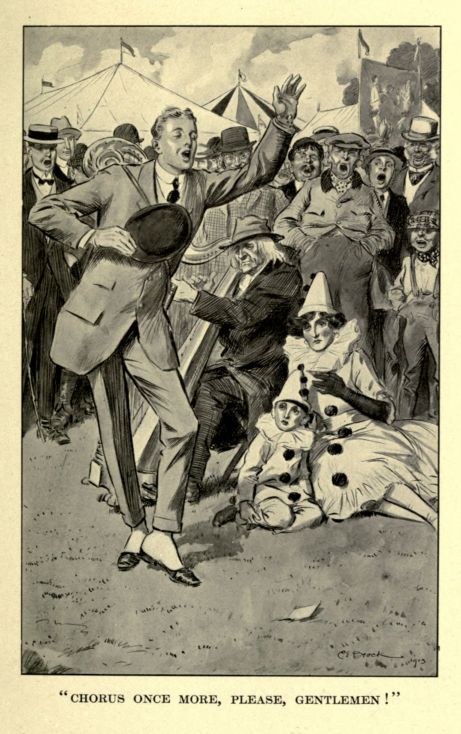
"CHORUS ONCE MORE, PLEASE, GENTLEMEN!"
The refined and elevating pæan rolled forth, Dicky conducting:--
"Beer, Beer, glorious Beer!
Fill yourself right up to here!
(Illustrative gesture.)
Take a good deal of it,
Make a good meal of it--"
With head thrown back and mouth wide open, I shouted with the rest--and--caught the eye of Miss Hilda Beverley! She was standing exactly opposite to me on the other side of the circle. Next moment she was gone.
――――
It was the accompanist who gave in first. For nearly half an hour his aged but nimble fingers had followed the singer's most extravagant flights, and he now began obviously to falter.
Dicky seized this opportunity to conclude his performance.
"That is all, gentlemen," he said, with a flourish of his hat. "I know no more. Thank you for your kind attention and assistance. But don't go away. I am going to ask the Colonel here to carry his hat round."
He signalled to the small pale-faced boy to take up a collection, but the child hung back shyly. Evidently he was not accustomed to enthusiastic audiences. Dicky accordingly borrowed his cone-shaped headpiece and set to work himself.
Touch your neighbour's heart, and his pocket is at your mercy. The bell was ringing for the last race, but not a man in that crowd stirred until he had contributed to Dicky's collection. Silver and copper rained into the cap. I saw one sturdy old farmer clap Dicky upon the shoulder with a "Good lad! good lad!" and drop in half-a-crown.
Then the audience melted away as suddenly as it had collected, and we five were left--Dicky, myself, the old man, his daughter, and the recently gazetted Colonel. The daughter still sat limply upon the grass. Dicky crossed over to her and emptied the collection into her lap.
"You had better tie that up in a handkerchief," he said. He spoke awkwardly. He was no longer an inspired comedian--only a shy and self-conscious schoolboy. My thoughts flew back to a somewhat similar scene in a third-class carriage on the Great Eastern Railway many years before.
The woman was crying softly. Her tears--those blessed faith-restoring tears that come to people who encounter kindness when they thought that the world held no more for them--dropped one by one upon the pile of coins in her lap. She caught Dicky's hand, and clung to it. The Freak cleared his throat in a distressing manner, but said nothing. Far away we could hear the roar of the crowd, watching the last race.
"I must be going now," said Dicky at length. "I hope you will soon get rid of your cough and have good luck again. We all get under the weather sometimes, don't we? Good-bye! Good-bye, Colonel!"
The officer addressed fixed round and wondering eyes upon the eccentric stranger, but made no remark.
"Good-bye, sir," said the woman. "God--"
Dicky released his hand gently and turned deferentially to the old gentleman, who was still sitting patiently at his harp.
"Thank you very much, sir," he said, speaking like a polite undergraduate to an aged don who has just entertained him to dinner, "for your splendid accompaniments. I can't imagine how you contrived to follow me as you did. I'm a pretty erratic performer, I 'm afraid. Good-bye!"
He held out his hand.
The old man struggled to his feet, and gave a little old-fashioned bow, but disregarded Dicky's proffered hand.
"Good-bye, sir," he said, "and thank you kindly for what you have done for us."
"Would you mind putting your hand in his, sir?" said the woman to Dicky. "He can't see it. He's blind," she added apologetically.
Five minutes later we found ourselves back at the railings. The motor was already purring, and Romulus and Remus had been put into the victoria.
Miss Damer hastened up to us. Her brown eyes looked very soft.
"Dicky dear," she said tremulously, "we all saw you, and I think you are a brick. But keep away from Hilda for a bit."
CHAPTER IX
THE ONLY WAY OUT
The ladies, pleading fatigue after their long day, retired early, bringing a somewhat oppressive evening to a timely conclusion. Dinner had been a constrained function, for Miss Beverley's aloofness had cast a gloom upon the spirits of her fiancé, and the rest of us had joined with him in a sort of sympathetic melancholy. In the drawing-room afterwards Mr. Crick, whose ebullient soul chafed beneath what he termed "compulsory hump," sat down at the piano and treated us to a musical sketch,--something humorous but lingering. Whereupon Lady Adela awoke out of her sleep, and with a disregard for the performer's feeling that was almost indecent, cut short the entertainment and shepherded her flock to the upper regions.
The four gentlemen adjourned to the billiard-room. Here Mr. Mainwaring and Crick set about a game of billiards--fifty up--at which the latter, with a loftiness of spirit which his subsequent performance entirely failed to justify, insisted upon conceding his elderly opponent twenty-five points. Aided by this generous subsidy and by the fact that the scratch player, in bringing off some delicate long shots into the top pocket, more than once omitted the formality of glancing off one of the other balls on the way, our host made quite surprising progress. His own contributions to the score were mainly derived from a monotonous but profitable system of potting the white and leaving his opponent a double balk. Indeed, the old gentleman reached his points before Mr. Crick had accomplished a feat vaguely described by himself as "getting the strength of the table." Mr. Mainwaring then trotted happily upstairs to bed, followed very shortly afterwards by his highly incensed play-fellow.
As the door closed, Dicky put down his pipe and turned to me.
"Bill, old man," he said, "I don't often face facts; but this time I admit that I have fairly torn the end off things."
"You are in disgrace, my boy," I agreed. "What are you going to do about it?"
Dicky pondered, and finally summed up.
"The fact is," he said, "I am not up to Hilda's standard, and never shall be."
I rose, and took my stand upon that tribunal beloved of the Briton--the hearthrug--and looked down upon my friend's troubled countenance.
"Dicky," I began, having blown my nose nervously, "you and I don't usually go deeply into these matters together; but--do you love that girl?"
We two regarded one another deliberately for a minute, and then Dicky shook his head.
"I do not," he said at last. "Not more, that is, than I love half a dozen others. I suppose the truth is," he continued, relighting his pipe, "that I don't quite realise the meaning of the word--yet. Some day, perhaps, the big thing will come to me; but until it does and wipes out everything else, I shall go on imagining, as at present, that I am in love with every girl who happens to attract me or whom I happen to attract--if such a thing is possible. Nature, I suppose--just Nature! Just now I am making the instinctive involuntary experiments that every man must make, and go on making, until he encounters his right mate. Some men, I imagine, are luckier than others. They are not inflammable. They do not make false starts or get down blind alleys. I believe you are one, Tiny, but there are not many. With women, I believe, it is different. They have more intuition than men, and can tell almost immediately whether they have found the goods this time or not. But the average man must just go blundering on, making an ass of himself, and learning by experience. I fall into love readily enough, but have never been able to stay there. That is my trouble. I am therefore forced to the conclusion that I have never really been in love at all."
"That is because you have never met the girl, Freak."
"Possibly; but there is another explanation, and that is that I am incapable of a sustained affection under any circumstances whatever. However, you may take it from me that such is not the case. I know that. I can't explain it or prove it, but I know it. What I really want--but I have n't met one so far--is a girl who will fall in love with me, and show it--show that she is willing to burn her boats for me. A good many young women, estimable creatures, have indicated that they care for me a little, but not one has done it in the way I have described. I don't believe that I could ever really throw myself absolutely headlong into love with a girl unless I knew in my heart that she was prepared to do the same for me. They are all so cautious, so self-contained, so blooming independent, nowadays, that a man simply cannot let himself go on one of them for fear she should turn round and laugh at him. But if a girl once confided to me that she wanted to entrust herself to me--body and soul, for better, for worse, and so on--without any present-day stipulations about maintaining her independence and preserving her individuality, and stuff of that kind--well, good-bye to all indecision or uncertainty on my part! What man who called himself a man could resist such an appeal as that--a genuine whole-hearted appeal from weakness to strength? (Not that I am exactly a model of strength," he commented, with a disarming smile; "but I know I soon should be, if such an honour were done me.) Weakness to strength! That's what it comes to in the end, old man, whatever the modern advanced female may say. Male and female created He them--eh? When I do meet that girl--perhaps she is the girl the old gipsy foretold for me to-day--I shall love her, and slave for her, and fight for her, so long as we both live, just because she is so utterly dependent on me. That is what brings out the best in a man. Unfortunately, I have not yet met her. When I do you may take it from me that I shall cease to be a Freak. Amen! Here endeth the First Lesson. There will be no collection."
His discourse thus characteristically concluded, my friend sat silent and pensive.
This was quite a new Dicky to me.
"You appear to have studied the question deeply and scientifically," I said, frankly impressed.
"My lad," replied Dicky with feeling, "if you possessed a disposition as flighty as mine--"
"Quixotic," I amended.
"All right--as quixotic as mine, and were also blessed with a dear old mother who spent her life confronting you with attractive young women with a view to matrimony, you would begin to study the question deeply and scientifically too. I am only a Freak, and all that, but I don't want to make a mess of a girl's life if I can help it; and that, old friend, owing to my susceptible nature and gentle maternal pressure from the rear, is exactly what I am in great danger of doing. I have had to mark time pretty resolutely of late, I can tell you. And that brings us to the matter in hand. Hilda and I seem to have reached the end of our tether. Something has got to be done."
"It is just possible," I said, "that Miss Beverley has done it already."
"What?"
"It--the only thing that ought to be done."
"What do you mean?"
"When the others went upstairs to bed Miss Hilda retired into an inner drawing-room and sat down at a writing-table. There is no post out of here until lunch-time to-morrow. Therefore she was probably writing to some one in the house."
Dicky nodded comprehendingly.
"Proceed, Sherlock," he said.
"To whom was she writing?" I enquired.
Dicky thought.
"To me," he announced at length. "Economical hobby. No stamps required. Well?"
"Supposing," I continued, "that Miss Beverley has been writing to you to-night--what then?"
"I shall receive a letter from her in the morning," concluded Dicky. "Eh? Wrong answer? Sorry! What will happen, then?"
"You will get your letter to-night."
Dicky looked doubtful.
"Where? When?" he asked.
"That's it. Where and when?"
Dicky pondered.
"On my pin-cushion, when I go upstairs to bed," he said at last--"although it strikes me as a most unmaidenly action for Hilda."
"So unmaidenly," I replied, "that you will probably find the letter on the hall table by your candle. Come and see."
My faith in Miss Beverley's sense of propriety was fully justified, for we found the letter in the hall beside the candlesticks exactly as I had foretold. Probably it had not lain there more than five minutes.
"What do you think of that?" I enquired.
"By Heavens, Holmes," exclaimed Dicky, who after his late lofty flight had characteristically relapsed into one of his most imbecile moods, "this is wonderful!"
We bore the letter back to the billiard-room.
"Four sheets!" murmured The Freak dejectedly. "Well, the longer I look at them the less I shall like them. Here goes!"
He began to unfold the crackling document.
"What is that protuberance down there, between your finger and thumb?" I enquired. "It may epitomise the letter for you."
Dicky turned the envelope upside down, and shook it over the billiard-table. Something fell out, rolled a short distance, and lay sparkling and shimmering on the green cloth.
Dicky picked up the ring very slowly, and regarded it long and intently. Then he turned to me.
"Thank God!" he said, softly and quite reverently; and I knew he spoke less for himself than for a certain superior young woman upstairs, who considered him flippant, lacking in depth, and altogether unworthy of her.
CHAPTER X
STILL AT LARGE
I saw very little of The Freak the following winter. For one thing, I went abroad again. The Government of the Auricula Protectorate had decided to connect their capital with the sea by means of a canal. I happened to know the district, for I had been engaged eight years previously upon the great dam, thirty miles from Auricula, which now holds in beneficent restraint the turbid waters of the Rumbolo River. I accordingly applied for work in connection with the scheme. By the greatest luck in the world one Vandeleur, C.B., a magnate of no small standing in the Auricula district, happened to be home on leave. He had visited my dam in his official capacity, and had noted that it was still standing. He spoke the word, and I got my canal.
The next four months I spent upon the continent of Africa, sketching, surveying, and drawing up specifications. Then I came home to be married.
At the very first dinner-party to which we were bidden on our return from our honeymoon I encountered The Freak.
I saw him first, so to speak. Covers had been laid, as they say in country newspapers, for twenty-two persons. My wife, through the operation of an inscrutable but inexorable law, had been reft from my side, and was now periodically visible through a maze of table decorations, entertaining her host with what I could not help regarding as the most unfeeling vivacity and cheerfulness. I began to take an inventory of the company. We had been a little late in arriving--to be precise, the last--and I had had no opportunity of observing my fellow-guests. My own partner was a Mrs. Botley-Markham, an old acquaintance of mine. She combined short sight and an astonishingly treacherous memory for names and faces with a rooted conviction that the one infallible sign of good breeding is never to forget a name or a face. ("A truly Royal attribute," she had once announced in my presence.) I was therefore agreeably surprised to find that she remembered not merely my face, but my name and métier. After putting me at my ease with a few kindly and encouraging remarks upon the subject of canals, she turned to her other neighbour.
"Dear Sir Arthur," I heard her say, "this is indeed a pleasant surprise!"
"Dear lady," replied a hearty voice, "the pleasure is entirely mine."
I leaned carelessly forward to inspect the menu, and shot a sidelong glance in the direction of Sir Arthur. I was right. It was The Freak, in his most acquiescent mood. I wondered what his surname was, and whether he knew it.
"We had such a teeny talk last time we met," continued Mrs. Botley-Markham. "Now we can chat as long as we please."
Heaving a gentle sigh of relief, Mrs. Botley-Markham's rightful dinner-partner helped himself to a double portion of the entrée and set to work.
The chat commenced forthwith.
"And how is Gipsy?" enquired Mrs. Botley-Markham.
"Gipsy," replied Sir Arthur without hesitation, "is top-hole."
"How quaint and original you always are in your expressions!" cooed my neighbour. "But I am so glad to hear about Gipsy. Then the dear thing has quite recovered?"
"Absolutely," replied Dicky courageously.
Mrs. Botley-Markham cooed again. Then she enquired, confidentially:--
"Now tell me, what was it?"
"What was it?" echoed The Freak cautiously. "Ah!"
"Yes; what was it?" pursued his interlocutor, much intrigued. "Don't tell me they never found out!"
"Never. At least," admitted The Freak guardedly, "not for some time."
"Then they actually operated without being sure?" exclaimed Mrs. Botley-Markham, shuddering.
Dicky, making up his arrears with a portion of quail, inclined his head gravely, and the quail reached its destination.
"And when they did find out," pursued Mrs. Botley-Markham, clasping her hands--she had finished her quail--"what was it? Tell me, dear Sir Arthur!"
Sir Arthur cogitated for a moment, and then took the plunge.
"It was clavicle," he said solemnly.
Assuming that my friend was labouring under the same disadvantage as myself--namely, inability to decide whether Gipsy was a woman, child, horse, dog, cat, or monkey--to invent a mysterious and non-committal disease upon the spur of the moment struck me as quite a stroke of genius on Dicky's part. Connie would enjoy hearing about this.
"How truly terrible!" said Mrs. Botley-Markham, in an awe-struck voice. "Clam--clavicle is a very rare disease, is it not?"
"Rare and mysterious," replied my friend in the same tone. "In fact, the doctor--"
"You mean Sir Herbert?"
"No, the other blo--the other gentleman--the anæsthetist, you know! He told me that he had never encountered a case of it before."
"How truly terrible!" said Mrs. Botley-Markham again. "And all the time you suspected appendicitis."
The Freak acquiesced readily. Here was light. Gipsy apparently was human--not equine, canine, feline, or simian.
"And the little one?" enquired Mrs. Botley-Markham tenderly.
I held my breath. Sir Arthur had reached his second fence.
"The little one," he replied after consideration, "is doing nicely. Not so very little, though, when you come to think of it," he continued, boldly taking the initiative.
"Has she grown so big, then?" enquired Mrs. Botley-Markham, unconsciously giving away another point. The little one's sex was determined. Certainly it was an exhilarating game.
"Quite extraordinary," said Dicky. "How big," he continued cunningly, "would you imagine she was now?"
"Not as big as my Babs?" cried Mrs. Botley-Markham incredulously.
"That," replied The Freak, "is just exactly how big she is." There was the least tinge of disappointment in his voice. Evidently he had hoped for something more tangible. For purposes of mensuration Babs was useless to him.
"Why 'just exactly'?" enquired Mrs. Botley-Markham doubtfully. "You are very precise about it."
"We met Babs in the Park the other day," replied the audacious Dicky, "and compared them."
Mrs. Botley-Markham frankly gaped.
"But, dear Sir Arthur," she exclaimed--"How?"
"How does one compare--er--little ones?" was the evasive reply of Sir Arthur.
The outraged parent turned upon him.
"You mean to say you laid those two innocents side by side upon the wet grass," she gasped, "and--"
"It was nearly dry," said Dicky soothingly.
I choked noisily, for I was rapidly losing self-control; but neither of the performers in the duologue took the slightest notice of me.
"I shall speak to my nurse to-morrow morning," announced Mrs. Botley-Markham firmly. "I cannot imagine what she was thinking about."
"Don't be hard on her," begged Dicky. "It was my fault entirely."
"It certainly was very naughty of you," said Mrs. Botley-Markham, already relenting, "but I forgive you--there!" She tapped the eccentric Sir Arthur playfully upon the arm. "Tell me, though, what does Gwladys weigh? Mere bigness in children is so often deceptive."
Even assuming that Gwladys was also the Little One, it was obvious that Dicky had not yet cleared his second fence. I began vaguely to calculate what a healthy child should weigh. A thirty-pound salmon, for instance--how would that compare with a fat baby? But Dicky made a final and really brilliant effort.
"Fourteen point eight," he said promptly.
"I beg your pardon?" replied Mrs. Botley-Markham.
"Fourteen point eight cubic centimetres," repeated The Freak in a firm voice. "That is the metric system of weights and measures. It is the only accurate and scientific method. All the big doctors have taken to it, you will find. I never allow any other to be employed where Gwladys is concerned. I strongly advise you," he added earnestly, "to have Babs weighed in the same manner. Everybody's doing it now," he concluded lyrically.
Mrs. Botley-Markham quivered with pleasure. An opportunity of getting ahead of the fashion does not occur to us every day.
"I will certainly take your advice, dear Sir Arthur," she replied. "Tell me, where does one get it done?"
"At the British Museum, between seven and eight in the morning," replied The Freak, whose pheasant was growing cold. "And now, dear lady, tell me everything that you have been doing lately."
Mrs. Botley-Markham, being nothing loath, launched forth. She even found time to re-include me in the conversation, disturbing my meditations upon the strenuous awakening which awaited poor Babs upon the morrow with an enquiry as to whether my canal was to contain salt water or fresh. But she had not finished with Dicky yet. Suddenly she turned upon him, and remarked point-blank:--
"How pleased the Stantons will be!"
"Indeed, yes!" replied The Freak enthusiastically.
At the sound of his voice I trembled. We had reached the dessert, and with port in sight, so to speak, it was impossible to tell what foolishness he might not commit.
"In fact," he continued shamelessly, "I happen to know that they are not merely pleased but ecstatic. I saw them yesterday."
"Where?" asked Mrs. Botley-Markham.
"Dear lady," replied Dicky, smiling, "where does one invariably meet the Stantons?"
"You mean at the Archdeacon's?" said Mrs. Botley-Markham.
"I do," said my reprobate friend. "They had all been down the Str--I mean to the Pan-Mesopotamian Conference," he added quite gratuitously.
"Ah, of course; they would," assented Mrs. Botley-Markham hazily, evidently wondering whether she ought to have heard of the Pan-Mesopotamian Conference. "Were they all there?"
"All but the delicate one," replied The Freak, abandoning all restraint.
"Do you mean Isobel?"
"Yes," replied the graceless Richard--"I do. Poor Isobel!" he added gently.
"I am afraid they are not a strong family," said Mrs. Botley-Markham, with a sympathetic glance which rather alarmed me. I foresaw complications.
The Freak wagged his head gloomily.
"No; a weak strain, I fear."
"I hope--I hope," said Mrs. Botley-Markham, evidently choosing her words with care and tact, "that the weakness does not extend to Gipsy."
Then Gipsy was connected with the Stantons! Freak would have to walk warily. But at this moment his attention was wandering in the direction of our hostess, who was beginning to exhibit symptoms of upheaval with a view to withdrawal. He replied carelessly:--
"No. Why should it?"
Mrs. Botley-Markham, a little offended and flustered at being taken up so sharply, replied with exaggerated humility:--
"I only meant, dear Sir Arthur, that if one sister is delicate, possibly another may be slightly inclined--"
Then Isobel and Gipsy were sisters. I knew it!
At this moment the hostess gave the mystic sign, and the company rose. Freak turned a sad and slightly reproachful gaze upon Mrs. Botley-Markham.
"You are forgetting, dear lady," he said gently. "Isobel and Gipsy are not related. Isobel was the sister of my poor first wife."
He drew back Mrs. Botley-Markham's chair with grave courtesy, and that afflicted lady tottered down the room and out of the door, looking like the Leaning Tower of Pisa.
The Freak and I resumed our seats.
"Dear Sir Arthur," I said, "are you a knight or a baronet?"
Before this point of precedence could be settled, our host called to us to move up higher.
"I want to introduce you to Sir Arthur Twigg, Mainwaring," he said, indicating a pleasant-looking youth strongly resembling Dicky in appearance and bearing.
"Come to lunch with me to-morrow, Tiny," said Dicky hurriedly to me.
A few minutes later I heard him regretfully explaining to his host that an important legal consultation in his chambers at ten o'clock that evening would prevent him from joining the ladies afterwards in the drawing-room.
CHAPTER XI
THE FIRST TURNING TO THE RIGHT
Next day I lunched with The Freak in Hall in the Inner Temple, where I was introduced by my host to the surrounding company as a "distinguished engineer, who had dammed the Nile several times and was now prepared to speak disrespectfully of the Equator."
After luncheon Dicky suggested that I should walk round with him to his chambers in Bolton Street. It was a murky December afternoon. Christmas shopping had set in with its usual severity, and visitors from the country, armed with sharp-cornered parcels, surged tumultuously along the wrong side of every pavement, while the ordinary citizens of London trudged resignedly in the gutter.
Dicky, quite undisturbed by the press, continued the conversation.
"Yes, the family are all very fit," he said. "You must come and stay with us. I shall give myself a week's holiday at Christmas and take you and Connie down to Shotley Beauchamp, and we will have a pop at Ethelbert, our pheasant, and discuss the days that are no more."
"Talking of the days that are no more," I began, stepping aside to avoid a stout lady carrying an inverted baby under one arm and an imperfectly draped rocking-horse under the other, "what has become--"
"Hilda Beverley--eh?" replied Dicky cheerfully. "I'll tell you all about her. (Don't apologise, sir, really! After all, I still have an eye left, and you very nearly lost your umbrella.) She is engaged, if not married, to an Oxford Don. I believe they are very happy. They go out and sing an ode to Apollo every morning before breakfast, or something of that kind."
A wedge of excursionists clove its way between us, and it was with a voice unconsciously raised that I remarked from the gutter:--
"You had an escape that time, my lad."
"Not at all!" yelled Dicky loyally from the other side of the pavement. ("Mind that kiddie's balloon, old son!) No," he continued, as we converged once more, "I had a very profitable six months. Hilda took immense pains with me, and it was n't her fault that I turned out a failure."
Presently I asked a question which always rose to my lips when I met Dicky after any considerable interval.
"Have your family any fresh matrimonial irons in the fire for you at present?" I enquired.
"No," replied my friend, "I rejoice to say they have not. The market is utterly flat. The Hilda Beverley slump knocked the bottom out of everything, and for the last half-year I have been living a life of perfect peace. I am settling down to a contented spinsterhood," he added, to the obvious surprise and consternation of a grim-looking female in a blue mackintosh who had become wedged between us. "In a few years I shall get a tabby cat and a sampler, and retire to end my days in the close of some quiet cathedral city."
The female in the mackintosh, by dint of using her elbows as levers and our waistcoats as fulcrums, heaved herself convulsively out of our company and disappeared in the crowd, probably in search of police protection. Dicky and I came together again.
"Occasionally," he continued fraternally, "I shall come and stay with you and Connie, and give you advice as to--Bill! Tiny! My son William! Look at that girl's face! Did you catch her profile? Did you ever see anything so lovely in all your life?"
We had reached that spot in the narrowest part of Piccadilly where all the omnibuses in the world seem to stop to take up passengers. Dicky's fingers had closed round my left biceps muscle with a grip like iron. I turned and surveyed him. His cheery good-tempered face was transfigured: his eyes blazed.
"Look!" he said again, pointing. He was trembling like a nervous schoolgirl.
But I was just too late. All I saw was a trim lithe young figure--rather like Connie's, I thought--stepping on to an omnibus. (When I told the story at home I was at once asked how she was dressed, but naturally could not say.) I caught sight of a pair of slim square shoulders, a good deal of pretty brown hair, and finally a pair of neat black shoes, as their owner deftly mounted to the top of the swaying vehicle.
"I just missed her face, old man," I replied. "Was she pretty?"
Here I stopped. To address empty air in Piccadilly for any length of time causes one to incur the unworthy suspicions of the bystanders. It also causes a crowd to collect, which is an indictable offence.
For I was alone. Afar off, pursuing a motor-omnibus just getting into its top speed, I beheld the flying figure of my friend. Presently he overtook the unwieldy object of his pursuit, hopped on board, and proceeded to climb to the top.
At this moment the omnibus reached Bond Street--the first turning to the right--swung round the corner, and disappeared.
BOOK THREE
THE RIGHT ROAD
NOTE
The main idea of Book Three was suggested by a very minor episode in the closing chapters of 'A Man's Man.' The usual acknowledgments are therefore made to the author of that work.
CHAPTER XII
MICE AND MEN
"Sylvia, is your father in from his walk?"
Miss Sylvia Mainwaring, attired in a sage-green robe and distressingly rational boots, turned and surveyed her male parent's recumbent form upon the sofa.
"Yes, mother mine," she replied. (Sylvia was rather addicted to little preciosities of this kind.)
"Is he awake?"
"He is reading 'The Spectator,' Mother," was the somewhat Delphic response.
"Then ring for tea, dear."
It was a bleak Saturday afternoon in late February. Darkness was closing in, and the great fire in the hall at The Towers flickered lovingly upon our leading weekly review, which, temporarily diverted from its original purpose in order to serve as a supplementary waistcoat for Mr. Mainwaring, rose and fell with gentle regularity in the warm glow.
Mr. Mainwaring's daughter rang a bell and switched on the electric light with remorseless severity; his wife came rustling down the broad oak staircase; and Mr. Mainwaring himself, realising that a further folding of the hands to sleep was out of the question, peeled off "The Spectator" and sat up.
"Abel," observed Lady Adela--her husband's baptismal name was a perpetual thorn in her ample flesh, but she made a point of employing it on all occasions, as a sort of reducing exercise to her family pride--"tea will be here in a moment."
Mr. Mainwaring rose to his feet. He was an apologetic little gentleman, verging on sixty, with a few wisps of grey hair brushed carefully across his bald head. At present these were hanging down upon the wrong side, giving their owner a mildly leonine appearance. A kindly, shy, impulsive man, Abel Mainwaring was invariably mute and ill at ease beneath the eye of his wife and daughter. Their patrician calm oppressed him; and his genial expansive nature only blossomed in the presence of his erratic but affectionate son.
"Tea?" he exclaimed with mild alacrity--"Who said tea?"
"Abel," announced Lady Adela in tones which definitely vetoed any further conversational openings originating in tea, "I think it only right to tell you that a visitor may arrive at any moment; and your present appearance, to put it mildly, is hardly that of the master of a large household."
"My dear, I fly!" said Mr. Mainwaring hurriedly, and disappeared. At the same moment there was a tinkle in the back premises.
"There goes the front-door bell," said Sylvia. "I never heard the carriage. Can it be Connie already?"
"A caller, probably," sighed her mother. "How tiresome people are. See who it is, Milroy, and then bring tea."
The butler, who had entered from the dining-room, crossed the hall to the curtained alcove which screened the front door.
"Hardly a caller on an afternoon like this," said Sylvia, shivering delicately. "It is raining in sheets."
"My experience," replied Lady Adela peevishly, "has always been that when one's neighbours have made up their minds to be thoroughly annoying, no weather will stop them."
Simultaneously with this truthful but gloomy reflection Lady Adela composed her fine features into an hospitable smile of welcome and rose to her feet.
"Misterilands!" announced Milroy, drawing back the curtain of the outer hall.
Lady Adela, still smiling, rolled an enquiring eye in the direction of her daughter.
"New curate!" hissed Sylvia.
Through the curtained archway advanced a short, sturdy, spectacled young man, dumbly resisting Mr. Milroy's gracious efforts to relieve him of his hat and stick.
Lady Adela extended her hand.
"How do you do, Mr. Highlands?" she enquired, as the ruffled Milroy, shaken off like an importunate limpet, disappeared into the dining-room.
"My name," replied the visitor apologetically, "is Rylands--not Highlands."
"How stupid of me!" said Lady Adela condescendingly. "But my butler is a most inarticulate person, and in any case we give him the benefit of the doubt where H's are concerned."
"It's of no consequence," Mr. Rylands assured her. "Oh, I beg your pardon!"
He picked up his walking-stick, which had fallen upon the polished floor with a shattering crash, and continued breathlessly:--
"The fact is, Lady Adela, the Archdeacon asked me to come round this afternoon and warn Mr.--Mr.--" he was uncertain of Mr. Mainwaring's exact status and title, so decided to hedge--"your husband, about the First Lesson in to-morrow morning's service. The Arch-deacon--"
"Be seated, Mr. Rylands," said Lady Adela, in the voice which she reserved for golfers, politicians, and other people who attempted to talk shop in her presence. "My husband will be downstairs presently. This is my--"
"The Archdeacon," continued the conscientious Rylands, "thinks it would be better to substitute an alternative Lesson--"
At this point his walking-stick, which he had after several efforts succeeded in leaning against the corner of the mantelpiece, fell a second time upon the floor, and a further hail of apology followed.
"--An alternative Lesson to-morrow morning," he resumed pertinaciously, "in view of the fact that certain passages--"
"This is my daughter Sylvia," said Lady Adela coldly.
"Oh, I beg your pardon!" exclaimed the curate to Sylvia, starting up and dropping his hat. "I did n't see you. My glasses are rather dimmed by the rain. I have come here," he recommenced rapidly, evidently hoping for a more receptive auditor this time, "at the request of the Arch-deacon, to see Mr.--your father--about an alteration in the First Lesson to-morrow--"
"I don't think you need trouble, Mr. Rylands," replied the dutiful Sylvia. "My father will probably read the wrong Lesson in any case."
"Who is taking my name in vain?" enquired the playful voice of Mr. Mainwaring, as its owner, newly kempt, descended the stairs.
"This is Mr. Rylands, Abel, who has recently come among us," said Lady Adela. "To assist the Archdeacon," she added, with feeling.
Mr. Mainwaring shook hands with characteristic friendliness.
"Welcome to Shotley Beauchamp, Mr. Rylands!" he said warmly.
"Thank you, sir, very much," replied the curate, flushing with pleasure. "I have called," he continued with unabated enthusiasm--evidently he saw port ahead at last--"at the request of the Archdeacon, with reference to the First Lesson at Matins to-morrow. One of those rather characteristic Old Testament passages--"
"Mr. Rylands," interposed Lady Adela, with the air of one who cannot stand this sort of thing much longer, "how many lumps of sugar do you take?"
"Four, please," replied Mr. Rylands absently, with his finger in Mr. Mainwaring's buttonhole.
Lady Adela's eyebrows rose an eighth of an inch.
"Four, did you say?"
The curate came suddenly to himself.
"I beg your pardon," he said cringingly, "I meant none."
"Then why did you specify four, Mr. Rylands?" enquired Sylvia, who disliked what she called "vague" people.
"Well, the fact is," explained the curate, in a burst of shy confidence--"I always take four when I am alone in my lodgings. But when I go out to tea anywhere, four always seems such a fearful lot to ask for, that--oh, I beg your pardon!"
He had stepped heavily back into a cake-stand, and patisserie strewed the hearthrug.
But both crime and apology passed unnoticed, for at this moment Milroy, who had crossed the hall a minute previously, reappeared at the curtained entrance, and announced, in tones of intense personal satisfaction:--
"Mrs. Carmyle!"
Even the female Mainwarings had no eyes for any one else when Connie Carmyle entered a room.
During the mêlée of greetings and embraces which ensued, Mr. Rylands, blessing the small deity who had descended to his aid, found time to right a capsized plum-cake and restore four highly-speckled cylinders of bread and butter to the plate on the bottom storey of the cake-stand. He even succeeded in grinding a hopelessly leaky chocolate éclair into the woolly hearthrug with his heel. By the time that the Mainwarings had removed their visitor's furs and escorted her to the fireplace, no trace of the outrage remained. The undetected criminal sat nervously upon the edge of an art nouveau milking-stool in the chimney-corner, waiting to be introduced.
"This is Mr. Rylands, Connie," announced Lady Adela. "Mrs. Carmyle."
"How do you do, Mr. Rylands?" said Connie, holding out her hand with a friendly smile.
Mr. Rylands, with an overfull teacup in one hand and a tiny plate entirely obscured by an enormous bun in the other, rose cautiously to his feet, and bestowing a sickly smile upon Mrs. Carmyle, entered at once upon a series of perilous feats of legerdemain with a view to getting a hand free.
"Let me hold your cup for you," suggested Connie kindly. "That's better!"
The curate, gratefully adopting this expedient, ultimately succeeded in wringing his benefactress by the hand.
"What has the Archdeacon been up to lately?" enquired Connie, gently massaging her fingers.
The curate's face brightened.
"It is curious that you should mention the Archdeacon's name," he said. "The fact is, I have just come from the Arch--"
"Constance dear," enquired Lady Adela in trumpet tones, "did you see anything of Dick on your way down?"
"No, Lady Adela," said Connie, extending a slim foot towards the blazing logs. ("Mr. Rylands, would you mind bringing me one of those little cakes? No, not those--the indigestible-looking ones. Thank you so much!) Are you expecting him for the week-end?"
"Yes, but I am afraid there is a little disappointment in store for him. I invited Norah Puncheon down--a sweet girl, Constance!--but at the last moment she has had to go to bed with one of her throats."
"Poor thing!" murmured Mrs. Carmyle absently. The reason for her own invitation--by telegraph--had just been made apparent to her.
"So perhaps you would not mind keeping Dick amused," concluded Lady Adela. "You and he used to be such particular friends," she added archly.
"Bow-wow!" observed Mrs. Carmyle dreamily into Mr. Rylands's left ear.
The curate choked, then glowed with gentle gratification. He realised that he had come face to face at last with one of the Smart Set, of which one heard so much nowadays.
"The naughty boy," concluded the fond mother, "must have missed his train."
"The naughty boy," replied Mrs. Carmyle, "is probably coming down by the four-fifteen. It is a much better train. Mr. Rylands, will you please choose me a nice heavy crumpet?"
"In that case," said Lady Adela, "he will probably be here in about half an hour. Sylvia dear, will you go upstairs and see if Constance's room is ready? I forgot to give orders about a fire."
Sylvia obediently disappeared, and Lady Adela crossed the hall to a chair under a lamp, where her husband was furtively perusing the evening paper. Mr. Mainwaring was now favoured with a brief but masterly display of the fast dying art of pantomime, from which he gathered without any difficulty whatever that he was to remove himself and Mr. Rylands to another part of the house, and that right speedily.
Mr. Mainwaring coughed submissively, and rose.
"Mr. Rylands, will you come and smoke a cigarette with me?" he said.
"Second Chronicles?" remarked Connie's clear voice. "I shall look it up during the sermon to-morrow." The Archdeacon's emissary had unburdened his soul at last.
Lady Adela extended a stately hand. "Good-bye, Mr. Rylands," she said. "My husband insists on carrying you off to the smoking-room."
Mr. Rylands, by this time hopelessly enmeshed in Connie Carmyle's net, sprang guiltily to his feet.
"Oh, I beg your pardon!" he exclaimed. "Good-bye! Good-bye, Mrs. Carmyle!"
He shook hands, gathered together his impedimenta, and hurried blindly up the staircase.
"Remember I am coming to hear you preach to-morrow," Connie called after him, with a dazzling smile. "Morning or evening?"
The godly but mesmerised youth halted, and broke out afresh. "I am preaching at Evensong," he began, "but--"
"This way, Mr. Rylands," said Lady Adela patiently, indicating her husband, who was standing by a swing door at the opposite side of the hall.
Mr. Rylands, utterly confounded, pattered headlong downstairs again, and disappeared with Mr. Mainwaring, still apologising.
Lady Adela tapped Connie playfully but heavily upon the cheek. ("Like being tickled by a mastodon" wrote that lady to her husband a short time later.)
"Constance dear," she said, with a reproving smile, "you are incorrigible. Now let us sit down and have a cosy chat."
The incorrigible one sat submissively down upon the sofa and waited. She knew that her hostess had not rendered the hall a solitude for nothing.
Presently the cosy chat began. Not too suddenly, though. Lady Adela first enquired after the health of Mr. Carmyle, and expressed regret that he had been prevented from accompanying his wife to The Towers.
"He was sent for about his wretched canal," explained Connie. "But he saw me off at Waterloo, and promised to come down on Monday if he could get away."
"Is it the first time you have been parted?" asked Lady Adela.
"Yes," said Connie, in quite a small voice.
Her hostess, suddenly human, patted her hand.
"The time will soon pass, dear," she said. "You will find this house quiet but soothing. I like it much better than town myself. Mr. Mainwaring is no trouble, and things are so cheap. The only drawback is Sylvia. She dislikes the people about here."
"By the way," enquired Connie, recovering her spirits, "what is Sylvia's exact line just at present? Last year it was slumming; the year before it was poker-work, and the year before that it was Christian Science. What does that sage-green gown mean? Don't tell me she has become a Futurist, or a Post-Impressionist, or anything!"
"I never attempt," replied Lady Adela, closing her eyes resignedly, "to cope with Sylvia's hobbies. At present she is a Socialist of some kind. She is evolving a scheme, I believe, under which the masses and classes are to intermarry for the next twenty years. By that time, she considers, social distinctions will have ceased to exist, and consequently the social problem will have solved itself."
Mrs. Carmyle nodded her head comprehendingly.
"I see," she said, "it sounds a good idea. I shall start looking out in the 'Morning Post' for the announcement of Sylvia's engagement to a plumber. Just half a cup more, please."
Lady Adela now decided to begin the cosy chat. She accordingly discharged what is known on rifle-ranges as a sighting shot.
"By the way, dear Constance, have you and your husband seen much of Dick lately?"
"Oh, we meet him about occasionally," replied Connie, casting about for cover--"at parties, and so on."
"I fear," continued Lady Adela, with what the police call "intent," "that the poor boy is lonely."
"The last time I saw him," replied Connie, "he was entertaining five people to luncheon at the Trocadero. He did n't look lonely."
"There is a loneliness of spirit, dear," replied Lady Adela gently, "of which some of us know nothing. I think it shows that Dick must be feeling lonely if he requires no less than five people to cheer him up."
"I am sure you are right," said the obliging Mrs. Carmyle.
"Was Norah Puncheon of the party, by any chance?" enquired Lady Adela carelessly.
"No. I did n't know any of the people. Is Norah a friend of Dicky's?"
"They have seen a good deal of one another of late, I believe," replied the diplomatic Lady Adela, much as a motorist with his radiator full of feathers might admit having recently noticed a hen somewhere. "Constance dear," she continued, coming in her maternal solicitude quite prematurely to the point, "you are always so discreet. It is high time Dick was married, and this time I really do think--no, I feel it instinctively--that Norah Puncheon is the right woman for him."
"The right woman!" replied the late First Reserve pensively. "How awful that always sounds! The wrong one is always so much nicer!"
"My dear," exclaimed the horrified Lady Adela, "whoever put such a notion into your head?"
"Dicky. He told me so himself."
"Has Norah Puncheon much influence over him, do you know?" continued Lady Adela, falling back on to safer ground.
"Yes, lots," replied Connie, stifling the tiniest of yawns. "There goes your telephone."
"Milroy will attend to it, dear. Let me see," pursued Lady Adela, with studious vagueness--"what were we talking about?"
"Norah Puncheon's influence over Dicky," replied Connie, popping a lump of sugar into her mouth and crunching it with all the satisfaction of a child of six.
"You have noticed it yourself, then?"
Connie, quite speechless, nodded.
Lady Adela beamed. The scent was growing stronger.
"In what way, dear?" she asked, with unfeigned interest.
"Well," said Connie, after an interval of profound reflection, "Dicky wanted to back Prince Caramel for the St. Leger, and Norah would n't let him. He was so grateful to her afterwards!"
Lady Adela summoned up a lopsided smile--the smile of a tarpon-fisher who has pulled up a red herring.
"I think her influence goes deeper than that, dearest," she rejoined in patient reproof. "You, who only knew my son as a rather careless and light-hearted boy, would hardly credit--"
"A telephone message, my lady!" announced Milroy, appearing at the dining-room door.
Lady Adela, tripped up on her way to a striking passage, sighed with an air of pathetic endurance, and enquired:--
"From whom, Milroy?"
"From Mr. Richard, my lady."
"Mr. Richard? Where is he?"
"He has telephoned from Shotley Post-Office, my lady," replied Milroy, keenly appreciating the mild sensation he was about to create; "to say that he has arrived by the four-fifteen and is walking up."
"Walking--on a night like this?" cried Lady Adela, all the mother in her awake at once. "Tell him to wait, and I will send the motor."
"Mr. Richard said he preferred walking, my lady," rejoined Milroy, growing more wooden as he approached the clou of his narrative. "He said he would explain when he arrived. But the luggage-cart was to go down."
"For one portmanteau?"
"For the young lady's trunks, my lady."
"Young lady?" Lady Adela turned a puzzled countenance to her companion. "Constance, dear, was not your luggage sent up with you?"
"Yes," replied Connie, scenting fun; "it was. I fancy this must be some other lady."
Light broke in on Lady Adela.
"Norah Puncheon, after all!" she exclaimed joyfully. "Her throat must be better, and that headstrong son of mine has compelled her to come down by the four-fifteen."
"And walk up in the rain," supplemented Connie.
"The thoughtless boy!" wailed Lady Adela insincerely. "He will give her pneumonia."
"Perhaps it is n't Miss Puncheon," suggested Connie soothingly.
"But, my dear," said Lady Adela, refraining with great forbearance from slapping the small but discouraging counsellor by her side, "who else can it be?" She turned to Milroy.
"Did Mr. Richard mention if he was bringing the young lady up with him?" she asked.
"Yes, my lady," replied Milroy with unction--"he did."
"Did he mention her name, Milroy?" enquired Connie.
"No, Miss. He just said 'the young lady.' Will there be anything further, my lady?"
"No," snapped Lady Adela; and her aged retainer, as feverishly anxious beneath his perfectly schooled exterior to solve the mystery of his beloved Master Dick's latest escapade as his mistress, departed to lay another place for dinner.
In the hall there was a long silence. The wind roared round the house, and the rain drummed softly upon the diamond panes of the big oriel window.
"It might be some old friend of the family," said Lady Adela hopefully--"some one whom Dick has encountered unexpectedly and invited down. You know his impulsive, hospitable way! Aunt Fanny, perhaps."
"A young lady, I think Milroy said," replied the Job's comforter beside her.
"Perhaps," pursued Lady Adela, still endeavouring to keep her courage up, "it is only one of the foolish boy's practical jokes."
These speculations were cut short by the prolonged buzz of an electric bell, followed by the sound of a spirited tattoo executed upon the panels of the front door, apparently by a walking-stick. The Freak (and party) had arrived.
Lady Adela sat bolt upright, almost pale.
"Mercy! here they are!" she said.
Milroy, who had appeared from his lair with uncanny celerity, was already in the outer hall. There was the sound of a heavy door being opened; the curtains bulged out with the draught; and a voice was heard uplifted in cheery greeting.
Then the door banged, and Dicky Mainwaring appeared through the curtains.
He was alone, and very wet.
"What ho, Mum!" he observed, after the fashion of the present generation.
"My son!" exclaimed Lady Adela, advancing with outstretched arms.
Dicky, enduring a somewhat lengthy embrace, suddenly caught sight of a small alert figure on the sofa. Curtailing the maternal caress as gently as possible, he darted forward.
"Connie!" he cried enthusiastically. "What tremendous luck meeting you!" He shook his ancient ally by both hands.
"I want you more at this moment," he continued earnestly, "than at any other period of my life."
Connie Carmyle pointed an accusing finger at him.
"Dicky Mainwaring," she enquired sternly, "where is your lady friend?"
"I was just going to introduce her," replied Dicky, with a rapturous smile. "I wonder where she has got to, by the way. Found a mirror, I expect."
Then he raised his voice and cried:--
"Tilly!"
"Hallo!" replied an extremely small voice; and a shrinking figure appeared in the opening of the curtains.
CHAPTER XIII
LUCIDITY ITSELF
I
"This, Mum," announced Dicky in tones of immense pride, "is Tilly. Miss Welwyn, you know."
He advanced to the girl, who still stood hesitatingly in the opening of the curtains, and drew her forward by the hand.
"Come along, little thing," he said, in a voice which made Connie Carmyle's heart warm to him. "Don't be frightened. I present to you my lady mother. You will know one another intimately in no time," he added untruthfully.
Miss Tilly Welwyn advanced with faltering steps. It was seen now that she was petite, almost the same height and build as Connie Carmyle, with great grey eyes and a pretty mouth. She was wrapped in a man's Burberry coat, and wore a motor veil tied under her chin. Rain dripped from her in all directions. Timidly she extended a glistening and froggy paw in the direction of her hostess.