Front matter (continued 3)
Reading edition
"How do you do, Miss Weller?" said Lady Adela, mystified but well-bred.
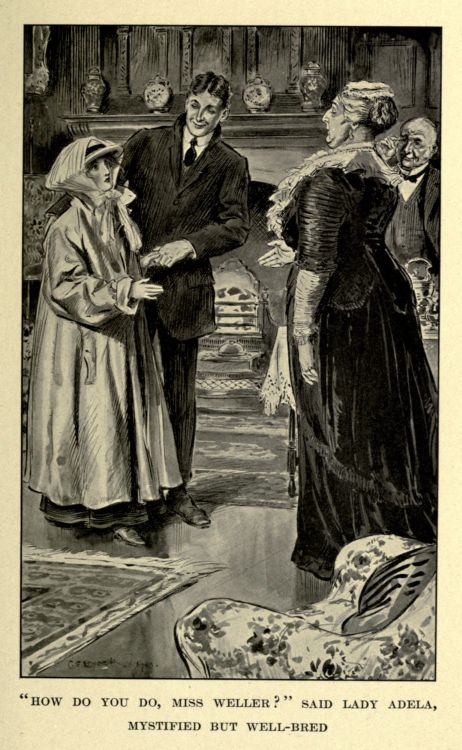
"HOW DO YOU DO, MISS WELLER?" SAID LADY ADELA, MYSTIFIED BUT WELL-BRED
"Very well, thank you," replied the visitor in a frightened squeak.
Dicky cheerfully set his parent right upon the subject of Miss Welwyn's surname, and then introduced Mrs. Carmyle.
"Tilly," he said, "this is Connie--one of the very best that ever stepped! Don't forget that: you will never hear a truer word."
The two girls regarded one another for a moment, and then shook hands with instinctive friendliness. The small stranger's face cleared, and she smiled, first at Connie and then up at Dicky.
Thereafter came a pause. The atmosphere was tense with enquiry. One could almost feel the Marconigrams radiating from Lady Adela. But apparently The Freak's coherer was out of order. He merely turned towards the staircase, and exclaimed:--
"Hallo, here are Dad and Sylvia. These are the last two," he added in a reassuring undertone to Miss Welwyn. "Quite tame, both of them."
Mr. Mainwaring's face lit up joyfully at the sight of his son, and he hurried forward.
"Dick, my boy, you've arrived at last! Capital!" He clapped the prodigal on the shoulder.
"Yes, Dad," replied Dicky with equal zest; "we have arrived. This is Tilly!"
Mr. Mainwaring, entirely at sea but innately hospitable, greeted Tilly heartily. "You must be terribly cold," he said. "Come to the fire and let me take off that wet garment of yours."
He led the girl to the blaze, then turned to shoot a glance of respectful enquiry in the direction of his august spouse. It was ignored. Meanwhile Dicky had introduced the languid but far from indifferent Sylvia.
"Now you all know one another," he said. "Sylvia, be a dear old soul and take Miss Welwyn up to your room and give her some dry things, will you? She is soaking, and her luggage is n't here yet. You see," he added a little lamely--Sylvia's patrician calm had rather dashed him as usual--"we walked from the station--did n't we, Tilly?"
Tilly nodded dutifully, eyeing Sylvia the while with some distrust.
"You will take care of her, won't you?" concluded the solicitous Dicky.
"Surely!" replied Sylvia, in her grandest manner. "This way, Miss Welwyn."
She swept across the hall and up the staircase, followed by the small, moist, and mysterious figure of the newcomer.
At the foot of the stair Tilly halted and looked back. Dicky, who had been following her with his eyes, was at her side in a moment.
"What is it?" he asked in a low voice.
The girl laid an appealing hand on his arm.
"Don't leave me, Dicky!" she whispered.
The Freak replied by tucking her arm under his own and propelling her vigorously up to the turn of the stair.
"Don't be a little juggins," he said affectionately. "I can't come and change your shoes and stockings for you, can I?"
Miss Welwyn, acquiescing in this eminently correct view of the matter, smiled submissively.
"All right," she said. "Au revoir!"
She ran lightly upstairs after the disappearing Sylvia, turning to wave her hand to Dicky before she disappeared.
Dicky, who had waited below for that purpose, acknowledged the salute, and turned to find Mrs. Carmyle at his elbow.
"Dicky," announced that small Samaritan, "I am going up, too. Sylvia might bite your ewe lamb."
The Freak smiled gratefully.
"The Lady and the Tiger--eh?" he said. "Connie, you are a brick! Be tender with her, won't you?" he added gently. "She's scared to death at present, and no wonder!"
Connie Carmyle, with a reassuring pat upon the anxious young man's arm, turned and sped upstairs. Dicky, hands in pockets and head in air, strolled happily back into the circle of firelight and took up his stand upon the hearthrug. Lady Adela, looking like a large volcano in the very last stages of self-suppression, sat simmering over the teacups.
The heir of the Mainwarings addressed his parents affectionately.
"Well, dear old things," he enquired, "how are we? So sorry to be late for tea, but it was an eventful and perilous journey."
The long-overdue eruption came at last.
"Dick," demanded Lady Adela explosively, "why have you brought that young person here?"
"Young per--oh, Tilly?" Dicky smiled ecstatically to himself at the very sound of Miss Welwyn's name. "Tilly? Well, I don't see what else I could have done with her, Mummie dear. I could n't leave her at the station, could I? But I must tell you about our adventures. First of all we lost Percy."
"Dick," repeated Lady Adela, "who--is--?"
"Who is Percy?" asked Dicky readily. "I forgot; I have n't told you about Percy. He is her brother. A most amazing fellow: knows everything. Can explain to you in two minutes all the things you have failed to understand for years. Teach you something you did n't know, I should n't wonder, Mother. He is going to introduce me to some of his friends, and put me up for his club."
"What club, my boy?" interposed Mr. Mainwaring, snatching at this gleam of light in the general murkiness.
"'The Crouch End Gladiators,' I think they 're called," said Dicky. "But I have n't met any of them yet."
"Where is Crouch End?" enquired Lady Adela. "And why should one have a club there?"
"It is a cycling club," explained Dicky. "You go out for spins in the country on Saturday afternoons. Topping! I'll bring them down here one day if you like! Each member is allowed to have one lady guest," he added, with a happy smile. "But to resume. We lost friend Percy at Waterloo. He went to get a bicycle ticket, or something, and was no more seen. The train started without him. Tilly was fearfully upset about it: said she thought it was n't quite proper for her to come down without a chaperon on her first visit."
"She proposes to come again, then?" said Lady Adela, with a short quavering laugh.
Dicky stopped short, and regarded his mother with unfeigned astonishment.
"Come again? I should think she was coming again! Anyhow, the poor little thing was quite distressed when we lost Perce."
"That, dear," remarked Lady Adela icily, "is what I should call straining at a gnat and swallowing a camel. And now, my boy, let me beg you to tell me--"
Dicky, who was too fully occupied with the recollections of his recent journey to be aware of the physical and mental strain to which he was subjecting his revered parents, suddenly started off down a fresh alley of irrelevant reminiscence.
"Talking of camels," he said, "there is the goat."
"Bless my soul, my dear lad!" exclaimed Mr. Mainwaring. "What goat?"
Dicky was perfectly ready to explain.
"When Tilly and I got out of the train at Shotley Beauchamp station," he began, "and found that you two absent-minded old dears had forgotten to send anything to meet us--"
"But Dick, my boy," interposed the old gentleman--Lady Adela was rapidly progressing beyond the stage of articulate remonstrance--"how could your mother be expected to divine your intentions with regard to trains, or to know that you were bringing down--er--a guest?"
"I wrote and told you," said Dicky.
"When, pray?" enquired Lady Adela, finding speech again.
"The day before yesterday," said Dicky positively; "breaking the news about Tilly, and when we were coming, and--"
"We received no letter from you," replied Lady Adela.
"But I wrote it, Mum!" cried Dicky. "I spent three hours over it. It was the most important letter I have ever written in my life! Is it likely a man could forget--"
"Feel in your pockets, my boy," suggested the experienced Mr. Mainwaring.
Dicky smiled indulgently upon his resourceful parent, and pulled out the contents of his breast-pocket--a handful of old letters and a cigarette case.
"Anything to oblige you, Dad," he ran on, scanning the addresses. "But I know I posted the thing. A man does not forget on such an oc-- No! you are right. I'm a liar. Here it is!"
He produced a fat envelope from the bunch, and threw it down upon the tea-table.
II
"I forgive you both," he said, smiling serenely, "for not sending to meet us. Well, to return to the goat--"
Veins began to stand out upon Lady Adela's patrician brow.
"Richard," she exclaimed, in a low and vibrant tone--"for the last time, who is that young woman?"
Dicky stared down upon his afflicted parent in unaffected surprise, and then dissolved into happy laughter.
"I must tell Tilly about this," he roared. "Of course, now I come to think of it, you don't know a thing about her. You never got my letter! Fancy you two poor old creatures sitting there as good as gold and wondering why I had brought her down here at all! Oh, my sainted Mother!"
"Who is she?" reiterated the sainted Mother, fighting for breath.
"She is my little girl," replied Dicky proudly. "We're engaged."
"I knew it," said Lady Adela, in a hollow voice.
"And I have brought her down here to make your acquaintance, that's all!" concluded the happy lover, apparently surprised that his relationship to Miss Welwyn should ever have been a matter of doubt to any one. "We met the goat outside the station--"
Lady Adela uttered a deep groan. Mr. Mainwaring rose from his seat and advanced upon his tall son, who still leaned easily against the mantel-piece, with his feet upon the hearthrug and his head above the clouds.
"My dearest boy," he said, patting Dicky affectionately and coaxingly upon the shoulder, "do you realise that you are our only son, and that as such we take a not unreasonable interest in your welfare? Would you mind postponing the goat for a moment and giving us a more explicit account of the young lady? I had only the merest glimpse of her just now," he concluded, doggedly avoiding his wife's eye, "but she struck me as charming--charming!"
Dicky's air of cheerful inanity fell from him like a cloak. Exultantly he took his father by the shoulders.
"Dad," he shouted, "she's the most blessed little darling that ever walked this earth! She's a princess! She's a fairy! She's a--"
The rhapsodist broke off short, and flushed red.
"Forgive me," he said, "for waffling like that, but I don't quite know what I 'm doing just at present. Dad, I'm the happiest man that ever lived!"
"My boy, my boy," cried little Mr. Mainwaring, "I'm glad--I'm glad!"
And father and son, regardless of the feelings of the unfortunate lady upon the sofa, proceeded to shake one another violently and continuously by both hands.
At last they desisted, a little sheepishly.
"Abel," said a cold voice, "be seated. Dick, take that chair."
Both gentlemen complied meekly.
"I see," said Lady Adela, looking up from a rapid perusal of her son's letter, "that the girl's name is Tilly Welwyn. Tilly, I presume, is an abbreviation of Matilda?"
"I don't know," confessed Dicky. "But Tilly will," he added brightly. "She knows everything."
"I notice," continued the Counsel for the Prosecution, still skimming through the letter, "that you have known one another for a short time--"
"Seven weeks, five days, four hours, and a few odd minutes," confirmed the defendant, looking at his watch.
"--And you became engaged as recently as last Sunday." Lady Adela laid down the letter. "Where?"
"On the top of a 'bus."
"H'm!" said Mr. Mainwaring uneasily.
"A rather unusual place, was it not?" enquired Lady Adela coldly.
"Unusual," agreed Dicky readily, "but not irregular. Oh, no! Besides, Percy was there, three seats behind. Perfect dragon of a chaperon, old Perce! Yes, the proceedings were most correct, I promise you."
"I note," continued Lady Adela, taking up the letter again, "that you do not say where you made Miss Welwyn's acquaintance."
"That was on the top of another 'bus," explained Dicky, with a disarming smile.
"And was her brother," enquired Lady Adela, ominously calm, "present on this occasion?"
"Percy? Rather not! Otherwise I need not have interfered."
"Int--" began both Lady Adela and Mr. Mainwaring together.
"Yes," said Dicky glibly. "It was like this. The rain began to come down hard, and a rather poisonous-looking bounder sitting beside her offered her his umbrella."
"Any gentleman would have done the same, Dick," interposed Mr. Mainwaring quietly.
"Yes, Dad. But I don't think any gentleman would have insisted on paying a girl's fare for her; and I don't think any gentleman would have considered a half-share in a three-and-ninepenny brolly an excuse for putting his arm round a girl's waist," replied Dicky, with sudden passion.
"He did that?"
"Yes."
"What did you do?"
Dicky grinned cheerfully.
"I did a pretty bright thing," he said. "It was no business of mine, of course, and I naturally did n't want to start a brawl on the top of a Piccadilly omnibus--"
"Dick, what were you doing on the top of an omnibus at all?" demanded Lady Adela unexpectedly. "Such economies are a new feature of your character."
Dicky nodded his head sagely.
"Yes," he agreed, "that's a sound point--a sound point. What was I doing on the top of that omnibus at all? That's the mystery. I was extremely surprised myself. I have spent whole days since, wondering how I got there. I have come to the conclusion that it was Fate--just Fate! That's it--Fate!"
"My dear boy, don't talk nonsense," said Lady Adela impatiently.
"But I am quite serious, dear Mum," persisted Dicky. "I don't as a rule go following unprotected young females onto the summits of omnibuses--"
Lady Adela's fine eyes began to protrude, crabwise.
"You followed her?" she gasped.
"I did. What else was there to do?" said Dicky simply. "I might never have seen her again if I had n't. Fate does n't as a rule give a man two chances. I got this one, and I took it. One moment I was walking along Piccadilly, bucking about something to old Tiny Carmyle. Next moment there she was, stepping on to that Piccadilly 'bus. In about five seconds I found myself up on top, too, sitting on the seat behind her. I tell you, it must--"
"What became of Mr. Carmyle?" asked Lady Adela, ruthlessly interrupting another rhapsody.
Dicky smiled vaguely, and rubbed his head.
"Upon my soul, I don't know," he confessed. "It's the first time the matter has occurred to me. I expect he went home. He's a resourceful old creature."
"How did you dispose of the man with the umbrella, my boy?" enquired Mr. Mainwaring.
"Ah," said Dicky, abandoning Carmyle to his fate, "that was where I did the bright thing. The fellow looked as if he made rather a hobby of this sort of game, and that gave me an idea. When he started amusing himself, I tapped him on the shoulder and said, right in his ear: 'Look here, my man, do you remember what happened to you the last time you were rude to a lady when you thought no one was with her?"
Mr. Mainwaring rubbed his hands gently.
"Well?" he said.
"At that," continued The Freak with relish, "my sportsman went a sort of ripe gorgonzola colour, grabbed his filthy brolly, and slid heavily down the back stairs of the 'bus."
"And what did you do then?" enquired Lady Adela.
"I," replied Dicky triumphantly, "got up and took his seat and gave Tilly my umbrella!"
"Ha! ha! ha!" crowed Mr. Mainwaring delightedly. "H'm! h'm! h'm! Honk! honk! honk!" he concluded hurriedly, coughing laboriously and patting himself upon the chest, as his consort turned menacingly in his direction.
"And where did you part company?" asked Lady Adela.
"Well," explained the culprit, "I offered to see her home. She was rather shaken up by what had happened."
Lady Adela nodded her head as if she had expected this.
"I see. And what did the young woman--
"Don't you think, Mum dear, that you might start calling her 'lady' now?" suggested Dicky gently.
"--Say to that?" she enquired, without taking the slightest notice of the interruption.
"She said she was n't going home. She was out shopping, it seemed. In fact, she got down at a shop in Oxford Street. I insisted on her keeping the umbrella, though."
"As a gift?"
"No," said Dicky with a twinkle; "as a hostage."
"And you gave her your address?"
Dicky's radiant countenance clouded for a moment.
"Not quite," he said. "I meant to, of course; but I can't have been quite my own calm self; for instead of giving her my own address, I asked for hers."
"She gave it, I suppose?" said Lady Adela dryly.
"No. She hesitated badly. I ought to have realised at once that I was not quite playing the game; but I was so mad keen to see her again that the idea never occurred to me. I simply thought she had forgotten where she lived, or something, and waited."
"But finally," said Lady Adela, "the young--lady did confide her address to you?"
Dicky nodded, and his mother continued:--
"Where does she live?"
"Russell Square," said Dicky rapturously.
"Russell Square? Ah! I know it. One drives through it on the way to Euston. In Bloomsbury, I believe?" said Lady Adela.
Her infatuated son corrected her. "Not Bloomsbury," he said reverently; "Heaven."
"Quite so," agreed Lady Adela, entirely unmoved. "What number?"
"I have forgotten the number long ago," replied Dicky, "but I could find my way to the place blindfold by this time."
"Don't you ever write to her?" asked his mother curiously.
"Every day."
"Then you must know her postal address," was the crushing rejoinder.
Dicky merely shook his head, and smiled serenely.
"No, I don't," he said.
"Then where do you address her letters?"
"I walk round every night after bedtime, and drop the letter into her letter-box. Is it likely I would let a postman touch it? Anyhow, on this occasion Tilly told me that if I asked for my umbrella any time I was passing it would be handed out to me. Then she thanked me again, the darling, and went into the shop."
"Front entrance?" enquired Lady Adela swiftly.
"Was it?" said Dicky vaguely. "I don't remember. Yes, I do. She went round and in at the side somewhere. Why?"
"Nothing," said Lady Adela. "And did you call at Russell Square?"
"Rather! I went there next afternoon."
"Were you invited in?"
"As a matter of fact, I met her coming out, with her father. A splendid old chap! Apparently Tilly had told him the whole tale, and he had expressed a desire to make my acquaintance. A lucky desire for me, what? He took us both out to tea."
"Where?"
"Gunter's. Said he was sorry he could n't ask me into the house at present, as they had the paperhangers in. After that visitation was over, I was to come and make the acquaintance of the rest of the family."
"And did you?"
"Yes."
"What is the house like inside?" was the next inevitable feminine enquiry.
"To tell you the truth I have n't been inside yet, except the front hall. But I met the rest of the family at a very friendly little luncheon given in my honour at the Criterion on the following Saturday afternoon."
"And what are the rest of the family like?"
Dicky pondered.
"Now I come to think it over," he confessed at length, "I'm not very clear about the rest of the family. Collectively they struck me as being the most charming people I had ever met, but I don't seem to have noticed them individually, if you know what I mean. You see, Tilly was there."
"How many are there?" pursued his mother, with exemplary patience.
"Four or five, I should think, but I have never counted them," replied the exasperating Richard. "Tilly--"
Mr. Mainwaring came timidly to his wife's aid.
"Is there a mother, my boy?" he asked.
"Yes, there is a mother," replied Dicky hastily. "Oh, yes," he repeated with more confidence, "certainly there is a mother."
"Any sisters?"
"There is a small girl--a dear. And I have a kind of notion there are some twins somewhere. Tilly--"
"Any brothers?"
Dicky smiled, apparently at some amusing thought.
"Yes," he said, "there is Percy. A sterling fellow, Perce! I wonder where he is, by the way. If he were here he might be able to do something with the goat. Any one would respect Percy--even a goat."
Lady Adela sighed despairingly. Mr. Mainwaring, taking the goat by the horns, so to speak, asked his son to elucidate the mystery once and for all.
"Did n't I tell you about the goat?" asked Dick in surprise. "Well, it was like this. When Tilly and I were hunting for a cab in the rain at the station just now, we met a woman with a goat, in tears."
"The goat?" said Lady Adela incredulously.
"No, its mother--I mean, its proprietress. She had missed the market, or something, owing, to her pony breaking down, and she had come to the station as a forlorn hope, to see if she could catch a departing goat-merchant and unload Maximilian on him."
"Maximilian?" interjected Lady Adela giddily.
"Yes--the goat. We had to call him something, you know. Her husband was very ill in bed, and Maximilian had to be sold to defray expenses, it seemed."
"And so you--er--purchased Maximilian?" said Mr. Mainwaring.
"We did," replied The Freak gravely. "That was why we had to walk. The cabman would not allow us to take Maximilian inside with us, and Max absolutely declined to sit on the box beside the cabman--which did n't altogether surprise me--so we all three had to come here on our arched insteps. I wonder where Tilly is."
"Where is the animal now?" enquired Lady Adela apprehensively. She was quite prepared to hear that Maximilian was already in the best bedroom.
"We left him on the lawn, tethered to the rain-gauge," replied Dicky. "Ah, there she is!"
Forgetting the goat and all other impediments to the course of true love, he hurried to the foot of the staircase.
III
Miss Welwyn and Mrs. Carmyle descended the stairs together, Sylvia stalking majestically in the rear. Tilly wore a short navy-blue skirt and a soft silk shirt belonging to Connie--garments which, owing to the mysterious readiness with which the female form accommodates itself to the wardrobe of its neighbour, fitted her to perfection. In this case, however, the miracle was less noticeable than usual, for the two girls were of much the same height and build, their chief points of difference being their hair and eyes.
In reply to her swain's tender enquiries, Miss Welwyn intimated that she was now warm and dry.
"In that case," replied Dicky, "come and sit up to the tea-table and take some nourishment."
On her way to her tea Tilly was met by Mr. Mainwaring senior, with outstretched hands.
"My dear young lady," he said, with shy cordiality, "we owe you a most humble apology."
Tilly, flushing prettily, asked why.
"For our extremely vague greeting to you just now," explained her host. "You see"--he clapped Dicky fondly on the shoulder--"this intellectual son of ours forgot to post the letter announcing your--telling us about you. We have only just heard the news. Now that we have you, my dear"--the old gentleman's eyes beamed affectionately--"we are going to make much of you!"
"Oh, thank you! You are kind!" cried Tilly impulsively; and smiled gratefully upon her future father-in-law. His were the first official words of welcome that she had received.
"Good old Dad!" said Dicky.
Meanwhile Lady Adela had come to the conclusion that her male belongings were overdoing it.
"Do you take sugar, Miss Welwyn?" she enquired loudly.
"Yes, please," said Tilly, still engaged in smiling affectionately upon the Mainwarings, père et fils.
"I wonder now," continued Mr. Mainwaring, "if you are in any way related to an old friend of mine--or perhaps I should say acquaintance, for he moved on a higher plane than I--Lucius Welwyn? I was at school with him more than forty years ago, and also at Cambridge."
"Lucius Welwyn?" cried Tilly, her eyes glowing. "He is my Daddy--my father!"
"You don't say so? Capital!" Abel Mainwaring turned to his wife. "Adela, do you hear that? Miss Welwyn and I have established a bond of union already. Her father was actually at school with me."
Lady Adela flatly declined to join in the general enthusiasm.
"Are you sure, dear?" was all she said. "There might be two."
Mr. Mainwaring pointed out, with truth, that Lucius Welwyn was an uncommon name. "But we can easily make sure," he said. "The Lucius Welwyn whom I remember was a Fellow of his College. Did your father--"
"Yes, Dad was a Fellow of his College for some years," said Tilly. "I think I will come a little farther from the fire now, if you don't mind. I am quite warm."
"Come and sit here by me, dear Miss Welwyn," said Lady Adela with sudden affability. "I want to have a cosy little chat with you. Dick, you are very wet and muddy. Go and change."
"All right," said Dicky obediently.
As he left the hall he said something in a low voice to Mrs. Carmyle. That small champion of the oppressed nodded comprehendingly, and established herself at a writing-table under the curtained window.
"Abel," enquired Lady Adela, in pursuance of her policy of once more clearing the decks for action, "what have you done with Mr. Rylands?"
"I quite forgot him," confessed Mr. Mainwaring. "I was so much occupied with Miss Welwyn. I fear he is still in the smoking-room."
"Go and let him out--by the side door," commanded Lady Adela.
"Come on, Dad!" said Dicky.
Father and son disappeared, arm-in-arm; Lady Adela and Sylvia closed in upon the flinching Miss Welwyn; and Mrs. Carmyle, taking up her pen, addressed herself to the composition of an epistle to her lord and master.
Lady Adela looked round, and remarked in solicitous tones:--
"Constance, dear, you have chosen a very draughty corner for yourself."
"I have put fresh note-paper in your bedroom, Connie," added Sylvia cordially.
"I'm as right as rain, thanks," said Connie. "Just scribbling a line to Bill."
And she began:--
I have arrived quite safely, old man, and the most tremendously exciting things are happening here. Listen!
CHAPTER XIV
ANOTHER COSY CHAT, WITH AN INTERRUPTION
I
The victim, continued Connie presently, is now upon the sofa, wedged in between the Chief Ogress and the Assistant Tormentor. She is scared out of her wits, poor thing, but has stood up to the pair of them splendidly so far.
"It was good of you to come down to this poky little corner of the country, Miss Welwyn," Lady Adela was saying, handing Tilly a second cup of tea. "It is so nice when one's friends take one as they find one, is it not?"
Tilly, wide-eyed and quaking, was understood to assent to this proposition.
"You live in town, I understand?" continued Lady Adela cautiously.
Tilly took a deep breath, and began:--
"Yes--in Russell Square. The house," she continued rapidly, "is very old-fashioned. It belonged to my grandfather. My father inherited from him, and we have lived there ever since we left Cambridge. We have often talked of leaving, but Dad says he can't bear transplanting at his time of life. So," concluded Tilly, with an hysterical little gasp--Lady Adela and Sylvia were listening with the dispassionate immobility of a pair of well-nourished sphinxes--"we just stay on."
She has confessed that she lives in Bloomsbury, wrote Mrs. Carmyle. The Inquisition are one up.
"Russell Square!" cooed Lady Adela. "How charming and old-fashioned! So handy for the British Museum, too!"
"And Euston Road!" added Sylvia enthusiastically.
Cats! Cats!! Cats!!! recorded Connie furiously.
Lady Adela offered Tilly a bun, and resumed her long-distance fire.
"You are quite a small family, I imagine?"
"Well," began Tilly readily--they had reached a topic that lay very near her heart--"there are Father and Mother, of course, and my brother Percy, and my sister, and two quite tiny ones. My grandmother--"
"How nice," murmured Lady Adela indulgently, closing her eyes as if to mitigate the strain of this enumeration. "And what is your little sister's name?"
"Amelia."
"Amelia? Delightful! Perfect! It suits Russell Square exactly."
"One feels," corroborated Sylvia, "as if the Sedleys and the Osbornes and the Rawdon Crawleys all lived next door."
Why don't they smack people like Sylvia more in their youth? enquired Mrs. Carmyle's letter plaintively.
"I don't think we have met any of them," said Miss Welwyn doubtfully. "The Mossops live on one side of us and the Rosenbaums on the other. We don't call on them, of course," she added apprehensively. "And oh, Lady Adela, I have an invitation for you from my mother, to come and have tea with us."
"That is very kind of your mother," said Lady Adela graciously. "You shall give me the invitation when you have unpacked your boxes."
"It's--it's not a written invitation," said Tilly. "Mother just asked me to ask you, any day you happen to be coming into town. Then you would meet my father and the others."
"That will be charming," replied Lady Adela. "I think we have no engagement on Monday." (Lady A. is simply bursting with curiosity about the girl's family, observed Connie at this point.) "I will write a little note to your mother, and you shall take it back with you on Monday morning. Are you the eldest of the family?"
"No. Perce--Percy is the eldest. He is twenty-two."
"Is he at the University?"
Miss Welwyn shook her head.
"Not now," she said. She spoke with more freedom. The restraint of her surroundings was wearing off, and her courage, which was considerable, was beginning to assert itself. "He is in the City. He dislikes it very much, poor boy. He is so fond of open-air sports, and he finds an office very trying. My father was a great sportsman, too. He used to go racing a good deal at one time, but he has given it up now. He says he is on the shelf."
"And he was a Fellow of his College, I think you said?" remarked Lady Adela, a little bored with this prattle.
"Yes--Fellow and Tutor."
"But he is no longer in residence, you say?"
"No," said Tilly briefly.
There is something shady about the poor child's father, wrote Mrs. Carmyle, but Lady A. has got no change out of her so far.
"I am looking forward greatly to making your father's acquaintance, Miss Welwyn," said Lady Adela, with absolute sincerity. "Now, I wonder if I know any of your mother's people. I don't think you have mentioned her maiden name."
"She was a Banks," replied Miss Welwyn readily.
Bill, dear, this little girl is splendid! recorded Connie enthusiastically.
"I beg your pardon?" said Lady Adela.
"A Banks," repeated Tilly politely.
Lady Adela nodded her head intelligently.
"Ah, to be sure!" she said. "Let me see. Are they a Warwickshire family, now?"
"Or is it a Cornish name?" queried Sylvia, with an encouraging smile.
"No," said Tilly. "Mother came from Bedfordshire--or else Cambridgeshire," she added rather breathlessly, for the four eyes of the sphinxes were upon her once more.
"But, dear Miss Welwyn--" began Sylvia.
I can stand this no longer! scribbled Connie, and threw down her pen.
"Thank goodness, that's over!" she exclaimed, rising and coming over to the fire. "What a nuisance affectionate husbands are! Talking of husbands, Sylvia, I hear you are going to marry a plumber."
Lady Adela and Sylvia, taken in flank, both turned and eyed the frivolous interloper severely. Had they not done so, they would have noted that Miss Welwyn's teacup had almost leaped from its saucer.
"Dear Connie, you are priceless," commented Sylvia patronisingly. "I wonder where you got your quaint sense of humour."
"Lady Adela was my informant," said Connie, quite unruffled. She had drawn the enemy's fire upon herself, which was precisely what she had intended to do. "Jolly sensible of you, too! A plumber is a useful little thing to have about a house. My Bill is practically one, you know, although he calls himself something grander. Now, what about a four-handed game of billiards before dinner? Do you feel inclined to play, Miss Welwyn?"
"I am rather out of practice," said Tilly dubiously.
"Never mind!" said Connie. "You can play with Dicky against Mr. Mainwaring and me."
She walked to the foot of the staircase, and called up: "Mr. Richard, forward!"
"In one moment, Miss!" replied a voice far up the height. "I'm just attending to a lady at the ribbon counter. I'll step down directly." Then a stentorian bawl: "Sign, please!"
During this characteristic exchange of inanities an electric bell purred faintly in the distance, with the usual result that the dining-room door opened, to emit the jinnee-like presence of Mr. Milroy.
"What is it, Milroy?" enquired Lady Adela.
"Front door bell, my lady," replied Milroy, and disappeared like a corpulent wraith through the curtains.
"Heavens, not another caller!" exclaimed the overwrought mistress of the household.
"Probably Mr. Rylands come back for his goloshes," said Sylvia. At the same moment Dicky and his father appeared, descending the staircase together.
"And the next article, madam?" continued Dick lustily, addressing Mrs. Carmyle, who stood below.
He was answered, not by the lady to whom his query was addressed, but by Milroy, who appeared holding back one of the curtains which covered the entrance to the vestibule, to announce, in the resigned tones of a man for whom life holds no further surprises:--
"Mr. Percy Welwyn!"
II
Mr. Percy Welwyn entered. He was a slender young man with an insufficient chin and a small moustache. He looked like a shop assistant; and Dicky's last remark, still ringing through the hall, emphasised rather than suggested the comparison. His hair was brushed low down upon his forehead, with an elaborate curl over his right eyebrow. His eyes were bulgy. He wore a tight-fitting cycling suit, splashed with mud, and carried in his hand a small tweed cap bearing a metal badge. Altogether an impartial observer might have been excused for not feeling greatly surprised that Dicky and Tilly had mislaid him.
Mr. Welwyn advanced to the fire, with the easy grace of one who is habitually a success in whatever grade of society he finds himself, and remarked: "Good-evenin', all!"
For a moment there was a frozen silence. Then Dicky hurried forward.
"My dear Percy," he exclaimed, wringing the newcomer by the hand, "here you are, after all! Dear old soul! Let me present the rest of my family."
He linked his arm in that of the travel-stained cyclist, and led him towards the petrified Lady Adela.
"Mother," he announced, "this is my friend Percy Welwyn."
"Mr. Percy Welwyn," said a gentle voice in his ear.
"Sorry, old man!" said Dicky hastily.
"No offence taken," Mr. Welwyn assured him, "where none intended. This, I presume,"--he waved his dripping tweed cap in the face of the speechless matron before him,--"is your hostess."
"Yes," said Dicky. "My mother, Lady Adela Mainwaring."
Mr. Welwyn shook hands affably.
"How de do, your ladyship?" he said. "Very pleased to make your ladyship's acquaintance, I'm sure."
"And this," continued Dicky, swiftly wheeling his guest out of the danger zone, "is my old Dad."
"How do you do, Mr. Welwyn?" said Mr. Mainwaring, with a courteous little bow. "We make you welcome."
"How de do, your lordship?" replied Mr. Welwyn, repeating his hand-shaking performance. "Very pleased to make your lordship's acquaintance."
"That's an error on your part, Percy," said Dicky smoothly. "Dad's only a commoner. But we'll work it out afterwards. This is my little sister Sylvia."
Mr. Welwyn greeted the statuesque Miss Mainwaring as he had greeted her parents, throwing in an ingratiating ogle which plainly intimated that he intended to make an impression in this quarter.
"Very pleased to make your acquaintance, Miss," he said. "We shall be calling each other Perce and Sylvie in no time, I can see. And now," he continued, turning his back upon the quivering figure of his future playmate, "I should like to address a few observations to the happy couple. You're a nice pair of turtle-doves to come and play gooseberry to, I don't suppose! Here I give up a whole Saturday afternoon to come and chaperon our Tilly and her young gentleman down to his ancestral home; and the first thing I know is the pair of them give me the slip at Waterloo! Chronic, I call it!"
"What else did you expect, Mr. Welwyn?" interposed Connie, coming characteristically to the rescue, the majority of the Mainwaring family being in no condition to cope with Percy. "Have n't you ever been engaged yourself?"
Her unsolicited intrusion into the conversation was plainly a shock to Percy's sense of decorum. He coughed reprovingly behind his hand, and turning to Dicky, remarked:--
"Introdooce me!"
Dicky, humble and apologetic, complied. Mr. Welwyn went through his usual performance, and continued:--
"Engaged, Mrs. Carmyle? Not me! Not that I might n't have bin, mark you, if I had n't been born careful. Be born careful, and you need n't be born lucky. The Proverbs of Perce--Number one!" he added, in a humorous aside. "Well, to resume. Luckily I had the old push-bike with me, and I managed to find my way down here in a matter of an hour and a half or so. And then what happens? Just as I am doing a final spin up your kerridge-drive, your ladyship--bing! bang! and I get bowled over in the dark by a charging rhinoceros!"
Mr. Welwyn concluded this dramatic narrative with a few appropriate gestures, and paused to note its effect upon his auditors.
"That was Maximilian, I fancy," explained Dicky cheerfully. "The little fellow must have got loose. Did you notice which way he was going?"
"I did," replied Percy with feeling. "He was going the opposite way to me."
"In that case," replied Dicky reflectively, "he must be halfway back to mother by this time. Well, perhaps it is just as well. Did you happen to observe whether he had the rain-gauge with him?"
"All I remarked," replied Mr. Welwyn bitterly, "was about half a mudguard. But that," he continued, with a winning smile to the ladies, "is neither here nor there, is it? Seeing as you are safe, Tilly, old girl, I think I may now resign the post of chaperon into her ladyship's hands. And perhaps," he added with a graceful bow, "I may be permitted to remark that in my humble opinion a more capable pair of hands could not be found for the job."
Lady Adela had suffered severely that day, and her spirit for the time being was almost broken. She merely smiled weakly.
Mr. Welwyn, now at the very top of his form, struck an attitude.
"My trusty iron steed," he declaimed, "waits without the battlements--all but a few spokes, that is, accounted for by the aforesaid rhinoceros--and I must hence, to ketch the seven-fifteen back to Londinium."
"Does that mean he is going?" murmured Lady Adela to her daughter, with a flutter of hope upon her drawn features.
Sylvia was nodding reassuringly, when the tactless Dicky broke in:--
"Percy, old son, you really must stay for dinner, if not for the night."
"We can't send you away empty in weather like this, Mr. Welwyn," added Mr. Mainwaring hospitably. "My dear--"
He turned to his wife, but the words froze upon his lips, for Lady Adela presented an appearance that can only be described as terrible. But the impervious Percy noticed nothing.
"By my halidom," he exclaimed, highly gratified, "that was well spoken! Yet it cannot be. I thank you, ladies and gentles all, for your courtly hospitality; but, as the bard observes: 'I must get home to-night!'" (Here he broke into song, and indulged in what are known in theatrical circles as "a few steps.") "The club has an important run billed for to-morrow, and if little Percy is missing, there will be enquiries. Still, rather than disoblige, I'll split the difference. I will drain a stirrup-cup of foaming Bass with ye ere I depart. Then, forward across the drawbridge! Yoicks! Likewise Tally Ho! Which way, fair sir," concluded this high-spirited youth, turning to his host, "to the Saloon Bar?"
"Percy," remarked Dicky hurriedly, "you are immense! You ought to go on the Halls. Come along! This way!"
"I have bin approached, mind you," began the comedian, taking Dicky's arm, "but!"
"Are you coming too, Tilly?" asked Dicky, looking back.
Tilly, who had been apprehensively regarding the flinty countenances of her future relatives-in-law, assented hurriedly and gratefully.
"Yes, please," she said. "I will come and see Percy off."
She took Dicky's free arm.
"'T is meet and fitting," observed the ebullient Percy. "We will drain a tankard jointly. Right away! Pip, pip! Good-morrow, knights and ladies all!"
The trio disappeared into the dining-room, leaving a most uncanny silence behind them!
Mr. Mainwaring hastily picked up the evening paper and enshrouded himself in its folds. Lady Adela feebly signalled to Sylvia for the smelling-salts.
"A perfectly appalling young man!" she announced.
"And a perfectly sweet little girl!" quoth loyal Connie.
CHAPTER XV
A DAY OF CALM REFLECTION
I
At half-past eight next morning Connie Carmyle, wearing a tweed coat and skirt and neat brown brogues, came whistling downstairs, intent upon a constitutional before breakfast.
Upon the sofa in front of the hall-fire, self-consciously perusing a Sunday newspaper, sat a large man of slightly sheepish appearance. At the sight of Connie he rose guiltily to his feet. Mrs. Carmyle embraced him in a motherly fashion.
"And may I ask what you are doing here, my man?" she enquired.
"Finished things off last night after all," replied her husband; "so thought I might as well run down this morning and spend the day."
"Why?" asked Mrs. Carmyle wonderingly. She knew perfectly well; but being a woman and the possessor of an undemonstrative husband, it pleased her to spur him into making an exhibition of himself.
"Thought I should like a rest," said Mr. Carmyle gruffly. "Had a pretty tough week," he added, in a pusillanimous attempt to excite compassion.
"Is that the only reason?" persisted his heartless spouse.
"Having a wife, thought I might as well come and see her for an hour or two," conceded Carmyle grudgingly.
"You must put it better than that, darling," said Connie inexorably. "Now, be a little man! You came because--because--"
The sorely-harrassed husband, driven into a corner, turned a deep plum-colour.
"Because I love you!" he growled. "Now chuck it, Connie, for goodness' sake!"
He was rewarded by a radiant smile.
"That is much better," said Connie approvingly. "Now you shall have some breakfast. After that I have a great deal for you to do."
"What?"
"You can take us for a drive in the car."
"Us?"
"Yes--us. Me, Dicky, and his fiancée," answered Connie very distinctly.
"Righto!" replied this maddening man unconcernedly.
Connie heaved a patient little sigh, and repeated:--
"Me, Dicky, and--his fiancée."
This effort was more successful.
"Righto!" said Carmyle once more. "Freak engaged again?" he added as an afterthought.
Connie cast up her eyes in a piteous fashion, as if to imply that it is better to have a husband like this than none at all, and replied resignedly:--
"Yes. It's a long story. I wrote you a letter about it last night. Here it is in the post-basket. Read it now; while I run and break the news of your visitation to Lady Adela."
By the time that Connie returned, her taciturn but capable husband had mastered the contents of her letter--parentheses, italics, notes of exclamation, and all--and was ready to receive the orders of the day.
"Now, listen," commanded Connie swiftly. "At breakfast you will invite Dicky and Tilly to come for a run in the motor. I don't know anything about that girl, but I had a long talk with her last night when we were getting ready for bed, and she is the right sort. She seemed to like me, too. What did you say?"
"Nothing," replied the exasperating William. "Go on."
"Anyhow," continued Connie, ignoring a mysterious chuckle, "I am not going to have her pumped and bullied by Lady Adela and Sylvia before she has found her feet. Therefore we will take her and Dicky away for the day. Get your invitation off at breakfast, before Lady Adela begins organising a party for church. The young couple can have the back seat to themselves, and I will come in front with you."
"Anything you like," replied Carmyle cheerfully. He had been looking forward to an indolent morning with Connie in the smoking-room, for he really had had a hard week; but he never questioned the dispositions of the small goddess who controlled his movements. Whatever she ordained was right.
"Thank you, Bill darling! I love you very much."
Mrs. Carmyle stood upon tiptoe, and with an affectionate sigh endeavoured to lay her head upon her husband's left shoulder. Mr. Carmyle gave her no assistance. He merely removed his sovereign-purse with some ostentation from his left-hand waistcoat-pocket to his right.
II
"This is the first time that you and I have been out in a motor together, Tilly," remarked Dicky a few hours later, taking advantage of a jolt on the part of the car to annihilate a portion of the space which separated him from his beloved.
Tilly, availing herself of a margin which instinct and experience had taught her to provide for such contingencies as this, moved a corresponding number of inches farther away, and pointed out that they had enjoyed a motor-ride together only three days previously.
"On a motor-'bus," she explained.
"Motor-'bus? Not a bit. Fairy coach!" declared her highly imaginative swain.
"Fairy coaches don't as a rule carry eighteen inside and twenty-two outside, dear," replied the matter-of-fact Miss Welwyn.
"No, you are right," admitted Dicky. "Fairy coaches are invariably two-seaters. This one is n't a bad substitute, though--what?"
He lolled luxuriously, and turned to survey the profile beside him. Tilly was wearing a saxe-blue suède hat, secured to her head by a filmy motor-veil--both the property of the open-handed Mrs. Carmyle, who was sitting in front driving the car under the complacent contemplation of her husband. The fur rug which Tilly shared with Dicky enveloped her to the chin: her cheeks glowed; her lips were parted in a smile of utter content; and her eyes were closed. Dicky tried to count the long lashes that swept her cheek. She was his! His--to keep, to cherish, to protect, to pamper, to spoil! Something very tremendous stirred within him--something that had never found a place in that receptive and elastic organ, his heart, before. All the dormant tenderness and chivalry of his nature seemed to heap itself up into a mighty tidal wave, topple over, and inundate his very soul. Foolish tears came into his eyes. Very reverently he reached for Tilly's hand under the rug. She surrendered it, smiling lazily, without raising her lashes. Dicky wondered what she was thinking about.
Tilly, on her part, was trying to summon up courage to tell him.
By this time the car had cleared the village of Shotley Beauchamp, filled with parties of worshippers hastening in what Connie described as "rival directions," and was spinning along the open road bound for the Surrey hills. It was a crisp and sunny morning. There was a touch of spring in the air, quickening the pulse.
"I wonder," began Dicky, whose conversation at this period, like that of all healthy young men in a similar condition, wandered round in a clearly defined and most constricted circle, "if I had not had that row with the umbrella-merchant on the top of the Piccadilly 'bus, whether you and I would ever--"
Bang!
Mr. Carmyle said something distressingly audible. Mrs. Carmyle applied the brakes; and the car, bumping uncomfortably, came to a standstill at the side of the road, under the lee of a pine wood.
"Was that your collar-stud at last, Tiny, old man?" enquired The Freak anxiously.
"Back tyre," replied Mr. Carmyle shortly, disencumbering himself of his rug.
They stepped out upon the muddy road and examined the off-hind wheel. The tyre was flat, but apparently whole.
"It is the valve," announced Carmyle, after unscrewing the dust-cap. "Blown himself clean out of bed. That means a fresh inner tube. And I lent the Stepney wheel to a broken-down car coming along this morning!"
"Bad luck!" said Dicky speciously, glancing up at the pine wood. "Can Tilly and I help?"
"No, better run away and play."
Dicky and Tilly, without further insincerities, obeyed at once.
"I fear you will besmirch yourself, comrade," said Dicky over his shoulder, as they departed.
"Bet you half-a-crown I don't even dirty my gloves," replied Carmyle.
"No: you'll take them off," replied the astute Richard.
"No, kid!" persisted Carmyle. "I undertake to get a new inner tube put into this tyre without laying a finger on it. Is it a bet?"
"Is Connie going to do it?" asked Dicky incredulously.
"She is and she is n't. She won't lay a finger on the tyre either, though. Will you stake your half-crown like a man?"
"I suppose there is a catch about it somewhere," said The Freak resignedly. "Still, I fancy we must humour the young people, Tilly. All right, my lad."
Mr. Carmyle turned to his wife.
"Show them, Connie," he said.
His dutiful helpmeet selected a large tyre-lever, and sitting down in the midst of the King's highway upon the tool-box, in a position which combined the maximum of discomfort with the minimum of leverage, began to pick helplessly at the rim of the wheel. Occasionally she looked up and smiled pathetically.
"Will that do, Bill dear?" she enquired.
"Yes; but try and look a bit more of an idiot."
Mrs. Carmyle complied.
"Now you're overdoing it," said her stage-manager severely. "Don't loll your tongue out like a poodle's! That's better. Hallo, I believe I can hear a car already! Come on, you two--into this wood!"
Next moment Tilly, beginning dimly to comprehend, was propelled over a split-rail fence by two muscular gentlemen and bustled into the fastnesses of the pine wood. The Casabianca-like Connie remained in an attitude of appealing helplessness upon the tool-box.
The pine wood ran up the side of a hill. The trio climbed a short distance, and then turned to survey the scene below them. Round the bend of the road came a car--a bulky, heavy, opulent limousine, going thirty-five miles an hour, and carrying a cargo of fur coats and diamonds.
"Rolls-Royce. Something-in-the-City going down to lunch at Brighton," commented Dicky. "That's the wrong sort, anyhow."
"Connie will be run over," cried Tilly apprehensively.
"Not she," replied the callous Carmyle.
He was right. Connie, diagnosing the character of the approaching vehicle from afar, had already stepped round to the near side of her own, escaping a shower bath of mud and possibly a compound fracture.
"Do you always get your running repairs done this way, Tiny?" enquired Dicky of Carmyle.
"As a rule. Connie loves it. Gives her a chance of talking prettily to people and smiling upon them, and all that. She thinks her smile is her strong point."
"I should be afraid," said Tilly.
"Connie is afraid of nothing on earth," said Carmyle. "Why, she--" he flushed red and broke off, realizing that he had been guilty of the solecism of paying a public tribute to his own wife. "Here's another car coming," he said. "This looks more like what we want."
A long, lean, two-seated apparition, with a bonnet like the bow of a battleship, had swung round the bend, and was already slowing down at the spectacle of beauty in distress. It contained two goggled and recumbent figures. Presently it slid to a standstill beside the stranded car, and its occupants leaped eagerly forth.
"Metallurgique, twenty-forty," announced Dicky, with technical precision.
"Undergraduates--or subalterns," added Carmyle contentedly, beginning to fill his pipe. "That's all right. You two had better go for a little walk, while I stay here and keep an eye on the breakdown gang."
He produced from his greatcoat pocket a copy of "The Sunday Times," and having spread it on the ground at the foot of a convenient tree, sat down upon it with every appearance of cheerful anticipation, already intent upon the, to him, never-palling spectacle of his wife adding further scalps to her collection.
Dicky and Tilly, nothing loath, wandered farther along the hillside, under strict injunctions not to return for twenty minutes. It was the first time that they had found themselves alone since their arrival on the previous evening, and they had long arrears of sweet counsel to make up.
"Dicky," said Tilly, suddenly breaking one of those long silences that all lovers know, "have you ever--loved any one before me?"
Most men are asked this question at some time in their lives, and few there be that have ever answered it without some mental reservation. But The Freak merely looked surprised--almost hurt.
"Loved any one before? I should think I had!" he replied. "Who has n't?"
"I have not," said Tilly,
Dicky was quite prepared for this.
"I meant men--not girls," he said. "Girls are different. Not that some of them don't fall in and out of love rather easily, but they only do it as a sort of pleasant emotional exercise. The average male lover, however youthful, means business all the time. Quite right, too! It is a healthy masculine instinct for an Englishman to want to found a household of his own just as soon as he grows up. But it is this very instinct which often sends him after the wrong girl. He is full of natural affection and sentiment, and so on, and he wants some one to pour it out upon. So he picks out the first nice girl he meets, endows her in his mind with all the virtues, and tries to marry her. Usually it comes to nothing--the girl sees to that; for she is gifted by nature with a power of selection denied to men--and in any case it is hardly likely that he will meet the right girl straight off. So he goes on seeking for his mate, this child of nature, in a groping, instinctive sort of way, until at last he finds his pearl of great price. Then he sells all that he has, which being interpreted means that he straightway forgets all about every other girl he ever knew, and loves his Pearl forever and ever. Therefore, Tilly, if ever a man comes to you and tells you that you are the only girl he ever loved, trust him not. It is not likely. It is against nature."
"A girl likes to believe it, all the same, dear," answered Tilly, voicing an age-long truth.
"I don't see why she should," argued the ingenious Dicky. "It is no compliment to be loved by a man who has had no experience. Now I can love and appreciate you properly, because I am able to compare you with about"--he counted upon his fingers, finally having recourse to a supplementary estimate on his waistcoat-buttons--"with about fourteen other ladies, of all ages, whom I have admired at one time and another; and can unhesitatingly place you in Class One, Division One, all by your own dear self, so far as they are concerned. Is n't that something?"
But Tilly was not quite satisfied.
"I should like to feel," she said, instinctively giving utterance to that point of view which makes a woman's love such an intensely personal and jealously exacting thing in comparison with a man's, "that you could never have been happy with any woman in the world but me. Could you, Dicky?"
Dicky pondered.
"It depends," he said, "on what you mean by happy. Our measure of happiness, it seems to me, depends entirely on what we have compared with what we want. If I had never met you, I could never have missed you; and so I dare say I might have settled down happily enough--or what I considered happily enough--with some other girl. But that is impossible now. I have met you, you see. If I were to lose you"--Tilly caught her breath sharply--"no one else could ever take your place. Love like ours makes all substitutes tasteless and colourless, as they say in chemical laboratories. You have raised my standard of love so high that no one but yourself can ever attain to it. So," concluded the philosopher, with a smile which brought more happiness and reassurance into Tilly's heart than all the laborious logic-chopping in the world could have done, "though I don't know that I never could have been happy with any one but you, I can truly say this, that I never can be happy with any one but you. It's merely a matter of the difference between two conditional sentences, that's all."
But a girl talking with her lover is not interested in points of syntax.
"And will you go on loving me?" asked Tilly, putting a small but unerring finger upon the joint in Dicky's harness.
Dicky glanced down upon the eager, wistful face beside him, and smiled whimsically.
"Madam," he said, "your fears are groundless."
"How do you know?" enquired Madam, convinced in her heart, but anxious to be reassured.
"Because," said Dicky simply, "you love me. You have said it. Don't you see how that binds me to you? The mere fact of your love for me makes mine for you imperishable. The moment a man discovers that the woman he loves loves him in return, he is hers, body and soul. Previous to that something has held him back. Pride--reserve--caution--call it what you like--it has held him back. He has not let himself go utterly. After all, we can only give of our best once in this life, and usually some instinct inside us makes us refuse to surrender that best, however prodigal we may have been of the inferior article, until we know that we are going to get the best in return." Dicky was talking very earnestly now. "I have been keeping my best for you all these years, little maid, though neither of us knew it. Such as it is, you have it. That is why I know I can never go back on you. Besides, what man worthy of the name could let a girl down, once she had abandoned her reserve--her beautiful woman's reserve--and confessed her great secret to him? Why, I once nearly married a girl whom I could not stand at any price, just because the little idiot gave herself away one day when we were alone together."
"Why should you have married her," asked single-minded, feminine Tilly wonderingly, "if you did n't love her?"
"It seemed so mean not to," said Dicky.
Tilly nodded her head gravely.
"Yes," she said, "I think I understand." (As a matter of fact, she did not. To her, as to most women, such a quixotic piece of folly as that to which Dicky had just confessed was incomprehensible. But she desired to please her lover.) "It was like you to do it, but I hate the girl. I expect she was a designing minx. But go on, dear. Go on convincing me. I love it. Say it over and over again."
"Say what?" enquired Dicky, who was not aware that he had been saying anything unusual.
"Pearls, and things like that," replied Tilly shyly.
"Oh!" said Dicky dubiously, "that takes a bit of doing. Wait a minute!"
Tilly obediently refrained from speech while her beloved dredged his imagination for further metaphors. They were a curiously old-fashioned couple, these two. That uncanny blend of off-hand camaraderie and jealously guarded independence which constitutes a modern engagement meant nothing to them. They loved one another heart and soul, and were not in the least ashamed of saying so.
Presently Dicky took up his parable.
"Hearken, O my Daughter," he began characteristically, "to the words of the Prophet. Behold, I tell you an allegory! Do you know what riveting is?"
"No, dear. Women don't understand machinery," replied Tilly resignedly, in the tones of a young mother threatened with an exposition of the mechanism of her firstborn's clockwork engine.
"Well, a rivet," pursued the Prophet, "is a metal thing like a small mushroom. It is used for binding steel plates together, and requires two people to handle it properly. First of all the rivet is heated red-hot, and then a grimy man (called the holder-on) pops the stalk of the mushroom into a hole bored through two over-lapping plates and keeps the little fellow in position with a sort of gripping-machine, while another grimy man (called the riveter) whangs his end of the stalk with a sledge-hammer. That punches the poor little rivet into the shape of a double mushroom, and the two plates are gripped together for good and all."
Tilly nodded her head. The allegory was beginning to emerge from a cloud of incorrect technical detail.
"Now it seems to me," continued Dicky, "that love is very like that. Men are the holders-on and women the riveters. I have occupied the position of holder-on several times in my life. I fancy most men do: it is their nature to experiment. (I have also had the post of riveter thrust upon me, but we need not talk about that. One tries to forget these things as soon as possible," he added, with a little wriggle.) "But the point which I want to bring out is this--a rivet can only be used once. It may be slipped through various plates by its holder-on in a happy-go-lucky sort of way over and over again; but once it meets the hammer fairly, good-bye to its career as a gallivanting, peripatetic little rivet! It is spread-eagled in a moment, Tilly--fixed, secured, and settled for life. And if it is the right stuff, sound metal all through, it will never wriggle or struggle or endeavour to back upon its appointed task of holding together its two steel plates. It won't want to. It will endure so long as the two plates endure. Nothing can shake him, that little rivet--nothing! Poverty, sickness, misunderstanding, outside interference--nothing will have any effect. That is the allegory. The wanderings of Dicky Mainwaring are over. He has flitted about long enough, poking his inquisitive little head into places that were not intended for him; and he has come to the right place at last. One neat straight crack on his impressionable little cranium, and the deed is done! The Freak's place in life is fixed at last. Mutual love has double-ended him, and he is going to hold on now for keeps."
Dicky was silent for a moment, and then continued:--
"No one but you could have dealt that stroke, Tilly, or I should have been fixed up long ago. I could never have remained engaged to Hilda Beverley, for instance. She was a fine girl, but she did not happen to be my riveter or I her holder-on--that's all. I should have dropped out of my place at the first rattle. Lucky little rivet! Some poor beggars don't get off so cheap. They pop their impulsive little heads into the first opening, and never come out again. But Providence has been good to me, Freak though I am. I have come safe through, to the spot where the Only Possible Riveter in the World was waiting for me. Here we are together at last, settled for life. Launch the ship! Ting-a-ling! Full speed ahead! I have spoken! What are you trembling for, little thing?"
"I was only thinking," replied Miss Welwyn shakily, "how awful it would have been if one of the other girls had been a better riveter." Then she took a deep breath as of resolution.
"Dicky," she began, "I want to talk to you about something. I think I ought to tell you--"
But as she spoke, the figure of Mr. Carmyle, heralded by unnecessary but well-intentioned symptoms of what sounded like a deep-seated affection of the lungs, appeared among the trees, and announced:--
"Off directly, you two! Connie is just having a last farewell with her mechanics. She has collected quite a bunch of them by this time."
"They have n't taken long over the job," said Dicky, in a slightly injured tone.
Carmyle, who too had once dwelt in Arcady, smiled.
"An hour and ten minutes," he said concisely.
Dicky and Tilly said no more, but meekly uprose from the fallen tree upon which they had been sitting and accompanied their host to the road.
All signs of disaster had disappeared. The punctured back tyre stood up once more, fully inflated; the tool-box had been repacked and put away; and Connie, smiling indulgently, sat waiting at the wheel. Far away in the distance could be descried two other cars, rapidly receding from view. They contained in all five knights of the road--grotesquely attired and extremely muddy, but very perfect gentle knights after their kind--who were now endeavouring, in defiance of the laws of the land, to overtake the time lost by their recent excursion into the realms of romantic adventure; all wishing in their hearts, I dare swear, that life's highway contained a few more such halts as this.
"Connie is going to write a book one day," observed Mr. Carmyle, as they climbed into the car, "called 'Hims Who Have Helped Me.' All right behind there?"
The car set off once more.
III
The rest of the day passed uneventfully, and as it was spent à quatre need not be described at length.
They sped home in the gathering darkness of a frosty evening. Connie, who had relinquished the wheel to her husband, with instructions to get the car home as speedily as possible--she had not forgotten her promise to go and hear Mr. Rylands's evening sermon--now shared the back seat with Tilly; and the two ladies snuggled contentedly together under the warm rug, silently contemplating the outlines of their squires against the wintry sky.
The car swung in at the lodge gates and began to run along the crackling gravel of the drive. Presently, as they rounded a bend, the lights of the house sprang into view.
"Tea--and a big fire!" murmured Connie contentedly.
To Tilly the sight of the house suggested other thoughts. Suddenly she removed her gaze from Dicky's broad back and slipped a cold hand into Connie's.
"Will they try to take him from me?" she whispered passionately.
One of Connie Carmyle's many gifts was her ability to catch an allusion without tiresome explanations. Straightway she turned and looked deep into the appealing grey eyes beside her. Her own brown ones glowed indomitably.
"If they do, dear," she answered--"fight for him."
"I will," said Tilly, setting her teeth.
The two girls gripped hands in the darkness.
CHAPTER XVI
AN IMPOSSIBLE FAMILY
Amelia Welwyn, grievously overweighted by a tray containing her father's breakfast, tacked unsteadily across the floor of the drawing-room at Russell Square; and, having reached the door of her parent's bedroom, proceeded to arouse the attention of its occupant by permitting the teapot to toboggan heavily into one of the panels.
"Don't come in!" said a muffled voice.
"Half-past eleven, Daddy," announced Amelia cheerily. "Your breakfast!"
"In the fender, my child," replied the voice.
Amelia obediently put over her helm, and despite a heavy list to starboard induced by a sudden shifting of ballast (in the form of the hot-water jug) ultimately weathered the sofa and deposited the breakfast tray in the fender, without throwing overboard anything of greater moment than a piece of buttered toast.
By the fireside, in a very large armchair, sat a small, alert, wizened, and querulous old lady of eighty-one.
"Cup of tea, Grannie?" said Amelia.
"What's that?" enquired Mrs. Josiah Banks--late of Bedfordshire (or Cambridgeshire).
"Will you have a cup of tea?" repeated the child in a louder voice.
"No," replied her aged relative; "I won't."
"Very well, then," said Amelia good-temperedly. "Now you two, not so much of it, if you please!"
This warning was addressed to her younger brother and sister, who, together with herself, had joined the Welwyn family at a date subsequent to that upon which we first made its acquaintance. Amelia was twelve years of age, The Caution five, and The Cure some twenty minutes younger. At present the latter young lady, in the course of a life-and-death struggle for the possession of the jettisoned piece of buttered toast, had become involved in an embrace with her brother, so involved that it seemed as if no one unfamiliar with the use of letter-locks could ever unravel them. However, the experienced Amelia succeeded; and having shaken the skirts of The Cure a little lower and pulled the knicker-bockers of The Caution a little higher, dumped both combatants upon the sofa and divided the now hopelessly mangled booty between them.
"And don't let me catch you at it again," she added magisterially. "Only Monday morning, and your pinnies no more use than nothing! Come in!"
At the sight of the figure which appeared in the doorway in response to this invitation The Caution and The Cure set up a combined howl of apprehension, only to be quelled by a dole of lump-sugar--hush-money in the most literal sense of the word--supplied by the resourceful Amelia.
"Come in, Mr. Mehta Ram! What can we do for you this morning?" she enquired maternally. "Never mind those two"--indicating the quaking infants on the sofa. "It's their consciences, that's all. You see, I always threaten to give them to you when they are naughty, and now they think that you have really come for them. It's all right," she added, turning reassuringly to the culprits. "Mr. Ram won't eat you this time."
Benevolent Mr. Mehta Ram beamed upon the chubby buccaneers through his gold spectacles.
"Believe me, Miss Amelia," he replied, "I could cherish no cannibalistic designs upon such jolly kids. Is your excellent mother within her domicile, or has she gone for a tata?" (Mr. Ram prided himself upon his knowledge of colloquial English.)
"She is out--shopping. Tell me your trouble," said businesslike Amelia.
"I came here," began the Bengalee, "to address your mother in her offeecial capacity."
"I know," said Amelia swiftly. "It was that kipper you had for breakfast. I thought it was wearing a worried look while mother was cooking it. Well, you shan't be charged for it."
Mr. Mehta Ram waved a fat and deprecating hand.
"Far be it from me," he replied, "to reflect upon the culinary ability of your excellent mother Welwyn. I came about a very different pair of shoes."
Mr. Ram then proceeded, in the curious blend of Johnsonian English and street-boy slang which constitutes the vocabulary of that all-too-precocious linguist, the Babu, with all the forensic earnestness and technical verbiage of the student who has spent the past six months grappling with the intricacies of English Law, to bring a weighty indictment against the gentleman on the second-floor back.
"In brief," he concluded, "Mr. Pumpherston has impounded my sugar-basin."
"Broken it, you mean?"
"No, Miss Amelia. He has confiscated it--pinched it, in fact. And"--Mr. Ram swept onward to his peroration, his brown face glistening with mild indignation--"although I have assured him upon my word of honour that there will be father and mother of a row if same is not returned forthwith, he merely projects the sneer of scorn upon my humble petition."
"Oh, does he?" exclaimed Miss Amelia, with heat. "Mr. Pumpherston has been enquiring for trouble for a long while now, and this time he is going to get it. Mother"--as Mrs. Welwyn, humming a cheerful air, entered the room and began to deposit parcels upon the table, much as a mountain deposits an avalanche--"here is Mr. Ram says Mr. Pumpherston has sneaked his sugar-basin and won't give it back."
"What's that, Ducky?" enquired Mrs. Welwyn, breaking off her little tune. She was a large, still handsome, and most unsuitably attired matron of about forty-five. Her task (and be it added, her joy) in life was the support of a rather useless husband, of whom she was inordinately proud because he happened to have been born a gentleman; and all the energy and resource of her honest simple nature had been devoted to the single aim of raising her children to what she considered his level rather than permit them to remain upon her own. In the case of the girls she had been singularly successful. Percy was her failure, but fortunately she regarded him as her greatest triumph. (Providence is very merciful to mothers in this respect.) And her love had not been utterly vain, for although her taste in dress was disastrous and her control of the letter "h" uncertain, her family were devoted to her.
"You ask Mr. Mehta Ram all about it!" replied Amelia darkly.
"The aforesaid Pumpherston," resumed Mr. Ram at once, "has threatened me with personal violence--to wit, a damn good skelp in the eyeball. I quote his ipsissima verba."
"Oh, has he?" replied Mrs. Welwyn, with decision. "Well that puts the lid on Pumpherston, anyway. He's behind with his rent as it is; so the moment our Perce gets home to-night, up goes Perce to the second-floor back, and out goes my lord Pumpherston! I never could abide Scotchies, anyhow."
"Martha," enquired a piping but painfully distinct voice from the fireside, "what does that black 'eathen want in 'ere?"
"All right, Mother," replied Mrs. Welwyn. She turned soothingly to the Babu. "We'll put things straight for you, Mr. Ram," she said reassuringly. "You'll get justice in this country, never fear! Good-morning!"
Mr. Mehta Ram, inarticulate with gratitude, salaamed himself out of the room, to the manifest relief of The Caution and The Cure. Mrs. Welwyn followed him onto the landing.
"You'll get your sugar-basin back, double-quick!" she announced in a loud voice. "That'll frighten Pumpherston," she observed grimly, re-entering the room and shutting the double doors behind her.
"It's a pity losing a lodger, Mother," said Amelia.
"Yes, dearie, it is," agreed Mrs. Welwyn with a sigh. "But it can't be helped. I'll tell you what, though. Run after that blackamoor and ask him if he has n't got a friend wants a room--a nice peaceable creature like himself. The Museum Reading-Room is full of them, Father says. Tell him to pick us a good one. Take the children up with you. Father will be in here for his breakfast in a minute."
As the door closed upon Amelia and her charges, Mrs. Welwyn crossed the room to her surviving parent's side.
"Well, Mother," she enquired cheerily, arranging the old lady's shawl, "how goes it to-day? World a bit wrong?"
The genial Mrs. Banks did not answer immediately. Obviously she was meditating a suitable repartee. Presently it came.
"When is that good-for-nothing 'usband of yours going to get up?" she enquired.
Mrs. Welwyn flushed red, but patted her cantankerous parent good-humouredly on the shoulder.
"That's all right, Mother," she said. "You mind your business and I'll mind mine. Lucius sits up very late at night, working,--long after you and I have gone to bed,--so he's entitled to a good long lay in the morning."
"Pack o' nonsense!" observed Mr. Welwyn's mother-in-law. "I'd learn 'im!"
"Good-morning, good people!"
Lucius Welwyn strode into the room with all the buoyancy and cheerfulness of a successful man of forty. As a matter of fact he was a failure of fifty-nine, but he still posed to himself with fair success as a retired man of letters. His rôle was that of the philosophic onlooker, who prefers scholarly ease and detachment to the sordid strivings of a commercial age. In reality he was an idle, shiftless, slightly dissipated, but thoroughly charming humbug. He was genuinely attached to his wife, and in his more candid moments readily and bitterly acknowledged the magnitude and completeness of his debt to her. He possessed a quick smile and considerable charm of manner; and when he was attired, not as now in a dressing-gown and slippers, but in the garments of ceremony, he still looked what he undoubtedly was--a scholar and gentleman.
"Good-morning, Father. Your breakfast is all ready. Sit down, do, and take it while it's hot," Mrs. Welwyn besought him.
"Breakfast?" exclaimed Mr. Welwyn with infectious heartiness. "Capital!" He seated himself before the tray. "A good wife and a good breakfast--some men are born lucky!"
"Some men," remarked an acid voice, "are born a deal luckier than what they deserve to be."
Mr. Welwyn, who was sitting with his back to the oracle, did not turn round.
"That you, Grandma?" he said lightly, pouring out his tea. "You are in your usual beatific frame of mind, I am glad to note."
"None of your long words with me, Lucius Welwyn!" countered his aged relative with spirit. "I never 'ad no schooling, but I knows a waster when I sees 'un."
"Kidneys? Delicious!" remarked Mr. Welwyn, lifting the dish-cover. "Martha, you spoil me."
This pronouncement received such hearty endorsement from the fireside that Mrs. Welwyn crossed the room and laid a firm hand upon her sprightly parent's palsied shoulder.
"Now then, Mother," she said briskly, "you trot across the landing to your own room. I'm going to turn this one out presently. I've lit a fire for you."
Mrs. Banks, who knew full well that behind a smiling face her daughter masked a hopelessly partisan spirit, rose to her infirm feet and departed, grumbling. At the door she paused to glare malignantly upon the back of her well-connected son-in-law. But that unworthy favourite of fortune was helping himself to kidneys.
"Seems to me," remarked Mrs. Welwyn apologetically, as the door closed with a vicious snap, "that Mother got up on the wrong side of her bed this morning. You don't mind, do you, Father dear?"
"I? Not in the least," replied Mr. Welwyn with much cheerfulness. "I find your worthy mother, if anything, a tonic. You are a good soul, Martha. Sit down and have a cup of tea with me: it must be some time since you breakfasted. Take mine."
He pushed his brimming cup towards his wife.
"Oh, no, Father!" said Mrs. Welwyn, quite distressed. "I'll get one for myself."
She rose, and went to the sideboard.
"On consideration," interposed her husband, as if struck by a sudden idea, "I think--yes, I think--I should prefer a tumbler. I was working late last night; and possibly--I rather feel--You know what the doctor said. A man of letters--thank you, dearest. You anticipate every wish!"
The man of letters helped himself from the decanter and siphon which his prescient spouse had already laid beside the tray, and attacked the kidneys with renewed confidence.
"Father," observed Mrs. Welwyn presently, nervously sipping her second-hand cup of tea, "there's trouble among the lodgers again."
Mr. Welwyn gave her a reproving little glance.
"I think, dearest," he said gently, "that we agreed to call them paying guests."
"That," retorted Mrs. Welwyn with sudden indignation, "is just what they're not. Pumpherston has paid nothing for three weeks, and now he is threatening to murder poor old Mehta Ram."
"In my house?" exclaimed Mr. Welwyn grandly. "Impossible! This must stop. Where is Percy?"
"Percy," replied matter-of-fact Mrs. Welwyn, "is where you would expect him to be at this hour, you dear old silly--earning his living at Cratchett and Raikes's!"
"Talking of Cratchett and Raikes," said Mr. Welwyn, characteristically forgetting all about Mr. Pumpherston, "is there a letter this morning from Gandy and Cox?"
"No," said Mrs. Welwyn quickly. "Why?"
"Nothing, nothing," said Mr. Welwyn, rising to look for his cigarette-case. "They have been rather pressing over their little account lately. In fact, they have had the presumption to threaten me with distraint."
"How much was the bill, dear?" enquired Mrs. Welwyn, removing the breakfast-tray to the sideboard.
"A mere trifle," was the airy reply. "Seven pounds odd, I fancy, for a case of champagne which I had a year or two ago, when my heart was a little--you recollect? The doctor--"
"Yes, lovey," said Mrs. Welwyn. "It was an anxious time for all of us. But"--her brow puckered--"did n't you pay cash for it? I seem to remember giving you the money."
"Now you mention it," said Mr. Welwyn, lighting a cigarette, "I believe you did--ah--hand me the money. But I fear I was weak--quixotic, if you will. I gave it away." He raised a deprecating hand. "No! Please! I beg! Do not ask me more, dearest. It was one of those private disbursements for which a man with a weakness for his fellow-creatures often finds himself made liable. A little nameless charity. It will appear upon no subscription-list; no public acknowledgment will be made. But--I have my reward. Do not embarrass me, Martha, by alluding to the matter again."
Mr. Welwyn, quite affected by the memory of his own generosity, took his wife tenderly in his arms and kissed her upon the forehead. He then blew his nose violently, evidently ashamed of his own weakness, and sat down by the fire with the newspaper.
Mrs. Welwyn knew only too well what the little nameless charity had been; but, after all, seven pounds odd was a small price to pay for the affection of such a husband as hers. She accepted the embrace gratefully, sighed, and said:--
"Very well, dearie. It's a good thing," she added inconsequently, "that the house is our own and we don't have to bother about rent. Rates are bad enough. The butcher has been a bit crusty of late; and what with Pumpherston not paying for his room and Tilly giving up her blouse-designing, I don't believe there's change for a sovereign in the house."
Mr. Welwyn arose from his armchair, finished the refreshment contained in the tumbler (which he had placed conveniently upon the mantel-piece), and smiled indulgently upon his care-worn helpmeet.
"You women, you women!" he said, shaking his handsome head in playful reproach. "No breadth of view! No sense of proportion! Martha, dearest, how often have I begged you never to judge a situation by its momentary aspect? Cultivate a sense of perspective. Step back--"
Suiting the action to the word, Mr. Welwyn trod heavily upon the fire-irons in the fender. These resentfully retaliated, the knob of the shovel springing up and striking him a sharp rap upon the knuckles, while the tongs nipped him viciously in the ankle.
After the clatter had subsided and Mr. Welwyn had said what many a less distinguished man would have said under similar circumstances, his habitual placidity of temper returned, and he resumed his lecture where it had been interrupted.
"I was about to urge you, Martha," he continued, "to cast your mind forward--forward to the time when you will possess a wealthy son-in-law."
Mrs. Welwyn, who was endeavouring to remove from the sofa certain traces of its recent occupancy by the glutinous Caution and the adhesive Cure, turned suddenly and faced her husband.
"Lucius," she said gravely, "I have a feeling that there is going to be trouble over this business."
"Over what business?" enquired Mr. Welwyn.
"Over this son-in-law business," said Mrs. Welwyn doggedly. "Mr. Mainwaring--"
"Richard, dear--Richard!"
"All right--Richard! I don't think Richard will take very kindly to us when he sees us at home, and he'll have to see us here sometime, you know. Things look different in Russell Square from what they do at the Trocadero. And if he sheers off after all--well, it'll break our Tilly's heart."
At this moment the door burst open, to admit the sisters Welwyn, locked in an affectionate embrace and dancing a two-step to a whistled accompaniment. Tilly had returned.
CHAPTER XVII
THE WORD "SWANK"
"That's how it goes, 'Melia," panted Tilly, whirling her partner into an armchair. "It's quite easy, really; Dicky taught me in the billiard-room on Saturday night in ten minutes. Hallo, hallo, hallo! Here I am, everybody! Hallo, Mother darling!"
Mrs. Welwyn gently parried the approaching embrace.
"Here's your father, dear," she remarked, with the least tinge of reproof in her voice.
"Hallo, Dad! I did n't see you," exclaimed Tilly, kissing her male parent excitedly.
"Welcome home, my daughter!" said Mr. Welwyn. "Now kiss your mother."
Tilly had already begun to do so, and an eager conversation followed.
"Of course, we've heard a bit from Perce," began Mrs. Welwyn at once, drawing the pins out of her daughter's hat, "and my word! you seem to have got into the very thick of it this time, and no mistake!"
"I should just think so," gabbled Tilly. "Such a place, Mother! Billiard-rooms, and garages, and butlers, and a fire in your bedroom and a hot bottle in your bed, and a maid to put you into your clothes, and I don't know what all! And I was introduced to a lot of future relations. There was Lady Adela. She tried to patronise me, but was n't much good. Then Sylvia, the daughter. I hate her--she is a cat. And Connie Carmyle. She is no relation, but I love her. And Father Mainwaring, he is a dear. He says he was at Cambridge with you, Dad."
Mr. Welwyn put down the newspaper.
"What is that?" he enquired in a sharp voice. "Cambridge?"
"Yes. He does n't remember you at all distinctly," said Tilly, "but says he has an impression that you were the most brilliant man of your year."
"If that," remarked Mr. Welwyn, in a distinctly relieved tone, "is all that he recollects about me, I shall be pleased to meet him again."
"How is Dicky, Tilly?" enquired Amelia.
Tilly's merry face softened.
"Dicky," she said, half to herself, "is just Dicky. He brought me as far as the door, but I would n't let him come in."
"And are they all coming to tea?" enquired Mrs. Welwyn anxiously.
"Yes--the whole boiling of them, at five this afternoon--a state call!" replied Tilly. "By the way, Mother, that was a bloomer we made about the invitation. I knew at the time we talked about it that you ought to have written a note and chanced the spelling. Her ladyship made that quite plain to me."
"Oh dear!" said Mrs. Welwyn in distress. "What did she say?"
"She did n't say anything in particular," admitted Tilly, crinkling her brow. "Nothing one could take hold of, you know. Just--just--"
"Sort of snacks," suggested her mother sympathetically.
Tilly nodded her head.
"That's it," she said. "Anyhow, she has sent you a written reply. Here it is."
Mrs. Welwyn and Amelia breathed hard and respectfully at the sight of the large thin grey envelope, addressed by Lady Adela's own compelling hand.
"You read it, dearie," said Mrs. Welwyn.
"No; I'll tell you what," exclaimed Tilly. "We'll let little 'Melia read it. She does n't get much fun."
"Oh, Tilly!" cried Amelia gratefully.
She took the letter, opened it with an air, and began:--
"My deah Mrs. Welwyn--haw!"
There was great merriment at this, for in her own family circle Miss Amelia enjoyed a great reputation as a wit and mimic. The fact that neither she nor any of her audience, save Tilly, had ever beheld Lady Adela in the flesh detracted not a whit from their enjoyment of her performance.
"It is really too good of you," continued Amelia, in the high-pitched and even tones of a lady of exceptional breeding, "to invite us all--such a crowd of us--to come to tea on Monday. As it happens, we shall be in town that day, so Mr. Mainwaring and I propose to take you at your word, and shall be charmed to come with our son and daughter at five o'clock."
"That'll be four cups," murmured Mrs. Welwyn abstractedly. "We can get Mehta Ram's. Go on, Ducky."
"After our recent experience of your daughter's society--"
Here Amelia broke off, to observe that in her opinion the last phrase sounded tabbyish.
"Never mind! Go on!" urged Mrs. Welwyn.
"--Daughter's society, we are naturally anxious to make the acquaintance of her forbears."
"Her four what?" asked Mrs. Welwyn in a dazed voice.
Amelia carefully examined the passage, and repeated:--
"It says 'four bears'--written as one word. Does that mean you and Dad and me and Perce?"
"If her ladyship," began Mrs. Welwyn warmly, "is going to start naming names from the Zoo--"
Tilly laid a quick hand upon her mother's arm and turned in the direction of the fireplace.
"Dad," she enquired, "what does 'forbears' mean?"
A chuckling voice from behind "The Daily Mail" enlightened her.
"The laugh is on your mother, children," said Mrs. Welwyn good-temperedly. "Finish it, 'Melia."
Amelia did so. "What weather! Sincerely yours, Adela Mainwaring. That's all."
"Quite enough, too!" commented Mrs. Welwyn, who still had her doubts about the four bears.
"Any way," remarked Tilly energetically, "they are coming; and we have till five o'clock to get ready for them. Hallo, Perce!"
To the company assembled entered Mr. Percy Welwyn, immaculate in frock coat, brown boots, and a rakish bowler hat.
"What oh, Sis!" he exclaimed, kissing Tilly affectionately. "Back again from the Moated Grange--eh? My dinner ready, Mother?"
"Wait a minute, Percy dear," said Tilly quickly. "I want to talk to you--all of you. Sit down, everybody. Father!"
"My daughter?"
"Come and sit here, please!"
"A round-table conference?" enquired Mr. Welwyn amiably. "Capital!"
Tilly upon her own quarter-deck was a very different being from the frightened little alien whom we saw at Shotley Beauchamp. In two minutes the Welwyn family had meekly packed themselves round the octagonal table. Tilly took the chair.
"Now, then, all of you," she began, with a suspicion of a high-strung quaver in her voice--"Father, Mother, Percy, and little 'Melia--listen to me! You know, no one better, that when I went down to Shotley Beauchamp on Saturday I meant to act perfectly square to Dicky's people--tell them who I was and what I was, and that I worked for my living and so on; and generally make sure that they did n't take me in on false pretences. Is that correct?"
"Yes--quite correct," chorused the family.
"Well," continued Tilly defiantly--"I have n't done it! I have n't said a word! There! I couldn't! I have seen Dicky's people, and their house, and their prosperity, and the way they look at things. They're a pretty tough proposition, the Mainwarings. They are no better born than we are; but they are rich, and stupid, and conceited, and purse-proud--"
"Tilly! Tilly!" said Mrs. Welwyn, scandalised to hear the gentry so miscalled.
"Yes, they are, Mother!" cried the girl passionately. "You don't know what I have had to put up with this week-end, when Dicky was n't by. Why--"
"Dicky," observed Mr. Welwyn dryly, "is also a Mainwaring, Tilly."
"Dicky," replied Tilly, with feminine contempt for the laws of heredity and environment, "may be a Mainwaring, but he does n't take after the rest of the family. But never mind Dicky for a moment. What I want to say is this. In dealing with people of this kind--people who regard those who have no money as so much dirt beneath their feet--there is only one thing that pays; and that thing," she concluded with intense conviction, "is--swank, swank, swank!"
"Good old Tilly!" shouted Percy enthusiastically; and the rest of the Welwyns, quite carried away by their small despot's earnestness, beat upon the table with their fists.
"The Mainwarings swanked for my benefit, I can tell you," continued Tilly, with cheeks glowing hotly. "They laid off to me about their town house and their country house and their shooting and their hunting and their grand relations; and they did their best--especially the daughter--to make me feel like a little dressmaker who has come in for the day."
"I bet you stood up to them, Sis," said the admiring Percy.
Tilly smiled in a dreamy, reminiscent fashion.
"I did," she said. "I matched them, brag for brag. They asked who you were, Mother. I said you were a Banks--one of the Bankses--of Bedfordshire!"
Unseemly but sympathetic laughter greeted this announcement, and Mrs. Welwyn was made the recipient of several congratulatory thumps from her son and younger daughter.
"I wasn't quite sure whether it was Bedfordshire or Cambridgeshire," continued Tilly. "Where is Hitchin, anyway?"
"Hertfordshire," replied Amelia, and every one laughed again. They had all things in common, the Welwyns, especially their jokes.
"Then," Tilly proceeded, "I told them a lovely fairy-tale about our old town house. Been in the family for generations, and so on."
"So it has," said Mr. Welwyn.
"And I also told them," continued the unfilial Tilly, "that Dad was a bit of an antique himself, and could n't bear to move. Has his roots in the cellar, so to speak. You don't mind, do you, dear?" she enquired eagerly.
"My child," replied Mr. Welwyn, "I feel proud to have figured as one of your assets."
"And finally," concluded Tilly, "as I began to warm up to my work a bit, I added a few things, looking as sweet as anything all the time--like this!" (Here she treated her enraptured audience to a very creditable reproduction of Sylvia Mainwaring's languid and superior smile.) "I chatted about our billiard-room, and our old family butler, and our motor, and so on. I am afraid I lost my head a bit. I have a notion that I gave them to understand that we went yachting in the summer!"
There was more laughter, but Mrs. Welwyn added anxiously:--
"You did n't mention anything about Southend, did you, dearie?"
"Not me!" said Tilly; "though I was feeling utterly reckless by that time. For two pins I would have told them that I had been presented at Court!"
She rose to her feet.
"That is all I have to say," she announced. "I just mention these little facts to you so that when the Mainwarings come to tea this afternoon you may know what to talk about. See?"
The other members of the conference, avoiding the eager eye of the chairwoman, began to regard one another uneasily. Then Percy said:--
"Tilly, old girl, you've landed us with a bit of a shipping order, ain't you?"
Tilly nodded. "You are right," she said. "But it will only be for an afternoon. We need not invite them again."
But Percy, who was an honest youth, although he wore a dickey, hesitated.
"How about the gallant Ricardo?" he enquired. "What's his position in this glee-party? Is he with us or them?"
"Oh--Dicky?" said Tilly, with less confidence. "I have been quite square with him. I have told him everything."
"Everything?" enquired several people at once.
"A good deal, anyhow," maintained Tilly. "I have warned him that I shan't have a penny to my name; and that I have had very few of the advantages that the ordinary girl gets; and that he must take me and my people as he finds us. And he says he prefers me that way. In fact"--Tilly's thoughts flew back to Sunday's idyll in the pine wood--"he has said a good deal more than that. And if I want him and he wants me," she added eagerly, like one anxious to struggle on to less debatable ground, "what does it matter what we say or do to his silly old mother and sister? I want my Dicky!" Her eyes shone. "He loves me and I love him, and that is all there is to be said about it. Father, Mother, Percy, 'Melia"--Tilly's hands went forth appealingly--"promise that you will stand by me and see me through!"