XII.—INTERLUDES, PUZZLES, &c.
Reading edition
PUZZLES.
The best material for these geometrical puzzles is hard wood about an eighth of an inch thick; but pasteboard, cardboard, and stiff paper are efficient substitutes.
TO FORM A SQUARE.
To cut a card of the shape and in the proportions of Fig. 79, into three parts, to form a perfect square, you 117must cut through the lines of the obtuse angle, and it will then be an easy task.
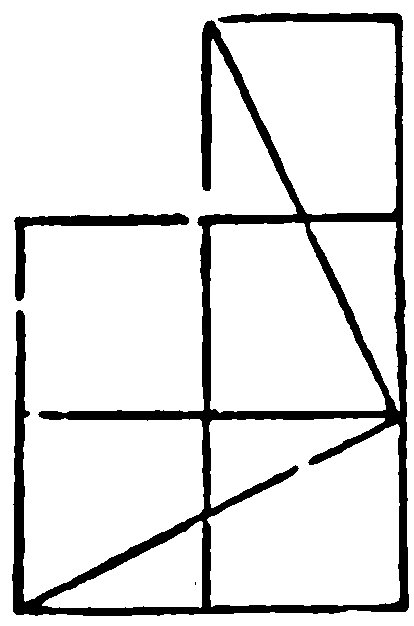
Fig. 80.
A SQUARE OF FOUR PIECES.
In a square card punch twelve holes, or make them with a pencil, and then cut it into four equal-sized pieces, each of the same shape, and containing three holes or marks.
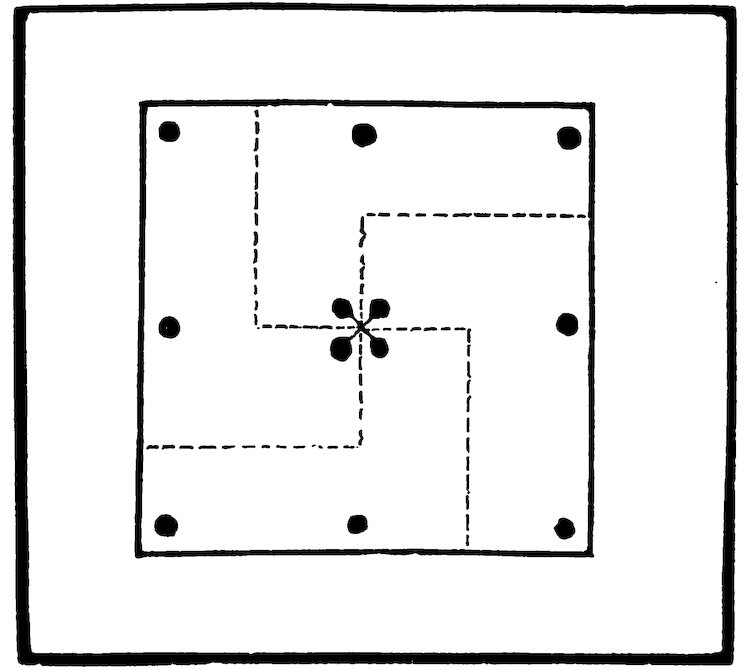
Fig. 81.
118
The Puzzle of Five Pieces.
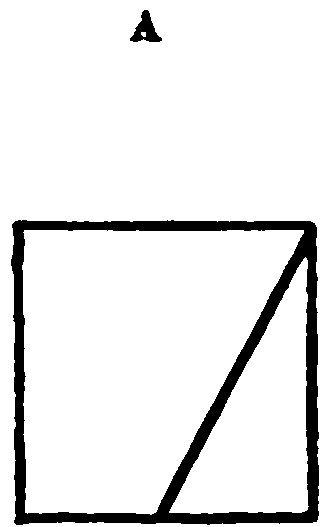
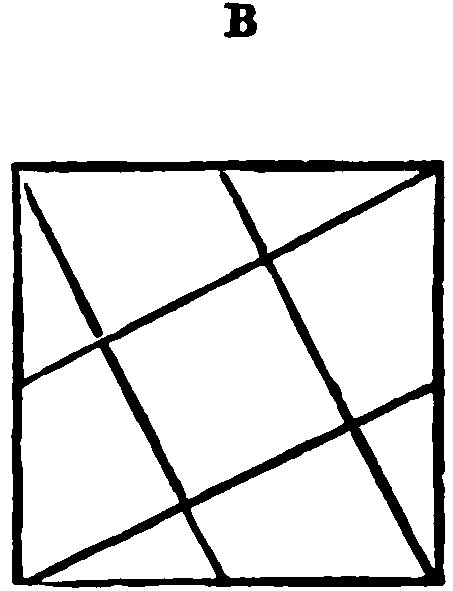
Find the centre of one side of four out of five squares, and cut them from that point to the opposite corner; place them around the perfect square, and they will form the figure here presented.
A Fig. 82.
B Fig. 83.
Another of Triangles.
With the five triangles make a square.
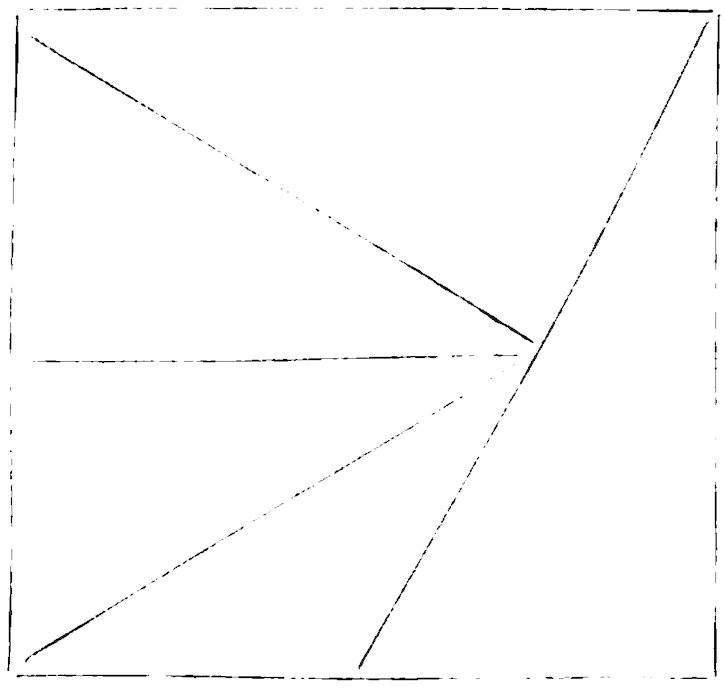
Fig. 84.
Another.
Dot a square card in eight places, which dots are to be divided by straight lines, so as to cut the cross into 119five pieces, two dots to each piece except the centre one, which must comprise eight.
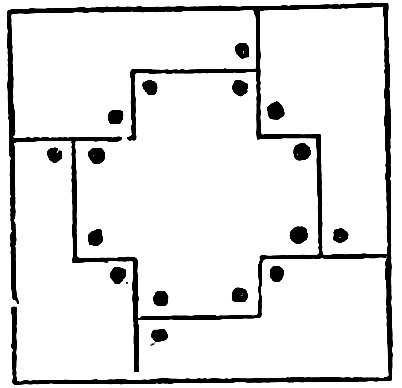
Fig. 85.
A SQUARE OF SEVENTEEN SQUARES.
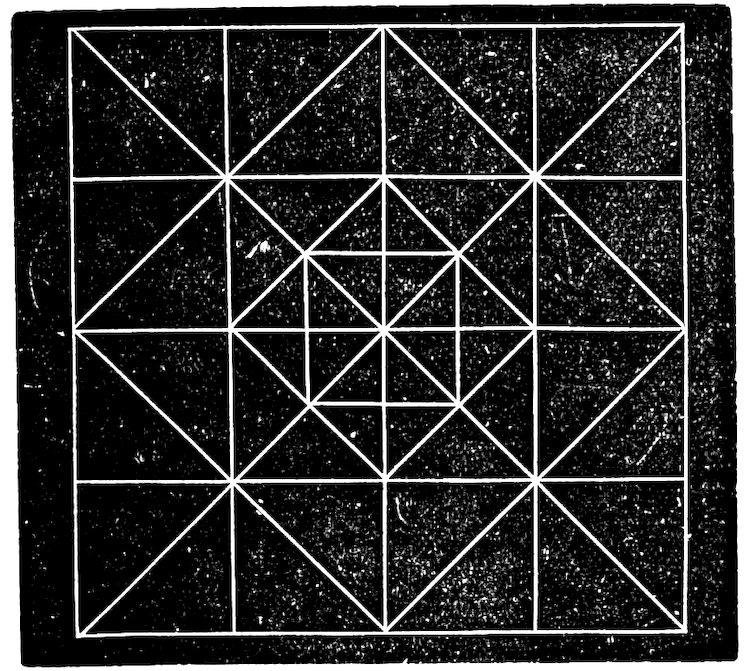
Fig. 86.
To divide a square into seventeen squares, begin by dividing each side of the square into four portions, drawing lines across each way to these points to make 120sixteen squares. Unite the points of the diamond, within which is a square one-quarter the size of the first. A second diamond within this quarter-sized square, cut by a Saint Andrew’s Cross—gives the points for the seventeenth square.
Another of Four Triangles and a Square.
Cut the card first into a ten-inch length, two inches wide; and then of the pieces form a square.
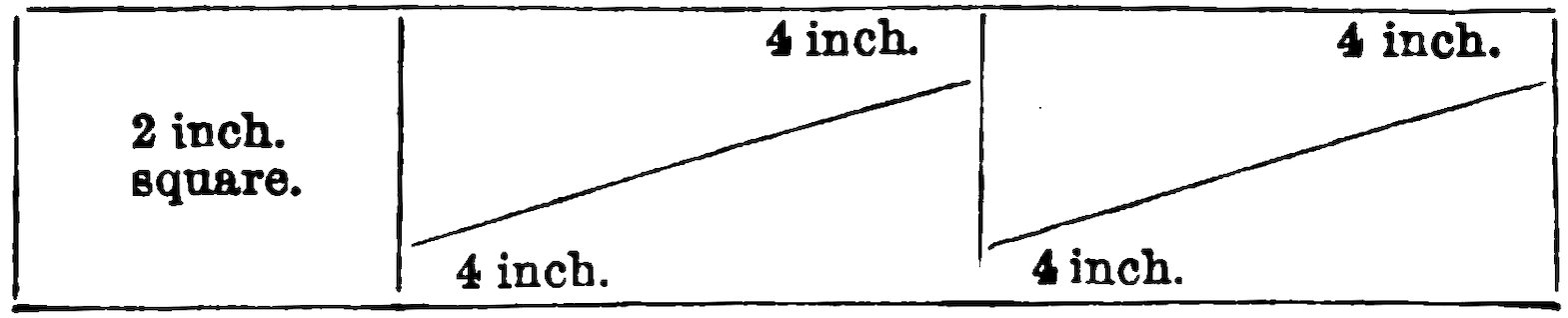
Fig. 87.
Of Four Squares and Eight Triangles.
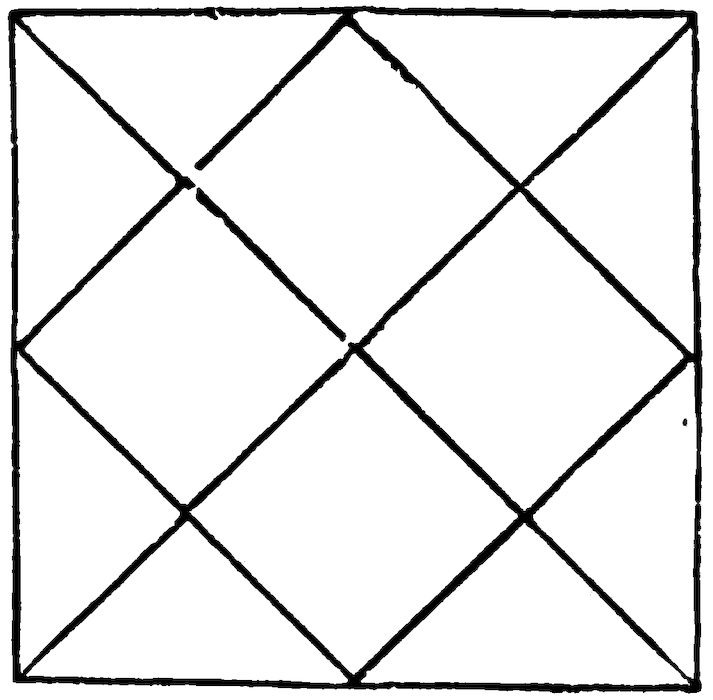
Fig. 88.
121
Of Nine Pieces.
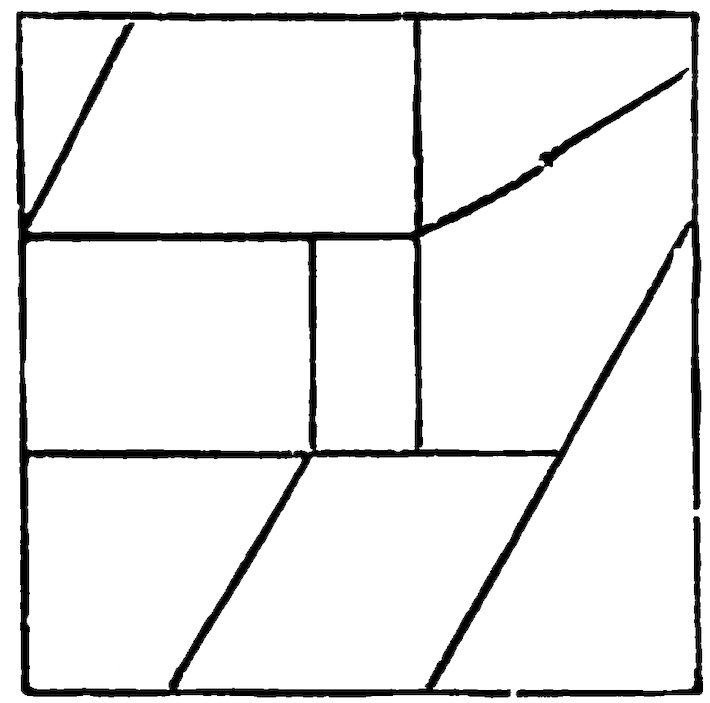
Fig. 89.
Of Ten Pieces.
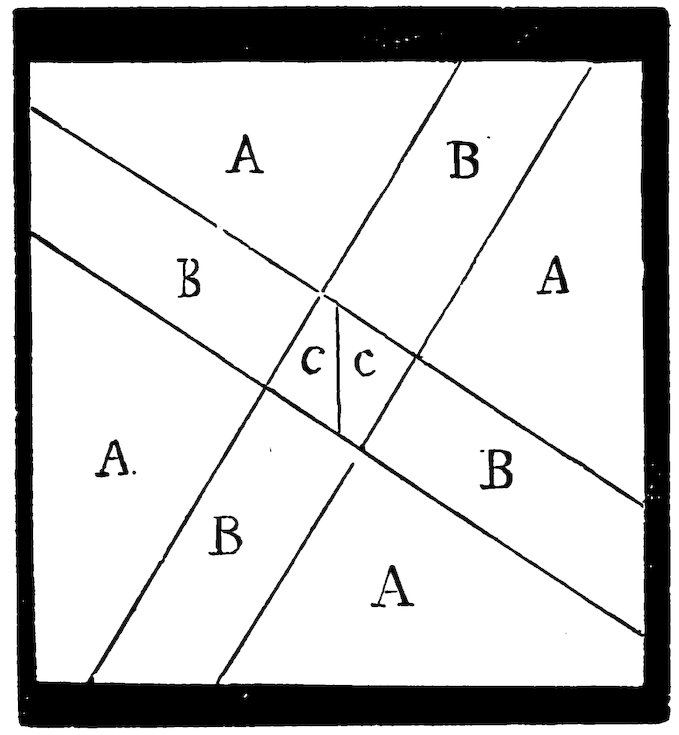
Fig. 90.
First cut the square into pieces of the three shapes shown, four of A, four of B, and two of the small one C. 122The formation of a perfect square with them will be a difficult task.
Of Twenty Triangles.
Begin by placing four triangles at the sides of a square of four triangles, when the rest of the shape can be filled in readily.
Of Eleven Pieces.
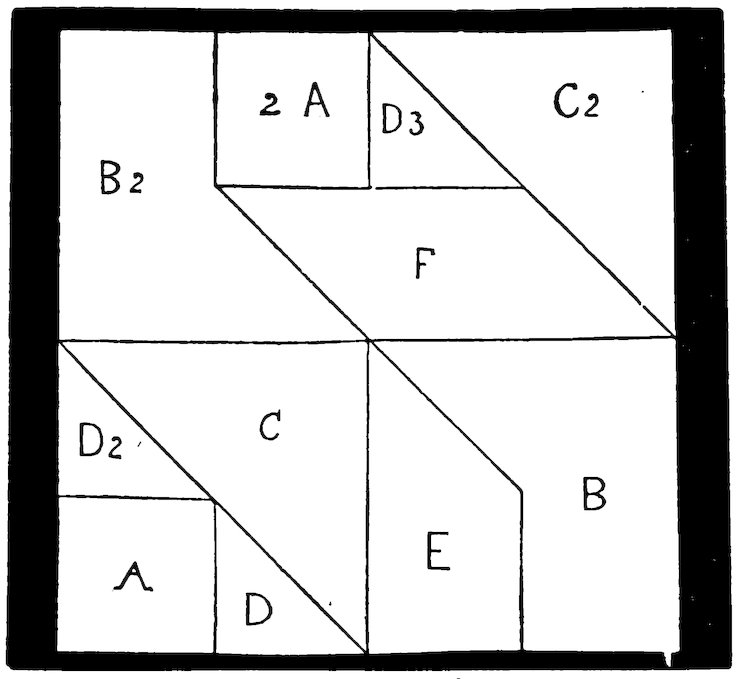
Fig. 91.
Cut up a square into four sets of two each, A a square, B and C a triangle; three of the triangle D, and one each of E and F. Begin at the left lower corner with A, to its top and right side place two of D, then a large triangle C; a square is now made, one quarter of the large one. The second square to the right requires but 123the two pieces, E and B. The other half, from there only being five pieces to fit, will take but little time and trouble.
THE OVAL PUZZLE.
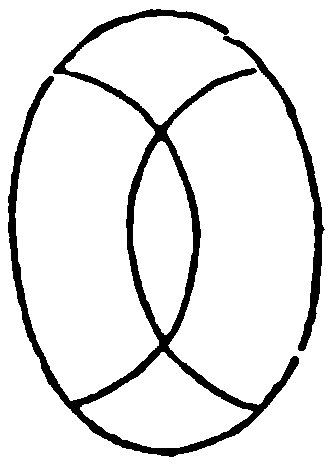
Fig. 93.
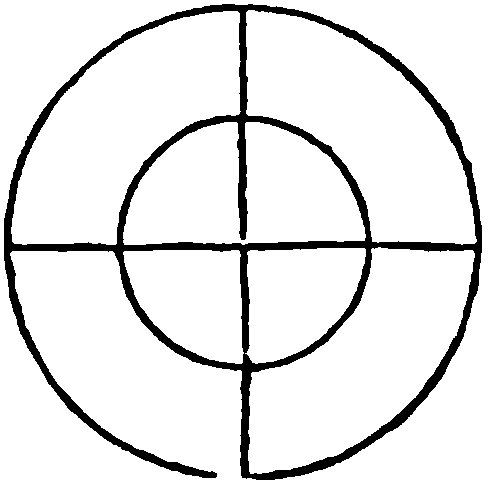
Fig. 92.
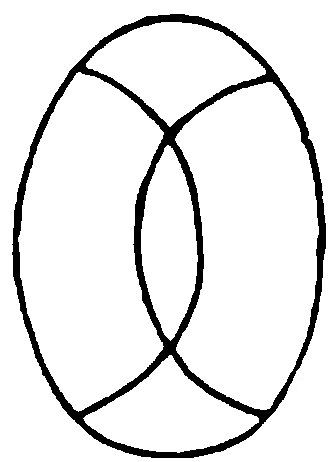
Fig. 94.
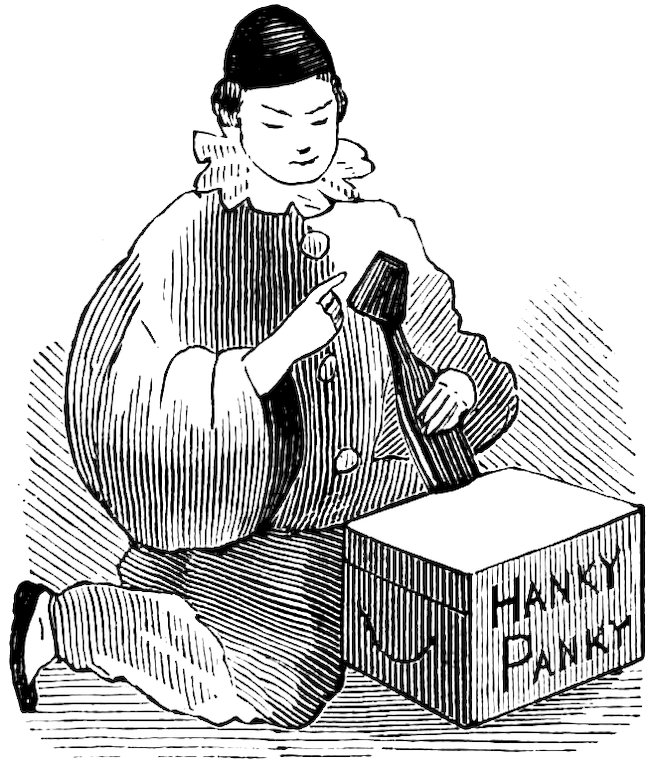
Hanky Panky has to make two oval boards: but it so happens that the area, exclusive of hand-holes in the centre, and the circular piece, are the same. To cut his stuff, on finding the centre of the circle, he strikes a second circle, half the diameter of the first, with the same centre. Then he cuts the whole into quarters, by means of two lines drawn at right angles to each other, then cuts along the inner circle (Fig. 92) and puts the pieces together, as in Figs. 93, 94.
124
CHECKER PUZZLE.
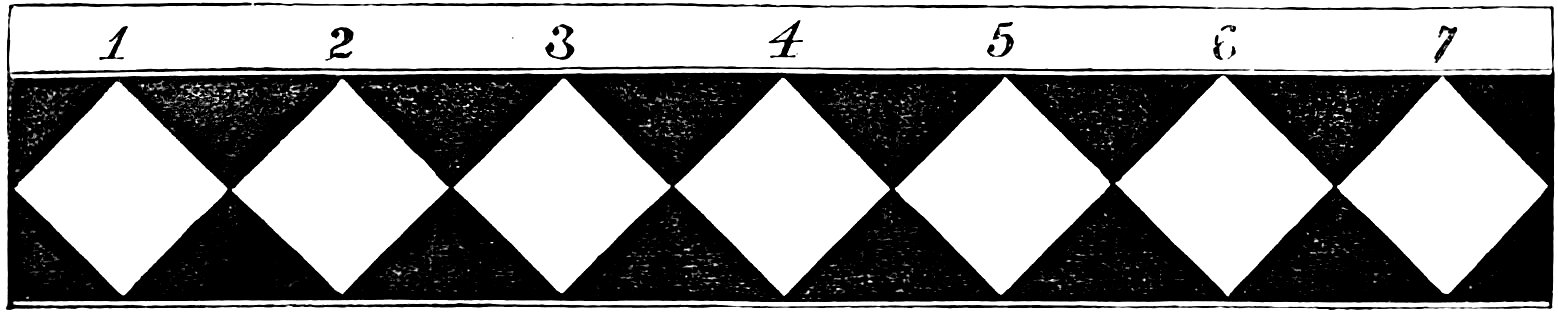
Fig. 95.
The puzzle is as follows:—After placing three red wafers in the squares Nos. 1, 2 and 3, and three blue wafers in Nos. 5, 6 and 7, you are to move the three blues into the squares occupied by the reds and the three reds into the squares occupied by the blues (keeping within the squares), the reds moving towards the right, and the blues to the left, not being allowed to move back after once moving forward. You are to jump only one at a time, and have the privilege of moving either card into a vacant square adjoining. The first move, of course, is either from 3 or 5 into 4.
Explanation. Move blue wafer from 5 to 4; red wafer from 3 to 5, jumping 4; red from 2 to 3; blue 4 to 2, jumping 3; red from 6 to 4, jumping 5; blue from 7 to 6; red from 5 to 7, jumping 6; red from 3 to 5, jumping 4; red from 1 to 3, jumping 2; blue from 2 to 1; blue from 4 to 2, jumping 3; blue from 6 to 4, jumping 5; red from 5 to 6; red from 3 to 5, jumping 4; 125and blue from 4 to 3, which performs the puzzle, having changed the three blue wafers from their former places into those of the red, and the red into those of the blue. This may be shown to a person a number of times, and if done quickly not one in ten will be able to perform it.
THE UNDETACHABLE CYLINDER.
Cut a slit close to one edge lengthwise of half a playing card, and of the other piece make a cutting in the following shape:—
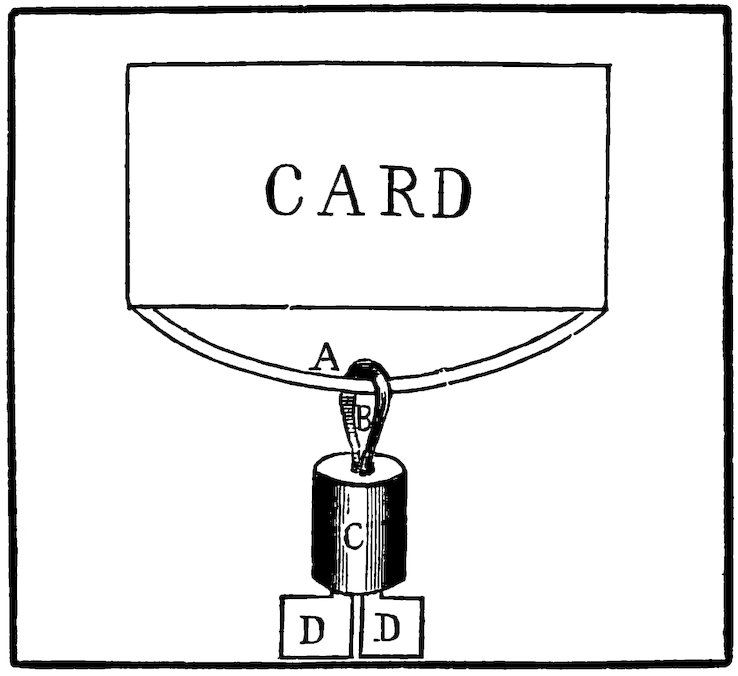
Fig. 97.
Pass the thin long ends through a button, a perforated disc of paper, or a piece of pipe-stem, after having taken the slip of card in its loop, and unfold the large square wings.
126If the bands are not shown, the way to get the little cylinder off is truly undiscoverable.
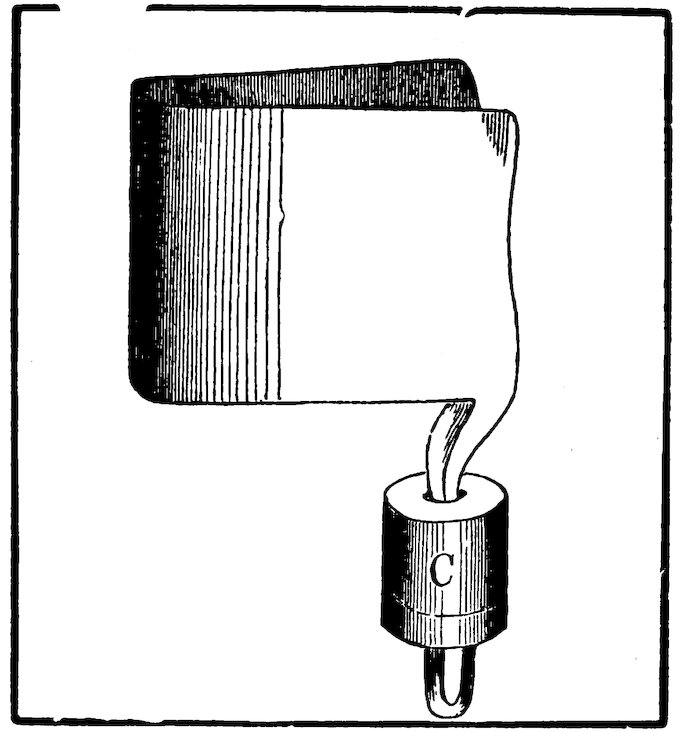
Fig. 98.
It is done, of course, by doubling the flat card till the slip can be pulled through the pipe-stem, when one of the square wings will go through it, and the release follows naturally.
TRIUMPHANT COLUMN.
Take a number of smooth true cylinders, of metal or hard wood, and, by carefully placing one upon another, rear a slender column. If the ground is firm and level, such a pillar may attain a somewhat astonishing height.
127
A PRETTY TRICK IN BALANCING.
Put an orange, apple, or other tempting object fifteen inches from the wall, and present it to any one who can pick it up while standing against the wall, or rather while keeping his legs against it. Or, again, challenge whoever has been distinguishing himself in agility to keep upright on the inner leg while sidewise against a wall.
Then—as probably you will be asked to perform some feat yourself after having thus set impossible tasks to others—put a cork in a bottle. Drive a large pin into it horizontally, and, having previously stuck two steel forks opposite each other in a second cork, with their handles inclining downwards, and run the head of a needle into the bottom of this cork, set the needle point on the pin’s head, when the forkified cork will be delicately balanced, and may even be turned round without falling.
THE ANGULAR PUZZLE.
Cut a piece of cardboard into the form of, and of equal proportions to, the figure given here, after which, produce, with the same, three successive pyramidal or angular boxes, alternately bearing the respective numbers 128of 7, 6, and 5 corners, still keeping the cardboard in one piece. After cutting the card half through at the dotted lines, so that it will bend more squarely, bring the ends of 1—2 and 3—4 together; bend the whole in the middle at 5—6: fold 1—2 and 3—4 over one another, and the six-cornered box is formed. By again placing the angular sections inwards, the box will be finished. If larger, gum the parts as you fold them, and a curious box will be the result; if covered with Dutch metal so as to conceal all the seams, it may be a puzzle-box indeed.
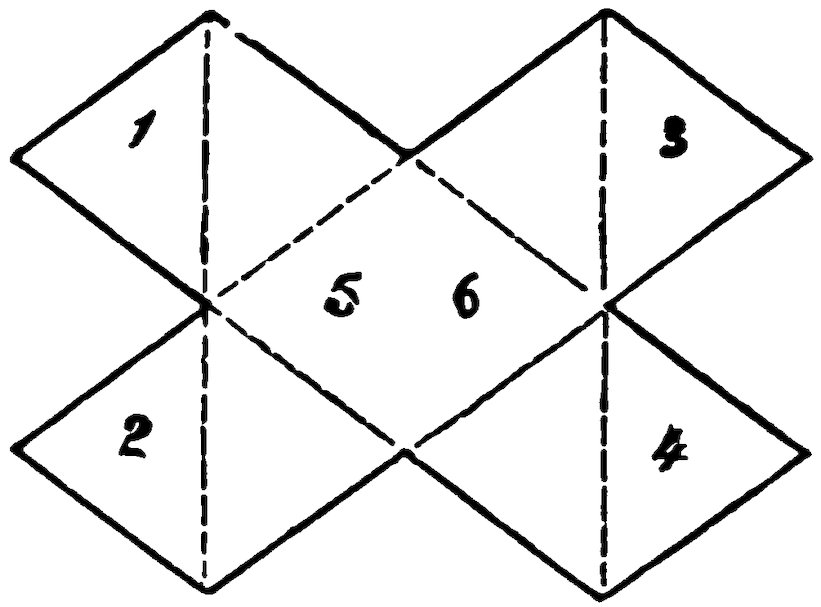
Fig. 99.
129
THE POSTS AND PADDOCK PUZZLES.
I have a paddock found, which is neither square nor round,
But an octagon; and this I have laid out
In a novel way, though plain in appearance, and retain
Three posts in each compartment; but I doubt
Whether you discover how I apportioned it, e’en though
I inform you ’tis divided into four.
But, if you solve it right, ’twill afford you much delight,
And repay you for the trouble, I am sure.
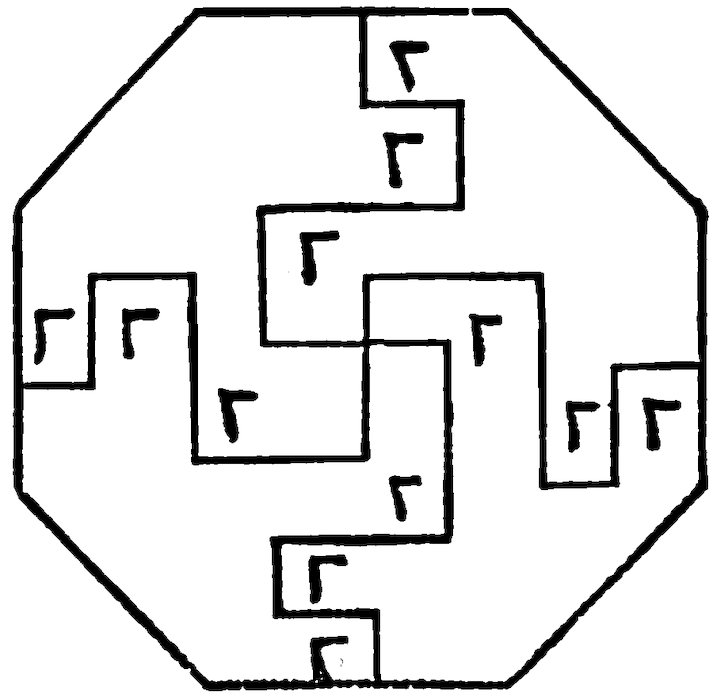
Fig. 100.
THE LANDLORD TRICKED.
Twenty-one persons sat down to dinner at an inn, with the landlord at the head of the table. When dinner was finished it was resolved that one of the number should pay the whole score; to be decided as follows. A person should commence counting the company, and every seventh man was to rise from his seat, until all were counted out but one, who was to be the individual who should pay the whole bill. One of 130the waiters was fixed upon to count the company out, who, owing his master a grudge, resolved to make him the person who should have to pay. How must he proceed to accomplish this?
Explanation.—Commence with the sixth from the landlord. You illustrate with counters.
THE DIVIDED ORCHARDS.
To a house where dwell four persons, (see the windows to their rooms) is an orchard; each man wishes to enclose his two fruit-trees in a space equal to his neighbour’s. The dotted lines show the position of the hedges.
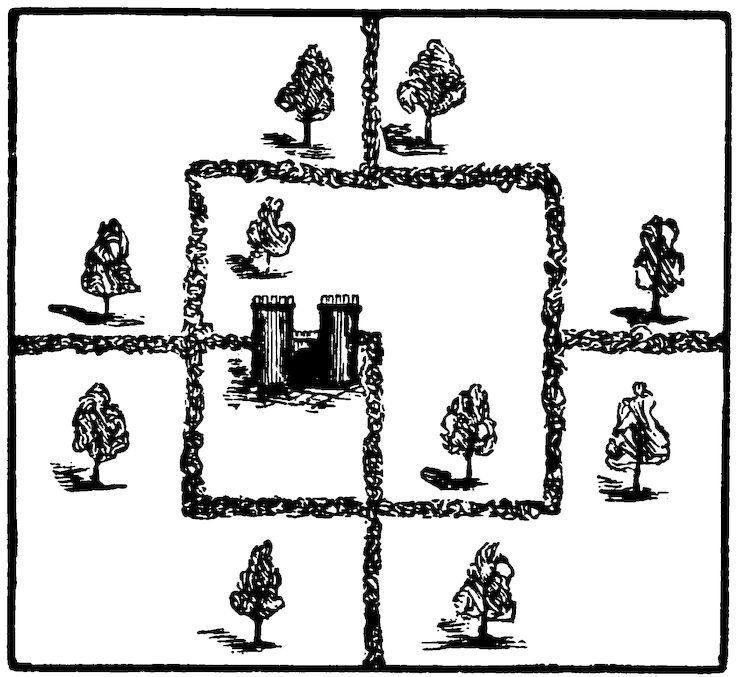
Fig. 101.
131
THE OBLONG PUZZLE.
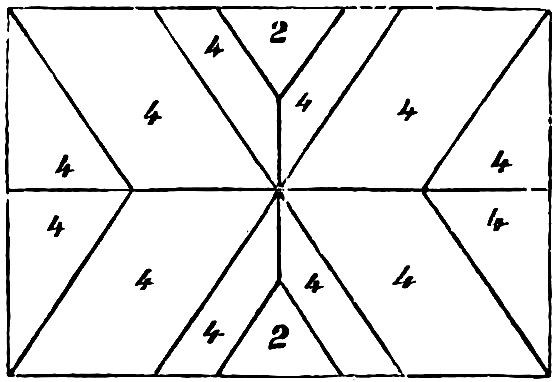
Fig. 102.
Having cut up a square of card by the lines shown, reform it. By remembering how to form one quarter of the figure, the whole will be so simplified that you can perform it under the spectator’s eyes with a rapidity which will bewilder them.
132
THE ONE-QUARTERLESS SQUARE.
To divide a square less one-quarter, triangularly shaped, into four parts of the same shape and size, follow the lines here described.
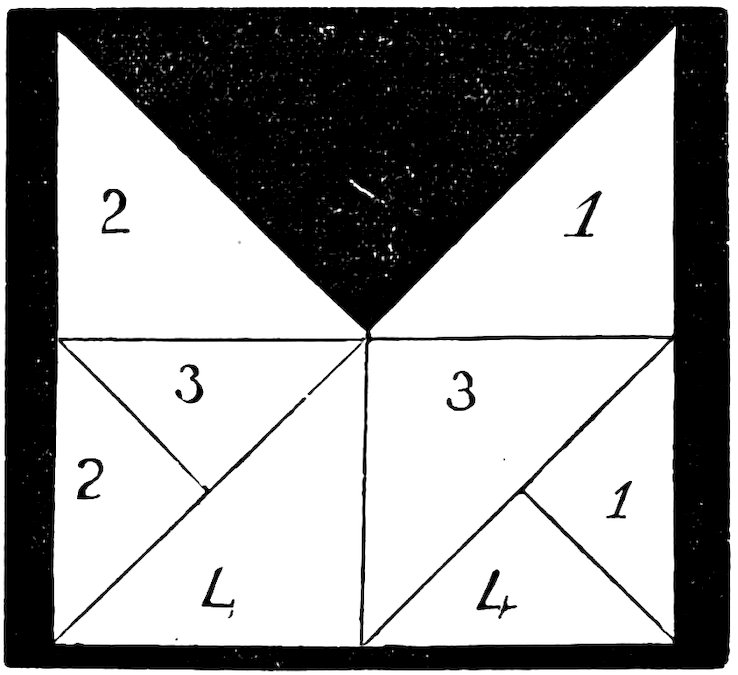
Fig. 103.
COUNTER PUZZLE.
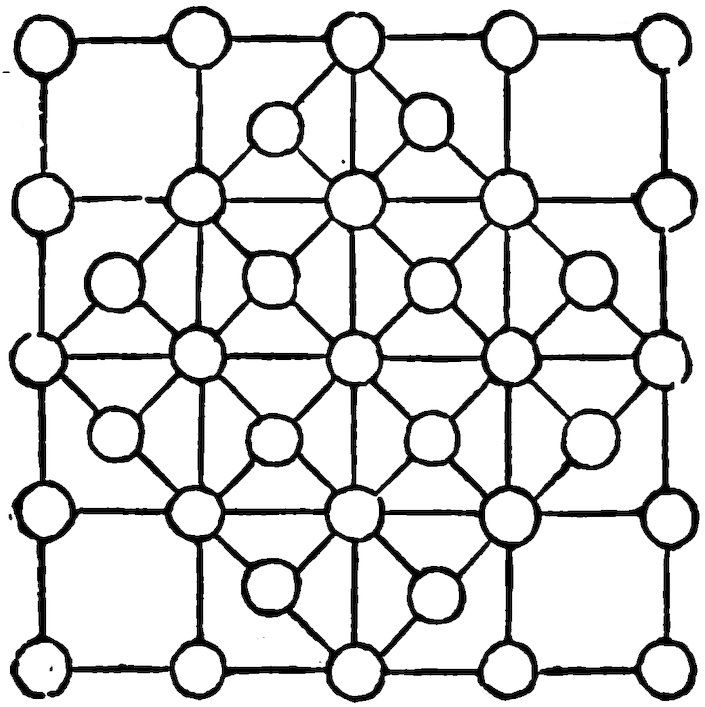
Place eight counters as here given:

The puzzle is to play them in twos, taking up only one at a time, and, each time, skipping two with the one in your hand. Answer: Put 4 on 7, 6 on 2, 1 on 3, 8 on 5; or, 5 on 2, 3 on 7, 8 on 6, 4 on 1, &c. For ten, put the 4th on the 1st, the 6th on the 9th, the 8th upon the 3rd, the 2nd on the 5th, and the 7th on the 10th.
133