TRICKS WITH CARDS, DICE, DOMINOES, &c.
Reading edition
As the deceptions performed by sleight of hand at cards rely, notwithstanding their variety, on only a few easily acquired movements, and these have been fully explained, with illustrative diagrams, in “The Secret Out,” we do not repeat the revelation, in all cases, of these processes.
The tricks immediately following are quite innocent, and may be performed in any private circles. We have thought it advisable to append an exposure of the devices by which gamblers or any persons who cheat their associates and strangers, deceive the inexperienced.
The conjuror always warns the company that his 252exhibitions of dexterity, are meant to delude the inattentive and untaught, so that he can do no harm and occasion no loss.
THE GARCIA SLIP, OR TOUR D’HOMBOURG.
You must remember the bottom card of the pack, which you hold face down in your left hand. Cover the cards with your right hand, held over them palm down, and run the cards one by one in under the right hand by means of the finger ends. One of the company is to lay his finger on any card he pleases and stop it. Let us call this one A.
On his doing so you secretly slip back the bottom card, and, opening the pack at the card A, get the bottom card up next under it. Now bring the lower portion to the top of the other, and show B as the bottom card.
The audience having fully taken note of it, you let them shuffle the cards as much as they please, for it little matters while you know what the card is.
On receiving the cards again, you spread them out on the table, face up, and readily point to the card B as if it were the card A which was really selected, but for which B was substituted.
TO TELL A CARD THOUGHT OF.
Take a pack containing fifty-two cards, then lay out one card, any card you see proper. Then divide the cards into three rows, by laying them down face upwards. When you have laid down three begin at the left and lay one upon the first, so continue to the right until you have laid out the fifty-one; at the same time request some person to think of a card. When they are laid out, ask which parcel the card is in; he tells you, place that parcel 253in the middle of the other. This done, lay them out again in three parcels; so continue to do for four times, and the card he thought of will be the twenty-sixth card.
TO GUESS THE SPOTS ON A CARD.
Take a whole pack, consisting of 52 cards, and desire some person in company to draw out any card, at pleasure, without showing it. Having assigned to the different cards their usual value, according to their spots, call the knave 11, the queen 12, and the king 13. Then add the spots of the first card to those of the second; the last sum to the third; and so on, always rejecting 13, and keeping the remainder to add to the following card. It may be readily seen that it is needless to reckon the kings, which are counted 13. If any spots remain at the last card, you must abstract them from 13, and the remainder will indicate the card that has been drawn: if 12 remains, it has been an ace; but if nothing remains, it has been a king.
Demonstration.—Since a complete pack contains 13 cards of each suit, the values of which are 1, 2, 3, &c., as far as 13, the sum of all the spots of each of the different suits will be 7 times 13 (91), which is a multiple of 13; consequently the quadruple is also a multiple of 13: if we add the spots of all the cards, always rejecting 13, the remainder at last must be 0. Hence it is evident, that if a card, the spots of which are less than 13, be drawn, the difference between its spots and 13 will be what is wanting to complete the number. If, at the end, then, instead of attaining to 13, we attain only to 10, for example, it is plain, that the card wanting is a 3; and if we attain exactly to 13, the card missing must be equivalent to 13; that is, it must be a king.
254
TO TELL TWO CARDS OUT OF TWENTY.
You must retain in your memory the four following words, with the arrangement of the letters which compose them:—
m i s a i
t a t l o
n e m o n
v e s u l
Collect all the cards into the left hand, two by two, as they lay on the table, and then place them, one by one, in the same order as the preceding letters, taking care to place the two first as the two m, the two next as the two i, the two following as the two s, and so on.
Ask each person in which horizontal row his two cards are. If he says they are both in the same row, for example the third, they will be pointed out by the letters n and n, contained in that row; if they are in two different rows, as the first and last, the letters s and s will indicate the place which they occupy.
TO BRING ALL THE CARDS OF THE SAME KIND TOGETHER.
Have in readiness a pack, all the cards of which are arranged in successive order; that is to say, if it consists of 52 cards, every 13 must be regularly arranged, without a duplicate of any one of them. After they have been cut as many times as a person may choose, form them into 13 heaps of 4 cards each, with the coloured faces downwards. When this is done, the 4 kings, the 4 queens, the 4 knaves, and so on, must necessarily be together.
255
THE FOUR INDIVISIBLE KINGS.
Take four kings, and place between the third and fourth any two common cards whatever, which must be neatly concealed; then show the four kings, and place the six cards at the bottom of the pack; take one of the kings, and lay it on the top, and put one of the common cards into the pack nearly about the middle; do the same with the other, and then show that there is still one king at the bottom: desire any one to cut the pack, and as three of the kings were left at the bottom, the four will therefore be found together in the middle of the pack.
256
TO GUESS CARDS SELECTED BY SEVERAL PERSONS.
Show as many cards to each person as there are persons to choose; that is to say, 3 to each, if there are three persons. When the first has thought of one, lay aside the three cards in which he has made his choice. Present the same number to the second person, to think of one, and lay aside the three cards in the like manner. Having done the same in regard to the third person, arrange all these cards in three rows, with their faces turned downwards, and then put them together in order. If you take the 3 first, and present them successively to the different persons, and do the same thing with the others, you may easily guess the cards, by observing, that the card thought of by each person will have the same place among the cards as the person has in regard to the other two; that is to say, the card thought of by the first person will be first of that packet in which he discovered it; that thought of by the second will be the second in the packet where he recognized it; and that of the third will be the last and in the last packet.
The operation is exactly the same when the number of persons is greater. If, instead of 3, there are 4 or 5 persons, four or five cards must be presented to each.
A NEW THREE-CARD TRICK.
As it is necessary that the cards presented should be distinguished, we shall call the first A, the second B, and the third C. Let the persons, whom we shall distinguish by first, second, and third, choose privately whichever of the cards they think proper, and when they have made their choice, which is susceptible of six variations, give the first person 12 counters, the second 25724, and the third 36: then desire the first person to add together the half of the counters of the person who has chosen the card A; the third of those of the person who has chosen B; and the fourth part of those of the person who has chosen C; and ask the sum, which must be either 23 or 24, 25 or 27, 28 or 29, as in the following table:
First. Second. Third. Sums.
12 24 36
A B C 23
A C B 24
B A C 25
C A B 27
B C A 28
C B A 29
This table shows, that if the sum is 25, for example, the first person must have chosen the card B, the second the card A, and the third the card C; and that, if it be 28, the first person must have chosen the card B, the second the card C, and the third the card A; and so of the rest.
TO TELL THE SPOTS ON ALL THE BOTTOM CARDS OF SEVERAL HEAPS.
Arrange each heap of cards in such a manner that the spots on the bottom one, added to the cards above it, may always amount to twelve; continue to make as many heaps as possible, in the manner above prescribed, and place the remaining cards on one side. Then separate in your mind four heaps, and multiply the heaps which remain, after these are deducted, by 13; this product, added to the number of cards, will be that of the spots required. We give the solution of this problem by an analysis in “To Guess the Spots on a Card,” p. 253.
258
TO NAME ALL THE CARDS OF A PACK.
Have a complete pack of 52 cards, and arrange them according to the order of the following words, which you must retain in your memory.
Unus quinque novem famulus sex quatuor duo
Ace five nine knave six four two
Rex septem octo fœmina trina decem
King seven eight queen three ten
Besides this first order, you must arrange them also according to the order of the colours, spades, hearts, 259clubs, and diamonds; so that the 52 cards may be disposed as follows:
ORDER OF THE CARDS.
1
Ace of spades
2
Five of hearts
3
Nine of clubs
4
Knave of diamonds
5
Six of spades
6
Four of hearts
7
Two of clubs
8
King of diamonds
9
Seven of spades
10
Eight of hearts
11
Queen of clubs
12
Three of diamonds
13
Ten of spades
14
Ace of hearts
15
Five of clubs
16
Nine of diamonds
17
Knave of spades
18
Six of hearts
19
Four of clubs
20
Two of diamonds
21
King of spades
22
Seven of hearts
23
Eight of clubs
24
Queen of diamonds
25
Three of spades
26
Ten of hearts
27
Ace of clubs
28
Five of diamonds
29
Nine of spades
30
Knave of hearts
31
Six of clubs
32
Four of diamonds
33
Two of spades
34
King of hearts
35
Seven of clubs
36
Eight of diamonds
37
Queen of spades
38
Three of hearts
39
Ten of clubs
40
Ace of diamonds
41
Five of spades
42
Nine of hearts
43
Knave of clubs
44
Six of diamonds
45
Four of spades
46
Two of hearts
47
King of clubs
48
Seven of diamonds
49
Eight of spades
50
Queen of hearts
51
Three of clubs
52
Ten of diamonds
This order is of such a nature that, by knowing any one of the 52 cards, that which follows it may be also known.
Thus, for example, if it were required to know what card follows the king of spades, it will be sufficient to 260recollect that septem, in the two Latin lines above given, which follows that of rex, denotes that it is a seven; and as the colour which follows the spades is hearts, it is the seven of hearts, and so for the rest.
Everything being thus arranged, having retained in your memory the above words, and the order of the colours, desire any person to cut the pack as many times as he chooses; for it will be easy to name all the cards in order provided you have found means, by some dextrous manœuvre, to observe that one which is at the top of the pack.
The same arrangement of the cards may be employed for the following two tricks especially, as well as others.
EVEN OR ODD.
First, find out whether the last card in the pack be black or red; then, on the pack being cut into two parts, if the card found at the bottom of the upper division is of the same colour as that at the bottom of the pack, the two parts which have been separated, contain each an even number; on the other hand, if it be of a different colour, they contain each an odd number.
TO TELL THE SPOTS ON SELECTED CARDS.
Having presented the pack, that the person may choose several succeeding cards at pleasure, privately observe the card which is above those he has chosen, and how many he has drawn from the pack; it will then be easy to count how many spots they ought to contain.
For example, if the observed card be a nine, and four cards have been drawn, it may readily be seen that those drawn must be a knave, equivalent to 10 spots: a six, a four, and a two. You may then announce, that the cards in the person’s hand contain 22 spots.
261
TO TELL A CHOSEN CARD OF FOUR.
Let the person draw four cards from the pack at pleasure, and desire him to think of one of them; then take these four cards back, and place two of them at the top and two at the bottom of the pack, in a dextrous manner, so as not to be perceived: under the two last, place any four cards whatever; then display the lower part of the pack on the table, showing only 8 or 10 cards, and ask the person whether the one he thought of be among them. If he says No, you may be sure that it is one of the two which you put at the top of the pack; in that case you must transfer them to the bottom, and then, showing the bottom of the pack, say, Is not this your card? If he replies No, turn aside that card with your third finger, which you must have previously moistened, and desire him to draw out his card himself from the bottom of the pack.
If the person should say, that the card he thought of is among the first shown to him, dextrously remove the four cards put at the bottom of the pack, in order that the two, one of which is the card he thought of, may be the lowermost of the pack, and you may then either show him his card, or make him draw it out himself, as above explained.
262
TOPSY TURVY.
On receiving the selected card pretend to shuffle it amongst the others, but really bring it to the top. The rest of the pack you arrange with their edges even, whilst the top card projects a little.
On pushing that card a little out, at the same time as you drop the pack perpendicularly, the resistance of the air will turn the single card upside down, so that it will rest face up on the top of the fallen cards.
THE CONJUROR’S CARD CASTLE.
From a pack of cards two are forced upon two of the company. They are replaced, and the pack is shuffled. While this is being done, a little model house is brought into the room and placed on the table.
In its front are two windows, with closed blinds, and a door.
The pack is thrust down the chimney of the house, when, instantly, the door flies out and emits the pack of cards without the two selected cards, which appear one at each window.
Explanation.—The house is already prepared with a pack of cards, the duplicate of that used, less the two cards like the couple forced. These two are placed in the windows behind the closed shutters or drawn blinds, as the case may be.
When the second pack is thrust down the chimney, it touches a lever, which at the same time throws open the door and pushes out the other pack, and discloses the cards in the windows.
263
ODD OR EVEN.
Let one of the company take in each hand several cards, an even number in one hand, and an odd in the other.
You engage to tell in which hand he holds the even number.
To do so, bid him multiply the number held in his right hand by three, and that in his left hand by two, and add the product together. He is then to answer whether the sum is odd or even.
If even, the right hand contained an even number, and vice versâ.
MYSTERIOUS TRICK OF THIRTY-SIX CARDS. TELLING THE CARD YOU LOOK AT WITHOUT SEEING THE PACK.
To perform this trick you must take a pack of cards containing fifty-two in number. Then take out the two, three, four, and five spots of each suit (meaning the spades, hearts, diamonds and clubs). Then commence as follows with the remaining thirty-six: Commencing with six of diamonds, face downwards, seven of clubs, eight of hearts, nine of spades, ten of diamonds, jack of clubs, queen of hearts, king of spades, ace of diamonds, six of clubs, seven of hearts, eight of spades, nine of diamonds, ten of clubs, jack of hearts, queen of spades, king of diamonds, ace of clubs, six of hearts, seven of spades, eight of diamonds, nine of clubs, ten of hearts, jack of spades, queen of diamonds, king of clubs, ace of hearts, six of spades, seven of diamonds, eight of clubs, nine of hearts, ten of spades, jack of diamonds, queen of clubs, king of hearts, ace of spades.
After having arranged the cards in the order above mentioned, they may be cut by all in the house, or as 264many as please, and by placing the cut under the pack each time the relative position will not be changed. Then ask the person who has the cards in his hand what card he has at the bottom of the pack (the faces being down); he answers, giving the name of the bottom card; then you can answer positively, by calling the card one less in value. For example, the nine of clubs is at the bottom, the eight of diamonds will be upon the top, the second will be the seven of spades, the third the six of hearts, the fourth the ace of clubs, the fifth the king of diamonds, and thus you will find them completely arranged throughout the pack. At the conclusion of this feat you may shuffle them over and under by holding the main pack in the left hand, and slipping the cards off one at a time in the right hand, one over and the other under, until you change them entirely through the pack, then return the pack to the right hand and repeat the over and under shuffle. Then you can deal them out into four parcels, nine at a time, and you will find the nine hearts in one pile, the nine diamonds in the second, the nine spades in the third, and clubs in the fourth.
THE FOUR ASSOCIATES.
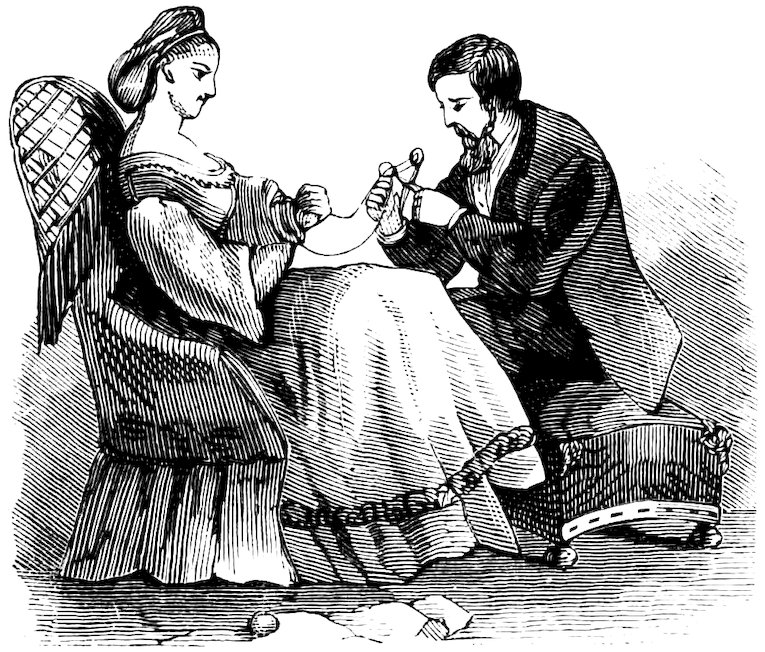
Let a person draw four cards from the pack, and tell him to think of one of them. When he returns you the four cards, dextrously place two of them under the pack, and two on the top. Under those at the bottom you place four cards of any sort, and then, taking eight or ten from the bottom cards, you spread them on the table, and ask the person if the card he fixed on be among them. If he say no, you are sure it is one of the two cards on the top. You then pass these two cards to the bottom, and drawing off the lowest of them, you 265ask if that be not his card. If he again say no, you take that card up, and bid him draw his card from the bottom of the pack. If the person say his card is among those you first drew from the bottom, you must dextrously take up the four cards that you put under them, and placing those on the top, let the other two be the bottom cards of the pack, which draw in the manner before described.
266
HOW TO CHANGE CARDS TO PICTURES.
Take a pack of cards, and paint the backs of one half of the pack with what figures you think fit, as men, birds, women, flowers, &c. Also, paint the faces of the other half of the cards in the same manner; thus, you will have a complete pack of odd pictures, and may—by showing the faces of that part of the pack whose backs only have been painted, and then by a momentary shuffle, apparently transforming them into a set of grotesque figures—produce much amusement.
There is another manner of making the pack; it is as follows:—Take a dozen cards or more, and draw a line from the right-hand upper corner, to the left-hand lower corner of the face of each of them; they will thus be all equally divided. Then paint part of some odd figure on the right division of each card, leaving the left untouched. By a little dexterity, you may now seem to transform a set of common cards into a painted pack.
MAGIC DISAPPEARANCE.
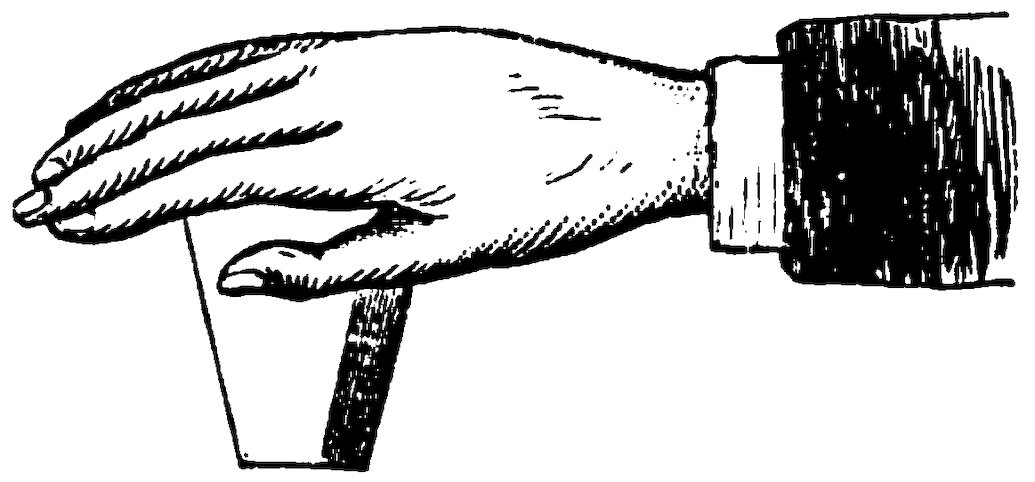
Divide the pack, placing one half in the palm of the left hand, with the face of the cards downwards; then take the balance of the pack in the right hand, holding them between the thumb and three first fingers, and place the cards upright, so that the edges of the cards in your right hand will rest upon the back of those lying in the palm of the left hand perpendicularly, and forming a right angle with them, by which means you will perceive that the four fingers of the left hand touch the last card of the upright cards in your right hand. Be sure you get this position correctly, for the rest of the trick is very simple. You now request any one of your audience to examine the top card of the half pack that rests in the 267palm of your left hand, and to replace it again. Having done this, you request him to look at it again, and to his amazement it will have disappeared, and another card will appear in its place.
To perform this trick after you have assumed the position already described, you must dampen the tips of the four fingers that rest against the last card of the upright cards in your right hand. You must now raise the upright cards in your right hand very quickly, and the last card, No. 1, will adhere to the dampened fingers of your left hand.
As you raise the upright cards you must close your left hand skilfully, and you will thereby place the last card of the upright cards—which adheres to the fingers of your left hand—upon the top of the cards in the palm of your left hand, and when you request the person who examined the top card in your hand to look at it once more, he will see the card you have just placed there, instead of the card he first examined.
Observe, be very rapid and dextrous in slipping the card at the back of the upright card from its position there to the top of the cards in the palm of your left hand.
268
SIXTEEN CARDS BEING IN TWO ROWS, TO FIND THAT WHICH A PERSON HAS THOUGHT OF.
The cards being arranged as follow, desire the person to think of one, and to observe well in which row it is:
A B C D E F H I
0 0 0 0 0 0 0 *
0 0 0 0 * 0 0 0
0 0 * 0 0 0 0 0
0 0 0 0 0 0 0 0
* 0 0 0 0 0 0 0
0 0 0 0 0 0 0 0
0 0 0 0 0 0 0 0
0 0 0 0 0 0 0 0
Let us suppose that the card thought of is in the row A: take up the whole row in the order in which it now stands, and dispose it in two rows C and D, in such a manner, that the first card of the row A may be the first of the row C; the second of the row A, the first of the row D; and so on, transferring the 16 cards from A and B, to C and D. This being done, again ask in which of the vertical rows the card thought of stands. We shall suppose it to be in C; remove that row as well as D, observing the same method as before; and continue in this manner until the card thought of becomes the first of the row I. If you then ask in which row it is, it may be immediately known, because after the last operation it will be the first in the row said to contain it; and as each row has a distinguishing character or sign, you may cause them all to be mixed with each other, and still be able to discover it by the sign you have remarked.
If a greater number of cards be employed, disposed in two vertical rows, the card thought of will not be at the top of the row after the last transposition: if there are 33 cards, 4 transpositions will be necessary; if 64 there must be 5; and so on.
269
A CERTAIN NUMBER OF CARDS BEING SHOWN TO A PERSON, TO GUESS THAT WHICH HE HAS THOUGHT OF.
To perform this trick, the number of the cards must be divisible by 3; and to do it with more convenience, the number must be odd.
The first condition, at least, being supposed, the cards must be disposed in three heaps, with their faces turned upwards. Having then asked the person in which heap is the card thought of, place the heaps one above the other, in such a manner that the one containing the card thought of may be in the middle. Arrange the cards again in three heaps, and having asked in which of them is the card thought of, repeat the operation as before. Arrange them a third time in three heaps, and having once more asked the same question, form them all into one heap, that containing the card thought of being in the middle. The card thought of must then necessarily be the middle one; that is to say, if 15 cards have been employed, it will be the eighth from the top; if 21, the eleventh; if 27, the fourteenth; and so on. When the number of the cards is 24, it will be the twelfth, &c.
THE RESTORATIVE CARD.
Secretly coil up a needle-full of thread by winding it round a ruler and slipping it off; and hide this in a card as you roll it up. Wind around this card a needleful of the same thread, which you then clip to pieces with scissors, shaking the bits into the fire or into your magic box by which they disappear. On unrolling the card, you seem to reproduce the destroyed thread.
270
THE FOUR CONFEDERATE CARDS.
A person draws four cards from the pack, and you tell him to remember one of them. He then returns them to the pack, and you dexterously place two of them under, and two on the top of the pack. Under the bottom ones you place four of any sort, and then taking eight or ten from the bottom cards, you spread them on the table, and ask the person if the card he fixed on is amongst them. If he says No, you are sure it is one of the two cards on the top. You then pass those two cards to the bottom, and drawing off the lowest of them, you ask if that is not his card. Should he again say No, you take up that card, and bid him draw his card from the bottom of the pack. But if, on the contrary, he says his cards are amongst those you first drew from the bottom, you must dexterously take up the four cards you put under them, and place them on the top. The other two are the bottom cards of the pack, and are to be drawn in the manner before described.
THE MAGIC POCKET-BOOK.
(Die zwei magichen Brieftaschen.)
Cut out two rectangular pieces of pasteboard three inches by three and a half inches, A B. Run a band of tape on the board A, from C to E, and from D to F: then turn over and glue the tape at C D at the back of A; and at E F at the back of B.
Fasten two other tapes in the same way on card B at G L on the back of it, and at G H on the back of A.
The two boards will now form a book of two leaves, opening as on hinges.
Bring four other tapes under those already fastened, marked M H Q R, and glue their ends down at the back 271of the card; and two more tapes on O and B sides of B; all of which form borders and are for no other purpose.
Make two envelopes like those for letters, and fasten down the front, where the address is written—which must be the same size as the card, so as to cover all the tapes G J and H L as well as the space between them; one envelope being thus face down upon the ribbons to which it is glued, the second envelope is pasted to the first one, face to face, one hiding the other and both, of course, hiding the tapes from view.
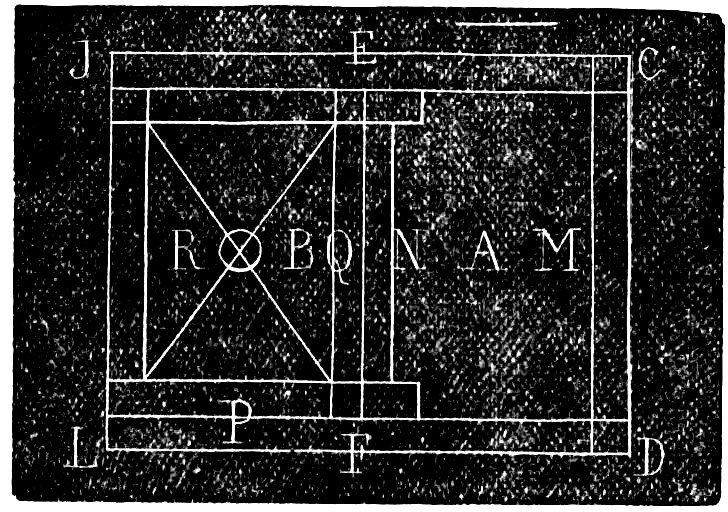
As the book can be opened twice over, by bringing the leaf on the left upon that next to it, and that again over on the other, when the envelope now open and alone shown is the duplicate, and not that first seen, a deception is easily performed.
Performance. A coin is borrowed and marked, or a question is written, and the coin or the paper is put into one of the envelopes, and folded up. In closing up the book you secretly reverse it, and bring the second envelope up so as to be shown open and empty, or with an answer to the question.
272Performance with cards. Having had a drawn card carefully noted, you undertake to change it into another one altogether. Placing it in your magic book and proceeding as with the coin above, the transformation is readily accomplished.
TO GUESS SEVERAL DRAWN CARDS.
A pack of similar cards is offered, from which two or three persons draw cards. They should not sit too closely together, however, lest one should see the cards drawn by the others. They note their cards and replace them in the pack. You turn, and while pretending to look through the pack, you take two other cards which you must have at hand, place with them a card out of the pack, and approach those persons who have drawn cards, asking each if his card is not among the three. On receiving an answer in the affirmative, you point out the drawn card.
THE BUTCHER’S GRIP, OR “HOLD IT FAST.”
Asking the most athletic person in company whether he is nervous, he will most probably answer in the negative; then ask whether he thinks he can hold a card tightly. If he answers, “No,” ask the question of some one else, till you obtain an answer in the affirmative. Desire the party to stand in the middle of the room, and holding up the pack of cards, you show him the bottom card, and request him to proclaim what card it is; he will say it is the knave of spades; you then tell him to hold the card tightly at the bottom, and look to the ceiling. While he is looking up, ask him if he recollects his card; if he says, “Yes,” desire him to draw it away, 273and ask him what it is; he will, of course, answer, “The knave of spades.” Tell him he has made a mistake, for if he looks at his card, he will find it to be the knave of hearts, which will be the case. Then give him the remainder of the pack, telling him that if he looks over it he will find the ace of spades in quite a different situation.
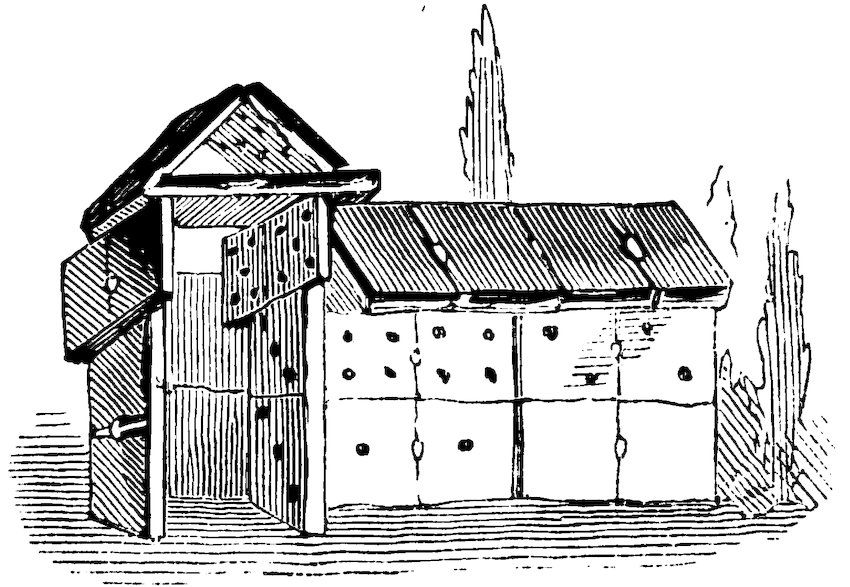
Explanation.—An extra knave of spades is cut in half, the upper part alone retained. When commencing your feat, get the knave of hearts to the bottom of the pack, and lay over the upper part of it, unperceived, your half knave of spades; and, under pretence of holding the pack very tight, throw your thumb across the middle of the knave, so that the joining may not be perceived, for the legs of those two knaves are so much alike that there is no danger of detection. You, of course, give him the legs of the knave of hearts to hold, and, when he has drawn the card away, hold your hand so that the faces of the cards will be turned towards the floor, and take an opportunity of removing the half knave: you may vary the feat by having a half knave of hearts.
274
TO PREVENT ANY ONE DRAWING A CARD WHICH YOU HOLD UP PLAINLY BEFORE HIM.
Place the four kings face up upon the top of the pack, their feet towards the company. As you place the topmost king upon the pack, you bend it secretly in the middle, folding the lower part back upon the upper half of the card, the head of which is now only visible, the feet of the king below seeming to belong to it. You conceal the deception by placing your two thumbs across the middle of the pack.
In this manner you can let three persons draw, and neither will draw the king that is on the top of the pack.
THE RECOVERABLE CARD.
Procure fifty-three cards exactly the same. Let a person draw from them, as from a regular pack, one card which he may burn or otherwise destroy.
Nevertheless, on his or another’s picking a second card at will out of the pack, it will appear to be the same as that destroyed.
It will possibly be observed: “You had two similar cards!” and a wiseacre will defy you to let the cards be counted, since he will suppose you were not prepared for this objection.
You can count them out, face down, and prove there are, indeed, fifty-two.
If other remarks are made substitute a regular pack of the same appearance.
Variation.—With two duplicate cards. After having shuffled the pack let the bottommost be drawn, examined, and destroyed.
Go to the chimney place and whistle: “Father, come 275home!” and, on returning to your former place, pull the duplicate card from the selector’s ear.
Modification.—Let a corner of the destroyed card be given to you. For this substitute a corner of the duplicate card. On returning and producing the card it is found to want that very piece by which it is to be identified.
A PACK OF CARDS KEPT TOGETHER IN THE AIR.
Have a pack of cards bound together with a hair, on the shelf at the back of your table. After having shuffled another pack of cards, bunch them rapidly, and, in lowering your hand as if to throw them away—substitute the prepared pack. These will fly through the air like a solid body until it comes in contact with ceiling, wall, or floor, when it will fall asunder.
276
TO CHANGE A CARD BY WORD OF COMMAND.
Have two cards of the same sort in the pack (say the ace of hearts). Place one next the bottom card (say ten of clubs), and the other at top. Shuffle the cards without displacing those three, and show a person that the bottom card is the ten of clubs. This card you slip aside with your moistened finger, and, taking the ace of hearts from the bottom, which all suppose to be the ten of clubs, lay it on the table, telling him to cover it with his hand. Shuffle the cards again, without displacing the first and last card, and, shifting the other see of hearts from the top to the bottom, show it to another person.
You then draw that secretly away, and, taking the bottom card, which will then be the ten of clubs, you lay that on the table, and tell the second person (who believes it to be the ace of hearts) to cover it with his hand.
You then command the cards to change places; and when the two parties take off their hands and turn up the cards, they will see, to their great astonishment, that your commands are obeyed.
TO PLACE THE FOUR KNAVES UPON ONE ANOTHER SO THAT ONLY THE UPPER HALF OF EACH CARD IS VISIBLE.
Upon the lower half of one of four knaves place the upper half of the second at right angles; upon the lower half of the second knave place the upper half of the third, also rectangularly; then the upper half of the fourth knave upon the under half of the third; and lastly push the under half of the fourth knave under the upper half of the first, and the trick is done.
277
TO CHANGE FIVE KINGS INTO FIVE QUEENS.
Draw a sharp knife gently across the middle of four kings of an ordinary pack. Peel the picture carefully from one half of the cards, and paste upon the blank part the four half pictures of four queens, which have been peeled off in the same manner. In this way you have four cards, each representing both a king and a queen.
To these prepared cards add an ordinary king and queen. These six cards you fan out, from the left to the right, in such a manner that only the kings are visible.
This is easily done if you keep the ordinary king at the end of the fan to the right, and the queen concealed behind it. You show the five kings, say that you will change them into five queens, blow upon the cards, reverse them, placing the king behind the queen, and display them as five queens.
278
THE SHUFFLED TEN.
Let a person remember the numerical position of a chosen card replaced in the pack. On taking the pack into your hand, bring a certain number of cards, say ten, from the top to the bottom.
Mentally take that number from the whole number of cards, fifty-two with a full pack, and boldly tell the company that the selected card will be the forty-second, reckoning from the card itself. If his card was the tenth, you count it eleven, twelve, thirteen, and so on, and his card will come out as announced.
THE MYSTIC CHANGE.
Take the four kings into your hand in such a manner that one slightly overlaps the other, yet so that each can easily be distinguished when held closely in the hand.
After showing them to the company, you slide them together, and place them, thus joined, upon the top of the pack, held in your right hand. You then draw off the four top cards, and lay each in a person’s lap, face downwards, directing them to place the flat of the hand upon them. You now draw four other cards from the pack, and place them each upon the lap of a neighbour of each of the four above persons, and direct them also to cover them with the flat of the hand. You now step with the rest of the cards, in front of each of these eight persons, flirt the cards towards the lap of each, and when each lifts his card from his lap, and looks at it, it appears that the four persons, upon whose lap you have placed the four kings, have altogether different cards, and their neighbours have now the four kings.
This is done in the following manner. While you are drawing the four kings from the pack, and placing them 279as described, one upon the other in your hand, you, at the same time, unperceived, carry off four other cards, and place them behind the four kings, so that they lie in the hollow of your hand, and cannot be seen. When, after having showed the four kings, you push them together in a heap, the four kings, of course, come in front of the four other cards, which latter now lie on the top of the pack; these you distribute to the first four persons, and then deal out the four kings to their neighbours.
TO SEPARATE A CHOSEN CARD FROM THE PACK AT A BLOW.
If the pack is placed between the finger and thumb of one of the company, holding it by one corner, and you strike them abruptly upwards with your wand while the grasp is tight, the cards will fly away, except the uppermost one. This will be caught between the fingers, on their coming naturally together on closing the pack between them.
Variation.—If the blow is given downwards the bottom card will be similarly retained.
It follows that if you have placed a selected card in either of the above positions described, it must be the one which is thus left in the person’s hold.
KNOCKING A CARD OUT OF THE PACK.
When a chosen card is replaced in the pack, bring it to the middle as you pretend to shuffle them.
The backs of the cards will be uppermost, so that no one can see where you have placed it.
Upon any one striking the cards you have merely to tighten your grip on the others and entirely release the centre one, for it to fall on the floor, where it will be discovered to be the selected card itself.
280
TO NAME EVERY CARD IN A PACK SUCCESSIVELY TURNED UP BY A SECOND PARTY.
Begin by laying out the cards in four rows according to the suits, all of a suit in a row side by side. The cards must now be arranged. Take up the six in the top or bottom row, then the two in the next row, the ten in the third, and the nine in the fourth, placing them one upon the other in the left hand. Then begin again with the row from which you took the six, and take up the three. From the next row take the king. These numbers will be easily remembered with a little practice, amounting altogether to 30, made up thus—6 and 2 are 8, 8 and 10 are 18, 18 and 9 are 27, 27 and 3 are 30—King. By repeating this addition a few times, it will be fixed in the memory. Proceed by next beginning with the row next to the one from which you took the last card or the king, and take the eight; from the next row take the four; from the next the ace; from the next the knave. These cards make up 13. Therefore say, 8 and 4 are 12 and one are 13—knave. From the next row to that whence you took the knave, take the seven; from the next row take the five; from the next the queen. These cards makeup 12. Thus—7 and 5 are 12—queen. It thus appears that you have taken up thirteen cards consisting of the four suits, successively taken and being arranged as follows—6, 2, 10, 9, 3, king; 8, 4, 1, knave; 7, 5, queen. Proceed in like manner with the remainder of the cards, beginning with the row next to that from which you took the queen, and take the six, then from the next row the two, and so on as before, making up another batch of 13 cards. Repeat the process for a third batch, and finish with the remainder for the fourth—always remembering to take the card from the next row in succession continually; in other words, only one card must be taken from each row at a time. When the 281cards are thus arranged, request a party to cut them. This is only pretence; for you must take care dexterously to replace the cut just as it was before. Let them be cut again, and replace them as before. Your ruse will not be detected, simply because nobody suspects the possibility of the thing. Now take up the pack, and from the bottom take the first four cards handing the remainder to a party sitting before you, saying, “I shall now call every card in succession from the top of the pack in your hand.” To do this, two things must be remembered; and there is no difficulty in it. First, the numbers 6, 2, 10, 9, 3, king, &c., before given; and next the suit of those cards. Now you know the numbers by heart, and the suit is shown by the four cards which you hold in your hand, fan-like, in the usual way. If the first of the four cards be a club, the first card you call will be the six of clubs; if the next be the heart, the next card called will be the two of hearts, and so on throughout the thirteen made up from every row, as before given, and the suits of each card will be indicated successively by the suit of each of your four indicator cards; thus, as the case may be, clubs, hearts, diamonds, spades; clubs, hearts, diamonds, spades, and so on. After a little private practice, you will readily and rapidly call, as the case may be, from the four cards in your hand:—the six of clubs, two of hearts, ten of diamonds, nine of spades, three of clubs, king of hearts, eight of diamonds, four of spades, ace of clubs, knave of hearts, seven of diamonds, five of spades, queen of clubs—and so on to the last card in the pack.
TO WIN EVERY TRICK AT WHIST.
In the midst of the astonishment produced by this seemingly prodigious display of memory, say—“Now, 282if you like, we will have a hand at whist, and I undertake to win every trick if I be allowed to deal.” Let the whist party be formed, and get the cards cut as usual—on taking care to replace them, as before enjoined, precisely as they were. Deal the cards, and the result will be that your thirteen cards will be all trumps. Let the game proceed until your opponents “give it up” in utter bewilderment.
TO TELL WHAT CARD A PERSON THINKS UPON.
To do this trick you must lay a wager that you will tell the card the person has touched, though you do not see it. Let several cards be laid out on a table, 1, 2, 3, 4, 5, 6, or any number, then turn your back, or leave the room while the person makes choice; on your return you must inquire what he will lay, having your eye upon the cards laid out: if he says he will lay six to one, or ten to one, you must take the highest number, as that will, in all probability, be the card he had fixed on. You must seem to pause about counting the cards as they lay and choosing the farthest off.
HOW TO DELIVER OUT FOUR ACES, AND CONVERT THEM TO FOUR KNAVES.
Take a pack of eight cards, viz., four aces and four knaves, and let them be laid in this order: an ace and a knave, and so alternately through all the eight cards; then shuffle them, so that always at the second shuffling or at least when you have done shuffling them, one of the aces may be the lowermost card; then putting your hand with the cards to the edge of the table, let out privately a piece of the second card, which is one of the knaves: then showing to the audience the lower card, 283which is one of the aces, be sure to cover the piece of the knave with your fingers; then draw out the same knave, laying it down on the table; then shuffle the cards as before, and you will have two aces at bottom; therefore take off the uppermost card, and thrust it in to the middle of the pack; do the same with the lowermost card, which is one of the aces, then you may show another ace as before; and instead of that lay down another knave; proceed in the same method, till, instead of the four aces, you have laid down the four knaves.
The beholders, all the time thinking that they lay four aces on the table, are greatly deceived when the cards are turned up, and will wonder at the transformation.
TO TELL A SELECTED CARD, WITHOUT SEEING IT TILL YOU FIND IT IN THE PACK
As you hold the cards in your hand, let any one take a card out of the pack, and look at it; then take the card from them with your eyes shut, and put it at the bottom of the pack; then shuffle the cards till you know it is come to the bottom again: then putting the cards behind you, pretend you shuffled them behind you, but let your shuffling be only this; take off the uppermost card, and put it at the bottom, reckon that two; then take off another card, and reckon that three; then take off as many as you please from the top, and put them at the bottom, counting to yourself how many you take off: then bring the cards forth, and hold them with their faces towards you; then take off one by one, privately counting the number, and smell them, as though you found it out by your nose, till you come to the right card; then produce it, saying this is it: and they will wonder how you found it out.
284
TO NAME THE NUMBER OF CARDS THAT A PERSON SHALL TAKE OUT OF THE PACK.
To perform this recreation you must so arrange a piquet pack of cards that you can easily remember the order in which they are placed. Suppose, for example, that they are placed according to the words in the following line.
Seven aces, eight kings, nine queens, and ten knaves, and that every card be of a different suit, following each other in this order; spades, clubs, hearts, and diamonds. Then the eight first cards will be the seven of spades, ace of clubs, eight of hearts, king of diamonds, nine of spades, queen of clubs, ten of hearts, and knave of diamonds; and so on.
You show that the cards are placed promiscuously, and then offer them with the backs upward, to any one, that he may draw what quantity he pleases; which, when he has done, you secretly look at the card that precedes, and that which follows those he has taken. After he has well regarded the cards, you take them from him, and putting them into different parts of the pack, shuffle them, or give them to him to shuffle. During which you recollect by the foregoing line all the cards he took out; and as you lay them down, one by one, you name each card.
THE CARD IN THE MIRROR.
Provide a mirror, either round or oval, the frame of which must be at least as wide as a card. The glass in the middle must be made to move in the two grooves, and so much of the quicksilver must be scraped off as is equal to the size of a common card. You will observe that the glass must likewise be wider than the distance between the frame by at least the width of a card.
285Then paste over the part where the quicksilver is rubbed off, a piece of pasteboard, on which is a card, exactly fitting the space, which must at first be placed behind the frame.
This mirror must be placed against a partition, through which is to go two strings, by which an assistant in the adjoining room can easily move the glass in the grooves, and consequently make the card appear or disappear at pleasure.
Without an Assistant.—Place a table against the partition, and let the string from the glass pass through a hollow leg of it, and communicate with a small trigger, which you may easily push down with your foot, and at the same time be wiping the glass with your handkerchief, that the card may appear the more conspicuous. It may also be diversified by having the figure of a head, say of some absent friend, in the place of the card.
Matters being thus prepared, you contrive to make a person draw the same sort of card with that fixed to the mirror, and place it in the middle of the pack: you then make the pass, and bring it to the bottom; you then direct the person to look for his card in the mirror, when the confederate behind the partition is to draw it slowly forward, and it will appear as if placed between the glass and the quicksilver. While the glass is coming forward you slide off the card from the bottom of the pack, and juggle it away.
The card fixed to the mirror may easily be changed each time the experiment is performed. This trick may be also made with a print that has a glass before it, and a frame of sufficient width, by making a slit in the frame through which the card is to pass; but the effect will not be so striking as in the mirror.
286
THE DIVINING SPY-GLASS.
Let a small perspective glass be made, that is wide enough at the end where the object-glass is placed, to hold a table similar to the following:—
1.131 10..132 19.133
2.231 11..232 20.233
3.331 12..332 21.333
4.121 13..122 22.123
5.221 14..222 23.223
6.321 15..322 24.323
7.111 16..112 25.113
8.211 17..212 26.213
9.311 18..312 27.313
Take a pack of cards that consists of 27 only, and giving them to a person, desire him to fix on any one, then shuffle them and give the pack to you. Place the twenty-seven cards in three heaps, by laying down one alternately on each heap, but before you lay each card down, show it to the person without seeing it yourself; and when the three heaps are finished, ask him at what number, from 1 to 27, he will have his card appear, and in which heap it then is. Then look at the heap through the glass, and if the first of the three numbers which stands against that number it is to appear at, say 1, put that heap at top; if the number be 2, put it in the middle; and if it be 3, put it at bottom. Then divide the cards into three heaps, in the same manner, a second and a third time, and his card will then be at the number he chose.
Example.—Suppose he desire that his card shall be the 20th from the top, and the first time of making the heaps he says it is in the third heap; you then look 287at the table in the perspective, holding it at the same time over that heap, and seeing that the first figure is 2, you therefore put that heap in the middle of the pack. The second and third times you in like manner put the heap in which he says it is, at the bottom, the number each time being 3. Then looking at the pack with your glass, as if to discover which the card was, you lay the cards down one by one, and the twentieth card will be that he fixed on.
THE CARDS IN THE OPERA-GLASS.
Provide an opera-glass about two inches and a half long, the tube of which is to be of ivory, and so thin that the light may pass through it. In this tube place a lens of two inches and a quarter focus, so that a card of about three quarters of an inch long may appear of the size of a common card. At the bottom of the tube there is to be a circle of black pasteboard, to which must be fastened a small card with figures on both sides, by two threads of silk, in such manner that by turning the tube either side of the card may be visible.
You then offer two cards in a pack to two persons, which they are to draw, and which are the same as those in the glass. After which you show each of them the card he has drawn, in the glass, by turning it to the proper position.
The better to induce the parties to draw the two cards, place them first on the top of the pack, and then, by making the pass, bring them to the middle. When you can make the pass in a dextrous manner, it is preferable, on many occasions, to the long card, which obliges you to change the pack frequently; for otherwise it would be observed that the same card is always drawn, and doubtless suspicion arise.
288
TO TELL THE CARDS BY THEIR WEIGHT.
Ask a person to cut the pack as often as he likes, undertaking by weighing each card for a moment on your finger, not only to tell the colour, but the suit and number of spots, and, if a court card, whether it is king, queen, or knave.
Have two packs of cards exactly alike: one pack to be constantly in use during the evening in performing your other tricks; the second, or prepared pack, in your pocket, which take an opportunity of exchanging, so that it may be believed that the pack of cards of which you tell the names is the same as that you have been doing your other tricks with, and which they must know have been well shuffled.
The manner of preparing your pack (which must be done previously) is by the following line, which you commit to memory, the words in italics forming the key:
Eight Kings threa-tened to save nine fair Ladies for one sick Knave.
Eight King three ten two seven nine five Queen four ace six Knave.
The initial letter of the words in the line and the names of the cards are identical. The word “threatened” is divided into two words, in order that it may answer for the three and ten; pay attention to this, or you may forget the ten altogether, which would set you entirely wrong. You should likewise commit to memory the order in which the suits come, viz. hearts—spades—diamonds—clubs.
You should now separate the different suits, and lay them on the table, face upwards, hearts first, then spades, diamonds next, and clubs last. Having done so, begin to sort (to yourself), according to your key: take up the eight of hearts, placing it in the left hand face up; then the king of spades, which you lay upon it, next the three of diamonds, next the ten of clubs, then the two of 289hearts, and so on, until you finish your line, which will terminate with the knave of hearts. You then take up the eight of spades, and go on in the same way till you come to the knave of spades, when you begin again with the eight of diamonds, and go on until you come to the knave of diamonds and beginning again with the eight of clubs, you go on until you come to the knave of clubs, which finishes the pack, and which is now ready for use; when you have made your exchange, and brought forward your prepared pack, hand it round to be cut.
You now want to know the first card, as a clue to the rest; and therefore take off the top card, and, holding it up between you and the light, you see what the card is, saying, at the same time, that the old way of performing the trick was by doing so, but that was very easily detected.
Having thus obtained a knowledge of the first card, which we will suppose to be the ten of diamonds, you then take the next card on your finger, and, while pretending to weigh it, you have time to recollect what is the next word in your key, to ten’d, which is to; you consequently know that this card is a two; you must then recollect what suit comes after diamonds, which is clubs; you, therefore, declare the card you are now weighing on your finger to be the two of clubs; the next will of course be the seven of hearts, the next to that the nine of spades, and so on as long as you please.
Variation.—Take a parcel of cards, suppose 40, among which insert two long cards; let the first be, for example, the 15th, and the other the 26th from the top. Seem to shuffle the cards, and then cutting them at the first long card, poise those you have cut off in your left hand, and say, “there should be here fifteen cards.” 290Cut them again at the second long card, and say, “There are here only eleven cards.” Then poising the remainder, you say, “Here are fourteen cards.”
TO DISCOVER A SELECTED CARD BY A THROW OF A DIE.
Prepare a pack of cards in which there are only six sorts of cards. Dispose these cards in such manner that each of the six different cards shall follow each other, and let the last of each suit be a long card. The cards being thus disposed, it follows that if you divide them into six parcels, by cutting at each of the long cards, those parcels will all consist of similar cards.
Let a person draw a card from the pack, and let him replace it in the parcel from whence it was drawn, by your only offering that part. Cut the cards several times, so that a long card may be always at bottom. Divide the cards in this manner into six heaps, and giving a die to the person who drew the card, tell him that the point he throws shall indicate the parcel and show him the card.
You should put the cards in your pocket immediately after performing this recreation, and have another pack, ready to show, if any one should ask to see the cards.
291
TO PLACE NINE CARDS IN TEN ROWS OF THREE EACH.
Arrange as in this figure.
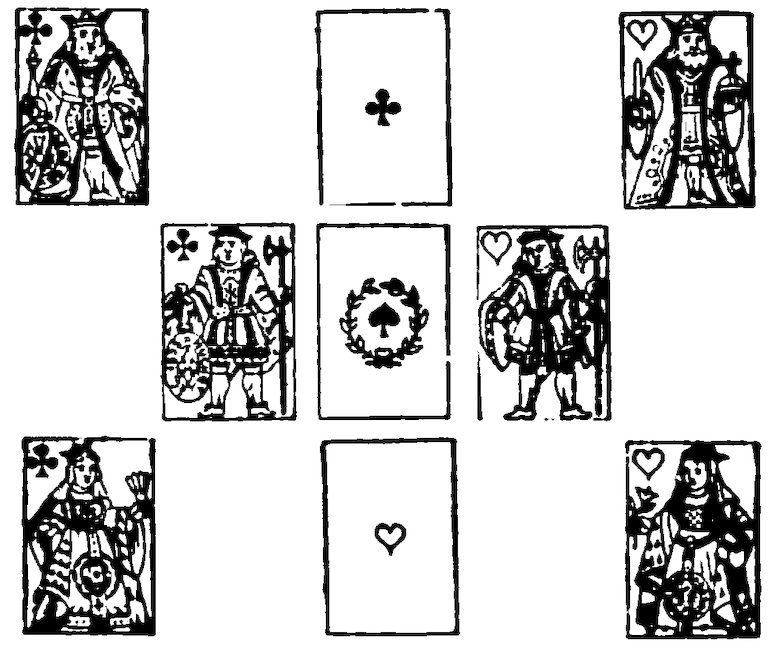
Fig. 161.
TO NAME SEVERAL CHOSEN CARDS OUT OF A PACK DIVIDED INTO TWO HEAPS.
A complete pack is divided into two such lots that all the aces, nines, sevens, fives, and threes, are in one, and all the kings, queens, knaves, tens, eights, sixes, fours, and twos, are in the other.
Let several of the company draw cards out of either of the heaps, change the heaps unperceived, and let the persons place the odd cards, as ace, nine, &c., into the heap of even cards, and vice versâ. On running over the cards, you easily discover the drawn cards, the even cards being in the heap of odd cards, and the odd cards in the heap of even cards.
TO MAKE TWO PERSONS DRAW THE SAME CARD OUT OF TWO PACKS.
You arrange with your confederate that he shall select a certain card, say the tenth from the top, in a prepared 292pack. From a second pack you force a similar card on an innocent member of the company. On the two comparing notes, the truth of your assertion will be made manifest.
TO PRODUCE A CARD WITHOUT SEEING THE PACK.
Take a pack of cards with the corners at one end slightly cut off. Place them all one way, and ask a person to draw a card; when he has done so, while he is looking at it, reverse the pack, so that when he returns the card to the pack the corner of it will project from the rest; let him shuffle them; he will never observe the projecting card. Hold them behind your back. You can feel the projecting card; draw it out, and show it.
HOW TO KEEP A ROADSIDE INN.
Pick out all the aces and picture cards, and then place an ordinary card upon the table. “This card,” you say, “we will call an inn.” You commence your story as follows:
“On a dark night there come four rustics to this inn, and ask for a night’s lodging. As none of the landlord’s four rooms are occupied, he shows each of the yokels to one of the rooms, and goes quietly to bed. (Lay the four knaves around the card which represents the hostelry, and proceed.)
“Not long afterwards four policemen knock at the door, and request also a night’s lodging. As Boniface has now no chamber unoccupied he puts an officer in with each of the clowns. (Lay the four aces upon the four knaves.)
“Presently four fine gentlemen come along, and these 293want a night’s lodging. Mine host is now in great embarrassment, but there is nothing left for him to do but to put a gentleman in each of the four tenanted chambers. (Here you lay a king upon each ace.)
“Thus far times went tolerably well, although not meeting with general approbation. But now come four fine ladies, who also must have a night’s lodging. The landlord is now beside himself with perplexity; indeed he fairly loses his senses, for the stupid fellow, not knowing where to halve them, actually quarters a lady in each of the already occupied rooms! (Lay the queens upon the four other cards.)
“The ladies are highly indignant. ‘Could he not have put like and like together?’ they ask. So he ought to have done, for policemen and louts, lords and ladies are badly assorted. The fellow is out of his wits!
“‘Well,’ cried the landlord, at last, ‘if you are agreed, I will lodge you like with like.’ All readily consent, and soon all the rustics are lodged in one chamber, all the constables in another, all the gentlemen in a third, and all the ladies in a fourth.”
While you are saying this, you lay the four heaps one upon another, and let the company cut them as often as they choose. But, notwithstanding all their cutting, if you now tell them off in order from the bottom of the pack, and place them about the tavern, all the knaves will be in one heap, all the aces in another, and so on.
TO TELL FOUR CARDS IN A LOOKING-GLASS.
Prepare a pack of cards thus: eight aces of diamonds, eight eights of clubs, as many tens of hearts, and a last octave of queens of spades. These sets are arranged in the order as described, the last bottommost.
The four persons who draw are forced to select each 294from a set of eight, in order from the top downwards. Do not allow the drawers to look at the cards, but keep them in their hands or pockets. You now hand around a mirror, and ask the spectators whether they see in it anything else except their own faces. On their replying in the negative, you say, with an air of mystery, that you can see something else in it, and then call off, as if out of the mirror, the card which each person has drawn.
THE CENTURY OF CARDS.
Arrange the nine cards below ten, ace included, so that by adding the spots on them together the amount will be 100.
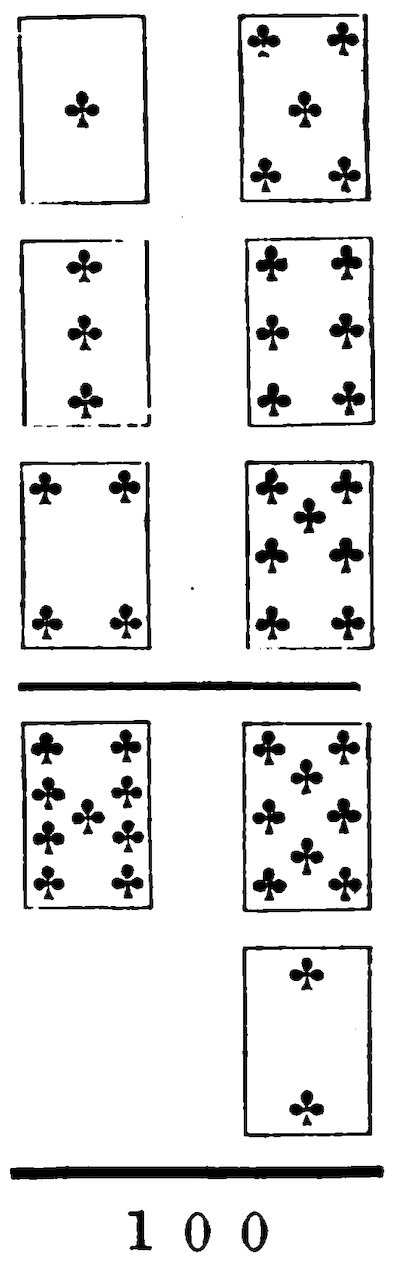
Fig. 162.
295
THE NINE DIGITS.
Place the cards of one suit from one to nine, inclusive, in three rows, so that, in whatever direction you add the rows, the amount will be fifteen.
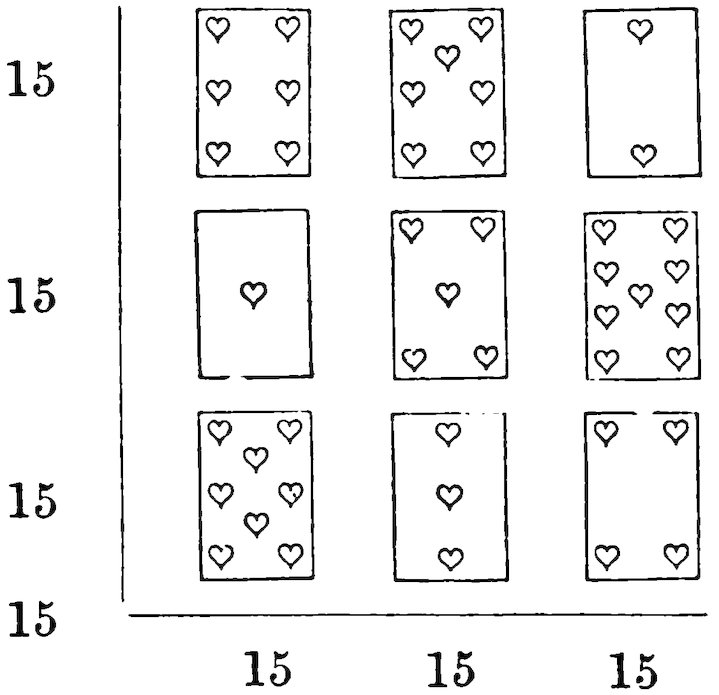
Fig. 163.
TO DIVIDE THE RED CARDS FROM THE BLACK BY A SINGLE CUT OF THE PACK.
Screw a pack of cards up tightly in a vice, and shave the edges so as to make the cards narrower at one end than at the other. You then arrange these cards in such a manner that the broad ends of the black cards lie all in one direction, and the broad ends of the red cards in the contrary direction. Now let any of the company shuffle it and return it to you. You then ask in which hand they wish the red, and in which the black cards to appear. On receiving a reply, you grasp the pack firmly at both ends, with both hands, and draw them apart, when you will have in each hand those cards whose broad ends lay in its direction. 296Sometimes you will have to draw the card several times before you can get them entirely separated.
Observe.—This recreation should not be repeated, unless you have another pack of cards to adroitly substitute for the former, in which you may separate the pictured cards from the others, they being prepared for that purpose; which will afford a fresh surprise. You may also write on a number of blank cards certain letters or words that form a question, and on others the answer.
THE CARD OF ONE COLOUR FOUND IN A PACK OF THE OTHER.
Put all the red cards in one heap, and all the black cards in the other. One of these packs you conceal in your pocket. You let any person draw a card from the other pack, and while he is examining the card, substitute the pack in your pocket for the one you hold in your hand. Let him place his card in the pack you have taken from your pocket, and shuffle as much as he pleases. On receiving back the pack, you will at once recognize the card he has drawn by the difference of colour.
TO IMPALE A CARD.
Take any card with a pip in the middle—as an ace, five, nine, &c., and thrust through the centre a short tack, of which the head is flat and broad, and the point made very sharp.
At the conclusion of a trick with a borrowed card like the one prepared as above, juggle the former away, and bring the other to the bottom of the pack, the tack point outwards. On hurling the pack horizontally 297against a door or other wood-work, the pack will act like a solid body and drive the nail in fast, when the chosen card will be displayed, while the others fall to the floor.
CARDS TOLD BY POETICAL INSPIRATION.
Lay sixteen cards on the table in four rows of four each, face up.
You state that you will leave the room, and, on your return, name any one card touched in your absence.
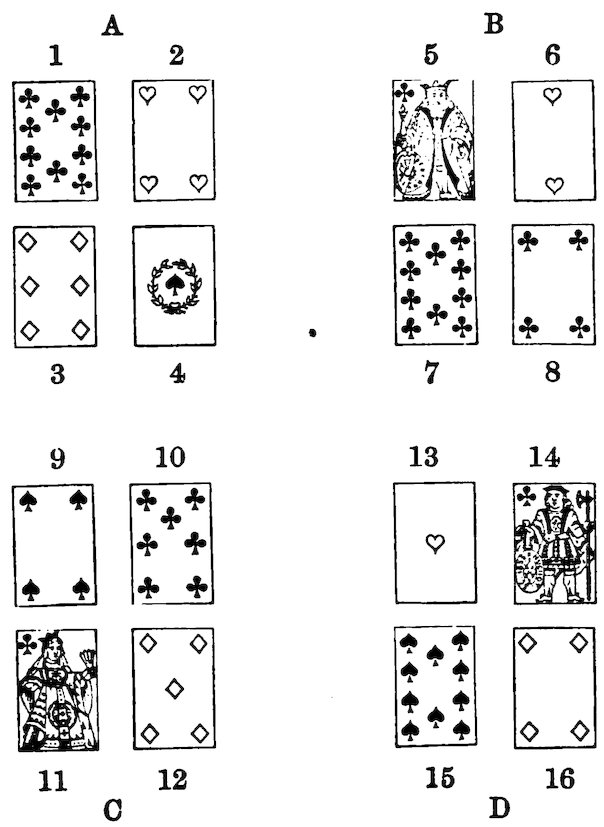
Fig. 164.
All the clue you ask is such a one as may be found in a passage read out of any poet on your return by any one. This any one, however, must be your confederate. The cards should be placed in the order in which they are 298here shown, you previously making your confederate acquainted with your mode of proceeding, which is thus: The cards are supposed to be divided into four classes, as A, B, C, D; you class everything in the world as biped (A), quadruped (B), vegetable (C), and mineral (D). Each class is subdivided similarly Class A, No. 1 is the biped; 2, the quadruped; 3, the vegetable; and 4, the mineral; and so with the other classes. When performing the trick your confederate must take care to select an appropriate passage. For example, we will suppose the card No. 12 to have been touched, and that, a volume of Wordsworth having been presented to your confederate to select from, he gives the following lines to be read:
“A violet by a mossy stone,” &c.
The first word which can be classed as above is “violet;” you may thus be certain that the card touched is in class C, a violet being a vegetable. The next word you can fix upon is “stone,” which you rank in the mineral class, and know that card No. 12 was the one touched, it being the mineral of the vegetable class.
Suppose the trick to be repeated, as is very likely, and that Shakspeare is given to your partner; he selects the passage in “Othello” commencing:
“My mother had a maid called Barbara, &c.”
You know, “mother” being the first word that can be classed, the card touched must be in class A (biped), and the next word “maid” being also a biped, the card touched must have been No. 1, which is the biped of the biped class. Many appropriate passages may be easily selected, and your confederate should select a long passage to be read, as it gives greater scope, and helps to mislead the rest of the company; for should they imagine that the card is discovered by the number of lines read, 299and they touch the same card again, he can select another passage, desiring them to read only as many lines as they choose.
THE CARD NAILED TO THE WALL WITH A PISTOL-SHOT.
The conjuror obtains a card drawn, and requests the person who has chosen it to tear off one of its corners, and to observe it well to know it again; he takes the card thus torn and tears it all to pieces, burns it, and reduces it to ashes; he then gets a pistol loaded with powder, mixed and confounded with the said ashes, and, instead of a leaden ball, a nail, marked by one of the company, is put into the barrel; then the pack of cards is thrown up into the air, the pistol is fired, and the burnt card is found nailed against the wall; the piece torn from it is then produced, and found to fit exactly the place from whence it was torn, and the nail is acknowledged to be the same by the person who marked it.
Explanation.—A corner of the chosen card being torn, the conjuror steps from the stage, takes a similar card and tears a corner of it exactly in the same manner; returning, he asks for the chosen card, places it secretly under the pack, and expertly substitutes that which he has prepared, in order to burn it in its stead; he then lays hold of the pistol for the first time, under pretence of showing how it should be cocked, fired, and handled; one of the company is then desired to load the pistol with some powder and paper; he seizes this interval to convey the card to his invisible agent, who speedily nails it upon a square piece of board, which serves to shut up hermetically a hole made in the partition and the hangings, but which is invisible, being covered with a piece of the same; by this means the card nailed to 300the wall or partition does not yet appear; the piece of tapestry with which it is covered is slightly fastened on one side with two pins, and on the other to a thread, the loose end of which the accomplice holds in his hand. As soon as the latter hears the pistol fired, he draws the thread, and rapidly pulls the piece of tapestry behind the glass; the card consequently appears, and as it is the same that had been marked with the nail just put into the pistol, it is no wonder that this trick, so difficult to account for, obtains applause. It depends entirely on first loading the pistol with powder, after which a tin tube is covered on the charge of powder, the card and nail being rammed down in the tin tube; the pistol being inverted, the tube and its contents fall into the conjurer’s hand to convey to his invisible agent.
THE CARDS IN TEA-CADDIES.
Two cards being drawn by different persons, are put into separate tea-caddies and locked up. The performer changes the cards without touching them, or any confederacy.
The caddies are made with a copper flap, which has a hinge at the bottom, open against the front, where it catches under the bolt of the lock, so as when the lid is shut and locked, the flap will fall down upon the bottom; the performer places two cards that he intends to be chosen between the flap and the front, which being lined with green cloth, may be handled without any suspicion; he then desires the first person to put his card into one of the caddies, taking care it be that which contains the contrary card from the one that he chose, and the second into the other; he then desires they will lock them up, which unlocks the flaps, covers their cards, and when opened, presents the contrary ones.
301
THE CARDS NAMED, DISCOVERED WITH THE EYES BLINDED.
A pack of cards are caused to be drawn by some person. A person arriving in the room names all the cards just drawn, without making the least mistake with regard to their colour, number, &c.
Explanation.—The cards are disposed as we observed before. The conjurer having, unnoticed, observed the card drawn, he informs his agent, even at the very instant he promises he will take particular care he or his agent shall know nothing about it: he says he will not speak a word while his agent names the cards, and that the person who holds them shall be confined to show them to the company, by saying this is such and such a card, &c. It is in this last phrase he names the card, which is underneath; his accomplice, who hears him, and who knows by heart the disposition of the pack, names the cards which follow it; that is to say, for instance, if he is given to understand that the 19th is underneath, he names the 10th, the 17th, &c. Having mentioned the whole pack, his friend, who, during this time, never speaks a word, resumes the use of his speech, and begs of the person who had chosen them, to ask what are the others that remain unnamed; the confederate is informed by this question that there is not one remaining, and answers accordingly.
THE CARD SPRINGING UP INTO THE AIR, FROM THE PACK, WITHOUT BEING TOUCHED.
One of the cards is drawn, which is afterwards put in, and shuffled with the rest of the pack; then the pack is put into a kind of a square spoon, placed upright upon a bottle, which serves it as a pedestal, and at the 302company’s pleasure the card instantly flies up into the air.
Explanation.—In the first place, a forced card must be chosen, in the manner described; then the pack must be placed in the spoon so that the chosen card may lean on a pin, bent in the form of a hook; this pin is fastened to a thread, and ascending through a pack, leans upon the upper end of the spoon; then it descends under the room, through the table. Thus arranged, the confederate cannot pull the thread without dragging along with it the hook and card, which causes it to be perceived as flying in the air. The thread slides upon the blunt edge of the spoon as easily as if it run in a pulley.
In order to place the cards in the spoon quick enough, that the spectators may perceive no preparation, care must be taken that another pack is presented dextrously on the table. The chosen card in the other, with the hook and thread, must be previously prepared as above described.
TO SHOW A CARD CHOSEN BY THE AUDIENCE IN A DARK ROOM.
Arrange the cards of a pack so as to name them all according to their positions after several changes. This is done in various ways, as explained in The Secret Out and the last few pages.
After the pack has been cut by different persons spread it out on the table and ask one of the company to select a card quite at random. Take up the pack, and in doing so divide it into two parcels, and place the one which preceded the drawn card below the other.
While pretending that you wish to convince the audience that the cards are of different suits, hold the pack in such a position that your accomplice in the 303next room can see which is the last card. Knowing, then, that the following one is the drawn card, he writes the name or draws the figure of it in black on a transparent screen in the adjoining room.
This screen is to be placed within an aperture in the wall, on withdrawing a curtain to which, the person who selected the card has but to look in to see the writing or picture of it “staring him in the face.”
The inner room should be quite dark, so that nothing but the writing is perceived.
THE DOUBLE CONFEDERATES.
Two accomplices are required. Each, however, supposes that he alone is in the secret. To the first accomplice, for instance, you say that the card to be noted is the king of hearts. You take this card from the pack, and give it to the second accomplice to hide somewhere. You then shuffle the cards, let Accomplice A shuffle them also, and then begin a conversation like the following:
You say to Accomplice A, “Kindly note a card in this pack. Shuffle the cards again, and then tell me the name of the card you noted. The king of hearts, is it? Thank you for the king of hearts.”
“But I cannot find that card.”
“Was it really the king of hearts that you noted?”
“Certainly.”
“Ah, I see how it is. His Majesty has gone out for a stroll. Perhaps, sir,” addressing Accomplice No. 2. “you saw which road the runaway went.”
“I rather fancy I saw him hide behind the clock.”
“Will one of you be so good as to look behind the clock?”
304And to the general astonishment the missing card is actually found behind the clock, or where else it was placed.
FINALE TO A CARD TRICK.
You ask a person to draw a card, which he does, and putting the pack of cards in a boy’s mouth, you tell him that card only shall remain there. You then give the card a blow, and all fall down except the card that was drawn.
Explanation.—Having forced a particular card upon a lady or gentleman, you take care to put this card only between the boy’s teeth, and the rest you can easily jerk away.
Variation.—You may put the cards into the boy’s pocket, and ask the lady or gentleman whether you shall draw that card out, or leave it by itself. Whichever is desired, you can easily do, having already separated the card from the pack while putting them into the pocket.
Improvement.—Your confederate is prepared by filling his pockets with cards. On his being called in, you send him among the audience to let several cards be selected. You pretend then to shuffle the selected cards into the pack but you (knowing them from the first, though even this is not necessary) really place them in order at the top or bottom of the pack. The whole pack is then placed in the confederate’s breast coat-pocket. He is then asked to draw the cards out one at a time, and show them to the audience, who recognize their selection. This being done, you ask your man to hand you the pack. He does so.
You tap the outside of the pocket, and say, “You have not given me all.” He denies that he omitted to 305empty his pocket, but on trial, discovers another entire pack. This can go on as long as his supply lasts, and you conclude by inserting your left hand in the man’s pocket (up the sleeve of your left arm are several packs) as if merely to keep it open, while with your right hand you shower out several hundreds of the cards.
JACK TAR’S PRAYER-BOOK, OR THE COMPREHENSIVE CARDS.
A nobleman, who kept a great number of servants, had employed as a confidential servant an old superannuated Jack Tar. Jack soon became the decided favourite, and upon him did he place all of his most important services. This excited great jealousy among the others, who, in order to prejudice their master, put into his pocket a pack of cards, and then accused Jack in broad terms of being a gambler. Jack was called up, and closely interrogated, but he denied the fact, at the same time declaring he never played a card in his life. To be more fully convinced, the gentleman ordered him to be searched, when behold a pack of cards was found in his pocket. Highly incensed at Jack’s want of veracity, the nobleman demanded, in a rage, how he dared persist in an untruth?
“My lord,” replied he, “I certainly do not know the meaning of a card: the bundle in my pocket is my almanac.”
“Your almanac, indeed? then I desire you to prove it.”
“Well, sir, I will begin. There are four suits in the pack, that intimate the four quarters in the year. There are thirteen cards in a suit: so there are thirteen weeks in a quarter. There are also the same number of lunations; twelve signs of the zodiac, through which the 306sun steers his diurnal course in one year. There are fifty-two cards in a pack; that directly answers to the number of weeks in a year. Examine them more minutely, and you will find three hundred and sixty-five spots, as many as there are days in a year; these multiplied by twenty-four and sixty, and you have the exact number of hours and minutes in a year. Thus, sir, I hope I have convinced you it is my almanac; and by your lordship’s permission, I will prove it my prayer-book also. I look upon the four suits as representing the four prevailing religions, Christianity, Judaism, Mahometism and Paganism; the twelve court cards remind me of the twelve patriarchs, from whom sprang the twelve tribes of Israel; the twelve Apostles; the twelve Articles of the Christian faith.
“The queen reminds me of the allegiance due to her Majesty. The ten brings to my recollection the ten cities in the plains of Sodom and Gomorrah, destroyed by fire and brimstone from heaven; the ten plagues of Egypt; the ten commandments; the ten tribes cut off for their vice. The nine remind me of the nine Muses; the nine noble orders among men. The eight reminds me of the eight beatitudes; the eight persons saved in Noah’s ark; also the eight persons mentioned in the Scripture to be released from death to life. The seven reminds me of the seven ministering spirits that stand before the holy throne; the seven seals wherewith the book of life is sealed; the seven liberal arts and sciences given for the instruction of man; the seven wonders of the world. The six reminds me of the six petitions contained in the Lord’s Prayer. The five reminds me of the senses—hearing, seeing, feeling, tasting, and smelling. The four puts me in mind of the four evangelists; the four seasons of the year. The three reminds me of the Trinity: the three hours of agony on the cross; the 307three days in the Holy Sepulchre. The two reminds me of the two Testaments; the two contrary principles struggling in man, virtue and vice. The ace reminds me of the only true God to adore, to worship, to serve; one faith to believe; one truth to practise, and one good master to serve and to obey.”
“So far is all very well,” said the nobleman; “but I believe you have omitted one card, the knave.”
“True, my lord; the knave reminds me of your lordship’s informer.”
The nobleman became more pleased with Jack than before, freely forgave him, raised his wages, and discharged the informer.
308