APPENDIX.
Reading edition
GAMBLERS’ TRICKS WITH CARDS, EXPOSED AND EXPLAINED.
GAMBLERS’ PREPARATION OR DOCTORING OF CARDS.
Of cards which are “marked” as they come from the manufacturers there is elsewhere mention. But it sometimes happens that the player cannot understand the peculiar patterns of the back, and hence has to mark them himself as he plays.
This is generally done, while he is holding them, by denting them with the nail, scratching the edges or face, or bending the corners.
When the cards have backs perfectly white, the swindling manufacturer can, at a moment’s glance, tell you what is on the face of the card; and this secret he communicates to others, whom he employs to go out, and by means of these cards to swindle people out of their money. This may seem quite incredible to some; it is, nevertheless, done, and very successfully too, and it is accomplished by embossing the paper on the back, so as to form a small, fine grain, which the eye would take to be the grain of the paper, this grain running different ways to represent different cards. And there is only one position in which this card must be held that it can be told; and that is, hold the end of the card that is from you the highest, and then the shade will cast the grain in a way that you can plainly see the marks.
309
REFLECTORS.
The cards so named are, by a mechanical process equally distinguishable to the initiated by their backs as by their faces; but, from the expense of manufacturing them, they are not often had recourse to. They nearly resemble those ingenious landscapes which, at first sight, present to our view some beautiful scene in nature, but, upon a more minute inspection, give us portraits of human faces with great exactness and fidelity. Some years back this trick was played off on the Continent, to the enriching of a German Jew and two or three of his confederates. He attended the fairs of Frankfort and Leipzic with a large quantity of these cards, which he sold at a price which bade defiance to competition. Visiting the country again, by the time he thought they would be in circulation at the various spas and watering-places where high play was going on, himself and his friends, by being alone able to decipher the apparently invisible hieroglyphics, made a fortune out of this scheme.
THE LONGS AND SHORTS
Consist of having all cards above the number eight a trifle longer than those below it. This is accomplished with great nicety, by a machine invented for that purpose. By this means, nothing under an eight can be cut; and the chances against an honour being turned up at whist are reduced two to one.
SAUTER LA COUPE, OR SLIPPING THE CARDS.
An adept at this trick can cheat and swindle at pleasure. Wherever it is practised the fair player has no 310earthly chance of rising from the table other than a loser. The trick, too, is much practised. By its means the wealth of the unwary and inexperienced player is transferred to the pocket of the cheat.
The following simple exposition of the manner in which this trick is performed, will be of essential service to the player. It will enable him to detect the sharper and black-leg; and thus protect himself from their nefarious scheme.
Sauter la Coupe is the French term for “Slipping the Cards.” It is practised at whist, when the cards are cut, and placed in the hands of the dealer. By a dexterity, easily acquired by practice, he changes the cut card, by slipping from its position in the pack, either from the top or the middle, the ace, and thus secures its “turning up.” The practiser of Sauter la Coupe, to cover the trick he is resorting to, invariably ruffles the cards, making with them a loudish noise. While the apparently simple action he thus performs, with the consequent noise, distracts attention, he slips the card, the ace, which he has hitherto concealed for the purpose, and dextrously placed on the head of the pack when passing it from one hand to another to deal, or ascertains its position in the pack by one of the many means resorted to for that purpose. Whenever the player begins to ruffle the cards, instead of dealing quietly, suspect foul play. It is a symptom of cheating.
The fair player has no chance with the cheater by means of Sauter la Coupe. Suppose that during an evening twenty games have been played. The cheat and his partner would thus have to deal the cards at least ten times. During these ten deals the cards might be slipped six times, giving the cheat an advantage over the fair player of at least twenty to one.
311
CONVEX AND CONCAVE CARDS
Are both of the same genus with the foregoing ones. All from the eight to the king are cut convex, and all from the deuce to the seven, concave. Thus, by cutting the pack in the centre, a convex card is cut; and by taking hold of the cards, in cutting them, at either end of the pack, a concave card is secured.
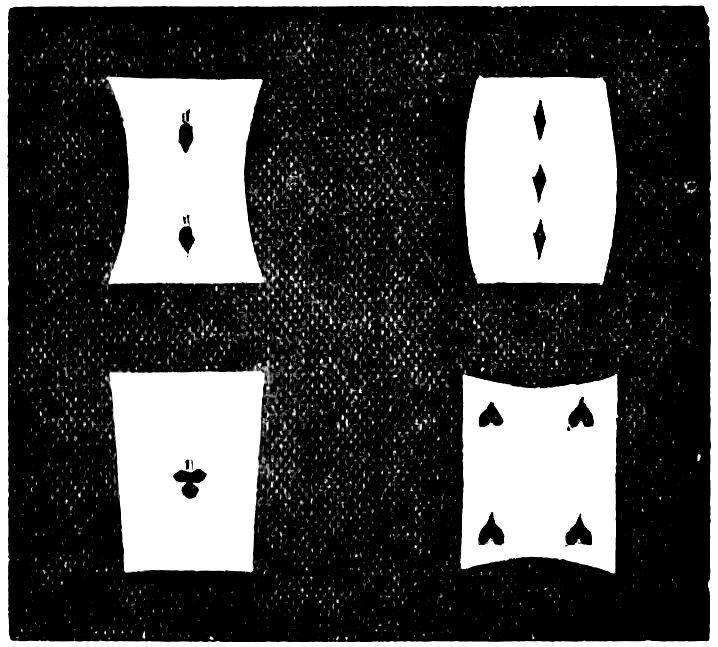
Fig. 165.
Sometimes these cards are cut the reverse way to the foregoing one, so that if suspicion arises, a pack of this description is substituted for the others. But here the sharper has not so great a pull in his favour, because the intended victim may cut in the usual way, and so cut a low card to the dealer. But the possibility, or rather certainty, of his being able, by any means to cut or deal a high or low card at pleasure, is an advantage against which no skill in the game can avail.
312
HANDLING THE CARDS.
So called from the cards being secured in the palm of the hand. The person who practises this art at cribbage generally takes care to get two fives, with any other two cards, placing one of the two ordinary cards at the top, next to it one five, then the other ordinary card, and under it the other five. These four cards, so placed, he secures in the palm of his hand, while he desires his adversary to shuffle the cards, and being very generous, also tells his opponent to cut them; when this is done, he puts his hand which contains the four cards upon that part of the pack which is to be uppermost, and then leaves the cards on the same; consequently, when he deals, the two fives will fall to his own hand of cards. By these means when a person who can handle, deals, he is pretty sure of two or more fives.
“GARRETTING.”
Is so called from the practice of securing the cards either under your hat or behind your head.
The method of doing this is to select out three or four extraordinary good cards, while your adversary is marking his hand of crib. This being done, and the cards properly dealt, you take up your own cards, which you take care to examine pretty quickly, and after laying out any two you think proper for crib, you immediately, with one hand, put your other remaining card on the pack, and with your other hand take down the cards which have been secured; then in lieu of very bad cards, which you might possibly have had, you have the best which can be got.
313
WALKING THE PEGS
Means either putting your own pegs forward, or those of your adversary back, as they may best suit your purpose; and it is always executed while you are laying out your cards for crib.
The method generally adopted for this business is to take the two cards which you intend to put out for the crib, and fix them with your third finger on the back of the cards, and your others on the front; then holding them fast in your hand, you cover the pegs in the board from the sight of your adversary, while with your first finger and thumb on the same hand, you take out unperceived any peg you like, and place the same wherever you think proper.
THE BRIDGE; or, “THE OLD GENTLEMAN”
Is a card slightly curved. By introducing it carelessly into the pack, and shuffling them, it can be cut at pleasure. The trick of the “Old Gentleman” consists in merely introducing into the pack a card of thicker substance than the rest, which can likewise be cut at pleasure, by being properly placed by the shuffler.
SKINNING.
It is by this operation that unfair cards are introduced, and too often without creating suspicion, by the ingenuity with which it is performed. Certain fair cards are taken out of the original stamped cover, without injury to it, and in their stead either concave, convex, or pricked ones, or reflectors, are placed. The stamp being stuck on the cover by means of gum, which the application of warm water dissolves, or deprives of 314its tenacity: a kettle of hot water and a sponge are the only things requisite. The exchange being completed, the unfair pack finds its way into societies of a certain description, where it is contrived to be placed on the card-tables unobserved. Plunder is the inevitable result.
SHUFFLING OR WEAVING.
Much fraud is practised by the help of dextrously shuffling, by which the power to place cards in certain parts of the pack is under the control of the sharper, when become an adept in the art. The preparatory step is a strict observance of the tricks taken up on both sides, and their contents, when those rich in trumps or court cards are selected to be operated upon by the shuffler, when it is his turn to deal.
THE GRADUS, OR STEP.
Consists in one particular card being so placed by the shuffler, on handing them to his adversary to be cut, as to project a little beyond the rest, and thus to insure its being the turn-up card, either at whist or ecarté.
SLIPPING THE FIVES.
Slipping the fives at cribbage is an amazing strong advantage. The mode of doing this is first to mark them in any manner so as to know them; and whenever it happens that you observe one coming to your adversary, you give him the next card under in lieu thereof, which many who are in the habit of playing much perform with extraordinary dexterity.
315
SADDLING THE CARDS.
Is frequently practised at cribbage, This is bending the sixes, sevens, eights, and nines, in the middle, long ways, with the sides downwards; by which it is extremely easy for you to have one of those cards for a start, by cutting where you perceive a card bent in that manner, taking due care to have the card so bent uppermost.
DEALING FROM THE BOTTOM.
Is a very common practice; it is, therefore, very necessary for you to be very watchful over your adversary while he deals.
This is a device of old date, but it is easier to be performed with the small cards used at ecarté than those generally played with at whist. It consists in secreting a certain card until an opportunity presents itself of its being available when it is produced, as implied, from the palm of the hand that secretes it. The story of the hand that was nailed to the table with a fork, and the proffered apology for the act if no card was found under it, is too well known to be repeated: but it is not a solitary instance in the play world. Some sixty years since a member of Brookes’s Club was playing at quinze with Mr. Fox. At this game a five is a principal card, and on the person alluded to displaying a five in his hand, after Mr. Fox supposed them all to have been played, he complained, with evident chagrin, of the increasing inaccuracy of his memory. Others, however, were less charitably disposed. The unfair gamester was watched, and detected in introducing a fifth five!
316
STEALING OUT CARDS, AND PALMING.
The cheat of stealing cards is practised as often, perhaps, as any other fraud in card playing. It is of great advantage to the gambler, and gives him an opportunity of forming very good winning hands. In whist, the most desirable cards to steal out are the “honours,” and sometimes all four will be stolen out by one man, that is, the honours of one suit; and then he will make that suit trump by keeping one of them at the bottom. This can be done by the backs as well as by the faces, for the cards in general use now by the gamblers can all be known by the backs, and a player will know by the backs where any particular card is dealt; and if he should not steal the honours, he can deal them to himself or his partner, by dealing off the second card instead of the top card, whenever the top card is one that he may want for himself; and if he should steal two of the honours out, he will hide the theft by dealing each player two cards twice; then all will have their proper number, and his theft remains hid; or he will miss giving himself a card twice during the deal, and hide the theft by that means; or he will give himself two twice during the deal, and have sixteen, while the others have but twelve each; he will then hide his theft by concealing four cards that are poor in the palm of his hand, and in gathering a trick will place all upon his bunch of tricks. And as his tricks are all bunched, the players will depend on counting the tricks of the other party to determine who has won the odd trick; and hence he succeeds in hiding his theft.
317
CUTTING, SHUFFLING, DEALING, STEALING, &c.
No man is secure from the artifice of the gambler; so long as he will play at all, he may rest assured that he will, in the end, come out loser, for the methods of cheating are almost innumerable. A majority of gamblers have arrived at such perfection in the art of dealing that they will deal the second card from the top instead of the top card, and will go all through the pack in that manner: and you may look directly at them, and will not be able to detect the cheat. They will, at other times, have a hand which they have stolen out, and will smuggle it under the bottom; then, in the course of dealing, they will deal this hand just where they please, and defy you to discover their dealing from the bottom. A gambler will often deal himself six or seven cards, when he should have but five, and if he can make a good hand, by laying out the two poorest in his lap, he will do so; or if he cannot make a good hand, he will take the two best to help him in his next hand. This cheat is very often practised.
DIAMOND CUT DIAMOND.
1 will here relate a case which occurred not long since, as going to show how well-experienced men will play more than their number. A gambler got to playing, coming up from Goodwood, with a man whom he mistook for a “greeney” that knew nothing of playing scientifically. But he was sadly deceived. The gambler from the beginning played somewhat carelessly, supposing that it needed no science to beat the stranger; but the gambler lost, and commenced playing as scientifically as he could. He still lost, and finally lost nearly all he had before he left off; and after quitting, they went to 318the buffet to drink. The gambler said to his antagonist, “You beat any man for luck I ever played with. I’ve lost my money with you, but it makes no difference: I will be honest with you; you did not know it, but I played six cards all the time, and your luck beat it.” “Well,” said the innocent chap, “since you have been so frank, I will also be frank; I have played seven cards all the way through, besides stocking and palming and occasionally stealing, for the sake of variety.” The gambler was greatly surprised, and swore that he would not have supposed that he knew much more than one card from another; but he was deceived in the man, and it would not have done for him to have shown any anger, as he first confessed having cheated the other, who was in reality a most expert gambler, and had purposely assumed that disguise.
GAMBLERS’ MEANS OF SECRET COMMUNICATION.
Again, gamblers, for mutual advantage, generally travel in small companies, and in secret partnership. I have again adverted to this, in order to mention one of the ways in which they often turn their partnership to good account. They almost invariably feign to be total strangers to each other, the better to carry out their base designs; and when one or two of them are seated at a table at play with some whom they wish to fleece, one of the company will seem to be a total stranger to everybody, seats himself in sight of a man’s hand, who is at play, and is not one of the confederates; and if he shows, by word or act, that he would rather he would not, he will readily protest that his only motive is the gratification of an idle curiosity; that he scarcely knows one card from another. And very probably, after such protestations from one who appears a stranger, and withal an 319honest gentleman, he is suffered to continue to look into the player’s hand. If he should be asked to play, he will say, “I cannot, as I have never learned; indeed, I scarcely know the cards.” He will take this course in order that his looking into the hands of the players may not be objected to. And his motive in looking into the hands is to give his secret partners signs. This he will do in various ways. I have known men who would give signs, that were perfectly intelligible, by the different manner in which they would blow their cigar smoke. In even such simple and imperative acts as holding the cards a gambler can give intelligence to his partner. As for his fingers, their slightest movement, however natural, conveys information. And in order to evade suspicion, I have also known signs to be conveyed through two and three different persons, who were secret partners of the players, and were sitting in different parts of the same room; and the signs would always reach the player in time to benefit him. This is often done when there is danger of being detected, if he should look at the man who is looking in the other’s hands for his signs. Nor is it a matter of importance whether there is a room full or not; for they will practise these artifices before a room full as well as if there was a very small number of persons present.
At other times, when a man loses heavily, one of the company will go to him and form an acquaintance, if it does not already exist, and will say to him, “You are much the loser with A or B, and I am acquainted with him, and if you will in confidence accept the offer, I will do you a favour, by which you will stand a chance of getting your money back again. Do you engage with him in play, and I will sit back of him, and give you correct signs from his hand, so that you can know how to govern your bets.” Nothing appears more generous than 320this; and a weak man is apt to be eager to avail himself of any means that promises to restore him his lost money, and will feel highly elated that he has met with an unexpected friend, and will flatter himself with the idea of winning all the man has; feeling that if his pretended friend should succeed in giving him correct signs one hand out of four, it will be sufficient to enable him to win much from him. This is all the basest deception. The man proposing this mode of playing is a secret partner of the winner, and their design is to swindle the man still further. Both are fully apprised of the plan, and when they succeed in getting the loser to play again (they generally have cards which they know as well by the backs as by the faces), if the winner should have a large hand, and the loser a larger one, he (the winner) will bunch his cards so closely that the one behind cannot see to give signs, and he then suffers himself to be run off. And if you should have one or two pairs (which he will know by the backs), and he should get the same, though a little larger, he will then permit the man to give signs that he has only one or two pairs, as the case may be, and all that he can entice the loser to bet, he will win from him.
The gambler will only bet on small worthless cards when his hand is better than his opponent’s; and, frequently, by such contrivances as we explain, will deal the latter three aces and a pair of kings to his own four tens or knaves.
Anybody would bet largely on such a hand, and thus, a gambler will ruin a man in a few games.
321
TRICKS AND ROULETTE.
Roulette is played upon a long table, of which we give a representation. This table is covered with green cloth. In its centre is a movable cylinder, on the circumference of which are thirty-seven divisions, separated from each other by wires, and numbered from 6 to 36.
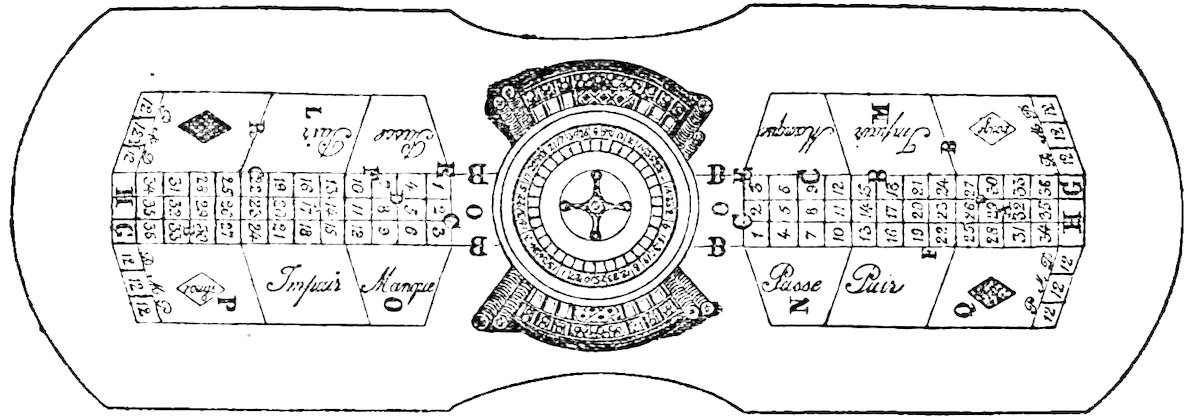
DIAGRAM OF ROULETTE.
This cylinder is made to revolve, by the hand, at the same time that a small ball is thrown in the opposite direction upon the fixed parts of the machine, where, after several circuits, it falls into one of the numbered compartments, which are alternately black and red.
322At each end of the table, numbers corresponding with the thirty-seven upon the cylinder, are stamped on the cloth in three columns, with the words manque (“dead” or missed), pair (even), and rouge (red), on one side of the columns; and passe (stake), impair (odd), and noir (black), on the other side. While, in the line below the columns and the divisions mentioned (namely, manque, pair, impair, &c., &c.) are nine spaces, marked below the columns, first C, second C, third C; and to the right and left three spaces marked first D, second D, third D.
Mode of Playing.—The smallest stake allowed by the foreign tables is one florin. If the player bet upon any odd number, and the ball drops into the compartment so numbered, he receives thirty-six times the amount of his stake; but since there are always thirty-eight chances against him, he may lose a very large sum before winning at all.
To simplify matters, and to encourage the player, he is at liberty to divide his stakes among several numbers, lay his wagers upon any of the columns containing twelve numbers each, or upon the first, second, or third series of twelve numbers (in these cases he is paid double if he win); or play upon red or black, odd or even—the former including the numbers from 1 to 18, and the latter from 19 to 36.
The three D’s printed on the cloth stand for Douzaine, and signify the first, second, or third dozen on the red or black side; and the three C’s similarly stand for the column of figures under which they are placed.
The game, however complicated it may appear at first glance, is really quite simple, as a little attention to the explanation will attest, and affords great variety in the betting.
As the bank must win in the long run, and its percentage 323is but small, the “regular” places can afford to dispense with deceptions. In private gaming-houses, however, as many tricks as ingenuity can invent are employed to fleece the unwary.
ENGLISH ROULETTE.
(From Rogues and Vagabonds of the Race-Course.)
The thirty-six divisions of the English roulette-table into which the ball falls, are thus designated:—
Two Crowns.
Two Feathers.
Three Yellows.
Four Blues.
Ten Reds.
Fifteen Blacks.
The odds laid are— The proper odds being—
Against Crown 12 to 1 17 to 1
„ Feather 12 to 1 17 to 1
„ Yellow 8 to 1 11 to 1
„ Blue 5 to 1 8 to 1
„ Red 2 to 1 13 to 5
„ Black 1 to 1 7 to 5
Any one not acquainted with the roulette man would almost marvel that with such immense odds in his favour, he should think it necessary to cheat; but to cheat is his delight and recreation.
The man who enters the roulette-tent on the racecourse, should he be the only bonâ fide player, may well leave all hope behind. Supposing that he commenced playing with the determination of losing a certain sum only, he would save himself trouble by paying down that sum then and there.
True, if several are playing at the same time, he does stand a chance; a poor one, perhaps, but yet he 324may win considerably—for however sharp the man at the wheel may be, he cannot fleece everybody at once. If anything delights the roulette man, it is to slay his victims one by one; for where there are many playing, some shrewd man is sure to place his sovereign or two exactly opposite the large stakes; and should he vary this amusement by an occasional half-sovereign on zero, when heavy stakes are on the black and red, he becomes an intolerable nuisance. In this game the ball can be made to fall into zero at will, and very often into any other number. Should a heavy stake be placed on red, it is any odds on black turning up, and vice versâ; and should, as is often the case, a large stake be on both red and black, provided there is no stake on zero, then zero will inevitably turn up.
On examining a roulette wheel, it will be found, probably, that the brass partition on one, and often on each side of zero, can be drawn out slightly, thus causing a projection. We say probably, for in case of any untoward event, a perfectly fair duplicate movable bottom, with which most tables are provided, will be substituted for the unfair one with marvellous rapidity.
Supposing that the man at the wheel wishes zero to turn up, by the same movement with which he starts the wheel to the right, he dexterously pulls out the brass partition on the left of zero, causing a projection which, in the rapid rotary motion, escapes notice; he then carefully sends the ball in the opposite direction, which, as it encounters the projection, jumps forcibly, making a peculiar clicking noise. As it lessens its speed the jumping becomes less violent, till, at last, the ball has not impetus sufficient to clear the projection; it therefore calmly “refuses,” or, in other words falls into zero “dead beat.” Of course, the same principle holds good conversely, for by drawing out the other 325partition, or by turning the wheel to the left, it is a moral impossibility for the ball to rest in zero.
To stand a chance, then, the player should never on any account stake until the ball is fairly in play.
The clever way in which the partitions are restored to their proper places is worthy of notice. After the ball has fallen into the desired place, but before the wheel has ceased to revolve, the roulette man places his hand, apparently with the intention of stopping the wheel, but in reality so as to make each partition, as it passes his finger, strike up against it. Those that have been pulled out are thus driven back again.
There is another way of preparing the table, bungling and apparent; but it is only attempted upon the intoxicated and very inexperienced young men.
In this case, though only one or two of the brass partitions can be pulled out, on the left of the crowns, feathers, yellow, and blue, the partitions were all fixed projecting more or less, so that no sleight of hand was at all necessary in the manipulation of the wheel; for when it is turned to the right, and the ball of course thrown in the opposite direction, the ball must necessarily fall into one of the above-mentioned divisions; but, on the other hand, were the wheel turned to the left, red or black would necessarily turn up.
If the roulette man cannot by this system, as he can by the other, turn up what he likes, he can, at all events, prevent anything turning up that he would lose upon.
Roulette is considered vulgar compared with 30-and-40 (Trente et Quarante), otherwise Red and Black (Rouge-et-Noir).
326
ROUGE-ET-NOIR, OR, TRENTE ET QUARANTE.
This game is played, like roulette, on a table covered with green cloth.
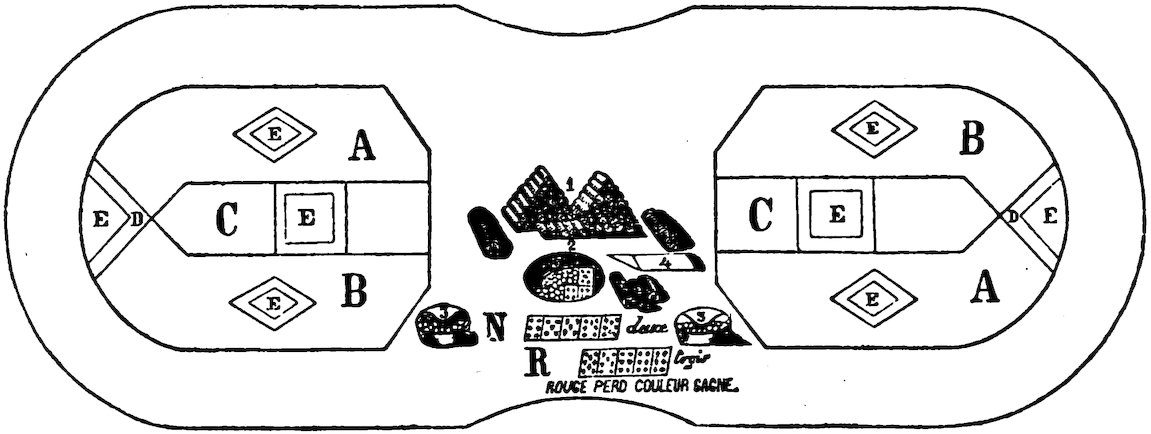
DIAGRAM OF ROUGE-ET-NOIR.
The tailleur (“cutter of the cards,” banker or dealer) seats himself at the centre of the table, while opposite him, and at each end, are croupiers (rakers-in), to see that no mistakes are made, to aid bettors in placing stakes, and to draw or push money lost or won with long wooden rakes.
327On one side of the table is a piece of red cloth, diamond shaped, and, opposite it, a piece of black cloth of the same shape.
The bettors who believe that red will win, put their money on the red side, and those who believe in black, lay their wagers on the black side.
The dealer continually calls out, “Faites votre jeu” (Make your play), and when he sees that all the stakes are down on the table, he adds, “Le jeu est fait” (The game is made), closing, as he begins to deal out the cards, “Rien ne va plus” (no more stakes can be received).
All bets are then rejected, and all stakes pushed back.
Mode of playing.—The game is played with six packs of cards, the court cards counting ten each, and all the others according to the number of spots upon their faces. They are shuffled and held face down, and laid on the cloth face up in two rows or series. The dealer continues dealing out, and counting in a loud voice, until the added numbers reach thirty-one, but they must not be beyond forty. The first row counts for black, and the second for red. Supposing that the first row or series of black came thus:

This makes in all 32, completing that series.
Now, supposing that the second row or series of red came thus:

This makes in all, 37. In this case, black wins, because 32 is nearer 31 than 37.
328The dealer, therefore, declares, “Noir gagne” (Black wins), or “Rouge perd” (Red loses), whereupon all bets upon black are paid, and all the stakes upon red taken in by the croupiers.
Wagers on colour are made during the play, and decided by the colour of the last card in the winning series.
Thus: if black wins, and the last card of that series be clubs or spades, colour wins; but if hearts or diamonds has been turned up last, colour loses.
The bank has, in the long run, advantages enough to defeat all players. The advantage at Rouge-et-Noir is called the refait (drawn game), which happens when there is a tie between the two series, and both count the same number between 32 and 40. For instance, 34 or 39 for both the series, red and black.
In this case, neither bank nor players win or lose. The players may change their stakes, or let them remain, at pleasure.
Should each of the series count 31 (which occurs once in thirty-eight or forty times), bets are en prison (dead); that is, there they must remain until the next deal decides their fate. This seems fair, but it is equivalent to giving the bank half the stakes. The Homburg Bank, which is the most liberal, puts the stakes en prison only when the last card of the second series is black.
The refait at Rouge-et-Noir is estimated to make the percentage of the bank about two and two-thirds, which is diminished at Homburg to one and a third.
The advantage at Rouge-et-Noir is less than at roulette; while the minimum stake is two florins, and the maximum is 5,600 florins. The bank capital at the present game must be something like five times that at roulette. The extent of stake, on a simple chance, is 4,000 francs.
J. Ogden and Co., Printers, 172, St. John Street, E.C.
Clarendon House, upon the site and with the materials of which 74 Piccadilly was built.—See Evelyn and Pepys.
VERY IMPORTANT NEW BOOKS.
Special List for 1873.
⁂ Note.—To ensure the correct delivery of the actual Works or Particular Editions specified in this List, the Name of the Publisher MUST BE DISTINCTLY GIVEN. Stamps or P.O. Order may be sent to the Publisher, who will forward per return. When “DIRECT application” is requested, the Trade will please communicate with Mr. Hotten.
Splendid New Gift-Books.
Illustrated by Steel Engravings, not by evanescent Photographs.
COURT BEAUTIES of the REIGN of CHARLES II. From the Originals in the Royal Gallery at Windsor, by Sir Peter Lely. Engraved in the highest style of Art. With Memoirs by Mrs. Jameson, Author of “Legends of the Madonna.” The Illustrations, Proofs Before Letters. New and Sumptous “Presentation Edition.” Price £1 1s.
“This truly beautiful and splendid production is equally a gem among the Fine Arts and in Literature.”—Quarterly Review.
MACLISE’S PORTRAIT GALLERY OF LITERARY CELEBRITIES. With Notes by the late William Maginn, LL.D. Edited, with Copious Notes, by William Bates, B.A., Professor of Classics in Queen’s College, Birmingham. Demy 4to. 83 Splendid and most Characteristic Portraits. Now first issued in a complete form. Price 31s. 6d. Morocco elegant, 70s.
BEAUTIFUL PICTURES BY BRITISH ARTISTS. A Gathering of Favourites from our Picture Galleries, 1800–1870. Wilkie, Constable, J. M. W. Turner, Mulready, Sir Edwin Landseer, Maclise, Leslie, E. M. Ward, Frith, Sir John Gilbert, Ansdell, Marcus Stone, Sir Noel Paton, Eyre Crowe, Faed, Madox Brown. All Engraved in the highest style of Art. With Notices of the Artists by Sydney Armytage, M.A. A Magnificent Volume, in Byzantine cloth gilt, 21s.
AARON PENLEY’S SKETCHING IN WATER-COLOURS. 21s. By the Author of “The English School of Painting in Water-Colours,” &c. Illustrated with Beautiful Chromo-Lithographs, resembling original Water-Colour Drawings. In handsome binding, gilt edges, suitable for the Drawing-room table, price 21s.
⁂ It had long been felt that the magnificent work of the great English master of Painting in Water-colours, published at £4 4s., was too dear for general circulation. The above embodies all the instructions of the distinguished author, with fine specimens of Water-colour Painting. A most charming Present for a Young Lady.
A truly Magnificent Work.
LIVES OF THE SAINTS. Enriched with 51 exquisite Full-page Miniatures, in Gold and Colours. Every page of the Text within Engraved Borders of Beautiful Design. Thick 4to, sumptuously printed, and bound in silk velvet, enriched with gold, preserved in a case, £7 7s.; in morocco, extra gilt, inlaid, £10 15s.
THIS VERY IMPORTANT WORK, commenced three years since, has at length been completed, and fully justifies the high expectations formed of it during its progress through the press. Taking the text of the Rev. Alban Butler as his guide, the Editor has, wherever practicable, carefully verified the references of that eminent divine. The delicacy and finish of the beautiful miniatures have never before been approached in any similar work in this country. They exhibit a beauty and exquisite softness of colour which have hitherto only been realized by the most expensive miniature paintings. The work must be seen to be appreciated; it is like no other of the kind.
A very Splendid Volume.
SAINT URSULA, Princess of Britain, and her Companions. With 25 Full-page 4to Illuminated Miniatures from the Pictures of Cologne, and exquisitely designed Woodcut Borders. In crown 4to, beautifully bound in satin and gold, £3 15s.
⁂ The Finest Book-Paintings of the kind ever Published. The Artist obtained the Gold Prize at the Paris Exposition.
THE BOOK MUST BE SEEN TO BE APPRECIATED. The illustrations are exact reproductions of the exquisite paintings of the Van Eyck school, and in finish and beauty are far above any similar book-paintings issued in this country.
Exquisite Miniatures and Illuminations.
GOLDEN VERSES FROM THE NEW TESTAMENT. With 50 Illuminations and Miniatures from celebrated Missals and Books of Hours of the 14th and 15th Centuries, in Gold and Colours. The Text very beautifully printed in Letters of Gold on fine Ivory Paper. 4to, in a handsome cloth case, with silk ribbons, 30s.; or bound in a volume, morocco, gilt edges, £2 5s.
BRUNET’S MANUEL DU LIBRAIRE, 5 vols., royal 8vo, half morocco, top edge gilt, 25s. only. (Apply direct.)
THE STORY of the LONDON PARKS. By Jacob Larwood. With numerous Illustrations, Coloured and Plain. Vol. I. Hyde Park; Vol. II., St. James’s Park and the Green Park. Price of the Two Volumes, 18s.
⁂ This is a new and most interesting work, giving a complete History of these favourite out-of-door resorts, from the earliest period to the present time, together with the fashions, the promenades, the rides, the reviews, and other displays.
CURIOSITIES OF LONDON. Exhibiting the most Rare and Remarkable Objects of Interest in the Metropolis; with nearly Sixty Years’ Personal Recollections. By John Timbs, F.S.A. New Edition, Corrected and Enlarged, 21s.
⁂ “A most valuable and interesting work, and a mine of information to all who desire any particulars about London, past and present. It contains nearly 1,000 closely printed pages.”
Beef and Liberty.
CLUBS AND CLUB-LIFE IN LONDON. With Anecdotes of its Famous Coffee Houses, Hostelries, and Taverns. By John Timbs, F.S.A. New Edition, uniform with the “History of Signboards;” with Numerous Illustrations, drawn expressly for this Popular Edition. Crown 8vo, 600 pages, 7s. 6d.
LONDON CHARACTERS: The Humour, Pathos, and Peculiarities of London Life. By Henry Mayhew (Author of “London Labour and the London Poor”) and other Writers. With upwards of 70 Characteristic Illustrations of London Life. Crown 8vo, 480 pages, 7s. 6d.
KNIGHT’S (Charles) PICTORIAL HISTORY OF LONDON, Ancient and Modern. With nearly 700 Engravings of Buildings, Antiquities, Costumes, Remarkable Characters, Curiosities, &c., &c. 6 vols., imp. 8vo, bound in 3, cloth neat, 35s.
⁂ The most delightful book ever written about Old and Modern London. It is a perfect mine of information, and should be in every English Library. If looked at from the point of cheapness alone, the work is a perfect marvel, containing as it does more than 2,500 large and handsomely printed pages, crowded with pictures.
New Books of Humour.
See also “Artemus Ward,” “Mark Twain,” and “Bret Harte.”
“The public are indebted to Mr. Hotten for the BEST collection of HUMOROUS WORKS in the English language; and living as we do in the midst of sufferings, anxieties, and serious occupations, which tend to produce solemn rather than light, blithesome thoughts, the public ought to be, and are, very much indebted to him.”—Tablet, May 20, 1871.
HOLMES’S POET AT THE BREAKFAST TABLE. From Jan. to June. 1s.
DIVERSIONS OF THE ECHO CLUB. A Delightful Volume of Refined Literary Humour. Cloth, 2s.; paper, 1s. 6d.
A Companion to the “Autocrat of the Breakfast Table.”
UNLIKELY TALES AND WRONG-HEADED ESSAYS. By Charles H. Ross. Fcap., with amusing Illustrations. Price 1s.
HATTON’S (Joseph) KITES AND PIGEONS. A most amusing Novelette. Illustrated by Sambourne. 1s.
MR. BROWN on the GOINGS ON of MRS. BROWN at the Tichborne Trial and in her own Family, with the sad end of the Unfortunate Lady thro’ a Writin’ of Books.
SHAVING THEM; or, The Adventures of Three Yankees on the Continent of Europe. By Titus A. Brick, Esq. 1s.
LITTLE BREECHES, and JIM BLUDSO. By Col. John Hay. Cloth, 2s. 6d.; paper, 1s. 6d.
BIGLOW PAPERS. By J. R. Lowell. The best and fullest edition of these Humorous and very Clever Verses. 1s.
ORPHEUS C. KERR [Office-Seeker] PAPERS. By R. S. Newell. A most mirth-provoking work. 1s.
JOSH BILLINGS: His Book of Sayings. Exceedingly droll, and of world-wide reputation. 1s.
VERE VEREKER’S VENGEANCE. By Tom Hood. A delightful piece of humour. Idiotically illustrated by Brunton. 1s.
WIT AND HUMOUR. Verses by O. W. Holmes, Author of the “Autocrat of the Breakfast Table.” 1s.
BOCCACCIO. THE DECAMERON. Now fully translated into English, with Introduction by Thomas Wright, F.S.A., (Uniform with our Edition of “Rabelais.”) Crown 8vo, with the Beautiful Engravings by Stothard which adorned Pickering’s fine Edition, published at £2 12s. 6d. This New Edition is only 7s. 6d.
⁂ A faithful translation, in which are restored many passages omitted in former Editions.
EDGAR ALLAN POE. Complete Prose and Poetical Works; including the Additional Tales and fine Essays by this great Genius. Now First Published in this Country. With Charles Baudelaire’s “Essay on Poe.” 750 pages, crown 8vo, Fine Portrait and Illustrations, 7s. 6d.
⁂ After much searching, Mr. Hotten has succeeded in identifying the School near London where Poe remained for five years. Interior and Exterior Views are given.
JOAQUIN MILLER. “JOAQUIN ET AL.” By Cincinnatus H. Miller. Royal 16mo, 4s. 6d.
⁂ The first drafts of some of his finest Poems will be found here, together with compositions which will be quite new to English readers. The “Standard” places Mr. Miller first amongst contemporary poets.
SHELLEY’S EARLY LIFE. From Original Sources. With Curious Incidents, Letters, and Writings, now first Published or Collected. By Denis Florence Mac-Carthy. Crown 8vo, with Illustrations, 440 pages, 12s. 6d.
⁂ A most interesting volume of new Biographical Facts. The work will possess special interest to Irish readers; as the poet’s political pamphlets, advocating Home Rule and other Rights, are here given for the first time in a collected form. It was these pamphlets which Shelley and his wife threw from the balcony of a window in Sackville Street, as the best means of publishing the poet’s political principles.
MODERN BABYLON, and other Poems. By H. Cholmondeley Pennell, Author of “Puck on Pegasus.” Cr. 8vo., 4s. 6d.
JENNINGS (HARGRAVE). ONE OF THE THIRTY. With Curious Illustrations. Crown 8vo, 10s. 6d.
⁂ An extraordinary narrative, or story, tracing down one of the accursed pieces of silver for which Jesus of Nazareth was sold. Through eighteen centuries is this fated coin tracked, now in the possession of the innocent, now in the grasp of the guilty, but everywhere carrying with it the evil that fell upon Judas.
Capital Shilling Books.
PEACE. By Erckmann-Chatrian. A Charming Story. 1s. New.
WAR. By Erckmann-Chatrian. A Powerful Story. 1s.
POLISH JEW. By Erckmann-Chatrian. A Thrilling Story. 1s.
CONSCRIPT. By Erckmann-Chatrian. Only Unabridged translation. 1s.
WATERLOO. By Erckmann-Chatrian. Only Unabridged translation. 1s.
BISMARCK: The Story of his Career, told for Popular Reading. By Mr. Geo. Bullen, of the British Museum. 1s.
KILLED AT SAARBRÜCK: An Englishman’s Adventures during the War. By Edward Legge, Correspondent at the Seat of War. Cloth, 2s. 6d.; paper, 1s.
NEVER CAUGHT: The thrilling Narrative of a Blockade Runner during the American War. 1s.
CHIPS FROM A ROUGH LOG. Amusing Account of a Voyage to the Antipodes. 1s.
DICKENS: The Story of his Life. By the Author of “The Life of Thackeray.” 360 pages, 2s.
THACKERAY, the Humourist and Man of Letters. The Story of his Life. By the Author of the “Life of Dickens.” 1s.
HOWARD PAUL’S New Story Book, Lord BYRON in LOVE, &c. 1s.
ROGUES AND VAGABONDS OF THE RACE-COURSE. How they Cheat at Roulette, Three Cards, Thimblerig. By Alfred Toulmin, late 65th Regiment. Price 1s.
MYSTERY OF MR. E. DROOD. A delightful Adaptation. By Orpheus C. Kerr, 1s.
POLICEMAN Y: His Opinions on War and the Millingtary. With Illustrations by Soden. Cloth, 2s. 6d.; paper, 1s.
⁂ Readers of Thackeray’s “Policeman X Ballads” will be much amused by the “Opinions” of his brother officer, “Policeman Y.”
THE HISTORY OF ADVERTISING, in all Ages and Countries. A Companion to the “History of Signboards.” With many very amusing Anecdotes and Examples of Successful Advertisers. By Messrs. Larwood and Hotten. [In Preparation.]
Walk up! Walk up! and see the FOOL’S PARADISE; with the Many Wonderful Adventures there, as seen in the strange, surprising PEEP-SHOW OF PROFESSOR WOLLEY COBBLE,
Raree Showman these Five-and-Twenty Years.
N.B.—Money returned if Performance not approved of. Private Parties attended on the Shortest Notice. Crown 4to, with nearly 200 immensely funny Pictures, all beautifully Coloured. Price 7s. 6d.
The Professor’s Leetle Music Lesson. ⁂ One of the drollest, most comical books ever published.
YANKEE DROLLERIES. Edited by Sala. Containing Artemus Ward, Biglow Papers, Orpheus C. Kerr, Major Jack Downing, and Nasby Papers. One of the Cheapest Books ever published. Cloth, 700 pages, 3s. 6d.
MORE YANKEE DROLLERIES. Second Series of the best American Humourists. Artemus Ward’s Travels; Hans Breitmann; Professor at Breakfast-Table; Biglow Papers, Part II.; Josh Billings. Introduction by Sala. 700 pp., cloth, 3s. 6d.
Third Supply of YANKEE DROLLERIES. The best recent American Humourists. A. Ward’s Fenians, Mark Twain, Autocrat of Breakfast Table, Bret Harte, Innocents Abroad. Introduction by G. A. Sala. 700 pages, cloth, 3s. 6d.
⁂ An entirely new gathering of Transatlantic humour. Fourteen thousand espies have been sold of the first and second series.
WORKS by BRET HARTE.
Widely Known for their Exquisite Pathos and Delightful Humour.
☞ Blackwood’s Magazine goes into raptures over this Author, and gives page after page to prove that he is a literary star of undoubted brilliancy.
1. LUCK OF ROARING CAMP, and other Stories. By Bret Harte. Crown 8vo, toned paper, 3s. 6d.; a paper edition, 1s.
2. THAT HEATHEN CHINEE, and other Humorous Poems. By Bret Harte. Cloth, very neat, 2s. 6d.; paper, 1s. 6d.
3. SENSATION NOVELS. Condensed by Bret Harte. Price 2s. 6d., cloth, neat; or, in paper, 1s. 6d.
⁂ A most enjoyable book.
4. LOTHAW; or, The Adventures of a Young Gentleman in Search of a Religion. By Mr. Benjamins (Bret Harte). Price 6d. Curiously Illustrated.
⁂ Readers of a recent popular novel will enjoy it with considerable relish.
6. EAST AND WEST. The New Volume of Verse. By Bret Harte, Author of “That Heathen Chinee.” Cloth, very neat, 2s. 6d.; or in paper, 1s. 6d.
7. STORIES of the SIERRAS; and other Sketches. By Bret Harte. With a Wild Story of Western Life by Joaquin Miller, Author of “Songs of the Sierras.” 2s. 6d. cloth; 1s. paper.
8. THE LITTLE DRUMMER; or, The Christmas Gift that came to Rupert. A Story for Children, by Bret Harte. With Six Illustrations in Sepia by Henry H. Banks. 4to, cloth gilt. 5s.
⁂ An exquisite story. No other author could have written it except Bret Harte. The late Charles Dickens would have been delighted with it.
9. MISS SKAGG’S HUSBAND, and other Stories. By Bret Harte. Uniform with the “Luck of Roaring Camp.”
[Shortly.
10. BRET HARTE’S COMPLETE WORKS, IN PROSE AND POETRY. Now First Collected. With Introductory Essay by J. M. Bellew. Portrait of the Author, and Fifty Illustrations. Crown 8vo, 650 pages, cloth extra, 7s. 6d.
⁂ Some of the finest and most moving of Mr. Bellew’s inimitable readings are from the works of Bret Harte. The complete edition, now first published, will receive a hearty welcome from the Author’s numerous admirers; and those who assist at penny readings will find it invaluable—a perfect cyclopædia of the most telling stories and humorous verse of the past half century.
Uniform with Mr. Ruskin’s Edition of “Grimm.”
AS PRETTY AS SEVEN, and other Popular German Stories. Collected by Ludwig Bechstein. With additional Tales by the Brothers Grimm. 100 Illustrations by Richter. Small 4to, green and gold, 6s. 6d.
⁂ One of the most delightful books for children ever published. It is, in every way, a Companion to the German Stories of the Brothers Grimm, and the tales are equally pure and healthful. The quaint simplicity of Richter’s engravings will charm every lover of legendary lore. The publisher hopes to make this book as well known here as it deserves to be.
GOLDEN TREASURY of THOUGHT. The Best Encyclopædia of Quotations and Elegant Extracts ever formed. Edited by Theodore Taylor, Author of “Thackeray, the Humourist and Man of Letters.” 8vo, 700 pages, 7s. 6d.
THEODORE HOOK. The choice Humorous Works, Ludicrous Adventures, Bon-mots, Puns and Hoaxes of Theodore Hook. With a new Life of the Author. Portraits and Illustrations. 8vo, 7s. 6d.
⁂ As a wit and humourist of the highest order “his name will be preserved. His political songs and jeux d’esprit, when the hour comes for collecting them, will form a volume of sterling and lasting attraction!”—J. G. Lockhart. The time has arrived, and Hook’s inimitable songs, jokes, and stories are here for the first time gathered together for the amusement of readers who delight in the hearty waggeries of the old school of humourists.
SKETCHES OF IRISH CHARACTER. By Mrs. S. C. Hall. With numerous Illustrations on Steel and Wood, by Daniel Maclise, R.A., John Gilbert, W. Harvey, and G. Cruikshank. 8vo, pp. 450, cloth, gilt edges, 7s. 6d.
“The Irish sketches of this lady resemble Miss Mitford’s beautiful English Sketches in ‘Our Village,’ but they are far more vigorous and picturesque and bright.”—Blackwood’s Magazine.
DROLLS OF OLD CORNWALL; or, Popular Romances of the West of England. Collected and Edited by Robert Hunt, F.R.S. New Popular Edition, Complete in One Vol., with Illustrations by George Cruikshank. Price 7s. 6d.
⁂ “Mr. Hunt’s charming book on the Drolls and Stories of the West of England.”—Saturday Review.
GESTA ROMANORIUM; or, Entertaining Stories invented by the Monks as a Fireside Recreation, and commonly applied in their Discourses from the Pulpit. With Introduction by Thomas Wright, Esq., M.A., F.S.A. 2 vols. 8vo, only 250 copies printed, on fine ribbed paper, 18s.; large paper, only 50 copies printed, 30s.
WORKS by MARK TWAIN.
Widely Known for their Fresh and Delightful Humour.
1. PLEASURE TRIP ON THE CONTINENT OF EUROPE. By Mark Twain. 500 pages, 2s.; or in cloth, 2s. 6d.
⁂ Twain’s Pleasure Trip is also issued in Two-vol. form, under the title of
2. “INNOCENTS ABROAD.” By Mark Twain. THE VOYAGE OUT. Cloth, neat, fine toned paper, “Superior Edition,” 3s. 6d.; or in paper, 1s.
3. NEW PILGRIM’S PROGRESS. By Mark Twain. THE VOYAGE HOME. Cloth, neat, fine toned paper, “Superior Edition,” 3s. 6d.; or in paper, 1s.
4. THE JUMPING FROG, AND other Humorous Sketches. By Mark Twain, 1s.
“An inimitably funny book.”—Saturday Review.
5. BURLESQUE Autobiography
First Mediæval Romance, AND On Children. By Mark Twain. 6d.
6. EYE-OPENERS. A volume of immensely Funny Sayings, and Stories that will bring a smile upon the gruffest countenance. By Mark Twain. Cloth, neat, 2s. 6d.; paper, 1s.
7. SCREAMERS. A Gathering of Delicious Bits and Short Stories, by Mark Twain. Cloth, neat, 2s. 6d.; paper, 1s.
8. PRACTICAL JOKES; or, Mirth with Artemus Ward. And other Papers. By Mark Twain, and other Humourists. Price 1s.; cloth, 2s. 6d.
⁂ The connection of two such names as Mark Twain and Artemus Ward will indicate to the reader the pleasant feast in store for him.
9. A FURTHER GATHERING OF MARK TWAIN’S DELIGHTFUL PAPERS. Price 1s.
[Shortly.
10. MARK TWAIN’S CHOICE WORKS. Now First Collected. With extra passages to the “Innocents Abroad,” now first reprinted, and a Life of the Author. 50 Illustrations by Mark Twain and other Artists, also Portrait of the Author. 700 pages, cloth gilt, 7s. 6d.
⁂ Admirers of Mark Twain’s Humorous Works will be glad to possess such a choice gathering as the above.
MAGICIAN’S OWN BOOK. Containing Ample Instructions for Performances in Legerdemain with Cups and Balls, Eggs, Hats, Handkerchiefs, &c. By the Author of “The Secret Out.” All from Actual Experience, and Edited by W. H. Cremer, Jun., of Regent Street. Crown 8vo, with 200 Illustrations, 4s. 6d.
THE SECRET OUT; or, One Thousand Tricks with Cards, and other Recreations; with Entertaining Experiments in Drawing-Room or “White Magic.” By the Author of the “Magician’s Own Book.” Edited by W. H. Cremer, Jun., of Regent Street. With 300 Engravings. Crown 8vo, cloth, 4s. 6d.
⁂ These Books are complete Cyclopædias of Legerdemain. Under the title of “Le Magicien des Salons,” the first has long been a Standard Magic Book with all French and German Professors of the Art. The tricks are described so carefully, with engravings to illustrate them, that anybody can easily learn how to perform them.
ENTIRELY NEW GAMES.
THE MERRY CIRCLE. A Book of New, Graceful, and Intellectual Games and Amusements. Edited by Mrs. Clara Bellew. Crown 8vo, numerous Illustrations, 4s. 6d.
⁂ A new and capital book of Household Amusements. These are in every way Intellectual Games, and will please both old and young. It is an excellent book to consult before going to an evening party.
THE ART OF AMUSING. A Collection of Graceful Arts, Games, Tricks, Puzzles, and Charades, intended to amuse everybody, and enable all to amuse everybody else. By Frank Bellew. With nearly 300 Illustrations. Crown 8vo, 4s. 6d.
⁂ One of the most entertaining handbooks of amusement ever published.
HANKY-PANKY. A New and Wonderful Book of Very Easy Tricks; Very Difficult Tricks; in fact, all those startling Deceptions which the Great Wizards call “Hanky-Panky.” Edited by W. H. Cremer, of Regent Street. With nearly 200 Illustrations. Price 4s. 6d.
⁂ Sure to be a VERY POPULAR BOOK.
WORKS OF THE LATE ARTEMUS WARD.
New Edition, price 1s.; by post 1s. 2d.
ARTEMUS WARD: HIS BOOK. The Author’s Enlarged Edition. With Notes and Introduction by the Editor of the “Biglow Papers.” One of the wittiest, and certainly one of the most mirth-provoking, books published for many years. Containing the whole of the Original, with the following extra chapters:—Babes in the Wood; Tavern Accommodation, Betsy-Jain-Re-Organized; A. Ward’s First Umbrella; Brigham Young’s Wives; Artemus Ward’s Brother; Mormon Bill of Fare.
NOTICE.—Mr. Hotten’s Edition it the only one published in this country with the sanction of the Author.
The Saturday Review says of Mr. Hotten’s edition: “The author combines the powers of Thackeray with those of Albert Smith. The salt is rubbed in by a native hand—one which has the gift of tickling.”
“We never, not even in the pages of our best humorists, read anything so laughable and so shrewd as we have seen in this book by the mirthful Artemus.”—Public Opinion.
ARTEMUS WARD: His Travels Among the Mormons and on the Rampage. Edited by E. P. Hingston, the Agent and Companion of A. Ward whilst “on the Rampage.” New Edition, price 1s.
⁂ Some of Artemus’s most mirth-provoking papers are to be found in this book. The chapters upon the Mormons will unbend the sternest countenance. As bits of fun they are IMMENSE!
ARTEMUS WARD AMONG THE FENIANS: with the Showman’s Experiences of Life at Washington, and Military Ardour at Baldinsville. Toned paper, price 6d.; by post, 7d.
ARTEMUS WARD’S LECTURE AT THE EGYPTIAN HALL, with the Panorama. Edited by the late T. W. Robertson (Author of “Caste,” “Ours,” “Society,” &c.) and E. P. Hingston. Small 4to, exquisitely printed, bound in green and gold, with numerous Tinted Illustrations, price 6s.
“Mr. Hotten has conceived the happy idea of printing Artemus Ward’s ‘Lecture’ in such a way as to afford the reader an accurate notion of the emphasis, by-play, &c., with which it was delivered. We have no hesitation in saying that Mr. Hotten has almost restored the great humourist to the flesh.”—Daily Telegraph.
“The tomahawk fell from our hands as we roared with laughter—the pipe of peace slipped from between our lips as our eyes filled with tears! Laughter for Artemus’s wit—tears for his untimely death! This book is a record of both. Those who never saw Artemus in the flesh, let them read of him in the spirit.”—Tomahawk.
“It actually reproduces Ward’s Lecture, which was brimful of first-class wit and humour.”—Daily News.
“It keeps you in fits of laughter.”—Leader.
“One of the choice and curious volumes for the issue of which Mr. Hotten has become famous.”—City Press.
“The Lecture is not alone droll: it is full of information.”—Examiner.
“It adds one to our books of genuine fun.”—Sunday Times.
12mo, 200 pages, 1s. 6d.; or cloth, neat, 2s.
ARTEMUS WARD IN LONDON. Comprising the Letters to “Punch,” and other Humorous Papers, now first collected.
⁂ Contains some quaint and humorous compositions which were found upon the authors table after his decease.
ARTEMUS WARD, Complete. The Works of Charles Farrer Browne, better known as “Artemus Ward,” now first collected. Crown 8vo, with fine Portrait, facsimile of handwriting, &c., 540 pages, cloth neat, 7s. 6d.
⁂ Comprises all that the humourist has written in England or America. Admirers of poor Artemus Ward will be glad to possess his writings in a complete form.
GUSTAVE DORÉ’S MOST CHARACTERISTIC WORKS.
RABELAIS. Faithfully translated from the French, with variorum Notes, and numerous characteristic Illustrations by Gustave Dore. Cloth neat, 600 pages. Price 7s. 6d.
⁂ When it is stated that this is a “faithful translation,” scholars will know what is meant. The 60 full-page Illustrations are in the Artist’s best and most fantastic manner.
COCKAYNES IN PARIS, The; or, an English Family Abroad. By Blanchard Jerrold. With MOST AMUSING thumb-nail Sketches of the English by Gustave Dore, taken on the Rail, the Steam-boat, and the Pavement. Price 7s. 6d.
⁂ Returned tourists who would like to see themselves from a French point of view, will be greatly diverted with this new travel-book. The pictures are very droll, and give the exact notions of foreigners concerning us. One of these notions is that all English ladies and gentlemen breathe through their mouths instead of through their noses, hence our mouths are always open, our teeth protrude, and we are continually on the grin. Some of their caricatures of our weaknesses are not wholly devoid of truth.
COUNTRY OF THE DWARFS, The. By Paul Du Chaillu. New Book of Hair-breadth Escapes. Reveals a New World to the reader. 1s. in paper; 3s. 6d. in cloth. Full-page Illustrations.
Hotten’s Edition of “CONTES DROLATIQUES” (Droll Tales collected from the Abbeys of Lorraine), par Balzac. With 425 Marvellous, Extravagant, and Fantastic Woodcuts by Dore. Beautifully printed, thick 8vo, half morocco, Roxburghe. 12s. 6d.
⁂ The most singular designs ever attempted by any artist. So crammed is the book with pictures that even the contents are adorned with thirty-three illustrations. Direct application must be made to Mr. Hotten for this work.
Gustave Dore’s Favourite Pencil Sketches.
HISTORICAL CARTOONS; or, Rough Pencillings of the World’s History from the First to the Nineteenth Century. By Gustave Dore. With admirable letterpress descriptions by Thomas Wright, F.S.A. Oblong 4to, handsome Table Book. Price 7s. 6d.
⁂ This is a new book of daring and inimitable designs, which will excite considerable attention, and doubtless command a very wide circulation.
AN EPIC OF WOMEN, and other Poems. By Arthur W. E. O’Shaughnessy. With Original Designs by Mr. J. T. Nettleship. Cloth, neat, price 6s.
“What he has given us is remarkable. With its quaint title, and quaint illustrations, ‘An Epic of Women’ will be a rich treat to a wide circle of admirers.”—Athenæum, Nov. 5, 1870.
“Combine Morris and Swinburne, and inspire the product with a fervour essentially original, and you have, as we take it, a fair notion of Mr. O’Shaughnessy’s poems.”—Dispatch, Oct. 30, 1870.
ANACREON. Illustrated by the Exquisite Designs of Girodet. Translated by Thomas Moore. Bound in vellum cloth and Etruscan gold, 12s. 6d.
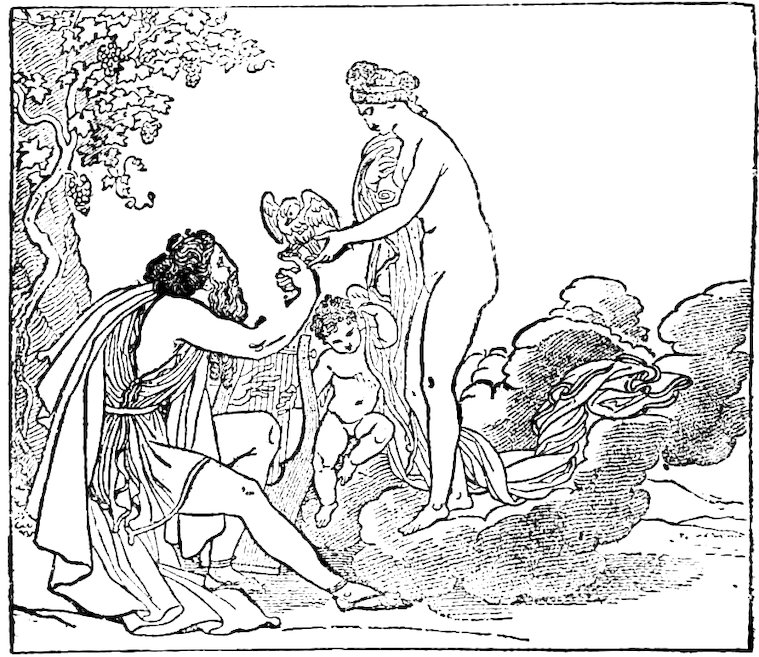
⁂ A MOST BEAUTIFUL AND CAPTIVATING VOLUME. The well-known Paris house, Firmin Didot, a few years since produced a miniature edition of these exquisite designs by the photographic process, and sold a large number at £2 per copy. The designs have been universally admired by both artists and poets.
ECHOES FROM THE FRENCH POETS. An Anthology from Baudelaire, Alfred de Musset, Lamartine, Victor Hugo, A. Chenier, T. Gautier, Beranger, Nadaud, Dupont, Parny, and others. By Harry Curwen. Fcap. 8vo, cloth, 5s.; half morocco, 6s.
“A pleasant little volume of translations from modern French poets.”—Graphic, Aug. 20, 1870.
FAIR ROSAMOND, and other Poems. By B. Montgomerie Ranking (of the Inner Temple). Fcap. 8vo, price 6s.
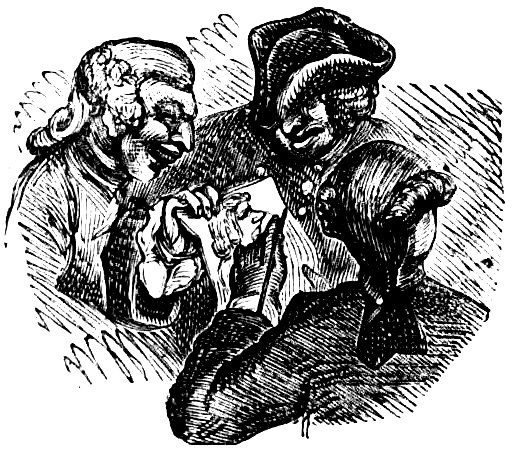
HOGARTH’S FIVE DAYS’ Frolic; or, “Peregrinations by Land and Water.” Illustrated with Tinted Drawings, made by Hogarth and Scott during the Journey. 4to, beautifully printed, 10s. 6d.
⁂ A graphic and most extraordinary picture of the hearty English times in which these merry artists lived.
ACROSTICS, in Prose and Verse. Edited by A. E. H. 12mo, gilt cloth, gilt edges, 3s.
—— Second Series, cloth gilt, 3s.
—— Third Series, cloth gilt, 3s.
—— Fourth Series. With 8 Pictorial Acrostics. Cloth gilt, 3s.
—— Fifth Series. An entirely New and Original Work. Cloth elegant, 4s. 6d.
—— Supplement, under the title of “Easy Double, Historical, and Scriptural Acrostics.” Cloth gilt, 3s.
⁂ Each series sold separately. These are the best volumes of Acrostics ever issued. They comprise Single, Double, Treble, and every variety of acrostic, and the set would amuse the younger members of a family for an entire winter.
The Five Series Complete in a Case, “The Acrostic Box,” price 15s.
WONDERFUL CHARACTERS: Memoirs and Anecdotes of Remarkable and Eccentric Persons of Every Age and Nation. From the text of Henry Wilson and James Caulfield. 8vo, with Sixty-one full-page Engravings of Extraordinary Persons, price 7s. 6d.
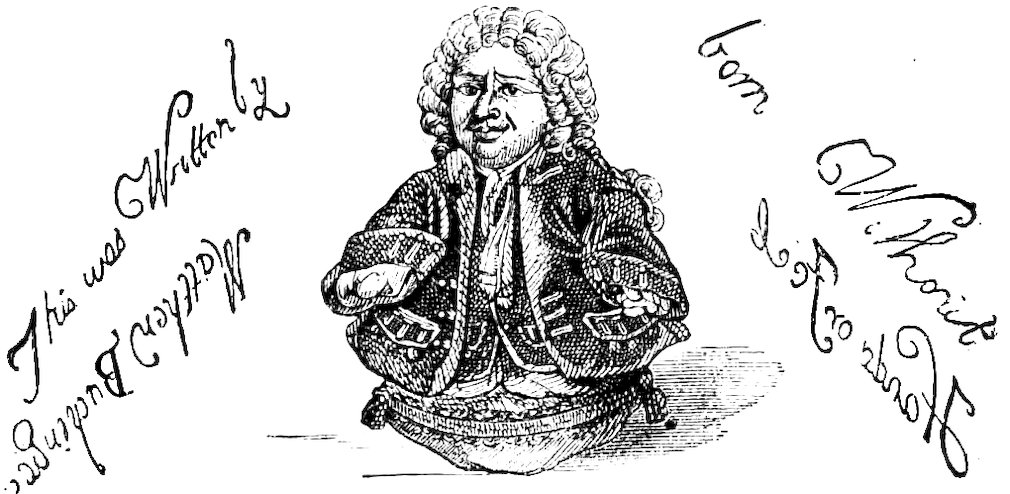
⁂ There are so many curious matters discussed in this volume, that any person who takes it up will not readily lay it down. The introduction is almost entirely devoted to a consideration of Pig-Faced Ladies, and the various stories concerning them.
THE COLLECTOR; Essays on Books, Newspapers, Pictures, Inns, Authors, Doctors, Holidays, Actors, Preachers. By Henry T. Tuckerman; with an Introduction by Dr. Doran. Half morocco, 6s.
⁂ A charming volume of delightful Essays, and, a Companion to John Hill Burton’s “Book-Hunter.”
LITERARY COPYRIGHT. Seven Letters addressed by permission to Earl Stanhope, D.C.L., F.R.S. By John Camden Hotten. Price 5s.
“A sensible and valuable little book.”—Athenæum.
“We agree with Mr. Hotten.”—Saturday Review.
OLD DRAMATISTS—NEW EDITIONS.
MARLOWE’S (Christopher) WORKS; Including his Translations. Edited, with Notes and Introduction, by Lieut. Col. F. Cunningham. Cr. 8vo, Portrait. Cloth, 6s.; cloth gilt, 6s. 6d.
MASSINGER’S (Philip) PLAYS. From the Text of Wm. Gifford. With the addition of the Tragedy of “Believe as You List.” Edited by Lieut. Col. Francis Cunningham. Crown 8vo, Portrait. Cloth, 6s.; cloth gilt, 6s. 6d.
BEN JONSON’S WORKS. With Notes, Critical and Explanatory, and a Biographical Memoir by William Gifford. Edited by Lieut. Col. Francis Cunningham. Complete in 3 vols., crown 8vo, Portrait. Cloth, 6s. each; cloth gilt, 6s. 6d. each.
LIFE AND NEWLY-DISCOVERED WRITINGS OF DANIEL DEFOE. Comprising Several Hundred Important Essays, Pamphlets, and other Writings, now first brought to light, after many years’ diligent search. By William Lee, Esq. With Facsimiles and Illustrations. 3 Vols., uniform with “Macaulay’s History of England.” 36s.
A Very Useful Book.—In folio, half morocco, cloth sides, 7s. 6d.
LITERARY SCRAPS, CUTTINGS from NEWSPAPERS, EXTRACTS, MISCELLANEA, &c. A Folio Scrap-Book of 340 Columns, formed for the reception of Cuttings, &c., with guards.
⁂ A most useful volume, and one of the cheapest ever sold.
THE ROSICRUCIANS; their Rites and Mysteries. With Chapters on the Ancient Fire and Serpent Worshippers, and Explanations of the Mystic Symbols represented in the Monuments and Talismans of the Primeval Philosophers. By Hargrave Jennings. 10s. 6d.
⁂ A volume of startling facts and opinions upon this very mysterious subject, illustrated by nearly 300 engravings.
“Curious as many of Mr. Hotten’s works have been, the volume now under notice is, among them all, perhaps the most remarkable. The work purports to describe the Rites and Mysteries of the Rosicrucians. It dilates on the ancient Fire and Serpent Worshippers. The Author has certainly devoted an enormous amount of labour to these memorials of the Rose-Cross—otherwise the Rosicrucians.”—The Sun.
The New Books.
The Standard Edition.
ROBINSON CRUSOE. Profusely Illustrated by Ernest Griset. Edited, with a New Account of the Origin of Robinson Crusoe, by William Lee, Esq. Crown 8vo, 5s.
⁂ This edition deserves special attention from the fact that it is the only correct one that has been printed since the time of Defoe. All those alterations and blunders which have been discovered in every recent edition are here avoided. There is no living artist better adapted to the task of illustrating Crusoe than Ernest Griset.
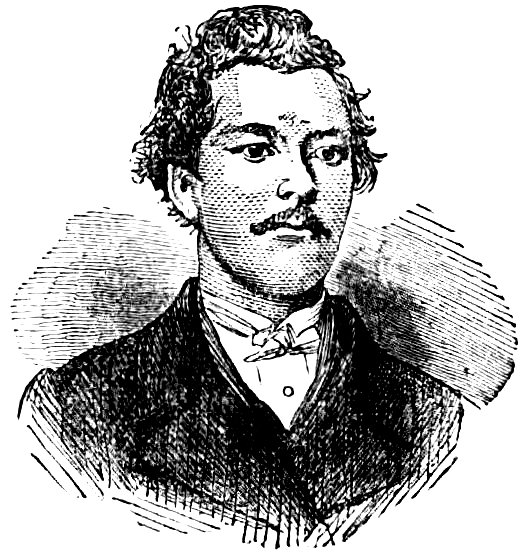
LIVINGSTONE. THE FINDING OF LIVINGSTONE BY H. M. STANLEY, Special Commissioner of the New York Herald. With the full text of Mr. Stanley’s graphic and very interesting Despatches, now first printed in this Country, and the whole of Dr. Livingstone’s Despatches and Letters to the Government. With numerous full-page Illustrations and Portraits. 8vo, 350 pages, cloth gilt, 5s.
“Letters like these reveal the man more than books which are composed in comfort and peace of mind after a return home.”—Times, Aug. 12.
⁂ It was thought that a graphic account of the discovery of Livingstone, in Mr. Stanley’s own words, and offered at a low price, with admirable Illustrations, would be acceptable to those readers who have not a guinea to spare.
HENRY M. STANLEY: The Story of his Life; from his Birth, in 1841, to his Discovery of Livingstone, in 1871. With Portraits, Views of his Birth-place and School; Facsimiles of Handwriting, &c. By Cadwalader Rowlands. 8vo, 12 Illustrations, cloth gilt, 5s.
“We desire to do honour to his energy, courage, and pluck.”—Sir Henry Rawlinson.
Notice.—This work answers the question which has been in everybody’s mouth for some time past. It gives interesting anecdotes of Stanley’s youth and early adventures; also gives a graphic account of a previous expedition successfully undertaken by him—an expedition attended with so many dangers that a United States Minister declared “his search after Livingstone to be a safe trip compared with it.”
BOOK OF HALL-MARKS; or, Manual of Reference for the Goldsmith and Silversmith. By Alfred Lutschaunig, Manager of the Liverpool Assay Office. 8vo, with 46 Plates of the Hall-Marks of the different Assay Towns of the United Kingdom, as now stamped on Plate and Jewellery, 7s. 6d.
⁂ This work gives practical methods for testing the quality of gold and silver. It was compiled by the author for his own use, and as a Supplement to “Chaffers.”
For Gold and Silversmiths.
PRIVATE BOOK OF USEFUL ALLOYS AND MEMORANDA for GOLDSMITHS and JEWELLERS. By James E. Collins. C.E., of Birmingham. Royal 16mo, 3s. 6d.
⁂ The secrets of the Gold and Silversmiths’ Art are here given, for the benefit of young Apprentices and Practitioners. It is an invaluable book to the Trade.
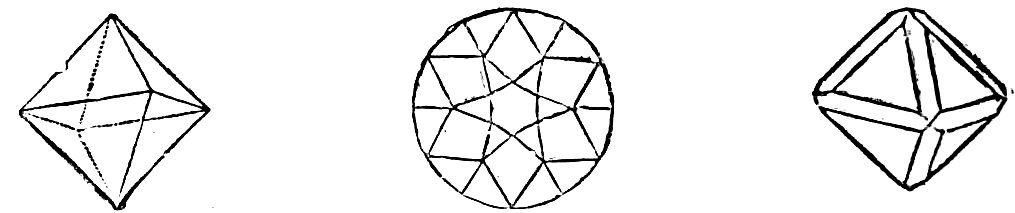
THE STANDARD WORK ON DIAMONDS AND PRECIOUS STONES: their History, Value, and Properties; with Simple Tests for ascertaining their Reality. By Harry Emanuel, F.R.G.S. With numerous Illustrations, tinted and plain. New Edition. Prices brought down to the present time, full gilt, 6s.
“Will be acceptable to many readers.”—Times’ review of three columns.
“An invaluable work for buyers and sellers.”—Spectator.
⁂ This Second Edition is greatly superior to the previous one. It gives the latest market value for Diamonds and Precious Stones of every size.
GUNTER’S MODERN CONFECTIONER. The Best Book on Confectionery and Desserts. An Entirely New Edition of this Standard Work, adapted for Private Families or Large Establishments, By William Jeanes, Chief Confectioner at Messrs. Gunter’s, Berkeley Square. With Plates, 8vo, cloth, 6s. 6d.
“All housekeepers should have it.”—Daily Telegraph.
⁂ This work has won for itself the reputation of being the Standard English Book on the preparation of all kinds of Confectionery, and on the arrangement of Desserts.
HOUSEKEEPER’S ASSISTANT. A Collection of the most valuable Recipes, carefully written down for future use by Mrs. B——, during her Forty Years’ active Service. Cloth, price 2s. 6d.
⁂ As much as two guineas have been paid for a copy of this invaluable little work.
THE YOUNG BOTANIST: A Popular Guide to Elementary Botany. By T. S. Ralph, of the Linnæan Society. In 1 vol., with 300 Drawings from Nature, 2s. 6d. plain; 4s. Coloured by hand.
⁂ An excellent book for the young beginner. The objects selected as illustrations are either easy of access as specimens of wild plants, or are common in gardens.
CHAMPAGNE: its History, Manufacture, Properties, &c. By Charles Tovey, Author of “Wine and Wine Countries,” “British and Foreign Spirits,” &c., Cr. 8vo, numerous illustrations, 5s.
⁂ A practical work, by one of the largest champagne merchants in London.
BRIGHAM’S (Dr. A.) MENTAL EXERTION: Its Influence on Health. With Notes and Remarks on Dyspepsia of Literary Men. By Arthur Leared, M.D. 8vo, boards, 1s. 6d.
NAPOLEON III., THE MAN OF HIS TIME:
Part I.—The Story of the Life of Napoleon III., as told by Jas. W. Haswell.
Part II.—The Same Story, as told by the Popular Caricatures of the past Thirty-five Years. Crown 8vo, 400 pages, 7s. 6d.
⁂ The object of this Work is to give Both Sides of the Story. The Artist has gone over the entire ground of Continental and English Caricatures for the last third of a century, and a very interesting book is the result.
CRUIKSHANK’S COMIC ALMANACK. A Nineteen Years’ gathering of the Best Humour, the Wittiest Sayings, the Drollest Quips, and the Best Things of Thackeray, Hood, Mayhew, Albert Smith, A’Beckett, Robert Brough, 1835–1853. With nearly Two Thousand Woodcuts and Steel Engravings by the inimitable Cruikshank, Hine, Landells, &c. Two Series, Crown 8vo, each of 600 pages, price 7s. 6d. each.
⁂ A most extraordinary gathering of the best wit and humour of the past half-century. Readers can purchase one Series and judge for themselves. The work forms a “Comic History of England” for twenty years.
Original Edition of the Famous JOE MILLER’S JESTS; the politest Repartees, most elegant Bon-Mots, and most pleasing short Stories in the English Language. London: printed by T. Read, 1739. Remarkable facsimile. 8vo, half morocco, price 9s. 6d.
⁂ ONLY A VERY FEW COPIES OF THIS HUMOROUS AND RACY OLD BOOK HAVE BEEN REPRODUCED.
HISTORY OF PLAYING CARDS. With Sixty curious Illustrations, 550 pp., price 7s. 6d.
“A highly interesting volume.”—Morning Post.
Anecdotes, Ancient and Modern Games, Conjuring, Fortune Telling and Card-Sharping, Skill and Sleight of Hand, Gambling and Calculation, Cartomancy and Cheating, Old Games and Gaming-Houses, Card Revels and Blind Hookey, Picquet and Vingt-et-un, Whist and Cribbage, Old-Fashioned Tricks.
SLANG DICTIONARY; or, The Vulgar Words, Street Phrases, and “Fast” Expressions of High and Low Society; many with their Etymology, and a few with their History traced. With curious Illustrations. A New Dictionary of Colloquial English. Pp. 328, in 8vo, price 6s. 6d.
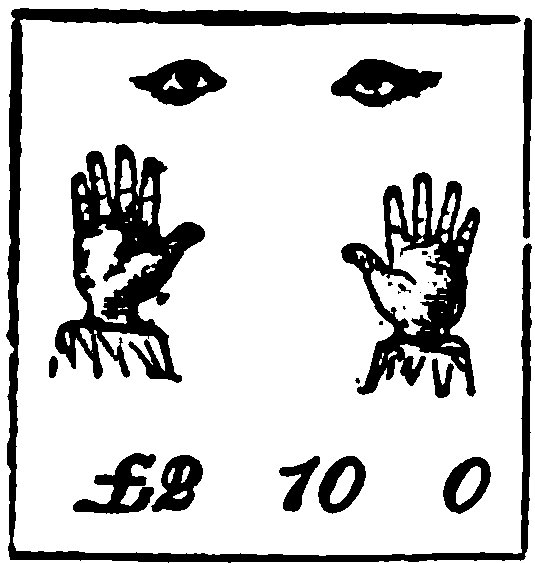
See Two upon Ten, in the Dictionary, p. 264.
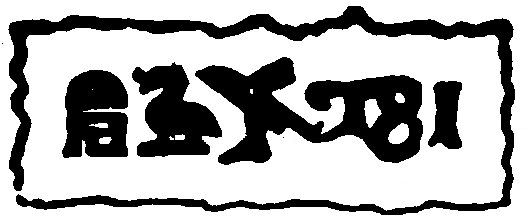
Egyptian Hieroglyphic verb, to be drunk, showing the amputation of a man’s leg. See under Breaky Leg (viz. Strong Drink) in the Dictionary, p. 61.
“It may be doubted if there exists a more amusing volume in the English language.”—Spectator.
“Valuable as a work of reference.”—Saturday Review.
“All classes of society will find amusement and instruction in its pages.”—Times.
CAPTAIN GROSE’S DICTIONARY of the VULGAR TONGUE, 1785. A genuine unmutilated Reprint of the First Edition. Price 8s.
⁂ Only a small number of copies of this very vulgar, but very curious, book have been printed for the Collectors of “Street Words” and Colloquialisms, on fine toned paper, half-bound morocco, gilt top.
THE NEW “PUNIANA” SERIES OF
CHOICE ILLUSTRATED WORKS of HUMOUR.
Elegantly printed on toned paper, full gilt, gilt edges, for the Drawing-Room, price 6s. each.
1. CAROLS OF COCKAYNE. By Henry S. Leigh. Vers de Société, and charming Verses descriptive of London Life. With numerous exquisite little Designs by Alfred Concanen and the late John Leech. Small 4to, elegant, uniform with “Puniana,” 6s.
2. COUNTRY-HOUSE CHARADES, for Acting. By Capt. E. C. Nugent. With Illustrations by W. R. Snow. Small 4to, green and gold, 6s.
⁂ An entirely new book of Household Amusements. An Appendix gives the various Songs set to Music for accompaniment upon the Pianoforte.
“An awfully Jolly Book for Parties.”
3. PUNIANA: Thoughts Wise and Otherwise. Best Book of Riddles and Puns ever formed. With nearly 100 exquisitely fanciful Drawings. Contains nearly 3,000 of the best Riddles and 10,000 most outrageous Puns, and is one of the most Popular Books ever issued. New Edition, uniform with the “Bab Ballads.” Price 6s.
Why did Du Chaillu get so angry when he was chaffed about the Gorilla?—Why? we ask.
Why is a chrysalis like a hot roll?—You will doubtless remark, “Because it’s the grub that makes the butter fly!” But see “Puniana.”
Why is a wide-awake hat so called?—Because it never had a nap, and never wants one.
The Saturday Review says of this most amusing work:—“Enormous burlesque—unapproachable and pre-eminent. We venture to think that this very queer volume will be a favourite. It deserves to be so; and we should suggest that, to a dull person desirous to get credit with the young holiday people, it would be good policy to invest in the book, and dole it out by instalments.”
New Society Book by the Author of “Puniana.”
4. GAMOSAGAMMON; or, Advice to Parties about to Connubialise. By the Hon. Hugh Rowley. With numerous exquisite and fanciful designs from his pencil. Small 4to, green and gold, 6s.
⁂ The Quaintest, Funniest, most Original Book published for a long time.
PIERCE EGAN’S “FINISH” TO “LIFE IN AND OUT OF LONDON.” Royal 8vo, cloth extra, with spirited Coloured Illustrations by Cruikshank, 21s.
⁂ An extraordinary picture of “London by Night” in the Days of George the Fourth. All the strange places of Amusement around Covent Garden and in St. James’s are fully described, and very queer places they were too!
LIFE IN LONDON; or, The Day and Night Scenes of Jerry Hawthorn and Corinthian Tom. Crown 8vo. With the whole of Cruikshank’s very Droll Illustrations, in Colours, after the Originals. Cloth extra, 7s. 6d.
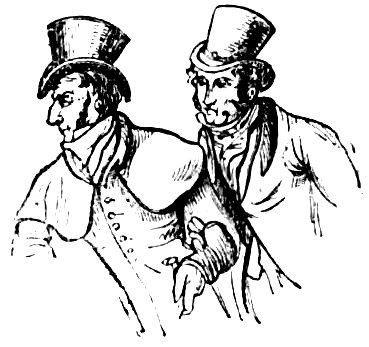
Tom and Jerry Taking a Stroll.
⁂ One of the most popular books ever issued. It was an immense favourite with George IV., and as a picture of London life fifty years ago was often quoted by Thackeray, who devotes one of his “Roundabout Papers” to a description of it. Clean Second-hand copies of this work always realize from £1 to £2.
VYNER’S NOTITIA VENATICA: A Treatise on Fox-Hunting, the General Management of Hounds, and the Diseases of Dogs; Distemper and Rabies; Kennel Lameness, &c. Sixth Edition, Enlarged. By Robert C. Vyner, Esq., of Eathorpe Hall, Warwickshire. Royal 8vo. With spirited Illustrations in Colours, by Alken, of Memorable Fox-Hunting Scenes. 21s.
⁂ An Entirely New Edition of the best work extant upon Fox-Hunting.
“TOM SMITH.”
REMINISCENCES OF THE LATE THOMAS ASSHETON SMITH, Esq.; or, The Pursuits of an English Country Gentleman. By Sir John E. Eardley Wilmot, Bart. With Illustrations Coloured and Plain. New Edition, uniform with Nimrod’s “Chase, Turf, and Road.” Price 7s. 6d.
FINE OLD HUNTING BOOKS, with Coloured Plates.
MR. JORROCKS’S JAUNTS AND JOLLITIES.
LIFE AND ADVENTURES OF JACK MYTTON.
ANALYSIS OF THE HUNTING FIELD.
LIFE OF A SPORTSMAN. By NIMROD.
Apply to Mr. Hotten DIRECT for these books.
HISTORY OF CARICATURE AND THE GROTESQUE in Art, Literature, Sculpture, and Painting, from the Earliest Times to the Present Day. By Thomas Wright, F.S.A. (Author of “A Caricature History of the Georges.”) 4to, profusely illustrated by Fairholt. 21s.
⁂ A valuable historical, and at the same time most entertaining work. The author’s first idea was to call it a “History of Comic Literature and Art in Great Britain.” The illustrations are full of interest.
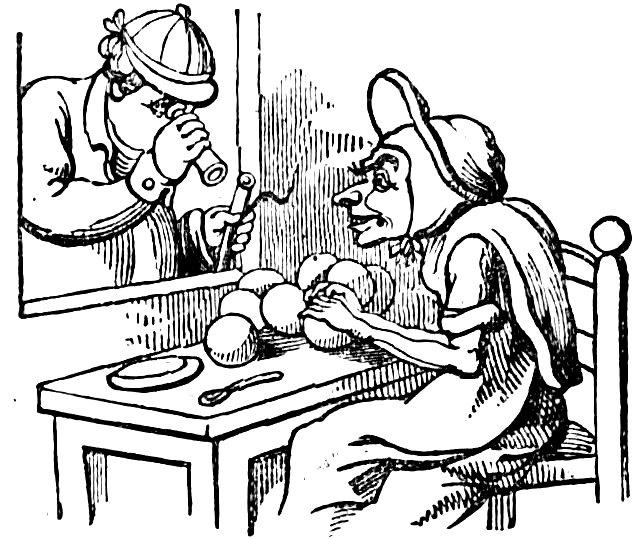
George III. wondering how the Apples got Inside the Dumplings.
CARICATURE HISTORY OF THE GEORGES (House of Hanover). Very Entertaining Book of 640 pages, with 400 Pictures, Caricatures, Squibs, Broadsides, Window Pictures. By T. Wright, F.S.A. 7s. 6d.
⁂ Companion Volume to “History of Signboards.” Reviewed in almost every English journal with the highest approbation.
“A set of caricatures such as we have in Mr. Wright’s volume brings the surface of the age before us with a vividness that no prose writer, even of the highest power, could emulate. Macaulay’s most brilliant sentence is weak by the side of the little woodcut from Gillray, which gives us Burke and Fox.”—Saturday Review.
“A more amusing work of its kind was never issued.”—Art Journal.
“It is emphatically one of the liveliest of books, as also one of the most interesting. It has the twofold merit of being at once amusing and edifying. The 600 odd pages which make up the goodly volume are doubly enhanced by some 400 illustrations, of which a dozen are full-page ones.”—Morning Post.
Large Paper Edition, 4to, only 100 printed, on extra fine paper, wide margins, for the lovers of choice books, with extra Portraits, half morocco (a capital book to illustrate). 30s.
A Companion Table Book to “Leech’s Sketches.”
MAIDEN HOURS AND MAIDEN WILES. Designed by “Beaujolais” (Captain Hans Busk). A Series of remarkably clever Sketches, showing the Occupations of a Fashionable Young Lady at All Hours of the Day. With appropriate Text. Folio, half morocco, blue and gold, gilt edges, 10s. 6d.
A Clever and Brilliant Book,
Companion to the “Bon Gaultier Ballads.”
PUCK ON PEGASUS. By H. Cholmondeley Pennell. In 4to, printed within an India-paper tone, and elegantly bound, gilt, gilt edges, price 10s. 6d. only.
⁂ This most amusing work has already passed through Five Editions, receiving everywhere the highest praise as “a clever and brilliant book.” To no other work of the present day have so many distinguished Artists contributed Illustrations. To the designs of George Cruikshank, John Leech, Julian Portch, “Phiz,” and other Artists, Sir Noel Paton, Millais, John Tenniel, Richard Doyle, and M. Ellen Edwards, have now contributed several exquisite pictures, thus making the New Edition—which is Twice the Size of the old one, and contains irresistibly funny pieces—the best book for the Drawing-room table now published.
AUSTIN’S (Alfred) THE SEASON: A Satire. Elegantly bound for the Drawing-room, 5s.
⁂ An entirely New Edition of this famous Work, it having been out of print seven years.
SIGNBOARDS: Their History. With Anecdotes of Famous Taverns and Remarkable Characters. By Jacob Larwood and John Camden Hotten. “A book which will delight all.”—Spectator. Fourth Edition, 580 pp., price 7s. 6d. only.
From the “Times.”
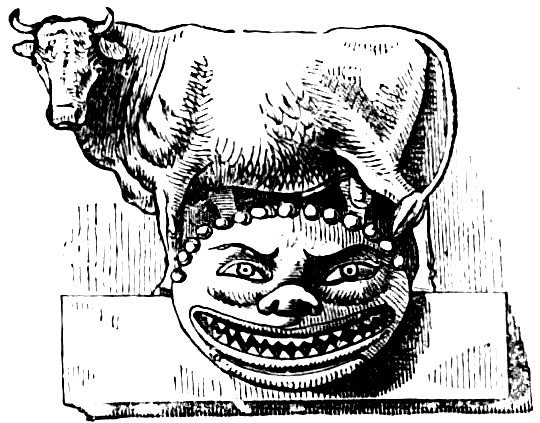
BULL AND MOUTH.
“It is not fair on the part of a reviewer to pick out the plums of an author’s book, thus filching away his cream, and leaving little but skim-milk remaining; but, even if we were ever so maliciously inclined, we could not in the present instance pick out all Messrs. Larwood and Hotten’s plums, because the good things are so numerous as to defy the most wholesale depredation.”—Review of three columns.
⁂ Nearly 100 most curious illustrations on wood are given, showing the various old signs which were formerly hung from taverns and other houses.
ROMANCE OF THE ROD: An Anecdotal History of the Birch, in Ancient and Modern Times. With some quaint Illustrations. Crown 8vo, handsomely printed.
[In preparation
THE FAMOUS “DOCTOR SYNTAX’S” THREE TOURS. One of the most amusing and Laughable Books ever published. With the whole of Rowlandson’s very droll full-page Illustrations, in Colours, after the Original Drawings. Comprising the well-known Tours—
1. In Search of the Picturesque.
2. In Search of Consolation.
3. In Search of a Wife.
The Three Series Complete and Unabridged in One Handsome Volume with a Life of this industrious Author—the English Le Sage—now first written by John Camden Hotten. This Edition contains the whole of the original, hitherto sold for 31s. 6d., now published at 7s. 6d. only.
Uniform with “Wonderful Characters.”
REMARKABLE TRIALS AND NOTORIOUS CHARACTERS. From “Half-Hanged Smith,” 1700, to Oxford who shot at the Queen, 1840. By Captain L. Benson. With spirited full-page Engravings by Phiz. 8vo, 550 pages, 7s. 6d.
⁂ A Complete Library of Sensation Literature! There are plots enough here to produce a hundred “exciting” Novels, and at least five hundred “powerful” Magazine Stories. The book will be appreciated by all readers whose taste lies in this direction. Phiz’s pictures are fully equal to those in “Master Humphrey’s Clock.”
A Keepsake for Smokers.
“THE SMOKER’S TEXT-BOOK.” By J. Hamer, F.R.S.L. Exquisitely printed from “silver-faced” type, cloth, very neat, gilt edges, 2s. 6d., post free.
“A pipe is a great comforter, a pleasant soother. The man who smokes, thinks like a sage, and acts like a Samaritan.”—Bulwer.
“A tiny volume, dedicated to the votaries of the weed; beautifully printed on toned paper, in, we believe, the smallest type ever made (cast especially for show at the Great Exhibition in Hyde Park), but very clear, notwithstanding its minuteness.... The pages sing, in various styles, the praises of tobacco. Amongst the writers laid under contribution are Bulwer, Kingsley, Charles Lamb, Thackeray, Isaac Browne, Cowper, and Byron.”—The Field.
MR. SWINBURNE’S ESSAY.
⁂ “A wonderful literary performance.”—“Splendour of style and majestic beauty of diction never surpassed.”
WILLIAM BLAKE: A Critical Essay. With facsimile Paintings, Coloured by Hand, from the Original Drawings painted by Blake and his Wife. Thick 8vo, pp. 350, 16s.
“An extraordinary work: violent, extravagant, perverse, calculated to startle, to shock, and to alarm many readers, but abounding in beauty, and characterized by intellectual grasp.... His power of word-painting is often truly wonderful—sometimes, it must be admitted, in excess, but always full of matter, form, and colour, and instinct with a sense of vitality.”—Daily News, Feb. 12, 1868.
“It is in every way worthy of Mr. Swinburne’s high fame. In no prose work can be found passages of keener poetry, or more finished grace, or more impressive harmony. Strong, vigorous, and musical, the style sweeps on like a river.”—The Sunday Times, Jan. 12, 1868.
MR. SWINBURNE’S SONG OF ITALY. Fcap. 8vo, toned paper, cloth, price 3s. 6d.
⁂ The Athenæum remarks of this poem—“Seldom has such a chant been heard, so full of glow, strength, and colour.”
MR. SWINBURNE’S POEMS AND BALLADS. Fourth Edition. Price 9s.
MR. SWINBURNE’S NOTES ON HIS POEMS, and on the Reviews which have appeared upon them. Price 1s.
MR. SWINBURNE’S ATALANTA IN CALYDON. New Edition. Fcap. 8vo, price 6s.
MR. SWINBURNE’S CHASTELARD. A Tragedy. New Edition. Price 7s.
MR. SWINBURNE’S QUEEN MOTHER AND ROSAMOND. New Edition. Fcap. 8vo, price 5s.
MR. SWINBURNE’S BOTHWELL. A New Poem.
[In preparation.
CHARLES DICKENS—The Story of his Life. By the Author of “The Life of Thackeray.” Price 7s. 6d., with numerous Portraits and Illustrations, 370 pp.
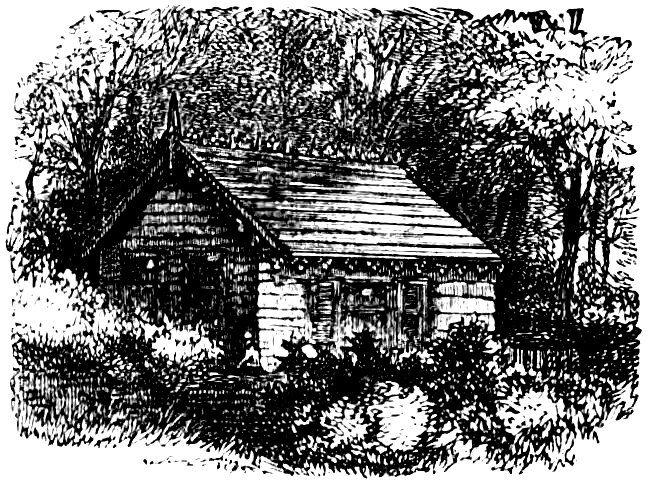
Dickens’s Summer House.
“Anecdotes seem to have poured in upon the author from all quarters.... Turn where we will through these 370 pleasant pages, something worth reading is sure to meet the eye.”—The Standard.
Dickens’s Life: Another Edition, without Illustrations, uniform with the “Charles Dickens Edition,” and forming a Supplementary Volume to that favourite issue, crimson cloth, 3s. 6d.
Dickens’s Life.—Cheap Popular Edition, in paper, 2s.
DICKENS’S SPEECHES, Literary and Social.—Now first collected. With Chapters on “Charles Dickens as a Letter Writer, Poet, and Public Reader.” Price 7s. 6d., with Fine Portrait by Count D’Orsay, 370 pages.
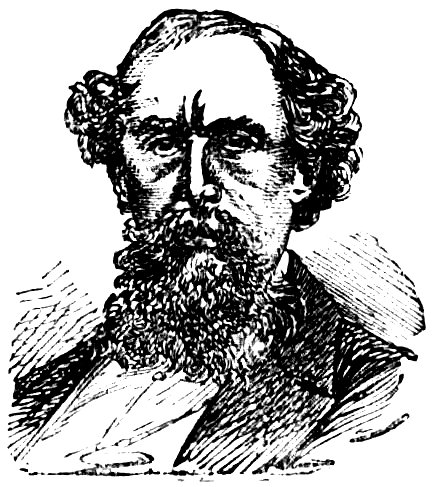
⁂ “His capital speeches. Every one of them reads like a page of ‘Pickwick.’”—The Critic.
“His speeches are as good as any of his printed writings.”—The Times.
Dickens’s Speeches.—Uniform with the “Charles Dickens Edition,” and forming a Supplementary Volume to that favourite issue, crimson cloth, 3s. 6d.
Dickens’s Speeches.—Cheap Edition, without Portrait, in paper wrapper, 2s.
HUNTED DOWN. A Story by Charles Dickens. With some Account of Wainewright, the Poisoner. Price 6d.
⁂ A powerful and intensely thrilling story, now first printed in book-form in this country.
GEORGE COLMAN’S HUMOROUS WORKS.
BROAD GRINS. My Nightgown and Slippers, and other Humorous Works, Prose and Poetical, of George Colman the Younger. Now first collected, with Life and Anecdotes of the Author, by George B. Buckstone. Crown 8vo, 500 pages, 7s. 6d.
⁂ Admirers of genuine old English wit and humour—irresistible and always fresh—will be delighted with the collected edition of George Colman’s humorous works. As a wit, he has had no equal in our time; and a man with a tithe of his ability could, at the present day, make the fortune of any one of our so-called “comic journals,” and bankrupt the rest.
Are you Engaged? If so, procure
ADVICE TO PARTIES ABOUT TO MARRY. A Series of Instructions in Jest and Earnest. By the Hon. Hugh Rowley. With Humorous Illustrations. Price 3s. 6d., elegantly bound.
⁂ Before taking the “awful plunge” be sure to consult this little work. If it is not a guarantee against life-long misery, it will at least be found of great assistance in selecting a partner for life.
SEYMOUR’S SKETCHES. A Companion Volume to “Leech’s Pictures.” The Book of Cockney Sports, Whims, and Oddities. Nearly 200 highly amusing Illustrations. Oblong 4to, a handsome volume, half morocco, price 12s.
⁂ A re-issue of the famous pictorial comicalities which were so popular thirty years ago. The volume is admirably adapted for a table book, and the pictures will doubtless again meet with that popularity which was extended towards them when the artist projected with Mr. Dickens the famous “Pickwick Papers.”
THE GENIAL SHOWMAN; or, Adventures with Artemus Ward, and the Story of his Life. By E. P. Hingston, companion of Artemus Ward during the latter’s Adventures. Cheap and popular Edition, cr. 8vo, illustrated by Brunton, 7s. 6d.
⁂ This is a most interesting work. It gives Sketches of Show-Life in the Far West, on the Pacific Coast, among the Mines of California, in Salt Lake City, and across the Rocky Mountains; including chapters descriptive of Artemus Ward’s visit to England.
RUSKIN AND CRUIKSHANK. “German Popular Stories.” Collected by the Brothers Grimm. Translated by Edgar Taylor. Edited by John Ruskin. With Twenty-two Illustrations after the inimitable designs of George Cruikshank. Both Series Complete. Cloth, 8vo, 6s. 6d.; gilt leaves, 7s. 6d.
⁂ These are the designs which Mr. Ruskin has praised so highly, placing them far above all Cruikshank’s other works of a similar character. So rare had the original book (published in 1823–1826) become, that £5 to £6 per copy was an ordinary price.
“FAMILY FAIRY TALES;” or, Glimpses of Elfland at Heatherston Hall. Edited by Cholmondeley Pennell, Author of “Puck on Pegasus,” &c. Adorned with beautiful Pictures of “My Lord Lion,” “King Uggermugger,” and other Great Folks. Handsomely printed on toned paper, in cloth, green and gold, price 4s. 6d. plain, 5s. 6d. coloured.
⁂ This charming volume has been universally praised by the critical press.
SCHOOL LIFE AT WINCHESTER COLLEGE; or, The Reminiscences of a Winchester Junior. By the Author of “The Log of the Water Lily,” and “The Water Lily on the Danube.” Second Edition, Revised, Coloured Plates, 7s. 6d.
⁂ This book does for Winchester what “Tom Brown’s School Days” did for Rugby.
PRINCE UBBELY BUBBLE’S NEW STORY BOOK. The Dragon all Covered with Spikes; The Long-tailed Nag; The Three One-legged Men; The Old Fly and the Young Fly; Tom and the Ogre; and many other Tales. By J. Templeton Lucas. With numerous Illustrations by Matt Morgan, Barnes, Gordon Thompson, Brunton, and other Artists. In small 4to, green and gold, 4s. 6d.; gilt leaves, 5s. 6d.
⁂ The Times devoted a special column in praise of this New Story Book.
MADGE AND THE FAIRY CONTENT. A charming Child’s Story. By Blanchard Jerrold. Intended to inculcate a spirit of Contentment. With nearly 100 Pictures of the Industry requisite to produce the Christmas Pudding. 4s. 6d.
LITTLE CHARLIE’S LIFE OF HIMSELF. Edited by the Rev. W. R. Clark, M. A., Vicar of Taunton. 4to, cloth, full of curious Illustrations, 3s. 6d.
⁂ A most amusing Present for a child. It is an exact facsimile of the autobiography of a boy between six and seven years of age, as written by himself in his copy-book.
FLAGELLATION and the FLAGELLANTS; A History of the Rod in all Countries, from the Earliest Period to the Present Time. By the Rev. William Cooper, B.A. With numerous Illustrations. Thick crown 8vo, 12s. 6d.
THE ROD in The Church, Convent, Monastery, Prison, Army, Navy, In Public and In Private.
THE BIRCH in The Family, Ladies’ Seminaries, Boys’ Schools, Colleges, The Boudoir, Ancient and Modern.
⁂ “A very remarkable, and certainly a very readable volume. Those who care for quaint stories of the birch will find much matter for reflection, and not a little amusement, in Mr. Cooper’s ‘Flagellation’ Book.”—Daily Telegraph.
The ENGLISHMAN’S HOUSE, from a Cottage to a Mansion. A Practical Guide to Members of Building Societies, and all interested in Selecting or Building a House. By C. J. Richardson, Architect, Author of “Old English Mansions,” &c. Second Edition, Corrected and Enlarged, with nearly 600 Illustrations. Crown 8vo, 550 pages, cloth, 7s. 6d.
⁂ This Work might not inappropriately be termed “A Book of Houses.” It gives every variety of house, from a workman’s cottage to a nobleman’s palace. The book is intended to supply a want long felt, viz., a plain non-technical account of every style of house, with the cost and manner of building.
⁂ Mr. Hotten is enabled to afford most material and important assistance to all interested in Genealogical Inquiries, difficult Pedigree Researches, or in the Compilation of Family Histories. He has the following FAMILY HISTORIES FOR SALE:—
FORSTER AND FOSTER FAMILIES. 4to, 31s. 6d.
BAIRD FAMILY. Roy. 8vo, 10s. 6d.
CHICHESTER AND RALEIGH FAMILIES. 4to, 21s.; with Arms Emblazoned, 31s. 6d.
WASHINGTON FAMILY. Preparing.
MILLAIS FAMILY. With Etchings by Millais. 28s.
COLE FAMILY. 5s. 6d.
STUART FAMILY. 8s. 6d.
CHICHELE FAMILY. (Contains Pedigrees of many other Families.) 17s. 6d.
HANDBOOK OF FAMILY HISTORY OF THE ENGLISH COUNTIES: Descriptive Account of 20,000 most Curious and Rare Books, Old Tracts, and Ancient Manuscripts. 350 pages, 5s.
THE BEST HANDBOOK of HERALDRY. Profusely Illustrated with Plates and Woodcuts. By John E. Cussans. 8vo, pp. 360. in emblazoned gold cover, with copious Index, 7s. 6d.
Best Guide to Reading Old MSS., Records, &c.
WRIGHT’S COURT HAND RESTORED; or, Student’s Assistant in Reading Old Deeds, Records, &c. 4to, 10s. 6d.
LISTS OF ROMAN CATHOLICS AND RECUSANTS IN YORKSHIRE., temp. James I. (A. D. 1604.) With copious Genealogical Notes, by Edward Peacock, F.S.A. Small 4to, 15s.
ROLL OF CAERLAVEROCK; with Arms of Knights present at the Siege in Scotland, A.D. 1300. In Gold and Colours, 4to, 12s.
MAGNA CHARTA. Exact Facsimile of Original Document. Arms and Seals of Barons in Gold and Colours, 5s.
⁂ Framed in Carved Oak, 22s. 6d. A full translation, with notes, price 6d.
ROLL OF BATTLE ABBEY: List of the Normans who came with William the Conqueror, and settled in this Country, A.D. 1066–1067. Arms of Barons in Gold and Colours. Price 5s.
⁂ Of great interest to all of Norman descent. Framed in carved oak, 22s. 6d.
WARRANT TO EXECUTE CHARLES I. Exact Facsimile, with the 59 Signatures of Regicides, and Seals. 2s.; by post, 2s. 4d.
WARRANT TO EXECUTE MARY QUEEN OF SCOTS. Signature of Elizabeth, and Great Seal of England. 2s.; by post, 2s. 4d.
⁂ Both warrants, carved oak and glazed, 14s. 6d.
John Camden Hotten, 74 and 75, Piccadilly, London.
Hotten’s “Golden Library”| OF THE BEST AUTHORS.
⁂ A charming collection of Standard and Favourite Works, elegantly printed in Handy Volumes, uniform with the Tauchnitz Series, and published at exceedingly low prices. The New Volumes are—
ROCHEFOUCAULD.—Reflections and Moral Maxims. 1s.; cloth, 1s. 6d. Essay by Sainte-Beuve.
SHELLEY.—Poetical Works. From the Author’s Original Editions. First Series, Queen Mab and Early Poems. 1s. 8d.; in cloth, 2s. 2d.
HOLMES.—Autocrat of the Breakfast Table. 1s.; cloth, 1s. 6d.
THE CLERGY.—The Book of Clerical Anecdotes and Pulpit Eccentricities. 1s. 4d.; cloth, 1s. 10d.
CHARLES LAMB.—The Essays of Elia. Complete. Both Series. 1s.; cloth, 1s. 6d.
DICKENS.—Life. By the Author of the “Life of Thackeray.” 2s.
DICKENS.—Speeches upon Literary and Social Topics. 2s.
“His Speeches are as good as any of his printed writings”—The Times.
ARTEMUS WARD.—In London; with the “Punch” Letters. 1s. 6d.; cloth, 2s. 6d.
TENNYSON.—Old Prose Stories of Idylls of the King. 1s.; cloth, 1s. 6d.
DISRAELI’S, GLADSTONE’S, AND BRIGHT’S SPEECHES in separate vols., at 1s. 4d.; cloth, 1s. 10d.
Comprise all the Important Speeches of these Statesmen during the past 25 years.
CARLYLE.—On the Choice of Books. 1s.; cl. 1s. 6d.
Should be read and re-read by every young man in the three kingdoms.
HOLMES.—Professor at the Breakfast Table. 1s.; cloth, 1s. 6d.
LEIGH HUNT.—Tale for a Chimney Corner, and other Essays. 1s. 4d.; cloth, 1s. 10d.
HOOD.—Whims and Oddities. 80 Illustrations 2 Series, Complete. 1s.; cloth, 1s. 6d.
LELAND.—Hans Breitmann’s Ballads, Complete. 1s.; cloth, 1s. 6d.
J. Ogden and Co., Printers, 172, St. John Street, E.C.
TRANSCRIBER’S NOTES
Silently corrected obvious typographical errors and variations in spelling.
Retained archaic, non-standard, and uncertain spellings as printed.