PORK.
Reading edition
TO SELECT.
When the rind is tender and thin, the pork is young; when thick and hard, it is old.
To be good, the meat must be soft, and have a fresh and good appearance.
We do not think it necessary to indicate here how to make black puddings, chitterlings, Bologna, and other sausages. It is nearly, if not quite impossible, for a person having no practice in it, to make them edible; it is better to buy them ready made at pork-butchers' shops, or to hire an experienced person to make them.
CHINE AND FILLET.
Take a good chine of pork, place it on the spit before a sharp fire, baste often with a little melted butter first, and then with the drippings; when properly cooked, serve it with a vinaigrette, Robert, piquante, or poivrade sauce. It will take from two to three or four hours to roast, according to the size of the chine.
HOW TO IMPROVE THE CHINE OF PORK.
Place it in a crockery vessel, pour on it two tablespoonfuls of sweet-oil, then sprinkle on two teaspoonfuls or chopped parsley, also salt and pepper, two onions chopped fine, four cloves, and two bay-leaves; leave thus twenty-four hours in winter, and ten in summer, turning over two or three times. The taste of the meat is much improved by that process. The oil may be used for basting instead of butter.
Baked.—Put the chine in a bakepan, sprinkle salt over it, coyer the bottom of the pan with cold water, and put in a rather quick oven, baste often, and in case there should be much fat in the pan, take it off and add a little cold water.
When overdone, serve with any of the following purées: beans, lentils, Lima beans, onions, peas, potatoes, sorrel, or spinach.
It may also be served with the following sauces: fines herbes, piquante, poivrade, Provençale, ravigote, rémolade, Robert, tarragon, Tartar, and vinaigrette.
It is served also with a tomato-sauce. Make more sauce for pork than for other dishes, and make the tomato-sauce rather thick by boiling it gently for some time; it tastes better so with pork.
Always use mustard with pork, if you like it. Horse-radish, also, is good with it.
CUTLETS.
Flatten the cutlets with a chopper (they may be improved in the same way as the chine), place them on the gridiron and set on a sharp fire; turn over two or three times, and when properly done, serve them with a piquante, Robert, or tomato-sauce, adding to them some slices of pickled cucumbers just before serving.
The same, sautées.—Instead of broiling them, when prepared as above, place them in a frying-pan with a little butter, turn over two or three times during the cooking, and serve as the above, or on a purée of sorrel.
LEG, ROASTED.
How to improve it.—Take the skin or rind gently off, put the leg in a crockery vessel, pour on it the following mixture: a pint of white wine, two tablespoonfuls of sweet-oil, a bunch of sage, salt, pepper, and a pinch of grated nutmeg. Leave it thus two days in winter and one in summer, turning it over two or three times during the process.
Place the leg on the spit and put before a very sharp fire, baste often with the mixture from the crockery vessel, or with melted butter, and serve when cooked, with the gravy strained. It will take about two or two and a half hours to roast it.
Baked.—Bake and serve the leg in the same and every way as the chine, with purées and sauces. Any part of pork is prepared like chine.
Ham in hors-d'oeuvre.—Cut the ham in small and thin slices, place the slices tastefully on a dish, either overlapping or in pyramid, or in any other fancy way, and serve with parsley in the middle or around. Slices of lemon may also be served with it, either with the parsley or without it.
HAM.
To boil.—Sugar-cured are preferred to others.
Scrape off the outside gently, soak in cold water for from six to twenty-four hours, take off and wipe dry.
Envelop it in a towel and tie it. Place it in a kettle large enough to hold it without bending it; cover with cold water; season with six small onions, two carrots, four cloves, two bay-leaves, a handful or two plants of parsley, two or three stalks of thyme, two of celery, two cloves of garlic (a handful of hay and half a bottle of white wine, if handy would improve the taste); boil gently for four or five hours, according to the size (four hours for a ten-pound one, five for a fifteen-pound one). Pay no attention to the old saying that "it takes half an hour to every pound."
Take from the fire, remove the towel, break off and remove the small bone at the larger end of it, and without tearing the meat. Remove the rind also, leaving only about two inches of it near the smaller end, cutting it so that it will be dentilated.
To decorate.—It is decorated in several ways, according to taste and fancy. If the fat is not white after having removed the rind, spread a very thin coat of lard over it, place the ham on a dish, the fatty side up. Cut carrots, turnips, and beets, boiled tender, in fancy shapes, with paste-cutters or with a knife; place them tastefully all over the ham; place also all over it some parsley, capers, and olives. Chop some meat-jelly and put it all around the dish, and serve. In carving it, scrape back the lard and vegetables, slice, and serve.
Another.—When boiled, trimmed, and the rind removed, put it in the oven for about twenty minutes, basting the while with a Madeira sauce. Serve with the sauce. Any kind of purée may be served with it.
Another.—When trimmed and soaked in water as directed, boil it with half wine and half water: the same seasonings as when boiled in water. Use either Catawba, Sauterne, or Rhine wine. It makes it more expensive, but it is excellent. It is served as when boiled in water.
Another.—Boil it in claret wine, and when trimmed and decorated, serve it with a mushroom or a truffle sauce.
Another.—Boil, trim, and cut off the rind as described in the above cases; place the frill, and serve with spinach au beurre.
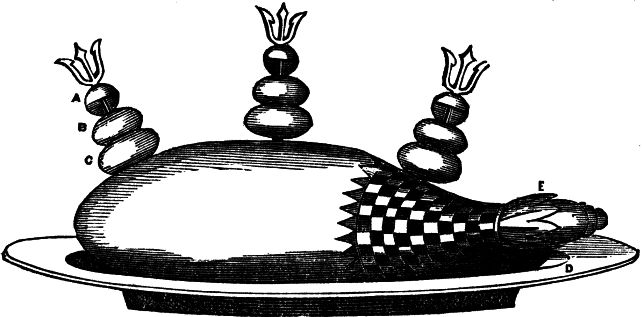
A, skewers; B, carrot; C, truffle or mushroom; D, jelly; E, frill.
Another.—Boil and trim the ham as above, cut the rind in the same way. What is left of the rind is cut as seen in the cut opposite: that is, some small square pieces are cut off, from place to place, so that it resembles a checkerboard; stick two or more skewers in it, glaze it with essence of beef or with sugar, and serve either on a tomato-sauce or on peas à l'Anglaise.
Ham English fashion.—Soak it in water and trim it as directed. Make some paste with water and flour only; spread a coat of this paste all over the ham, and then envelop it in buttered or oiled paper. Put it on the spit and baste with fat while it is roasting. Roast it for three or three and a half hours, according to size; remove the paper about two hours after it has been taken from the fire; cut a hole in the paste about an inch in diameter and on the lean side; pour into it, little by little, half a pint of good Madeira wine, cover the hole with some paste, placing a band of paper on it to prevent it from falling; put the ham back on the spit for about twenty minutes, and serve whole with Madeira sauce. We mean, by serving whole, with the paste around it, but not the paper.
Besides the sauce, some green vegetables, boiled only, are served on separate dishes, but eaten with the ham.
It is also served like game, with currant-jelly, apple-sauce, etc.
Champagne Sauce.—Proceed as for the above in every particular, except that you use Champagne instead of Madeira wine, and when done serve it with a Champagne sauce.
Another.—It may be boiled as directed above, and served with a Champagne sauce also.
Another.—When soaked and dry, put it in a crockery vessel; put on and all around it four onions chopped fine, two bay-leaves, two sprigs of thyme, a piece of nutmeg, and pour on the whole a bottle of white wine; cover the vessel as nearly air-tight as possible, leave it thus for about twenty-four hours, turning it over two or three times, so as to let every side take the seasonings. Place the ham on the spit before a good fire, baste often with the seasonings from the crockery vessel, and when done take it off, dust it with fine raspings of bread, place it fifteen minutes in a slow oven, strain the drippings, boil them till reduced to a proper thickness, dish the ham, pour the drippings on it, and serve.
SALTED PORK.
The best and only proper way to cook salted pork, is, to put it in a kettle, entirely cover it with cold water, boil gently till cooked, and serve it with a purée or with a garniture of cabbage. Any thing else that you might put with it would rather spoil than better it.
PIG'S EARS.
How to prepare.—Soak them in warm water for a few minutes, then wash and clean them well, and scrape the hair off, if any.
Boiled.—When prepared, you throw them in boiling water for two minutes and take from the fire; add four onions for four ears, one carrot, salt and pepper; leave just water enough to cover the whole, and when cooked, drain. Serve them on a purée of beans or of lentils.
The same, broiled.—When cleaned, prepared, and cooked as above, just dip them in beaten eggs, roll them in bread-crumbs, place on the gridiron and on the fire, broil for about two or three minutes; then serve them with a maître d'hôtel sauce.
PIG'S FEET.
Broiled, or à la Sainte Menehould.—Split six feet in two, lengthwise, and soak them in tepid water for ten minutes, then envelop each in a piece of linen well tied or sewed; place them in a kettle or stewpan with four small onions, four sprigs of parsley, two of thyme, two of sweet basil, two bay-leaves, two cloves of garlic, two cloves, two small carrots cut in pieces, salt, pepper, and half a pint of white wine; cover with cold water, simmer about six hours, skim them properly, fill with boiling water so as to have them covered all the time; take from the fire when cooked, and when nearly cool take the feet from the kettle, untie them, throw away the linen, and let them cool. Dip each in melted butter or in sweet-oil, roll in bread-crumbs, and place on a gridiron and on a good fire; serve them as they are, when properly broiled.
Stuffed.—Prepare the feet and cook them as above. When perfectly cold, remove the long bone of each half, fill the place with sausage-meat; dip each in melted butter and yolk of egg, mixed and seasoned with salt and pepper, roll in bread-crumbs, and broil. While they are broiling, baste them with melted butter. Serve as they are, or with meat-jelly, or gravy.
Stuffed with Truffles.—Proceed as with the above in every particular, so far as removing the long bone of each half, so as to be ready for stuffing them.
Cut truffles in small dice, enough to half fill the feet, and put them on the fire in a small saucepan, just covered with Madeira wine; toss and stir till the wine is absorbed and nearly boiled away, then add a little gravy, stir half a minute, take from the fire and let cool. When cold, fill each half foot till half full, and finish with sausage-meat; then dip in butter and egg, roll in crumbs, broil and serve as the above.
They may be filled with truffles only, and served with meat-jelly.
PIG'S HEAD.
Soak in water and clean it well; take all the bones and flesh out; then cut the flesh and about one pound of salt pork in strips, which you put inside of the head, well mixed with salt, pepper, half a dozen middling-sized onions chopped, two teaspoonfuls of chopped parsley, half a saltspoonful of allspice, two bay-leaves, two sprigs of thyme, a little sage, and the juice of half a lemon; lay it in a crockery vessel for from four to six days. Envelop the head in a towel, place it in a kettle with eight small onions, two carrots cut in pieces, salt, pepper, four sprigs of parsley, four of thyme, four bay-leaves, two cloves, and a pint of white wine; cover with water, set on the fire, and simmer from six to eight hours; take from the fire and drain, take the towel off and drain again till dry and cold. Serve it with sprigs of green parsley around.
Wild-Boar like.—Prepare, stuff, cook, and allow it to cool as the one preceding; then place it on an oval dish, the ears up, with one or two skewers to hold them in place, and also two or three decorated skewers in the middle of the head and between the eyes—not across, but lengthwise. Glaze it with essence of beef, by means of a brush; make eyes with meat-jelly, which you cut with a vegetable spoon, and imitate the tongue, teeth, and tusks with butter colored with cochineal and kneaded with flour. Cover the back part with jelly and skewers ornamented with flowers or slices of truffles, or with both. Some jelly, chopped, may also be placed all around, and flowers in the ears and on the eyes. It is served as an entrée, or for supper, lunch, or breakfast.
PIG'S KIDNEYS.
Prepare, cook, and serve like calf's kidneys.
PIG'S TAIL.
Prepare, cook, and serve like pig's ears.
PIG'S TONGUE.
Prepare, cook, and serve like beef tongue.
Head-cheese.—Soak a pig's head in cold water for two or three hours, clean, and then cut the whole of it, ears and tongue included, in strips one or two inches long, and then put the whole with about two pounds of salt pork, cut in strips also, in a crockery bowl, season with salt, pepper, chopped onion, chopped parsley, thyme, bay-leaf, and sage, chopped also, the juice of a lemon, and leave thus for about two or three days, turning it over occasionally. Then put the mixture in a mould or wrap it in a towel and boil till done. It must be immersed in the water.
Some beet or sheep's tongue, together with the flesh of chicken, may be added to the head.
When cooked and cold, if there are any empty places, they may be filled with meat-jelly.
It is served at late suppers, or at lunch and breakfast. It is always served cold, with parsley around.
SUCKING-PIG.
A sucking-pig, to be good, must be fat.
Then properly cleaned, and hoofs off, clean the inside, leaving the kidneys; skewer it, put in it half a pound of butter kneaded with chopped parsley and green onions, four or five mushrooms, and two white onions with a clove stuck in each; place it on the spit before a good fire, baste often with melted butter first, and then with the drippings, and when done serve on a vinaigrette.
Some truffles may be added to the seasoning, if handy; it gives it a good taste.
Baked.—Stuff it as the above, place it in a baking-pan with just cold water enough to cover the bottom of the pan; put it in a quick oven, baste often, and when done serve with a rémolade or vinaigrette sauce.
When roasted or baked, place it on a dish with slices of truffles, mushrooms, and parsley all around. Run some skewers through slices or truffles and whole mushrooms, and plant them in it like the one represented in the cut on the following page.
A small red apple is placed in the mouth after it is cooked, to make room for which a stone is placed in the mouth before cooking it, in order to keep the mouth open. It is served as warm as possible.
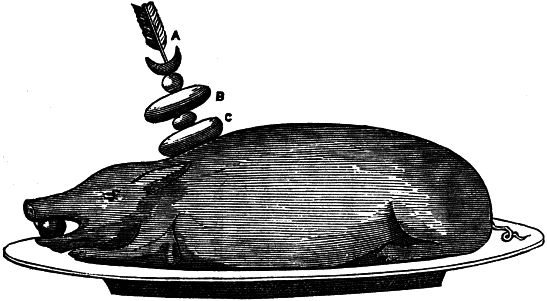
A, skewer; B, slices of truffles; C, mushrooms
Boned.—A sucking-pig can be boned and filled just the same as a turkey, and cooked and served alike also.