MUTTON.
Reading edition
HOW TO SELECT.
You may be sure that mutton is good when the flesh is rather black, and the fat white; if the fat breaks easily, it is young.
The wether is much superior to the ewe.
You will know if a leg of mutton comes from a wether, if there is a large and hard piece of fat on one side at the larger and upper end; if from a ewe, that part is merely a kind of skin, with a little fat on it.
ROASTED.
A piece of mutton to roast must not be too fresh, it is much more tender when the meat is rather seasoned, but not tainted, or what is sometimes called "high." When on the spit, place it near the fire, baste immediately with a little melted butter, and then with the drippings. As soon as you notice that a kind of crust or coating has formed around the piece of meat, remove it a little from the fire by degrees; and continue basting till done. The quicker the crust is formed, though without burning the meat, the more juicy and tender it will be.
Roast mutton, like roast beef, is better served rather underdone, but should be a little more done than beef. When properly roasted, the meat, whatever piece it may be, either a loin or saddle, a leg, shoulder, or a breast, may be served with its gravy only; that is, with what is in the dripping-pan after having removed all the fat, also on a soubise or on a purée of sorrel. The above pieces may also be served in the following ways:
With Potatoes.—When dished, surround the meat with potatoes, either fried, mashed, or in croquettes.
With Quenelles.—Dish the meat, place half a dozen quenelles around it, and decorate it with skewers which you have run through a quenelle and then through a craw-fish and stuck in the meat.
With Carrots.—When dished, put all around the meat carrots au jus, or glazed and cut with a vegetable spoon.
With Spinach.—Spinach au jus when done is spread on the dish, the meat is put on it, and served warm. Do the same with a purée of cauliflowers.
BAKED.
All the above pieces are baked as well as roasted; and when done, served exactly in the same and every way as when roasted.
Put the meat in a baking-pan with a little butter spread over it; cover the bottom of the pan with cold water, then put in a quick oven. After it has been in the oven for about fifteen minutes, baste and place a piece of buttered paper on the top of the meat. If the bottom of the pan is getting dry, add a little more water, but it is seldom the case except with inferior meat. When you see rather too much fat in the pan, take from the oven, turn the fat off, put cold water instead, and put back in the oven to finish the cooking. If the paper burns, put on another piece; but by basting often over the paper, it will remain pretty long before burning.
With a small knife or a skewer you ascertain when done enough or to your liking; never cook by guess or by hearsay; the oven may be quicker one day than another, or slower; the meat may be more tender, or more hard; remember that if you cook by guess (we mean, to put down, as a matter of course, that it takes so many hours, or so many minutes, to bake this or that), and stick to it, you will fail nine times out of ten. When done, serve as directed above.
In Croquettes.—Make and serve as chicken croquettes.
In Haricot or Ragout.—Take a neck or breast piece of mutton, which cut in pieces about two inches long and one broad. Put them in a saucepan (say three pounds) with two ounces of butter, set on the fire and stir occasionally till turning rather brown, then add a tablespoonful of flour, stir for one minute, cover with cold water, add one onion whole, salt, a bunch of seasonings composed of four sprigs of parsley, one of thyme, a bay-leaf, and a clove, one clove of garlic, chopped fine. Boil gently till about two-thirds done, stirring now and then; add potatoes, peeled, quartered, and cut, as far as possible, of the shape of a carpel of orange. The proportion is, about as many pieces of potatoes as of meat. Boil again gently till done, place the pieces of meat in the middle of the dish, the potatoes around, the juice or sauce over the whole, and serve. Skim off the fat, if any, before turning the sauce over the rest.
BREAST BOILED.
Put the breast entire in a saucepan, with a sprig of thyme, two of parsley, a bay-leaf, a clove, salt, and pepper, cover with water, set on the fire, boil gently till cooked, and then drain. Put in a frying-pan three tablespoonfuls of sweet-oil, a teaspoonful of chopped parsley, salt, and pepper; when hot lay the breast in and fry it all around for five minutes; then take it off, roll it in bread-crumbs, place it on a gridiron, and set on a good fire for five minutes; turn it over once only, then serve it with a piquante, poivrade, or tomato sauce. It may also be served on a purée of sorrel.
NECK BROILED.
Prepare and serve exactly the same as a breast broiled.
A breast or a neck piece broiled may be served on a soubise. It may also be served with a maître d'hôtel or mushroom sauce, also with a piquante or any other sharp sauce.
CHOPS.
Broiled.—Trim and flatten the chops with a chopper, sprinkle salt and pepper on both sides, dip them in melted butter, place them on a gridiron, and set on a sharp fire, turn over two or three times to broil properly, and when done, serve them around a dish, one lapping over the other, etc., and serve with the gravy. It takes about twelve minutes to cook with a good fire.
Another way.—When trimmed and flattened, dip them in beaten egg, roll them in bread-crumbs and broil, either as they are, or enveloped in buttered paper, and serve them with a maître d'hôtel sauce.
Sautés.—When trimmed and flattened, fry them with a little butter on both sides; then take the chops from the pan and put them in a warm place. Leave in the pan only a tablespoonful of fat, add to it three times as much broth, a teaspoonful of parsley and green onions, two shallots, two pickled cucumbers, all chopped fine, and a pinch of allspice; give one boil, pour the whole on the chops, also the juice of half a lemon, and serve.
The same, with Vegetables.—Put in a frying-pan a piece of butter the size of two walnuts for four chops, set on a good fire, and when hot lay the chops in, after having flattened them with a chopper, and having sprinkled salt and pepper on both sides; add a clove, and a teaspoonful of chopped parsley and green onions; leave thus five minutes, turn over once or twice; then add also half a wine-glass of broth, same of white wine, and finish the cooking. Take the chops off the pan and put them in a warm place. Boil the sauce in the pan ten minutes, turn it on the chops, put a garniture of vegetables around, and serve. Throw away the clove just before serving.
Another way.—Have a piece of butter the size of an egg for eight chops in a crockery vessel, and set it on a good fire; when melted take from the fire, lay the chops in, after having flattened them; then cover them with a sheet of buttered paper; place the vessel in a rather hot oven, and when cooked serve them on a maître d'hôtel, provençale, or tomato sauce. They may also be served on a purée of sorrel, or one of potatoes.
The same, in Papillote.—Cut the chops rather thin, beat them gently and flatten them; then proceed as for veal cutlets in papillotes in every particular.
Financière.—Broil the chops, either with or without egg and crumbs, and serve them with a financière garniture.
Soubise.—The chops are either broiled or fried; either broiled only dipped in lukewarm butter or in beaten egg and crumbs and then served on a soubise. A little lemon-juice may be added when they are on the dish.
Jardinière.—Cut two carrots and two turnips with a vegetable spoon and set on the fire with cold water and salt; boil gently till tender, and drain. Boil also in the same way, in another pan and till tender, two tablespoonfuls of green peas, or string-beans cut in pieces, and drain also. Then put carrots, turnips, peas, or beans, back on the fire, in the same pan with a little gravy and broth, enough to cover them, salt, and pepper; boil gently five minutes; then put the chops in after being fried as directed below; boil another five minutes; take from the fire, place the chops around the dish, one lapping over the other, and so that an empty place is left in the middle; turn the carrots, turnips, and peas, with the sauce in that empty place, and serve. Salt and pepper the chops on both sides; fry them in a little butter till about three-quarters done; then take off and put with the vegetables as directed above. They may be broiled instead of fried, which is better.
A la Princesse.—Trim the chops as usual and salt and pepper both sides. Chop very fine a piece of lean veal about half a pound for six or eight chops, according to size, then pound it and mix it with half a teaspoonful of flour, a pinch of nutmeg, salt, pepper, a yolk of egg, two tablespoonfuls of bread-crumbs and one ounce of butter. If too firm the butter must be melted so as to mix better. Put the mixture in a saucepan, set on a good fire, stir for ten minutes, and take off. Then grease the paste-board slightly with butter, put a teaspoonful of the mixture here and there on it, roll and make small balls of it, drop them in boiling broth or water, boiling about fifteen minutes, and take off with a skimmer. Dip the chops in melted butter, then in beaten eggs, and roll in bread-crumbs; fry them with a little butter. Fry the balls also. Place the chops on the dish, the bones toward the edge, and the balls between the chops; serve warm. A few balls may be placed in the middle.
With Mushrooms.—Broil and serve them with a purée of mushrooms, or with a mushroom garniture.
Mutton chops, broiled, may be served with every kind of butter, every garniture, and every sauce, according to taste; they may also be served with every purée.
A French cook once said he could serve mutton chops in three hundred ways, apples in two hundred ways, and eggs in four hundred ways. The culinary science and art is advanced enough to-day to double the above figures, and have plenty to spare.
LEG.
Besides being prepared as directed for roast mutton, a leg of mutton, roasted or baked, may be served in the following ways:
Boil white beans and drain them as directed, then put them on the fire with the drippings of the leg of mutton for ten minutes, stirring now and then, and serve them with it. They may also be kept in the dripping-pan for ten minutes, when boiled and drained, before the leg is done. If the leg of mutton is baked, set them on the fire for about ten minutes, with the gravy, stirring occasionally. Serve either on the same or on a separate dish.
With Currant Jelly.—Roast or bake the leg of mutton, and serve it with currant jelly or with a purée.
Provençale.—With a sharp-pointed knife, make a small cut in the leg of mutton here and there, and large enough to stick into the cut a clove of garlic. Make as many cuts as you please, from six to twenty, according to taste, and in each cut stick a clove of garlic. When prepared thus, roast or bake, and serve it with either of the following sauces: piquante, poivrade, ravigote, rémolade, Robert, shallot, Tartar, tomato, and in vinaigrette.
Decorated.—A leg of mutton may be decorated the same as a fillet of beef.
Stewed.—Take the large bone out, leaving the bone at the smaller end as a handle; cut off also the bone below the knuckle, and fix it with skewers; then put it in a stewpan with a pinch of allspice, four onions, two cloves, two carrots cut in four pieces each, a small bunch of parsley, two bay-leaves, three sprigs of thyme, salt, pepper, two ounces of bacon cut in slices, a quarter of a pint of broth, and water enough just to cover it; set on a good fire, and after one hour of boiling add a liquor-glass of French brandy. Let simmer then for about five hours, in all about six hours; then dish it, strain the sauce on it, and serve.
We would advise those who have never tasted of a leg of mutton cooked as above, to try it.
It may be served also with white beans cooked in water and fried in butter, or on fried potatoes.
The next day.—If you have a piece left for the next day, cut it in thin slices after dinner, place the slices on a dish, with parsley under, in the middle, and above, and keep in a cold place.
A while before dinner you put in a stewpan a piece of butter (the quantity to be according to the quantity of meat), and set it on a good fire; when melted, sprinkle in, gradually, a little flour, stirring with a wooden spoon; when of a proper thickness, and of a brownish color, add a glass of broth, salt, pepper, a few pickled cucumbers cut in slices, and two or three mushrooms; boil ten minutes; lay the slices of meat in, subdue the fire, simmer twenty minutes, and serve.
The same, in another way.—Chop fine the slices of leg of mutton, put a piece of butter in a stewpan, and set it on the fire; when melted, place the chopped meat in, keep stirring with a wooden spoon for about ten minutes; then add two or three tablespoonfuls of broth, salt, pepper, and a pinch of allspice; simmer fifteen minutes, and serve with fried eggs all around the dish.
Boiled.—Set a saucepan on the fire with cold water enough to cover the leg of mutton, add salt; at the first boil put the leg of mutton in, wrapped up in a towel. Boil gently till done. For a middling-sized one, it takes about two hours. Remove the towel, dish the leg of mutton, spread a caper-sauce over it, and serve hot. The sauce may also be served in a boat or saucer.
Cold.—What is left of it may be prepared like cold mutton in vinaigrette.
SHOULDER.
Shoulder boned.—Split the shoulder just in the middle, on the inside, lengthwise and following the middle of the bones; remove the flat bone at the larger end first. This is easily done by scraping the meat off the bone on both sides, and then pulling it off. Do the same with the remaining bone. Spread the shoulder open on the table, the inside up, salt and pepper it, then spread on it the same stuffing as for a chicken stuffed with sausage-meat. Roll the shoulder round, tie it with twine, and roast or bake it. When roasted or baked, serve with the gravy.
On a Purée.—Bone and roll the shoulder as above directed, but do not stuff it; roast or bake it, and serve it on a purée of potatoes, beans, peas, lentils, or any other vegetable; place the shoulder in the middle of a dish, cut it in slices, and place them all around the purée, one lapping over the other; turn the gravy over the whole through a strainer, and serve hot.
With a Sauce.—When baked or roasted as above, with or without stuffing, serve it with a piquante, ravigote, or Robert sauce.
Boiled.—Boil, and serve it with a caper-sauce, the same as the leg.
SADDLE.
Prepare, cook, and serve the saddle in the same way as the leg—roasted or baked, warm or cold.
COLD MUTTON.
Served cold, à la Vinaigrette.—A shoulder of mutton, roasted or baked, after being boned, makes a handsome dish served cold. Cut any piece of cold mutton that you may have, in thin slices, as evenly as possible. Place a paste-cutter, about an inch and a half in diameter, in the middle of an oval dish; then place the slices of meat all around the dish, one slice lapping over another; the dish being oval, the slices of meat will touch the paste-cutter on two sides, but there will be two empty places on the two other sides, which you fill with hard-boiled white of egg chopped fine, and hard-boiled yolk of egg chopped fine also; they must not be mixed, and the yolk must be farther from the paste-cutter, the white touching it. Put a string of chopped yolk of egg all around the meat, and outside of it one of chopped white of egg around the yolk, and one of chopped parsley around the white. Remove the paste-cutter, and put a rose, or two or three pinks, in its place, or a small bunch of violets. Place one or three capers on each small heap of yolk of egg that is on the middle of the dish, and also some capers here and there on the string of white of egg.
Place a rose at each end of the dish, as indicated in the cut opposite; six radishes around the dish, also as indicated in the cut, and you have a dish as sightly as can be made, and an excellent one, too. Serve with the following sauce in a boat or saucer: Put in a bowl half a teaspoonful of mustard, a little pepper and salt; then pour one or two tablespoonfuls of vinegar on, little by little, beating with a fork at the same time; again, three or four tablespoonfuls of oil, and in the same way; and when the whole is well mixed, serve.
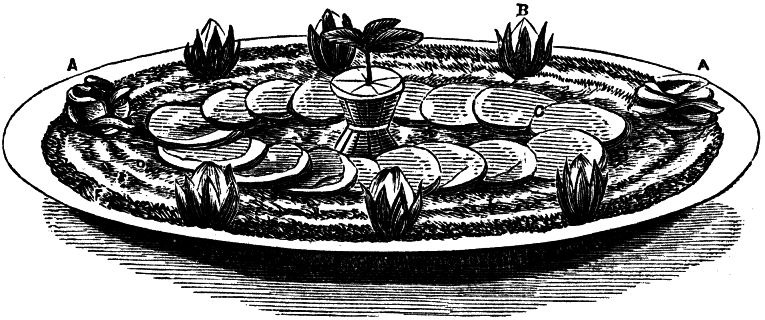
A, two roses, one at each end; B, six radishes around; C, slices of meat; D, eggs; E, yolks of eggs; F, parsley.
SHEEP'S BRAIN.
Prepare, cook, and serve as calf's brain.
FEET.
Broiled.—Throw them in boiling water for ten minutes, clean and scrape off the hair and take out the large bone. Put in a saucepan a bay-leaf, one clove, a tablespoonful of vinegar, a clove of garlic, two sprigs of parsley, two green onions, salt, pepper, a piece of butter the size of two walnuts, half a pint of broth, then a dozen feet on the whole; set on a slow fire, simmer one hour, stir now and then, take from the fire and let cool. Then dip each foot in beaten egg, and roll it in bread-crumbs; place them on a gridiron; turn over to broil both sides properly, and serve them with the sauce in which they have been cooked, after having strained it. They may also be served on a piquante, poivrade, ravigote, or Robert sauce.
In Poulette.—Prepare and clean them as directed above. Put in a saucepan four ounces of salt pork cut in dice, two ounces of lard, salt, and white pepper; when warm, add three sprigs of parsley, two of thyme, a bay-leaf, one clove, four onions, and one carrot, cut in slices, a quarter of a lemon, also cut in slices, free from rind and seed, two tablespoonfuls of flour; this last must be added by sprinkling it little by little, stirring the while with a wooden spoon; five minutes after, place the feet in, cover the whole with warm water, and let simmer gently for five or six hours. After that time see if the meat can be easily detached from the bones, and if so, they are cooked; if not, leave them a little longer, and take from the fire as soon as it is easily detached, but do not detach it. Put in a stewpan a piece of butter the size of two walnuts; when melted, sprinkle in it a tablespoonful of flour, stir with a wooden spoon, then put the feet in, add a teaspoonful of chopped parsley and green onions, a little piece of nutmeg, salt, pepper, and two or three mushrooms cut in slices or pieces; wet with broth; simmer half an hour, take from the fire, and throw away the piece of nutmeg; mix with the whole two yolks of eggs well beaten and a tablespoonful of vinegar, and serve.
SHEEP'S KIDNEYS, BROILED.
Split them in two, and put them in cold water for five minutes; trim off the pellicle or thin skin, run a skewer through, sprinkle salt and pepper on, place them on the gridiron, and set on a good fire; turn over, and when broiled, serve them with a piece of butter and chopped parsley kneaded together, and placed on each kidney; add also a few drops of lemon-juice.
You may also, when broiled, serve them on a maître d'hôtel sauce.
The same, in Brochette.—Proceed as above in every particular, except that you place the kidneys on the spit instead of on the gridiron. Serve them in the same way.
The same, with Champagne.—Cut the kidneys in slices, each in ten or twelve pieces. Put in a stewpan a piece of butter the size of two walnuts, and set it on the fire; when melted, add a teaspoonful of chopped parsley, same of mushrooms, a pinch of grated nutmeg, salt, pepper, and the kidneys; keep tossing till they become stiff, then sprinkle on them a saltspoonful of flour, stirring with a wooden spoon the while; add also a wine-glass of Champagne, or of good white wine; subdue the fire, and let simmer till cooked; take from the fire, add about one ounce of fresh butter, and the juice of half a lemon, and serve. This is a very delicate dish.
SHEEP'S TAILS.
Put in a stewpan two ounces of bacon cut in slices, with a bay-leaf, two sprigs of parsley, one of thyme, one clove, six small onions, one carrot cut in four pieces, then about six tails; cover the whole with broth and white wine, half of each; add salt and pepper. Place the pan in a moderately heated oven; it will take about four hours to cook them. After that time, take the tails from the pan, and put them in a warm place, then strain the sauce in which they have cooked, skim off the fat if too much of it, put the sauce back in the pan, and set on the fire; let it reduce till rather thick, place the tails on a purée, turn the sauce on them, and serve.
SHEEP'S TONGUES.
Soak the tongues in cold water for two hours in winter, and one in summer, and drain. Throw them in boiling water, and leave till you can easily take the skin off; then skin and clean well, split in two lengthwise, and let cool. Put in a stewpan two ounces of bacon cut in thin slices, a bay-leaf, two sprigs of thyme, four of parsley, two cloves, three green onions and six small red or white ones, one carrot cut in four pieces, salt and pepper, then the tongues; add also half a pint of broth, same of water, same of white wine; set in a moderately heated oven, and simmer about four hours; have the stewpan covered as nearly air-tight as possible. Then take the tongues from the pan and drain them; knead well together two ounces of fresh butter, with two teaspoonfuls of chopped parsley, a little salt and allspice; spread some on each of the tongues as soon as they are cold; envelop each in oiled paper, broil them gently on a slow fire, and serve with the paper.
You may also when prepared and cooked as above directed, and instead of broiling them, place a purée on a dish, and serve them on a purée, pouring on the whole the sauce in which they have cooked, and straining it at the same time.
They are really more delicate when broiled.
LAMB.
To select.—The flesh must be like that of mutton, rather black, and the fat white.
There is no difference in the wether and ewe. The shorter the quarters are the better the meat, and the fore as well as the hind quarter. With the exception that the breast-piece is prepared also in épigramme, and that it is cut in quarters instead of dividing it like mutton, lamb may be prepared in the same and every way like mutton. The quarters may be prepared like shoulder, leg, and saddle of mutton.
Chops may be cut and prepared the same as mutton-chops.
Fore-Quarter.—According to the opinion of a great many epicures, the fore-quarter is the best part of the lamb; but, as we have previously said, every one to his liking.
Lard it slightly, and envelop it with buttered paper, place it upon the spit before a good fire; when done take from the fire, and take the paper off, sprinkle on it salt, pepper, and chopped parsley; put back on the spit before a sharp fire, just long enough to allow it to take a fine color; then take off, run a knife under the shoulder to make a small hole, pour maître d'hôtel sauce in it, and serve either as it is, with its gravy, or on a purée of sorrel.
To bake it.—Put it in a baking-pan, spread a little salt, pepper, and butter over it; cover it with a piece of buttered paper; have the bottom of the pan covered with cold water and put in a warm oven, baste often till done. If the paper burns, put on another piece. Run a small knife or a skewer into the meat, to ascertain when properly done.
It may be served with the gravy only, after having removed the fat, or with a piquante, poivrade, or maître d'hôtel sauce.
It is also served with a garniture of mushrooms or onions, or with a macédoine, or on a purée of spinach, or of sorrel.
Hind-Quarter.—Throw it in boiling water for five minutes, and drain. Put in a stewpan a piece of butter the size of an egg, and set on the fire; when melted, mix in it a tablespoonful of flour; after which, pour in, little by little, a pint and a half of boiling water, stirring with a wooden spoon all the time; then put the meat in the pan, add four onions, a bay-leaf, two cloves, three sprigs of parsley, two of thyme, salt, and pepper; about fifteen minutes before it is done, add two or three mushrooms cut in slices, take from the fire when cooked, place the meat on a dish with the mushrooms and onions around, or if preferred, without either; strain the sauce on the meat, and serve.
If the sauce is not thick enough, mix the yolk of an egg in it just before serving.
Roasted.—Roast and serve the hind-quarter in the same way as directed for the fore-quarter.
Baked.—Bake and serve it also in the same and every way like the fore-quarter.
Epigramme.—Put a breast of lamb in a saucepan, cover it with cold water, season with a small onion and one clove stuck in it, two stalks of parsley, a piece of carrot, one of turnip, and salt. Boil gently till you can pull off the bones easily. It may also be boiled in the soup-kettle while making broth. When the bones come off easily, take from the fire, pull out all the small bones and cut out the large one. Place the breast in a large bakepan, with some weight over so as to flatten it, and leave it so till perfectly cold. Then cut it in pieces of rhombic shape about four inches long and two inches broad; salt and pepper each piece on both sides; dip them in beaten egg, roll in bread-crumbs and fry them with a little butter, and serve on a tomato, piquante, ravigote, or soubise sauce, or on any purée.
When the sauce is spread on the dish, place the pieces of lamb all around it, one lapping over the other, and forming a kind of oblong string, and serve warm.
Another.—When the épigramme is prepared as above and ready to be served, have as many mutton-chops as you have pieces of meat from the breast; dish in the same way, except that you put one piece of the breast and then a mutton-chop fried in the same way as the pieces of meat; the chops lapping over the pieces of breast, and vice versa.
Broiled.—The same may be broiled instead of fried, and served in the same way.
Roasted entire.—Skewer a lamb properly on the spit, envelop it with buttered paper, place before a good fire, baste often with melted butter first, and then with the drippings; when nearly done take the paper off, let the lamb take a fine color around, and serve it with the gravy. It may be served with a garniture around and decorated with skewers, the same as directed for fillet of beef; it then makes a sightly as well as a delicious dish.
Served with a garniture and decorated as directed for a fillet of beef, it is served as a relevé at a grand dinner, and as an entrée at a family dinner.
Cold.—Cold lamb is served in every way like cold mutton. A part left from a roasted piece may be enveloped in buttered paper, put on the spit just long enough to warm it, and served just in the same way as roast lamb.
Lamb's head, feet, kidneys, etc., are prepared and served like the same parts of the sheep, and as directed in the different receipts.
KID.
Prepare, cook, and serve kid the same as lamb.