GUNBOAT AND GUN-RUNNER (continued 5)
Reading edition
I had not the patience to try to persuade him to run the slight risk and get rid of the beastly bracelet once and for all, so said nothing. It was he who at last, trembling and sweating with fright, suggested that Jassim should be allowed to come on board and talk things over—"if—if you'll stand by with a revolver, sir, and kill him if he tries to seize it."
It was the only sensible course to take; and, later on, Jassim did come aboard.
What a grand-looking fellow he was in spite of his age, and how he must have hated me and the Bunder Abbas for the part we had played in capturing his caravan! If he did, he showed no sign, salaaming to me as to an equal. I took him up to our little deck, to Mr. Scarlett, and the two began yarning very earnestly, whilst I stood by to see fair play. Jassim was evidently explaining how he proposed to take off the bracelet, and produced two pairs of thin pincers—the same idea that my chum and I had suggested a hundred times.
Some extraordinary excess of courage seemed to come to Mr. Scarlett, and he actually bared his arm, uncovered the bandage, and showed the snake. As it glittered in the sunlight I saw Jassim's eyes flash with something which was not all greed. He slid on his knees, bent down till his lips touched it, holding out his hands and muttering something. Then he rose to his feet, his chest muscles working under his muslin shirt, walked to the rails, and stood for a few moments looking towards the mountains. Mr. Scarlett's arm was stretched across the table, the muscles clenched so hard that they stood out in lumps. He looked at me appealingly, said something to Jassim, who came back to the table, lay half across it to steady himself, and took up those two pincers. Very, very gently he began to insert the jaws of one under a coil of the bracelet, whilst with the other he held fast the head of the snake. I noticed Mr. Scarlett shudder as the pincers touched his skin, and great drops of sweat gathered on his forehead. Then Jassim gently pulled at the coil until it began to come away from the skin. I was looking on, fascinated, my eyes riveted on the head, which, although it was gripped by the other pair of pincers, seemed to be fighting to twist itself backwards and wriggle itself free. At an unlucky moment those pincers slipped off the head, and as the iron dug into Mr. Scarlett's arm and the head flattened itself against the skin, Mr. Scarlett's self-control gave way.
Clenching his free hand over the snake, and seizing the pincers which held the coil, he tore them out of Jassim's hand and jumped away. His chair and the pincers fell with a clatter on the deck, and he stumbled blindly into the cabin, crying to me to send Jassim away, and closing the door behind him.
I turned towards the Arab. He too seemed to have grown older. His face was not pleasant to look at. I managed somehow or other to get rid of him, but there was no peace for me. Mr. Scarlett would not let me leave him all that day nor all through the night. I think he must have been mad. He sat crouched in one corner of the cabin, clutching the snake with his right hand, and moaning for me not to leave him if ever I stirred.
I did everything I could to rouse him—taunted him with cowardice, told him that he was not fit to be called an Englishman, let alone an officer; but he only whimpered like a child, and moaned that it was the Arab blood in him, rocking himself backwards and forwards, cursing himself for ever having allowed Jassim to see the snake.
When day broke after that horrid night those two camels had disappeared from under the nabac trees. Seizing my telescope and looking towards the mountains I could see them entering the gloomy mouth of the ravine. Mr. Scarlett was just in time to see them too, and some of the terror in his face faded away as they were lost to view. All day he followed me, cringing and apologizing in the most abject manner. Twice he came to me, with his face set and determined, to ask me to take off the snake; but at the sight of it round his bare arm he would alter his mind and say: "Not now, sir; let's wait till Jassim shows his hand again; let's wait till we go back to Muscat!" I lost patience with him completely, and would not speak to him.
The whole crew were, of course, aware that something mysterious had occurred, and Percy guessed that danger threatened his hero. It was quite pathetic to watch him following Mr. Scarlett with his big brown eyes, and looking wistfully sad at not being able to help him.
This affair of Jassim completely upset me, and made me wish that the Bunder Abbas should be sent patrolling again. However monotonous that might be, there would not be the dread of such a scene and such a horrid night as I had just spent with the gunner. Our fortnight at Kalat-al-Abeid had now come to a close, so I went ashore to wish my old friend the sheikh good-bye and to give him a few parting words of advice—through Jaffa. I pointed out to him that if a man and two camels could come riding down from the gap without anyone seeing them, five hundred could do so just as easily and just as unexpectedly. However, he only smiled a superior smile and patted his rifle, so I left him complacently oblivious to his danger, and took the Bunder Abbas through the channel in the cliffs out into the open sea once more. Once out there Mr. Scarlett quickly recovered his composure, but I very much dreaded what would happen should we be detained at Muscat for any length of time.
However, we were in luck. When I went aboard the Intrepid to report myself, and told Commander Duckworth that, so far, the Bedouins had made no attempt to attack the village, and amused him by describing the results of their rifle practice and the grand appearance of the old sheikh on his walking camel, he said: "Well, Martin, you've had a fortnight's rest, and now I have rather an amusing job for you. There's a place called Sur on the chart; it's thirty miles to the south'ard, a deep backwater with two towns—Heija, on the north-east side, belonging to the Beni-Bu-Ali tribe; and, on the west, Shateif-al-Kabira, inhabited by the Beni Janaba. They hate each other like poison, and are always having rows. There is only one decent well for both towns—half-way between them—and the old Sultan has a fort and keeps a garrison there to protect it and keep order. A few months ago he sent a son of his there to command, and the harum-scarum young ass got himself into a mess, enraged both tribes so much that they've joined forces—for the first time on record—and surrounded his precious fort. As a personal favour the Sultan has asked the political agent if he will get him out of this trouble; so there's your job, and off you go as soon as you're ready. The Sultan is sending off a few thousand rupees, and if you find these won't do the trick, and the tribes are bent on getting the young scamp's blood, just bring him back with you. The Bunder Abbas can get quite close in to the fort, and you ought to have no trouble. At any rate, fix things up as best you can."
"Thank you very much, sir!" I said, and asked him if there was any more news from Jask.
He shook his head. "The political agent is always hearing rumours of trouble—nothing more. They haven't sent those ladies away. I wish they would."
So did I.
I stayed on board to lunch with Popple Opstein. He was beginning to find lying off Muscat rather dull work after the exciting times we had had, and almost wished we had not captured all those arms. "The gun-running business has been knocked on the head for the next few months or so," he told me, "and things are as dull as ditch-water."
The Bunder Abbas had taken nearly all her coal, water, and provisions on board by the time I went back to her, and I found Mr. Scarlett in another of his nervous saturnine fits. Moore told me he had shut himself in his cabin ever since the coal lighter had come alongside. When he came out to speak to me he was so nervous and shaky that I was more than ever anxious about him.
To come back from the noisy, cheery mess aboard the Intrepid to be cooped up alone with him again made me feel extremely miserable. I was beginning to dread Percy announcing a meal. The food, generally speaking, was horrid—horrid to look at and horrid to eat. The gunner would sit on one side of the table, I on the other, and we often never spoke a single word all through a single meal except to curse Percy or the cook or the flies or the sun blazing through the awning. At least once every day the wretched cook would be sent for by the gunner and slanged in Hindustani or Urdu or some such queer dialect or other until he slunk down the ladder trembling with fear. Often to avoid a row with the gunner I would go away and leave him to finish his meal by himself. Latterly, when I saw Percy laying the cloth for "food", I would find myself a job of work to do, hoping that Mr. Scarlett would finish before I came. But that was no good; he would always wait for me.
I was, in fact, heartily sick of him. I don't mean to say that I actually disliked him, but we had nothing whatever in common once we had told each other all the yarns we knew and when the subject of gun-running was worn threadbare.
It suddenly occurred to me to ask old Popple Opstein to get leave and come along with me for this trip to Sur, so I signalled across, and presently back came a semaphore: "Right oh! leave granted. What time do you sail?"
I was not going until the morning; it was no good spending a night at sea along that coast. So I signalled: "Daybreak—delighted."
He made me dine with him; we had a great sing-song on the poop, with the ship's company chipping in, and after it he came back with me, bringing his bedding and other gear.
The night was as hot as Hades, without a breath of air, but the old "B.A." standing out in the moonlight was a different ship with Popple Opstein climbing up her side and with him to yarn to before we lay down on the little deck outside the cabin (inside which Mr. Scarlett had again shut himself) and tried to sleep.
Not much sleep did we get, so much had we to talk about, and so pleasant it was for me to have someone to talk to.
CHAPTER XIII
Rounding up a Prodigal
At daybreak next morning our little steam-winch ran the anchor out of the water merrily, and off we went for Sur, its two towns of irrepressible Arabs, and the young scamp of a Sultan's son who had caused all this bobbery. Old Popple Opstein, in his pyjamas, lay back in my easy chair, smoking his noisy pipe—the deck all round him soon strewn with half-burnt matches—and looking happy and contented to sit there and watch me take the Bunder Abbas out of harbour. Mr. Scarlett, his old self once more, was in the bows under the awning, securing the anchor, and I'm almost certain he was whistling a cheerful tune; the crew, both black and white, were skylarking and singing snatches of song whilst they scrubbed and holystoned the decks; Percy's big, shy eyes were dancing with fun as he brought three cups of tea up the ladder to our little deck; and even the despondent cook seemed to have made a better brew than usual that morning.
"Here's luck to the 'B.A.'!" Popple Opstein cried, as he drank his, and the Bunder Abbas, not intending to be left out of the lightheartedness and gaiety he had brought with him, dipped her bows into the swell and gambolled and sported like a porpoise.
It was a very joyous morning, and though the monsoon was in a rather too playful mood we made five knots against it as we steamed along that grand coast line. By noon Jebel-al-Khamis, towering into the burning vault of blue sky, showed that we were abreast the opening in the cliffs which led to Sur, so over went the helm and inshore we steamed, with the swell catching us up, sliding under us, and hastening ahead to crash itself to a foaming dazzling death. A cairn perched on the top of the naked cliff, and a vast jumble of rocks, piled on each other like a heap of enormous broken bricks, at its foot, marked the entrance to the actual channel. In half an hour we were inside just such another ravine as the one leading to Kalat-al-Abeid, only the walls were not so high nor so bold. The roar of the breaking swell outside died away: we twisted this way and that, and saw by the chart that in a few minutes we should turn another corner, enter the open backwater, and see right ahead of us the fort which guarded the well, and the two towns whose people were trying to "do for" the Sultan's son, or the "Prodigal Son" as my chum called him.
By this time we were both in uniform—if one could call it uniform: white topee helmets, white cotton shirts with the sleeves rolled up, white cotton "shorts", bare legs, and canvas shoes. We only had to put our neck through our revolver lanyards and buckle our revolver belts round our waists to be ready to land and demand the Prodigal Son; quite ready even though ten thousand Arabs wanted to keep him. The chart showed three fathoms of water quite close to the fort which he was so gallantly, or otherwise, holding out against such odds; the little "B.A." only drew eight feet at the stern, so we could run up almost alongside, and the one thousand or ten thousand Arabs would, we feared, soon alter their minds when they heard the chink of those dollars. Both of us sincerely hoped that they would not and would give the six-pounder and the Maxims a chance of arguing it out with them. We were doing this for the Sultan as a personal favour, so knew he wouldn't mind how many of his faithful (?) subjects went to Paradise during the argument. We certainly did not.
"My dear old chap," Popple Opstein said, smacking me on the back as this thought struck him, "there'll be no red-tape business about this little job; none of your beastly waiting for them to fire at you first, no worry about 'papers' and nationality or rot like that. Just go straight in, see how things are; if he's in a tight place, and they won't take the old man Sultan's bag of dollars, pull the Prodigal Son out by the scruff of his neck—and there we are. We ought to have fine sport."
Presently we ran clear of the channel into a big backwater or "khor", not so big as that at Kalat-al-Abeid but longer and more narrow, its shores thick with scraggy, dried-up-looking mangrove trees, with here and there a clump of darker almond trees, the everlasting bare hills rising behind everything.
"There's the fort," we both cried, pointing to the top end, where we could see a big, square, battlemented building about two miles away, standing alone on a waste of sand in which even the mangrove trees apparently could not exist, for they stopped short perhaps five hundred yards from either side of the fort. Almost at the same moment we spotted the two rebellious towns—one on each shore—nestling under the trees. Through my telescope I saw that the red flag of Muscat drooped down from the flagstaff over the fort, so we had not arrived too late! Not another sign of life appeared, no figures were moving about behind the parapet of the fort, and not a single soul showed on the open sandy space. As we drew nearer, a dark patch close to the edge of the sea turned out to be a couple of trees half-concealing a dome-shaped well—the well for the guarding of which the fort had been built.
It all seemed so peaceable that we were rather disappointed, until suddenly that open space round the fort simply swarmed with crawling figures, hundreds of little white "puff-balls" of smoke seemed to grow out of the sand, and great spurts of white smoke leapt out from the battlemented parapet of the fort itself. The dull booms coming across the water told us that the Prodigal Son must be firing his old muzzle-loading cannon. To judge by the amount of firing, he was having a very bad time of it indeed.
"Just in time, Martin, old chap," Popple Opstein chuckled, his face becoming violet in his excitement. "Shove the 'B.A.' ahead and we'll chip in."
Mr. Scarlett, sucking in his breath and looking unhappy, wondered why they were fighting in the heat of midday.
"They never do so," he said. "It must be a very fierce attack."
But I was not going to shove on any faster. To begin with, I had to go carefully, because there were many shoal patches marked on the chart; and, to end with, I couldn't go faster, because the packing in the high-pressure piston-rod gland had opened out on the way down. The lascar engine-drivers were already terrified at the escape of noisy steam, and if we shoved her on faster the packing might blow out altogether.
So I just sent along two or three six-pounder shells—or, to be accurate, four—two among the people on one side, two among the people on the other.
"The white sea-lord metes out even justice," old Popple Opstein chuckled (of course I had told him the yarn about the "white sea-lord jolly well wanting to shoot his own leopards ").
The little shells burst beautifully, and their result was magical. The dark crawling figures making "puff-balls" tore back to the cover of some huts at the edge of the mangroves, whilst the defenders of the fort gave it them hot with the little cannon.
As we anchored within fifty yards of the shore—just abreast the big fort with its red flag, and the white-domed well close to it—the big door at one corner was flung open, and out streamed a crowd of men laden with water-skins and chatties—any mortal thing which would hold water—hurrying to the well. They began working like the very dickens to fill them, and staggered back again into the fort with anxious glances to right and left, to see whether the tribesmen were going to attack again.
"We were just in time, old sonny," my chum grinned; "they were short of water."
"That's why they were fighting at noonday," Mr. Scarlett explained. "It must have been a very close thing."
I prepared to land. Where I went my chum went too. We both buckled on our revolver belts, and I saw to it that he put his lanyard round his neck this time. Jaffa, clean as a new pin, standing at the side waiting for Griffiths to bring the dinghy alongside, was making certain that the magazine of his Mauser pistol was full. Mr. Scarlett remained in charge; Moore had to "stand by" with the six-pounder, and Webster and his marines manned one Maxim, Ellis and his bluejackets the other. With the knowledge that they would shoot straight and quickly there was no danger in landing, and I knew that no Arab would play the fool with us.
It was my chum who suggested that we should lay out a kedge-anchor astern, in order to bring the "B.A."'s broadside to bear. This delayed us for a quarter of an hour, but at last we were ready, and with a white ensign flying in the stern of the dinghy—almost as big as herself—we landed on the beach: Popple Opstein, Jaffa, and myself. My aunt, but it was hot! The sand seemed to burn through our rope-soled shoes as we tramped up towards the well and its two weeping "nabac" trees. Footmarks in thousands were all round it; one deep trail leading to the door of the fort, two more leading away along the sand to the towns on either side.
As we left the shade of the trees the door at the angle of the fort opened, and out came four Arabs, armed to the teeth with rifles, belts of cartridges, swords, and huge curved daggers. They advanced to meet us, salaaming a hundred times. The leader fixed his dark eyes on me whilst he jabbered away to Jaffa.
Jaffa translated, to the effect—more or less—that, thanks to the all-seeing benevolent kindness of the Prophet, whose name be praised, who always shielded the true believer and scattered his enemies just as they were cock-sure of having won in an innings with runs to spare—or words to that effect—we, rulers of the sea and sons of the Great White Queen, had unexpectedly turned up and scored the winning goal just as time was called. He implored us to demean our noble selves sufficiently to take some abominable refreshment (he was pretty well right in that) under the wretched roof of his cowardly and entirely despicable master, the mighty fighter, the heaven-born leader of men, born with a double-edged sword in his hand, and destined to bring joy to the heart of his noble father, the Sultan of Muscat, "to whom all we pigs and nobodies own eternal allegiance—Mohammed be praised!" There was another long rigmarole to explain why the Prodigal Son could not come to receive us, but I gathered that he had been wounded in this recent attack, and was having his wounds dressed even now.
"Right oh! We'll go along with them," I told Jaffa, cutting him short. "Tell him that we didn't come here by chance, but at the request of the Sultan."
The sheikh, or whoever he was, received this news with astonishment.
"He say they all lay down lives for Sultan—love Sultan very much," Jaffa interpreted to me with impassive face.
Off we went, and, my word, it was a most unpleasant place! The foot of the walls of the fort was piled with all kinds of rubbish—cast-off blood-stained clothes, bones, skeletons of dogs and camels, all the filth one could imagine—and the stench was horrid.
Popple Opstein pointed out any number of bullet marks in the crumbling bricks of the forts, and we made grimaces as we realized what a very tough defence they must have been making, and how excessively uncomfortable they must be.
Two solemn, weary-looking Arabs—one bandaged about the head—opened a little door in the big one, which had been closed again, and we passed into a large passage, which opened out into the court-yard in the centre of the fort. Stone benches on either side of this passage-way were thronged with more tired-looking soldiers, most of them asleep, and very many of them evidently wounded. In the court-yard itself the heat and the smell were awful. Thirty or forty lean horses were tethered in the open, a dozen camels knelt stolidly in the shade which a mat-screen gave them, whilst hundreds of goats and sheep wandered about feeding on whatever garbage lay about. As we passed across, and tried to avoid falling over sheep, being kicked by a horse, or bitten by a camel, a score or more battle-stained Arabs raised themselves wearily from the ground and leant on their rifles.
"A beastly place to be cooped up in," Popple Opstein whispered, as we followed our guides through an archway into a delightfully-cool chamber or hall, and up some winding stone steps to the upper story. This was evidently where the officials and officers lived—much more handsomely decorated it was, with carvings, and lattice-work of stone, wood, and iron, elegant pillars and arches forming a delightfully-cool, creeper-covered balcony above the four sides of the crowded court-yard, from which, however, the smell and the noise of all the animals below were still too unpleasantly evident. Fifty or more soldiers were lying on this balcony in every attitude of weary sleep, and as we hurried along it after our silent guides we could catch a glimpse of the battlements on the flat roof above our heads, and a motionless sentry standing out vividly against the sky, watching to give the alarm did the tribesmen make another attack.
We passed several elegant door-ways screened with matting, and then, at last, a richly-embroidered curtain was drawn aside and we were ushered into a long, darkened room, the wooden floors carpeted with splendid rugs, on which six or seven magnificently-dressed Arabs were seated. They welcomed us gravely. Most of them appeared to have been wounded: one had his arm in a sling, another had his leg swathed in white cotton and tried to repress a groan when he moved. We, in our very rudimentary costume, must have made a comical appearance in the midst of all this magnificence; but we didn't care "tuppence" about that. On a raised, rug-carpeted platform a very handsome Arab stood erect, his left arm bound closely to his chest under his white linen shirt, his right hand grasping the hilt of a gold-mounted dagger stuck in his belt. Salaaming gravely, he stepped down to meet us with outstretched hand, drew us to the platform, and made us sit beside him.
We almost fell over ourselves when he burst out with: "It's awfully good of you fellows to come along—awfully lucky, too; just when things were queer. Another hour of it and my chaps would have burst out to get water or die—you saw them scurrying out. I can never be too grateful. You are on your way to Muscat, I suppose; if you can see my father, the Sultan, or get hold of the Chief Wazir, tell him you have saved his son's honour. He will do anything for you, I know."
"Oh no!" I said, when I'd recovered from my astonishment at hearing him speak such English. "We've come straight from Muscat, at the Sultan's special request, to get news of you."
I did not like telling him that we'd come to rescue him.
"Really!" he said, his eyes glowing. "We are all the more in your debt. But when you return, do not say anything about this," he touched his left arm; "it's nothing. A bullet splintered the bone. It will do quite well. My father will only worry if he knows of it. Have some coffee and cigarettes," he continued, as a Zanzibar slave brought round a tray. "Now you've given me the chance of stocking my fort with water we can hold out until these tribes leave us alone to fight each other. They're certain to do that soon. I need hardly tell you that we are all very grateful indeed."
He turned and spoke to the others, who answered with a murmur of respectful and dignified acquiescence.
Coffee was brought in tiny little enamelled metal cups, more cigarettes were handed round, and the Prodigal Son kept us busy answering questions about the latest news from Muscat; and, when he discovered that we were practically ignorant of anything that was happening there, asked questions about European politics, of which neither Popple Opstein nor I knew much more. It seemed really most extraordinary that though he was wounded and surrounded by the tribesmen from those two towns, thirsting to eat up him and his handful of soldiers, he should interest himself in events so far away. To show him that I was not altogether ignorant of Court "goings on", I told him of the two sums of money which the Sultan had already tried to send him overland.
"The Sultan is a good father; he deserves a better son," he said with such engaging frankness that he raised himself tremendously in our estimation. To cap all, I told him that he had sent five thousand rupees with us, not daring to trust them by land again, and that if he thought they would be of any use in pacifying the two tribes, I would send them ashore directly we returned to the Bunder Abbas.
"If not," I added with a great show of importance, "I have orders to take you back to Muscat."
He smiled, such a jovial frank smile that I could not wonder why he was such a favourite with his father.
"What would you do in my place?" he asked. "Here I'm given a fairly important job, to protect this well and keep peace between the two towns. I've done it so successfully that they are as thick as thieves, and are so hot-headed with the imagined strength of their combined forces that they dare to revolt. Would you give up the job until you were compelled, now that it has turned out a failure? A few more weeks, perhaps months, a little money paid out here and there—now that you have brought me some—and I shall be able to report that all is peace again, and commence to levy taxes, of which (he shrugged his shoulders) I have not sent to Muscat enough to buy a skinful of wine—not for the last five months."
There was no necessity for us to tell him what we should do if we were in his place—he knew; but the interview was becoming rather prolonged, so I hinted to him that unless we showed ourselves outside the fort fairly soon that six-pounder on board the Bunder Abbas might "go off".
He smiled delightfully, apologized, and immediately led us out, down the stone staircase, across the courtyard, through the passage-way with its sleeping soldiers, and out into the glare of the open waste land. I could have sworn that I heard some women's voices singing to the twang of musical instruments, and women's merry laughter coming from an upper, lattice-hid window. What a place for women, and how brave they must be to be merry under these conditions! I could not help thinking of Jask and those two ladies there, and wondered whether they kept up their spirits as well as these did.
At last we were again in full view of the Bunder Abbas, and I guessed that the sight of us must have been a great relief to Mr. Scarlett.
A brilliant idea struck the Prodigal Son.
"How much money did you say you brought? Five thousand? It's not much, is it? but we'll see if the Khans of the two towns are open to a little bribing. They often are, in spite of them being such important people," he laughed.
"I'll send messengers to them at once," he said. "Come down to the well. We always discuss things there."
He gave some orders, and before we had reached the grateful shade of those two nabac trees, two mounted Arabs, bearing white flags fastened to spears, came out from the fort, separated, and galloped away along the sands.
We sat down, thoroughly enjoying our amusing experience, and whilst we were waiting I sent Griffiths in the dinghy to bring back the money bags. Before he returned with them, nine or ten splendidly-mounted Arabs had galloped up from the two towns and dismounted. Bowing in the most dignified manner to the Prodigal Son and ourselves, they squatted in a circle round us, keeping their eyes fixed on my chum's yellow hair and blue eyes—in evident admiration. More coffee was brought from the fort and more cigarettes were rolled, and a discussion—a very heated discussion—took place, of which we, of course, could not understand a word.
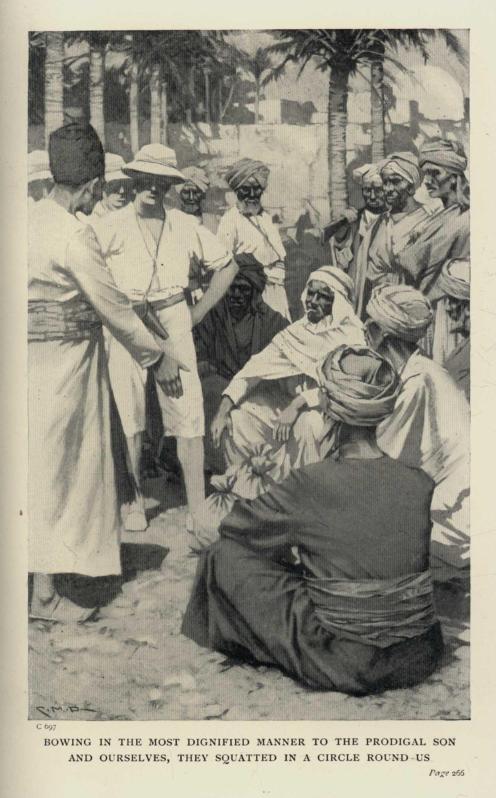
BOWING IN THE MOST DIGNIFIED MANNER TO THE PRODIGAL SON AND OURSELVES, THEY SQUATTED IN A CIRCLE ROUND US.
However, the Prodigal Son seemed to soothe them and when Griffiths came up the beach with four fat bags of rupees—making two trips with them—and dumped them down at my feet, they became very affable indeed. To watch those dignified Arabs—half of them wounded and all of them scarred—try to pretend not to be interested in the four bags, when all the time their eyes kept turning towards them, evidently calculating how much was inside, was as good as a play.
Eventually, after innumerable cups of coffee, everything seemed to have been arranged peacefully. They rose to their feet, bowed to us, to the Prodigal Son, to each other, mounted their horses, and rode back to the two towns, leaving us alone.
"Well, I cannot thank you enough," he began, his face twitching as he pressed one hand against his broken arm, as though the pain was very great. "With your help, and with the money my father sent me, I have patched up the quarrel, and I trust it will be lasting."
"The quarrel or the patching up?" Popple Opstein interrupted admiringly. "I do really believe you'd prefer the first."
I'm certain that he was right too.
We induced him to come aboard the "B.A.", which he did in the uncomfortable little dinghy, first having sent the bags of silver into the fort, and he made himself so agreeable to Mr. Scarlett that the gunner's dark eyes glowed with pleasure.
"Will you do me one more favour?" he asked before he went ashore. "The Sultan will be anxious to hear how things are—you have seen for yourself. He is an old man, and he worries. Both of us will be the more grateful if you let him know as soon as you can."
We were so carried away by his delightful personality that within an hour the "B.A." was steaming back to Muscat, going so fast—to save daylight—through that tricky channel that the lascar drivers were scared to death by the noise of steam escaping through the piston-rod gland. We saved daylight right enough, and were soon tumbling about in the swell outside; but the gland gave so much trouble that we could only manage to go dead slow, with barely enough way to prevent the Bunder Abbas being driven on the rocks, where the roar of the breaking swell boomed in our ears all night. We had a most horrid time of it—old Popple Opstein and I—not knowing from one minute to another when the engines would stop entirely. It was not the slightest use to try to reach Muscat, and I only waited for the first streak of daylight to crawl back through the channel into safety.
My lascar first-driver said he could repair the gland in two days at anchor, and I intended anchoring close to the fort again; but before we were clear of the channel the packing blew out altogether, the engine-room was filled with steam—the whole launch seemed to be in a cloud of it—and the engines stopped entirely so there was nothing to do but anchor where we were. It was a beastly nuisance, because I was so anxious to take the news to Muscat as quickly as possible; otherwise I did not care a rap.
Popple Opstein suggested that we should sail the dinghy up to the fort and spend the day with the Prodigal Son. No sooner said than done. Out went the dinghy; Griffiths stepped the mast and put up the sail; my chum and I jumped in with a loaf of bread, a tin of tongue, and some sardines, and off we went, only to pull back again for water and for Jaffa—we had forgotten both, and both were necessities. We drifted and sailed, pulled round corners, and sailed again until we came out into the open "khor", met a fairly-steady breeze—a soldier's breeze—which filled our little sail, and made us bubble through the water.
In a couple of hours from leaving the "B.A." we were hauling the dinghy on to the sand, close by the well, and were tramping up to the fort as happy as schoolboys, leaving Jaffa to guard the boat from a crowd of loafing Arabs who surrounded it. We noticed one thing immediately—the horses, camels, sheep, and goats were now outside the fort, so we knew at once that all was peace.
However, the Prodigal Son was not at home—we imagined that he had perhaps gone to distribute the money; so, as the silly soldiers at the big door would not let us inside, we amused ourselves by examining the outer walls, walking all round them and looking up at the battlements and the muzzles of the silly little cannon sticking out from the towers at the corners. The walls were pitted everywhere with bullet marks, especially round the loopholes, and we felt that we had underrated the Arab marksmanship. The heat thrown back from those lofty bare red-brick walls was so great that soon we were only too glad to go back to the shade of the nabac trees near the well, until the attentions of the crowd gathered there became rather irritating and the beastly flies almost insupportable. So off we went for a short walk to have a look at Heija.
Whilst we were wandering round it, feeling like a couple of trippers, we turned round a corner, and, clatter, clatter, with a smother of dust, a dozen or more Arab horsemen dashed madly past us. Behind them, at a more dignified pace, cantered others, and among these we at once recognized the Prodigal Son, who, catching sight of us, drew his horse back almost on his haunches to speak to us. On his right wrist was a hooded falcon, and he was holding the reins with his left hand—holding in a troublesome, fiery horse with the arm we had seen bandaged to his side the day before, the one he had said was broken. Although we recognized several of the cavalcade, not one now had a bandage or a sign of a wound; even the man whose leg had been swathed in cotton was joyously curveting and pirouetting on a splendid horse.
For a minute neither of us quite realized the real truth. Then, when we looked enquiringly at his left arm, the Prodigal Son burst out laughing, and even the older, more dignified among them smiled grimly.
They lent us a couple of horses to ride back with them, and old Popple Opstein disgraced himself by falling off, but afterwards managed to stick on until we reached the fort. There we were taken up to that same audience-hall and had more cigarettes and coffee. The Prodigal Son never gave us a chance of asking for an explanation of the marvellous recoveries, and presently we found ourselves sailing merrily back to the "B.A.", so delighted with his amusing, frank manner that it was not until we were halfway there that we even began to wonder what was the meaning of it.
Jaffa's dignified face had been gradually relaxing, as if he was bursting to tell us something amusing.
"Out with it, Jaffa," I called. "What is it?"
"Very much laughter—in Heija—in Shateif also—make much fool of Sultan—poor people very angry—sheikhs and soldiers much joy. Plenty men from Heija and Shateif come to well—tell me. All pretence—the fighting—surround fort—much powder play—news goes Muscat—Sultan's son in much danger—want money—buy peace—money comes—son rob caravan—Sultan think wild Bedouin rob caravan—send more—son rob that—writes letter that he in much danger—Sultan thinks money never come to him—so send more money in Bunder Abbas."
"But we saw them fighting like 'billy loo', going it 'hammer and tongs' yesterday. You mustn't believe everything you hear," I said, incredulous still.
Jaffa shook his head. "All game—make pretence to fight—all men know Bunder Abbas bringing more money—runner come from Muscat in early morning—when they see her come, begin pretend fight—fort fires powder from cannon—men fire rifles—take no aim—only make noise. Then hurry, pretend have many wounds when masters land—take money—send masters away with good tale for Sultan."
"Nonsense!" Popple Opstein blurted out; "the walls are peppered with bullet holes. We've seen them ourselves."
Jaffa smiled again. "Make them—themselves—when merry—fire at loophole for target—all play."
My chum was the first to believe the yarn. He roared with laughter. "It all fits in like a puzzle. The Prodigal Son! What a name for the chap! That's why they all looked like cripples yesterday, and left off their bandages to-day. My holy Moses! the whole thing was a 'plant', simply to delude us. What a chap! Didn't you hear those girls singing and laughing? They wouldn't have been there if there had been real fighting—or they wouldn't have been so cheery. D'you remember the rush for water? My sacred aunt!"
He kept on roaring with laughter every few minutes.
As he had said, the whole thing fitted in like a puzzle. It amused him, but it did not amuse me to be made a fool of. I was very angry, though with my chum in the boat it was impossible to remain angry for long, and soon I, too, saw the funny side of the expedition, and was laughing as much as he was.
And the Prodigal Son had been so anxious for us to hurry back to Muscat, and so anxious for us not to mention his poor wounded arm to his father! Of course not! It was all as plain as a pikestaff now. If the Sultan heard of it, back to Muscat he would order him, and evidently the fatted calf there was not half so much to his liking as the spree he was having in that fort.
On our return to the Bunder Abbas we told Jaffa not to breathe a word of this to anyone.
By next night the steam gland had been repacked so, threading our way out again to the sea, we steamed back to Muscat.
I went across to the Intrepid and told Commander Duckworth everything. He, too, roared with laughter but quickly checked himself.
"That's all right. It doesn't matter one way or the other. You saw the battle; you got there just in time to stop it; the money was just in time to make peace; and you saw the Prodigal Son, as you call him, out hawking. That is all the Sultan wants to know, and he'll be just as grateful to us as though you had actually rescued him."
And he was, too, and sent me a Mauser pistol, just like Jaffa's, as a present.
CHAPTER XIV
We Deal with Jassim
The packing in the high-pressure piston-rod gland blew out again as we anchored at Muscat. As a matter of fact, the whole of our engines required a thorough overhaul after practically four months of almost continuous steaming; and though the lascar engine-drivers had done their best—a very poor best—it was now entirely beyond their capabilities to put things to "rights", and make all the necessary readjustments and the Bunder Abbas again fit for sea.
In these circumstances, and as neither the political agent nor Commander Duckworth had anything very pressing for us to do, artificers were sent across from the Intrepid to carry out the necessary repairs. Whilst they were opening out the engines, working and sweating down below, there was, of course, but little to do on deck, and I had at first a very pleasant, lazy time indeed—pleasant, at any rate, after five o'clock in the evening. Before five o'clock the heat was much too great except to pant and perspire under the awnings; after that hour one's muscles began to call out for exercise. Then, with Popple Opstein and the rest of the Intrepid's officers, we would often pull across to a sandy beach—where no sharks ventured—about a mile from the rock on which the southern of those two old Portuguese forts stood, and have grand bathing picnics—in and out of the water for a couple of hours at a time. Occasionally fifty or sixty of the men would come with us and drag the seine-net, for the sea was simply alive with fish. If we did not do this, we would go up to the political agent's house and play tennis in the compound there—on a concrete court—in the most terrible glare; or perhaps we would wander out through the main gates of the town and scramble about the ravines and defiles leading inland.
I have never in my life been in such a hot place as this was. The little white town of Muscat is surrounded by bare, razor-backed, volcanic, rocky ridges; the harbour itself is enclosed by more black, naked cliffs, and these seem to collect the violent heat of the sun all day to give it out all night. The temperature in the shade on board seldom fell below a hundred degrees during the day, and seldom dropped more than four or five degrees at night. Sleep under these conditions was very difficult, very unrefreshing, and often I have tumbled and sweated on my grass mat till daybreak, kept awake by the oppressive heat and the weird chants of the watchmen calling across the harbour from the towers of the two great forts.
Several of my men went sick. Little wounds (a scratched mosquito bite, for instance) simply would not heal; and Wiggins, the broken-rib man, had to be sent down to Karachi suffering from fever. He was very loath to go, poor chap.
For the first two or three days Mr. Scarlett was quite happy. I let him take some men ashore to paint the name of the launch on the rocky face of one of the sides of the harbour. He painted it in white letters, four feet long—"BUNDER ABBAS"—among the names of a hundred other ships which had done the same during the last twenty years, and this kept his mind occupied; but after he had finished, he shrank into his usual saturnine self, his dark eyes seemed to sink farther back than ever beneath his shaggy eyebrows, and he spent his whole time watching lest Jassim should come again. For fear of seeing him, and for fear of any violence, he never ventured on the mainland.
Jassim had sent him another letter, increasing his offer to fifteen thousand rupees if only Mr. Scarlett would let him have the bracelet. My chum happened to be on board when the letter arrived, and we both went over the same old arguments as before, doing our utmost to persuade him to take the risk, and holding out before him all he could do with the money—a thousand pounds would be a fortune to him—and how with that and his pension he could retire and live comfortably ever after. If he had been an ordinary warrant-officer we might have argued with him successfully. But he was not; he was more than half-Arab, by nature and upbringing if not by birth; and if our arguments were met at first by a half-shrinking consent, the possibility of a fatal result would so terrify him immediately afterwards that he always ended with a flat, sullen refusal.
"Kismet," he would groan, and once he had used that word we knew it was impossible to move him.
If he did agree to accept the increased offer we were to hoist a red flag; and the mere knowledge that evening that Jassim's gloomy eyes were watching us from shore, awaiting his signal, made even my chum and myself feel nervous. It drove Mr. Scarlett into the locked cabin, where he stewed all night.
As you can imagine, this state of things was bad for his health, and when one day he ran a rusty nail into the palm of his left hand the wound festered, and the hand and the whole of his arm swelled tremendously.
He was so ill that Nicholson, the staff surgeon of the Intrepid, determined to give him chloroform, and make deep cuts into both hand and arm. The snake, of course, would have to be exposed during the operation, and Mr. Scarlett was so desperately anxious that no one else should know anything about it that he only consented when Nicholson promised (I had told him about it) to come across to the Bunder Abbas, and, if Popple Opstein and I would stand by and give him a hand, do it there. He came that very evening, when the great heat of the day was over, and we (with Percy terrified and sad) cleared a space on the little upper deck, just outside the cabin, for the operation. Having kicked Percy down the steps and screened the deck from observation, Nicholson began.
It is not necessary to go into all the details, but when Mr. Scarlett, lying on the deck, was thoroughly insensible, we unwound the bandage and found the beastly snake almost sunk in a deep groove of the mottled, swollen skin, clinging ever so tightly. I noticed Nicholson run his finger along it until he came to the head, when he tried to pass one finger under the jaw, but my nerves were very much on the stretch. I saw him pick up a knife, and, not being used to such things, turned away my head. It was not till Mr. Scarlett had given one or two sudden, half-conscious moans that I turned round again. There were the deep cuts in the arm and hand, but—I almost started out of my skin—the snake had disappeared, and only the deep groove round the arm remained, the scale marks showing how tightly the snake must have buried itself.
Nicholson quietly pointed to a corner of the deck close to the funnel, and there, sparkling in a patch of sunlight coming under the edge of the awning, was the bracelet—writhing, coiling, and uncoiling, drawing back, and striking with its head.
Popple Opstein's face was blue, his mouth wide open, his eyes staring at it, his great red hands shaking violently.
Nicholson went on with his work.
"Good God!" I at last managed to gasp. "Did it bite him or you?"
Nicholson did not answer. Mr. Scarlett was recovering consciousness now, and he was working very rapidly. Popple Opstein and I had to fly round and do this and that as he bade us. There was no time to ask questions or answer them.
At last Nicholson, starting to bandage the arm, asked for a piece of rope—a couple of feet of signal halyard.
"Now a needle and thread," he called, and, when I fetched them, sewed the bandage very securely.
Not till then had I time to look at the snake again.
It was now lying perfectly still, coiled closely like a watch-spring, the flat head pressed over the coils and the light flickering in its green opal eyes and playing on the enamelled scales.
Nicholson, busy holding Mr. Scarlett's head, jerked out: "Hide it!
"Pick it up," he said irritably, as my chum hesitated to touch it; "the confounded thing won't hurt you."
Popple Opstein stooped and took hold of it very gingerly. As it did not move he held it in the palm of his hand, and we were both examining its marvellous beauty when Nicholson again jerked out: "Hide it somewhere—lock it up—Mr. Scarlett's coming round—he mustn't see it."
I took it very nervously from Popple Opstein, and in the excited state of my nerves, its scales seemed to press themselves into my hand and wriggle. I could only just prevent myself dropping it, and darted into the cabin and locked it in my one drawer.
"Now, help me to lift him," Nicholson called out, and in a couple of minutes Mr. Scarlett lay moaning in his bunk, with the bad arm swathed in cotton-wool and bandages.
"He'll do all right now. Give me a drink, and have this mess cleared up," Nicholson said gruffly.
"How did you do it?" I asked him.
"Feel that," he answered, and with a blood-stained finger and thumb pinched the end of one of my fingers.
I winced—he might have had hold of me with pincers.
I shouted for Percy, and sang out for Moore to send up a couple of hands, and whilst Nicholson kept an eye on his patient my chum told me what had happened.
"He took up his knife. I set my teeth; but just as I thought he was going to use it he dropped it, and before I could wink an eyelash he'd nipped the jaws of the snake—just as he nipped your finger—bent four inches of its neck right away from the arm and, with the fingers of the other hand, swept round under the coils and unwound it. For a moment or two he held it in the air, the jaws in between his finger and thumb, the body coiling and twisting—I could hardly breathe—then he threw it away where you saw it, and it lashed about like a live thing. It's done now; what danger there was is over. Won't he be thankful?"
"We'll tell him directly he's round," I said. "My country, won't he be pleased! He'll be a new man."
Nicholson, coming out of the cabin, sang out: "No, you won't, unless you want to kill him. He's bad enough now, and he'll fancy the swelling is due to poison, whatever we tell him. He must not know until he's well again. As many people die of sheer fright, after being bitten, as from the poison itself."
"Is that why you coiled the signal halyard round the groove?" we both asked excitedly.
"Of course it was. He'll feel it under the bandage and think the snake's still there. I sewed the bandage so that he couldn't take it off to make certain. Don't you tell him till I give the word."
A very anxious week followed, for Mr. Scarlett was so ill that he had to go aboard the Intrepid. Whilst he was away, several more letters came from Jassim, and at last Jassim himself came aboard.
On the chance of his coming I had given very strict orders that no one should say where Mr. Scarlett had gone, and when I took him all round the Bunder Abbas his face fell as he realized that he was not on board. Not a word would he say about the snake, never so much as a hint to Jaffa; but as he left the ship he spoke to him, looking at me, and Jaffa repeated: "Twenty thousand rupees". I could not resist asking him, through Jaffa (who, if he had a shrewd suspicion that he was the red-bearded leader of the caravan, never mentioned it), how his son was—the wounded man who had been carried through the gap.
At the question Jassim gave me a glance of such terrible hatred that I knew at once that the poor chap was dead, and that he blamed me for it.
This could not help but worry me, and another worry came along about this time: there was disquieting news from Jask. Mr. Fisher, the acting political agent, had telegraphed across that the Baluchis were causing trouble and constantly threatening to come down from the hills and attack the place. The land wire had been cut in several places, and a party of native employees had been beaten and robbed about twenty-five miles to the eastward. He had borrowed a few of the border police from the Mir of Old Jask, but they were such brigands and so much of a nuisance that he had sent them back again.
It really made me angry to think of keeping Miss Borsen and Mrs. Fisher there. I actually asked if the "B.A." could not go as soon as ever her repairs had been effected, but Commander Duckworth shook his head.
"It's just as it always is at this time of year," he said. "Those tribesmen keep on threatening, hoping to get 'backsheesh'. They do it every year; but nothing will come of it. They won't risk their skins."
However, this did not relieve my anxiety. I seemed to have a personal interest in little Miss Borsen, because, I suppose, she had come out from England with me, and possibly because we had quarrelled.
One day Nicholson signalled across that he and Popple Opstein were bringing Mr. Scarlett across that evening. They came, he looking desperately ill, although his arm was practically well. When we four were alone he pulled out another letter—Jassim had evidently soon found where he had gone.
"He offers me twenty thousand rupees," he said wearily. "It's a lot of money."
He thought that we should commence the same old arguments again, but, Nicholson winking at me, I went into the cabin, unlocked my drawer, and brought out the bracelet. I handed it to Nicholson, for it was "up" to him to tell the good news. He simply laid it on Mr. Scarlett's thin knees and said quietly: "It's been off your arm for ten days. I took it off when you had the operation."
Mr. Scarlett shrank from it and clutched his arm. "But it's there—I can feel it—I've felt it a hundred times in these last days."
Nicholson smiled, pulled up his sleeve, cut through the bandage, and showed him the signal halyard.
Mr. Scarlett gave a wild look at each of us, dropped the snake on the deck, bolted into the cabin, and we heard him sobbing like a child.
Nicholson yelled for Percy. "Brandy and soda for Mr. Scarlett."
"For all of us," I said, because we needed it.
Eventually Mr. Scarlett came back and asked to see the bracelet, handling it tenderly. He was much too disturbed to talk coherently, or to thank Nicholson or either of us. It was pitiful to watch him. He had not found his "bearings"; did not realize all that it meant to him, and kept on rolling up his sleeve to look at his bare arm as if he did not believe his own eyes.
He gave way again, buried his face in his lean hands, lying half over the table, which shook with his sobs. It was very distressing to watch.
"Can't we hoist that red flag, sir?" he asked presently, lifting a haggard face.
I nodded.
He jumped to our signal locker, picked out a red-and-white flag, tore off the white part like a maniac, bent it to the halyard, and hoisted it to our little yardarm, where it drooped in the heated air. Seizing a pair of glasses he watched the shore as though he expected Jassim to come paddling out. But Jassim did not come, and in his nervous condition Mr. Scarlett worked himself into a terrible state of agitation lest he had disappeared, and was, even now, preparing violent measures to regain the bracelet.
I think that before Nicholson went away he had taken the precaution of giving him a very strong sleeping-draught, because he eventually became calmer and went to sleep.
When he was asleep I took the bracelet away from him and locked it in my drawer, hoping most devoutly that Jassim would soon come and claim it; and next morning, without saying anything to him, I took the precaution of sending the bracelet across to the Intrepid, so that the sight of it should not upset him, and that Jassim, if he came, should not be able to terrorize him into giving it away before the money was produced.
Jassim did come that day, and his manner was mysterious and threatening; nor did I like the look in his eyes when Mr. Scarlett bared his arm and he realized that the bracelet had disappeared and that the gunner had not now the fear of taking it off.
Jassim evidently wanted to get rid of me; but I would not go.
"When he puts down his twenty thousand rupees he shall have it, not before," I told Mr. Scarlett. "The bracelet is not on board, and I shall not tell you where it is. Never you mind where it is." I stopped him enquiring. "You tell him to bring his money and he shall have it."
As I imagined, Jassim could not produce the money, nor do I think that he ever intended doing so, hoping all along so to work on the gunner's fears that he could get it for nothing. The two of them began talking very excitedly, waving their arms and thumping the little table. From the fierce looks which Jassim occasionally turned on me I was evidently being talked about, and was not very popular in that quarter.
I saw that hateful muddy colour spread over Mr. Scarlett's face and his eyes narrow with fear. He turned to me, hardly able to speak.
"For God's sake, sir, give up the wretched thing," he stuttered. "Tell me where it is and I will give it him. I don't want any of his money; all I want is to be quit of it."
"When you've got your money, not before," I said.
"But, sir, remember we are not in England. He swears he'll kill you; that if you land he will kill you; if you don't he'll find other ways of killing you. He won't touch me, because I gave his wife that drink of water. But, sir, it's different with you."
"I gave his son water a month ago," I said, with a sudden inspiration.
Mr. Scarlett was too much agitated to enquire when or where. He turned to Jassim and asked him something. Jassim replied bitterly.
"He says you shot him, and he died; the drink of water made no difference. You don't know these people out here," he implored. "Don't run any risk. I don't want the money, indeed I don't."
Jassim had risen to his feet and stood not three feet from me, glaring at me as if he would willingly kill me then and there. I saw in his eyes that what Mr. Scarlett had said was true. I don't know what made me do it—I certainly never thought, and regretted it immediately afterwards—but I suddenly locked my arms round him, and before he could make a move I had tripped him over the railings and dropped him overboard.
The boat which had brought him off was close there, and he scrambled on board like a drowned rat, sat down in the stern-sheets, folded his clinging wet burnous round him, and, without deigning to turn his head in our direction, was paddled ashore.
"You've done it now, sir," Mr. Scarlett moaned, burying his face in his hands and sprawling across the table. "For God's sake let's get away from Muscat."
I tried to pacify him by pointing out that if Jassim killed me he would lose all chance of finding the snake. "He won't be such a fool as that," I said.
"He'll want revenge—revenge more than the snake—now, sir," Mr. Scarlett groaned.
There are times in plenty in most men's lives when, either through anger or stubbornness, danger does not influence them. This was a case in point. I had suffered so much from Jassim and his wretched snake that his threats simply stiffened my back to such an extent that I much preferred to be killed than give in. The mail steamer was leaving next day so to make certain that Jassim should not get it, I went aboard the Intrepid, told Popple Opstein what had happened, and after one last look at the bracelet we packed it up and sent it home to my bankers in London. At any rate, whatever happened to me (and I did not really believe that anything would happen) Jassim should never have it, and later on we might be able to negotiate for the reward of thirty thousand rupees with the rightful owner, the Khan of Khamia himself.
I breathed more freely when the mail steamer left the harbour, and not until it had gone did I tell Mr. Scarlett what I had done.
He and I stood watching till she disappeared behind the rocks at the entrance, and, drawing a deep breath of relief, he said:
"It seems wonderful, sir; don't it, sir? Here for thirteen years it's been part and parcel of me, and now I'm finished with it. I never want to set eyes on the beastly thing again."
From that moment Mr. Scarlett began very rapidly to mend. He grew stouter, his eyes lost their hunted look, and though he worried much about the risks I was running, still it is a different thing to worry about other people's risks from worrying about one's own, and he rapidly recovered his spirits.
I made light of any danger and took no precaution whatever, until one night, shortly afterwards, I was awakened by the noise of a scuffle and a splash in the water alongside.
"What's that?" I sang out, springing up.
Webster answered out of the darkness: "It's all right, sir. It's that Arab chap you hove overboard the other day. He was trying to creep on board over the stern. I spotted him, sir, and popped him back into the 'ditch'."
Another day I was bathing with the Intrepids, and we were skylarking afterwards on the beach, when a bullet hit the sand close to me and we heard the report of a revolver. Spotting someone moving behind a rock we all darted in that direction, but when we reached it saw no one.
I don't mind saying that those two things happening made me extremely nervous, and made me stick pretty close to the "B.A.".
I could now realize what mental agony Mr. Scarlett had suffered, and though perhaps I did not show it as much I felt it most acutely. The boot was on the other foot now with a vengeance, and it was I who, when it grew dark, looked longingly at the little hot oven of a cabin and felt a great temptation to lock myself in until daylight.
A few days after the revolver-shot incident Mr. Scarlett astonished me by asking leave to go ashore for a walk in Muscat itself. Remember that he had not dared to land since he and I had had that first walk there and had run across Jassim. Away he went, taking Jaffa and Webster with him, and they did not return on board until long after I had finished dinner.
Mr. Scarlett was chuckling—I had never seen him so pleased with himself—Jaffa had a contented smile on his face, and Webster so far forgot himself as to wink at me.
"Hallo, what have you been doing?" I asked.
"He's all right, sir," the gunner said, rubbing his hands. "Mr. Jassim won't be worrying you again for some time."
"What has happened?" I asked eagerly. "Have you killed him?"
"Well, sir, not exactly, but we just happened to meet him—after we'd been hunting round for him all the afternoon—and we just happened to have a bit of a row, and there just happened to be a couple of the Sultan's soldiers handy. I made a bobbery, Jaffa and I calling out that he had stolen money from us, and off they took him up there," and Mr. Scarlett jerked his thumb towards the big fort on the right, whose towers and battlemented walls showed out in the moonlight over our heads. "There he'll stay, sir, as long as we like to pay for his keep. It cost us five chips to the soldiers and another twenty to the sheikh in charge of the fort. It was well worth it. Don't you think so, sir? So long as we pay the governor of that fort or jail, call it what you like, five rupees a day he'll keep him there and feed him," Mr. Scarlett said, emphasizing the "feed him" as if that made his action quite meritorious.
Well, it was a very "low-down" game to play, and if I had known they were going to play it I should have put a "stopper" on it; but now the man was under lock and key it was so much a relief that I had not the honest courage to blame the gunner or take steps to have Jassim set free.
After that Mr. Scarlett visited the jail nearly every day, to assure himself that Jassim was still there; nor was he content until he had peered through a grating overlooking the court-yard in which untried prisoners were kept, and seen him. He seemed to take a fiendish delight in those visits, and I must say that I fully shared his satisfaction, for, to me, the resulting comfort and relief from anxiety was cheap at the price—only five rupees a day. It may have been a cowardly, despicable thing to do, but I don't believe that anyone placed in the same circumstances would have done otherwise.
We had now been very nearly a month at Muscat, and the artificers from the Intrepid had not quite finished my engine-room defects, when one morning, four or five days after Jassim had been secured, an urgent signal came from Commander Duckworth that he wanted to see me at once. I had a presentiment that something had gone wrong at Jask.
I was right. As I went into his cabin the Commander sang out: "You'll have to go across to Jask after all, and as soon as ever you are ready. There's more trouble there. One of the European telegraph people has been killed somewhere along the coast by a marauding lot of brigands who have cut the wire again. Fisher dare not send his people to repair it without an escort, so you had better go across and see what you can do. When can you start?"
"By midnight, sir," I told him, having taken the precaution of finding out before I left the "B.A.".
"Right you are! Off you go! I don't fancy that there is anything serious. If there is you can telegraph for me and I will bring the Intrepid along. Good-bye! Good luck!"
What a grand chap he was! I left his cabin feeling that he had not hampered me with any restrictions whatsoever, and had placed entire confidence in my judgment. If only senior officers would always treat their juniors in that way they would not so often have to grumble at the way they are served—and, what is more important still—they would make more efficient officers of them.
I met Popple Opstein outside. For once he had shipped a long face.
"Did the skipper tell you who has been killed?" he asked. "I'm afraid it's our poor little friend's brother. What rotten hard luck on her if it's true!"
In my excitement at getting this job I had never thought. Of course it must be Borsen; he was the only other European there. Poor fellow! Poor little sad-eyed slip of a girl, she would be weeping her heart out.
I had a burning feeling inside me, and I wished that I could have started off then and there to blow a dozen or more of those cowardly treacherous Baluchis to atoms.
"I wish I could come along with you," my chum said wistfully. "I'd love to have a 'go' at them!"
He tried to get leave, but without success, so back I went to the "B.A.", angry, and impatient to get away.
"Good-bye, old chap! Tell her how very sorry I am," he called after me.
"Right you are!" I shouted back, but had an uneasy thought that perhaps she was still too angry to allow me to speak to her.
I told Mr. Scarlett the news, rather expecting him to show the old half-frightened expression, and was quite taken aback when he smiled and said: "A chance of our seeing a bit more scrapping—eh, sir?" He said it as if he, too, rather looked forward to such a thing happening, and I had to look again at his face to make sure. Well, his disposition seemed to be changing, and as there was nothing else to account for the change except the parting with the snake I put it down to that.
It was splendid the way those artificers and lascars worked to finish their job. They knew why they had to hurry, and they toiled and sweated in the heat of the engine-room like demons.
By half-past ten that night we were ready. I sent the Intrepid's artificers back to their ship with something inside them to warm their stomachs, flashed across the "Permission to part company", and steamed out of the harbour.
"He won't be there very long now," Mr. Scarlett grunted, jerking his thumb towards the fort, whose towers and walls showed up above us in the moonlight.
I really had forgotten Jassim, and did not care how soon he bribed the jailers and got free. I despised myself for having allowed him to be kept there.
Off we went to Jask—-easily at first, to give the engines a chance of settling down; later on as fast as they would whizz round.
We were all so impatient to get there that however fast they went the "B.A." seemed to crawl along.
At ten o'clock next morning we met the fortnightly mail-steamer coming from Jask, on her way to Muscat and Hartley semaphored across to ask if all was well there.
Someone on board took in the signal and answered "Yes," to our great relief, and then I asked if the two ladies from Jask were on board.
"No," was semaphored back, and I was half-glad and half-sorry—glad to know that I should see them, sorry that another fortnight must elapse before another steamer would give them a chance of escaping.
By noon the little white telegraph buildings showed up over the horizon, and two hours later I steamed close in under the rocks on which they stood, and anchored. No white handkerchief fluttered from the signal-mast. Poor little lady, if it was her brother who had been killed she must be somewhere inside those white walls in a terrible state of grief.
I landed immediately.
CHAPTER XV
A Tragedy of the Telegraph
As the keel of the dinghy grated on the sand, and I scrambled ashore, Mr. Fisher, the acting political agent, came down the path to meet me, looking so thin and haggard I scarcely recognized him.
In answer to my eager questions he told me that he feared Borsen had been killed, but was not yet certain.
"Five days ago the poor chap went down the coast on his usual monthly duty of paying the local people at the different relay stations along the telegraph-line. He took with him a Goanese telegraphist and half a dozen native employees. The party rode away on their camels, and the next I heard of them—two days later—was a telephone message that they had seen some wandering parties of Baluchis or Afghans and had been warned, by a friendly village where they had halted, that they might be attacked and robbed. He intended to send the pay-chest, that night, secretly, to the next village and to push on after it next morning.
"A message came from him to his sister, next morning, saying that he was thoroughly enjoying himself and wished she was with him—that was to allay her anxiety. Within an hour the Goanese telephoned in that he had been killed, but the message was then interrupted, the wire was cut, and we have heard nothing since. Quite probably this man was killed as well.
"All we know is that the wire was broken somewhere about twenty-eight miles away, and that when I took a large party out to try to reach the spot, we found the coast swarming with brigands and were glad enough to get back safely. We only returned a few hours ago, and now I want you to take us down there as quickly as you can. It is our only chance of finding any of the party alive—and a very poor chance, I'm afraid."
Of course I was ready to go anywhere or do anything. He and his party were "standing by" to embark, and some ten or twelve natives were already coming down from the telegraph-station with folding-ladders, a portable telephone apparatus, coils of telegraph-wire, and repairing tools. They also brought with them a roughly-made coffin, and, as fast as they arrived, I sent them aboard the Bunder Abbas. Whilst Griffiths was pulling the dinghy backwards and forwards I asked Mr. Fisher how his wife and Miss Borsen were bearing up.
"Wonderfully well," he said, his face twitching. "Women sometimes make us men almost ashamed of ourselves—they are so patient and brave."
The dinghy had returned for us, and just as we were stepping in we heard a girl's voice calling, and saw poor little Miss Borsen standing behind us, looking the picture of misery and distress, so sad and so pale under her big, white topee that I felt horribly sorry for her. I saluted and tried to show my sympathy. As I did so she flushed scarlet, and as quickly every trace of colour left her face; she seemed to freeze, and only bowed in the most distant manner. I knew that she meant this as a direct "cut", to remind me that she had not yet forgiven me for carrying her over the swamp that night.
Speaking to Mr. Fisher, and ignoring me, she implored him to take her.
He tried his best to dissuade her, but she insisted on coming.
"Do you mind if she comes?" he asked, turning to me.
"Not at all," I answered coldly, as if she were a complete stranger. "Anybody you care to bring may come."
I looked to see if that hurt her, but she gave no sign whatever that she had heard. I felt angry to be so snubbed, and a brute to feel so enraged with her just when she was so miserable; but I could not help it.
So they both came aboard with me, and an extremely uncomfortable trip it was—squeezed up together in the little dinghy as we were, with Miss Borsen ignoring me completely.
However, I was sitting where I could see her profile, and she looked so utterly woebegone and lonely that my anger died away, until we got alongside, when she smiled so sweetly on Mr. Scarlett, as he helped her out of the boat, that I was furious again. I beat the feeling down, and, as she evidently loathed the sight of me, kept away, giving her and Mr. Fisher the use of the cabin and the little deck aft of it, and rigging up a screen for'ard of it, so that she need not see me whilst I took the "B.A." out of harbour. Percy fetched my pipe and tobacco, and I smoked furiously and fumed inwardly all the way down the coast, unable to avoid hearing Mr. Scarlett, on the other side of the screen, spinning one of his most exciting yarns and trying to take her thoughts away.
However, he soon found that was no use, and came for'ard to me shaking his head. "Poor little lady! Poor little soul!"
Percy was a fickle youth. Whilst Popple Opstein had been aboard, on that amusing "Prodigal Son" adventure, he had transferred his worship from Mr. Scarlett to him. Now he transferred it again to Miss Borsen, and waited on her hand and foot, standing by with his big eyes fixed on her as if she was some beautiful angel come straight down from heaven into this little world of his. He was such a nuisance that Mr. Scarlett had to drag him out and drop him down the ladder on to the fo'c'sle.
Mr. Fisher joined us presently, and we three, through our glasses, examined the shore and desert plains running inland behind the line of telegraph-posts. Before we had steamed ten miles we saw numerous bands of mounted men moving about the dreary wastes, and Mr. Fisher was on thorns to get back as quickly as possible to the telegraph-station (which was now without a white man), and kept on saying: "I must send my wife and Miss Borsen away by the very next steamer. I don't like the look of things at all." He also told me that he had tried to make them go by yesterday's mail-steamer—the one we had "spoken"—but that Miss Borsen would not go until she had definite news of her brother's fate, and his wife would not leave her at Jask alone. "They'll have to stay there for another fortnight now," he said, shrugging his shoulders.
"She doesn't seem very pleased to see me," I said bitterly.
"I'm afraid you rather annoyed her the last time you were here."
"How? Carrying her over that swampy place?"
"Yes," he nodded; "she thought it an insult."
"If she never gets a bigger insult than that she won't do badly," I answered angrily. "However, I'm sorry; but she won't let me tell her so."
At last, about half-past four, Mr. Fisher thought we were abreast the place where the last telephone message had come from—the five hundred and twentieth telegraph-post I think he said it was—so I turned the "B.A."'s bows inshore, with Ellis heaving the lead every few seconds, to warn us of shoaling water.
It was a shallow, sandy bay with nothing to be seen on the desolate shore except the endless line of telegraph-posts. I anchored three hundred yards off and took ashore Mr. Fisher, a native telegraphist, and the portable telephone apparatus.
They connected this to the telegraph-wire and tried to call up Jask. If Jask answered, we were on the near side of the cut wire; and, as Jask did answer, it showed that the spot where the tragedy had taken place must be still farther away.
So back to the "B.A." we went, and I heard Miss Borsen asking Mr. Fisher, with a half-sob, whether he had found anything.
We weighed anchor and felt our way, carefully, still farther along to the east'ard.
Presently the signal-man shouted to me that he saw someone on the beach, and, looking through my telescope, I made out a man hopping down towards the water's edge on one leg and waving his arms to attract attention.
I called out to Mr. Fisher that we had found the place, pushed the "B.A." in as far as I dared, anchored, and he and the man with the telephone-box came ashore with me.
"The wire's cut about two hundred yards on the left," Mr. Scarlett shouted after us. "I can see it trailing on the ground."
Griffiths pulled us in to the spot where the man—a Goanese he was—was waiting for us, squatting down close to the sea. As I jumped ashore I realized why he had been hopping—his left foot had been roughly hacked off above the ankle. He was gesticulating and sobbing, jerking his head backwards and forwards. Raving mad I thought him; certainly he was half-delirious, and as he held out both his arms towards us I shuddered, for he had no right hand, only a stump of a forearm.
"Right hand, left foot—a common custom," Mr. Fisher said, quite calmly, as he let him sip from his water-bottle and tried to calm him.
Presently he was helped upright, and went hopping through the sand to the top of the beach, where he clung to a telegraph-pole, close to the foot of which were the remains of a wood fire and what I took to be charred sticks.
He began speaking very rapidly.
He stopped, and Mr. Fisher led me away just as the repair party landed about two hundred yards farther along the beach.
"Would you mind going and giving them a hand? They will work better if you do. I must stay here."
I thought his request strange. His manner was very strange: his eyes were burning with fear and disgust.
I did as he asked me and walked along to where the telegraph-wire lay on the sand, coiled in spirals like a snake. The repairing people were very smart at their job, fixed a rope and tackle from one cut end to the other, and then hauled taut the great length of wire between the two nearest telegraph-posts, mounting their portable ladders and fixing things in a most seamanlike way, until they had the wire as taut as they could haul it, with six or seven feet of rope tackle bridging the gap and the two cut ends of the wire hanging down. Then they commenced to put in a splice, and worked so cleverly and systematically that I was quite interested.
The sun was getting close to the horizon by the time the wire was properly joined together and their work finished. Mr. Fisher came to see the job, and the telephone-box was brought along and messages sent into Jask and to the nearest relay station on the other side.
"Well, that is done," he said, with a sigh of relief, "until they cut it again."
The repairing people took their gear back to the "B.A." and we were left alone. He took me to where we had landed, and I saw the mutilated Goanese sitting close to the coffin, which I had not noticed being brought ashore.
"Did you find Borsen's body?" I asked.
He nodded very sadly. "Yes; all that was left of it—a few charred bones. They had cut him in pieces and burnt them."
I shuddered, and knew that what I had mistaken for charred sticks had been bones. That was why he had sent me away.
There was nothing more to say, and we stood looking out over the sea, with rage burning within us, at the thought of the hideous, useless tragedy which had taken place at this spot only two days ago.
The glorious sunset was bathing everything—the sea, my little launch, the shore—in a flood of molten gold, shading to the tenderest pinks as it reached the barren mountains standing up so clear and sharp against the silvery, green sky behind them. The radiant glow threw our shadows and the shadows of those gaunt telegraph-poles slanting across the sands, far across the trackless desert towards the feet of the mountains. If we moved our bodies, our shadows swept in huge arcs across the infinite silence, and, as we moved our arms, shot out huge, ghastly tentacles horrid to see. The setting sun seemed to mock us in its beauty, to laugh and say: "See, I rejoice in the wild wastes of eternal sands. I wash their edges with my golden sea. I paint them with my wondrous tints, and your ghostly shadows, and the shadows of the telegraph-posts you have dared to place there, are the only blots on my fair handiwork."
A beautiful sunset generally gives me a feeling of hope and of trust in a glorious future. That evening I felt myself trembling with an ill-defined fear of impending danger, and as though we and that lonely telegraph-line had trespassed, had forced ourselves and our civilization upon a land where nature, primitive and unchanged, held her sway, and that we too should have to pay the penalty of our vandalism, even as poor Borsen had already paid for his.
The dinghy was coming ashore, her sides glowing with light, the blades of her oars dropping showers of golden spray as Griffiths lifted them from the surface of the sea.
I stirred myself as the bows rasped on the beach, and helped to carry the coffin into the boat, not daring to look behind me. It was very heavy, and I looked enquiringly at Mr. Fisher.
"Sand," he said, and I understood.
The poor Goanese had crawled a little distance away, and was digging at the sand with one hand. We found that he had buried his telephone-box—the one by which he had sent that interrupted message into Jask, and we quickly brought it to light. I knew what the look of satisfaction in his eyes meant—he had saved it from falling into the hands of the brigands, and had been faithful to his trust. The fellow deserved a V.C., but seemed perfectly contented when Mr. Fisher spoke a few words of praise to him.
We pulled away from the appalling loneliness of the telegraph-wire and gaunt poles, and as we came alongside, the sun slid down below the horizon, and Hartley, the signal-man, struck our little ensign.
What Mr. Fisher told Miss Borsen I do not know. I heard him take her into the little cabin, slide the door across, and leave her there. The port-holes were close to me as I stood by the compass giving orders to the helmsman, and her broken-hearted sobs seemed to tear their way right through me. Poor little fragile, lonely thing, and I had been so fiercely angry at her scorn of me! I would have given the whole world for her to forgive me and to be able to comfort her.
Presently her sobs ceased; possibly she slept. I dared not look through the port-holes to see, and gave my orders in a whisper lest they should disturb her. You could not hear a sound aboard the Bunder Abbas except the noise of the engines and the occasional tinkle of cooking-pots as the dismal cook went on with his everlasting washing of them.
On the way back to Jask Mr. Fisher told me all that he had been able to learn from the Goanese. The morning after Borsen had sent off the pay-chest all his native employees deserted, so he and the Goanese had to continue their inspection alone. They thought that the brigands would not molest them; but when these cruel brutes galloped up and found the money-chest gone, they were so enraged that they had killed Borsen, mutilated the Goanese (as you know), and galloped away again. They probably thought that the wretched telegraphist would die of sun and thirst, and so he would had he not bravely crawled to the wire, dragging the telephone-box after him, and with consummate pluck, considering the horrible agony he must have been in, had thrown up the connecting wire till its hook caught the telegraph-wire overhead, and enabled him to send the message into Jask. This was the message which had been telegraphed to Jask, from there to Muscat, and had brought us a hundred and twenty miles across the sea to save his life. He had not been able to complete it, because the Baluchis—some of them—had ridden back and cut the wire between him and the telegraph-station. There he had been for more than forty-eight hours without one drop of water. It was indeed marvellous how he had survived.
On the way back, Percy and the dismal cook prepared as lavish a meal as our little meat-safe and a small store of tinned food (kept for special occasions) could provide, but I was in no fit mood to eat, and stayed alone at the wheel. I steered to the south'ard, to get well away from the land before laying off my course to Jask, picked up the light shown from the telegraph-station some time before midnight, and anchored close in under the rocks.
I believe that Miss Borsen slept all the way back. Poor little lady, the strain of the last two days must have been awful, and she must have been dead tired. I thought that the sight of me would increase her misery, so I did not go down on deck when Mr. Fisher took her ashore.
Leaving Mr. Scarlett to see that everything was fixed up for the night, I turned in, weary in mind and body, and dreamt once more that I was carrying Miss Borsen down the path from the telegraph-station, pursued by a score of mounted Baluchis, and that Griffiths was trying to bring the dinghy ashore, but had lost one oar and was turning circles. I was yelling for him to come my way, when Jassim suddenly appeared between me and the sea.
I jumped up in a perspiration, and found Mr. Scarlett bending over me.
"What's the matter, sir? You're making a terrible noise. I had to give you a shake."
I murmured some apology, and he left me to sleep again.
Mr. Fisher had asked me to go up to the telegraph-station early next morning, and so I did, landing in time to have some "chota-hazri" with him in the veranda. The old head-boy, wearing his best yellow turban, came forward for my helmet, and smiled a greeting.
"Have some coffee; there are some bananas too—yesterday's steamer brought them," Mr. Fisher said.
I asked him how Miss Borsen was, but he did not know. His wife had been with her all night, and he had not seen her.
He tried to talk of many things, but with manifest effort. At last he blurted out: "The truth is, affairs are in a very unpleasant position. It's impossible to disguise the fact any longer. Our coolies, and even some of the house boys, are leaving us. They all say the same thing: don't want to go, but they have wives and children, and they don't want to be killed. They are going to their village, and presently, they say, they will come back. 'Presently' means," he said bitterly, "if the tribesmen don't kill us all. There is no doubt in my mind that they intend to attack this place. Almost daily I get warnings from the Mir of Old Jask, who's a feeble, well-meaning old chap, with all he can do to look after his own town, and quite unable to spare us any of his soldiers. Not that they would be of any help. I've tried them, so know.
"You see," he continued, "I have no absolute proof of any rising more formidable than what has just occurred. No one knows what is going on behind those beastly mountains. I've sent plenty of warnings both to Karachi and to Muscat (I knew that), even to Teheran; but the answer is always the same: Sit tight, and if anything definite happens, let us know.
"Well, you are here, that's something; and I don't mind telling you that the presence of your little launch makes all the difference in the world. Up there, right away beyond those hateful hills (he had risen and was pointing away towards the gaunt Baluchistan ranges), in every village for a hundred miles or more, it is known you are anchored here; and the head-men at this very moment probably are deliberating whether they had better not keep quiet till you steam away."
"I'm hanged if I'm going!" I said, rising too. "If I'm ordered away I'll break down my engine and take a month to repair it."
He smiled. "I want you to come round our little defences with me and make suggestions. We have nineteen Eurasians here who can be trusted with rifles. If the worst came to the worst we might hold out for a week until help came; but I wish with all my heart that those two women were not here. It's getting on my nerves. I find myself peering through the big telescope up there hour after hour, searching the desert. I can't tear myself away from it, and at night I can't sleep. This place at the best of times is one of the worst holes in the world, and after being stuck here for two solid years my mind is so enfeebled that it is almost impossible to concentrate my thoughts.