GUNBOAT AND GUN-RUNNER (continued 3)
Reading edition
[#] Underrun = drop a bight or loop of rope over the bows and haul it along under her keel.
"Then there's another dodge they have round about these coasts. All along the Arabian side there are plenty of mangrove trees, and a great trade in firewood is carried on with the Persian coast. So what was easier for a dhow than to stow a dozen or more rifles at the bottom of the hold and fill up with firewood on the top of them? They'd chance us getting tired of unloading them; a cutter cruising by herself couldn't do it, because you daren't throw any of the stuff overboard, and there wasn't room on the dhow's deck for all the wood stowed below. Why, sir, I've seen the whole of the Pigeon's upper deck on both sides full up to the level of the 'nettings' with chunks of firewood. Just imagine the amount of work that meant—five or six hours in the horrid heat—every chap feeling as limp as putty with the climate and the monotony. A cutter cruising by herself either had to let her go or stand by the dhow, wasting perhaps three or four days, till her gunboat came along to victual her.
"However, we did search them, and we did find rifles, which meant 'Good-bye' for that dhow and 'chokey' for her crew. They found that trick not worth the risk, these people being generally law-abiding people (more or less), simply tempted every now and then to make a larger profit by carrying a few rifles. They weren't what you might call reg'lar hands at the business.
"And there's another thing they do, sir; on top of the firewood they often load a small cargo of their dried fish, thinking the British sailor won't stomach the smell of it. Ugh! the stink from some of those dhows! Why, we sometimes never got rid of the smell of it for weeks.
"You never heard about the mail-steamers—the Royal British Mail—carrying rifles themselves, I suppose, sir?" he asked, a little less gloomily as the incongruity of it appealed to him. "Why, sir, for one whole six months the mail-steamer brought up regular consignments of sugar from Karachi to Bushire and landed them there for a respectable firm of merchants. One fine day a careless chap at a winch, who was lowering a cask of sugar into a lighter, let it drop. The cask was stove in, and instead of sugar they found half a dozen rifles stowed in pieces, packed in saw-dust. That was an eye-opener, I can tell you. The mail-steamers don't carry so many casks of sugar now as they did then," Mr. Scarlett finished, smiling sardonically.
Another night he became talkative and began:
"You remember that chap who fired at us—the first time we shoved our nose under the cliffs at Sheikh Hill? I told you for certain he was an Afghan and couldn't possibly help firing his rifle at a white man. Well, sir, they often send one or two of these fellows across to the Arabian coast in the empty dhows, just to see that the rifles are brought to the proper place. You can always tell if there's one of these chaps aboard a dhow when you come along to search her, because he'll fire at you for a dead 'cert'. What we did was to make the crew line the side nearest us, after they'd lowered the sail and unbent the halyards. Our sportsman, the Afghan (or Afghans) dar'n't fire then for fear of hitting his friends, or had to climb up where we could see him, which didn't give him much of a chance, we being standing by waiting for him. Still, he didn't mind being riddled with bullets so long as he got in a shot at us English, more especially if he'd hit any of us.
"The only thing in this world he does fear and does mind is the sea. If there's a bit of a lop running you may bet your life that Mr. Afghan is as sea-sick as a dog, and you'll find him coiled up like a cat somewhere under the poop, without a kick left in him. He'd give anyone, white man or no white man, all he possessed, if he'd only kill him right out—that's when he's sea-sick.
"He's a terrible bad sailor, is the Afghan!" Mr. Scarlett said reflectively; "that's the only good point about him except being such a born fighter."
Mr. Scarlett, as you know, would talk about gun-running occasionally, but never once in those weeks did he mention that bracelet snake of his. It was covered with a bandage which he used to replace very carefully every morning; sometimes I happened to catch him doing this and saw it, but as he never referred to it neither did I.
Percy, I am sure, was very inquisitive to know what was the matter with his arm, because, as I said before, everything about Mr. Scarlett was of absorbing interest to him; though, after he had been kicked out of the cabin once or twice when Mr. Scarlett was dressing, he never ventured near it again until he was called.
Things went on like this for three weeks—three weeks of calm, intensely hot weather. Popple Opstein's wound had healed without anything going wrong with it; my scars were becoming less marked. Jones, the private of marines, was well—as were all the other wounded. Popple Opstein was quite himself again, and in fact everything was going on very comfortably if monotonously. It certainly was monotonous, because during all that time we never sighted one single dhow, and although the Intrepid had stopped and searched a few farther out at sea she had not found a single rifle over and above the proper number a dhow is allowed to carry for her own protection.
Then, to vary the tedium, it began to blow. A shamel got up very quickly, and blew steadily for eight or nine days. It was not so bad that the Bunder Abbas couldn't keep the sea and do her patrolling, but the two cutters had to hug tight at anchor in their two little creeks.
However, Evans grew restless after the third day, and put to sea one morning, leaving the shelter of Kuh-i-Mubarak and beating into the shamel long after he ought to have run back again. A squall carried away his foremast when he was already to leeward of it, and he rapidly began to drift farther to the south. Fortunately I happened to sight him, went down to help him, and took him in tow. Towing him back into shelter against a heavy head sea strained some of the planks in the bows, below the water-lines, and the boat began leaking badly. We had only left the Intrepid four days previously, so that she would not be coming inshore to revictual us for another three; and, as it would have been foolish to attempt to tow the cutter right out to sea to find her and repair damages, we decided to beach her, do a little amateur caulking, and try to repair the foremast if that was possible.
There was a jolly little sandy beach about half a mile up the creek, so we beached her there after Evans had transferred his Maxim, ammunition, and stores to the Bunder Abbas. I anchored close by, in case he was attacked. There was little chance of that, however, because the village of Sudab lay more than three miles away behind the sand-hills, not a single living soul was in sight, and none could approach without being seen for at least a mile.
His men were soon busy working and skylarking, stretching their legs on the strip of sand, and thoroughly enjoying themselves. Not a sign of an Arab or an Afghan, not even of a miserable Baluchi, did we see all that day. In fact, things seemed so safe and pleasant that I landed most of my fellows too, and we got up a cricket match, with an empty paraffin tin for a wicket, a ball made of "spun yarn", and a bat made out of a broken oar. We equalized numbers with my lascars, and had a most exciting game, the Bunder Abbas winning the championship of Kuh-i-Mubarak just before the "spun-yarn" ball was worn out completely.
The work on the boat had been finished, the seams recaulked, and the mast repaired; but Evans decided, as it was going to be a perfect moonlight night, to stay there until next morning, in order that his men might have a change from the cramped cutter and get a good night's sleep.
At sunset I took all my people back to the Bunder Abbas, leaving the cutter's crew playing football with that paraffin tin, with their bare feet, until they grew tired of that, and kicked it into the edge of the sea. They then made themselves snug for the night, lying down on the crest of the beach with their rifles by their sides, in case they were attacked, and with one man doing "sentry go", to give warning if necessary.
When the moon rose I could see them all lying comfortably there, one sleepy-looking figure sitting up among them, and some way along the sand the cutter, with the sea—it was just about high water—lapping against her stern-post. Having seen my own "look-out" man "standing by" with a loaded belt in the Maxim, in case he was needed, I lay down on the deck, outside my cabin, and slept gloriously.
I was awakened by a rifle shot, and jumped up. More rifle shots spluttered out. I looked ashore and saw the cutter's crew lying flat on their chests firing along the strip of beach—showing up in the moonlight as clearly as if it was daytime—and heard Evans shouting out excited orders by the dozen. (I told you what a "nervy" chap he was.) One of his men came crawling down towards us, yelling to us to open fire. It did not want his shouts to alarm us; my fellows were already on deck, looking wildly up and down the creek to see who was attacking. Not a sign of an enemy could I see, and it was light enough to see half a mile; but the hummocks of sand stretching inland and along the beach cast such very dark shadows that whoever was attacking could lie there absolutely hidden.
To judge by the amount of ammunition the cutter's crew were expending, Evans was evidently certain of his enemy. Spurts of sand were flying up just in front of his men, although I could not see any flashes coming from out of those dark shadows. I admit that I felt considerably flustered; Mr. Scarlett's face looked ghastly in the moonlight, and I wished with all my heart that I had not allowed Evans to sleep ashore. I could not help thinking of how Popple Opstein had been caught, and was very fearful that something of the same kind was going to happen again.
If we could only have seen something to fire at it would have been less frightening, but there was nothing.
Then Evans himself came rushing down to where the cutter lay, and yelled to me to open fire whilst his men shoved her off.
I thought he could not possibly have made a mistake, so banged away with a Maxim at those shadows. "There, sir, there! Look there, sir!" Moore suddenly rushed at me, pointing excitedly to a dark object apparently crawling along just by the water's edge not a hundred yards away.
The cutter's crew had seen it too, their bullets were spurting close to it, but Evans shrieked for them to come down and shove off the cutter, so I started the Maxim. We saw our bullets splashing all round, ceased fire, and waited for anything else to appear. Whatever that was, it never moved again.
By this time Evans had got the cutter afloat, and had come alongside the Bunder Abbas.
"Arabs crawling along the beach!" he shouted. "The sentry saw them first, fired at them—we've all fired at them—we've not seen any more since."
"Were they firing at you?" I called down, when he left off shouting at me.
He didn't know—he was not certain of anything except that his fellows had managed to kill at least one man.
At any rate, whatever had happened, no one was attacking us now. I stopped the Maxim, and together we waited on the qui vive all night, in case we were attacked again.
When the moon sank, an hour and a half before the sun was due to take her place, it became extremely dark, which made it most trying and nervous work waiting for daylight. Instead of the good night's sleep we had all promised ourselves, not a soul among us so much as closed his eyes after the alarm.
At daybreak not a sign of any living thing could be seen on those desolate sand-hills or on the beach, so we ventured ashore to pick up the cutter's masts and sails, which had been left behind in the panic.
I went too, to have a look at the chap we had shot, and guess what we found—fifty yards along the beach—that paraffin tin! just where we had thought we had seen the enemy crawling along to attack us—simply riddled with bullets. It was like a nutmeg grater, and the sand all round it was scored and tossed about by hundreds more.
I simply sat down and laughed and laughed till I thought something would crack. The whole thing was so obvious. It was high water when the men went to sleep; as the tide fell it left that tin high and dry: the sentry, suddenly catching sight of it and its shadow, lost his head, thought it was someone crawling along the beach, let off his rifle at it, woke the others, and in their excitement they fired at every shadow they saw.
"You killed him, sure enough," I roared, holding up the perforated tin; "the attack was repulsed with great slaughter."
It was not until we had walked behind the sand-hills, and found not a single trace of footsteps, that Evans would allow that the whole thing had been a false alarm.
"Your Maxim fired at it too," he said angrily. "You've made a fool of yourself as well."
Evans never heard the last of his paraffin tin, nor did his boat's crew; and, later on, when the yarn (with additions) spread aboard the Intrepid, we all came in for a great deal of chaff. For months afterwards, a messmate hankering after a black eye had only to ask a man belonging to that cutter's crew, or to the Bunder Abbas, what kind of an Afghan a paraffin tin was most like, and he got one.
However, we had made the cutter watertight and mended the foremast (after a fashion), though it was not strong enough to "look at" the shamel still blowing; so, leaving Evans to wait until it had blown itself out, I struggled up to wind'ard to have a look at Popple Opstein and find out how he had fared.
I found him snugly anchored under the lee of Sheikh Hill. He was so close inshore that when I poked in to have a yarn, the "B.A." could not get within half a mile of his cutter.
I pulled across in the dinghy.
"Has no one fired at you?" I asked him, seeing that he was within easy range of the shore and even of those high cliffs.
"Not a soul," he told me. "I've not seen a man, woman, or child these five days. Just look at those palm trees!" pointing in the direction where Bungi village lay. "They seem to have changed colour: they're browner than they were; and we cannot see anyone moving about among the sand-hills, not even from the top of the mast. I can't make it out."
I had to tell him the yarn of last night's brilliant little battle with the paraffin tin, and left him and his crew intensely amused.
When I went back to the Bunder Abbas I climbed her mast (much higher it was than the cutter's masts), and through my glasses very carefully searched the flats behind those sand-hills. Not a single living, moving thing did I see, although I watched for quite a quarter of an hour.
I sent Jaffa up to the masthead, and he came down puzzled, wanting me to land him so that he could find out what had happened.
He smiled when I suggested danger. "You wait, sir," he said, and disappeared down below.
My chum began making a signal to me, asking if I could spare any matches, so I forgot about Jaffa until, going back to the cabin, I came across him rigged out as a coast Persian or Baluchi—I didn't know anything of the different tribes, and I don't now—a regular low-caste, unkempt, miserable creature, dirtier than the dirtiest. The only thing remaining of the immaculate Jaffa was his dignified smile.
"You send me shore, sir, when dark comes. I go Bungi; find out things; come back to-morrow night—same time."
Mr. Scarlett told me that no self-respecting Afghan would waste a cartridge or blunt a knife on him in that rig, and that he would run very little risk; so, after sunset, and before the moon rose, I took him ashore myself in the dinghy, feeling rather ashamed to let him disappear behind the sand-hills alone, and promising to be there for him the next night.
At sunrise next morning, just as we were preparing to go to sea for the day, he was seen strolling calmly over the sand-hills, not even deigning to wave his arms to attract attention. One thing was certain: he could not be in any danger.
I stopped heaving in the cable, lowered the dinghy, and pulled ashore myself, jolly glad to get some exercise.
"What's the news?" I called out, as the dinghy took the ground.
"Bungi all gone—houses burnt—men and old women lying all round—killed—no one else there—no young women—no children—only dogs and some goats—no Baluchis—no camels—no Afghans—all nothing."
"What's the meaning of that?" I asked in horror and astonishment.
He shrugged his shoulders.
"Afghan take revenge—lose many fighting men—cannot have rifles so take young women and children—take them to mountains—come and see."
I was only too keen to go, and followed him over those same sand-hills from behind which the Afghans had fired at Popple Opstein that horrid Sunday morning. We walked nearly a mile across the sandy wastes—very hot they were to my bare feet—and as we neared the clumps of palm trees which showed where Bungi had stood I saw why they had changed their colour—nearly all had been scorched by the heat from the burning thatched roofs. Their big leaves, red and yellow and black, hung low, mournfully.
The whole village was destroyed and the scene was too horrible to describe, but I saw enough to know that Jaffa was right.
Some half-jackal half-wolf dogs went yelping away when we disturbed them; nothing else lived.
The cruel Afghans had not even been satisfied with this. It was plain that they had driven their herd of camels up and down the patches of cultivated ground until not a trace of them existed. Jaffa explained this, and pointed out the innumerable hoof-marks.
The one well was heaped with dead bodies.
He said, in his quaint way, that that was a proof that "the Afghans had been very angry"!
Then he took me out of the village and showed me the broad track of camel marks leading across the ford towards the mountains.
The sooner the captain of the Intrepid knew of this the better; so back to the dinghy and the Bunder Abbas we went. I signalled across to tell Popple Opstein (we now knew why he had not been fired at) and went to sea, steaming down to Kuh-i-Mubarak. The shamel was still blowing strongly, so Evans was taking shelter in the creek close to the site of the "battle of the paraffin can". As we passed him I shouted out to tell him the news, and that I was going to find out whether Sudab had met the same fate.
I steamed up until the lagoon opened out and the water became too shallow to go farther. Then, landing with Jaffa, Webster, the corporal of marines, and two privates, all armed, we advanced very cautiously inland towards those palm trees under which I had seen the camels many weeks ago. Long before we reached them we knew by the burnt leaves and the sickening smell which pervaded everything that Sudab had met the same fate as Bungi. Even the fishing-boats had been smashed or burnt. We were very glad to get away from it, tramping back through the hot sand, and meeting Evans on his way to explore on his own account. I tried to dissuade him from going, but he was too excited to listen.
"I'm going along to find the Intrepid" I shouted after him.
"I'll come along too, directly the shamel has finished," he called back.
In an hour the little "B.A." was plunging and burying herself into a head sea, making two knots, over the land. We went at it all the rest of that day and all that night, sighting the Intrepid next morning.
I signalled across my news, and was immediately ordered to close. It was too rough to go alongside. I was ordered to steam to Jask with telegrams for the Admiral and to find out if the telegraph people had any news.
Of course, it was evident to everyone that the Afghans had given up any idea of landing more rifles at either of these two places, so the sooner the Admiral knew of this and the sooner we found out what fresh schemes were under way, the better.
But I was short of coal, and it took nearly two hours to fill up from the Intrepid, making fast with a hawser to her stern, and passing small bags from her poop to our bows along a running whip—no light job with such a nasty sea running. Then I was off again for Jask.
I looked at myself in the cracked glass inside our cabin. That scar across my forehead still showed very plainly, and for the life of me I could not help wondering what that little yellow-haired lady would say when she saw it.
CHAPTER VIII
Ugly Rumours
At daybreak next morning we were off Jask Point, with its square white telegraph buildings and its low sand-hills jutting out into the sea. As the shamel was still blowing hard from the north-west I anchored to the east'ard of the point, close to some rocks, and among a number of dhows sheltering there.
Percy pipeclayed my shoes and helmet, laid out my last clean white suit of uniform, and, having made myself look as smart as I could, I landed close to the old ruined fort (or sheikh's house) and walked up towards the telegraph buildings, meeting the political agent, in pyjamas, smoking a cigar and looking critically at the earth breastwork and the line of wire entanglements.
"Hallo!" he called out cheerily; "they told me you were coming in. You people have made it hot for everybody along the coast, and no mistake!"
He did not want me to give him any news. He had already heard of the capture of one dhow and the destruction of the other, of the terrible losses of the Afghans, of our men being killed, and that Bungi and Sudab had been destroyed. The Afghans had got the idea into their heads that the poor, wretched Persian villagers had given the "show" away, so had taken this ghastly revenge.
"You can't keep anything secret in this country," he said; "the way news travels is simply marvellous. I even heard that an officer had been wounded.
"Was that you?" he asked, looking at my forehead. "I heard that one of you had been seen to fall whilst running along the beach."
I shook my head. "I did not land. It was my chum. Shot through the calf he was. He's all right now."
"Those Afghans came along this way before they went home," he continued; "camped round the new fort, halfway to old Jask; hanged a couple of Persian customs people who lived in it; hanged them from the top of the wall to show their contempt for the Persian Governor; looted it and went away next morning with their camels and the women and children captured in those villages. They had a great number of wounded, those you had wounded—poor wretches!—and threatened to come along and cut our throats later on. A few of them did actually ride up here and fire their rifles—but that was nothing. They put down their losses—they had more than sixty killed—and their ill luck with the gun-running business to the telegraph cable—about right they are too—and would do anything to destroy it and us. Before they went away they cut the land line running along the coast to Karachi, just to give us the trouble of repairing it."
"Aren't you rather nervous?" I asked him.
He shrugged his shoulders.
"We have twenty fellows here who can handle rifles—Eurasians and people like that—besides Borsen and myself. The governor of Jask, too, has fifty or sixty border police, Bedouins, whom the Afghans hate more than they hate us, so we could rely upon them at a pinch!"
"I suppose they will not attempt to run more rifles into Bungi or Sudab?" I said enquiringly.
"No, no! they've had enough of those two places. They'll get news across to the Arabian coast and lie quiet for some months. Come along and have 'chota-hazri'," he said, changing the subject. "You needn't say anything about those Afghans or about them coming along here. My wife knows nothing about it, nor does Miss Borsen; I don't want them to know."
He took me up to his house and sent off the telegrams for the Admiral. The old head boy brought us tea, bread and butter, and fruit, and I quite enjoyed myself, except that the old gentleman was wearing a yellow-silk turban, and every time he came out on the veranda it caught my eye, and I thought he was Miss Borsen.
However, I might have spared myself the trouble of constantly turning my head and expecting to see her, because she was not even living in that house, but with her brother.
Afterwards, on my way down to the beach, I saw her there, a slim little figure on the shore, dressed all in white, with a big white helmet almost covering her yellow hair, looking strangely out of place among a motley crowd of Arabs, Persians, and Zanzibaris, loading and unloading the dhows.
"Her brother ought not to let her come down alone," I thought angrily.
She had a camera with her, and was taking pictures of the natives and their camels. She smiled when she saw me, and every mortal thing I had in my head seemed to go out of it. I couldn't think of any blessed thing to say except that it was a fine morning.
Then she laughed until I grew red and uncomfortable. It was a relief to shout across to the "B.A." for the dinghy, but whilst it was coming she made me pose for my photograph.
"I have a snapshot of your little steamboat (boat!—mind you); I must have one of its captain too," she said, as if it was a great compliment to be photographed by her.
If there is one thing I hate more than another it is having my photograph taken. Especially did I hate this, because she arranged me and rearranged me, with Griffiths in the dinghy for a background, and all the time he was grinning at me till I felt the idiot I looked. She never mentioned the scar on my forehead, so I took my helmet off so that she must see it, and then all she said was: "Do put your hat on again, and turn side face; that nasty scratch quite spoils the picture."
Hat! Nasty scratch! Spoils her picture! My word, what irritating things girls are! I'd gone ashore wanting her to see the wound, perhaps to say something nice about it, and hoping that she would treat me, for once, as though I were a man; and she'd made me cover it up in order not to spoil her picture, and made me stand there, like a baby, whilst she took the snapshot.
I felt very irritated, and when she said: "Let me come aboard and photograph that dear Mr. Scarlett," I felt more annoyed than ever. At that time of the morning the Bunder Abbas wasn't clean and tidy, so I answered rather cuttingly that I'd send the gunner ashore to be photographed, and suggested that perhaps she'd better wait until her brother or the political agent's wife could bring her on board some other time.
She smiled again her mocking smile, and, curtsying derisively, watched me clambering clumsily into the dinghy, trying not to wet my feet. With her eyes on me I felt like an elephant trying to get into a canoe, and one of my feet slipped and went into the water. That buckskin shoe was pretty well spoiled.
When Griffiths shoved off—still grinning the brute was—I looked back to salute; but she was already walking away from the beach and did not turn her head.
"She's offended now," I thought. "Serve her jolly well right! Fancy asking herself aboard like that; no English girl would have dreamt of doing such a thing!"
However, I was not really in the least pleased, and Mr. Scarlett soon found out that I was in a pretty bad temper.
Commander Duckworth had ordered me to lie at Jask until replies to his telegrams had been received from the Admiral, so there I had to stay—possibly for days.
The morning went by very slowly. I was in a thoroughly bad temper, and didn't care a "buttered biscuit" whether the six-pounder's recoil springs wanted adjusting or not; and when the lascar first-driver reported that the packing in the high-pressure piston-rod gland was not as tight as it should be, dragging me down below to see it, I cursed him till he salaamed a hundred times a minute to appease me. Moore, too, reported Ellis again for giving him "lip", and went away "with a flea in his ear".
I could not get the idea out of my head that those Afghans would come back and attack the place. Those wire entanglements and earthworks looked such puny things to keep back those fierce chaps who had faced our Maxims and six-pounder near Bungi, that if they really meant business, fifty rifles would not keep them out.
It was such hard luck on those two women. The political agent and Borsen did not count. They'd gone into the job with their eyes open, but the women—well, that was different. They should never have been allowed to come to this desolate, exposed, out-of-the-way spot, on the very edge of civilization.
Those mountains, too, were only twenty miles away; the Afghans could swoop down from them in a night, appear as unexpectedly as a vulture, get between the telegraph station and old Jask, with its fifty Bedouin border police, and cut it off entirely.
I sent for Jaffa and asked him what kind of fellows these border police were. He shrugged his shoulders, as much as to say that they were useless, and volunteered to go to Jask and find out, in the bazaars, what news there was. I let him go, and he borrowed a camel from a friend on the beach and rode away inland, his black lambskin fez disappearing among the palms surrounding the ruined sheikh's house.
That afternoon Mr. Scarlett and I enjoyed the luxury of a thoroughly good sleep, lying back in our canvas chairs under the awning outside our cabin until Percy woke us for afternoon tea—tinned milk, bread (stale) buttered with liquid tinned butter, rancid at that.
There was a little sandy cove among the rocks close alongside, so I sent the whole crew ashore there, natives and all. They were soon enjoying themselves to their hearts' content, bathing and skylarking, scrubbing their clothes, drying them on the hot sand, and having a thoroughly good time.
"I'm hanged if I'm going to land at Jask again," I said to myself; but I did go, bawling ashore for someone to bring off the dinghy, and wearing my one respectable flannel suit of "plain clothes"—the very first time I had worn "plain clothes" since joining the Bunder Abbas.
I left Mr. Scarlett in charge; he never wanted to go ashore. He said, quite openly, that he was afraid of meeting Jassim, and felt sure that he would do so sooner or later. He was not a man one could argue with. Once he had made up his mind that something gloomy was going to happen he'd stick to it, and when it didn't happen he would be more certain that something worse still would take its place. This silly business about Jassim and the bracelet was, of course, at the bottom of it all. It seemed so absolutely childish for him to imagine that he would meet the man, or that anyone would remember the beastly thing, after all these years, to say nothing of the fact that whatever poison was left in the fangs after they had bitten those two could not possibly have retained its powers, that I lost patience with him.
I landed, but never intended going near the telegraph station, not by a long chalk. I did not want to be treated like a child by Miss Borsen—you bet I did not—so I wandered off to explore the ruins of that sheikh's house or fort among the palm trees.
It was a great square building with a tower at one corner, built up of red sandy bricks, all rounded by age, and the mortar, or whatever it was which bound them together, so friable and crumbling that I could loosen a brick with the end of a stick in no time. An entrance under the tower (from which the door had long since disappeared) led into a courtyard covered with rubbish, and all round it were the remains of dwelling-rooms, storehouses, and stables. Some still had roofs to them. A great high wall with crumbling battlements and platforms seemed to shut out every trace of breeze and shut in every ray of heat. The place was like an enormous oven. I climbed up some rough brick steps leading towards the battlements and base of the tower and had a good view over the surrounding country.
Beyond a few miserable palm trees was the open narrow piece of flat ground forming the neck of the peninsula. It gradually rose towards the telegraph buildings, and about halfway between—something like three hundred yards from where I stood—-were the line of wire entanglements and the earth breastwork, stretching right across from the rocks under which the Bunder Abbas was anchored to the shore on the other side, where the shamel was still driving white breakers up the beach with a continuous roar.
Still higher was that strong, loopholed wall surrounding the buildings themselves.
Away to the east'ard ran the telegraph line on its bare steel poles: the line which ran along the coast to Karachi, and which the Afghans had cut only a few days ago. I could follow the line of telegraph posts till they dwindled into "nothing", and felt very thankful that it was not my job to go along that appallingly lonely coast to repair damages.
I suppose I was seen from the telegraph station, for a servant came running down the peninsula, came into the middle of the courtyard, and I'm hanged if I didn't get an invitation to tea with the political agent's wife.
I climbed down and followed him, pretending that I was unwilling to go, and grumbling to myself that if I did meet Miss Borsen we should probably have a row. In half an hour I found myself playing tennis with a borrowed racket and borrowed shoes, which flopped about like canoes on my feet, with Miss Borsen playing opposite me, and beating me time after time with her low drives along the side lines. She seemed to take a positive joy in seeing me falling over my own feet in my attempts to return balls much too good for me. I hate being beaten at any game, especially by a woman, so that did not improve my temper.
"What about your gunner?" the political agent said, when at last I was allowed to "cool off" out of range of that little torturer's eyes. "Doesn't he ever come ashore?"
This made me think of Jassim, the bracelet, and of snake poisons.
"Do you know anything about poisons?" I asked. "How long do you suppose a cobra's poison would remain deadly?"
"In a dead cobra, do you mean? I don't know; but I should not care to keep a dried one without having his poison gland removed."
"No," I said. "If you extracted the poison and kept it in a—a bottle, for instance."
"Not for long, I should imagine," he answered; and then I was fairly startled, for he began to tell me the story of the very cobra bracelet on Mr. Scarlett's arm. I did my best to appear as if this was all quite unknown to me, for fear he should guess that I knew something about it, and drag more information from me than Mr. Scarlett would care I should tell.
"I've never seen it," he went on, quite unsuspiciously; "but an old friend of mine, skipper of a tramp steamer doing a queer business in the Gulf many years ago, saw it once, and told me that he'd never seen such a beautiful piece of workmanship. It will turn up some day at Christie's or at some other curio dealer's in London, I expect, and I'm rather sorry for whoever buys it. If he is known to possess it the news will come along out here, and I don't mind saying that it will disappear again within six months. The present Khan of Khamia, the real owner, is not the wealthy chap some of the former khans were, but he offers a reward every three months in the bazaars of every town on both sides of the Gulf—a reward of thirty thousand rupees—to whoever brings back the 'twin death', as it is called. That's two thousand pounds, and there's not an Arab born yet who wouldn't give his body to earn that, to say nothing about his being certain of Paradise if he helped to restore it to its rightful owners."
I mopped my perspiring face often enough to prevent him noticing how his confirmation of Mr. Scarlett's yarn had stirred me, and was quite glad to be called away to play tennis.
I played worse than ever, and Miss Borsen grew more provokingly successful.
After all my determination never to go near her again, I found myself weakly consenting to stay to dinner. The political agent rigged me out in clothes of his own, and the meal was a most delightful change after "pigging it" on board the "B.A." for six weeks on tinned grub, with only the gunner's black-bearded, morose face in front of me. After such fare as we had had this dinner was luxury, but still more of a luxury than the food was the daintily decorated table with its soft candlelight.
It would have been absolutely enjoyable if Miss Borsen had not been there too. She had a most irritating effect on me. Whether she intended it or not she always seemed to be "pulling my leg", and I instinctively "bristled up" and wanted to get the upper hand, and put her in her proper place as a very dainty little lady who should listen, very respectfully, whilst I talked.
I tried to tell them about being carried away to sea in that dhow; but when I came to the part where I climbed along the struggling yard, instead of looking impressed, she merely giggled: "I wish I'd been there; you must have looked like a frog." This put me "off" telling any more yarns, and made me so annoyed with her that I disagreed with everything she said.
Every time I did so she came off best in the argument, in spite of not speaking English very fluently.
By the end of that dinner I felt that I wanted to pick her up—I could have done so with one hand—and give her a thoroughly good shaking, just to make her realize how strong I was, and that though she could defeat me with her clever little tongue, she was, at any rate, helpless physically.
It was a most gloriously cool night, with millions of stars shining, and they all walked down to the beach to see me go aboard. We came to a dark patch close to the beach, where the tide sometimes washed across, and when the political agent called out: "Be careful of your feet; it's swampy," the temptation was too great. I whisked little Miss Borsen off her feet, and, before she had time to make more than an angry protest, had carried her twenty paces across it and set her down on the dry sand.
She never spoke a single word after that, and I chuckled to think that, at last, I had stopped her tormenting little tongue. I would try that dodge again if necessary.
I hailed the "B.A."; the dinghy came ashore for me, and off to my launch I went, shouting good-night to them all. My little tormentor's voice was not among the chorus of "good-nights" shouted back. She still had her tongue tied.
Mr. Scarlett was waiting up for me, looking more saturnine than ever. His dark eyes gleamed maliciously when I came into the light of the lamp, because a little blue-velvet bow had caught in a button of my coat. It was one she had worn, and I got red, looked an ass, and untwisted it. I kept it, too, as a trophy of the first victory I had won.
"Brute force is better than brains—sometimes," I chuckled to myself.
"Jaffa come back?" I asked.
Mr. Scarlett shook his head, and I felt rather nervous about him, although that was quite unnecessary, because he arrived next morning, safe and sound, but with very little definite information. The townspeople in Old Jask were in a state of alarm at the threats of the hill tribes, and the Khan or Mir had called in the border police from outlying villages. He had actually served out ammunition to them—a thing he did not often do for fear that they themselves would plunder Jask. I went up to see the political agent to tell him of this. He knew it already, but it was a good enough excuse to go, for I wanted to know if I had offended Miss Borsen and apologize if I had done so.
However, I did not see her; and although the replies to those telegrams did not come from the Admiral for another four days, and I went there every day, I never did see her. There was always some excuse: that she had a headache, or was resting; but it was plain enough that I had mortally offended her, and my victory seemed much more like a defeat.
So it was quite a relief when the cipher telegrams did arrive, and when the "B.A." steamed away north-west again, to look for the Intrepid.
These telegrams ordered Commander Duckworth to proceed immediately to Muscat. He wasted no time in picking up the two cutters and departing, leaving me to cruise up and down that same strip of coast for another fortnight, without seeing a sail—until, in fact, I had to run across to Muscat myself, for coal and water.
I found the Intrepid there anchored under the black cliffs and the old fort, and hoped to get ashore, but was ordered to fill up as quickly as possible and to cruise off a place called Jeb, about forty miles to the north'ard, where those rifles were originally reported to have been stowed. A miserable native chap, with a grudge to repay, had come along from there to say that a dhow was filling up with rifles for the Makran coast. So off I had to go.
This coast was entirely different from the one I had just left. Stupendous barren mountains towered up to the sky; their ridges and shoulders, sweeping down to the sea, ended abruptly in stupendous cliffs whose feet were eaten away by the continual beating of the south-west monsoon waves, until they looked as if they must soon topple over. Forbidding-looking inlets here and there made very comfortable shelter to lie in for a few hours, though I could not stay in them for long without being "sniped". My orders were not to go within five hundred yards of any inhabited place, because the people along the coast were so well armed, and even in these desolate inlets they would discover me, after a very short time, and compel me to go out into the heavy seas again.
Thank goodness, they were execrable shots!
Luck was not in our way, for when we returned to Muscat we found that the Intrepid herself had captured that dhow, and all we had to do was to tow it out and burn it—not a very heroic task.
The next fortnight was spent still farther to the north'ard. Sixty miles of coast we had to examine, and we started from the farthest point, gradually working along towards Muscat. Wherever there was a gap in the cliffs, or a valley running down to the sea, in we would go and be sure to find a village, perhaps a dozen huts, perhaps fifty, nestling under a few date-palm trees or along the banks of a stream. The natives (fishermen, for the most part, owning perhaps a few sheep or goats, which they guarded day and night from wolves and jackals) were an inoffensive, absolutely ignorant lot of people. Even Jaffa could make very little out of them except that they lived in perpetual fear of Bedouins or other raiding Arab tribes and of wild animals. They did not want money—they did not seem to know the use of it—and for a few dates and a few pounds of rice—especially rice—we could get enough fish for the whole crew.
I had to search all these villages for concealed arms. It was supposed that the Arabs—Bedouins or whoever they were—knowing that it was useless to try to send any more rifles away from Jeb, would take them farther up the coast in caravans, distributing them in small numbers among these villages and compelling the natives to store them in their huts, until dhows should come along and take them away.
However, we found nothing whatever except a few old muzzle-loaders, dating from the year "one".
There was such an entire absence of danger that whilst a couple of bluejackets or marines, under Moore, Ellis, or Webster, went from hut to hut, searching, I would take the head man of the village away up the slopes of the mountains and try to get a shot at a wild goat. I managed to bag one or two, and when, one day, at some wretched place which I don't believe possessed a name, I shot a leopard (I had only a shotgun with me), breaking its hindlegs so that it could not get away and the natives could surround it and beat it to death, I was looked upon as the saviour of the village. They filled the dinghy with fish, and actually brought along a sheep. Jaffa and Mr. Scarlett said it was a sheep; I thought it was a goat; and I'm hanged if it was possible to tell, by eating it, which it was.
The news of my shooting the leopard spread along the coast, and whereas, previously, the villagers had been half-frightened out of their lives when the "B.A." appeared, flying hurriedly with their women and children, goats and sheep, to the mountains, now, when we anchored off a village, the beach would often be lined with people to welcome us and implore me to go and shoot leopards or jackals.
On the last day of this cruise, the last morning before we had to return to Muscat for more coal and food, I took the Bunder Abbas into a most marvellous gorge in the cliffs. Just imagine enormous, perpendicular, sea-worn cliffs, eight hundred feet high, with the south-west monsoon swell roaring at their feet, and a cleft, not fifty yards across, cut straight down through them, as by some enormous knife.
Into this the "B.A." shoved her nose, twisted and turned, with those huge walls on either side, until long after the sea had disappeared and the booming of the breaking swell had ceased. Gradually the walls trended downwards, until a last turn disclosed an inland basin, quite a mile long and nearly as broad. Mangrove trees came down all round it nearly to the water's edge; what looked like rich grass-land ran up the slopes of the mountains until it faded among the gaunt bare rock; and at one place, where a little stream opened, there was quite a large cluster of huts, with many fishing-boats drawn up on the beach in front of them. I anchored in front of this village—marked on the chart as Kalat al Abeid—lowered the dinghy, and pulled ashore, with Jaffa to interpret, and the three marines (armed with rifles) to do the usual searching.
I took my shot-gun, but the head-man—a tall, wizened, old chap with a scarlet sash round his waist and a scarlet turban on his head—as soon as he saw it, shook his head, patted one of the marine's rifles, and jabbered away excitedly to Jaffa, pointing up to the mountains.
Jaffa interpreted: "He say plenty leopard in mountain—come down every night—kill sheep and goats—two nights ago killed a woman. Want you get rifle from ship—go shoot them—want all men go—kill many leopard—he show you where they sleep in daytime."
"Right oh, old cock!" I said, sent the dinghy back for another rifle, and hurried away the marines and Jaffa to get their searching done.
The villagers were so eager for us to go shooting that they had actually stripped their huts of everything movable, bringing the things outside, so that all we had to do was to stoop down through the low doorway, see that the floor was bare and had not been disturbed lately (no rifles buried there), then back out again and search the next.
It was the quaintest sight in the world to see the excited children—little brown naked urchins—staggering out with big clay cooking utensils and brass cooking pots as big as themselves, as happy as the day was long at this new kind of game.
One or two huts were so dark inside that we could not see; but the natives tore away some of the palm-leaf roof to let in light, in order that nothing should delay us.
Griffiths came back with the dinghy and my rifle, bringing a spare one on the chance that I would let him have a day's sport too. I let him come, and away inland we started, the head-man, Jaffa (with my shot-gun), and myself leading, followed by Webster, his two marines, and Griffiths, surrounded by a dirty, happy mob of natives, armed with short, clumsy hunting spears, some only with boat's paddles. Innumerable children followed, shrieking with delight, and a dozen or more women, hooded so that we could only see their eyes, bearing vessels of water—big earthenware chatties—on their heads, brought up the rear of the expedition.
If I had had any idea whatever of treachery the fact of the women coming along would have dispelled that. We were just as safe as if we had been going shooting among a lot of country people in England.
Directly we had reached the limits of cultivation the children were sent back very quickly. No leopard could have slept comfortably within a mile of the noise they made. Then we commenced to wind up a track towards the mountains themselves, and the nearer we came to them the more rugged and barren they looked. Very nearly black they were in places; great rents split whole shoulders from the main ridge; huge masses of rock were poised on each other like vast columns, looking as though a bird perching on them would upset them. Indeed the slope we were ascending was so strewn with gigantic blocks of black rock that one knew that they, at one time, must have fallen from just such columns.
The head-man began talking volubly to Jaffa, and he, turning to me, said: "Leopards there—come down at night—go back sleep close by."
I told Jaffa that whatever happened I must be back by sunset.
The old man understood and nodded—so we pushed on. It was very hot work scrambling up that vast, debris-strewn slope, over smooth rocks which gave scarcely any foothold, twisting round great boulders or half-wading through loose sand, worn from the face of some steep, precipitous part by countless years of exposure—everything too hot to put one's hands on comfortably, and the sun always scorching on one's back. I called a halt long before the old head-man had begun to show the slightest sign of fatigue.
I looked back. My three marines and Griffiths were some way below us, among the admiring villagers, wiping their perspiring faces. Lower down was the little group of women crouching together, with their water chatties in front of them; a thousand feet below, beyond the dark, green fringe of mangrove trees, the Bunder Abbas lay in that inland basin, and, winding out like a dark snake, the channel wriggled through the cliffs to the sea. The blazing sun poured down relentlessly from a cloudless sky.
Jaffa touched my arm, pointing out to sea and to a faintly-showing trail of smoke. Unslinging my glasses, I followed the line of smoke till I saw a steamer. It was the Intrepid, evidently making for this same harbour.
"Why the dickens is she coming here?" I thought, and would have stayed; but the head-man was impatient, so we shoved on again, though I kept turning back to watch her until she disappeared under the shore-line. In half an hour Jaffa, whose one eye seemed better than my two, swung me round to see her emerge from the channel into the basin itself.
Well, the old "B.A." was safe enough now. It did not matter how late we got back; when he heard about the leopards Commander Duckworth would be too good a sportsman to be annoyed that I was not there. I felt quite at ease.
So on we scrambled, in Indian file, higher and higher, until a turn of the track round a shoulder of the rocks shut out the sight of the sea, and also, thank goodness, gave us shelter from the sun. It was like going from brilliant sunlight into a darkened room.
We now found ourselves in an extraordinary hollow, more like being at the bottom of a huge well or cup—a coffee-cup with a crack in it, the crack the ravine through which we had just entered—its bottom strewn with a jumble of rocks which had fallen in the course of ages from the precipitous walls which shut out the sky. It was very gloomy and silent but delightfully cool.
Craning our necks backwards we looked up through the rim of our coffee-cup to the burning sky overhead. That rim must have been a thousand or twelve hundred feet above our heads if it was an inch, and at one point, immediately opposite us, there was an extraordinary gap in it. Just as the cleft in the cliffs through which the Bunder Abbas had steamed three hours before looked as though some giant had chipped it out with an enormous axe, so this gap looked as though the same giant, on his way to the sea, had pinched a piece out of the edge as he swung himself across it.
Strangely enough, Jaffa discovered afterwards that there was a local tradition something to that effect.
The villagers began to crowd round us, jabbering excitedly. The old head-man drove them away, whacking them with his long stick. Then he began talking to Jaffa.
"Villagers stay here," Jaffa explained. "Head-man take you and us up to gap—leopards lie among rocks all about here—when we climb up to top villagers make noise—leopards try escape through gap—you shoot."
What a grand idea! I would have gone anywhere with the sporting old chap, although I had not the faintest idea how we were to get up there without wings.
"Right oh! Lead on!" I cried, and the old fellow began leading us farther into the gloomy bottom of the "cup", clambering round the boulders, Jaffa, myself, the three marines, and Griffiths following him. Then he began to ascend the precipitous wall itself by a path—if you could call it a path—so steep and so narrow in places that it was as much as I could do to keep my feet or climb up it. It zigzagged up that wall in twenty or more zigzags; looking down from the upper ones we could see those below; looking upwards we could see no trace of any foothold, nothing whatever but rocks rising sheer above us. At one or two of the worst places the edge of the track actually overhung, and small stones dislodged by my feet fell plumb down until I dare not watch them far for fear of feeling dizzy.
Presently we had scaled the rocks sufficiently high to come to the edge of the shadow cast by the eastern rim of the "cup". Here I called a halt, perhaps three hundred feet below the gap, and we leant back against the rocks and rested. I felt like a fly on a wall, and only wished that I had suckers on my hands and feet, or were a goat.
"This isn't a proper track, is it?" I asked Jaffa.
He smiled, and at the time I didn't believe him when he said: "The only way out of the valley—only way inland from the village—for men or camels!"
"Camels! What nonsense!" I thought.
The old head-man was much too energetic for me. Off he went again, and led us into the full blaze of the sun.
Great snakes! In a minute or two I was dripping with perspiration, and when we did at last reach that gap, and I threw myself down on some rocks there, I don't think that I had ever felt so hot in my life.
However, a grand current of air whistled through the gap, as though this, too, was the only way the sea-breezes could pour inland. I soon cooled down.
"What a climb!" I said to Webster, as we looked down at the extraordinary chasm beneath our feet—the "coffee-cup", as I have called it—and tried to trace the zigzag path up which we had climbed. It must have taken us an hour at least to ascend, and I confess that, as I looked down, I did not in the least relish the idea of having to crawl down again.
At the bottom it was dark and gloomy and silent; not a trace of villagers could we see among the rocks there, nor could we get a view of the Intrepid or the sea beyond, because the crack in the "coffee-cup" was shut in by another shoulder of the mountains.
The gap was about five yards wide, its sides about twenty feet high, and I took twelve paces before I looked down into the valleys on the far side. Deep and misty they were, and beyond them stupendous ranges of barren, naked mountains lost themselves in the distance.
The old man made us take up positions on the crest on either side of the gap, myself, himself, Jaffa, and Griffiths on one side, the three marines on the other; and was just going to give the signal to the men below to commence their drive—a leopard drive, mind you; think of it, and think how happy and excited we were—when, turning to look down the far side, his face became a muddy-yellow colour—just as Mr. Scarlett's often did. All the life seemed to die out of it, and he gasped out: "Bedouin!"
We all turned, and through my glasses I saw what at first looked like some huge snake winding up the valley towards us. Then I saw that it was an apparently endless caravan of heavily-laden camels, wearily trailing one after the other. Among them were many horsemen—a hundred or more, although it was impossible to count them.
Then I knew why the Intrepid had turned up so unexpectedly. These were the very fellows we had been hunting for, bringing their rifles from Jeb to hide them in the village at our feet, until dhows could be sent to take them away. And they must pass through this gap, on either side of which we were lying, in order to get there. Some wretched brute must have taken the news to Muscat, and given away the scheme (there were always plenty of these fellows mean enough to sell their own fathers for a few rupees).
The old head-man, half-paralysed with fear, was worming himself down into the gap. I clutched him.
"Ask him how long before they reach here!" I told Jaffa.
The old chap could hardly speak, he was so frightened.
"In two hours!" Jaffa told me.
My brain was hot with the fluster of wondering what I ought to do.
Webster, the corporal of marines, came scrambling down across the gap and up to me, his eyes gleaming. He was bursting to suggest something.
"Out with it!" I said.
"Beg pardon, sir, but the five of us could hold this here gap against a whole regiment, and we'd drive these chaps off like winking. They can't outflank us, they must come along in single file. It would be grand if we could stop 'em."
I could see that for myself; but at the first shot back would go the whole caravan, and if those camels were laden with rifles and ammunition not one should we capture. A better plan rushed through my head—to let them get through and then prevent them getting back!
I would send the head-man to tell Commander Duckworth. He would come along with every man he could land, and do the whole business whilst we stopped their retreat. It would be the grandest haul that had ever been made. Instead of the villagers driving leopards up to us, the Intrepid should drive these Bedouins and their camels; instead of getting a few mangled leopard skins, we would bag the whole caravan and its rifles.
I told Webster. He grinned with delight.
"How many rounds of ammunition have we?" I asked.
We had nearly six hundred between us; that was enough.
Hurriedly I explained to Jaffa what we intended doing. I tore a leaf from his note-book, and with his pencil wrote a message to Commander Duckworth.
"Give it to the old man! Tell him to take it to the Intrepid as quickly as he can; tell him to take his villagers and the women back with him."
Jaffa's eyes sparkled as he passed the orders to the trembling head-man and gave him the note.
I let go of his cloak, and he slid down the rocks like an eel, and was off down the dizzy zigzag path, like a goat, to where his people lay hid.
Then Webster, with a grin on his face, went back to his side of the gap with orders to conceal himself and his two men farther along the edge, not to expose themselves on the sky-line for a single moment, and on no account to fire until I fired.
I knew that I could trust Webster.
Jaffa drew out his beloved Mauser pistol to see that it was loaded, and we had nothing to do but wait whilst those weary camels and their escort wound their way up towards the gap.
CHAPTER IX
Trapping a Caravan
From where I lay, sprawling on my stomach, on the very edge of that vast ridge, like a fly clinging to the rim of a cup—my "coffee-cup"—I could look down on both sides. Inland, the sides of the ridge fell away steeply but not precipitously; the track from the gap did not zigzag down, as it did on my other side, but wound and sloped at an easy angle until I could trace it no farther. The leading horseman of the caravan was, possibly, two miles away, and perhaps a thousand or fifteen hundred feet below me—one could not judge heights or distances with any accuracy—the middle portion of the winding caravan was hidden by a swelling of the mountain slope, and the tail end, indistinct, lost itself in the stifling haze which filled the valleys below. I watched those first few mounted men. They kept on halting and waiting, going on again and stopping, as though the camels could not keep pace with them.
I turned my head the other way, and looked down the precipitous curtain of rocks which fell almost sheer into the extraordinary hollow below me. The red turban and flowing white cloak of the old villager showed up—a bright spot against the dark rocks—as he scrambled hastily to join his people, tiny little dots moving about between the boulders which strewed the bottom of the "coffee-cup". I could not see the crack through which we had entered the hollow, because the huge walls surrounding it overlapped there, but I marvelled how we had managed to climb the path without slipping and being dashed to pieces below. I really did not believe it possible for a camel to negotiate it in safety.
"Surely a camel cannot go there?" I asked Jaffa.
"Yes, camel go down, safe; horse cannot; Bedouin leave horses behind them."
"Will they bring them up to the gap?"
Jaffa did not think they would, and I devoutly hoped that they would not.
I thought how old Popple Opstein's face would have beamed, and his yellow hair stood up, if only he had been here with me on that edge of rocks. Yes, here I was literally on the edge of civilization, where all my life I had longed to be. How my chum would have chaffed me about that if he saw me now! Perhaps in a few hours, if he had the luck to be landed, he would see me.
And, thinking of yellow hair, perhaps little Miss Borsen, if she too could see me and could realize what might soon happen, would treat me as a man. More likely than not she would only have smiled in her tantalizing, irritating way, and told me how uncomfortable I looked.
Jaffa touched me. "Bedouin see very far; very good sight; see us soon."
What an ass I was! I had ordered Webster and his fellows to conceal themselves below the crest, and here I was still sprawling on the sky-line myself.
I crawled lower down; so did Jaffa and Griffiths.
Until I had left the ridge it never occurred to me that probably the advance party of Bedouins would scale the sides of the gap and scatter along the edge. If they did that they would certainly see us; so it was necessary to hide much farther away from it and take no such risk.
I whistled softly to Webster, and he came crawling across to me, keeping well below the sky-line.
"Take your men a hundred yards along the ridge," I told him; "hide among those rocks there, below the edge, and for Heaven's sake don't show yourselves, not until the last Arab and the last camel have gone halfway down the zigzag, and not until you see me move."
"I understand, sir," he answered grimly, and presently I saw him and his two men scramble to a cluster of detached rocks much farther along.
When they were safely hidden, Jaffa, Griffiths, and myself crawled in the opposite direction, away from the gap, behind some more boulders. We shifted about among them until we found a position from which we could see that gap, and also look down the zigzag path. We were about one hundred and fifty yards from the gap, and practically on a level with it. Of course we could see nothing of the approaching horses and camels, but I trusted to my ears to hear them.
Lying there under these conditions was an extraordinary trial to my nerves, and I thanked my stars that Webster had come ashore with me that morning and not Moore. Moore would have made a hopeless muddle of his job, and could not have controlled his own nerves, let alone those of his men. As it was, I presently found the strain of waiting and listening so great that I had to hang on to those rocks, like a maniac, to prevent my legs making me crawl up to the sky-line, twenty feet above us, to have one more look at the caravan.
I do not believe that if I lived a thousand years I could be more excited or "jumpy".
I breathed more freely when I saw the head-man reach the bottom of the "coffee-cup", gather his villagers together, and disappear with them, like a lot of white ants, out of sight round that projecting corner of rock which marked the huge crack or rent giving exit to the path. I relied upon the old sportsman hurrying down to the village as quickly as he could, and hoped that in another hour Commander Duckworth would receive my note. In another forty or fifty minutes afterwards he might be able to land his men, and in another hour and a half they might reach the entrance to the "coffee-cup".
Then the fun would begin.
My wrist watch was, of course, still smashed—there had been no chance of having it repaired—so I could only judge by the height of the sun that the time was about eleven o'clock. At the earliest the Intrepids could not reach the bottom of the zigzag path for another three hours; and, if the head-man had been accurate, the head of the caravan would be at the gap an hour and a half before they arrived.
The only thing that troubled me then was whether the leading Arabs would have descended it, turned the corner, and sighted the Intrepid, and perhaps the advancing bluejackets, before the rear of the caravan had passed through the gap and had begun the perilous descent.
Once the rear-guard was below us I felt that we could prevent them climbing back; but if it should happen that the Intrepids were sighted and the alarm given when only a part of the caravan had passed us, then our position would be perilous.
If they searched the ridge before even commencing to send their camels down I knew that we should be discovered, and in that case there would be nothing for it except to sell our lives as dearly as possible. But I did not think they would take the trouble to do this, nor did Jaffa, and the chief danger lay in the alarm being given before all the camels and Arabs had passed through the gap.
If this happened, I made up my mind to shoot as many camels as possible, to prevent the Arabs getting away with all their rifles; and I told Jaffa that if anything went wrong, I relied upon him and his Mauser pistol to prevent either Griffiths or myself falling alive into their hands.
Somehow or other I could rely upon Jaffa, and it was a comfort. Webster would have to look after himself and his two men; I knew that he would not fail.
Writing this now, the fact that I really thought this ending possible, or prepared for it, seems almost unreal. Time has quickly blurred the remembrance of the extraordinary peril of our position at that time, and only left vivid recollections of the wonderful feeling of exhilaration which took hold of us as we lay there feeling almost like wild beasts waiting for our prey, and listening for the first sound of their approaching feet.
A large bird appeared above us, circling with motionless wings. Suddenly he came gliding downwards, disappearing behind the crest. Looking up again into the burning sky I saw more specks coming from all directions. Soon there were ten or twelve of the ugly brutes circling round. So close to us did they come that I could see their heads and their naked necks stretched towards the ground. They were vultures, and one by one they slid downwards in huge spirals and disappeared.
Jaffa whispered: "A camel or a horse has dropped; they must be driving them hard."
He told me that the speed of a camel caravan was about two and a half miles an hour. As the crow flies, Jeb was probably thirty miles away from the spot where we lay. It was inside the mark to add another fifteen for the turns and twists of the track through the mountains and valleys; this would bring the probable march to forty-five miles, and if the camels had been pressed forward day and night, as Jaffa imagined likely, the poor beasts must be very weary.
Jaffa had noticed when he first looked through my glasses at them that their necks were very straight. He now explained to me that the halter of one camel is secured to the one next in front, and that, as the leading camels of a gang were always the best, when the others tire they tend to be dragged along, and the ropes stretch their necks until they are almost straight and not curved.
"They were very straight," he said.
This waiting was a tremendous strain. To know that the caravan was approaching on the other side of that ridge, behind and above us, made the longing to climb up and look over simply maddening.
To pass the time we made little loopholes between the rocks, through which we could fire towards the gap and down the zigzag path without being seen ourselves. Griffiths asked me, under his breath, if he could smoke his pipe. He asked simply to hear himself speak. He knew that I would refuse, but it was a comfort for him to whisper and a comfort for me to whisper back that the blue smoke might show—a fact he knew well enough.
Then a horrid thought struck me. When we had first reached the gap I had lighted a cigarette, and the burnt match and the end of the cigarette must be lying somewhere there still. If either of them were seen the alarm would be given at once. My whole mind became tortured with picturing them lying there on the bare stones, and I would have given anything in the world to be able to crawl across and try to find them. I did not fear that our tracks would be found: the rocks were quite bare; what loose stones there were between them would not leave a foot-mark; but even now, as the scene comes back to me, I remember that the fear of the burnt match and cigarette end being discovered was horrible at the time.
Just as the strain became almost unbearable, and the impulse to crawl to the gap almost more than I could resist—I had actually risen to my hands and knees—Jaffa gave a low sound, and pressed me down.
Looking through my loophole I saw a tall, fine-looking Arab standing erect at our side of the gap, with a rifle in his hand, turning his head from side to side and then peering below into the chasm beneath.
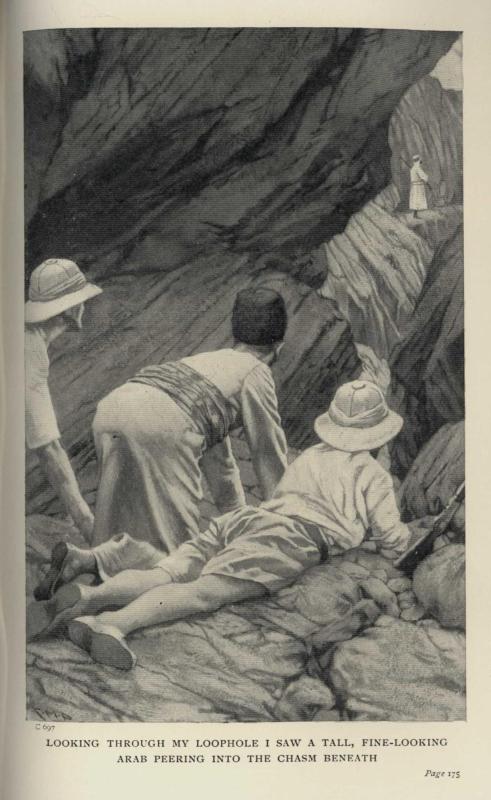
LOOKING THROUGH MY LOOPHOLE I SAW A TALL, FINE-LOOKING ARAB PEERING INTO THE CHASM BENEATH.
I felt certain that the white cigarette end must be lying there at his feet, and that in another second he must see it. My heart seemed to stop beating and my ears buzzed. He turned and looked intently at the very heap of boulders behind which we lay. I could have sworn that our eyes met. I had to put my hand to my mouth to prevent me giving way to the frantic desire to yell. Then he disappeared back into the gap, and I breathed more freely.
"He tell others—all safe—see nothing—camels come presently," Jaffa whispered.
In two or three minutes more Arabs—ten, then twenty—crowded through the gap, their rifles held ready and their fierce eyes scanning every rock.
Thank goodness! The towering sides of the "coffee-cup" hid the Intrepid from view.
They moved stiffly, as though tired, talking quietly and squatting on the rocks for a few minutes, until they suddenly stood up, looked back through the gap, slung their rifles over their shoulders, and commenced to scramble down the zigzag path.
They had hardly left the gap when, with a light scraping noise, the ugly head and neck of a camel appeared. He hesitated as he saw the steepness of the path below him, but the camel leader beat him about his head and lips until he condescended to move out of the gap, and with hesitating paces, putting down his huge feet with very great care, started the descent. As his body came into view we saw long sacks or bundles of matting—containing rifles, we felt sure—strapped one on either side of him.
From his quarters stretched taut the halter of the camel "next astern", and another supercilious, scornful, ugly head appeared. Camel after camel (all with their bundles), Arab after Arab (some armed, others simply leading camels) squeezed after each other through the gap in the crest and started down the zigzag path.
I was thankful to notice that the advance-guard seemed in no hurry to reach the bottom, but would go on for a hundred yards, wait for the leading camel to overtake them, and go on again. The longer the time which elapsed before they sighted the Intrepid, the more chance would there be that the end of the caravan had already passed through the gap before the alarm was given.
Fifty camels I counted; sixty; sixty-two—three; but as the sixty-fourth head emerged into sight it sank down to the rocks. The wretched brute had fallen on his knees, his neck stretched quite straight as his halter to the camel ahead took the strain. He was dragged bodily forward for a few inches on the smooth rock, then the halter "parted", and his neck curved again.
Another ugly camel's head appeared over his back, but there was no room to pass—the gap was too narrow—and he stopped, swaying his head angrily from side to side.
The Arabs called shrilly one to another—-half-dazed they seemed to be, probably from fatigue—and a dozen of them, surrounding the kneeling camel, tried to make him rise to his feet. They prodded him with their rifles and spears, howling execrations, hauled on the broken halter, and beat him on the nose and face. They actually fired rifles close to his face; but he took not the slightest notice. He never even moved his head, holding it up quite motionless, with that extraordinary sarcastic, supercilious look which camels always have, and appeared to be quite unaware of the cruel treatment.
"Camel—finish—much tired—never get up—stay to die," Jaffa whispered.
Two vultures—appearing from nowhere—perched silently on the rocks behind which lay Webster and his two men, saw them, and flapped across to another rock. The Arabs were too busy to notice this or they might have been suspicious.
Then a fine-looking, very richly dressed Arab, with a flowing red[#] patriarchal beard and a green turban pushed past the camel and began to give orders. The ropes securing the bundles were unlashed, the bundles were dragged aside and propped up against the projecting rocks, and then, hauling on those ropes (they passed under the camel's belly), shouting and yelling as though hell had broken loose, the Arabs tried to hoist him to his feet.
[#] The sheikh must have visited Mecca three times, as only after three such pilgrimages are beards dyed red.
The sheikh, or whoever he was, climbed to the top of the gap, the better to superintend operations. A grand-looking chap he was, with a fine "fighting" face, beetling eyebrows, and a great hooked nose.
For a moment I thought again of that cigarette end, and grew sick with fear lest it was there and he should see it. But he was too much interested in the camel to see anything else. Although his men heaved with all their might they only raised the poor beast a few inches, and down it would sink again.
Then the sheikh gave more orders. Men began calling down to those on the paths of the zigzag, immediately underneath the helpless camel, and I saw these hurriedly making large gaps in the line of camels. Two men took hold of the poor brute's halter and hauled the head round until it was touching the hind quarters; the others, gathering at the side of the camel farther from the precipice below, using their rifles as levers and also pressing against his lean flanks, shoved "all together"; the men on the head-rope tugged the head still farther round, and the helpless brute toppled over the edge. Rolling and falling, sliding through the gaps in the lines beneath, bounding from boulder to boulder, he at last "fetched up", two hundred feet below, against a rock, and lay there a shapeless mass of broken back and neck and legs.
The two vultures hopped about excitedly and flapped a little farther down, eyeing the remains with twisted heads.
At another order from the sheikh those bundles were torn open, and I simply "thrilled" to see at least two dozen rifles—brand-new rifles—hauled out. Each man, taking one or two of them as he passed, started off again along the zigzag path after the rest of the camels. The sheikh, clambering down to the path, followed them slowly, and that procession of camels commenced afresh through the gap, camel after camel, until I had counted eighty-three. After the eighty-third came many more, pace by pace, with weary feet, but these were loaded with boxes of ammunition. No attempts had been made to conceal that fact; the boxes were just as they had left the manufacturers, slung in great nets across the camels' backs.
One hundred and thirty-four passed through, counting both those with rifles and those with ammunition; and, last of all, led by two men, a magnificent camel, splendidly caparisoned, with a scarlet, silver-embroidered cloth and with silver-mounted harness, stalked angrily through, followed by two smaller ones with unwieldy burdens. These three were doubtless the sheikh's own camels, his riding camel and the two which carried his tent and the cooking gear and food which he might want on the march.
No more camels came.
I could hardly believe our good fortune. Everything had turned out as we had planned. Looking down into the "coffee-cup" I could see the zigzag of painfully-descending camels; and still farther below them the white figures of the advance-guard, not yet near the bottom or that corner beyond which they would be able to see the Intrepid. Not one of those Bedouin Arabs suspected that we six were lying there above them, or that the Intrepids were—possibly—hurrying up to drive them back to us. I would have given much to know what was happening beyond the mountain screen, whether the Intrepids had actually landed, and, if they had landed, how near they were. I reckoned that, by now, if all had happened as I hoped, they would be about halfway up from the village, and in another quarter of an hour, or less, the first of those Arabs would have scrambled out of the bottom of the "coffee-cup" and should see them.
What the time was, or how long it had taken those one hundred and thirty-seven camels to pass through the gap, I had no idea; but the sun was already slanting downwards in the west and was no longer lighting the rocks at the bottom of the "coffee-cup". In fact they had disappeared for some time in the shadow cast by the ridge on which we were hidden, and as the sun gradually sank, so did the sharply-outlined shadow of the ridge and the gap, rising upwards along the opposite face of the chasm, gradually shade the zigzag path higher and higher.
We were fearfully thirsty, but we still dared not shift our cramped positions to get at our water-bottles and make ourselves more comfortable. We simply lay where we were, peering through our loopholes between the rocks at the caravan crawling down the path. Vultures, perched on the rocks around us, craned their bare necks downwards and watched too. It looked like some huge centipede or caterpillar, as each camel carefully felt for his next foothold and swung his long ungainly legs stiffly and cautiously forward. I caught sight of one, the third in a gang or string of five, evidently making very "heavy weather" of it. Whenever the path was sufficiently broad I noticed that an Arab would take hold of his halter to steady him. I pointed out this camel to Jaffa, and scarcely had he whispered: "He fall—soon," when the poor brute stumbled, tried to recover his feet, and fell on one knee, the other leg sprawling over the edge, violently pawing space. The Arab guiding him sprang away, clinging to the rocks, and in a moment the camel had toppled over. I heard wild cries of alarm; the camel leaders on the zigzag below tried desperately to make a gap in their line as they saw what was happening over their heads; but too late. The camel fell; the two camels behind were dragged after him, and the three slid like an avalanche down the rocks, sweeping more camels and one or two Arabs from the narrow zigzags below, bursting their bundles and scattering rifles until they disappeared in the gloom beneath.
It was a horrid sight, and for two or three minutes there was the utmost confusion. The frightened drivers pulled the camels' heads this way and that, and how the poor stupid creatures could keep their foothold at all was marvellous, especially as in many places the path was so narrow that, even from where I was, I could see the "inner" bundles of rifles scraping against the rocks.
We were so intent on watching this that we never turned our heads; but when I did again look across the gap to see whether Webster and his men were still hidden, I had a terrible fright.
Squatting right in the mouth of the gap, and on both edges of it, were a score or more of Arabs, their rifles slung over their shoulders. Jaffa saw them; Griffiths saw them. If they were as frightened as I was they did not show it.
We hardly dared to breathe. There they were, the nearest of them not fifty yards away. They evidently meant to stay, for they had brought firewood, and some of them were trying to set light to it, whilst others were pouring water from a skin into a brass cooking pot.
That anything such as this should happen had never entered my head. I never thought that they would have taken the precaution of leaving a rearguard to protect their line of retreat, and to have done so entirely altered the whole situation and upset all my calculations.
If they took to wandering along that ridge we should be discovered, and if they simply remained where they were we could not fire on the caravan without exposing ourselves to this new force. At the very first shot they would take cover, find out where we lay, and then crawl to the rocks overhead and shoot down. In those first few moments my whole idea was to kill as many as possible before being killed myself.
We watched them with straining eyes. If they had scattered and come near us I should have opened fire. My fingers clutched my rifle to draw it to me, and then loosened again, because they all collected round that cooking pot; the blue smoke came curling up among them, and they evidently had no other thought than to rest and make coffee. They never even troubled to look down to see whether their comrades and the camels were recovering from their disorder, but huddled close together, sheltering their heads from the sun with their dirty cloaks.
There was no immediate danger, so I turned to watch the caravan. Down at the gloomy bottom of the "coffee-cup" I could just distinguish little white figures moving among the boulders—-the advance party had at last reached the gorge which led them out into the open. Three or four disappeared round the shoulder of the rocks which shut out my view of the gorge, and I knew that in a moment or two they would sight the Intrepid lying at anchor—and perhaps her advancing men.
I was right. Hardly had they disappeared before back they came into view, very hurriedly, and in a marvellously short space of time the whole of that "coffee-cup" rang with strange cries and shouts as they passed the word up and up its precipitous sides. Along the zigzag path—from one zigzag shouted to the next above—we could hear the news being passed. The camel leaders seized the heads of their camels and stopped them; the Arabs crouching round the gap sprang to their feet as the shouting disturbed them, unslung their rifles, and began talking excitedly.
Down below I saw the green turban of the sheikh as he worked his way along the lowest zigzag, until he too reached the bottom and also disappeared from view.
I would have given all I possessed to know what he could see.
Whatever he had seen I quickly knew that he had seen something which convinced him that the caravan could not hope to escape downwards, because more orders—flurried and high-pitched—were shouted upwards along the zigzag until the deep ravine re-echoed from side to side with them. The camel leaders began unfastening the long halters from the camels, and, very nervously, began to try to turn the tired animals round to face upwards again. Some had room enough and managed to do so; others were in places so narrow, with steep rocks so close to the path, that it was a pure impossibility for a camel to turn. Many camels absolutely refused to try, sinking to their knees; two or three tried, toppled over their clumsy feet, and fell, increasing the horrible confusion as they crashed below.
I realized now that the caravan could neither move upwards nor downwards. If only Commander Duckworth and his people could come quickly the whole of these rifles and ammunition would be theirs. In the joy of knowing this I cared not a jot what happened to us.
The shouting and confusion below us grew greater; every armed Arab was trying frantically to reach the bottom of the path, squeezing past the standing or crawling over the kneeling camels. Directly they reached the bottom they hurried away round the shoulder out of sight.
Some unarmed camel men began shouting to the men round the gap, and ten or twelve of these left the group round that cooking bowl and began the perilous descent. They had not gone more than a hundred yards along the first arm of the zigzag before more shouts came from below; they turned and called back to the others, and the remainder of the rear-guard rose and followed them.
In five minutes we six were alone on that ridge, with the blue curling smoke of that Arab fire between our two little parties.
I had to hold my breath to prevent myself shouting with joy; Jaffa's face was beaming; I heard Griffiths chuckling with delight.
The relief from the awful strain of having that rear-guard so close to us was too much for Webster or one of his men, because for a moment I saw the barrel of a rifle appear behind their rocks and almost expected to hear a cheer. The rifle disappeared as if someone had pulled it down violently.
By this time the caravan was in a state of the most hopeless confusion, totally unable to move either upwards or downwards; many camels had fallen, others were kneeling and refused to move; some were facing one way, some the other. The frightened camel leaders had given up any attempt to restore order and were gradually moving up the path as if to escape themselves, even if they could not bring their camels with them.
Only the upper few zigzags were now in sunlight; the gloom down at the bottom was increasing very rapidly, and unless the Arabs there had worn fairly white clothes we should not have been able to see them as they scrambled among the boulders, to disappear out of sight round that corner.
I realized now that when the sun sank still lower, and the gloom increased still more, we should be able to see nothing whatever to fire at down below. And, too, I had never thought that if they tried to defend the approach to the gorge they might take up a position round that corner where our fire could not reach them. They were evidently doing this, and it upset my scheme still more.
I knew enough of soldiering to know that a small force, well posted behind rocks, could hold the mouth of that ravine (the crack in the "coffee-cup") for an almost indefinite time against a very much superior force. If the Intrepids were actually advancing, and had not brought Maxims or field-guns, these Arabs, with their "backs to the wall", could keep them at bay for the three and a half or four remaining hours of daylight. If so, they might be able during the night to withdraw a remnant of the caravan, and in the dark our five rifles and six hundred cartridges would not stop them.
There was only one thing to do. It sounds heroic, but there was no thought of heroism. Those men still scrambling to the bottom and the men of the rear-guard must be stopped. We five must open fire on them and compel them to remount the zigzag to attack us, and therefore prevent them joining those who had already issued from the "coffee-cup" to defend it against the Intrepid's people.
If I could only have been certain of what was actually happening down there, outside our line of vision, we might have waited; but I did not know, and it was absolutely necessary to do something, and to do that something quickly.