GUNBOAT AND GUN-RUNNER (continued 2)
Reading edition
Presently the six Arabs still on their legs crawled and slunk aft, and dragged the two dead bodies away, helping the wounded man along the deck, and then sitting in a ring round the foot of the mast, motionless and mute as bats, drawing their cloaks round them to protect them from the seas.
The nakhoda was still unconscious, so we secured him to a ring to prevent him being washed overboard.
Someone lashed a handkerchief round my head and stopped the bleeding. That made me more comfortable, and I was able to take stock of our position.
Kuh-i-Mubarak, that hill near the southern creek, was now abreast us, just visible through the gale. The shamel roared down on us more fiercely than ever, driving in front of it a wild, jumping, short sea, twenty feet high, with boiling crests. That such waves could have been whipped up in such a short time seemed incredible.
Every now and then the launch's white side and her yellow funnel and mast showed up against the dark sky to wind'ard; so she was still safe. But we were more than two thousand yards to leeward of her, and how I was going to beat up against that wind and sea in this crazy dhow I didn't know.
However, I was not going to leave the launch helpless; I knew that she could not raise steam for a long time, and determined to make the attempt.
"I'm going to hoist that sail—part way up—see if we can work to wind'ard," I bawled to Dobson.
He shouted back: "She'll never do it, sir; not in this sea."
We should have to try anyway; so we rolled up and lashed the foot of that huge sail as firmly as we could, and, having done that, all four of us clapped on to the main-halyard purchase and slowly raised the big yard about three feet. What canvas was now free lashed about ferociously, giving us stern way.
"Stand by your main sheets," I yelled. "Stand by to ease and haul your tiller hard a-starboard."
Dobson and Wiggins dashed aft to obey, and, as the rudder was put over, our bows began to pay off from the gale, and, doing so, the full force of it broke on the beam; that scrap of sail filled, and bore us over until our bows were buried in the sea.
"Midships the helm!" I shouted, and watched to see how the dhow would behave. A squall struck her, and a wave of great height, leaping over us, surged on board—solid water. The dhow heeled over till we could not stand, and those lashings round the foot of the sail gave way like pistol shots, one after the other; the whole of that huge sail shot out like a balloon, and we gave a tremendous lurch.
Where the bows had been was now a churning mass of water; the lee gunwale and the foot of the lee shrouds were out of sight; I was up to my waist in water; one of the Arabs was washed overboard, and the nakhoda would have been had he not been lashed to that ringbolt.
I struggled to the main sheet, yelling to Dobson to ease it, but it was under water and had jammed; no one could get at it.
I thought that unless the mast carried away we must capsize.
"Cut it, for God's sake, cut it!" I roared, and Dobson hacked away at one of the thick ropes. Whilst he was sawing away—his knife was blunt and would not cut—Jaffa, quick as lightning, pulled out his Mauser pistol, put the muzzle up against the rope, and fired in quick succession.
With a leap and a shriek the rope gave way, the running parts lashed through the sheaves of the "purchase", the sail flew out to leeward, and the dhow began to right herself, shaking the water from her like a dog.
Thank God we had not opened the hatch cover! If we had done so we should have sunk like a stone.
As it was, we were in a bad enough plight. The huge sail was beating madly, one second half-buried in the sea, the next whirled as high as the masthead, and cracking with a noise like thunder, the big block on the standing part of the main sheet attached to the sail being hurled about like a stone on the end of a rope. This block kept on sweeping over the stern, where we were taking shelter, splintering the railings like matchwood, and it was all we could do to dodge it. If it had struck anyone, that would have been the last of him.
Perhaps, for most of the time, the sail, or the lower part, was in the water, and the dhow could not lift it out or herself on an even keel; like a huge bird, with one wing broken, we went rolling and reeling to leeward, waiting for the mast to carry away.
To have attempted to drag the sail on board and smother it would have been sheer lunacy, even if we had twenty men to do it. It would have been as easy to try to stop a wounded elephant tearing up trees round him by lassoing his trunk with twine.
To add to our troubles, the seas were beating against the rudder, which was wrestling with the tiller ropes and trying to shake itself free.
Jask! I wasn't thinking of Jask then, or of Mr. Scarlett and the Bunder Abbas. What was to happen in the next half-minute was quite enough for me. We could not stand without clinging to something, the dhow was lurching too much, and sea after sea, four or five feet deep, in foaming cataracts, poured over the dhow's waist.
We had to do something: we tried to lower the big yard, struggling waist-deep in the sea to reach the foot of the mast, where those poor wretches of Arabs, in the last stage of fright, were clinging for dear life. We could not move it or its clumsy rope "sleeve", securing it to the mast, and Wiggins was banged against the mast by a wave—flattened against it like a fly on a wall. It was all we could do to prevent his being washed overboard. He broke two ribs, though we did not know that until afterwards.
As we scrambled back to the poop we saw the rudder head wrench itself free from the tiller ropes, and to the noise of the gale and the thundering of that mad sail now came the grinding noise of the rudder breaking itself to pieces under the stern. Thank goodness, it broke away before it had knocked a hole in our bottom, floating up and threatening to come inboard on the top of the next wave. However, we drifted away from it like a feather from a piece of seaweed, and had soon left it out of sight.
Why that mast did not go over the side I cannot think. The strain on it and the weather shrouds must have been enormous.
If it had broken we should have been perfectly helpless, and the end—well, as I said before, we were too busy with each succeeding half-minute to worry about anything beyond that.
We were drifting to leeward at a tremendous rate; Kuh-i-Mubarak was below the horizon, and the gale showed no signs of lessening.
"If this goes on much longer we'll find ourselves blown a hundred miles out to sea," Dobson roared in my ear. "We'd best cut away the mast. She'll ride more easy and won't drift so quick."
I looked to wind'ard. Even though the gale howled as fiercely as ever, the sky showed signs of clearing; the line of the horizon was certainly clearer than it had been the last time I looked. I knew that these gales often died down as quickly as they rose; the fiercer they were the quicker over, and I still hoped to sail into Jask. I even began to think how best to rig a "jury" rudder.
So I shook my head at Dobson, and determined to keep the mast unless things became worse, and we hung on, dodging the waves and the block on that main sheet.
Presently the sail began to give way, great rents showing in it when it lifted, spreading and ripping, and flying to leeward in long streamers, which one by one tore themselves clear and spun madly down wind.
As each strip parted it eased the strain, until, after a time, the dhow came on a more even keel, and in the hollows of the seas wallowed less deeply.
Somehow or other we felt that the worst was over, and began to look round us and shift into more comfortable positions. The old nakhoda—half-drowned he was—began to recover consciousness, and the Arabs ventured a little farther aft, crouching for shelter under the weather gunwale.
There was now no sign whatever of the Bunder Abbas—we had drifted out of sight of her long ago—but the sky overhead was clearing; large blue patches showed between the clouds, and though the gale still shrieked down on us with unabated violence, our spirits rose considerably.
The edge of civilization! Yes, I was there, with a vengeance! What an extraordinary change seven weeks had made, after my long seven years in home waters! I could not help picturing the Channel Squadron anchored, as I last saw it, under Portland Bill, and wondered whether it was still there, thanking Heaven that I was not keeping a monotonous day "on".
To make things still more comfortable for us, that big wooden block, in a last furious endeavour to dash our brains out, banged itself to pieces against a big wooden bollard on the poop, so we had no longer to dodge it. But to level up things we began to realize how horribly thirsty we were. We found some water, or rather Jaffa found some, under the poop, in an old kerosene tin. It tasted horrid, and was so brackish that it did little to quench our thirst. My head, too, now that I had not so much to think about, began to throb and ache. Wiggins began to complain of his side.
"We've got to stick it out, that's all," I called to them; and Dobson smiled cheerily, shouting back that he thought "this 'ere shamel wouldn't last long; it was too blooming strong at the start."
He talked about a shamel as if it was an old acquaintance—sometimes in a good, but now in a very bad temper.
I began to feel that the wind was not so strong; waves were certainly not breaking over the dhow so frequently nor with so much force. The lee gunwale was well clear of the sea.
I thought that now it might be possible to capture the remnants of that sail, so, making a rope fast round my waist, and telling Dobson to come with me, I scrambled to the foot of the mast. Whilst he stood by to "pay out" I chose a moment when the big yard over my head was still, climbed on to it, swung myself across it, and, holding on with arms and legs, worked my way along it slowly. It tried to shake me off every half-minute. Once it managed to get rid of my knees, whilst I clung like grim death, my legs dangling almost in the water. Then it tossed me like a feather, and I caught it again with my knees, waiting a moment till it was possible to wriggle along still farther. I managed to crawl almost twenty feet from the mast. That was far enough for my purpose. I wanted to secure my rope to it there—the rope round my waist—but that was the trouble; directly I let go with one hand, off I was jerked, just as if the beastly sail and yard were waiting their opportunity.
For a second I hung by one arm, my body actually in the water, then the sail, billowing up, lifted me with it, and I clung to that yard like a fly. There was a gap just below me, beneath the yard, where the sail had torn itself away from its lashing. I wriggled through it and over the yard again, the rope of course coming along after me, and by waiting my opportunity I managed another wriggle round the yard. There I was, with a turn of the rope round it and myself, secured to it like a pig lashed to a pole. However, I could not be jerked off and could use one hand. Looking down I saw Dobson yelling encouragement; the Arabs were looking at me with frightened faces.
Dobson paid out the rope very handsomely, and in a couple of minutes I managed to take another turn round the yard, secure it, and unlash myself. Then, shinning and clinging like a limpet as the yard waved about, wriggling backwards when it was quiet, I managed to reach the mast and clambered down on deck.
"That's done 'im in the eye right enough!" Dobson shouted enthusiastically, as he grabbed me by the feet. '"Im" was the shamel.
Together we led that rope aft, passed it through a block under the lee gunwale, took a turn round a cleat, and the four of us tried to haul the yard on board, hauling for all we were worth.
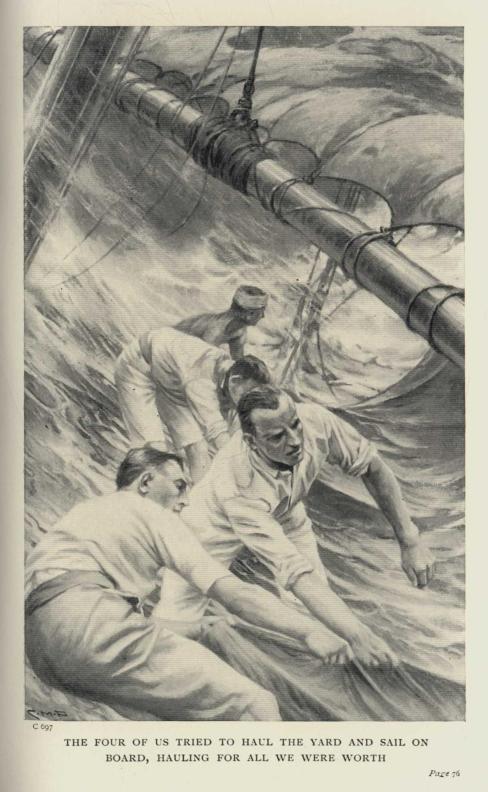
THE FOUR OF US TRIED TO HAUL THE YARD AND SAIL ON BOARD, HAULING FOR ALL WE WERE WORTH.
We won a few inches at a time, between squalls, and another turn round the cleat would prevent the yard dragging them out again. Slowly, inch by inch, the end of it came closer to us, and at every inch the dhow would heel over a little more. However, I knew how much she would stand by now, so cared not a jot.
However, at last the yard and sail beat us. It was all we could do to hold in what we had won; not another inch could we gain. Then, to our intense delight, the six Arabs came aft and clapped on too.
"Go it, lads!" I yelled, and, working like one man, we pulled the yard towards us until the peak of it was close to the railings round the stern.
Dobson scrambled up with a coil of rope, lassoed it, and captured it for good and all.
It was grand.
"Now lower it!" I yelled, and we scrambled for'ard to the mast, Arabs and all, slacked off the main halyards, and down it slid.
The remnant of the sail made a last attempt to escape, then draggled over the lee side, hanging down in the water—beaten.
No one wanted an order; Dobson, Wiggins, Jaffa, and myself, and every one of those Arabs, flung ourselves on to it to prevent it filling again, clutching and pulling till, in a minute or two, it was all on board, lashed to the yard, and as harmless as a handkerchief.
The dhow now came on a level keel, and, her stern paying off before the wind, our bows pointed into the sea. You can imagine what a relief this was after we had been rolling over on our beam-ends for so long.
However, she could not face the seas, and we were soon being spun round and round again.
"A sea-anchor; that's what she wants!" Dobson shouted. "That'll steady her, sir; she'll be like a cradle when she's got one."
There was plenty of timber on the fore hatch, so we unlashed it, and, making half a dozen long balks fast to a big grass hawser we found in the bows, we tipped them overboard, or allowed the seas to wash them overboard—whichever happened first—one after the other. As the dhow drifted to leeward so much faster than they did, the hawser soon tautened out, and brought our bows round into the wind.
Jolly proud we all were of that sea-anchor. It sounds easy enough to make, but if you had seen us trying to prevent those planks and balks of timber taking "charge" whilst we were passing the grass hawser round each one singly, leaping away as they tore themselves out of our hands and tried to break our legs, you would realize that it was not the simple matter it sounds.
We must have been struggling with it for at least an hour, up to our waists in water most of that time, and were thoroughly exhausted by the time we had paid out the whole of the hawser.
But we were now riding head to sea, our decks were not washed by the waves, and when we gathered on the poop to rest after our exhausting work we were as comfortable, as Dobson said, "as fleas in a blanket".
CHAPTER V
My First Capture
With that sea-anchor keeping our bows up to wind'ard, the worst of our troubles seemed to be over. My wrist watch had been broken in that first mêlée, so we did not know what time it was. From the height of the sun we guessed it to be nearly noon.
I climbed to the mast head. Not a sign of the Bunder Abbas could I see; in fact, the whole circle of the horizon was empty but for ourselves, and as there was absolutely nothing to be done (for it would have been madness to hoist a scrap of sail, and as for trying to make a jury-rudder, we simply could not have done it whilst we were pitching and tossing so violently) we four sat comfortably on the poop, dried ourselves, and watched the Arabs squatting close to the foot of the mast. They had asked Jaffa's permission to search for food, and had found some dried dates. They seemed to enjoy them, and the sight of food of any sort made us remember that we had not had any that day, and that we were as hungry as hunters.
Jaffa found a large store of these dates under the poop, and, though they looked unappetizing to a degree, we enjoyed them hugely, washing them down with another drink out of that kerosene tin.
I was so hungry that I could have eaten a cat.
The sun was now blazing down on us. Unfortunately we had not brought our helmets or topees, having left the Bunder Abbas at daybreak. Our caps were little, if any, protection from it, in spite of our constantly dipping them into the sea, and my head was burning and throbbing. Salt water got into that wound, and I did not dare to take off the handkerchief for fear of it bleeding again. Wiggins complained a good deal of his ribs.
The nakhoda, too, recovered consciousness, and begged for water, sitting up and moaning when he saw all the wreckage round him. He had such a cruel, cunning face that I could not trust him for'ard with the crew, but kept him aft with us. He looked as if it would have given him a great deal of joy to cut our throats, and no doubt it would.
Every half-hour or so Dobson or I would go for'ard to see that the hawser to the sea-anchor was not chafing in the "fairway," taking stock of the weather at the same time. Every time I said: "I think it's easing off," Dobson would shake his head; "'E ain't finished with 'is tantrums yet, sir."
However, at last I felt sure that the gale was moderating. There were not such high waves, they did not boil down on us so furiously, they were longer too, not so steep, and we were certainly riding more easily. Dobson at last agreed: "'E's in a good 'umour, I do believe."
The nakhoda's wicked old face was a good enough barometer. As the wind and the sea fell, so did his face look more glum, until at last, when there was no manner of doubt that the gale was fast dying down, he scowled angrily. What idea he had in his cunning old head, I did not know.
"We'll be able to start rigging a jury-rudder soon," I told Dobson, "hoist a bit of sail, and bear away towards Jask."
I had given up any possibility of beating up to the Bunder Abbas. If I could get into Jask the political agent would soon charter me a dhow to go back and look for her.
Well, we made that jury-rudder. It took us two hard-working hours, and without the help of the Arab crew we could not have made it. A clumsy thing it was; a triangle made of balks of timber, with one long projecting plank at each corner for the steering ropes. We also managed to secure the lower after end of what remained of the sail, binding a rope round it to act, later on, as a sheet.
There were still six able-bodied Arabs, not counting the nakhoda. The wounded man (the one who could not walk) had been washed overboard by the first big sea which struck us. The wounds of the others were not worth troubling about. As far as I remember, Dobson's fists had made them; certainly they had not been struck with bullets, because Jaffa was the only one on board who had shown himself able to hit a haystack at ten yards.
Having completed the jury-rudder we rested until the falling wind and sea allowed us to use it. We took it "turn and turn about" to keep watch, Jaffa and I, Dobson and Wiggins—nothing to do and two to do it. The only thing we had to do was to keep an eye on the treacherous old nakhoda.
The afternoon slipped by; the sun began to set in all its grandeur, and only a few gloriously-tinted clouds, scudding across the sky, were left to remind us that nature had been in such an angry mood. The wind and the sea seemed to sink to rest with the sun; only an occasional sobbing gust moaned through the rigging, and, rising from the sea, a huge full moon, like a burnished silver plate, set deep in a dark indigo sky, flooded us with light.
It was now possible to try to bring the dhow under control; so, first of all, overboard went the jury-rudder, with two hawsers lashed to those projecting planks, and led to either side of the poop. Then we hoisted a little of our tattered sail, cut away the grass hawser to the sea-anchor, and, the breeze—it was only a breeze now—blowing steadily and softly from the north-west, filling the sail gently, we squared the yard and let her "rip".
But the jury-rudder would not act as a rudder. It was too clumsy, and the ropes attached to it too heavy. Twenty men on each would have been scarcely sufficient to work it. However, it kept our stern to the wind—acting as a drag on the dhow—and we scudded merrily away to the south-east at about three knots. I imagined that we were about eighty miles to the south-west of Jask, and hoped that as the breeze backed, as it generally did for some time after a shamel, we should be presently blown away to the east.
Up to now the Arab crew had been helping quite willingly: but whilst they were working aft with the jury-rudder I noticed that the sly old nakhoda took every opportunity of speaking to them, and that afterwards, though they still worked, they worked sullenly and unwillingly.
I had thought of allowing him to go for'ard with them, but after this, and after Jaffa had warned me not to do so ("He only make a mischief," he said), I kept him aft where he was, much as I disliked his company.
I rather fancy that that knock on the head had made me sleepy. I could hardly keep my eyes open during my first turn of watch-keeping. It was beautifully cool, the "shamel" was now nothing more than a respectable breeze, and the long subsiding swell made a most heavenly sight in the moonlight. Jaffa and I talked—it was the only way we could keep awake—he telling me more about the peculiarities of the winds which blew in this region. Then he went on to tell me some of the experiences he had had during the nine years he had served in the British service as an interpreter. Though they were very interesting I was more interested in him and in his quiet aristocratic method of telling them. After the wonderfully cool way he had handled his Mauser pistol that morning he was not to me the same Jaffa who had boarded the dhow with us.
Dobson and Wiggins relieved us presently. "The jury-rudder is keeping our stern into the wind well enough," I told Dobson; "the sea is nearly smooth, the wind mostly gone, and the Arabs are all sound asleep—the nakhoda under the poop, the rest for'ard."
Then I slept like a log until Dobson called me for another spell of watch, and Jaffa and I were again on duty.
It was as wonderful, enchanting a sight as I have ever seen. Above us the great, dazzling, silent moon; around us the sea, a rippling surface of silvery white, stretching away to the circle of the horizon. The little dhow, with her white deck and black shadows, was the centre of it, her sail a great patch of white, casting its clear-cut shadow to starboard over the bows and over the water under them, as sharply cut where it fell on the water as across the deck.
In the bows, beyond the foot of the sail, the sleeping Arabs lay in its dark shadow; in the stern, in the shadow of the poop, Dobson and Wiggins were soon fast asleep—the nakhoda had crawled under the poop and slept there.
It was all so silent and so beautiful—the embodiment of all that is lovely and peaceful and good in nature—that the perils and tragedies of the day before seemed almost unreal, and it seemed impossible to realize that, unless we kept wideawake and alert for the first suspicious movement, we might have our throats cut at any moment.
What we could realize—only too painfully—was that we were very hungry.
Probably that helped to keep us awake more than anything else.
At any rate we did keep awake until I thought that two hours had gone by, when I woke Dobson, coiled down on deck again, and was asleep in a second.
Something touched me. I woke up. Dobson was bending over me. "There's summat going on for'ard, sir. I don't like the sound of it. I've been for'ard under the foot of that 'ere sail twice in the past 'arf-'our, and those noises leave off. I find them Arabs a-lying there as quiet as mice in a nest, and I don't understand it."
I rubbed my eyes, sat up, and rose to my feet—very stiff I was.
The sea was absolutely calm now; the moonlight flooded our decks. Every seam and knot in the planks was distinct; every stitch and ragged tear showed out clearly in the drooping sail, whose shadow swallowed up the whole of the bows.
"Listen, sir!" Dobson whispered, pointing for'ard.
I heard a soft rasping sound, as if pieces of rough wood were being drawn across each another. I crept for'ard close to the gunwale, and had not taken two paces before the noise ceased.
Dobson joined me. "It always leaves off directly I start to go for'ard, sir."
"Come along," I said, and we both walked along the deck, and, lifting the foot of the sail, peered underneath. When our eyes were accustomed to the darkness we could see the figures of Arabs huddled up close together on top of the fore hatch. We waited for several minutes, but no one stirred.
We crept back again.
"Where's Wiggins?" I asked, and Dobson pointed under the poop. "He felt so bad with his ribs, sir, that I told him to go and lie down."
"See if the nakhoda is under there," I told him, and he crept in.
He came back again, white in the face. "'E's not there, sir."
I crawled under myself, crawled all over the beastly place. He certainly was not there.
"I never saw 'im go, sir!" Dobson whispered apologetically.
However, he was gone; there could be no doubt about that. He was certain to have crept for'ard among his men, and it was as certain that mischief would be brewing.
"We'll turn 'em out and see what it is," I said, pulling my revolver from its holster and opening the breech to see that it was loaded.
We went for'ard again, and as we bent down under the sail, our revolvers in our hands, there was a rush of bare feet and the whole crowd of them leapt at us. Three or four were clinging to me, throttling me round the neck, clutching my arms to my sides, and pulling my legs from under me. In spite of all my struggles I was thrown to the deck on my face; someone bent back my wrist to wrench the revolver away, but before it was dragged out of my hand I managed to get my finger on the trigger and pulled it. As my head whirled with the choking of those iron fingers round my throat I did not know whether I had actually fired it or not. I was banged on the deck, twisted round and round under a heap of grunting Arabs; something was forced into my mouth; I nearly lost consciousness, but when the grasp on my throat was relaxed I managed to draw a breath of air and found myself next to Dobson, both of us lashed up like mummies, lying on our backs on some coils of rope.
We were both gagged, unable to speak, much less able to shout and wake Jaffa and Wiggins—lying perfectly helpless.
Two Arabs were squatting on their haunches on either side of us. Like a fool I tried to struggle, and the one near me bent down and drew something across my forehead—a knife; I felt its edge jag along the bone and the blood running down the side of my temples and matting on my eyebrows.
I lay still, terrified lest the next time I moved that knife would be across my throat. I really was horror-struck.
I saw the remainder of those brutes stealing aft noiselessly, under the sail into the moonlight, and had an awful fear that in our struggles we had made so little noise that Wiggins and Jaffa would not have waked, and that they, too, would be caught unawares. I did not know whether my revolver had fired or not. I tried to imagine that it had, but everything was too horribly blurred for me to be sure.
Then my heart gave a great bound of relief, for, as the last of those Arabs had stooped down and shown himself in the moonlight, I saw a flash and heard Jaffa's Mauser pistol—and a louder one, Wiggins firing too. Shots banged out close to us, from the foot of the sail. An Arab gave a yell of pain, and the others came stampeding into the shadow again.
Thank Heaven! They had not caught them asleep.
Two of the Arabs—two with revolvers, mine and Dobson's I imagined—knelt down by us and hunted for more ammunition, pressing the muzzles against our foreheads to keep us quiet. The muzzle slipped into that gash; how it did pain! I had no more cartridges—none, thank God! Dobson had an unopened packet of twelve rounds, and we saw them carefully dividing these between each other. A cartridge dropped between us, and they hunted for it among the coils of rope, pulling us away roughly. An Arab pounced on it with a hiss of delight. I saw the Arab with a revolver take it and place it in his chamber, so I knew that they only had twelve rounds between them. Then these two armed men crept along, one on each side, to the edge of the shadow of the sail, stooping down to see under it, whilst the others, with knives in their hands, lay flat down on the deck between them.
I was half-dazed and mad with mortification and rage. I would have given my life to have known what Jaffa and Wiggins were doing at the other end of the dhow. There was a dark shadow under the poop platform, I knew, and trusted with all my heart that they had retreated there. But not a sound came from aft; they might both have been hit for all I knew. And not a sound did the Arabs make either. The only noise was the creaking of the yard against the mast and its huge sleeve of rope. The sail drooped down absolutely motionless, blotting out the moon.
How long this silence lasted I have not the least idea. It seemed ages.
"They have only twelve cartridges," was the only thing I could think of, and waited to count the shots, holding my breath for fear the thudding of my heart would prevent my hearing them.
The dark figures of those Arabs suddenly seemed to stiffen, and then, from either gunwale, where the shadows were darkest, the revolvers flashed and banged, twice on my right, three times on my left.
"Seven cartridges now, only seven," I thought joyfully, and each flash had been answered by more flashes from aft, and bullets ripped along the deck close to where Dobson and I lay.
An Arab gave a low sob, and I heard a revolver clatter to the deck on my left. A dark arm stretched out to pick it up, where it lay in the moonlight, and as the dark hand seized it and hurriedly drew back into the shadow a bullet splintered the deck where it had been.
A long period of silence followed. Except for an occasional groan from one of the Arabs, and the creaking of the yard above us, no sound came to relieve the extreme tension of my ears.
Seven more they had. How many had Jaffa and Wiggins? That was all I could think about. Wiggins would probably have very few, but Jaffa—I knew nothing about him. My ears were throbbing with the strain of listening to count pistol shots which never came. Then they crept aft again. I thought they were going to kill us. They dragged us aft until we lay among them, just in the edge of the shadow of the sail, and one of them began calling out. Though there was no reply from aft, I knew well enough that they were telling Jaffa that he would probably hit us if he fired any more.
So long as these Arabs did not recapture the dhow, I did not care in the least whether I was hit or not.
The answer came with a single pistol shot from aft. As it flashed, both the Arab revolvers went off. Probably they were waiting for this, and fired at the flash. I was too dazed to count the number of shots. Was it two or three? Had they five or four cartridges still? My brain was whirling and numb. I could not be sure.
They were probably as bad shots as ourselves, and appeared to be getting nervous.
There was a hurried consultation among them; they drew back farther into the shadow, and all of a sudden began stripping off their loose cloaks, five of them, two with revolvers, the others with knives, and I could make out the figure and beard of the nakhoda as he gesticulated and encouraged them.
I knew that they were standing by to make a rush aft, when suddenly they gave a hoarse cry and stiffened where they stood, pointing over the sea. They stood like dark statues for a moment, and then the whole darkness disappeared. They stood out in the glare of a searchlight, naked to the waist, their eyes glittering, their lips drawn back in fear, showing their white teeth, and their shadows thrown against the now lighted sail.
In another moment the searchlight—for it was a searchlight—had passed and it was dark again. Jaffa and Wiggins fired half a dozen rounds very rapidly; the bullets did not come for'ard, so probably they were firing in the air; they yelled, too, and back the searchlight swept and remained, whilst a small shell, bursting with a roar close to the bows, threw up a column of fire and water. In a second those Arabs had dropped on their knees, crouching below the gunwales and hiding from the glare of the light—all except the nakhoda, who, yelling something like "Allah", rushed at me with a long knife.
He would have stuck it into me had not the others thrown themselves on him and pulled him to the deck.
As they did so Jaffa and Wiggins, shouting and cursing, rushed forward.
In a minute I was free, Dobson was free. Wiggins had cut the ropes, whilst Jaffa stood guard over the Arabs, and as I staggered to the deck, bleeding like a pig again, a boat rasped alongside, and Popple Opstein's great red face appeared as he climbed over the gunwale, followed by half a dozen men.
"Four more! They've got four more—or is it three?" was all I could think of to say as he came for'ard. I had to sit down to prevent my legs giving way.
"Thank God you came along in time!" I said, as he shook some sense into me and gave me something to drink.
I was all right again in a few minutes, and whilst the Arabs were being securely tied up, to prevent any unpleasant mistakes, I was able to tell him what had happened.
"What about your edge of civilization, Martin, old chap?" he laughed. "You nearly toppled over the edge of it that time, eh? We spotted you in the moonlight, and saw the revolver flashes, so knew something was wrong. We never thought it was you."
"Man, she's full of rifles. I'm dead certain she is," I burst out, "and I haven't been out here ten days! Isn't it splendid?"
"You don't look very splendid," my chum smiled grimly. "The sooner you get on board to our doctor the better."
I really felt almost intoxicated. I could not stop talking. "Look at that one-eyed interpreter of mine," I babbled, turning to Jaffa, who was leaning up against the gunwale cleaning his Mauser pistol. "Look at him! He saved the whole show. He's simply grand with that pistol of his. Aren't you, Jaffa?"
He smiled his inscrutable, dignified smile.
"You saved all our lives. We should not have pulled through without you," I went on, and for the life of me I do not know whether he looked pleased or not.
The Intrepid's men were going round collecting the knives which the Arabs had dropped on deck. Dobson and I found our revolvers.
For the life of me I could not keep silent.
"How many cartridges are there in yours?" I asked him, opening my breech. "There are only two in mine."
"Not a blessed one, sir!" he grinned; so, after all, I had miscounted.
"How many have you?" I asked Wiggins.
"Not a blessed one either, sir! I did have two, but fired 'em when we sighted the Intrepid—that 'ere Pershun told me to!"
Commander Duckworth of the Intrepid now came on board the dhow, and I had to tell him the yarn all over again. In spite of feeling absolutely "played out", I talked as if I should never stop, telling him detail after detail, imploring him to go right away and hunt for the Bunder Abbas. I rather fancy I suggested that he should leave us in the dhow to sail into Jask.
However, I found myself, Dobson, Wiggins, and Jaffa climbing down into his boat and being pulled across to the Intrepid. I know that I talked to them all the time, and to Nicholson, the staff surgeon of the Intrepid, whilst he was probing and stitching those wounds of mine. When he had finished these he stuck the needle of a syringe into my arm. "That'll send you to sleep all right," he said, looking at me curiously.
When I went aft he was commencing work on three wounded Arabs who had been brought over. The rest of them were in the battery surrounded by inquisitive bluejackets. The old nakhoda squatted on deck by himself, covered up in his burnous, with only his eyes showing. He did not even deign to look at me. The Intrepid was already steaming ahead, her boats hoisted, and the dhow ("My dhow, old chap," I said, slapping old Popple Opstein on the back) was safely towing astern; I could see her mast.
"Rifles, my dear chap! She's simply chock-full of them!" I laughed.
I was famished—starvingly hungry—and they got food for me down in the ward-room, although Nicholson tried to make me lie down. The ward-room chaps, in their pyjamas, sat round me as I talked to them. I could not leave off talking, and I found that I didn't like anything they had on the table, so could not eat.
Nicholson took hold of my wrist and shoved another beastly syringe needle into my arm. He made the fellows go away too, although I had not told them nearly all that had happened, and in a little while I did let Nicholson take me to a cabin—just to humour him. That is the last I remember—I certainly don't remember undressing—but I woke in broad daylight to find myself in pyjamas belonging to somebody else, feeling rather shaky, my head covered in bandages, and Nicholson standing over me with a satisfied smile on his fat face.
My aunt! how hungry I was!
"Food, Nicholson, that's what I want," I said. "I haven't had anything worth speaking about for twenty-four hours."
He felt my pulse, smiled, and went away. I called him back. "How about the Bunder Abbas? Have you found her yet?"
"She's been alongside us for the last forty hours or more," he said. "We are anchored off Sheikh Hill. She's all right."
I looked puzzled. I had not noticed that the engines were not working.
"My dear chap, you've slept solidly for nearly three days. I've seen to that."
Popple Opstein came in, looking anxious, until Nicholson told him that I was as "right as rain". "Man, you are lucky!" he cried, his face growing violet with excitement; "she had nearly four hundred rifles on board. Look! I've brought you one," and he held up a brand-new Mauser rifle.
I handled it lovingly—my first capture. "You won't 'pot' at any poor wretched sentry on the Indian frontier, my beauty," I thought.
"How did you find the B.A.?" I asked; and my chum explained that the Intrepid had taken my dhow in tow, steaming to the north'ard; that at daybreak the launch had been sighted, and though she had raised steam again she could not use her engines as something had fouled her propeller, below the waterline of course, where Mr. Scarlett could not get at it.
"The result was," old Popple Opstein went on to tell me, "that we had to tow her as well, and when we anchored here sent our divers down to clear it."
Later on Nicholson allowed me to dress, Percy smiling out of his great eyes when he brought me some clean clothes. Afterwards I went aboard the Bunder Abbas to hear Mr. Scarlett's account of what had happened and to see what repairs were still necessary. I found people from the Intrepid busily straightening the bent stanchions and fitting a new after-awning cut from an old awning belonging to the cruiser.
"She'll look all right in a couple of days," Mr. Scarlett said, as he and I watched the last few boxes of ammunition being hoisted up through the dhow's hatches and transferred to the Intrepid's battery deck. It was a most comforting sight.
"Thought I'd seen the last of you, sir, when that big squall struck the dhow, and thought you'd seen the last of the Bunder Abbas when she half-filled herself with water, her fires had been put out, and that hawser coiled itself round the screw.
"My, sir, but I was being sick every few minutes with pure fright—I was that frightened that I wanted to jump overboard and get the drowning over quietly, without a lot of lascars howling and clawing round me—as I was waiting for 'em to do when she did sink. We made some kind of a sea-anchor with what was left of that awning and some spars, got her head to the wind, and baled her out with buckets—with buckets, sir! Three mortal hours that took, and another six to raise steam again, the lascars all preferring to drown up on deck, so not a blessed one would go below.
"We never noticed that hawser round her screw till we let the steam in her engines, wound a few more turns round her screw, and brought them up all standing. Thank God! we hadn't cast off our sea-anchor, or we'd have had all the making of another over again—and dead tired, tired as dogs, we all were."
There was this to say for Mr. Scarlett—I never doubted him. Whenever he told me of anything, I felt perfectly sure that he had told me all. However, I was inquisitive to know how he himself had actually behaved, so could not help asking Corporal Webster later on what kind of a time they had had, hoping that he might have something to say about him.
"Awful weren't the word for it, sir; the worst time I've ever had in my life. We none of us thought she'd float, and she wouldn't have but for the gunner—sick one moment, working like half a dozen men the next. Why, sir, when we steadied her into the wind, an' baled her out, he laid the fires in the boilers himself, no one else knowing how to do it, them lascar chaps funking going below, and we chipping up a mess table (the only dry bit of wood on board) and passing the bits down to him."
I learnt still more of that extraordinary man by watching Percy, the Tamil boy. His eyes showed the most unbounded admiration for the gunner. He simply slaved for him all day long, and seemed to be perfectly happy so long as he was doing something for him: pipeclaying his helmet, or washing out his vests—anything, in fact.
I don't pretend to be a judge of character—luckily—and he certainly puzzled me. That gale had told me more about Mr. Scarlett, Dobson, and Jaffa than I should have learnt in six months of ordinary cruising.
CHAPTER VI
The Edge of Civilization
For two more days the Intrepid remained at anchor, three miles off Sheikh Hill, within sight of the open shallow creek running up to Bungi village and of those cliffs from which the Afghan, a week before, had wasted ammunition on the Bunder Abbas. The launch remained alongside of her and the dhow astern. Why we were thus delayed I am not certain, but from the many curious and inquisitive questions Nicholson continually asked me, and from the many times I caught him watching me, I imagine that it was principally on my account, and that Commander Duckworth would not send me away cruising by myself until Nicholson had reported favourably.
At the end of this time both the Bunder Abbas and I were in first-class condition: the bandage which covered my wounds had been replaced by what Nicholson called a collodion dressing, and the Bunder Abbas showed no signs whatever of her recent hard usage. I was ordered to tow my empty dhow out to sea, set her on fire, and sink her. This I did with very great regret, for, although she was old and rotten, she was my first capture, and I wanted her to be condemned and sold properly by a prize court. However, it was not to be; so she was burnt to the water's edge, and her stone ballast quickly sank her.
We all knew that her cargo of arms and ammunition represented not a tenth of the great number reported to have been brought down to Jeb for shipment to the Makran coast, and everybody felt certain that sooner or later—probably sooner—more dhows would endeavour to run across.
We were therefore very grateful when we did at last receive orders for patrolling between the two inlets.
Two cutters belonging to the Intrepid, with a Maxim gun in the bows of each, had to patrol the creeks, keeping out of rifle shot from shore during the day and running close in at night. My chum, Baron Popple Opstein, commanded No. 1; and Evans, a little rat of a lieutenant, full of "go", but all nerves, No. 2.
I was ordered to patrol from one to the other, backwards and forwards, on a line about six miles from the shore, during the daytime, and to close to within a mile of the shore at sunset. I was also ordered to communicate with both cutters each morning, as soon after daylight as possible, to receive reports of any happenings during the preceding night. Still farther out to sea the Intrepid herself would patrol a line twenty miles long, also closing at dusk to within sighting distance of a Very's light, should we want to communicate with her by firing one.
All being ready, Evans, Popple Opstein, and I went aboard the cruiser, fully expecting that Commander Duckworth would give us a great deal of unnecessary advice, as though we were a lot of babies, not to be trusted a hundred yards from him; instead of which he simply asked us if we understood his written orders, and when we answered that we did, merely said: "Right you are! You can get away as soon as you like. Good night!"
"He's a splendid chap to serve under," Evans said in his nervous, hurried way of talking. "He's always just like that."
It was grand to be sent away entirely on one's own, without being tied down this way and that before ever the conditions which might conceivably happen had happened.
"Imagine anything like this in the good old Home Fleet!" my chum said as we parted. "We should be fathered and mothered day and night."
So, an hour before the sun set, I took the two cutters in tow, dropped Intrepid No. 1 close under Sheikh Hill, and steamed down to Kuh-i-Mubarak with No. 2, leaving her there in the mouth of the deep creek running up to Sudab, the village where I had seen the camels.
"Good night and good luck!" I shouted, as I steamed off to sea to commence my own job.
No one expected a dhow to slip across during those first days, because there were so few hours of darkness; but the moon, of course, was rising later each night, and every twenty-four hours increased our chances.
However, nothing came in sight, and on the seventh day—a Thursday it was—according to my orders, I fetched Intrepid No. 2 back to the anchorage off Sheikh Hill, and found the Intrepid herself anchored there, with my chum's boat already alongside.
I made fast to her, and immediately began the job of filling up with coal, water, and provisions; whilst the crews of the two cutters went inboard in order to get a good meal and a comfortable sleep whilst their boats were being revictualled. Sleep in a cutter crammed with gear is not a success. It does not matter how comfortable you try to make yourself, there is always something sticking into your back; and a chum's foot in your face, though quite an unimportant detail, does not induce slumber, especially if the owner happens to be restless.
I went aboard to have my wounds dressed. Nicholson took out the stitches, and said that both gashes were healing well. I wanted him to let me take Wiggins back again. I had had to leave him behind with his broken ribs (very much against his wish), but he was not yet well enough to rejoin.
Then my chum came aboard the Bunder Abbas and smoked his dirty old pipe with me on the little platform deck outside my cabin. We sat in those two easy canvas chairs under the awning and had a good time.
"Enjoyed the week?" I asked.
"Splendid," he said, beaming and showing his white teeth. "Splendid."
"Did that Afghan chap have a shot at you?"
"Once or twice," he nodded. "He's a rattling poor shot."
"Shoot back?"
"Once or twice; never hit him."
He was on board for three hours, and I don't believe he said another word (as a matter of fact he slept most of the time); but as he was going away he wanted to know whether I had seen Mr. Scarlett's snake again.
I had not. He kept a bandage round it now. If he did uncover it, he did so at night.
Popple Opstein was evidently still very interested in it.
"I wish he'd let me try that dodge of a pair of pincers and a bit of tin slipped under it, or wiring its head or something," he said.
I shook my head, and told him that it was useless to suggest that again.
Just before sunset I towed both cutters back to their positions, leaving them there.
Nothing happened during that week, although the darkness was very favourable for any dhow to try to creep in. At sunrise every morning I waited inshore to see that the two cutters were safe and had nothing to report, then pushed farther out to sea to steam slowly up and down, whilst the men not on duty scrubbed decks, cleaned guns, or washed and mended their clothes.
It was fearfully hot all this time, and I learnt that Moore was right after all, and that one could hardly keep awake in the afternoon. From noon until four o'clock the heat, even under the awnings, was at times almost unbearable. I could not keep awake myself, so had to let the men sleep too, and Moore did not hide his satisfaction at my first defeat. The crew was so small, and, what with men on watch and those wanting extra sleep after a night's watch, there were seldom more than three or four "hands" to employ at odd jobs, so precious little cleaning was done either, and I even began to wonder whether it would not be wiser to paint the water jackets of the Maxims, and even the six-pounder, as they were so difficult to keep bright.
"There is either too much wind or not enough" is a sailor's saying about the Persian Gulf; and although we were actually outside the Gulf itself, yet the saying held true enough here. Hardly a puff of wind ruffled the glassy, glaring surface of the sea for those first fourteen or fifteen days: the sun blazed at us all day from an absolutely silent, monotonous, burnished sky. I began to curse it when it rose, and when it did set, and give me a chance to cool down, to dread its reappearance and the heat of the next day.
Mr. Scarlett told me that I should soon become accustomed to it. He himself simply revelled in it. He advised me to drink as little fluid as possible, if I did not want to be covered with prickly heat, and I did my best to follow his advice, although the desire for liquid was sometimes almost unbearable.
Another Thursday we spent alongside the Intrepid, my chum coming aboard me to sleep and smoke, and occasionally make some contented remark. Then back we went to our stations for another week of patient watching.
On Sunday morning I edged in as usual, to see whether the Baron had anything to report.
It was about half-past four, still dark, but the darkness rapidly disappearing, when he flashed a signal lantern, and I answered him.
In ten minutes he was alongside. He had a sick man whom he wanted me to take on board, so we hoisted him in and put him down below.
"It's only a touch of the sun," the Baron said; "but we can't make him comfortable here. You can give him back to-morrow."
This occupied perhaps ten minutes. It had become appreciably lighter, and I could see the sheikh's house or fort looming above our heads as I started off to go along to Evans.
We had not steamed a mile before we heard a Maxim firing very rapidly. Looking inshore I could see the cutter pulling in under those cliffs from which that Afghan had fired at us.
"Put your helm over and wake up the engine-room people," I ordered, and round we swung. The cutter had now disappeared round the base of the cliffs, but as we hurried after her we could still hear the Maxim firing.
We all were grandly excited—all except Mr. Scarlett. As he went down to see that our guns were ready I saw that his face was a muddy, grey colour. He would not look me in the face, and his hand was shaking as he steadied himself by the rail. My former feeling of contempt for his cowardice came back.
Percy came up with two cups of cocoa and some biscuits, grinning delightfully; but his face fell when Mr. Scarlett refused any—he thought that he had not made it properly.
It was quite light now, and I steered wide of the cliffs, in order to be able to look up the creek more quickly and to be able sooner to help the Baron if he was "busy".
Then, as the mouth of the creek opened out, there was a shout from for'ard of "Look, sir; look there!" and I was astonished to see a large dhow—a very large dhow—lying half in, half out of the water on the beach, two thousand yards away. A red flag was trailing down from her ensign staff, and her bows were surrounded by a great crowd of camels and natives. The cutter was about nine hundred yards away—between us and the dhow; pulling like mad her men were, and tut-tut-tut-tut went the Maxim in her bows. I could see the line of bullet splashes, first in the water, then in the sand among the camels, then in the water again. They were making bad shooting—a Maxim is always a troublesome weapon in a moving boat.
"Give them a shell!" I yelled down to Mr. Scarlett. The little six-pounder barked, and its first shell burst in the water, but the second sent up a cloud of smoke and sand right among a tangled mass of camels and men. We saw some camels struggling on the ground, and broke into cheers as the rest of them were driven frantically up the beach and the sand-hills, to disappear behind them.
A few chaps, their loose cloaks flapping about, scampered after the others, until not a single living thing was left in sight.
"She's a fine dhow that," Mr. Scarlett said, coming up the ladder to me, his voice very shaky. "We shall have to be very careful, sir."
"Careful!" I shouted. "Why, man alive, they've run away! There's not a soul to stop us. Look at the cutter, man; they're almost up to her."
Mr. Scarlett looked and shivered.
I saw that the cutter had taken the ground. Her bluejackets, with their rifles in their hands, were jumping into the water and wading ashore, racing ashore, my chum struggling to get ahead of them.
"Go it, Popple Opstein!" I yelled, unable to control myself, and wished that the old "B.A." would go faster, so that I could be alongside him.
My aunt! What luck! Two dhows in less than a fortnight!
"We shall be millionaires in no time," I said, turning to Mr. Scarlett, to cheer him up; but he had gone down on deck again.
Then I had to stop my engines. I dared not go in any closer; there was not a foot of water under my keel.
I shouted for the dinghy to be lowered.
The Baron and his men—eight of them—were on the firm sand now, running along towards the dhow, cheering and whooping, when suddenly I heard rifle-firing—rifles from behind the tops of those sand-dunes, rifles from the tops of those beastly cliffs, and saw the sand spurting up all round them as they ran. Through my glasses I could see heads peering over the sand-dunes and rifles firing over them. I yelled to the men to leave the dinghy and open fire again with the six-pounder.
Then two of those running figures fell; one rose and went on, the other lay where he fell.
"Lie down and shoot back, or you'll all be killed," I shouted, like a fool, as if they could hear me eight hundred yards away.
Then I realized that if they could reach the dhow they would obtain some shelter from the fire.
I saw my chum fall, sprawling, and get up again, stoop to pick up his revolver—he never would put the lanyard round his neck—and go on again, slowly, limping. Two men stopped to help him, but I saw him waving them to leave him, and they dashed to the side of the dhow, flung themselves flat down, half in, half out of the water, and commenced shooting. My Maxims were busy now, and keeping down the fire a little; but for a couple of seconds poor old Popple Opstein was alone on the beach, with bullet-spirts jumping up all round him. Those two seconds seemed like ages, till, with a gasp of relief, I saw him gain the shelter of the dhow and throw himself down among the others.
Thank goodness! he could not be very badly wounded.
But the dhow only gave shelter from the men behind the sand-hills; my chum and his people were still entirely exposed to a dropping, long-range fire from the tops of those cliffs, and bullets still splashed and spurted all round the dhow.
The six-pounder shells were bursting well along the tops of the sand-hills, and three men, left behind in the stranded cutter, were also peppering them with their Maxim. These two guns kept the people on the beach fairly quiet, so I cocked up my two Maxims and opened fire on the cliff, the people up there immediately paying attention to us. A bullet splintered the deck close to where I was standing, several whistled through the awnings, others flattened themselves against the funnel. Griffiths and I were standing there by the wheel and compass absolutely exposed. I do not know how I looked, but I do know that I was chiefly frightened lest I should look as frightened as I felt. I wondered what Mr. Scarlett was doing. He was under the awning, so I could not see him. A bullet smashed Percy's coffee-cup and broke it to atoms—bullets were flying all round us. There was nothing for me to do; that was the worst of it. To relieve the strain of being idle, I sent Griffiths to bring up a rifle and some ammunition, and took the wheel myself.
Before he came back I saw the figures close to the dhow rise up and dash into the water, wade round her stern, and disappear from view. Seven figures I counted; that little white heap halfway along the sand only made eight; so another must have been badly hit. But now they were safe for a time, entirely sheltered by the dhow.
The natives, Afghans, Baluchis, whatever they were, thereupon turned more rifles on to us and that stranded cutter—both from the sand-hills and from the cliffs. The range from the sand-hills was well over twelve hundred yards, and most of the firing was very wild; but one of our chaps, Jones, a marine, working one of the Maxims, was shot through the arm about this time. However, our high gunwales kept off most of the bullets.
It was very different with that stranded cutter. She was not more than six hundred yards away from the sand-hills, closer still to the foot of the cliffs, and almost immediately one of the three men still working her Maxim fell and was pushed aside or crawled away—I couldn't see which.
Griffiths came up with his rifle. "Go on, fire yourself!" I shouted, and he lay down and began potting at the people on the cliff, over our heads. The shooting now slackened from there, and I quickly understood why, for I saw fifty or sixty natives scampering down a cliff path and wading through the shallow mouth of the creek. By the time I had ordered a Maxim to swing round on them most of these had joined the others behind the sand-hills. We bagged two or three, however.
I knew that we were in a horrid mess, and didn't want Mr. Scarlett to come up to me—absolutely yellow in the face—and tell me so. Just as he was blurting and stuttering out something about a falling tide and getting that cutter afloat, people down below began shouting: "Look! Look!"
Griffiths, peering over his shoulder with frightened eyes, pointed, and I saw a regular horde of Afghans pouring over the tops of those sand-hills and racing down the beach, straight for the stranded cutter. I looked at her. Only one man was now working that Maxim, or trying to do so, and making a bad job of it. Something had gone wrong with the belt. He tried desperately to jerk it clear, failed, then gave it up, caught sight of the yelling Afghans charging down on him, and hid under the gunwale.
The six-pounder fired as rapidly as it could, and must have killed many, but one of our Maxims had jammed and the other would not bear. Mr. Scarlett's piercing voice was shrieking for me to turn the Bunder Abbas round so that he could use the second Maxim. I gave the wheel a turn and rang down to the engine-room. Before I was able to turn her side farther towards the beach that fierce rush had reached the water's edge. Scores of wild Afghans were splashing through the sea. We could hear them yelling as they waded knee-deep—waist-deep—towards the cutter. Then we saw the two men still alive in her peer over the gunwale, and one seized a rifle and began firing, but the other crawled across the thwarts, let himself down over the stern, and commenced to swim towards the Bunder Abbas.
A six-pounder will not stop a rush: its shells are not deadly enough. I thought the Maxim would never fire. Looking at the dhow to see whether our people were safe, I saw rifles sticking out from under her poop railings, so knew that Popple Opstein and his men had climbed on board. They, too, were firing on the Afghans charging through the water. On these came; they were not thirty yards from the cutter; the man inside it had his face turned appealingly to us.
Then Mr. Scarlett started the Maxim. He found the range in a twinkling—he only had to follow the splash of the bullets till they fell amongst the natives, and then wobble the gun—and it was impossible to miss. Their shouts of triumph changed to wild shrieks of terror. It was just as if a scythe had swept over them. They subsided under the water—they disappeared—only a few, crouching till their heads hardly showed above the surface, regained the beach and the protection of the sand-hills.
There was no time for thinking of this sickening slaughter; my chum and his men had to be brought off, his cutter had to be refloated, and that dhow had still to be destroyed.
"Land and help him!" The thought did come into my head for a second, but it would have been idiotic. We should only be putting our heads into the same trap that he was in.
The Afghans had had such a terrible lesson that for a short time only a few ventured to the edge of the sand-hills to fire on us. The fire from the cliffs, whilst our Maxims were no longer keeping it down, became somewhat more vigorous, and I knew that now was my chum's chance to rush back along that beach and regain the cutter.
I shouted to the signal-man to semaphore across to him, but he must have also realized that this was his opportunity, for almost immediately we saw the bluejackets sliding down the dhow's side—two had to be helped down—and then they all—seven of them— came back along the water's edge. Very slowly they came, for one man was being carried and my pal was limping badly, though managing without assistance. Only a few Afghans were firing at them, and these we stopped by mowing the edges of the sand-hills with Maxim bullets wherever a head showed.
They seemed to be taking hours. I found myself yelling to them to try to go faster. They kept on stopping to fire at the sand-hills. Then, at last, they began wading out, and we cheered as we saw them climb aboard the boat without further loss, get out their oars, and try to push off. Our joy died down when we saw that they could not move her. The tide had fallen, and the cutter was on top of a sandbank with not a foot of water covering it. They jumped out again into the shallows and strained and heaved, but not an inch could they shift her.
All this time the Afghans on the cliff were firing at them. They clambered back into the boat and replied to this fire with rifles: something had evidently gone wrong with their Maxim. Afghans now appeared over the sand-hills immediately behind the cutter, where we dare not fire for fear of hitting my chum's people. These, too, opened fire on the cutter, and the water all round it was alive with bullet splashes. Another man fell down in the boat and his rifle overboard.
Unless something was done very quickly they would all be killed. I yelled for volunteers to pull the dinghy across and take them a rope. Dobson, the leading seaman, and Webster, the corporal of marines, jumped into her first. "Take the wheel and don't go farther inshore," I called to Griffiths, and rushed down on deck to supervise the rope being passed into the dinghy and coiled down in her stern-sheets. On my way I saw Jaffa, standing at the foot of the ladder, aiming at the top of the cliffs with a rifle. He was as calm as ever.
The dinghy was on our shore side, away from the cliffs and sheltered from fire. We coiled all the ropes we had into her stern, bending one to the end of the next. I rushed back to the wheel and moved the Bunder Abbas in towards the cutter until my bows touched the sand. Then I gave the word to Dobson and Webster and they shot ahead of the bows, the rope uncoiling and paying out as they pulled.
Directly they had cleared our bows the whole of the rifle fire was turned on them, and they had not taken fifty strokes before Dobson was hit. He dropped his oar, but grabbed it again, pulling with one hand. A moment later he was struck a second time and fell forward.
Webster seized his oar and went on, but I shouted to him to come back, and with a brilliant thought he made fast the rope and we hauled him back. As the dinghy came near I saw that Dobson was dead. We lifted him out and Mr. Scarlett jumped in.
"I'm going, sir," he said, and I was so astonished that I could say nothing.
We laid Dobson on deck and jumped back to work our guns, whilst Mr. Scarlett and Webster pulled madly towards the cutter, paying out the rope and steering wildly. We yelled with delight when they reached the cutter and passed the rope inboard.
In a moment the cutter's crew had clambered into the water again to lighten the boat. They held up their hands to signal my rope made fast.
I gave the "B.A." a touch astern and stopped her engines, the rope tautened, the cutter's crew shoved and pushed and yelled that she was moving. In half a minute we had her afloat, her men scrambling in as she slid into deep water; in ten minutes we were out of range, and in half an hour she and the dinghy were both alongside, and I had dropped anchor two miles from the cliffs and out of sight of the dhow. The cutter was peppered with bullet holes, her gunwales, sides, and oars splintered and grooved in a hundred places. She leaked like a sieve, and water filled her to her thwarts.
She had one dead man on board—one of those left as boat-keepers—the one I had seen shot when working the Maxim; one man shot through the chest and leg; four others wounded (one with three bullet wounds through soft parts), besides Popple Opstein.
"It went clean through my calf muscles," he told me. "It's nothing."
Not until then did anyone remember the man who had started to swim back towards the Bunder Abbas when those Afghans charged down. He had not been seen since, and must have been drowned, or perhaps killed by a bullet in the head. Two of the cutter's crew had been left on shore dead, so these made the cutter's total casualties three killed, one missing, and five wounded. Only four had escaped untouched.
The dead man and the wounded were all brought aboard the Bunder Abbas: the dead who might only have been wounded, the wounded who so easily might have been dead. A turn of the head, and a bullet which would have only grazed your ear blows out your brains; you drop a cartridge, stoop to pick it up, and a bullet which would have gone through your heart wings on its way without your knowing that it had ever come and gone.
Whenever one sees dead and wounded brought back by the untouched men who have been fighting alongside them, one cannot help thinking queer thoughts, and casting enquiring glances at the survivors to see what qualities they have which spared them. I must admit that I have never yet noticed anything particularly noble about those who have escaped. Since those gun-running days I have seen much fighting and many killed and wounded, and the untouched have generally been cursing something or somebody, giving relief to the strain on their nerves by cursing hard. Thoughts take longer to write than to think, so they don't, in actual practice, waste much time.
We were obliged to take every heavy weight out of the cutter to prevent her sinking, and then tried to stop the bullet holes below the water line.
Webster, the corporal of marines, was as handy with the medicine chest and its bandages as he was with anything else I ever saw him try his hands on. In half an hour he had made the wounded chaps as comfortable as it was possible for them to be. Percy, too, was in his element bringing them water, tinned milk, and coffee. He was like a dog in his admiration for white men. If he had had a tail he would have wagged it off that morning.
Until that cutter was safe I did not care how many rifles the Afghans took out of the dhow in our absence; but directly she was fairly watertight I left her at anchor with the dinghy, Moore, the timid Goanese carpenter, and a couple of hands, to carry on repairs, and steamed inshore again.
I kept wide of the cliffs (from which a terrific fire burst out) until the beach and the dhow herself came in full view.
The shore was again alive with Afghans and their camels. Through my glasses I could see sacks of rifles being thrown from the dhow on to the sand, snatched up by eager men, and rapidly packed on the camels' backs. A long string of heavily-laden camels was already disappearing behind the sand-hills.
But I was not going to worry about them or Afghans. I was going to set that dhow on fire with my shells.
At twelve hundred yards I opened fire.
"At the dhow!" I shouted to Mr. Scarlett. "Don't worry about people."
Her woodwork began flying, and I knew that the shells were bursting inside her. It was only a question of time—the people aboard and close to her had vanished at the first shell—and presently smoke began to pour from her hatches. We cheered at this—those of us on deck working the gun, Griffiths at the wheel, and poor old Popple Opstein supporting himself against the deck rails. The rest I had sent down below under cover.
We kept on firing at her, and soon there was a rush of black smoke, small explosions took place aboard her, her stern blew out, her masts came tumbling down, and she took fire fore and aft. Every other minute some ammunition must have exploded, scattering fragments of wood and broken rifles round her on the sand. It was courting death to go near her; but, even so, some Afghans now and then rushed towards her, seized a rifle, and rushed back again. What plucky fellows they were!
By half-past ten o'clock there was no doubt that not a round of ammunition remained in her, nor a rifle that was not entirely useless; so, with a parting shot dropped behind the sand-hills, I went back to the cutter and dinghy, running the gauntlet of the cliffs without receiving any damage.
Hoisting in the dinghy, and taking the empty, waterlogged cutter in tow, I steamed very slowly seawards to find the Intrepid and Nicholson.
Four men killed, one missing, and five wounded among the cutter's crew, one man killed and one wounded aboard the Bunder Abbas, was the price of that Sunday morning's work.
As we left Sheikh Hill behind us reaction set in, and we were very depressed.
The edge of civilization! I could not help thinking of that. At home people were just getting out of bed, wondering what Sunday clothes they should wear. I wished that some of them could have seen how we had spent that morning. If only I could have got hold of the people, English, French, or Germans—I didn't know and I didn't care—who had manufactured those rifles or sent them out there, I should have enjoyed torturing them.
Poor old Popple Opstein sat moodily outside my cabin under the awning, with his elbows on the table and his face buried in his hands. If I had been in his place I know that I should have done exactly as he had done; but, poor old chap, he knew as well as I did that he had bungled the whole affair, that we might have destroyed the dhow and the rifles without landing or losing a single man. He was suffering the tortures of the damned.
I put my hand on his shoulder and squeezed it. Nothing I could say would do him any good, and nothing did either of us say.
I dared not ask him if he was certain that those two men who had been left on the beach were actually killed; the thought of them having fallen alive into the hands of the Afghans was too horrible. Instead, I asked one of his men, and, thank God! he was certain that they were both dead. The one who had dropped halfway along the beach had been shot through the head, and the other, the one shot whilst lying half in the water under the dhow's stern, had been lying next to him, and his head was under the water all the time they were there.
The only touch of humour about the whole tragic business came from Percy. Dressed in his best, and looking very important, he had come up to me as we were in the middle of destroying that dhow and asked, pointing to my chum: "Master have guest to breakfast?" I had laughed like a fool, till I hurt myself.
As we were eating the food he had prepared for us—on the way back to the Intrepid that was—I turned to the gunner. "Mr. Scarlett," I said, "if you are a coward you are the bravest coward I have ever heard of."
"I do things like that just to try and beat it down, sir," he mumbled; "but it's just as bad when the next show comes along. I can't help it, sir; I really can't. I know I look frightened; but I don't look half as frightened as I really am."
Percy looked upon him as a demigod—that was very evident.
CHAPTER VII
The Battle of the Paraffin Can
We were only able to tow that waterlogged cutter very slowly, so we did not sight the Intrepid until three o'clock that afternoon. Half an hour later we crawled alongside, and my chum and I went on board to report. He looked as if he was going to his execution, and though I did my best to make him "buck up", and tried to hammer it into his head that we had done our best, and could do no more, he seemed more "down in the mouth" than ever.
Commander Duckworth made us tell him all that had happened, and I thought afterwards that if only people at home—just coming out of church they should have been at that hour—could have peered down into that luxuriously-furnished cabin of the Intrepid in the middle of the Straits of Ormuz, could have heard the story which my chum told, and seen the agony in his face as he told it, how it would have impressed them!
Cool, grey-green silk curtains kept out the glare from the port-holes and skylight; green-silk lampshades on the tables fluttered in the grateful breeze from the electric fans; pictures of English scenery, old naval prints, photographs of beautiful women in evening and Court dress, and photograph groups of polo teams and their ponies covered the white bulkheads. From photographs in silver frames, standing on the tables between silver cups and trinkets, more delicate women looked out with smiling sympathetic eyes, whilst backwards and forwards past them paced the commander in his spotless white uniform. The Baron and I were sitting on a dainty, silk-covered sofa, digging our bare feet and toes into a soft Persian rug. We had no clothes on except dirty, open cotton shirts (the sleeves rolled up), and a pair of dirty duck "shorts" halfway up our thighs. Our bare legs and knees, our sunburnt chests and arms, looked very much out of place among the luxurious surroundings. Tied below his left knee Popple Opstein had a blood-stained handkerchief, and on my head and forehead was the dressing which Nicholson had put there three days ago.
My chum still wore his revolver belt and holster, and, for once, the dirty lanyard was round his neck.
"I made a fool of myself, sir," he blurted out; "I'd never had a chance before, and I went straight for her." His face was drawn with pain and shame at his want of discretion.
"You both want a brandy-and-soda," was all Commander Duckworth said when he had heard our tale.
He made us drink one—it was iced, and it was grand—and said not a word of reproof for our foolhardiness. If he had stormed and cursed us, I do not know what we should have done.
I dreaded terribly that my chum would not be allowed to take his cutter away again on account of his wound—if for no other reason—but I think that the commander realized his distressed state of mind, and I breathed freely when he quietly told us to repair all damages, that fresh men would be sent to replace casualties (my chum winced), and that we were to report as soon as we were ready to return to our stations.
I saw Popple Opstein's face flush with gratitude. He said, tremblingly: "Thank you, sir!" and limped out.
Commander Duckworth stopped me. "I don't know whether I am doing wisely or not in allowing him to go away again. Just have a look at him every daybreak, and, if that wound goes wrong, bring him back. Tell Nicholson to report to me what he thinks of it before he does go, and—and—just let him know how things stand."
"Very good, sir. Thank you, sir, very much! He's rather a strange old chap, fearfully sensitive, and he'd break his heart if you stopped him going."
The cutter was hoisted to the davits, and, whilst all the carpenters and ship-wrights in the ship were repairing her, the Intrepid slowly steamed inshore, towing my launch astern. Nicholson found time to look at the wounds in my scalp and forehead. He told me that they had healed splendidly; but when I saw them in a looking-glass—a great red line across my forehead and another on the side of my head across a patch of half-grown hair—I could not help making a grimace.
"It won't show in a month's time," he said, laughing. "Don't you worry about your beauty being spoilt; the girls will like you all the better for it."
Strangely enough, I did happen to be thinking that perhaps if that little, yellow-haired lady saw me now, her mocking grey eyes might look a little serious—for once. At any rate she could not possibly treat me as an infant. I grew quite red—though that I should have done so was perfectly absurd, because I scarcely knew her, had only spoken to her once or twice, and then she had treated me as if I were a midshipman or a mere child.
Nicholson read my thoughts—or thought he did—and chaffed me till I grew more red than ever, and wanted to kick him.
Five miles off Sheikh Hill the Intrepid lowered the repaired cutter, the Bunder Abbas came alongside for me and to take in more ammunition, my chum and an entirely fresh crew manned his boat, and I towed him back to his old billet. He looked so sad and "rigid" as the cliffs opened out and he saw the blackened mass of woodwork, all that remained of the dhow which had caused that tragedy of the morning, that I felt very nervous to leave him alone for the night. It was quite dark when I yelled "good night" to him and steamed away down the coast to Kuh-i-Mubarak, to try to find Evans.
We found him surely enough—or rather he found us. He mistook the "B.A." in the darkness for a dhow, and fired twenty or thirty rounds from his Maxim before he saw my flashing lamp.
He was awfully apologetic; though, as no damage had been done, it did not matter. He had not seen a suspicion of a dhow, nor had he heard the noise of our firing, so went nearly "off his head" with excitement when I told him what had happened.
Having found that he was safe and sound, I went back to my patrolling line.
For several weeks everything went on extremely quietly. Every morning I would hail old Popple Opstein, and find how things were going with him; sometimes, when there was no hurry, he even came aboard for a cup of coffee. Every morning I visited Evans, and these two events were about the only excitement we had; except, of course, the weekly Thursday afternoon alongside the Intrepid.
The weather was monotonously fine, and it really was monotonous work. Neither was Mr. Scarlett exactly the type of man I should have chosen to live with. We agreed very well, indeed, but he was of a morbid disposition, never laughed except cynically, and seldom talked much unless something or other stimulated his rather brooding, sluggish mind. Then, as you already know, it was difficult to make him stop.
I liked talking at meals—he didn't; and, as a matter of actual fact, I, being a cheerful kind of chap, found him rather a "damper".
Wiggins had returned to the Bunder Abbas, and a leading seaman named Ellis, a sturdy, hard-working, little man, rather opinionated and fond of "gassing", had taken Dobson's place. He and Moore, the petty officer, did not "get on" at all well together. Moore was jealous of him, and was for ever coming to me complaining that "that 'ere Ellis took too much on 'isself."
Several times Moore brought him up to my platform deck (which we used as a quarter-deck) and reported him for disrespect. Precious little sympathy did he get from me, however. Still, in such a tiny little ship it was unpleasant to know that they were not on friendly terms. The jealousy first started, I fancy, when we had a "sing-song" one night. Both of them had sung songs, and Ellis had been more often "encored" than Moore. The reason seems perfectly inane, but full-grown men, under conditions such as these were, often behave in the most childish way possible.
During these first weeks Mr. Scarlett and Jaffa, between them, put me up to all the tricks of the gun-running business. What one didn't know of the Arabs' dodges for concealing rifles the other did; so I became quite an expert, theoretically.
One evening when it was fairly cool—after a regular furnace of a day—Mr. Scarlett became communicative. We had been speaking of boarding suspected dhows.
"Now take the case, sir, of a dhow flying the Turkish flag. You steam up to her; down goes her sail; over you bob to her in the dinghy with Jaffa, and tell the nakhoda to show his papers. You dare not board until you have seen them. He hands them down to you. You look through them—written in Turkish, English, and Hindustani; all three probably—and so long as they are in order, whether you know for certain that she's brim-full of rifles or whether you only suspect that she is, you dare not board and search her.
"I remember," he said, "running up against a fine dhow one morning—I was away in the old Pigeon's cutter then—a long time since. We ran her down, headed her off till she couldn't get away, felt sure that she was going to be a fair prize, and yelled "Hallib! Hallib!" until she lowered her sails. And that reminds me, sir; never go alongside any dhow until she's lowered her sail. They Arabs have a nasty trick of waiting for you to come alongside, and then lowering the sail so that it and its big yard drops into the boat and smothers it. I've known 'em carry away a cutter's mast that way. Whilst you are helpless under the sail they pot at you, hoist it up again, and sail away. I've been 'had' like that myself once.
"Just you see that sail properly lowered and then make them hold up the halyards to show you that they are 'unbent', because they are as nippy as sharks a-hoisting it again.
"Well, as I was saying, we were as keen as mosquitoes over that 'ere dhow, but, as we caught hold of her with our boat-hooks, she hoisted Turkish colours and we dared not board her. The nakhoda, grinning at us, leant over her side and handed down his papers. These were in perfect order, so we no more dared board her than we dared stop the mail-steamer. What riled us chiefly was the brazen-faced way they did things. The cargo was put down as one hundred cases of champagne, consigned to a dirty little Persian village of about twenty miserable fishing-huts. We knew it well, we did, before—and after. We felt jolly well 'had'. We were as certain as 'eggs is eggs' that she was chock-full of rifles and ammunition, but they were as safe where they were as if they'd been on top of the Eiffel Tower.
"The lieutenant in charge of us cursed the Arab nakhoda, and called his ancestors dogs and sons of dogs, hoping he knew enough Hindustani to understand. Then off we had to shove.
"Our only chance was to catch those rifles on their way to the beach whilst the dhow was unloading, or when they once got there. All we could do was to pull off again and follow her, and it was about all we could do to keep up with her until she reached her blessed village just before dark.
"We'd been there a week before—for water—so we knew what it was like. If there had been thirty half-starved fishermen then I'd be overshooting the mark; now the beach was crowded with rascally Afghans and their camels, and no sooner did the dhow drop her anchor, close in to the beach, than those cases of champagne—about five feet long they were, each holding a dozen fat rifles we felt sure—were bundled into boats.
"We had a Gardner machine-gun in our bows, and opened fire with that and our old Martin Henrys; but there must have been a couple of hundred Afghans letting rip at us, so we had to pull out of range and watch those cases of champagne being lashed on the camels' backs until it was too dark to see anything more. At any rate, all those rifles got ashore, and you can guess what they were used for later on—for potting at British Tommies trying to keep order on the Indian frontier.
"Don't you go away with the idea that we English don't have a hand in the game," Mr. Scarlett continued gloomily. "Why, sir, many's the time I've seen captured rifles with the old 'Tower' mark on them, showing that they'd been made in England—old-fashioned Army rifles some of them, others not. And the tricks they're up to! My word, they are as artful as a bagful of monkeys! I've helped search a couple of hundred dhows or more in my time, and that's taught me a thing or two."
"The first dodge as I remember bowling out—and the simplest of 'em," Mr. Scarlett told me another evening, as he sipped his tot of rum—for it was not until Percy had brought along his rum and he had taken several "sips", when the crew had "piped down" and everything was quiet, that he generally started his "talking machine"—"they built double bottoms in their dhows, made 'em so cleverly that we used to think they were the real inner skin. But we happened to have emptied one of her cargo, and walking about inside her she sounded hollow under our feet, so we ripped up a board and found a snug little collection of rifles lying there. Of course the nakhoda swore he knew nothing about them; he and his crew called upon Allah and most of the minor prophets to testify to that, but it didn't prevent them doing their five months 'chokey' or losing their dhow. A nice little haul that was, and the word was passed along to 'sound' the bottoms of all the dhows we overhauled. We used to bang 'em with the butts of our rifles. They gave up that dodge after a while and invented something 'cuter' still. They'd fasten ten or twelve long ropes to the keel, outside her, bringing them over the side on deck, and they'd lash the free ends to sacks of rifles. If they sighted a gunboat or a launch, or any of our people, and there was a risk of being caught and searched, they'd simply drop them overboard and let them hang down in the water suspended from the keel. Along we would come, and find nothing wrong; search her high and low, and let her go, with our blessing or the other thing. Then one of our launches happened to come upon a dhow unexpectedly, and caught them doing it, heaving the sacks of rifles overboard—took her by surprise—and that game was 'up'. Never you leave a dhow, sir, till you've 'underrun' her.[#] You'd be surprised how many rifles we picked up that way.