Front matter (continued 9)
Reading edition
"Where will you sleep to-night, guv'nor?" asked Jim, as they walked along.
"I don't know," answered Thomas. "I must leave you to find me a place. But I say, Jim, can you think of anything I could turn to? for my money won't last me long."
"Turn to!" echoed Jim. "Why a man had need be able to turn to everything by turns to make a livin' nowadays. You ain't been used to hard work, by your hands. Do you know yer Bible well?"
"Pretty well," answered Thomas; "but I don't know what that can have to do with making a living."
"Oh, don't you, guv'nor? Perhaps you don't know what yer Bible means. It means pips and pictures."
"You mean the cards. No, no, I've had enough of that. I don't mean ever to touch them again."
"Hum! Bitten," said Jim to himself, but so that Thomas heard him.
"Not very badly, Jim. In the pocket-book I told you I lost I had a hundred pounds, won at cards the night before last."
"My eye!" exclaimed Jim. "What a devil of a pity! But why don't you try your luck again?" he asked, after a few moments of melancholy devoted to the memory of the money.
"Look here, Jim. I don't know where to go to sleep. I have a comfortable room that I dare not go near; a father—a rich man, I believe—who would turn me out; and, in short, I've ruined myself forever with card-playing. The sight of a pack would turn me sick, I do believe."
"Sorry for you, guv'nor. I know a fellow, though, that makes a good thing of the thimble."
"I've no turn for tailoring, I'm afraid."
"Beggin' your pardon, guv'nor, but you are a muff! You never thought I meant a gen'leman like you to take to a beastly trade like that. I meant the thimble and peas, you know, at fairs, and such like. It's all fair, you know. You tell 'em they don't know where the pea is and they don't. I know a friend o' mine'll put you up to it for five or six bob. Bless you! there's room for free trade and money made."
Thomas could hardly be indignant with Jim for speaking according to his kind. But when he looked into it, it stung him to the heart to think that every magistrate would regard him as capable of taking to the profession of thimble-rigging after what he had been already guilty of. Yet in all his dealings with cards Thomas had been scrupulously honorable. He said no more to Jim about finding something to do.
They had gone a good way, and Thomas's strength was beginning to fail him quite. Several times Jim had inquired after the Marmaid, always in public-houses, where he paid for the information or none, as the case might be, by putting a name upon something at Thomas's expense; so that he began to be rather uplifted.
At length he called out joyfully:
"Here's a fishy one, guv'nor, at last! Come along."
So saying, he pushed the swing door, to which was attached a leather strap to keep it from swinging outward, and entered. It admitted them to a bar served by a big fat man with an apron whose substratum was white at the depth of several strata of dirt, and a nose much more remarkable for color than drawing, being in both more like a half-ripe mulberry than anything else in nature. He had little round, watery eyes, and a face indicative of nothing in particular, for it had left its original conformation years behind. As soon as they entered, Jim went straight up to the landlord, and stared at him for a few moments across the counter. "You don't appear to know me, guv'nor?" he said, for the many things he had drank to find the way had made him barky. His vocabulary of address, it will be remarked, was decidedly defective.
"Well, I can't take upon me to say as I do," answered the man, putting his thumbs in the strings of his apron, and looking at Jim with a mixture of effort and suspicion on his puffy face. "And I'll be bound to say," remarked Jim, turning toward Thomas, "that you don't know this gen'leman either. Do 'ee now guv'nor? On yer honor, right as a trivet? No, ye don't."
"Can't say I do."
"Look at him, then. Ain't he fit to remember? Don't he look respectable?"
"Come, none o' your chaff! Say what you've got to say. What do you want?"
"Cut it short, Jim," said Thomas.
"How's your young marmaid as took to the water so nat'ral at the Horsleydown tother day, Mr. Potts?" asked Jim, leaning on his elbows on the counter.
"Jolly," answered the landlord. "Was you by?"
"Wasn't I, then! And there's a guv'nor was nearer than I was. Mr. Potts, that's the very gen'leman as went a header into the water and saved her, Mr. Potts. Hold up yer head, guv'nor."
"You're a chaffin of me, I know," said Potts.
"Come, come, Jim, don't make a fool of me," said Thomas.
"I wish I had known you were bringing me here. Come along. I won't stand it."
But Jim was leaning over the counter, speaking in a whisper to the down-bent landlord.
"You don't mean it?" said the latter.
"Ask the mis'ess, then," said Jim.
"You don't mean it!" repeated the landlord, in a husky voice, and with increase of energy. Then looking toward Thomas, "What will he take?" and with the words turned his back upon Jim, and his face toward a shelf on which stood his choicest bottles between two cask-like protuberances. He got down one of brandy, but Thomas, who was vexed at being brought there as if he wanted some acknowledgment of the good deed he had been fortunate enough to perform, refused to take anything.
"What will you take then?" said the man, whose whole stock of ideas seemed to turn upon taking.
But at the moment a woman entered from behind the shop.
"There, mis'ess," said her husband, "can you tell who that gentleman is?"
She looked at him for a moment, and exclaimed:
"Bless my soul! It's the gentleman that took our Bessie out of the water. How do you do, sir?" she continued, with mingled pleasure and respect, as she advanced from behind the counter, and curtsied to Thomas.
"None the worse for my ducking, thank you," said Thomas, holding out his hand in the delight a word of real friendship always gives.
She shook it warmly, and would hardly let it go.
"Oh! isn't he, then?" muttered Jim, mysteriously, but loud enough for Potts to hear.
"Won't you come in, sir?" said the woman, turning to lead the way.
"Thank you," answered Thomas. "I have been walking about all day, and am very tired. If you would let me sit down awhile—and—perhaps it wouldn't be giving you too much trouble to ask for a cup of tea, for my head aches rather."
"Come in, sir," she said, in a tone of truest hospitality. "That I will, with pleasure, I'm sure."
Thomas followed her into a dingy back room, where she made him lie down on a sofa from which he would have recoiled three days ago, but for which he was very grateful now. She then bustled about to get him some tea, and various little delicacies besides, in the shape of ham, and shrimps, etc., etc. It was pretty clear from her look, and the way she pressed her offerings of gratitude, that she had a true regard for inward comforts, if not for those outward luxuries of neatness and cleanliness.
The moment Thomas was out of the shop, Jim Salter began to be more communicative with Mr. Potts.
"None the worse!" said he, reflectively. "Oh, no. That's the way your quality talk about a few bank-notes. Nothing but a hundred pounds the worst. Oh, no."
"You don't mean it?" said Mr. Potts, making his eyes as round as two sixpences.
"Well, to be sure," said Salter, "I can't take my davy on it; 'cause as how I've only his word for it. But he don't look like a cony-catcher, do he? He's a deal too green for that, I can tell you. Well, he is green!" repeated Jim, bursting into a quiet chuckle.
"I don't mean he's a fool, neither. There's a vasty heap o' difference betwixt a leek in yer eye and a turnip in yer brain-box. Ain't there now, guv'nor?"
"You don't mean it?" said Mr. Potts, staring more than ever.
"What don't I mean, Mr. Potts?"
"You don't mean that that 'ere chap? What do you mean about them hundred pounds?"
"Now I'll tell 'ee, guv'nor. It's a great pleasure to me to find I can tell a story so well."
"There you are—off again, no mortal man can tell to where. You ain't told me no story yet."
"Ain't I? How came it then, guv'nor, that I ha' made you forget your usual 'ospitable manners? If I hadn't ha' been telling you a story, you'd ha'—I know you'd ha' asked me to put a name upon something long ago."
Mr. Potts laughed, and saying, "I beg yer pardon, Mr. Salter, though I'm sure I don't remember ever meetin' of you afore, only that's no consequence; the best o' friends must meet some time for the first time," turned his face to the shelf as he had done before, and, after a little hesitation, seemed to conclude that it would be politic to take down the same bottle. Jim tossed off the half of his glassful, and, setting the rest on the counter, began his story. Whether he wished to represent himself as Thomas's confidant, or, having come to his conclusions to the best of his ability, believed himself justified in representing them as the facts of the case, it is not necessary to inquire; the account he gave of Thomas's position was this: That when Thomas went overboard after little Bessie, he had in the breast of his coat a pocket-book, with a hundred pounds of his master's in it; that he dared not go home without it; that the police were after him; and, in short, that he was in a terrible fix. Mr. Potts listened with a general stare, and made no reply.
"You'll give him a bed to-night, won't you, guv'nor? I'll come back in the morning and see what can be done."
Jim finished his glass of brandy as if it had been only the last drops, and set it on the counter with a world of suggestion in the motion, to which Mr. Potts mechanically replied by filling it again, saying as he did so, in a voice a little huskier than usual, "All right." Jim tossed off the brandy, smacked his lips, said "Thank you, and good-night," and went out of the beer-shop. Mr. Potts stood for five minutes motionless, then went slowly to the door of the back parlor, and called his wife. Leaving Thomas to finish his meal by himself, Mrs. Potts joined her husband and they had a talk together. He told her what Jim had just communicated to him, and they held a consultation, the first result of which was that Mrs. Potts proceeded to get a room—the best she could offer—ready for Thomas. He accepted her hospitality with gratitude, and was glad to go to bed.
Meantime, leaving his wife to attend to the thirst of the public, Mr. Potts set out to find his brother-in-law, the captain of a collier trading between Newcastle and London, who was at the moment in the neighborhood, but whose vessel was taking in ballast somewhere down the river. He came upon him where he had expected to find him, and told him the whole story.
The next morning, when Thomas, more miserable than ever, after rather a sleepless night, came down stairs early, he found his breakfast waiting for him, but not his breakfast only: a huge seafaring man, with short neck and square shoulders, dressed in a blue pilot-coat, was seated in the room. He rose when Thomas entered, and greeted him with a bow made up of kindness and patronage. Mrs. Potts came in the same moment.
"This is my brother, Captain Smith, of the Raven," she said, "come to thank you, sir, for what you did for his little pet, Bessie."
"Well, I donnow," said the captain, with a gruff breeziness of manner. "I came to ask the gentleman if, bein' on the loose, he wouldn't like a trip to Newcastle, and share my little cabin with me."
It was the first glimmer of gladness that had lightened Thomas's horizon for what seemed to him an age.
"Thank you, thank you!" he said; "it is the very thing for me."
And, as he spoke, the awful London wilderness vanished, and open sea and sky filled the world of his imaginings.
"When do you sail?" he asked.
"To-night, I hope, with the ebb," said the captain; "but you had better come with me as soon as you've had your breakfast, and we'll go on board at once. You needn't mind about your chest. You can rough it a little, I dare say. I can lend you a jersey that'll do better than your 'longshore togs."
Thomas applied himself to his breakfast with vigor. Hope even made him hungry. How true it is that we live by hope! Before he had swallowed his last mouthful, he started from his seat.
"You needn't be in such a hurry," said the captain. "There's plenty of time. Stow your prog."
"I have quite done. But I must see Mr. Potts for a minute."
He went to the bar, and, finding that Jim had not yet made his appearance, asked the landlord to change him a sovereign, and give half to Jim.
"It's too much," said Mr. Potts.
"I promised him a day's wages."
"Five shillings is over enough, besides the brandy I gave him last night. He don't make five shillings every day."
Thomas, however, to the list of whose faults stinginess could not be added, insisted on Jim having the half sovereign, for he felt that he owed him far more than that.
In pulling out the small remains of his money, wondering if he could manage to buy a jersey for himself before starting, he brought out with it two bits of pasteboard, the sight of which shot a pang to his heart: they were the pawn-tickets for his watch and Lucy's ring, which he had bought back from the holder on that same terrible night on which he had lost almost everything worth having. It was well he had only thrust them into the pocket of his trousers, instead of putting them into his pocket-book. They had stuck to the pocket, and been dried with it, had got loose during the next day, and now came to light, reminding him of his utter meanness, not to say dishonesty, in parting with the girl's ring that he might follow his cursed play. The gleam of gladness which the hope of escaping from London gave him had awaked his conscience more fully; and he felt the despicableness of his conduct as he had never felt it before. How could he have done it? The ring, to wear which he had been proud because it was not his own, but Lucy's, he had actually exposed to the contamination of vile hands—had actually sent from her pure, lovely person into the pocket of a foul talker, and thence to a pawnbroker's shop. He could have torn himself to pieces at the thought. And now that she was lost to him forever, was he to rob her of her mother's jewel as well? He must get it again. But if he went after it now, even if he had the money to redeem it, he might run into the arms of the searching Law, and he and it too would be gone. But he had not the money. The cold dew broke out on his face, as he stood beside the pump-handles of the beer-shop. But Mr. Potts had been watching him for some time. He knew the look of those tickets, and dull as his brain was, with a dullness that was cousin to his red nose, he divined at once that Thomas's painful contemplation had to do with some effects of which those tickets were the representatives. He laid his hand on Thomas's shoulder from behind. Thomas gave a great start.
"I beg your pardon for frightening of you, sir," said Mr. Potts; "but I believe a long experience in them things makes me able to give you good advice."
"What things?" asked Thomas.
"Them things," repeated Potts, putting a fat forefinger first on the one and then on the other pawn-ticket. "'Twasn't me, nor yet Bessie. 'Tis long since I was in my uncle's. All I had to do there was a-getting of 'em down the spout. I never sent much up it; my first wife, Joan—not Bessie, bless her! Now I ain't no witch, but I can see with 'alf a heye that you've got summat at your uncle's you don't like to leave there, when you're a-goin' a voyagin' to the ends o' the earth. Have you got the money as well as the tickets?"
"Oh dear, no!" answered Thomas, almost crying.
"Come now," said Potts, kindly, "sweep out the chimley. It's no use missing the crooks and corners, and having to send a boy up after all. Sweep it out. Tell me all about it, and I'll see what I can do—or can't do, it may be."
Thomas told him that the tickets were for a watch—a gold watch, with a compensation balance—and a diamond ring. He didn't care about the watch; but he would give his life to get the ring again.
"Let me look at the tickets. How much did you get on 'em separate?"
Thomas said he did not know, but gave him the tickets to examine.
Potts looked at them. "You don't care so much for the watch?" he said.
"No, I don't," answered Thomas; "though my mother did give it to me," he added, ruefully.
"Why don't you offer 'em both of the tickets for the ring, then?" said Potts.
"What?" said Thomas. "I don't see—"
"You give 'em to me," returned Potts. "Here, Bess! you go in and have a chat with the captain—I'm going out, Bessie, for an hour. Tell the captain not to go till I come back."
So saying, Potts removed his white apron, put on a black frock coat and hat, and went out, taking the tickets with him.
Mrs. Potts brought a tumbler of grog for her brother, and he sat sipping it. Thomas refused to join him; for he reaped this good from his sensitive organization, that since the night on which it had helped to ruin him, he could scarcely endure even the smell of strong drink. It was rather more than an hour before Mr. Potts returned, during which time Thomas had been very restless and anxious. But at last his host walked into the back room, laid a small screw of paper before him, and said:
"There's your ring, sir. You won't want your watch this voyage. I've got it, though; but I'm forced to keep it, in case I should be behind with my rent. Any time you look in, I shall have it, or know where it is."
Thomas did what he could to express his gratitude, and took the ring with a wonderful feeling of relief. It seemed like a pledge of farther deliverance. He begged Mr. Potts to do what he pleased with the watch; he didn't care if he never saw it again; and hoped it would be worth more to him than what it had cost him to redeem them both. Then, after many kind farewells, he took his leave with the captain of the Raven. As they walked along, he could not help looking round every few yards; but after his new friend had taken him to a shop where he bought a blue jersey and a glazed hat, and tied his coat up in a handkerchief—his sole bundle of luggage—he felt more comfortable. In a couple of hours he was on board of the Raven, a collier brig of a couple of hundred tons. They set sail the same evening, but not till they reached the Nore did Thomas begin to feel safe from pursuit.
The captain seemed a good deal occupied with his own thoughts, and there were few things they understood in common, so that Thomas was left mostly to his own company; which, though far from agreeable, was no doubt the very best for him under the circumstances. For it was his real self that he looked in the face—the self that told him what he was, showed him whence he had fallen, what he had lost, how he had hitherto been wasting his life, and how his carelessness had at length thrown him over a precipice up which he could not climb—there was no foothold upon it. But this was not all: he began to see not only his faults, but the weakness of his character, the refusal to combat which had brought him to this pass. His behavior to Lucy was the bitterest thought of all. She looked ten times more lovely to him now that he had lost her. That she should despise him was terrible—even more terrible the likelihood that she would turn the rich love of her strong heart upon some one else. How she had entreated him to do her justice! and he saw now that she had done so even more for his sake than for her own. He had not yet any true idea of what Lucy was worth. He did not know how she had grown since the time when, with all a girl's inexperience, she had first listened to his protestations. While he had been going down the hill, she had been going up. Long before they had been thus parted, he would not have had a chance of winning her affections had he had then to make the attempt. But he did see that she was infinitely beyond him, infinitely better than—to use a common phrase—he could have deserved if he had been as worthy as he fancied himself. I say a common phrase, because no man can ever deserve a woman. Gradually—by what gradations he could not have told—the truth, working along with his self-despising, showed him something of all this; and it was the first necessity of a nature like his to be taught to look down on himself. As long as he thought himself more than somebody, no good was to be expected of him. Therefore, it was well for him that the worthlessness of his character should break out and show itself in some plainly worthless deed, that he might no longer be able to hide himself from the conviction and condemnation of his own conscience. Hell had come at last; and he burned in its fire.
He was very weary, and went to bed in a berth in the cabin. But he was awaked while it was yet quite dark by the violent rolling and pitching of the vessel, and the running to and fro overhead. He got up at once, dressed in haste, and clambered up the companion-ladder. It was a wild scene. It had come on to blow hard. The brig was under reefed topsails and jib: but Thomas knew nothing of sea affairs. She was a good boat, and rode the seas well. There was just light enough for him to see the water by the white rents in its darkness. Fortunately, he was one of those few favored individuals in whose nerves the motion of a vessel finds no response—I mean he did not know what sea-sickness was. And that storm came to him a wonderful gift from the Father who had not forgotten his erring child—so strangely did it harmonize with his troubled mind. New strength, even hope, invaded his weary heart from the hiss of the wind through the cordage as it bellied out from the masts; his soul rejoiced in the heave of the wave under the bows and its swift rush astern; and though he had to hold hard by the weather shrouds, not a shadow of fear crossed his mind. This may have partly come from life being to him now a worthless thing, save as he had some chance of—he did not know what; for although he saw no way of recovering his lost honor, and therefore considered that eternal disgrace was his, even if God and man forgave him, there was yet a genuine ray of an unknown hope borne into him, as I say, from the crests of those broken waves. But I think it was natural to Thomas to fear nothing that merely involved danger to himself. In this respect he possessed a fine physical courage. It was in moral courage—the power of looking human anger and contempt in the face, and holding on his own way—that he was deficient. I believe that this came in a great measure from a delicate, sensitive organization. He could look a storm in the face; but a storm in a face he could not endure; he quailed before it. He would sail over a smooth human sea, if he might; when a wind rose there, he would be under bare poles in a moment. Of course this sensitiveness was not in itself an evil, being closely associated with his poetic tendencies, which ought to have been the center from which all the manlier qualities were influenced for culture and development; but he had been spoiled in every way, not least by the utterly conflicting discords of nature, objects, and character in his father and mother. But although a man may be physically brave and morally a coward—a fact too well known to be insisted upon—a facing of physical danger will help the better courage in the man whose will is at all awake to cherish it; for the highest moral courage is born of the will, and not of the organization. The storm wrought thus along with all that was best in him. In the fiercest of it that night, he found himself often kissing Lucy's ring, which, as soon as he began to know that they were in some danger, and not till then, he had, though with a strong feeling of the sacrilege of the act, ventured to draw once more upon his unworthy hand.
The wind increased as the sun rose. If he could only have helped the men staggering to and fro, as they did on the great sea in the days of old! But he did not know one rope from another. Two men were at the tiller. One was called away on some emergency aloft. Thomas sprang to his place.
"I will do whatever you tell me," he said to the steersman; "only let me set a man free."
Then he saw it was the captain himself. He gave a nod, and a squirt of tobacco-juice, as cool as if he had been steering with a light gale over a rippling sea. Thomas did his best, and in five minutes had learned to obey the word the captain gave him as he watched the binnacle. About an hour after the sun rose the wind began to moderate; and before long the captain gave up the helm to the mate, saying to Thomas:
"We'll go and have some breakfast. You've earned your rations, anyhow. Your father ought to have sent you to sea. It would have made a man of you."
This was not very complimentary. But Thomas had only a suppressed sigh to return for answer. He did not feel himself worth defending any more.

CHAPTER XLIV.
THOMAS RETURNS TO LONDON.
After this Thomas made rapid progress in the favor of Captain Smith. He had looked upon him as a landlubber before, with the contempt of his profession; but when he saw that, clerk as he was, he was yet capable at sea, he began to respect him. And as Thomas wakened up more and more to an interest in what was going on around him, he did not indulge in giving him fool's answers to the questions he asked, as so many sea-farers would have been ready to do; and he soon found that Thomas's education, though it was by no means a first-rate one, enabled him to ask more questions with regard to the laws of wind and water and the combination of forces than he was quite able to solve. Before they reached the end of the voyage, Thomas knew the rigging pretty well, and could make himself useful on board. Anxious to ingratiate himself with the captain—longing almost unconsciously for the support of some human approbation, the more that he had none to give himself—he laid himself out to please him. Having a tolerably steady head, he soon found himself able to bear a hand in taking in a reef in the foretop-sail, and he could steer by the course with tolerable steadiness. The sailors were a not unsociable set of men, and as he presumed upon nothing, they too gave him what help they could, not without letting off a few jokes at his expense, in the laughter following on which he did his best to join. The captain soon began to order him about like the rest, which was the best kindness he could have shown him; and Thomas's obedience was more than prompt—it was as pleasant as possible. He had on his part some information to give the captain; and their meals in the cabin together were often merry enough.
"Do you think you could ever make a sailor of me?" asked Tom, one day.
"Not a doubt of it, my boy," the captain answered. "A few voyages more, and you'll go aloft like a monkey."
"Where do you think of making your next voyage, sir?" asked Tom.
"Well, I'm part owner of the brig, and can do pretty much as I like. I did think of Dundee."
"I should have thought they have coal enough of their own thereabouts."
"A cargo of English coal never comes amiss. It's better than theirs by a long way."
"Would you take me with you?"
"To be sure, if you can't do better."
"I can't. I don't want anything but my rations, you know."
"You'll soon be worth your wages. I can't say you are yet, you know."
"Of course not. You must have your full crew besides."
"We're one hand short this voyage; and you've done something to fill the gap."
"I'm very glad, I'm sure. But what would you advise me to do when we reach Newcastle? It will be some time before you get off again."
"Not long. If you like to take your share in getting the cargo on board, you can make wages by that."
"With all my heart," said Thomas, whom this announcement greatly relieved.
"It's dirty work," said the captain.
"There's plenty of water about," answered Thomas.
When they came to Newcastle, Thomas worked as hard as any of them, getting the ballast out and the new cargo in. He had never known what it was to work before; and though it tired him dreadfully at first, it did him good.
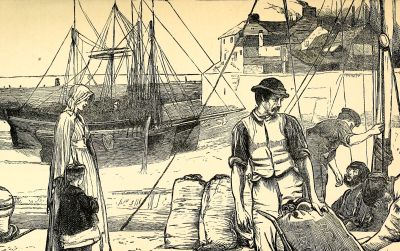
"THOMAS WORKED AS HARD AS ANY OF THEM."
Among the men was one whom he liked more than the rest. He had been in the merchant service, and had sailed to India and other places. He knew more than his shipmates, and had only taken to the coasting for a time for family reasons. With him Thomas chiefly consorted when their day's work was over. With a growing hope that by some means he might rise at last into another kind of company, he made the best he could of what he had, knowing well that it was far better than he deserved, and far better than what of late he had been voluntarily choosing. His hope, however, alternated with such fits of misery and despair, that if it had not been for the bodily work he had to do, he thought he would have lost his reason. I believe not a few keep hold of their senses in virtue of doing hard work. I knew an earl's son, an heir, who did so. And I think that not a few, especially women, lose their senses just from having nothing to do. Many more, who are not in danger of this, lose their health, and more still lose their purity and rectitude. In other words, health—physical, mental, moral, and spiritual—requires, for its existence and continuance, work, often hard and bodily labor.
This man lived in Newcastle, and got Thomas a decent room near his own dwelling, where he slept. One evening they had been walking together about the place till they were tired. It was growing late, and as they were some distance from home, they went into a little public house which Robins knew, to get a bit of bread and cheese and some ale. Robins was a very sober man, and Thomas felt no scruple in accompanying him thus, although one of the best things to be said for Thomas was, that ever since he went on board the Raven he had steadily refused to touch spirits. Perhaps, as I have hinted before, there was less merit in this than may appear, for the very smell was associated with such painful memories of misery that it made him shudder. Sometimes a man's physical nature comes in to help him to be good. For such a dislike may grow into a principle which will last after the dislike has vanished.
They sat down in a little room with colored prints of ships in full sail upon the walls, a sanded floor, in the once new fashion which superseded rushes, and an ostrich egg hanging from the ceiling. The landlady was a friend of Robins, and showed them this attention. On the other side of a thin partition was the ordinary room, where the ordinary run of customers sat and drank their grog. There were only two or three in there when our party entered. Presently, while Thomas and Robins were sitting at their supper, they heard two or three more come in. A hearty recognition took place, and fresh orders were given. Thomas started and listened. He thought he heard the name Ningpo.
Now, from Thomas's having so suddenly broken off all connection with his friends, he knew nothing of what had been going on with regard to the property Mr. Boxall had left behind him. He thought, of course, that Mrs. Boxall would inherit it. It would not be fair to suppose, however, that this added to his regret at having lost Lucy, for he was humbled enough to be past that. The man who is turned out of Paradise does not grieve over the loss of its tulips, or, if he does, how came he ever to be within its gates? But the very fact that the name of Boxall was painful to him, made the name of that vessel attract and startle him at once.
"What's the matter?" said Robins.
"Didn't you hear some one in the next room mention the Ningpo?" returned Thomas.
"Yes. She was a bark in the China trade."
"Lost last summer on the Cape Verdes. I knew the captain—at least, I didn't know him, but I knew his brother and his family. They were all on board and all lost."
"Ah!" said Robins, "that's the way of it, you see. People oughtn't to go to sea but them as has business there. Did you say the crew was lost as well?"
"So the papers said."
Robins rose, and went into the next room. He had a suspicion that he knew the voice. Almost the same moment a rough burst of greeting came to Thomas's ears: and a few minutes after, Robins entered, bringing with him a sailor so rough, so hairy, so brown, that he looked as if he must be proof against any attack of the elements—case-hardened against wind and water.
"Here's the gentleman," said Robins, "as knew your captain, Jack."
"Do, sir?" said Jack, touching an imaginary sou'wester.
"What'll you have?" asked Tom.
This important point settled, they had a talk together, in which Jack opened up more freely in the presence of Robins than he would have felt interest enough to do with a stranger alone who was only a would-be sailor at best—a fact which could not be kept a secret from an eye used to read all sorts of signals. I will not attempt to give the story in Jack's lingo. But the certainty was that he had been on board the Ningpo when she went to pieces—that he had got ashore on a spar, after sitting through the night on the stern, and seeing every soul lost, as far as he believed, but himself. He had no great power of description, and did not volunteer much; but he returned very direct answers to all the questions Thomas put to him. Had Thomas only read some of the proceedings in the Court of Probate during the last few months, he would have known better what sort of questions to put to him. Almost the only remark Jack volunteered was:
"Poor little July! how she did stick to me, to be sure! But she was as dead as a marlin-spike long afore the starn broke up."
"Were you long on the island?" asked Tom.
"No, not long," answered the sailor. "I always was one of the lucky ones. I was picked up the same day by a brigantine bound from Portingale to the Sambusy."
Little did Tom think how much might be involved in what Jack said. They parted, and the friends went home together. They made a good voyage, notwithstanding some rough weather, to Dundee, failed in getting a return cargo, and went back to Newcastle in ballast. From Newcastle their next voyage was to London again.
"If you would rather not go to London," said the master to Tom, "there's a friend of mine here who is just ready to start for Aberdeen. I dare say if I were to speak to him he would take you on board."
But Tom's heart was burning to see Lucy once more—if only to see her and restore her ring. If, he thought, he might but once humble himself to the dust before her—if he might but let her see that, worthless as he was, he worshiped her, his heart would be easier. He thought, likewise, that what with razoring and tanning, and the change of his clothes, he was not likely to be recognized. And besides, by this time the power must be out of Mr. Stopper's hands; at least Lucy must have come to exert her influence over the affairs of the business, and she would not allow them to drive things to extremity with him, worthless as he was. He would venture, come of it what might. So he told the captain that he would much prefer to work his passage to London again. It was a long passage this time, and very rough weather.
It was with strange feelings that Thomas saw once more the turrets of the Tower of London. Danger—exposure, it might be—lay before him, but he thought only of Lucy, not of the shame now. It was yet early morning when Captain Smith and he went on shore at Shadwell. The captain was going to see an old friend in the neighborhood, and after that to Limehouse, to the Mermaid, to see his sister. Thomas wanted to be alone, for he had not yet succeeded in making up his mind what he was going to do. So he sent a grateful message by the captain, with the addition that he would look in upon them in the evening.
Left alone, without immediate end or aim, he wandered on, not caring whither he went, but, notwithstanding his heavy thoughts, with something of the enjoyment the sailor feels in getting on shore even after only a fortnight at sea. It was a bright, cold, frosty morning, in the month of March. Without knowing his course, Thomas was wandering northward; and after he had gone into a coffee-shop and had some breakfast, he carelessly resumed his course in the same direction. He found that he was in the Cambridge Road, but whither that led he had no idea. Nor did he know, so absorbed was he in his own thoughts, even after he came into a region he knew, till, lifting up his head, he saw the gray, time-worn tower, that looks so strong and is so shaky, of the old church of Hackney, now solitary, its ancient nave and chancel and all having vanished, leaving it to follow at its leisure, wearied out with disgust at the church which has taken its place, and is probably the ugliest building in Christendom, except the parish-church of a certain little town in the north of Aberdeenshire. This sent a strange pang to his heart, for close by, that family used to live whose bones were now whitening among those rocky islands of the Atlantic. He went into the church-yard, sat down on a grave-stone, and thought. Now that the fiction of his own worth had vanished like an image in the clouds of yesterday, he was able to see clearly into his past life and conduct; and he could not conceal from himself that his behavior to Mary Boxall might have had something to do with the loss of the whole family. He saw more and more the mischief that had come of his own weakness, lack of courage, and principle. If he could but have defended his own conduct where it was blameless, or at least allowed it to be open to the daylight and the anger of those whom it might not please, he would thus have furnished his own steps with a strong barrier against sliding down that slope down which he had first slidden before falling headlong from the precipice at its foot. In self-abasement he rose from the grave-stone, and walked slowly past the house. Merry faces of children looked from upper windows, who knew nothing of those who had been there before them. Then he went away westward toward Highbury. He would just pass his father's door. There was no fear of his father seeing him at this time of the day, for he would be at his office, and his mother could not leave her room. Ah, his mother! How had he behaved to her? A new torrent of self-reproach rushed over his soul as he walked along the downs toward Islington. Some day, if he could only do something first to distinguish himself in any way, he would go and beg her forgiveness. But what chance was there of his ever doing any thing now? He had cut all the ground of action from under his own feet. Not yet did Thomas see that his duty was to confess his sin, waiting for no means of covering its enormity. He walked on. He passed the door, casting but a cursory glance across the windows. There was no one to be seen. He went down the long walk with the lime-trees on one side, which he knew so well, and just as he reached the gates there were his sister Amy and Mr. Simon coming from the other side. They were talking and laughing merrily, and looking in each others face. He had never seen Mr. Simon look so pleasant before. He almost felt as if he could speak to him. But no sooner did Mr. Simon see that this sailor-looking fellow was regarding them, than the clerical mask was on his face, and Thomas turned away with involuntary dislike.
"It is clear," he said to himself, "that they don't care much what is become of me." He turned then, westward again, toward Highgate, and then went over to Hampstead, paused at the pines, and looked along the valley beneath; then descended into it, and went across the heath till he came out on the road by Wildwood. This was nearly the way he had wandered on that stormy Christmas Day with Mary Boxall. He had this day, almost without conscious choice, traversed the scenes of his former folly. Had he not been brooding repentantly over his faults, I doubt if he could have done so, even unconsciously. He turned into the Bull and Bush, and had some dinner; then, as night was falling, started for London, having made up his mind at last what he would do. At the Bull and Bush he wrote a note to Lucy, to the following effect. He did not dare to call her by her name, still less to use any term of endearment.
"I am not worthy to speak or write your name," he said; "but my heart is dying to see you once more. I have likewise to return you your mother's ring, which, though it has comforted me often in my despair, I have no longer any right to retain. But I should just like to tell you that I am working honestly for my bread. I am a sailor now. I am quite clear of all my bad companions, and hope to remain so. Dare I ask you to meet me once—to-morrow night, say, or any night soon, for I am not safe in London? I will tell you all when I see you. Send me one line by the bearer of this to say where you will meet me. Do not, for the sake of your love to me once, refuse me this. I want to beg your forgiveness, that I may go away less miserable than I am. Then I will go to Australia, or somewhere out of the country, and you will never hear of me more. God bless you."
He cried a good deal over this note. Then came the question how he was to send it. He could, no doubt, find a messenger at the Mermaid, but he was very unwilling to make any line of communication between that part of London and Guild Court, or, more properly, to connect himself, whose story was there known, with Lucy's name. He would go to the neighborhood of Guild Court and there look out for a messenger, whom he could then watch.
CHAPTER XLV.
THOMAS IS CAPTURED.
As soon as he had resolved upon this he set out. There was plenty of time. He would walk. Tired as he was beginning to be, motion was his only solace. He walked through Hampstead, and by Haverstock Hill, Tottenham Court Road, and Holborn to the City. By this time the moon was up. Going by Ludgate Hill, he saw her shining over St. Paul's right through the spire of St. Martin's, where the little circle of pillars lays it open to the sky and the wind; she seemed to have melted the spire in two. Then he turned off to the left, now looking out for a messenger. In his mind he chose and rejected several, dallying with his own eagerness, and yielding to one doubt after another about each in succession. At last he reached the farther end of Bagot Street. There stood Poppie with her "murphy-buster." Had it been daylight, when her dress and growth would have had due effect upon her appearance, probably Thomas would not have known her; but seeing her face only by the street-lamp, he just recollected that he had seen the girl about Guild Court. He had no suspicion that she would know him. But Poppie was as sharp as a needle; she did know him.
"Do you know Guild Court, my girl?" he asked.
"I believe you," answered Poppie.
"Would you take this letter for me, and give it to Miss Burton, who lives there, and wait for an answer? If she's not at home, bring it back to me. I will take care of your potatoes, and give you a shilling when you come back."
Whether Poppie would have accepted the office if she had not recognized Thomas, I do not know. She might, for she had so often forsaken her machine and found it all right when she returned that I think the promise of the shilling would have enabled her to run the risk. As it was, she scudded. While she was gone he sold three or four of her potatoes. He knew how to deliver them; but he didn't know the price, and just took what they gave him. He stood trembling with hope.
Suddenly he was seized by the arm from behind, and a gruff voice he thought he knew, said:
"Here he is. Come along, Mr. Worboise. You're wanted."
Thomas had turned in great alarm. There were four men, he saw, but they were not policemen. That was a comfort. Two of them were little men. None of them spoke but the one who seized him. He twisted his arm from the man's grasp, and was just throwing his fist at his head, when he was pinioned by two arms thrown round him from behind.
"Don't strike," said the first man, "or it'll be the worse for you. I'll call the police. Come along, and I swear nothing but good will come of it—to you as well as to other people. I'm not the man to get you into trouble, I can tell you. Don't you know me?—Kitely, the bookseller. Come along. I've been in a fix myself before now."
Thomas yielded, and they led him away.
"But there's that child's potatoes!" he said. "The whole affair will be stolen. Just wait till she comes back."
"Oh! she's all right," said Kitely. "There she is, buttering a ha'p'orth. Come along."
They led him through streets and lanes, every one of which Thomas knew better than his catechism a good deal. All at once they hustled him in at a church door. In the vestibule Thomas saw that there were but two with him—Mr. Kitely, whom he now recognized, and a little man with his hair standing erect over his pale face, like corn on the top of a chalk-cliff. Him too he recognized, for Mr. Spelt had done many repairs for him. The other two had disappeared. Neither Mr. Salter nor Mr. Dolman cared to tempt Providence by coming farther. It was Jim who had secured his arms, and saved Kitely's head. Mr. Kitely made way for Thomas to enter first. Fearful of any commotion, he yielded still, and went into a pew near the door. The two men followed him. It is time I should account for the whole of this strange proceeding.
Jim Salter did not fail to revisit the Mermaid on the day of Tom's departure, but he was rather late, and Tom was gone. As to what had become of him, Mr. Potts thought it more prudent to profess ignorance. He likewise took another procedure upon him, which, although well-meant, was not honest. Regardless of Thomas's desire that Jim should have a half-sovereign for the trouble of the preceding day, Mr. Potts, weighing the value of Jim's time, and the obligation he was himself under to Tom, resolved to take Tom's interests in his own hands, and therefore very solemnly handed a half-crown and a florin, as what Thomas had left for him, across the counter to Jim. Jim took the amount in severe dudgeon. The odd sixpence was especially obnoxious. It was grievous to his soul.
"Four and sixpence! Four bob and one tanner," said Jim, in a tone of injury, in which there certainly was no pretense—"after a-riskin' of my life, not to mention a-wastin' of my precious time for the ungrateful young snob. Four and sixpence!"
Mr. Potts told him with equal solemnity, a righteous indignation looking over the top of his red nose, to hold his jaw, or go out of his tavern. Whereupon Jim gave a final snuff, and was silent, for where there was so much liquor on the premises it was prudent not to anger the Mermaid's master. Thereupon the said master, probably to ease his own conscience Jim-ward, handed him a glass of old Tom, which Jim, not without suspicion of false play, emptied and deposited. From that day, although he continued to call occasionally at the Mermaid, he lost all interest in his late client, never referred to him, and always talked of Bessy Potts as if he himself had taken her out of the water.
The acquaintance between Dolman and him began about this time to grow a little more intimate; and after the meeting which I have described above, they met pretty frequently, when Mr. Dolman communicated to him such little facts as transpired about "them lawyers," namely, Mr. Worboise's proceedings. Among the rest was the suspicious disappearance of the son, whom Mr. Dolman knew, not to speak to, but by sight, as well as his own lap-stone. Mr. Salter, already suspicious of his man, requested a description of the missing youth, and concluded that it was the same in whom he had been so grievously disappointed, for the odd sixpence represented any conceivable amount of meanness, not to say wickedness. This increased intimacy with Jim did Dolman no good, and although he would not yet forsake his work during work-hours, he would occasionally permit Jim to fetch a jug of beer from a neighboring tavern, and consume it with him in his shop. On these occasions they had to use great circumspection with regard to Dolly's landlord, who sat over his head. But in the winter nights, Mr. Spelt would put up the outside shutter over his window to keep the cold out, only occasionally opening his door to let a little air in. This made it possible to get the beer introduced below without discovery, when Dolman, snail-like, closed the mouth of his shell also, in which there was barely room for two, and stitched away while Jim did the chief part of the drinking and talking—in an undertone—for him—not so low, however, but that Spelt could hear not a little that set him thinking. It was pretty clear that young Worboise was afraid to show himself, and this and other points he communicated to his friend Kitely. This same evening they were together thus when they heard a hurried step come up and stop before the window, and the voice of Mr. Kitely, well known to Dolman, call to the tailor overhead.
"Spelt, I say. Spelt!"
Mr. Spelt looked out at his door.
"Yes, Mr. Kitely. What's the matter?"
"Here's that young devil's lamb, Worboise, been and sent a letter to Miss Burton by your Poppie, and he's a-waitin' an answer. Come along, and we'll take him alive."
"But what do you want to do with him?" asked Spelt.
"Take him to Mr. Fuller."
"But what if he won't come?"
"We can threaten him with the police, as if we knew all about it. Come along, there's no time to be lost."
"But what would you take him to Mr. Fuller for?"
My reader may well be inclined to ask the same question. I will explain. Mr. Kitely was an original man in thinking, and a rarely practical man in following it up, for he had confidence in his own conclusions. Ever since he had made the acquaintance of Mr. Fuller, through Mattie's illness, he had been feeling his influence more and more, and was gradually reforming his ways in many little things that no one knew of but himself. No one in London knew him as any thing but an honest man, but I presume there are few men so honest that if they were to set about it seriously, they could not be honester still. I suspect that the most honest man of my acquaintance will be the readiest to acknowledge this; for honesty has wonderful offshoots from its great tap-root. Having this experience in himself, he had faith in the moral power of Mr. Fuller. Again, since Lucy had come to live in the house, he had grown to admire her yet more, and the attention and kindness she continued to show to his princess, caused an equal growth in his gratitude. Hence it became more and more monstrous in his eyes that she should be deprived of her rights in such a villainous manner by the wickedness of "them Worboises." For the elder, he was afraid that he was beyond redemption; but if he could get hold of the younger, and put him under Mr. Fuller's pump, for that was how he represented the possible process of cleansing to himself, something might come of it. He did not know that Thomas was entirely ignorant of his father's relation to the property of the late Richard Boxall, and that no man in London would have less influence with Worboise, senior, than Worboise, junior. He had had several communications with Mr. Fuller on the subject, and had told him all he knew. Mr. Fuller likewise had made out that this must be the same young man of whom Lucy had spoken in such trouble. But as he had disappeared, nothing could be done—even if he had had the same hope of good results from the interview as Mr. Kitely, whose simplicity and eagerness amused as well as pleased him. When Mr. Kitely, therefore, received from Poppie Thomas's letter to give to Lucy, who happened to be out, he sped at once, with his natural promptitude, to secure Mr. Spelt's assistance in carrying out his conspiracy against Thomas.
As soon as the two below heard Mr. Spelt scramble down and depart with Mr. Kitely, they issued from their station; Mr. Dolman anxious to assist in the capture, Mr. Salter wishing to enjoy his disgrace, for the odd sixpence rankled. As soon as they saw him within the inner door of the church they turned and departed. They knew nothing about churches, and were unwilling to enter. They did not know what they might be in for, if they went in. Neither had they any idea for what object Thomas was taken there. Dolman went away with some vague notion about the Ecclesiastical Court; for he tried to read the papers sometimes. This notion he imparted with equal vagueness to the brain of Jim Salter, already muddled with the beer he had drunk. Dolman went back to his work, hoping to hear about it when Spelt came home. Jim wandered eastward to convey a somewhat incorrect idea of what had happened to the inhabitants of the Mermaid. Having his usual design on the Mermaid's resources, his story lost nothing in the telling, and, in great perplexity, and greater uneasiness, Captain Smith and Mr. Potts started to find out the truth of the matter. Jim conducted them to the church door, which was still open, and retired round the corner.
Meantime the captors and the culprit waited till the service was over. As soon as Mr. Fuller had retired to the vestry, and the congregation had dispersed, Mr. Kitely intimated to Thomas that he must follow him, and led the way up the church. With the fear of the police still before his eyes, Thomas did follow, and the little tailor brought up the rear. Hardly waiting, in his impatience, to knock at the door, Mr. Kitely popped his head in as Mr. Fuller was standing in his shirt-sleeves, and said with ill-suppressed triumph:
"Here he is, sir! I've got him!"
"Whom do you mean?" said Mr. Fuller, arrested by surprise with one arm in his coat and the other hand searching for the other sleeve.
"Young Worboise. The lawyer-chap, you know sir," he added, seeing that the name conveyed no idea.
"Oh!" said Mr. Fuller, prolongedly. "Show him in, then." And on went his coat.
Thomas entered, staring in bewilderment. Nor was Mr. Fuller quite at his ease at first, when the handsome, brown sailor-lad stepped into the vestry. But he shook hands with him, and asked him to take a chair. Thomas obeyed. Seeing his conductors lingered, Mr. Fuller then said:
"You must leave us alone now, Mr. Kitely. How do you do, Mr. Spelt?"
They retired, and, after a short consultation together in the church, agreed that they had done their part and could do no more, and went home.
CHAPTER XLVI.
THE CONFESSION.
As soon as the door closed behind them, Mr. Fuller turned to Tom, saying, as he took a chair near him, "I'm very glad to see you, Mr. Worboise. I have long wanted to have a little talk with you."
"Will you tell me," said Tom, with considerable uneasiness, notwithstanding the pacific appearance of everything about him, "why those people have made me come to you? I was afraid of making a row in the street, and so I thought it better to give in. But I have not an idea why I am here."
Mr. Fuller thought there must be some farther reason, else a young man of Thomas's appearance would not have so quietly yielded to the will of two men like Kitely and Spelt. But he kept this conclusion to himself.
"It certainly was a most unwarrantable proceeding if they used any compulsion. But I have no intention of using any—nor should I have much chance," he added, laughing, "if it came to a tussle with a young fellow like you, Mr. Worboise."
This answer restored Tom to his equanimity a little.
"Perhaps you know my father," he said, finding that Mr. Fuller was silent. In fact, Mr. Fuller was quite puzzled how to proceed. He cared little for the business part, and for the other, he must not compromise Lucy. Clearly the lawyer-business was the only beginning. Ana this question of Tom's helped him to it.
"I have not the pleasure of knowing your father. I wish I had. But, after all, it is better I should have a chat with you first."
"Most willingly," said Tom, with courtesy.
"It is a very unconventional thing I am about to do. But very likely you will give me such information as will enable me to set the minds of some of my friends at rest. I am perfectly aware what a lame introduction this is, and I must make a foolish figure indeed, except you will kindly understand that sometimes a clergyman is compelled to meddle with matters which he would gladly leave alone."
"I have too much need of forbearance myself not to grant it, sir—although I do not believe any will be necessary in your case. Pray make me understand you."
Mr. Fuller was greatly pleased with this answer, and proceeded to business at once.
"I am told by a man who is greatly interested in one of the parties concerned, that a certain near relative of yours is in possession of a large property which ought by right, if not by law, to belong to an old lady who is otherwise destitute. I wish to employ your mediation to procure a settlement upon her of such small portion of the property at least as will make her independent. I am certainly explicit enough, now," concluded Mr. Fuller, with a considerable feeling of relief in having discharged himself, if not of his duty, yet of so creditable a beginning of it.
"I am as much in the dark as ever, sir," returned Thomas. "I know nothing of what you refer to. If you mean my father, I am the last one to know anything of his affairs. I have not seen him or heard of him for months."
"But you cannot surely be ignorant of the case. It has been reported in the public prints from time to time. It seems that your father has come in for the contingent reversion—I think that is the phrase, I'm not sure—of all the property of the late Richard Boxall—"
"By Jove!" cried Thomas, starting to his feet in a rage, then sinking back on his chair in conscious helplessness. "He did make his will," he muttered.
"Leaving," Mr. Fuller went on, "the testator's mother and his niece utterly unprovided for."
"But she had money of her own in the business. I have heard her say so a thousand times."
"She has nothing now."
"My father is a villain!" cried Thomas, starting once more to his feet, and pacing up and down in the little vestry like a wild beast in a cage. "And what am I?" he added, after a pause. "I have brought all this upon her." He could say no more. He sat down, hid his face in his hands, and sobbed.
Thomas was so far mistaken in this, that his father, after things had gone so far as they had, would have done as he had done, whatever had been Thomas's relations to the lady. But certainly, if he had behaved as he ought, things could not have gone thus far. He was the cause of all the trouble.
Nothing could have been more to Mr. Fuller's mind.
"As to Miss Burton," he said, "I happen to know that she has another grief, much too great to allow her to think about money. A clergyman, you know, comes to hear of many things. She never told me who he was," said Mr. Fuller, with hesitation; "but she confessed to me that she was in great trouble."
"Oh, sir, what shall I do?" cried Thomas; "I love her with all my heart, but I can never, never dare to think of her more. I came up to London at the risk of—of—I came up to London only to see her and give her back this ring, and beg her to forgive me, and go away forever. And now I have not only given her pain—"
"Pain!" said Mr. Puller. "If she weren't so good, her heart would have broken before now."
Thomas burst out sobbing again. He turned his face away from Mr. Puller and stood by the wall, shaken with misery. Mr. Puller left him alone for a minute or two. Then, going up to him, he put his hand on his shoulder, kindly, and said:
"My dear boy, I suspect you have got into some terrible scrape, or you would not have disappeared as they tell me. And your behavior seems to confirm the suspicion. Tell me all about it, and I have very little doubt that I can help you out of it. But you must tell me everything."
"I will, sir; I will," Tom sobbed.
"Mind, no half-confessions. I have no right to ask you to confess but on the ground of helping you. But if I am to help you, I must know all. Can I trust you that you will be quite straightforward and make a clean breast of it?"
Tom turned round, and looked Mr. Fuller calmly in the face. The light of hope shone in his eyes: the very offer of hearing all his sin and misery gave him hope. To tell it, would be to get rid of some of the wretchedness.
"I hate myself so, sir," he said, "that I do not feel it worth while to hide anything. I will speak the truth. When you wish to know more than I tell, ask me any questions you please, and I will answer them."
At this moment a tap was heard at the vestry door, and it opened, revealing two strange figures with scared, interrogating faces on the top—the burly form of Captain Smith, and the almost as bulky, though differently arranged, form of Mr. Potts.
"Don't'ee be too hard on the young gentleman, sir," said Mr. Potts, in the soothing tone of one who would patch up a family quarrel. "He won't do it again, I'll go bail. You don't know, sir, what a good sort he is. Don't'ee get him into no trouble. He lost his life—all but—a reskewing of my Bessie. He did now. True as the Bible, sir," added Mr. Potts, with conciliatory flattery to the clergyman's profession, whom they both took for the father or uncle of Thomas.
"You just let me take him off again, sir," put in Captain Smith, while the face of Mr. Potts, having recovered its usual complexion, looked on approvingly like a comic but benevolent moon.
Mr. Fuller had a wise way of never interrupting till he saw in what direction the sense lay. So he let them talk, and the seaman went on:
"Everybody knows the sea's the place for curing the likes o' them fine fellows that carries too much sail ashore. They soon learns their reef-points there. Why, parson, sir, he's been but three or four voyages, and I'll take him for an able-bodied seaman to-morrow. He's a right good sort, though he may ha' been a little frolicsome on shore. We was all young once, sir."
"Are these men friends of yours, Mr. Worboise?" asked Mr. Fuller.
"Indeed they are," answered Thomas. "I think I must have killed myself before now, if it hadn't been for those two."
So saying, he shook hands with Mr. Potts, and, turning to the captain, said:
"Thank you, thank you, captain, but I am quite safe with this gentleman. I will come and see you to-morrow."
"He shall sleep at my house to-night," said Mr. Fuller; "and no harm shall happen to him, I promise you."
"Thank you, sir;" and "Good-night, gentlemen," said both, and went through the silent, wide church with a kind of awe that rarely visited either of them.
Without further preface than just the words, "Now, I will tell you all about it, sir," Thomas began his story. When he had finished it, having answered the few questions he put to him in its course, Mr. Fuller was satisfied that he did know all about it, and that if ever there was a case in which he ought to give all the help he could, here was one. He did not utter a word of reproof. Thomas's condition of mind was such that it was not only unnecessary, but might have done harm. He had now only to be met with the same simplicity which he had himself shown. The help must match the confession.
"Well, we must get you out of this scrape, somehow," he said, heartily.
"I don't see how you can, sir."
"It rests with yourself chiefly. Another can only help. The feet that walked into the mire must turn and walk out of it again. I don't mean to reproach you—only to encourage you to effort."
"What effort?" said Tom. "I have scarcely heart for anything. I have disgraced myself forever. Suppose all the consequences of my—doing as I did"—he could not yet call the deed by its name—"were to disappear, I have a blot upon me to all eternity, that nothing can wash out. For there is the fact. I almost think it is not worth while to do anything."
"You are altogether wrong about that," returned Mr. Fuller. "It is true that the deed is done, and that that cannot be obliterated. But a living soul may outgrow all stain and all reproach—I do not mean in the judgment of men merely, but in the judgment of God, which is always founded on the actual fact, and always calls things by their right names, and covers no man's sin, although he forgives it and takes it away. A man may abjure his sin so, cast it away from him so utterly, with pure heart and full intent, that, although he did it, it is his no longer. But, Thomas Worboise, if the stain of it were to cleave to you to all eternity, that would be infinitely better than that you should have continued capable of doing the thing. You are more honorable now than you were before. Then you were capable of the crime; now, I trust, you are not. It was far better that, seeing your character was such that you could do it, you should thus be humbled by disgracing yourself, than that you should have gone on holding up a proud head in the world, with such a deceitful hollow of weakness in your heart. It is the kindest thing God can do for his children, sometimes, to let them fall in the mire. You would not hold by your Father's hand; you struggled to pull it away; he let it go, and there you lay. Now that you stretch forth the hand to him again, he will take you, and clean, not your garments only, but your heart, and soul, and consciousness. Pray to your Father, my boy. He will change your humiliation into humility, your shame into purity."
"Oh, if he were called anything else than Father! I am afraid I hate my father."
"I don't wonder. But that is your own fault, too."
"How is that, sir? Surely you are making even me out worse than I am."
"No. You are afraid of him. As soon as you have ceased to be afraid of him, you will no longer be in danger of hating him."
"I can't help being afraid of him."
"You must break the bonds of that slavery. No slave can be God's servant. His servants are all free men. But we will come to that presently. You must not try to call God your Father, till father means something very different to you from what it seems to mean now. Think of the grandest human being you can imagine—the tenderest, the most gracious whose severity is boundless, but hurts himself most—all against, evil, all for the evil-doer. God is all that and infinitely more. You need not call him by any name till the name bursts from your heart. God our Saviour means all the names in the world, and infinitely more! One thing I can assure you of, that even I, if you will but do your duty in regard to this thing, will not only love—yes, I will say that word—will not only love, but honor you far more than if I had known you only as a respectable youth. It is harder to turn back than to keep at home. I doubt if there could be such joy in heaven over the repenting sinner if he was never to be free of his disgrace. But I like you the better for having the feeling of eternal disgrace now."
"I will think God is like you, sir. Tell me what I am to do."
"I am going to set you the hardest of tasks, one after the other. They will be like the pinch of death. But they must be done. And after that—peace. Who is at the head of the late Mr. Boxall's business now?"
"I suppose Mr. Stopper. He was head-clerk."
"You must go to him and take him the money you stole."
Thomas turned ashy pale.
"I haven't got it, sir."
"How much was it, did you say?"
"Eleven pounds—nearly twelve."
"I will find you the money. I will lend it to you."
"Thank you, thank you, sir. I will not spend a penny I can help till I repay you. But—"
"Yes, now come the buts," said Mr. Fuller, with a smile of kindness. "What is the first but?"
"Stopper is a hard man, and never liked me. He will give me up to the law."
"I can't help it. It must be done. But I do not believe he will do that. I will help you so far as to promise you to do all that lies in my power in every way to prevent it. And there is your father; his word will be law with him now."
"So much the worse, sir. He is ten times as hard as Stopper."
"He will not be willing to disgrace his own family, though."
"I know what he will do. He will make it a condition that I shall give up Lucy. But I will go to prison before I will do that. Not that it will make any difference in the end, for Lucy won't have a word to say to me now. She bore all that woman could bear. But she shall give me up—she has given me up, of course; but I will never give her up that way."
"That's right, my boy. Well, what do you say to it?"
Tom was struggling with himself. With a sudden resolve, the source of which he could not tell, he said, "I will, sir." With a new light in his face he added, "What next?"
"Then you must go to your father."
"That is far worse. I am afraid I can't."
"You must—if you should not find a word to say when you go—if you should fall in a faint on the floor when you try."
"I will, sir. Am I to tell him everything?"
"I am not prepared to say that. If he had been a true father to you, I should have said 'Of course.' But there is no denying the fact that such he has not been, or rather, that such he is not. The point lies there. I think that alters the affair. It is one thing to confess to God and another to the devil. Excuse me, I only put the extremes."
"What ought I to tell him, then?"
"I think you will know that best when you see him. We cannot tell how much he knows."
"Yes," said Thomas, thoughtfully; "I will tell him that I am sorry I went away as I did, and ask him to forgive me. Will that do?"
"I must leave all that to your own conscience, heart, and honesty. Of course, if he receives you at all, you must try what you can do for Mrs. Boxall."
"Alas! I know too well how useless that will be. It will only enrage him the more at them. He may offer to put it all right, though, if I promise to give Lucy up. Must I do that, sir?"
Knowing more about Lucy's feelings than Thomas, Mr. Fuller answered at once—though if he had hesitated, he might have discovered ground for hesitating—
"On no account whatever."
"And what must I do next?" he asked, more cheerfully.
"There's your mother."
"Ah! you needn't remind me of her."
"Then you must not forget Miss Burton. You have some apology to make to her too, I suppose."
"I had just sent her a note, asking her to meet me once more, and was waiting for her answer, when the bookseller laid hold of me. I was so afraid of making a row, lest the police should come, that I gave in to him. I owe him more than ever I can repay."
"You will when you have done all you have undertaken."
"But how am I to see Lucy now? She will not know where I am. But perhaps she will not want to see me."
Here Tom looked very miserable again. Anxious to give him courage, Mr. Fuller said:
"Come home with me now. In the morning, after you have seen Mr. Stopper, and your father and mother, come back to my house. I am sure she will see you."
With more thanks in his heart than on his tongue, Tom followed Mr. Fuller from the church. When they stepped into the street, they found the bookseller, the seaman, and the publican, talking together on the pavement.
"It's all right," said Mr. Fuller, as he passed them. "Good-night." Then, turning again to Mr. Kitely, he added, in a low voice, "He knows nothing of his father's behavior, Kitely. You'll be glad to hear that."
"I ought to be glad to hear it for his own sake, I suppose," returned the bookseller. "But I don't know as I am, for all that."
"Have patience, have patience," said the parson, and walked on, taking Thomas by the arm.
For the rest of the evening Mr. Fuller avoided much talk with the penitent, and sent him to bed early.
CHAPTER XLVII.
THOMAS AND MR. STOPPER.
Thomas did not sleep much that night, and was up betimes in the morning. Mr. Fuller had risen before him, however, and when Thomas went down stairs, after an invigorating cold bath which his host had taken special care should be provided for him, along with clean linen, he found him in his study reading. He received him very heartily, looking him, with some anxiety, in the face, as if to see whether he could read action there. Apparently he was encouraged, for his own face brightened up, and they were soon talking together earnestly. But knowing Mr. Stopper's habit of being first at the counting-house, Thomas was anxious about the time, and Mr. Fuller hastened breakfast. That and prayers over, he put twelve pounds into Thomas's hand, which he had been out that morning already to borrow from a friend. Then, with a quaking heart, but determined will, Thomas set out and walked straight to Bagot Street. Finding no one there but the man sweeping out the place, he went a little farther, and there was the bookseller arranging his stall outside the window. Mr. Kitely regarded him with doubtful eyes, vouchsafing him a "good-morning" of the gruffest.
"Mr. Kitely," said Thomas, "I am more obliged to you than I can tell, for what you did last night."
"Perhaps you ought to be; but it wasn't for your sake, Mr. Worboise, that I did it."
"I am quite aware of that. Still, if you will allow me to say so, I am as much obliged to you as if it had been."
Mr. Kitely grumbled something, for he was not prepared to be friendly.
"Will you let me wait in your shop till Mr. Stopper comes?"
"There he is."
Thomas's heart beat fast; but he delayed only to give Mr. Stopper time to enter the more retired part of the counting-house. Then he hurried to the door and went in.
Mr. Stopper was standing with his back to the glass partition, and took the entrance for that of one of his clerks. Thomas tapped at the glass door, but not till he had opened it and said "Mr. Stopper," did he take any notice. He started then, and turned; but, having regarded him for a moment, gave a rather constrained smile, and, to his surprise, held out his hand.
"It is very good of you to speak to me at all, Mr. Stopper," said Thomas, touched with gratitude already. "I don't deserve it."
"Well, I must say you behaved rather strangely, to say the least, of it. It might have been a serious thing for you, Mr. Thomas, if I hadn't been more friendly than you would have given me credit for. Look here."
And he showed him the sum of eleven pounds thirteen shillings and eightpence halfpenny put down to Mr. Stopper's debit in the petty cash-book.
"You understand that, I presume, Mr. Thomas. You ran the risk of transportation there."
"I know I did, Mr. Stopper. But just listen to me a moment, and you will be able to forgive me, I think. I had been drinking, and gambling, and losing all night; and I believe I was really drunk when I did that. Not that I didn't know I was doing wrong. I can't say that. And I know it doesn't clear me at all, but I want to tell you the truth of it. I've been wretched ever since, and daren't show myself. I have been bitterly punished. I haven't touched cards or dice since. Here's the money," he concluded, offering the notes and gold.
Mr. Stopper did not heed the action at first. He was regarding Thomas rather curiously. Thomas perceived it.
"Yes," Thomas said, "I am a sailor. It's an honest way of living, and I like it."
"But you'll come back now, won't you?"
"That depends," answered Thomas. "Would you take me, now, Mr. Stopper?" he added, with a feeble experimental smile. "But there's the money. Do take it out of my hands."
"It lies with your father now, Mr. Thomas. Have you been to Highbury? Of course, I took care not to let him know."
"Thank you heartily. I'm just going there. Do take the horrid money, and let me feel as if I weren't a thief after all."
"As for the money, eleven pound, odd," said Mr. Stopper, without looking at it, "that's neither here nor there. It was a burglary, there can be no doubt, under the circumstances. But I owe you a quarter's salary, though I should not be bound to pay it, seeing you left as you did. Still, I want to be friendly, and you worked very fairly for it. I will hand you over the difference."
"No, never mind that, I don't care about the money. It was all that damned play," said Thomas.
"Don't swear, Mr. Thomas," returned Stopper, taking out the check-book, and proceeding to write a check for thirteen pounds six shillings and fourpence.
"If you had suffered as much from it as I have, Mr. Stopper, you would see no harm in damning it."
Mr. Stopper made no reply, but handed him the check, with the words:
"Now we're clear, Mr. Thomas. But don't do it again. It won't pass twice. I've saved you this time."
"Do it again!" cried Thomas, seizing Mr. Stopper's hand; "I would sooner cut my own throat. Thank you, thank you a thousand times, Mr. Stopper," he added, his heart brimful at this beginning of his day of horror.
Mr. Stopper very coolly withdrew his hand, turned round on his stool, replaced his check-book in the drawer, and proceeded to arrange his writing materials, as if nobody were there but himself. He knew well enough that it was not for Thomas's sake that he had done it; but he had no particular objection to take the credit of it. There was something rudely imposing in the way in which he behaved to Thomas, and Thomas felt it and did not resent it: for he had no right to be indignant: he was glad of any terms he could make. Let us hope that Mr. Stopper had a glimmering of how it might feel to have been kind, and that he was a little more ready in consequence to do a friendly deed in time to come, even when he could reap no benefit from it. Though Mr. Stopper's assumption of faithful friendship could only do him harm, yet perhaps Thomas's ready acknowledgment of it might do him good; for not unfrequently to behave to a man as good rouses his conscience and makes him wish that he were as good as he is taken for. It gives him almost a taste of what goodness is like—certainly a very faint and far-off taste—yet a something.
Thomas left the counting-house a free man. He bounded back to Mr. Fuller, returned the money, showed him the check, and told him all.
"There's a beginning for you, my boy!" said Mr. Fuller, as delighted almost as Thomas himself. "Now for the next."
There came the rub. Thomas's countenance fell. He was afraid, and Mr. Fuller saw it.
"You daren't go near Lucy till you have been to your father. It would be to insult her, Thomas."
Tom caught up his cap from the table and left the house, once more resolved. It would be useless to go to Highbury at this hour; he would find his father at his office in the city. And he had not far to go to find him—unfortunately, thought Tom.
CHAPTER XLVIII.
THOMAS AND HIS FATHER.
When he was shown into his father's room he was writing a letter. Looking up and seeing Tom he gave a grin—that is, a laugh without the smile in it—handed him a few of his fingers, pointed to a chair, and went on with his letter. This reception irritated Tom, and perhaps so far did him good that it took off the edge of his sheepishness—or rather, I should have said, put an edge upon it. Before his father he did not feel that he appeared exactly as a culprit. He had told him either to give up Lucy, or not to show his face at home again. He had lost Lucy, it might be—though hope had revived greatly since his interview with Mr. Stopper; but, in any case, even if she refused to see him, he would not give her up. So he sat, more composed than he had expected to be, waiting for what should follow. In a few minutes his father looked up again, as he methodically folded his letter, and casting a sneering glance at his son's garb, said:
"What's the meaning of this masquerading, Tom?"
"It means that I am dressed like my work," answered Tom, surprised at his own coolness, now that the ice was broken.
"What's your work, then, pray?"
"I'm a sailor."
"You a sailor! A horse-marine, I suppose! Ha, ha!"
"I've made five coasting voyages since you turned me out," said Tom.
"I turned you out! You turned yourself out. Why the devil did you come back, then? Why don't you stick to your new trade?"
"You told me either to give up Lucy Burton, or take lodgings in Wapping. I won't give up Lucy Burton."
"Take her to hell, if you like. What do you come back here for with your cursed impudence? There's nobody I want less."
This was far from true. He had been very uneasy about his son. Yet now that he saw him—a prey to the vile demon that ever stirred up his avarice till the disease, which was as the rust spoken of by the prophet St. James, was eating his flesh as it were fire—his tyrannical disposition, maddened by the resistance of his son, and the consequent frustration of his money-making plans, broke out in this fierce, cold, blasting wrath.
"I come here," said Thomas—and he said it merely to discharge himself of a duty, for he had not the thinnest shadow of a hope that it would be of service—"I come here to protest against the extreme to which you are driving your legal rights—which I have only just learned—against Mrs. Boxall."
"And her daughter. But I am not aware that I am driving my rights, as you emphasize the word," said Mr. Worboise, relapsing into his former manner, so cold that it stung; "for I believe I have driven them already almost as far as my knowledge of affairs allows me to consider prudent. I have turned those people out of the house."
"You have!" cried Thomas, starting to his feet. "Father! father! you are worse than even I thought you. It is cruel; it is wicked."
"Don't discompose yourself about it. It is all your own fault, my son."
"I am no son of yours. From this moment I renounce you, and call you father no more," cried Thomas, in mingled wrath and horror and consternation at the atrocity of his father's conduct.
"By what name, then, will you be pleased to be known in future, that I may say when I hear it that you are none of mine?"
"Oh, the devil!" burst out Tom, beside himself with his father's behavior and treatment.
"Very well. Then I beg again to inform you, Mr. Devil, that it is your own fault. Give up that girl, and I will provide for the lovely siren and her harridan of a grandam for life; and take you home to wealth and a career which you shall choose for yourself."
"No, father. I will not."
"Then take yourself off, and be—" It is needless to print the close of the sentence.
Thomas rose and left the room. As he went down the stairs, his father shouted after him, in a tone of fury:
"You're not to go near your mother, mind."
"I'm going straight to her," answered Tom, as quietly as he could.
"If you do, I'll murder her."
Tom came up the stairs again to the door next his father's where the clerks sat. He opened this and said aloud:
"Gentlemen, you hear what my father has just said. There may be occasion to refer to it again." Then returning to his father's door, he said, in a low tone which only he could hear: "My mother may die any moment, as you very well know, sir. It may be awkward after what has just passed."
Having said this, he left his father a little abashed. As his wrath ebbed, he began to admire his son's presence of mind, and even to take some credit for it: "A chip of the old block!" he muttered to himself. "Who would have thought there was so much in the rascal? Seafaring must agree with the young beggar!"
Thomas hailed the first hansom, jumped in, and drove straight to Highbury. Was it strange that notwithstanding the dreadful interview he had just had—notwithstanding, too, that he feared he had not behaved properly to his father, for his conscience had already begun to speak about comparatively little things, having been at last hearkened to in regard to great things—that notwithstanding this, he should feel such a gladness in his being as he had never known before? The second and more awful load of duty was now lifted from his mind. True, if he had loved his father much, as it was simply impossible that he should, that load would have been replaced by another—misery about his father's wretched condition and the loss of his love. But although something of this would come later, the thought of it did not intrude now to destroy any of the enjoyment of the glad reaction from months—he would have said years—yea, a whole past life of misery—for the whole of his past life had been such a poor thing, that it seemed now as if the misery of the last few months had been only the misery of all his life coming to a head. And this indeed was truer than his judgment would yet have allowed: it was absolute fact, although he attributed it to an overwrought fancy.
CHAPTER XLIX.
THOMAS AND HIS MOTHER.
When the maid opened the door to him she stared like an idiot, yet she was in truth a woman of sense; for, before Thomas had reached the foot of the stairs, she ran after him, saying:
"Mr. Thomas! Mr. Thomas! you mustn't go up to mis'ess all of a sudden. You'll kill her if you do."
Thomas paused at once.
"Run up and tell her, then. Make haste."
She sped up the stairs, and Thomas followed, waiting outside his mother's door. He had to wait a little while, for the maid was imparting the news with circumspection. He heard the low tone of his mother's voice, but could not hear what she said. At last came a little cry, and then he could hear her sob. A minute or two more passed, which seemed endless to Thomas, and then the maid came to the door, and asked him to go in. He obeyed.