Front matter (continued 5)
Reading edition
One evening, still and sultry, they were together as usual. Lucy was sitting at the piano, where she had just been singing, and Tom stood beside her. The evening, as the Italian poets would say, had grown brown, and Mrs. Boxall was just going to light the candles, when Tom interposed a request for continued twilight.
"Please, grannie," he said—for he too called her grannie—"do not light the candles yet. It is so sweet and dusky—just like Lucy here."
"All very well for you," said Mrs. Boxall; "but what is to become of me? My love-making was over long ago, and I want to see what I'm about now. Ah! young people, your time will come next. Make hay while the sun shines."
"While the candle's out, you mean, grannie," said Tom, stealing a kiss from Lucy.
"I hear more than you think for," said the cheery old woman. "I'll give you just five minutes' grace, and then I mean to have my own way. I am not so fond of darkness, I can tell you."
"How close it is!" said Lucy. "Will you open the window a little wider, Tom. Mind the flowers."
She came near the window, which looked down on the little stony desert of Guild Court, and sank into a high-backed chair that stood beside it.
"I can hardly drag one foot after another," she said, "I feel so oppressed and weary."
"And I," said Tom, who had taken his place behind her, leaning on the back of her chair, "am as happy as if I were in Paradise."
"There must be thunder in the air," said Lucy. "I fancy I smell the lightning already. Oh, dear!"
"Are you afraid of lightning, then?" asked Thomas.
"I do not think I am exactly; but it shakes me so! I can't explain what I mean. It affects me like a false tone on the violin. No, that's not it. I can't tell what it is like."
A fierce flash broke in upon her words. Mrs. Boxall gave a scream.
"The Lord be about us from harm!" she cried.
Lucy sat trembling.
Thomas did not know how much she had to make her tremble. It is wonderful what can be seen in a single moment under an intense light. In that one flash Lucy had seen Mr. Molken and another man seated at a table, casting dice, with the eagerness of hungry fiends upon both their faces.
A few moments after the first flash, the wind began to rise, and as flash followed flash, with less and less of an interval, the wind rose till it blew a hurricane, roaring in the chimney and through the archway as if it were a wild beast caged in Guild Court, and wanting to get out.
When the second flash came, Lucy saw that the blind of Mr. Molken's window was drawn down.
All night long the storm raved about London. Chimney-pots clashed on the opposite pavements. One crazy old house, and one yet more crazy new one, were blown down. Even the thieves and burglars retreated to their dens. But before it had reached its worst Thomas had gone home. He lay awake for some time listening to the tumult and rejoicing in it, for it roused his imagination and the delight that comes of beholding danger from a far-removed safety—a selfish pleasure, and ready to pass from a sense of our own comfort into a complacent satisfaction in the suffering of others.
Lucy lay awake for hours. There was no more lightning, but the howling of the wind tortured her—that is, drew discords from the slackened strings of the human instrument—her nerves; made "broken music in her sides." She reaped this benefit, however, that such winds always drove her to her prayers. On the wings of the wind itself, she hastened her escape "from the windy storm and tempest." When at last she fell asleep, it was to dream that another flash of lightning—when or where appearing she did not know—revealed Thomas casting dice with Molken, and then left them lapt in the darkness of a godless world. She woke weeping, fell asleep again, and dreamed that she stood in the darkness once more, and that somewhere near Thomas was casting dice with the devil for his soul, but she could neither see him nor cry to him, for the darkness choked both voice and eyes. Then a hand was laid upon her head, and she heard the words—not in her ears, but in her heart—"Be of good cheer, my daughter." It was only a dream; but I doubt if even—I must not name names, lest I should be interpreted widely from my meaning—the greatest positivist alive could have helped waking with some comfort from that dream, nay, could have helped deriving a faint satisfaction from it, if it happened to return upon him during the day. "But in no such man would such a dream arise," my reader may object. "Ah, well," I answer, because I have nothing more to say. And perhaps even in what I have written I may have been doing or hinting some wrong to some of the class. It is dreadfully difficult to be just. It is far easier to be kind than to be fair.
It was not in London or the Empire only that that storm raged that night. From all points of the compass came reports of its havoc. Whether it was the same storm, however, or another on the same night, I cannot tell; but on the next morning save one, a vessel passing one of the rocky islets belonging to the Cape Verde group, found the fragments of a wreck floating on the water. The bark had parted amidships, for, on sending a boat to the island, they found her stem lying on a reef, round which little innocent waves were talking like human children. And on her stem they read her name, Ningpo, London. On the narrow strand they found three bodies: one, that of a young woman, vestureless and broken. They buried them as they could.

CHAPTER XXIII.
MATTIE'S ILLNESS.
The storm of that night beat furiously against poor Mattie's window, and made a dreadful tumult in her big head. When her father went into her little room, as was his custom every morning when she did not first appear in his, he found her lying awake, with wide eyes, seemingly unaware of what was before them. Her head and her hand were both hot; and when her father at length succeeded in gaining some notice from her, the words she spoke, although in themselves intelligible enough, had reference to what she had been going through in the night, in regions far withdrawn, and conveyed to him no understanding of her condition further than that she was wandering. In great alarm he sent the charwoman (whose morning visits were Mattie's sole assistance in the house, for they always had their dinner from a neighboring cook-shop) to fetch the doctor, while he went up the court to ask Lucy to come and see her.
Lucy was tossing in a troubled dream when she woke to hear the knock at the door. Possibly the whole dream passed between the first and second summons of the bookseller, who was too anxious and eager to shrink from rousing the little household. She thought she was one of the ten virgins; but whether one of the wise or foolish she did not know. She had knocked at a door, and as it opened, her lamp went out in the wind it made. But a hand laid hold of hers in the dark, and would have drawn her into the house. Then she knew that she was holding another hand, which at first she took to be that of one of her sisters, but found to be Thomas's. She clung to it, and would have drawn him into the house with her, but she could not move him. And still the other hand kept drawing her in. She woke in an agony just as she was losing her hold of Thomas, and heard Mr. Kitely's knock. She was out of bed in a moment, put on her dressing-gown and her shoes, and ran down stairs.
On learning what was the matter she made haste to dress, and in a few minutes stood by Mattie's bedside. But the child did not know her. When the doctor came, he shook his head, though he was one of the most undemonstrative of his profession; and after prescribing for her, said she must be watched with the greatest care, and gave Lucy urgent directions about her treatment. Lucy resolved that she would not leave her, and began at once to make what preparations were necessary for carrying out the doctor's instructions. Mattie took the medicine he sent; and in a little while the big eyes began to close, sunk and opened again, half closed and then started wide open, to settle their long lashes at last, after many slow flutterings, upon the pale cheek below them. Then Lucy wrote a note to Mrs. Morgenstern, and left her patient to run across to her grandmother to consult with her how she should send it. But when she opened the door into the court, there was Poppie, who of course flitted the moment she saw her, but only a little way off, like a bold bird.
"Poppie, dear Poppie!" cried Lucy, earnestly, "do come here. I want you."
"Blowed if I go there again, lady!" said Poppie, without moving in either direction.
"Come here, Poppie. I won't touch you—I promise you. I wouldn't tell you a lie, Poppie," she added, seeing that she made no impression on the child.
To judge by the way Poppie came a yard nearer, she did not seem at all satisfied by the assurance.
"Look here, Poppie. There's a little girl—you know her—Mattie—she's lying very ill here, and I can't leave her. Will you take this letter for me—to that big house in Wyvil Place—to tell them I can't come to-day?"
"They'll wash me," said Poppie, decisively.
"Oh, no, they won't again, Poppie. They know now that you don't like it."
"They'll be giving me something I don't want, then. I know the sort of them."
"You needn't go into the house at all. Just ring the bell, and give the letter to the servant."
Poppie came close up to Lucy.
"I'll tell you what, lady: I'm not afraid of him. He won't touch me again. If he do, I'll bite worser next time. But I won't run errands for nothink. Nobody does, miss. You ain't forgotten what you guv me last time? Do it again, and I'm off."
"A good wash, Poppie—that's what I gave you last time."
"No, miss," returned the child, looking up in her face beseechingly. "You know as well as me." And she held up her pretty grimy mouth, so that her meaning could not be mistaken. "Old Mother Flanaghan gave me a kiss once. You remember her gin-bottle, don't you, miss?" she added, still holding up her mouth.
For a moment Lucy did hesitate, but from no yielding to the repugnance she naturally felt at dirt. She hesitated, thinking to make a stipulation on her side, for the child's good.
"I tell you what, Poppie," she said; "I will kiss you every time you come to me with a clean face, as often as you like."
Poppie's dirty face fell. She put out her hand, took the letter, turned, and went away slowly.
Lucy could not bear it. She darted after her, caught her, and kissed her. The child, without looking round, instantly scudded.
Lucy could hardly believe her eyes, when, going down at Mr. Kitely's call, some time after, she found Poppie in the shop.
"She says she wants to see you, miss," said Kitely. "I don't know what she wants. Begging, I suppose."
And so she was. But all her begging lay in the cleanness and brightness of her countenance. She might have been a little saint but for the fact that her aureole was all in her face, and around it lay a border of darkness that might be felt.
"Back already!" said Lucy, in astonishment.
"Yes, lady. I didn't bite him. I throwed the letter at him, and he throwed it out again; and says I, pickin' of it up, 'You'll hear o' this to-morrow, Plush.' And says he, 'Give me that letter, you wagabones.' And I throwed it at him again, and he took it up and looked at it, and took it in. And here I am, lady," added Poppie, making a display of her clean face.
Lucy kissed her once more, and she was gone in a moment.
While Mattie was asleep Lucy did all she could to change the aspect of the place.
"She shan't think of Syne the first thing when she comes to herself," she said.
With the bookseller's concurrence, who saw the reason for it the moment she uttered it, she removed all the old black volumes within sight of her bed, and replaced them with the brightest bindings to be found in the shop. She would rather have got rid of the books altogether; but there was no time for that now. Then she ventured, finding her sleep still endure, to take down the dingy old chintz curtains from her tent bed, and replace them with her own white dimity. These she then drew close round the bed, and set about cleaning the window, inside and out. Her fair hands were perfectly fit for such work, or any other labor that love chose to require of them. "Entire affection hateth nicer hands," is one of the profoundest lines in all Spenser's profound allegory. But she soon found that the light would be far too much for her little patient, especially as she had now only white curtains to screen her. So the next thing was to get a green blind for the window. Not before that was up did Mattie awake, and then only to stare about her, take her medicine, and fall asleep again; or, at least, into some state resembling sleep.
She was suffering from congestion of the brain. For a week she continued in nearly the same condition, during which time Lucy scarcely left her bedside. And it was a great help to her in her own trouble to have such a charge to fulfill.
At length one morning, when the sun was shining clear and dewy through a gap between the houses of the court, and Lucy was rising early according to her custom—she lay on a sofa in Mattie's room—the child opened her eyes and saw. Then she closed them again, and Lucy heard her murmuring to herself:
"Yes, I thought so. I'm dead. And it is so nice; I've got white clouds to my bed. And there's Syne cutting away with all his men—just like a black cloud—away out of the world. Ah! I see you, Syne; you ought to be ashamed of yourself for worrying me as you've been doing all this time. You see it's no use. You ought really to give it up. He's too much for you, anyhow."
This she said brokenly and at intervals. The whole week had been filled with visions of conflict with the enemy, and the Son of Man had been with her in those visions. The spiritual struggles of them that are whole are the same in kind as those of this brain-sick child. They are tempted and driven to faithlessness, to self-indulgence, to denial of God and of his Christ, to give in—for the sake of peace, as they think. And I, believing that the very hairs of our heads are all numbered, and that not a sparrow can fall to the ground without our Father, believe that the Lord Christ—I know not how, because such knowledge is too wonderful for me—is present in the soul of such a child, as certainly as in his Church, or in the spirit of a saint who, in his name, stands against the whole world. There are two ways in which He can be present in the Church, one in the ordering of the confluence and working of men's deeds, the other in judgment: but he can be present in the weakest child's heart, in the heart of any of his disciples, in an infinitely deeper way than those, and without this deeper presence, he would not care for the outside presence of the other modes. It is in the individual soul that the Spirit works, and out of which he sends forth fresh influences. And I believe that the good fight may be fought amid the wildest visions of a St. Anthony, or even in the hardest confinement of Bedlam. It was such a fight, perhaps, that brought the maniacs of old time to the feet of the Saviour, who gave them back their right mind. Let those be thankful who have it to fight amid their brothers and sisters, who can return look for look and word for word, and not among the awful visions of a tormented brain.
"As thick and numberless As the gay motes that people the sunbeams."
Lucy did not venture to show herself for a little while, but at length she peeped within the curtain, and saw the child praying with folded hands. Ere she could withdraw, she opened her eyes and saw her.
"I thought I was in heaven!" she said; "but I don't mind, if you're there, miss. I've been seeing you all through it. But it's all over now," she added, with a sigh of relief.
"You must be very still, dear Mattie," said Lucy. "You are not well enough to talk yet."
"I am quite well, miss; only sleepy, I think." And before Lucy could answer, she was indeed asleep once more.
It was quite another fortnight before Lucy ventured to give up her place to her grandmother. During this time, she saw very little of Thomas—only for a few minutes every evening as he left the place—and somehow she found it a relief not to see more of him.
All the time of Mattie's illness, Mr. Spelt kept coming to inquire after her. He was in great concern about her, but he never asked to see her. He had a great gift in waiting, the little man. Possibly he fared the better, like Zaccheus, who wanted only to see, and was seen. But perhaps his quietness might be partly attributed to another cause—namely, that since Mattie's illness he had brooded more upon the suspicion that his wife had had a child. I cannot in the least determine whether this suspicion was a mere fancy or not; but I know that the tailor thought he had good grounds for it; and it does not require a very lawless imagination to presume the thing possible.
Every day of those three weeks, most days more than once or twice even, Poppie was to be seen at one hour or other in Guild Court, prowling about—with a clean face, the only part of her, I am all but certain, that was clean—for the chance of seeing Lucy. From what I know of Poppie, I cannot think that it was anxiety about Mattie that brought her there. I do not doubt that she was selfish—prowling about after a kiss from Lucy. And as often as Lucy saw her she had what she wanted.
But if Lucy did not see her sometimes, at least there was one who always did see her from his nest in the—rock, I was going to say, but it was only the wall. I mean, of course, Mr. Spelt. He saw her, and watched her, until at length, as he plied his needle, the fancy which already occupied his brain began to develop itself, and he wondered whether that Poppie might not be his very lost child. Nor had the supposition lasted more than five minutes before he passionately believed, or at least passionately desired to believe it, and began to devise how to prove it, or at least to act upon it.
CHAPTER XXIV.
FISHING FOR A DAUGHTER.
Mr. Spelt sat in his watch-tower, over the head of patiently cobbling Mr. Dolman, reflecting. He too was trying to cobble—things in general, in that active head of his beneath its covering of heathery hair. But he did not confine his efforts to things in general—one very particular thing had its share in the motions of his spirit—how to prove that Poppie was indeed his own child. He had missed his little Mattie much, and his child-like spirit was longing greatly after some child-like companionship. This, in Mattie's case, he had found did him good, cleared his inward sight, helped him to cobble things even when her questions showed him the need of fresh patching in many a place where he had not before perceived the rent or the thin-worn threads of the common argument or belief. And the thought had come to him that perhaps Mattie was taken away from him to teach him that he ought not, as Mattie had said with regard to Mrs. Morgenstern, to cultivate friendship only where he got good from it. The very possibility that he had a child somewhere in London seemed at length to make it his first duty to rescue some child or other from the abyss around him, and they were not a few swimming in the vast vortex.
Having found out that Mrs. Flanaghan knew more about Poppie than anyone else, and that she crept oftener into the bottom of an empty cupboard in her room than anywhere else, he went one morning to see whether he could not learn something from the old Irishwoman. The place looked very different then from the appearance it presented to Lucy the day she found it inhabited by nobody, and furnished with nothing but the gin-bottle.
When the tailor opened the door, he found the room swarming with children. Though it was hot summer weather, a brisk fire burned in the grate; and the place smelt strongly of reesty bacon. There were three different groups of children in three of the corners: one of them laying out the dead body of a terribly mutilated doll; another, the tangle-haired members of which had certainly had no share in the bacon but the smell of it, sitting listlessly on the floor, leaning their backs against the wall, apparently without hope and without God in the world; one of the third group searching for possible crumbs where she had just had her breakfast, the other two lying ill of the measles on a heap of rags. Mrs. Flanaghan was in the act of pouring a little gin into her tea. The tailor was quick-eyed, and took in the most of this at a glance. But he thought he saw something more, namely, the sharp eyes of Poppie peeping through the crack of the cupboard. He therefore thought of nothing more but a hasty retreat, for Poppie must not know he came after her.
"Good-morning to you, Mrs. Flanaghan," he said, with almost Irish politeness. Then, at a loss for anything more, he ventured to add—"Don't you think, ma'am, you'll have too much on your hands if all them children takes after the two in the corner? They've got the measles, ain't they, ma'am?"
"True for you, sir," returned Mrs. Flanaghan, whom the gin had soothed after the night's abstinence. "But we'll soon get rid o' the varmint," she said, rising from her seat. "Praise God the Father! we'll soon get rid o' them. Get out wid ye!" she went on, stamping with her foot on the broken floor. "Get out! What are ye doin' i' the house when ye ought to be enjoyin' yerselves in the fresh air? Glory be to God!—there they go, as I tould you. And now what'll I do for yerself this blessed marnin'?"
By this time the tailor had made up his mind to inquire after a certain Irishman, for whom he had made a garment of fustian, but who had never appeared to claim it. He did not expect her to know anything of the man, for he was considerably above Mrs. Flanaghan's level, but it afforded a decent pretext. Mrs. Flanaghan, however, claimed acquaintance with him, and begged that the garment in question might be delivered into her hands in order to reach him, which the tailor, having respect both to his word and his work, took care not to promise.
But as he went to his workshop, he thought what a gulf he had escaped. For suppose that Mrs. Flanaghan had been communicative, and had proved to his dissatisfaction that the girl was none of his! Why, the whole remaining romance of his life would have been gone. It was far better to think that she was or might be his child, than to know that she was not. And, after all, what did it matter whether she was or was not?—thus the process of thinking went on in the tailor's brain—was she not a child? What matter whether his own or someone else's? God must have made her all the same. And if he were to find his own child at last, neglected and ignorant and vicious, could he not pray better for her if he had helped the one he could help? Might he not then say, "O Lord, they took her from me, and I had no chance with her, but I did what I could—I caught a wild thing, and I tried to make something of her, and she's none the worse for it—do Thou help my poor child, for I could not, and Thou canst. I give thee back thine, help mine." Before he had reached his perch, he had resolved that he would make no further inquiry whatever about Poppie, but try to get a hold of her, and do for her what he could. For whether he was her father or not, neither case could alter the facts, that she was worth helping, and that it would be very hard to get a hold of her. All that Poppie could know of fathers would only make her more unwilling to be caught if she had a suspicion that Mr. Spelt laid such a claim to her; and he would therefore scheme as if their nearest common relations were "the grand old gardener and his wife," and with the care which the shy startling nature of Poppie, to use a Chaucerian word, rendered necessary. Tailors have time to think about things; and no circumstances are more favorable to true thought than those of any work which, employing the hands, leaves the head free. Before another day had passed Mr. Spelt had devised his bait.
The next morning came—a lovely morning for such fishing as he contemplated. Poppie appeared in the court, prowling as usual in the hope of seeing Lucy. But the tailor appeared to take no notice of her. Poppie's keen eyes went roving about as usual, wide awake to the chance of finding something. Suddenly she darted at a small object lying near the gutter, picked it up, put it in her mouth, and sucked it with evident pleasure. The tailor was as one who seeing sees not. Only he plied his needle and thread more busily, casting down sidelong glances in the drawing of the same. And there was no little triumph, for it was the triumph of confidence for the future, as well as of success for the present, in each of those glances. Suddenly Poppie ran away.
The morning after she was there again. Half involuntarily, I suppose, her eyes returned to the spot where she had found the bull's-eye. There, to the astonishment even of Poppie, who was very seldom astonished at anything, lay another—a larger one, as she saw at a glance, than the one she had found yesterday. It was in her mouth in a moment. But she gave a hurried glance round the court, and scudded at once. Like the cherub that sat aloft and saw what was going to come of it all, the little tailor drew his shortening thread, and smiled somewhere inside his impassive face, as he watched the little human butterfly, with its torn wings, lighting and flitting as in one and the same motion.
The next morning there again sat Mr. Spelt at his work—working and watching. With the queerest look of inquiry and doubtful expectation, Poppie appeared from under the archway, with her head already turned toward El Dorado—namely, the flag-stone upon which the gifts of Providence had been set forth on other mornings. There—could she, might she, believe her eyes?—lay a splendid polyhedral lump of rock; white as snow, and veined with lovely red. It was not quartz and porphyry, reader, but the most melting compound of sugar and lemon-juice that the sweet inventing Genius—why should she not have the name of a tenth muse? Polyhedia, let us call her—had ever hatched in her brooding brain, as she bent over melting sugar or dark treacle, "in linked sweetness long drawn out." This time Poppie hesitated a little, and glanced up and around. She saw nobody but the tailor, and he was too cunning even for her. Busy as a bee, he toiled away lightly and earnestly. Then, as if the sweetmeat had been a bird for which she was laying snares, as her would-be father was laying them for her, she took two steps nearer on tiptoe, then stopped and gazed again. It was not that she thought of stealing, any more than the birds who take what they find in the fields and on the hedges; it was only from a sort of fear that it was too good fortune for her, and that there must be something evanescent about it—wings somewhere. Or perhaps she vaguely fancied there must be some unfathomable design in it, awful and inscrutable, and therefore glanced around her once more—this time all but surprising the tailor, with uplifted head and the eager eyes of a fowler. But the temptation soon overcame any suspicion she might have. She made one bound upon the prize, and scudded as she had never scudded before. Mr. Spelt ran his needle in under the nail of his left thumb, and so overcame his delight in time to save his senses.
And now came a part of the design which Mr. Spelt regarded as a very triumph of cunning invention. That evening he drove two tiny staples of wire—one into Mr. Dolman's door-post close to the ground; the other into his own. The next morning, as soon as he arrived, he chose a thread as near the color of the flag-stones that paved the passage as he could find, fastened one end with a plug of toffee into a hole he bored with his scissors in another splendor of rock, laid the bait in the usual place, drew the long thread through the two eyes of the staples, and sat down in his lair with the end attached to the little finger of his left hand.
The time arrived about which Poppie usually appeared. Mr. Spelt got anxious—nervously anxious. She was later than usual, and he almost despaired; but at length, there she was, peeping cautiously round the corner toward the trap. She saw the bait—was now so accustomed to it that she saw it almost without surprise. She had begun to regard it as most people regard the operations of nature—namely, as that which always was so and always will be so, and therefore has no reason in it at all. But this time a variety in the phenomenon shook the couch of habitude upon which her mind was settling itself in regard to the saccharine bowlders; for, just as she stooped to snatch it to herself and make it her own, away it went as if in terror of her approaching fingers—but only to the distance of half a yard or so. Eager as the tailor was—far more eager to catch Poppie than Poppie was to catch the lollypop—he could scarcely keep his countenance when he saw the blank astonishment that came over Poppie's pretty brown face. Certainly she had never seen a living lollypop, yet motion is a chief sign of life, and the lollypop certainly moved. Perhaps it would have been wiser to doubt her senses first, but Poppie had never yet found her senses in the wrong, and therefore had not learned to doubt them. Had she been a child of weak nerves, she might have recoiled for a moment from a second attempt, but instead of that she pounced upon it again so suddenly that the Archimago of the plot was unprepared. He gave his string a tug only just as she seized it, and, fortunately, the string came out of the plugged hole. Poppie held the bait, and the fisherman drew in his line as fast as possible, that his fish might not see it.
The motions of Poppie's mind were as impossible to analyze as those of a field-mouse or hedge-sparrow. This time she began at once to gnaw the sugar, staring about her as she did so, and apparently in no hurry to go. Possibly she was mentally stunned by the marvel of the phenomenon, but I do not think so. Poppie never could be much surprised at anything. Why should anything be surprising? To such a child everything was interesting—nothing overwhelming. She seemed constantly shielded by the divine buckler of her own exposure and helplessness. You could have thought that God had said to her, as to his people of old, "Fear not thou, O Poppie," and therefore Poppie did not fear, and found it answer. It is a terrible doctrine that would confine the tender care of the Father to those that know and acknowledge it. He carries the lambs in his bosom, and who shall say when they cease to be innocent lambs and become naughty sheep? Even then he goes into the mountains, and searches till he finds.
Not yet would the father aspirant show his craft. When he saw her stand there gnawing his innocent bait, he was sorely tempted to call, in the gentlest voice, "Poppie, dear;" but, like a fearful and wise lover, who dreads startling the maiden he loves, he must yet dig his parallels and approach with guile. He would even refine upon his own cunning. The next morning his bait had only a moral hook inside, that is, there was no string attached. But now that happened which he had all along feared. A child of the court—in which there were not more than two, I think—whom Mr. Spelt regarded, of course, as a stray interloper, for had she not enough of the good things already?—spied the sweetmeat, and following the impulses of her depraved humanity, gobbled it up without ever saying, like heathen Cassius, "By your leave, gods." Presently after Poppie appeared, looked, stared—actually astonished now—and, with fallen face, turned and went away. Whether she or her cunning enemy overhead was the more disappointed, I will not venture to determine, but Mr. Spelt could almost have cried. Four-and-twenty long tedious hours of needle and thread must pass before another chance would arrive—and the water so favorable, with the wind from the right quarter just clouding its surface, and the fly so taking!—it was hard to bear. He comforted himself, however, by falling back upon a kind of divine fatalism with which God had endowed him, saying to himself, "Well, it's all for the best,"—a phrase not by any means uncommon among people devoutly inclined; only there was this difference between most of us and Mr. Spelt, that we follow the special aphorism with a sigh, while he invariably smiled and brightened up for the next thing he had to do. To say things are all right and yet gloom does seem rather illogical in you and me, reader, does it not? Logical or illogical, it was not Spelt's way anyhow. He began to whistle, which he never did save upon such occasions when the faithful part of him set itself to conquer the faithless.
But he would try the bait without the line once more. Am I wearying my reader with the process? I would not willingly do so, of course. But I fancy he would listen to this much about a salmon any day, so I will go on with my child. Poppie came the next morning, notwithstanding her last disappointment, found the bull's-eye, for such I think it was this time, took it, and sucked it to nothing upon the spot—did it leisurely, and kept looking about—let us hope for Lucy, and that Poppie considered a kiss a lovelier thing still than a lollypop.
The next morning Mr. Spelt tried the string again, watched it better, and by a succession of jerks, not slow movements, lest, notwithstanding the cunning of the color, she should see the string, drew her step by step in the eagerness of wonder; as well as of that appetite which is neither hunger nor thirst, and yet concerned with the same organs, but for which we have, so far as I am aware, no word, I mean the love of sweets, to the very foot of his eyrie. When she laid hold of the object desired at the door-post, he released it by a final tug against the eye of the staple. Before she could look up from securing it, another lump of rock fell at her feet. Then she did look up, and saw the smiling face of the tailor looking out (once more like an angel over a cloudy beam) over the threshold, if threshold it could properly be called, of his elevated and stairless door. She gave back a genuine whole-faced smile, and turned and scudded. The tailor's right hand shuttled with increased vigor all the rest of that day.
CHAPTER XXV.
MR. FULLER.
One evening Lucy was sitting as usual with Mattie, for the child had no friends but her and grannie; her only near relative was a widowed sister of her father, whom she did not like. She was scarcely so well as she had been for the last few days, and had therefore gone early to bed, and Lucy sat beside her to comfort her. By this time she had got the room quite transformed in appearance—all the books out of it, a nice clean paper up on the walls, a few colored prints from the Illustrated London News here and there, and, in fact, the whole made fit for the abode of a delicate and sensitive child.
"What shall I read to-night, Mattie?" she asked. For Mattie must always have something read to her out of the New Testament before she went to sleep; Mr. Spelt had inaugurated the custom.
"Oh, read about the man that sat in his Sunday clothes," said Mattie.
"I don't know that story," returned Lucy.
"I wish dear mother was here," said Mattie, with the pettishness of an invalid. "He would know what story I mean—that he would."
"Would you like to see Mr. Spelt?" suggested Lucy. "He was asking about you not an hour ago."
"Why didn't he come up, then? I wonder he never comes to see me."
"I was afraid you weren't strong enough for it, Mattie. But I will run and fetch him now, if he's not gone."
"Oh, yes; do, please. I know he's not gone, for I have not heard his step yet. I always watch him out of the court when I'm in bed. He goes right under me."
Lucy went, and Mr. Spelt came gladly.
"Well, mother," said Mattie, holding out a worn little cloud of a hand, "how do you do?"
Mr. Spelt could hardly answer for emotion. He took the little hand in his, and it seemed to melt away in his grasp, till he could hardly feel it.
"Don't cry, mother. I am very happy. I do believe I've seen the last of old Syne. I feel just like the man that had got his Sunday clothes on, you know. You see what a pretty room Miss Burton has made, instead of all those ugly books that Syne was so fond of: well, my poor head feels just like this room, and I'm ready to listen to anything about Somebody. Read about the man in his Sunday clothes."
But Mr. Spelt, no less than Lucy, was puzzled as to what the child meant.
"I wish that good clergyman that talked about Somebody's burden being easy to carry, would come and see me," she said. "I know he would tell me the story. He knows all about Somebody."
"Shall I ask Mr. Potter to come and see you?" said Spelt, who had never heard of Mr. Fuller by name, or indeed anything about him, but what Mattie had told him before she was taken ill.
"I don't mean Mr. Potter—you know well enough. He's always pottering," said the child, with a laugh.
She had not yet learned to give honor where honor is not due; or, rather, she had never been young enough to take seeming for being, or place for character. The consequence was that her manners and her modesty had suffered—not her reverence or her heart.
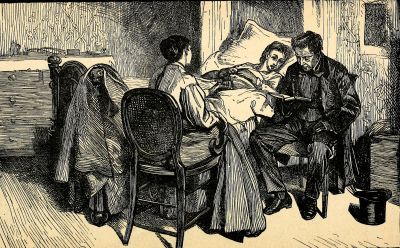
"THE LITTLE TAILOR WAS VERY SHY OF READING BEFORE LUCY."
"I want to see the gentleman that really thinks it's all about something," she resumed. "Do you know where he lives, Miss Burton?"
"No," answered Lucy, "but I will find out to-morrow, and ask him to come and see you."
"Well, that will be nice," returned Mattie. "Read to me, Mr. Spelt—anything you like."
The little tailor was very shy of reading before Lucy, but Mattie would hear of nothing else, for she would neither allow Lucy to read, nor yet to go away.
"Don't mind me, Mr. Spelt," said Lucy, beseechingly. "We are all friends, you know. If we belong to the Somebody Mattie speaks about we needn't be shy of each other."
Thus encouraged, Mr. Spelt could refuse no longer. He read about the daughter of Jairus being made alive again.
"Oh, dear me!" said Mattie. "And if I had gone dead when Syne was tormenting of me, He could have come into the room, and taken me by the hand and said, 'Daughter, get up.' How strange it would be if He said, 'Daughter' to me, for then He would be my father, you know. And they say He's a king. I wonder if that's why Mr. Kitely calls me princess. To have Mr. Kitely and Somebody," she went on musingly, "both for fathers is more than I can understand. There's something about godfathers and godmothers in the Catechism, ain't there, Miss Burton?" Then, without, waiting for a reply, she went on, "I wish my father would go and hear what that nice gentleman—not Mr. Potter—has got to say about it. Miss Burton, read the hymn about blind Bartimeus, and that'll do mother good, and then I'll go to sleep."
The next day, after she came from the Morgensterns', Lucy went to find Mr. Fuller. She had been to the week-evening service twice since Mattie began to recover, but she had no idea where Mr. Fuller lived, and the only way she could think of for finding him was to ask at the warehouses about the church. She tried one after another, but nobody even knew that there was any service there—not to say where the evening preacher lived. With its closed, tomb-like doors, and the utter ignorance of its concerns manifested by the people of the neighborhood, the great ugly building stood like some mausoleum built in honor of a custom buried beneath it, a monument of the time when men could buy and sell and worship God. So Lucy put off further inquiry till the next week-evening service, for she had found already that Mr. Fuller had nothing to do with the Sunday services in that church.
How she wished that she could take Thomas with her the next time she went to receive Mr. Fuller's teaching! She had seen very little of Thomas, as I have said, and had been so much occupied with Mattie, that she did not even know whether he had fulfilled his promise about telling his father. I suspect, however, that she had been afraid to ask him, foreboding the truth that he had in fact let his promise lapse in time, and was yet no nearer toward its half redemption in act, which was all that remained possible now. And, alas! what likelihood was there of the good seed taking good root in a heart where there was so little earth?
Finding Mr. Kitely in his shop door, Lucy stopped to ask after Mattie, for she had not seen her that morning. And then she told him what she had been about, and her want of success.
"What does the child want a clergyman for?" asked Mr. Kitely, with some tone of dissatisfaction. "I'm sure you're better than the whole lot of them, miss. Now I could listen to you—"
"How do you know that?" retorted Lucy, smiling; for she wanted to stop the eulogium upon herself.
"Because I've listened to you outside the door, Miss Burton, when you was a-talking to Mattie inside."
"That wasn't fair, Mr. Kitely."
"No more it wasn't, but it's done me no harm, nor you neither. But for them parsons!—they're neither men nor women. I beg their pardons—they are old wives."
"But are you sure that you know quite what you are talking about? I think there must be all sorts of them as well as of other people. I wish you would come and hear Mr. Fuller some evening with Mattie and me when she's better. You would allow that he talks sense, anyhow."
"I ain't over hopeful, miss. And to tell the truth, I don't much care. I don't think there can be much in it. It's all an affair of the priests. To get the upper hand of people they work on their fears and their superstitions. But I don't doubt some of them may succeed in taking themselves in, and so go on like the fox that had lost his tail, trying to make others cut off theirs too."
Lucy, did not reply, because she had nothing at hand to say. The bookseller feared he had hurt her.
"And so you couldn't find this Mr. Fuller? Well, you leave it to me. I'll find him, and let you know in the afternoon."
"Thank you, Mr. Kitely. Just tell Mattie, will you? I must run home now, but I'll come in in the afternoon to hear how you have succeeded."
About six o'clock, Lucy reëntered Mr. Kitely's shop, received the necessary directions to find the "parson," ran up to tell Mattie that she was going, for the child had not come down stairs, and then set out.
To succeed she had to attend to Mr. Kitely's rather minute instructions; for although the parsonage lay upon the bank of one of the main torrents of city traffic, it was withdrawn and hidden behind shops and among offices, taverns, and warehouses. After missing the most direct way, she arrived at last, through lanes and courts, much to her surprise, at the border of a green lawn on the opposite side of which rose a tree that spread fair branches across a blue sky filled with pearly light, and blotted here and there with spongy clouds that had filled themselves as full of light as they could hold. The other half of the branches of the same tree spread themselves across the inside of a gable, all that remained of a tavern that was being pulled down. The gable was variegated with the incongruous papers of many small rooms, and marked with the courses of stairs and the holes for the joints of the floors; and this dreariness was the background for the leaves of the solitary tree. On the same side was the parsonage, a long, rather low, and country-looking house, from the door of which Lucy would not have been surprised to see a troop of children burst with shouts and laughter, to tumble each other about upon the lawn, as smooth, at least, if not as green, as any of the most velvety of its kind. One side of the square was formed by a vague, commonplace mass of dirty and expressionless London houses—what they might be used for no one could tell—one of them, probably, an eating-house—mere walls with holes to let in the little light that was to be had. The other side was of much the same character, only a little better; and the remaining side was formed by the long barn-like wall of the church, broken at regular intervals by the ugly windows, with their straight sides filled with parallelograms, and their half-circle heads filled with trapeziums—the ugliest window that can be made, except it be redeemed with stained glass, the window that makes the whole grand stretch of St. Paul's absolutely a pain. The church was built of brick, nearly black below, but retaining in the upper part of the square tower something of its original red. All this Lucy took in at a glance as she went up to the door of the parsonage.
She was shown into a small study, where Mr. Fuller sat. She told him her name, that she had been to his week-evening service with Mattie, and that the child was ill and wanted to see him.
"Thank you very much," said Mr. Fuller. "Some of the city clergymen have so little opportunity of being useful! I am truly grateful to you for coming to me. A child in my parish is quite a godsend to me—I do not use the word irreverently—I mean it. You lighten my labor by the news. Perhaps I ought to say I am sorry she is ill. I dare say I shall be sorry when I see her. But meantime, I am very glad to be useful."
He promised to call the next day; and, after a little more talk, Lucy took her leave.
Mr. Fuller was a middle-aged man, who all his conscious years had been trying to get nearer to his brethren, moved thereto by the love he bore to the Father. The more anxious he was to come near to God, the more he felt that the high-road to God lay through the forest of humanity. And he had learned that love is not a feeling to be called up at will in the heart, but the reward as the result of an active exercise of the privileges of a neighbor.
Like the poor parson loved of Chaucer, "he waited after no pomp ne reverence;" and there was no chance of preferment coming in search of him. He was only a curate still. But the incumbent of St. Amos, an old man, with a grown-up family, almost unfit for duty, and greatly preferring his little estate in Kent to the city parsonage, left everything to him, with much the same confidence he would have had if Mr. Fuller had been exactly the opposite of what he was, paying him enough to live upon—indeed, paying him well for a curate. It was not enough to marry upon, as the phrase is, but Mr. Fuller did not mind that, for the only lady he had loved, or ever would love in that way, was dead; and all his thoughts for this life were bent upon such realizing of divine theory about human beings, and their relation to God and to each other, as might make life a truth and a gladness. It was therefore painful to him to think that he was but a city curate, a being whose thirst after the relations of his calling among his fellows reminded himself of that of the becalmed mariner, with "water, water everywhere, but water none to drink." He seemed to have nothing to do with them, nor they with him. Perhaps not one individual of the crowds that passed his church every hour in the week would be within miles of it on the Sunday; for even of those few who resided near it, most forsook the place on the day of rest, especially in the summer; and few indeed were the souls to whom he could offer the bread of life. He seemed to himself to be greatly overpaid for the work he had it in his power to do—in his own parish, that is. He had not even any poor to minister to. He made up for this by doing his best to help the clergyman of a neighboring parish, who had none but poor; but his heart at times burned within him to speak the words he loved best to speak to such as he could hope had the ears to hear them; for among the twelve people—a congregation he did not always have—that he said he preferred to the thousand, he could sometimes hardly believe that there was one who heard and understood. More of his reflections and resolutions, in regard to this state of affairs, we shall fall in with by and by. Meantime, my reader will believe that this visit of Lucy gave him pleasure and hope of usefulness. The next morning he was in Mr. Kitely's shop as early as he thought the little invalid would be able to see him.
"Good-morning, sir," said Mr. Kitely, brusquely. "What can I do for you this morning?"
If Mr. Fuller had begun looking at his books, Kitely would have taken no notice of him. He might have stayed hours, and the bookseller would never have even put a book in his way; but he looked as if he wanted something in particular, and therefore Mr. Kitely spoke.
"You have a little girl that's not well, haven't you?" returned Mr. Fuller.
"Oh! you're the gentleman she wanted to see. She's been asking ever so often whether you wasn't come yet. She's quite impatient to see you, poor lamb!"
While he spoke, Kitely had drawn nearer to the curate, regarding him with projecting and slightly flushed face, and eyes that had even something of eagerness in them.
"I would have come earlier, only I thought it would be better not," said Mr. Fuller.
Mr. Kitely drew yet a step nearer, with the same expression on his face.
"You won't put any nonsense into her head, will you, sir?" he said, almost pleadingly.
"Not if I know it," answered Mr. Fuller, with a smile of kind humor. "I would rather take some out of it."
"For you see," Kitely went on, "that child never committed a sin in her life. It's all nonsense; and I won't have her talked to as if she was a little hell-cat."
"But you see we must go partly by what she thinks herself; and I suspect she won't say she never did anything wrong. I don't think I ever knew a child that would. But, after all, suppose you are right, and she never did anything, wrong—"
"I don't exactly say that, you know," interposed Mr. Kitely, in a tone of mingled candor and defense. "I only said she hadn't committed any sins."
"And where's the difference?" asked Mr. Fuller, quietly.
"Oh! you know quite well. Doing wrong, you know—why, we all do wrong sometimes. But to commit a sin, you know—I suppose that's something serious. That comes in the way of the Ten Commandments."
"I don't think your little girl would know the difference."
"But what's the use of referring to her always?"
"Just because I think she's very likely to know best. Children are wise in the affairs of their own kingdom."
"Well, I believe you're right; for she is the strangest child I ever saw. She knows more than any one would think for. Walk this way, sir. You'll find her in the back room."
"Won't you come, too, and see that I don't put any nonsense into her head?"
"I must mind the shop, sir," objected Kitely, seeming a little ashamed of what he had said.
Mr. Fuller nodded content, and was passing on, when he bethought himself, and stopped.
"Oh, Mr. Kitely," he said, "there was just one thing I was going to say, but omitted. It was only this: that suppose you were right about your little girl, or suppose even that she had never done anything wrong at all, she would want God all the same. And we must help each other to find Him."
If Mr. Kitely had any reply ready for this remark, which I doubt, Mr. Fuller did not give him time to make it, for he walked at once into the room, and found Mattie sitting alone in a half twilight, for the day was cloudy. Even the birds were oppressed, for not one of them was singing. A thrush hopped drearily about under his load of speckles, and a rose-ringed paroquet, with a very red nose, looked ashamed of the quantity of port-wine he had drunk. The child was reading the same little old book mentioned before. She laid it down, and rose from the window-sill to meet Mr. Fuller.
"Well, how do you do, sir?" she said. "I am glad you are come."
Any other child of her age Mr. Fuller would have kissed, but there was something about Mattie that made him feel it an unfit proceeding. He shook hands with her and offered her a white camellia.
"Thank you, sir," said Mattie, and laid the little transfiguration upon the table.
"Don't you like flowers?" asked Mr. Fuller, somewhat disappointed. "Isn't it beautiful now?"
"Well, where's the good?" answered and asked Mattie, as if she had been a Scotchwoman. "It will be ugly before to-morrow."
"Oh, no; not if you put it in water directly."
"Will it live forever, then?" asked Mattie.
"No, only a few days."
"Well, where's the odds, then? To-morrow or next week—where's the difference? It looks dead now when you know it's dying."
"Ah!" thought Mr. Fuller, "I've got something here worth looking into." What he said was, "You dear child!"
"You don't know me yet," returned Mattie. "I'm not dear at all. I'm cross and ill-natured. And I won't be petted."
"You like the birds, though, don't you?" said Mr. Fuller.
"Well, yes. Mr. Kitely likes them, and I always like what he likes. But they are not quite comfortable, you know. They won't last forever, you know. One of them is dead since I was taken ill. And father meant it for Miss Burton."
"Do you like Miss Burton, then?"
"Yes, I do. But she'll live forever, you know. I'll tell you something else I like."
"What is that, my child?"
"Oh, I'm no such a child! But I'll tell you what I like. There."
And she held out the aged little volume, open at the hymn about blind Bartimeus.
"Will this live forever, then?" he asked, turning the volume over in his hand, so that its withered condition suggested itself at once to Mattie.
"Now you puzzle me," answered Mattie. "But let me think. You know it's not the book I mean; it's the poem. Now I have it. If I know that poem by heart, and I live forever, then the poem will live forever. There!"
"Then the book's the body, and the poem the soul," said Mr. Fuller.
"One of the souls; for some things have many souls. I have two, at least."
Mr. Fuller felt instinctively, with the big forehead and the tiny body of the child before him, that they were getting on rather dangerous ground. But he must answer.
"Two souls! That must be something like what King David felt, when he asked God to join his heart into one. But do you like this poem?" he hastened to add. "May I read it to you?"
"Oh, yes; please do. I am never tired of hearing it. It will sound quite new if you read it."
So Mr. Fuller read slowly—"As Jesus went into Jericho town." And from the way Mattie listened, he knew what he must bring her next—not a camellia, but a poem. Still, how sad it was that a little child should not love flowers!
"When were you in the country last, Miss Kitely?"
"I never was in the country that I know of. My name is Mattie."
"Wouldn't you like to go, Mattie?"
"No I shouldn't—not at all."
"Why?"
"Well, because—because it's not in my way, you see."
"But surely you have some reason for not liking the country."
"Well, now, I will tell you. The country, by all I can hear, is full of things that die, and I don't like that. And I think people can't be nice that like the country."
Mr. Fuller resolved in his heart that he would make Mattie like the country before he had done with her. But he would say no more now, because he was not sure whether Mattie as yet regarded him with a friendly eye; and he must be a friend before he could speak about religion. He rose, therefore, and held out his hand.
Mattie looked at him with dismay.
"But I wanted you to tell me about the man that sat at Somebody's feet in his Sunday clothes."
Happily for his further influence with her, Mr. Fuller guessed at once whom she meant, and taking a New Testament from his pocket, read to her about the demoniac, who sat at the feet of Jesus, clothed, and in his right mind. He had not known her long before he discovered that all these stories of possession had an especial attraction for Mattie—she evidently associated them with her own visions of Syne and his men.
"Well, I was wrong. It wasn't his Sunday clothes," she said. "Or, perhaps, it was, and he had torn the rest all to pieces."
"Yes; I think that's very likely," responded Mr. Fuller.
"I know—it was Syne that told him, and he did it. But he wouldn't do it any more, would he, after he saw Somebody?"
"I don't think he would," answered Mr. Fuller, understanding her just enough to know the right answer to make. "But I will come and see you again to-morrow," he added, "and try whether I can't bring something with me that you will like."
"Thank you," answered the old-fashioned creature. "But don't be putting yourself to any expense about it, for I am not easy to please." And she lifted her hand to her head and gave a deep sigh, as if it was a very sad fact indeed. "I wish I was easier to please," she added, to herself; but Mr. Fuller heard her as he left the room.
"She's a very remarkable child that, Mr. Kitely—too much so, I fear," he said, reëntering the shop.
"I know that," returned the bookseller, curtly, almost angrily. "I wish she wasn't."
"I beg your pardon. I only wanted—"
"No occasion at all," interrupted Mr. Kitely.
"I only wanted," Mr. Fuller persisted, "to ask you whether you do not think she had better go out of town for a while."
"I dare say. But how am I to send her? The child has not a relation but me—and an aunt that she can't a-bear; and that wouldn't do—would it, sir? She would fret herself to death without someone she cared about."
"Certainly it wouldn't do. But mightn't Miss—I forget her name—"
"Miss Burton, I dare say you mean."
"I mean Miss Burton. Couldn't she help you? Is she any relation of yours?"
"None whatever. Nor she's not like it. I believe she's a stray, myself."
"What do you mean, Mr. Kitely?" asked Mr. Fuller, quite bewildered now.
"Well, sir, I mean that she's a stray angel," answered Mr. Kitely, smiling; "for she ain't like anyone else I know of but that child's mother, and she's gone back to where she came from—many's the long year."
"I don't wonder at your thinking that of her if she's as good as she looks," returned Mr. Fuller. And bidding the bookseller good-morning, he left the shop and walked home, cogitating how the child could be got into the country.
Next morning he called—earlier, and saw Lucy leaving the court just as he was going into the shop. He turned and spoke to her.
"Fancy a child, Miss Burton," he said, "that does not care about flowers—and her heart full of religion too! How is she to consider the lilies of the field? She knows only birds in cages; she has no idea of the birds of the air. The poor child has to lift everything out of that deep soul of hers, and the buckets of her brain can't stand such hard work."
"I know, I know," answered Lucy. "But what can I do?"
"Besides," Mr. Fuller continued, "what notion of the simple grandeur of God can she have when she never had more than a peep of the sky from between these wretched houses? How can the heavens declare the glory of God to her? You don't suppose David understood astronomy, and that it was from a scientific point of view that he spoke, when he said that the firmament showed his handiwork? That was all he could say about it, for the Jewish nation was not yet able to produce a Ruskin. But it was, nevertheless, the spiritual power of the sky upon his soul—not the stars in their courses, but the stars up there in their reposeful depth of blue, their 'shining nest'—which, whatever theory of their construction he might have, yet impressed him with an awe, an infinitude, a shrinking and yet aspiring—made his heart swell within him, and sent him down on his knees. This little darling knows nothing of such an experience. We must get her into the open. She must love the wind that bloweth where it listeth, and the clouds that change and pass. She can't even like anything that does not last forever; and the mind needs a perishing bread sometimes as well as the body—though it never perishes when once made use of, as Mattie told me yesterday. But I beg your pardon; I am preaching a sermon, I think. What a thing it is to have the faults of a profession in addition to those of humanity! It all comes to this—you must get that child, with her big head and her big conscience, out of London, and give her heart a chance."
"Indeed, I wish I could," answered Lucy. "I will do what I can, and let you know. Are you going to see her now, Mr. Fuller?"
"Yes, I am. I took her a flower yesterday, but I have brought her a poem to-day. I am afraid, however, that it is not quite the thing for her. I thought I could easily find her one till I began to try, and then I found it very difficult indeed."
They parted—Lucy to Mrs. Morgenstern's, Mr. Fuller to Mattie.
I will give the hymn—for the sake, in part, of what Mattie said, and then I will close the chapter.
"Come unto me," the Master says. But how? I am not good; No thankful song my heart will raise, Nor even wish it could. I am not sorry for the past, Nor able not to sin; The weary strife would ever last If once I should begin. Hast thou no burden then to bear? No action to repent? Is all around so very fair? Is thy heart quite content? Hast thou no sickness in thy soul? No labor to endure? Then go in peace, for thou art whole, Thou needest not His cure. Ah! mock me not. Sometimes I sigh; I have a nameless grief, A faint, sad pain—but such that I Can look for no relief. Come then to Him who made thy heart; Come in thyself distrest; To come to Jesus is thy part, His part to give thee rest. New grief, new hope He will bestow, Thy grief and pain to quell; Into thy heart Himself will go, And that will make thee well.
When Mr. Fuller had finished the hymn, he closed the book and looked toward Mattie. She responded—with a sigh—
"Well, I think I know what it means. You see I have such a big head, and so many things come and go just as they please, that if it weren't for Somebody I don't know what I should do with them all. But as soon as I think about Him, they grow quieter and behave better. But I don't know all that it means. Will you lend me the book, Mr. Fuller?"
All the child's thoughts took shapes, and so she talked like a lunatic. Still, as all the forms to which she gave an objective existence were the embodiments of spiritual realities, she could not be said to have yet passed the narrow line that divides the poet from the maniac. But it was high time that the subjects of her thoughts should be supplied from without, and that the generating power should lie dormant for a while. And the opportunity for this arrived sooner than her friends had expected.
CHAPTER XXVI.
THE NINGPO IS LOST.
Lucy was so full of Mattie and what Mr. Fuller had said that she told Mrs. Morgenstern all about it before Miriam had her lesson. After the lesson was over, Mrs. Morgenstern, who had, contrary to her custom, remained in the room all the time, said:
"Well, Lucy, I have been thinking about it, and I think I have arranged it all very nicely. It's clear to me that the child will go out of her mind if she goes on as she's doing. Now, I don't think Miriam has been quite so well as usual, and she has not been out of London since last August. Couldn't you take her down to St. Leonard's—or I dare say you would like Hastings better? You can go on with your lessons there all the same, and take little Mattie with you."
"But what will become of my grandmother?" said Lucy.
"She can go with you, can't she? I could ask her to go and take care of you. It would be much better for you to have her, and it makes very little difference to me, you know."
"Thank you very much," returned Lucy, "but I fear my grandmother will not consent to it. I will try her, however, and see what can be done. Thank you a thousand times, dear Mrs. Morgenstern. Wouldn't you like to go to Hastings, Miriam?"
Miriam was delighted at the thought of it, and Lucy was not without hopes that if her grandmother would not consent to go herself, she would at least wish her to go. Leaving Mattie out of view, she would be glad to be away from Thomas for a while, for, until he had done as he ought, she could not feel happy in his presence; and she made up her mind that she would write to him very plainly when she was away—perhaps tell him positively that if he would not end it, she must. I say perhaps, for ever as she approached the resolution, the idea of the poor lad's helpless desertion arose before her, and she recoiled from abandoning him. Nothing more could be determined, however, until she saw her grandmother.
But as she was going out she met Mr. Sargent in the hall. He had come to see her.
This very morning the last breath of the crew and passengers of the Ningpo had bubbled up in the newspapers; and all the world who cared to know it knew the fact, that the vessel had been dashed to pieces upon a rock of the Cape Verde Islands; all hands and passengers supposed to be lost. This the underwriters knew but a few hours before. Now it was known to Mr. Stopper and Mr. Worboise, both of whom it concerned even more than the underwriters. Mr. Stopper's first feeling was one of dismay, for the articles of partnership had not been completed before Mr. Boxall sailed. Still, as he was the only person who understood the business, he trusted in any case to make his position good, especially if he was right in imagining that old Mrs. Boxall must now be heir-at-law—a supposition which he scarcely allowed himself to doubt. Here, however, occurred the thought of Thomas. He had influence there, and that influence would be against him, for had he not insulted him? This he could not help yet. He would wait for what might turn up.
What Mr. Worboise's feelings were when first he read the paragraph in the paper I do not know, nor whether he had not an emotion of justice, and an inclination to share the property with Mrs. Boxall. But I doubt whether he very clearly recognized the existence of his friend's mother. In his mind, probably, her subjective being was thinned by age, little regard, and dependence, into a thing of no account—a shadow of the non-Elysian sort, living only in the waste places of human disregard. He certainly knew nothing of her right to any property in the possession of her son. Of one of his feelings only am I sure: he became more ambitious for his son, in whom he had a considerable amount of the pride of paternity.
Mrs. Boxall was the last to hear anything of the matter. She did not read the newspapers, and, accustomed to have sons at sea, had not even begun to look for news of the Ningpo.
"Ah, Miss Burton," said Mr. Sargent, "I am just in time. I thought perhaps you would not be gone yet. Will you come into the garden with me for a few minutes? I won't keep you long."
Lucy hesitated. Mr. Sargent had of late, on several occasions, been more confidential in his manner than was quite pleasant to her, because, with the keenest dislike to raise appearances, she yet could not take his attentions for granted, and tell him she was engaged to Thomas. He saw her hesitation, and hastened to remove it.
"I only want to ask you about a matter of business," he said. "I assure you I won't detain you."
Mr. Sargent knew something of Mr. Wither, who had very "good connections," and was indeed a favorite in several professional circles; and from him he had learned all about Lucy's relations, without even alluding to Lucy herself, and that her uncle and whole family had sailed in the Ningpo. Anxious to do what he could for her, and fearful lest, in their unprotected condition, some advantage should be taken of the two women, he had made haste to offer his services to Lucy, not without a vague feeling that he ran great risk of putting himself in the false position of a fortune-hunter by doing so, and heartily abusing himself for not having made more definite advances before there was any danger of her becoming an heiress; for although a fortune was a most desirable thing in Mr. Sargent's position, especially if he wished to marry, he was above marrying for money alone, and, in the case of Lucy, with whom he had fallen in love—just within his depth, it must be confessed—while she was as poor as himself, he was especially jealous of being unjustly supposed to be in pursuit of her prospects. Possibly the consciousness of what a help the fortune would be to him made him even more sensitive than he would otherwise have been. Still he would not omit the opportunity of being useful to the girl, trusting that his honesty would, despite of appearances, manifest itself sufficiently to be believed in by so honest a nature as Lucy Burton.
"Have you heard the sad news?" he said, as soon as they were in the garden.
"No," answered Lucy, without much concern; for she did not expect to hear anything about Thomas.
"I thought not. It is very sad. The Ningpo is lost."
Lucy was perplexed. She knew the name of her uncle's vessel; but for a moment she did not associate the thing. In a moment, however, something of the horror of the fact reached her. She did not cry, for her affections had no great part in anyone on board of the vessel, but she turned very pale. And not a thought of the possible interest she might have in the matter crossed her mind. She had never associated good to herself with her uncle or any of his family.
"How dreadful!" she murmured. "My poor cousins! What they must all have gone through! Are they come home?"
"They are gone home," said Mr. Sargent, significantly. "There can be but little doubt of that, I fear."
"You don't mean they're drowned?" she said, turning her white face on him, and opening her eyes wide.
"It is not absolutely certain; but there can be little doubt about it."
He did not show her the paragraph in the Times, though the paper was in his pocket: the particulars were too dreadful.
"Are there any other relations but your grandmother and yourself?" he asked, for Lucy remained silent.
"I don't know of any," she answered.
"Then you must come in for the property."
"Oh, no. He would never leave it to us. He didn't like me, for one thing. But that was my fault, perhaps. He was not over-kind to my mother, and so I never liked him."
And here at length she burst into tears. She wept very quietly, however, and Mr. Sargent went on.
"But you must be his heirs-at-law. Will you allow me to make inquiry—to do anything that may be necessary, for you? Don't misunderstand me," he added, pleadingly. "It is only as a friend—what I have been for a long time now, Lucy."
Lucy scarcely hesitated before she answered, with a restraint that appeared like coldness:
"Thank you, Mr. Sargent. The business cannot in any case be mine. It is my grandmother's, and I can, and will, take no hand in it."
"Will you say to your grandmother that I am at her service?"
"If it were a business matter, there is no one I would more willingly—ask to help us; but as you say it is a matter of friendship, I must refuse your kindness."
Mr. Sargent was vexed with himself, and disappointed with her. He supposed that she misinterpreted his motives. Between the two, he was driven to a sudden, unresolved action of appeal.
"Miss Burton," he said, "for God's sake, do not misunderstand me, and attribute to mercenary motives the offer I make only in the confidence that you will not do me such an injustice."
Lucy was greatly distressed. Her color went and came for a few moments, and then she spoke.
"Mr. Sargent, I am just as anxious that you should understand me; but I am in a great difficulty and have to throw myself on your generosity."
She paused again, astonished to find herself making a speech. But she did not pause long.
"I refuse your kindness," she said, "only because I am not free to lay myself under such obligation to you. Do not ask me to say more," she added, finding that he made no reply.
But if she had looked in his face, she would have seen that he understood her perfectly. Honest disappointment and manly suffering were visible enough on his countenance. But he did not grow ashy pale, as some lovers would at such an utterance. He would never have made, under any circumstances, a passionate lover, though an honest and true one; for he was one of those balanced natures which are never all in one thing at once. Hence the very moment he received a shock, was the moment in which he began to struggle for victory. Something called to him, as Una to the Red-Cross Knight when face to face with the serpent Error:
"Strangle her, else she sure will strangle thee."
Before Lucy's eyes and his met, he had mastered his countenance at last.
"I understand you, Miss Burton," he said, in a calm voice, which only trembled a little—and it was then that Lucy ventured to look at him—"and I thank you. Please to remember that if ever you need a friend, I am at your service."
Without another word, he lifted his hat and went away.
Lucy hastened home full of distress at the thought of her grandmother's grief, and thinking all the way how she could convey the news with least of a shock; but when she entered the room, she found her already in tears, and Mr. Stopper seated by her side comforting her with commonplaces.
CHAPTER XXVII.
OF USEFUL ODDS AND ENDS.
During all this time, when his visits to Lucy were so much interrupted by her attendance upon Mattie, Thomas had not been doing well. In fact, he had been doing gradually worse. His mother had, of course, been at home for a long time now, and Mr. Simon's visits had been resumed. But neither of these circumstances tended to draw him homeward.
Mrs. Worboise's health was so much improved by her sojourn at Folkestone, that she now meditated more energetic measures for the conversion of her son. What these measures should be, however, she could not for some time determine. At length she resolved that, as he had been a good scholar when at school—proved in her eyes by his having brought home prizes every year—she would ask him to bring his Greek Testament to her room, and help her to read through St. Paul's Epistle to the Romans with the fresh light which his scholarship would cast upon the page. It was not that she was in the least difficulty about the Apostle's meaning. She knew that as well at least as the Apostle himself; but she would invent an innocent trap to catch a soul with, and, if so it might be, put it in a safe cage, whose strong wires of exclusion should be wadded with the pleasant cotton of safety. Alas for St. Paul, his mighty soul, and his laboring speech, in the hands of two such! The very idea of such to read him, might have scared him from his epistle—if such readers there could have been in a time when the wild beasts of the amphitheatre kept the Christianity pure.
"Thomas," she said, one evening, "I want you to bring your Greek Testament, and help me out with something."
"O, mother, I can't. I have forgotten all about Greek. What is it you want to know?"
"I want you to read the Romans with me."
"Oh! really, mother, I can't. It's such bad Greek, you know."
"Thomas!" said his mother, sepulchrally, as if his hasty assertion with regard to St. Paul's scholarship had been a sin against the truth St. Paul spoke.
"Well, really, mother, you must excuse me. I can't. Why don't you ask Mr. Simon? He's an Oxford man."
To this Mrs. Worboise had no answer immediately at hand. From the way in which Thomas met her request my reader will see that he was breaking loose from her authority—whether for the better or the worse does not at this point seem doubtful, and yet perhaps it was doubtful. Still he was not prepared to brave her and his father with a confession, for such it appeared to him to be, of his attachment to Lucy.
Since he could see so little of her, he had spent almost all the time that used to be devoted to her with Molken. In consequence, he seldom reached home in anything like what he had been accustomed to consider decent time. When his mother spoke to him on the subject he shoved it aside with an "Ah! you were in bed, mother," prefacing some story, part true, part false, arranged for the occasion. So long as his father took no notice of the matter he did not much mind. He was afraid of him still; but so long as he was out of bed early enough in the morning, his father did not much care at what hour he went to it: he had had his own wild oats to sow in his time. The purity of his boy's mind and body did not trouble him much, provided that, when he came to take his position in the machine of things, he turned out a steady, respectable pinion, whose cogs did not miss, but held—the one till the other caught. He had, however, grown ambitious for him within the last few days—more of which by and by.
In the vacancy of mind occasioned by the loss of his visits to Lucy—for he had never entered heartily into any healthy pursuits in literature, art, or even amusement—Thomas had, as it were, gradually sauntered more and more into the power of Mr. Molken; and although he had vowed to himself, after his first experience, that he would, never play again, himself not being to himself a very awe-inspiring authority, he had easily broken that vow. It was not that he had any very strong inclination to play—the demon of play had not quite entered into him: it was only that whatever lord asserted dominion over Thomas, to him Thomas was ready to yield that which he claimed. Molken said, "Come along," and Thomas went along. Nor was it always to the gambling-house that he followed Molken; but although there was one most degrading species of vice from which his love to Lucy—for he loved Lucy with a real though not great love—did preserve him, there were several places to which his friend took him from which he could scarcely emerge as pure as he entered them. I suspect—thanks to what influence Lucy had with him, to what conscience he had left in him, to what good his mother and Mr. Simon had taught him, in a word, to the care of God over him—Mr. Molken found him rather harder to corrupt than, from his shilly-shally ways, he had expected. Above all, the love of woman, next to the love of God, is the power of God to a young man's salvation; for all is of God, everything, from first to last—nature, providence, and grace—it is all of our Father in Heaven; and what God hath joined let not man put asunder.
His gambling was a very trifle as far as money went: an affair of all but life and death as far as principle was concerned. There is nothing like the amount of in-door gambling that there used to be; but there is no great improvement in taking it to the downs and the open air, and making it librate on the muscles of horses instead of on the spinning power of a top or the turning up of cards. And whoever gambles, whether at rouge-et-noir or at Fly-away versus Staywell, will find that the laws of gambling are, like those of the universe, unalterable. The laws of gambling are discontent, confusion, and loss upon everyone who seeks to make money without giving moneys worth. It will matter little to the grumbler whether the retribution comes in this world, he thinking, like Macbeth, to "skip the life to come," or in the next. He will find that one day is with the Lord as a thousand years, and a thousand years as one day.
But for Thomas, the worst thing in the gambling, besides the bad company it led him into, was that the whole affair fell in so with his natural weakness. Gambling is the employment fitted for the man without principles and without will, for his whole being is but, as far as he is concerned, the roulette-ball of chance. The wise, on the contrary, do not believe in Fortune, yield nothing to her sway, go on their own fixed path regardless "of her that turneth as a ball," as Chaucer says. They at least will be steady, come to them what may. Thomas got gradually weaker and weaker, and, had it not been for Lucy, would soon have fallen utterly. But she, like the lady of an absent lord, still kept one fortress for him in a yielded and devastated country.
There was no newspaper taken in at Mr. Worboise's, for he always left home for his office as soon as possible. So, when Thomas reached the counting-house, he had heard nothing of the sad news about his late master and his family. But the moment he entered the place he felt that the atmosphere was clouded. Mr. Wither, whose face was pale as death, rose from the desk where he had been sitting, caught up his hat, and went out. Thomas could not help suspecting that his entrance was the cause of Mr. Wither's departure, and his thoughts went back to last night, and he wondered whether his fellow-clerks would cut him because of the company he had been in. His conscience could be more easily pricked by the apprehension of overt disapprobation than by any other goad. None of them took any particular notice of him; only a gloom as of a funeral hung about all their faces, and radiated from them so as to make the whole place look sepulchral. Mr. Stopper was sitting within the glass partition, whence he called for Mr. Worboise, who obeyed with a bad grace, as anticipating something disagreeable.
"There!" said Mr. Stopper, handing him the newspaper, and watching him as he read.
Thomas read, returned the paper, murmured something, and went back with scared face to the outer room. There a conversation arose in a low voice, as if it had been in the presence of the dead. Various questions were asked and conjectures hazarded, but nobody knew anything. Thomas's place was opposite the glass, and before he had been long seated he saw Mr. Stopper rake the key of the door of communication from a drawer, unlock the door, and with the Times in his hand walk into Mrs. Boxall's house, closing the door behind him. This movement was easy to understand, and set Thomas thinking. Then first the thought struck him that Lucy and her grandmother would come in for all the property. This sent a glow of pleasure through him, and he had enough ado to keep the funeral look which belonged to the occasion. Now he need not fear to tell his father the fact of his engagement—indeed, he might delay the news as long as he liked, sure that it would be welcome when it came. If his father were pleased, he did not care so much for his mother. But had he known how much she loved him, he could not have got so far away from her as he was now. If, on the other hand, he had fallen in with her way of things, she would have poured out upon him so much repressed affection that he would have known it. But till he saw as she saw, felt as she felt, and could talk as she talked, her motherhood saw an impervious barrier between her and him—a barrier she labored hard to remove, but with tools that could make no passage through an ever-closing mist.
I cannot help thinking that if he had told all now, the knowledge of his relation to Lucy would have been welcomed by his father, and would have set everything right. I cannot but believe that Mr. Worboise's mind was troubled about the property. With perfect law on his side, there was yet that against him which all his worldliness did not quite enable him to meet with coolness. But the longer the idea of the property rested upon his mind, the more, as if it had been the red-hot coin of the devil's gift, it burned and burrowed out a nest for itself, till it lay there stone-cold and immovably fixed, and not to be got rid of. Before many weeks had passed he not only knew that it was his by law, but felt that it was his by right—his own by right of possession, and the clinging of his heart-strings around it—his own because it was so good that he could not part with it. Still it was possible that something adverse might turn up, and there was no good in incurring odium until he was absolutely sure that the fortune as well as the odium would be his; therefore he was in no haste to propound the will.
But, as I have said, he began to be more ambitious for his son, and the more he thought about the property, the more he desired to increase it by the advantageous alliance which he had now no doubt he could command. This persuasion was increased by the satisfaction which his son's handsome person and pleasing manners afforded him; and a confidence of manner which had of late shown itself, chiefly, it must be confessed, from the experience of the world he had had in the company he of late frequented, had raised in his father's mind a certain regard for him which he had not felt before. Therefore he began to look about him and speculate. He had not the slightest suspicion of Thomas being in love; and, indeed, there was nothing in his conduct or appearance that could have aroused such a suspicion in his mind. Mr. Worboise believed, on the contrary, that his son was leading a rather wild life.
It may seem strange that Thomas should not by this time have sunk far deeper into the abyss of misery; but Molken had been careful in not trying to hook him while he was only nibbling; and, besides, until he happened to be able to lose something worth winning, he rather avoided running him into any scrape that might disgust him without bringing any considerable advantage to himself.
There was one adverse intelligence, of whom Mr. Worboise knew nothing, and who knew nothing of Mr. Worboise, ready to pounce upon him the moment he showed his game. This was Mr. Sargent. Smarting, not under Lucy's refusal so much as from the lingering suspicion that she had altogether misinterpreted his motives, he watched for an opportunity of proving his disinterestedness; this was his only hope; for he saw that Lucy was lost to him. He well knew that in the position of her and her grandmother, it would not be surprising if something with a forked tongue or a cloven foot should put its head out of a hole before very long, and begin to creep toward them; and therefore, as I say, he kept an indefinite but wide watch, in the hope which I have mentioned. He had no great difficulty in discovering that Mr. Worboise had been Mr. Boxall's man of business, but he had no right to communicate with him on the subject. This indeed Mr. Stopper, who had taken the place of adviser in general to Mrs. Boxall, had already done, asking him whether Mr. Boxall had left no will, to which he had received a reply only to the effect that it was early days, that there was no proof of his death, and that he was prepared to give what evidence he possessed at the proper time—an answer Mrs. Boxall naturally enough, with her fiery disposition, considered less than courteous. Of this Mr. Sargent of course was not aware, but, as the only thing he could do at present, he entered a caveat in the Court of Probate.