Front matter (continued 6)
Reading edition
Mr. Stopper did his best for the business in the hope of one day having not only the entire management as now, but an unquestionable as unquestioned right to the same. If he ever thought of anything further since he had now a free entrance to Mrs. Boxall's region, he could not think an inch in that direction without encountering the idea of Thomas.
It was very disagreeable to Thomas that Mr. Stopper, whom he detested, should have this free admission to what he had been accustomed to regard as his peculium. He felt as if the place were defiled by his presence, and to sit as he had sometimes to sit, knowing that Mr. Stopper was overhead, was absolutely hateful. But, as I shall have to set forth in the next chapter, Lucy was not at home; and that mitigated the matter very considerably. For the rest, Mr. Stopper was on the whole more civil to Thomas than he had hitherto been, and appeared even to put a little more confidence in him than formerly. The fact was, that the insecurity of his position made him conscious of vulnerability, and he wished to be friendly on all sides, with a vague general feeling of strengthening his outworks.
Mr. Wither never opened his mouth to Thomas upon any occasion or necessity, and from several symptoms it appeared that his grief, or rather perhaps the antidotes to it, were dragging him down hill.
Amy Worboise was not at home. The mother had seen symptoms; and much as she valued Mr. Simon's ghostly ministrations, the old Adam in her rebelled too strongly against having a curate for her son-in-law. So Amy disappeared for a season, upon a convenient invitation. But if she had been at home, she could have influenced events in nothing; for, as often happens in families, there was no real communication between mother and sister.

CHAPTER XXVIII
MATTIE IN THE COUNTRY.
I now return to resume the regular thread of my story.
I do not know if my reader is half as much interested in Mattie as I am. I doubt it very much. He will, most probably, like Poppie better. But big-headed, strange, and conceited as Mattie was, she was altogether a higher being than Poppie. She thought; Poppie only received impressions. If she had more serious faults than Poppie, they were faults that belonged to a more advanced stage of growth; diseased, my reader may say, but diseased with a disease that fell in with, almost belonged to, the untimely development. All Poppie's thoughts, to speak roughly, came from without; all Mattie's from within. To complete Mattie, she had to go back a little, and learn to receive impressions too; to complete Poppie; she had to work upon the impressions she received, and, so to speak, generate thoughts of her own. Mattie led the life of a human being; Poppie of a human animal. Mattie lived; Poppie was there. Poppie was the type of most people; Mattie of the elect.
Lucy did not intend, in the sad circumstances in which she now was, to say a word to her grandmother about Mrs. Morgenstern's proposal. But it was brought about very naturally. As she entered the court she met Mattie. The child had been once more to visit Mr. Spelt, but had found the little nest so oppressive that she had begged to be put down again, that she might go to her own room. Mr. Spelt was leaning over his door and his crossed legs, for he could not stand up, looking anxiously after her; and the child's face was so pale and sad, and she held her little hand so pitifully to her big head, that Lucy could not help feeling that the first necessity among her duties was to get Mattie away.
After the fresh burst of her grandmother's grief at sight of her was over, after Mr. Stopper had gone back to the counting-house, and she had fallen into a silent rocking to and fro, Lucy ventured to speak.
"They're gone home, dear grannie," she said.
"And I shan't stay long behind them, my dear," grannie moaned.
"That's some comfort, isn't it, grannie?" said Lucy, for her own heart was heavy, not for the dead, but for the living; heavy for her own troubles, heavy for Thomas, about whom she felt very despondent, almost despairing.
"Ah! you young people would be glad enough to have the old ones out of the way," returned Mrs. Boxall, in the petulance of grief. "Have patience, Lucy, have patience, child; it won't be long, and then you can do as you like."
"Oh, grannie, grannie!" cried Lucy, bursting into tears. "I do everything I like now. I only wanted to comfort you," she sobbed. "I thought you would like to go too. I wish I was dead."
"You, child!" exclaimed Mrs. Boxall; "why should you wish you was dead? You don't know enough of life to wish for death." Then, as Lucy went on sobbing, her tone changed—for she began to be concerned at her distress. "What is the matter with my darling?" she said. "Are you ill, Lucy?"
Then Lucy went to her and kissed her, and knelt down, and laid her head in the old woman's lap. And her grannie stroked her hair, and spoke to her as if she had been one of her own babies, and, in seeking to comfort her, forgot her own troubles for the moment.
"You've been doing too much for other people, Lucy," she said. "We must think of you now. You must go to the sea-side for awhile. You shan't go about giving lessons any more, my lamb. There is no need for that any more, for they say all the money will be ours now."
And the old woman wept again at the thought of the source of their coming prosperity.
"I should like to go to the country very much, if you would go too, grannie."
"No, no, child, I don't want to go. I don't want any doing good to."
"But I don't like to leave you, grannie," objected Lucy.
"Never mind me, my dear. I shall be better alone for awhile. And I dare say there will be some business to attend to."
And so they went on talking, till Lucy told her all about Mrs. Morgenstern's plan, and how ill poor Mattie looked, and that she would be glad to go away for a little while herself. Mrs. Boxall would not consent to go, but she even urged Lucy to accept the proposed arrangement, and proceeded at once to inquire into her wardrobe, and talk about mourning.
Two days after, Lucy and Mattie met Mrs. Morgenstern and Miriam at the London Bridge railway station. Mattie looked quite dazed, almost stupid, with the noise and bustle; but when they were once in motion, she heaved a deep sigh, and looked comforted. She said nothing, however, for some time, and her countenance revealed no surprise. Whatever was out of the usual way always oppressed Mattie—not excited her; and, therefore, the more surprising anything was, the less did it occasion any outward shape of surprise. But as they flashed into the first tunnel, Lucy saw her start and shudder ere they vanished from each other in the darkness. She put out her hand and took hold of the child's. It was cold and trembling; but as she held it gently and warmly in her own, it grew quite still. By the time the light began to grow again, her face was peaceful, and when they emerged in the cutting beyond, she was calm enough to speak the thought that had come to her in the dark. With another sigh—
"I knew the country wasn't nice," she said.
"But you don't know what the country is yet," answered Lucy.
"I know quite enough of it," returned Mattie. "I like London best. I wish I could see some shops."
Lucy did not proceed to argue the matter with her. She did not tell her how unfair she was to judge the country by what lay between her and it. As well might she have argued with Thomas that the bitterness of the repentance from which he shrank was not the religion to which she wanted to lead him; that religion itself was to him inconceivable; and could but be known when he was in it. She had tried this plan with him in their last interview before she left. She had herself, under the earnest teaching of Mr. Fuller, and in the illumination of that Spirit for which she prayed, learned many a spiritual lesson, had sought eagerly, and therefore gained rapidly. For hers was one of the good soils, well prepared beforehand for the seed of the redeeming truth of God's love, and the Sonship of Christ, and his present power in the human soul. And she had tried, I say, to make Thomas believe in the blessedness of the man whoso iniquities are pardoned, whose sins are covered, to whom the Lord imputeth not his transgressions; but Thomas had replied only with some of the stock phrases of assent. A nature such as his could not think of law and obedience save as restraint. While he would be glad enough to have the weight of conscious wrong-doing lifted off him, he could not see that in yielding his own way and taking God's lay the only freedom of which the human being, made in the image of God, is capable.
Presently Mattie found another argument upon her side, that is, the town-side of the question. She had been sitting for half an hour watching the breath of the snorting engine, as it rushed out for a stormy flight over the meek fields, faltered, lingered, faded, melted, was gone.
"I told you so," said Mattie: "nothing lasts in the country."
"What are you looking at now?" asked Lucy, bending forward to see.
"Those white clouds," answered Mattie. "I've been expecting them to do something for ever so long. And they never do anything, though they begin in such a hurry. The green gets the better of them somehow. They melt away into it, and are all gone."
"But they do the grass some good, I dare say," returned Lucy—"in hot weather like this especially."
"Well, that's not what they set out for, anyhow," said Mattie. "They look always as if they were just going to take grand shapes, and make themselves up into an army, and go out and conquer the world."
"And then," suggested Lucy, yielding to the fancy of the child, "they think better of it, and give themselves up, and die into the world to do it good, instead of trampling it under their feet and hurting it."
"But how do they come to change their minds so soon?" asked Mattie, beginning to smile; for this was the sort of intellectual duel in which her little soul delighted.
"Oh, I don't think they do change their minds. I don't think they ever meant to trample down the world. That was your notion, you know, Mattie."
"Well, what do you think they set out for? Why do they rush out so fiercely all at once?"
"I will tell you what I think," answered Lucy, without perceiving more than the faintest glimmering of the human reality of what she said, "I think they rush out of the hot place in which they are got ready to do the fields good, in so much pain, that they toss themselves about in strange ways, and people think they are fierce and angry when they are only suffering—shot out into the air from a boiling kettle, you know, Mattie."
"Ah! yes; I see," answered Mattie. "That's it, is it? Yes, I dare say. Out of a kettle?"
Miriam had drawn near, and was listening, but she could make little of all this, for her hour was not yet come to ask, or to understand such questions.
"Yes, that great round thing in front of us is just a great kettle," said Lucy.
"Well, I will look at it when we get out. I thought there wasn't much in the country. I suppose we shall get out again, though. This isn't all the country, is it?"
Before they reached Hastings, Mattie was fast asleep. It was the evening. She scarcely woke when they stopped for the last time. Lucy carried her from the carriage to a cab, and when they arrived at the lodgings where they were expected, made all haste to get her to bed and asleep.
But she woke the earlier in the morning, and the first thing she was aware of was the crowing of a very clear-throated cock, such a cock as Henry Vaughan must have listened to in the morning of the day when he wrote
"Father of lights! what sunnie seed, What glance of day hast thou confined Into this bird? To all the breed This busie Ray thou hast assigned; Their magnetisme works all night, And dreams of Paradise and light."
She could not collect her thoughts for some time. She was aware that a change had taken place, but what was it? Was she somebody else? What did they use to call her? Then she remembered Mr. Spelt's shop, and knew that she was Mattie Kitely. What then had happened to her? Something certainly had happened, else how could the cock crow like that? She was now aware that her eyes were open, but she did not know that Lucy was in another bed in the same room watching her—whence afterward, when she put Mattie's words and actions together, she was able to give this interpretation of her thoughts. The room was so different from anything she had been used to, that she could not understand it. She crept out of bed and went to the window. There was no blind to it, only curtains drawn close in front.
Now my reader must remember that when Mattie went to the window of her own room at home she saw into Guild Court. The house in which they now were was half way up one of the hills on the sides of which great part of Hastings is built. The sun was not shining upon the window at this hour of the morning, and therefore did not obstruct the view. Hence when Mattie went between the curtains she saw nothing but that loveliest of English seas—the Hastings sea—lying away out into the sky, or rather, as it appeared to her unaccustomed gaze, piled up like a hill against the sky, which domed it over, vast and blue, and triumphant in sunlight—just a few white sails below and a few white clouds above, to show how blue the sea and sky were in this glory of an autumn morning. She saw nothing of the earth on which she was upheld; only the sea and the sky. She started back with a feeling that she could never describe; there was terror, and loneliness, and helplessness in it. She turned and flew to her bed, but instead of getting into it, fell down on her knees by the side of it, clutched the bed-clothes, and sobbed and wept aloud. Lucy was by her side in a moment, took her in her arms, carried her into her own bed, and comforted her in her bosom.
Mattie had been all her life sitting in the camera-obscura of her own microcosm, watching the shadows that went and came, and now first she looked up and out upon the world beyond and above her. All her doings had gone on in the world of her own imaginings; and although that big brain of hers contained—no, I cannot say contained, but what else am I to say?—a being greater than all that is seen, heard, or handled, yet the outward show of divine imagination which now met her eyes might well overpower that world within her. I fancy that, like the blind to whom sight is given, she did not at first recognize the difference between herself and it, but felt as if it was all inside her and she did not know what to do with it. She would not have cried at the sight of a rose, as Poppie did. I doubt whether Mattie's was altogether such a refined nature as Poppie's—to begin with: she would have rather patronized the rose-tree, and looked down upon it as a presuming and rather unpleasant thing because it bore dying children; and she needed, some time or other, and that was now, just such a sight as this to take the conceit out of her. Less of a vision of the eternal would not have been sufficient. Was it worth while? Yes. The whole show of the universe was well spent to take an atom of the self out of a child. God is at much trouble with us, but he never weighs material expense against spiritual gain to one of his creatures. The whole universe existed for Mattie. There is more than that that the Father has not spared. And no human fault, the smallest, is overcome, save by the bringing in of true, grand things. A sense of the infinite and the near, the far yet impending, rebuked the conceit of Mattie to the very core, and without her knowing why or how. She clung to Lucy as a child would cling, and as, all through her illness, she had never clung before.
"What is the matter with you, Mattie, dear?" asked Lucy, but asked in vain. Mattie only clung to her the closer, and began a fresh utterance of sobs. Lucy therefore held her peace for some time and waited. And in the silence of that waiting she became aware that a lark was singing somewhere out in the great blue vault.
"Listen to the lark singing so sweetly," she said at length. And Mattie moved her head enough to show that she would listen, and lay still a long while listening. At length she said, with a sob:
"What is a lark? I never saw one, Miss Burton."
"A bird like a sparrow. You know what a sparrow is, don't you, dear?"
"Yes. I have seen sparrows often in the court. They pick up dirt."
"Well, a lark is like a sparrow; only it doesn't pick up dirt, and sings as you hear it. And it flies so far up into the sky that you can't see it—you can only hear the song it scatters down upon the earth."
"Oh, how dreadful!" said Mattie, burying her head again as if she would shut out hearing and sight and all.
"What is it that is dreadful? I don't understand you, Mattie."
"To fly up into that awful place up there. Shall we have to do that when we die?"
"It is not an awful place, dear. God is there, you know."
"But I am frightened. And if God is up there, I shall be frightened at him too. It is so dreadful! I used to think that God could see me when I was in London. But how he is to see me in this great place, with so many things about, cocks and larks, and all, I can't think. I'm so little! I'm hardly worth taking care of."
"But you remember, Mattie, what Somebody says—that God takes care of every sparrow."
"Yes, but that's the sparrows, and they're in the town, you know," said Mattie, with an access of her old fantastic perversity, flying for succor, as it always does, to false logic.
Lucy saw that it was time to stop. The child's fear was gone for the present, or she could not have talked such nonsense. It was just as good, however, as the logic of most of those who worship the letter and call it the word.
"Why don't you speak, Miss Burton?" asked Mattie at length, no doubt conscience-stricken by her silence.
"Because you are talking nonsense now, Mattie."
"I thought that was it. But why should that make you not speak? for I need the more to hear sense."
"No, Mattie. Mr. Fuller says that when people begin to talk falsely, it is better to be quite silent, and let them say what they please, till the sound of their own nonsense makes them ashamed."
"As it did me, Miss Burton, as soon as you wouldn't speak any more."
"He says it does no good to contradict them then, for they are not only unworthy to hear the truth—that's not it—if they would hear it—but they are not fit to hear it. They are not in a mood to get any good from it; for they are holding the door open for the devil to come in, and truth can't get in at the same door with the devil."
"Oh, how dreadful! To think of me talking like Syne!" said Mattie. "I won't do it again, Miss Burton. Do tell me what Somebody said about God and the sparrows. Didn't he say something about counting their feathers? I think I remember Mr. Spelt reading that to me one night."
"He said something about counting your hairs, Mattie."
"Mine?"
"Well, he said it to all the people that would listen to him. I dare say there were some that could not believe it because they did not care to be told it."
"That's me, Miss Burton. But I won't do it again. Well—what more?"
"Only this, Mattie: that if God knows how many hairs you have got on your head—"
"My big head," interrupted Mattie. "Well?"
"Yes, on your big head—if God knows that, you can't think you're too small for him to look after you."
"I will try not to be frightened at the big sky any more, dear Miss Burton; I will try."
In a few minutes she was fast asleep again.
Lucy's heart was none the less trustful that she had tried to increase Mattie's faith. He who cared for the sparrows would surely hear her cry for Thomas, nay, would surely look after Thomas himself. The father did not forget the prodigal son all the time that he was away; did not think of him only when he came back again, worn and sorrowful. In teaching Mattie she had taught herself. She had been awake long before her, turning over and over her troubled thoughts till they were all in a raveled sleeve of care. Now she too fell fast asleep in her hope, and when she awoke, her thoughts were all knit up again in an even resolve to go on and do her duty, casting her care upon Him that cared for her.
And now Mattie's childhood commenced. She had had none as yet. Her disputatiousness began to vanish. She could not indulge it in the presence of the great sky, which grew upon her till she felt, as many children and some conscience-stricken men have felt—that it was the great eye of God looking at her; and although this feeling was chiefly associated with awe at first, she soon began to love the sky, and to be sorry and oppressed upon cloudy days when she could no longer look up into it.
The next day they went down to the beach, in a quiet place, among great stones, under the east cliff. Lucy sat down on one of them, and began to read a book Mr. Fuller had lent her. Miriam was at a little distance, picking up shells, and Mattie on another stone nearer the sea. The tide was rising. Suddenly Mattie came scrambling in great haste over all that lay between her and Lucy. Her face was pale, scared, and eager.
"I'm so frightened again!" she said; "and I can't help it. The sea! What does it mean?"
"What do you mean, Mattie?" returned Lucy, smiling.
"Well, it's roaring at me, and coming nearer and nearer, as if it wanted to swallow me up. I don't like it."
"You must not be afraid of it. God made it, you know."
"Why does he let it roar at me, then?"
"I don't know. Perhaps to teach you not to be afraid."
Mattie said no more, stood a little while by Lucy, and then scrambled back to her former place.
The next day, they managed with some difficulty to get up on the East Hill; Mattie was very easily worn out, especially with climbing. She gazed at the sea below her, the sky over her head, the smooth grass under her feet, and gave one of her great sighs. Then she looked troubled.
"I feel as if I hadn't any clothes on," she said.
"How is that, Mattie?"
"Well, I don't know. I feel as if I couldn't stand steady—as if I hadn't anything to keep me up. In London, you know, the houses were always beside to hold a body up, and keep them steady. But here, if it weren't for Somebody, I should be so frightened for falling down—I don't know where!"
Lucy smiled. She did not see then how exactly the child symbolized those who think they have faith in God, and yet when one of the swaddling bands of system or dogma to which they have been accustomed is removed, or even only slackened, immediately feel as if there were no God, as if the earth under their feet were a cloud, and the sky over them a color, and nothing to trust in anywhere. They rest in their swaddling bands, not in God. The loosening of these is God's gift to them that they may grow. But first they are much afraid.
Still Mattie looked contemptuously on the flowers. Wandering along the cliff, they came to a patch that was full of daisies. Miriam's familiarity with the gorgeous productions of green-house and hot-house had not injured her capacity for enjoying these peasants of flowers. She rushed among them with a cry of pleasure, and began gathering them eagerly. Mattie stood by with a look of condescending contempt upon her pale face.
"Wouldn't you like to gather some daisies too, Mattie?" suggested Lucy.
"Where's the use?" said Mattie. "The poor things'll be withered in no time. It's almost a shame to gather them, I do think."
"Well, you needn't gather them if you don't want to have them," returned Lucy. "But I wonder you don't like them, they are so pretty."
"But they don't last. I don't like things that die. I had a little talk with Mr. Fuller about that."
Now Mr. Fuller had told Lucy what the child had said, and this had resulted in a good deal of talk. Mr. Fuller was a great lover of Wordsworth, and the book Lucy was now reading, the one he had lent her, was Wordsworth's Poems. She had not found what she now answered, either in Wordsworth's poems or in Mr. Fuller's conversation, but it came from them both, mingling with her love to God, and her knowledge of the Saviour's words, with the question of the child to set her mind working with them all at once. She thought for a moment, and then said:
"Listen, Mattie. You don't dislike to hear me talk, do you?"
"No, indeed," answered Mattie.
"You like the words I say to you, then?"
"Yes, indeed," said Mattie, wondering what would come next.
"But my words die as soon as they are out of my mouth."
Mattie began to see a glimmering of something coming, and held her peace and listened. Lucy went on.
"Well, the flowers are some of God's words, and they last longer than mine."
"But I understand your words. I know what you want to say to me. And I don't know the meaning of them."
"That's because you haven't looked at them long enough. You must suppose them words in God's book, and try to read them and understand them."
"I will try," said Mattie, and walked soberly toward Miriam.
But she did not begin to gather the daisies as Miriam was doing. She lay down in the grass just as Chaucer tells us he used to do in the mornings of May for the same purpose—to look at the daisy—"leaning on my elbow and my side"; and thus she continued for some time. Then she rose and came slowly back to Lucy.
"I can't tell what they mean," she said. "I have been trying very hard, too."
"I don't know whether I understand them or not, myself. But I fancy we get some good from what God shows us even when we don't understand it much."
"They are such little things!" said Mattie. "I can hardly fancy them worth making."
"God thinks them worth making, though, or he would not make them. He wouldn't do anything that he did not care about doing. There's the lark again. Listen to him, how glad he is. He is so happy that he can't bear it without singing. If he couldn't sing it would break his heart, I fancy. Do you think God would have made his heart so glad if he did not care for his gladness, or given him such a song to sing—for he must have made the song and taught it to the lark—the song is just the lark's heart coming out in sounds—would he have made all the lark if he did not care for it? And he would not have made the daisies so pretty if their prettiness was not worth something in his eyes. And if God cares for them, surely it is worth our while to care for them too."
Mattie listened very earnestly, went back to the daisies, and lay down again beside a group of them. Miriam kept running about from one spot to another, gathering them. What Mattie said, or what Miriam replied, I do not know, but in a little while Mattie came to Lucy with a red face—a rare show in her.
"I don't like Miss Miriam," she said. "She's not nice at all."
"Why, what's the matter?" asked Lucy, in some surprise, for the children had got on very well together as yet. "What has she been doing?"
"She doesn't care a bit for Somebody. I don't like her."
"But Somebody likes her."
To this Mattie returned no answer, but stood thoughtful. The blood withdrew from her face to its fountain, and she went back to the daisies once more.
The following day she began to gather flowers as other children do, even to search for them as for hidden treasures. And if she did not learn their meaning with her understanding, she must have learned it with her heart, for she would gaze at some of them in a way that showed plainly enough that she felt their beauty; and in the beauty, the individual loveliness of such things, lies the dim lesson with which they faintly tincture our being. No man can be quite the same he was after having loved a new flower.
Thus, by degrees, Mattie's thought and feeling were drawn outward. Her health improved. Body and mind reacted on each other. She grew younger and humbler. Every day her eyes were opened to some fresh beauty on the earth, some new shadowing of the sea, some passing loveliness in the heavens. She had hitherto refused the world as a thing she had not proved; now she began to find herself at home in it, that is, to find that it was not a strange world to which she had come, but a home; not, indeed, the innermost, sacredest room of the house where the Father sat, but still a home, full of his presence, his thoughts, his designs. Is it any wonder that a child should prosper better in such a world than in a catacomb filled with the coffined remains of thinking men? I mean her father's book-shop. Here, God was ever before her in the living forms of his thought, a power and a blessing. Every wind that blew was his breath, and the type of his inner breathing upon the human soul. Every morning was filled with his light, and the type of the growing of that light which lighteth every man that cometh into the world. And there are no natural types that do not dimly work their own spiritual reality upon the open heart of a human being.
Before she left Hastings, Mattie was almost a child.
CHAPTER XXIX.
POPPIE IN TOWN.
Between Mr. Spelt's roost and the house called No. 1 of Guild Court there stood a narrow house, as tall as the rest, which showed by the several bell-pulls, ranged along the side of the door, that it was occupied by different households. Mr. Spelt had for some time had his eye upon it, in the hope of a vacancy occurring in its top chambers, occupying which he would be nearer his work, and have a more convenient home in case he should some day succeed in taming and capturing Poppie. Things had been going well in every way with the little tailor. He had had a good many more private customers for the last few months, began in consequence to look down from a growing hight upon slop-work, though he was too prudent to drop it all at once, and had three or four pounds in the post-office savings-bank. Likewise his fishing had prospered. Poppie came for her sweets as regularly as a robin for his crumbs in winter. Spelt, however, did not now confine his bait to sweets; a fresh roll, a currant bun, sometimes—when his longing for his daughter had been especially strong the night before, even a Bath bun—would hang suspended by a string from the aerial threshold, so that Poppie could easily reach it, and yet it should be under the protection of the tailor from chance marauders. And every morning as she took it, she sent a sweet smile of thanks to the upper regions whence came her aid. Though not very capable of conversation, she would occasionally answer a few questions about facts—as, for instance, where she had slept the last night, to which the answer would commonly be, "Mother Flanaghan's;" but once, to the tailor's no small discomposure, was "The Jug." She did not seem to know exactly, however, how it was that she got incarcerated: there had been a crowd, and somebody had prigged something, and there was a scurry and a running, and she scudded as usual, and got took up. Mr. Spelt was more anxious than ever to take her home after this. But sometimes, the moment he began to talk to her she would run away, without the smallest appearance of rudeness, only of inexplicable oddity; and Mr. Spelt thought sometimes that he was not a single step nearer to the desired result than when he first baited his hook. He regarded it as a good omen, however, when, by the death of an old woman and the removal of her daughter, the topmost floor of the house, consisting of two small rooms, became vacant; and he secured them at a weekly rental quite within the reach of his improved means. He did not imagine how soon he would be able to put them to the use he most desired.
One evening, just as the light was fading and he proceeded to light a candle to enable him to go on with his work, he heard the patter of her bare feet on the slabs, for his ear was very keen for this most pleasant of sounds, and looking down, saw the child coming toward him, holding the bottom of her ragged frock up to her head. He had scarcely time to be alarmed before she stopped at the foot of his shop, looked up pale as death, with a dark streak of blood running through the paleness, and burst into a wail. The little man was down in a moment, but before his feet reached the ground Poppie had fallen upon it in a faint. He lifted the child in his arms with a strange mixture of pity and horror in his big heart, and sped up the three stairs to his own dwelling. There he laid her on his bed, struck a light, and proceeded to examine her. He found a large and deep cut in her head, from which the blood was still flowing. He rushed down again, and fortunately found Dolman on the point of leaving. Him he sent for the doctor, and returned like an arrow to his treasure. Having done all he could, with the aid of his best Sunday shirt, to stop the bleeding, he waited impatiently for the doctor's arrival, which seemed long delayed. Before he came the child began to revive; and, taught by the motion of her lips, he got some water and held to them. Poppie drank and opened her eyes. When she saw who was bending over her, the faintest ghost of a smile glimmered about her mouth, and she closed her eyes again, murmuring something about Mother Flanaghan.
As far as he could gather from piecing together what the child said afterward, Mr. Spelt came to the conclusion that Mrs. Flanaghan had come home a little the worse for "cream of the valley," and wanted more. Poppie happened to be alone in her room when she came, for we have seen that she sometimes forgot to lock the door, if, indeed, there was a lock on it. She had nothing to care for, however, but her gin-bottle; and that she thought she hid safely enough. Whether she had left it empty or not, I do not know, but she found it empty when she neither desired nor expected to find it so; and coming to the hasty and stupid conclusion that poor Poppie was the thief—just as an ill-trained child expends the rage of a hurt upon the first person within his reach—she broke the vile vessel upon Poppie's head with the result we have seen. But the child had forgotten everything between that and her waking upon Mr. Spelt's bed.
The doctor came and dressed her wound, and gave directions for her treatment.
And now Mr. Spelt was in the seventh heaven of delight—he had a little woman of his own to take care of. He was thirty-nine years of age; and now, for the first time in his life, saw a prospect of happiness opening before him. No—once before, when he led the splendid Mrs. Spelt home from church, he had looked into a rosy future; but the next morning the prospect closed, and had never opened again till now. He did not lie down all that night, but hovered about her bed, as if she had been a creature that might any moment spread out great wings and fly away from him forever. Sometimes he had to soothe her with kind words, for she wandered a good deal, and would occasionally start up with wild looks, as if to fly once more from Mother Flanaghan with the gin-bottle bludgeon uplifted in her hand; then the sound of Mr. Spelt's voice would instantly soothe her, and she would lie down again and sleep. But she scarcely spoke; for at no time was Poppie given to much speech.
When the light came, he hurried down-stairs to his shop, got his work and all his implements out, carried them up, and sat with them on the floor where he could see Poppie's face. There he worked away busily at a pair of cords for a groom, every now and then lifting his eyes from his seam to look down into the court, and finding them always met by the floor. Then his look would go up to the bed, seeking Poppie's pale face. He found he could not get on so fast as usual. Still he made progress; and it was a comfort to think that by working thus early he was saving time for nursing his little white Poppie.
When at length she woke, she seemed a little better; but she soon grew more feverish, and soon he found that he must constantly watch her, for she was ready to spring out of bed any moment. The father-heart grew dreadfully anxious before the doctor came; and all that day and the next he got very little work done, for the poor child was really in danger. Indeed it was more than a week before he began to feel a little easy about her; and ten days yet passed before she was at all able to leave her bed.
And herein lay the greatest blessing both for Spelt and Poppie. I doubt if anything else could have given him a reasonable chance, as we say, of taming the wild animal. Her illness compelled her into such a continuance of dependent association with him, that the idea of him had time to grow into her heart; while all her scudding propensities, which prevented her from making a quiet and thorough acquaintance with anybody, were not merely thwarted, but utterly gone, while she remained weak. The humanity of the child had therefore an opportunity of developing itself; obstructions removed, the well of love belonging to her nature began to pulse and to flow, and she was, as it were, compelled to love Mr. Spelt; so that, by the time old impulses returned with returning health, he had a chance against them.
CHAPTER XXX
MR. FULLER IN HIS CHURCH.
Mr. Fuller's main bent of practical thought was how to make his position in the church as far as possible from a sinecure. If the church was a reality at all, if it represented a vital body, every portion of it ought to be instinct with life. Yet here was one of its cells, to speak physiologically, all but inactive—a huge building of no use all the week, and on Sundays filled with organ sounds, a few responses from a sprinkling of most indifferent worshipers, and his own voice reading prayers and crying "with sick assay" sometimes—to move those few to be better men and women than they were. Now, so far it was a center of life, and as such well worthy of any amount of outlay of mere money. But even money itself is a holy thing; and from the money point alone, low as that is, it might well be argued that this church was making no adequate return for the amount expended upon it. Not that one thought of honest comfort to a human soul is to be measured against millions of expense; but that what the money did might well be measured against what the money might do. To the commercial mind such a church suggests immense futility, a judgment correct in so far as it falls short of its possibilities. To tell the truth, and a good truth it is to tell, Mr. Fuller was ashamed of St. Amos's, and was thinking day and night how to retrieve the character of his church.
And he reasoned thus with himself, in the way mostly of question and answer:
"What is a Sunday?" he asked, answering himself—"A quiet hollow scooped out of the windy hill of the week." "Must a man then go for six days shelterless ere he comes to the repose of the seventh? Are there to be no great rocks to shadow him between?—no hiding-places from the wind to let him take breath and heart for the next struggle? And if there ought to be, where are they to be found if not in our churches?—scattered like little hollows of sacred silence scooped out of the roar and bustle of our cities, dumb to the questions—What shall we eat? what shall we drink? and wherewithal shall we be clothed?—but, alas! equally dumb to the question—Where shall I find rest, for I am weary and heavy-laden? These churches stand absolute caverns of silence amid the thunder of the busy city—with a silence which does not remind men of the eternal silence of truth, but of the carelessness of heart wherewith men regard that silence. Their work is nowhere till Sunday comes, and nowhere after that till the next Sunday or the next saint's day. How is this? Why should they not lift up the voice of silence against the tumult of care? against the dissonance of Comus and his crew? How is it that they do not—standing with their glittering, silent cocks and their golden, unopening keys high uplifted in sunny air? Why is it that their cocks do not crow, and their keys do not open? Because their cocks are busy about how the wind blows, and their keys do not fit their own doors. They may be caverns of peace, but they are caverns without entrance—sealed fountains—a mockery of the thirst and confusion of men." "But men do not want entrance. What is the use of opening the doors of our churches so long as men do not care to go in? Times are changed now." "But does not the very word Revelation imply a something coming from heaven—not certainly before men were ready for it, for God cannot be precipitate—but before they had begun to pray for it?" Mr. Fuller remembered how his own father used always to compel his children to eat one mouthful of any dish he heard them say at table that they did not like—whereupon they generally chose to go on with it. "But they won't come in." "How can you tell till you try, till you fulfill the part of the minister (good old beautiful Christian word), and be 'the life o' the building?'" "Presumption! Are not the prayers everything?" "At least not till you get people to pray them." "You make too much of the priest." "Leave him for God, and the true priest has all the seal of his priesthood that he wants." At least so thought Mr. Fuller. "What is the priest?" he asked, going on with the same catechism. "Just a man to be among men what the Sunday is among the work-days of the week—a man to remind you that there is a life within this life, or beyond and about it, if you like that mode better—for extremes meet in the truest figures—that care is not of God, that faith and confidence are truer, simpler, more of common sense than balances at bankers' or preference shares. He is a protest against the money-heaping tendencies of men, against the desire of rank or estimation or any kind of social distinction. With him all men are equal, as in the Church all have equal rights, and rank ceases on the threshold of the same, overpowered by the presence of the Son of Mary, who was married to a carpenter—overpowered by the presence of the God of the whole earth, who wrote the music for the great organ of the spheres, after he had created them to play the same." Such was the calling of the clergyman, as Mr. Fuller saw it. Rather a lofty one, and simply a true one. If the clergyman cannot rouse men to seek his God and their God, if he can only rest in his office, which becomes false the moment he rests in it, being itself for a higher end; if he has no message from the infinite to quicken the thoughts that cleave to the dust, the sooner he takes to grave-digging or any other honest labor, the sooner will he get into the kingdom of heaven, and the higher will he stand in it. But now came the question—from the confluence of all these considerations, "Why should the church be for Sundays only? And of all places in the world, what place wanted a week-day reminder of truth, of honesty, of the kingdom of heaven, more than London? Why should the churches be closed all the week, to the exclusion of the passers-by, and open on the Sunday to the weariness of those who entered? Might there not be too much of a good thing on the Sunday, and too little of it on a week-day?" Again Mr. Fuller said to himself, "What is a parson?" and once more he answered himself, that he was a man to keep the windows of heaven clean, that its light might shine through upon men below. What use, then, once more, could he make of the church of St. Amos?
And again, why should the use of any church be limited to the Sunday? Men needed religious help a great deal more on the week-day than on the Sunday. On the Sunday, surrounded by his family, his flowers, his tame animals, his friends, a man necessarily, to say the least of it, thinks less of making great gains, is more inclined to the family view of things generally; whereas, upon the week-day, he is in the midst of the struggle and fight; it is catch who can, then, through all the holes and corners, highways and lanes of the busy city: what would it not be then if he could strike a five minutes'—yea, even a one minute's—silence into the heart of the uproar? if he could entice one vessel to sail from the troubled sea of the streets, shops, counting-houses, into the quiet haven of the church, the doors of whose harbor stood ever open? There the wind of the world would be quiet behind them. His heart swelled within him as he thought of sitting there keeping open door of refuge for the storm-tossed, the noise-deafened, the crushed, the hopeless. He would not trouble them with many words. There should be no long prayers. "But," thought he, "as often as one came in, I would read the collect for the day; I would soothe him with comfort out of Handel or Mendelssohn, I would speak words of healing for the space of three minutes. I would sit at the receipt of such custom. I would fish for men—not to make churchmen of them—not to get them under my thumb"—(for Mr. Fuller used such homely phrases sometimes that certain fledgling divines feared he was vulgar)—"not to get them under the Church's thumb, but to get them out of the hold of the devil, to lead them into the presence of Him who is the Truth, and so can make them free."
Therefore he said to himself that his church, instead of accumulating a weary length of service on one day, should be open every day, and that there he would be ready for any soul upon which a flask of silence had burst through the clouds that ever rise from the city life and envelop those that have their walk therein.
It was not long before his cogitations came to the point of action; for with men of Mr. Fuller's kind all their meditations have action for their result: he opened his church—set the door to the wall, and got a youth to whom he had been of service, and who was an enthusiast in music, to play about one o'clock, when those who dined in the city began to go in search of their food, such music as might possibly waken the desire to see what was going on in the church. For he said to himself that the bell was of no use now, for no one would heed it; but that the organ might fulfill the spirit of the direction that "the curate that ministereth in every parish church shall say the morning and evening prayer—where he ministereth, and shall cause a bell to be tolled thereunto a convenient time before he begins, that the people may come to hear God's word and to pray with him."
Over the crowded street, over the roar of omnibuses, carts, wagons, cabs, and all kinds of noises, rose the ordered sounds of consort. Day after day, day after day, arose the sounds of hope and prayer; and not a soul in the streets around took notice of the same. Why should they? The clergy had lost their hold of them. They believed that the clergy were given to gain and pleasure just as much as they were themselves. Those even of the passers-by who were ready to acknowledge worth where they saw it, were yet not ready to acknowledge the probability of finding it in the priesthood; for their experience, and possibly some of their prejudices, were against it. They were wrong; but who was to blame for it? The clergy of the eighteenth century, because so many of them were neither Christians nor gentlemen; and the clergy of the present century, because so many of them are nothing but gentlemen—men ignorant of life, ignorant of human needs, ignorant of human temptations, yea, ignorant of human aspirations; because in the city pulpits their voice is not uplifted against city vices—against speculation, against falsehood, against money-loving, against dishonesty, against selfishness; because elsewhere their voices are not uplifted against the worship of money and rank and equipage; against false shows in dress and economy; against buying and not paying; against envy and emulation; against effeminacy and mannishness; against a morality which consists in discretion. Oh! for the voice of a St. Paul or a St. John! But it would be of little use: such men would have small chance of being heard. They would find the one-half of Christendom so intent upon saving souls instead of doing its duty, that the other half thought it all humbug. The organ sounded on from day to day, and no one heeded.
But Mr. Fuller had the support of knowing that there were clergymen east and west who felt with him; men who, however much he might differ from them in the details of belief, yet worshiped the Lord Christ, and believed him to be the King of men, and the Saviour of men whose sins were of the same sort as their own, though they had learned them in the slums, and not at Oxford or Cambridge. He knew that there were greater men, and better workers than himself, among the London clergy; and he knew that he must work like them, after his own measure and fashion, and not follow the multitude. And the organ went on playing—I had written praying—for I was thinking of what our Lord said, that men ought always to pray, and not to faint.
At last one day, about a quarter past one o'clock, a man came into the church. Mr. Fuller, who sat in the reading-desk, listening to the music and praying to God, lifted up his eyes and saw Mr. Kitely.
The bookseller had been passing, and, having heard the organ, thought he would just look in and see what was doing in the church. For this church was a sort of link between him and his daughter now that she was away.
The moment he entered Mr. Fuller rose, and knelt, and began to read the collect for the day, in order that Mr. Kitely might pray with him. As soon as his voice arose the organ, which was then playing very softly, ceased; Mr. Kitely knelt, partly, it must be allowed, out of regard for Mr. Fuller; the organist came down and knelt beside him; and Mr. Fuller went on with the second and third collects. After this he read the Epistle and the Gospel for the foregoing Sunday, and then he opened his mouth and spoke—for not more than three minutes, and only to enforce the lesson. Then he kneeled and let his congregation depart with a blessing. Mr. Kitely rose and left the chapel, and the organist went back to his organ.
Now all this was out of order. But was it as much out of order as the omission of prayer altogether, which the Church enjoins shall be daily? Times had changed: with them the order of prayer might possibly be changed without offense. At least Mr. Fuller was not such a slave to the letter as to believe that not to pray at all was better than to alter the form by choice of parts. And although in the use of prayers the Church had made great changes upon what had been first instituted, he did not care to leave present custom for the sake merely of reverting to that which was older. He had no hope of getting business men to join in a full morning service—even such as it was at first—upon any week-day.
Mr. Kitely dropped in again before long, and again Mr. Fuller read the collect and went through the same form of worship. Thus he did every time any one appeared in the church, which was very seldom for the first month or so. But he had some friends scattered about the city, and when they knew of his custom they would think of it as they passed his church, until at length there were very few days indeed upon which two or three persons did not drop in and join in the collects, Epistle, and Gospel. To these he always spoke for a few minutes, and then dismissed them with the blessing.
CHAPTER XXXI.
A DREARY ONE.
"Couldn't you get a holiday on Saturday, Tom?" said Mr. Worboise. "I mean to have one, and I should like to take you with me."
"I don't know, father," answered Tom, who did not regard the proposal as involving any great probability of enjoyment; "my holiday is coming so soon that I should not like to ask for it, especially as Mr. Stopper—"
"What about Mr. Stopper? Not over friendly, eh? He is not a bad fellow, though, is Stopper. I'll ask for you, if you like that better."
"I would much rather you wouldn't, father."
"Pooh, pooh! nonsense, man! It's quite a different thing if I ask for it, you know."
Thomas made no further objection, for he had nothing at hand upon which to ground a fresh one; nor, indeed, could he well have persisted in opposing what seemed a kind wish of his father. It was not, however, merely because they had little to talk about, and that Thomas always felt a considerable restraint in his father's presence—a feeling not very uncommon to young men—but he lived in constant dread of something coming to light about Lucy. He feared his father much more than he loved him; not that he had ever been hardly treated by him; not that he had ever even seen him in a passion, for Mr. Worboise had a very fair command of his temper; it was the hardness and inflexibility read upon his face from earliest childhood, that caused fear thus to overlay love. If a father finds that from any cause such is the case, he ought at once to change his system, and to require very little of any sort from his child till a new crop has begun to appear on the ill-farmed ground of that child's heart.
Now the meaning of the holiday was this: Mr. Worboise had a city-client—a carpet-knight—by name Sir Jonathan Hubbard, a decent man, as the Scotch would say; jolly, companionable, with a husky laugh, and friendly unfinished countenance in which the color was of more weight than the drawing—for, to quote Chaucer of the Franklin, "a better envined man," either in regard of body or cellar, "was nowhere none;" upon Sir Jonathan's sociability Mr. Worboise had founded the scheme of the holiday. Not that he intended to risk any intrusion—Mr. Worboise was far too knowing a man for that. The fact was that he had appointed to wait upon his client at his house near Bickley on that day—at such an hour, however, as would afford cover to his pretense of having brought his son out with him for a holiday in the country. It was most probable that Sir Jonathan would invite them to stay to dinner, and so to spend their holiday with him. There was no Lady Hubbard alive, but there was a Miss Hubbard at the head of the house; and hence Mr. Worboise's strategy. Nor had he reckoned without his host, for if Sir Jonathan was anything he was hospitable; things fell out as the lawyer had forehoped, if not foreseen. Sir Jonathan was pleased with the young fellow, would not allow him to wait companionless in the drawing-room till business was over—sent, on the contrary, for his daughter, and insisted on the two staying to dinner. He was one of those eaters and drinkers who have the redeeming merit of enjoying good things a great deal more in good company. Sir Jonathan's best port would seem to him to have something the matter with it if he had no one to share it. If, however, it had come to the question of a half-bottle or no companion, I would not answer for Sir Jonathan. But his cellar would stand a heavy siege.
Thomas was seated in the drawing-room, which looked cold and rather cheerless; for no company was expected, and I presume Miss Hubbard did not care for color, save as reflected from her guests, seeing she had all her furniture in pinafores. How little some rich people know how to inherit the earth! The good things of it they only uncover when they can make, not receive, a show.
My dear reader—No, I will not take a liberty to which I have no right; for perhaps were he to see me he would not like me, and possibly were I to meet him I should not like him: I will rather say My Reader, without the impertinence or the pledge of an adjective—have a little patience while I paint Miss Hubbard just with the feather-end of my pen. I shall not be long about it.
Thomas sat in the drawing-room, I say, feeling vacant, for he was only waiting, not expecting, when the door opened, and in came a fashionable girl—rather tall, handsome, bright-eyed, well-dressed, and yet—What was it that Thomas did not like about her? Was it that she was dressed in the extreme of the fashion? I will not go on to say what the fashion was, for before I had finished writing it, it would have ceased to be the fashion; and I will not paint my picture knowingly with colors that must fade the moment they are laid on. To be sure she had ridden the fashion till it was only fit for the knacker's yard; but she soon made him forget that, for she was clever, pleasant, fast—which means affectedly unrefined, only her affectation did no violence to fact—and altogether amusing. I believe what Thomas did not like about her at first was just all wherein she differed from Lucy. Yet he could not help being taken with her; and when his father and Sir Jonathan came into the room, the two were talking like a sewing-machine.
"Laura, my dear," said the knight, "I have prevailed on Mr. Worboise to spend the day with us. You have no engagement, I believe?"
"Fortunately, I have not, papa."
"Well, I'll just give orders about dinner, and then I'll take our friends about the place. I want to show them my new stable. You had better come with us."
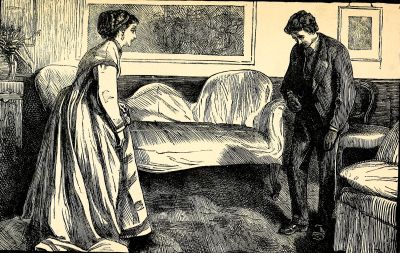
"SHE WAS CLEVER, PLEASANT, FAST—"
Sir Jonathan always ordered the dinner himself. He thought no woman was capable of that department of the household economy. Laura put on her hat—beautiful with a whole king-fisher—and they went out into the grounds to the stable—trim as her drawing-room—where her favorite horse ate apples out of her pocket; from the stable to the hothouses and kitchen-garden; then out at a back door into the lane—shadowy with trees—in which other colors than green were now very near carrying the vote of the leaves. Sweet scents of decay filled the air, waved about, swelling and sinking, on the flow of a west wind, gentle and soft, as if it had been fanned from the wings of spring when nearest to summer. Great white clouds in a brilliant sky tempered the heat of the sun. What with the pure air, the fine light, and the handsome girl by his side, Thomas was in a gayer mood than had been his for many a long day. Miss Hubbard talked plenteously—about balls and theatres and Mansion House dinners, about Rotten Row, and St. James's; and although of all these Thomas knew very little, yet being quick and sympathetic, he was able to satisfy the lady sufficiently to keep her going. He was fortunate enough, besides, to say one or two clever things with which she was pleased, and to make an excellent point once in a criticism upon a girl they both knew, which, slighting her, conveyed, by no very occult implication, a compliment to Miss Hubbard. By the time they had reached this stage of acquaintanceship, they had left stout Sir Jonathan and Mr. Worboise far behind; but Miss Hubbard was not in the least danger of being made uncomfortable by any squeamish notions of propriety; and, having nothing more amusing to do, and being out already, she proposed that they should go home by a rather longer road, which would lead them over a hill whence they would get a good view of the country.
"Do you like living in the country, Miss Hubbard?"
"Oh! dear no. London for me. I can't tell what made papa come to this dull place."
"The scenery is very lovely, though."
"People say so. I'm sure I don't know. Scenery wasn't taught where I went to school."
"Were you taught horses there?" asked Thomas, slyly.
"No. That comes by nature. Do you know I won this bracelet in a handicap last Derby?" she said, showing a very fine arm as well as bracelet, though it was only the morning, so-called.
Miss Hubbard had no design upon Thomas. How could she have? She knew nothing about him. She would have done the same with any gentleman she liked well enough to chatter to. And if Thomas felt it and thought that Laura Hubbard was more entertaining than sober Lucy Burton, he made up to Lucy for it in his own idea by asserting to himself that, after all, she was far handsomer than Miss Hubbard, handsome as she was. Yet I should never think of calling Lucy handsome. She was lovely—almost beautiful, too. Handsome always indicates more or less vulgarity—no, I mean commonness—in my ears. And certainly, whatever she might be capable of, had she been blessed with poverty, Miss Hubbard was as common as she was handsome. Thomas was fool enough to revert to Byron to try his luck with that. She soon made him ashamed of showing any liking for such a silly thing as poetry. That piqued him as well, however.
"You sing, I suppose?" he said.
"Oh, yes, when I can't help it—after dinner, sometimes."
"Well, you sing poetry, don't you?"
"I don't know. One must have some words or other just to make her open her mouth. I never know what they're about. Why should I? Nobody ever pays the least attention to them—or to the music either, except it be somebody that wants to marry you."
But why should I go further with the record of such talk? It is not interesting to me, and, therefore, can hardly be so to my reader. Even if I had the art to set it forth aright, I hope I should yet hold to my present belief, that nothing in which the art is uppermost is worth the art expended upon it.
Thomas was a little shocked at her coolness, certainly; but at the same time that very coolness seemed a challenge. Before they had reached the house again, he was vexed to find he had made no impression upon Miss Hubbard.
Farewell to such fencing. By the time he had heard her sing, and his father and he were on their way home again, I am glad to say that Thomas had had nearly enough of her. He thought her voice loud and harsh in speech, showy and distressing in song, and her whole being bravura. The contrasts in Lucy had come back upon him with a gush of memorial loveliness; for, as I have said, she still held the fortress of his heart, and held it for its lawful owner.
Scarcely were they seated in the railway carriage, of which they were the sole occupants, when the elder Worboise threw a shot across the bows of the younger.
"Well, Tom, my boy," he said, rubbing his lawyer palms, "how do you like Miss Hubbard?"
"Oh, very well, father," answered Thomas, indifferently. "She's a very jolly sort of girl."
"She's worth a hundred thousand," said his father, in a tone that would have been dry but for a touch of slight resentment at the indifference, possibly in the father's view irreverence, with which he spoke of her.
"Girls?" asked Thomas.
"Pounds," answered his father, clenchingly.
Tom was now convinced of his father's design in taking him out for a holiday. But even now he shrunk from confession. And how did he justify his sneaking now? By saying to himself, "Lucy can't have anything like that money; it won't do. I must wait a more fitting opportunity." But he thought he was very brave indeed, and actually seizing the bull of his father's will by the horns when he ventured to take his meaning for granted, and replied:
"Why, father, a fellow has no chance with a girl like that, except he could ride like Assheton Smith, and knew all the slang of the hunting-field as well as the race-course."
"A few children will cure her of that," said his father.
"What I say is," persisted Thomas, "that she would never look at a clerk."
"If I thought you had any chance, I would buy you a commission in the Blues."
"It wants blue blood for that," said Thomas, whose heart, notwithstanding, danced in his bosom at the sound of commission. Then, afraid lest he should lose the least feather of such a chance, he added hastily, "But any regiment would do."
"I dare say," returned his father, at right angles. "When you have made a little progress it will be time enough. She knows nothing about what you are now. Her father asked me, and I said I had not made up my mind yet what to do with you."
"But, as I said before," resumed Thomas, fighting somewhat feebly, "I haven't a chance with her. She likes better to talk about horses than anything else, and I never had my leg across a horse's back in my life—as you know, father," he added in a tone of reproach.
"You mean, Tom, that I have neglected your education. Well, it shall be so no longer. You shall go to the riding-school on Monday night. It won't be open to-morrow, I suppose."
I hope my reader is not so tired of this chapter as I am. It is bad enough to have to read such uninteresting things—but to have to write them! The history that is undertaken must be written, however, whether the writer weary sometimes of his task, or the interest of his labor carry him lightly through to the close.
Thomas, wretched creature, dallied with his father's proposal. He did not intend accepting it, but the very idea of marrying a rich, fashionable girl like that, with a knight for a father, flattered him. Still more was he excited at the notion, the very possibility of wearing a uniform. And what might he not do with so much money? Then, when the thought of Lucy came, he soothed his conscience by saying to himself, "See, how much I must love her when I am giving up all this for her sake!" Still his thoughts hovered about what he said he was giving up. He went to bed on Sunday night, after a very pathetic sermon from Mr. Simon, with one resolution, and one only, namely, to go to the riding-school in Finsbury on Monday night.
But something very different was waiting him.
CHAPTER XXXII.
AN EXPLOSION.
The whole ground under Thomas's feet was honey-combed and filled with combustible matter. A spark dropped from any, even a loving hand, might send everything in the air. It needed not an enemy to do it.
Lucy Burton had been enjoying a delightful season of repose by the sea-side. She had just enough to do with and for the two children to gain healthy distraction to her thinking. But her thinking as well as her bodily condition grew healthier every day that she breathed the sea air. She saw more and more clearly than ever that things must not go on between her and Thomas as they were now going on. The very scent of the sea that came in at her bed-room window when she opened it in the morning, protested against it; the wind said it was no longer endurable; and the clear, blue autumn sky said it was a shame for his sake, if not for her own. She must not do evil that good might come; she must not allow Thomas to go on thus for the sake even of keeping a hold of him for his good. She would give him one chance more, an if he did not accept it, she would not see him again, let come of it what would. In better mood still, she would say, "Let God take care of that for him and me." She had not written to him since she came: that was one thing she could avoid. Now, she resolved that she would write to him just before her return, and tell him that the first thing she would say to him when she saw him would be—had he told his father? and upon his answer depended their future. But then the question arose, what address she was to put upon the letter; for she was not willing to write either to his home or to the counting-house for evident reasons. Nor had she come to any conclusion, and had indeed resolved to encounter him once more without having written, when from something rather incoherently expressed in her grandmother's last letter, which indeed referred to an expected absence of Mr. Stopper, who was now the old lady's main support, she concluded, hastily, I allow, that Mr. Worboise was from home, and that she might without danger direct a letter to Highbury.
Through some official at the Court of Probate, I fancy that Mr. Worboise had heard of a caveat having been entered with reference to the will of Mr. Richard Boxall, deceased. I do not know that this was the case, but I think something must have occurred to irritate him against those whom he, with the law on his side, was so sorely tempted to wrong. I know that the very contemplation of wrong is sufficient to irritate, and that very grievously, against one thus contemplated; but Lucy would have been a very good match, though not equal to Miss Hubbard, even in Mr. Worboise's eyes. On the other hand, however, if he could but make up, not his mind, but his conscience, to take Boxall's money, he would be so much the more likely to secure Miss Hubbard's; which, together with what he could leave him, would make a fortune over two hundred thousand—sufficient to make his son somebody. If Thomas had only spoken in time, that is, while his father's conscience still spoke, and before he had cast eyes of ambition toward Sir Jonathan's bankers! All that was wanted on the devil's side now was some personal quarrel with the rightful heirs; and if Mr. Worboise did not secure that by means of Mr. Sargent's caveat, he must have got it from what had happened on the Monday morning. Before Thomas came down to breakfast, the postman had delivered a letter addressed to him, with the Hastings postmark upon it.
When Thomas entered, and had taken his seat, on the heels of the usual cool Good-morning, his father tossed the letter to him across the table, saying, more carelessly than he felt:
"Who's your Hastings correspondent, Tom?"
The question, coming with the sight of Lucy's handwriting, made the eloquent blood surge into Tom's face. His father was not in the way of missing anything that there was to see, and he saw Tom's face.
"A friend of mine," stammered Tom. "Gone down for a holiday."
"One of your fellow-clerks?" asked his father, with a dry significance that indicated the possible neighborhood of annoyance, or worse. "I thought the writing of doubtful gender."
For Lucy's writing was not in the style of a field of corn in a hurricane: it had a few mistakable curves about it, though to the experienced eye it was nothing the less feminine that it did not affect feminity.
"No," faltered Tom, "he's not a clerk; he's a—well, he's a—teacher of music."
"Hm!" remarked Mr. Worboise. "How did you come to make his acquaintance, Tom?" And he looked at his son with awful eyes, lighted from behind with growing suspicion.
Tom felt his jaws growing paralyzed. His mouth was as dry as his hand, and it seemed as if his tongue would rattle in it like the clapper of a cracked bell if he tried to speak. But he had nothing to say. A strange tremor went through him from top to toe, making him conscious of every inch of his body at the very moment when his embarrassment might have been expected to make him forget it altogether. His father kept his eyes fixed on him, and Tom's perturbation increased every moment.
"I think, Tom, the best way out of your evident confusion will be to hand me over that letter," said his father, in a cool, determined tone, at the same time holding out his hand to receive it.
Tom had strength to obey only because he had not strength to resist. But he rose from his seat, and would have left the room.
"Sit down, sir," said Mr. Worboise, in a voice that revealed growing anger, though he could not yet have turned over the leaf to see the signature. In fact, he was more annoyed at his son's pusillanimity than at his attempted deception. "You make a soldier!" he added, in a tone of contempt that stung Tom—not to the heart, but to the backbone. When he had turned the leaf and saw the signature, he rose slowly from his chair and walked to the window, folding the letter as he went. After communing with the garden for awhile, he turned again to the table and sat down. It was not Mr. Worboise's way to go into a passion when he had anything like reasonable warning that his temper was in danger.
"Tom, you have been behaving like a fool. Thank heaven, it's not too late! How could you be such a fool? Believe me, it's not a safe amusement to go trifling with girls this way."
With a great effort, a little encouraged by the quietness of his father's manner, Tom managed to say, "I wasn't trifling."
"Do you mean to tell me," said his father, with more sternness than Tom had ever known him assume—"do you mean to tell me," he repeated, "that you have come under any obligation to this girl?"
"Yes, I have, father."
"You fool! A dress-maker is no fit match for you."
"She's not a dress-maker," said Tom, with some energy, for he was beginning to grow angry, and that alone could give a nature like his courage in such circumstances; "she's a lady, if ever there was one."
"Stuff and nonsense!" said his father. "Don't get on your high horse with me. She's a beggar, if ever there was one."
Tom smiled unbelievingly, or tried to smile; for now his tremor, under the influence of his wholesome anger, had abated, and his breath began to come and go more naturally. A little more, and he would feel himself a hero, stoutly defending his lady-love, fearless of consequences to himself. But he said nothing more just yet.
"You know better than I do, you think, you puppy! I tell you she's not worth a penny—no, nor her old witch of a grandmother, either. A pretty mess you've made of it! You just sit down and tell the poor girl—it's really too bad of you, Tom!—that you're sorry you've been such a confounded fool, but there's no help for it."
"Why should I say that?"
"Because it's true. By all that's sacred!" said Mr. Worboise, with solemn fierceness, "you give up that girl, or you give up me. Not that your father is anything to you: but I swear, if you carry on with that girl, you shall not cross my door as long as you do; and not a penny you shall have out of my pocket. You'll have to live on your salary, my fine fellow, and perhaps that'll bring down your proud stomach a bit. By Jove! You may starve for me. Come, my boy," he added with sudden gentleness, "don't be a fool."
Whether Mr. Worboise meant all he said, I cannot tell, but at least he meant Thomas to believe that he did. And Thomas did believe it. All the terrible contrast between a miserable clerkship, with lodging as well as food to be provided, and a commission in the army with unlimited pocket-money, and the very name of business forgotten, rose before him. A conflict began within him which sent all the blood to the surface of his body, and made him as hot now as he had been cold just before. He again rose from his seat, and this time his father, who saw that he had aimed well, did not prevent him from leaving the room. He only added as his son reached the door, "Mark what I say, Tom: I mean it; and when I mean a thing, it's not my fault if it's not done. You can go to the riding-school to-night, or you can look out for a lodging suitable to your means. I should recommend Wapping."
Thomas stood on the heel of one foot and the toes of the other, holding the handle of the door in his hand till his father had done speaking. He then left the room, without reply, closed the door behind him, took his hat and went out. He was half way to London before he remembered that he had left Lucy's letter in his father's hands and had not even read it. This crowned his misery. He dared not go back for it; but the thought of Lucy's words to him being at the mercy of his hard-hearted father moved him so, that he almost made up his mind never to enter the house again. And then how Lucy must love him when he had given up everything for her sake, knowing quite well, too, that she was not going to have any fortune after all? But he did not make up his mind; he never had made up his mind yet; or, if he had, he unmade it again upon meeting with the least difficulty. And now his whole "state of man" was in confusion. He went into the counting-house as if he had been walking in a dream, sat down to his desk mechanically, droned through the forenoon, had actually only a small appetite for his dinner, and when six o'clock arrived, and the place was closed, knew no more what he was going to do than when he started out in the morning.
But he neither went to the riding-school in Finsbury, nor to look for a lodging in Wapping.
CHAPTER XXXIII.
DOWN AT LAST.
In the very absence of purpose, he strolled up Guild Court to call upon Molken, who was always at home at that hour.
Molken welcomed him even more heartily than usual. After a few minutes' conversation they went out together: having no plan of his own, Thomas was in the hands of any one who had a plan of which he formed a part. They betook themselves to one of their usual haunts. It was too early yet for play, so they called for some refreshment, and Thomas drank more than he had ever drunk before, not with any definite idea of drowning the trouble in his mind, but sipping and sipping from mere restlessness and the fluttering motion of a will unable to act.
It was a cold evening. An autumn wind which had dropped in its way all the now mournful memories of nature, and was itself the more dreary therefore, tumbled a stray billow now and then through the eddies of its chimney-rocks and housetop-shoals upon the dirty window of the little dreary den in which they sat, drinking their gin and water at a degraded card-table whose inlaid borders were not yet quite obscured by the filth caked upon it from greasy fingers and dusters dirtier than the smoke they would remove. They talked—not about gaming—no: they talked about politics and poetry; about Goethe and Heine; and Molken exerted all his wit and sympathy to make himself agreeable to his dejected friend, urging him to rise above his dejection by an effort of the will; using, in fact, much the same arguments as Lady Macbeth when she tried to persuade her husband that the whole significance of things depended on how he chose to regard them: "These things must not be thought after these ways." Thomas, however, had not made a confidant of Molken. He had only dropped many words that a man like him would not fail to piece together into some theory regarding the condition and circumstances of one of whom he meant to make gain.
At length, what between Molken's talk and the gin, a flame of excitement began to appear in Thomas's weary existence; and almost at the same instant a sound of voices and footsteps was heard below; they came up the stair; the door of the room opened; and several fellows entered, all eager for the excitement of play as a drunkard for his drink, all talking, laughing, chaffing. A blast of wind laden with rain from a laboring cloud which had crept up from the west and darkened the place, smote on the windows, and soft yet keen the drops pattered on the glass. All outside was a chaos of windy mist and falling rain. They called for lights, and each man ordered his favorite drink; the face of Nature, who was doing her best to befriend them, was shut out by a blind of green and black stripes stained with yellow; two dirty packs of cards were produced—not from the pocket of any of the company, for none of the others would have trusted such a derivation, but from the archives of the house; and, drawing round the table, they began to offer their sacrifice to the dreary excitement for whose presence their souls had been thirsting all the day. Two of them besides Molken were foreigners, one of them apparently a German, a very quiet and rather a gentlemanly man, between whom and Molken, however, if Thomas had been on the outlook, he might, I fancy, have seen certain looks of no good omen interchanged.
They began playing very gently—and fairly no doubt; and Thomas for some time went on winning.
There was not even the pretense of much money among them. Probably a few gold pieces was the most any of them had. When one of them had made something at this sort of small private game, he would try his luck at one of the more public tables, I presume. As the game went on and they grew more excited, they increased their stakes a little. Still they seemed content to go on for a little. Thomas and Molken were partners, and still they won. Gradually the points were increased, and betting began. Thomas began to lose and lose, of course, more rapidly than he had won. He had had two or three pounds in his pocket when he began, but all went now—the last of it in a bet on the odd trick. He borrowed of Molken—lost; borrowed and lost, still sipping his gin and water, till Molken declared he had himself lost everything. Thomas laid his watch on the table, for himself and Molken—it was not of great value—a gift of his mother only. He lost it. What was to be done? He had one thing left—a ring of some value which Lucy had given him to wear for her. It had belonged to her mother. He pulled it off his finger, showed that it was a rose diamond, and laid it on the table. It followed the rest. He rose, caught up his hat, and, as so many thousands of gamblers have done before, rushed out into the rain and the darkness.
Through all the fumes of the gin which had begun to render "the receipt of reason a limbeck only," the thought gleamed upon his cloudy mind that he ought to have received his quarter's salary that very day. If he had had that, what might he not have done? It was his, and yet he could not have it. His mind was all in a confused despair, ready to grasp at anything that offered him a chance of winning back what he had lost. If he had gone home and told his father—but he was not capable of reasoning out anything. Lucy's ring was his chief misery: so much must be said for him. Something—he did not know what—drove him toward Guild Court. I believe, though in his after reflections he could not identify the impulse, that it was the same which he obeyed at last. Before he knew where he was going, he was at Mrs. Boxall's door. He found it ajar, and walked up the stair to the sitting-room. That door too was open, and there was no one there. But he saw at a glance, from the box on the floor and the shawl on the table, that Lucy had returned, and he supposed that her grandmother had gone up stairs with her. The same moment his eyes sought the wall, and there hung two keys. They were the keys of the door of communication and of the safe.
Mr. Stopper, wise in his generation, sought, as we have seen, to stand as well as possible with the next of kin and supposed heir to Mr. Boxall, namely, his mother. He had, therefore, by degrees, made himself necessary to her, in her fancy at least, by giving her good advice till she thought she could not do without his wisdom. Nor that alone; he had pleased her by a hundred little acknowledgments of her suzerainty, especially grateful to one who loved power as Mrs. Boxall did. Among the rest, one evening, after locking up the counting-house, he went to her with those two keys in his hand, and kept playing with them till he was taking his leave—then, as if a sudden thought had struck him, said:
"But I don't see the use of troubling myself with these keys. I may as well hang them up somewhere," he added, looking about for a place.
"I don't know that it's wise to leave them here," objected Mrs. Boxall.
"Oh! don't be uneasy, ma'am," returned Mr. Stopper. "You mustn't suppose we leave a mint of money in the house at night. If we did, you wouldn't be safe either. It's only what comes in after banking-hours—a matter of ten pounds, or thereabouts, sometimes more, sometimes less. The safe's more for the books—in case of fire, you know."
"I hope there's no danger of that, Mr. Stopper."
"Not as long as the neighbors don't take fire. I see every spark out when we have a fire before I turn my back on the premises. Indeed, I'm rather more careful over the fire than the cash-box."
In the meantime Mr. Stopper had discovered a brass-headed nail in the wall, and thereupon he had hung the keys, and there he had hung them every evening since, and there they hung at this moment when Thomas's eyes went in search of them.
When he considered the whole affair afterward, Thomas thought he must have been driven by a demon. He hardly knew whether he was thinking over or doing the thing that was present to him. No thought of resisting it as a temptation arose to meet it. He knew that there was eleven pounds odd shillings in the cash box, for he had seen one of the other clerks count it; he knew that the cash-box was in the safe; he knew that that was the key of it; he knew that the firm owed him twenty-five pounds; he could replace it again before the morning; and while thinking all this he was "doing the effect of his thinking," almost without knowing it: he found himself standing before the safe with the key already in the lock, and the cold handle of the door in his hand. But it was dark all around and within him. In there alone lay light and hope. In another moment the door was open, and the contents of the cash-box—gold, silver, copper—in his pocket. It is possible that even then he might have restored the money if he had not heard the step of the policeman at the street-door. He left the safe open as it was, with the key in it, and sped from the house.
Nothing more marked itself on his memory till he reached the room where he had left his friends. It was dark. There was no one there. They had gone to try their luck in a more venturous manner, where rogue met rogue, and fortune was umpire rather than cunning. He knew their haunts, followed and found them. But his watch and ring were gone. They told him, however, where they were. He would go and seek them to-morrow. Meantime he would play. He staked and lost—lost, won, won again; doubled his stakes, won still; and when he left the house it was with a hundred pounds in his pocket and a gray dawn of wretchedness in his heart.
CHAPTER XXXIV.
MRS. BOXALL AND MR. STOPPER.
Lucy was not up stairs with her grandmother when Thomas went into the room. She had arrived some time before, and had ran across to the bookseller's to put Mattie to bed, according to promise, leaving the door just ajar that she might not trouble her grandmother to come down and open it for her. She had come home hoping against hope that Thomas must by this time have complied, in some way or other, with her request—must have written to his father, or, at least, so positively made up his mind to tell him on his return, that he would be at the station to meet her with the assurance, or would appear in Guild Court some time during the evening with a response to her earnest appeal. When she had put the child to bed, she lingered a few moments with the bookseller in his back parlor, for the shop was shut up, telling him about Mattie, and listening to what little bits of news the worthy man had to impart in return. Their little chat ran something in this way: