Front matter
James Strachey translation
THE INTERNATIONAL PSYCHO-ANALYTICAL LIBRARY No. 6
GROUP PSYCHOLOGY AND THE ANALYSIS OF THE EGO
BY SIGM. FREUD, M. D., LL. D.
AUTHORIZED TRANSLATION BY JAMES STRACHEY

THE INTERNATIONAL PSYCHO-ANALYTICAL PRESS LONDON MCMXXII VIENNA
Copyright 1922
TRANSLATOR'S NOTE
A comparison of the following pages with the German original (Massenpsychologie und Ich-Analyse, Internationaler Psychoanalytischer Verlag, Vienna, 1921) will show that certain passages have been transferred in the English version from the text to the footnotes. This alteration has been carried out at the author's express desire.
All technical terms have been translated in accordance with the Glossary to be published as a supplement to the International Journal of Psycho-Analysis.
J. S.
CONTENTS
Page
IIntroduction 1
IILe Bon's Description of the Group Mind5
IIIOther Accounts of Collective Mental Life23
IVSuggestion and Libido33
VTwo Artificial Groups: the Church and the Army41
VIFurther Problems and Lines of Work52
VIIIdentification60
VIIIBeing in Love and Hypnosis71
IXThe Herd Instinct81
XThe Group and the Primal Horde90
XIA Differentiating Grade in the Ego101
XIIPostscript110
Index
GROUP PSYCHOLOGY AND THE ANALYSIS OF THE EGO
I INTRODUCTION
The contrast between Individual Psychology and Social or Group[1] Psychology, which at a first glance may seem to be full of significance, loses a great deal of its sharpness when it is examined more closely. It is true that Individual Psychology is concerned with the individual man and explores the paths by which he seeks to find satisfaction for his instincts; but only rarely and under certain exceptional conditions is Individual Psychology in a position to disregard the relations of this individual to others. In the individual's mental life someone else is invariably involved, as a model, as an object, as a helper, as an opponent, and so from the very first Individual Psychology is at the same time Social Psychology as well—in this extended but entirely justifiable sense of the words.
The relations of an individual to his parents and to his brothers and sisters, to the object of his love, and to his physician—in fact all the relations which have hitherto been the chief subject of psycho-analytic research—may claim to be considered as social phenomena; and in this respect they may be contrasted with certain other processes, described by us as 'narcissistic', in which the satisfaction of the instincts is partially or totally withdrawn from the influence of other people. The contrast between social and narcissistic—Bleuler would perhaps call them 'autistic'—mental acts therefore falls wholly within the domain of Individual Psychology, and is not well calculated to differentiate it from a Social or Group Psychology.
The individual in the relations which have already been mentioned—to his parents and to his brothers and sisters, to the person he is in love with, to his friend, and to his physician—comes under the influence of only a single person, or of a very small number of persons, each one of whom has become enormously important to him. Now in speaking of Social or Group Psychology it has become usual to leave these relations on one side and to isolate as the subject of inquiry the influencing of an individual by a large number of people simultaneously, people with whom he is connected by something, though otherwise they may in many respects be strangers to him. Group Psychology is therefore concerned with the individual man as a member of a race, of a nation, of a caste, of a profession, of an institution, or as a component part of a crowd of people who have been organised into a group at some particular time for some definite purpose. When once natural continuity has been severed in this way, it is easy to regard the phenomena that appear under these special conditions as being expressions of a special instinct that is not further reducible, the social instinct ('herd instinct', 'group mind'), which does not come to light in any other situations. But we may perhaps venture to object that it seems difficult to attribute to the factor of number a significance so great as to make it capable by itself or arousing in our mental life a new instinct that is otherwise not brought into play. Our expectation is therefore directed towards two other possibilities: that the social instinct may not be a primitive one and insusceptible of dissection, and that it may be possible to discover the beginnings of its development in a narrower circle, such as that of the family.
Although Group Psychology is only in its infancy, it embraces an immense number of separate issues and offers to investigators countless problems which have hitherto not even been properly distinguished from one another. The mere classification of the different forms of group formation and the description of the mental phenomena produced by them require a great expenditure of observation and exposition, and have already given rise to a copious literature. Anyone who compares the narrow dimensions of this little book with the extent of Group Psychology will at once be able to guess that only a few points chosen from the whole material are to be dealt with here. And they will in fact only be a few questions with which the depth-psychology of psycho-analysis is specially concerned.
II LE BON'S DESCRIPTION OF THE GROUP MIND
Instead of starting from a definition, it seems more useful to begin with some indication of the range of the phenomena under review, and to select from among them a few specially striking and characteristic facts to which our inquiry can be attached. We can achieve both of these aims by means of quotation from Le Bon's deservedly famous work Psychologie des foules.[2]
Let us make the matter clear once again. If a Psychology, concerned with exploring the predispositions, the instincts, the motives and the aims of an individual man down to his actions and his relations with those who are nearest to him, had completely achieved its task, and had cleared up the whole of these matters with their inter-connections, it would then suddenly find itself confronted by a new task which would lie before it unachieved. It would be obliged to explain the surprising fact that under a certain condition this individual whom it had come to understand thought, felt, and acted in quite a different way from what would have been expected. And this condition is his insertion into a collection of people which has acquired the characteristic of a 'psychological group'. What, then, is a 'group'? How does it acquire the capacity for exercising such a decisive influence over the mental life of the individual? And what is the nature of the mental change which it forces upon the individual?
It is the task of a theoretical Group Psychology to answer these three questions. The best way of approaching them is evidently to start with the third. Observation of the changes in the individual's reactions is what provides Group Psychology with its material; for every attempt at an explanation must be preceded by a description of the thing that is to be explained.
I will now let Le Bon speak for himself. He says: 'The most striking peculiarity presented by a psychological group[3] is the following. Whoever be the individuals that compose it, however like or unlike be their mode of life, their occupations, their character, or their intelligence, the fact that they have been transformed into a group puts them in possession of a sort of collective mind which makes them feel, think, and act in a manner quite different from that in which each individual of them would feel, think, and act were he in a state of isolation. There are certain ideas and feelings which do not come into being, or do not transform themselves into acts except in the case of individuals forming a group. The psychological group is a provisional being formed of heterogeneous elements, which for a moment are combined, exactly as the cells which constitute a living body form by their reunion a new being which displays characteristics very different from those possessed by each of the cells singly.' (p. 29.)[4]
We shall take the liberty of interrupting Le Bon's exposition with glosses of our own, and shall accordingly insert an observation at this point. If the individuals in the group are combined into a unity, there must surely be something to unite them, and this bond might be precisely the thing that is characteristic of a group. But Le Bon does not answer this question; he goes on to consider the alteration which the individual undergoes when in a group and describes it in terms which harmonize well with the fundamental postulates of our own depth-psychology.
'It is easy to prove how much the individual forming part of a group differs from the isolated individual, but it is less easy to discover the causes of this difference.
'To obtain at any rate a glimpse of them it is necessary in the first place to call to mind the truth established by modern psychology, that unconscious phenomena play an altogether preponderating part not only in organic life, but also in the operations of the intelligence. The conscious life of the mind is of small importance in comparison with its unconscious life. The most subtle analyst, the most acute observer, is scarcely successful in discovering more than a very small number of the conscious[5] motives that determine his conduct. Our conscious acts are the outcome of an unconscious substratum created in the mind in the main by hereditary influences. This substratum consists of the innumerable common characteristics handed down from generation to generation, which constitute the genius of a race. Behind the avowed causes of our acts there undoubtedly lie secret causes that we do not avow, but behind these secret causes there are many others more secret still, of which we ourselves are ignorant.[6] The greater part of our daily actions are the result of hidden motives which escape our observation.' (p. 30.)
Le Bon thinks that the particular acquirements of individuals become obliterated in a group, and that in this way their distinctiveness vanishes. The racial unconscious emerges; what is heterogeneous is submerged in what is homogeneous. We may say that the mental superstructure, the development of which in individuals shows such dissimilarities, is removed, and that the unconscious foundations, which are similar in everyone, stand exposed to view.
In this way individuals in a group would come to show an average character. But Le Bon believes that they also display new characteristics which they have not previously possessed, and he seeks the reason for this in three different factors.
'The first is that the individual forming part of a group acquires, solely from numerical considerations, a sentiment of invincible power which allows him to yield to instincts which, had he been alone, he would perforce have kept under restraint. He will be the less disposed to check himself from the consideration that, a group being anonymous, and in consequence irresponsible, the sentiment of responsibility which always controls individuals disappears entirely.' (p. 33.)
From our point of view we need not attribute so much importance to the appearance of new characteristics. For us it would be enough to say that in a group the individual is brought under conditions which allow him to throw off the repressions of his unconscious instincts. The apparently new characteristics which he then displays are in fact the manifestations of this unconscious, in which all that is evil in the human mind is contained as a predisposition. We can find no difficulty in understanding the disappearance of conscience or of a sense of responsibility in these circumstances. It has long been our contention that 'dread of society [soziale Angst]' is the essence of what is called conscience.[7]
'The second cause, which is contagion, also intervenes to determine the manifestation in groups of their special characteristics, and at the same time the trend they are to take. Contagion is a phenomenon of which it is easy to establish the presence, but that it is not easy to explain. It must be classed among those phenomena of a hypnotic order, which we shall shortly study. In a group every sentiment and act is contagious, and contagious to such a degree that an individual readily sacrifices his personal interest to the collective interest. This is an aptitude very contrary to his nature, and of which a man is scarcely capable, except when he makes part of a group.' (p. 33.)
We shall later on base an important conjecture upon this last statement.
'A third cause, and by far the most important, determines in the individuals of a group special characteristics which are quite contrary at times to those presented by the isolated individual. I allude to that suggestibility of which, moreover, the contagion mentioned above is only an effect.
'To understand this phenomenon it is necessary to bear in mind certain recent physiological discoveries. We know to-day that by various processes an individual may be brought into such a condition that, having entirely lost his conscious personality, he obeys all the suggestions of the operator who has deprived him of it, and commits acts in utter contradiction with his character and habits. The most careful investigations seem to prove that an individual immersed for some length of time in a group in action soon finds himself—either in consequence of the magnetic influence given out by the group, or from some other cause of which we are ignorant—in a special state, which much resembles the state of fascination in which the hypnotised individual finds himself in the hands of the hypnotiser.... The conscious personality has entirely vanished; will and discernment are lost. All feelings and thoughts are bent in the direction determined by the hypnotiser.
'Such also is approximately the state of the individual forming part of a psychological group. He is no longer conscious of his acts. In his case, as in the case of the hypnotised subject, at the same time that certain faculties are destroyed, others may be brought to a high degree of exaltation. Under the influence of a suggestion, he will undertake the accomplishment of certain acts with irresistible impetuosity. This impetuosity is the more irresistible in the case of groups than in that of the hypnotised subject, from the fact that, the suggestion being the same for all the individuals of the group, it gains in strength by reciprocity.' (p. 34.)
'We see, then, that the disappearance of the conscious personality, the predominance of the unconscious personality, the turning by means of suggestion and contagion of feelings and ideas in an identical direction, the tendency to immediately transform the suggested ideas into acts; these, we see, are the principal characteristics of the individual forming part of a group. He is no longer himself, but has become an automaton who has ceased to be guided by his will.' (p. 35.)
I have quoted this passage so fully in order to make it quite clear that Le Bon explains the condition of an individual in a group as being actually hypnotic, and does not merely make a comparison between the two states. We have no intention of raising any objection at this point, but wish only to emphasize the fact that the two last causes of an individual becoming altered in a group (the contagion and the heightened suggestibility) are evidently not on a par, since the contagion seems actually to be a manifestation of the suggestibility. Moreover the effects of the two factors do not seem to be sharply differentiated in the text of Le Bon's remarks. We may perhaps best interpret his statement if we connect the contagion with the effects of the individual members of the group upon one another, while we point to another source for those manifestations of suggestion in the group which are put on a level with the phenomena of hypnotic influence. But to what source? We cannot avoid being struck with a sense of deficiency when we notice that one of the chief elements of the comparison, namely the person who is to replace the hypnotist in the case of the group, is not mentioned in Le Bon's exposition. But he nevertheless distinguishes between this influence of fascination which remains plunged in obscurity and the contagious effect which the individuals exercise upon one another and by which the original suggestion is strengthened.
Here is yet another important consideration for helping us to understand the individual in a group: 'Moreover, by the mere fact that he forms part of an organised group, a man descends several rungs in the ladder of civilisation. Isolated, he may be a cultivated individual; in a crowd, he is a barbarian—that is, a creature acting by instinct. He possesses the spontaneity, the violence, the ferocity, and also the enthusiasm and heroism of primitive beings.' (p. 36.) He then dwells especially upon the lowering in intellectual ability which an individual experiences when he becomes merged in a group.[8]
Let us now leave the individual, and turn to the group mind, as it has been outlined by Le Bon. It shows not a single feature which a psycho-analyst would find any difficulty in placing or in deriving from its source. Le Bon himself shows us the way by pointing to its similarity with the mental life of primitive people and of children (p. 40).
A group is impulsive, changeable and irritable. It is led almost exclusively by the unconscious.[9] The impulses which a group obeys may according to circumstances be generous or cruel, heroic or cowardly, but they are always so imperious that no personal interest, not even that of self-preservation, can make itself felt (p. 41). Nothing about it is premeditated. Though it may desire things passionately, yet this is never so for long, for it is incapable of perseverance. It cannot tolerate any delay between its desire and the fulfilment of what it desires. It has a sense of omnipotence; the notion of impossibility disappears for the individual in a group.[10]
A group is extraordinarily credulous and open to influence, it has no critical faculty, and the improbable does not exist for it. It thinks in images, which call one another up by association (just as they arise with individuals in states of free imagination), and whose agreement with reality is never checked by any reasonable function [Instanz].[11] The feelings of a group are always very simple and very exaggerated. So that a group knows neither doubt nor uncertainty.[12]
It goes directly to extremes; if a suspicion is expressed, it is instantly changed into an incontrovertible certainty; a trace of antipathy is turned into furious hatred (p. 56).[13]
Inclined as it itself is to all extremes, a group can only be excited by an excessive stimulus. Anyone who wishes to produce an effect upon it needs no logical adjustment in his arguments; he must paint in the most forcible colours, he must exaggerate, and he must repeat the same thing again and again.
Since a group is in no doubt as to what constitutes truth or error, and is conscious, moreover, of its own great strength, it is as intolerant as it is obedient to authority. It respects force and can only be slightly influenced by kindness, which it regards merely as a form of weakness. What it demands of its heroes is strength, or even violence. It wants to be ruled and oppressed and to fear its masters. Fundamentally it is entirely conservative, and it has a deep aversion from all innovations and advances and an unbounded respect for tradition (p. 62).
In order to make a correct judgement upon the morals of groups, one must take into consideration the fact that when individuals come together in a group all their individual inhibitions fall away and all the cruel, brutal and destructive instincts, which lie dormant in individuals as relics of a primitive epoch, are stirred up to find free gratification. But under the influence of suggestion groups are also capable of high achievements in the shape of abnegation, unselfishness, and devotion to an ideal. While with isolated individuals personal interest is almost the only motive force, with groups it is very rarely prominent. It is possible to speak of an individual having his moral standards raised by a group (p. 65). Whereas the intellectual capacity of a group is always far below that of an individual, its ethical conduct may rise as high above his as it may sink deep below it.
Some other features in Le Bon's description show in a clear light how well justified is the identification of the group mind with the mind of primitive people. In groups the most contradictory ideas can exist side by side and tolerate each other, without any conflict arising from the logical contradiction between them. But this is also the case in the unconscious mental life of individuals, of children and of neurotics, as psycho-analysis has long pointed out.[14]
A group, further, is subject to the truly magical power of words; they can evoke the most formidable tempests in the group mind, and are also capable of stilling them (p. 117). 'Reason and arguments are incapable of combating certain words and formulas. They are uttered with solemnity in the presence of groups, and as soon as they have been pronounced an expression of respect is visible on every countenance, and all heads are bowed. By many they are considered as natural forces, as supernatural powers.' (p. 117.) It is only necessary in this connection to remember the taboo upon names among primitive people and the magical powers which they ascribe to names and words.[15]
And, finally, groups have never thirsted after truth. They demand illusions, and cannot do without them. They constantly give what is unreal precedence over what is real; they are almost as strongly influenced by what is untrue as by what is true. They have an evident tendency not to distinguish between the two (p. 77).
We have pointed out that this predominance of the life of phantasy and of the illusion born of an unfulfilled wish is the ruling factor in the psychology of neuroses. We have found that what neurotics are guided by is not ordinary objective reality but psychological reality. A hysterical symptom is based upon phantasy instead of upon the repetition of real experience, and the sense of guilt in an obsessional neurosis is based upon the fact of an evil intention which was never carried out. Indeed, just as in dreams and in hypnosis, in the mental operations of a group the function for testing the reality of things falls into the background in comparison with the strength of wishes with their affective cathexis.[16]
What Le Bon says on the subject of leaders of groups is less exhaustive, and does not enable us to make out an underlying principle so clearly. He thinks that as soon as living beings are gathered together in certain numbers, no matter whether they are a herd of animals or a collection of human beings, they place themselves instinctively under the authority of a chief (p. 134). A group is an obedient herd, which could never live without a master. It has such a thirst for obedience that it submits instinctively to anyone who appoints himself its master.
Although in this way the needs of a group carry it half-way to meet the leader, yet he too must fit in with it in his personal qualities. He must himself be held in fascination by a strong faith (in an idea) in order to awaken the group's faith; he must possess a strong and imposing will, which the group, which has no will of its own, can accept from him. Le Bon then discusses the different kinds of leaders, and the means by which they work upon the group. On the whole he believes that the leaders make themselves felt by means of the ideas in which they themselves are fanatical believers.
Moreover, he ascribes both to the ideas and to the leaders a mysterious and irresistible power, which he calls 'prestige'. Prestige is a sort of domination exercised over us by an individual, a work or an idea. It entirely paralyses our critical faculty, and fills us with astonishment and respect. It would seem to arouse a feeling like that of fascination in hypnosis (p. 148). He distinguishes between acquired or artificial and personal prestige. The former is attached to persons in virtue of their name, fortune and reputation, and to opinions, works of art, etc., in virtue of tradition. Since in every case it harks back to the past, it cannot be of much help to us in understanding this puzzling influence. Personal prestige is attached to a few people, who become leaders by means of it, and it has the effect of making everything obey them as though by the operation of some magnetic magic. All prestige, however, is also dependent upon success, and is lost in the event of failure (p. 159).
We cannot feel that Le Bon has brought the function of the leader and the importance of prestige completely into harmony with his brilliantly executed picture of the group mind.
III OTHER ACCOUNTS OF COLLECTIVE MENTAL LIFE
We have made use of Le Bon's description by way of introduction, because it fits in so well with our own Psychology in the emphasis which it lays upon unconscious mental life. But we must now add that as a matter of fact none of that author's statements bring forward anything new. Everything that he says to the detriment and depreciation of the manifestations of the group mind had already been said by others before him with equal distinctness and equal hostility, and has been repeated in unison by thinkers, statesmen and writers since the earliest periods of literature.[17] The two theses which comprise the most important of Le Bon's opinions, those touching upon the collective inhibition of intellectual functioning and the heightening of affectivity in groups, had been formulated shortly before by Sighele.[18] At bottom, all that is left over as being peculiar to Le Bon are the two notions of the unconscious and of the comparison with the mental life of primitive people, and even these had naturally often been alluded to before him.
But, what is more, the description and estimate of the group mind as they have been given by Le Bon and the rest have not by any means been left undisputed. There is no doubt that all the phenomena of the group mind which have just been mentioned have been correctly observed, but it is also possible to distinguish other manifestations of the group formation, which operate in a precisely opposite sense, and from which a much higher opinion of the group mind must necessarily follow.
Le Bon himself was prepared to admit that in certain circumstances the morals of a group can be higher than those of the individuals that compose it, and that only collectivities are capable of a high degree of unselfishness and devotion. 'While with isolated individuals personal interest is almost the only motive force, with groups it is very rarely prominent.' (p. 65.) Other writers adduce the fact that it is only society which prescribes any ethical standards at all for the individual, while he as a rule fails in one way or another to come up to its high demands. Or they point out that in exceptional circumstances there may arise in communities the phenomenon of enthusiasm, which has made the most splendid group achievements possible.
As regards intellectual work it remains a fact, indeed, that great decisions in the realm of thought and momentous discoveries and solutions of problems are only possible to an individual, working in solitude. But even the group mind is capable of genius in intellectual creation, as is shown above all by language itself, as well as by folk-song, folk-lore and the like. It remains an open question, moreover, how much the individual thinker or writer owes to the stimulation of the group in which he lives, or whether he does more than perfect a mental work in which the others have had a simultaneous share.
In face of these completely contradictory accounts, it looks as though the work of Group Psychology were bound to come to an ineffectual end. But it is easy to find a more hopeful escape from the dilemma. A number of very different formations have probably been merged under the term 'group' and may require to be distinguished. The assertions of Sighele, Le Bon and the rest relate to groups of a short-lived character, which some passing interest has hastily agglomerated out of various sorts of individuals. The characteristics of revolutionary groups, and especially those of the great French Revolution, have unmistakably influenced their descriptions. The opposite opinions owe their origin to the consideration of those stable groups or associations in which mankind pass their lives, and which are embodied in the institutions of society. Groups of the first kind stand in the same sort of relation to those of the second as a high but choppy sea to a ground swell.
McDougall, in his book on The Group Mind,[19] starts out from the same contradiction that has just been mentioned, and finds a solution for it in the factor of organisation. In the simplest case, he says, the 'group' possesses no organisation at all or one scarcely deserving the name. He describes a group of this kind as a 'crowd'. But he admits that a crowd of human beings can hardly come together without possessing at all events the rudiments of an organisation, and that precisely in these simple groups many of the fundamental facts of Collective Psychology can be observed with special ease (p. 22). Before the members of a random crowd of people can constitute something in the nature of a group in the psychological sense of the word, a condition has to be fulfilled; these individuals must have something in common with one another, a common interest in an object, a similar emotional bias in some situation or other, and ('consequently', I should like to interpolate) 'some degree of reciprocal influence' (p. 23). The higher the degree of 'this mental homogeneity', the more readily do the individuals form a psychological group, and the more striking are the manifestations of a group mind.
The most remarkable and also the most important result of the formation of a group is the 'exaltation or intensification of emotion' produced in every member of it (p. 24). In McDougall's opinion men's emotions are stirred in a group to a pitch that they seldom or never attain under other conditions; and it is a pleasurable experience for those who are concerned to surrender themselves so unreservedly to their passions and thus to become merged in the group and to lose the sense of the limits of their individuality. The manner in which individuals are thus carried away by a common impulse is explained by McDougall by means of what he calls the 'principle of direct induction of emotion by way of the primitive sympathetic response' (p. 25), that is, by means of the emotional contagion with which we are already familiar. The fact is that the perception of the signs of an emotional state is calculated automatically to arouse the same emotion in the person who perceives them. The greater the number of people in whom the same emotion can be simultaneously observed, the stronger does this automatic compulsion grow. The individual loses his power of criticism, and lets himself slip into the same emotion. But in so doing he increases the excitement of the other people, who had produced this effect upon him, and thus the emotional charge of the individuals becomes intensified by mutual interaction. Something is unmistakably at work in the nature of a compulsion to do the same as the others, to remain in harmony with the many. The coarser and simpler emotions are the more apt to spread through a group in this way (p. 39).
This mechanism for the intensification of emotion is favoured by some other influences which emanate from groups. A group impresses the individual with a sense of unlimited power and of insurmountable peril. For the moment it replaces the whole of human society, which is the wielder of authority, whose punishments the individual fears, and for whose sake he has submitted to so many inhibitions. It is clearly perilous for him to put himself in opposition to it, and it will be safer to follow the example of those around him and perhaps even 'hunt with the pack'. In obedience to the new authority he may put his former 'conscience' out of action, and so surrender to the attraction of the increased pleasure that is certainly obtained from the removal of inhibitions. On the whole, therefore, it is not so remarkable that we should see an individual in a group doing or approving things which he would have avoided in the normal conditions of life; and in this way we may even hope to clear up a little of the mystery which is so often covered by the enigmatic word 'suggestion'.
McDougall does not dispute the thesis as to the collective inhibition of intelligence in groups (p. 41). He says that the minds of lower intelligence bring down those of a higher order to their own level. The latter are obstructed in their activity, because in general an intensification of emotion creates unfavourable conditions for sound intellectual work, and further because the individuals are intimidated by the group and their mental activity is not free, and because there is a lowering in each individual of his sense of responsibility for his own performances.
The judgement with which McDougall sums up the psychological behaviour of a simple 'unorganised' group is no more friendly than that of Le Bon. Such a group 'is excessively emotional, impulsive, violent, fickle, inconsistent, irresolute and extreme in action, displaying only the coarser emotions and the less refined sentiments; extremely suggestible, careless in deliberation, hasty in judgment, incapable of any but the simpler and imperfect forms of reasoning; easily swayed and led, lacking in self-consciousness, devoid of self-respect and of sense of responsibility, and apt to be carried away by the consciousness of its own force, so that it tends to produce all the manifestations we have learnt to expect of any irresponsible and absolute power. Hence its behaviour is like that of an unruly child or an untutored passionate savage in a strange situation, rather than like that of its average member; and in the worst cases it is like that of a wild beast, rather than like that of human beings.' (p. 45.)
Since McDougall contrasts the behaviour of a highly organised group with what has just been described, we shall be particularly interested to learn in what this organisation consists, and by what factors it is produced. The author enumerates five 'principal conditions' for raising collective mental life to a higher level.
The first and fundamental condition is that there should be some degree of continuity of existence in the group. This may be either material or formal; the former, if the same individuals persist in the group for some time; and the latter, if there is developed within the group a system of fixed positions which are occupied by a succession of individuals.
The second condition is that in the individual member of the group some definite idea should be formed of the nature, composition, functions and capacities of the group, so that from this he may develop an emotional relation to the group as a whole.
The third is that the group should be brought into interaction (perhaps in the form of rivalry) with other groups similar to it but differing from it in many respects.
The fourth is that the group should possess traditions, customs and habits, and especially such as determine the relations of its members to one another.
The fifth is that the group should have a definite structure, expressed in the specialisation and differentiation of the functions of its constituents.
According to McDougall, if these conditions are fulfilled, the psychological disadvantages of the group formation are removed. The collective lowering of intellectual ability is avoided by withdrawing the performance of intellectual tasks from the group and reserving them for individual members of it.
It seems to us that the condition which McDougall designates as the 'organisation' of a group can with more justification be described in another way. The problem consists in how to procure for the group precisely those features which were characteristic of the individual and which are extinguished in him by the formation of the group. For the individual, outside the primitive group, possessed his own continuity, his self-consciousness, his traditions and customs, his own particular functions and position, and kept apart from his rivals. Owing to his entry into an 'unorganised' group he had lost this distinctiveness for a time. If we thus recognise that the aim is to equip the group with the attributes of the individual, we shall be reminded of a valuable remark of Trotter's,[20] to the effect that the tendency towards the formation of groups is biologically a continuation of the multicellular character of all the higher organisms.
IV SUGGESTION AND LIBIDO
We started from the fundamental fact that an individual in a group is subjected through its influence to what is often a profound alteration in his mental activity. His emotions become extraordinarily intensified, while his intellectual ability becomes markedly reduced, both processes being evidently in the direction of an approximation to the other individuals in the group; and this result can only be reached by the removal of those inhibitions upon his instincts which are peculiar to each individual, and by his resigning those expressions of his inclinations which are especially his own. We have heard that these often unwelcome consequences are to some extent at least prevented by a higher 'organisation' of the group; but this does not contradict the fundamental fact of Group Psychology—the two theses as to the intensification of the emotions and the inhibition of the intellect in primitive groups. Our interest is now directed to discovering the psychological explanation of this mental change which is experienced by the individual in a group.
It is clear that rational factors (such as the intimidation of the individual which has already been mentioned, that is, the action of his instinct of self-preservation) do not cover the observable phenomena. Beyond this what we are offered as an explanation by authorities upon Sociology and Group Psychology is always the same, even though it is given various names, and that is—the magic word 'suggestion'. Tarde calls it 'imitation'; but we cannot help agreeing with a writer who protests that imitation comes under the concept of suggestion, and is in fact one of its results.[21] Le Bon traces back all the puzzling features of social phenomena to two factors: the mutual suggestion of individuals and the prestige of leaders. But prestige, again, is only recognizable by its capacity for evoking suggestion. McDougall for a moment gives us an impression that his principle of 'primitive induction of emotion' might enable us to do without the assumption of suggestion. But on further consideration we are forced to perceive that this principle says no more than the familiar assertions about 'imitation' or 'contagion', except for a decided stress upon the emotional factor. There is no doubt that something exists in us which, when we become aware of signs of an emotion in someone else, tends to make us fall into the same emotion; but how often do we not successfully oppose it, resist the emotion, and react in quite an opposite way? Why, therefore, do we invariably give way to this contagion when we are in a group? Once more we should have to say that what compels us to obey this tendency is imitation, and what induces the emotion in us is the group's suggestive influence. Moreover, quite apart from this, McDougall does not enable us to evade suggestion; we hear from him as well as from other writers that groups are distinguished by their special suggestibility.
We shall therefore be prepared for the statement that suggestion (or more correctly suggestibility) is actually an irreducible, primitive phenomenon, a fundamental fact in the mental life of man. Such, too, was the opinion of Bernheim, of whose astonishing arts I was a witness in the year 1889. But I can remember even then feeling a muffled hostility to this tyranny of suggestion. When a patient who showed himself unamenable was met with the shout: 'What are you doing? Vous vous contresuggestionnez!', I said to myself that this was an evident injustice and an act of violence. For the man certainly had a right to counter-suggestions if they were trying to subdue him with suggestions. Later on my resistance took the direction of protesting against the view that suggestion, which explained everything, was itself to be preserved from explanation. Thinking of it, I repeated the old conundrum:[22]
Christoph trug Christum,
Christus trug die ganze Welt,
Sag' wo hat Christoph
Damals hin den Fuss gestellt?[23]
Christophorus Christum, sed Christus sustulit orbem: Constiterit pedibus dic ubi Christophorus?
Now that I once more approach the riddle of suggestion after having kept away from it for some thirty years, I find there is no change in the situation. To this statement I can discover only a single exception, which I need not mention, since it is one which bears witness to the influence of psycho-analysis. I notice that particular efforts are being made to formulate the concept of suggestion correctly, that is, to fix the conventional use of the name.[24] And this is by no means superfluous, for the word is acquiring a more and more extended use and a looser and looser meaning, and will soon come to designate any sort of influence whatever, just as in English, where 'to suggest' and 'suggestion' correspond to our nahelegen and Anregung. But there has been no explanation of the nature of suggestion, that is, of the conditions under which influence without adequate logical foundation takes place. I should not avoid the task of supporting this statement by an analysis of the literature of the last thirty years, if I were not aware that an exhaustive inquiry is being undertaken close at hand which has in view the fulfilment of this very task.
Instead of this I shall make an attempt at using the concept of libido for the purpose of throwing light upon Group Psychology, a concept which has done us such good service in the study of psycho-neuroses.
Libido is an expression taken from the theory of the emotions. We call by that name the energy (regarded as a quantitative magnitude, though not at present actually mensurable) of those instincts which have to do with all that may be comprised under the word 'love'. The nucleus of what we mean by love naturally consists (and this is what is commonly called love, and what the poets sing of) in sexual love with sexual union as its aim. But we do not separate from this—what in any case has a share in the name 'love'—on the one hand, self-love, and on the other, love for parents and children, friendship and love for humanity in general, and also devotion to concrete objects and to abstract ideas. Our justification lies in the fact that psycho-analytic research has taught us that all these tendencies are an expression of the same instinctive activities; in relations between the sexes these instincts force their way towards sexual union, but in other circumstances they are diverted from this aim or are prevented from reaching it, though always preserving enough of their original nature to keep their identity recognizable (as in such features as the longing for proximity, and self-sacrifice).
We are of opinion, then, that language has carried out an entirely justifiable piece of unification in creating the word 'love' with its numerous uses, and that we cannot do better than take it as the basis of our scientific discussions and expositions as well. By coming to this decision, psycho-analysis has let loose a storm of indignation, as though it had been guilty of an act of outrageous innovation. Yet psycho-analysis has done nothing original in taking love in this 'wider' sense. In its origin, function, and relation to sexual love, the 'Eros' of the philosopher Plato coincides exactly with the love force, the libido, of psycho-analysis, as has been shown in detail by Nachmansohn and Pfister;[25] and when the apostle Paul, in his famous epistle to the Corinthians, prizes love above all else, he certainly understands it in the same 'wider' sense.[26] But this only shows that men do not always take their great thinkers seriously, even when they profess most to admire them.
Psycho-analysis, then, gives these love instincts the name of sexual instincts, a potiori and by reason of their origin. The majority of 'educated' people have taken their revenge by retorting upon psycho-analysis with the reproach of 'pan-sexualism'. Anyone who considers sex as something mortifying and humiliating to human nature is at liberty to make use of the more genteel expressions 'Eros' and 'erotic'. I might have done so myself from the first and thus have spared myself much opposition. But I did not want to, for I like to avoid concessions to faint-heartedness. One can never tell where that road may lead one; one gives way first in words, and then little by little in substance too. I cannot see any merit in being ashamed of sex; the Greek word 'Eros', which is to soften the affront, is in the end nothing more than a translation of our German word Liebe [love]; and finally, he who knows how to wait need make no concessions.
We will try our fortune, then, with the supposition that love relationships (or, to use a more neutral expression, emotional ties) also constitute the essence of the group mind. Let us remember that the authorities make no mention of any such relations. What would correspond to them is evidently concealed behind the shelter, the screen, of suggestion. Our hypothesis finds support in the first instance from two passing thoughts. First, that a group is clearly held together by a power of some kind: and to what power could this feat be better ascribed than to Eros, who holds together everything in the world? Secondly, that if an individual gives up his distinctiveness in a group and lets its other members influence him by suggestion, it gives one the impression that he does it because he feels the need of being in harmony with them rather than in opposition to them—so that perhaps after all he does it 'ihnen zu Liebe'.[27]
V TWO ARTIFICIAL GROUPS: THE CHURCH AND THE ARMY
We may recall from what we know of the morphology of groups that it is possible to distinguish very different kinds of groups and opposing lines in their development. There are very fleeting groups and extremely lasting ones; homogeneous ones, made up of the same sorts of individuals, and unhomogeneous ones; natural groups, and artificial ones, requiring an external force to keep them together; primitive groups, and highly organised ones with a definite structure. But for reasons which have yet to be explained we should like to lay particular stress upon a distinction to which the authorities have rather given too little attention; I refer to that between leaderless groups and those with leaders. And, in complete opposition to the usual practice, we shall not choose a relatively simple group formation as our point of departure, but shall begin with highly organised, lasting and artificial groups. The most interesting example of such structures are churches—communities of believers—and armies.
A church and an army are artificial groups, that is, a certain external force is employed to prevent them from disintegrating and to check alterations in their structure. As a rule a person is not consulted or is given no choice, as to whether he wants to enter such a group; any attempt at leaving it is usually met with persecution or with severe punishment, or has quite definite conditions attached to it. It is quite outside our present interest to enquire why these associations need such special safeguards. We are only attracted by one circumstance, namely that certain facts, which are far more concealed in other cases, can be observed very clearly in those highly organised groups which are protected from dissolution in the manner that has been mentioned. In a church (and we may with advantage take the Catholic Church as a type) as well as in an army, however different the two may be in other respects, the same illusion holds good of there being a head—in the Catholic Church Christ, in an army its Commander-in-Chief—who loves all the individuals in the group with an equal love. Everything depends upon this illusion; if it were to be dropped, then both Church and army would dissolve, so far as the external force permitted them to. This equal love was expressly enunciated by Christ: 'Inasmuch as ye have done it unto one of the least of these my brethren, ye have done it unto me.' He stands to the individual members of the group of believers in the relation of a kind elder brother; he is their father surrogate. All the demands that are made upon the individual are derived from this love of Christ's. A democratic character runs through the Church, for the very reason that before Christ everyone is equal, and that everyone has an equal share in his love. It is not without a deep reason that the similarity between the Christian community and a family is invoked, and that believers call themselves brothers in Christ, that is, brothers through the love which Christ has for them. There is no doubt that the tie which unites each individual with Christ is also the cause of the tie which unites them with one another. The like holds good of an army. The Commander-in-Chief is a father who loves all his soldiers equally, and for that reason they are comrades among themselves. The army differs structurally from the Church in being built up of a series of such groups. Every captain is, as it were, the Commander-in-Chief and the father of his company, and so is every non-commissioned officer of his section. It is true that a similar hierarchy has been constructed in the Church, but it does not play the same part in it economically; for more knowledge and care about individuals may be attributed to Christ than to a human Commander-in-Chief.[28]
It is to be noticed that in these two artificial groups each individual is bound by libidinal[29] ties on the one hand to the leader (Christ, the Commander-in-Chief) and on the other hand to the other members of the group. How these two ties are related to each other, whether they are of the same kind and the same value, and how they are to be described psychologically—these questions must be reserved for subsequent enquiry. But we shall venture even now upon a mild reproach against the authorities for not having sufficiently appreciated the importance of the leader in the psychology of the group, while our own choice of a first object for investigation has brought us into a more favourable position. It would appear as though we were on the right road towards an explanation of the principal phenomenon of Group Psychology—the individual's lack of freedom in a group. If each individual is bound in two directions by such an intense emotional tie, we shall find no difficulty in attributing to that circumstance the alteration and limitation which have been observed in his personality.
A hint to the same effect, that the essence of a group lies in the libidinal ties existing in it, is also to be found in the phenomenon of panic, which is best studied in military groups. A panic arises if a group of that kind becomes disintegrated. Its characteristics are that none of the orders given by superiors are any longer listened to, and that each individual is only solicitous on his own account, and without any consideration for the rest. The mutual ties have ceased to exist, and a gigantic and senseless dread [Angst] is set free. At this point, again, the objection will naturally be made that it is rather the other way round; and that the dread has grown so great as to be able to disregard all ties and all feelings of consideration for others. McDougall has even (p. 24) made use of the case of panic (though not of military panic) as a typical instance of that intensification of emotion by contagion ('primary induction') upon which he lays so much emphasis. But nevertheless this rational method of explanation is here quite inadequate. The very question that needs explanation is why the dread has become so gigantic. The greatness of the danger cannot be responsible, for the same army which now falls a victim to panic may previously have faced equally great or greater danger with complete success; it is of the very essence of panic that it bears no relation to the danger that threatens, and often breaks out upon the most trivial occasions. If an individual in panic dread begins to be solicitous only on his own account, he bears witness in so doing to the fact that the emotional ties, which have hitherto made the danger seem small to him, have ceased to exist. Now that he is by himself in facing the danger, he may surely think it greater. The fact is, therefore, that panic dread presupposes a relaxation in the libidinal structure of the group and reacts to it in a justifiable manner, and the contrary view—that the libidinal ties of the group are destroyed owing to dread in the face of the danger—can be refuted.
The contention that dread in a group is increased to enormous proportions by means of induction (contagion) is not in the least contradicted by these remarks. McDougall's view meets the case entirely when the danger is a really great one and when the group has no strong emotional ties—conditions which are fulfilled, for instance, when a fire breaks out in a theatre or a place of amusement. But the really instructive case and the one which can be best employed for our purposes is that mentioned above, in which a body of troops breaks into a panic although the danger has not increased beyond a degree that is usual and has often been previously faced. It is not to be expected that the usage of the word 'panic' should be clearly and unambiguously determined. Sometimes it is used to describe any collective dread, sometimes even dread in an individual when it exceeds all bounds, and often the name seems to be reserved for cases in which the outbreak of dread is not warranted by the occasion. If we take the word 'panic' in the sense of collective dread, we can establish a far-reaching analogy. Dread in an individual is provoked either by the greatness of a danger or by the cessation of emotional ties (libidinal cathexes[30] [Libidobesetzungen]); the latter is the case of neurotic dread.[31] In just the same way panic arises either owing to an increase of the common danger or owing to the disappearance of the emotional ties which hold the group together; and the latter case is analogous to that of neurotic dread.[32]
Anyone who, like McDougall (l.c.), describes a panic as one of the plainest functions of the 'group mind', arrives at the paradoxical position that this group mind does away with itself in one of its most striking manifestations. It is impossible to doubt that panic means the disintegration of a group; it involves the cessation of all the feelings of consideration which the members of the group otherwise show one another.
The typical occasion of the outbreak of a panic is very much as it is represented in Nestroy's parody of Hebbel's play about Judith and Holofernes. A soldier cries out: "The general has lost his head!" and thereupon all the Assyrians take to flight. The loss of the leader in some sense or other, the birth, of misgivings about him, brings on the outbreak of panic, though the danger remains the same; the mutual ties between the members of the group disappear, as a rule, at the same time as the tie with their leader. The group vanishes in dust, like a Bologna flask when its top is broken off.
The dissolution of a religious group is not so easy to observe. A short time ago there came into my hands an English novel of Catholic origin, recommended by the Bishop of London, with the title When It Was Dark. It gave a clever and, as it seems to me, a convincing picture of such a possibility and its consequences. The novel, which is supposed to relate to the present day, tells how a conspiracy of enemies of the figure of Christ and of the Christian faith succeed in arranging for a sepulchre to be discovered in Jerusalem. In this sepulchre is an inscription, in which Joseph of Arimathaea confesses that for reasons of piety he secretly removed the body of Christ from its grave on the third day after its entombment and buried it in this spot. The resurrection of Christ and his divine nature are by this means disposed of, and the result of this archaeological discovery is a convulsion in European civilisation and an extraordinary increase in all crimes and acts of violence, which only ceases when the forgers' plot has been revealed.
The phenomenon which accompanies the dissolution that is here supposed to overtake a religious group is not dread, for which the occasion is wanting. Instead of it ruthless and hostile impulses towards other people make their appearance, which, owing to the equal love of Christ, they had previously been unable to do.[33] But even during the kingdom of Christ those people who do not belong to the community of believers, who do not love him, and whom he does not love, stand outside this tie. Therefore a religion, even if it calls itself the religion of love, must be hard and unloving to those who do not belong to it. Fundamentally indeed every religion is in this same way a religion of love for all those whom it embraces; while cruelty and intolerance towards those who do not belong to it are natural to every religion. However difficult we may find it personally, we ought not to reproach believers too severely on this account; people who are unbelieving or indifferent are so much better off psychologically in this respect. If to-day that intolerance no longer shows itself so violent and cruel as in former centuries, we can scarcely conclude that there has been a softening in human manners. The cause is rather to be found in the undeniable weakening of religious feelings and the libidinal ties which depend upon them. If another group tie takes the place of the religious one—and the socialistic tie seems to be succeeding in doing so—, then there will be the same intolerance towards outsiders as in the age of the Wars of Religion; and if differences between scientific opinions could ever attain a similar significance for groups, the same result would again be repeated with this new motivation.
VI FURTHER PROBLEMS AND LINES OF WORK
We have hitherto considered two artificial groups and have found that they are dominated by two emotional ties. One of these, the tie with the leader, seems (at all events for these cases) to be more of a ruling factor than the other, which holds between the members of the group.
Now much else remains to be examined and described in the morphology of groups. We should have to start from the ascertained fact that a mere collection of people is not a group, so long as these ties have not been established in it; but we should have to admit that in any collection of people the tendency to form a psychological group may very easily become prominent. We should have to give our attention to the different kinds of groups, more or less stable, that arise spontaneously, and to study the conditions of their origin and of their dissolution. We should above all be concerned with the distinction between groups which have a leader and leaderless groups. We should consider whether groups with leaders may not be the more primitive and complete, whether in the others an idea, an abstraction, may not be substituted for the leader (a state of things to which religious groups, with their invisible head, form a transition stage), and whether a common tendency, a wish in which a number of people can have a share, may not in the same way serve as a substitute. This abstraction, again, might be more or less completely embodied in the figure of what we might call a secondary leader, and interesting varieties would arise from the relation between the idea and the leader. The leader or the leading idea might also, so to speak, be negative; hatred against a particular person or institution might operate in just the same unifying way, and might call up the same kind of emotional ties as positive attachment. Then the question would also arise whether a leader is really indispensable to the essence of a group—and other questions besides.
But all these questions, which may, moreover, have been dealt with in part in the literature of Group Psychology, will not succeed in diverting our interest from the fundamental psychological problems that confront us in the structure of a group. And our attention will first be attracted by a consideration which promises to bring us in the most direct way to a proof that libidinal ties are what characterize a group.
Let us keep before our eyes the nature of the emotional relations which hold between men in general. According to Schopenhauer's famous simile of the freezing porcupines no one can tolerate a too intimate approach to his neighbour.[34]
The evidence of psycho-analysis shows that almost every intimate emotional relation between two people which lasts for some time—marriage, friendship, the relations between parents and children[35]—leaves a sediment of feelings of aversion and hostility, which have first to be eliminated by repression. This is less disguised in the common wrangles between business partners or in the grumbles of a subordinate at his superior. The same thing happens when men come together in larger units. Every time two families become connected by a marriage, each of them thinks itself superior to or of better birth than the other. Of two neighbouring towns each is the other's most jealous rival; every little canton looks down upon the others with contempt. Closely related races keep one another at arm's length; the South German cannot endure the North German, the Englishman casts every kind of aspersion upon the Scotchman, the Spaniard despises the Portuguese. We are no longer astonished that greater differences should lead to an almost insuperable repugnance, such as the Gallic people feel for the German, the Aryan for the Semite, and the white races for the coloured.
When this hostility is directed against people who are otherwise loved we describe it as ambivalence of feeling; and we explain the fact, in what is probably far too rational a manner, by means of the numerous occasions for conflicts of interest which arise precisely in such intimate relations. In the undisguised antipathies and aversions which people feel towards strangers with whom they have to do we may recognize the expression of self-love—of narcissism. This self-love works for the self-assertion of the individual, and behaves as though the occurrence of any divergence from his own particular lines of development involved a criticism of them and a demand for their alteration. We do not know why such sensitiveness should have been directed to just these details of differentiation; but it is unmistakable that in this whole connection men give evidence of a readiness for hatred, an aggressiveness, the source of which is unknown, and to which one is tempted to ascribe an elementary character.[36]
But the whole of this intolerance vanishes, temporarily or permanently, as the result of the formation of a group, and in a group. So long as a group formation persists or so far as it extends, individuals behave as though they were uniform, tolerate other people's peculiarities, put themselves on an equal level with them, and have no feeling of aversion towards them. Such a limitation of narcissism can, according to our theoretical views, only be produced by one factor, a libidinal tie with other people. Love for oneself knows only one barrier—love for others, love for objects.[37] The question will at once be raised whether community of interest in itself, without any addition of libido, must not necessarily lead to the toleration of other people and to considerateness for them. This objection may be met by the reply that nevertheless no lasting limitation of narcissism is effected in this way, since this tolerance does not persist longer than the immediate advantage gained from the other people's collaboration. But the practical importance of the discussion is less than might be supposed, for experience has shown that in cases of collaboration libidinal ties are regularly formed between the fellow-workers which prolong and solidify the relation between them to a point beyond what is merely profitable. The same thing occurs in men's social relations as has become familiar to psycho-analytic research in the course of the development of the individual libido. The libido props itself upon the satisfaction of the great vital needs, and chooses as its first objects the people who have a share in that process. And in the development of mankind as a whole, just as in individuals, love alone acts as the civilizing factor in the sense that it brings a change from egoism to altruism. And this is true both of the sexual love for women, with all the obligations which it involves of sparing what women are fond of, and also of the desexualised, sublimated homosexual love for other men, which springs from work in common. If therefore in groups narcissistic self-love is subject to limitations which do not operate outside them, that is cogent evidence that the essence of a group formation consists in a new kind of libidinal ties among the members of the group.
But our interest now leads us on to the pressing question as to what may be the nature of these ties which exist in groups. In the psycho-analytic study of neuroses we have hitherto been occupied almost exclusively with ties that unite with their objects those love instincts which still pursue directly sexual aims. In groups there can evidently be no question of sexual aims of that kind. We are concerned here with love instincts which have been diverted from their original aims, though they do not operate with less energy on that account. Now we have already observed within the range of the usual sexual object-cathexis [Objektbesetzung] phenomena which represent a diversion of the instinct from its sexual aim. We have described them as degrees of being in love, and have recognized that they involve a certain encroachment upon the ego. We shall now turn our attention more closely to these phenomena of being in love, in the firm expectation of finding in them conditions which can be transferred to the ties that exist in groups. But we should also like to know whether this kind of object-cathexis, as we know it in sexual life, represents the only manner of emotional tie with other people, or whether we must take other mechanisms of the sort into account. As a matter of fact we learn from psycho-analysis that there do exist other mechanisms for emotional ties, the so-called identifications, insufficiently-known processes and hard to describe, the investigation of which will for some time keep us away from the subject of Group Psychology.
VII IDENTIFICATION
Identification is known to psycho-analysis as the earliest expression of an emotional tie with another person. It plays a part in the early history of the Oedipus complex. A little boy will exhibit a special interest in his father; he would like to grow like him and be like him, and take his place everywhere. We may say simply that he takes his father as his ideal. This behaviour has nothing to do with a passive or feminine attitude towards his father (and towards males in general); it is on the contrary typically masculine. It fits in very well with the Oedipus complex, for which it helps to prepare the way.
At the same time as this identification with his father, or a little later, the boy has begun to develop a true object-cathexis towards his mother according to the anaclitic type [Anlehnungstypus].[38] He then exhibits, therefore, two psychologically distinct ties: a straightforward sexual object-cathexis towards his mother and a typical identification towards his father. The two subsist side by side for a time without any mutual influence or interference. In consequence of the irresistible advance towards a unification of mental life they come together at last; and the normal Oedipus complex originates from their confluence. The little boy notices that his father stands in his way with his mother. His identification with his father then takes on a hostile colouring and becomes identical with the wish to replace his father in regard to his mother as well. Identification, in fact, is ambivalent from the very first; it can turn into an expression of tenderness as easily as into a wish for someone's removal. It behaves like a derivative of the first oral phase of the organisation of the libido, in which the object that we long for and prize is assimilated by eating and is in that way annihilated as such. The cannibal, as we know, has remained at this standpoint; he has a devouring affection for his enemies and only devours people of whom he is fond.[39]
The subsequent history of this identification with the father may easily be lost sight of. It may happen that the Oedipus complex becomes inverted, and that the father is taken as the object of a feminine attitude, an object from which the directly sexual instincts look for satisfaction; in that event the identification with the father has become the precursor of an object tie with the father. The same holds good, with the necessary substitutions, of the baby daughter as well.
It is easy to state in a formula the distinction between an identification with the father and the choice of the father as an object. In the first case one's father is what one would like to be, and in the second he is what one would like to have. The distinction, that is, depends upon whether the tie attaches to the subject or to the object of the ego. The former is therefore already possible before any sexual object-choice has been made. It is much more difficult to give a clear metapsychological representation of the distinction. We can only see that identification endeavours to mould a person's own ego after the fashion of the one that has been taken as a 'model'.
Let us disentangle identification as it occurs in the structure of a neurotic symptom from its rather complicated connections. Supposing that a little girl (and we will keep to her for the present) develops the same painful symptom as her mother—for instance, the same tormenting cough. Now this may come about in various ways. The identification may come from the Oedipus complex; in that case it signifies a hostile desire on the girl's part to take her mother's place, and the symptom expresses her object love towards her father, and brings about a realisation, under the influence of a sense of guilt, of her desire to take her mother's place: 'You wanted to be your mother, and now you are—anyhow as far as the pain goes'. This is the complete mechanism of the structure of a hysterical symptom. Or, on the other hand, the symptom may be the same as that of the person who is loved—(so, for instance, Dora in the 'Bruchstück einer Hysterieanalyse'[40] imitated her father's cough); in that case we can only describe the state of things by saying that identification has appeared instead of object-choice, and that object-choice has regressed to identification. We have heard that identification is the earliest and original form of emotional tie; it often happens that under the conditions in which symptoms are constructed, that is, where there is repression and where the mechanisms of the unconscious are dominant, object-choice is turned back into identification—the ego, that is, assumes the characteristics of the object. It is noticeable that in these identifications the ego sometimes copies the person who is not loved and sometimes the one who is loved. It must also strike us that in both cases the identification is a partial and extremely limited one and only borrows a single trait from the person who is its object.
There is a third particularly frequent and important case of symptom formation, in which the identification leaves any object relation to the person who is being copied entirely out of account. Supposing, for instance, that one of the girls in a boarding school has had a letter from someone with whom she is secretly in love which arouses her jealousy, and that she reacts to it with a fit of hysterics; then some of her friends who know about it will contract the fit, as we say, by means of mental infection. The mechanism is that of identification based upon the possibility or desire of putting oneself in the same situation. The other girls would like to have a secret love affair too, and under the influence of a sense of guilt they also accept the pain involved in it. It would be wrong to suppose that they take on the symptom out of sympathy. On the contrary, the sympathy only arises out of the identification, and this is proved by the fact that infection or imitation of this kind takes place in circumstances where even less pre-existing sympathy is to be assumed than usually exists between friends in a girls' school. One ego has perceived a significant analogy with another upon one point—in our example upon a similar readiness for emotion; an identification is thereupon constructed on this point, and, under the influence of the pathogenic situation, is displaced on to the symptom which the one ego has produced. The identification by means of the symptom has thus become the mark of a point of coincidence between the two egos which has to be kept repressed.
What we have learned from these three sources may be summarised as follows. First, identification is the original form of emotional tie with an object; secondly, in a regressive way it becomes a substitute for a libidinal object tie, as it were by means of the introjection of the object into the ego; and thirdly, it may arise with every new perception of a common quality shared with some other person who is not an object of the sexual instinct. The more important this common quality is, the more successful may this partial identification become, and it may thus represent the beginning of a new tie.
We already begin to divine that the mutual tie between members of a group is in the nature of an identification of this kind, based upon an important emotional common quality; and we may suspect that this common quality lies in the nature of the tie with the leader. Another suspicion may tell us that we are far from having exhausted the problem of identification, and that we are faced by the process which psychology calls 'empathy [Einfühlung]' and which plays the largest part in our understanding of what is inherently foreign to our ego in other people. But we shall here limit ourselves to the immediate emotional effects of identification, and shall leave on one side its significance for our intellectual life.
Psycho-analytic research, which has already occasionally attacked the more difficult problems of the psychoses, has also been able to exhibit identification to us in some other cases which are not immediately comprehensible. I shall treat two of these cases in detail as material for our further consideration.
The genesis of male homosexuality in a large class of cases is as follows. A young man has been unusually long and intensely fixated upon his mother in the sense of the Oedipus complex. But at last, after the end of his puberty, the time comes for exchanging his mother for some other sexual object. Things take a sudden turn: the young man does not abandon his mother, but identifies himself with her; he transforms himself into her, and now looks about for objects which can replace his ego for him, and on which he can bestow such love and care as he has experienced from his mother. This is a frequent process, which can be confirmed as often as one likes, and which is naturally quite independent of any hypothesis that may be made as to the organic driving force and the motives of the sudden transformation. A striking thing about this identification is its ample scale; it remoulds the ego in one of its important features—in its sexual character—upon the model of what has hitherto been the object. In this process the object itself is renounced—whether entirely or in the sense of being preserved only in the unconscious is a question outside the present discussion. Identification with an object that is renounced or lost as a substitute for it, introjection of this object into the ego, is indeed no longer a novelty to us. A process of the kind may sometimes be directly observed in small children. A short time ago an observation of this sort was published in the Internationale Zeitschrift für Psychoanalyse. A child who was unhappy over the loss of a kitten declared straight out that now he himself was the kitten, and accordingly crawled about on all fours, would not eat at table, etc.[41]
Another such instance of introjection of the object has been provided by the analysis of melancholia, an affection which counts among the most remarkable of its exciting causes the real or emotional loss of a loved object. A leading characteristic of these cases is a cruel self-depreciation of the ego combined with relentless self-criticism and bitter self-reproaches. Analyses have shown that this disparagement and these reproaches apply at bottom to the object and represent the ego's revenge upon it. The shadow of the object has fallen upon the ego, as I have said elsewhere.[42] The introjection of the object is here unmistakably clear.
But these melancholias also show us something else, which may be of importance for our later discussions. They show us the ego divided, fallen into two pieces, one of which rages against the second. This second piece is the one which has been altered by introjection and which contains the lost object. But the piece which behaves so cruelly is not unknown to us either. It comprises the conscience, a critical faculty [Instanz][43] within the ego, which even in normal times takes up a critical attitude towards the ego, though never so relentlessly and so unjustifiably. On previous occasions we have been driven to the hypothesis[44] that some such faculty develops in our ego which may cut itself off from the rest of the ego and come into conflict with it. We have called it the 'ego ideal', and by way of functions we have ascribed to it self-observation, the moral conscience, the censorship of dreams, and the chief influence in repression. We have said that it is the heir to the original narcissism in which the childish ego found its self-sufficiency; it gradually gathers up from the influences of the environment the demands which that environment makes upon the ego and which the ego cannot always rise to; so that a man, when he cannot be satisfied with his ego itself, may nevertheless be able to find satisfaction in the ego ideal which has been differentiated out of the ego. In delusions of observation, as we have further shown, the disintegration of this faculty has become patent, and has thus revealed its origin in the influence of superior powers, and above all of parents.[45] But we have not forgotten to add that the amount of distance between this ego ideal and the real ego is very variable from one individual to another, and that with many people this differentiation within the ego does not go further than with children.
But before we can employ this material for understanding the libidinal organisation of groups, we must take into account some other examples of the mutual relations between the object and the ego.[46]
VIII BEING IN LOVE AND HYPNOSIS
Even in its caprices the usage of language remains true to some kind of reality. Thus it gives the name of 'love' to a great many kinds of emotional relationship which we too group together theoretically as love; but then again it feels a doubt whether this love is real, true, actual love, and so hints at a whole scale of possibilities within the range of the phenomena of love. We shall have no difficulty in making the same discovery empirically.
In one class of cases being in love is nothing more than object-cathexis on the part of the sexual instincts with a view to directly sexual satisfaction, a cathexis which expires, moreover, when this aim has been reached; this is what is called common, sensual love. But, as we know, the libidinal situation rarely remains so simple. It was possible to calculate with certainty upon the revival of the need which had just expired; and this must no doubt have been the first motive for directing a lasting cathexis upon the sexual object and for 'loving' it in the passionless intervals as well.
To this must be added another factor derived from the astonishing course of development which is pursued by the erotic life of man. In his first phase, which has usually come to an end by the time he is five years old, a child has found the first object for his love in one or other of his parents, and all of his sexual instincts with their demand for satisfaction have been united upon this object. The repression which then sets in compels him to renounce the greater number of these infantile sexual aims, and leaves behind a profound modification in his relation to his parents. The child still remains tied to his parents, but by instincts which must be described as being 'inhibited in their aim [zielgehemmte]'. The emotions which he feels henceforward towards these objects of his love are characterized as 'tender'. It is well known that the earlier 'sensual' tendencies remain more or less strongly preserved in the unconscious, so that in a certain sense the whole of the original current continues to exist.[47]
At puberty, as we know, there set in new and very strong tendencies with directly sexual aims. In unfavourable cases they remain separate, in the form of a sensual current, from the 'tender' emotional trends which persist. We are then faced by a picture the two aspects of which certain movements in literature take such delight in idealising. A man of this kind will show a sentimental enthusiasm for women whom he deeply respects but who do not excite him to sexual activities, and he will only be potent with other women whom he does not 'love' but thinks little of or even despises.[48] More often, however, the adolescent succeeds in bringing about a certain degree of synthesis between the unsensual, heavenly love and the sensual, earthly love, and his relation to his sexual object is characterised by the interaction of uninhibited instincts and of instincts inhibited in their aim. The depth to which anyone is in love, as contrasted with his purely sensual desire, may be measured by the size of the share taken by the inhibited instincts of tenderness.
In connection with this question of being in love we have always been struck by the phenomenon of sexual over-estimation—the fact that the loved object enjoys a certain amount of freedom from criticism, and that all its characteristics are valued more highly than those of people who are not loved, or than its own were at a time when it itself was not loved. If the sensual tendencies are somewhat more effectively repressed or set aside, the illusion is produced that the object has come to be sensually loved on account of its spiritual merits, whereas on the contrary these merits may really only have been lent to it by its sensual charm.
The tendency which falsifies judgement in this respect is that of idealisation. But this makes it easier for us to find our way about. We see that the object is being treated in the same way as our own ego, so that when we are in love a considerable amount of narcissistic libido overflows on to the object. It is even obvious, in many forms of love choice, that the object serves as a substitute for some unattained ego ideal of our own. We love it on account of the perfections which we have striven to reach for our own ego, and which we should now like to procure in this roundabout way as a means of satisfying our narcissism.
If the sexual over-estimation and the being in love increase even further, then the interpretation of the picture becomes still more unmistakable. The tendencies whose trend is towards directly sexual satisfaction may now be pushed back entirely, as regularly happens, for instance, with the young man's sentimental passion; the ego becomes more and more unassuming and modest, and the object more and more sublime and precious, until at last it gets possession of the entire self-love of the ego, whose self-sacrifice thus follows as a natural consequence. The object has, so to speak, consumed the ego. Traits of humility, of the limitation of narcissism, and of self-injury occur in every case of being in love; in the extreme case they are only intensified, and as a result of the withdrawal of the sensual claims they remain in solitary supremacy.
This happens especially easily with love that is unhappy and cannot be satisfied; for in spite of everything each sexual satisfaction always involves a reduction in sexual over-estimation. Contemporaneously with this 'devotion' of the ego to the object, which is no longer to be distinguished from a sublimated devotion to an abstract idea, the functions allotted to the ego ideal entirely cease to operate. The criticism exercised by that faculty is silent; everything that the object does and asks for is right and blameless. Conscience has no application to anything that is done for the sake of the object; in the blindness of love remorselessness is carried to the pitch of crime. The whole situation can be completely summarised in a formula: The object has taken the place of the ego ideal.
It is now easy to define the distinction between identification and such extreme developments of being in love as may be described as fascination or infatuation. In the former case the ego has enriched itself with the properties of the object, it has 'introjected' the object into itself, as Ferenczi expresses it. In the second case it is impoverished, it has surrendered itself to the object, it has substituted the object for its most important constituent. Closer consideration soon makes it plain, however, that this kind of account creates an illusion of contradistinctions that have no real existence. Economically there is no question of impoverishment or enrichment; it is even possible to describe an extreme case of being in love as a state in which the ego has introjected the object into itself. Another distinction is perhaps better calculated to meet the essence of the matter. In the case of identification the object has been lost or given up; it is then set up again inside the ego, and the ego makes a partial alteration in itself after the model of the lost object. In the other case the object is retained, and there is a hyper-cathexis of it by the ego and at the ego's expense. But here again a difficulty presents itself. Is it quite certain that identification presupposes that object-cathexis has been given up? Can there be no identification with the object retained? And before we embark upon a discussion of this delicate question, the perception may already be beginning to dawn on us that yet another alternative embraces the real essence of the matter, namely, whether the object is put in the place of the ego or of the ego ideal.
From being in love to hypnosis is evidently only a short step. The respects in which the two agree are obvious. There is the same humble subjection, the same compliance, the same absence of criticism, towards the hypnotist just as towards the loved object. There is the same absorption of one's own initiative; no one can doubt that the hypnotist has stepped into the place of the ego ideal. It is only that everything is even clearer and more intense in hypnosis, so that it would be more to the point to explain being in love by means of hypnosis than the other way round. The hypnotist is the sole object, and no attention is paid to any but him. The fact that the ego experiences in a dream-like way whatever he may request or assert reminds us that we omitted to mention among the functions of the ego ideal the business of testing the reality of things.[49] No wonder that the ego takes a perception for real if its reality is vouched for by the mental faculty which ordinarily discharges the duty of testing the reality of things. The complete absence of tendencies which are uninhibited in their sexual aims contributes further towards the extreme purity of the phenomena. The hypnotic relation is the devotion of someone in love to an unlimited degree but with sexual satisfaction excluded; whereas in the case of being in love this kind of satisfaction is only temporarily kept back, and remains in the background as a possible aim at some later time.
But on the other hand we may also say that the hypnotic relation is (if the expression is permissible) a group formation with two members. Hypnosis is not a good object for comparison with a group formation, because it is truer to say that it is identical with it. Out of the complicated fabric of the group it isolates one element for us—the behaviour of the individual to the leader. Hypnosis is distinguished from a group formation by this limitation of number, just as it is distinguished from being in love by the absence of directly sexual tendencies. In this respect it occupies a middle position between the two.
It is interesting to see that it is precisely those sexual tendencies that are inhibited in their aims which achieve such lasting ties between men. But this can easily be understood from the fact that they are not capable of complete satisfaction, while sexual tendencies which are uninhibited in their aims suffer an extraordinary reduction through the discharge of energy every time the sexual aim is attained. It is the fate of sensual love to become extinguished when it is satisfied; for it to be able to last, it must from the first be mixed with purely tender components—with such, that is, as are inhibited in their aims—or it must itself undergo a transformation of this kind.
Hypnosis would solve the riddle of the libidinal constitution of groups for us straight away, if it were not that it itself exhibits some features which are not met by the rational explanation we have hitherto given of it as a state of being in love with the directly sexual tendencies excluded. There is still a great deal in it which we must recognise as unexplained and mystical. It contains an additional element of paralysis derived from the relation between someone with superior power and someone who is without power and helpless—which may afford a transition to the hypnosis of terror which occurs in animals. The manner in which it is produced and its relationship to sleep are not clear; and the puzzling way in which some people are subject to it, while others resist it completely, points to some factor still unknown which is realised in it and which perhaps alone makes possible the purity of the attitudes of the libido which it exhibits. It is noticeable that, even when there is complete suggestive compliance in other respects, the moral conscience of the person hypnotized may show resistance. But this may be due to the fact that in hypnosis as it is usually practised some knowledge may be retained that what is happening is only a game, an untrue reproduction of another situation of far more importance to life.
But after the preceding discussions we are quite in a position to give the formula for the libidinal constitution of groups: or at least of such groups as we have hitherto considered, namely, those that have a leader and have not been able by means of too much 'organisation' to acquire secondarily the characteristics of an individual. A primary group of this kind is a number of individuals who have substituted one and the same object for their ego ideal and have consequently identified themselves with one another in their ego. This condition admits of graphic representation:
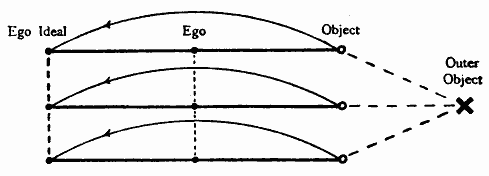
IX THE HERD INSTINCT
We cannot for long enjoy the illusion that we have solved the riddle of the group with this formula. It is impossible to escape the immediate and disturbing recollection that all we have really done has been to shift the question on to the riddle of hypnosis, about which so many points have yet to be cleared up. And now another objection shows us our further path.
It might be said that the intense emotional ties which we observe in groups are quite sufficient to explain one of their characteristics—the lack of independence and initiative in their members, the similarity in the reactions of all of them, their reduction, so to speak, to the level of group individuals. But if we look at it as a whole, a group shows us more than this. Some of its features—the weakness of intellectual ability, the lack of emotional restraint, the incapacity for moderation and delay, the inclination to exceed every limit in the expression of emotion and to work it off completely in the form of action—these and similar features, which we find so impressively described in Le Bon, show an unmistakable picture of a regression of mental activity to an earlier stage such as we are not surprised to find among savages or children. A regression of this sort is in particular an essential characteristic of common groups, while, as we have heard, in organized and artificial groups it can to a large extent be checked.
We thus have an impression of a state in which an individual's separate emotion and personal intellectual act are too weak to come to anything by themselves and are absolutely obliged to wait till they are reinforced through being repeated in a similar way in the other members of the group. We are reminded of how many of these phenomena of dependence are part of the normal constitution of human society, of how little originality and personal courage are to be found in it, of how much every individual is ruled by those attitudes of the group mind which exhibit themselves in such forms as racial characteristics, class prejudices, public opinion, etc. The influence of suggestion becomes a greater riddle for us when we admit that it is not exercised only by the leader, but by every individual upon every other individual; and we must reproach ourselves with having unfairly emphasized the relation to the leader and with having kept the other factor of mutual suggestion too much in the background.