Knight-Errant of the North (continued 4)
Reading edition
Of course the lord of the animate creation on land in the north—as the sperm whale is monarch of the sea—is the polar bear. Grenfell gives a most interesting account of this white king of beasts whom we properly pity on warm days as he lolls and pants by the soup-like water of his tank in one of our southern Zoos. The Doctor once saw a polar bear swimming three miles out at sea, headed, by a marvelous instinct, straight for the north. There was no convenient ice-pan floating near on which he might clamber for a snooze. This bear had been shot, and he floated high in the water, so that evidently his fat was a great help to him, enabling him to stay at sea as long as he pleased.
The polar bears wander from their native shores: they seem to enjoy travel, and when they sail south on pans of ice they are looking for that toothsome morsel, the seal.
If they cannot get seals, these bears devour the eggs of sea-birds on the islands.
When they swim after ducks, they hide under water, all but the nose: and since that nose is black, and therefore a telltale, they have been seen to bury it in the snow when creeping toward a seal-herd.
The polar bear stands a poor chance against a pack of lively and determined dogs.
They have reason to fear his huge paws and tearing claws until he tires, but he cannot face all ways at once, and if there are enough dogs the struggle soon becomes hopeless.
They are not fast enough to get away from the fleet smaller animals.
In the water, where they swim slowly and dive expertly, the fishermen may easily "do for them" with a blow from an axe or an oar. Though the polar bear has a fishy taste, the Eskimos relish the meat, and the prospect of a successful bear-hunt delights the savage breast.
XVToC
THE KEEPER OF THE LIGHT
Once I asked Dr. Grenfell if he was tired. His blue eyes lit up as if I had thrown salt into a fire. He threw his head back and said: "Tired? I was never tired in my life!"
But I thought he was weary that September evening in 1919 when he sat with his legs unkinked to the cheerful blaze, in the big living-room of his comfortable house at St. Anthony.
The wind can go whooping around that house all it likes and it never will get in unless it is invited. That house was nailed and shingled, doored and windowed, to stand up against the stiffest blast that ever came howling across the rocks and bergs from the Humboldt Glacier or even the North Pole.
Part of the time a blind piano-tuner was at work groping for lost chords among the strings of Mrs. Grenfell's piano. The piano didn't seem to need tuning so much. But the man needed the work. You can imagine there is not much for a blind piano-tuner to do in Newfoundland. Most of the music is the canned variety of the Victrola. Or, if there is a dance, someone may squat obligingly in a corner and hum very loudly what is called by its true name—"chin-music."
Mrs. Grenfell, happy to have her husband back from the gales and fogs for a little while, was sitting in the puffy armchair with her knitting-needles, and the boys, Pascoe and Wilfred, were up-stairs with their teacher, making out jig-saw puzzles in arithmetic or knocking the tar out of the French Grammar, with various loud sounds.
What the telephone is to busy men in America, giving them no peace even in the bathtub, the telegraph is to the Doctor in Newfoundland. If it isn't a man on the doorstep with a bleeding cut or a hacking cough, then it is a boy with a message which comes from a point twenty to sixty miles off. Most of the time your doctor or mine has a few blocks to go: and we think it hard, and he thinks so too, if a patient clamors for him in the middle of the night. But the middle of the night is the heart of Grenfell's office hours. Once after conducting a late evening service in the church at Battle Harbor he had to doctor forty patients in the room off the chancel before he could get away.
So it was no surprise to him, in the midst of a tale of the old days at Oxford on the football-field, to have a rat-tat like Poe's raven at the door, and a respectful "young visitor" doffing his sou'wester.
"Please, sir, a telegram."
Grenfell tore it open.
It read: "Doctor would you please come. My throat is full up and I can't eat or sleep."
It was signed "J.N. Coté."
"That," said Grenfell, "is the lighthouse-keeper at Greenley Island, just west of the line that divides Canadian Labrador from Newfoundland Labrador. He has a big job on his hands. He has two fog-horns, each with a twelve horse-power Fairbanks gasoline engine, so that if one's put out of business he can use the other. He's had fog all summer—and a sub-tonsillar abscess, too. The big Canadian Pacific ships go by his place. It's a bad spot. The light-keeper at Forteau tried to bring out his wife and five children—and lost all but one child on the rocks. Another keeper at Belle Isle tried to bring out a family of about the same size—and they all were lost. A doctor stopped in on Captain Coté on the down trip from Battle Harbor, on his way back to Baltimore. Evidently whatever he did wasn't enough. Looks as if I must go and finish the job."
As if to settle the question, even while he spoke there came another messenger—like the first, a volunteer—bringing another telegram.
This time, as in those messages sent from Cape Norman about the woman, the tone was sharper, more imperative and anxious.
"Please come as fast as you can to operate me in the throat and save my life."
The shade of concern in the Doctor's grave face deepened.
"Coté doesn't cry out for nothing," he said. "He's a real man. We must go. Would you rather stay here and rest a few days, or will you go with me?" Who would care to toast his toes and dally with a book, while Grenfell was abroad on such a mission? I had a quick vision of the gallant run the Strathcona would be called on to make—squirming through the rocks and bucking the headwinds and the heavy seas, to save that lighthouse-keeper and keep the big, proud ships from Montreal and Quebec from running blind in the dark. Not far from that spot a British man-of-war ran aground in 1922 and was a total loss, though happily her men were saved. I have been in the wireless cabin on the topmost crags of Belle Isle when the Straits all round about, fog-bound, were clamorous with the ships, anchor-down, calling to one another and whimpering like little lost children trying to clasp hands and afraid in the dark together.
It would be a run of a hundred miles from St. Anthony to Captain Coté's strangling throat—and what miles they were! Not until the middle of June had the mail-boat—that poor, doomed Ethie of the dog's rescue—been able to pierce the ice. Where those ice-pans met at Cape Bauld the grinding, rending and heaving of their battle was worse to hear and see than all the polar bears or the tusked walruses that ever rose up and fought together.
Dr. Grenfell could be perfectly sure that he would have to run a gauntlet all the way—picking and choosing between crags on the one hand and bergs on the other: just such a risky, "chancy" course as he most relishes. While he crumpled the telegram in his hand I could see his eyes light up again with that flash they showed when I asked him if he was ever tired.
His pockets at that moment were full of pleading, piteous letters from White Bay, meant to pull him to the other side of the island. One of them, from a desperate woman, after saying her husband had caught but eleven dollars' worth of fish all season, wound up with an appeal for oddments of clothes to put on the children, for "We are all as naked as birds."
It was hard to say no to the heart-throbs of those begging letters in his pocket. But Captain Coté's life was not one life. It was the lives of thousands—men, women and children—going down to the sea in ships, faring through the St. Lawrence, and the Gulf, and then those terrible Straits of Belle Isle, to the Old Country.
So we started. But was Mrs. Grenfell going to stay home with the piano, and French verbs, and her fancy-work, while the Strathcona nosed the seething waters? Not on your life! Wilfred and Pascoe had a perfectly good governess, and while it was hard on them to remain behind with their books, their turn with Father was coming.
The big black dog, named Fritz, had no French verbs to study, and no measly sums in arithmetic to do, so—at one running jump—he was added to the passenger-list. His berth was chiefly out on the end of the bowsprit—he was more ambitious than a figurehead. There he could sniff the breeze, and see the shore, even when there wasn't any, and bark defiance at all the dogs and the sea-pusses.
The Strathcona used both steam and sail. She was ketch-rigged, with six sails—mainsail, foresail, two jibs, two topsails. One of those topsails was a fancy, oblong thing which Dr. Grenfell's crew mistrusted as though it were witchcraft. He had brought it from the North Sea; they had never seen the likes of it before, and their minds are likely to be sternly set against anything new. But the Doctor, who is restless on shipboard, climbed to the crow's nest now and then to adjust the strange contraption, and make sure that it was using the wind in such a way as to develop the last ounce of pulling power. This was no pleasure cruise. It was a run for life.
The sea was a vast blue smile as we swaggered out of St. Anthony Harbor. What a fickle creature is that northern ocean! This was the first clear day in ever so long—and now the sun and the water were in conspiracy to pretend it had always been this gay, fair weather.
The only blemish on the seascape was a troop of bergs, six in number, out yonder to starboard. But they were dim and distant as we bore in toward the headland at Quirpon Tickle. Quirpon is called "Carpoon" by the fishermen because that isn't the way to pronounce it. And Tickle has nothing to do with making you laugh. Quite the contrary. It means a very serious business of creeping and twisting snakewise through a channel that winds among the rocks. You are perfectly sure you are about to ram the face of a wall—and then, lo and behold! there is a way out at the last minute, and it leads you to another wall and another rift that suddenly and impossibly opens to let you through. You have to think of the pirates who used to run and hide in places like that, and give the slip to honest sailor men from France and England who were trying to run them down. If they didn't meet the pirates they met and fought each other, which was vastly diverting to the pirates and perhaps just as satisfying to themselves.
There were fishermen's dories bouncing about like happy children in the shallower waters near the shore. I happened to be at the wheel, and my one idea was not to hit those sharp and cruel rocks, not to strike a fisherman, and to give the widest berth I could to the distant menace of those icebergs.
Grenfell, red-booted and brown-sweatered, put his head in at the wheel-house door, and the wind ruffled his silver hair as he cried: "Run her so close to those rocks that you all but skin her!"
You see, his mind was only on Captain Coté, with the choke in his throat, strangling and struggling, but going on with his duty as the keeper of the light with the beams outflashing to the long, far bellow of his mighty horn.
In our race against time, we were burning coal, that precious commodity, then twenty-four dollars a ton,—and much more costly to-day. Spruce and fir and juniper were piled on deck—some of the wood across the barrels of whale-meat, in a vain attempt to shut off the rotten smell of the food so loved by the dogs. But, hasten as we might, the night closed down like a lid on a box as we sounded our gingerly way through the perilous twistings of the Tickle. The wind was rising, and as we looked back we saw the waves, running white and high at a mad dance in cold moonlight. If we went on, and came out into the Straits, the wind would hold us there without an inch of gain, though we had the full power of the engines going and all sails set. The Strathcona, a tiny steamer of less than fifty tons, was no match for the sea aroused in opposition. It is a miracle that this small boat, the Strathcona, lived so long, with so many attempts of ice and rock to punch the life out of her wherever she went.
Dr. Grenfell, as his habit is on shipboard, rose at two, at three and at four to study his charts and lay out his course, and at twenty minutes to five his strong hands were at the wheel, on which are the words "Follow me, and I will make you fishers of men."
The dog Fritz had been sleeping all night on a thick blue woolen blanket in the bunk below mine. He had no business there, and he knew it, but as regularly as I turned him out into the nipping air and the frosty starlight he would return indignantly. "What's the matter with you?" his wrinkled face seemed to say. "You're just a visitor on this boat, and I belong here. What right have you to keep me out of a nice warm bed? You don't need this whole cabin, you selfish man." Finally my patience gave out and I let him have his way.
Under the red edges of the dawn, a fresh breeze blowing, we came within hail of that ugly rock named the Onion. "In that bay over there," laughed Grenfell, "we were blown across the ice—sled and dogs and all—when we were trying to round up the reindeer herd. We had the time of our lives!
"You see, we had brought a bunch of reindeer all the way from Lapland, and Lapp herders came with them, to keep off the dogs and prevent the natives from shooting them as if they were caribou. On one occasion we had a real 'Night before Christmas' celebration, and St. Nick delighted the children at the Orphanage where he came with his gifts on a big sled behind a real team of reindeer.
"But the reindeer spread all over the peninsula, and the Lapps couldn't keep track of their charges. The hunters and the dogs were hard on the trail of the herd. You couldn't blame hungry men and famished animals.
"I meant in time to persuade the people to give up their dogs and use reindeer instead. The reindeer could draw sleds, and would give milk, and meat too, if necessary, and their furs would be valuable. There wouldn't be any risk of their hurting children, or strangers, or sick people, and they wouldn't make night hideous with their howling.
"But at last, in order to save the remnant, it was necessary to move them, and I decided to load them on a fishing-vessel and take them across the Straits to the St. Augustine River country, where they could increase in peace, and the dogs would not bother them, and the Canadian Government could protect them from any Indian hunters who might come along.
"It was a fine plan, on paper. But it was like the old recipe for making a rabbit pie—'first catch your hare.' The reindeer having had the run of the open spaces so long saw no reason why they should be caught and put on a boat and carried off.
"So they gave us a run for it, I can tell you! All over the place we rushed, shouting and trying to lasso or corner the terrified animals. I never laughed so hard in my life. The wind was blowing great guns, and you simply couldn't stand up against it. We caught a great many of the reindeer. But a lot of them romped off into the woods and took to the hills and we never saw them again. Since they were moved to Canada they have done well—and some day, when the people are ready to have them, I want to move them back and see if we can't replace the dog-teams with them."
Meanwhile the little ship had turned her head away from the unsavory Onion, and was running on, over a long diagonal, to cross the straits in the bared teeth of the green and yeasty waves. That she was top-heavy was plainly to be seen, with her barrels of whale-meat and her high-piled fire-wood on deck, and almost no ballast or cargo below.
As we stood out into the middle of the channel, I thought of the great boats that must feel their way through the dense fog in evil weather. They would have to be honking like wild geese, even though the straits at their narrowest between Flower's Cove and Greenley Island are ten miles wide. Fog is a terrible deceiver. I remember coming up the East Coast on the mail-steamer Invermore in 1913. In a day after leaving Twillingate we were nearly wrecked three times. First, when we thought we were ten miles offshore, we found a tiny skiff, with two persons aboard, in our path—we nearly ran it down. Father and small son, fourteen, were fishing for cod, and had their meagre catch in a tin pail. Captain Kane had stopped our boat—we were going at quarter speed—and he had the man come up on the bridge to show us where the land lay. "Out yonder!" The ancient mariner pointed to the northwest. A rowboat was manned: in a few minutes its crew came back and reported that the rocks were not more than two hundred yards away. So we backed off, and steamed hard in the opposite direction. But only an hour or so later,—pulled steadily on and on toward the shore, by the strong, insetting tide,—we saw the grey edge of the fog lifting like a table-cloth, and there were those cruel rocks again, dragons in a lair, waiting to receive us, crush our bones and drink our blood. Again we backed away—and before long the fierce jangle of the bell in the engine room and the captain's sharp accent of command from the bridge once more halted us suddenly. There, directly before our prow, was a great white wall of ice, which had taken almost the color of the mist. It was an iceberg that barred our path, and if we had been speeding like the Titanic instead of creeping like a snail, it would doubtless have been the end of the Invermore. Only one more tragedy of a missing ship.
At four in the afternoon, when the great rock bastion of Belle Isle loomed across our bows, we gave up for the night: and next morning, between seven and eight, no fewer than eight enormous icebergs crossed our bows in a glittering processional.
But to-day, mid-stream, there was no fog, and despite the roughness of the water the cool air and clear sunlight were cause for rejoicing. "Isn't it fun to live?" exclaimed the Doctor, as he swung the wheel; and the Strathcona, feeling her master's hand, trembled and obeyed.
Fritz, out yonder on the prow, was staring toward the bleak Labrador coast. Was he thinking of dogs to fight, and fish to eat, and a snooze on the beach, after the run was over and the anchor was down? No—he was looking at something near at hand—and his ears were even quicker than ours to catch over the voice of waves or wind the cry of men in a power-boat off the starboard bow.
There were three of them. Two of them held up the third man, whose bare head flopped over on his chest. The collar of his overcoat was turned up to shelter that agonizing throat. Yes, it was Captain Coté, the man we came so far to seek.
"Doctor!" they called. "He couldn't wait! We've brought him out to ye!"
A moment more and hands as tender as they were willing were lifting him over the rail. A wee baby would have had no gentler handling.
Captain Coté's face was the greenish white of a boiled potato. It was seamed with deep lines of pain and sleepless nights. He was carried to the brass rungs of the ladder and lowered.
"Easy! easy!" those who let him down were saying to each other. They seemed to fear he would break if they dropped him.
By the light of a battered tin lamp Grenfell ran a needle into his throat with the novocaine that would destroy the pain of the operation.
Then he took his thin scissors a foot long and thrust them into the abscess under the tonsils.
Five minutes later, Captain Coté had found the use of his tongue again, and, waving both hands round his ears as he talked, he was thanking God and Dr. Grenfell, and giving us the full history of the dreadful months he spent before help came.
Next day we landed on his island—Greenley Island. From the small wharf where women were cleaning fish there were two lines of planking laid, on cinders, for perhaps a thousand feet through the long green grass to the red brick lighthouse tower. On these wooden rails was the chassis of a Ford car, and we rode in state. But you had to stick closely to the track, or you came to grief on the rough, shelly soil alongside.
"It's the first automobile ride I ever had in Labrador!" the Doctor gleefully exclaimed.
In the lighthouse was a living-room with a talking-machine, a violin, a typewriter and other things to add to the comfort of a home and make a family happy.
The patient was brought into the room by his beaming wife and two of his children.
"How are you this morning, Captain?" asked Grenfell.
"Feeling fine, Doctor."
"Did you sleep?"
"Slept like a baby. First time in three months."
"And can you eat?"
"I can eat rocks, Doctor."
Then the Captain brought out a pocketbook stuffed with greenbacks. Twelve hundred dollars a year, with nothing to spend it for, since he gets his living, seems a fortune to a man in that part of the world.
"How much do I owe you?" He pulled out three ten-dollar bills.
"One of those will do," said the Doctor, quietly.
It was right for him to take the money. Self-respect on Captain Coté's part demanded that he should pay. Grenfell lets his patients pay in wood or fish or whatever they have, a value merely nominal compared with what they receive. But he wants them to feel—and they, too, wish to feel—that they are not beggars, living on the dole of his charity.
"Now then, Doctor, how about the coal you burned getting here? How much does that come to? The Canadian Government'll give it back to you. We've got some down on the wharf. We can take it out now and put it on your boat."
The emergency run of the Strathcona had used five tons and a quarter. At twenty-four dollars a ton, this would be worth one hundred and twenty-six dollars.
We went down to the wharf, and tried to put the coal, which was soft coal, like dust, on a skiff, to take it two hundred yards in a half-gale to the Strathcona.
But the mighty wind blew the coal out of the boat as fast as it was shoveled aboard.
Then Captain Coté said, "We'll send it, when calm weather comes, to Sister Bailey at Forteau." She was a wonderful trained nurse,—a friend of Edith Cavell,—who lived in the near-by village, and had a cow that fought off the dogs and gave milk to the sick babies.
So Captain Coté's life was saved and the great boats from Montreal and Quebec with their hundreds of passengers could enter and traverse the Straits in any weather, because the keeper of the light was at his post once more.
XVIToC
THROUGH THE BLIZZARD
Another trip was to the north, in January, over the thirty miles from St. Anthony to Cape Norman, to save a woman's life. It all looks so easy when you get out the map and measure it across white space.
But when that white space is snow instead of paper, and there are thirty miles of it to flog through, instead of three inches under your hand—that, as Kipling would say, is another story.
Over the telegraph line from Cape Norman to St. Anthony came a piteous message from a young fisherman. It said his wife was dying. Grenfell telegraphed back, the message running something like this: "My assistant has gone off with the dogs to answer another call. Cannot leave my patients at the hospital and cannot get any dogs till he comes back."
Then another message came from the distracted husband: "Doctor, my wife is dying. For God's sake find another team somewhere and come."
The night, as the island saying is, was as dark as the inside of a cow. Grenfell stumbled out into the blackness to hunt for dogs. The trail to Cape Norman is very rough, and the January snow was deep. The wind blowing over it threw the snow, biting and blinding, in the face of anyone who attempted the trail.
But Grenfell did not hesitate. From house to house he went, to rouse the occupants like another Paul Revere, and beg for dogs that he might use on the desperate journey.
One man let him take four. Another, for pay, gave him a fifth animal. A boy named Walter said he would get four more dogs and would drive the ill-assorted team. By that time it was midnight.
"We'll start at 4:30," said the Doctor. At 4:30 it would still be pitch-black.
Grenfell went back to the hospital, roused the head nurse, and went to every patient to make sure that while he was gone no accident would happen that he could possibly prevent.
At 4:30 he was ready to start. Few men are his match for staying up all night and looking as fresh as a mountain daisy after the vigil.
He opened the door and a blizzard swept in and tried to rush him off his feet. Through the whirling drift staggered Walter, dogless.
"Where are those dogs?" asked the Doctor. He expects men to keep agreements made with him. He couldn't get through the length and breadth of his big day's work if they didn't.
Walter shook his snow-covered head. "I ain't brought 'em, sir. It's too bad a night to be startin' before sun-up. The dogs don't know each other: they comes from here, there an' all over. They'll be fightin' in the traces an' eatin' each other up in the dark. Us must be able to see 'em in order to drive 'em. You know what dogs is like, sir."
"Yes, I do," said Grenfell. "But you're the driver, and I leave it to you. We must get off as soon as we can."
Dr. Grenfell went to his room to snatch a catnap before the start. Another telegram woke him as he was drowsing off.
"Come along soon. Wife worse."
The storm instead of going down was more violent than ever when the grey day came. The sun was not seen at all. On the contrary, the air was filled with a mad whirl of pelting, stinging flakes almost as hard as Indian arrow-heads. The dogs would be no good in the teeth of such a storm—for the team-mates who work with a will are those that are best acquainted, and with an unknown driver this team suddenly thrown together would have pulled as many different ways as there were fierce and headstrong dogs. They would be at each other's throats before they were out of sight of the houses.
As he waited, walking restlessly up and down, in his brown sweater and thick leggins, Grenfell was plagued with the picture of the woman fighting for her life till help should come from the one man who could give it.
Still another of those telegrams! This time the message read: "Come immediately if you can. Wife still holding out."
Just as he read the words, there were voices, and battering hands at the door.
Two men, white as Santa Claus from head to foot, staggered into the room, with the wind whooping at their backs as if in a wild anger that they escaped its clutches.
Grenfell, accustomed as he was to the brave men of a hard country, fairly gasped when he saw them.
"Where did you come from?"
"We comes to fetch you, sir, for the sick woman at Cape Norman."
"Do you think dogs can get me there now?" the Doctor asked, anxiously.
"No, sir. We was blown here most o' the way, wi' the wind at our backs. The wind drove us. The dogs can't make head against it, not till the wind shifts clean round the other way, sir."
Ten miles of their journey had been in the fairly sheltered lee of the land. Twenty miles had been before the pitiless sweep of the wind over the unprotected sea-ice. If the snow had not drifted so heavily, they would have been borne along at a pace so rapid that their sled would have been wrecked.
"When was it you left Cape Norman?" was the Doctor's next question.
"Eight o'clock last night, sir."
So they had been coming on all through the night, without rest or food. Yet the first thing they had done when the sled stopped at last before Grenfell's door was to get something for their dogs to eat. Already, the animals lay snug and tranquil in a drift, as if it were a feather-bed—sleeping the sleep of good dogs who have done their work and earned their daily fish-heads and know of nothing more to want in this life or the next.
The Doctor patted the broad shoulders of the gaunt, shy spokesman. "Go into the hospital and get a good, big, hot dinner," he said. "Then go to bed. We'll wake you when it's time to start."
But after dark—and the darkness came on very early—the two troubled men were at Grenfell's door again. "Us couldn't sleep, sir, for thinkin' of the woman. Us have got another telegram sayin' please to hurry. The storm is not so bad as it was, sir. If you think fitten to start, we're ready."
"Call Walter," said the Doctor.
"Us has called he, sir. He's gettin' the dogs. He'll be here in a minute."
Grenfell and his comrades knew that the lull in the storm did not mean the end of it. It was gathering strength, and might at any moment break loose again with redoubled fury. But he—and they—couldn't stand waiting any longer. They must go. It was as if out of the black distances they heard the thin, far, pleading voice of the sufferer calling to them, to come and save her.
Their first task was to get across the harbor of St. Anthony in the dark and the eddying snow. They had their snowshoes, but in spite of these they sank to their knees in slush, and the two dog-teams floundered and half-swam. The team from Cape Norman went first, to encourage the others. A man stumbled ahead of them all, to break out a footway. Walter trudged in advance of the rear team, with Grenfell driving an assortment of beasts he had never handled before. Only a dog-driver knows what that means.
Ascending the flank of the hill across the harbor, they found themselves almost overwhelmed by the deep snow, with more piling down from above, as they fought their way foot by foot up the hill. They had to take hold of the sleds and lift them to help the dogs, and the sweat rolled off them in spite of the keen bite of the cold. When they topped the rise at last, the wind struck them full force, so that their loudest shouts could not be heard in the roaring onrush of the wind. The slope was a steep glaze of ice, and down it they coasted, running into tree-trunks and rocks that threatened to wrench the sleds and injure the dogs and men. It was hardly better when they reached the bottom. Here the Bartlett River became their necessary roadway, and twice Grenfell and others broke through into the swirling current and were almost carried away to be drowned under the ice.
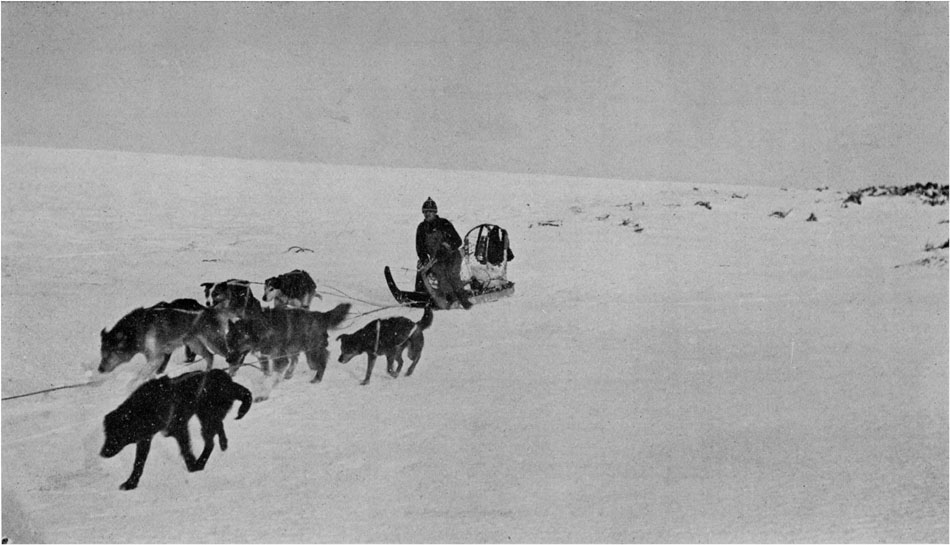
Where Four Feet Are Better Than TwoToList
Down-stream they battled their course—no wonder "Battle Harbor" is the name of the Labrador inlet not far away. It is a battle to get anywhere in winter on this coast. At half-past one in the morning they came to where the twenty-mile stretch of sea-ice began.
After that experience of a few years before on the ice-pan, Grenfell would not have been to blame if he had called a halt and said, "No, not out there! Let us take the longest way round, by the shore, and be safe."
But that has never been his way. When duty calls, he takes the air line to the scene of action. So it was on this awful night. It had taken six hours to do ten miles. The sea was throwing the ice about with a mighty booming and crashing like the firing of cannon. The blizzard stung their faces and lashed their bodies. Grenfell was ready to dare the passage. But the men who came for him would not have it so. His life was precious in their sight: and they knew what its preservation meant to all that helpless lonesomeness of the winter coast.
It lacked six hours to daylight. If they waited, the dogs would not freeze, but men might suffer, and perhaps lose their lives.
But the rugged pair from Cape Norman said that in the preceding fall someone had put up a "tilt"—a log refuge—in the woods near by. They roved about until to their exceeding joy they found it.
There was not merely a shack of spruce-logs. In the shelter there was a stove, and beside the stove was a pile of wood. It is the habit of the men of the North to think of those who come after them. They who have been through a winter understand what it means to depend on others and have others depend on them. Those who do not play the game that generous, open-handed, far-sighted way have no friends and are despised by their neighbors.
The dogs fell asleep in the snow. One of the Cape Norman men "bust open" the river with his axe and filled the kettle for tea. But even while Grenfell was fussing with the knots of the dunnage bag to get out the tea and the sugar, he heard his comrade's pipe fall to the floor.
Grenfell looked up. The good soul, standing erect, was fast asleep. It had been sixty hours since he had slept, and forty-eight of these had been spent on that terrible trail where there was no trail. Flesh and blood rebelled at last. Even the records of ambulance-drivers in the war have seldom equalled such endurance. The sleeper was roused and put on the bench. He tried again to stuff his pipe with his frightful rubbish called tobacco. But the pipe clattered to the floor again: he was dead to the world: his snoring shook the peace of dreamland, and would have broken the glass in the tilt if there had been any glass to break.
What might be called dawn came at last, but with it the snow returned fast and thick as the flies and mosquitoes of a Labrador spring.
The snow cut off their view of the sea, but they heard it roaring as though possessed of all the devils.
Over that roaring there seemed to come to their ears again the still small voice of the woman in misery—hopeful, waiting for them, trusting the Doctor who had never failed her yet.
They were not the sort who would say sea-ice was impassable, if humans and dogs could traverse it.
But examination showed that there was no way over the partly frozen sea.
Greatly against their will, they must take the roundabout route overland. By two in the afternoon the ice held sufficiently to let them cross to Crow Island, and there they tried to boil water and make tea. The blizzard defeated them. In the blinding snow, they set their course by the compass, and the dogs plunged on. They said nothing to the dogs after that, but let them follow their own cold noses. The wonderful beasts took them straight to a tiny shore village. A short dash from the village, and the long run was over. In a jiffy, Grenfell had out the surgical instruments and put the patient under ether. To-day the woman is not merely alive but in the best of health, and she thinks of Dr. Grenfell as the Greeks used to think of a god.
XVIIToC
WHY THE DOCTOR WAS LATE
We have seen by this time that Grenfell does not rush slam-bang into danger for the mere sake of "the tumult and the shouting," like a soldier of fortune.
Once he said to me: "I'm like these dogs. Every time they hear a fight going on at the other end of the village they feel that they have to get into it, and off they go, pell-mell. Whenever I hear of a good scrap in progress anywhere in the world, my first impulse is to drop everything else and get into the struggle. Then I realize that I'm serving my fellow-man as truly by staying just where I am, and trying to do my duty in my place."
He is fearlessly willing to spend his life in heroic deeds: but he always has a definite purpose in view: he is not posing for the motion-pictures. So when he harnesses his dogs to go on a journey we may be pretty sure that at the other end of the run there is some man, woman or child who needs the Doctor, and who takes the medicine of hope just from seeing him at the bedside, before he has done anything with a knife or a needle.
In the spring of 1919 the Doctor had to go to New York. It wasn't a sick person this time: it was a board of directors that wanted to hear his report on his work, and was to discuss with him big plans to raise $1,500,000 for an endowment fund to carry it on. A Seamen's Institute, a string of hospitals, several mission steamers, an industrial school and a number of dispensaries take a lot of money to run, even with many volunteer helpers.
Most of us, if we find it inconvenient to attend a meeting, telephone or write politely to say we have the laryngitis or the shingles or some other good excuse, and are very, very sorry that we cannot come.
But Grenfell, having said he would be in New York at the end of May, was bound to be there in spite of fog and bog, sea and snow and berg, if it was humanly possible. I remember his story of what happened as vividly as though it were yesterday, for I also had an appointment with him at that time—and he was only a month late in keeping it.
He had written me:
"I am in a terrible state about my boat: she is still in the blockade of ice, after two months fighting it. It is harder to beat than the Huns, but I am very anxious you should come with me, even if we have to canoe down the coast."
The story behind his finally successful attempt to reach New York on that occasion is as follows:
He set apart a month to make the journey, which in open summer weather would require only a week. He meant to go round the northern tip of Newfoundland, from his headquarters on the east coast at St. Anthony.
He planned, therefore, to go by dog-team northward to the Straits of Belle Isle, and then alongshore rounding Cape Bauld and Cape Norman, and on down the west coast to the railroad at Curling which would take him to Port aux Basques. At the latter place, the southwestern corner of Newfoundland, an ice-breaking steamer would carry him over Cabot Straits to North Sydney, and there he could get a train which would make connections for New York.
There is what dogs would consider a fair route alongshore on the western coast. And the dogs' opinion is worth considering.
But there sprang up a continuing gale, with a blizzard in its teeth. It rocked and hammered and broke the ice with the fury of great guns round about the headlands. As the trail for much of the way lay along the sea-ice, it would have been as impossible for the dogs to go by it as it was to make that short-cut across the bay when Doctor and dogs had that terrible experience on the ice-pan.
"Very well then," said Grenfell, "we'll try a motor-boat."
Motor-boating is fun enough in summer on the placid reaches of the Delaware or the Hudson, but it is a very different matter on the coast of Newfoundland, in a narrow lane between great chunks that have broken off a Greenland glacier and lean brown crags with the sea crashing white and high upon them. If he went in a motor-boat, Grenfell would have to be on the lookout day and night for ice-pans and bergs, lest they close in and crush his boat as an elephant's tread would squash a peanut.
When the blizzard that had spoiled the ice eased off, Grenfell had his boat ready. After two or three days of creeping in the lee of the rocks and trying to keep out of the clutch of the breakers, he would find himself at a point where he could begin a lonely trek overland, a hundred miles to the railroad, with his pack of food and clothing on his stalwart shoulders.
Just such a lonely walk as that many a sealer, fisherman or clergyman has made. If night overtakes a man, and he is far from a hut, he kicks a hole in a drift, lines it with fir boughs, makes his fire and crawls in snugly. He finds snow-water will not hurt him if he mixes it with tea or sugar. Grenfell, accustomed to hiking with the dog-team, felt no dread of a night with a snow-bank for his feather-bed.
The start was made auspiciously. The ice kept well out of the way till Grenfell, who had one man with him, cleared the harbor. As they went on, however, the east wind spied the bold little craft, and came on like an evil thing, to play cat-and-mouse with it.
It brought in the ice, and the ice was constantly pushing the boat toward the shore, toward which the current was pulling like a remorseless unseen hand.
"Keep her off the rocks, Bill!" warned the Doctor, poling vigorously at the stern.
"I'm tryin' to, sir. But the wind is wonderful strong, and I'm thinkin'——"
Whatever Bill was thinking, he was rudely interrupted by a rock that did not show above the surface. They were in a most perilous position. The boat, caught on the tidal reef, tossed to and fro, and the propeller, lifted high out of water, whirled like an electric fan. Through a hole in the prow the water rushed in. The two men sprang to the leak and stuffed it with their hats and coats and anything on which they could lay their hands.
Fortunately the hole was not large, and as they had hammer and nails and pieces of board for such an emergency they managed to shut out the water with rude patchwork. They bailed the boat and shoved it off again, and crept onward. But the thermometer dropped fast, and in the intense cold the circulating pipes froze and burst. That damage, too, was laboriously repaired, and they went ashore and spent the night under the glittering starlight with no coverlid but juniper boughs, beside a roaring fire. The next day they saw that the ice had so closed in to the southward that their little boat could not possibly go forward.
They must, therefore, retreat to St. Anthony, and try to get round the Cape and into the Straits of Belle Isle.
But they found they were now shut off even from their home port of St. Anthony!
Leaving the motor-boat at a tiny fishing-hamlet, they borrowed a small rowboat, and went out to "buck the ice."
The ice "made mock of their mad little craft." While they were hunting to and fro for crevices through which they might work their way, their old enemy the east wind was narrowing the channels till they saw that the tiny cockle-shell must soon be caught in the grip of the ice-pack and crushed to flinders.
"Jump out, Bill!" commanded the Doctor, setting the example. "We've got to lift her onto the pan!"
They seized the prow and hauled with might and main.
But the boat was doomed. They could not pull the stern free in time. The ice came on, ramming and jamming—and in an instant the stern was cut off, and was crushed to kindling-wood. The ice chewed the splinters savagely, as a husky gnaws a bone.
This time there was no question of repairs. They had half a boat, and the gaunt cliffs of the shore were far away, with bits of ice dotting the black water between.
They had their guns, and they fired at intervals to signal to the shore.
"Evidently there ain't nobody at home," Bill remarked grimly. The pan was taking them out to the sea, just as it did with Grenfell and the dogs on that earlier memorable occasion.
Bill was a venturesome soul. "I'm going to copy," he announced briefly.
That meant, as I have explained, that he would jump from one cake of ice to the next. Eliza crossing the river-ice in "Uncle Tom's Cabin" was nothing to the feat he set himself in that perilous, pitiless northern sea. There was no causeway to the land. He would have to do as a lumberman does in a log-jam, jumping before the object he has stepped on has time to sink with him. There would be no chance to think. He would have to keep on the move every instant, and death might be the penalty of a misstep.
"Mebbe," said Bill, as coolly as though it were a question of running bases at a ball-game, "mebbe I'll git close enough to the land so some o' the boys 'll see me. Lend me your boat-hook, will you, Doctor?"
The Doctor, who would rather have taken the water-hazard himself, passed over the boat-hook.
Bill jumped from pan to pan, nimble as a goat. Fortune seemed to be favoring the brave. His leaps would have broken records at a track-meet. Sometimes he put out the boat-hook after the manner of a pole-vaulter, and flung himself with its aid across a terrifying chasm.
But as Grenfell watched and waited in suspense, all of a sudden, to his acute dismay, he saw the pole slip from his comrade's grasp.
Bill staggered on the edge of a pan, and gave a desperate wrench of the body to save himself from falling. In vain. In another instant he was struggling in the waves. In a moment more the pans might crush him, or he might be so benumbed that he could make no further effort to help himself.
While the Doctor stood there in mental anguish because he could do nothing to help his comrade, he saw Bill with a desperate effort throw a burly leg over the edge of the pan and scramble out, seemingly none the worse for the ducking.
All Bill could do now was to stand on his pan and let the wind and the sea take him where they would.
Grenfell kept on shooting, but there was no response from the shore.
Bill's pan crept nearer and nearer to the Doctor's—but not near enough to let Bill get back.
At last the shooting was answered.
They saw the flash of an oar—always the first signal of rescue under these conditions—and a boat hove in sight.
The two men on the ice shouted excited encouragement to each other at the same instant.
The rescuers were not less joyful than the rescued. Such events as this have led some of the fishermen to believe that Grenfell leads a charmed life, and that the winds and the seas are aware that he is their master.
He had now spent a precious month in trying to break the ice-blockade. Since the ice had backed away a short distance from the coast, Grenfell now thought he might use the mission steamer herself, the brave Strathcona, to get round the northern end of the peninsula and so follow his original plan of a journey down the west coast. Compared with the Strathcona, the mail steamer was palatial luxury.
All went well enough till they came to the Straits. There it was the old story. The ice was piled mountainously, in a barricade that meant a long siege to penetrate. What was still worse, it closed in suddenly about the ship, just as it has so often embraced Arctic explorers. The Strathcona might not be able to rid herself of the encumbrance for many days, perhaps for several weeks.
One way was left—to walk. The distance was ninety miles—and what miles they were!
Like the snail, he had to carry all his baggage on his back. It included a frying-pan, blankets, food, and a suit of clothes fit to wear at the meeting of the board of directors,—a sufficient burden for two human shoulder-blades. Mrs. Grenfell remained aboard the Strathcona. It was to take her down the east coast to the railroad at Lewisporte, when the ice released its hold on the ship. In time, if all went well, she would join her husband in New York.
It was a hard and lonely journey for Grenfell for the next three days. Thirty miles a day was as much as he could do over a beach piled high with gnarled, weather-worn rocks and ice carved by the sea into strange forms, and flung into rough sugar-bowl heaps. When night came, for want of soft snow-banks into which he might dig for a snug bed, he scraped himself a place in the wet sand and built a fire and dried his clothes to the tune of a raving wind. He knew the mail boat was expected at any time at Flower's Cove, and if he missed it he would have to wait a fortnight, at least, for its next southward journey. In spite of the discomfort of sleeping on the ground, and the fear that he might reach the Cove just too late to catch the steamer, his rest was sound and sweet, while it lasted. But he let himself have very little of it, because of the need of forcing the pace, and we can easily imagine that it was a man thoroughly ready for a night in bed who rapped at Parson Richard's door at Flower Cove when the three days' hike was over.
"Well, well, Doctor!" Parson Richard's face was a warm and beaming lamp of welcome. "Come right in! Why didn't you telegraph? You know there's nobody I'd rather see than you.—Mary!" he called. "Get the Doctor a cup of tea—and let him have a piece of that caribou steak we've been keeping. It sure is good to see you, Doctor! Now we'll have a fine chance to talk, when you're rested. The mail-boat won't be along till to-morrow morning. There are so many things I want to tell you about and ask your advice."
Grenfell had tugged off his rubber boots and sat in a cushioned chair with his feet luxuriously outstretched to the stove. Now that the hard pull afoot from cove to cove was over, it would be comparatively luxurious travel the rest of the way. He could probably have the full length of the table to sleep on, in the dining-saloon of the Ethie when the dishes were cleared away. Since it was the beginning of the season, and southward-bound travel was slack, he might even get a berth to himself.
But a frowsy-polled messenger just at that delicious moment of warmth and reverie threw open the front door without the ceremony of knocking, and a blast of wind swirled after him.
Parson Richards in his thin, worn coat clasped himself like a cabman and shivered. "Shut the door, Tom! What is it?"
The pale and agitated messenger could hardly stammer out the words.
"It's—it's Abe Gould, sir!"
"What has Abe Gould done now?"
"He's shot himself in the leg!"
"Well, well, is it as bad as all that?" asked the good man, his brow furrowing with anxiety. "We must come right off and see what we can do."
"He's bleeding to death!"
Parson Richards turned to Grenfell. "Now you stay right here, Doctor!"
The Doctor was already hauling on his wet, stiff boots.
"No, no," protested Grenfell, as if somebody had suggested a joy-ride and he didn't want to miss it. He turned to the boy. "Take me to him, Tom. How far is it?"
"Five miles, sir," said the trembling lad. "Oh, do come, please, sir, and hurry up. He's bleeding to death."
"Have you dogs?"
"No, sir."
"Can you get any?"
"No, sir. All the good dogs is away."
"Then we'll walk—or run," Grenfell smiled.
He left the tea with the spoon in it, and did not even stop to thrust a bit of bread into his pocket.
"How did it happen?" he said, as they started the jog-trot from the door.
"He was cleanin' a gun, sir, and it went off and shot him in the leg."
Not much more was said. Man and boy needed all the breath they had for that five-mile marathon over rocks and stumps and snow in the biting wind. Grenfell remembered the cross-country runs of the "harriers" at Oxford. Then, it was smooth going through fields and meadows and down the winding rural lanes. Then, he ran after nights of comfortable sleep, and with good fuel for the human machine. Now he had to make speed when he was hungry and after three broken nights of lying on damp sand. What a difference!
But the old zest of life and youth came flooding back to him—the thought of the good he could do was a spur to keep him going at top speed. Of old he ran for a ribbon, a medal or a cup. Now he was running for a life. So often his errands, afoot or behind the dogs, had that guerdon before them—and what prize of victory was more valuable than that?
The boy had hard work keeping up with the man—the man who always had kept himself in the pink of condition, whose frame never failed to serve him when he called on it for a sudden, extra strain.
Grenfell remembered the war service of the young fellow he ran to help. Abe Gould was but twenty. As a member of the First Regiment of Newfoundland, 5,000 young men picked from the 250,000 islanders, he had given four years of his life to the world war, in France and Flanders. Then he had come home, and with his honors, and the tales of his bravery on all tongues and in all ears, he had gone back quietly to scraping the fish and mending the nets as though he never knew another life or another country.
As they ran on with hearts pounding, the one big question that kept asking itself in the Doctor's mind was, "Am I too late?" He forgot everything else—the battle with the ice-pack, the possible fate of the Strathcona, the weary trudging round the northern promontory. Nothing mattered except the brave young soldier, whose blood was ebbing away clock-tick by clock-tick, as they hastened to his side. That five miles seemed longer than the ninety miles he had covered in the three preceding days.
He was no longer stiff and lame—the need of him seemed to have put wings on his heels as if he were Mercury.
There was the little grey house at last. The panting boy at his side gasped out, "My brother's there!"
Grenfell fairly fell against the door. It was flung open instantly. The room was crowded with people who sobbed and sniffled and wrung their hands: and none could do anything to help.
"The Doctor!" they cried. It was almost as if Christ Himself had come.
The young soldier lay on a hard table, flat on his back. Imagine his conscious agony. What was left of his leg had been laid on a feather pillow and to stop the flow of blood his foot was strung up to the ceiling. Blood and salt water soaked his garments and dripped to the floor, as if he were a slab of seal-meat.
Men and women alike were weeping, and telling each other how fond they were of Abe, and what a good, brave lad he was, and how they would hate to lose him now. Trouble in this part of the world makes people singularly neighborly, and often in their need they are as children. They think that any stranger from outside, with better clothes than they wear, must know enough to doctor them.
Most of the people had to be sent from the room, for the sake of air and space and the poor boy's comfort. Dr. Grenfell had no instruments for an operation. He had no medicines. But messengers went hither and yon, and picked up things he had left in the neighborhood for use in such a crisis. They came back with a knife or two, rusty and in need of sharpening, a precious thimbleful of ether, shreds of silk to tie the arteries, a small supply of opium.
By the time they came back from their house-to-house search, Dr. Grenfell had wound a towel round the patient's thigh, and twisted it with a stick in a "tourniquet" that stopped the deadly ebbing of the blood.
There wasn't ether enough, but what he had was used. A man stood on each side and held the patient to the table. Grenfell had to pick out piece after piece of bone from the shattered leg with his fingers. It didn't help at all when one of his helpers fainted at the gory sight, and fell across the body of the wounded man. The leg had to be cut off, eventually, but Abe's life was saved. During the night that followed Grenfell's ministration, the Doctor sat by the table-bed, feeding the patient a sleeping-draught of opium now and then, to dull the awful agony. Not a wink of sleep did the great physician get, the long night through. But as he sat there, he was happy to think—that he had come in time to save Abe Gould. This more than made up for the fact that he was a month late for the meeting with those New York gentlemen. And when he finally reached them and told them why he was late—they forgave him.
No wonder the fisher-folk of the Labrador swear by "the Doctor" and turn a deaf ear and a curling lip of contempt toward any who dares to talk against him. They have seen him on the firing-line of his work: he is their friend: they know what he did for them and theirs, and—men of few words as they are—they would in their turn do anything for him.
THE END
Typographical errors corrected in text:
Page 36: 'Ie means' replaced with 'It means'
Page 235: 'the next to be dropped' replaced with 'the nets to be dropped'