Knight-Errant of the North (continued 2)
Reading edition
The only thing to do was to chop a passage through the ice along the bank—like making a tow-path for a canal.
After they had fought their way through the narrows, they yearned for sleep. So they built a fire, and felled tree-trunks twenty feet long into it, till they had a "gorgeous blaze." Then they dug holes in the snow, deep as bear's dens, broke loose from their stiff, icy clothes, got into their sleeping bags, and slept the sleep of the just till the golden sun warmed them with its morning blessing.
The rest of the way gave them no trouble. They got a royal welcome from the hands at the mill. It was such a great event, in fact, that a holiday was declared, and all hands went "rabbiting." At the end of the day they built another mighty fire of logs, gathered round it with steaming cocoa and pork buns, and decided all over again that life was worth living and that moving a lumber-mill on an Arctic fore-shore is sheer fun, if you only think so.
Not long after an experimental fox farm was begun. The farm part of it is not so hard as the foxes. All you need for the farm is a few poles and some wire netting.
They picked up a dozen couples of foxes—red, white, cross, and one silver pair. A Harvard professor describes moving day when foxes were being brought on the little steamer to St. Anthony. "Dr. Grenfell at one time had fifteen little foxes aboard.... Some of these little animals had been brought aboard in blubber casks, and their coats were very sticky. After a few days they were very tame and played with the dogs; they were all over the deck, fell down the companionway, were always having their tails and feet stepped on, and yelping for pain, when not yelling for food. The long-suffering seaman who took care of them said, 'I been cleaned out dat fox box. It do be shockin'. I been in a courageous turmoil my time, but dis be de head smell ever I witnessed.'"
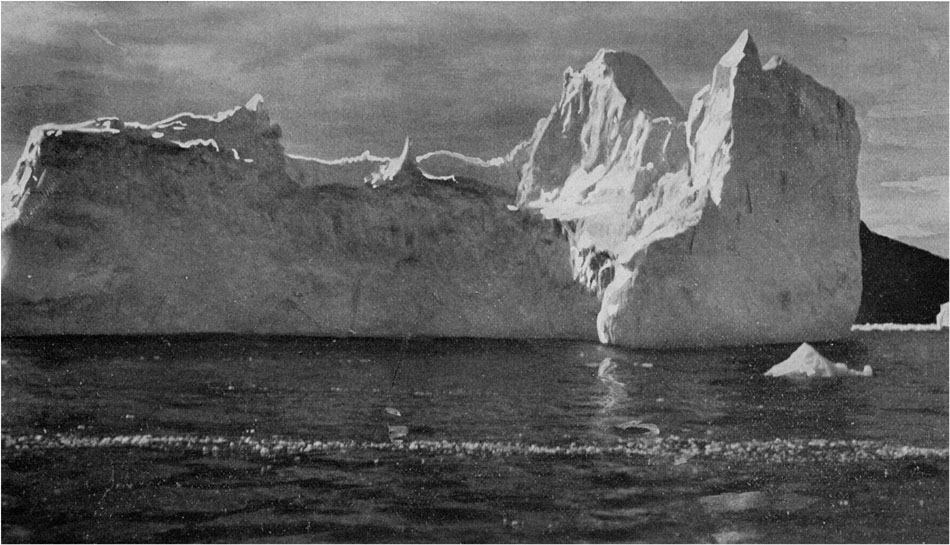
Castles and Cathedrals of Ice AfloatToList
Probably the fox farm suffered from too much publicity. A mother silver fox is one of the scariest of creatures, and is known to "kill her children to save their lives" when a thunderstorm comes on, or visitors are alarming. Most fox farms are therefore in the depths of the woods: and the path to them is kept a dark secret by the owners. But the farmers at St. Anthony's were green to the business, and they let the fishermen come in numbers to see the show, not realizing what the consequences would be. The red and the cross foxes seemed pleased to entertain guests; not so with the white foxes, and the precious silver foxes were the shyest of all. Not a pup lived to grow up. Many were born, but their parents killed them all. By and by, after a mortal plague broke out among the animals, the farm was converted into a garden with a glass frame for seeding vegetables.
But others, with more science at their command, developed a profitable industry in Quebec, Labrador and in Prince Edward Island. In the year the war began a silver vixen and her brood were sold for ten thousand dollars. A wild fox, sold for twenty-five dollars, was resold for a thousand. There is money in the business, properly conducted. For those who want wild animals to have fair play, there is satisfaction in the thought that to get fox fur by way of breeding is infinitely more humane than to get it by way of the trap, whose cruel teeth may hold the animals through hours and days of suffering till the hunter comes.
VToC
SOME REAL SEA-DOGS
"Get out o' there, youse!"
A big raw-boned fisherman with an oar in his hand came running up the stony beach at Hopedale.
The door of the little Moravian church was open. So were the windows. And so were the mouths of a pack of dogs who were yowling their heads off and trying to kill each other inside the church.
"That's just the way with them huskies!" panted Long Jim, as he stumbled up the slope. "Can't leave 'em be ten minutes without their gettin' into mischief. 'Tis a nice place they picked out for a fight this time! I'll soon have 'em out o' there! They'll find out the house o' God ain't no dog-house."
Swinging his oar right and left he dashed into the church.
Such a scene as met his eyes!
The dogs had been tearing the hymn-books apart as if they were slabs of raw seal-meat. For the Eskimos had been handling the books with their fingers fresh from cleaning fish and cutting up blubber. So that to a dog's nose each book smelt and tasted perfectly delicious. As fast as one dog closed his hungry jaws on a book, another dog, snarling and yowling, would try to snatch it from him.
Over and over in the aisles and between the pews they rolled, snapping and tearing at one another. For the sake of meat they would do murder any day—and the fact that it was in a church on Sunday meant nothing to Long Jim's idle, hungry pack.
"Go on, now! Git outa here!" Long Jim laid about him vigorously with the oar. Sharp yelps resounded as he thwacked their heads and legs. One dog took a header into the baptismal font, which was full of stale water.
Another tried to climb under the little cabinet organ. But there were two dogs there already, and one of them bit him in the chest. He backed away, slobbering and raging.
Another dog hid under the communion table, but Long Jim found him and kicked him away with his soft furry boots that did no damage to dog ribs.
The leaders of the pack, Jock and Sandy, soared out of the window at the right. Jock landed on his head in the kitchen garden where the precious cabbages were growing behind high wooden palings. Sandy was more fortunate, and fell squarely on his feet. Both dogs began to gobble the soft green stuff just visible above the ground.
The other dogs came after them, biting and tearing at each other even while they were scrambling across the window-sill.
"Long Jim" ran out at the door, and had to tear down a lot of the stakes before he could drive the dogs out of the garden. When at last they went, most of the young and precious cabbages went with them. The garden looked like a mud-pile where children have been in a quarrel.
"Ain't that a shame!" exclaimed Long Jim. "Them poor Moravian brothers worked so hard to git that garden goin'! I s'pose I gotta pay for them hymn-books an' them cabbages. Where I'm a-gonna git the money t' pay f'r it all, I'm blessed if I know! I guess I'll have to see if I can git the money from Dr. Grenfell till I get paid for my fish."
Dr. Grenfell was in a cottage near by, visiting a patient. The sick man couldn't stir from his bed.
A puff of wind blew the door open, just as the hungry pack of dogs came rushing up.
Instantly Jock and Sandy halted, and sniffed a mighty, soul-satisfying sniff.
Such a nice, sweet smell of dinner as was blown on the breeze from the door!
Their whiskers twitched and their mouths watered.
Then it was just as if Jock and Sandy said to the other dogs: "Well, what about it, boys? Shall we have some more fun? Are you hungry?"
For the whole pack as though pulled by a string made a dash for the door and swept in on the Doctor and the sick man lying there.
It was like an avalanche. Dr. Grenfell was swept off his legs, as if he had been bathing in the surf and a big wave rushed up and knocked him down.
The boldest jumped up on the stove, where the stewpot was, that sent out such a delicious smell.
He pried off the cover, and then the pot rolled off the stove with a terrible clatter, and its steaming contents were dumped out on the floor.
You could fairly hear those beasts screaming "That's mine! Get out of there! That belongs to me!" Just like greedy, quarrelsome boys that forgot their manners long ago, if they ever had any.
They fought with added fury because—the hot stew burned their noses. They were in such a hurry they couldn't wait for it to cool. They snuffled and scuffled, they bit and snarled and snorted, as they had done in the church with the hymn-books and then with the cabbages in the vegetable garden.
One of the dogs thrust his head in the pot to get the last "lickings" and then he couldn't shake it loose again.
Round and round the room he banged and struggled, till the Doctor took pity on him and hauled it off his head.
Meanwhile the house filled with steam as if it were on fire.
The Eskimos came rushing from everywhere, with shouts in their own tongue that sounded almost like the cries of the dogs.
They had long harpoon handles, and they pranced about the room, thwacking right and left.
The Doctor was entirely forgotten. So was the sick man. The room was filled with steam, stew, dogs, harpoons, and blue language.
At last the dogs were shoved out, and the door was slammed after them.
"How are you feeling?" said the Doctor to his patient.
"B-b-better, Doctor. It was a funny show while it lasted. But I guess they ain't much left o' that there stew, is there?"
The Doctor laughed. "No—our dinner is wrecked. A total loss!"
The door opened slowly. Long Jim stood there in the doorway, fumbling his hat in his hand. "Awful sorry about them dogs, Doctor," he muttered. "They just seem to ha' gone clean crazy. They ain't had nothin' to eat for so long, you see. They're good dogs when they ain't hungry. Would you—would you lend me the money to pay for them hymn-books an' cabbages an' the stew till I can pay ye back?"
"Oh, that's all right, Jim!" answered the Doctor. "All told, the damage won't amount to much. I'll fix it up. Dogs will be dogs."
"Thank ye, Doctor," said Jim, simply. But he was deeply grateful. He went out after his dogs to make them quit rampaging and take their places in the team.
"Doctor," said the sick man, "I minds me o' the time one o' them missionaries put a young dog in the team ahead o' the old leader. Did ye ever hear tell o' that?"
"No. What happened?"
"Well, the big feller bit through the little feller's traces an' then must 'a' said 'you get out o' here!' the way one dog knows how to talk to another. 'Cause the pup he began to run away, before they'd got the sled started at all."
"And then what?" asked Grenfell.
"Why—Mr. Young harnessed up the pup three times an' each time the big dog he bites the pup loose an' the pup runs away."
"So what did Mr. Young do then?"
"He give the big dog a whipping."
"Did that do any good?"
"Not the least little bit that ever was. It done a lot o' harm. The old dog's heart was bust. After that beatin' he weren't never the same again—he seemed to lose all taste for haulin' a sled. He might as well have lain down an' died in the traces, for all the use he was to the team after that. He wa'n't no good for a leader any more. He wa'n't no good for anything."
"Do you use moccasins for your dogs?" asked Grenfell.
"Sure us does. Makes 'em o' sealskin. Us ties 'em round the dog's ankles, cuttin' three little holes for the claws."
"I know," said Grenfell. "And the dog sometimes eats his own shoes, doesn't he?"
"Yes, sir. Till he gets to know what the shoes is for. I've had my dogs eat their own harness, many's the time. Don't seem as if dogs could ever git so tired they wouldn't rather fight than sleep. I'd just like to know what'd wear out a husky so he wouldn't be ready for a scrap. They likes fightin' next to eatin'!"
"I suppose you feed your dogs once a day?" said the Doctor.
"Yes, Doctor. Only—they puts down the two fish I gives 'em in about one swallow for both fish. I can't see that they gits much fun out o' their supper."
Then the sick man began to laugh feebly. "It 'minds me o' the time I was out with the dogs in the deep snow. I was just goin' to build me a snow hut for the night. There was a herd o' caribou come by, goin' so fast I couldn't git my gun ready in time.
"But the dogs—they tears 'emselves loose from the traces, 'cause I hadn't taken 'em out yet, an' off they starts like the wind. They leaves behind one little mother dog. She was their leader—they was mostly from her litter.
"So off they goes like a shot from a gun, me runnin' an' yellin' after 'em.
"Pretty soon they finds a deer a hunter had shot an' must ha' left behind 'cause he had so much he couldn't carry any more.
"Anyway, they didn't ask no questions. They eats an' eats till you could see 'em bulgin' way out like they had swallowed a football.
"Well sir, would you believe it? All those dogs wa'n't such pigs. There was one hadn't forgot the poor little ole mother dog at home that was all tied up so she couldn't go with 'em. The biggest dog, he brought back a whole hunk out o' the leg o' that deer, an' he laid it down, within her reach, where she could grab it up an' give a gnaw to it when she felt like it."
"That reminds me," said Grenfell. "A settler and his wife, in a lonely place, got the 'flu.' They were so weak they couldn't take care of each other. The poor woman could hardly crawl to the cupboard and get what little food there was, and she couldn't cook it when she got it.
"But she managed to write in pencil on a bit of paper, 'come over quickly.' She put it in a piece of sealskin and tied it with a piece of deer-thong round a dog's neck.
"He ran with it to the nearest house, which was ten miles away. And soon men came and brought them aid, and their lives were saved.—Well, John, I'm coming back in a day or two to see how you are. And I'll call in on neighbor Martha Dennis, and she'll make you some nice broth to take the place of the stew the dogs got."
"Thank you, Doctor! I'll be glad to see you when you comes back. I don't know what us would do, if it wasn't for you, Doctor!"
To the stories that the Doctor and his patient told each other might be added many more true tales of the intelligence of the "husky" dogs.
Sometimes a man at work in the forest, getting in his winter's supply of fire-wood, will send the dog home with no message at all.
Then the good wife looks about, to see what the dog's master has forgotten. It may be an axe-head, or his pipe, or his lunch of bread and potatoes.
Whatever it is, she ties it to the dog and back he trots to his master in the woods, a willing express-messenger.
But one of the finest deeds set down to the credit of a "husky" is what a plain, every-day "mutt" dog did at Martin's Point, on the west coast of Newfoundland near Bonne Bay, in December 1919.
The steamer Ethie, Captain English commanding, was making her last southward trip of the season. I knew the Ethie well, every inch of her, for I had made the up trip and the down trip aboard her only a few weeks before. Through no fault of her gallant captain, she had been carrying a great many more passengers than she ever was meant to carry. On a pinch, she had accommodations for fifty. But on one trip, by standing up the fishermen in the washroom as if they were bunches of asparagus, she had taken three hundred passengers. From a hundred to two hundred was a common number. I had been one of about twenty-five lucky enough to find a "berth" in the small dining-saloon. The berth was like a parcel-rack in a railway car. The people of the coast were signing a long petition to have the miserable old tub laid up and a larger, modern vessel substituted.
When Captain English was nearing Martin's Point on the Ethie's last voyage, a high sea was running, and she sprang a leak. The water rushed into the fireroom. Captain English went below and made an appeal to "his boys" not to desert their fires and not to fail him.
"If you will stick till we get round the Point we can beach her," he said. The stokers manfully plied their shovels: with the snow whirling, and the wind blowing half a gale, the vessel struck, several hundred yards from the beach. In a little while the waves, sweeping furiously over the deck, would have swept the ninety-two persons aboard into the sea.
They tried to fire a line ashore to the willing crowd that stood at the edge of the breakers.
But the line fell short, across an ugly reef of jagged rocks half-way to the land.
Then volunteers were asked to swim ashore with the rope. But none of the sailors knew how to swim. It is a rare accomplishment among sailors, especially in those bitter northern waters. So that plan was surrendered.
A boat was launched. Before it had fairly hit the tremendous waves, it was dashed to pieces against the Ethie's side.
The company on shipboard seemed at the end of their resources. But the people ashore had not been idle.
There was a fisherman of Martin's Point named Reuben Decker, who had a dog whom he had not taken the trouble to name at all. It was one of the young dogs in process of being broken to the sled, and in the meantime it was kicked and stoned and starved—not by the owner, but by strangers afraid of it, as is the general lot of dogs in this part of the world, after they have done their best by man.
The dog happened to be down at the shore, forlornly searching for sculpins and caplin. There was still open water between the shore and the ship. Reuben Decker pointed to the rocks across which the rope had fallen. At his word of command, the dog jumped into the sea, swam to the rocks, and seized the rope in his mouth. Then, with the cries from the ship and the shore ringing in his ears, he turned and began to swim with it to the shore. It was not a heavy line. It was meant to be used to haul a thicker rope. But it was wet, of course, and partly frozen, and the miracle is how the animal managed to pull it through a sea where men did not dare to go.
The watchers ashore, standing waist and shoulder deep in the waves, anxious to launch a boat as soon as the heavy swell would let them, watched the dog and clapped their hands and yelled to him to come on.
"Look at un!"
"Swimmin' like a swile!"
"Kim alang, b'y, kim alang!"
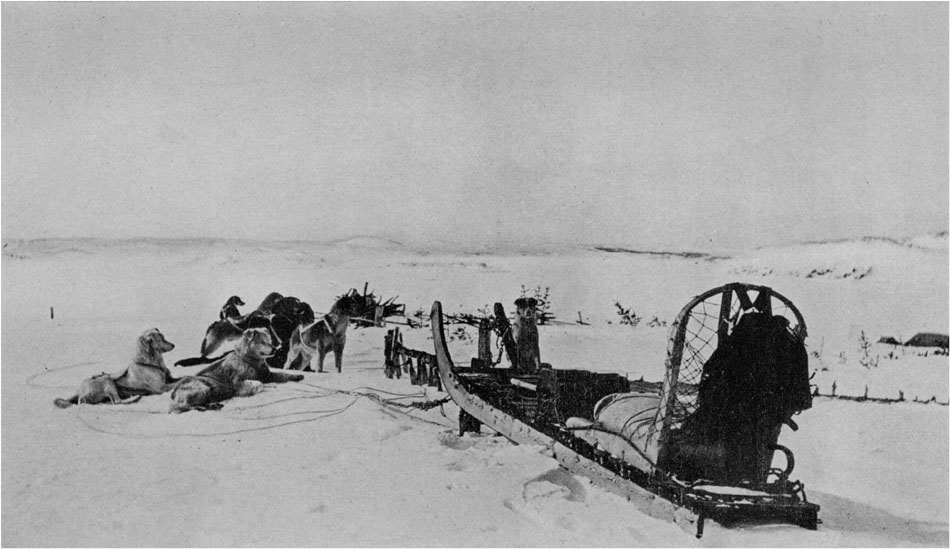
Let's Go!ToList
"Man dear! My, my, my! Ain't dat wunnerful, now!"
"Dat 'm de b'y!"
"By de powers!—Git y'r gaff, b'y! Help un in!"
"We'll have 'm all sove, soon's us lays han's on dat rope. Lord bless dat dog!"
At one moment his little brown head would rise on the crest of a streaked, yeasty wave, the rope still in the white teeth—and then as the wave curled and broke he would be plunged to the bottom of the trough and they would lose sight of him. Would he come up again?
"Yes—dere he be! My, my, my! Look at him a-comin' and a-comin'! I never did see a dog the beat o' un! By the livin' Jarge, he's got more sense 'n any o' us humans! I tell ye, thet's a miracle, thet's what it is. Nothin' short o' a gospel miracle!"
So the comment ran—for those who said anything. But many were too surprised and thrilled to speak—and if they cried out it was when they all cheered mightily together as the dog, hauled through the surf by as many as could get their eager hands on him, scrambled out on the beach and dropped the fag-end of the rope as if it were a stick, thrown into the water in sport, for him to retrieve.
Now that communication was established, the next thing to do was to haul a heavier rope to the beach. On this a breeches-buoy was rigged without delay. In that breeches-buoy the ninety-two were hauled ashore. One of them was a baby, eighteen months old, who traveled in a mail-bag, "pleasantly sleeping and unaware." The last to leave was the captain.
The sea hammered the life out of the boat—but the human life was gone from it, and nobody cared. As for the dog—you can imagine how Reuben Decker's cottage door was kept a-swing till it was nearly torn from its hinges, by friends who dropped in to pat him on the back, and look with curiosity at the animal which a few hours ago they ignored or despised. And Reuben did not tire of telling them all what a dog it was. He could safely say there was no better on the coast. Perhaps in the world.
The rumbling echoes of the dog's brave deed traveled "over the hills and far away," to Curling, where lives from hand to mouth a little paper called The Western Star. It has a circulation of 675 in fair weather and 600 when it storms. The editor is a man named Barrett, who is a correspondent of the Associated Press. He put a brief dispatch on the wire for all America. Some people in Philadelphia read it, and sent the dog a silver collar, almost big enough to go three times round his neck. Since the dog had no name, the word "Hero" was engraved on the collar.
The day of the presentation was a general holiday. All the way from St. John's, people came to see "Hero" rewarded. Father Brennan made a speech, the sheriff was in his glory, and Reuben Decker and his dog, dragged blinking into the limelight, were equally dumb with modesty, surprise and gratitude. The cheer that was raised when the silver clasp of the magnificent collar clicked round "Hero's" throat drowned out the loud music of the ocean.
Now "Hero," freed forever from bondage to the sled, may lie by the fire in his master's house, his head on his paws, his nose twitching, as he dreams of his great adventure.
VIToC
HUNTING WITH THE ESKIMO
When Dr. Grenfell first sailed his mission boat to the Eskimo settlements, the Eskimo swarmed aboard his little schooner, the Albert. They were singing a hymn the Moravian missionaries taught them.
"What do you know about that?" said Sailor Bill to Sailor Jim. "Them fellers certainly can sing!"
"Yes, an' they got a brass band," answered Jim. "Just hear 'em a-goin' it, over there on the shore when the wind sets our way. You'd sure think the circus was comin' to town! Hey there, where you goin', young feller?"
The "young feller" was an old Eskimo of about seventy, but Jim couldn't be expected to know that. For he was all done up like a figure from fairy-land—in snow-white jumper, peaked fur cap, and sealskin boots.
The Eskimo only grinned from ear to ear. He seemed ready to laugh at everything. His little bright eyes missed nothing.
"These husky-maws are so bloomin' curious," said Jim. "Just like them husky dogs. Hafta take the lid off 'n' look into everything. The cook says he dasn't turn his back to the stove. Don't you let 'em into the cabin!"
"There's one of 'em in there now!" cried Bill. Out of a port-hole issued the notes of a hymn, which one of the Eskimo was pumping out of a melodeon.
"Come up outa there!" yelled Bill, thrusting his head in at the doorway.
The Eskimo didn't understand the words, but he knew what the tone meant, and meekly turned a smiling face toward the sailor.
Then he jumped up from his seat on the top of a keg and put out his hand. Bill took the pudgy, greasy little fingers. The Eskimo brought from somewhere in his blouse a piece of ivory carved in the likeness of a boat with rowers.
"How much d'ye want for that?" asked Bill.
The Eskimo shook his head.
"Are ye deaf?" cried Bill. "How much d'ye want for the boat?"
"Aw shucks!" exclaimed Jim. "Hollerin' so loud don't do no good. He dunno what you're sayin'. He can't talk English. Show him your clasp-knife. That'll talk to him better'n you can. He wants to swop with ye."
Bill brought out the big knife. The little brown man nodded eagerly. Then he handed over the ivory boat. It was worth a great deal more than the knife. But not to the Eskimo. That knife would be a precious thing to help him carve meat and cut things out of sealskin and perhaps stab a polar bear.
"So everybody's happy?" laughed a clear and pleasant voice at Bill's shoulder. "You traded about even, did you?"
"Guess so, Doctor. He's got what he wants, and I'm goin' to send the boat to the kiddies in the old country."
That night as the men sat around the cabin lamp with their pipes and a big pail of steaming cocoa, Dr. Grenfell told them something about the strange people they had come among.
He had spent all day ashore among them, in various repairs to their bodies, and he had promised to come back to them in the morning.
"They're a nice, jolly, friendly lot," he said. "So different from the old days, before the Moravian missionaries came.
"You know, they always called themselves 'Innuits.' That means 'the people.' They said God went on making human beings till He made the Eskimo. When He saw them, He was perfectly satisfied, and didn't make any more.
"But the early Norsemen came along, about a thousand years after the time of Christ, and called them 'skrellings.' That means 'weaklings.' It was the Indians who called them Eskimo. The word means 'eaters of raw meat.'"
"They've sure got some funny ideas about Hell 'n' the Devil, Doctor!" put in an old, wise sailor who was sitting deep in the shadows.
"Yes they have!" agreed the Doctor. "Their God, Tongarsuk, is a good spirit. He rules a lot of lesser spirits, called tongaks, and they run and tell the priests, who are called angekoks, what to do. The angekoks are the medicine-men and the weather-prophets. The Devil isn't he, but she. And she is so dreadful that she hasn't any name, because you're not supposed to talk about her at all.
"The angekoks are awfully busy fellows. They have to keep making journeys to the centre of the earth, the Eskimos believe. Because that's where Tongarsuk the good spirit is, and they have to go and ask him what to do when the little spirits get lazy and won't tell them.
"Anybody who thinks the angekok has an easy time of it on his voyage is mistaken. The journey has to be in winter. It must be at midnight. The angekok's body is standing alone in the hut—his head tied between his legs, his arms bound behind his back. In the meantime his soul has left the body, and is on the way to heaven or hell.
"That's what an ordinary, every-day angekok has to do. But if you want to become an angekok poglit, which is a fat priest (meaning a chief priest), it hurts a lot more, and takes much more time and trouble. Then you have to let a white bear take your wandering soul and drag it down to the sea by one toe. They don't tell you how a soul comes to have a toe to drag it by.
"When the soul reaches the seaboard, it must be swallowed by a sea-lion—and of course the soul may have to sit there in the cold for quite a while waiting for a sea-lion to come along. After the sea-lion has swallowed it, the same white bear must reappear and swallow it too. Then the white bear must give up the spirit, and let it return to the dark house where the body is waiting for it. All this time the neighbors keep up an infernal racket with a drum and any other musical instruments they may happen to have.
"The Eskimo know very well that once there was a flood—but they cannot say exactly when. The trouble was that the world upset into the sea, and all were drowned except one man who climbed out on a cake of ice. They are sure of what they say, because although the oldest man alive only heard about it from the oldest man when he was a baby, they still find shells in the crannies of the rocks far beyond the maddest reach of the sea: and somebody once found the remains of a whale at the very top of a high mountain.
"You do not go up to heaven when you die: you go down,—way, way down, to the bottom of the sea, where the best of everything is. There it's summer all the time. To the Eskimo there is no hell in being hot—hell is terrible cold. Down there where it is summer all the time you don't have to chase reindeer if you want them to pull you about—they come running up to you, obliging as taxicabs, and ask you please to harness them and tell them where you would like to go. And your dinner is ready for you all the time: the seals are swimming about in a kettle of boiling water. The women don't have to spend their time chewing on the sealskins to make them pliable for shoes and garments. The skins come off, all by themselves, already chewed—as nice and soft as can be, fit to make a bed for an Eskimo baby.
"His boat and his weapons go with the warrior to his grave, so that his spirit may have the use of them in the next world.
"Once, one of the sailors from Newfoundland took something from a grave and hid it in his bunk.
"That night the dead Eskimo came looking for his property.
"It was pitch dark—but one of the crew saw and felt the ghost prowling about in the cabin!
"He yelled, and they lit the lamp.
"The ghost went out at the hatchway instantly.
"They put out the light, and the ghost came back. Then shouts were heard, 'There he is! He's a Eskimo! He's huntin' in Tom's bunk!'
"After that, they kept the lamp lit all night long: and the next day, Tom went back and with trembling fingers restored what he had stolen to the grave.
"There are wide chinks in the rocky roof of every properly made Eskimo grave. This is not so that prowling sailor-men may reach in: it is so the spirits will have no trouble going in and out.
"You may still find lying in a grave a modern high-powered rifle ready for business, and good steel knives ready to carve those cooked seals down there in Heaven. I've even found pipes all ready filled with tobacco, to save the spirits the trouble of using their fingers to cram the bowl.
"Nowadays sealskins are exchanged for European goods, especially guns, and the Labrador Eskimo have lost much of the art of using their kayaks, the canoes into which they used to bind themselves securely, so that when they turned over in the water it did no harm. They would 'bob up serenely' and go right on, and in contests one man would pass his boat right over that of a rival without risk of accident.
"The Eskimo and the Indians were bitter enemies. The story of the last fight is, that the Eskimo had their fishing-huts on an island off the mouth of a river.
"Down-stream by night crept the Indians in their war-canoes. These they dragged ashore and hid in the rocks. Next morning the Eskimo came upon their enemies and at once attacked them.
"The Eskimo are little people as compared with the Indians. The Indians, their squaws fighting like bears beside them, drove the Eskimo back and back toward the sea.
"Stubbornly the 'huskies' contested every inch of the ground. Now and again they would crawl into holes among the rocks—but the Indians would find them there and cut them down without mercy, like animals trapped in their burrows.
"The Eskimo had their choice between the Indians and the sea. They would carry their children and even their wives down to the boats on their backs, and sometimes the frail skin-boats would turn over, and all the people in them would be drowned. If they succeeded in putting out to sea, they had no place to go: the Indians waiting ashore would get them whenever and wherever they landed.
"At last—there were only the Indians in their war-paint, dancing and howling on the beach—not an Eskimo was left to tell the tale."
A few days later, Dr. Grenfell came to Hopedale.
There, he found, the Eskimo believed that Queen Victoria, away off there on the other side of the ocean, was sitting on a rock waiting for the Harmony (the Moravian mission ship from Labrador) to come in sight.
They loaded him down with all sorts of messages they wanted him to give her.
Especially, they wanted him to say to her that they were very, very grateful to her for sending him over the seas to help them.
When they learned that England was at war in Egypt, and a brave general was holding the upper Nile against a crowd of savages, although they hadn't the slightest notion as to where Egypt was or who the Egyptians were, they got out everything they had in the way of firearms and began to drill up and down on the rocky beach.
One old fellow had a policeman's coat split up the back and much too big for him, and he dragged the tail of it along the ground like a bedraggled water-fowl. He also had a single epaulet that had come in a box of cast-off clothing.
On the strength of that uniform they made him captain of the company.
Then they all marched up to the missionaries and said:
"We want to go to war and help the English!"
"It won't be any use," said the missionaries. "Egypt is a long, long way off—and the war will be over before you could get there!"
"Never mind!" insisted the "huskies." "We want to go!"
They kept on drilling and making warlike noises with their mouths till the ice melted and the cod came in. And after that, in the struggle with the cold sea and the barren land for a living they forgot all about war and the rumors of war.
There were seals and bears and foxes to be hunted, instead of men.
Dr. Grenfell found one man who was lucky enough to catch a black fox in a trap of stones.
He was so happy over the catch that tears of joy ran down his face as he carried the precious skin to the store. He said God had heard his prayers and made his family suddenly rich.
The storekeeper paid him forty-five dollars. That seemed like a fortune. The price was not paid in cash, however, but in food.
Staggering under the load he came back to his hut, and when the stuff was put on the shelves it looked like such a lot he began to think he and his family never would be able to get it eaten before the end of the world came.
So he sent out for his friends and neighbors.
Be sure they came. An Eskimo can smell food cooking (or even merely rotting) for miles beyond the power of sight to detect it.
The invitation ran: "Come and eat and stay with me." And then the Eskimo ran too, the big ones tumbling over the little ones, and the dogs outstripping their masters, and all making loud noises according to their kind.
Alas! in two days they had literally eaten their generous host out of house and home, and along with the dogs of the quarreling packs there was the wolf of hunger gnawing at the door.
One of the Newfoundland fishermen left an Eskimo in charge of his supplies for the winter. Of these provisions he had set aside plenty for the Eskimo—for he knew how much a "husky" can eat. The Eskimo seems to have a "bread-basket" quite as extensible as any dog he drives.
Then all the other Eskimo came swarming: and he fed them all, so that in two days the whole crowd were starving together.
Grenfell found that the white man, green to the business of dog-driving or whale-hunting, had to win the respect of the Eskimo.
The Eskimo knows that most of his paleface brethren from the south are wholly unable to paddle their own canoes.
The white man, as a rule, cannot slay the seal, nor catch the cod, nor catch anything else except a cold.
He cannot stand up to a polar bear with a knife in fair fight.
He cannot sit out on a rock in a rain-storm all day without an umbrella and seem to enjoy it.
He cannot stand hunger, thirst and frost, and he chokes when the fumes and the black smoke of oil lamps get into his throat.
Then he is so funny about food! He doesn't care for stinking fish: he doesn't like his meat crawling with maggots after it has been buried in the ground; he doesn't know how much better molasses tastes when mice have fallen into it and expired.
The white man washes. How silly! He takes a brush made of little white bristles and rubs his teeth with it. Well, if the white man's mouth, which is full of water, isn't clean, then what part of him can be clean? And why does he turn up his nose at the Eskimo for being dirty?
As for smells, what is a bad smell? The Eskimo doesn't seem to know. In Kipling's wonderful address on "Travel," before the Royal Geographical Society, he had much to say about smells, and how they suggest places. Eskimo taken to the World's Fair in Chicago were homesick for the smell of decaying blubber, rancid whale-meat, steaming bodies in the igloo, the rich perfume of the dogs, and all the other aromatic comforts of home. As smells are their special delight, so dirt is their peculiar glory. A bath in warm water would make them as unhappy as it makes a cat.
Fond of eating as they are, they like a change of food, and if bear-meat is all they find to eat in a certain spot, they hitch up and hike on to a better meal at a distance. They always want to be on the go. They rarely stay in one place more than a year or two.
Even the rifle does not seem, in the long run, to be helping them much. When the sealer used a harpoon, he hardly ever missed the seal, for he always struck at close range. But with the rifle, shooting from afar, the sea often swallows up his prey ere he can reach it. The walrus has gone to the farthest North and the seal is becoming gun-shy very fast.
As a hunter, the Eskimo is not wanting in nerve. A mighty hunter north of Nain was out gunning for big birds—ptarmigan, guillemot and divers,—when he came on a robust and fierce polar bear, a monstrous specimen.
The Eskimo had a shotgun, not a rifle. It takes a ball cartridge of large calibre to do for Mr. Bruin ordinarily—and he can "make his getaway" with a good deal of lead in him. But the "husky" calmly walked up close to the bear, and discharged his shotgun pointblank in the face of the astonished animal. If the hunter had been at a distance, the bear would have minded the dose about as much as a pinch of pepper. As it was, the animal was blinded, and turned in fury on the hunter.
The Eskimo tore off his sealskin tunic and threw it over the bear's head, the way a bull-fighter confuses a charging bull with a mantilla. The bear stopped to tear the garment in pieces before proceeding to kill and devour the owner.
But the delay was fatal to Mr. Bear. In jig-time the hunter had reloaded the gun. He put the second charge into the bear's head through the eye,—and the monster expired at his feet.
The boys have bows and arrows; they begin by practising on small birds and later become proficient with a gun, so that by the time they are twelve years old they are veteran hunters.
The greatest joy in the life of the Eskimo is to spend a day in a seal-hunt.
Hours before dawn, the hunter climbs a rock and looks out to sea, anxious to learn if it will be a good day for his watery business.
Then he gets his breakfast. In the old days, it was a drink of water. Nowadays, if the Eskimo has learned to like the white man's hot drink, it may be a cup of coffee.
At any rate, he drinks his breakfast: he doesn't eat it. He says food in his stomach makes him unhappy in the kayak.
The only food he takes with him is a plug of tobacco. He carries the kayak to the water, puts his weapons where he can get his hands on them instantly, climbs into the hole amidship and fastens his jacket round the circular rim.
He may have to go a dozen miles out to sea. Now and then, to vary the paddling, he throws a bird-dart. Like the Eskimo harpoon, this dart and the stick that throws it are most ingenious contrivances, and beautifully wrought.
The hunter grabs the beak of a wounded bird in his teeth, and with a wrench breaks the creature's neck. He then ties his prey to the rear of the kayak and grins at the other hunters.
At the hunting-ground, seals' heads are to be seen everywhere, like raisins in a pudding. This is not sealing on the ice, as along the coast of Newfoundland: it is hunting them in open water—a very different thing.
Papik (let us call him) spots the seal he wants and creeps up on it, paddling warily.
The seal, a wise creature where such hunting is concerned, sees him and dives.
Papik rests on his paddle, and gets his harpoon ready for the reappearance of the seal.
It is a waiting game. Whenever the seal bobs up, the kayak is a little nearer, for while the seal is under water a few strokes of the paddle have cut down the distance.
A seal can stay under water a long, long time.
But an Eskimo, for his part, can sit all day as still as a tombstone in a cemetery.
Woe be to the furry creature, if it waits a fraction of a second too long before it dives!
In the clear sunlight the shaft flashes whistling from the throwing stick, the barb strikes, and the seal goes down in a welter of blood-stained foam. At the end of the harpoon line is a bladder—and as the bladder dances away over the surface, sometimes bobbing out of sight, Papik is after it like a hound chasing a rabbit.
The bladder is to the barbed harpoon what the fisherman's float is to the baited hook.
When the seal comes up, furious to attack and punish the hunter, it first tears the bladder in pieces—then it makes at the kayak.
But Papik is calmly ready. He has a lance with which he takes careful aim.
The seal comes on, bent double to hurl itself forward with all its might. It seems strange that a creature usually so gentle can show such ferocity.
The lance is flung. It goes through the seal's mouth and comes out at the back of the neck. The seal shakes its head violently, but it is doomed.
Papik's second lance strikes through a flipper into the lungs.
The seal is still alive as he comes close. Papik stabs it with his long knife, and it ceases to struggle at last. The seal is a creature that clings to life a long, long time. He ties the seal to the stern of the kayak, rearranges his apparatus, coils his rope, puts his lances in their place, and is ready for another. If he is in luck, he may paddle homeward with four seals, and even more, in his wake.
If a storm comes before he gets to the shore, his watermanship is severely tested. He fights not only to bring his boat and himself through the tumult of the waters: he means to save every one of those carcasses wallowing along behind.
In the midst of his hard fighting with the waves, which turn him over and roll him about, as he stubbornly rights himself after each capsizing and hurls himself through the next curving green hillside of water, he comes upon a helpless comrade.
Ordinarily, the second man, Patuak, could bob up again and go on, like stalwart Papik.
But Patuak's jacket worked loose at the rim of the body-hole of the kayak. The water rushed in. Now he is water-logged. He will lose his boat, his seals, his life, unless Papik can save him.
Is Papik tempted to think only of himself and leave Patuak to his fate? If he is, it does not appear in what he does. He runs his kayak alongside that of his friend: he puts his paddle across both boats, and if he cannot bring in both kayaks, with such help as Patuak is able to give, he may even carry Patuak lying across the prow of his own boat.
It is easier to drown a seal than to drown an Eskimo.
The women stand on the rocks, shielding their eyes with their hands as they gaze eagerly seaward—just as the women of Nantucket stood on the roofs of the houses in olden times watching and waiting for the whaling-fleet.
At the first sign of the approaching hunters a cry goes up: "They are coming!"
Then they begin to count.
They thank their own idea of Heaven when they find that—seals or no seals—their men are coming back in safety.
If a man is towing seals, they shout his name with joy—and after it put the word "kaligpok," which means "towing."
The women haul in the boats, rub noses with their husbands to show their affection, and proceed to prepare the feast of raw blubber.
After that feast the men tell the story of the day's work—without boasting, but with touches of humor that send the listeners off into ringing peals of laughter.
The story-telling is a part of the seal-hunt. The phrases are straight-flung as a seal-lance.
"When the time came for using the harpoon, I looked to it, I took it, I seized it, I gripped it, I had it fast in my hand, I balanced it"—and so on. The audience, mouths agape, misses no word. It is the nearest thing the Eskimos have to motion pictures—and what a motion picture the whole of the seal-hunt is! No wonder the hunter lolls back like a lord, and lets himself be waited on, a conquering hero.
The old men feel their youth renewed as they sit and listen to these wonder-tales. In their turn, they are moved to tell how they met the walrus in fair fight and overcame him. Perhaps the dreaded tusk went right through the side of the boat and wounded the hunter. But there are no friends like Eskimo friends for a man in such a plight. They killed the walrus—they dined off the meat—and the tusks are kept to this day to show for it. A skin canoe against a walrus—that is a battle indeed. The younger men know what it means: and the old man is comforted by the remembrance of what he used to be.
They are patient people, the Eskimo, and they need all the patience they have. An Inspector sent a boat-load of Eskimo to a fiord to get some grass for his goats.
They were gone a long time, and he wondered what had become of them.
When at last they returned, he asked them why they remained away so long. They told him that when they got to the place where he told them to go, they found the grass was too short. So they had to sit down and wait until it grew. Their time was of no value. And they had their orders to obey!
The world owes it to these brave people not to take from them their birthright to their few possessions in the far places where they dwell.
VIIToC
LITTLE PRINCE POMIUK
There was an Eskimo boy named Pomiuk who lived in the far north of Labrador, at Nachoak Bay. Pomiuk had the regular sea-and-land training of the Eskimo boy. In summer his family lived in a skin tent, in winter they occupied an ice igloo. It is a fine art making one of those rounded domes—the curving blocks must be shaped and fitted exactly, so as to come out even at the top.
Blubber in a stone dish supplied light and heat. If the air got too thick, father could thrust the handle of his dog-whip through the roof. Nobody bothered about bathing on Saturday night, and nobody minded the smell of rotten whale-meat for the dogs. In an atmosphere that would stifle a white man, Pomiuk and his brothers and sisters throve and laughed and had the time of their lives. Pomiuk had his own whip of braided walrus hide, and even when he was little the dogs respected him and ran forward when he shouted "oo-isht!" turned to the right at "ouk!" and stopped and sat down panting when he shouted "ah!"
When Pomiuk was ten years old a ship came on a strange errand. Pomiuk's family and their friends were fishing for cod. But when the strange ship dropped anchor, they flocked to it shouting in their own tongue "Stranger! stranger!" When they learned why it came they were amazed.
An Eskimo interpreter who came with the white men from the south explained that what they wanted was to take the Eskimo to that far-off land called America, where at a place called Chicago most wonderful things were gathered together in huge igloos for all the world to see. They wanted the Eskimo to come themselves and to bring with them their boats and dogs, their sleds, their tools, their clothing, and the things with which they hunted whales and seals and polar bears. In fact the white men could not pretend to show the world anything very remarkable, unless such clever people as the Eskimo brought their things with them.
The men from the south urged and flattered and argued till a number of the Eskimo let themselves be persuaded. The Eskimo had no idea of the trouble and disaster they were letting themselves in for, or they never would have started. The beautiful fairy-tales told by the white men inflamed their imaginations. They had always been very well pleased with their own white, cold world of whales and seals and kayaks—those canoes in which they are as much at home as the fish in the sea. But here was a chance to travel, and see marvels, and come home and rouse the envy of those who had not dared. It was too good a chance to miss. They would return rich men, and have nothing to do but brag about their adventures for the rest of their lives.
Pomiuk's father didn't care to go. But he was broad-minded. It was a big sacrifice for him to part with his wife and son, for it is the teeth of the women that must chew the sealskins to make them pliable for shoes and clothes: it is the fingers of women that do all the sewing. But Pomiuk's mother could show the helpless white women how to make skin boots, and Pomiuk could teach the paleface men and children to use the dog whip as he used it every day. If the Eskimo brought back money enough to buy many things at the nearest trading-post, the time spent on the long southward trek would not be wasted. The Eskimo, unlike the northern Indian, is a good business man, counting his puppies after they are born and his fox-skins before he spends them.
So the Eskimo sailed away from their own coast, with a gnawing homesickness at heart, though their lips were silent about it: and when they got to Chicago the life was strange with hideous sight and sound, and altogether unbearable: and they longed to get away from it to the sea and the ice and behold again their northern lights, which to the Eskimo are the spirits of the dead at play.
But there they were cooped up behind a stockade, like creatures at the zoo, to amuse the crowd, and be giggled at and poked toward as if they were some newly imported breed of monkey. An Eskimo likes as little as any other human to have fun made of him.
Worst of all, they lived in the white man's houses, and found the four walls instead of the "wide and starry sky" intolerable. A snow house has its own kind of stuffiness—the smell of whale-blubber and seal-oil to Eskimo nostrils is a sweet perfume. To be cooped up in a bedroom, and expected to sleep on a mattress with pillows, is pure torture.
While they were on the exhibition stand, in the torrid heat, they had to wear those heavy clothes of furs and skins which the ladies said looked so picturesque. They knew how the polar bear felt in his cage away from his ice-blocks. The food the white man ate with relish was such queer stuff. They longed for that delicious tidbit, the flipper of a seal. How good the entrails of a gull, or a fox's stomach would have tasted! But the white men seemed to think that coffee, and watermelon and corn on the cob, and ham and eggs, and the pies their Eskimo mothers never used to make were good enough for them. Except for the warm blood of the seal, the Eskimo ordinarily has no use for a hot drink.
Several of the older Eskimo wilted away like flowers, and died. They were buried and forgotten; and when the dogs died they were buried and forgotten too: there was about the same lack of ceremony in the one case as in the other.
But little Pomiuk through thick and thin was the joyous life of the party. They worked him hard, because he amused the visitors. The visitors would throw nickels and dimes into the enclosure, and as the coins flickered in the air Pomiuk would lash out at them with his thirty-five foot whip. If he nicked the coin it was his. Then he would laugh—a very musical laugh, that could be heard a long way off. He was a jolly, friendly little soul, and he wore a smile that hardly came off even when he slept.
But there came a time when even happy little Pomiuk could not smile.
One day as he leapt high in the air, agile as a Russian dancer, to bring down one of those spinning coins with his whip, he fell on the boards, his hip striking a nail that stuck out.
His mother ran to pick him up. His face was twisted with agony.
He tried to stand, for her sake, but the effort was too much for him, and he sank back in her arms, weak as a baby. What was she to do? The men who ran the exhibit had not kept their promises. Pomiuk was the chief bread-winner for them all. The coins he had nicked with his whip were most of what they had to spend.
With this money they sent out and got a so-called "surgeon" who did not know his business, but took the money just the same. He patched up poor "Prince" Pomiuk so that the boy was worse off than before.
The Fair closed: the Eskimo were stranded. If that had happened on a sea-beach at home, they would have known what to do: they would have laughed—for they are merry people, like our southern negroes—and they would have killed sea-birds with stones and made their way alongshore. But to be stranded in Chicago is another story. God knows how a few survivors of the band found pity in men's hearts, and straggled back to their home at Nachoak Bay.
Pomiuk's wound never healed—he could not run about, nor walk, nor even stand. His mother had to carry him everywhere. In Newfoundland the fishermen and the sealers, desperately poor as they were, took them into their bare cabins, and gave them bread and tea taken from the mouths of their own hungry children.
Dr. Frederick Cook, creation's champion liar, did a golden deed for which the Recording Angel should give him a good mark in the Book of Life. He made room for several of the Eskimo on his journey to the Labrador coast: and fishing-schooners took the rest of the survivors.
Imagine how happy Pomiuk was, in spite of the pain in his hip, when he thought of crawling back into the mouth of his own snow house again, and rubbing noses with his father once more!
But when the mother and the child were put ashore at Nachoak Bay—they were told that the father's spirit was at play with the rest among the northern lights. In this world they would not see him again. He had been murdered while his wife and child were in Chicago.
It was at that dark hour that Dr. Grenfell came into his life.
Grenfell found the poor little boy, who had earned so much money, and brought so much glory to his tribe, lying naked on the rocks beside the hut. The mother had married again, and gone off "over the mountains" with the other children, leaving her crippled son to the tender mercy of the neighbors. It was indeed a "come-down" in the world for a "prince," whose father was a "king" among his fellows. It was deemed best to send Pomiuk south on the little hospital steamer with the Doctor. The Doctor could fix him up, if anybody could, and moreover—this was the clinching argument—he was "no good fishing." So the next day found Pomiuk bound south, clasping his only worldly possession—a letter from a clergyman of Andover, Massachusetts. There was a photograph with it. If you asked Pomiuk what he had there, he would turn on that magic smile and show you the picture, and say: "Me love even him."
The minister who wrote the letter sent money for the care of the poor "Prince." Next summer Grenfell saw him again, and the child laughed as he said, "Me Gabriel Pomiuk now." A Moravian missionary had given him the name. They had made him as comfortable as possible at the Indian Harbor hospital: his own disposition made him happy. He had been moved from the hospital to a near-by home, and he hopped about on crutches as gayly as though he could run and play like the other children.
But malignant disease in his hip was sapping his strength, just as the ants of Africa will eat away a leg of furniture till it is a hollow shell, and one day the whole table or chair falls crashing. His strength was ebbing fast. Suddenly he became very ill: he was put to bed, with high fever, and was often unconscious. In a week he was dead. But that little generous, courageous life was the foundation-stone of Dr. Grenfell's noble orphanage at St. Anthony, put up with the pennies of American children, where I had the pleasure of telling dog-stories to smiling Eskimo boys in the summer of 1919. Gabriel is the angel of comfort: and this small Gabriel has left behind him the comfort of fatherless homes in Labrador for ages yet to be.
Dr. Grenfell says that on the night of his passing the heavens were aflame with the aurora. It was as though little Prince Pomiuk's father had come to welcome him, and they were at play once more in the old games they knew.
VIIIToC
CAPTURED BY INDIANS
In the lonely interior of Labrador in midsummer an old man sat on the rocky ground with a ring of Indians about him.
He was "Labrador" Cabot of Boston. Year after year he had gone to Labrador to visit the Indian tribes and study their ways. He could talk the Indian language and understand what they said to him.
"What's the matter with your leg?" asked the Chief, a big, strong fellow with keen eyes. "Can't you walk? We must get started if we want to find the deer."
"I think I must have broken my leg when I slipped and fell on the rocks," answered Mr. Cabot.
He made an effort to rise and stand, but sank back helplessly.
A curious, evil grin spread across the red man's face.
"You're sure you can't walk?"
Mr. Cabot shook his head.
"What will you do?"
"One thing is sure," said Mr. Cabot, "I'll have to stay with you if I'm to get out of this place alive."
"We can't let you keep us back," answered the Indian. "We might leave you here with a fire and something to eat."
"And what would I do after the fire went out, and the food was gone?"
The Indian shrugged his shoulders. "I don't know."
"Can't some of your men make a litter of boughs and carry me?" pleaded Mr. Cabot.
"They could if they wanted to," answered the Indian, coldly. "But I don't think they want to."
"Haven't we always been friends?" urged Mr. Cabot.
"I suppose so."
"Haven't I been here summer after summer, and helped you, and given medicine to sick people?"
The Indian picked up handfuls of sand and threw them on the fire. "Yes, and you were always writing in a little book. Maybe when you went away from here you told lies to the world about us. Who knows?"
Mr. Cabot was puzzled. Was this the friendly, peaceful Chief he knew before he had the misfortune to fall and hurt his leg?
In spite of the pain he was suffering, he tried to talk calmly and not show that he was afraid of being left behind. "Why have you turned against me?"
"What do you mean?" the Indian chief answered.
"A little while ago you seemed like my friend. Now you are willing to leave me here where there are no fish, and the deer do not come, and the mosquitoes are worse than any wild animals. What is the meaning of all this?"
"I will tell you," the Indian answered, very slowly. "You must pay us for what a white man did to us."
"What do you mean?"
"Listen, and you shall hear.
"Last year, we had fox furs—very many and very fine. We had risked our lives: we had starved and frozen to get them. All over Ungava we had tracked and trapped in the wilderness.
"Then—see what happened. A trader came among us. He had much money. It was not like any money we had seen before, but he said it was a new kind of money. And he would give us more of it for our furs than any man had given us before.
"He gave us much to drink. We had a feast, and dancing. The trader gave handsome presents to our wives. Beads and bright cloth for dresses. He gave us tobacco, and whiskey.
"When we did not know what we were doing, he bought our furs. He bought them all. He gave us this new, strange money and much of it. Then he went away. We fired guns in the air to honor him. We shook hands with him. We thought he was our friend. We promised to be friends with him as long as sun and moon endured.
"He smiled, and waved, and went away—and we, we had nothing of him but the money. It was paper, all of it, very bright and new and green, with printed marks on it we could not read.
"Some shook their heads when he had gone, and said, 'No, no, brothers. We should not have taken this green paper and given him those furs.'
"But others said, 'Look what he has paid us! We are all rich men. The price is better than we ever had before!'
"The old, wise men said, 'How do you know that it is more, when you do not know how much it is?'
"So, night and day, there was talking to and fro—along the trail by day, around the camp-fire when the sun had set.
"It soon came time for us to send men down to Rigolet, on Hamilton Inlet, there to buy at the Hudson's Bay store the things that we would need in the winter time.
"We sent twelve of the strong young men in their canoes to get the things and bring them home to our tents. We were happy when we thought of all the guns and tobacco, all the flour and the fine clothes so much money would buy.
"They went: and they were gone many days, while we waited in one fixed place for them, and in our minds spent the money many times over."
Then the Indian paused. He was squatting on his haunches, and puffing at his pipe. Mr. Cabot's leg was giving him much pain, but he was too proud to ask the Indian to do anything for him.
The Indian's face grew very stern as he remembered. His tone became as hard as the expression of his face. He looked at Mr. Cabot and clenched his fist. "When our men came to the storekeeper, they walked all about the store. 'I'll take that fine dress,' said one. 'Give me that shotgun,' said another. 'I will have this bag of tobacco,' said a third. Some took flour, and some chose bright ornaments for their wives, and others took candy, and one man got a talking-machine. Some chose the best clothes in the store. They also took much food of every kind, and ammunition for the guns.
"They made great piles of the things on the floor, to take them to the canoes.
"Then they brought out their money to pay for all these things.
"'What is that stuff?' said the storekeeper.
"'That? It is our money. It is what a trader paid us for our furs.'
"'What was his name?'
"'That we do not know. We did not ask. We do not care who buys from us; all we care is that he buys. One man's money is as good as another's.'
"Then the storekeeper laughed in their faces. And he said: 'You have been fooled. You have been fooled as easily as little children. Do you know what this "money" is that you have given me?'
"'No,' they said.
"'It is not money at all,' he told them. 'It is nothing but labels from beer bottles. You cannot have those things you have piled up on the floor. I will take them back and keep them here until you bring me real money for them.'
"Then they said to him, 'But it is all we have. We cannot go back to our people with nothing.'
"He said: 'I cannot help that. It is no fault of mine.'
"They wanted to fight—but it would do no good to kill the agent or drive him away. There would be no one from whom to get things another year.
"'You ought to have brought your furs to me. I would have given you real money for them,' said the agent.
"They went away very sorrowful. After many days they came back to us again. We were very glad when we saw them coming—but we wondered that their canoes were not piled high with the things we had told them to buy.
"When we heard their story we were very sorrowful. We talked about it a great deal. We said, 'What shall we do?'
"Then we made up our minds. This is what we decided. We said: 'The next white man that comes among us we shall hold. We shall not let him go until he pays to us a sum of money, seven hundred dollars, equal to that which we have lost. Since he is a white man he or his friends must make up to us that which we have lost at the hands of a white man.'
"So now you see—you are the man. And it is you that must pay back to us the money."
"But I haven't seven hundred dollars."
"Then you must promise that you will pay it, or get your friends to pay it. These many years you have come here among us. We will trust you for that. It is much that we should trust you—when it is one of your own people who brought such suffering and loss upon us."
"But this is an outrage!" said Mr. Cabot. "I never did anything to you but good. You know that."
"Yes, we know that," said the Indian, gravely. "But we shall leave you here unless you pay. You cannot find your way out alone—even if you could stand and walk upon your broken leg. We shall not carry you from here unless you pay the money. Is that not so?"
He turned to the others, who had not said one word all this while: they had been merely looking on and listening.
"Yes," they said. "He has spoken for us all. As he has said, we shall do. You shall be left here, if you do not pay."
"The Great Spirit has given you into our hands," the Chief declared. "When you came to us this summer again, we said among ourselves that he had sent you. We did not know that he would cause you to break your leg. We were going to keep you even if this had not happened. Now the Great Spirit has caused this hurt to happen to you. We see, by this, that we were not mistaken. He sent you to us as surely as he sends the fish or the deer when we have need of food. It is for you to choose, if you will pay, and go on with us to the coast—or refuse to pay and be left here in the wilderness to die."
So Cabot had to sign a promise to pay them the $700 for a great rascal whose name neither he nor those Indians will ever know.
They made a stretcher and put him on it, and carried him with them out to the coast.
If they had not done so—his white bones would now be bleaching beside the cold embers of a camp-fire in the desolate interior of Labrador.
Do you blame those Indians for wanting to "take it out" of the first member they met, of a race that bred such a rogue as the man who cheated them?
Dr. Grenfell tells us that for about two hundred years the Eskimo of the interior and the Indians of the coast were at war with one another. There was a battle, long, long ago, in which Indians killed a thousand Eskimo.
But nowadays when the Eskimo and Indians come together they have no quarrel.
There was such a meeting at Nain in 1910. It was the first time the Eskimo had ever seen Indians in that tiny fishing-village, and they "ran about in circles" in their excitement.
It was on a Sunday afternoon when the Indians appeared. They had come down a stream from the interior, and when they rounded the bend in their boats—of a kind that was strange to the Eskimo—the latter set up a cackle like that of a barnyard when a hawk appears.
The Indians, with their bundles on their shoulders, filed ashore, made their way to a hut the kindly Moravian missionary let them use, and sat in muddy, weary silence round the walls.
The Eskimo crowded into the doorway, their tongues hanging out, staring at these queer folk as if they had dropped from the moon.
But other Eskimo, kind-hearted and hospitable, were moved to show the strangers what shore life was like.
They got busy at the stove, boiled water, and presently handed about large cups of tea, with sugar and biscuit.
The Indians devoured the refreshments thankfully, for they were very hungry. The Northern Indians lead lives that are often sharpened with hunger for long periods together. You can see it in their lank frames and their gaunt faces. The southern Indians, nearer the flesh-pots, with kindly priests at work among them, look roly-poly, chubby and content.
It was a very silent party. The Indians who had been so bold as to come this far to the sea were probably homesick for the flat stones, the dwarf birches, the far-lying ponds and cold swirling streams, the hordes of mosquitoes and the caribou of their lone spaces at Indian House Lake. The cluster of houses at Nain looked to them as New York would seem to one who had always dwelt in the heart of the Maine woods.
By morning, after a sound sleep on the floor, they were eager to begin trading.
A southern Indian translated.
They had brought deerskins chiefly. There are few valuable furs in their part of Labrador, but they did their best to make a brave showing with the few they were able to find.
You can imagine their people at home at Indian House Lake saying before the start of the expedition: "Oh, if we only had some beaver or marten skins! Wouldn't it be nice, now, if we could get a silver or a cross fox? Those people down there at the coast know such a lot, and are so rich, and so particular! Nothing but the very best we have will do."
They held up a bearskin with great pride. They had a wolverine,—the only sort of fur on which snow will not freeze,—several wolf-skins, and moccasins, embroidered. The translator would point to what they wanted on the shelves. Then they would take the object in their hands and weigh it very carefully, thinking of all those portages on the homeward trail—probably twenty at least—over which every ounce must be carried on a man's shoulders.
They bought lots of tea—one man getting as much as sixteen pounds. They wanted gay prints. Other things to which they took a fancy were tobacco, cartridges, fish-hooks, matches, needles, and pearl buttons. First they handed over the skins, and received money in return: then they spent the money. Mouth-organs were much in demand, and they looked longingly at an accordeon and tried to play on it and were enchanted with the squawks that came out: but they were not rich enough to buy it. One boy bought a clay pipe, and spent all his time licking it. They were not allowed to smoke in the store, but they spat wherever they pleased.
Doctor and Mrs. Grenfell are out on the war-path against this disgusting custom, and they have had very hard work to persuade even the "liveyeres" that there is danger concealed in germs that cannot be seen, when saliva dries and the wind blows it about. In all this glorious fresh air it is mournful to think of the many who die of consumption, pneumonia and all sorts of lung-trouble, because of stifling houses and unclean habits.
The Indians at first were extremely shy. Then they waxed merry, and as they bought they laughed and chatted. In the party were three women. One of them was young and good-looking, and she was showered with presents—kettles, cups and saucers, perfumed soap and cologne! A young man bought for her anything she wanted—and every time he made a purchase for the fair one the others laughed aloud. And each time he bestowed a gift, one of the other women turned to her husband and made him buy the same thing for her. Human nature is the same on the Labrador as on Coney Island.
It took two days for them to do their buying, and wrap up their purchases, and say farewell.
By this time Indians and Eskimo were sworn friends.
The Eskimo crowded to the end of the little pier, and knelt down to reach over and grasp the hands of the parting guests. There were shouts of "Yomai!" from the Indians, and various cries in answer from the Eskimo. Then, crouching on their heels, the Indians trimmed their sails to the breeze and were borne swiftly round the point to be seen no more.
How different is all this from the days of old, when the Eskimo were called "the most savage people in the world!"
IXToC
ALONE ON THE ICE
In April, 1908, Dr. Grenfell had the closest call of his life. Of course in April the ice and snow are still deep over the bays and forelands of Labrador and northern Newfoundland. There is not the slightest sign that spring with its flowers and mosquitoes is coming. All travel save by dog-team is at a standstill, and only a life-and-death message—such as Dr. Grenfell is constantly getting—is a reason for facing the howling winds and the driving snows of the blizzards that the bravest seamen and the mightiest hunters have good reason to fear.
On Easter Sunday morning at his St. Anthony home Dr. Grenfell was walking back from the little church to his house after the morning service, thinking of the sermon, and of his mother in England.
Suddenly a boy came running after him from the hospital near by.
"Oh, Doctor, Doctor!"
The Doctor turned in his deep, floundering steps to see who it was that called him.
"Doctor," panted the small messenger, "I came to the hospital to fetch ye. There's a man with dogs, from sixty mile away down to the south, and he says they must have a doctor come to 'em, right off, or the boy'll die."
The Doctor put his kind hand on the little fellow's shoulder. "Who is it that is sick?"
"I dunno, Doctor, but he's wonderful sick. He'll die unless ye come."
The Doctor thought a moment—then he remembered. It was a young man on whom he had operated two weeks before, for a bone disease that was eating away his thigh.
Those who had tried to help him had closed up the wound—the worst thing to do. The poison had collected, and probably the leg would have to be taken off.
The Doctor knew that every minute counted. He went to his kennels in the snow and picked out his sturdiest dog-team. They whined and pawed and jumped up and down, eager to be chosen. The real "husky" hates to loaf, except when he has come in from a long, hard run late at night and has had his meal of fish. He wants to be at work all the time, and when the sled is loaded the dogs must be tied up tight or they will dart away at breakneck speed and perhaps upset everything. This sleigh was heavy-laden with instruments, drugs and dressings. A second team was to follow, with the messengers.
Dr. Grenfell loved, as with a personal affection, every one of the five beasts that were taking him on this long haul to save a boy's life.
First came "Brin," by common consent the surest leader anywhere on the coast. The strongest dog of the team—big and affectionate and playful—was "Doc." A black and white dog whose muscles were like small wire ropes, was "Spy," and "Moody," now in his third year, was a black-and-tan named for Dr. Grenfell's friend Will Moody, son of the evangelist. "Moody" had the reputation of never looking behind him: he was eager to go on to the bitter end.
The youngest dog of the team, named "Watch," had beautiful soft eyes, a Gordon setter coat, and long legs capable of carrying him over the frozen crust at a tremendous rate of speed. Then there was "Sue," the most wolf-like of the lot—black as jet, her pointed ears the standing question-marks for further orders. "Jerry" was a perfect lady, quick on her feet as a dancer, and so fond of play and so demonstrative that she often tipped the Doctor over when he had a boxing-bout with her, and sent him sprawling on his back in the snow.
"Jack," a black dog with the looks and the ways of a retriever, had "Moody's" good habit of going straight on without turning to see who followed, and he was put in the position of trust nearest the sledge. He liked to run with his nose close to the ground, and nothing that the trail or the snow-crust could tell any wise "husky" dog was a secret to the busy nose of this gentle-natured fellow.
Do you wonder that Dr. Grenfell was proud and fond of these four-legged helpers, and that he gave them the tender care one bestows on children? It would have grieved him to the heart to think of any accident happening to any of them. He looked on them just as a Captain Scott or a Sir Ernest Shackleton regarded his mates on a Polar expedition. They were his friends and helpers. Some of them had stood by him in many a hard tussle with the cold and the stinging hail, with the rotten ice threatening to let them down into the river or the sea. With their bushy tails thrown over them like fur wraps, they had slept in the snow-drift round his camp-fires. They seemed to him like human beings, his little brothers. As he is fond of saying, "Dogs are much nicer than a Ford car. A Ford car can't come and kiss you good-night."
Since it was late April, and the melting ice might mean a soaking any moment, Grenfell carried a spare outfit—a change of clothes, an oilskin suit, snowshoes, an axe, a rifle, a compass. He knew there was no place to stop and get any of these things if he should lose them. The most daring skipper of a boat or driver of a sled along the coast, the Doctor takes no chances when it comes to his equipment.
Though the messengers had broken the trail on the up journey, they preferred to fall in behind the Doctor on the down trip. They knew that he would want to travel like the wind. They felt a certain security and comfort in letting him take the lead. It relieved them of a lot of responsibility for setting the course. There are always people traveling in Grenfell's wake who are willing to let him make the hard choices and take the daring chances. But a good reason for Grenfell's going first this time was that his picked team of young, strong, spry dogs were hustlers, whom it would be impossible to hold back, and the other dogs were heavier and slower.
Although Grenfell in the twenty miles before nightfall twice called a halt, the slower team behind him was unable to catch up. He reached a small hamlet and had given his eager dogs their supper of two fish apiece, and was gathering the people together for prayers when the second team overtook him.
In the night the weather changed. The wind began to blow from the northeast; a fog set in, with rain. The snow became mushy, to make hard going, and out in the bay the sea was ugly, with the water heaving the ice-pans about. The plan for the coming day was to make a run of forty miles, the first ten miles a short cut across a bay, over the salt-water ice.
Grenfell did not want to get too far from his convoy, and so he let the second team start on ahead, with a lead of two hours.
He told them just where to call a halt and wait for him. There was a log hut, or "tilt," at the half-way point. Since there was no one living on that part of the very lonely coast-line, this hut was a refuge fitted out with anything that a shipwrecked mariner or a benighted traveler by land might need—dry clothes, food, and medicines.
"You go to the hut and wait there till I come," were the Doctor's final orders.
The rain began to fall, and when Grenfell got under way it was such treacherous going that he couldn't cut straight across the bay as he wished, but had to keep closer to the land. The sea had risen in its wrath and thrown the pans of ice about, so that there were wide spaces between, and half a mile out from the shore it was clear water.
But far out from the shore there was an island, and by a daring series of jumps across the cracks,—the dogs as buoyant as their master, hauling the sled as though it were a load of feathers,—Grenfell reached the island, and made the dogs rest—a hard thing to do—while he looked about him to see where the next lap of the journey would take him and them.
It was four miles, he knew, to a rocky headland over yonder, if he ventured out on that uncertain field of ice. That would save several miles over the more prudent course alongshore.
As far as he could see, the ice looked as though it would hold up the sled. It was rough—but a hardened voyager with a dog-team is accustomed to a hummocky road. It looked as if the sea had torn it up, as men tear up the paving blocks in a city street, and then thrown the bits together to make a hard, cohesive mass that men and dogs could surely trust. The strong wind seemed to have packed it in and the intense cold of the night, he supposed, had frozen it solid.
The wind died down, and Grenfell found that he was deep in what is known as "sish"—soft ice as mushy as the name sounds. He compares it to oatmeal, and it must have been many feet deep. There was a thin coating of new ice on top of it, through which the whip-handle easily pierced.
The "sish" ice is composed of the small fragments chipped off the floes after the pounding and grinding between the millstones of the great winds and the heavy seas. The changing breeze now blew from offshore, and instead of packing the ice together it was driving it apart. The packed "slob" was "running abroad," as the fisher-folk say. The ice-pans were so small that there was hardly one as large as a table-top.
By this time the team had come to a halt on one of these tiny pans, and with the other pans floating about as the entire sheet was breaking up the peril was evident. It was not possible to go back—the way was cut off by the widening spaces between the pans. Only about a quarter of a mile was left between their pan and the shore.
Grenfell threw off his oilskins, knelt by the side of the komatik, and ordered the dogs to make for the shore.
It takes a great deal to "rattle" a husky. But the dogs, after about twenty yards of half-wading, half-swimming, were thoroughly frightened. They stopped, and the sled sank into the ice. With the sled in the freezing water, it was necessary for the dogs to pull hard, and now they too began to sink.
Not long before, the father of the boy to whom the Doctor was going was drowned by being tangled in the dog's traces in just such a place as this. To avoid that danger, Grenfell got out his knife, and cut the traces in the water.
But he still kept hold of the leader's trace, which he wound about his wrist.
In the water there was not a piece of ice to be seen in which dogs or driver could put their trust. The dogs were as eager as their master to find something to cling to. Care-free and jolly as they had been hitherto, they knew as well as he that death by drowning stared their little caravan in the face.
About twenty-five yards away there was a big lump of snow, such as children put up when they mean to make a snow-man. The leading dog, "Brin," as he wallowed about managed to reach it, at the end of his long trace of about sixty feet. "Brin" had black marks on his face, which made it look as though he were laughing all the time, like one who finds this world a grand, good joke. When he clambered out on the hummock he shook his coat and turned round and gazed calmly at his master.
"He seemed to be grinning at me," says the Doctor.
But it was no laughing matter for the other dogs, floundering about.
Grenfell hauled himself along toward "Brin" by means of the trace still attached to his wrist. But suddenly "Brin" stepped out of his harness, and then the Doctor found himself sprawling and struggling in the water, with no means of getting to the place where "Brin" had found temporary safety.
Grenfell thought this time it was all over. He had looked Death in the eyes before, but Death had decided to go by. This time, it did not seem possible to escape. He did not feel any great alarm—in fact, he became drowsy, and thought how easy it would be just to fall asleep and forget everything, as the icy water chilled and numbed his senses. He was like the weary traveler who drops into the snow-bank, on whom the torpor steals by slow degrees.
Suddenly Grenfell caught sight of a big dog that had gone through the ice and was pulling the trace after him, in a desperate effort to reach the hummock on which "Brin" was sitting. Grenfell grabbed the trace, and hauled himself along after the animal. He calls this "using the dog as a bow anchor."
But the other dogs were following this poor beast's example, and they crowded and jostled the Doctor so that it was hard for him to hold on. One of them, in fact, got on his shoulder, very much as a drowning man in his desperation will throw his arms round the neck of someone who tries to rescue him, and drag him under. This pushed Grenfell still deeper into the ice, and it was a question whether his energy would hold out in that frigid water.
As they say on the football field, he now had only three yards to gain, and by a mighty effort he drew himself past his living anchor and climbed up on the piece of slob ice. He rested a moment to draw breath, and then began to haul his beloved dogs one after another up to a place beside him. They swam and panted through the lane in the ice that he had broken, and seemed to understand perfectly that their master was trying to save them, even though they had lost their heads and had almost drowned him.
It would not do for them all to remain on that small, treacherous lump of ice. It might break in two at any moment with the combined weight of dogs and driver. It was slowly drifting with the tidal current out to the open sea, where all hope would be lost. Grenfell knew that if he were to save his team and himself—they were always first in his thoughts—he must act instantly.
He stood up to survey the scene. About twenty yards away there was a good-sized pan floating about in the "sish" like a raft, such as that on which Huck Finn and Tom Sawyer floated down the Mississippi. To reach that raft would at any rate be to postpone death for a little while. But it was taking too much of a risk, to try to get from the little cake to the big one without a life line. How was he to make such a line, and then how was he to get it across the wide space between?
Fortunately when the Doctor cut the dogs away from the sled he had not lost his knife: he had tied it to the back of one of the dogs. There it was still. It was the work of a joyful moment to untie it, and he fell to work cutting from the dogs' harness the sealskin traces that remained and stringing those together to make two long lines. His overalls, coat, hat and gloves were gone, but he still had his sealskin hip-boots. He took these off, shook them free from ice and water, and tied them on the backs of "Brin" and another dog. Then he fastened the lines to the two animals, tying the near ends round his wrists.
"Hist!" he shouted—the signal to go on: but the dogs refused to budge. They were setting their own wits against their master's. Such dogs believe they know their business. They saw no proper place to go to. Why should they dash into the icy water for the sake of reaching another pan not much bigger than their own? If it were land—that would be another story. So they must have reasoned, in their doggish fashion. They had been devoted and obedient—but there were limits even to their faith.
Grenfell three times threw the dogs off the Pan. Each time they struggled back upon it: and their master could not blame them.
"This is really the end!" Grenfell told himself. "We never shall get out of this!"