Knight-Errant of the North (continued 3)
Reading edition
Just as a boy sometimes comes up to the scratch where a man has failed, a small dog may play the hero when a big one quits. That was the case here. The smallest dog of the lot, "Jack," came to the rescue. He was so small that he was not taken very seriously for his hauling power—but when it came to hunting, he was there with all four paws, and he was used as retriever when Dr. Grenfell went out with a gun. Here was a chance for him to show the stuff that was in his black, rough hide.
"Jack!" said the Doctor. "Hist! Hist!" And he pointed to the other pan, and threw a piece of ice in that direction.
"Jack" understood and instantly obeyed. In little more time than it takes to tell of it, his furry paws had taken his small body through and over the rotten mush. Since he was the lightest of the lot, he scarcely sank below the surface as he went. "His frame was little but his soul was large."
When he got there he turned about, wagging his tail as a flag-signal, his tongue lolling out, his whole attitude seeming to say, "Well, aren't you pleased with me?"
"Lie down!" shouted Grenfell, and the dog at once obeyed—"a little black fuzz ball on the white setting."
That was an object lesson to "Brin" and the other dog. The next time he threw them off they made directly for the other pan. It was a hard fight to get there, but they must have said to themselves: "What dog has done, dog can do. If that little fellow can turn the trick, so can we." So they plashed and floundered through, their heads barely above the waves, and the salt spray in their eyes, till they had carried the lines across. The traces had been knotted securely under their bellies, so they could not come off when the Doctor pulled with the weight of his body against the lines.
He took as much of a run as he could get in the few feet from side to side of the pan, and dived headlong into the "slob." It was a long, hard pull, but the lines held, and the dogs too, so that presently he found himself scrambling up beside them on the other pan where they were waiting with little "Jack."
To his crushing disappointment, Dr. Grenfell found that the place where he now clung was if anything worse than the spot he had left. By this time all the other dogs but one poor fellow had made the distance, and were beside him, their eyes asking the piteous questions their tongues could not utter.
"What does this mean, master? What are you going to do with us now? Which is the way home? Why don't we start? How soon are we going to have our suppers?"
The pan was sinking: it could not hold them all. They must get off it at the earliest possible moment. This pan was nearer the shore than the one they had left, but all the time an offshore wind was shoving the entire ice-pack steadily out toward the open sea, so that, like the frog in the well, for every foot they gained they were losing two or three. All this time, Grenfell was longing for a chance to swim ashore—and the dogs would have followed him in that. Grenfell doesn't in the least mind a bath in icy waters. I remember one nipping day on the Strathcona I came out on deck to find that he had just been taking his bath in the open by emptying the bucket over himself in the biting wind. "You could have had one too," he said, "but I've just lost the bucket overboard." I wonder that he didn't dive for it, as he dived for the cricket-ball on that earlier occasion.
It was impossible to swim ashore from the pan—because there was that slushy "sish" filling all the gaps. The tiny table-top on which they were now crowded together measured about ten by twelve feet. It was not even solid ice—it was more like a great snowball loosely packed by the cold wind—and at any moment under the extra strain of the weight of men and dogs it might break up and let them all down into a watery grave. As the wind became more brisk and the sea grew rougher, the pan rocked about and bent and swayed, and the risk of its parting in the middle increased.
The pan headed toward a rocky point, where heavy surf was breaking: and a hope sprang up in Grenfell's heart that he might get near enough to swim ashore after all. But then the worst possible thing happened, short of an utter break-up. The pan hit a rock, and a large piece of it broke off. Then the rest of it swung round and the wind took hold of it, like a fiend alive, and started to push it steadily out to sea again.
The sea has been compared to a cat, which in calm weather purrs at your feet and in a storm will reveal its true nature and crack your bones and eat you. Now it was cruelly teasing Grenfell and his four-footed comrades as a cat tortures a mouse before it kills. The last hope seemed to have gone—unless someone by a miracle should pass along the shore and spy that tiny object on the horizon, and summon others to help him launch a boat to the rescue.
But no one lives on the shore of that huge bay. The other sled by now was so far ahead that it would be a long time before those with it could come back to make a search, even after they felt sufficiently alarmed to do so.
Cold and keen and marrow-searching, the brutal west wind—the worst of all in the spring of the year—moaned and whistled over the ice to the benumbed Doctor, and an additional exasperation was the fact that the komatik, from which he had been compelled to cut the dogs loose, had bobbed up to the surface again, and could now be seen not fifty yards away, but just as un-get-atable as if it were a mile off. There it stood to tantalize him, in the slush, and he knew that it had aboard everything he now wanted so acutely. There were dry clothes, wood and matches to make a signal fire, food and even a thermos bottle with hot tea!
The slender hope of being seen from the shore diminished as Grenfell thought of how inconspicuous he was, nearly naked, his dogs about him. Crusoe alone on his isle of solid ground was a king of space by comparison. Should he escape it would be the first time that a man adrift on the offshore ice had come ashore to tell the tale. Nearly anybody gazing seaward—even if anybody saw—would say: "Oh, that's just a piece of kelp or a bush!" The wiseacres refuse to be fooled by such sights. They are like the Arabs of the desert, who refuse to get excited over a mirage.
That he might not freeze to death before he drowned, Grenfell cut off those long top boots down to their moccasin feet, split the legs, and managed to tie them together into a makeshift for a jacket which at least protected his back from the fiercest biting of the wind.
Presently as Grenfell watched the widening interval between himself and the island he had left so comfortably a few hours before, he saw the komatik with its load up-end and vanish through the ice, as though it grew tired of waiting for him to make a try for it. The disappearance was one more sign of the general break-up of the ice on all sides of him, as his frail ice-pan neared the wide-open mouth of the bay. The white plain over which he had trudged from the island with the dogs had almost disappeared. The island was evidently surrounded on all sides by water and "sish," so that even if he could get back to it he would be cut off from the shore.
There were eight dogs on the pan. Slowly, slowly he was making up his mind to the hardest of all decisions. It was a choice between his own life and the lives of some of the animals he loved so well.
XToC
A FIGHT WITH THE SEA
No boat could come out from the shore through the sort of sea that was now running. The great pans of ice, rising and falling on the waves, were crashing and charging into the cliffs alongshore "like medieval battering-rams," and the white spray dashed high against the rocks with a sullen roar as of artillery. It would be necessary to skin some of the dogs and use their pelts for blankets, in order to escape freezing in the terrible cold of the oncoming night. Imagine how hard it was for their master to choose which should be slain!
He had the sealskin traces wound about his waist, to keep the hungry animals from devouring them. He now undid them, and made a hangman's noose. This he slipped over the head of one of the dogs. Then he threw the animal on his back, put his foot on his neck, and stabbed him to the heart. The struggling creature bit his master—a deep gash—in the leg, but Grenfell kept the knife in the dog till the poor beast lay still, that the blood might not spurt out and freeze on the skin. Two more animals were put to death in the same fashion, and one of them bit him again in the death throes. So violent was the battle that the Doctor fully expected the pan to break up as they fought, and let them all into the sea.
With the strange indifference that "huskies" generally show to the fate of their fellows, the other dogs were licking their coats and trying to dry themselves. The Doctor had done his best to stifle the cries of the slain animals, for these would have roused them to a frenzy and led them to fall upon the under dog, and upon one another as well, and a general fight at such close quarters would have been disastrous.
He found himself envying the dead dogs, and wondering whether, when they came to the open sea, it would not be better to use his knife on himself than to die, inch by agonizing inch, in the freezing water.
When the dogs were skinned, and the harness had been used to lash the skins together, it was nearly dark, and they were fully ten miles out at sea.
To the north he spied a solitary light, twinkling from the village he had left in the morning. He thought of the fishermen sitting down to their tea: and he knew they would not think of him as in danger, for he had told them he would not be back for three days. And all the "liveyeres" think of Grenfell as a man who knows the coast so well, and the ways of getting about, that he is far more likely to give help than to ask it of them.
He had unraveled a small piece of rope, and soaked this in fat from the entrails of a dog, thinking he might make a torch of it. But his match-box, which he wore on a chain, had leaked. Fishermen will tell you how hard it is to find a match-box that will not let in water: I prize one I have carried a great many years, which seems to be waterproof. I wish Grenfell had had it then. The matches were a pulp. Nevertheless Grenfell kept them, thinking that they might be dried and usable by morning. Every now and then, by a sort of mechanical instinct, the Doctor would rise to his full height and wave his hands toward the land, in the forlorn hope of being seen through a powerful glass.
There was nothing but his hands to wave. He dared not let his shirt fly as a flag: it would not do to take it off too long at any time, because of the piercing cold.
Nor would it be safe to pile up snow from the pan to break the force of the wind, for the pan might give way if it were thinned out anywhere. So he placed the dog-skins in a pile, sat on them, and changed his clothes, wringing them out, and flapping them in the wind, then putting them by turns against his body. The exercise at least postponed the coming of the last hour of all.
The moccasins let the water through so easily that it was impossible for him to dry his feet. Then he remembered a trick of the Lapps, who had been brought over to care for the reindeer which Grenfell was striving to introduce at St. Anthony in place of the dogs. The Lapps have a way of tying grass in pads about their feet. On the harness of the dogs there was flannel, to make it soft where it rubbed against the flanks. The Doctor cut off the flannel, raveled out the rest of the rope, stuffed his shoes with the fragments of rope, and wound the flannel about his legs like puttees. If the situation were not so serious, he might have laughed at the outfit in which he faced the night wind, for the Oxford University running trunks and the Richmond Football Club red, yellow and black stockings were garments he had worn twenty years before and had recently found in a box of old clothes.
What was left over of the rope was stuffed inside the flannel shirt and the trunks, which with the stockings and sweater vest made up the Doctor's complete costume. Then he made "Doc," his biggest dog, lie down, so that he might curl up beside him and use him as a kind of fireless stove. He wrapped the three skins round his body, and—strange to say—fell asleep. One hand kept warm against "Doc's" hide, but the other froze,—since the Doctor had lost his gloves. Even so, Edward Whymper camping out on the volcano Cotopaxi in Ecuador found his tent too hot on the side next the volcano and too cold on the other side.
Grenfell awoke, his teeth chattering and his body shivering. He thought for an instant he was looking at the sunrise, but it was the moon, and he guessed it must be about half an hour after midnight. "Doc" didn't at all relish having his slumber disturbed. He was warm and comfortable, and he growled his remonstrance, deep down in his throat, till he discovered that it was his master and not another dog against his cushioned ribs.
For a great mercy, the wind died down, and stopped pushing the ice-pan out into the dreaded North Atlantic. Just out yonder, not sixty feet away, was a cake of ice much bigger than his own. It would have made a fine raft for them all: and if only they could have reached it, Grenfell was sure he could have held out for two or three days. He could have killed off the dogs one by one, eaten the flesh, and drunk the warm blood. The Eskimo would think such a meal luxury. On his little pan, the effort to kill each dog would mean the risk of drowning every time.
At daybreak, Grenfell remembered, men would be starting from Goose Cove with their sleds to go twenty miles to a parade of Orangemen. With this thought in his mind he fell asleep again. Then he woke with a sharp realization of the fact that he must have some kind of flag with which to signal them. He made up his mind that as soon as it was daylight he would use his shirt for a flag—but the pole was lacking. So in the dark he wrenched the bodies of the dead dogs apart—an extremely difficult task with the tough, frozen muscles and fibres. But he made what he says was "the heaviest and crookedest flagpole it has ever been my lot to see," lashing the bones together with his bits of rope and the remains of the seal traces.
By this time he was almost starving, since he had not yet been able to bring himself to the point of devouring his comrades. His last meal had been porridge and bread and butter, nearly twenty-four hours before. Round one leg was a rubber band which had replaced a broken garter. He chewed on this constantly, and somehow it seemed to help him from being overcome with hunger and thirst.
No more welcome sight—except that of men to the rescue—could there have been than the face of the rising sun. When he took off his shirt to run it up as a flag, he found that it was not so cold as it had been. His skeleton flagpole as he tried to wave it bent and buckled—but he found that by means of it he could raise his shirt-flag three or four feet over his head, and the least additional height meant much to his slim chance of being spied from the shore.
The wind, too, had been carrying him back toward the shore, at a rugged point called Ireland Head. Unhappily for the man at sea, the little fishing-village there was deserted in winter: the people had shifted, bag and baggage, to another settlement where they could get teaching for their children and see more of other people.
Now it settled down to a severe endurance test. If Grenfell had been fresh with comfortable sleep, and well-fed, it might not have been so serious a business to keep that gruesome "flag" of his waving aloft to attract the keen eye of someone ashore. But as it was, he must keep the terribly heavy banner of dog-pelts swinging to and fro with his strength at a low ebb, and hope barely alive in his heart. Again, his imagination began to play cruel tricks with him. He thought he saw men moving: but they were trees blown by the wind. Then to his joy it seemed that a boat was approaching: he thought he saw it rising and falling on the waves, as the oars drove it onward. He wanted the boat to come so much that the wish was father to the thought. Instead—it was only the glitter of the sun on a block of ice bobbing up and down.
Whenever the Doctor sat down to rest, faithful old "Doc" would lick his face, and then roam about the ice-pan, coming back again and again to where the Doctor sat, his eyes and his ears asking: "Well, why aren't we starting? What is the matter? Isn't it time to be under way?" On a sunny day on the trail amid ice and snow the "husky" seeks some good reason for not being in the traces, tugging and hauling with his mates. The other dogs, following his example, were roaming about, and sometimes they would bite at the bodies of the slain dogs, wondering, no doubt, how soon their master would hand out to them the square meal of fish or seal-meat to which they were accustomed.
For his own midday meal, Grenfell had begun to plan another killing—that of one of the bigger dogs, whose blood he would drink. Nansen had to do the same thing, according to the story told in his book "Farthest North," which Grenfell had been reading only a few days before. It might be a hard battle to conquer one of the big dogs, as he himself grew weaker. But fear had not once entered the Doctor's mind. His uppermost sensation now was a desire to sleep—and if death came after that, it would only be the answer to a question he had many times asked himself.
He looked at the precious matches, to see if they were dry. The heads were a paste, except the blue tips of three or four wax matches. If the latter could be dried, they might be used. Once I gave Dr. Grenfell a bottle of the same kind of matches, and he said: "I'd rather have those than a five-dollar bill." If no air is stirring they will burn with a tall, strong flame for a minute or more, clean down to the bottom.
He laid the matches out to dry, and looked about for a piece of transparent ice which would do for a burning glass. With the tow he had stuffed into his leggings, and the fat from the slain dogs, he thought he could produce a plume of smoke to be seen from the land, if he could get a light. He found a piece of ice which he thought would serve his purpose, and was just about to wave his "flag" again when he saw something that made his heart stand still for an instant.
Was it—could it be—the glitter of an oar-blade rising and falling?
But no—it could not be. It was not clear water, but the "slob ice," probably too heavy for a rowboat to pierce, which lay between the pan and the beach. There had been no smoke-signal from the land, no gun discharged, no fire kindled: one of these things would be sure to happen, had anybody caught sight of him or of the unwieldy banner that he had raised aloft so many times.
By this time Grenfell was partly snow-blind, for he had lost his dark glasses. As he raised his "flag" again, however, it seemed to him that the glitter was more distinct. It seemed to be coming nearer. With his hopes now mounting, he lifted the skins as high as he could, and waved with all his might. Now he could see not only a white oar-blade, but a black hull. If the pan would hold together an hour more, his rescue was assured.
Queer tricks the mind of a man will play at such a time. Our boys in the war thought so much of saving helmets, pistols and belt-buckles from the battlefields that it has been said the war was fought for souvenirs. Even in the hospital where they lay suffering with the most dreadful wounds, they were more anxious for those precious relics than they were for their own recovery.
And so, coming back out of the jaws of icy death, Grenfell was thinking: "I wonder what trophies I can save, to take home and put up in my study." He had a picture in his mind's eye of the dog-bone flagstaff, hanging over the big fireplace in the living-room at St. Anthony. (Later, the dogs "beat him to it," and devoured the bones with relish, as a child would eat candy.) Then he thought how picturesque those queer puttees would look, hanging on the wall with snowshoes and lynx-skins. The "burning-glass" was forgotten where it lay. As a reception-committee of one, rehearsing the speech of welcome, Grenfell roamed to and fro, with the restlessness of a caged leopard in the Zoo at feeding-time. They couldn't very well miss him now—but he could remember harrowing tales he had read when he was a boy, of a man on a desert island who scanned the horizon many days for a sail. Then a ship came along, missed the frantic watcher, and sailed away, leaving him to utter despair. He did not intend that this should happen to him now. To his delight, he could see that the rescuers by this time were waving back, in answer to his signals. Presently he could hear them shouting: "Don't get excited! Keep on the pan where you are!"
They were far more excited than he was: for it now seemed as natural to Grenfell to be saved as, a little while before, it had seemed to perish where so many good men had been swallowed up before him as they went to their business in great waters. Nearer and nearer they came, plying the oars valiantly, till the snub nose of the boat was thrust into the soft edge of the pan, as a dog's muzzle is thrust into a man's hand.
The man in the bow jumped from the boat and took both of the Doctor's hands. Neither said a word. At such moments men do not care much to speak. You remember how Stanley hunted Africa for Livingstone, and in the thrilling moment when at last the two men came together Stanley simply walked up to the missionary, put out his hand, and said: "Dr. Livingstone, I presume?"
But the tears rolled down the cheeks of the honest fisherman, despite his silence.
The boatmen had brought a bottle of warm tea, and one can imagine how much good it did Grenfell after going without food and drink so long a time. The dogs were put in the boat, and strong arms drove the vessel shoreward. Five big, stalwart Newfoundlanders were at the oars,—all of them devoted to the Doctor, and rejoicing that they had come in time to save him. How often, in a dark hour, he had proved himself their friend! He had turned out in the dead of night to help them and their families: they knew he was on his way to aid one of their number now. There was nothing they would not do for him: it would be a small return for all he had done to earn their gratitude already.
It wasn't all plain rowing, by any means. Now and then the boat would get jammed in the ice-pack so that they all must clamber out and lift the stout vessel over the pans. Sometimes men had to stand in the bows and force the pans apart, using their oars after the fashion of crowbars. For a long time as they fought onward very little was said. They were saving their breath for their work. But as they rested on their oars and mopped their brows with their tattered sleeves, Grenfell asked: "How under the sun did you happen to be out in the ice in this boat?"
They said that on the night before four men had gone out on a headland to get some harp seals which they had left to freeze there during the winter. As they were starting home, one of them thought he saw an ice-pan with something on it, drifting out to sea. When they got back to the village, and told their neighbors, the latter said it must be just the top of a tree. There was one man in the village who had a good spy-glass.
He left his supper instantly, and ran out to the edge of the cliffs. Yes, he said, there was a man out yonder on the ice. He could see him wave his arms—and he declared it must be the Doctor, who had started out that morning.
Even though night was falling, and the wind was coming on, they wanted to launch a boat, but it would have been no use: and they decided to wait until morning. The sea was taking up the blocks of ice and hurling them on the beach, just as it used to throw the little fishing-smacks over the sea-wall at Grenfell's boyhood home.
Messengers went up and down the coast: look-outs were stationed: many were watching, and some were weeping, all the while that Grenfell thought nobody saw him and that he was waving in vain.
Before daybreak, these five volunteers had manned the boat. They took an awful risk in such seething waters. Just a little while before, a fisherman's wife said good-by to her husband and three sons when they started to row out toward a ship that was signaling with flags for a pilot. All four were drowned in spite of their cool and skilful seamanship.
The people had come from far and near to see the landing. They rushed into the surf to be the first to shake the Doctor's hands. They seized them and shook them so heartily that he did not find out till later that they had been badly frost-bitten. It was not a pretty object the villagers greeted. Says the Doctor: "I must have been a weird sight as I stepped ashore, tied up in rags, stuffed out with oakum, wrapped in the bloody skins of dogs, with no hat, coat, or gloves besides, and only a pair of short knickers. It must have seemed to some as if it were the old man of the sea coming ashore."
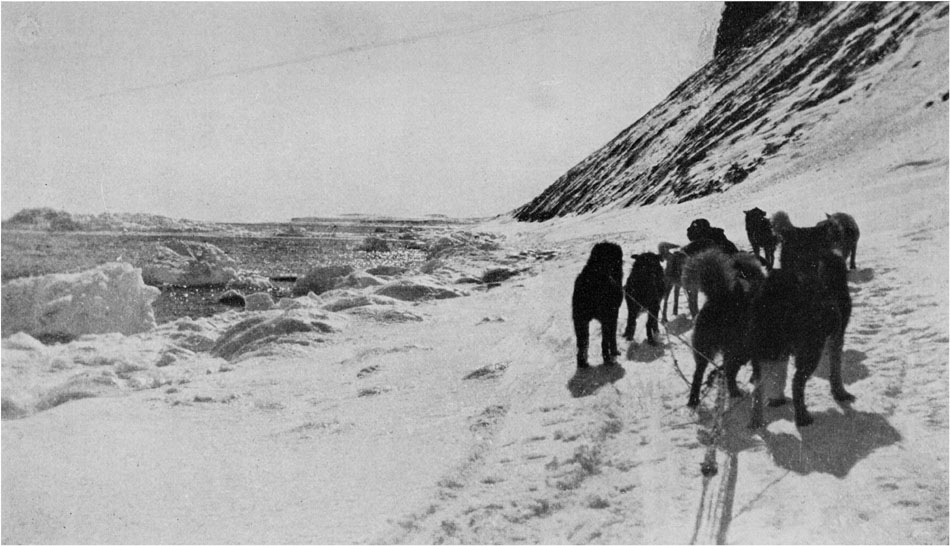
Who Said "Halt"?ToList
Copious draughts of hot tea, and almost equally liquid Irish stew went to the right spot. Grenfell as a veteran was wise enough not to eat too much all at once. That is the danger, after one has been without food so long.
They dressed Grenfell in the warm clothes fishermen wear, and hauled him back to the St. Anthony hospital. That ride was no fun at all. The jolting racked his weary bones and his feet were so frozen that he could not walk. There, two days later, they brought to him the boy on whom he was to have operated at his own home. The operation was a complete success.
The other dogs lived long and pulled the Doctor many leagues on errands of mercy: but he mourned the loss of the three who perished that he might survive. I have seen on the glass-enclosed veranda of the Doctor's home at St. Anthony the brass tablet with its inscription:
TO THE MEMORY OF Three Noble Dogs MOODY WATCH SPY Whose Lives Were Given For Mine on the Ice April 21st, 1908 Wilfred Grenfell St. Anthony
The men who came to the rescue wanted no reward. To have the Doctor back in their midst again was all they desired. But the Doctor insisted on giving them tokens of his gratitude. As George Andrews said:
"'E sent us watches, an' spy-glasses, an' pictures o' himself made large an' in a frame. George Read an' me 'ad th' watches an' th' others 'ad th' spy-glasses. 'Eere's th' watch. It 'as 'In memory o' April 21st' on it, but us don't need th' things to make we remember it, though we're wonderful glad t' 'ave 'em from th' Doctor."
XIToC
THE KIDNAPPERS
One day, as Grenfell was about to leave northern Labrador in his little steamer the Strathcona, a man came aboard with trouble in his eyes. It was the good-hearted Hudson's Bay agent.
"Doctor," he pleaded, "old Tommy Mitchell's been comin' in every Saturday for two months, tryin' to get somethin' for his family. I've been givin' him twenty pounds of flour a week for himself and wife and six children. That's every shred they've got to live on. He hasn't a salmon or a codfish to give me, and he was in debt when I came here. What'll we do?"
The Strathcona had steam up and was whistling to the Doctor to come aboard. On the Labrador coast you must leave promptly or the sea may punish you for the delay.
"See if you can't stop at the island off Napaktok Point, Doctor. They're livin' out there with nothin' but their own hats to cover 'em—if they've got any."
"I will," the Doctor promised, and was off.
When they came near the island, the dory was lowered, and Grenfell and his mate rowed toward the rocks.
"Can you see anything that looks like a house, Bill? You have better eyes than mine."
"No, Doctor. I been a-lookin'. I sees—nothing."
"I didn't expect you to do as well as that," said the Doctor. "But keep on looking. And call out when you see anything."
They rowed almost round the island, against a stiff head wind.
Each time they passed cove or headland they thought, "Well now, surely it must be just around the next point."
"There's a smoke, sir!" cried the sharp-eyed Bill.
Sure enough—there was a tiny wisp of smoke, trickling up the face of the rocks.
But no hut was to be seen.
They landed, and pulled the boat out on the beach.
Then they went toward the smoke. The fire was built among flat stones out in the open.
A hollow-cheeked woman sat with a poor, scrawny scrap of a baby on her arm. In her other hand she held what looked like an old paint can, and she was stirring some thin sort of gruel in it, in spite of the weight of the baby on her arm. It was not heavy, poor little creature!
"Good-morning. Where's your tent?" Grenfell asked, cheerily.
"There she is."
The woman pointed with the gruel stick to a mass of canvas and matting, plastered in patches with mud against the face of the cliff.
"Why do you cook in the open?"
"'Cos us hasn't got no stove."
"Where's Tom?"
"He's away. He's gone off wid Johnnie, tryin' to shoot a gull. Here, Bill, run an' fetch yer dad, an' tell him Dr. Grenfell wants 'un."
A half-naked little boy about nine years old darted off into the scrub bushes.
"What's the matter with baby?" Dr. Grenfell inquired kindly, as the infant clasped his finger and looked up into his mild face.
"Hungry," was the mother's sufficient answer. "I ain't got nothin' to give him." Her lip trembled, and she turned her head away.
The baby kept up a constant whimpering, like a lamb very badly scared.
"It's half-starved," said the Doctor. "What do you give it?"
"Flour, and berries," was the response. "I chews the loaf first—or else it ain't no good for him."
Then a little girl, of perhaps five, and a boy of—maybe—seven, shyly came from behind the tent, where they had fled wild-eyed and hid when the strangers came. They had nothing on: but they were brown as chestnuts and fat as butter.
It was snowing, and the snow had driven them toward the poor, mean fire where mother sat with the baby.
"Glad to see the other children are fat," said the Doctor.
"They bees eatin' berries all the time," was the mother's answer. Then suddenly the full force of their plight swept all other thoughts out of her mind.
"What's t' good of t' government?" she cried. "Here is we all starvin'. And it's ne'er a crust they gives yer. There bees a sight o' pork an' butter in t' company's store. But it's ne'er a sight of 'im us ever gets. What are them doin'? T' agent he says he can't give Tom no more'n dry flour, an' us can't live on dat."
Then a bent and weary figure shuffled on the scene. It was Tom, the poor husband and father. He had an old and rusty, single-barreled muzzle-loading gun, and he was carrying a dead sea-gull by the tip of one of its wings. Two small boys trudged along after him, their faces old before their time. They stood looking at the Doctor in wonderment.
"Well, Tom, you've had luck!" was Grenfell's greeting. He explains that he meant Tom was very lucky not to have the gun open at the wrong end and discharge its contents into his face!
"It's only a kitty," the hunter answered, sadly. "An' I been sittin' out yonder on the p'int all day." A kitty is a little gull.
"Your gun isn't heavy enough to kill the big gulls, I suppose."
"No, Doctor. I hain't much powder—and ne'er a bit o' shot. I has to load her up most times with a handful o' they round stones. T' hammer don't always set her off, neither. Her springs bees too old, I reckon." He fumbled with the trigger in a way that led Grenfell to ask him to let him hold the gun instead. Tom passed it over, and Grenfell held it till their talk was over.
Tom, who was part Eskimo, was a very poor business man. He had been a slave of the "truck system" by which a man brings his furs or his fish to a trader, exchanges them for supplies, and is always in debt to the storekeeper who takes pains to see that it shall be so.
"Tom," the Doctor told him, "I want to help you. Winter is coming on, and here you are with a handful of flour and a sea-gull, and no proper shelter from the cold. You have too many children to keep. I think you'd better pass over to me for a while your two little boys, 'Billy' and 'Jimmy,' and the little girl. I'll feed them and clothe them and have them taught till they are big enough to come back and help you. All the time they are with me I'll do all I can to help you along. If you have them here—they'll certainly starve. The snow is beginning to cover up the berries already. And that's about all you've got to feed them."
Poor Tom couldn't think.
He merely stood there, looking first at the sea, then at the sky, then at the Doctor, his mouth wide open.
His wife broke the silence. "D'ye hear, man? T' Doctor wants to take t' children. I says 'tis the gover'ment should feed 'em here. I wouldn't let no children o' mine go, I wouldn't." Saying which, she held her sickly infant tighter.
The talk to and fro went on for a long time. It didn't get much of anywhere. On the part of the fond parents it consisted largely of what the government ought to do. Grenfell patiently explained that the government was a long way off, and couldn't answer before Christmas if it answered at all.
All this time Father Tom stood there, dumb as a stalled ox, trying to see daylight by which to make up his mind. Evidently his wife was the real man of the family.
"Why doesn't youse say something?" she broke out at last. "Bees you a-goin' to let t' Doctor have youse childer?"
Tom looked more distracted than ever, and it didn't help much when he took off his hat and let cold air blow on his heated brain as he rummaged with his finger in the dense thatch on his head.
Then Tom said: "I suppose he knows."
"Yes," Dr. Grenfell said. "I think you'd better let me have Billy and Jimmy for a while."
There was more talk, and finally the wife gave way. "Well, youse can take Billy, I suppose, if you wants un."
All this time the mate had said nothing. Big and burly as he was, there were tears in his eyes; he had a kind heart, for there were many little ones to feed and clothe in his own household. He thought it was time to settle the dispute.
For he heard the Strathcona's whistle blowing impatiently, warning the men ashore that the sea was rising and the rocks in the uncertain weather meant danger. The little steamer, while the palaver went on, had been following alongshore as they went round the island. The snow was getting thicker, and the wind was tipping the waves with whitecaps. They must be off without further parley.
So the mate, not wasting words, suddenly grabbed Billy under one long, strong arm.
Billy kicked and howled and struggled. Billy had no idea of that delightful home for the children at St. Anthony. He would have cried to go there, if he had known what playmates he would have, what diverting games to play.
Billy was captured "for good and all." But Dr. Grenfell knew that it wouldn't do for Billy to be toted off alone.
He was bound he'd get another child,—for he knew he was right, not merely because of the good he could do the children, but because of the hopeless situation of the whole family if they all remained on this miserable shelf of rock in the open Atlantic.
"Now, Mrs. Mitchell," he coaxed, "you're going to let Jimmy come too, to keep Billy company."
She shook her head in defiance. Her mind was made up. Billy could go—but he was the only one. That was flat and final.
Then Tom broke his silence once more: "I says he knows what's for t' best."
The Strathcona's whistle was petulantly crying: "Come on! We really must be starting! If you don't come aboard right away, we may be wrecked. Really, you must think of your crew. It isn't fair to let us run this risk, with the barometer falling, and the wind like this."
Dr. Grenfell made every tempting promise he could think of.
"If you'll let me have Jimmy, I'll give your husband a fine gun."
"No," said Mrs. Mitchell. "Ye can't have un."
"I'll send him plenty of powder and shot."
She shook her head.
"I'll give him a letter to the agent so he can get work."
She made an impatient gesture of rejection with her free hand.
The Doctor played a trump card. "You shall have nice dresses for yourself and clothes for all the children."
Mrs. Mitchell yielded. "Well then, ye can have Jimmy. But that's all. That's the very last one."
"Now, Mrs. Mitchell, be reasonable. Let me have the baby girl, too."
"No."
"Look at your tent. We'll put the little girl in a fine house with a roof on it, and a door that opens and shuts."
"No."
"We'll give her pretty clothes, and teach her from the picture books. She'll come back so you won't know her."
"But I want to know her."
"We'll feed her well, and fill her up till she's as fat as a seal."
"No. That's all. Jimmy and Billy can go. She shall stay here with me."
This time the father kept his face tight closed. There was no help at all from him. He looked the other way, stiff as a seal-gaff.
The mate was already on his way to the beach, with the two naked little boys wriggling under his arms. They were red and blue all over with the stains of the berries—a beautiful sight.
"All right, Mrs. Mitchell. We must go on board now. Come with us, and we'll give you the things."
Then there was joy for that poor, hungry family.
They were all clad in stout clothing that would keep out the wind. A gun was lent to the father, and his shattered fowling-piece was fixed up by the clever engineer, till it was "most as good as new." The eldest boy, John, would be big enough to use it.
The powder and shot were dug out of the lockers: tins of condensed milk were found for the poor little shrimp of a baby. The second axe—a gorgeous prize—went into the growing pile of gifts: soap, needles and thread, shoes and stockings, potatoes, some flour, a package of tea, sugar, and other precious things went into two oilskin bags, and then over the rail into the Mitchells' leaky, tossing boat.
Meanwhile an astonishing change was taking place in the two boys. They were getting a bath on the deck, in the wind and snow, with a bucket and a scrubbing-brush, and after they were dressed they had their hair cut. Their mother stared and stared as the boat rowed away. She could hardly believe they were hers.
"Good-by, Doctor. Thank you."
"Good-by, Mrs. Mitchell. We'll take good care of them."
Father said nothing. He was rowing the boat. But no doubt he was thinking very grateful thoughts.
The boys wept a little, silently as they looked their last on their patched and tattered home. The family they left behind them would make a journey of a hundred miles in that rotten boat to a winter hut on the mainland.
But they looked at each other, washed and dressed, with all that wild hair pruned away—and then they began to laugh at each other as the biggest joke in their short lives.
After they reached St. Anthony and were installed in the Orphanage, they were two of the happiest and most popular lads in the place.
They purred like pleased kittens and lost no chance to show how much they liked the people who were doing so much for them. They studied hard, and put the same driving spirit into play. It could be seen that the little "heathen" of the island were in a fair way to become in time the leaders of men who are needed in all walks of life. Dr. Grenfell felt well rewarded for all the trouble he had taken for Jimmy and Billy and all their family.
The "liveyeres," as those who "live here" are called, may lead rough, hard lives. But for that very reason they welcome books, and music, and all such things.
One day as the Strathcona was scudding southward, her sails swelling with a stiff breeze, and the Doctor in a great hurry to reach a distant coast-line and get to work on some patients who had been waiting a long time for him, a little boat came and planted herself directly in the Strathcona's path.
The Strathcona was a small craft herself, but she seemed a monster compared with this impudent sailboat. The smaller boat had a funny-looking flag, hoisted as a signal to stop. It was almost as if a harbor tug should attempt to hold up the Leviathan.
Dr. Grenfell thought it must be some very serious surgical case.
He gave the order at once: "Down sail and heave her to."
Then an old, white-haired man, the only passenger in the small boat, climbed stiffly over the rail, fairly creaking in his joints.
"Good-day," said Grenfell. "What can we do for you? We're in a hurry."
The old man took off his cap, and held it in his hand as he looked down at the deck. Then he mustered up courage to make his request.
"Please, Doctor," he said slowly, "I wanted to ask you if you had any books you could lend me. We haven't anything to read here."
Dr. Grenfell confesses with shame that his first impulse was to return a sharp, vexed answer, and to ask, "What do you mean by holding up my mission boat for such a reason?" But then he realized his mistake. In a way, it would be as good a deed to put a prop under the old man's spirit with a good book as to take off his leg with a knife.
"Haven't you got any books?"
"Yes, Doctor. I've got two, but I've read 'em through, over and over again, long ago."
"What were they?"
"One is the Works of Josephus, sir, and the other is Plutarch's Lives."
The old fellow was overjoyed when the Doctor put aboard his bobbing skiff a box of fifty books—a mixture of everything from Henty's stories to sermons.
Dr. Grenfell never could tell what a day—or a night—would bring forth. If variety is the spice of life, his life in the north has been one long diet of paprika.
Once late in the fall he was creeping along the Straits of Belle Isle in a motor-boat—the only one in those waters at that time.
It broke down, as the best of motor-boats sometimes will, and the tidal current, with that brutal habit which tidal currents have, began to pull the boat on the rocks as with an unseen hand.
They tied all the lines they had together, attached the anchor, and put it overboard.
The water was so deep they could not reach the bottom.
Darkness was shutting down—and it was an awful place to pass the night.
Then a schooner's lights flashed out. "Hurrah!" cried Grenfell's men. "We're all right now!"
They lashed the hurricane light on their boat-hook and waved it to and fro like mad. They MUST make those fellows on the schooner take notice and stop for them. The sea would probably get them if they failed.
The water was so rough, the night so dark, that even their precious motor-boat was nothing, if only they could clamber aboard that schooner. At almost any time, those Straits offer stretches of the most perilous sailing-water in the world. Sailors who have rounded Cape Horn would say yes to that.
But just then—to their horror, the schooner which had been close to them put about and hurried off like a startled caribou. Soon the powerless motor-boat was left far, far behind, wallowing in the trough of waves much too big for her size.
They shouted with all their might, but the whistling wind threw away their outcry instead of carrying it across the tossing waves, which threatened to swamp the boat at any instant.
They shot off their guns.
They yelled again.
They lit flares such as are used in the navy for signal lights.
But it was all in vain.
They almost began to believe they had dreamed of rescue—that a phantom ship had come to them in a nightmare.
They waved their hurricane light again and again, as high as they could hold it.
The engineer, a willing amateur, all this while had been toiling away till his hands bled, at his motor, drenched with the spray. He had torn the machinery limb from limb, and patiently refitted the parts. Suddenly one cylinder gave a weak kick, and then came a spasmodic succession of sputters, with long waits between. But with the aid of the oars the boat was now able to make slow and tedious progress in the schooner's wake.
At last—at last—along toward midnight they crept into the harbor where the schooner had also taken refuge.
Tired as they were, they wouldn't turn in at a fisherman's cottage without boarding the ship to rebuke the sailors for their unhandsome behavior.
How could they leave men in a tiny boat in distress, perhaps to be swamped and to drown in those cruel waters out yonder in the blind dark?
The skipper made solemn reply. "Them cliffs is haunted," he announced. "More'n one light's been seen there than ever any man lit. When us saw youse light flashing round right in on the cliffs, us knowed it was no place for Christian men that time o' night. Us guessed it was just fairies or devils tryin' to toll us in."
Many of the little boats on the Labrador are not fit to spend a night at sea, and often it is an anxious business to get into a safe harbor before sundown. Dr. Grenfell has a reputation as a daredevil skipper, because so often, on an errand of mercy, he has steamed right out in the teeth of the storm when hardened, ancient mariners shook their heads and hugged the land. But the Doctor does not take chances for the sake of the risk itself—his daring always has behind it the good reason that he wants to go somewhere in a great hurry in time of need.
A hundred miles north of Indian Tickle, where there was no light, Grenfell was caught one night when he was coming south with the fishing fleet.
All of a sudden the fog fell on the whole group of ships like a thick wet blanket, before they could make the harbor. There were many reefs between their position and the open sea: the only thing to do was to anchor then and there. When a rift came in the fog, Dr. Grenfell saw the riding-lights of eleven vessels round about him. A northeaster grew in violence as night came swiftly on, and a heavy sea arose. The ships tugged at their anchors. The great waves swept the decks from end to end.
In the hold of the Strathcona were patients lying in the cots, on their way to Battle Harbor Hospital. As the Doctor would say, there was less than an inch of iron between them and eternity.
They were dressed, and the boats were prepared to take them ashore.
One after another in the mad waters the neighbor lights went out. All night the Strathcona fought the sea. When day came, only one of the other boats was left—a ship much bigger than the Strathcona, named the Yosemite.
The Yosemite was drifting down upon the smaller vessel, and it seemed as if in a moment more there must be a collision.
But just then the Yosemite struck a reef. She turned over on her side. In that position the sea drove the vessel ashore, through the breakers, with the crew clinging to the bridge.
The fact that the Strathcona kept steam up and was "steaming to her anchors" all night long had saved her, the only survivor of the entire fleet. Every vessel that went ashore was smashed to kindling.
As they were about to weigh anchor, the main steam pipe began to leak. It was necessary to "blow down" the boilers.
For the whole of that short day the engineers tinkered at the damage, knowing that the lives of all on board might depend on their success ere nightfall.
Suddenly, to the inexpressible relief of everyone, the engineer shouted:
"Right for'ard!"
Then came the sweet music of the engine-room bell, and presently they were under way again, so nightfall found them safe at last in the harbor, with those eleven wrecks pounding on the rocks outside.
Sometimes the fishermen expected miracles of healing. One day a big "husk" of a fisherman clambered aboard, saying that his teeth hurt him.
"Sit down on that wood-pile," said the Doctor.
The man obeyed. The Doctor pried his mouth open, and saw the tooth that was making the trouble. Then he fetched the forceps.
Up started the patient in wide-eyed alarm.
"Bees you a-goin' to haul it, Doctor?"
"Of course I'm going to pull it out. What did you want me to do?"
"I wouldn't have you touch it! Not for all the fish in the sea!"
"Well then, why did you come to me? You're just wasting my time."
"I wanted you to charm her, Doctor."
"But my dear fellow, I'm not an Eskimo medicine-man. I don't know how, and I don't believe in it anyway."
Mr. Fisherman looked very much put out. "I knows why youse won't charm un. It's because I'm a Roman Catholic."
"Nonsense. That wouldn't make the slightest difference. But if you really think it would do any good,—come on, I'll try. Only—you'll have to pay twenty-five cents, just as though I had 'hauled' it."
"That I will, Doctor, and glad to do it. Go ahead!"
He perched on the rail like a great sea-bird. The Doctor to carry out the farce put his finger in the gaping mouth and touched the tooth. While he kept his finger in place he uttered the solemn words:
"Abracadabra Tiddlywinkum Umslopoga."
That last word must have come from a hazy memory of the name of the wonderful big black man in H. Rider Haggard's "Alan Quatermain," who after a long, hard run beside a horse that carries his master, defends a stairway against their enemies and splits a magic stone with an axe and so brings the foe to grief.
At any rate, the combination worked. Grenfell pulled out his finger quickly so that his patient wouldn't bite him.
The fisherman got up in silence. Then he slowly made the circuit of the deck. In the course of the brief journey, he thrust his hand deep into his jeans and pulled out a quarter.
"Thank you, Doctor. Many thanks." He solemnly handed the coin to his benefactor. "All the pain has gone."
Dr. Grenfell stood holding the coin in his hand, wondering how he came to make such a fool of himself, while the fisherman's broad back bent to the oars of the little boat that took him ashore.
A month later, in the same harbor, the same man swung his leg over the rail with a hearty greeting.
"Had any more trouble?" asked the Doctor.
"No—sir! Not an ache out of her since!" came the jovial answer.
The Doctor had much trouble with patients who wanted to drink at one draught all the medicine he gave them. They thought that if a teaspoonful of the remedy was good for you, the whole bottle must be ever so much better.
A haddock's fin-bone was a "liveyere's" charm against rheumatism—but you must get hold of the haddock and cut off the fin before he touches the boat. So you don't often get a fin that is good for anything.
If you want to avoid a hemorrhage, the best plan is to tie a bit of green worsted round your wrist.
Both Protestants and Catholics write prayers on pieces of paper and wear them in little bags about their necks to drive off evil things.
The constant battle against wind and wave develops heroes and heroines, and the tales told of golden deeds such as might earn a Carnegie medal or pension are beyond number.
One man started south for the winter in his fishing-boat, with his fishing partner, his wife, four children and a servant girl. A gale of wind came up. On the Labrador a gale is a gale: they do not use the word lightly. Grenfell tells of a new church that was blown into the sea with its pulpit, pews and communion-table. In a storm like that, the mainsail, jib and mast of this luckless smack went over the side. The boat was driven helplessly before the wind, for three days and nights. Then the wind changed, and they could put up a small foresail, which in two more awful days brought them to the land. But they were running ashore with such violence that they would have been lost beyond a doubt, if six brave "liveyeres" had not put out to rescue them. Their boat was smashed to flinders.
Then they found that all this time they had been going due north, for a hundred and fifty miles. They had to stay till the next summer. Their friends, when they got back to Newfoundland, had given them up for dead.
A fisherman said to Grenfell, in explaining why he couldn't swim: "You see, we has enough o' the water without goin' to bother wi' it when we are ashore." This man had barely escaped drowning on no less than four occasions. Once he saved himself by clinging to a rope with his teeth, after his hands were too numb to serve him, till they hauled him aboard.
The shore of one of the Labrador bays had a total adult population of just one man. As the ice was breaking up in the spring, he had sent his two young sons out on the ice-pans in pursuit of seals.
But the treacherous flooring gave way, and the father from the shore saw his boys struggling in the water.
He tied a long fishing-line round his body, and gave the other end to his daughter. While she held it he crawled out over the pans. Then he jumped into the bitter water, like a deep-sea diver going down to examine a wreck, and stayed between and below the pans till he had recovered both bodies—but the last spark of life was extinct.
Almost under the windows of Dr. Grenfell's hospital at Battle Harbor two men started with sled and dogs to get fire-wood. They were rounding a headland, when the sled went into the water, taking not merely the dogs but the drivers with it. One man got under the ice, and was seen no more. The other clung to the edge of the ice, too weak to crawl out.
His sister saw what happened, and came running over the ice. Men further away who were bringing a boat shouted to her: "For God's sake, don't go near the hole." She did not heed their warning. Instead, she threw herself flat, so as to distribute her weight, and dragged herself along till she was close enough to reach her brother's hand.
She could not quite pull him out. He was so benumbed that he could not help in the rescue. She lifted his body part way over the edge of the ice-sheet and held on.
Nearer and nearer the boat came with the rescuers shouting encouragement. "We're a-comin', girl.' Don't let go!" Her strength was almost gone. But she was bound to be faithful unto death—if the sea claimed her brother it must take her too.
She did not cry out. She wasted no energy in words upon the frosty air. The boat seemed ages in coming, though the rowers plied the oars with might and main.
One of her legs had broken through the ice. At any instant she might find herself struggling in the sea, and her agony of effort would have been in vain.
At what seemed the last second of the last moment for the pair, the brawny arms of the fishermen hauled them over the gunwale.
She told the story simply, and as though it were all in the day's work.
"What made you go on?" Grenfell asked her.
"I couldn't see him drown, could I?" was all her reply.
XIIToC
WHEN THE BIG FISH "STRIKE IN"
"Doctor, how do you catch the codfish? Do you use a hook and line, the same as father and I do when we go fishing in Long Island Sound?"
The speaker was a New York boy who hadn't been north of Boston, until one summer his father let him go to St. John's for the sea-trip. There by great good luck he ran into the Doctor, who had come from St. Anthony in his little steamer the Strathcona.
"You can catch codfish with a hook and line," explained the Doctor, "but it would take too long for the fishermen who have to get their living from the sea.
"Most of the time they use a great big net, called a 'cod-trap.'
"It's like a room of network without a roof. It has a door, and the cod are steered in at the door by another net which reaches from the cod-trap to the rocks."
"I should think the whole business would float away out to sea the minute it got the least bit rough," said Harry.
"It might," the Doctor admitted. "But you see they have heavy anchors, or they tie big stones to the net at the bottom to hold it down."
"I'd love to see those cod coming in!" exclaimed Harry. "They must push and shove like anything. But what do they want to go in for? I s'pose o' course they must use some kind of bait."
"They use the squid, or octopus," said the Doctor.
"Are those the funny things that wave their arms around and throw out ink when they get mad?" asked Harry.
"Yes."
"Are they very big?"
"They come in all sizes. There's even such a thing as a giant squid. For a long time people laughed at the idea that there was any such monster. They thought he was a myth, like the sea-serpent.
"But one day two fishermen were plying their trade when two great arms rose out of the sea and clasped their boat and tried to drag it under.
"Luckily, they had a big knife, and they hacked away at the arms till they cut them off.
"The cuttlefish—that's another name for it—made the sea about them as black as tar. But it did not try again.
"They took the arms ashore, and sold them to a man named Dr. Harvey. Everybody had been making fun of Dr. Harvey because he said there was such a thing as the giant squid.
"The Doctor hated strong drink, and so the clerks at the store of Job Brothers here in St. John's were very much surprised when Dr. Harvey rushed in and shouted: 'I want a barrel of rum!'
"Then he told them what he wanted it for—he wanted to send the giant squid to the Royal Society in London. The parts of the arms cut off were nineteen feet long.
"Later on, somebody who heard about it brought him an octopus that was lying dead on the water, whose reach was forty feet from tip to tip."
"How do they catch the octopus for bait?" asked Harry.
"It's exciting work. You see, besides having arms like a windmill, with curious sucking saucers on them, the octopus has a beak like a parrot, with awful teeth, and it can bite like anything.
"You'll see a cluster of rowboats anchored close together, and the fishermen are jigging up and down a little bright red leaden weight, bristling with spikes.
"Suddenly there's a stir. The squids have come rushing in, and they bite at those jiggers like a terrier after a rat.
"When the squids get those spiked weights in their mouths and are being hauled aboard—look out!
"All of a sudden—just the way people squirt things in the movies—they shoot out jets of ink at the fishermen.
"It stings like anything if it gets into your eyes and it ruins your clothes."
"How much do the squid cost when you buy them for bait?" asked Harry, who had a practical mind.
"Fifteen or twenty cents a hundred for the little ones."
"That isn't much for all that work," said Harry.
Dr. Grenfell smiled. "You'll find that the fishermen do lots of hard work for very little pay, Harry," he answered.
"What other kind of bait do they use for the cod?"
"Caplin—a small fish like a sardine—and herring. Sand eels and white-fish sometimes. Bits of sea-gulls, and even rubber fish with hooks. Mussels don't hold well on the hooks."
Harry looked thoughtful. "I suppose it makes a lot o' difference, having just the right kind o' bait."
"All the difference in the world," the Doctor agreed. "If a man can't please the fish, he might as well burn his nets and boats and leave the sea.—But I was telling you about the cod-traps.
"While the fish are following their leader, like so many sheep, in at the door of the trap, along comes the man they call the trap-master. He has a tube with plain glass in the bottom, and he puts it down over the side of the boat and looks through it to see if the trap is full.
"When he thinks it's full enough, the door is pulled up so the fish can't get out, and the floor of the trap is hauled to the surface.
"As it is lifted, a big dipper is put in, and the fish are ladled into the boat.
"When the boat is full, the rest of the fish are put into big net bags. These are tied to buoys, so the fishermen may come back later and get them."
"I suppose the fishermen like to pick out the best places," said Harry.
"Yes—there's a mad race on the day the season opens. You've got to get your cod-trap anchored in four days, with the net that leads from the shore put in place: and it's a big job to do it in that time.
"Then there's what they call the cod-seine. That's worked by seven men. The seine-master, fish-glass in hand, stands in the bow: and the minute he sights the school of fish he gives orders for the nets to be dropped.
"The men row in a circle and return to a buoy, paying out the net as they go.
"The bottom rope is weighted, and they gather it round a central anchor into a bag as they row. It's not so easy as it sounds, but 'practice makes perfect.' When they've got the fish bagged in this way they may scoop them up whenever they like.
"Other kinds of nets, as well as lines, are used.
"While those who use the lines generally take great pains to put on them the bait they think Mr. and Mrs. Cod will like, some fishermen make the others very angry by 'jigging' with unbaited hooks.
"This means that two hooks, joined back to back with a bit of lead that sinks them, are dropped where the fish are most thickly crowded.
"Then the line is jerked up and down. Half a dozen fish may be hurt for one that is hooked."
"What becomes of the one that gets hurt?" asked Harry.
"Oh, the rest of the cod rush at the poor fellow and eat him up!"
"They're not good sports!" was the boy's comment. "Neither are the fishermen that hurt the fish without catching them. That's like hunters that shoot more animals than they can use for food. But I suppose fishing just for fun is a very different thing from fishing to make a living."
Dr. Grenfell's blue eyes were very serious. "It is," he said. "You have to go out with the fishermen to understand the difference."
XIIIToC
BIRDS OF MANY A FEATHER
Harry had seen and heard many kinds of birds alongshore, of all sizes and colors, some flying in curious ways and some making very queer sounds, so he asked the Doctor to tell him about them.
"The Labrador coast is one of the finest bird-nurseries anywhere," said the Doctor. "You can find about two hundred different kinds—if your eyes are sharp enough and your patience—and your shoes—hold out!
"Of course they don't all live there the year round. Some of them are just summer boarders.
"Maybe in a very lonely spot you'll hear a bird all by himself, with a very sweet song—the hermit thrush.
"Perhaps there will be a chorus of pipits, fox and white-throated sparrows, robins, warblers and buntings.
"You might even come upon a Nashville warbler or a Maryland yellow-throat!
"If eggs are collected in Labrador, the contents aren't wasted.
"You bore a hole in the side of the egg, put in a blowpipe with a rubber bulb, and force the contents into a frying-pan. You can make fine omelet from the eggs of eiders, gulls, puffins and cormorants. Or you can mix flour with the eggs, add salt and butter, and make a nice pancake browned on both sides.
"It tastes rather fishy, of course, but it's very filling, and when you come in after a long, hard run behind the dogs, or soaked to the skin from a boat-ride, it certainly is fine to fill up on cormorant omelet while you pleasantly roast yourself before the leaping flames of a driftwood bonfire.
"A Labrador baby thinks that a gull's egg is as good as a stick of candy.
"Puffins are lots of fun. You've read about the penguins in the Antarctic, where they have almost no other animals—how the penguins dive and swim and carry stones about, looking like solemn old gentlemen at a club in their dress suits. Well, the puffins are to Labrador what penguins are to the South Pole country.
"Their burrows are two or three feet long, and the mother sits on a single dirty white egg in a straw nest. The birds have red, parrot-like bills, and they have pale grey faces with markings that make them look as if they were wearing spectacles.
"Their bodies are chunky, and they shuffle about very clumsily. They don't like it a bit when people come where they have their nests.
"But the razor-billed auk doesn't make any nest—it just lays its egg on the bare rock in the biting cold. There are very few auks left to-day, but there were lots of them when Audubon the naturalist visited Labrador ninety years ago. Audubon tells how a band of 'eggers' started out just like pirates.
"All they cared about was to plunder every nest.
"They went sneaking along from cove to cove, turning in sometimes at the little caves or finding shelter in an angle of the rocks when the sea ran too high.
"While they were waiting they would fight and swear and drink. It's a wonder that the eggers didn't get drowned oftener, for their boats would be mended with strips of sealskin and the sails were patched like an old suit, and it looked as if a puff of wind would blow them over.
"These eggers got out of their sailing ship into a rowboat they towed, so as to go to an island of sea-pigeons, or guillemots—because they couldn't get near enough in the larger vessel.
"As they came to the rocks, the birds rose up in a screaming white cloud. The air was full of them, just as you've seen the gulls creaking and crying about the hull of an ocean steamer, hoping to pick up food thrown overboard.
"But the mother birds stuck faithfully to the nests. It was the fathers and brothers that rose up in the air and made the noisy fuss.
"All of a sudden—bang! the eggers discharged their guns in a volley right into the middle of the wheeling, screaming cloud of feathers overhead.
"Some fell into the water, and the rest in terror flew about not knowing where to go or what to do.
"The eggers picked up the birds that lay in rumpled, bloody heaps on the water. They made toothsome pies, and what they couldn't eat they left behind. They didn't care how many birds they killed, because there were plenty left.
"They weren't shooting just for food—they were shooting mostly for fun. As they trampled about the island they crushed with their heavy boots more eggs than they picked up.
"No one would have blamed hungry men for killing enough birds and taking enough eggs to supply their families. But the eggers saw red, and just went on shooting and trampling without excuse.
"Years of that kind of thing turned many an island into a graveyard.
"Well, when they had gathered some eggs and smashed the rest, they picked up the dead birds they wanted and carried them back to the boat.
"They jerked off the feathers and broiled the sea-pigeons. Then they brought out big, black bottles of rum to take away the oily, fishy flavor, and filled themselves with strong drink and bird-flesh.
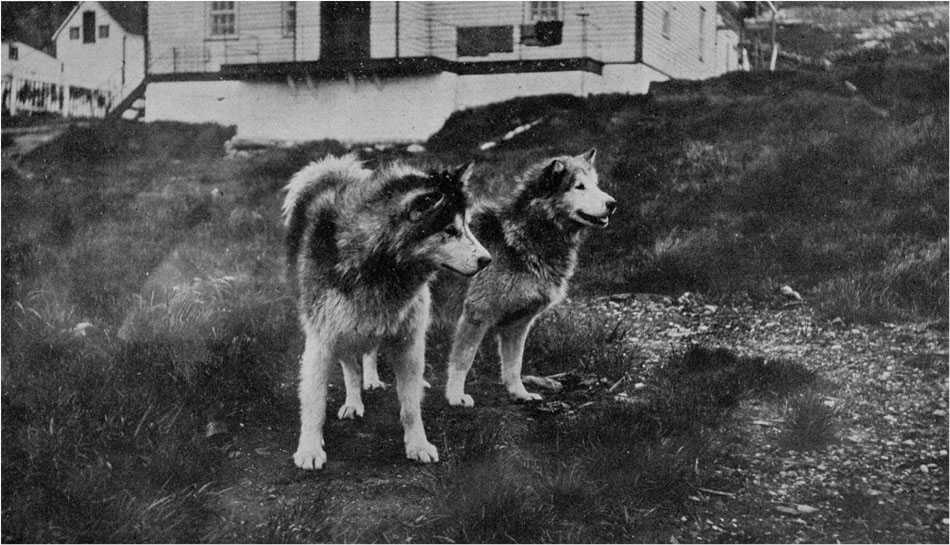
Off DutyToList
"They fell asleep, snoring drunk, and dawn found them piled about the deck helplessly.
"But when they got back to the island from which they started on their journey, they found that rivals had landed there, and were killing birds which they looked on as their own.
"There was a fight at once.
"The men who were coming back home fired a volley and then took their guns as if they were clubs and rushed toward their enemies.
"Then, man to man, they fought like wild beasts. One man was carried to the boat with his skull fractured: another limped off with a bullet in his leg: a third was feeling his jaw to learn how many of his teeth had been driven through a hole in his cheek.
"So they fought till they tired of it, and then they pulled out the rum-bottles, and drank themselves into forgetfulness of their fierce battle.
"With the next morning came a hundred honest fishermen who wanted nothing more from the islands than the birds and the eggs they actually needed for their hungry wives and little ones at home.
"They had been eating salt meat for months: scurvy had broken out, and they wanted a change of diet.
"But the pirate eggers were bound they shouldn't have it. The fishermen brought no guns: they weren't looking for trouble: they were taken by surprise when the eggers rushed down on them like tigers roused from their lairs.
"One of the eggers, who had not slept off the effects of the carousal of the night before, shot one of the fishermen. Then the fishermen, who outnumbered the eggers about ten to one, gave the latter the beating of their lives. Fortunately, the fisherman who had been shot was not killed.
"That was the sort of thing that happened again and again in the bad old days.
"No wonder Audubon, as a great lover of birds, was very angry at these men who were making it impossible for birds to make their homes and lay their eggs and raise their families on the Labrador. They could have had all they wanted to eat without exterminating the birds, and never giving a thought to anybody who might come after them.
"The fishermen still, in many places, out of sight and reach of any law, take all the eggs and kill all the birds they can.
"But it's not so bad as it was in Audubon's time, when men from Halifax took about 40,000 eggs which they sold for twenty-five cents a dozen. Near Cape Whittle he found two men gathering murre's eggs. They were proud of the fact that they had collected 800 dozen and they didn't intend to stop till they had taken 2,000 dozen. The broken eggs made such a dreadful smell that it almost made him sick.
"The ivory gull, known as the 'ice partridge,' is sometimes caught by pouring seal's blood on the ice. The birds swoop down to get it, and are shot. Some actually kill themselves by striking the ice too hard when they land, for they are so eager to get the blood.
"Labrador is a good place to study the diving birds, which are of two kinds.
"There are those that use their feet alone under the water—and then there are those that use only their wings.
"The feet-users clap their wings close to their sides when they dive.
"The wing-users spread out their pinions before they strike the water. The puffin uses its wings under the water, and so do the other members of the auk family.
"In the duck family, there are both wing-swimmers and foot-swimmers. The ducks of the sorts known as old squaws, scoters and eiders fly under water. But the redheads and canvas-back ducks use only their feet under water. Mergansers dive with their wings against their sides, like a folded umbrella. The cormorants are famous swimmers, and use their feet alone. You know how the Chinese use cormorants as fish-catchers, putting rings about their necks to keep them from swallowing their prey.
"Among the birds classed as game-birds, the willow grouse are so easy to kill that a true sportsman doesn't take much pleasure in going after them.
"They are often caught with nooses on the end of a stick, while they roost in the trees, and a group in this position may be killed all at once, if shot from the bottom, so that the falling bird doesn't disturb the others.
"Cartwright, an early explorer, tells how he came upon a covey of six grouse and knocked off all their heads with his rifle.
"In winter, the willow grouse bury themselves in the snow, and the 'cock of the roost' is sentinel, keeping his head above the snow to watch for an enemy.
"The Canada goose, breeding about the lakes and ponds, is a grass-eater, and so tastes better than the fishy, oily gulls and divers. You can tame the goose and use it as a decoy. When a number are shot at a time, those that can't be used right away are hung outside the house. There they freeze, and are kept fresh all winter long.
"There couldn't be a better retriever for a duck-hunt than the Eskimo dog. I've watched them dash into the waves after a bird, only to be thrown back, bruised and winded, high up on the ledges of the rock.
"Then the return wave would drag them off, and pound them against the rocks. But the dogs would hang on for dear life, till their nails were torn away and their paws were bleeding.
"Even that wouldn't make them quit. They would return to the charge, and waiting for their chance they would jump right over the breaking crest and get clear of the surf.
"When they've once got hold of a duck, nothing will make them let go. I've often been tempted to jump in and give the brave fellows a hand, when it seemed as if they couldn't keep up the struggle any longer.
"They'd sink out of sight in a bigger wave than usual—and then, sure enough, you'd see the duck again, and the dog's head after it, still true to duty even in the jaws of death. For sometimes, in spite of all his pluck and cleverness, the dog is drowned."
XIVToC
BEASTS BIG AND LITTLE
Both on sea and land, Labrador animals have to be as tough as Labrador people to stand the hard life they must lead.
Dr. Grenfell tells of a seal family he saw killed on an ice-pan about half the size of a tennis-court.
They were surprised by four sealers, with wooden bats. Before they gave up their lives they put up a tremendous struggle. The father seal actually caught a club in his mouth and swung it from side to side with such violence that the sealers had to get off the pan.
But at last he was dealt such a blow on the head that it was supposed he was killed.
Instead of stripping off the pelt as the fallen monster lay on the pan, the sealers hoisted him aboard the steamer "unscalped." As he was being lifted over the rail—two thousand pounds of him—the strap broke, and back into the sea the huge carcass splashed.
The cold water revived him.
He swam back to the pan, which was marked by the blood stains of his slaughtered family—the mate with her young which he had fought so desperately to protect.
The pan stood about six feet out of the water. Yet the great animal managed to fling himself upon it.
The men, who had bread and tea to win for their families, could not afford to let him go.
They went back after him, and this time they did not trust to their wooden bats. They used a few of their precious cartridges and shot him. And then they "scalped" him on the spot, and hauled the skin over the rail.
It is painful to think of such a fate for the brave old warrior.
Just as the cod-traps are put out from the shore, frame nets are set for the seals along the beach where they are fairly sure to pass at certain times of the year. There is a capstan from which the doorway of the seal-trap may be closed with a few turns. The Doctor tells of one "liveyere" family that took nine hundred seals in this way: and three to four hundred is nothing unusual. One trapper named Jones was so successful at this business of trapping seals with the net that he became "purse-proud." From his land where there are no roads, he sent to Quebec for a carriage and horses, and then he had a road built on which he might parade them up and down to show his neighbors how rich he was. Then, for his dances o' winter nights, no local fiddler would serve, scraping and patting his foot on the floor. He hired a real musician from Canada, who remained all winter playing jigs and reels to a continuous round of feasts and merry-making. But, as the familiar saying goes, it is often only one generation from shirt-sleeves to shirt-sleeves. In his case, the grandchildren finally found themselves with less than the shirt-sleeves. They appealed to Dr. Grenfell, and he found some old clothes on the boat to save them from freezing.
The whale is really a land animal, which finally found the sea more amusing, and so took to "a roving, nautical life."
Since the legs were no longer useful, in the course of time they became wee things, and were enclosed in the thick, tough skin.
The "arms" were left outside, but they are nothing to boast of. They are not useful for swimming, but they help to balance the huge bulk, and mother whale seizes her baby with them when she takes alarm.
The eyes are tiny, for when a whale eats he is not particular.
It takes so many millions of little bits of creatures to give a whale a square meal, that if he misses a hundred thousand or so out of the side of his huge jaws, at the top of his narrow gullet, he need not worry. The whale never starves until he is stranded. Out of water he may continue to breathe for an hour or two—but he cannot eat.
"On a fine morning on the Labrador Coast," Dr. Grenfell tells us, "I have counted a dozen whales in a single school. Now and again a huge tail would emerge from the water and lash the surface with its full breadth, making a sound like the firing of a cannon, while the silence was otherwise broken only by the noise of their blowing, as they rolled lazily along on the surface."
The thresher whale is only about twenty feet long, but he is a fierce fellow—the pirate of the whale family, terrorizing the rest, and ready to tackle anything in sight.
He has a fin which shows where he is as he cruises along close to the surface. He readily eats other whales. Three threshers went after a big cow sperm whale and her enormous infant, in shallow water. First they killed the "calf." Then they chased the mother away, and came back and ate the young one.
In 1892 a huge sperm whale rammed the rocks near Battle Harbor, where Dr. Grenfell now has one of his hospitals.
The whale evidently wondered why the rocks didn't give way—for nearly everything else he encountered had collapsed when he butted into it. He lunged once too often, and was left high, if not dry, on the beach.
They towed him into the harbor, a prize eighty feet in length, and proceeded to pump the oil out of him. From the head one hundred and forty gallons were taken. This oil in the whale's head, which may be a third as big as his body, helps to float the great jawbones.
Of course the "blowing" of the whale is one of its most remarkable performances. A whale can stay below an hour, because he puts air into his blood by spouting about sixty times, the operation taking him about ten minutes.
Grenfell helped take to pieces a "sulphur-bottom" whale ninety-five feet long, supposed to weigh nearly 300,000 pounds. A boat could row into the mouth. The jawbone was nearly eighteen feet long. "It took four of us a whole afternoon, with axes and swords mounted on pike handles, to cut out one bone and carry it to our steamer." And in order to get back far enough to start cutting at the end, where the joint came, they "had to walk almost in the footsteps of Jonah."
The whale is the one animal that lives to a great age—and it is said whales have lived to be a thousand years old. A wolf is aged at twenty, a caribou or fox at fifteen. A personal acquaintance of the Doctor was a black-backed gull which had been in captivity for thirty-two years.
The timber-wolf, which elsewhere is so fierce an animal, is comparatively mild-mannered in Labrador, and Grenfell has found no record of these wolves attacking men, though in packs they have often followed the settlers to the doors of their houses.
There is nothing good to be said of the Labrador timber-wolf. Like the eggers of Audubon's time, he seems to kill very often not for hunger's sake but for the sheer love of killing animals that cannot fight back. Often the bodies of deer are found with only the tongues and the windpipe torn out by the mean and cowardly slayer.
Sometimes the wolf bites the deer in the small of the back: or several wolves will stalk a caribou, some circling about to distract the attention of their prey while others creep up on it from behind.
The caribou are amiable and affectionate, and it is easy to tame them if they are taken in hand when they are young. They make very satisfactory pets.
Grenfell had one which went with him on his mission boat, like a dog or a cat.
If not taken ashore, it would stand crying at the rail.
It would follow him about while on land, and swim after its master when Grenfell was in a rowboat.
In the field it would come running to be petted, and if left behind within the palings would stand up on its hind legs and try desperately to butt its way out and follow the Doctor.
Sometimes the caribou has been successfully used to haul a sled.
The Labrador black bear is almost as harmless as the caribou.
Grenfell bought a cub, and in the winter-time gave him a barrel, to see if he would know what to do, having no mother to guide him.
The bear knew by instinct how to make himself a warm and cosy nest for his long winter sleep.
He found grass and moss, put them in the barrel, and trampled them down to make a padded lining such as a human being could hardly have bettered.
We all know the story of General Israel Putnam,—how he crawled into the wolf-den at Pomfret and shot a wolf "by the light of its own eyes." A trapper in Labrador, instead of crawling into a den where an animal lay, entered an empty lair, under a cliff. It seemed to have been made on purpose for campers.
He lit his small lantern, ate his supper, and then curled up as tidily as any four-footed tenant and fell asleep.
Like the bears in the fairy tale, who came back to find Goldilocks in the chair and then in the bed of one of them, the real owners of the cave appeared in the night.
The hunter was awakened suddenly by a noise like rolling thunder in the narrow entrance. He turned up his lamp, and the flare showed him a bear, so huge that it blocked the passage-way.
Nimbly the hunter reached for his gun, and before the animal could do anything more than growl and threaten, a shot had tumbled him flat.
Shoving aside the body, the trapper went out into the cold starlight, for he knew that the mate of the slain beast might appear at any moment.
Sure enough, presently over the brow of the hill there shambled in black silhouette two more bears.
He took careful aim and fired and brought them both down.
The next time he makes a tour of his traps he probably will not choose a bear's den for his night's lodging. A bear that is harmless in the open may be excused for getting violent if he finds a man asleep in the very bed he fixed for himself.
Grenfell's experience with bears for pets—he has tried to tame nearly everything animate from gulls to whales—was not so happy as with the caribou. He found that if "pigs is pigs," bears "remain bears, and are not to be trusted." He had two bear playmates for a long time, but when they hit out with their paws they dealt some "very nasty scratches," and what was fun for them was more serious for the tender pelt of a human being.
The wolverine lives by his wits.
He will turn over a trap and set it off before it can nip him.
He is the pest of the man who has fur traps, for he will go from trap to trap and grab whatever he finds therein.
He can climb trees and get meat which the owner thought was secure.
Sometimes when he is caught he will get away with the trap and chain still attached to his leg. He will even carry the trap in his mouth, to relieve the strain. Like Kipling's Fuzzy Wuzzy in the Sudan, he has a great way of shamming dead. He may jump up and bite the hunter, or he may make a sudden dash for freedom. Can you blame him?
One of the most satisfactory creatures of all is the beaver. I remember a pair in a pond on the west coast of Newfoundland, at Curling, where a beaver colony had a fine big house they had built in a lake with a dam of their making at one end. I didn't go into the house, which was mainly under water, but the male beaver evidently feared I would, and just as he dived he smartly slapped the water with his tail to give the danger signal to the lady who was placidly nosing about and grubbing for the roots of water-plants at the other side of the pond.
"Walking one day through thick wood," says Grenfell, "we came across a regular 'pathway,' the trees having been felled to make traveling easy. A glance at the stumps showed that it was a road cut by beavers, to enable them to drag their boughs of birch along more easily.
"The pathway led to a large house on the edge of a lake, and, fortunately for us, the beaver was at home. There were other houses on an island in the lake, and below them all a large, strong dam, some thirty yards long, and below this two more complete dams across the river that flowed out. The dams were made of large tree-trunks, with quantities of lesser boughs, and were many feet thick, and very difficult to break down. The houses were built half on land, half in the water. The sitting-room is up-stairs on the bank, and so is the 'crew's' bedroom, and the front door is made at least three feet below the surface to prevent being 'frozen out' in winter, or, worse still, 'frozen in.'
"The whole house was neatly rounded off, and so plastered with mud as to be warm and weather-proof. This is done by means of their trowel-like tails, which are also of great use in swimming. The house was so strong that even with an axe we could not get in without very considerable delay.
"In the deep pond they had dammed up, we found a quantity of birch poles pegged out. The bark of these forms their winter food, and is called 'browse.' The beaver cuts off enough for dinner, and takes it into his house. Sitting up, he takes the stem in his fore paws, and rolls it round and round against his chisel-shaped incisor teeth, swallowing the long ribands of bark thus stripped off.... When surprised they retreat to holes in the bank, of which the entrances are hidden under water. These are called 'hovels.'
"Beavers always work up wind when felling trees, and cut them on the water side, so that they fall into the pond if possible, and the wind helps to blow them home. This beaver we caught proved to be a hermit—at least he was living alone. He may have been a widower of unusual constancy. They do not destroy fish, their food in summer being preferably the stems of the water-lilies. Otters occasionally kill and eat beavers. When they call, the beaver has to try and be 'not at home.'"
While the beaver evidently has strong feelings on the subject of the otter, who seems to be a burglar and a murderer, he apparently does not mind the lowly muskrat as a summer boarder, even though the latter does not pay for his lodging.