Chapter V · EURIPIDES AND VASE PAINTING
Reading edition
§ 1. Introduction.
It has already been made clear that Euripides enjoyed an enormous popularity among Greek and Italian artists, and that he was the chief inspiration for works of art based on tragedy. This latter feature assumes a new interest when studied with the Greek vases. The great majority of these paintings, as has been pointed out, is to be placed within the fourth cent. B.C., and through them one approaches very near to the poet’s own time. They are to be valued, therefore, as most direct and reliable testimony concerning Greek tragedy and the place it occupied in the life of Lower Italy. Not a few of the paintings published in the following pages may have been seen by people who had known the Athenian society in which Euripides himself had moved. This proximity of the vases to the poet’s own day is an important point, and should be thoroughly comprehended in order to bring the true value of the paintings before one. The text of a classical Greek author, exposed to the emendatory zeal of the ancient grammarians and the ignorance and carelessness of scribes, had a precarious sort of existence before it was microscopically dissected 79and violently revised by modern philologists. Our oldest manuscript hardly goes back more than one-third of the way to the original. Between 1000 A.D. and 340 B.C., when the archetype of the three tragedians was ordered by Lykurgos, how long was the line of copies! It is vastly different with the edition of the Medeia, for example, on the amphora, p. 145. The vase relates the tragedy at first hand, and furnishes the student with an exhibition of the play that is more than twenty-two hundred years old. The original work and no copy carries one into the century succeeding the first production of the play. Such facts impress one with the importance of this class of monuments.
Before taking up the discussion of the vase paintings that are under the influence of Euripides, it may be well to examine for a moment the ancient testimony touching the poet. It is well known that he did not follow the orthodox form of tragic composition established by Aischylos and adhered to by Sophokles. He was less religious than either of the other two and, in the same degree, more a man of the world. He was interested in politics, rhetoric, and philosophy, and these elements accordingly found room in his plays. For introducing the common, ordinary affairs of daily life he was stoutly condemned by Aristophanes. His policy continued the same in spite of the virulent attacks of his enemies, and the individual appealed to him more strongly than the body politic; where the former poets had preached ἦθος and directed their messages to the world καθ’ ὅλον, Euripides disclosed for the first time the power of πάθος, and that of itself was specific and applied to the community καθ’ ἕκαστον. Herein lay Aristotle’s unfavourable criticism. The philosopher admired Homer, Aischylos, 80and Sophokles more than Euripides simply because he considered ἦθος to be a more potent factor than πάθος, and so he complains that none of the younger poets have the former[155]. By νέοι he evidently meant post-Euripidean writers, and yet there is no trace of the Aristotelian conception of ἦθος in Euripides. We may imagine that the great thinker looked for something more stable than πάθος. But this was all cold, calculating criticism, and Aristotle appears, for the most part, alone in placing Euripides below Aischylos and Sophokles. The Alexandrian grammarians were his chief followers. Plato found in Euripides an authority of great pre-eminence[156]. The immediate success that he enjoyed in his own time is well illustrated by the anecdote related in Plutarch’s Life of Nikias[157]. The fugitives from the Athenian army in the Sicilian expedition are said to have maintained themselves by reciting from Euripides’ works, and captives were able to gain their freedom by teaching their masters new selections from the Euripidean plays. The element of truth in this remarkable story enables one to understand something of the place held by this poet in the West. It is related of Alexander that he was particularly fond of Euripides, and that he performed the feat of reciting a whole scene from the Andromeda at his fatal banquet[158]. A certain Axionikos wrote a comedy called the ‘Lover of Euripides,’ in which he represented the people as suffering from the Euripides-fad to such an extent that they counted all other poetry worthless[159]. A fitting finale to all this is reached in the story told in the vita of Euripides to the effect that Philemon would have been willing to hang himself if 81thereby he might have seen Euripides. That he was always in men’s mouths is attested by the large number of fragments from the lost plays. It is instructive to see that he was quoted in the Hellenistic period to the exclusion of Aischylos and Sophokles. Wisdom and state-craft were found in Homer, Hesiod, Pindar, and Euripides[160]. One is not surprised, therefore, to learn that his tragedies were the only ones produced at certain Dionysia[161]. This was the period in which most of the vase paintings in the following pages belong, and it is only these numerous traditions of the unparalleled popularity of this poet, east and west, north and south, that makes it possible to appreciate his wide-spread influence over art. The vases have to be studied in this light, and only then does their importance as a Euripidean commentary become sufficiently clear.
A glance at the conditions in Magna Graecia is necessary before leaving this topic. The theatre-going propensities of the Tarentines has been mentioned above, and one has now to ask himself who their favourite poet was. There can be but one answer. Here, as in Africa, Asia Minor, and Sicily, the public was sure to find the greatest satisfaction in a Euripidean répertoire. The travelling troops of actors performed in all the towns of Apulia, Campania, and Lucania, and the tragic forms of the myths were widely published. Euripides was, in short, more than ever the people’s poet, and he became later, with the rise of Latin tragedy, the poet of the Republic. Roman tragedy was Greek in everything but 82the language. The 166 years between the death of Euripides and the production of Livius Andronicus’ first play in Rome were a seed-time for the works of the Greek poet. The titles of Livius’ ten tragedies include two from Euripides—the Andromeda and the Danaë—and the father of Latin poetry was a native of Tarentum. Ennius, born in Rudiae, which Strabo calls a πόλις Ἑλληνίς[162], was educated at Tarentum, and became the first national poet of the Romans. Among his twenty-two plays the following are either translations of Euripides or adaptations from him: Alexandrus, Andromacha, Andromeda, Erechtheus, Medea, Medea exul, Melanippa, Phoenix, Telephus, and perhaps Alcumena. Pacuvius, a nephew of Ennius, and the third one of the Latin tragedians, also followed Euripides more than Aischylos or Sophokles. He was born in Brundusium 268 B.C. and died in Tarentum 140 B.C. These three poets who come first in the history of Latin literature are peculiarly indebted to Euripides and likewise have a special relation to Magna Graecia and Tarentum. More than half of the whole number of works produced by them would appear to have been Euripidean. Whether it was the rhetorical or pathetic element that appealed to the Romans more strongly, the fact that Euripides was the primary force in Latin tragedy is very important.
In this attempt to indicate the wider influence of the Attic drama upon the Latins I have been carried beyond the time of the vase industry, but the Latin literature of the third and second century B.C. was the legitimate product of the conditions that had prevailed in the preceding period. The Greek literary and artistic genius blossomed into an Italian flower and flourished in the 83soil that had been fertilized by centuries of Hellenic influences. It is to a small section of this wonderful life in Magna Graecia that the present work is devoted. The vase paintings that follow can best tell their own story of the wide-spread Hellenization of Lower Italy in the fourth century and of the place held by Euripides in the onward march of Hellenism.
§ 2. Andromache.
It does not appear that in the pre-Euripidean literature Orestes played any part in the death of Neoptolemos. Pindar at least did not know anything of the Menelaos-Orestes conspiracy against the son of Achilles[163] but Menelaos’ relation to Sparta afforded a rare opportunity for a political polemic. The latter could be painted as a much more despicable character, as could also the Lakedaimonians in general, provided Orestes were involved in the unholy murder. The anti-Spartan feeling in Athens was sufficient to guarantee a hearty reception to any drama depicting the crookedness and treachery of the Spartan character. Such a play was certain to meet the demands of a campaign document.
The Andromache has, however, little of the merit which one can usually discover in Euripides; it was classed even by the ancients among his second-rate works[164]. There is but one effective situation in the whole tragedy, and that is the speech of the messenger, vs. 1085–1165, which gives the account of Neoptolemos’ murder at Delphi. The beginning is remarkably simple and unaffected, but when once the poet gets under way 84the action increases rapidly in violence, becoming at every step more and more intense until at last the whole temple of Apollo resounds with the roar of the unholy tumult. Orestes’ party is, of course, victorious over the single-handed descendant of Peleus. This manœuvring inside the temple is unique, and intensely dramatic and picturesque. The pictorial importance of the scene is attested by a painting on a large amphora found in Ruvo[165].
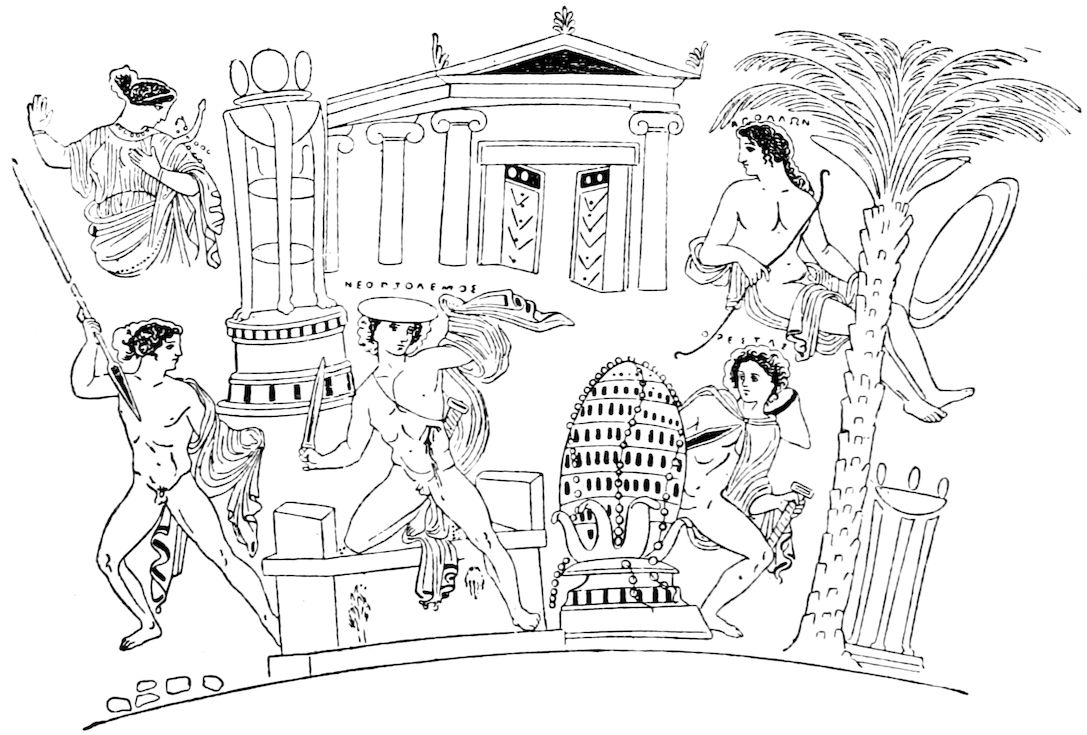
Fig. 10.
In the centre is the sanctuary of Apollo denoted by two tripods, the laurel tree, the omphalos covered with a netting, and the altar. To the latter, already dashed with blood, Neoptolemos, ΝΕΟΠΤΟΛΕΜΟΣ, has fled. He holds a drawn sword in his right hand and whirls his 85chlamys about his left. He wears a petasos and has a sword-cut in his left side from which blood is oozing. His face is turned towards the omphalos behind which Orestes, ΟΡΕΣΤΑΣ, appears to be dodging. He has a chlamys and a pilos; in his left hand the sheath of a sword, the latter being in his right. On the left, behind the altar, is another youth, nude except the chlamys on the left arm. He holds a spear in the right hand as though about to cast it at Neoptolemos. The centre of the upper section is filled out with an Ionic temple, the doors of which are open. On the left, the half-figure of a woman, recognizable by the key as the temple priestess (κλῃδοῦχος)[166], appears in great alarm. Apollo, ΑΠΟΛΛΩΝ, with his bow, occupies a seat on the right of the temple[167].
In order to understand the painting it is necessary to bear in mind what preceded the speech of the messenger. Andromache, the wife of Hektor, had fallen to the lot of Neoptolemos on the division of the Trojan spoils and had been taken by him to Phthia. As his captive she had raised him a son, Molossos, while his lawful wife Hermione, daughter of Menelaos and cousin of Orestes, continued barren. Hermione, being suspicious that it was through some drugs of Andromache that she had been rendered thus unhappy, determined upon the 86latter’s death, and while Neoptolemos was absent at Delphi to atone for certain family wrongs the desperate Hermione proceeded to carry out her resolve to destroy both the mother and the young Molossos. This spiteful work of the injured wife occupies the first part of the tragedy. The two are finally saved by the intervention of the aged Peleus, and Hermione thereupon resolves to kill herself. At this point, Orestes, who is on his way to consult the oracle at Dodona, enters. On learning of the insults and injuries that had been heaped upon Hermione, once promised him for a bride, he at once undertakes to relieve her of any reason for dreading the return of Neoptolemos and the attendant disclosure of her wicked plans.
He leaves accordingly for Delphi. The messenger comes in after a song by the chorus and relates what has taken place. Orestes had gone round putting the Delphians on their guard against this Neoptolemos whose plan was to sack the temple. Credence was at once given to the fabrication, and the inhabitants determined upon a bold step. When Neoptolemos was at the altar addressing the god, the band of armed Delphians who were lying in wait for him behind the sacred laurel tree sprang out and fell upon him.
This furnishes the setting for our painting, and we may turn for a little to a closer examination of the account given by the poet. It will be noticed that the artist, while in some respects keeping close to the latter, has in the main done his work rather independently. Common to both are the δάφνη (v. 1115) and the βωμός (vs. 1123 and 1138). The attacking party in the painting includes Orestes, thus emphasizing the point which Euripides really had in mind. In this particular 87the artist has gone ahead of the poet. It appears, indeed, as though Orestes had just made the slash in Neoptolemos’ side. The moment represented is, therefore, that when the fight was on. The Delphians appear to have but one representative, who is certainly creating far less annoyance for Neoptolemos than does the company in Euripides, where they hurl rocks and fill the air with dust and din. The setting of the scene in the painting is magnificent. Everything points to the great shrine; both the exterior and interior of the temple are visible. As for the Ionic order it should be remembered that this has nought to do with the historic facts in the case. An examination of the buildings on the vases of Lower Italy reveals a decided preference on the part of the artists for this order of architecture[168]. The painting is an excellent example of the influence of the poet over the artist. This is, however, no mere illustration, a fact to be remembered in dealing with all the paintings of this class; the spirit and not the letter is what one can trace most readily in works of art based upon the tragedians. The agreement between the literary source and the picture is more apparent here than in most instances, and this is largely due to the fact that the Andromache is particularly Euripidean. This turn does not occur in any other author. A parallel case will be observed in the chapter dealing with Iphigeneia among the Taurians. It is this alteration and extension of old myths which characterizes Euripides’ work. These new features were popular and attracted the public, and here one gets the key to the unparalleled influence which this poet exercised upon artists.
88
§ 3. Bakchai.
Euripides’ Bakchai is our chief authority concerning the fate of Pentheus[169], yet this writer did not by any means establish the details of the story. This was done long before Thespis may have assayed to dramatize the tragic episode[170] and before Aischylos wrote his Pentheus[171]. It is not probable that Euripides materially altered the accepted form of the myth, and there may be in his play a mixture of the traditional and Aischylean versions. Pentheus’ death, like the madness of the Thracian king Lykurgos, was inseparably connected with the advent of the Dionysiac worship. The series of victories won by the orgiastic god from the wild North was not bloodless; his coming was attended with opposition. In the end, however, his foes were annihilated or ruined, and the new joy brought in by the foreign god captivated a nation and made it his devout worshipper. Euripides could say little or nothing new touching the triumph of Dionysos over the king of Thebes, yet this tragedy, one of the most brilliant pieces of Greek literature, paints in glorious colours the history of the victory.
The events, as told by Euripides, are briefly as follows. Dionysos has arrived in Thebes from Lydia and the East, where he had already established his choirs of Bacchanals. Thebes was the first city to which he came, and here, where he least expected 89opposition, scepticism met him. The sisters of his mother Semele circulated the report that he was no god but an impostor. He forthwith drove the Kadmeian women maddened from their homes to wander in the mountains attired in the Dionysiac dress; the Bacchic craze spread further, and seized even the seer Teiresias and Kadmos, who with thyrsoi and fawn-skins joined the orgies. Pentheus, on hearing of these strange doings, appears and chides them both, and threatens to hunt the women from the mountains and punish the stranger who has made his family drunk with frenzy. At v. 434 Dionysos, bewitchingly beautiful, is led a prisoner before Pentheus, who orders him to be bound and cast into the royal stable. Soon afterward the walls are heard to crash in and flames burst forth in every direction (v. 593 ff.). The god, to be sure, is safe, and Pentheus is mocked and wild with anger, while the former bids him be quiet and subdue his anger. At this point a messenger arrives to recount the strange sights that had met his eyes on the mountains. Three bands of women, led by Autonoë, Agave, and Ino, had rushed upon his herd of cattle and torn them limb from limb, and afterward they washed the blood from their hands in a fountain made to flow by the god. In the face of these wonders he urges Pentheus to honour the latter, but the king will not brook this Bacchic insolence and threatens to sacrifice a hekatomb of women on Kithairon rather than propitiate the unwelcome visitor. Dionysos advises him not to kick against the pricks (v. 795); in a moment Pentheus’ attitude is seen to change; the secret power of the god is working on him; he will see the strange actions himself, and would rather forfeit a thousand-weight in gold than forgo the opportunity (v. 812). 90The linen chiton is at once provided, and Dionysos, who is to lead the way, directs the arrangement of the dress so that Pentheus shall not be mistaken for a man. After some scruples as to the figure he may make before his citizens he is anxious to be off. Once in the mountains giddiness comes upon him. He sees two suns, and a double Thebes, and twice seven gates; he declares that the god himself has taken on a bull’s form with horns (v. 918 ff.). Immediately thereafter he obtains the first glimpse of the women. There are Ino and his mother Agave. Then he worries lest he may not hold his thyrsos correctly. This shows his sad predicament too plainly. Dionysos has done his work; his vengeance on the recalcitrant Pentheus is at hand. At first the latter feels himself able to overturn the whole mountain and asks the advice of the god as to the best means of annihilating the troop. When violence is not recommended he suggests that he had best hide in a pine-tree to view the sight (v. 954). Nothing further is ever heard from the king’s own lips except in his death-cry reported by the messenger who had accompanied him. When they had reached the band in the glen, shadowed by pines (πεύκη, v. 1052), the thicket was so dense that Pentheus requested that he might be allowed to ascend the bank or climb a tree (v. 1061) in order to command the field. Dionysos bent a tree to the ground, placed the king upon the boughs and allowed it to rise again, and, turning to his devotees, pointed to their prey. Stones and darts are directed at Pentheus, and finally the tree is pulled up by main force and he falls an easy victim to the maddened women. Agave, heeding none of his cries, tears out a shoulder; Ino, Autonoë, and the rest help in dismembering the king. 91His mother fixed his head upon a thyrsos and led the troop on a wild dance over Kithairon, finally coming to the palace. Gradually freed from the insanity, she realized the enormity of her crime. Dionysos’ godhead was, however, established, and the house of Kadmos remained a terrible witness of his power. These are the harrowing details of the murder, and one cannot wonder that there are numerous vase paintings based on the tragedy.
There is a long list of vases that can for the most part be passed over with a mere reference. They are all, with perhaps one exception, later than 500 B.C. This means that the impetus for the tragedy in art was given largely by the tragic drama. The oldest painting is older than the Pentheus of Aischylos and cannot, therefore, be connected with his play. There may have been an earlier dramatization, such as that recorded of Thespis, which figured in this monument[172]. All the remaining paintings belong to the latter part of the fifth century B.C. and the fourth century B.C., and are, with one exception, of too general a character to be used as evidence for one of the tragedies[173]. On the Munich hydria it seems 92to me there are clear traces of the Bakchai, and this widely-known work is given here in fig. 11[174].
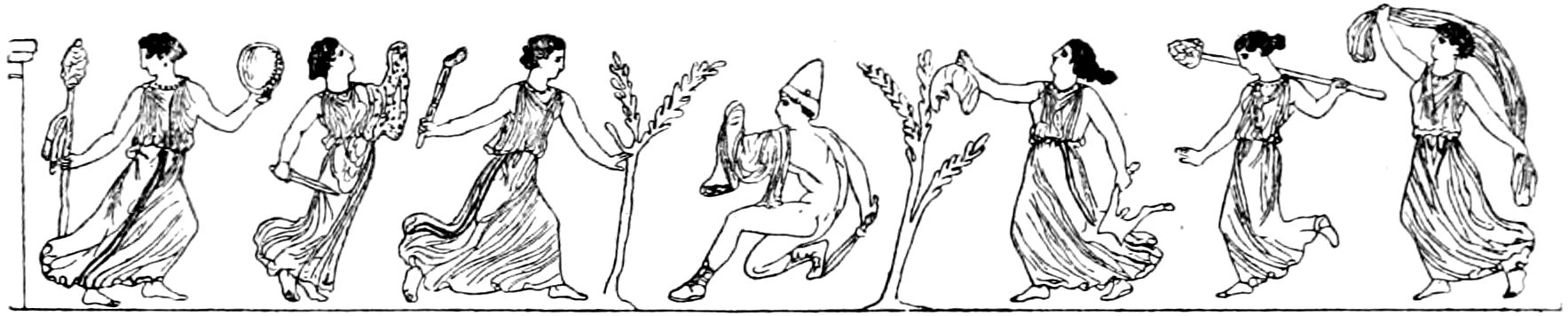
Fig. 11.
Pentheus, wearing chlamys, pilos, and boots, crouches, with a drawn sword in his right hand, in a thicket denoted by two trees. A maenad who appears to have just discovered him rushes into the hiding-place with a torch in her right hand[175]; she is dressed in a plain, Doric peplos. Another maenad, similarly dressed but having a fawn-skin over the left hand and a sword in the right, does not seem to have sighted Pentheus. A third, dressed like the first one, holding a tympanon in the left hand and a thyrsos in the right, approaches wholly unconcerned with the discovery of her companions. On the right is another group of three maenads all dressed alike and all in rapid motion. The first holds in either hand the quarters of a kid or roe. The second shoulders the thyrsos with her left hand and makes an ecstatic gesture with her right. The third one, in even more violent motion, swings her veil about her and rushes on towards the left.
93It should be noted, to begin with, that the vase is a Lower Italy fabric of the fourth century B.C., and that there is therefore no chronological difficulty in placing it under the influence of the Bakchai. The troop of maenads is arranged symmetrically, an equal number being on each side of the central scene, and this suggests the chorus in the play. The striking feature is the introduction of the landscape; there is no doubt as to where the catastrophe occurs. The artist did not allow himself the licence of placing Pentheus in the tree, for this had been too grotesque a sight for the fourth-century painter. The frequent references to the thicket[176] and the protection it was or the inconvenience it caused, is happily brought out in the picture, but the poet has not been followed in details. Pentheus does not appear with the thyrsos, talaric chiton, and dishevelled hair, for the simple reason that he would have been indistinguishable from the maenads. As he appears in the painting the contrast is striking and the eye at once grasps the situation. The torch held by the foremost maenad lights the way to the retreat of Pentheus, suggesting the words—
καὶ πρὸς οὐρανὸν
καὶ γαῖαν ἐστήριζε φῶς σεμνοῦ πυρός. v. 1082 f.
That one is armed with a sword while the others have no weapon finds also a parallel in Euripides, who says one time that they used nought but their hands—
χειρὸς ἀσιδήρου μέτα. v. 736.
and again that the sword shall do its work—
ἴτω ξιφηφόρος. vs. 992, 1012.
94The wild revelry of the whole is instructive when studied with the poet. The Bacchanal who flaunts the quarters of her victim reminds one at once of the words—
ἀγρεύων | αἷμα τραγοκτόνον, ὠμοφάγον χάριν. v. 138 f.
In conclusion, reference should be made again to the newly discovered wall painting in Pompeii. It is so remarkably preserved and so thoroughly in the spirit of Euripides that there can be little doubt as to the influence of the Bakchai[177]. The only Pentheus painting recorded in classical literature was that in the Dionysos temple in Athens, which may also have been inspired by Euripides[178]. Is the Pompeian painting an echo of the celebrated one in Athens?
§ 4. Hekabe.
The Hekabe is one of those plays which, like the Andromache, embraces a series of events loosely associated. There are in fact two distinct parts to this tragedy, having no other connexion than one would observe between two separate works where the same heroine appeared. Two heavy blows which the Fates dealt Hekabe after the fall of Troy constitute the subject of the action.
The first of these new calamities was the death of Polyxena. The Greeks are encamped on the Chersonesos side of the Hellespont. Among the captives 95are the former queen of Troy and her daughter. Achilles, who is among the shades, demands of the Greeks that Polyxena be sacrificed to him. The request cannot be ignored, and Odysseus and others are commissioned to secure her from her mother. The parting scene between Hekabe and the daughter is heartrending, but the courage and self-control exhibited by the latter are remarkable. Talthybios, the faithful herald of Agamemnon, afterwards reports to Hekabe the details of the sacrifice, and this description of the fair and innocent Polyxena is one of the gems of Greek literature. The lines in particular which describe her actions immediately before the fatal moment are famous for their beauty.
Although the offering of Polyxena was known in Greek art and letters before Euripides’ time[179], the subject must have been far more popular after the production of this tragedy. It appears to me a mere accident that no vase painting representing the scene has so far come to light. There is, however, on a so-called ‘Megarian Bowl’ a relief decoration, probably dating from the third century B.C., which doubtless owes its existence to Euripides[180]. It has seemed to me desirable to include 96this here, even though it carries us beyond the limits prescribed to the present work. The cup, found in Thebes, is in the Berlin Antiquarium[181]. The middle of the composition represents the tumulus of Achilles, above which is raised a stele with akroteria and a fillet. On the left, Polyxena, with exposed bosom and flowing hair, kneels with extended arms. Approaching her is Neoptolemos wearing a chlamys and holding his sword ready for the fatal stroke; behind the latter is a figure in a short undergarment, mantle and pilos. The cap distinguishes the person as Odysseus. Agamemnon sits with back to the beholder upon the extreme left, and lifts his left hand (not his right hand as Robert says), evidently astonished at the remarkable composure of the victim. On the right of the tomb are three warriors, who are more or less closely connected with the others. The first one appears to raise his hand in wonder at the fortitude of Polyxena; the second, who does not seem to be armed, has the appearance of one weeping; the third is apparently little interested in the tragedy. It 97is not necessary to name these three persons, evidently representatives of the Achaeans. The first one may perhaps be Talthybios, since he says he was present (v. 524). The dolphins upon the vase are meant no doubt to characterize the sea-shore where the sacrifice took place.
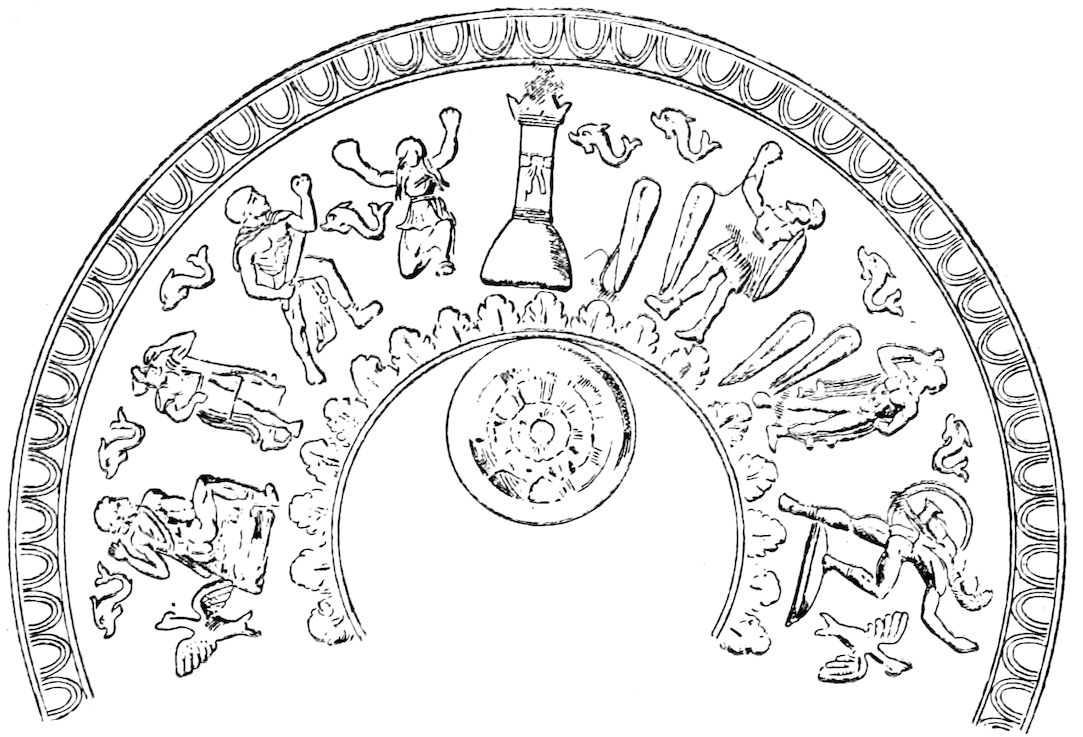
Fig. 12.
The essential part of the composition is, however, the tumulus and the figures on the left. Everything here illustrates Euripides. One reads in v. 221 of
... ὀρθὸν χῶμ’ Ἀχιλλείου τάφου.
The attitude of Polyxena is based upon the beautiful verses in the messenger’s speech:—
λαβοῦσα πέπλους ἐξ ἄκρας ἐπωμίδος
ἔρῥηξε λαγόνος ἐς μέσον παρ’ ὀμφαλόν,
μαστούς τ’ ἔδειξε στέρνα θ’ ὡς ἀγάλματος
98κάλλιστα, καὶ καθεῖσα πρὸς γαῖαν γόνυ
ἔλεξε πάντων τλημονέστατον λόγον·
‘ἰδοὺ τόδ’, εἰ μὲν στέρνον, ὦ νεανία,
παίειν προθυμεῖ, παῖσον, εἰ δ’ ὑπ’ αὐχένα
χρῄζεις, πάρεστι λαιμὸς εὐτρεπὴς ὅδε.’
ὁ δ’ οὐ θέλων τε καὶ θέλων, οἴκτῳ κόρης,
τέμνει σιδήρῳ πνεύματος διαρῥοάς. vs. 558–567.
Even the hesitation of Neoptolemos, expressed in the last two verses, finds its place in the relief. Odysseus, who was intimately identified with the proceedings from first to last (vs. 218–437), could not be wanting in an illustration of the final scene. Agamemnon too is fittingly present, for, according to Euripides, he had given the order to carry out the sacrifice,
Ἀγαμέμνων τ’ ἄναξ
εἶπεν μεθεῖναι παρθένον νεανίαις. vs. 553 f.
and had dismissed Talthybios to Hekabe (v. 504).
The second part of the play begins with v. 658, where the servant of Hekabe enters with the body of the latter’s young son Polydoros. Priam had intrusted the boy to Polymestor, king of Thrace, when the Greeks attacked Ilion. A considerable sum of gold accompanied the child to ensure his maintenance if the city should be captured. As long as the Trojans held out, Polymestor was true to his charge, but no sooner had the news of the downfall of Priam’s house reached the ears of the good Thracian than he put the child to death for the money and cast his body out unburied. This is related in the prologue by the ghost of Polydoros, who also prophesies the death of Polyxena on that day. His body was accordingly discovered by the attendant, who happened upon it by mere chance, and immediately 99after receiving the terrible message from Talthybios, Hekabe was made to bow beneath another sorrow. She at once summons her courage and determines to have revenge upon the unrighteous Polymestor. She first relates to Agamemnon the story of the boy’s death, and the king, deeply incensed at the ἀξενία of the Thracian, agrees to her plan for avenging herself on the latter. She sends for Polymestor under the pretence of disclosing to him some weighty matter. He comes, and at her request dismisses his bodyguard, not mistrusting in the least that his crime had been discovered. To questions as to the welfare of Polydoros and the safety of the gold he replies that all is well and that the child would gladly have come to visit his mother. Hekabe then proceeds to tell him of some treasures which she wishes to commit to his keeping. These are in the tent, and he shall go inside and examine them for himself. ‘No Achaean is within; we are quite alone,’ she says, and with this assurance Polymestor leaves the light of day for ever. Once inside, his cries of agony soon announce that Hekabe has done her work with swift and certain hand.
The scene representing the reappearance of the blinded Polymestor has been recognized on a Lucanian vase[182]. In the middle stands the helpless king, his arms extended in a distressed manner. He is dressed in a short, embroidered chiton and a mantle, and wears a tall head-gear that indicates his barbarian nationality. Agamemnon is on the left, with sceptre and himation; he appears to be addressing the former. Following is a doryphoros. On the right are Hekabe and an attendant, 100both dressed in chiton and mantle. The latter places her arm over Hekabe’s shoulder and seems to be comforting her, as she shrinks away from the figure in the centre. The cane is suggestive of the queen’s age and of the wandering life upon which she is entering. A sword rests upon the ground, pointing probably to the weapon which was used to blind Polymestor. It is not necessary to cite any particular verses from Euripides which the artist may have had in mind. He simply told the story as it recurred to him. Especially suggestive of the king’s staggering step are the verses beginning
ὤμοι ἐγώ, πᾷ βῶ,
πᾷ στῶ, πᾷ κέλσω; vs. 1056 ff.,
spoken when Polymestor first appeared before the tent of Hekabe after the latter had put out his eyes. The chorus, Agamemnon, and Hekabe are then present, and with alternating parts fill out the rest of the play (vs. 1109 ff.).
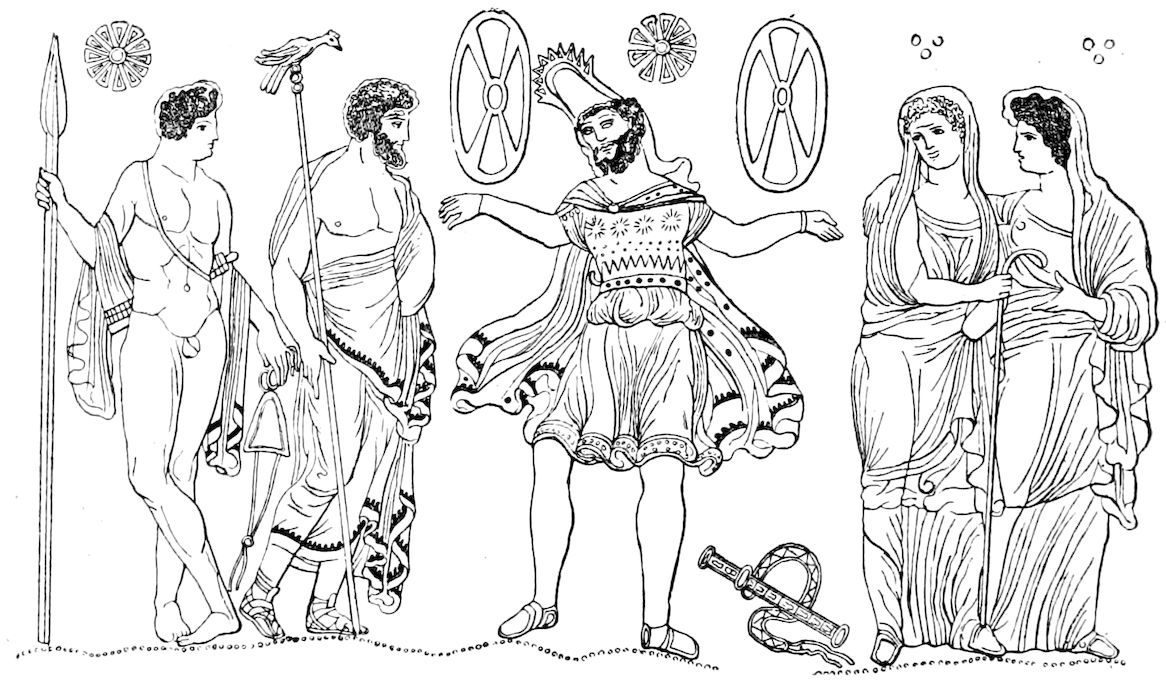
Fig. 13.
101
§ 5. Hippolytos.
In the Phaidra of Sophokles and the first Hippolytos of Euripides it was Phaidra herself who acknowledged to Hippolytos her love for him. The votary of Artemis, at once enraged at this effrontery, cast her aside. She then defamed the youth to Theseus, who, believing her statement, prayed to Poseidon to destroy his son. The god accordingly sent a sea-monster to frighten the horses of Hippolytos, and the latter was soon dragged to his death. On receiving the news of this, Phaidra hung herself[183]. Sophokles’ play does not appear to have ever made any impression upon the world and must have been soon forgotten, and Euripides’ tragedy met with great disapproval. Such a Phaidra was more than the Greeks would tolerate. The poet grasped the situation and wrote another Hippolytos, which set him right with his public. It was no longer Phaidra in and of herself who became the instrument of the youth’s death; Aphrodite, angered at Hippolytos’ serving Artemis instead of herself, starts the gentle flame within Phaidra’s bosom and visits her with a love-sickness that drives the unfortunate woman into a confession of her illness to her attendant. On the latter’s placing the matter before Hippolytos, all to no avail, Phaidra takes her own life, not forgetting, however, to leave behind a letter containing delicate charges against her step-son. Theseus returns, finds his wife a corpse, and reads the letter. The curse and death of 102his son follow, as in the earlier Hippolytos. This ruin was brought on him not so much by Phaidra as by Aphrodite.
The tragedy was counted among the best of Euripides’, and has always retained its popularity. The subject was dramatized again in Greek[184], and there is extant the Latin version of Seneca[185]. The theme was one which was sure to appeal to modern authors, and among the French alone one hears of no less than seven tragedies on the love of Phaidra, written between the years 1573 and 1786. Four of these, the most famous of which is Racine’s Phèdre, belong to the seventeenth century. They are, however, more directly indebted to Seneca and Ovid[186] than to Euripides. Mention should be made also of the two operas by Pellegrin, 1733, and Lemoine, 1786. But after all has been said on versions of the story either in classical or modern times, one turns to the masterpiece of Euripides as the great work. According to the author of the Hypothesis, the play is among the best of this poet and was given the first prize. In reflecting that Hippolytos has stood forth since March, 428 B.C., as the beau idéal of innocent, unsullied, young manhood, one is inclined to credit the judges with possessing good sense.
There was hardly a more attractive legend than this which the artists might have been tempted to make their own, yet one discovers a surprising dearth of Greek monuments that can be referred to the myth. From these I select two vase paintings that appear to be based upon Euripides.
103
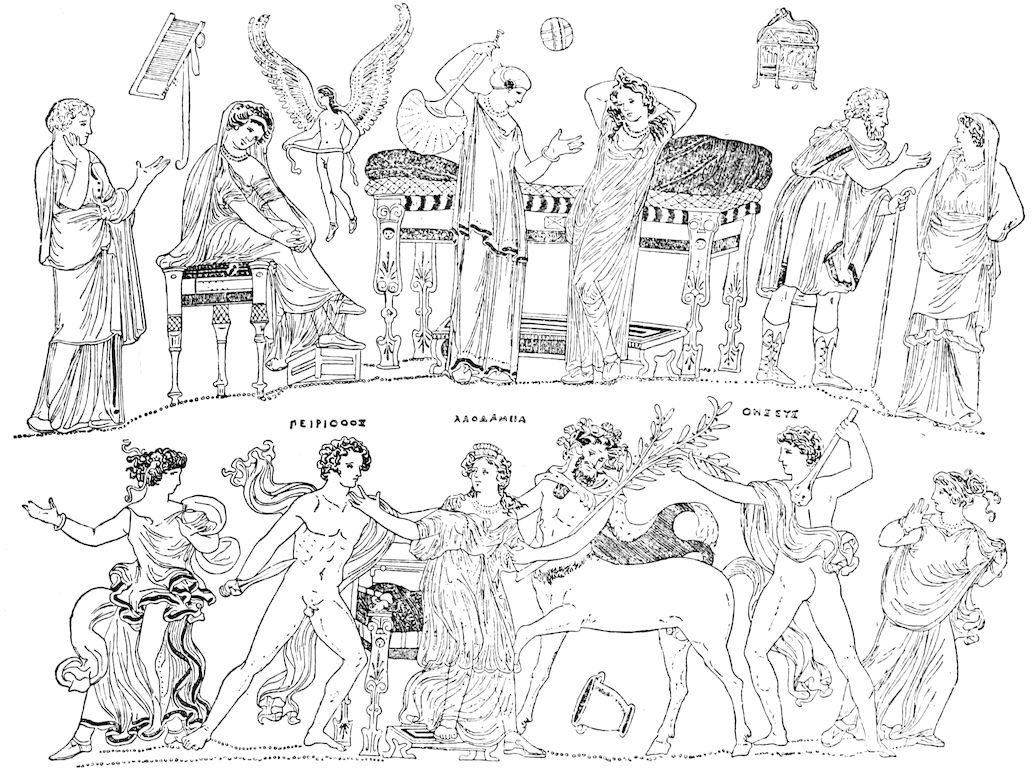
Fig. 14 (vid. p. 102 ff.).
104Fig. 14 represents a painting on a krater in the British Museum[187]. The upper section alone concerns us here, and this shows the interior of a gynaikonitis with kline. On the left is a group of two females. One sits on a stool to the right, wears chiton and veil, diadem, bracelets, and necklace, and leans forward, with head dropped to one side, clasping her right knee thrown over the other. Her left foot rests on a foot-stool. Behind her a white-haired servant in the usual costume holds her right hand to her chin, and with troubled air gestures with the left hand as she speaks to her mistress. A large Eros with immense wings flies down towards the latter with a taenia in his hands. There are, further, two other groups of two each. The one before the kline is two females again. An attendant, distinguished by her hood, who holds a fan in her right hand, talks and gestures earnestly before the other, who wears the simple Doric peplos, ungirdled, and stands with her back to the kline in a disturbed and troubled sort of mood. The remaining group of two, a pedagogue in the customary dress and a female figure similar to the one on the extreme left, is also concerned over some important matter which the pedagogue is telling. Certain articles hang on the wall.
The picture has been interpreted as representing Phaidra in the presence of the chorus, and depending upon Hippolytos vs. 267 ff. The right-hand group would then be very loosely connected with the rest. In so far as the love-sickness of Phaidra is concerned this appears 105to me a correct interpretation, but that the chorus is in any way represented by the other figures is entirely out of the question. The whole affair is supposed to be in Phaidra’s apartments, to which at no time the Troizenian women had access. What would they be doing by the kline[188]? The pedagogue is added on one side, as though to indicate how the news is spreading among the domestics[189].
But let me turn for a moment to another class of monuments that help to a better understanding of the scene. There are no less than seventeen reliefs on the long side of Roman sarcophagi which are practically intact and furnish from two to three scenes of the tragedy. Less frequently the ends contain one or two other groups supplementing the front side[190]. There are four moments that are distinctly traceable. (1) The love-sick Phaidra sits on a chair in her apartments surrounded by the old nurse and other servants, who attempt to comfort her. She wears a veil as on the vase painting, and on two reliefs one of the attendants is removing this[191]. The diadem is also distinguishable. (2) The nurse makes her declaration to Hippolytos, who turns away from her. (3) Hippolytos with his followers is 106about to start upon, or is already engaged in, the hunt. (4) The horses run away and bring him to his death. All four scenes occur on the famous sarcophagus in Girgenti[192], and on another in St. Petersburg[193]. It will be observed that in three of the four groups Hippolytos himself is present, and one naturally looks for him in scenes taken from the tragedy where he is the main figure. The earliest scene in Euripides which develops the hopeless state of affairs with Phaidra is, however, of prime importance next to the death of Hippolytos.
But a brief comparison of the left-hand group of our painting and the Phaidra scene on these reliefs is necessary, in order to reveal a striking resemblance in the compositions. The one difference rests in the size of the groups; the painter has confined himself to fewer figures. This fact, however, is of little importance. A closer examination of the two discloses much that points to a common source. On nearly all the reliefs Phaidra’s chair has, as in the painting, no back or arms; Eros, who flies towards Phaidra in fig. 14, invariably stands beside her on the sarcophagi, looking up into her sad face, or, what is still worse, aims an arrow at her[194]. The queen wears in all cases the veil, and often on the reliefs the diadem likewise[195]. The nurse never fails in her ministry.
It is time now to look more closely at the tragedy. After the prologue by Aphrodite, Hippolytos and his 107followers enter and pay their homage to Artemis. The hero lays a wreath upon her statue, which adorned one side of the entrance to Pittheus’ palace. The attendants are ordered inside and he then withdraws. His servant remains long enough to address a prayer to Aphrodite’s image on the other side of the stage. Following is the parodos in which the chorus relates what had been learned concerning the illness of Phaidra. Among other things they hear that she sits
... λεπτὰ δὲ φάρη
ξανθὰν κεφαλὰν σκιάζειν. v. 133 f.
This, it will be observed, corresponds to her position in the painting and in the reliefs. It is just this time of abstinence and mourning, spent in the palace surrounded by the faithful old nurse and other servants, which suggested the scene on the reliefs and on the vase. The visitations of Eros serve well to bring into objectivity the real cause of Phaidra’s illness, and to render the poet more plain. To be sure this all took place in her apartments, ἐντὸς οἴκων (v. 132), and could therefore be worked out according to the artist’s fancy. A long and animated scene ensues, in which Phaidra utters strange expressions that betray the sadness of her condition. The trophos finally coaxes the secret from her, and the chorus dips in from time to time as a sort of second to the nurse. The interview which the latter has with Hippolytos, vs. 601–668, is overheard by Phaidra. Her unrequited love bears her down and she leaves the stage determined to die (v. 731), and in a few moments is announced as dead[196].
108The scenes on the sarcophagi representing Hippolytos’ hunt, the counterpart of Phaidra’s illness, and the trophos’ proposal[197] to the hero do not appear on vases.
Hippolytos’ ride to death, the terrible finale of the tragedy, appears on an Apulian krater also in the British Museum[198]. The painting falls into an upper and lower section. In the latter, Hippolytos dashes along in his chariot; the four horses are not in any apparent disorder although the next moment must be fatal, for just before them the sea-monster rises into view, and a Fury with a flaming torch and serpents wound about her arms runs into their course. A pedagogue hurries along from the rear, extending his left hand, warning Hippolytos of his danger. The scene is viewed by five divinities. Their positions are the stereotyped ones of the Apulian vases, and their connexion with the tragedy before them need not be intimate[199]. Athena in the middle, a great favourite in these groups, leans on her shield and carries a lance and in her right hand the helmet. Apollo, distinguished by bow, laurel bough, and wreath in the hair, sits on her right, facing Pan who stands half reversed to the beholder with the syrinx in the right hand, and resting his left elbow on a rock. On Athena’s left sits Aphrodite, attended by a large Eros, who extends a kylix to Poseidon sitting on the right, holding the trident. There is certainly ample reason for the presence of the last two gods at the death of Hippolytos; they are, in fact, very instrumental in bringing about the catastrophe. I am not able to assign any satisfactory reason for the appearance of Athena, Apollo, and Pan. Mere speculation concerning the choice of these deities cannot be of much value. Artemis is surely indispensable in a group of gods concerned with Hippolytos’ death. Any one who knows these groups on the vases of Lower Italy is aware that Athena is a great favourite and often appears, as here, merely because she was so admired. Perhaps Apollo is intended to represent Artemis, but it is not likely that the artist thought so far[200].
109
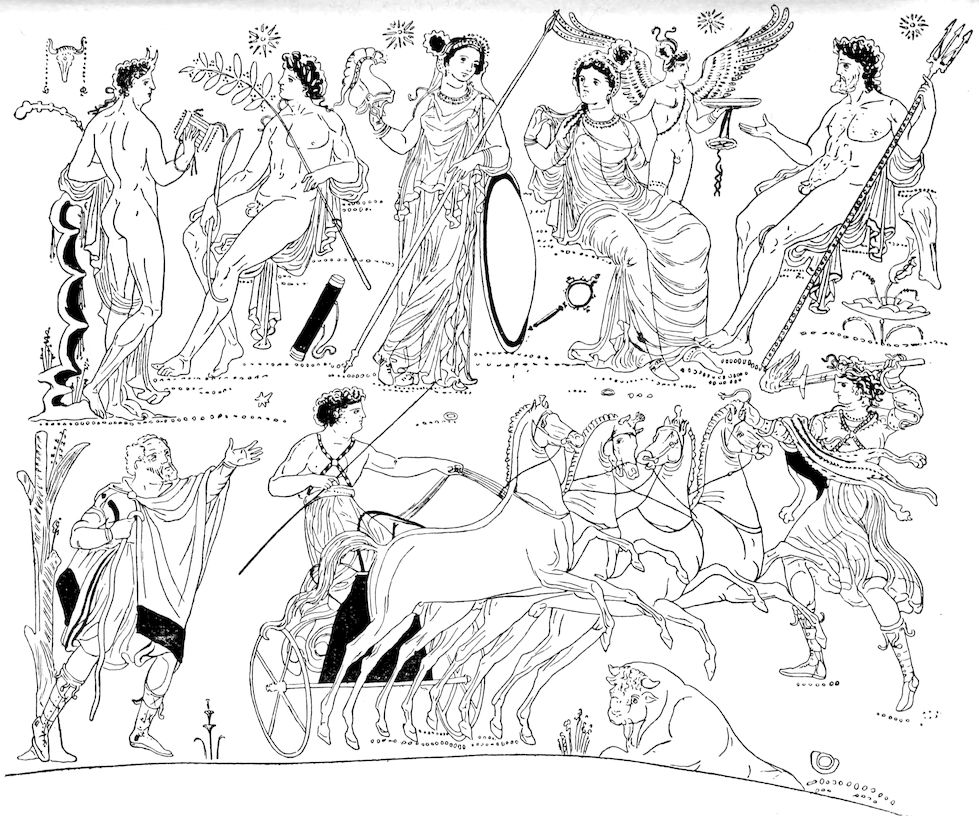
Fig. 15 (vid. p. 108 ff.).
110In regard to the lower section it may be observed first that the district is not denoted in any way as being the sea-shore where Euripides sends the youth for a drive[201]. There is no water indicated, out of which the ταῦρος ἄγριον τέρας[202] is issuing. The mounted companions 111of Hippolytos are represented only by the pedagogue. The time is that just preceding the breaking away of the horses described by the messenger, vs. 1218 ff. The Fury, a gratuitous addition of the artist, serves to intensify the violence of the death awaiting Hippolytos.
The deplorable end of the hero has never failed to awaken one’s sympathy. The innocent youth dragged to his death through the workings of a hasty and unjust curse presents one of the most pathetic pictures in Greek literature. It is well depicted by Philostratos in the Imagines[203]. ‘You see,’ he says, ‘how the horses no longer obey the reins but rush madly along the plain, covered with foam. This one makes for the wild beast, the second rebounds, another rushes for the sea, and the fourth glances fearfully at the ground.’ The breaking and crashing of the chariot are pointed out. Then the companions gallop up and try to manage the horses. The hills near by, sentinels of the disaster, in the form of women, tear their cheeks for grief; the meadows, in the form of boys, allow their flowers to wilt and the nymphs from the springs rend their hair, while water spouts from their breasts. Hippolytos’ limbs are torn and shattered, and his eyes are gouged from their sockets. Pliny tells of a painting by Antiphilus of Alexandria which represented Hippolytus tauro emisso expavescens[204], but nothing further is known of Antiphilus or when he lived. The sarcophagi reliefs representing the catastrophe are numerous, compared with those showing any other moment[205]. Not less interesting is the list of Etruscan urns decorated with reliefs showing the bull, the runaway 112horses, and the expavescens youth[206]. In all of these a female figure, doubtless a Fury, is frightening the horses[207]. In two cases she is winged, and every one carries a torch likewise, as on the vase painting.
§ 6. Iphigeneia at Aulis.
The story of Iphigeneia’s sacrifice appears to have been told first in the Kypria, and yet only occasional references are made to it by writers before the fifth century. It was the drama that infused new life into the myth and launched it as one of the most popular ones in the Trojan Cycle. Each of the three great tragedians tried his hand at the catastrophe in Aulis. Euripides’ work, the only one surviving, is at least two generations younger than the play of Aischylos, so that the wide popularity of the tragedy in this period is well attested. Among the Roman poets we know that Ennius, at least, wrote a version of the tragedy. Although it is known that this poet had a special predilection for Euripides, and for the most part translated or adapted the latter’s plays, attempts have been made to show that in his Iphigenia Ennius was largely indebted to Sophokles[208]. The few fragments remaining from these three Iphigeneias are, however, inconsiderable, and a clear notion of their relation to each other cannot be reached. The extant work of Euripides is accordingly of great value to us.
In art, likewise, this subject was rarely treated. I know of no Iphigeneia monument earlier than the fifth century. There is a reference in the Agamemnon to the 113sacrifice as though Aischylos may have seen the scene represented in a painting[209], and granted that the poet really had such a work in mind this becomes the earliest date for Iphigeneia in art. The earliest monument of which we possess any authentic record is the famous painting of Timanthes, who was a contemporary of Zeuxis and Parrhasios[210]. This date, however, does not carry one beyond the last years of the fifth century B.C.—an altogether late date for an art representation of a myth, which, from Aischylos’ time at least, was widely known. We have reason to believe that Timanthes’ work was suggested by Euripides’ tragedy. The latter was first produced in Athens after the poet’s death, not earlier than 405 B.C., and this requires that the painting be placed near the end of the century, which many are unwilling to admit; it is, however, more a matter of opinion than proof. Traces of this celebrated picture are very probably at hand in the well-known Pompeian wall painting[211], and the Uffizi altar[212]. The composition of the latter has much in common with such fifth-century products as the Orpheus and Peliades reliefs[213]. The Etruscan urns on the other hand furnish a wealth of reliefs representing the sacrifice, rarely surpassed in this class of monuments. Numbers have come to light 114in the neighbourhood of Perugia especially[214]. Two groups are easily distinguishable, (1) Iphigeneia, as a little girl, is held over the altar by Odysseus, while Agamemnon goes through the ἀπαρχαί. (2) The first group is extended by (a) Klytaimestra on the side of Agamemnon, and (b) Achilles on the side of Odysseus, each begging for mercy and the life of Iphigeneia. This is all non-Euripidean, and Schlie has attempted to point out that the reliefs owe their origin to Ennius’ play which combined Sophoklean and Euripidean elements[215].
There is no vase painting which can be claimed for this scene in its Euripidean character, but the whole play is the basis of a relief on a ‘Megarian’ cup, and the illustration is so valuable for the proper appreciation of the tragedy that I do not hesitate to include this little monument. The cup furnishes inscriptional evidence not only for the dramatis personae but for the literary source as well, and is, therefore, a unicum among the monuments that are based upon Euripides. The cut given in fig. 16 is of the vase in Berlin[216]. It should be observed, however, that there are two other copies of this same work, and that they tell exactly the same story from the Iphigeneia[217]. A word is necessary in order to prepare us for the first scene given. Agamemnon had sent a message to Argos summoning Iphigeneia, 115and, in spite of his attempt to countermand this by a secret letter to Klytaimestra, he was forced to face the results of his earlier resolve. His daughter came, and accompanying her were her mother and her young brother Orestes. The nuptials were to be celebrated with the son of Peleus, and the Argive party in gayest, happiest mood halted before the tent of Agamemnon. The Chalkian women, who through curiosity had crossed the Euripos to see the gathered hosts of the Greeks, are ready at hand to assist Iphigeneia in alighting from the chariot. The lad Orestes, who appears to have gone to sleep during the journey, is awakened and lifted down by one of the kindly strangers. With her mother’s permission, Iphigeneia hastens inside to meet her father[218]—she, innocently happy over the arrival of her wedding day—he, overcome with grief at her impending death, and smitten with remorse at the enormity of his crime.
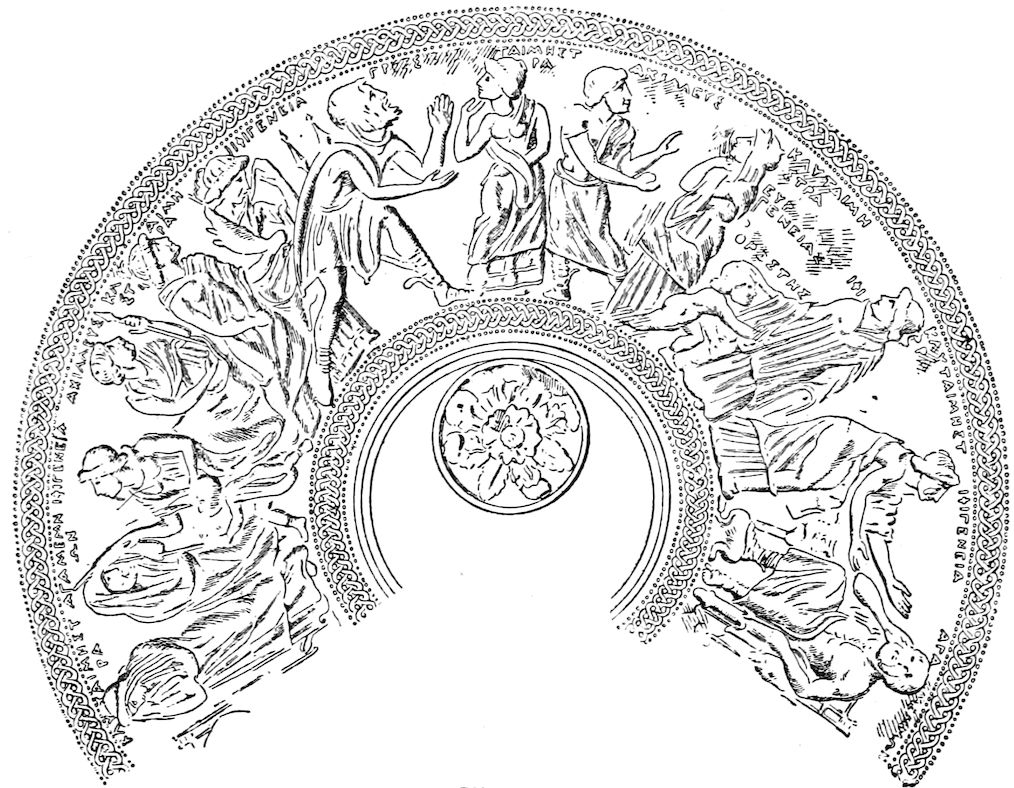
Fig. 16.
116This much renders plain the group on the right. Agamemnon, ΑΓΑΜΕΜΝΩΝ, sits upon his θρόνος with one foot on a foot-rest; his right hand is placed to his temple as though to shut out the gaze of Iphigeneia, ΙΦΙΓΕΝΕΙΑ, who approaches him in a beseeching manner with extended arms. The group is based upon vs. 644 ff.—
Iph. ἔα·
ὡς οὐ βλέπεις ἕκηλον, ἄσμενος μ’ ἰδών.
Aga. πόλλ’ ἀνδρὶ βασιλεῖ καὶ στρατηλάτῃ μέλει.
· · · · ·
Iph. μέθες νυν ὀφρὺν ὄμμα τ’ ἔκτεινον φίλον.
· · · · ·
κἄπειτα λείβεις δάκρυ’ ἀπ’ ὀμμάτων σέθεν;
Such is the situation described by the poet, and surely the artist has succeeded to a considerable degree in grasping the meaning of the scene. Klytaimestra, ΚΛΥΤΑΙΜΗΣΤΡΑ[219], appears on the left with Orestes, ΟΡΕΣΤΗΣ, and would seem to have had the boy in charge after he was helped from the chariot (vs. 621 f.). Following is the inscription, ΕΥΡ[ΙΠΙΔΟΥ] ΙΦΙΓΕΝΕΙΑΣ. The genitive case in the last word may depend upon some such word as τύποι. To avoid a possible misunderstanding of the scenes, even with the characters 117named each time, the artist considered it advisable to add the literary source. This is the Iphigeneia of Euripides and not of any other poet.
After Iphigeneia leaves her father he endeavours to persuade Klytaimestra to return to Argos and leave the final arrangements for the nuptials in his charge. Naturally enough she refuses, and retires to appear at v. 819, where she meets Achilles and enthusiastically brings up the subject of the marriage. Achilles, amazed at the disclosure, assures the queen that he has neither wooed Iphigeneia nor heard aught from the Atreidai concerning any such an alliance. This scene is represented in the next group. Achilles, ΑΧΙΛΛΕΥΣ, bends toward Klytaimestra and gestures emphatically. The latter holds her hand to her chin and is evidently dumbfounded by the declarations. The last words exchanged before the two separate are suggestive—
Ach. ἴσως ἐκερτόμησε κἀμὲ καὶ σέ τις,
ἀλλ’ ἀμελίᾳ δὸς αὐτὰ καὶ φαύλως φέρε.
Kly. χαῖρ’· οὐ γὰρ ὀρθοῖς ὄμμασίν ς’ ἔτ’ εἰσορῶ,
ψευδὴς γενομένη καὶ παθοῦς’ ἀνάξια.
Ach. καὶ σοὶ τόδ’ ἐστὶν ἐξ ἐμοῦ· πόσιν δὲ σὸν
στείχω ματεύσων τῶνδε δωμάτων ἔσω. vs. 849–854.
Immediately after these words the faithful old servant of Agamemnon comes out and relates to Klytaimestra that Iphigeneia is to be slain by her father; he goes further and tells the cause of it all, and how he had failed to get away to Argos with the letter. This meeting of the servant, ΠΡΕΣΣΒΥΣ, and the queen, is dramatically told in the third group. The former 118wears the costume of a pedagogue, with peculiar-looking boots. The latter has laid aside the veil which she wears in all the other scenes.
The following groups on the relief reverse the order of the text, so it is best to consider first that on the extreme left. Agamemnon, Klytaimestra, and Iphigeneia are all named. The young Orestes pulls at his father’s chiton; the latter has a mantle over his head, and shields his face with his left hand. The mother has turned aside and is consumed with her deep sorrow. She had won the sympathy of Achilles after the talk with the old servant, vs. 896–1035, and following the choral song appears again to seek Agamemnon whom neither she nor Iphigeneia had seen since the terrible truth of the marriage was disclosed. She calls her daughter from the house, v. 1117, and bids her
λαβοῦς’ Ὀρέστην σὸν κασίγνητον, τέκνον.
All of these figures occur on the cup, so that in a certain sense the whole scene from v. 1122 to v. 1275 is illustrated. The position of Klytaimestra and Iphigeneia would, however, lead one to think that the latter’s long appeal was particularly in the mind of the artist. She recounts in words, as eloquent as they are pathetic, the promises her father had once made to her as a child, and goes over all the ambitions that had filled her girlish heart in the happy Argive home.
βλέψον πρὸς ἡμᾶς, ὄμμα δὸς φίλημά τε,
ἵν’ ἀλλὰ τοῦτο κατθανοῦς’ ἔχω σέθεν
μνημεῖον, εἰ μὴ τοῖς ἐμοῖς πείθει λόγοις.
ἀδελφέ, μικρὸς μὲν σύ γ’ ἐπίκουρος φίλοις,
ὅμως δὲ συνδάκρυσον, ἱκέτευσον πατρὸς
τὴν σὴν ἀδελφὴν μὴ θανεῖν· αἴσθημά τοι
119κἀν νηπίοις γε τῶν κακῶν ἐγγίγνεται.
ἰδοὺ σιωπῶν λίσσεταί ς’ ὅδ’, ὦ πάτερ.
ἀλλ’ αἴδεσαί με καὶ κατοίκτειρον βίον.
ναί, πρὸς γενείου ς’ ἀντόμεσθα δύο φίλω·
ὁ μὲν νεοσσός ἐστιν, ἡ δ’ ηὐξημένη. vs. 1238–1248.
There is certainly inspiration enough in these verses for a more pretentious group than the simple terra cotta cup presents, but lacking all other Greek monuments bearing upon this scene one may prize this witness as a valuable inheritance from the Hellenistic period. Agamemnon speaks; he loves his child and realizes full well the meaning of the sacrifice, but he must obey the clamourings of the Greeks.
Iphigeneia and her mother remain alone with the chorus and bewail the bitterness of their sorrow, vs. 1276–1345, when a company of men is observed approaching. Among them is Achilles. His attempt to intercede in behalf of the doomed Iphigeneia had been of no avail. The Achaeans were inexorable; her blood must be spilt. Nevertheless he promises them his assistance, and encourages Klytaimestra to resist Odysseus and the others who come to drag her daughter away to the altar, vs. 1338–1433. The early part of this scene is recognizable in the remaining group.
Iph. διαχαλᾶτέ μοι μέλαθρα, δμῶες, ὡς κρύψω δέμας.
Kly. τί δέ, τέκνον φεύγεις;
Iph. Ἀχιλλέα τόνδ’ ἰδεῖν αἰσχύνομαι.
Kly. ὁς τί δέ;
Iph. τὸ δυστυχές μοι τῶν γάμων αἰδῶ φέρει.
Kly. οὐκ ἐν ἁβρότητι κεῖσαι πρὸς τὰ νῦν πεπτωκότα.
ἀλλὰ μίμν’· οὐ σεμνότητος ἔργον, ἢν δυνώμεθα.
Ach. ὦ γύναι τάλαινα, Λήδας θύγατερ. vs. 1340–1345.
120Achilles stands with staff in hand, either about to address the mother or perhaps having uttered the last verse above. Iphigeneia turns with bowed head to avoid his presence; her mother evidently tries to detain her. Inscriptions again indicate who the persons are. We have then precisely the situation in the lines quoted.
The sacrifice which followed, was attended by the marvellous wonder, and it was to be expected that if any one incident of the tragedy was told in art it would be the scene at the altar. Our little monument curiously enough stops where all the others begin. We are taken step by step up to the final act and there we are left. The works enumerated above[220] are, without exception, confined to the moment of the sacrifice. The famous wall painting and the Florence altar have much in common with the renowned painting of Timanthes, and all three are conceived in the spirit of Euripides as far as the actions of Agamemnon are concerned.
... ὡς δ’ ἐσεῖδεν Ἀγαμέμνων ἄναξ
ἐπὶ σφαγὰς στείχουσαν εὶς ἄλσος κόρην,
ἀνεστέναζε, κἄμπαλιν στρέψας κάρα
δάκρυα προῆγεν, ὀμμάτων πέπλον προθείς. vs. 1547 ff.
And so he stands completely wrapped in his mantle, exposing no part of his face. In this invention lay the unsurpassed success which Timanthes enjoyed with his painting. The dates for this artist allow us to place the work subsequent to the production of the Iphigeneia in 405 B.C., and credit Euripides with influencing Timanthes. This is at least possible, but does not admit of proof. It appears to me very likely that all three of these works are more or less closely connected with 121each other and with Euripides. The Etruscan ash-urns on the other hand, as well as the vase painting in the British Museum[221], follow a totally different version of the story. In these cases Agamemnon himself takes the part of the priest in the ceremony, and performs the ἀπαρχαί. So far from being the tender-hearted father who cannot even stand and watch the offering, he draws the fatal knife or pours the sacrificial liquid upon the victim’s head. Traces of this turn are found early in tragedy[222], but this is an Agamemnon with a far different heart from the one we follow in the Iphigeneia of Euripides. Even though the part from v. 1532 till the close of the play be thrown out as an interpolation, the character of Agamemnon in the first 1500 verses could not have changed so suddenly at the end that he would have taken the place of Kalchas at the altar. This set of monuments does not, therefore, give us the Euripidean spirit.
§ 7. Iphigeneia among the Taurians.
Euripides in all probability created in the life of Iphigeneia the chapter concerning her return to Greece with Orestes. There is at any rate no trace of this turn in preceding authors. Homer does not appear to have known any such a daughter of Agamemnon, unless one is to seek to identify Iphigeneia with Iphianassa. The ‘king of men’ speaks of
Χρυσόθεμις καὶ Λαοδίκη καὶ Ιφιάνασσα. Il. 9. 145.
as his three daughters. We know, however, from 122Sophokles[223] that Iphianassa was distinguished from Iphigeneia. Since Homer has not even her name there is no allusion to the catastrophe at Aulis. It is first in the Kypria[224], a work usually accredited to Stasinos in the early part of the eighth century B.C., that reference is made to the gathered hosts at Aulis, the calm, the sacrifice. It was not Iphigeneia, however, who was the victim, for Artemis had suddenly intervened and, having taken her away to the Black Sea country, had blessed her with immortality. From this date then the myth may have been widely spread among the Greeks. Hesiod related in his Κατάλογος γυναικῶν that Iphigeneia had received the gift of immortality from Artemis, thus following closely the author of the Kypria[225]. Herodotos also repeats the same story[226]. One looks in vain for any trace of her delivery from this wild people, until the latter part of Euripides’ life. Then it is that new light breaks in upon the old orthodox form of the myth: the mortal side of Iphigeneia is made to assume a new interest for the world, and she, who had been long lost amidst a wild, barbarous people, is suddenly restored to her only hope, Orestes. This is the work of ‘Euripides, the human, with his droppings of warm tears.’ With this tragedy the poet created at once a definite chapter in dramatic literature and furnished another impetus for ancient art.
There are traces of two other Greek tragedies dealing with this same subject; yet the play of Timestheos is a mere name[227], while that of Polyeidos is but little more. Aristotle, however, has given a certain prominence to 123the latter work by making two references to it in his Poetics[228]. This differed from the play of Euripides particularly in the recognition scene. The ἀναγνώρισις was brought about by Orestes using the words ‘and shall I too be sacrificed?’ Who but Orestes was likely to know aught of the attempt once made to sacrifice her at Aulis? It is worthy of note that the libretto of Glück’s opera also follows this manner of the dénouement. Among the Latin dramatists we hear that Naevius wrote a play called Iphigenia. One verse only is preserved[229]. It goes without saying that the tragedy was taken from the Greek, but from what author it is worthless to conjecture. The Dolorestes of Pacuvius was long thought to deal with the same subject, but this has been shown to be of an entirely different character. It is altogether improbable that these Latin versions worked any radical change in the Euripidean form of the myth. It is true that the story was remodelled in some particulars; Hyginus, e.g. in fabula 261, relates that the bones of Orestes had been brought from Aricia to Rome and had been interred before the temple of Saturn! Such a violent contortion of the myth may be laid to the credit of a poet[230], but I would prefer to recognize in the words of Hyginus the influence of the mythological handbooks which were written up in a manner well calculated to pamper the national pride of the Romans.
In no work written subsequent to Euripides is it possible to detect the sources for the representations of the myth in art; in all cases the poet of the fifth century B.C. can be shown to have wielded his absolute 124power. We shall see in the discussion of the vase paintings based upon the play that this class of monuments is not the only one in which the new Iphigeneia found her place. The Etruscan urns and mirrors, the wall paintings of Pompeii and of Herculaneum, the Roman sarcophagi, as well as pastes and gems, all furnish an extensive field in which parallel scenes may be traced.
This introduces the consideration of the vases and their relation to the tragedy. They fall readily into three classes corresponding to three well-defined stages in the play: 1. Orestes and Pylades alone upon the Taurian coast are surprised, and led by the shepherds to the king and Iphigeneia (vs. 67–466). 2. The scene following, in which it is determined that not both shall be killed, but that one, and he Pylades, shall be allowed to return to Mykenai, bearing a message from Iphigeneia (vs. 467–724). 3. The handing over of the letter and the accompanying explanation, whereby Orestes and his sister recognize each other (vs. 725–1088). There follow two other well-defined scenes which are not traceable on vases[231]. 4. The escape with the Artemis idol (vs. 1152–1233), and 5. the messenger’s speech which relates the manner of the escape.
There is but one vase painting that can be assigned to the first step in the play. The painting is a thoroughly ugly and, from an artistic standpoint, worthless specimen that represents the very decadence of ceramic art[232]. The vase is a slender amphora with three zones of 125pictures; ours is the middle one. On the left a woman in chiton and mantle sits with head turned to the right, her left hand resting on a sceptre or staff and her right on her knee. She wears a necklace and on one arm a bracelet. Standing before her with outstretched right hand is a bearded male figure in short chiton and mantle, and a spear in his left; he has just arrived, as one may conclude from the position of his feet. Immediately following are two youths entirely naked, hands pinioned behind their backs. The ends of the ropes seem to be held by the group of three youths following, who are dressed as the first male figure except that two of them wear boots. Their attention, like that of all, is directed towards the female figure.
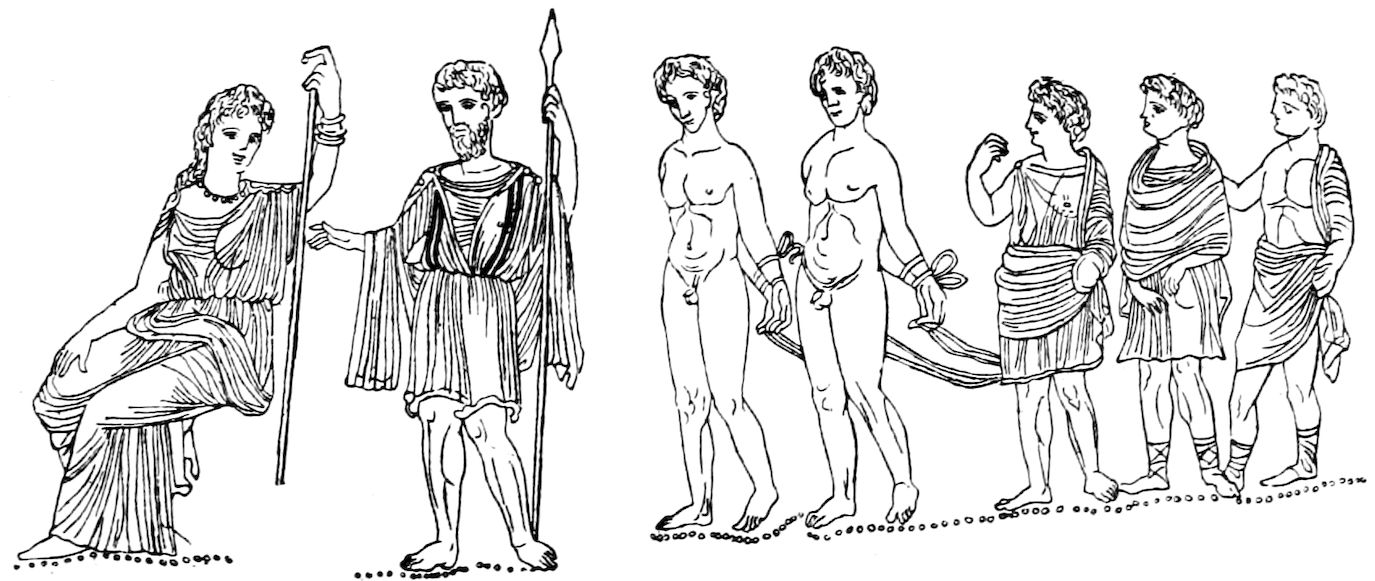
Fig. 17.
The arrest of Orestes and Pylades is given here, and more definitely their appearance before Iphigeneia. To be sure the manner is entirely different from that on other monuments. One expects Iphigeneia to be in or near the temple of Artemis and to be represented in a more concerned and active attitude; and furthermore, one looks for the altar (v. 72), and some indication of the 126fate which awaits the captives. All these features are wanting. That the artist endeavoured to represent the meeting of the priestess and the two Greeks can, however, admit of no doubt; that the necessary setting of the scene was omitted need be no more a matter of surprise to one than the helpless workmanship of the whole. The monument is valuable as being the only vase painting showing the first scene, which is never wanting on the sarcophagi[233]. This moment occurs likewise on certain other monuments[234]. The shepherd relates (vs. 260–339) how the discovery and capture were made; how they learned that one of the two was named Pylades; and further that the prisoners had been conducted first to the king, who after glancing at them (ἐσιδών) sent them to Artemis and her priestess. Iphigeneia says to the boukolos in v. 342, σὺ μὲν κόμιζε τοὺς ξένους μολών, and in v. 467, after her soliloquy and the song of the chorus, she appears again on the stage where she meets the captives. This is the moment, very largely modified, which the painting represents. Iphigeneia’s first words are—
μέθετε τῶν ξένων χέρας,
ὡς ὄντες ἱεροὶ μηκέτ’ ὦσι δέσμιοι.
At this the guards are commanded to enter the temple and make ready for the offering. Our picture follows in one respect the traditional manner of representing 127the scene. Orestes and Pylades are invariably nude, or so lightly clad with the chlamys that they are practically naked. There is the closest analogy between them as they appear here and as they occur on the sarcophagi.
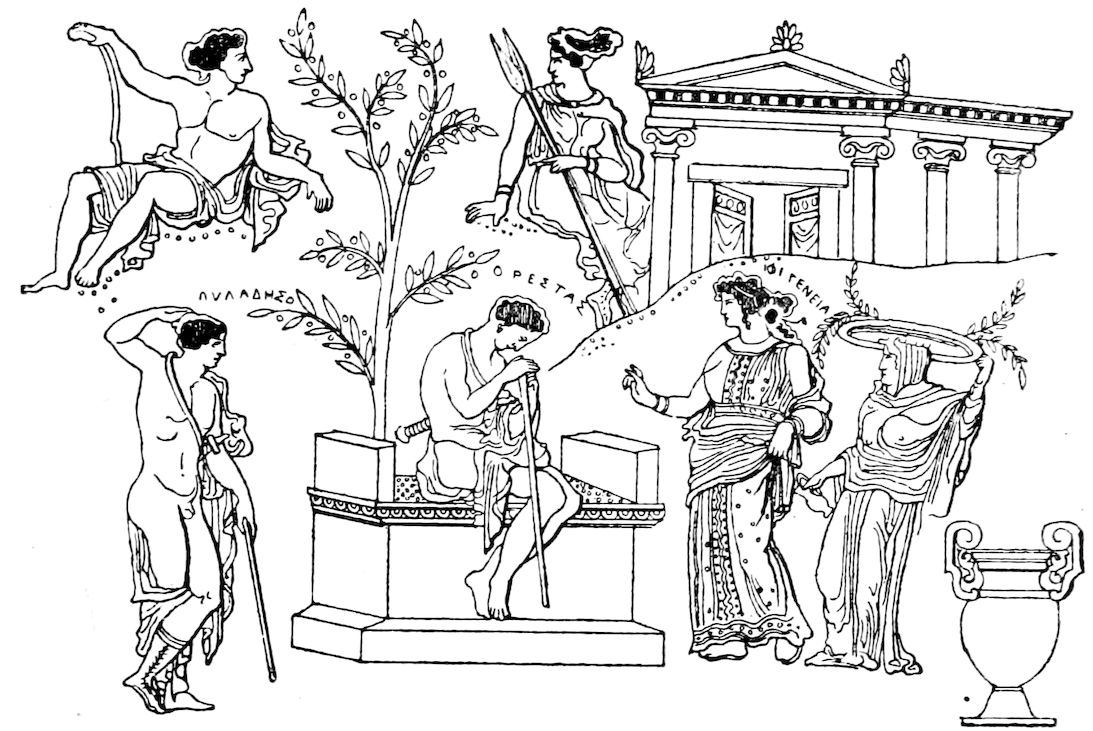
Fig. 18.
The second moment, as I have marked it out above, is also represented on one vase only[235]. In the centre Orestes, ΟΡΕΣΤΑΣ, sits to the right upon a large altar, chlamys about his hips, sword on his left side, hands supported upon his stick towards which his head is sunk. The whole attitude betokens sorrow. On the right 128is Iphigeneia wearing long, sleeved chiton, and mantle, necklace, and bracelets. In her left hand close by her side (incorrectly published as a knife) is the temple key which is emblematic of her office as κλῃδοῦχος[236]. Her right is extended towards Orestes, with whom she is speaking. She is accompanied by a temple servant who, entirely wrapped in chiton and mantle, carries in her right an oinochoë and upon her head a dish in which are articles for the sacrifice, including the branches for sprinkling. Behind Orestes is a laurel tree and on his right Pylades, ΠΥΛΑΔΗΣ, standing with one foot thrown over the other, his right hand placed sorrowfully to his head. The left rests upon his staff. On his left side is a sword. He is deeply concerned in the conversation. Above on the right behind a terrain is the temple of Artemis, Ionic order, and akroteria. Beside it on the left, Artemis, distinguished by her huntress-mantle, two spears, and hair-dress, sits with face to the left towards Apollo who is the remaining figure on the vase. He wears a garment around his waist, and rests his right upon a cane and turns his face towards Artemis.
The vase is especially interesting as being the only one on which any of the characters is accompanied by an inscription, and secondly, because Orestes sits here upon the altar. He cannot be thought of as a victim, and I do not believe he has fled to the altar for refuge, as has been suggested. That would comport but poorly with the spirit which he exhibits throughout the interview. Where does Orestes sit passively upon an altar at the attack of the Furies? He invariably has his 129sword drawn in a very emphatic manner, and while he crouches upon or clings to the altar he never gives any appearance of being an easy victim to his pursuers[237]. Just this point it is necessary to emphasize, for had the artist felt that the meaning of Orestes’ position indicated his pursuit either by seen or unseen Furies, he never would have committed the egregious error of placing him in a calm attitude quite unconscious that he has a sword ready at his side. Furthermore there is no trace in Euripides or the painting to allow us to assume that Orestes is again pursued at this point. He is not, therefore, in any sense a suppliant. The vase painter has simply allowed himself a great liberty in seating his figure where we should least expect to find him. An altar is not by any means a usual seat, and much less for the victim[238]. This same freedom in disposing of details led the decorator still further from the established usage, for neither of the captives should be allowed their swords. They are already ἱεροί (v. 469) and should be represented accordingly. In these particulars we must acknowledge that the painter idealized the scene (vs. 472 ff.).
If it were necessary to determine upon any one moment which the artist had in mind, one would discover a close parallel between vs. 625 ff. and the present scene. It has been agreed that Pylades shall be the messenger; Orestes is to die in his stead. The latter 130proceeds to ask who shall perform the sacrificial act, and whether a tomb shall receive him when all is over. To this Iphigeneia replies—
πῦρ ἱερὸν ἔνδον χάσμα τ’ εὐρωπὸν πέτρας.
and Orestes—
φεῦ·
πῶς ἄν μ’ ἀδελφῆς χεὶρ περιστείλειεν ἄν;
to which Iphigeneia remarks,
μάταιον εὐχήν, ὦ τάλας, ὅστις ποτ’ εἶ,
ηὔξω.
I can conceive of no more pitiable and hopeless condition than that of the unfortunate Orestes which the poet depicts. At this point his course seemed all in vain; Apollo’s promise appeared to be a farce, and Heaven and Earth seemed wrought into one violent confusion (cf. vs. 572 f. and 711). Perhaps it was at this juncture that he most impressed the painter, and we may see the wretched Orestes prostrate upon the altar in this moment of extreme despair.
Artemis and Apollo take no part in the action, but there is a greater fitness in their position as spectators than is often the case with the gods on the vases of Lower Italy. The former is a natural figure in her own precinct, by her own temple, while Apollo, as her brother, properly balances the scene. The latter, moreover, stands in so close a relation to Orestes’ trial and delivery that he is a most appropriate beholder of the progress of this his own enterprise (cf. v. 977).
Mention should be made here of the sarcophagi, on which essentially the same scene is found. The agreement 131with our vase is striking[239]. Orestes sits with his head wrapped in his mantle and drooping on his lap, while Pylades stands before him, always in the same attitude, one leg thrown over the other, one hand clutching his hair and the other resting on his stick. This is a striking coincidence, indeed, in these two classes of monuments, separated by at least four hundred years.
In the third step of the tragedy we are more fortunate and possess among vase paintings at least three that represent the transmission of the letter to Pylades, and the accompanying recognition between Orestes and his sister. It is not surprising that the supreme moment in the action should have attracted the artists, and that on the sarcophagi[240] also this unique point in Greek tragedy should have been represented[241].
132
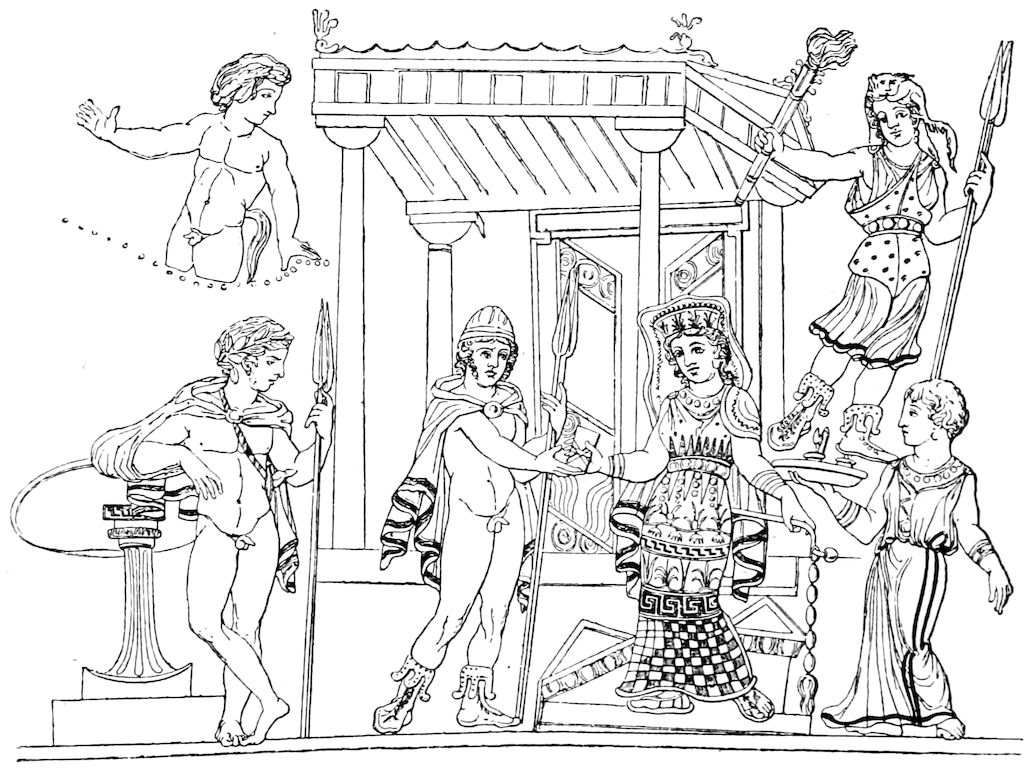
Fig. 19.
1. The best known of the vases is an amphora formerly in the possession of the Duke of Buckingham[242]. In front of the temple of Artemis, Doric order, stands Iphigeneia, en face, in richly embroidered chiton, and high head-dress from which falls a sort of veil reaching to the knees. She wears necklace, bracelets, earrings, and sandals; her costume bespeaks in every respect that of the theatre. She carries again the token of her office in the left, and hands the letter to Pylades with the right, who stands ready for the journey, wearing chlamys, pilos, boots, and carrying two spears. Further, on the left, leaning against the περιρῥαντήριον is Orestes, en face, but with laurel-wreathed head turned towards Pylades; his right leg is thrown over the left. He wears a chlamys, and carries two spears and a sword. Beside Iphigeneia is her servant, as in fig. 18, but with a simple girdled chiton, and in her right the dish with articles for the altar which is represented in poor perspective behind Iphigeneia. Above, on the right, before 133the temple doors, is Artemis in short, huntress-costume and high Thracian boots; two spears in her left, and a burning torch in her right. She wears the Thracian cap. On the left of the temple behind a terrain is a young satyr, no doubt thrown in to fill up the space.
2. The largest painting representing this scene is that on an amphora in St. Petersburg[243]. The centre of the picture is taken up by the temple, four Ionic columns. Inside on the right is the Artemis statue, costumed like Artemis in fig. 19; a burning torch in the right, around which is bound a sort of decoration. It is on a large pedestal, and has in the left a spear. On the left, about to leave the temple, is Iphigeneia with an elegant chiton, mantle, a diadem in hair, and the peculiar key in her left; beside her, and leaning against the wall, is a kylix with long handle. She makes a gesture towards Pylades with her right in which there is no letter. He stands on the left by the temple, leaning against his knotty stick; has petasos on the back of the neck, and wears high boots and an escaping chlamys. On the left, lower down, Orestes leans on the περιρῥαντήριον, as in fig. 19, but he is evidently more dejected here. The rest of the painting, which consists of five groups of two figures each, has so little to do with the central scene that we may omit any description of it. In the upper zone on the right are Hermes and Artemis, on the left Athena and Nike. Athena will observe the final part of the affair in which she was so deeply interested in Athens. The two groups, a female and an armed Thracian, represent the common ‘love-scenes’ on this class of vases. For the third group on the right, the artist preferred to draw a young deer instead of the female figure. Stephani[244] is correct in calling these ‘love-scenes,’ and so separating them permanently from any part in the action. Countless such groups are thrown upon vases of this style as meaningless, decorative figures. The parasol, wreaths, and vessels serve to enrich the setting and add charm to the coquetry.
134
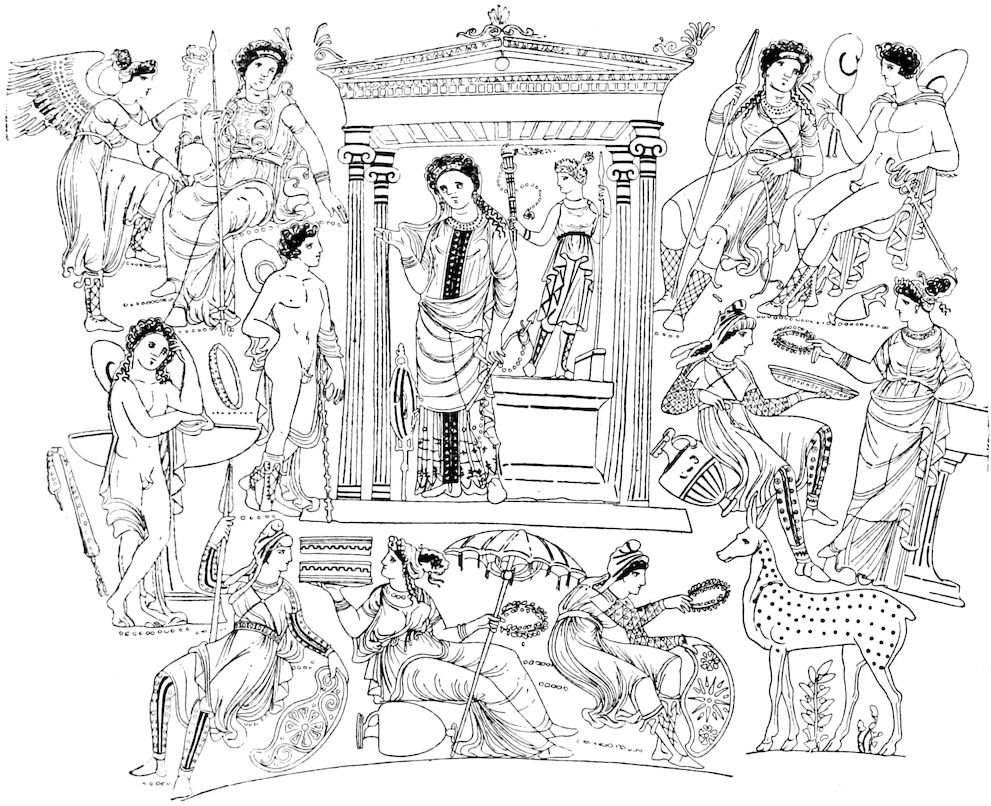
Fig. 20 (vid. p. 133 ff.).
135
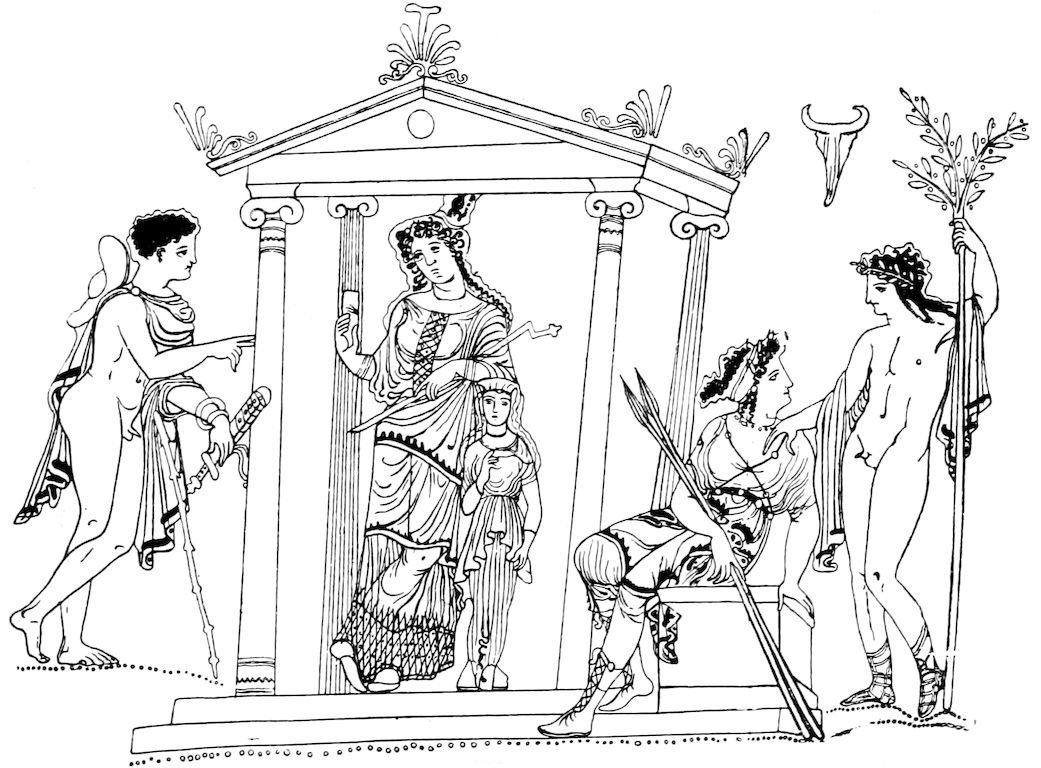
Fig. 21.
3. A vase, formerly in the possession of the art dealer Barone in Naples, shows an abridgement of the scene[245]. In an Ionic temple, four columns, and akroteria, Iphigeneia, en face, long chiton, mantle, hair done in a knot behind, leans with her left elbow upon the βρέτας. In 136her left is the temple attribute, and in the right the letter which she extends to Pylades, in chlamys and petasos. He leans against his stick, and has a sword in the left, while he points with the right towards the letter. On the right are Apollo and Artemis. The former, nude except for a mantle and high boots, grasps the laurel tree with his left, and rests his right upon Artemis’ shoulder, who sits to the left upon the altar and looks up to Apollo. She is dressed as usual with short chiton and high boots. She has two spears in the left.
In setting these three paintings over against each other and comparing the elements in them, the uniformity is very striking. Perhaps the details may be clearer if placed in a sort of scheme.
a. Elements common to all three vases.
1. Temple of Artemis. 2. Iphigeneia in elaborate dress, indicated as the κλῃδοῦχος. 3. A youth in travelling costume, with whom she is talking. 4. Artemis on the right of the temple.
b. Elements common to two of the three vases.
1. In figs. 19 and 20 a youth leans against the περιρῥαντήριον, resting on one leg over which the other is thrown. 2. In figs. 19 and 21 Iphigeneia hands the letter to the youth. 3. The Artemis ἄγαλμα is in the temple in figs. 20 and 21; so also is Iphigeneia.
We thus observe that the remarkable agreement, even in the details, shows that they must all be copies more or less exact of one and the same original. That Iphigeneia in fig. 20 does not hold the letter in her hand may be accredited to the carelessness of the artist who merely forgot to paint it. The same may be said 137with regard to the abridged form of the scene in fig. 21, where Orestes has been left out. The two central figures appeared to the artist to be the important part of the original, and accordingly he omitted all else.
Immediately following the scene represented in fig. 18, Iphigeneia entered the temple to get the letter—
ἀλλ’ εἶμι, δέλτον τ’ ἐκ θεᾶς ανακτόρων
οἴσω. v. 636 f.
and ordered the guards to watch the two without binding them. Thereafter ensues the touching scene between Orestes and Pylades (vs. 657–724). The priestess then reappears, and commanding the attendants to go inside, continues—
δέλτου μὲν αἵδε πολύθυροι διαπτυχαί,
ξένοι, πάρεισιν· ἃ δ’ ἐπὶ τοῖσδε βούλομαι,
ἀκούσατ’.
Orestes speaks first after these lines and asks her what she wishes. It shall be an oath for the safe delivery of the letter. At this he demands a counter-oath from her for the safe withdrawal of Pylades from the country. We may imagine that during the delivery of these verses, which were probably spoken while Iphigeneia was still in the temple doorway, Pylades had approached her to receive the letter, while Orestes stepped to one side as he appears in figs. 19 and 20. In vs. 769–787 the contents of the letter are related to ensure safe transfer of the message, even though the written words be lost in a shipwreck. This is the time represented on our vases. The hopelessness of Orestes requires, moreover, the earlier part of the scene, since from v. 772 he begins to be aroused and to prove his brotherhood to 138Iphigeneia. The αναγνώρισις is complete at the close of v. 826, and there follow the fourth and fifth stages which were noticed above[246]. Neither of these movements is, so far as I am aware, shown on any vase painting, although they are an important part of the reliefs on the Roman sarcophagi[247].
In conclusion, mention should be made of the wall paintings which represent the departure of the three with the statue to purify it in the sea. The first and most important of these is the fine casa del citarista painting[248]. Robert first correctly recognized the right meaning of this beautiful monument and based it upon the poet[249], thereby bringing it into harmony with the sarcophagi. That he was happily correct in reading the time in the painting after the recognition, contrary to Helbig’s interpretation[250], is nicely borne out by the painting recently discovered in the casa dei Vettii[251], which is another copy of the same original[252]. The 139variations are, however, enough to render any misunderstanding of it impossible. Here there is no temple, and Iphigeneia occupies the centre between Orestes and Pylades on the left, and Thoas on the right. She carries plainly the temple βρέτας on the left shoulder. Furthermore, the unconcerned attitude of the two prisoners in their tête-à-tête points clearly to the proper significance of the scene. Curiously enough Orestes appears to sit on the altar here as on the vase painting, fig. 18.
§ 8. Kyklops.
The satyr dance, the earliest form of the Greek drama and the simple beginning from which the immense superstructure of tragedy took its start, continued, in the satyr composition which followed the regular trilogy, to remind the public of the original plan and tendency of the performances in honour of Dionysos[253]. Till late in the fourth century B.C., at least, this echo of the original Dionysiac festival remained in vogue. The Kyklops of Euripides is the only example of this sort of composition which has reached us, and although the present work is concerned with tragedy and vase paintings I cannot refrain from including here a painting that is under the influence of this unique relic of Greek literature. The connexion between the satyr-play and tragedy is certainly intimate enough to warrant the introduction of the present chapter.
140Every one is acquainted with the story of Odysseus’ adventure with the Kyklops Polyphemos. Since the author of the Odyssey threw a charm around the story, this event in the wanderings of the hero has remained one of the most popular. In early Greek art there are numerous monuments based upon the myth. The black figured vases represent two critical moments. 1. The blinding of Polyphemos. 2. The escape of Odysseus and his companion from the cave. A long list of paintings tells this story over and over again, with little variation[254]. The artists evidently became tired of the monotony of the subject, for it is practically dead at the beginning of the fifth century. There was nothing new in the tale; it was distinctly epic, and for this very reason had its day and gave way to new motives in the dramatic literature. At the end of the century there was a revival of the myth. It gained a new lease of life through the Kyklops of Euripides, and once again all eyes were turned towards the old Homeric fiction. When the poet introduces Seilenos and his company of satyrs as slaves to Polyphemos, and turns the fortunes of Odysseus, on his arrival at the cave, by the intervention of this new element, the artist had certainly a new incentive. The rollicking, lusty antics of the tribe of satyrs had ever been the red figured vase painter’s delight, and when Euripides connected them with the adventures of Odysseus and the Kyklops the old story was ingrafted with a vigorous shoot[255]. Timanthes, whom we have 141already met[256], very likely owed it to Euripides that he associated Polyphemos with satyrs[257]. An interesting vase painting, which may be dated cir. 410 B.C., bears strong testimony to the influence of the Kyklops in Lower Italy[258].
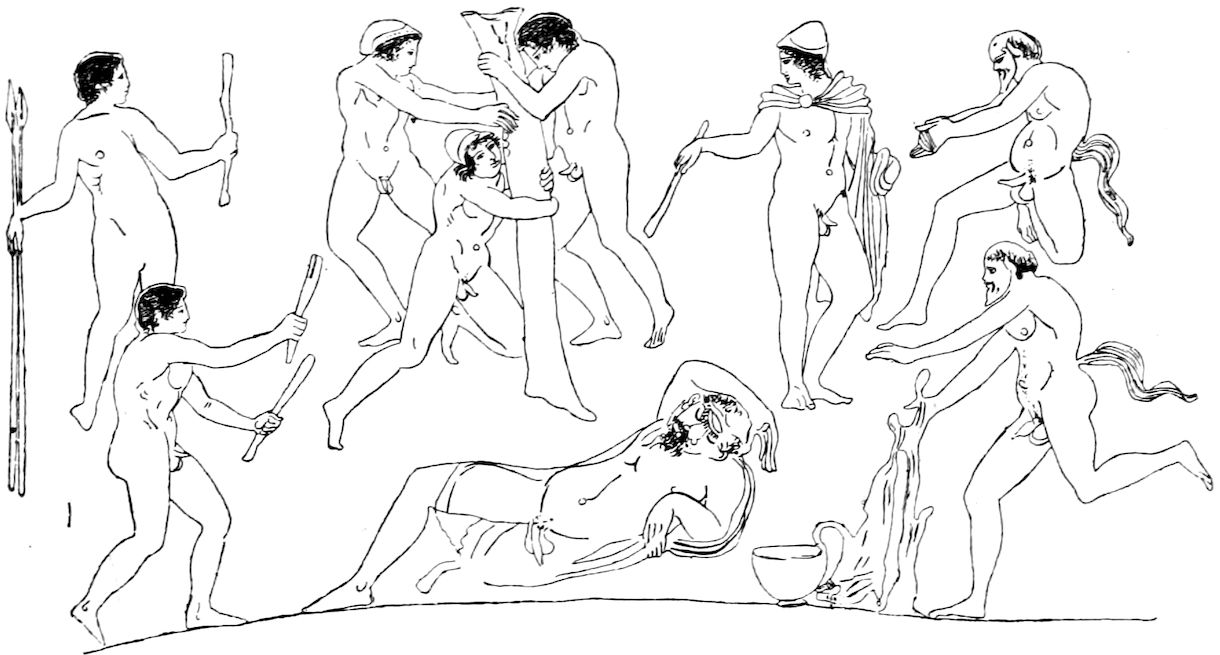
Fig. 22.
The picture appears in fig. 22. In the foreground Polyphemos lies stretched out in his drunken stupour[259]; beside him is a stump on which hangs an empty wineskin, and on the ground a bowl. In the centre three youths, the middle one wearing a pilos, are busy tugging at a log. Two others on the left bring fire-wood to 142kindle the large stick[260]; another youth, probably Odysseus, in pilos and chlamys, directs the work from the opposite side. Two bearded satyrs, with the usual horse-tails, caper around on the right[261].
The whole painting breathes with the spirit running through the Kyklops. The impression gained by reading the play is remarkably well supported by a study of the former. There is no detailed agreement between the two which strikes one, for the situations in Euripides are not closely followed. There is, however, the same stamp of originality and newness characterizing both. The painting is a revelation to one who has seen only the earlier Homeric monuments.
It may first be noticed that Polyphemos is represented outside of his cave, and that the attack upon his big eye is about to take place. This is quite opposed to Homer and Euripides, yet more than half the charm of the scene lies in the naïveté with which the artist disposes of the giant. A glance at the words of the poet will make this clearer. Odysseus and his chorus of satyrs have fixed upon the means for overcoming the Kyklops. They beg Odysseus for permission to take a hand in preparing the fatal pole;
δεῖ γοῦν· μέγας γὰρ δαλός, ὃν ξυλληπτέον. v. 472.
says the son of Laertes, but when he came to the point where he really needed their help they made every manner of excuse; some were suddenly seized with 143lameness; others had dust in their eyes. But he knew that it would turn out so, and he relies on his own companions,
... τοῖσι δ’ οἰκείοις φίλοις
χρῆσθαί μ’ ἀνάγκη. vs. 650 f.
This is well brought out, whether intentionally or not I do not say, for it is Greeks who are lifting the δαλός, and as for its size every one will agree that it is μέγας. The two satyrs, representing the chorus, dance around lustily the while, having smelt the contents of the wineskin (v. 153 f.). As soon as the plan has been decided upon, Polyphemos appears again, having already sated his appetite on two of the Greeks, and having had at least a taste of the wine. What could prepare one better for the appreciation of the figure on the vase than his own words?
παπαπαῖ, πλέως μὲν οἴνου,
γάνυμαι δὲ δαιτὸς ἥβῃ
σκάφος ὁλκὰς ὡς γεμισθεὶς
ποτὶ σέλμα γαστρὸς ἄκρας.
ὑπάγει μ’ ὁ χόρτος εὔφρων
ἐπὶ κῶμον ἦρος ὥραις,
ἐπὶ Κύκλωπας ἀδελφούς.
φέρε μοι, ξεῖνε, φέρ’ ἀσκὸν ἔνδος μοι. vs. 503 ff.
His proposal to go and share his good fortune with the brother Kyklopes does not meet the approval of Odysseus, who bids him keep his good things to himself and enjoy them. Seilenos goes even further and says—
κλίθητί νύν μοι πλεῦρα θεὶς ἐπὶ χθονός. v. 543.
144and Polyphemos takes up the suggestion at once, for we hear him ask
τί δῆτα τὸν κρατῆρ’ ὄπισθε μου τίθης; v. 545.
There can be little doubt that these verses particularly interested the artist. Well satisfied with the newly discovered drink, the Kyklops has dropped down upon his side as Seilenos recommended. The ἀσκός, which he ordered extra, hangs beside him and upon the ground is a bowl[262]. Both of these have evidently been drained. The inhuman monster sleeps on, quite in the manner of Euripides, in the presence of the active preparations for his own ruin.
§ 9. Medeia.
The heroine of this tragedy of Euripides is one of the most imposing and terrible figures that has come down to us from ancient Greek literature. It is not, however, the magician of strange power, who assisted Jason in winning the Golden Fleece and in performing his other Kolchian adventures, that overawes one; neither is it the sorceress who worked her wonders on Pelias, but rather the Medeia who avenged her slighted honour through the destruction of Jason’s newly won bride and his two sons; it is the Medeia at Corinth that we know best, the Medeia of Euripides. This chapter in the barbarian’s career assumed under his hand a prominence which far exceeded anything that had gone before. Euripides’ Medeia has remained ever since the Medeia of art and letters.
145In early Greek art Medeia is not a common figure, and when she does occur it is invariably as the sorceress[263]. In this rôle one meets her on both black and red figured vases[264], and on the famous relief in the Lateran[265]. After the beginning of the fourth century B.C. the Corinthian Medeia predominates. As such one finds her on vases from Lower Italy, Apulia and Campania especially, on Pompeian wall paintings[266], on terra cottas[267], gems[268], and the Roman sarcophagi[269].
146
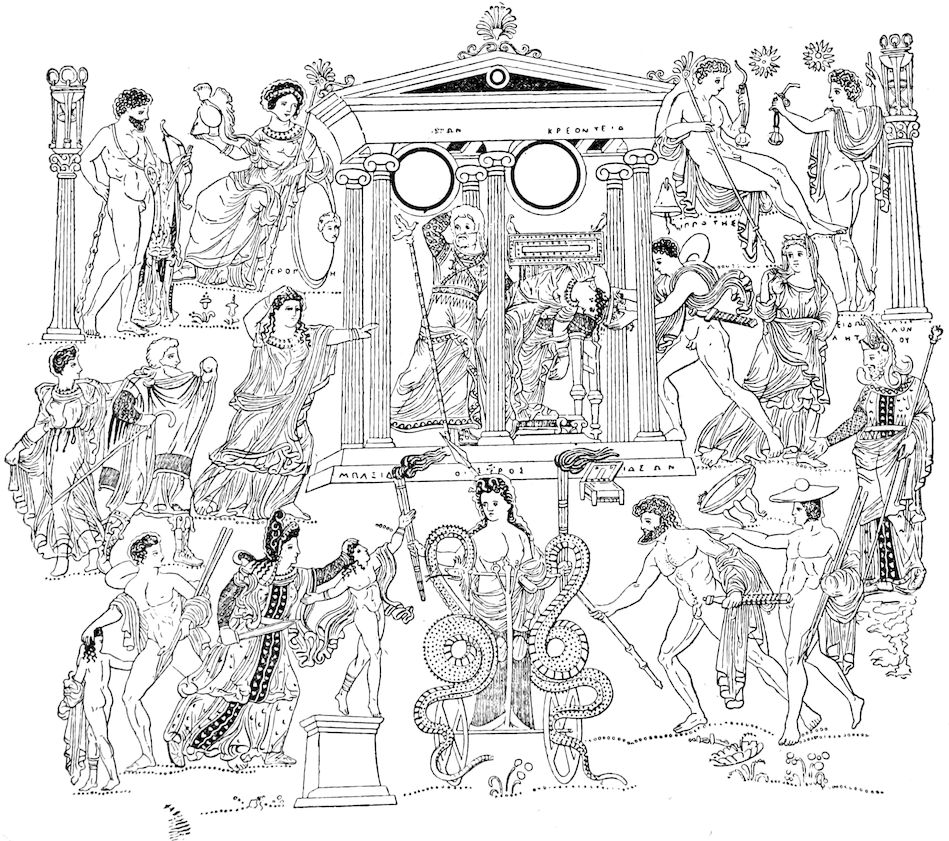
Fig. 23 (vid. p. 145 ff.)
147The most famous vase upon which we find Medeia is the great amphora in Munich[270], found in Canosa, the ancient Canusium, in Apulia, Oct. 16, 1813. The painting consists of three sections of figures parallel with the perimeter of the vase. The two upper ones are divided in the middle by a building with six Ionic columns. On the inside hang two round shields—a common decoration in this sort of picture. On the right, inside of the house, is a chair or θρόνος, over the arm-rest of which a richly dressed female figure has fallen; above on the frieze the inscription ΚΡΕΟΝΤΕΙΑ (sc. ΠΑΙΣ) shows the person to be Kreusa, or Glauke[271], the daughter of Kreon. Rushing rapidly towards her from the right is a youth in petasos and chlamys. He has already reached the upper step of the palace and is attempting to remove Kreusa’s head-dress. Incised in the vase is the name ΙΠΠΟΤΗΣ[272]. On the left an elderly male figure, bearded, wearing long, richly embroidered chiton, hurries to Kreusa. One hand is placed behind her as though to support the body; the other, from which the sceptre has just fallen, clutches his hair. He gazes to one side in a dazed sort of manner. On the frieze above is ΩΝ, evidently the last letters of ΚΡΕΩΝ[273]. To the left outside of the palace, and 148somewhat lower, an elderly woman in long chiton and mantle runs toward the scene of the tragedy, extending her left hand and holding her right to her head in the usual attitude of fright. She is designated by the inscription, incised, as ΜΕΡΟΠΗ[274]—most likely the wife of Kreon. Further on the left is a group of two, a pedagogue in the usual costume, and a female attendant. The former is hurrying towards the palace, while the latter attempts to divert him from his onward rush.
To the right from Hippotes is another female figure, en face, who appears to be leaving the palace. Her dress, especially the veil, and her bearing point her out as a nurse or servant of Kreusa. Just in front of the latter upon the ground is the open box in which the baneful presents were brought.
The lower section is divided into two parts by Medeia’s dragon-chariot, held in readiness by the charioteer with a burning torch in either hand. The upper part of the latter’s body is nude. There can be little doubt that the figure is female. The inscription ΟΙΣΤΡΟΣ shows it to be Οἴστρος, the personification of Medeia’s rage. On the left, Medeia, ΜΗΔΕΙΑ[275], with richly decorated oriental costume and Phrygian cap, advances to the right with drawn sword to kill one son 149whom she grasps by the hair with the left hand. It is not easy to say whether the boy has taken refuge on the altar, or whether his mother has lifted him upon it. More probably the latter is true. The lad is nude, with the exception of a garment over his left shoulder. He wears bracelets and on the left leg an anklet. Immediately behind Medeia a doryphoros, dressed as Hippotes, but with two spears instead of a sword, hurries to the left with the second boy, dressed as is the other. On the right of the chariot and hastening impetuously to rescue his son is Jason, ΙΑΣΩΝ. He is bearded and has a sword and long spear. His chlamys is thrown over his left arm. Beside him, but moving at slackened speed, another doryphoros extends the right hand towards the chariot as though to warn Jason of the futility of his intervention. Above this group on the right is a bearded male figure, pointing towards the events transpiring below. He wears a long royal dress and Phrygian cap, and carries a sceptre in his left. ΕΙΔΩΛΟΝ ΑΗΤΟΥ, incised, indicates him as the ghost of Aetes, Medeia’s father.
The upper section is bounded on either side by a Corinthian column surmounted by a tripod. Herakles, with club, bow and quiver, and lion’s skin, stands on the left facing Athene, who sits upon a terrain. She has her helmet in her right hand and leans against her shield. The spear is not wanting. On the right are two male figures, one sitting, the other standing. The oil-cruses and strigils, as well as the two stars and the pilos, near the one who sits, designate them as the Dioskouroi.
We turn now to a closer consideration of our vase to see if it is under the influence of Euripides. Starting with the scene which the vase painter has given us in 150Kreon’s palace, one cannot but be struck with the agreement between the picture and the scene described by the poet through the mouth of the messenger in the celebrated speech, vs. 1136–1230. This wonderful passage is the triumph of Euripidean rhetoric in the Medeia. The two boys, together with their father, had entered Kreusa’s apartment conveying the box with the rich vestment and golden crown, and she, who had refused to listen to words and be softened, was, woman-like, melted by these unexpected gifts. She accepts them, and father and sons retire. She then arrays herself before the mirror, admires her beauty, retreats across the room with proud, exulting step, all too captivated by her gracious figure, when the terrible moment comes—
χροιὰν γὰρ ἀλλάξασα λεχρία πάλιν
χωρεῖ τρέμουσα κῶλα καὶ μόλις φθάνει
θρόνοισιν ἐμπεσοῦσα μὴ χαμαὶ πεσεῖν. vs. 1168–1170.
There is a remarkable harmony between these words and the picture upon the vase, where Kreusa lies a helpless mass across the arms of the θρόνος. Her attitude suggests to one’s mind exactly the idea in θρόνοισιν ἐμπεσοῦσα μὴ χαμαὶ πεσεῖν. Rarely has a vase painter come nearer to illustration than here. It had, indeed, been far easier to paint Kreusa in her fallen position upon the floor, πίτνει δ’ ἐς οὖδας (v. 1195), where the chair and the form of the body would have presented no such difficulties in drawing as they do in the present position[276]. Why was this not done? Simply, as I am 151convinced, because the painter chose to present the most tragic moments, and shape them into the greatest possible dramatic effect. He seized the crisis in Kreusa’s dread struggle, when, doomed by the poison and flames, she dropped across the chair. Here, as in the scene below, the vase painter has given evidence of dramatic power of a high degree, and I venture to think that had he not been an artist he would have been a tragedian.