Chapter V · EURIPIDES AND VASE PAINTING (continued 2)
Reading edition
Kreon, who, of course, could not be represented as falling upon the body of Kreusa as he entered the room, ἄφνω προσελθὼν δῶμα προσπίτνει νεκρῷ (v. 1205), while she was still resting on the chair[277], is painted in the first moment of reaching the unfortunate one. He places his left hand under her body, and, overcome by the horror of the sight, lets fall his sceptre from his right hand as he gazes for a moment in transfixed agony from his daughter’s situation. The position of the arms is exactly that of the same figure on the sarcophagi reliefs[278], and no doubt would be traceable through the five intervening centuries if the monuments were at hand. Our vase would appear to represent here a tradition that was always closely followed in representing Kreon in an upright position.
152Merope, the mother, who is mentioned in Corinthian legends only as the wife of Sisyphos[279] and of Polybos[280], does not appear at all in Euripides. The painter’s principle was to name all the chief figures on the vase, and it is not necessary to point out here another source than the Medeia of Euripides. A name thus known as belonging to Corinthian royal families would be a natural invention for the wife of Kreon if there was no legend to provide further information about her. I hold this painting, however, as adequate evidence that there was a third Merope known in Corinth[281]. That the mother as well as the father should be represented here is further witness of the spirit which the poet breathed into his work. Medeia’s fixed determination to ruin all her enemies at one blow and to root out the whole royal house in a day (vs. 373 f.) is expressed in the extended scene here given, in a manner well calculated to inspire the beholder with much that lies between the lines in Euripides. There is absolutely no reason for claiming this scene as an extension of that given in the poet, and therefore based upon a post-Euripidean tragedy. One who denies the vase painter the right to introduce figures foreign to the poet fails utterly in comprehending the spirit of the fourth and third century vase painting. The artists followed the number of characters in the 153poetical version no more slavishly than they did the disposition and movement of the same. Starting with what the poet gave them and holding this in mind as a guide and inspiration in certain details, the painters proceeded to create, as independent artists, a similar scene, transfused, however, with their own alterations. It is to be expected that in the over-filled vase paintings of Apulia and Campania one will find figures that show a wide liberty on the part of the painters, and that illustrate well how much the severe methods of the Athenian vase painters had been altered in Magna Graecia.
Another instance of this same independence of the painter is seen in the introduction of Hippotes, to whom there is not the slightest reference in Euripides. In vs. 1168–1203, where Kreusa’s fate is described, no one is referred to as present except the female attendants, who were possessed with terror and lent no aid to their mistress. Kreon unexpectedly entered, ξυμφορᾶς ἀγνωσίᾳ, and soon succumbed, a victim together with his daughter. Why does Hippotes appear on the vase as the one who is trying to liberate Kreusa? With Vogel[282] again the answer liegt auf der Hand: weil Euripides nicht die Quelle der Darstellung ist. Because the painter enlarged the scene of the poet, and was more tragic and more dramatic than Euripides, a later or at least another version of the myth is claimed as his authority. This appears to me altogether improbable and unnecessary. It is improbable because, as we have abundant reason to believe, Euripides’ version of the myth was, both in Greek and Roman times, the most popular[283]. Other 154Medeias are mere names. Furthermore our vase cannot be dated later than the second half of the fourth century B.C., i. e. not much more than a century after the first appearance of the Medeia in 431 B.C. This is an important fact which seems to have been mostly overlooked. Euripides, it must be remembered, ruled the fourth century B.C. as the prophet of the time, and was hailed by the Greeks of the colonies and the motherland with universal admiration. It is safe to say that no Greek poet was more upon the lips of the people or more in their hearts. Tardy as was the recognition of his genius during his lifetime, the extent of his posthumous fame was unparalleled and his name rang through Alexandrian and Hellenistic times as that of one of the immortals. Are we to suppose then that a vase painter of Magna Graecia, who might have lived with those who had seen Euripides, was, in dealing with the Medeia myth, under the influence of some poet of a day? Was an artist who lived in this proximity to Euripides’ own time likely to follow the guidance of any other than the great master who created the Medeia character and started her down the centuries in that unexampled rage and fury? We dare, moreover, go further and claim with Robert that die Vasen stehen der Aufführungszeit der Medeia so nahe, dass sie den Werth directer Zeugnisse beanspruchen dürfen[284].
This explanation is unnecessary, for, as we have already pointed out, the vase painters gave less heed to the subject-matter and the details of the traditional types than to the general effect and dramatic arrangement. 155It was possible to double the dramatic effect here through the introduction of the bride’s brother, and the painter did not hesitate to place him on the vase, although the poet did not refer to him. The onward rush of this finely drawn figure, with his chlamys fluttering in the wind, has altogether a dramatic air and brings one to feel that the theatrical element, so much in the background in the fifth century B.C., had taken possession of the fourth century work[285]. It is surprising to find with what persistency certain scholars refuse such additions as incompatible with the dependence of the work on a given literary source. If the artist has done more than illustrate, all relationship between him and the poet is denied. But let us turn to a famous work where illustration pure and simple is meant, and we shall discover that if one follows even there this mode of criticism, the poet and the drawing which is meant to illustrate him will have to be divorced. I refer to Botticelli’s drawings for Dante’s Divina Commedia[286]. Each drawing is intended to bring out the events of the canto to which it is devoted, and so one expects only the incidents of one canto to appear in one drawing. The illustration for the Inferno, canto ii, represents Beatrice swinging upward in the air, to whom Virgil is pointing and calling Dante’s attention. This is all a pure invention of the artist as Beatrice is simply mentioned in the text, and not at all thought of as present or appearing to the two pilgrims. Had Botticelli then some other story in mind, and was there another 156version of Dante than that which we have? Certainly not. The artist, although in this place engaged as a mere illustrator, read his own notions into Dante and put them into his drawing. Again, even on the same plate, the entrance to the Inferno is shown with the words per me over the door. This scene belongs to canto iii, where in fact Botticelli again introduces it. If, therefore, the third canto and the drawing that belongs to it had never reached us but we did possess canto ii and its illustration, how would the critics who read the Greek vases as we have indicated, dispose of Botticelli and his faithfulness to Dante? They would all declare that the famous painter must have had another text which he followed. And so one may go on multiplying instances in this one work to show that an artist, even when he set out to follow the poet, was not able to do so[287].
There are also among the Pompeian wall paintings[288] some that are mere illustrations and are in the spirit of this sort of work, and yet they show various peculiar changes and additions contrary to the epigrams on which they are based. One is to remember therefore that in the vase paintings, where a more independent form of art is found than in illustrations, a liberty in adding or omitting figures, that may often disturb the form of the myth, is to be allowed. To select one 157example from many: Euphronios[289] on the Eurystheus kylix represents Sthenelos and his wife as present when Herakles brings the boar and is about to drop it into the cistern where Eurystheus has taken refuge. That the latter was king and had imposed the labours on Herakles, was proof enough that Sthenelos was already dead. How then did Euphronios dare to place him on the vase? Evidently because he took little heed of the exactitude for which modern scholars would call him and others of his trade to account.
The old nurse who observed the first signs of her mistress’ precarious condition—καὶ τις γεραιὰ προσπόλων ... ἀνωλόλυξε (vs. 1171–73)—or one of the numerous attendants present (v. 1176) may be recognized in the figure to the right from Hippotes. Perhaps this is more correctly the one who broke away to convey the sad news to Jason—ἑ δὲ πρὸς τὸν ἀρτίως πόσιν, | φράσουσα νύμφης συμφοράς (vs. 1178 f.). This person with the matronly air always occurs on the sarcophagi, but in the scene where the two boys are handing over the gifts to Kreusa[290].
The position of the pedagogue on the opposite side is not so incongruous as many have thought. There is really no reason for considering him a sort of connecting link between the middle and lower sections, as Robert has done[291]. Let us follow the pedagogue and the boys through the play. At vs. 46 f. of the prologue the nurse reports the latter as returning from their sport—ἐκ 158τρόχων πεπαυμένοι—and in vs. 89 ff. she orders them inside the palace,
ἴτ’, εὖ γὰρ ἔσται, δωμάτων ἔσω, τέκνα,
and commands the pedagogue to keep them at a safe distance from their mother,
σὺ δ’ ὡς μάλιστα τούσδ’ ἐρημώσας ἔχε,
καὶ μὴ πέλαζε μητρὶ δυσθυμουμένῃ.
At v. 105 the three disappear and nothing more is heard of them till Medeia, who is addressing Jason and the chorus, cries out in v. 894—
ὦ τέκνα, τέκνα, δεῦτε, λείπετε στέγας,
ἐξέλθετ’.
Hereupon the boys appear in the orchestra, unaccompanied by their pedagogue, and remain with Medeia and Jason till vs. 969 ff., where their mother hands them the gifts and bids them go, ὁς τάχιστα (v. 974), to Kreusa and place the same in her hands. They then depart with their father and deliver the presents in the manner afterwards described by the messenger (vs. 1136–1155), and in company with Jason leave Kreusa’s apartments. Just outside somewhere the pedagogue joins them and appears with the children in the orchestra to inform Medeia that her sons have been pardoned (vs. 1002 ff.). Immediately thereafter she orders the pedagogue to go inside,
... ἀλλὰ βαῖνε δωμάτων ἔσω
καὶ παισὶ πόρσυν’ οἶα χρὴ καθ’ ἡμέραν. vs. 1019 f.
As he re-enters the palace the terrible news reaches him, through, one of the female attendants, that Kreusa 159is possessed with some strange malady. It is at this juncture, dramatic in the extreme, that, as it seems to me, the vase painter thought of the pedagogue. The latter has forgotten Medeia’s command to arrange the boys’ program for the day and is determined to go to the apartments whence comes the great alarm. The attendant, however, endeavours to dissuade him, and the artist has even represented her in the attempt to deter the sturdy old pedagogue from carrying out his resolution. While all this is happening within the palace, Medeia gives expression to the great battle that is going on in her bosom. The speech is one of the finest in Euripides. Shall she now go ahead and kill her children, or is the courage lacking? She finally bids them enter the house χωρεῖτε, παῖδες, ἐς δόμους (vs. 1053 and 1076), and soon follows them. The death-cries of vs. 1271 ff. are heard not long afterwards. We have therefore no reason to infer from anything in Euripides that the pedagogue ever met the boys again. The fact that he is so often represented in the death-scene[292] is simply due to the fancy of the artists. It is natural to think of him in company with the boys. The vase painter has in the present instance shown us the whereabouts of the pedagogue when the poet had passed him by.
The lower section, which represents the events directly succeeding those in the one just considered, completes the dread vengeance work of Medeia. The artist had an opportunity here to follow largely his own notions in disposing of the details, for in the last moments when horror followed close upon horror, and the royal house of Corinth was shaking to its foundations, Euripides hurries us on with great rapidity and omits many of the 160particulars. Medeia moves with resistless fury through the last part of the bloody drama, till she at last disappears upon her chariot. What was the vase painter to do with all this? It is plain that he felt himself compelled to combine, for greater effect, different moments. Medeia enters the palace after the triumphant address in vs. 1236–1250, and a moment later the cries of the boys are heard within. Jason, aroused by the ruin wrought upon Kreusa, suddenly appears and asks where Medeia is, and remarks that he must save his sons from the fury of the populace (vs. 1293–1305). He at once learns the whole truth, and orders that the palace doors be thrown open that he may behold the scene of murder. Medeia appears then on her chariot, rolled out upon the ekkyklema. She stands thus during the final dialogue with Jason (vs. 1317–1404) till she disappears by the aid of the Flugmaschine[293].
From these elements the vase painter selected the murder scene, which, not being described by Euripides, could be represented in any manner that struck his fancy. He made this the centre about which all else was grouped; all eyes are turned upon Medeia and the altar. In this disposition of the matter other details had to be sacrificed. The chariot, which could not be wanting, had to have a charioteer, and as Medeia was 161not ready to mount it herself, the personification of the Medeia-spirit is the natural figure that the artist would select. Jason, again, to omit whom would have been unpardonable, had to be painted in the act of rescuing or attempting the rescue of his sons. So we see that the three moments discernible in the poet, (a) the murder, (b) Jason’s appearance to save the boys, (c) the chariot and the escape of Medeia, are all worked together by the artist into a strong complex. One feels no incongruity in the picture, and is forced to agree to a large amount of success that the artist has enjoyed here. Since the pedagogue appears in the scene above, the artist uses one of the ever convenient doryphoroi as a companion to the boys or rather as rescuer of one of them[294]. It is immaterial whether the painter intended to represent the one boy as actually out of danger or not. A great many useless words have been spent in trying to show that the vase painter has here followed a tradition referred to by Diodorus Siculus[295], who relates that one child escaped—πλὴν γὰρ ἑνὸς τοῦ διαφυγόντος τοὺς ἄλλους υἱοὺς ἀποσφάξαι. This is not only highly improbable[296], but, more than that, speaks for a superficial reading of Diodorus on the 162part of those who use this quotation. It appears that nothing more of the chapter had been read than it was necessary to quote. In the first place, what can τοὺς ἄλλους above refer to if not to more than one, and therefore to at least two? But where upon our vase or upon any other monument does Medeia appear with three children[297]? It would seem, therefore, that, because the vase painter drew the scene as he did, this very inapt quotation is brought out to bolster up an unnecessary theory.
Is it necessary to conclude with numerous scholars that Oistros upon the chariot represents one of Pollux’s ἔκσκευα πρόσωπα (iv. 141)? Does our painting necessarily go back to some tragedy in which the personification, Oistros, appears before the audience as Medeia’s charioteer? It has already been pointed out that the moment which the vase painter chose to represent never was visible in the theatre of Euripides. What happened before the palace doors were unbarred, in v. 1314, could be painted in a hundred different ways, and still be inspired by the poet from v. 1271 to v. 1316. It is true that Euripides does not mention Οἶστρος, much less as Medeia’s charioteer. What need had he to introduce any personification of her rage and fury to guide the chariot, when, at the first glimpse of it in v. 1317, Medeia manages it herself? Any one who thoroughly works himself into the situation that the painter has shown upon the vase cannot help seeing that Medeia’s double, her burning and infuriated barbarian wildness, the spirit 163shown in vs. 1236–1250, was a natural and easy subject for embodiment under the name Οἶστρος. This personification is not met with in Euripides, and has naturally caused much stumbling. It should, however, be compared with Λύσσα, with which it has much in common. Orestes says to Pylades, μὴ θεαί (i. e. the Furies) μ’ οἴστρω κατασχῶς’[298], and two verses further on, εὐλαβοῦ Λύσσης μετασχεῖν τῆς ἐμῆς. Thus the use of the οἶστρος caused Λύσσα. The step to the personification of a figure Oistros would easily follow from some such development as this, and I hold both words to cover the cause and effect in the case mentioned.
As Lyssa was a favourite figure with Euripides, we may examine still another place where the rôle that she plays is much the same as that which Oistros takes in the painting.
In Her. Fur. vs. 880 ff., the chorus describes Lyssa as travelling upon a chariot[299].
βέβακεν ἐν δίφροισιν ἁ πολύστονος,
ἅρμασι δ’ ἐνδίδωσι κέντρον ὡς ἐπὶ λώβᾳ
Νυκτὸς Γοργὼν ἑκατογκεφάλοις
164Here at least one has adequate evidence that the vase painter did not paint an unknown scene, even though he did prefer to call his figure Οἶστρος[302].
The shade of Aetes[303], a pure invention of the artist, has been held to refer to a post-Euripidean tragedy. One finds such pedantic ingenuity used in explaining this figure that the would-be-learnedness borders upon the ridiculous. It is affirmed, for example, that somewhere it must have been stated for the vase painter that Aetes had died since Medeia left him[304]. How far, pray, did vase painters concern themselves about such points of chronology or sequence of events? We have already pointed out in regard to these artists that 165they introduced and omitted characters just as they chose; and especially is this true in regard to such side-figures as Aetes is here. Then again, why is any literary source necessary to prove the old man’s death? It was but the natural course of events that the painter followed when he concluded that Aetes was among the shades. It is absurd to require some proof that the unlucky king had, within the long period of Medeia’s absence, passed into the world of spirits. It seems to me that there are two views that can adequately explain this addition to the picture, and with either one in mind the vase painter would have needed no post-Euripidean work or painting but simply the Medeia tragedy to inspire him.
Robert[305] pointed to vs. 31 ff. of the prologue as furnishing perhaps the suggestion for this figure, but that is but a small part of the whole suggestion, and it is well to follow this note which recurs in many places, and is, to my mind, a very important part of the Euripidean conception of Medeia. I give herewith the various places where this element may be discovered.
αὐτὴ πρὸς αὑτὴν πατέρ’ ἀποιμώζη φίλον
καὶ γαῖαν οἴκους θ’, οὒς προδοῦς’ ἀφίκετο. vs. 31 f.
ὤ πάτερ, ὤ πόλις, ὧν ἀπενάσθην
αἰσχρῶς τὸν ἐμὸν κτείνασα κάσιν. vs. 166 f.
αὐτὴ δὲ πατέρα καὶ δόμους προδοῦς’ ἐμούς. v. 483.
πότερα πρὸς πατρὸς δόμους,
οὓς σοὶ προδοῦσα καὶ πάτραν ἀφικόμην; vs. 502 f.
ἡμάρτανον τόθ’ ἡνίκ’ ἐξελίμπανον
δόμους πατρῴους. vs. 800 f.
166These repeated allusions to her father and her former home seem to me to express in a strong manner what the painter chose to develop into the ghost-figure. Aetes appears here to behold the retribution that is overtaking Jason; and his participation in the fearful tragedy emphasizes the secret power in Medeia, her sorcery, and her chariot. The artist read between the lines and discovered the spirit of the poet, and this he has successfully reproduced. A similar instance was noted in the liberty assumed by Botticelli in including Beatrice in the second plate to the Inferno[306].
In the second place the εἴδωλον emphasizes the barbaric element in the Medeia-Jason history, and impresses the beholder with the workings of barbarism versus Hellenism. This chord is, moreover, continuously struck by Euripides[307]. The poet endeavours from first to last to keep up the keenest distinction between Greece and Kolchis, between Jason’s family and that of Aetes.
There was, moreover, an opportunity, in introducing this oriental king, to add features strikingly characteristic of the Apulian vase paintings[308]. The elegance and display of costume peculiar to the Persian and Asia Minor kings were attractive for an artist, and the introduction of Aetes’ shade was a happy invention that went far towards making the deeper meaning of the poet plain.
The deities, who, as spectators, are an important part 167of the paintings on so many Lower Italy vases, are arranged in the upper section. They need not have any particular connexion with the incidents before them. The Olympian sympathy with earthly affairs was a favourite theme with the artists of the time, and a satisfactory number of participating divinities is usually added where important events occur. Herakles and Athena seem to be but indifferently interested in what is happening below them, although the former was intimately associated with the Argonautic expedition[309], and the latter was the promoter of the enterprise[310]. The Dioskouroi, who likewise took a large part in the adventures of the voyage, are fitly represented here[311]. They are, however, giving no heed to the tragedy. It is enough if the painter has recalled for us the famous voyage and shown us the prelude, as it were, to the drama played in the two lower sections. The panorama of Jason and Medeia’s life together passes before us in distinct scenes. By painting the participants in the expedition and also the shade of Aetes the artist has heightened the effect of the double tragedy which the poet made famous.
Such is the painting on this celebrated amphora, which I do not hesitate to call Euripidean.
Another monument which also shows Kreusa’s death is a vase from Pomarico, now in Naples[312].
168
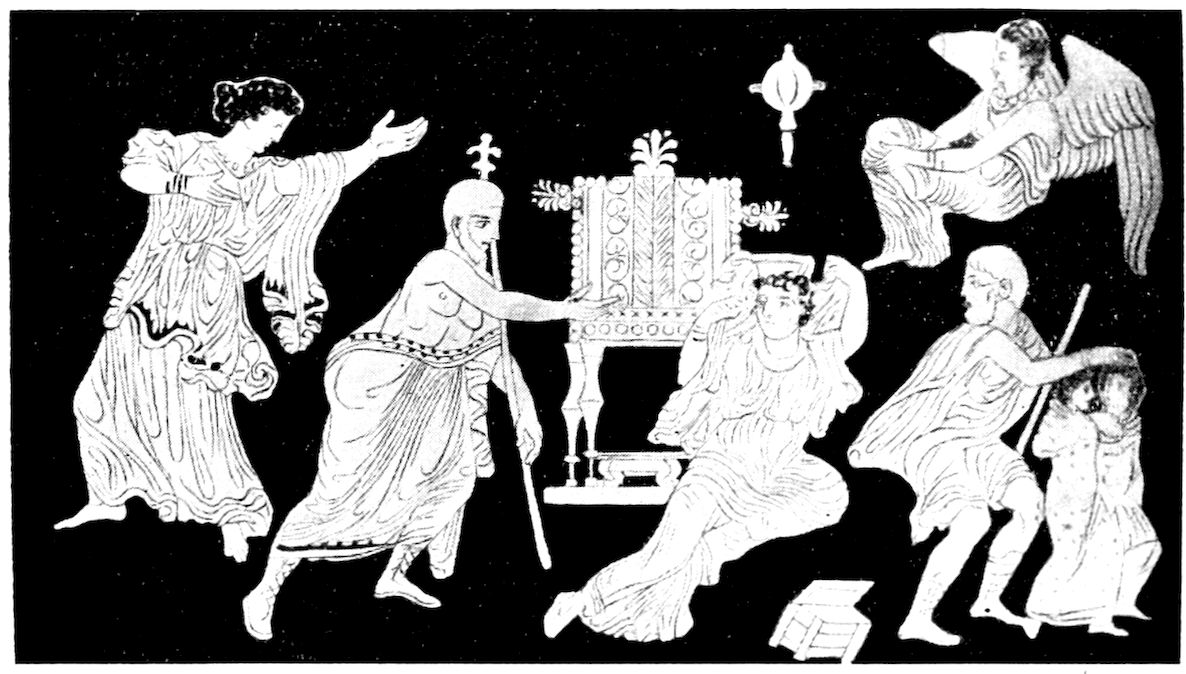
Fig. 24.
Kreusa has fallen from the θρόνος that occupies the middle of the scene, and in a half-sitting posture upon the floor endeavours to remove the head-dress. Before her is the open box in which the presents were brought. A mirror hangs on the wall. She is dressed in the Ionic chiton with mantle; has earrings and one bracelet. She stares at Kreon, who hurries toward her with outstretched right hand. He has the sceptre in the left hand, is bearded, bald, and wears a chiton which has slipped down to his waist. To the left a female figure rushes away en face, and, watching Kreusa, makes the gestures of one terror-stricken. She is dressed like the latter except the earrings and necklace. Jahn called her a companion of Kreusa, considering that if she were Merope of the Munich vase she would be approaching her daughter and not leaving her. I prefer to see in this figure one of the attendants who in vs. 1177 ff. spread the news. It is true that the appearance of the figure 169is that of a more important personage than a servant. The latter are not usually represented wearing jewellery and fine costumes, and yet the attendant on the Munich vase, who is endeavouring to divert the pedagogue, is quite as richly dressed. In the present instance, however, the drawing is very careless and the workmanship is of an inferior sort. I believe, therefore, that the artist either did not know the fitness of things, or else took no pains to indicate that this figure was a servant or attendant. When he had once drawn such a miserable king as Kreon is, hobbling along in a ridiculous manner, he might well have slipped into the other extreme of painting a nurse in a lady’s garb. The scene is based upon the messenger’s speech, vs. 1176 ff.
The pedagogue on the right, who is hurrying away the two boys wrapped in cloaks, is a reminiscence of vs. 1157 ff. where the father, Jason, goes away with them.
καὶ πρὶν ὲκ δόμων
μακρὰν ἀπεῖνει πατέρα καὶ παῖδας σέθεν.
The winged Fury sitting in the upper right-hand corner observing the scene might well be expected as a spectator. The suggestion for her may be found in
ἔξελ’ οἴκων φονίαν
τάλαινάν τ’ Ἐρινὺν ὑπ’ ἀλαστόρων. vs. 1259 f.
The murder of the boys inside of the palace is painted on a Nolan amphora in the Cabinet des Médailles in Paris[313]. Medeia in Greek dress and Phrygian cap has slain one boy, who lies over the altar, either extremity touching the floor. She stands, en face, with the other 170child grasped fast by the hair. This hand also holds the sword. In her left, stretched out behind the altar, is the sheath. The artist doubtless had in mind the words which the chorus heard in vs. 1271 ff.—
οἴμοι, τί δράσω; ποῖ φύγω μητρὸς χέρας;
οὐκ οἶδ’, ἀδελφὲ φίλτατ’· ὀλλύμεσθα γάρ.
In the upper right-hand corner the pedagogue appears, carrying an oil-cruse in his left hand. His right is raised to his head. A wreath and two fillets point to the sanctuary.
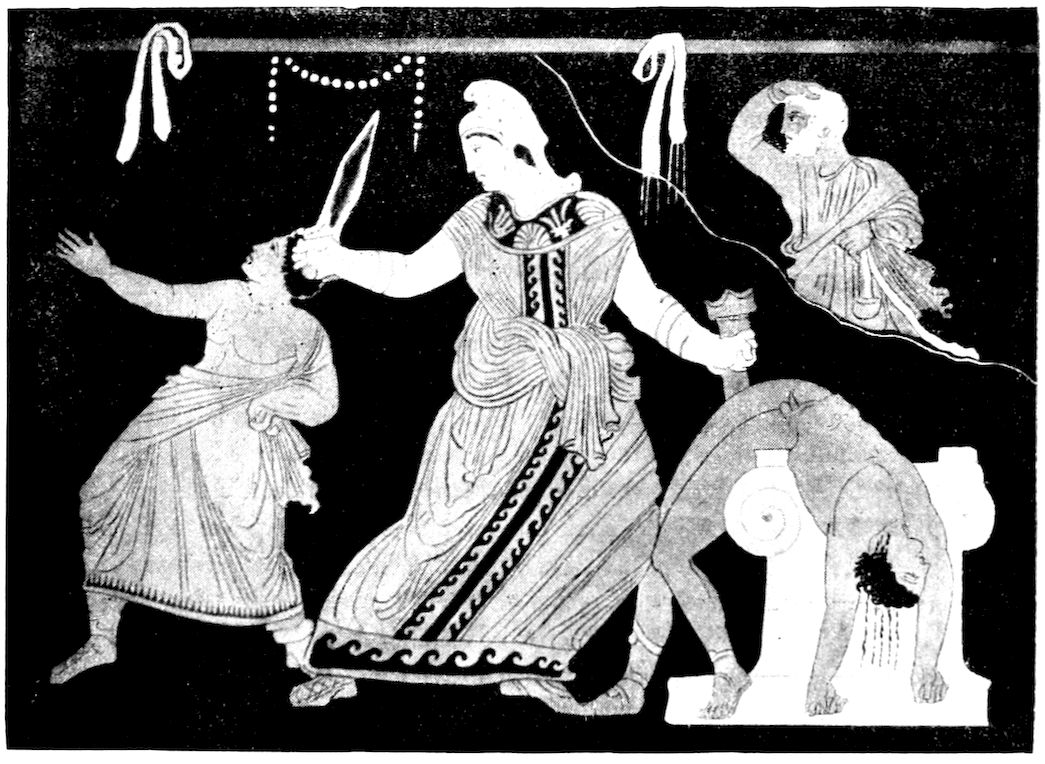
Fig. 25.
Another Canosa vase in Naples[314], although furnishing a free handling of Medeia’s escape, is still an important witness for the chariot and its actual appearance in the 171production of the tragedy. In this particular the painting is Euripidean.
Medeia in rapid flight upon her dragon-chariot holds the reins in her left hand and the corner of her mantle in the right. Her dress is the customary one for charioteers. On the ground by the wheels one boy lies dead; the other is said to be visible on the original, inside of the chariot as on the sarcophagi. The sword is also on the ground. She is pursued by three youths, one on horseback, Jason (?), and two on foot. They all carry spears, and each has a chlamys. The middle one also wears a pilos and has a shield. In front of the chariot is Lyssa (?) with a sword in the right hand, and staff or κέντρον (?) in the left. She has an Artemis costume with a mantle. Galloping ahead to lead the way is Selene, seated as usual on her horse.
The painting is poorly preserved, but the main part is sufficiently plain. The artist followed the traditional manner of Medeia’s flight.
§ 10. Phoinissai.
The Phoinissai in common with the Septem of Aischylos deals with the well-known story of the attack of Polyneikes and his supporters on Thebes. The events connected with this war can be traced all through Greek and Roman literature and art[315]. We have here to do with a relief cup, which illustrates Euripides’ version of the combat. It possesses, like the other ‘Megarian Bowls’ discussed in the present work, a value so unique for the study of our poet that it may stand beside any vase painting in assisting us in the study of the drama’s influence upon art.
172
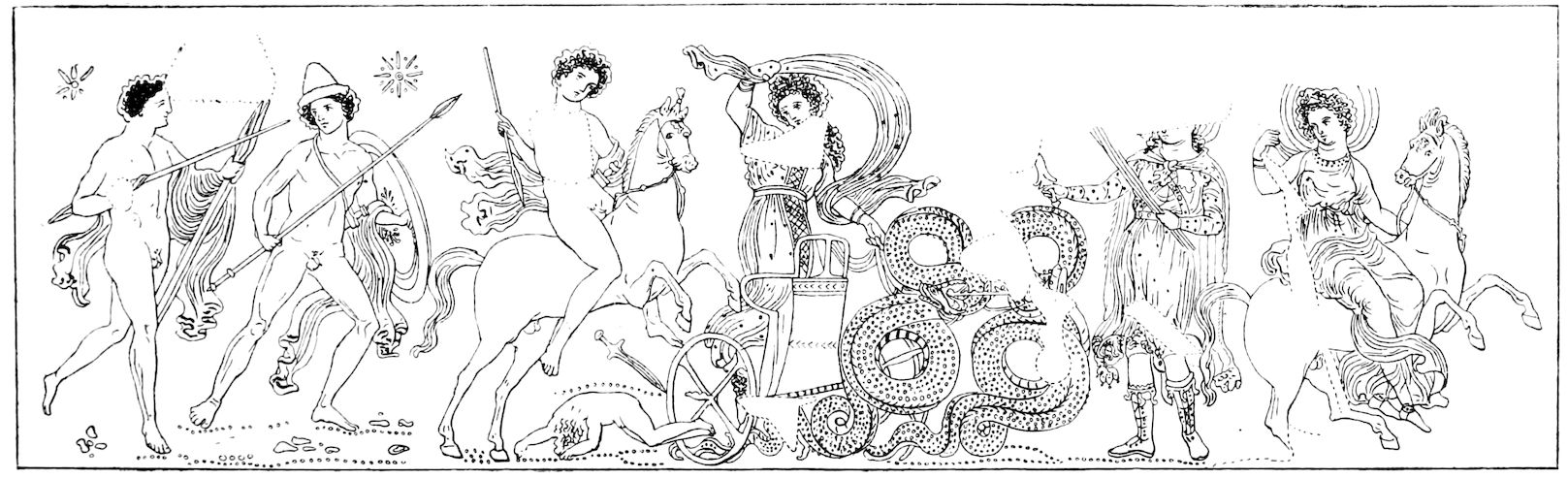
Fig. 26 (vid. p. 170 f.).
173The cup shown in fig. 27 is of red, unglazed ware, and is said to have been found in Thebes[316]. The following figures may be discerned. On the left Teiresias, ΤΕΙΡΕΣΙΑΣ, carrying a bough and led by his daughter Manto, ΜΑΝΤΩ, approaches Kreon, ΚΡΕΩΝ, who kneels before the aged seer. They are both bearded, and the latter wears a long chiton. Next follows Polyneikes, ΠΟΛΥΝΕΙΚΗΣ, and Eteokles, ΕΤΕΟΚΛΗΣ, in full armour, engaged in their fatal fight. Thebe, ΘΗΒΗ, holding in her hand a sceptre, sits upon a rock watching the sight. The messenger, ΑΓΓΕΛΟΣ, wearing a short chiton and chlamys, stands by Iokaste, ΙΟΚ ... ΣΤΗ, before the palace from which Antigone, ΑΝΤΙΓΟΝΗ, has come. The latter raises her hand in astonishment. The women both wear long chitons. Lastly, on the right, Antigone appears before Kreon, inscriptions in each case, in a supplicating attitude.
That Kreon might know definitely how matters were to terminate, he had sent for Teiresias. The latter makes his appearance in v. 834—
ἡγοῦ πάροιθε, θύγατερ, ὡς τυφλῷ ποδὶ
ὀφθαλμὸς εἶ σύ, ναυτίλοισιν ἄστρον ὤς·
174
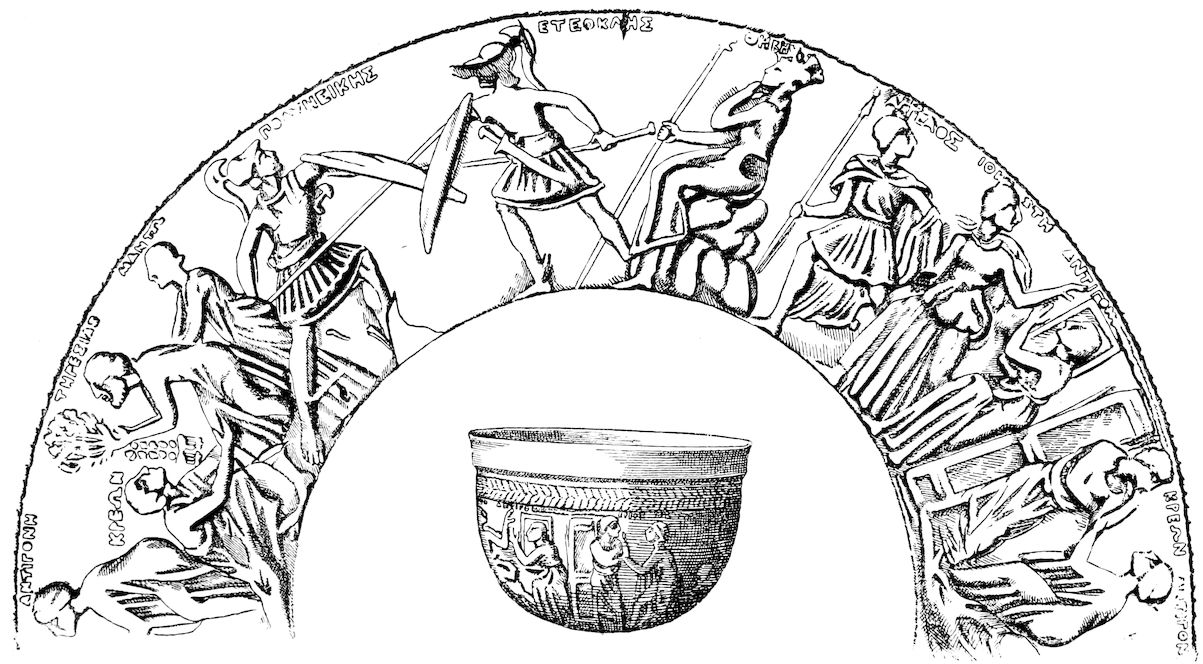
Fig. 27 (vid. p. 173 ff.).
175and so one sees him here before Kreon. His daughter has brought him as he wished, and now stands behind him, while the seer discloses the terrible misfortune which must visit Kreon before success can crown the Theban arms. The son Menoikeus, who is present in Euripides, has been left out of the group. The messenger soon appears and calls for Iokaste.
ἔξελθ’, ἄκουσον, Οἰδίπου κλεινὴ δάμαρ. v. 1070.
She does hear, and comes from the palace and learns everything about the attack thus far, and how the different heroes on each side were armed. To her special inquiry regarding her two sons the messenger replies in detail (vs. 1217 ff.).
ἤδη δ’ ἔκρυπτον σῶμα παγχάλκοις ὅπλοις
δισσοὶ γέροντος Οἰδίπου νεανίαι. vs. 1242 f.
στήτην δὲ λαμπρώ, χρῶμά τ’ οὐκ ἠλλαξάτην,
μαργῶντ’ ἐπ’ ἀλλήλοισιν ἱέναι δόρυ. vs. 1246 f.
But this is before the battle. They were waiting for the word from the priests who examined the entrails of the victims. The second messenger brings the account of the engagement proper, and this is what the artist seized upon[317].
ᾖξαν δρόμημα δεινὸν ἀλλήλοις ἔπι·
κάπροι δ’ ὅπως θήγοντες ἀγρίαν γένυν
ξυνῆψαν, ἀφρῷ διάβροχοι γενειάδας·
ᾖσσον δὲ λόγχαις· ἀλλ’ ὑφίζανον κύκλοις,
ὅπως σίδηρος ἐξολισθάνοι μάτην. vs. 1379 ff.
176This is the moment which the relief represents. Their spears have clashed, and each is still safe behind the good circumference of his shield.
Iokaste, much disturbed at the critical situation described by the messenger, determines to call Antigone and rush to the battle-field to reconcile the brothers,—
ὦ τέκνον, ἔξελθ’, Ἀντιγόνη, δόμων πάρος. v. 1264.
she cries, and Antigone at once appears and asks—
τίν’, ὦ τεκοῦσα μῆτερ, ἔκπληξιν νέαν
φίλοις ἀϋτεῖς τῶνδε δωμάτων πάρος; vs. 1270 f.
The situation is dramatically told on the vase. The palace doors are still open, and Antigone stands astonished before her mother.
No sooner has Kreon learned the result of the battle than he passes an edict banishing the blind Oedipus from the land. The faithful daughter comes to intercede for her father and the scene is described in vs. 1539–1682. The artist has seized upon this situation, but has omitted Oedipus. Antigone bows before the new king, who stands with his arms folded listening placidly to the supplications.
ἀτὰρ ς’ ἐρωτῶ τὸν νεωστὶ κοίρανον·
τί θεσμοποιεῖς ἐπὶ ταλαιπώρῳ νεκρῷ; vs. 1644 f.
This is the moment which the last group represents.
177The personification of Thebes occupying the central field and presiding, as it were, over the destinies of the capital, extends the setting of the poet and adds not a little to the interest of the picture.
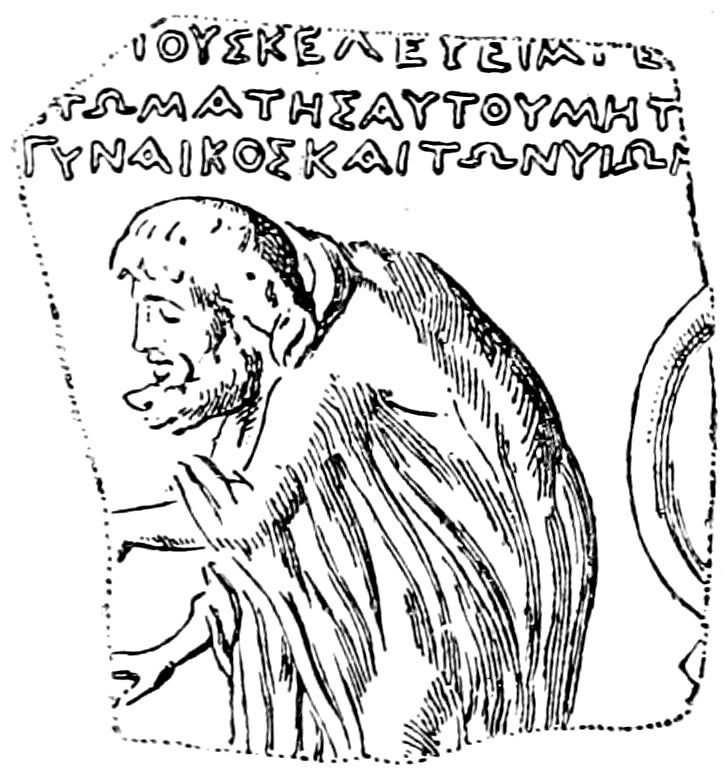
Fig. 28
There exists, remarkable enough, a small fragment of another cup, which must have been much like the one just discussed. It is shown in fig. 28, and joins on well to the last scene in fig. 27, filling out the gap made by the omission of Oedipus[318]. We see the stooping and aged figure of the former king, in long chiton, feeling his way along or being led by some one. The inscription renders everything plain. Οἰδίπ]ους κελεύει [ἄγειν πρὸς τὸ π]τῶμα τῆς αὑτοῦ μητρ[ός τε καὶ] γυναικὸς καὶ τῶν υίῶ[ν. The unfortunate Oedipus’ doom is sealed, and he enters with Antigone upon his permanent banishment, but he will be led to Iokaste that he may embrace her once more, even though she is now a corpse;
προσάγαγέ νύν με, μητρὸς ὡς ψαύσω σέθεν. v. 1693.
178At this moment the artist conceived his figure, and that one might not mistake its meaning he wrote above it who the person was and what the scene meant. Here, then, in this bit of potsherd, one can see and study the workings of that awful curse which blasted the house of Labdakos and sent the miserable Oedipus to wander ‘blind amidst the blaze of noon.’
§ 11. Supplementary.
There remains still a number of vase paintings that have been referred to certain of Euripides’ extant plays. It will be seen that I have not been able to convince myself of their Euripidean character, and have therefore not included them in the number of published paintings. The following list gives the most important vases of this class. No discussion accompanies them, as they seem to me to present difficulties that preclude their relation to extant tragedies.
Alkestis.
1. Etruscan amphora, no. 728 in the Cabinet des Médailles, Paris. Pub. as frontispiece to Dennis’ Cities and Cemeteries of Etruria, vol. ii. = Arch. Ztg. 1863, pl. 180. 3.
Andromache.
1. Amphora, Brit. Mus., cat. iii. E 155. Pub. Raoul-Rochette, Mon. inéd. pl. 40. 2; cf. Vogel, Scen. eur. Trag. p. 141 f., and Arch. Ztg. 1880, p. 189.
Elektra.
1. Slender Campanian amphora, Berlin. Pub. Arch. Anz. 1890, p. 90, no. 7; cf. loc. cit. The interpretation given explains the scene as representing Orestes slaying Aigisthos. This was done, however, not at a sanctuary or in the open, as here, but in the palace where Aigisthos, Orestes, and Pylades were engaged in the slaughtering of oxen. At v. 790 they had entered the palace.
179
Herakles Furens.
1. The Assteas vase in Madrid. Pub. Wiener Vorlegeblätter, ser. B, pl. 1 = Mon. d. Inst. viii. 10; cf. Hirzel, Annali d. Inst. 1864, p. 323 ff.: Körte, Ueber Personificationen psychologischer Affekte, p. 18 f., and Vogel, op. cit. p. 143.
Hippolytos.
1. Amphora. Attic fabric, cir. 420 B.C. Berlin, vid. Arch. Anz. 1890, p. 89.
2. Lekythos from Paestum, now in Naples, no. 2900. Pub. Reinach-Millingen, Peintures, 41 = Élite Céram. iv. 87.
Ion.
1. Nolan vase in Cassel. Pub. Arch. Ztg. 1852, pl. 37; cf. Furtwängler, Sammlung Sabouroff, Vasen, Einleitung, p. 14, note 12; Vogel, op. cit. p. 145.
2. Painting on a fourth cent. krater. Pub. Élite Céram. ii. 76 a; cf. Furtwängler, op. cit. p. 14.
3. An Oxybaphon in the Louvre. Pub. Élite Céram. ii. 88 a = Reinach-Millin. op. cit. i. 46 = Müller-Wieseler, Denkmäler d. a. Kunst. ii. 142; cf. Furtwängler, loc. cit.
Iphigeneia at Aulis.
1. Lucanian krater, Brit. Mus., cat. iv. F 159. Pub. Overbeck, Bildwerke, pl. 14. 9 = Wiener Vorlegeblätter, ser. 5, pl. 9. 3 = Inghirami, Vasi fitt. iii. pl. 251; cf. Vogel, op. cit. p. 116.
Euripides’ Lost Plays.
The following list includes most of the paintings referred to the lost tragedies. Where it has seemed to me doubtful about the Euripidean character of the scenes I have preferred to omit mention of them altogether.
Aiolos.
1. Canosa hydria in Bari. The shoulder decoration only is pub. Arch. Ztg. 1883, pl. 7. 1; cf. p. 51 ff. and Furtwängler, Masterpieces, p. 109. The latter thinks the painting is from the fifth cent. B.C. Vid. also Vogel, op. cit. p. 28 ff.
Alkmene.
1. Bell-shaped krater, signed by Python now in the Brit. Mus., cat. iv. F 149. Pub. J. H. S. 1890, pl. 6; cf. ibid. p. 225 ff.
1802. Amphora from Capua. Brit. Mus., cat. iv. F 193. Pub. Annali d. Inst. 1872, pl. A. Cf. ibid. p. 1 ff. On both paintings Alkmene sitting on an altar appeals to Zeus against Amphitryon. Cf. Vogel, op. cit. p. 34.
Andromeda.
1. Krater from Capua. Berlin, no. 3237. Cf. Arch. Anz. 1893, p. 91, f. no. 50. Pub. and discussed by Bethe, Jahrbuch, 1896, p. 292 ff. and pl. 2; cf. Bethe’s Prolegomena zur Geschichte des Theaters im Altertum, p. 320, 330, and p. 35 above.
2. Amphora from Canosa. Naples, no. 3225. Pub. Minervini, Memorie accademiche, pl. 1–3; cf. Vogel, p. 39.
3. Amphora in Naples, no. 708, Museo S. Angelo. Pub. Mon. d. Inst. ix. 38; cf. Annali d. Inst. 1872, p. 108 f., and Vogel, op. cit. p. 41.
4. Hydria from Anzi in the Basilicata. Brit. Mus., cat. iv. F 185; cf. Vogel, p. 42. C.
Antigone.
1. Ruvo amphora. Jatta coll. no. 423. Pub. Arch. Ztg. 1871, pl. 40. 2, and by Heydemann, Ueber eine nacheuripideische Tragödie, 1868, pl. 1, and Mon. d. Inst. x. 26, 27. Polychrome view of whole vase on pl. 26 = Rayet et Collignon, Histoire de la Céramique grecque, pl. 12, p. 300.
2. Apulian amphora. Berlin, no. 3240. Pub. Gerhard, Apulische Vasenbilder, xi = Arch. Ztg. 1871, pl. 40. 1. Cf. Heydemann, op. cit. and Klügmann, Annali d. Inst. 1876, p. 173 ff., and Vogel, op. cit. p. 50 ff.
3. Fragment of Apulian amphora in Carlsruhe; Winnefeld’s Beschreibung der Vasensammlung, p. 62 f. Pub. Arch. Ztg. 1884, pl. 19. b = Wiener Vorlegeblätter, ser. E. 6. 3. Cf. Winckler in Aus der Onomia, p. 149 ff.
Antiope.
1. Apulian krater found near Syracuse. Berlin, no. 3296. Pub. Arch. Ztg. 1878, pl. 7 and 8; cf. ibid. p. 42 ff, and Robert, Bild und Lied, p. 36; Vogel, p. 60 f.
Bellerophon.
1. Ruvo amphora. Pub. Mon. d. Inst. iv. 21 = Wiener Vorlegeblätter, ser. viii, pl. 8. 1. Cf. Annali d. Inst. 1845, p. 227.
Chrysippos.
1. Ruvo amphora. Naples, no. 1769. Pub. Overbeck, Bildwerke, 1. 2.
2. Apulian amphora. Berlin, no. 3239. Pub. Overbeck, op. cit. 1. 1.
1813. An abridgement of the foregoing. Pub. Wiener Vorlegeblätter, ser. 6, II. 2 = Roscher’s Lexikon, i. p. 903; cf. Vogel, op. cit. p. 137 f.
Hypsipyle.
1. Lasimos amphora in the Louvre. Pub. Reinach-Millin, Peintures, ii. 37 = Overbeck, op. cit. pl. 28. 1. Cf. Vogel, p. 98 f.
2. Ruvo amphora. Naples, no. 3255. Pub. Overbeck, Bildwerke, pl. 4. 3 = Baumeister, Denkmäler, i. p. 114; cf. Vogel, p. 99 f.
3. Ruvo amphora. St. Petersburg, no. 523. Pub. Overbeck, op. cit. pl. 4. 2; cf. Vogel, loc. cit.
Meleagros.
1. Apulian amphora. Naples, Mus. S. Angelo, no. 11, A. Pub. Arch. Ztg. 1867, pl. 220.
Stheneboia.
1. Krater in Naples, No. 1891. Pub. Annali d. Inst. 1874, pl. A.
2. Krater in St. Petersburg, no. 427. Pub. Inghirami, Vasi fitt. i. pl. 1–3; cf. Engelmann in Annali, 1874, p. 35 f., and Vogel, op. cit. p. 85 f.
Telephos.
1. Hydria in Naples. Heydemann, Raccolta Cumana, no. 141. Pub. Arch. Ztg. 1857, pl. 106.
2. Tischbein, Vases d’Hamilton, ii. 6; cf. Jahn, Telephos und Troilos, p. 44, and Vogel, op. cit. p. 89 ff.
182