Volume 8 — PAINTERS AND SCULPTORS (continued 4)
Reading edition
The world is seldom ready to receive any new thing. These drawings of Rossetti's were scarcely noticed even by those who are habitually on the watch for fresh developments in art. But when the painter next emerges into something like publicity we find him attended by a brilliant company of younger men, all more or less influenced by his teaching and attracted by his gifts. The Pre-Raphaelite Brotherhood had been a very ephemeral institution; in three years, or four at the most, it had ceased to exist; but its principles and the energy of its founder had left their mark on the whole world of art. In 1849 Rossetti had exhibited his picture, "The Girlhood of Mary Virgin," at the Portland Gallery, an exhibition in rivalry of the Royal Academy, which existed but a very short time. As far as I can discover, he did not exhibit again in London until 1856, when he and his friends opened a collection of their pictures at 4 Russell Place, Fitzroy Square. We would rather have seen that little gallery than see most of the show-exhibitions of Europe. In it the fine art of the Anglo-Saxon race was seen dawning again after its long and dark night. Rossetti himself was the principal exhibitor, but his two earliest colleagues, now famous painters, Mr. Millais and Mr. Holman Hunt, also contributed. And here were all the new talents whom Rossetti had attracted around him during the last seven years: Mr. Madox Brown, with his fine genius for history; Mr. J. D. Watson, with his strong mediæval affinities; Mr. Boyce, with his delicate portraiture of rustic scenes; Mr. Brett, the finest of our students of the sea; Mr. W. B. Scott himself; besides one or two others, Mr. Charles Collins, Mr. Campbell, Mr. Halliday, Mr. Martineau, whom death or adverse fortune removed before they had quite fulfilled their promise. Gabriel Rossetti contributed to this interesting and historic exhibition five or six of those marvellous drawings of which mention has just been made. "Dante's Dream," the famous vision of June 9, 1290, with its counterpart, "The Anniversary of the Dream," in 1291, were the most prominent of these. A "Mary Magdalene" was perhaps the most moving and exciting. This extremely original design showed the Magdalene pursued by her lovers, but turning away from them all to seek Jesus in the house of Simon the Pharisee. The architecture in this drawing was almost childish; the wall of Simon's house is not three inches thick, and there is not room for a grown-up person on the stairs that lead to it; but the tender imagination of the whole, the sweet persuasiveness of Christ, who looks out of a window, the passion of the awakened sinner, who tears the roses out of her hair, the curious novelty of treatment in the heads and draperies, all these combine to make it one of those works, the moral force and directness of which appeal to the heart at once. Perhaps the most brilliant piece of color at the Russell Place Gallery may have been Rossetti's "Blue Closet," a picture which either illustrated or, as I should rather suppose, suggested Mr. Morris's wonderful poem published two years later.
The same year that displayed him to the public already surrounded by a brilliant phalanx of painter-friends, discovered him also, to the judicious, as a centre of poetic light and heat. The circumstances connected with Rossetti's visit to Oxford a little earlier than this are too recent, are fresh in the memories of too many living persons of distinction, to be discussed with propriety by one who was not present. But certain facts are public, and may be mentioned. The Oxford Union still shows around the interior of its cupola strange, shadowy frescoes, melting into nothingness, which are the work of six men, of whom Rossetti was the leader. These youths had enjoyed no practical training in that particularly artificial branch of art, mural painting, and yet it seems strange that Rossetti himself, at least, should not have understood that a vehicle, such as yolk of egg mixed with vinegar, was absolutely necessary to tempera, or that it was proper, in fresco-painting, to prepare the walls, and paint in the fresh wet mortar. They used no vehicle, they fixed their colors in no coat of plaster, but they threw their ineffectual dry paint on the naked brick. The result has been that their interesting boyish efforts are now decayed beyond any chance of restoration. It is impossible, however, to ascend the gallery of the Oxford Union and examine the ghostly frescoes that are fading there, without great interest and even emotion. Of the young men who painted there under Gabriel Rossetti's eye, all have become greatly distinguished. Mr. Edward Burne-Jones, Mr. William Morris, and Mr. Spencer Stanhope were undergraduates at Oxford. Mr. Valentine Prinsep and Mr. Arthur Hughes, I believe, were Royal Academy students who were invited down by Rossetti. Their work was naïve and queer to the last degree. It is perhaps not fair to say which one of them found so much difficulty in painting the legs of his figures that he drew an impenetrable covert of sunflowers right across his picture, and only showed the faces of his heroes and heroines between the golden disks.
The Oxford and Cambridge Magazine, which also dates from the year 1856, is a still more notable expression of budding genius than the dome of the Oxford Union. It was edited by Mr. Godfrey Lushington, all its articles were anonymous, and it contrived to exist through twelve consecutive monthly numbers. A complete set is now rare, and the periodical itself is much less known than befits such a receptacle of pure literature. It contains three or four of Rossetti's finest poems; a great many of those extraordinary pieces, steeped in mediæval coloring, which Mr. William Morris was to collect in 1858 into his bewitching volume, called "The Defence of Guenevere;" several delightful prose stories of life in the Middle Ages, also by Mr. Morris, which, like certain prose romances by Mr. Burne-Jones, have never been publicly claimed or reprinted by their author; and not a little else that was as new as it was notable. A little later Mr. William Morris's first book was dedicated "To my Friend Dante Gabriel Rossetti, Painter," and in 1860 Mr. Swinburne followed with a like inscription of his first-fruits, his tragic drama of "The Queen-Mother." Thus in the course of a little more than ten years, Rossetti had become the centre and sun of a galaxy of talent in poetry and painting, more brilliant perhaps than any which has ever acknowledged the beneficent sway of any one Englishman of genius.
But all this while the world outside knew nothing of the matter. One by one the younger men stepped forward on the public stage and secured the plaudits of the discerning, and ascended the slow incline of general reputation. But Rossetti remained obstinately recluse, far preferring to be the priest and confessor of genius to acting himself a public part. To this determination several outward things engaged him still further. He married quite early in life; and his wife, who was herself an artist of rare, if somewhat wild and untrained talent, bore him a son who died at birth, and then shortly after died herself. During his brief married months Rossetti had collected the MSS. of his poems, and thought to publish them; but when he lost his wife, in a paroxysm of grief he placed the sheets of his poems in her coffin, and would hear no more a suggestion of publication. In 1861 he presented the world with a very learned and beautiful anthology of early Italian poetry, and proposed as early as that year to print his original poems. It was his scheme to name the little volume "Dante in Verona, and other Poems;" but it came to nothing. About 1867 the scheme of publication again took possession of him. I have been told that a sudden sentiment of middle age, the fact that he found himself in his fortieth year, led him to conquer his scruples, and finally arrange his pieces. But he was singularly fastidious; the arrangement would never please him; the cover must be cut in brass, the paper at the sides must bear a special design. These niceties were rarer twelve years ago than they are now, and the printers fatigued him with their persistent obstinacy. It was not till early in 1870 that the "Poems" in stately form first appeared, and were hailed with a shout of admiration which was practically universal.
It was about Christmas in that same year, 1870, that he who writes these lines was first presented to Gabriel Rossetti. The impression on my mental eye is as fresh as if it had been made yesterday, instead of twelve years ago. He was a man of average height, commonly loosely clad in black, so as to give one something of the notion of an abbé; the head very full, and domed like that of Shakespeare, as it was then usual to say—to my thinking more like that of Chaucer—in any case a head surcharged with imagination and power, strongly Italian in color and cast. The eyes were exceedingly deep set, in cavernous sockets; they were large, and black, and full of a restless brilliance, a piercing quality which consoled the shy novice by not being stationary. Lastly, a voice of bell-like tone and sonority, a voice capable of expressing without effort every shade of emotion from rage and terror to the most sublime tenderness. I have never heard a voice so fitted for poetical effect, so purely imaginative, and yet, in its absence of rhetoric, so clear and various, as that of Gabriel Rossetti. I retain one special memory of his reading in his own studio the unfinished MS. of "Rose Mary," in 1873, which surpassed in this direction any pleasure which it has been my lot to enjoy; and on various occasions I have listened to his reading of sonnets, his own and those of others, with a sense that his intonation revealed a beauty in the form of that species of verse which it had never been seen to possess before. I have already spoken of his wonderful courtliness to a new acquaintance, his bewitching air of sympathy; on a closer intimacy this stately manner would break up into wild fits of mirth, and any sketch of Rossetti would be incomplete that did not describe his loud and infectious laughter. He lived very much apart from the every-day life of mankind, not ostentatiously, but from a genuine lack of interest in passing events. An old friend tells me that during the French Revolution he burst into Rossetti's studio with the incredible news, "Louis-Philippe has landed in England!" "Has he?" said Rossetti, calmly. "What has he come for?" That certain political events, in which he saw a great symbolic significance, could move him deeply, is easily proved by such sonnets as the noble "On the Refusal of Aid between Nations," and "Czar Alexander II." But such glances out of window into the living street were rare, and formed no characteristic part of his scheme of life.
As a poet in these great years he possessed rare gifts of passionate utterance, and harmony of vision and expression. Mr. Swinburne has characterized these qualities in words which leave no later commentator the chance of distinguishing himself. But it would be totally unjust, even in so cursory and personal a sketch as this, to allow the impression to go undisputed that Rossetti preferred the external form to the inward substance of poetry. This charge was brought against him, as it has always been brought against earnest students of poetic art. I will rather quote a few words from a letter of Rossetti to me, written in 1873, when he was composing his own magnum opus of "Rose Mary." I have always felt them to be very salutary, none the less because it is obvious that the writer did not at all times contrive, or perhaps desire, to make them true in his own work:
"It seems to me that all poetry, to be really enduring, is bound to be as amusing (however trivial the word may sound) as any other class of literature; and I do not think that enough amusement to keep it alive can ever be got out of incidents not amounting to events, or out of travelling experiences of an ordinary kind however agreeably, observantly, or even thoughtfully treated. I would eschew in writing all themes that are not so trenchantly individualized as to leave no margin for discursiveness."
During the last eight years of his life, Rossetti's whole being was clouded by the terrible curse of an excitable temperament—sleeplessness. To overcome this enemy, which interfered with his powers of work and concentration of thought, he accepted the treacherous aid of the new drug, chloral, which was then vaunted as perfectly harmless in its effect upon the health. The doses of chloral became more and more necessary to him, and I am told that at last they became so frequent and excessive that no case has been recorded in the annals of medicine in which one patient has taken so much, or even half so much, chloral as Rossetti took. Under this unwholesome drug his constitution, originally a magnificent one, slipped unconsciously into decay, the more stealthily that the poison seemed to have no effect whatever on the powers of the victim's intellect. He painted until physical force failed him; he wrote brilliantly to the very last, and two sonnets dictated by him on his death-bed are described to me as being entirely worthy of his mature powers. There is something almost melancholy in such a proof of the superior vitality of the brain. If the mind had shared the weakness of the body, the insidious enemy might perhaps have been routed in time to secure the elastic rebound of both. But when the chloral was stoutly met at last, it was too late.
So at the age of fifty-four we have lost a man whom we should have retained, in the nature of things, for twenty years longer in the plentitude of his powers, but for a mistake in hygiene—a medical experiment. His work of inspiring the young, of projecting his fiery originality along the veins of others, was perhaps completed; it is doubtful whether this can ever be continued with advantage through more than two generations. The prophet is apt at last to become a tyrant, and from this ill apotheosis Rossetti was spared. But there was no reason why he should not, for at least a score of years, have produced noble pictures and have written gorgeous poems, emphasizing a personal success which he would have extended, though he hardly could have raised it. Yet he was always a melancholy man; of late years he had become almost a solitary man. Like Charles of Austria, he had disbanded his body-guard, and had retired to the cloister. Perhaps a longer life would not have brought much enjoyment with it. But these are idle speculations, and we have rather to call to our remembrance the fact that one of the brightest and most distinguished of our race, a man whose very existence was a protest against narrowness of aim and feebleness of purpose, one of the great torch-bearers in the procession of English art, has been called from us in the prime of life, before the full significance of his genius had been properly felt. He was the contemporary of some mighty names older than his, yet there scarcely was to be found among them all a spirit more thoroughly original; and surely, when the paltry conflicts of passing taste are laid to rest forever, it will be found that this man has written his signature indelibly on one of the principal pages of the register of our intellectual history.[Back to Contents]

GUSTAVE DORÉ[11] By Kenyon Cox (1832-1883)
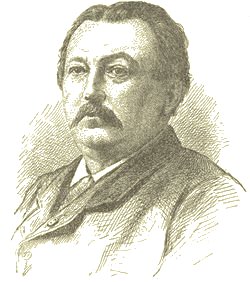
It is now eleven years since Gustave Doré died. He was an officer of the Legion of Honor, had attained considerable wealth, and was probably more widely known than any other artist of his day. His name was a household word in two continents. Yet he died a disappointed and embittered man, and is proclaimed by his friends as a neglected and misunderstood genius. He was known the world over as the most astonishingly prolific illustrator of books that has ever lived; he wished to be known in France as a great painter and a great sculptor, and because the artists and critics of France never seriously recognized his claims to this glory, he seems to have become a victim of the mania of persecution, and his naturally sunny nature was over-clouded with moroseness and suspicion. Hailed by some as the emulator and equal of the great names of the Italian Renaissance, and considered a great moral force—a "preacher painter"—by others he has been denounced as "designer in chief to the devil," and described as a man wallowing in all foulness and horror, a sort of demon of frightful power. Both these extreme judgments are English. The late Blanchard Jerrold, an intimate friend and collaborator of the artist, takes the first view. Mr. Ruskin and Mr. Hamerton have taken the second. Doré's own countrymen have never accepted either. Just where, between them, the truth lies, as we see it, we shall endeavor to show in this article.
The main facts of Doré's life may be dismissed very briefly. He was born with a caul on January 6, 1832, in the Rue Bleue at Strasbourg, near the Cathedral. About 1841 his father removed to Bourg, in the Department of Ain, where he was chief government engineer of the department. These two residences of the young artist are supposed to account for the mastery of Gothic architecture and of mountain scenery which his admirers find in his mature work. He showed very early in life a passion for drawing, and, as a small child, had always a pencil in his hand, which he begged to have "sharpened at both ends," that he might work longer without interruption. His father intended him for an engineer, but he was determined from the first to be an artist. He was of a gay and jovial disposition, given to pranks and practical jokes, and of an athletic temperament. Théophile Gautier afterward called him a "gamin de génie." In 1847, when he was fifteen years old, being in Paris with his parents, he called upon Phillippon, the publisher, and showed him some of his sketches. M. Phillippon looked at them, and sent a letter to Doré's parents, persuading them to allow the boy to remain in Paris, and promising them to begin using his work at once and to pay for it. Thus, without any study of art whatever, he began his career, and in a few years had produced a prodigious quantity of work, and was a celebrated man before he was twenty. No one knows how many drawings he made. He "lived like an Arab," worked early and late, and with astonishing rapidity made thousands of drawings for the comic papers, besides early beginning the publication of independent books. One estimate, which Mr. Jerrold thinks excessive, credits him with having published forty thousand drawings before he was forty! Mr. Jerrold himself reckons two hundred and sixty-six drawings done in one year. His "Labors of Hercules" was brought out in 1848, when he was sixteen, and before he was twenty-seven he had published his "Holy Russia," his "Wandering Jew," his illustrations to Balzac's "Contes Drôlatiques," to Rabelais, and many other authors. His best work was done at an age when most artists are painfully acquiring the rudiments of their art. We all know the books that followed.
Meanwhile he was determined to be known as a great painter, and, while flooding the market with his countless illustrations, was working at great canvases of Biblical subjects, which, though the French would not accept them, were hugely admired in the Doré Gallery of London. Later he tried sculpture also, and his last work was a monument to Alexandre Dumas, which he made at his own expense, and presented to the city of Paris. He died in the beginning of the year 1883, worn out with excessive production—a great name, but an unsatisfied man.
Mr. Jerrold has divided his book into two parts, dealing first with Doré the illustrator, and then with Doré the painter and sculptor. It is an eminently natural arrangement, and, in our effort to arrive at Doré's true position in art, we cannot do better than to follow it.
Doré's earliest work was frankly that of a caricaturist. He had a quick eye, no training, and a certain extravagant imagination, and caricature was his inevitable field. He was, however, as Mr. Jerrold himself remarks, "a caricaturist who seldom raises a laugh." Not hearty fun, still less delicate humor, was his. In the higher qualities of caricature his contemporaries, Daumier and Gavarni, were vastly his superiors. An exuberance of grotesque fancy and a recklessness of exaggeration were his dominant notes. His earlier work, up to and including the Rabelais, is not really funny—to many minds it is even painful—but it is unmistakably caricature of a dashing, savage sort. To our mind it remains his best work, and that by which he is most likely to live. At least it is the work that formed him and fixed his characteristics, and an understanding of it is essential to any judgment of him. The qualities and the defects of his later work—that which is most praised and most blamed in his production—are inherent in the work of this period, and are best explained by a reference to the latter.
Take, for instance, what has been denounced as his love of horrors and of foulness, his delight in blood and massacre. He is scored for this as if he were one of that modern French school, beginning, perhaps, with Regnault, who have revelled in the realistic presentation of executions and battles, and have sought to effect by sheer sensationalism what they could not by gentler means. It is surprising that his critics have not seen that Doré's battles are always, even to the end, the battles of a caricaturist. His decapitated trunks, cloven heads, smoking hearts, arms still fighting though severed from their bodies, are simply a debauch of grim humor. There is never the slightest attempt to realize carnage—only to convey, by the caricaturist's exaggeration, an idea of colossally impossible bloodthirstiness. One may not enjoy this kind of fun, but to take it seriously, as the emanation of a gloomy and diabolic genius, is absurd.
The same test is equally destructive of much of the praise Doré has received. He is constantly spoken of, even by severe critics of his painting, as a great illustrator who identified himself with the minds of one great writer after another. But Doré identified himself with no one; he was always Doré. Even in these early drawings he cannot keep to the spirit of the text, though the subjects suited him much better than many he tried later. There is a great deal of broad gayety and "Gallic wit" in the "Contes Drôlatiques," but it was not broad enough for Doré, and he has converted its most human characters into impossible grotesques.
Another thing for which Doré is praised is his wonderful memory. Mr. Jerrold repeats more than once Doré's phrase, "I have lots of collodion in my head," and recounts how he could scarcely be induced to make sketches from nature, but relied upon his memory. He also speaks of Doré's system of dividing and subdividing a subject, and noting the details in their places, so that he could reproduce the whole afterward. This question of work from memory is one of the most vital for an understanding of Doré, and one of general interest in all matters of art, and is worth attention. Of course, a man who made hundreds of drawings every year could not work much from nature, and came to rely upon his memory. But what is the nature of artistic memory, and how does it perform its task? We think the truth is, that the artist who habitually works from memory, fills in his details, not from memory of the object, but from memory of the way he has formerly drawn similar objects. He reverts to a series of formulæ that he has gradually accumulated. This man must have a cloak. This is the way a cloak is done. A hand? Nothing can be easier; the hand formula is ready. The stock in trade of the professional illustrator and caricaturist is made up of a thousand such formulæ—methods of expression that convey the idea readily enough to the spectator, but have little relation to fact. So it is that Doré never learned, in the true sense, to draw. He had made for himself a sort of artistic shorthand, which enabled him to convey his superabundant ideas quickly and certainly to his public, but his drawing is what is called mannered in the extreme. It is not representation of nature at all, but pure formula and chic. He is said to be a master of drapery, but he never drew a single fold correctly. He is said to show great knowledge of Gothic architecture, but he never drew well a single column or finial. In his later years he studied anatomy with great perseverance, and advocated the necessity of dissection, saying, "Il faut fourrer la main dedans" (You must stick your hand in it); but the manner was formed, and he never drew a leg with a bone in it.
With this equipment he illustrated Don Quixote, Dante, the Bible. Is it strange that he shows no sympathy with the grand simplicity of Dante, or the subtle humor of Cervantes, and that we can only be thankful that he never completed his projected illustrations to Shakespeare? Doré, the illustrator, was fecund beyond precedent, possessed a certain strange drollery, had a wonderful flow of ideas, but was superficial, theatrical, and mannered, and as far from expressing real horror as from expressing real fun. What shall we say of Doré the painter and sculptor?
Mr. Jerrold reports a discussion between Doré and Théophile Gautier, in which the roles of artist and man of letters are strangely reversed. "Gautier and Doré," he says, "disagreed fundamentally on the aims and methods of art. Gautier loved correctness, perfect form—the technique, in short, of art; whereas Doré contended that art which said nothing, which conveyed no idea, albeit perfect in form and color, missed the highest quality and raison d'être of art." What is plain from this is, that Gautier was an artist and cared first of all for art, while Doré was never an artist, properly speaking, at all, and never understood the artist's passion for perfection. To Doré, what was necessary was to express himself anyhow—who cared if the style was defective, the drawing bad, the color crude? The idea was the thing. His admirers can defend him only on this ground, and they adopt of necessity the Philistine point of view. The artists of Doré's time and country were very clear in their opinion. "The painters," says Mr. Jerrold, "said he could not paint."
The sculptors admitted that he had ideas in his groups, but he was not sculpturesque. His friends protest against this judgment, and attribute it, ad nauseam, to "malevolence" and "envy." What if his technique was less brilliant than that of Hals, they say; what if his shadows are less transparent than those of Rembrandt (and they will make no meaner comparison)? He is "teeming with noble thoughts," and these will put his work "on a level with the masterpieces of the Italian masters of the sixteenth century." It is the conception, the creation—not the perfect painting of legs and arms and heads, the harmonious grouping, the happy and delicate combination of color—by which the observer is held spell bound. All these qualities, which his admirers grudgingly admit that Doré had not, are classed as "mere dexterity," and are not considered worth a second thought.
This is the true literary gospel of art, but it is one that no artist, and no critic who has any true feeling of art, has ever accepted or will ever accept. Thoughts, ideas, conceptions, may enhance the value of a work of art, provided it is first of all a piece of beautiful art in itself, but they have never preserved, and never will preserve from oblivion bad painting or bad sculpture. The style is the artist, if not the man; and of the two, beautiful painting with no idea at all (granting, for the sake of argument, that it exists), will ever be infinitely more valuable to the world than the lame expression of the noblest thoughts. What may be the real value of Doré's thoughts is therefore a question with which we have no concern. As painter and sculptor, his lack of education and his great technical imperfections—his bad drawing, false light and shade, and crude color—relegate him forever to a rank far below mediocrity. Such reputation as he has is the result of the admiration of those altogether ignorant of art, but possessed of enough literary ability to trumpet abroad their praises of "great conceptions," and will as surely fade away to nothing as the reputation of such simple painters as Van Der Meer or Chardin will continue to grow, while painting as an art is loved and understood.[Back to Contents]