Volume 8 — COMPOSERS (continued 2)
Reading edition
Czerny at once took to Liszt, but refused to take anything for his instruction. Salieri was also fascinated, and instructed him in harmony; and fortunate it was that Liszt began his course under two strict mentors. He soon began to resent Czerny's method—thought he knew better and needed not those dry studies of Clementi and that irksome fingering by rule—he could finger anything in a half-a-dozen different ways. There was a moment when it seemed that master and pupil would have to part, but timely concessions to genius paved the way to dutiful submission, and years afterward the great master dedicated to the rigid disciplinarian of his boyhood his "Vingt-quatre Grandes Études" in affectionate remembrance.
Such a light as Liszt's could not be long hid; all Vienna, in 1822, was talking of the wonderful boy. "Est deus in nobis," wrote the papers, profanely. The "little Hercules," the "young giant," the boy "virtuoso from the clouds," were among the epithets coined to celebrate his marvellous renderings of Hummel's "Concerto in A," and a free "Fantasia" of his own. The Vienna Concert Hall was crowded to hear him, and the other illustrious artists—then, as indeed they have been ever since forced to do wherever Liszt appeared—effaced themselves with as good a grace as they could.
It is a remarkable tribute to the generous nature as well as to the consummate ability of Liszt, that, while opposing partisans have fought bitterly over him—Thalbergites, Herzites, Mendelssohnites versus Lisztites—yet few of the great artists who have, one after another, had to yield to him in popularity have denied to him their admiration, while most of them have given him their friendship.
Liszt early wooed, and early won Vienna. He spoke ever of his dear Viennese, and their resounding city. A concert tour on his way to Paris brought him before the critical public of Stuttgart and Munich. Hummel, an old man, and Moscheles, then in his prime, heard him and declared that his playing was equal to theirs. But Liszt was bent upon completing his studies in the celebrated school of the French capital, and at the feet of the old musical dictator, Cherubini. The Erards, who were destined to owe so much to Liszt, and to whom Liszt throughout his career owed so much, at once provided him with a magnificent piano; but Cherubini put in force a certain by-law of the Conservatoire excluding foreigners, and excluded Franz Liszt.
This was a bitter pill to the eager student. He hardly knew how little he required such patronage. In a very short time "le petit Liszt" was the great Paris sensation. The old noblesse tried to spoil him with flattery, the Duchesse de Berri drugged him with bonbons, the Duke of Orleans called him the "little Mozart." He gave private concerts, at which Herz, Moscheles, Lafont, and De Beriot, assisted. Rossini would sit by his side at the piano, and applaud. He was a "miracle." The company never tired of extolling his "nerve, fougue et originalité," while the ladies who petted and caressed him after each performance, were delighted at his simple and graceful carriage, the elegance of his language, and the perfect breeding and propriety of his demeanor.
He was only twelve when he played for the first time at the Italian Opera, and one of those singular incidents which remind one of Paganini's triumphs occurred. At the close of a bravura cadenza, the band forgot to come in, so absorbed were the musicians in watching the young prodigy. Their failure was worth a dozen successes to Liszt. The ball of the marvellous was fairly set rolling. Gall, the inventor of phrenology, took a cast of the little Liszt's skull; Talma, the tragedian, embraced him openly with effusion; and the misanthropic Marquis de Noailles became his mentor, and initiated him into the art of painting.
In 1824 Liszt, then thirteen years old, came with his father to England; his mother returned to Austria. He went down to Windsor to see George IV., who was delighted with him, and Liszt, speaking of him to me, said: "I was very young at the time, but I remember the king very well—a fine, pompous-looking gentleman." George IV. went to Drury Lane on purpose to hear the boy, and commanded an encore. Liszt was also heard in the theatre at Manchester, and in several private houses.
On his return to France, people noticed a change in him. He was now fourteen, grave, serious, often pre-occupied, already a little tired of praise, and excessively tired of being called "le petit Liszt." His vision began to take a wider sweep. The relation between art and religion exercised him. His mind was naturally devout. Thomas à Kempis was his constant companion. "Rejoice in nothing but a good deed;" "Through labor to rest, through combat to victory;" "The glory which men give and take is transitory," these and like phrases were already deeply engraven on the fleshly tablets of his heart. Amid all his glowing triumphs he was developing a curious disinclination to appear in public; he seemed to yearn for solitude and meditation.
In 1827 he again hurried to England for a short time, but his father's sudden illness drove them to Boulogne, where, in his forty-seventh year, died Adam Liszt, leaving the young Franz for the first time in his life, at the early age of sixteen, unprotected and alone. Rousing himself from the bodily prostration and torpor of grief into which he had been thrown by the death of his father, Franz, with admirable energy and that high sense of honor which always distinguished him, began to set his house in order. He called in all his debts, sold his magnificent grand "Erard," and left Boulogne for Paris with a heavy heart and a light pocket, but not owing a sou.
He sent for his mother, and for the next twelve years, 1828-1840, the two lived together, chiefly in Paris. There, as a child, he had been a nine days' wonder, but the solidity of his reputation was now destined to go hand in hand with his stormy and interrupted mental and moral development. Such a plant could not come to maturity all at once. No drawing-room or concert-room success satisfied a heart for which the world of human emotion seemed too small, and an intellect piercing with intuitive intelligence into the "clear-obscure" depths of religion and philosophy.
But Franz was young, and Franz was poor, and his mother had to be supported. She was his first care. Systematically, he labored to put by a sum which would assure her of a competency, and often with his tender genial smile he would remind her of his own childish words, "God will help me to repay you for all that you have done for me." Still he labored, often woefully against the grain. "Poverty," he writes, "that old mediator between man and evil, tore me from my solitude devoted to meditation, and placed me before a public on whom not only my own but my own mother's existence depended. Young and over-strained, I suffered painfully under the contact with external things which my vocation as a musician brought with it, and which wounded me all the more intensely that my heart at this time was filled entirely with the mystical feelings of love and religion."
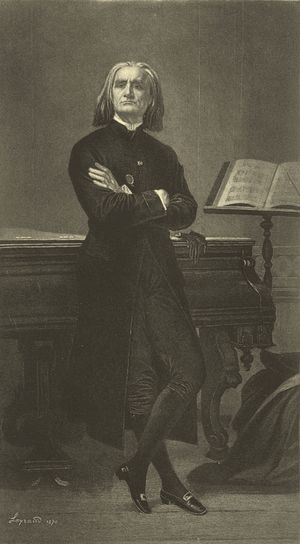
Franz Liszt.
Of course the gifted young pianist's connection grew rapidly. He got his twenty francs a lesson at the best houses; he was naturally a welcome guest, and from the first seemed to have the run of high Parisian society. His life was feverish, his activity irregular, his health far from strong; but the vulgar temptations of the gay capital seemed to have little attraction for his noble nature. His heart remained unspoiled. He was most generous to those who could not afford to pay for his lessons, most pitiful to the poor, most dutiful and affectionate to his mother. Coming home late from some grand entertainment, he would sit outside on the staircase till morning, sooner than awaken, or perhaps alarm, her by letting himself in. But in losing his father he seemed to have lost a certain method and order. His meals were irregular, so were his lessons; more so were the hours devoted to sleep.
At this time he was hardly twenty; we are not surprised anon to hear in his own words, of "a female form chaste, and pure as the alabaster of holy vessel," but he adds: "Such was the sacrifice which I offered with tears to the God of Christians!"
I will explain. Mlle. Caroline St. Cricq was just seventeen, lithe, slender, and of "angelic" beauty, with a complexion like a lily flushed with roses, open, "impressionable to beauty, to the world, to religion, to God." The countess, her mother, appears to have been a charming woman, very partial to Liszt, whom she engaged to instruct Mademoiselle in music. The lessons went not by time, but by inclination. The young man's eloquence, varied knowledge, ardent love of literature, and flashing genius won both the mother and daughter. Not one of them seemed to suspect the whirlpool of grief and death to which they were hurrying. The countess fell ill and died, but not before she had recommended Liszt to the Count St. Cricq as a possible suitor for the hand of Mademoiselle.
The haughty diplomat, St. Cricq, at once put his foot down. The funeral over, Liszt's movements were watched. They were innocent enough. He was already an enfant de la maison, but one night he lingered reading aloud some favorite author to Mademoiselle a little too late. He was reported by the servants, and received his polite dismissal as music master. In an interview with the count his own pride was deeply wounded. "Difference of rank!" said the count. That was quite enough for Liszt. He rose, pale as death, with quivering lip, but uttered not a word. As a man of honor he had but one course. He and Caroline parted forever. She contracted later an uncongenial marriage; he seems to have turned with intense ardor to religion. His good mother used to complain to those who came to inquire for him that he was all day long in church, and had ceased to occupy himself, as he should, with music.
It was toward the close of 1831 that Liszt met Chopin in Paris. From the first, these two men, so different, became fast friends. Chopin's delicate, retiring soul found a singular delight in Liszt's strong and imposing personality. Liszt's exquisite perception enabled him perfectly to live in the strange dreamland of Chopin's fancies, while his own vigor inspired Chopin with nerve to conceive those mighty Polonaises that he could never properly play himself, and which he so gladly committed to the keeping of his prodigious friend. Liszt undertook the task of interpreting Chopin to the mixed crowds which he revelled in subduing, but from which his fastidious and delicately strung friend shrank with something like aversion.
From Chopin, Liszt and all the world after him got that tempo rubato, that playing with the duration of notes without breaking the time, and those arabesque ornaments which are woven like fine embroidery all about the pages of Chopin's nocturnes, and lift what in others are mere casual flourishes into the dignity of interpretative phrases and poetic commentaries on the text.
People were fond of comparing the two young men who so often appeared in the same salons together—Liszt with his finely shaped, long, oval head and profil d'ivoire, set proudly on his shoulders, his stiff hair of dark blonde thrown back from the forehead without a parting, and cut in a straight line, his aplomb, his magnificent and courtly bearing, his ready tongue, his flashing wit and fine irony, his genial bonhomie and irresistibly winning smile; and Chopin, also, with dark blonde hair, but soft as silk, parted on one side, to use Liszt's own words, "An angel of fair countenance, with brown eyes from which intellect beamed rather than burned; a gentle, refined smile, slightly aquiline nose; a delicious, clear, almost diaphanous complexion, all bearing witness to the harmony of a soul which required no commentary beyond itself."
Nothing can be more generous or more true than Liszt's recognition of Chopin's independent support. "To our endeavors," he says, "to our struggles, just then so much needing certainty, he lent us the support of a calm, unshakable conviction, equally armed against apathy and cajolery." There was only one picture on the walls of Chopin's room; it hung just above his piano. It was a head of Liszt.
It is no part of my present scheme to describe the battle which romanticism in music waged against the prevalent conventionalities. We know the general outcome of the struggle culminating, after the most prodigious artistic convulsions, in the musical supremacy of Richard Wagner, who certainly marks firmly and broadly enough the greatest stride in musical development made since Beethoven.
In 1842 Liszt visited Weimar, Berlin, and then went to Paris; he was meditating a tour in Russia. Pressing invitations reached him from St. Petersburg and Moscow. The most fabulous accounts of his virtuosity had raised expectation to its highest pitch. He was as legendary even among the common people as Paganini. His first concert at St. Petersburg realized the then unheard-of sum of £2,000. The roads were crowded to see him pass, and the corridors and approaches to the Grand Opera blocked to catch a glimpse of him. The same scenes were repeated at Moscow, where he gave six concerts without exhausting the popular excitement.
On his return to Weimar he accepted the post of Capellmeister to the Grand Duke. It provided him with that settled abode, and above all with an orchestra, which he now felt so indispensable to meet his growing passion for orchestral composition. But the time of rest had not yet come.
In 1844 and 1845 he was received in Spain and Portugal with incredible enthusiasm, after which he returned to Bonn to assist at the inauguration of Beethoven's statue. With boundless liberality, he had subscribed more money than all the princes and people of Germany put together, to make the statue worthy of the occasion and the occasion worthy of the statue.
The golden river which poured into him from all the capitals of Europe now freely found a new vent in boundless generosity. Hospitals, poor and needy, patriotic celebrations, the dignity and interests of art, were all subsidized from his private purse. His transcendent virtuosity was only equalled by his splendid munificence; but he found—what others have so often experienced—that great personal gifts and prodigious éclat cannot possibly escape the poison of envy and detraction. He was attacked by calumny; his gifts denied and ridiculed; his munificence ascribed to vainglory, and his charity to pride and ostentation; yet none will ever know the extent of his private charities, and no one who knows anything of Liszt can be ignorant of the simple, unaffected goodness of heart which prompted them.
Still he was wounded by ingratitude and abuse. It seemed to check and paralyze for the moment his generous nature. Fétis saw him at Coblenz soon after the Bonn festival, at which he had expended such vast sums. He was sitting alone, dejected and out of health. He said he was sick of everything, tired of life, and nearly ruined. But that mood never lasted long with Liszt; he soon arose and shook himself like a lion. His detractors slunk away into their holes, and he walked forth victorious to refill his empty purse and reap new laurels.
His career was interrupted by the stormy events of 1848. He settled down for a time at Weimar, and it was then that he began to take that warm interest in Richard Wagner which ended in the closest and most enduring of friendships.
He labored incessantly to get a hearing for the "Lohengrin" and "Tannhäuser." He forced Wagner's compositions on the band, on the grand-duke; he breasted public opposition and fought nobly for the eccentric and obscure person who was chiefly known as a political outlaw and an inventor of extravagant compositions which it was impossible to play or sing, and odiously unpleasant to listen to. But years of faithful service, mainly the service and immense prestige and authority of Liszt, procured Wagner a hearing, and paved the way for his glorious triumphs at Bayreuth in 1876, 1882, and 1883.
I have preferred to confine myself in this article to the personality of Liszt, and have made no allusion to his orchestral works and oratorio compositions. The "Symphonic Poems" speak for themselves—magnificent renderings of the inner life of spontaneous emotion—but subject-matter which calls for a special article can find no place at the fag-end of this, and at all times it is better to hear music than to describe it. As it would be impossible to describe Liszt's orchestration intelligibly to those who have not heard it, and unnecessary to those who have, I will simply leave it alone.
I saw Liszt but six times, and then only between the years 1876 and 1881. I heard him play upon two occasions only, and then he played certain pieces of Chopin at my request and a new composition by himself. I have heard Mme Schumann, Bülow, Rubenstein, Menter, and Esipoff, but I can understand that saying of Tausig, himself one of the greatest masters of technique whom Germany has ever produced: "No mortal can measure himself with Liszt. He dwells alone upon a solitary height."[Back to Contents]
RICHARD WAGNER By Franklin Peterson, Mus. Bac. (1813-1883)
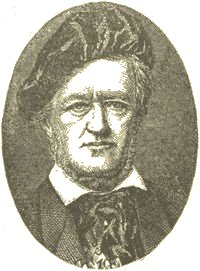
Richard Wagner's personality has been so overshadowed by and almost merged in the great controversy which his schemes of reform in opera raised, that his life and character are often now sorely misjudged—just as his music long was—by those who have not the time, the inclination, or the ability to understand the facts and the issues. Before briefly stating then the theories he propounded and their development, as shown in successive music dramas, it will be well to summarize the story of a life (1813-83) during which he was called to endure so much vicissitude, trial and temptation, suffering and defeat.
Born in Leipsic, on May 22, 1813, the youngest of nine children, Wilhelm Richard was only five months old when his father died. His mother's second marriage entailed a removal to Dresden, where, at the Kreuzschule, young Wagner received an excellent liberal education. At the age of thirteen the bent of his taste, as well as his diligence, was shown by his translation (out of school hours) of the first twelve books of the "Odyssey." In the following year his passion for poetry found expression in a grand tragedy. "It was a mixture," he says, "of Hamlet and Lear. Forty-two persons died in the course of the play, and, for want of more characters, I had to make some of them reappear as ghosts in the last act." Weber, who was then conductor of the Dresden opera, seems to have attracted the boy both by his personality and by his music; but it was Beethoven's music which gave him his real inspiration. From 1830 to 1833 many compositions after standard models are evidence of hard and systematic work and in 1833 he began his long career as an operatic composer with "Die Feen" which, however, never reached the dignity of performance till 1888—five years after Wagner's death. After some time spent in very unremunerative routine work in Heidelberg, Königsberg, and Riga (where in 1836 he married), he resolved, in 1839, to try his fortune in Paris with "Rienzi," a new opera, written on the lines of the Paris Grand Opera and with all its great resources in view. From the month's terrific storm in the North Sea, through which the vessel struggled to its haven, till the spring of 1842, when Wagner left Paris with "Rienzi" unperformed, heartsick with hope deferred, his lot was a hard and bitter one. Berlioz, in similar straits, supported himself by singing in the chorus of a second-rate theatre. Wagner was refused even that humble post. In 1842 "Rienzi" was accepted at Dresden, and its signal success led to his appointment as Capellmeister there (January, 1843). In the following year the "Flying Dutchman" was not so enthusiastically received, but it has since easily distanced the earlier work in popular favor. The story was suggested to his mind during the stormy voyage from Riga; and it is a remarkable fact that the wonderful tone-picture of Norway's storm-beaten shore was painted by one who, till that voyage, had never set eyes on the sea. In 1845 his new opera, "Tannhäuser," proved at first a comparative failure. The subject, one which had been proposed to Weber in 1814, attracted Wagner while he was in Paris, and during his studies for the libretto he found also the first suggestions of "Lohengrin" and "Parsifal." The temporary failure of the opera led him to the consideration and self-examination which resulted in the elaborate exposition of his ideal (in "Opera and Drama," and many other essays). "I saw a single possibility before me," he writes, "to induce the public to understand and participate in my aims as an artist." "Lohengrin" was finished early in 1848, and also the poem of "Siegfried's Tod," the result of Wagner's studies in the old Nibelungen Lied; but a too warm sympathy with some of the aims of the revolutionary party (which reigned for two short days behind the street barricades in Dresden, May, 1849) rendered his absence from Saxony advisable, and a few days later news reached him in Weimar that a warrant was issued for his arrest. With a passport procured by Liszt he fled across the frontier, and for nearly twelve years the bitterness of exile was added to the hardships of poverty. It is this period which is mainly responsible for Wagner's polemical writings, so biting in their sarcasm, and often unfair in their attacks. He was a good hater; one of the most fiendish pamphlets in existence is the "Capitulation" (1871), in which Wagner, safe from poverty (thanks to the kindness of Liszt and the munificence of Ludwig II., of Bavaria), and nearing the summit of his ambition, but remembering only his misfortunes and his slights, gloated in public over the horrors which were making a hell of the fairest city on earth. There is excuse at least, if not justification, to be found for his attacks on Meyerbeer and others; there are considerations to be taken into account while one reads with humiliation and pity the correspondence between Wagner and his benefactor, Liszt; but it is sad that an affectionate, humane, intensely human, to say nothing of an artistic, nature, could so blaspheme against the first principles of humanity.
In 1852 the poem of the "Nibelungen Ring Trilogy" was finished. In 1854 "Rheingold" (the introduction of "Vorabend") was ready, and "Die Walküre" (Part I.) in 1856. But "tired," as he said, "of heaping one silent score upon another," he left "Siegfried" unfinished, and turned to the story of "Tristan." The poem was completed in 1857, and the music two years later. At last, in 1861, he received permission to return to Germany, and in Vienna he had the first opportunity of hearing his own "Lohengrin." For three years the struggle with fortune seems to have been harder than ever before, and Wagner, in broken health, had practically determined to give up the unequal contest, when an invitation was sent him by Ludwig II., the young King of Bavaria—"Come here and finish your work." Here at last was salvation for Wagner, and the rest of his life was comparatively smooth. In 1865 "Tristan und Isolde" was performed at Munich, and was followed three years later by a comic opera, "Die Meistersinger," the first sketches of which date from 1845. "Siegfried" ("Nibelungen Ring," Part II.) was completed in 1869, and in the following year Wagner married Cosima, the daughter of Liszt, and formerly the wife of Von Bülow. His first wife, from whom he had been separated in 1861, died at Dresden in 1866.
Wagner's life and his individuality are of unusual importance in rightly estimating his work, because, unlike the other great masters, he not only devoted all his genius to one branch of music—the opera—but he gradually evolved a theory and an ideal which he consciously formulated and adopted, and perseveringly followed. It may be asked whether Wagner's premises were sound and his conclusions right; and also whether his genius was great enough to be the worthy champion of a cause involving such revolutions. Unless Wagner's operas, considered solely as music, are not only more advanced in style, but worthy in themselves to stand at least on a level with the greatest efforts of his predecessors, no amount of proof that these were wrong and he right will give his name the place his admirers claim for it. It is now universally acknowledged that Wagner can only be compared with the greatest names in music. His instrumentation has the advantage in being the inheritor of the enormous development of the orchestra from Haydn to Berlioz, his harmony is as daring and original as Bach's, and his melody is as beautiful as it is different from Beethoven's or Mozart's. (These names are used not in order to institute profitless comparisons, but as convenient standards; therefore even a qualification of the statement will not invalidate the case.)
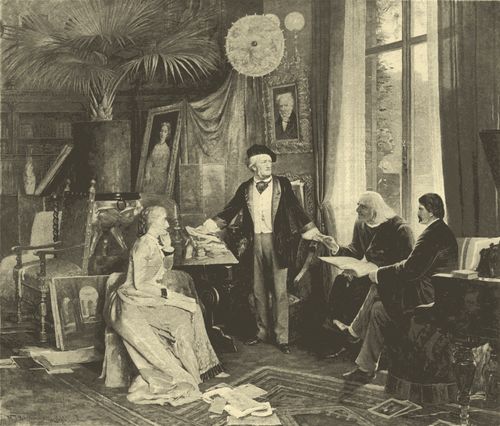
Wagner and his Friends.
His aim (stated very generally) was to reform the whole structure of opera, using the last or "Beethoven" development of instrumental music as a basis, and freeing it from the fetters which conventionality had imposed, in the shape of set forms, accepted arrangements, and traditional concessions to a style of singing now happily almost extinct. The one canon was to be dramatic fitness. In this "Art Work of the Future," as he called it, the interest of the drama is to depend not entirely on the music, but also on the poem and on the acting and staging as well. It will be seen that Wagner's theory is not new. All or most of it is contained in the theories of Gluck and others, who at various periods in the development of opera consciously strove after an ideal music drama. But the times were not ripe, and therefore such music could not exert its proper influence. The twin arts of music and poetry, dissociated by the rapid advance of literature and the slow development of music, pursued their several paths alone. The attempt to reunite them in the end of the sixteenth century was futile, and only led to opera which never needed, and therefore did not employ, great poetry. In Germany music was developed along instrumental lines until the school arrived at its culmination in Beethoven; and when an opera composer stopped to think on the eternal verities, the result must always have been such a prophecy of Wagner's work as we find in Mozart's letters:
"October, 1781.—Verse indeed is indispensable for music, but rhyme is bad in its very nature.... It would be by far the best if a good composer, understanding the theatre and knowing how to produce a piece, and a clever poet, could be united in one...."
Other but comparatively unimportant features in the Wagner music drama are, e.g., the use of the Leitmotiv, or leading motive—found occasionally in Gluck, Mozart, Weber, etc., but here first adopted with a definite purpose, and the contention for mythological rather than historical subjects—now largely admitted. But all Wagner's principles would have been useless without the energy and perseverance which directed his work, the loving study which stored his memory with all the great works of his predecessors, and, above all, the genius which commands the admiration of the musical world.
Wagner's works show a remarkable and progressive development. "Rienzi" is quite in the grand opera style of Meyerbeer, Spontini, etc. The "Flying Dutchman" is a deliberate departure from that style, and in romantic opera strikes out for itself a new line, which, followed still further in "Tannhäuser," reaches its stage of perfection in "Lohengrin." From this time dates the music drama, of which "Tristan" is the most uncompromising type, and by virtue of wonderful orchestration, and the intense pathos of the beautifully written poem, the most fascinating of all. The "Trilogy" ("Walküre," "Siegfried," "Götterdämmerung," with the "Rheingold" as introduction) is a very unequal work. It is full of Wagner's most inspired writing and most marvellous orchestration; but it is too long and too diffuse. The plot also is strangely confused and uninteresting, and fails alike as a story and as a vehicle of theories, morals, or religion. "Parsifal," with its sacred allegory, its lofty nobility of tone, and its pure mysticism, stands on a platform by itself, and is almost above criticism, or praise, or blame. The libretto alone might have won Wagner immortality, so original is it and perfect in intention; and the music seems to be no longer a mere accessory to the effect, but the very essence and fragrance of the great conception.[Back to Contents]
GIUSEPPE VERDI (BORN 1813)
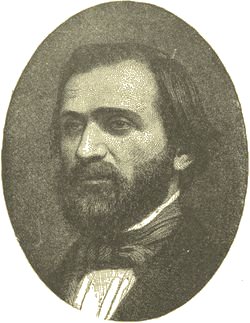
Giuseppe Verdi, the last and most widely successful of the school of Italian opera proper, was born at Roncole, near Busseto, October 9, 1813. At ten years he was organist of the small church in his native village, the salary being raised after a year from £1 8s. 10d. to £1 12s. per annum. At the age of sixteen he was provided with funds to prosecute his studies at the Conservatorium at Milan; but at the entrance examination he showed so little evidence of musical talent that the authorities declined to enroll him. Nothing daunted, he pursued his studies with ardor under Lavigna, from 1831 to 1833, when, according to agreement, he returned to Busseto to take the place of his old teacher Provesi, now deceased.
After five unhappy years in a town where he was little appreciated, Verdi returned to Milan. His first opera, "Oberto," is chiefly indebted to Bellini, and the next, "Un Giorno di Regno" (which fulfilled its own title, as it was only once performed), has been styled "Un Bazar de Reminiscences." Poor Verdi had just lost his wife and two children within a few days of each other, so it is hardly to be wondered at that a comic opera was not a very congenial work, nor successfully accomplished.
"Nabucodonosor" (1842) was his first hit, and in the next year "I Lombardi" was even more successful—partly owing to the revolutionary feeling which in no small degree was to help him to his future high position. Indeed, his name was a useful acrostic to the revolutionary party, who shouted "Viva Verdi," when they meant "Viva Vittorio Emanuele Re D' Italia." "Ernani," produced at Venice in 1844, also scored a success, owing to the republican sentiment in the libretto, which was adapted from Victor Hugo's "Hernani." Many works followed in quick succession, each arousing the enthusiasm of the audiences, chiefly when an opportunity was afforded them of expressing their feelings against the Austrian rule. Only with his sixteenth opera did Verdi win the supremacy when there were no longer any living competitors; and "Rigoletto" (1851), "Il Trovatore," and "La Traviata" (1853) must be called the best, as they are the last of the Italian opera school. "I Vespri Siciliani" (1855) and "Simon Boccanegra" (1857) were not so successful as "Un Ballo in Maschera" (1859); and none of them, any more than "La Forza del Destino" (1862) or "Don Carlos" (1867), added anything to the fame of the composer of "Il Trovatore."
Only now begins the interest which the student of musical history finds in Verdi's life. Hitherto he had proved a good man, struggling with adversity and poverty, a successful composer ambitious to succeed to the vacant throne of Italian opera. But the keen insight into dramatic necessity which had gradually developed and had given such force to otherwise unimportant scenes in earlier operas, also showed him the insufficiency of the means hitherto at the disposal of Italian composers, and from time to time he had tried to learn the lessons taught in the French Grand Opera School, but with poor success. Now a longer interval seemed to promise a more careful, a more ambitious work, and when "Aïda" was produced at Cairo (1871), it was at once acknowledged that a revolution had taken place in Verdi's mind and method, which might produce still greater results. The influence of Wagner and the music-drama is distinctly to be felt.
But Verdi was apparently not yet satisfied. For sixteen years the successful composer maintained absolute silence in opera, when whispers of a great music-drama roused the expectation of musical Europe to an extraordinary pitch; nor were the highest expectations disappointed when "Otello" was produced at Milan in 1887. The surrender of Italian opera was complete, and Verdi took his right place at the head of the vigorous new school which has arisen in Italy, and which promises to regain for the "Land of Song" some of her ancient preeminence in music. A comic opera by Verdi, "Falstaff," was announced in 1892: it has well sustained his previous reputation.[Back to Contents]