Volume 8 — COMPOSERS
Reading edition
HANDEL By C. E. Bourne (1685-1759)
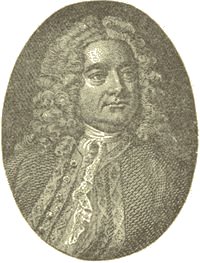
George Frederick Handel, of whom Haydn once reverently said, "He is the master of us all," was born at Halle, in Lower Saxony, on February 23, 1685. His father was a surgeon, and sixty-three years of age at the time of his birth—a terribly severe old man, who, almost before his son was born, had determined that he should be a lawyer. The little child knew nothing of the fate before him, he only found that he was never allowed to go near a musical instrument, much as he wanted to hear its sweet sounds, and the obstinate father even took him away from the public day-school for the simple reason that the musical gamut was taught there in addition to ordinary reading, writing, and arithmetic.
But love always "finds out the way," and his mother or nurse managed to procure for him the forbidden delights; a small clavichord, or dumb spinet, with the strings covered with strips of cloth to deaden the sound, was found for the child, and this he used to keep hidden in the garret, creeping away to play it in the night-time, when everyone was asleep, or whenever his father was away from home doctoring his patients.
But, at last, when George Frederick was seven years of age, the old man was compelled to change his views. It happened in this way. He set out one day on a visit to the court of the Duke of Saxe-Weissenfels, where another son by a former marriage was a page. George Frederick had been teasing his father to let him go with him to see his elder brother, whom he had not yet met, but this was refused. When old Handel started by the stagecoach the next morning, the persistent little fellow was on the watch; he began running after it, and at length the father was constrained to stop the coach and take the boy in. So, though at the expense of a severe scolding, the child had his way and was allowed to go on to Saxe-Weissenfels. When there, the chapel, with the beautiful organ, was the great attraction, and George Frederick, as indomitable then as he was in after-life, found his way into the organ loft, and when the regular service was over, contrived to take the organist's place, and began a performance of his own; and strange to say, though he had not had the slightest training, a melody with chords and the correct harmonies was heard. The duke had not left the chapel, and noticing the difference in style from that of the ordinary organist, inquired as to the player, and when the little boy was brought to him he soon discovered, by the questions he put, the great passion for music which possessed the child. The duke, a sensible man, told the father it would be wrong to oppose the inclination of a boy who already displayed such extraordinary genius; and old Handel, either convinced, or at any rate submitting to the duke's advice, promised to procure for his son regular musical instruments. Handel never afterward forgot the debt of gratitude he owed to the Duke of Saxe-Weissenfels for this intercession.
On his return to Halle he became the pupil of Zachau, the organist of the cathedral there. This man was an excellent teacher and a sound musician. Before the pupil was nine years old his instructor used to set him to write fugues and motets as exercises, and before long the boy was allowed to play the organ at the cathedral services on Sunday, whenever the elder musician was inclined to linger over his breakfast or to take a holiday. At last, when young Handel was nine years old, the master honestly confessed that his pupil knew more music than he himself did, and advised that he should be sent to Berlin for a course of further study there. Thither he accordingly went in the year 1696.
In Berlin the boy of eleven years was soon recognized as a prodigy. There he met two Italian composers of established reputation, Bononcini and Attilio Ariosti, both of whom he was to encounter in after-life, though under very different circumstances, in London. Bononcini, who was of a sour and jealous disposition, soon conceived a dislike for the gifted little fellow, and attempted to injure him by composing a piece for the harpsichord full of the most extraordinary difficulties, and then asking him to play it at sight. The boy, however, at once executed it without a mistake, and thus the malicious schemer was foiled by his own device. Attilio was of a different disposition; he praised the young musician to the skies, and was never weary of sitting by his side at the organ or harpsichord, and hearing him improvise for hours. The Elector of Brandenburg also conceived a great admiration for the boy's talents, and offered to send him to Italy. On old Handel being consulted, however, he pleaded that he was now an old man, and wished his son to remain near him. In consequence of this, probably much to the boy's disappointment, he was brought back to Halle, and there set to work again under his old master, Zachau.
Soon after this return his father died, in 1697, leaving hardly anything for his family, and young Handel had now to seriously bestir himself to make a living. With this object he went to Hamburg, where he obtained a place as second violin in the Opera-house. Soon after arriving there, the post of organist at Lübeck became vacant, and Handel was a candidate for it. But a peculiar condition was attached to the acceptance of the office; the new organist must marry the daughter of the old one! And, as Handel either did not approve of the lady, or of matrimony generally (and in fact he never was married), he promptly retired from the competition. At first, no one suspected the youth's talents, for he amused himself by pretending to be an ignoramus, until one day the accompanyist on the harpsichord (then the most important instrument in an orchestra) was absent, and young Handel took his place, astonishing everybody by his masterly touch. Probably this discovery aroused the jealousy of some of his brother-artists, for soon afterward a duel took place between him and Matheson, a clever composer and singer, who one night, in the midst of a quarrel on leaving the theatre, gave him a box on the ear; swords were drawn, and the duel took place there and then under the portico of the theatre. Fortunately Matheson's weapon was shivered by coming in contact with a metal button on his opponent's coat. Explanations were then offered, and the two adversaries became friends—indeed, close friends—afterward. "Almira, Queen of Castile," Handel's first opera, was brought out in Hamburg in 1705, and was followed by two others, "Nero," and "Daphne," all received with great favor, and frequently performed.
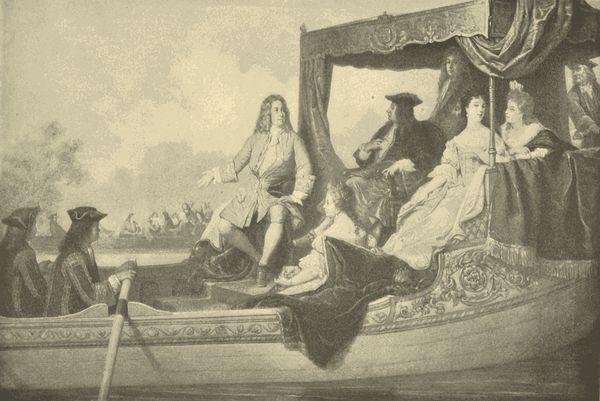
Handel's River-Concert for George I.
But the young musician determined to visit Italy as soon as possible, and after staying in Hamburg three years, and having, besides the money he sent his mother, saved two hundred ducats for travelling expenses, he was able to set off on the journey, then one of the great events in a musician's lifetime. He visited Florence, Venice, Rome, and Naples, in almost every city writing operas, which we are told were produced with the most brilliant success. At Venice an opera was sought for from him, and in three weeks he had written "Agrippina." When produced, the people received it with frantic enthusiasm, the theatre resounding with shouts of "Viva il caro Sassone!" (Long live the dear Saxon!) The following story illustrates the extraordinary fame he so quickly acquired in Italy. He arrived at Venice during the middle of the carnival, and was taken to a masked ball, and there played the harpsichord, still keeping on his mask. Domenico Scarlatti, the most famous harpsichord player of his age, on hearing him, exclaimed, "Why, it's the devil, or else the Saxon whom everyone is talking about!" In 1709 he returned to Hanover, and was appointed by the Elector George of Brunswick, afterward King George I., of England, his Court Capellmeister.
Handel's wanderings next led him to England, where he was treated with so much honor that he showed no great hurry to return to Hanover, and, in fact, he remained in England and coolly ignored his engagement as Capellmeister. But an awkward piece of retribution was at hand. The Elector of Hanover, on the death of Queen Anne, came to England as the new king, and Handel, his delinquent Capellmeister, could hardly expect to receive any share of the royal favor in future. With the help of a friend of his, Baron Kilmanseck, he determined, however, to make an attempt to conciliate the king, and accordingly he wrote twenty-five short concerted pieces of music, and made arrangements for these to be performed by musicians in a boat following the royal barge on the Thames, one day when the king went on an excursion up the river for a picnic. The king recognized the composer at once by his style, and spoke in terms of approbation of the music, and the news was quickly conveyed by his friend to the anxious musician. This is the story of the origin of the famous "Water Music." Soon afterward the king allowed Handel to appear before him to play the harpsichord accompaniments to some sonatas executed by Geminiani, a celebrated Italian violinist, and finally peace was made between them, Handel being appointed music-master to the royal children, and receiving an additional pension of £200. In 1726 a private Act of Parliament was passed, making George Frederick Handel a naturalized Englishman.
In the year 1720 a number of noblemen formed themselves into a company for the purpose of reviving Italian opera in London, at the Haymarket Theatre, and subscribed a capital of £50,000. The king himself subscribed £1,000, and allowed the society to take the name of the Royal Academy of Music, and at first everything seemed to promise the most brilliant success. Handel was appointed director of the music. Bononcini and Attilio Ariosti, his old acquaintances in Berlin, were also attracted by this new operatic venture to London, and their arrival was followed by a competition of a very novel character. The libretto of a new opera, "Muzio Scævola," was divided between the three composers. Attilio was to put the first act to music, Bononcini the second, and Handel the third. We need hardly wonder that the victory is said to have rested with the last and youngest of the trio, although at this time the cabals against him, which afterward were to do him such grievous harm, had already commenced.
Handel still clung to the operatic speculation; and when he had to leave the Haymarket Theatre, which was given up to another Italian company with the famous Farinelli, from Lincoln's Inn Fields, undauntedly he changed to the Lincoln's Inn Fields Theatre, and there commenced again. More operas were produced, with the one unvarying tale of fiasco, and at last, in 1737, having lost the whole of his hardly earned money, Handel was compelled to close the theatre, and, worse than all, to suspend payment for a time. Happily he now turned his thoughts to oratorio. "Saul" and "Israel in Egypt" were composed in quick succession; the last gigantic work being written in the almost incredibly short space of twenty-seven days. How great it is everyone now knows, but, at the time the colossal choruses were actually considered a great deal too heavy and monotonous; and Handel, always quick in resource, at the second performance introduced a number of operatic songs to make them go down better, and after the third performance the piece was withdrawn altogether. Fortunately, opinions have changed since then. These works were followed by his fine setting of Dryden's "Ode on St. Cecilia's Day," and Milton's "L'Allegro" and "Il Penseroso;" but it cannot be said that his pecuniary affairs were materially improved by their production.
The first performance of his greatest oratorio, the "Messiah," took place at Neale's Music Hall, in Dublin, on April 18, 1742, at mid-day, and, apropos of the absurdities of fashion, it may be noticed that the announcements contained the following request: "That ladies who honor this performance with their presence, will be pleased to come without hoops, as it will greatly increase the charity by making room for more company." The work was gloriously successful, and £400 were obtained the first day for the Dublin charities. Handel seems always to have had a special feeling with regard to this masterpiece of his—as if it were too sacred to be merely used for making money by, like his other works. He very frequently assisted at its performance for the benefit of the Foundling Hospital, and he left the score as a precious gift to the governor of that institution. This work alone brought no less a sum than £10,299 to the funds of the hospital. In this connection a fine saying of his may be repeated. Lord Kinnoul had complimented him on the noble "entertainment" which by the "Messiah" he had lately given the town. "My Lord," said Handel, "I should be sorry if I only entertained them—I wish to make them better." And when someone questioned him on his feelings when composing the "Hallelujah Chorus," he replied in his peculiar English, "I did think I did see all heaven before me, and the great God himself." What a fine saying that was of poor old George III., in describing the "pastoral symphony" in this oratorio—"I could see the stars shining through it!"
The now constant custom of the audience to rise and remain standing during the performance of this chorus, is said to have originated in the following manner: On the first production of the work in London, "the audience were exceedingly struck and affected by the music in general; but when that chorus struck up, 'For the Lord God Omnipotent' in the 'Hallelujah,' they were so transported that they all together, with the king (who happened to be present), started up and remained standing till the chorus ended." "This anecdote I had from Lord Kinnoul." So says Dr. Beattie, the once famous poet, in one of his letters.
The "Messiah" was commenced on August 22, 1741, finished on September 12th, and the orchestration filled up two days afterward—the whole work thus being completed in twenty-three days. Handel was fifty-six years old at the time.
The next ten years of the life of the "Goliath of Music," as he has been called, are marked by some of the most splendid achievements of his genius. "Samson," the "Dettingen Te Deum," "Joseph," "Belshazzar," "The Occasional Oratorio," "Judas Maccabeus," "Joshua," "Solomon," and, "Theodora," being composed by him during this time, when, already an old man, it might have been thought that he would have taken some repose after the labors of so toilsome and troubled a life. But, oak-like, he was one of those who mature late; like Milton, his greatest works were those of his old age.
But a terrible misfortune was approaching—his eyesight was failing. The "drop serene," of which Milton speaks so pathetically, had fallen on his eyes, and at the time when, in February, 1752, he was composing his last work, "Jephtha" (the one containing "Deeper and Deeper Still," and "Waft her, Angels"), the effort in tracing the lines is, in the original MS., very painfully apparent. Soon afterward he submitted to three operations, but they were in vain, and henceforth all was to be dark to him. His sole remaining work was now to improvise on the organ, and to play at performances of his oratorios. There is a pathetic story told of an incident that occurred on one occasion, when "Samson" was given. While the magnificent air,
Total eclipse! no sun, no moon! All dark, amidst the blaze of noon. O glorious light! no cheering ray To glad my eyes with welcome day. Why thus deprived thy prime decree? Sun, moon, and stars are dark to me—
was being sung by Beard, the tenor, the blind old man, seated at the organ, was seen to tremble and grow pale, and then, when he was led forward to the audience to receive their applause, tears were in the eyes of nearly everyone present at the sight. It was like the scene that is described in Beethoven's life on the occasion of that composer's appearance, when almost totally deaf, to conduct his great Choral Symphony at Vienna.
One night, on returning home from a performance of the "Messiah" at Covent Garden, Handel was seized with sudden weakness and retired hurriedly to bed, from which he was never to rise again. He prayed that he might breathe his last on Good Friday, "in hope of meeting his God, his sweet Lord and Saviour on the day of his resurrection." And strangely enough his wish was granted, for on Good Friday, April 13, 1759, he quietly passed away from this life, being then seventy-four years of age. His remains were laid in Poets' Corner in Westminster Abbey, and the place is marked by a statue by Roubilliac, representing him leaning over a table covered with musical instruments, his hand holding a pen, and before him is laid the "Messiah," open at the words, "I know that my Redeemer liveth."[Back to Contents]
MOZART By C. E. Bourne (1756-1791)
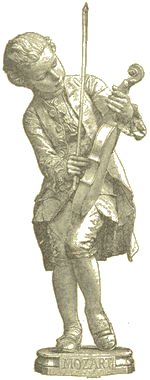
Leopold Mozart was a violinist in the band of Archbishop Sigismund, the reigning Prince of Salzburg, and it was probably in compliment to his master that he bestowed on the youngest of his seven children the name of Joannes Chrysostomus Wolfgangus Theophilus Sigismundus. Born on January 27, 1756, this child was destined to make the name of Mozart famous wherever music is known; and surely no more beautiful life—beautiful in itself and in the works of immortal beauty which in its short course were produced—has ever been lived by anyone of those to whom the crown of inspired singers and an enduring monument in the temple of art has been given. "Look around," was the epitaph on a great architect. "Listen," is the most fitting tribute to the wonderful genius of a Mozart.
Infant prodigies very often turn out to be nobodies in after-life. But Mozart was an exception; and though he might well have been called "the marvellous boy," his latest works—and he died at the early age of thirty-five—were undoubtedly his grandest and most perfect. He began very early to compose. One of these first attempts was a concerto so difficult that no one could play it; but the child undauntedly said, "Why, that's the very reason why it is called a concerto; people must practise it before they can play it perfectly."
Wolfgang and his sister, Nannerl, as he used to call her, had been taken by their father, in 1762, to Vienna, where the children played the piano before the Empress Maria Theresa and her husband. Little Wolfgang was here, as everywhere, perfectly at his ease, with a simplicity and childish grace that won every heart. When he had been playing for some time, he jumped without ceremony on the lap of the empress, and kissed her heartily for being so good to him. Little Marie Antoinette, her daughter, afterward the ill-fated wife of Louis XVI., and then about the same age as Wolfgang, he treated in almost the same way. He had slipped on the polished floor, to which he was unaccustomed, and the little princess had hurried forward to raise him up, on which he promptly said, "You are good; I will marry you." The empress asked why he wished this, to which he answered, "Out of gratitude; she was kind, while her sister took no notice of me" (she had not come forward to help him). After returning to Salzburg, Leopold Mozart, in the spring of 1763, took his children on a more lengthy tour to Munich, Paris, London, and The Hague, and everywhere their playing, especially Wolfgang's performances on the organ, which he had now learned, were listened to with delight and astonishment. At Heidelberg the priest of the Church of the Holy Ghost engraved on the organ the boy's name and the date of his visit, in remembrance of "this wonder of God," as he called the child. At London, old Mozart says, they were received, on April 27th, by King George III. and Queen Caroline, at the palace, and remained from six to nine o'clock. The king placed before the boy compositions of Bach and Handel, all of which he played at sight perfectly; he had also the honor of accompanying the queen in a song. "On leaving the palace," the careful father says, "we received a present of 24 guineas."
A great delight was now before him, for his father had resolved on a journey to Italy, then far more than now the land of music. How much this visit did for the young maestro it is impossible to say; he has not, like Mendelssohn, left us an "Italian Symphony," recording the impressions which that sunny spot of classic beauty had made upon him, but there can be little doubt of the great influence it had on the whole of his after-life. There are some significant words which he wrote eight years later to his father from Paris: "You must faithfully promise to let me see Italy again in order to refresh my life. I do entreat of you to confer this happiness upon me." In Mantua, Milan, Bologna (where he had the good fortune to meet the learned Padre Martini, one of the soundest musicians of his age, and for whom he ever afterward maintained a warm attachment), Florence, Rome, and Naples, the young genius was received everywhere with enthusiasm by the crowds who came to hear him. In Naples the superstitious people believed that there was magic in his playing, and pointed to a ring on his left hand as the cause of his wonderful dexterity; and it was only when he had taken this off, and gone on playing just the same, that they had to acknowledge it was simply the perfection of art.
There is something sad in contrasting these brilliant early days with the anxious times that came later on, when the great Mozart was compelled to wait in the ante-chambers of the great, dine with their lacqueys, give lessons to stupid young countesses, and write begging letters to his friends; yet, in reality, those later days, when "Don Giovanni," "Die Zauberflöte," and the "Requiem," were composed, were the truly brilliant ones. And it may be that the very greatness came, in some measure, from the sorrow and pain; that Mozart, like so many others of the world's great singers, "learnt in suffering what he taught in song."
On his return to Munich, after composing a comic opera in the Italian style, "La Finta Giardiniera," which had a great success, young Mozart, who had been very shabbily treated by Archbishop Hieronymus—of whose spiteful conduct we shall hear more hereafter—the successor of Sigismund, determined to resign his situation in the court band, and to set out on his travels again, giving concerts from place to place, and everywhere looking out for some suitable appointment that might afford him a permanent income. This time his father was refused permission to travel, and, as on his exertions depended the support of the whole family, he remained behind, while Frau Mozart, the mother, accompanied young Wolfgang. In 1777, now a young man of twenty-one, he set out upon his second great artistic tour, buoyant with hope, and with all the beautiful audacity of young genius determined to conquer the world. This time it was not the infant prodigy whom men listened to, but the matured musician and the composer of melodies sweeter than men had ever listened to before. But the tale is changed now. True, there are triumphs to be spoken of, flattery from the great, and presents sent in recompense for his marvellous playing (he tells one day of his chagrin in receiving from a certain prince a gold watch, instead of money that he sorely wanted—and, besides, he had five watches already!); but rebuffs, intrigues, and all sorts of petty machinations against him, make the tale a sadder one; and so it continued to be to the end.
From Munich—where it had been hoped that the elector would have given him an appointment at court, but he was only told to go to Italy and become famous, "it was too early yet to think about becoming a Capellmeister"—he went to Augsburg, spending some pleasant days there in the society of a cousin, Marianne, nicknamed by him Bäsle, a merry, open-hearted girl of nineteen.
Thence, he went on to Mannheim, a town that is memorable as the place where he first met the Webers, and made the acquaintance of Herr Cannabich, the director of the music at the elector's court, and one who proved a stanch friend through everything to the young composer. Cannabich had a daughter named Rosa, a girl of thirteen, exceedingly pretty and clever, and Wolfgang appears to have admired her very much, and perhaps for a time to have flirted and been in love with her. He wrote her a sonata, and was delighted with the way in which she played it; the andante, he said, he had composed to represent her, and when it was finished he vowed she was just what the andante was. But this little love affair, if it existed, soon was forgotten in a more serious one with Aloysia Weber. Her father was a theatre copyist in poor circumstances. There were a number of children, and she was a beautiful girl of fifteen, with a magnificent voice. She was cousin, by the way, to Weber, afterward composer of the "Freischütz." Mozart was so charmed with her voice that he undertook to give her lessons, and we soon hear of him composing airs for her and meditating a concert tour in Italy in company with her, and her father and sister. In writing of it to his own father he sets out the advantages to be gained by co-partnership, and very prosaically says: "Should we stay long anywhere, the eldest daughter [Josepha, afterward Frau Hofer, for whom Mozart wrote the part of Astrafiammente in the "Zauberflöte"] would be of the greatest use to us; for we could have our own ménage, as she understands cooking." But papa Mozart decidedly objected. "Your proposal to travel about with Herr Weber—N. B., two daughters—has driven me nearly wild," and he straightway orders his son off to Paris, whither, with a parting present of a pair of mittens knitted for him by Mlle. Weber, he reluctantly sets out in company with his mother.
His stay in Paris during the next year was not very eventful, and a symphony produced at the Concerts Spirituels seems to have been his most successful work at this time. It was clever and lively, full of striking effects, and was most warmly applauded. He says: "The moment the symphony was over I went off in my joy to the Palais Royal, where I took a good ice, told my beads, as I had vowed, and went home, where I am happiest and always shall be happiest." A great sorrow came to him here in the death of his mother. Owing to the great expense of living in Paris, they had been compelled to live together in a small, dark room, so cramped for space that there was not even room for the indispensable piano. Here she was taken ill, and though for fourteen days Wolfgang most devotedly attended to her wants, she died in his arms. The letters in which he breaks the news to his father and sister are full of the most beautiful tenderness and forgetfulness of his own grief in solicitude for theirs. Things did not indeed prosper with him in Paris; he tried to give lessons, but the ladies whom he taught paid him very shabbily, and the labor of getting from one part of the city to another to teach was so great that he found it difficult to give the time he wished to composition.
Music in Paris, just then, was at a low ebb. Vapidly pretty Italian operas were in fashion, and Piccinni was the favorite composer. It was some years afterward that the great contest between the Piccinnists and Gluckists culminated in the victory of the latter, though "Alceste," had already been produced, and "Iphigenia" was soon to follow. Mozart was a fervent admirer of Gluck, and the music of the older master had evidently an important influence on that of the younger and more gifted composer.
Once more his thoughts were turned to Salzburg, for two of the leading musicians there having died, the Archbishop Hieronymus offered their posts to the Mozarts, father and son, at a salary of a thousand florins for the two. The father anxiously entreated his son to return and accept this offer, mentioning as a further bait, that Aloysia Weber would probably be engaged to sing in Salzburg. Much as Wolfgang hated Salzburg, or rather the people living there, his love for his father and sister prevailed over his aversion; and though with no pleasure at all in the prospect of seeing the hateful archbishop again, he set out from Paris, travelling to Salzburg in very leisurely fashion via Strasbourg, Mannheim, and Munich. At Strasbourg he was induced to give several concerts, but they were not pecuniary successes, and he did not make by any one more than three louis d'or. But how the artist peeps out in every line of the letters in which he describes these! After saying how few were present, and how cold it was, he proceeds: "But I soon warmed myself, to show the Strasbourg gentlemen how little I cared, and played to them a long time for my own amusement, giving a concerto more than I had promised, and at the close extemporizing. It is now over, but at all events I gained honor and fame."
At Munich a great shock awaited him. He visited the Webers, and being in mourning for his mother, wore, after the French fashion, a red coat with black buttons. When he appeared, Aloysia hardly seemed to recognize him, and her coldness was so marked, that Mozart quietly seated himself at the piano, and sang in a loud voice, "Ich lass das Mädchen gern das mich nicht will" (I gladly give up the girl who slights me). It was all over, and he had to bear the loss of the fickle girl as best he might. There is a significant line in one of his letters at this time to his father: "In my whole life I never wrote worse than I do to-day, but I really am unfit for anything; my heart is so full of tears." After two years' absence he returned home to Salzburg, where he was warmly welcomed back. Here he remained for a little while, and wrote his first serious opera, "Idomeneo," to the text of an Abbe Varesco, a Salzburger. This opera Beethoven thought the finest of all that Mozart wrote. It was brought out at Munich in January, 1781, and was brilliantly successful. In the March following, an order was received from the archbishop to follow him to Vienna, where he wished to appear with all the full pomp and brilliant retinue of a prince of the church; and as one of this retinue Mozart had to follow him, little thinking at the time that he should never return to Salzburg, but that Vienna henceforth was to be his home.
In Vienna he found that he had to live in the archbishop's house, and was looked upon there as one of the ordinary servants. He says, "We dine at eleven o'clock in the forenoon, unluckily rather too early an hour for me. Our party consists of the two valets, the comptroller, Herr Zetti, the confectioner, the two cooks, Cecarilli, Brunetti (two singers), and my insignificant self. N. B.—The two valets sit at the head of the table. I have, at all events, the honor to be placed above the cooks; I almost believe I am back to Salzburg."
Mozart was a true gentleman, with no foolish false pride, but with the honorable self-respect that every gentleman must possess, and it was very galling to him to have to suffer such odious treatment from the mean-spirited archbishop. Indeed, it was only for his father's sake that he submitted to the continued contumely and petty slights to which the archbishop delighted in subjecting him. At last the open rupture came. The archbishop called him a knave and dissolute fellow, and told him to be off; and when Mozart waited upon Count Arco, the principal official, to obtain the regular dismissal that was necessary, the fellow poured abuse upon him, and actually kicked him out of the room. Poor Mozart was in a state of violent excitement after this outrage, and for some days was so ill that he could not continue his ordinary work. But now at least he was free, and though his father, like a timid, prudent old man, bewailed the loss of the stipend which his son had been receiving, Mozart himself knew that the release was entirely for the best.
In 1782 appeared "Die Entführung aus dem Serail," his first really important opera, full of beautiful airs, which at once became enormously popular with the Viennese. The Emperor Joseph II. knew very little about music, but, as frequently happens in such cases, considered that he possessed prodigious taste. On hearing it he said, "Much too fine for our ears, dear Mozart; and what a quantity of notes!"
The bold reply to this was, "Just as many notes as are necessary, your Majesty."
Much of the delight which Mozart felt in the success of the opera arose from the fact that it enabled him seriously to contemplate marriage. Aloysia Weber had been faithless to him, but there was another sister—with no special beauty save that of bright eyes, a comely figure, and a cheerful, amiable disposition—Constanze, whom he now hoped to make his wife. His father objected to all of the Weber family, and there was some difficulty in obtaining the paternal consent; but at last the marriage took place, on August 4, 1782. How truly he loved his wife from first to last, his letters abundantly show; her frequent illnesses were afterward a great and almost constant source of expense to him, but he never ceased to write to her with the passionate ardor of a young lover. He says: "I found that I never prayed so fervently, or confessed so piously, as by her side; she felt the same." And now for some time everything went smoothly in the modest little ménage in Vienna. Mozart had plenty of lessons to give, but none of the commissions for operas which he would have wished.
Passing over a visit to Leipsic—where he studied with the keenest delight a number of the unpublished works of the great Sebastian Bach—and to Berlin, he returned to Vienna, and at once set to work upon some quartets which the King of Prussia had ordered from him. "Cosi fan tutte," a comic opera, with the beautifully flowing music that only Mozart could write, but with a stupid plot that has prevented its frequent repetition in later times; and the glorious "Zauberflöte," written to assist a theatrical manager, Schikaneder, were his next works. At this time a strange melancholy began to show itself in his letters—it may be that already his overwrought brain was conscious that the end was not far distant. Such lines as these, pathetic and sad in their simple and almost childlike expression, occur in a letter he wrote during a short absence from his wife, at Frankfort, in 1790: "I am as happy as a child at the thought of returning to you. If people could see into my heart I should almost feel ashamed—all there is cold, cold as ice. Were you with me, I should possibly take more pleasure in the kindness of those I meet here, but all seems to me so empty." On his return to Vienna pecuniary want was rather pressingly felt; his silver plate had to be pawned, and a perfidious friend, Stadler, made away with the tickets, and the silver was never redeemed. On one occasion Joseph Deiner, the landlord of the "Silberne Schlange," chanced to call upon him, and was surprised to find Mozart and his wife Constanze dancing round the room. The laughing explanation was that they had no firewood in the house, and so were trying to warm themselves with dancing. Deiner at once offered to send in firewood, Mozart promising to pay as soon as he could.
That grand work, the "Zauberflöte," had just been completed when a strange commission was given him. One day a tall, haggard-looking man, dressed in gray, with a very sombre expression of countenance, called upon Mozart, bringing with him an anonymous letter. This letter contained an inquiry as to the sum for which he would write a mass for the dead, and in how short a time this could be completed. Mozart consulted his wife, and the sum of fifty ducats was mentioned. The stranger departed, and soon returned with the money, promising Mozart a further sum on completion, and also mentioned that he might as well spare the trouble of finding out who had given this commission, for it would be entirely useless. We now know that the commission had really been given by Count Walsegg, a foolish nobleman, whose wife had died, and who wanted, by transcribing Mozart's score, to pass it off as his own composition—and this he actually did after the composer's death. Poor Mozart, in the weak state of health in which he now was, with nerves unstrung and over-excited brain, was strangely impressed by this visit, and soon the fancy took firm possession of him that the messenger had arrived with a mandate from the unseen world, and that the "Requiem" he was to write was for himself. Not the less did he ardently set to work on it. Hardly, however, was it commenced than he was compelled to write another opera, "La Clemenza di Tito," for which a commission had been given him by the Bohemian Estates, for production on the occasion of the Emperor Leopold's coronation in their capital. This was accomplished in the short space of eighteen days, and though it does not contain the best music, yet the overture and several of the numbers are full of a piquant beauty and liveliness well suiting the festival of a people's rejoicing. But a far greater work, the "Zauberflöte," was produced in Vienna shortly afterward. It did not take very well at first, but subsequent performances went better.
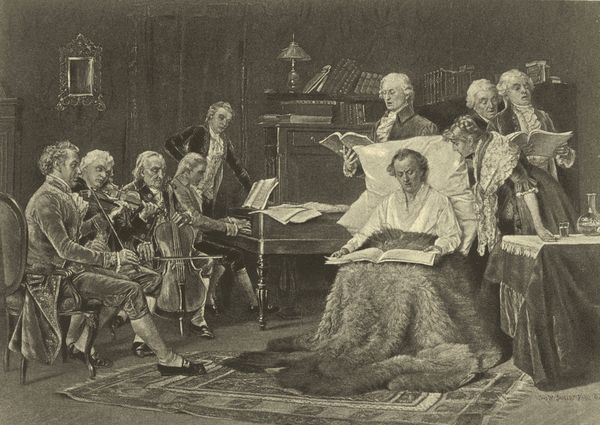
Mozart singing his Requiem.
His labors in bringing out the "Zauberflöte" over, Mozart returned to the "Requiem" he had already commenced, but while writing he often had to sink back in his chair, being seized with short swoons. Too plainly was his strength exhausted, but he persisted in his solemn work. One bright November morning he was walking with Constanze in the Prater, and sadly pointing out to her the falling leaves, and speaking of death, with tears in his eyes, he added; "I well know I am writing this 'Requiem' for myself. My own feelings tell me that I shall not last long. No doubt some one has given me poison—I cannot get rid of this thought." With these gloomy fancies haunting his mind, he rapidly grew worse, and soon could not leave his room. The performances of the "Zauberflöte" were still going on, and extraordinarily successful. He took the greatest interest in hearing of them, and at night would take out his watch and note the time—"Now the first act is over, now is the time for the great Queen of Night." The day before his death he said to his wife, "Oh, that I could only once more hear my 'Flauto Magico!'" humming, in scarcely audible voice, the lively bird-catcher song. The same day, at two o'clock in the afternoon, he called his friends together, and asked for the score of his nearly completed "Requiem" to be laid on his bed. Benedict Schack sang the soprano; his brother-in-law, Hofer, the tenor; Gerl, the bass; and Mozart himself took the alto in a weak but delicately clear voice. They had got through the various parts till they came to the "Lacrymosa," when Mozart burst into tears, and laid the score aside. The next day (Sunday), he was worse, and said to Sophie, his sister-in-law, "I have the taste of death on my tongue, I smell the grave, and who can comfort my Constanze, if you don't stay here?" In her account of his last moments, she says: "I found Süssmayer sitting by Mozart's bed. The well-known 'Requiem' was lying on the coverlet, and Mozart was explaining to Süssmayer the mode in which he wished him to complete it after his death. He further requested his wife to keep his death secret until she had informed Albrechtsberger of it, 'for the situation of assistant organist at the Stephen Church ought to be his before God and the world.' The doctor came and ordered cold applications on Mozart's burning head.... The last movement of his lips was an endeavor to indicate where the kettledrums should be used in the 'Requiem.' I think I still hear the sound."[Back to Contents]
HAYDN By C. E. Bourne (1732-1809)
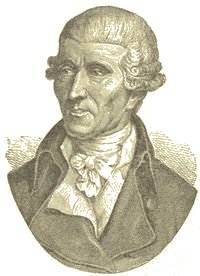
No composer has ever given greater or purer pleasure by his compositions than is given by "papa" Haydn; there is an unceasing flow of cheerfulness and lively tone in his music, even in the most solemn pieces, as in his Masses, the predominant feeling is that of gladness; as he once said to Carpani: "At the thought of God my heart leaps for joy, and I cannot help my music doing the same." But it is not alone as the writer of graceful and beautiful music that Haydn has a claim on our remembrance; he has been truly called the "father of the symphony." Mozart once said: "It was from Haydn that I first learned the true way to compose quartettes;" and "The Creation," which must ever be counted one of the masterpieces of oratorio music, was his work.
His family were of the people, his father being a master wheelwright at Rohrau, a small Austrian village on the borders of Lower Austria and Hungary and his mother having been employed as a cook in the castle of Count Harrach, the principal lord of the district. Joseph Haydn was born on March 31, 1732 the second child of his parents; and as ten brothers and sisters afterward came into the world, it can easily be understood that his lot was not a very luxurious one. His parents were simple, honest people of the laboring class, very ignorant, but, like most German peasants, with a certain love for and facility in music, not quite so common in this country. Haydn's father had a good voice, and could sing well, accompanying himself on the harp, though he did not know a single note of written music. Then there was the village schoolmaster, who could actually play the violin, and whom little Joseph watched with wondering eyes, extracting those marvellously sweet sounds from his wooden instrument, until, with the child's spirit of imitation, as his parents sang their "Volkslieder," the little fellow, perched on a stone bench, gravely handled two pieces of wood of his own as if they were bow and fiddle, keeping exact time, and flourishing the bow in the approved fashion of the schoolmaster. From this very little incident came an important change in his life; for a relation, Johann Mathias Frankh, of Hainburg, happened to be present on one occasion, and, thinking he saw an aptitude for music in the boy, offered to take him into his own school at Hainburg, where accordingly young Haydn went at the age of six years.
There he remained for two years, making rapid progress in singing and in playing all sorts of instruments, among others the clavier, violin, organ, and drum. He said afterward, with the unaffected piety, far removed from cant, that was characteristic of him: "Almighty God, to whom I render thanks for all his unnumbered mercies, gave me such facility in music that, by the time I was six years old, I stood up like a man and sang masses in the church choir, and could play a little on the clavier and violin." Of Frankh, a very strict, but thorough and most painstaking teacher, he also said afterward: "I shall be grateful to that man as long as I live for keeping me so hard at work, though I used to get more flogging than food;" and in Haydn's will he remembered Frankh's family, leaving his daughter a sum of money and a portrait of Frankh himself, "my first instructor in music."
For some years he seems to have lived a miserable, struggling life, giving lessons, playing the organ in churches, and studying when and where he could. He had a few pupils at the moderate remuneration of two florins a month, and he had contrived to obtain possession of an old worm-eaten clavier, on which he used diligently to practise in the garret in the Kohlmarkt, where he lived. A pitiable description is given of the lodging he then occupied. It was on the sixth story, in a room without stove or window. In winter his breath froze on his thin coverlet, and the water, that in the morning he had to fetch himself from the spring for washing, was frequently changed into a lump of ice before his arrival in that elevated region. Life was indeed hard; but he was constantly at work, and, having made a precious "find" on an old bookstall one day of Fux's "Gradus ad Parnassum," in a very dilapidated condition, but very cheap, he was ardently preparing himself for the life—he now vowed should be his—of a composer.
About this time Haydn received a commission from Felix Kurz, a comic actor of the Stadt-Theatre, to put a farce of his, "Der neue krumme Teufel," to music. This farce, of which the words still remain, though the music has been lost, was very successful, and was played in Vienna, Prague, Berlin, and a number of other towns. The well-known story of Haydn's "Tempest Music" is connected with this. In one part of this piece a terrible storm was supposed to be raging, and the accompanying music must of course be suitably descriptive; but the difficulty was that Haydn had never seen the sea: therefore had not the slightest notion of what a storm at sea was like. Kurz tries to describe the waves running mountains high, the pitching and tossing, the roll of thunder, and the howling of the wind; and Haydn produces all sorts of ugly, jerky, and noisy music, but none of it is in the remotest degree like a storm at sea, or anywhere else. At last, after Kurz had become hoarse with his nautical disquisitions, and Haydn's fingers were tired of scrambling all over the piano, the little musician in a rage crashed his hands down on the two extremes of the instrument, exclaiming: "Let's have done with this tempest!"
"Why, that's it; that's the very thing!" shouted the clown, jumping up and embracing him; and with this crash and a run of semitones to the centre of the piano this troublesome tempest was most satisfactorily represented.
When, many years afterward, Haydn was crossing the Straits of Dover to England, amid his sufferings he could not help laughing at the ludicrous recollections of this early experience of his.
Things still went on improving, and Haydn, who was always lucky in the patrons he secured (at least according to the notion about patrons that then prevailed), was invited to the country-house of Herr von Fürnberg, a wealthy amateur, to stay there and compose quartettes for him—a style of music for which von Fürnberg had an especial liking. To his prompting it is that we owe the lovely series of quartettes which Haydn wrote—still as fresh and full of serene beauty as when first tried over by the virtuosi of Weinzirl. The next piece of good fortune was Haydn's appointment as director of the band and composer to Count Ferdinand Morzin at Lukaver near Pilsen; and here, in 1759, his first symphony was written. His salary was very small, only 200 florins a year (or £20), with board and lodgings; but on the strength of it he unfortunately determined on the serious step of embarking in matrimony. A barber, named Keller, is said to have been very kind to him in the days of his poverty, and out of gratitude Haydn gave music-lessons to his daughters. One of them, the youngest, was very pretty, and Haydn fell in love with her. But she became a nun; and the father then prevailed upon Haydn to marry the elder one, who was three years older than he—a sour-tempered, bigoted, and abominably selfish woman, who contributed little to the happiness of his life, and was always bringing priests and friars to the house and worrying her good-tempered husband to compose masses and other church music for these men.
Count Morzin was compelled to give up his band in 1761; but Haydn did not remain long without employment, as Prince Esterhazy, who had heard his symphonies at Morzin's house, engaged him to assist Werner, his Capellmeister. As director of Prince Esterhazy's band, Haydn was fated to remain for many years living at Esterház, the prince's country-seat, composing there nearly all his operas and songs, and many of his symphonies.
In 1785 Haydn received a commission which showed the wide reputation he had then gained. The Chapter of Cadiz Cathedral requested him to write some instrumental music for performance on Good Friday. "The Seven Words of our Saviour on the Cross" was in consequence written by him.
Several invitations had been sent from England for Haydn to pay a visit there; but it was only after Prince Esterhazy was dead that he was prevailed on by Salomon to cross the sea. A characteristic conversation between him and Mozart—which took place before he undertook this, in those days, really formidable journey—is recorded.
"Papa," said Mozart, "you have no training for the great world, and you speak too few languages."
Haydn replied: "My language is understood by all the world."
He set out on December 15, 1790, and did not return to Vienna till July, 1792. In London, where he wrote and conducted a number of symphonies for Salomon, he was the "lion" of the season, being in constant request for conducting concerts and paying visits to the nobility. Of these symphonies Salomon once said to him: "I am strongly of opinion that you never will surpass this music."
"I never mean to try," was the answer.
But this must not be taken to mean that Haydn had given up striving after the truest perfection in his art, and it probably meant no more than that for the time he was satisfied with his work. Far more like the genuine expression of the feeling of the great artist was his utterance, just before he died, to Kalkbrenner: "I have only just learned in my old age how to use the wind-instruments; and now that I do understand them, I must leave the world."
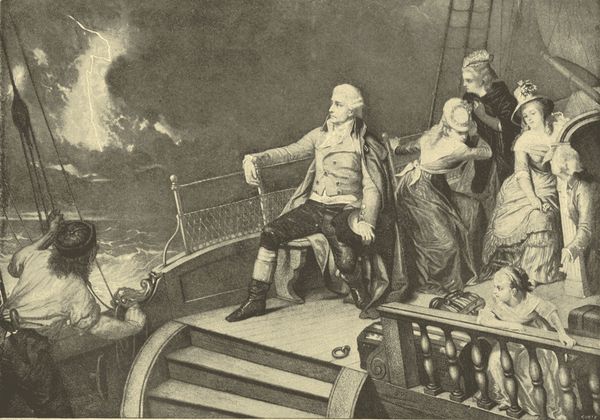
Haydn composing his "Creation."
Great as the work accomplished in his youth and early manhood unquestionably was, it remained for his old age to accomplish his greatest work, and that by which he is best known—the oratorio of "The Creation." It is said that the first ideas for this came to him when, in crossing the English Channel, he encountered a terrific storm. Soon after his leaving London, where the words had been given him by Salomon, Haydn set about composing the music. "Never," he says, "was I so pious as when composing 'The Creation.' I knelt down every day and prayed God to strengthen me for my work." It was first produced on March 31, 1799, his 67th birthday, at the National Theatre, Vienna, and was at once accorded an extraordinary share of popular favor. There is a pathetic story of the last performance of the work, at which Haydn, in extreme old age, in 1808, was present, when Salieri conducted. He was carried in an arm-chair into the hall, and received there with the warmest greeting by the audience. At the sublime passage, "And there was light!" Haydn, quite overcome, raised his hand, pointing upward and saying, "It came from thence." Soon after this his agitation increased so much that it was thought better to take him home at the end of the first part. The people crowded round him to take leave, and Beethoven is said to have reverently kissed his hand and forehead. After composing "The Creation," Haydn was prevailed upon to write another work, of somewhat similar character, to words adapted from Thomson's poem, and entitled "The Seasons." This, though containing some fine descriptive music and several choruses of great beauty, is not at all equal to the earlier work, though at the time its success was quite as complete. But the exertion of writing two such great works, almost without rest between them, was too great, and he himself said: "'The Seasons' gave me the finishing stroke." The bombardment of Vienna by the French in 1809 greatly disturbed the poor old man. He still retained some of his old humor, and during the thunder of the cannons called out to his servants: "Children, don't be frightened; no harm can happen to you while Haydn is by!" He was now no longer able to compose, and to his last unfinished quartette he added a few bars of "Der Greis," as a conclusion:
"Hin ist alle meine Kraft: Alt und schwach bin ich.
—Joseph Haydn."
"Gone is all my strength: old and weak am I." And these lines he caused to be engraved, and sent on a card to the friends who visited him. The end was indeed now near. On May 26, 1809, he had his servants gathered round him for the last adieus; then, by his desire, he was carried to the piano, where he played three times over the "Emperor's Hymn," composed by him. Then he was taken to his bed, where five days afterward he died.[Back to Contents]
BEETHOVEN By C. E. Bourne (1770-1827)
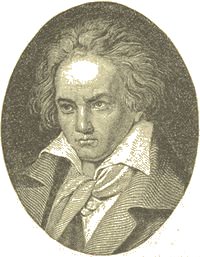
In one of his letters to Frau von Streicher, at Baden, Beethoven writes: "When you visit the ancient ruins, do not forget that Beethoven has often lingered there; when you stray through the silent pine-forests, do not forget that Beethoven often wrote poetry there, or, as it is termed, composed." He was always fond of claiming the title "Ton-dichter, poet in music;" and surely of all the great geniuses who have walked the earth, to none can the glorious name of "poet" more truly be given than to Ludwig von Beethoven.
He was born at Bonn, on December 17, 1770. His father, Johann von Beethoven, was a tenor singer in the Electoral Chapel of the Archbishop of Cologne, at Bonn, and his mother, Maria Magdalena, was a daughter of the head cook at the castle of Ehrenbreitstein. The Beethoven family originally came from Louvain, in Belgium; but the composer's grandfather had settled in Bonn, first as a singer, and afterward as Capellmeister to the court. Musicians were not held of much account in those days, and the marriage of a singer with the daughter of a cook was not at all considered a mésalliance. Johann was a sad drunken scapegrace, and his poor wife, in bringing up her family upon the small portion of his earnings which she could save from being squandered at the tavern, had a pitiably hard and long struggling life of it.
Johann soon discovered the extraordinary musical endowments of his child and at once set to work to make a "prodigy" of him, as Handel, Bach, and Mozart had been before; for in this way the father hoped to secure a mine of wealth and lazy competence for himself. So the boy, when only a few years old, was kept for long weary hours practising the piano, and one of the earliest stories of his life is of the five-year-old little child made to stand on a bench before the piano laboring over the notes, while the tears flowed fast down his cheeks at the cold and aching pain, from which his hard taskmaster would not release him. Besides his father, a clever musician who lodged in the house, Pfeiffer, an oboist at the theatre, gave him lessons. Beethoven used afterward to say that he had learnt more from this Pfeiffer than from any one else; but he was too ready to abet the father in his tyranny, and many a time, when the two came reeling home late at night from drinking bouts at the tavern, they would arouse the little fellow from his sleep and set him to work at the piano till daybreak.
His next instructor was Neefe, the organist of the Archbishop's private chapel, a really skilful and learned musician, who predicted that the boy would become a second Mozart. Under him Beethoven studied for several years, and in 1782, when he was hardly twelve years old, we find him acting as organist in Neefe's place during the absence of the latter on a journey. The next year three sonatas composed by young Beethoven, and dedicated to the Elector in fulsome language, which was probably his father's production, were printed. Soon afterward the boy obtained the appointment of assistant-organist to the Elector, with a salary of a hundred thalers, no inconsiderable addition to the resources of his poor mother, who, with her family of three children, Ludwig, Carl, and Johann, and the more and more frequent visits of her ne'er-do-well of a husband to the tavern, was often grievously hard put to it for money. Young Ludwig had little play time in his life, and little opportunity for education; but amid his hard work some indications of a mischievous boyish spirit are to be found.
In the year 1791, the Elector, as head of the Teutonic Order, had to be present at a grand conclave at Mergentheim, and thither he resolved to take his musical and theatrical staff. Two ships were chartered to convey these gentlemen down the Rhine and Maine, and a very pleasant excursion, with all sorts of frolics and high revellings, they had of it. Lux, a celebrated actor, was chosen king of the expedition, and we find Beethoven figuring among the scullions.
In the autumn of the year following, a visit was paid by Haydn to Bonn on his return from his second journey to London. The musicians of the town gave a breakfast at Godesberg in his honor, and here Beethoven summoned up courage to show the veteran musician a cantata which he had recently composed. This was warmly praised by Haydn, and probably about this time arrangements were made for Beethoven to be received as a pupil by the older master. It is in this period that we must place a well-known anecdote. The young musician, already famous in his own neighborhood, was composing, as his custom was, in the wood outside the city, when a funeral cortége passed him. The priest, seeing him, instantly checked the dirge which was being chanted, and the procession passed in solemn silence, "for fear of disturbing him." In the beginning of November, 1792, the young musician left Bonn for Vienna, and, as it happened, he never afterward returned to the familiar scenes of his birthplace.
Beethoven was never a very easy man to get on with, and his intercourse with Haydn, who used to call him the "Great Mogul," does not seem to have been the most friendly. He was dissatisfied with the instruction given him, and suspicions were awakened in his mind that the elder musician was jealous of him, and did not wish him to improve. These thoughts were strengthened by the result of a chance meeting one day, as he was walking home with his portfolio under his arm, with Johann Schenk, a scientific and thoroughly accomplished musician. Beethoven complained to him of the little advance he was making in counterpoint, and that Haydn never corrected his exercises or taught him anything. Schenk asked to look through the portfolio, and see the last work that Haydn had revised, and on examining it he was astonished to find a number of mistakes that had not been pointed out. It is difficult to understand Haydn's conduct in this matter, for the perfidious treatment suspected by Beethoven is quite at variance with the ordinarily accepted character of the old man, and I cannot help fancying that the only foundation for Beethoven's suspicion was that Haydn did not quite understand the erratic genius of the youth till some time afterward. Beethoven dedicated his three pianoforte sonatas, Op. II., to Haydn, and when the latter suggested that he should add on the title page "Pupil of Haydn," the "Great Mogul" refused, bluntly saying "that he had never learnt anything from him." After Haydn, Albrechtsberger and Salieri were for a time his teachers, but Beethoven got on no better with them, and Albrechtsberger said, "Have nothing to do with him; he has learnt nothing, and will never do anything in decent style." Perhaps not in your pedant's style, O great contrapuntist!
Beethoven cannot be said to have been unfortunate in his friends. He had many true and faithful ones throughout his life, and though he suffered from pecuniary troubles, caused by the conduct of his brothers, he was never in such a state of grinding poverty as some other artists, such as Schubert, have been—never compelled to waste precious years of his life in producing "pot-boilers"—working not for art so much as for mere food and shelter. In 1794 Prince Karl Lichnowski, who had been a pupil of Mozart, and who, as well as his wife Christiane, was fanatico per la musica, proposed that Beethoven should come and live at his palace. They had no children; a suite of rooms was placed at the musician's disposal; no terms were proposed; the offer was the most delicate and friendly imaginable, and was accepted by Beethoven in the spirit in which it was made. For ten years he resided with the Lichnowskis, and these were probably the years of purest happiness in the great composer's life, although early in their course the terrible affliction of deafness began to be felt by him. He at this time freely frequented the salons of the Viennese nobility, many of whom were accomplished virtuosi themselves, and were able to appreciate the great genius of the new-comer, rough and bearish as oftentimes he must have appeared to them—a great contrast to the courtly Haydn and Salieri, who might be seen sitting side by side on the sofa in some grandee's music-room, with their swords, wigs, ruffles, silk stockings, and snuff-boxes, while the insignificant-looking and meanly dressed Beethoven used to stand unnoticed in a corner. Here is a description of his appearance given by a Frau von Bernhard: "When he visited us, he generally put his head in at the door before entering, to see if there were any one present he did not like. He was short and insignificant-looking, with a red face covered with pock-marks. His hair was quite dark. His dress was very common, quite a contrast to the elegant attire customary in those days, especially in our circles.... He was very proud, and I have known him refuse to play, even when Countess Thun, the mother of Princess Lichnowski, had fallen on her knees before him as he lay on the sofa to beg him to. The Countess was a very eccentric person.... At the Lichnowskis' I saw Haydn and Salieri, who were then very famous, while Beethoven excited no interest."
It was in the year 1800 that Beethoven at last was compelled to acknowledge to himself the terrible calamity of almost total deafness that had befallen him. He writes to his friend Wegeler, "If I had not read somewhere that man must not of his own free will depart this life, I should long ere this have been no more and that through my own act.... What is to be the result of this the good God alone knows. I beg of you not to mention my state to any one, not even to Lorchen [Wegeler's wife]. But," he continues, "I live only in my music, and no sooner is one thing completed than another is begun. In fact, as at present, I am often engaged on three or four compositions at one time."
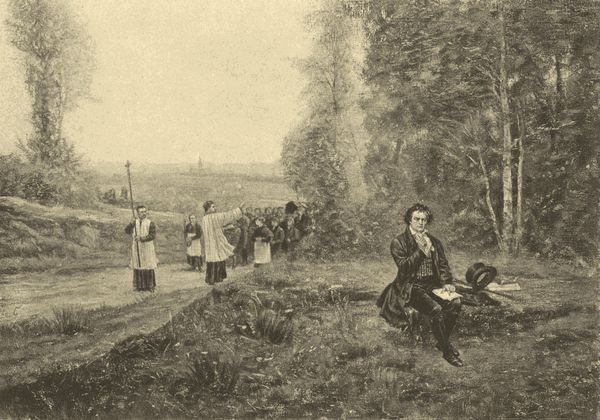
An Anecdote about Beethoven.
But at first all was not gloom; for Beethoven was in love—not the love of fleeting fancy that, like other poets, he may have experienced before, but deeply, tragically, in love; and it seems that, for a time at least, this love was returned. The lady was the Countess Julia Guicciardi; but his dream did not last long, for in the year 1801 she married a Count Gallenberg. Hardly anything is known of this love affair of Beethoven's. A few letters full of passionate tenderness, and with a certain very pathetic simple trustfulness in her love running through them all—on which her marriage shortly afterward is a strange comment; the "Moonlight Sonata," vibrating, as it is throughout, with a lover's supremest ecstasy of devotion, these are the only records of that one blissful epoch in the poor composer's life; but how much it affected his after life, how it mingled in the dreams from which his loveliest creations of later years arose, it is impossible now to say. In a letter to Wegeler, dated November 16, 1801, he says, "You can hardly realize what a miserable, desolate life mine has been for the last two years; my defective hearing everywhere pursuing me like a spectre, making me fly from every one, and appear a misanthrope; and yet no one in reality is less so! This change [to a happier life] has been brought about by a lovely and fascinating girl who loves me and whom I love. After the lapse of two years I have again enjoyed some blissful moments, and now for the first time I feel that marriage can bestow happiness; but alas! she is not in the same rank of life as myself.... You shall see me as happy as I am destined to be here below, but not unhappy. No, that I could not bear. I will grasp Fate by the throat; it shall not utterly crush me. Oh, it is so glorious to live one's life a thousand times!" No misanthropy this, surely; he could not always speak the speech of common men, or care for the tawdry bravery of titles or fine clothes in which they strutted, but what a heart there was in the man, what a wondrous insight into all the beauty of the world, visible and invisible, around him! The most glorious lovesong ever composed, "Adelaide," was written by him; but Julia Guicciardi preferred a Count Gallenberg, keeper of the royal archives in Vienna, and Beethoven, to the end of his days, went on his way alone.
It was at this time that he composed his oratorio, "The Mount of Olives," which can hardly be reckoned among his finest works; and his one opera—but such an opera—"Fidelio." The greater part of these works was composed during his stay, in the summer months, at Hetzendorf, a pretty, secluded little village near Schönbrunn. He spent his days wandering alone through the quiet, shady alleys of the imperial park there, and his favorite seat was between two boughs of a venerable oak, at a height of about two feet from the ground. For some time he had apartments at a residence of Baron Pronay's, near this village; but he suddenly left, "because the baron would persist in making him profound bows every time that he met him." Like a true poet, he delighted in the country. "No man on earth," he writes, "loves the country more. Woods, trees, and rock give the response which man requires. Every tree seems to say, 'Holy, holy.'"
In 1804 the magnificent "Eroica" symphony was completed. This had originally been commenced in honor of Napoleon Bonaparte, then First Consul, who, Beethoven—throughout his life an ardent Republican—then believed was about to bring liberty to all the nations of Europe. When the news of the empire came the dream departed, and Beethoven, in a passionate rage, tore the title page of the symphony in two, and, with a torrent of imprecations against the tyrant, stamped on the torn fragments.
"My hero—a tyrant!" he shrieked, as he trampled on the poor page. On this page the inscription had been simply, "Bonaparte—Luigi v. Beethoven". For some years he refused to publish the work, and, when at last this was done, the inscription read as follows: "Sinfonia Eroica per festigiari il sovvenire d'un grand' uomo" (Heroic symphony, to celebrate the memory of a great man). When Napoleon died, in 1821, Beethoven said, "Seventeen years before I composed the music for this occasion;" and surely no grander music than that of the "Funeral March" was ever composed for the obsequies of a fallen hero. This is not the place to enter into a description of the marvellous succession of colossal works—symphonies, concertos, sonatas, trios, quartets, etc., culminating in the "Choral Symphony," his ninth, and last—which, through those long years of a silent life, imprisoned within himself, the great master put forth. His deafness prevented his appearing in public to conduct, although, with the natural desire of a composer to be present at the production of his own work, he long struggled to take his part in the first performances of symphonies and concertos.
When the great choral symphony was first performed he attempted to conduct, but in reality another conductor was stationed near him to give the right time to the band. After the majestic instrumental movements had been played came the final one, concluding with Schiller's "Hymn to Joy." The chorus breaks forth, thundering out in concert with all the instruments. At the words "Seid umschlunger, Millionen," the audience could no longer restrain their excited delight, and burst into tremendous applause, drowning the voices of singers and the sounds of strings and brass. The last notes are heard, but still Beethoven stands there absorbed in thought—he does not know that the music is ended. This was the first time that the people realized the full deprivation of hearing from which he suffered. Fraulein Unger, the soprano, gently takes his arm and turns him round to front the acclaiming multitude. There are few in that crowd who, while they cheer, do not feel the tears stealing down their cheeks at the sight of the poor lonely man who, from the prison-house of his affliction, has brought to them the gladness of thought so divine. Unmoved, he bowed his acknowledgment, and quietly left the building.
His later years were embittered with troubles about his nephew Carl, a youth to whom he was fondly attached, but who shamefully repaid the love of the desolate old man. Letters like the following, to the teacher in whose house the boy lived, show the constant thought and affection given to this boy: "Your estimable lady is politely requested to let the undersigned know as soon as possible (that I may not be obliged to keep it all in my head) how many pairs of stockings, trousers, shoes, and drawers are required, and how many yards of kerseymere to make a pair of black trousers for my tall nephew."
His death was the result of a cold which produced inflammation of the lungs. On the morning of March 24, 1827, he took the sacrament and when the clergyman was gone and his friends stood round his bed, he muttered. "Plaudite amici, comedia finita est." He then fell into an agony so intense that he could no longer articulate, and thus continued until the evening of the 26th. A violent thunder-storm arose; one of his friends, watching by his bedside when the thunder was rolling and a vivid flash of lightning lit up the room, saw him suddenly open his eyes, lift his right hand upward for some seconds—as if in defiance of the powers of evil—with clenched fist and a stern, solemn expression on his face; and then he sank back and died.[Back to Contents]
PAGANINI (1784-1840)
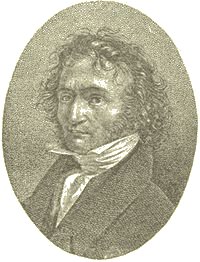
Nicolo Paganini, whose European fame as a violinist entitles him to a notice here, was born at Genoa in 1784. His father, a commission-broker, played on the mandolin; but fully aware of the inferiority of an instrument so limited in power, he put a violin into his son's hands, and initiated him in the principles of music. The child succeeded so well under parental tuition, that at eight years of age he played three times a week in the church, as well as in the public saloons. At the same period he composed a sonata. In his ninth year he was placed under the instruction of Costa, first violoncellist of Genoa; then had lessons of Rolla, a famous performer and composer; and finally studied counterpoint at Parma under Ghiretti and the celebrated maestro Paer. He now took an engagement at Lucca, where he chiefly associated with persons who at the gaming-table stripped him of his gains as quickly as he acquired them. He there received the appointment of director of orchestra to the court, at which the Princess Elisa Bacciochi, sister of Napoleon I., presided, and thither invited, to the full extent of her means, superior talent of every kind. In 1813 he performed at Milan; five years after, at Turin; and subsequently at Florence and Naples. In 1828 he visited Vienna, where a very popular violinist and composer, Mayseder, asked him how he produced such new effects. His reply was characteristic of a selfish mind: "Chacun a ses secrets" In that capital, it is affirmed, he was imprisoned, being accused of having murdered his wife. He challenged proofs of his ever having been married, which could not be produced. Then he was charged with having poignarded his mistress. This he also publicly refuted. The fact is that he knew better how to make money than friends, and he raised up enemies wherever his thirst for gold led him. Avarice was his master-passion; and, second to this, gross sensuality.
The year 1831 found Paganini in Paris, in which excitable capital he produced a sensation not inferior to that created by the visit of Rossini. Even this renowned composer was so carried away, either by the actual genius of the violinist or by the current of popular enthusiasm, that he is said to have wept on hearing Paganini for the first time. He arrived in England in 1831, and immediately announced a concert at the Italian Opera House, at a price which, if acceded to, would have yielded £3,391 per night; but the attempt was too audacious, and he was compelled to abate his demands, though he succeeded in drawing audiences fifteen nights in that season at the ordinary high prices of the King's Theatre. He also gave concerts in other parts of London, and performed at benefits, always taking at these a large proportion of the proceeds. He visited most of the great towns, where his good fortune still attended him. He was asked to play at the Commemoration Festival at Oxford, in 1834, and demanded 1,000 guineas for his assistance at three concerts. His terms were of course rejected.
Paganini died at Nice, in 1840, of a diseased larynx ("phthisie laryngée"). By his will, dated 1837, he gave his two sisters legacies of 60,000 and 70,000 francs; his mother a pension of 1,200; the mother of his son Achillino (a Jewess of Milan) a similar pension; and the rest of his fortune, amounting to 4,000,000 francs, devolved on his son. These and other facts before related, we give on the authority of the "Biographie Universelle."
Paganini certainly was a man of genius and a great performer, but sacrificed his art to his avarice. His mastery over the violin was almost marvellous, though he made an ignoble use of his power by employing it to captivate the mob of pretended amateurs by feats little better than sleight-of-hand. His performance on a single string, and the perfection of his harmonics, were very extraordinary; but why, as was asked at the time, be confined to one string when there are four at command that would answer every musical purpose so much better? His tone was pure, though not strong, his strings having been of smaller diameter than usual, to enable him to strain them at pleasure; for he tuned his instrument most capriciously. He could be a very expressive player; we have heard him produce effects deeply pathetic. His arpeggios evinced his knowledge of harmony, and some of his compositions exhibit many original and beautiful traits.[Back to Contents]
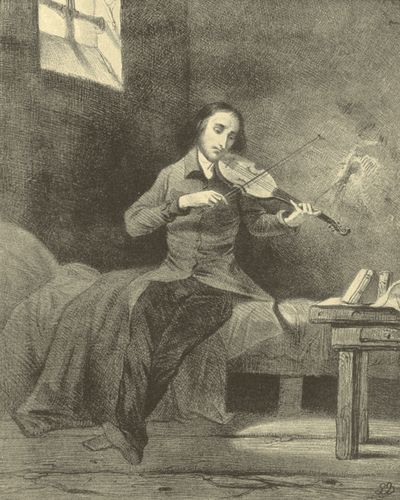
Paganini in Prison
MENDELSSOHN By C. E. Bourne (1809-1847)
Mendelssohn's lot in life was strikingly different from that of all the musicians of whom I have hitherto written; he never knew, like Schubert, what grinding poverty was, or suffered the long worries that Mozart had to endure for lack of money. His father was a Jewish banker in Berlin, the son of Moses Mendelssohn, a philosopher whose writings had already made the name celebrated throughout Europe. The composer's father used to say, with a very natural pride, after his own son had grown up, "Formerly I was the son of my father, and now I am the father of my son!"
Felix Mendelssohn-Bartholdy was born on February 3, 1809. His parents were neither of them trained musicians, though both appreciated and loved music, and it was from his mother that young Felix received his first music-lessons. When he had made some advance, Ludwig Berger became his tutor for the piano, and Zelter, a very learned and severe theorist, for counterpoint. At the age of nine years Felix had attained such proficiency that we find him taking the pianoforte part in a trio at a public concert of a Herr Gugel's, and when twelve years old he began to compose, and actually wrote a trio, some sonatas, a cantata, and several organ pieces. His home life was in the highest degree favorable to his musical development. On alternate Sundays musical performances were regularly given with a small orchestra in the large dining-room, Felix or his sister Fanny, who also possessed remarkable musical gifts, taking the pianoforte part, and new compositions by Felix were always included in the programme. Many friends, musicians and others, used to be present, Zelter regularly among their number, and the pieces were always freely commented on, Felix receiving then, as indeed he did all his life, the criticisms expressed, with the utmost good-natured readiness.
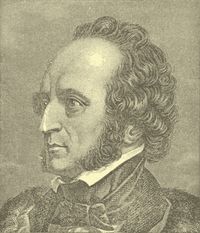
In 1824 Moscheles, at that time a celebrated pianist, and residing in London, visited Berlin, and was asked to give Felix music-lessons. This is the testimony of Moscheles, an excellent and kind-hearted man, and a thoroughly skilled musician, after spending nearly every day for six weeks with the family: "It is a family such as I have never known before; Felix, a mature artist, and yet but fifteen; Fanny, extraordinarily gifted, playing Bach's fugues by heart and with astonishing correctness—in fact, a thorough musician. The parents give me the impression of people of the highest cultivation;" and on the subject of lessons he says: "Felix has no need of lessons; if he wishes to take a hint from me as to anything new, he can easily do so." But it is very pleasant to find Mendelssohn afterward referring to these lessons as having urged him on to enthusiasm, and, in the days in London when his own fame had far outstripped that of the older musician, acknowledging himself as "Moscheles's pupil." The elder Mendelssohn was by no means carried away by the applause which the boy's playing and compositions had gained, and in 1825 he took his son to Paris to obtain Cherubini's opinion as to his musical abilities, with a view to the choice of a profession; for he had by no means made up his mind that Felix should spend his whole life as a musician. However, the surly old Florentine, who was not always civil or appreciative of budding genius (teste Berlioz), gave a decidedly favorable judgment on the compositions submitted to him, and urged the father to devote his son to a musical career. And, indeed, on listening to the pieces which were dated this year, especially a beautiful quartet in B minor, an octet for strings, the music to an opera in two acts, "Camacho's Wedding," and numerous pianoforte pieces, it is difficult to realize that the composer was then only sixteen years of age, or that anyone could question the artistic vocation that claimed him. But the next year a work was written, the score of which is marked "Berlin, August 6, 1826," when it must be remembered that he was seventeen years of age, which of itself was sufficient to rank him among the immortals—the overture to the "Midsummer Night's Dream." Full of lovely imaginings, with a wonderful fairy grace all its own, and a bewitching beauty, revealing not only the soul of the true poet, but also the musician profoundly skilled in all the art of orchestral effect, it is hard to believe that it is the work of a boy under twenty, written in the bright summer days of 1826, in his father's garden at Berlin.
Passing over the intermediate years with a simple reference to the "Meeresstille," "Calm Sea and Prosperous Voyage," which was then composed, and a fine performance of Bach's "Passion Music," for which he had been long drilling the members of the Berlin Singakademie, the next event is a visit to England in 1829, where he was received with extraordinary warmth, playing at the Philharmonic Concerts, conducting his C minor Symphony, which he dedicated to the Philharmonic Society, they in their turn electing him one of their honorary members; going to dinners, balls, and the House of Commons, and enjoying himself most hugely. His letters from England at this time are brimming over with fun and graphic description; there is one especially amusing, in which he describes himself with two friends going home from a late dinner at the German Ambassador's, and on the way buying three German sausages, going down a quiet street to devour them, with all the while joyous laughter and snatches of part songs. There is also a little incident of this time showing the wonderful memory he possessed. After a concert on "Midsummer Night," when the "Midsummer Night's Dream" had very appropriately been played, it was found that the score had been lost in a hackney-coach as the party were returning to Mr. Attwood's. "Never mind," said Mendelssohn, "I will make another," which he did, and on comparison with the separate parts not a single difference was found in it.
At the beginning of December he was at home again, and that winter he wrote the "Reformation Symphony," intended to be produced at the tercentenary festival of the "Augsburg Confession" in the following June. This symphony, with which Mendelssohn was not entirely satisfied, was only once performed during his lifetime, but since his death it has frequently been performed, and though not one of his most perfect works, is recognized as a noble monument in honor of a great event. The next spring he again set out on his travels, this time southward to Italy.
In 1833 Mendelssohn accepted an official post offered him by the authorities of Düsseldorf, by which the entire musical arrangements of the town, church, theatre, and singing societies were put under his care. Immermann, the celebrated poet, being associated with him in the direction of the theatre. Things, however, did not go on very smoothly there. Mendelssohn found all the many worries of theatrical management—the engagement of singers and musicians, the dissensions to be arranged, the many tastes to be conciliated—too irksome, and he did not long retain this appointment; but the life among his friends at Düsseldorf was most delightful, and the letters written at this time are exceedingly lively and gay. It was here that he received the commission from the Cæcilia-Verein of Frankfort for, and commenced, his grand oratorio "St. Paul." The words for this, as also for the "Elijah" and "Hymn of Praise" afterward, he selected himself with the help of his friend Schubung, and they are entirely from the Bible—as he said, "The Bible is always the best of all." Circumstances prevented the oratorio being then produced at Frankfort, and the first public performance took place at the Lower Rhine Festival at Düsseldorf, in May, 1836.
But his visits to Frankfort had a very important result in another way. Mendelssohn there met Mademoiselle Cécile Jeanrenaud, the daughter of a pastor of the French Reformed Church, and, though he had frequently indulged in the admiration of beautiful and clever women—which is allowable, and indeed an absolute necessity for a poet!—now for the first time he fell furiously in plain unmistakable and downright love. But it is more characteristic of the staid Teuton than the impulsive musician, that before plighting his troth to her he went away for a month's bathing at Scheveningen, in Holland, for the purpose of testing the strength of his affection by this absence. On his return, finding his amatory pulse still beating satisfactorily, he proposed to the young lady, and, as it must be presumed that she had already made up her own mind without any testing, he was accepted. On March 28, 1837, they were married, and the wedded life that then began was one of pure, unclouded happiness to the very end. Cécile Mendelssohn was a beautiful, gentle-hearted, and loving wife, just the one to give a weary and nervous artist in the home-life, with herself and the children near him, the blessed solace of rest and calm that he so needed. It is thus that Edward Devrient, the great German actor, and one of Mendelssohn's most intimate friends, describes her: "Cécile was one of those sweet womanly natures whose gentle simplicity, whose mere presence, soothed and pleased. She was slight, with features of striking beauty and delicacy; her hair was between brown and gold, but the transcendent lustre of her great blue eyes, and the brilliant roses of her cheeks, were sad harbingers of early death. She spoke little, and never with animation, in a low, soft voice. Shakespeare's words, "My gracious silence," applied to her no less than to the wife of Coriolanus."
After giving up his official position at Düsseldorf, in 1835, Mendelssohn was invited to become the conductor of the now famous Gewandhaus concerts at Leipsic, a post which he gladly accepted, and which, retained by him for many years, was to be one of the greatest delights of his artistic life. Not only was he loved and appreciated in Leipsic—far more than in Berlin, his own city—but he had here an opportunity of assisting many composers and virtuosi, who otherwise would have sought in vain for a hearing. Thus, after Liszt, when visiting the town, had been first of all received with great coldness, owing to the usual prices of admission to the concerts having been raised, Mendelssohn set everything straight by having a soirée in his honor at the Gewandhaus, where there were three hundred and fifty people, orchestra, chorus, punch, pastry, Meeresstille Psalm, Bach's Triple Concerto, choruses from St. Paul, Fantasia on Lucia, the Erl King, the Devil and his Grandmother, the latter probably a mild satirical reference to Liszt's stormy and often incoherent playing. It is also pleasant to find how cordially Mendelssohn received Berlioz there, as told in the "Memoirs" of the latter, spending ungrudgingly long days in aiding in rehearsals for his "Romeo et Juliette," though Mendelssohn never sympathized much with Berlioz's eccentric muse.
The "Lobgesang," or "Hymn of Praise," a "symphonie-cantata," as he called it, was his next great work, composed in 1840, together with other music, at the request of the Leipsic Town-Council, for a festival held in that town in commemoration of the invention of printing, on June 25th. None who have heard this work can forget the first impression produced when the grand instrumental movements with which it commences are merged in the majestic chorus, "All men, all things, praise ye the Lord," or the intensely dramatic effect of the repeated tenor cry, "Watchman, will the night soon pass?" answered at last by the clear soprano message of glad tidings, "The night is departing, the day is at hand!" This "watchman" episode was added some time afterward, and, as he told a friend, was suggested to the composer during the weary hours of a long sleepless night, when the words, "Will the night soon pass?" again and again seemed to be repeated to him. But a greater work even than this was now in progress; the "Elijah" had been begun.
In 1841 began a troublesome and harassing connection with Berlin, a city where, except in his home life, Mendelssohn never seems to have been very fortunate. At the urgent entreaty of the king, he went to reside there as head of the new Musical Academy. But disagreements arose, and he did not long take an active part in the management. The king, however, was very anxious to retain his services, and a sort of general office seems to have been created for him, the duties of which were to supply music for any dramatic works which the king took it into his head to have so embellished. And, though it is to this that we owe the noble "Antigone," "Œdipus," "Athalie," "Midsummer Night's Dream," and other music, this work to dictation was very worrying, and one cannot think without impatience of the annoyances to which he was subjected. The king could not understand why he shrank from writing music to the choruses of Æschylus's "Eumenides." Other composers would do it by the yard, why not he?
Passing rapidly over the intervening years filled with busy work, both in composition and as one of the principals of a newly started Conservatorium in Leipsic, we come to 1846, when his great work "Elijah" was at last completed and performed. On August 26th, at the Birmingham Festival, the performance went splendidly. Staudigl took the part of the prophet, and a young tenor, Lockey, sang the air, "Then shall the righteous," in the last part, as Mendelssohn says, "so very beautifully, that I was obliged to collect myself to prevent my being overcome, and to enable me to beat time steadily." Rarely, indeed, has a composer so truly realized his own conception as Mendelssohn did in the great tone-picture which he drew of the Prophet of Carmel and the wilderness.
"I figured to myself," he says, "Elijah as a grand, mighty prophet, such as might again reappear in our own day, energetic and zealous, stern, wrathful, and gloomy, a striking contrast to the court myrmidons and popular rabble—in fact, in opposition to the whole world, and yet borne on angel's wings!" Nothing can be finer than this, with that exquisite touch in the last words, "in opposition to the whole world, and yet borne on angel's wings."
After returning to Germany he was soon busily employed in recasting some portions of "Elijah" with which he was not satisfied; he had also another oratorio on even a grander scale, "Christus," already commenced; and at last, after all his life-long seeking in vain for a good libretto for an opera, he had begun to set one written by Geibel, the German poet, "Loreley," to music. But his friends now noticed how worn and weary he used oftentimes to look, and how strangely irritable he frequently was, and there can hardly be a doubt that some form of the cerebral disease from which his father and several of his relations had died, was already, deep-seated and obscure, disquieting him. The sudden announcement of the death of his sister, Fanny Hensel, herself a musical genius, to whom he was very fondly attached, on his return to Frankfort from his last visit to England in May, 1847, terribly affected him. He fell to the ground with a loud shriek, and it was long before he recovered consciousness.
Indeed, it may be said that he never really recovered from this shock. In the summer he went with his wife and children, and in company with his brother Paul and his family, on a tour in Switzerland, where he hoped that complete idleness as regards music, life in the open air, sketching, and intercourse with chosen friends, might once more give strength to his enfeebled nerves. And for a time the beauty of the mountains and the lakes seemed to bring him rest, and again he began to work at his oratorio "Christus;" but still his friends continued anxious about him. He looked broken down and aged, a constant agitation seemed to possess him, and the least thing would often strangely affect and upset him.
In September he returned to Leipsic; he was then more cheerful, and able to talk about music and to write, although he could not resume the conductorship of the Gewandhaus concerts. He again had projects in view. Jenny Lind was to sing in his "Elijah," at Vienna, whither he would go and conduct, and he was about to publish some new songs. One day in October he went to call upon his friend, Madame Frege, a gifted lady who, he said, sang his songs better than anyone else, to consult her about some new songs. She sang them over to him several times, and then, as it was getting dark, she went out of the room for a few minutes to order lights. When she returned he was lying on the sofa, shivering with cold, and in agonizing pain. Leeches were applied, and he partially recovered; but another attack followed, and this was the last.[Back to Contents]
FRANZ LISZT By Rev. Hugh R. Haweis, M.A. (1811-1886)
Franz Liszt was born in 1811. He had the hot Hungarian blood of his father, the fervid German spirit of his mother, and he inherited the lofty independence, with none of the class prejudices, of the old Hungarian nobility from which he sprang. Liszt's father, Adam, earned a modest livelihood as agent and accountant in the house of Count Esterhazy. In that great musical family, inseparably associated with the names of Haydn and Schubert, Adam Liszt had frequent opportunities of meeting distinguished musicians. The prince's private band had risen to public fame under the instruction of the venerable Haydn himself. The Liszts, father and son, often went to Eisenstadt, where the count lived; there they rubbed elbows with Cherubini and Hummel, a pupil of Mozart.
Franz took to music from his earliest childhood. When about five years old he was asked what he would like to do. "Learn the piano," said the little fellow. Soon afterward his father asked him what he would like to be; the child pointed to a print of Beethoven hanging on the wall, and said, "Like him." Long before his feet could reach the pedals or his fingers stretch an octave, the boy spent all his spare time strumming, making what he called "clangs," chords and modulations. He mastered scales and exercises without difficulty.