Volume 4 — LIST OF ILLUSTRATIONS (continued 6)
Reading edition
Thiers now entered on an active career as a politician. He was elected deputy for the town of Aix, and was appointed secretary-general to the minister of finance. His first appearance in the Chamber of Deputies gave no promise of his subsequent distinction. His diminutive person, his small face, encumbered with a pair of huge spectacles, and his whole exterior presenting something of the ludicrous, the new deputy, full of the impassioned eloquence of the revolutionary orators, attempted to impart the thrilling emotions affected by Mirabeau. The attempt provoked derision; but soon subsiding into the oratory natural to him—simple, easy, rapid, anecdotic—he became one of the most formidable of parliamentary speakers. Almost from the moment of his entrance into public life he and Guizot stood forth in opposition to each other as the champions of radicalism and conservatism, respectively. But he was a stanch monarchist, and for a time a favorite with Louis Philippe. In 1832 he accepted the post of minister of the interior under Soult, exchanging it subsequently for the ministry of commerce and public affairs, and that in turn for the foreign office. He was universally regarded as a stronger man than any of his chiefs during this period; but his public and private actions alike were always marked by a certain fussy quarrelsomeness which prevented him from being ever accounted a statesman of the first rank. The spirited foreign policy, calculated above all things to precipitate a quarrel between France and Great Britain, of which for many years he was the chief advocate, is now allowed to have been a great, and might have been a fatal, mistake. In 1836 he became president of the council, but in August of the same year he resigned office, and became the leader of the opposition. In 1840 he was again summoned to office as president of the council and foreign minister. In a few months he was a terror to the peace of Europe. He refused Lord Palmerston's invitation to enter into an alliance with Britain, Austria, and Prussia for the preservation of the integrity of the Ottoman empire, from a sympathy with the principles which dictated the first Napoleon's invasion of Egypt and Syria, and a desire to accomplish by diplomacy with Mehemet Ali what Bonaparte had endeavored to effect by force of arms—the supremacy of France in these regions. He talked menacingly of setting aside the treaties of 1815, and of extending the French frontier to the Rhine, and is said to have actually spent £8,000,000 on military and naval demonstrations. Then followed the seizure of the Society Islands, and a well-founded protest by the British government against the ill-treatment by the French of Mr. Pritchard, their consul at Tahiti. In consequence of this Thiers was forced to resign office, and retire into private life. He now returned to the study of French history. The first volume of his "Histoire du Consulat et de l'Empire" appeared in 1845; it was not completed till 1860. This, the most ambitious of all Thiers's literary enterprises, must be considered a large rather than a great work. It is a monument to its author's industry in reading, and rises here and there to rhetorical brilliance. But that it is inaccurate and unfair has been admitted even by French critics. Thiers greatly overrated Napoleon, and probably to his own hurt.
Thiers was not one of the promoters of the revolution which in 1848 drove Louis Philippe from the throne. On the contrary, he would, as prime minister summoned at the eleventh hour, have prevented it if he could. He accepted its consequences in the form of the Republic. He voted for the election of Prince Louis Napoleon as its president. This action brought him much vituperation and ridicule from former political friends. But whatever may have been the motive that inspired it, it certainly did not help him at the time of the coup-d'état of 1851; he was arrested, imprisoned in Mazas, and banished. Next year, however, he was allowed to return from Switzerland to France. For eight years he was occupied with his "History of the Consulate and Empire." He re-entered the Chamber in 1863, having been elected liberal deputy for the Department of the Seine in opposition to the imperialist candidate. Till the fall of the Second Empire he was regarded as the ablest and most formidable of its more moderate and parliamentary opponents. His speeches in the years between 1863 and 1870 were filled with taunts of the Empire on account of the loss of prestige which had marked its history, and these must not be left out of account when blame has to be apportioned among the authors of the war of 1870, although he opposed it when declared by the Ollivier ministry, and predicted defeat.
The collapse of the Second Empire, however, enabled Thiers to play the greatest of all his parts, that of "liberator of the territory." He declined, after Sedan, to become a member of the Government of National Defence; but he voluntarily undertook diplomatic journeys to Great Britain, Russia, Austria, and Italy, on behalf of France—a self-imposed mission in which he was unsuccessful, but by which he obtained the gratitude of his countrymen. He was largely instrumental in securing for his country that armistice which permitted the holding of a national assembly with a view to the negotiation of a peace. Twenty constituencies chose him as their deputy. Electing to sit for Paris, he was made head of the provisional government. He had great difficulty in persuading the colleagues of the Assembly, and his countrymen generally, to agree to peace on terms that were practically dictated by Germany. But he succeeded; peace was voted March 1, 1871. No sooner had he accomplished this task than he was face to face with the sanguinary madness of the Commune. But this difficulty also he set himself to surmount with characteristic energy, and succeeded. When the seat of government was once more removed from Versailles to Paris, Thiers was formally elected (August 30) President of the French Republic. He held office only till 1873, but during this brief period he was probably of greater service to his country than at any previous time in his life. He was mainly instrumental in securing the withdrawal of the Germans from France and the payment of the war indemnity, and in placing both the army and the civil service on a more satisfactory footing. But in course of time the gratitude of the country exhausted itself, and Thiers, who was old-fashioned in many of his opinions, and as opinionative as he was old-fashioned, did not make any new friends. He was specially detested by the Extreme Left, whose chief, Gambetta, he styled a fou furieux. As a result, a coalition of Reactionaries and Radicals was formed expressly, as it seemed, to harass him, and even in the beginning of 1872 he tendered his resignation. It was not accepted; and his opponents for a time suspended their intrigues. They were revived, however, in 1873, and resolved themselves into a resolute effort to limit the powers of the president. This Thiers stoutly resisted. He made an appeal to the country, but this course did not increase the strength of his following. Finally, what he interpreted as a vote of no confidence was carried (May 24) by a majority of sixteen. He resigned, and his place was taken by Marshal MacMahon. He lived four years longer, and never ceased to take an interest in politics. In 1877 he took an active part in bringing about the fall of the ministry presided over by the Duc de Broglie. He now leaned to the side of the Left, and was reconciled to Gambetta, and he might once again have played a prominent part in politics had he not died of apoplexy on September 3, 1877, at St. Germain en Laye. He has not left behind him the memory either of a very great statesman, or of a very great historian. But he was a man of indomitable courage, and his patriotism, if narrow and marred with Chauvinism, was deep and genuine. He was, perhaps, the most successful of the large class of journalist-politicians that France has produced, and that he was at least a personal power in literature was evidenced by the great influence which he wielded in the Academy, of which he became a member in 1834.[Back to Contents]
LÉON GAMBETTA (1838-1882)
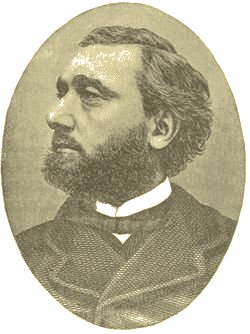
Léon Michel Gambetta was born at Cahors on April 3, 1838. His father was a tradesman dealing in crockery; his mother's maiden name was Massabie. Léon's grandfather was a Genoese, who emigrated to France at the beginning of this century; and as his name signifies, in the dialect of Genoa, a liquid measure of two quarts capacity, it has been supposed that it was conferred upon one of his forefathers as a sobriquet. Léon Gambetta's grandfather was a poor man of no education, and his only son, Léon's father, thought he had done very well for himself when he set up a shop with the small dowry brought him by his wife, Mlle. Massabie. The mother of Léon died while he was a child, and he was indebted for his early teaching to his maternal aunt and to her brother, a priest, who held a small benefice in a village near Cahors. It was at first intended that Léon should follow his father's trade; but, as he was a boy very apt at learning and fond of books, his uncle and aunt decided that it would be better to put him at the seminary, with a view to his ultimately taking holy orders. Léon's father does not seem to have much liked this scheme, for he had no second son who could succeed to his business; but he had a great love for his bright-witted boy, and having conceived a high respect for his talents, yielded to the pleasing idea that he would some day become an ornament to the Church. This belief may be explained by the fact that Léon was, as a child, ardently religious. When twelve years old he wrote an ode dedicated to his "patron, St. Léon, and to all the popes called Léon," and this composition was printed in the Catholic journal of the diocese. In after-years some of his political enemies tried to get hold of a copy, but failed, and published a spurious one which they gave out for his.
The career of Léon Gambetta must continue to exercise over young advocates and journalists the same kind of fascination as that of Napoleon I. does over young officers; and, indeed, the fact that Bonaparte and Gambetta were both of Italian origin, and came to sudden and great power while they were very young, was often quoted to draw a parallel between the two. But there is this difference between Bonaparte and Gambetta, that whereas the latter made his mark in life later by some three or four years than the former, brilliant destinies were prophesied for him by others besides his relations, when he was still a child. While Bonaparte was a pupil at the school of Brienne, his masters predicted that he would make a poor officer, because he had no aptitude for mathematics; when Gambetta was at the seminary, his tutors foretold that he would make a great figure in life, "but never," they regretfully added, "as a churchman." The boy began well, but he had evidently no vocation for the strict discipline of the Church; he was too disputatious, not meek enough about taking blows without returning them, and in short, too headstrong. Anticipating the judgment which M. Grévy passed upon him when he was thirty-three years old, his ecclesiastical masters reported of him that he was un esprit rebelle, turbulent, and they advised his removal to another school.
Young Gambetta was accordingly sent to the lycée—that is, the lay public school—of Cahors, and here he immediately won golden opinions by his cleverness, his industry, and the happy vivacity of his character. One of the half-yearly bulletins of the lycée, which has been preserved in his family, records that he was "passionate without being vindictive, and proud without arrogance." In time he became the best Latin scholar at the school, and the most proficient in French composition. When he was in his sixteenth year, however, an accident, which destroyed his left eye, quelled for a time the exuberance of his character and suddenly gave a new direction to his studies. Fearing lest he should lose his sight altogether, he set himself to learn the alphabet for the blind, in order that he might read in books with raised letters; he also applied himself to the study of music and the violin. During a whole year he was forbidden to open a book.
From Cahors Gambetta went to Paris to study law, and he quickly drew the attention of the Imperial police upon himself by acting as ringleader in those demonstrations which the students of the Latin Quarter were accustomed to make in time of public excitement. Peaceful demonstrations they always were, because the police would stand nothing like rioting, but it was something to march at the head of a procession carrying wreaths to the tomb of a Republican, or to lead cabals for hissing off the stage of the Théâtre Français or the Odéon pieces by unpopular writers, like M. Edmond About (for in those days M. About was a Bonapartist).
Gambetta's first public speech was delivered in 1861, in defence of the Marquis Le Guillois, a nobleman of facetious humor, who edited a comic newspaper called Le Hanneton. He was seized with unexpected nervousness as he began, but before he had stammered out a dozen sentences he was stopped by the presiding judge, who told him mildly that no big words were required in a cause which only involved a fine of 100 francs—"all the less so," added he, "as your client is acquitted."
Gambetta used to say after this that it took him years to recover from the effect of the judge's quiet snub. Like many other young men of talent, he had gone into court expecting to carry everything before him, and had found that the art of forensic pleading is not to be acquired without practice. He did practise most diligently, and the speeches—some thirty in all—which he delivered in unimportant cases during the next seven years, were conspicuous for their avoidance of rhetorical flourish. Adolphe Crémieux had cautioned him that the secret of oratory lies in mastering the subject of one's discourse. "Don't try gymnastic feats until you have a firm platform to spring from"—a maxim which a conceited young man, impatient of results, might have despised, but which commended itself to an ambitious man who felt that, although a chance comes to all, it is an important point to be prepared for the chance when it does come. A plutocrat once asked Horace Vernet to "do him a little thing in pencil" for his album. Vernet did the little thing and asked 1,000 francs for it. "But it only took you five minutes to draw," exclaimed the man of wealth. "Yes, but it took me thirty years to learn to do it in five minutes," replied Vernet. And so Gambetta, when someone remarked that he was very lucky in having conquered renown by a single speech, broke out impetuously, "I was years preparing that speech—twenty times I wanted to deliver it, but did not feel that I had it here (touching his head), though it palpitated here (thumping his breast) as if it would break my heart."
The speech in question was delivered on November 17, 1868, before the notorious Judge Delesvaux (who has been called the Jeffreys of the Second Empire), in defence of Louis Charles Delescluze, editor of the Réveil. The Réveil had started a subscription for erecting a monument to the memory of the Representative Baudin, who was killed at the coup-d'état of 1851, and the Government unwisely instituted a prosecution against the editor. It was late in the afternoon when the case was called on after a number of others, but the sixth chamber was crowded with journalists and barristers, as it always was on Fridays, when Delesvaux—a man with hawk-like features and a flaming complexion—would sit "tearing up newspaper articles with beak and talons," as Émile de Girardin said of him. Just before Gambetta rose, Delesvaux observed, "I suppose you have not much to say; so it will hardly be worth while to have the gas lighted." "Never mind the gas, sir, I will throw light enough on this affair," answered Gambetta; and it was amid the laughter produced by this joke that he began. His genius found vent that day, and he spoke from first to last without a halt. Reviewing his client's case, he brought Napoleon III. himself to book, and recalled the circumstances under which Baudin had died, "defending that Republican Constitution which President Louis Bonaparte, in contempt of his oath, had violated." At this, Judge Delesvaux half rose in his seat and endeavored to stop the speaker, but a positive roar from the whole crowd in court forced him to sit down. It was a sign of the approaching political earthquake that Delesvaux should have sat down in that way, for he was a man of great resolution; but he must have felt then as if the earth were trembling under him. So Gambetta continued to speak, denouncing with unimaginable energy the tyrannies and turpitudes of the reign which had confiscated all the liberties of France, till at last he concluded with this magnificent peroration, which was rendered most solemn by the increasing darkness of the court and the intense attentive silence of the audience: "In every country but this you see the people commemorate as a holiday the date which brought the reigning dynasty to the throne. You alone are ashamed of the day which gave you a blood-stained crown—the December 2d when Baudin died! Well, that day which you reject, we Republicans will keep holy. It shall be the day of mourning for our martyrs and the festival of our hopes!"
When Gambetta left the court after this, it was felt by all who had heard him that he was the coming man of the Republican party; and next day opposition journals of every shade of opinion, from one end of France to the other, acclaimed him as a future leader.
Within the next two years the Republican party made such rapid strides that to regain his prestige the French emperor felt that a glorious war was necessary. The leader of the moderate reformers, M. Ollivier, was won over, and was forced upon Prussia. Gambetta and the Republicans felt that they had every cause for fear when matters had taken this turn. Relying upon Marshal Lebœuf's assurances that "everything was ready," they saw the prospect of a short sensational campaign like that against Austria in 1859, to be followed by some high-handed stroke of home policy that would sweep most of them into prison or exile. Gambetta could not refrain from bitterly upbraiding Ollivier. "You will find that you have been fooled in all this," he said; "for when the war is over you will be thrown aside like a squeezed orange." "I think my fate will be a happier one than yours, unless you mend your manners," answered Ollivier dryly. Three weeks after this, however, everything was changed. The imperial armies had been beaten at Woerth and Forbach; the Ollivier cabinet had fallen amid popular execration (hardly deserved); and Gambetta, forced by circumstances into a position of great influence, received a private visit from Madame Bazaine, who prayed him to agitate that her husband might be appointed as the commander-in-chief of the armies. Gambetta was too sincerely patriotic to feel any partisan satisfaction at the reverse which Napoleon III.'s armies had suffered; and in stirring up the Republicans in the Chamber and in the press to clamor for the appointment of Bazaine, he believed he was urging the claims of a competent soldier who was being kept from the chief command solely by dynastic jealousies. He was to learn, a couple of months later, how much he had been mistaken in his estimate of Bazaine's talents and rectitude of purpose; and, indeed, Bazaine's conduct toward Gambetta and the Republicans from first to last was the more inexplicable, as it was unquestionably owing to their agitation that he was placed in the high position which he had coveted.
During the three weeks between Forbach and Sedan, Gambetta had to take rather exciting precautions to insure his own safety. He was aware that the Empress-Regent's advisers were urging her to have the leaders of the opposition arrested, and he felt pretty certain that this course would be adopted if the news of a victory arrived. He used to sleep in a different house every night, and never ventured abroad unattended or without firearms. His position was one of great difficulty, for agents of the Internationale made overtures to him with a view to promote an insurrection in Paris, and he forfeited the confidence of these fanatics by declining to abet their plans. Gambetta was so little desirous of establishing a republic by revolution that, even when the tidings arrived on the night of September 3d of the emperor's surrender at Sedan, his chief concern was as to how he could get the deposition of Napoleon III. and the Empress-Regent effected by lawful methods. He hastened to M. Thiers's house, and asked him whether he would accept the presidency of a provisional government? Thiers, sitting up in bed, said he was willing, provided that this office was conferred upon him by the Corps Législatif.
Accordingly, Gambetta spent all the morning of Sunday, September 4th, whipping up members of the majority, and trying to persuade them to go down to the Palais Bourbon and elect a new government. But he found most of these gentlemen anxious to get off to the different railway stations as soon as possible in cabs. Going to the Chamber himself toward one o'clock, he was carried through the doors by the surging mob which invaded the palace, and in half an hour he shouted himself quite hoarse in adjuring the crowds from the tribune to let the Assembly deliberate in peace. But while he was literally croaking in his attempts to make the people hear reason, news was brought to him that M. Blanqui and some other adventurous spirits, taking time by the forelock, had repaired to the Hôtel de Ville, and were setting up a government of their own. Upon this, Gambetta precipitately left the palace, jumped into a victoria, and drove to the Hôtel de Ville, amid a mob of several thousands of persons who escorted him, cheering all the way. Before five o'clock the deputies for Paris, with the exception of M. Thiers, had constituted themselves into a government, which, at the suggestion of M. Rochefort, took the name of Government of the National Defence; and M. Gambetta received the appointment of Minister of the Interior. It may be remarked in passing that on the day after these events, Judge Delesvaux, fearing, perhaps needlessly, that some of the triumphant Republicans whom he had so often punished would wreak vengeance upon him, committed suicide. On the other hand, Gambetta's client in the Baudin affair—L. C. Delescluze—came to him on the morning of September 5th, and reproached him with much asperity for not having caused the empress to be arrested. "We want no rose-water Republicans to rule us," said this honest, but gloomy, zealot, who was shot a few months later during the extermination of the Commune.
The siege of Paris brought M. Gambetta to the most romantic part of his career. The National Defence Government had delegated two of their members, MM. Crémieux and Glaiz-Bizoin, to go to Tours and govern the provinces; but being both elderly men of weak health, they were hardly up to their work; and early in October M. Gambetta was ordered by his colleagues to join them. He had to leave Paris in a balloon, and in going over the German lines nearly met with misadventure, through the balloon sinking till it came within range of some marksmen's rifles. He reached Tours in safety, however, and set to work at once with marvellous activity to organize resistance against the invasion. He was ably seconded by M. de Freycinet, and between them these two did all that was humanly possible to perform; but from the first their task was one of formidable difficulty, and all chances of repelling the Germans from French soil vanished after the shameful capitulation of Bazaine at Metz.
Nevertheless, all who saw M. Gambetta during his proconsulate at Tours will remember with what a splendid energy he worked, how sincerely hopeful he was, and—this must not be forgotten—how uniformly generous and genial. Invested with despotic powers, he never once abused them to molest an opponent.
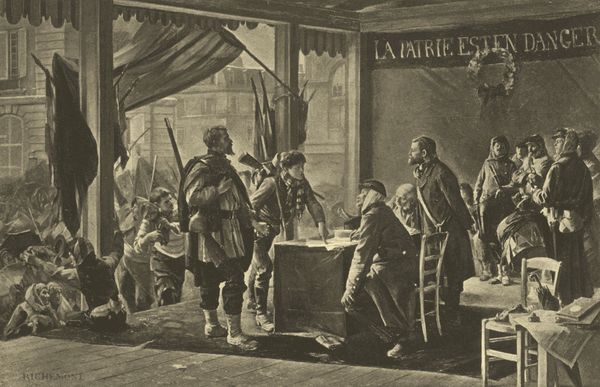
The enrollment of volunteers, 1870.
In his public harangues, both at Tours and Bordeaux (whither the Provisional Government repaired in December, being driven southward by the German advance), he somehow always managed to electrify his hearers. He spoke from balconies, railway carriages, curb-stones; wherever he went the people demanded a speech of him, and his words never failed to cheer, while they conquered for him a wide popularity. Indeed, Gambetta so deluded himself while diffusing hope and combativeness into others, that when, after a five months' siege, Paris capitulated, he still persisted in thinking that resistance was possible, and rather than take any part in the national surrender he gave in his resignation. He was by that time fairly worn out, and had to go to St. Sebastian to recruit his health. It was alleged that he went there so as to avoid taking any side in the civil war between the Parliament of Versailles and the Commune; but after the Communist Government had been at work a fortnight, and when the impracticability of its aims was fully disclosed, he took care to let it be known that he was on the side of the National Assembly.
M. Thiers did not understand Gambetta as Gambetta understood him, or he would not have resigned in 1873, saying that the Republicans were making his work too difficult. When Marshal MacMahon succeeded to the Presidency it looked as if the Republic were doomed, and nothing but M. Gambetta's wonderful suppleness and tact during the sessions of 1874-75 could have saved it. He had to keep himself in the background, to use an Italian astuteness in explaining away the blunders of his followers; and when this would not do he had to use violent language, which should frighten timid doctrinaire Orleanists with prospects of popular risings in which he would take the lead. His greatest triumphs were earned when, by dint of superhuman coaxing in the lobbies, he got the Republic proclaimed as the Government of France (in 1875, on M. Wallon's motion) by a majority of one vote; and again when, at the first election for life senators, he concluded a treaty with the Legitimists, and by giving them a dozen seats, secured fifty for the Republicans and ousted the Orleanists altogether.
From this time the Republic was founded with at least temporary security, and although a coalition of all the reactionary parties rallied against it in 1877, when M. Jules Simon's ministry was dismissed, and when the Duc de Broglie was induced to try to destroy the new form of government by Cæsarist methods, yet there was never any real danger that the Republic would succumb. From the day when M. Thiers died, M. Gambetta stood guarding it like a sentinel. Just before the general election of 1877, an emissary was sent to him from the De Broglie-Fourtou Ministry, requesting him for his own sake not to make a speech against Marshal MacMahon. He laughed when he heard that he would be prosecuted if he made the speech. He was twirling a cigarette, and laid down a copy of the Revue des Deux Mondes in which he had been reading an essay on Mr. Gladstone's speeches about the Irish Church. "Tell the Prime Minister," he said, "that I will speak from a pedestal if I can, but if not, from a housetop. In one way or another, my voice shall reach further than his, and so long as I have a drop of blood to shed the Republic shall not fall." M. Gambetta was sentenced to four months' imprisonment for the speech in which he said that Marshal MacMahon would have to yield to the popular will or resign, but before he could be put into jail the De Broglie cabinet had ceased to exist. Marshal MacMahon's resignation in 1879 was the obviously natural consequence of the complete victory which the Republicans gained in 1877; but it was greatly to M. Gambetta's credit that he quietly tolerated during fifteen months the presidency of the gallant soldier who had never been his friend. When urged to agitate for the marshal's overthrow, he always said, "It will do the Republic good if its first president serves his term of office quietly to the end."
Had Gambetta lived till 1885 he would probably have been the next president of the Republic he had established and preserved; but it was not to be. His work was done. He died December 31, 1882.[Back to Contents]
BENJAMIN DISRAELI[16] By Harriet Prescott Spofford (1804-1881)
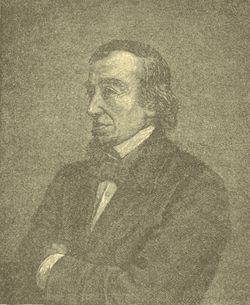
Since the days of Richelieu, there has been no such picturesque figure in the history of civilization as that of Benjamin Disraeli.
Although his father, Isaac Disraeli, was in much more than easy circumstances and had made a literary reputation, he was under the social disadvantage that was the portion of a Jew, and his mother, Maria Basevi, was of the same despised race.
Their son was born in London, December 21, 1804, and his birth was attended by the usual Jewish ceremonies in the Spanish synagogue. When he was thirteen years old his father formally withdrew from the Jewish congregation, and the children were baptized into the Christian faith, Benjamin's godfather being Sharon Turner. The boy was early seen to have rare talents, and he was already an immense reader in his father's vast library. It was decided to give him an exact education and send him to one of the large schools, where he should have the advantage of discipline and the opportunity of desirable friendships; but the prejudice against his birth was an obstacle—life would have been made impossible by the indelicacy and cruelty of the high-born and Christian lads. He was finally sent to a school where he found himself the superior of his masters; even there he was taunted with his birth; and he was taken home to work with his father and with tutors, where, conscious of his powers and full of lively ambition, he studied twelve hours a day, and made himself the master of a vast and varied information. At seventeen he entered a solicitor's office, and while working there for three years, entered at Lincoln's Inn, he evinced an ability that promised him great eminence. It was not, however, precisely the sort of eminence that he desired, the strifes and achievements of political life being more to his taste.
He had the qualities which fitted him for that life, the "taking arts" and accomplishments; he was a fine linguist; he had a wonderfully well-stored memory, great self-confidence, self-respect, and assurance; his manners were easy, and he had all social graces and refinements; his face was singularly handsome, and remarkable through its pallor, the depth of its black eyes, and delicacy of its chiselled features framed in night-dark curls; he was a master of the art of self-defence, a hard and fine rider, and he was equipped with wit, sarcasm, poetical perception, keen reason, unbounded ambition, and undaunted courage.
He dressed in his early years in a manner that has been described as extraordinary, but which was the manner of the young men of the period, of D'Orsay and of Bulwer, at the time when Tennyson called the latter a band-box. Later his dress was more negligent, although always neat and fine.
He was on pleasant terms with the distinguished people whom he met at his father's table, and was everywhere sought in society, when, at twenty, he began his career by the publication of "Vivian Grey," a novel, unlike anything that had been written, bristling with point and sally, and full of daring portraiture, and which made him immediately famous.
His health, however, now gave way, a trouble in his head making it necessary to suspend work; and after a tour of Europe he remained for two or three years at Bradenham, near High Wycombe, his father's country-house, happy in the companionship of his father and mother, and his thoroughly congenial sister Sarah; passionately fond of country life, and during the time producing a novel, "The Young Duke," and three shorter works, "Popanilla," "The Infernal Marriage," and "Ixion in Heaven," gay and brilliant satires, sparkling with epigram and with beauty, and destined to live with the English language and English history.
In company with Mr. Meredith, to whom his sister was promised in marriage, he journeyed for the next two years through the south of Europe and the East. Spain was among the first of his objective points, in the proud memory of his descent from the Spanish nobles who, driven out of Spain in the fifteenth century, went over to Venice, and changed the name belonging to the House of Dara to that of D'Israeli, the sons of Israel—a cognomen never borne by any other family—and remained there for two hundred years, going to England only when, Venice falling into decay, it was necessary to go where they could live in safety. He wrote the account of his travels to his sister in a series of affectionate and light-hearted letters, which charmingly betray his own personality, and which are full of the most vivid pictures of Malta, Corfu, Albania, the Plains of Troy, Turkey—which was kind to his race when a cruel and unreasoning world showed it only malignant hate, and which he regarded with the gratitude that never forsakes a Jew; Cyprus, the advantage of whose possession he early recognized; Egypt, whose destinies were afterward in his hand; and Jerusalem, the holy city of his people, his impressions of which "Tancred" afterward embodied, together with a foreshadowing of much of his policy in the East. The journey made him acquainted with the theatre of his intentions, and with the prepossessions which it gave or fostered, doubtless had a great influence upon his life and action. The close of the journey was darkened by the death of his companion, for whom his sister mourned as long as she lived.
After his return home he wrote a new novel, "Contarini Fleming," a wonderful and poetical study of temperament, which Milman pronounced the equal of "Childe Harold," which Goethe and Heine and Beckford, the author of "Vathek," praised with delighted warmth. The "Wondrous Tale of Alroy," also, published a little later, with "The Rise of Iskander," Beckford found stirring and full of intensity and charm.
In 1832 Disraeli offered himself as an independent candidate for the borough of High Wycombe. The Government of course defeated him; and not until after several hot contests during the next few years, did he gain his end, taking his seat, then at the age of thirty-three, in Queen Victoria's first Parliament. The character of the struggle at these elections may be inferred from O'Connell's declaration in one of them, that in all probability this "Disraeli was the heir-at-law of the blasphemous thief that died on the cross." Disraeli challenged O'Connell's son, who failed to accept the challenge. But Disraeli never cherished a grudge; and only three weeks after he entered Parliament he risked his seat there by a pointed statement of the misgovernment of Ireland. Neither did O'Connell bear malice, and he said of one of Disraeli's speeches, somewhat later, that "it was all excellent except the peroration, and that was matchless." Not only in O'Connell's case was this impossibility in Disraeli's nature of doing anything ignoble shown; he secured, when in power, a life-pension to the widow and children of the artist Leech, who had for half a lifetime showered him with the cruel ridicule of the caricaturist; and he offered the Grand Cross of the Bath, and a life-income suitable to the maintenance of its dignity, to Carlyle, who had pursued him now with contempt and now with malignity. In the intervals of the electoral contests a series of letters to The Times, filled with biting sarcasm, under the signature of "Runnymede;" a novel—"Henrietta Temple;" a "Vindication of the British Constitution," dedicated to Lord Lyndhurst; a contrasting presentation of the characters of Byron and Shelley, in the form of romance, under the title of "Venetia," sufficiently occupied Disraeli's time. He was, meanwhile, in the vortex of gay social life, a member of the Carlton Club, the friend of Count D'Orsay, Lady Blessington, Mrs. Norton, Lady Dufferin, Bulwer, Tom Moore, Lady Morgan, of Lyndhurst, of the public men and of the men of fashion, and he was courted by princes and pretty women. He had come to Parliament prepared as few or none before him, with coolness, courage, wit, and eloquence, and with a far-seeing sagacity that enabled him to make the most of something like the gift of prophecy. But he was handicapped with the fact of his race, with his debts, which, although he was not personally extravagant or at all self-indulgent, had become heavy, with the absence of a constituency or a popular cause; and having no landed property, nor belonging even remotely to any great family, he was looked upon both by Whig and Tory as more or less of an adventurer.
Like almost all young men, his first preferences and professions were for reform. But brought face to face with responsibility he modified his opinions; and the great power and place that he ultimately won, were won through the originality, the thought, the force, and the independence that dared act without reference to his own advantage, and the splendid courage that was undismayed by any odds. Although he could have acquired office in the earlier years by withholding open expression of his opinions, he preferred his freedom; and although always in want of money, he never made a penny by means of the place or the power that he won, or even through the legitimate opportunities which these offered.
His first speech in Parliament was attended by peculiar circumstances. A number of the ruder members of the opposition were determined that he should not be heard, and they drowned every sentence in derisive cheers and mocking yells. Disraeli bore it with dignity, but as it was impossible to proceed in the noisy and barbarous din, he closed by saying that he had begun several times many things, and had succeeded at last; and then in a tone that resounded even above the clamor, for he had at all times a sonorous and impressive voice, he cried, "I will sit down now. But the time will come when you will hear me!" Of this speech Peel said it was anything but failure; and Sir John Campbell, the Attorney-General, assured him that there was a lively desire in the opposing party to hear him, but they were hindered by a coterie over whom they had no control. In describing the scene, in a letter to his sister that night, with great frankness, as disastrous, Disraeli signed himself, "Yours in very good spirits." When he spoke, a week afterward, he commanded the attention of the House.
Disraeli had always declared that no government should have his support which did not seek to improve the condition of the poor; and as he looked at the British constitution and social construction, he believed that the Conservatives were the best able to accomplish this end. Because he was a Jew he was none the less an Englishman, and he had the true interests of the United Kingdom at heart. He held that the strength of England lay in the land, and he supported the corn laws from stern principle. "It will be an exception to the principles which seem hitherto to have ruled society," he exclaimed, "if you can maintain the success at which you aim, without the possession of that permanence and stability which the territorial principle alone can afford. Although you may for a moment flourish after their destruction, although your ports may be filled with shipping, your factories smoke on every plain, and your forges flame in every city, I see no reason why you should form an exception to that which the page of history has mournfully recorded, that you should not fade like Tyrian dye, and moulder like the Venetian palaces."
He was already, in 1839, to a certain extent, a power in Parliament, launching the shafts of his sarcasm alike at the Chancellor of the Exchequer or an Under Secretary; and in this year he published his tragedy of "Count Alarcos," and married Mrs. Wyndham Lewis, the wealthy widow of his friend and colleague, several years his senior, but through thirty years his invaluable friend and confidante. In dedicating "Sybil" to her, he said, "I would inscribe this work to one whose noble spirit and gentle nature ever prompt her to sympathize with the suffering; to one whose sweet voice has often encouraged and whose taste and judgment have ever guided its pages, the most severe of critics, but a perfect wife." Her devotion to him was illustrated by her behavior one night when, on the eve of an exciting session, she drove with him to Palace Yard, and her hand being crushed in the carriage-door, she gave no sign, lest it should disturb his train of thought and lessen his power in the approaching debate, and endured her agony without blenching till he had left her. He rewarded such devotion in kind, his happiest hours were those spent in her society, and perhaps the proudest moment of his life was that when, the Queen having offered him a peerage, he declined it for himself but accepted it for his wife, and made her Viscountess Beaconsfield in her own right.
Immediately upon their marriage Mr. Disraeli travelled with his wife for a couple of months on the continent; and returning to London he received the congratulations of Peel, Wellington, and others, and began to entertain the party chiefs; he dined privately with Louis Philippe in Paris, shook hands with the King of Hanover in London, and in every way took his social and personal position firmly. In Parliament he crossed swords with Palmerston, refused his support to Peel's Coercion Bill in relation to Ireland, characterizing it as one of those measures which to introduce was degrading, and to oppose disgraceful; later he maintained that as revolution was the only remedy for the wrongs of Ireland, and as her connection with England prevented revolution, therefore it was the duty of England to effect by policy what revolution would effect by force, and as he had defended the Chartist petition, so in turn, when the Eastern Question came up, he defended Turkey; in all this making it supremely plain that he never was the one to truckle to rank or authority. He was the head of the small party of Young Englanders; he was feared and respected by both the larger parties; and the Commons, whose assemblage he had scornfully proclaimed a thing of past history, if they did not choose, had presently to accept him for their leader.
Henry Hope, entertaining a number of their friends at Deepdene, urged Disraeli to treat the questions of common interest in a literary form, and the powerful works—rather treatises than novels—"Coningsby" and "Sybil," appeared; and these were followed by "Tancred," in which the curious reader will find much of Disraeli's Eastern policy indicated. These three books the author regarded as a trilogy upon English politics, principles, and possibilities.
As a debater, then and always, Disraeli was keen, ready, and unanswerable; as a satirist, swift, subtle, and finished. His epigrams were among the "jewels that on the stretched forefinger of all time sparkle forever." It was he that said "Destiny is our will, and our will is nature." At another time he said, "The critics—they are those who have failed in literature and in art." When Prince Napoleon was slain he exclaimed, "A very remarkable people the Zulus: they defeat our generals, they convert our bishops, they have settled the fate of a great European dynasty." Every one remembers the startling sentence in which he condemned Mr. Gladstone's Irish policy of 1868: "We have legalized confiscation; we have consecrated sacrilege; we have condoned treason." And his power of picturesque mockery appears in a speech made, in 1872, immediately before the downfall of the Gladstone ministry: "As I sat opposite the Treasury bench the ministers reminded me of those marine landscapes not unusual on the coasts of South America. You behold a range of exhausted volcanoes. Not a flame flickers on a single pallid crest. But the situation is still dangerous. There are occasional earthquakes, and ever and anon the dark rumbling of the sea." His attacks on Peel have been pronounced to be among the most remarkable speeches in the annals of the British Legislature. In 1849, at which period also he wrote the biography of his father and the memoir of his friend Lord George Bentinck, he was the recognized leader of the Conservatives. When Peel was overthrown, Disraeli, who had overthrown him, after a brief period, succeeded to his place.
It was not with cordiality that the Conservatives submitted to Disraeli's direction. He had carried himself in relation to them with an unsurpassed independence. He was of a people whom they held in contempt, and whose admission to Parliament he had enforced. In his speeches he had spared none of them. He had no friend at court, and he was still very young. But there was no help for it—he was master of the situation, and master of them. He was now thrice Chancellor of the Exchequer; and for a quarter of a century he led the opposition in the House of Commons, except in the brief intervals when he was identified with the Government. In leading the opposition he was never an obstructionist; and he lent his aid to every generous measure, such as the reduction of the hours of labor, the protection of factory children, the improvement of the homes of the poor, the extension of the suffrage. He refused English interference on the side of the South during the Civil War in the United States of America; he hindered disastrous hostilities with France at the time of Louis Napoleon's coup-d'état; he would have prevented the Crimean War had it been possible; and he would not allow retaliation in kind for the Sepoy atrocities. He did the most and the best with his opportunities. His policy was always to develop and sustain English character. "There is no country," he said in a remarkable warning to the House, "at the present moment that exists under the same circumstances and under the same conditions as the people of this realm. You have an ancient, powerful, and richly endowed Church, and perfect religious liberty. You have unbroken order and complete freedom. You have landed estates as large as the Romans, combined with a commercial enterprise such as Carthage and Venice united never equalled. And you must remember that this peculiar country, with these strong contrasts, is not governed by force. It is governed by a most singular series of traditionary influences, which generation after generation cherishes and preserves, because it knows that they embalm custom and represent law. And with this you have created the greatest empire of modern times. You have amassed a capital of fabulous amount. You have devised and sustained a system of credit still more marvellous, and you have established a scheme so vast and complicated of labor and industry that the history of the world affords no parallel to it. And these mighty creations are out of all proportion to the essential and indigenous elements and resources of the country. If you destroy that state of society, remember this: England cannot begin again."
In religion Disraeli accepted Christianity fully—but as a completion of the Hebrew revelation. He coupled in thought and word "the sacred heights of Sinai and of Calvary." He was proud of his great people, and never hesitated to declare his pride. "All the north of Europe worship a Jew," he said, "and all the south of Europe worship a Jew's mother." In spite of the fact that he was an Asiatic by nature, he despised what he called the pagan ceremonies of the ritualists, and distrusted what he felt to be the atheistic tendency of science.
Shortly after his father's death, Mr. Disraeli had purchased with his paternal inheritance the manor of Hughenden, near Bradenham, in whose park his wife erected a monument to his father; and there, in the intervals of public business, he found quiet and enjoyment with his peacocks and swans and owls, his gardening, his tenantry. His books brought him in great sums of money; a friend, Mrs. Brydges Willyams, of Torquay, after twelve years of romantic intimacy with him and his wife, bequeathed him a fortune, and lies buried by the side of himself and Lady Beaconsfield at Hughenden. His circumstances were easy, his fame was assured, and when he went down to Parliament for the first time after he became Prime Minister, the crowds outside cheered him to the echo, the crowds within took up the acclaim, and the House that once had silenced him with derisive mockery, hailed with wild welcome this man who, without money, without birth, without support, had made himself, by force of will, courage, genius, loyalty, and truth, the ruler of the British Empire.
While he was again in opposition Mr. Disraeli took occasion to write "Lothair," a precise portraiture of the British aristocracy and a clear presentation of its relation to the Church, the spirit of revolution, the intrigues of the ultramontanes, the simplicity of true religion; every page splendid with wit and with picturesque charm. During another period of enforced leisure he wrote "Endymion," in which there are some slight autobiographical features.
In public or in private Disraeli never did a dishonorable action. He never attacked the weak or the defenceless, but singled out the proudest adversary. He never held malice. His impulses were always the most generous, his ideas and his purposes of the largest. He desired in all things the good of his country, and he sought it by what seemed to him, whether or not he was mistaken, the surest and loftiest ways.[Back to Contents]

WILLIAM EWART GLADSTONE By Justin McCarthy (Born 1809)
William Ewart Gladstone, statesman, orator, and author, was born in Rodney Street, Liverpool, on December 29, 1809. He is the fourth son of Sir John Gladstone (1764-1851), a well-known, and it might almost be said a famous, Liverpool merchant, who sat for some years in Parliament, and was a devoted friend and supporter of George Canning. Mr. Gladstone is of Scotch descent, on both sides, and has declared more than once in a public speech that the blood that runs in his veins is exclusively Scottish. He was educated at Eton and at Christ Church, Oxford. He became a student at Oxford in 1829, and graduated as a double first-class, in 1831. He had distinguished himself greatly as a speaker in the Oxford Union Debating Society, and had before that time written much in the Eton Miscellany, which indeed he helped to found. He appears to have begun his career as a strong opponent of all advanced measures of political reform. In the Oxford Union he proposed a vote of censure on the government of Lord Grey for introducing the great Reform Bill which was carried in 1832, and on the Duke of Wellington, because of his having yielded to the claims for Catholic emancipation. He also opposed a motion in favor of immediate emancipation of the slaves in the West Indian islands. He soon became known as a young man of promise, who would be able to render good service to the Conservative party in the great struggle which seemed likely to be forced upon them—a struggle, as many thought, for their very existence. It was a time of intense political emotion. Passion and panic alike prevailed. The first great "leap in the dark" had been taken; the Reform Bill was carried, the sceptre of power had passed away from the aristocracy and the privileged ranks to the middle and lower middle classes. The Conservative party were looking eagerly out for young men of promise to stiffen their ranks in the new parliament, the first elected under the Reform Bill, the first which the middle class had their due share in creating; the first in which such cities as Manchester and Liverpool and Birmingham were allowed to have representation.
Mr. Gladstone was invited to contest the burgh of Newark in the Conservative interest, and he had the support of the great Newcastle family. He stood for Newark, and he was elected. He delivered his maiden speech on a subject connected with the great movement for the emancipation of the West Indian slaves; but he seems to have confined himself mainly to a defence of the manner in which his father's estates were managed, the course of the debate having brought out some charge against the management of the elder Gladstone's possessions in one of the West Indian islands. The new orator appears to have made a decided impression on the House of Commons. His manner, his voice, his diction, his fluency were alike the subject of praise. Mr. Gladstone evidently continued to impress the House of Commons with a sense of his great parliamentary capacity. We get at this fact rather obliquely; for we do not hear of his creating any great sensation in debate; and to this day some very old members of the House insist that for a long time he was generally regarded as merely a fluent speaker, who talked like one reading from a book. But on the other hand, we find that he is described by Macaulay, in 1839, as "the rising hope" of the "stern and unbending Tories," and the whole tone of Macaulay's essay—a criticism of Gladstone's first serious attempt at authorship, his book on the relations between church and state—shows that the critic treats the author as a young man of undoubted mark and position in the House of Commons.
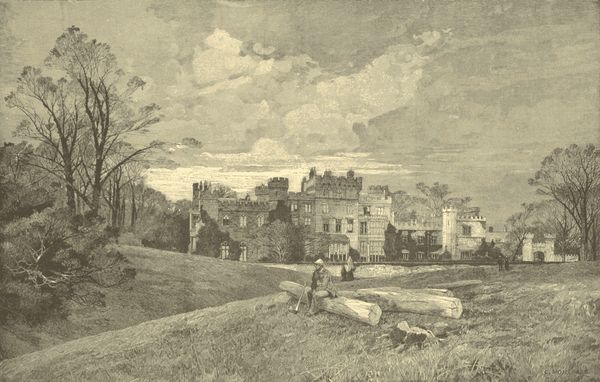
Hawarden Castle, the home of Gladstone.
In December, 1834, Sir Robert Peel appointed Gladstone to the office of a Junior Lord of the Treasury. In the next year Peel, who was quick to appreciate the great abilities and the sound commercial knowledge of his new recruit, gave to him the more important post of Under-secretary for the Colonies. Gladstone looked up to Peel with intense admiration. There was much to draw the two men together. Knowledge of finance, thorough understanding and firm grasp of the principles on which a nation's business must be conducted—perhaps, it may be added, a common origin in the middle class—these points of resemblance might well have become points of attraction. But there were other and still higher sympathies to bring them close. The elder and the younger man were alike earnest, profoundly earnest; filled with conscience in every movement of their political and private lives; a good deal too earnest and serious, perhaps, for most of the parliamentary colleagues by whom they were surrounded. Mr. Gladstone always remained devoted to Peel, and knew him perhaps more thoroughly and intimately than any other man was privileged to do. Peel went out of office very soon after he had made Mr. Gladstone Under-secretary for the Colonies. Lord John Russell had brought forward a series of motions on the ominous subject of the Irish Church, and Peel was defeated and resigned. It is almost needless to say that Gladstone went with him. Peel came back again in office in 1841, on the fall of the Melbourne administration, and Mr. Gladstone became Vice-president of the Board of Trade and Master of the Mint, and was at the same time sworn in a member of the Privy Council. In 1843 he became President of the Board of Trade. Early in 1845 he resigned his office because he could not approve of the policy of the government with regard to the Maynooth grant.
The great struggle on the question of the repeal of the Corn Laws was now coming on. It would be impossible that a man with Mr. Gladstone's turn of mind and early training could have continued a protectionist, when once he applied his intellect and his experience to a practical examination of the subject. Once again he went with his leader. Peel saw that there was nothing for it but to accept the principles of the Free Trade party, who had been bearing the fiery cross of their peaceful and noble agitation all through the country, and were gathering adherents wherever they went.
It is a somewhat curious fact that Mr. Gladstone was not in the House of Commons during the eventful session when the great battle of free trade was fought and won. In thorough sympathy with Peel, he had joined the government again as Colonial Secretary. Knowing that he could no longer be in political sympathy with the Duke of Newcastle, whose influence had obtained for him the representation of Newark, he had given up his seat, and did not come into Parliament again until the struggle was over. At the general elections in 1847, Mr. Gladstone, still accepted as a Tory, was chosen one of the representatives for the University of Oxford.
Up to the time of the abolition of the Corn Laws, or at least of the movement which led to their abolition, Mr. Gladstone had been a Tory of a rather old-fashioned school. The corn-law agitation probably first set him thinking over the possible defects of the social and legislative system, and showed him the necessity for reform at least in one direction. The interests of religion itself at one time seemed to him to be bound up with the principles of the Tory party; and no doubt there was a period of his career when the principle of protection would have seemed to him as sacred as any other part of the creed. With a mind like his, inquiry once started, must go on. There was always something impetuous in the workings of his intellect, as well as the rush of his sympathy. He startled Europe, and indeed the whole civilized world, by the terrible and only too truthful description which he gave, in 1851, of the condition of the prisons of Naples under the king who was known by the nickname of "Bomba," and the cruelties which were inflicted on political prisoners in particular. Again and again, in Mr. Gladstone's public life we shall see him carried away by the same generous and passionate emotion on behalf of the victims of despotic cruelty in any part of the world. Burke himself could not be more sympathetic, more earnest, or more strong.
By the death of Sir Robert Peel, in 1850, Mr. Gladstone had lost a trusted leader, and a dear friend. But the loss of his leader had brought Gladstone himself more directly to the front. It was not till after Peel's death that he compelled the House of Commons and the country to recognize in him a supreme master of parliamentary debate. The first really great speech made by Mr. Gladstone in Parliament—the first speech which would fairly challenge comparison with any of the finest speeches of a past day—was made in the debate on Mr. Disraeli's budget in the winter of 1852, the first session of the new Parliament. Mr. Disraeli knew well that his government was doomed to fall. He knew that it could not survive that debate. It was always one of Mr. Disraeli's peculiarities that he could fight most brilliantly when he knew that his cause was already lost. That which would have disheartened and disarmed other men, seemed only to animate him with all Macbeth's wild courage of despair. Never did his gift of satire, of invective, and of epithet show to more splendid effect than in the speech with which he closed his part of the debate, and mercilessly assailed his opponents. Mr. Disraeli sat down at two o'clock in the morning, and then Mr. Gladstone rose to reply to him. Most men in the House, even on the opposition side, were filled with the belief that it would be impossible to make any real impression on the House after such a speech as that of Mr. Disraeli. Long before Mr. Gladstone had concluded, everyone admitted that the effect of Mr. Disraeli's speech had been outdone and outshone. From that hour Mr. Gladstone was recognized as one of the great historic orators of the English Parliament—a man to rank with Bolingbroke and Chatham and Pitt and Fox. With that speech began the long parliamentary duel between these two great masters of debate, Mr. Gladstone and Mr. Disraeli, which was carried on for four and twenty years.
On the fall of the short-lived Tory administration, Lord Aberdeen came into office. He formed the famous Coalition Ministry. Lord Palmerston took what most people would have thought the uncongenial office of Home Secretary. Lord John Russell became Secretary of Foreign Affairs. Mr. Gladstone, who with others of the "Peelites," as they were called, had joined the new administration, was Chancellor of the Exchequer. His speech on the introduction of his first budget was waited for with great expectation, but it distanced all expectation. It occupied several hours in delivery, but none of those who listened to it would have wished it to be shortened by a sentence. It may be questioned whether even the younger Pitt, with all his magic of voice, and style, and phrase, could lend such charm to each successive budget as Mr. Gladstone was able to do. A budget speech from Mr. Gladstone came to be expected with the same kind of keen, artistic longing as waits the first performance of a new opera by some great composer. A budget speech by Mr. Gladstone was a triumph in the realm of the fine arts.
The Crimean War broke up the Coalition Ministry; but the year 1859 saw Lord Palmerston back again in office, and Mr. Gladstone in his old place as Chancellor of the Exchequer. The budget of 1860 was remarkable, as it contained the provisions for the reduction of the wine duties and the whole simplified system of taxation intended to apply to the commercial treaty which Mr. Cobden had succeeded in persuading the Emperor of the French to accept. Mr. Gladstone also introduced a provision for the abolition of the duty on paper—a duty which was simply a tax upon reading, a tax upon popular education. The House of Lords struck out this clause; a somewhat impassioned popular agitation followed; and in the next session the Lords passed the measure for the repeal of the duty without offering any further opposition. The death of Lord Palmerston, in 1865, called Lord Russell to the position of prime-minister, and made Mr. Gladstone leader of the House of Commons. Mr. Gladstone's mind had long been turning in the direction of an extension, or rather expansion, of the suffrage. It was assumed by everyone that Lord Russell and Mr. Gladstone being now at the head of affairs, a reform bill would be sure to come. It did come; a very moderate and cautious bill, enlarging the area of the franchise in boroughs and counties. The Conservative party opposed it, and were supported in their opposition by a considerable section of the Liberals, who thought the measure was going too far on the road to universal suffrage and the rule of the democracy. The bill was defeated, and the Liberal statesman went out of office (1866). Mr. Gladstone had carried his point, however, for when Mr. Disraeli came into office he saw that a reform bill was inevitable, and he prepared his party, or most of them, for the course which would have to be taken. In the very next session Mr. Disraeli introduced a reform bill of his own, which was enlarged and expanded until it became practically a measure of household suffrage for cities and boroughs.
Somewhere about this time the attention of Mr. Gladstone began to be attracted to the condition of Ireland. The distressed and distracted state of Ireland, the unceasing popular agitation and discontent, the Fenian insurrection, brought under England's very eyes by the schemes for an attack on Chester Castle—all these evidences of malady in Ireland's system led Mr. Gladstone to the conviction that the time had come when statesmanship must seek through Parliament for some process of remedy. Mr. Gladstone came after a while to the conclusion that the Protestant State Church in Ireland must be disestablished and disendowed, that the Irish land tenure system must be reformed, and that better provision must be made for the higher education of the Catholics of Ireland. He made short work with the Irish State Church. He defeated the government on a series of resolutions foreshadowing his policy; the government appealed to the country, the Liberals returned to power, and Mr. Gladstone became prime minister (1868). In his first session of government he disestablished and disendowed the State Church in Ireland. In the next session he passed a measure which for the first time recognized the right of the Irish tenant to the value of the improvements he had himself made at his own cost and labor. Never probably was there such a period of energetic reform in almost every direction as that which set in when Mr. Gladstone became prime-minister. For the first time in English history a system of national education was established. The Ballot Act was passed for the protection of voters. The system of purchase in the army was abolished by something, it must be owned, a little in the nature of a coup-d'état. Then Mr. Gladstone introduced a measure to improve the condition of university education in Ireland. This bill was intended almost altogether for the benefit of Irish Catholics; but it did not go far enough to satisfy the demands of the Catholics, and in some of its provisions was declared incompatible with the principles of their Church. The Catholic members of the House of Commons voted against it, and with that help the Conservatives were able to throw out the bill (1873). Mr. Gladstone tendered his resignation of office. But Mr. Disraeli declined just then to take any responsibility, and Mr. Gladstone had to remain at the head of affairs. The great wave of reforming energy had, however, subsided in the country. The period of reaction had come. The by-elections began to tell against the Liberals. Mr. Gladstone suddenly dissolved Parliament and appealed to the country, and the answer to his appeal was the election of a Conservative majority. Mr. Disraeli came back to power, and Mr. Gladstone retired from the leadership of the House of Commons (1874).
For a while Mr. Gladstone occupied himself in literary and historical studies, and he published essays and pamphlets. But even in his literary career Mr. Gladstone would appear to have always kept glancing at the House of Commons, as Charles V. in his monastery kept his eyes on the world of politics outside. The atrocious conduct of the Turkish officials in Bulgaria aroused his generous anger, and he flung down his books and rushed out from his study to preach a crusade against the Ottoman power in Europe. The waters rose and lifted him, whether he would or no, into power. The Parliament which had gone on from the spring of 1874 was dissolved in the spring of 1880, and the Liberals came in with an overwhelming majority. The period of reaction had gone, and the period of action was come again. Mr. Gladstone had to become prime-minister once more. His name was, to adopt the phraseology of continental politics, the only name that had come out of the voting urns.
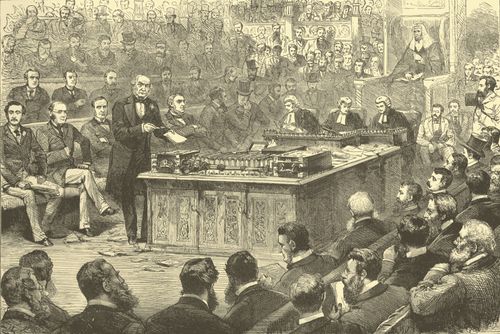
Gladstone's first home rule bill.
It was an unpropitious hour at which to return to office. There were troubles in Egypt; there was impending war in the Soudan and in South Africa. There was something very like an agrarian revolution going on in Ireland; and the Home Rule party in the House of Commons was under new, resolute, and uncompromising leadership. Mr. Gladstone succeeded, nevertheless, in carrying what might be called a vast scheme of parliamentary reform, a scheme which established something very near to universal suffrage, arranged the constituencies into proportionate divisions, extinguished several small boroughs, leaving their electors to vote in their county division, and in general completed the work begun in 1832, and carried further in 1867. It is to the credit of the Conservative party that after a while they co-operated cordially with Mr. Gladstone in his reforming work of 1885. This was a triumph for Mr. Gladstone of an entirely satisfactory character; but he had sore trials to counterbalance it. He found himself drawn into a series of wars in North and South Africa; and he, whose generous sympathy had of late been so much given to Ireland, and who had introduced and carried another land bill for Ireland, found that in endeavoring to pass the measures of coercion, which the authorities in Dublin Castle deemed advisable, he had to encounter the fiercest opposition from the Irish members of Parliament and the vast bulk of the Irish population. That time must have been, for a man of Mr. Gladstone's nature, a time of darkness and of pain. Lord Frederick Cavendish and Mr. Burke were assassinated in Dublin; General Gordon perished at Khartoum. In the end the Irish members coalesced with the Conservatives in a vote on a clause in the budget, and Mr. Gladstone's government was defeated. Lord Salisbury came back into office, but not just then into power. He was in a most precarious position, depending on the course which might be taken by the Irish members. He was out of office in a few months, and then the general elections came on. These elections were to give the first opportunity to the newly made voters under Mr. Gladstone's latest reform act; and these voters sent him back into office and apparently into power once again. The use Mr. Gladstone made of office and of power astonished his enemies, and startled and shocked not a few of his friends. His government had had, in the years between 1881 and 1884, to fight a fierce battle against the policy of obstruction organized by Mr. Parnell, the leader of the Home Rule party. The obstruction was organized to prevent or delay the passing of coercion measures, and to force the attention of the British public to the claims of Ireland. The struggles that were carried on will be always memorable in the history of Parliament. The fiercest passions were aroused on both sides, and at one time Ireland seemed to have come to regard Mr. Gladstone as her worst enemy. Many a statesman in his place might have allowed himself to be governed by a feeling of disappointment and resentment. But when the elections under the new and extended Reform Bill were held, and the Irish Nationalist party came back 87 members out of the whole Irish representation of 103, Mr. Gladstone made up his mind that the voice of the Irish people was in favor of Home Rule, and he resolved to stake power and popularity on an acceptance of their demand. In March, 1886, he brought in a measure to give a statutory Parliament to Ireland. A sudden and serious split took place in his party; some of his most influential colleagues declared against him; the bill was rejected on the second reading, and Mr. Gladstone appealed to the country, only to be defeated at the general elections.
Opinion is still divided—may be divided forever—as to the wisdom of his policy; but no impartial man can deny him the credit of his sacrifice and the sincerity of his intentions. Then the Conservative party came back into office, and with the help of Liberals who had declined to follow Mr. Gladstone, came back with a powerful majority, Mr. Gladstone leading the opposition. At the general election of 1892, his party, including both sections of Irish Nationalists, secured a majority of above forty over the combined Conservatives and Liberal Unionists. Under his leadership a home-rule bill for Ireland was passed by the Commons in spite of the most bitter opposition. It was rejected almost unanimously by the House of Lords; and for a time it seemed probable that the Liberals would attack the very existence of that body. Perhaps this was Mr. Gladstone's intention for he introduced several popular radical bills. But time was beginning to tell upon the Grand Old Man; he was now eighty-four years old, and he felt himself unequal to the gigantic struggle. He resigned his offices and retired into private life in March, 1894.
Mr. Gladstone will find his fame as a statesman and an orator. We have taken little account here of his contributions to literature; his Homeric studies, his various essays in political and literary, in ecclesiastical, and even theological, criticism. For another man these in themselves would have made a not inconsiderable reputation; but to the world they are interesting chiefly as illustrating a marvellous mental activity stretching itself out in every direction; unresting in the best sense of the word; incapable of settling down into even momentary idleness. "Repos ailleurs" seems to have been the motto of Mr. Gladstone's career—let rest come elsewhere—this is the world of activity and of labor. His work as a statesman has been almost unique; probably there is no other English minister who leaves behind him so long and so successful a record of practical legislation; and, as we have seen, some of the best legislation accomplished by his political opponents was initiated by him, was his own work taken out of his hands. As a parliamentary debater he never had a superior—it is doubtful whether he ever had an equal—in the whole of the political history of the British Empire. There have been, even in our time, orators who now and then shot their arrows higher; but so ready, so skilful, and so unerring an archer as he, taken all around, never drew bow on modern parliamentary battle-ground. Nature had given him an exquisite voice, sweet, powerful, easily penetrating, capable of filling without effort any public building however large, vibrating to every emotion. The incessant training of the House of Commons turned nature's gifts to their fullest account. He was almost too fluent; his eloquence sometimes carried him away on its impassioned tide; but his listeners were seldom inclined to find fault with this magnificent exuberance. We should be inclined to rank him as one of the greatest orators, and the very greatest debater, of the House of Commons.[Back to Contents]
PRINCE VON BISMARCK[18] By Prince Outisky (1815-1898)
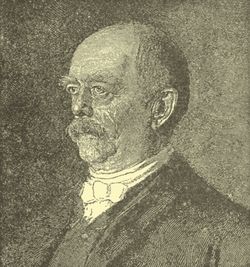
The "aureole of unpopularity" which encircled Bismarck's brow during four short years of inaugural premiership has, to all appearance, vanished under the influence of unbroken success, making room throughout the world for a confiding deference to his capacity and forethought, that every year seems to intensify. It is he, in the belief of most governments, who has preserved to them what never was more indispensable for their very existence—peace in Europe. With supreme adroitness, he avoids entanglements for himself and his country, bears many an affront patiently before retorting, keeps up the appearance of a good understanding after its substance has long passed away, but, when fairly engaged in diplomatic contention, lays out his field in a manner that insures success. People agree, therefore, that it is best to take him as he is. And it is in the nature of man when he has once accorded that favor to a fellow-creature, to "take him as he is," that he ends by liking him. Thus Bismarck, of all living men the most unlikely to succeed in the race after a world-wide popularity, is probably at this moment the best-liked man in either hemisphere.
His own countrymen have shown a decided indisposition to admit him among their household gods. To them he was, from the commencement of his political career, the very embodiment of what had gradually become the most objectionable type of Teuton existence—the unmitigated squireen or Junker, with his poverty and arrogance, with his hunger and thirst after position and good living, with his hatred for the upstart liberal burgher class. "Away with the cities! I hope I may yet live to see them levelled to the ground." Is there not a ring of many centuries of social strife, so laboriously kept down by the reigning dynasty, in these stupendous words, which were pronounced by Bismarck in 1847, when among the leaders of the conservatives in the first embryo parliament of the Prussian monarchy? And if uncongenial to the generation of Prussians among whom he had grown up, how infinitely greater was the dislike against him of South Germans, more gifted, as a rule, by nature, to whom the name of Prussian is synonymous of all that is strait-laced and overweening and unnatural and—generally inconvenient.
Little of that sentiment remains among the Germans of the present day. Such strangers as have had the opportunity of observing the attitude of the nation during the late celebration of his seventieth birthday, agree in declaring them to have been spontaneous, enthusiastic, and at times almost aggressive. Some tell us, to be sure, that the farther from Berlin the more gushing has been the ecstasy. The electors of Professor Virchow and of Herr Löwe, in whose electoral districts a torchlight procession on the eve of Bismarck's birthday had to elbow its way through immense crowds, must have kept at home. The municipality of Berlin, a model body of civic administrators, sent a birthday letter to their "honorary citizen," but abstained, with proper self-respect, from tendering their congratulations through a deputation. No Berlin citizen of any importance had a hand in the management of the procession. Yet, if thousands kept aloof, tens of thousands shared the national enthusiasm—students of universities chiefly, but older men too, even in distrustful, radical Berlin. And as for South Germany, where the gospel of protection seems, perhaps, to be more firmly believed in than any other, we read of trains to Berlin taken by storm, banquets, processions, chorus-singing—of real, heartfelt, rapturous effervescence.
There cannot be a shadow of doubt that, to numberless non-Prussians at any rate, the new era of German unity has brought a symbol of greatness not before known, and that they worship in Bismarck the hero who has given them a country to love, who has delivered them from the pettiness and self-satisfaction of Philistinism.
Now, if this be so—if, indeed, the countries of the world at large, and Germany in particular, acknowledge him almost affectionately as the leading statesman of the day, would it not be an interesting study to examine the degree of merit due to him personally, the character of the present administration, and what lasting good or lasting evil may be expected from this new phase of European politics? The subject, through its weight and its bulk alike, excludes full treatment within the limits of an essay. Nevertheless, since it intertwines itself with nearly every other question of moment, a few remarks by an outsider may be acceptable.
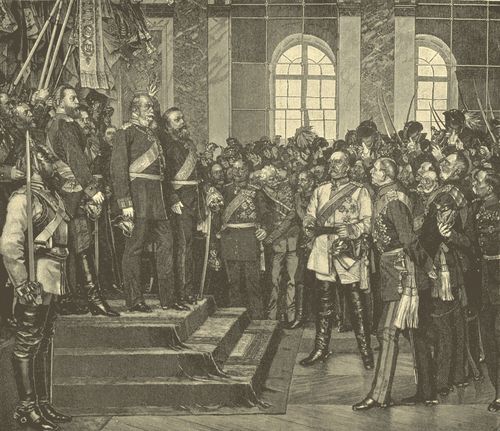
Proclamation of the German Empire at Versailles.
None but the incorrigibly childish can be inclined to ascribe to good luck a prosperous career extending over near twenty-three years, spent under the fiercest glare of the world's sunshine. No minister of any age was more bitterly assailed or opposed, even at the court of which he is now the acknowledged major domus in the manner of the Pepins and other Thum-Meiers of the Frankish monarchy. The king's brother, Prince Charles, detested the innovator whose opinions on the necessity of Austria being removed from membership in a remodelled German confederation, had for years leaked out from the despatch-boxes of the Foreign Office. Even the Junkers, whose dauntless leader he had been before and after the revolutionary events of 1848, shrank instinctively from a man who could not be credited with veneration for the Holy Alliance. It is remembered in Berlin that, on the nomination of one of them, well at court, a diplomatist of some standing, to the post of under-secretary of state for foreign affairs, the new member of the government confessed to his friends that he accepted the post in spite of Bismarck's "foreign" policy, and only in consideration of his contempt for parliamentarism. The queen, on the other hand, brought up in principles of constitutional government, and strongly attached to the English alliance, viewed with horror the bold pugilist who was daily assailing, not the persons only of the people's representatives, but some of the very foundations of every parliamentary edifice. Yet fiercer was the animosity shown him on every occasion by the Princess Royal of England, whose father had early taught her that a throne, to be safe, requires absolute solidity of institutions and agreement with the people, and who seriously trembled for the preservation of her children's future. Her husband expressed himself forcibly on a public occasion against some reactionary measures of the government. As the court, so were the liberal parties, so the people in general. When a fanatic, of the name of Kohn, attempted Bismarck's life in May, 1866, there were few persons who did not regret his failure. It may be said with truth that, for years, two men only understood a portion at least of his political views, and shared them. One was King William. Isolated as Herr von Bismarck was, he learned to rely implicitly on his sovereign's faithfulness, and has had no reason to regret his trust; for the king, though greatly his inferior in intellect, and far from unblest with legitimist predilections, was as firmly convinced as his minister that the confederation of German states, and Prussia herself, might be swept away unless placed upon a new footing, in one of those tornadoes which used periodically to blow across the continent of Europe. Thus, the new departure was as much his own programme as Bismarck's, and although he started (in 1861) with a hankering after "moral" rather than material conquests, he gradually understood the necessity for war, and has of a certainty "taken kindly," as the saying is, to material conquests of no inconsiderable magnitude.
None, even among Bismarck's modern sycophants, would pretend that their hero was the inventor of German unity. Passionately, though not over-wisely, had that ideal been striven after and suffered for by the best patriots in various parts of Fatherland, their vision becoming hazy just as often as they attempted to combine two opposite claims, that of a national texture, and that of a headship of Austria, which is non-German in a majority of its subjects, and alien in nearly all its interests. The Frankfort Parliament of 1848 marks the transition to a clear insight, inasmuch as its final performance, the constitution of 1849, placed the new crown on the King of Prussia's head. When offered, it was haughtily declined under the applause of Bismarck and his friends. The king refused because its origin lay in a popular assembly; in Bismarck's eyes its chief defect was that Prussia would be dictated to by the minor states. It was not until later, in 1851, when appointed Prussian ambassador to the Germanic Diet, chiefly because of his defence of the Treaty of Olmütz, which placed Prussia at the mercy of Austria, that he recognized the central point to be the necessity of thrusting Austria out of the confederation. It is proved now that he was sagacious enough also to perceive that such a wrench would not lead to a permanent estrangement, but that Austria, removed once and for all from her incubus-like and dog-in-the-manger position within the federate body, would become, in her own interest and that of European peace, New Germany's permanent ally.
These, then, became the two purposes of his active life ever since the day when, at the age of thirty-six, he obtained a share of the responsibility in the management of affairs as ambassador in Frankfort; first, to transfer Austria to a position in the East, and then to bestow upon the Fatherland political unity under Prussia, the royal prerogative in the latter remaining uncurtailed, so far as circumstances would allow. Thirty-four years have now elapsed. His opponents, in his own country or out of it, are at liberty to reiterate that he was born under a lucky star; that he merely took up the thread of German unification where the Frankfort Parliament of 1849 had let it drop; that anybody could have utilized such mighty armaments as those of Prussia with the same effect; that, given total disregard of principle or moral obligations, the result, in the hands of any political gamester, must have been what it was. There is something to be set against each of these assertions. For it was not the goddess of Fortune which pursued Bismarck in the ungainly shape of his former friend, that spiteful Prince Gortschakoff. The Frankfort assembly had left the Austrian riddle unsolved, and apparently insoluble. There was no hand in the country firm or skilful enough, no brain sufficiently hard or enlightened as to the needs of the day—not the king's, not Count Arnim's, nor certainly that of any other known to his contemporaries. And finally, when a public man so deftly gauges the mental capacities or extent of power of his antagonists—such as Count Beust, or Napoleon, or Earl Russell—that he knows exactly how far he can step with safety; then such a "gamester," however terrible the risks to which he may have exposed his country, is a great man. Complete unity of aims throughout, power given to carry them out, a wonderful absence of very serious mistakes, and finally a life sufficiently prolonged to admit of retrospection; in each of these respects the career of Bismarck resembles that of Mr. Disraeli.
The oft-told story of his diplomatic adventures at Frankfort, at Vienna, at Petersburg, and at Paris, and still more of his rulership in Prussia since 1862, and in Germany since 1866, has been uniform under two aspects. First, as already mentioned, in the stern continuity of his purposes. And secondly, in the mistaken view entertained regarding him at each successive period of his public life. Passing under review the whole career of this political phenomenon, you naturally pause before its strangest and its most humorous feature, viz., that, although living under the closest inspection, he was misunderstood year after year. Who would, consequently, deny the possibility at least, of Bismarck's being so misunderstood, by friend and foe, at this present moment?
While those despatches were written by him from Frankfort which Poschinger's researches have now exhumed, their writer was thought, by his partisans just as much as by his enemies, to be occupied solely with strengthening the "solidarity of conservative interests" and the supremacy of Austria, or with spinning the rope of steel which was to strangle all parliaments in Germany. And yet we know positively at present that, with increasing vigor day by day, did he warn his government against the scarcely concealed intention of Austria to "avilir la Prusse d'abord et puis l'anéantir" (Prince Schwartzenberg's famous saying in 1851); we observe with surprise how quickly legitimist leanings disappear behind his own country's interests; we stand aghast at the iron sway obtained by so young a man over the self-conceit of a vacillating, yet dogmatic and wilful, king (Frederick William IV.). It was he whose advice, given in direct opposition to Bunsen's, led to the refusal by Prussia of the Western alliance during the Crimean war. But he did not give this advice, as German liberals then believed, out of subservience to the autocrat of the North, whose assistance his party humbly solicited in order to exterminate liberalism. He persistently gave it to thwart Austria and to preserve Prussia (then in no brilliant military condition) from having to bear the brunt of Muscovite wrath, which he cunningly judged to be of more lasting importance in the coming struggles than the friendship of Western Europe. At a time when European politicians considered that he was the mouthpiece of schemers for a Russo-French alliance in his repeated and successful endeavors to gain Napoleon's good-will, he was adroitly sounding the French emperor's mind and character. He soon convinced himself that it was shallow and fantastic, and he built upon this conviction one of the most hazardous designs which ever originated in a brain observant of realities—that identical design which eventually led Prussia, some years later, first to Schleswig and then to Sadowa, with the "arbiter of Europe," as Napoleon was then called, stolidly looking on! And what is one to say of the four years of parliamentary conflicts (1862 to 1866), during which no one doubted but that his object in life and his raison d'être consisted in a reinstatement of the Prussian king on the absolute throne of his ancestors—a reaction from all that was progressive to the grossest abuses of despotism? All this time he was fighting a desperate battle against backstairs influences, which with true instinct were deprecating and counteracting his schemes of aggrandizement and national reorganization. It is clear, on looking back to that period which has left such indelible marks on the judgment of many well-meaning liberals, that his exaggerated tone of aggressive defence in the Prussian Landtag, the furious onslaught of his harangues, were intended to silence the tongues at court which denounced him as a demagogue and a radical. Paradoxical as it may sound, one may safely assert that nothing more effectually helped King William in his later foreign policy, than the opinion pervading all Europe in 1864 and 1866, that, having lost all hold upon the minds of his people, weakened and crippled in every sense of the word by Bismarckian folly, his Majesty could never strike a blow.
There was peace and concord in Germany between 1866 and 1877. Without becoming a liberal, and while opposing every attempt to outstep certain limits, Bismarck created and rather enjoyed an alliance with the majority formed in his favor by the national liberals and a moderate section of the conservatives. The German Empire, proclaimed by the German sovereigns at Versailles in January, 1871, was of his creation; and while established upon somewhat novel principles of federation by a parliamentary statute, it looked to outsiders like a home for progress and liberty. There were dangers lurking, it is true, beneath many a provision of the new constitution, such as the absence of an upper house, and the substitution in its stead of delegates from the separate governments, acting in each case according to instructions received, authorized to speak whenever they chose before the Reichstag, but deliberating separately and secretly both upon bills to propose, and upon replies to give to resolutions of the Reichstag. In fact, this Bundesrath, or federal council, represents the governing element under the emperor, with functions both administrative and legislative. By an artificial method of counting, Prussia, although she would command three-fifths of all the voters by virtue of her population, has less than one-third. Thus the possibility of an imbroglio between the governments is ever present, as well as that of a hasty vote in the popular assembly.
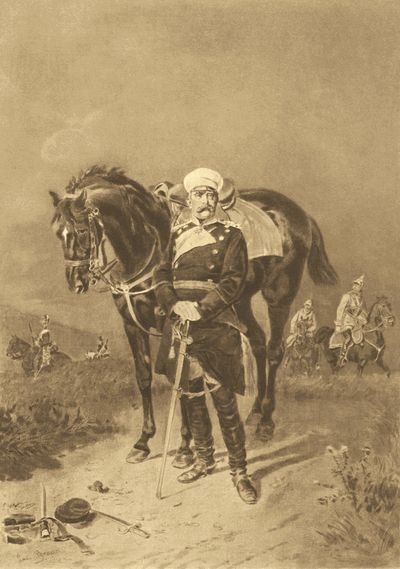
Bismarck before Paris.
It will never, probably, be quite understood why Prince Bismarck broke loose from a political alliance which, it would seem, had given no trouble whatever. In foreign affairs the house, in its immense majority, abstained from even the faintest attempt at interference. As for patronage, it has been said that no appointment was ever solicited for anyone by a member of the liberal party. From ministerial down to menial posts no claim was raised, no request preferred. If the section of moderate conservatives above mentioned has furnished a few ambassadors like Prince Hohenlohe, Count Münster, Baron Keudell, and Count Stolberg, that was by the chief's free will. Why, then, it has been asked, a change so absolute as the one the world has witnessed, from the saying of the chancellor in 1877, that his ideal was to have high financial duties on half a dozen objects and free trade on all others, to one of the most comprehensive tariffs in the world two years later? His own and his friends' explanations are lamentably deficient—"growing anæmia and impoverishment of the country," "drowning of native industry by foreign manufacturers," "corn imported cheaper than produced," and what not. The present writer, looking from afar, has always thought two motives to have been paramount in the chancellor's mind when he separated from the liberals and became, not a convinced, but a thorough-going protectionist. It is not said that these were his only motives. Chess-players know that each important move affects not only the figures primarily attacked, but changes the whole texture of the play.
First, then, and foremost, fresh sources of income were wanted to make the finances of the empire independent from the several exchequers of the states bound by statute to make up for any deficiency pro rata parte of their population. Two or three objects would have provided the needful, viz., spirits and beetroot sugar, and (with due caution) tobacco; or an "imperial" income tax, changing according to each year's necessities; or both systems combined. Tobacco, it is true, was tried, and the attempt failed. Spirits would bear almost any taxation, but the chancellor does not choose to tread upon the tender toe of the great owners of land who are potato-growers, and consequently distillers on a large scale. And another important class of agriculturists, the beetroot growers and sugar-producers, were not to be trifled with either. But how about direct taxation, the manly sacrifice of free peoples, the plummet by which to sound the enlightenment of a nation? The chancellor instinctively felt, I believe, that there he would be going beyond his depth; that under such a régime the free will of citizens must have the fullest swing; the "prerogative" would suffer, if not immediately, yet as a necessary sequence. And so he deliberately abandoned free trade and espoused indirect taxation and protection.
Success, let free traders say what they please on the subject, success has accompanied Bismarck's genius on this novel field, as well as on the older fields where all mankind acknowledges his superiority. For the coffers of the empire are filling. A motley majority in the Reichstag not only accepts, but improves upon his protectionist demands. He has become the demigod of the bloated manufacturing, mining, and landlord interests throughout the country. He is now about to win the last of the great industries, and the one which withstood his blandishments the longest, viz., the trans-oceanic carrying trade. He is credited with having improved the state of certain trades, even by such as know perfectly well that, like the former depression, the present improvement in those has been universal. The whole country is becoming protectionist. All young men, even in Hamburg and Bremen, believe in protection as "the thing." The Prussian landlord, whose soul was steeped in free trade so long as Prussia was a grain-exporting country, cherishes protectionist convictions now that she must largely import cereals. The bureaucrat who had never sworn by other economic lawgivers than Adam Smith and his followers, now accepts Professor Adolphus Wagner's ever-changing sophisms. And as for the south and the west of Germany, why, they adore the man who had fulfilled that dream of protection in which they, as disciples of Friedrich List, had grown up. It is true that all large cities, even there, are protesting against the lately imposed and quite lately increased duties upon cereals; but then, "can any good thing come out of" large cities? Compared to the difficulties that impede the action of the free trade party in Germany, Mr. Bright's and Mr. Cobden's up-hill work sinks into insignificance.