Volume 4 — LIST OF ILLUSTRATIONS (continued 5)
Reading edition
It was in the year 1812 that Webster was first elected a member of Congress, and he reached that elevation by his masterly ability in the affairs of his profession. By persistent patience first, and then by resistless power, he took up the foremost position in the sphere in which he moved. He appeared in the majesty of intellectual grandeur, like one who was all might and soul, and poured forth the stores of an opulent mind in a manner which was entirely his own. His words had both weight and fire; and the contrast is now great between the boy who broke down and wept at his first declamation, and the man, bending opponents to his will by his energy and indomitable zeal. The laurel of victory, it has been fondly said, was proffered to him by all, and bound his brow for one exploit till he went forth to another. In his thirtieth year he entered the field of politics, like one who had made up his mind to be decided, firm, and straightforward; and such was the serenity of this great soul, amid wild commotions, that the enthusiast mistook it for apathy, the fierce for lukewarmness. It was the great calm of profound conviction, borne up by a thorough reliance on the right—the right as to time, as to degree, and as to resources for the battle of life. From the day on which he threw himself into the political arena, he belonged to the United States, and not to his native county alone. Crowds soon gathered round one who had mastered so many difficulties, and taken his place among the kingly men who rule the spirits whom they are born first to subdue, and then to bind to themselves by the spell of genius.
It is well known that this man, so humble in his origin, yet so masterly in his mind, passed through all the gradations of rank that are open to an American citizen, up to the right hand of the highest. We have seen when he entered Congress. In 1841 he became Secretary of State, and from that period bore the place in American politics which would be readily conceded, in this ardent country, to one who was deemed and called "the master mind of the world." In his love of freedom, Webster has been likened to Washington, or expressly called his equal in regard to patriotism and true greatness. It is not wonderful, therefore, that this patriot's friends proposed him as President of the United States. He failed, and felt the failure, but soothed his disappointment by the conviction that no man "could take away from him what he had done for his country." Those who loved and admired him thought that the word president would have dimmed the lustre of the name of Daniel Webster; and they add, in regard to his disappointment, "if we must sorrow that what men expected can never come to pass, let us not weep for him but for our country." Others, however, were of opinion that Webster was "rejected and lost"; while those who look deeper at the causes of events may see, in that disappointment, the needful antidote administered by the Supreme Wisdom to ward off the danger of too universal a success. This gifted and ambitious man was suffered to take an active part in the government of one of the greatest of the nations. By his bold and manly grasp of American interests, he did much to weld the different States more closely into one. He negotiated, on the part of his country, some of the most important treaties which promote the peace and the amity of nations, for example, what is called the Ashburton treaty with Great Britain; and it would have seemed too much for one mortal, successful as Webster had already been, to be lifted to an official level with princes. That was denied him; his empire was not countries—it was minds. He was to be trained for a nobler exaltation than a throne.
Little has yet been said regarding Webster as an orator. It was mainly in that respect, however, that he surpassed his fellows, and mainly by that means was he enabled to ascend to the high position which he held so long. The versatility of his powers was very great, and the mode in which he sometimes employed them was not a little remarkable. He had, on one occasion, spent several hours with his colleagues in adjusting some important questions involving the interests of kingdoms; and on returning home he sportively sallied forth and purchased some eggs, on the principle of seeing how extremes meet, in regard to occupation as well as in other respects. But there were serious things mixed with his jests; and as an orator, Webster stands in the first rank, if not foremost, in the New World. When it was known that he was to speak, the excitement sometimes amounted to a furor, and a hundred dollars have been paid for a ticket of admission to hear him. Meanwhile the avenues that led to his arena were blocked up by the crowds pressing for admittance; and when he did appear, it was to rouse, to agitate, and convulse. He felt what he said in his inmost soul, and his words were winged with fire, even while they were massively powerful, and connected with a logic which tolerated no breaks in the chain.
Webster reached the allotted term of mortal existence, and in his seventy-first year passed away alike from the frowns and the applause of mortals. On the morning of Sabbath, October 24, 1852, he was summoned away. Though much enfeebled, his mind was calm, and he died with the confidence of a little child, reposing on the mercy of his God as revealed in the Saviour. Among his last utterances was this, "Heavenly Father, forgive my sins, and welcome me to thyself through Christ Jesus." His very last words were, "I still live," and his loving, weeping friends took them up as a prediction of that immortality on which he was about to enter. Through life he had hallowed the Sabbath, and he died upon it. The autumn was his favorite season, and he passed away amid its mellow glories, after affectionately and solemnly taking leave of his weeping wife, children, kindred, and friends, down to the humblest members of his household. His death, it is supposed, was hastened by injuries received by the breaking down of his carriage; but it did not find him unprepared. Long years before he had erected his own tomb; and there, on a plain marble slab over the door, the visitor reads the simple inscription—Daniel Webster.
Some ten thousand friends, countrymen, and lovers, helped to lay him there, and one of the orations pronounced in connection with his departure was thus touchingly closed: "The clasped hands—the dying prayers—oh, my fellow-citizens, this is a consummation over which tears of pious sympathy will be shed, after the glories of the forum and the senate are forgotten."
The following letter to a friend on the choice of a profession, written by Webster when only twenty years of age, is reprinted from "The Life of Daniel Webster" by George Ticknor Curtis, through the courtesy of D. Appleton & Co., the publishers, and with the permission of the widow and heirs of the author.
"What shall I do? Shall I say, 'Yes, gentlemen,' and sit down here to spend my days in a kind of a comfortable privacy, or shall I relinquish these prospects, and enter into a profession, where my feelings will be constantly harrowed by objects either of dishonesty or misfortune, where my living must be squeezed from penury (for rich folks seldom go to law), and my moral principle continually be at hazard? I agree with you that the law is well calculated to draw forth the powers of the mind, but what are its effects on the heart? Are they equally propitious? Does it inspire benevolence, and awake tenderness; or does it, by a frequent repetition of wretched objects, blunt sensibility, and stifle the still small voice of mercy?
"The talent with which Heaven has intrusted me is small, very small, yet I feel responsible for the use of it, and am not willing to pervert it to purposes reproachful and unjust; nor to hide it, like the slothful servant, in a napkin.
"Now, I will enumerate the inducements that draw me toward the law: First, and principally, it is my father's wish. He does not dictate, it is true, but how much short of dictation is the mere wish of a parent, whose labors of life are wasted on favors to his children? Even the delicacy with which the wish is expressed gives it more effect than it would have in the form of a command. Secondly, my friends generally wish it. They are urgent and pressing. My father even offers me—I will sometime tell you what—and Mr. Thompson offers my tuition gratis, and to relinquish his stand to me.
"On the whole, I imagine I shall make one more trial in the ensuing autumn. If I prosecute the profession, I pray God to fortify me against its temptations. To the winds I dismiss those light hopes of eminence which ambition inspired, and vanity fostered. To be 'honest, to be capable, to be faithful' to my client and my conscience, I earnestly hope will be my first endeavor. I believe you, my worthy boy, when you tell me what are your intentions. I have long known and long loved the honesty of your heart. But let us not rely too much on ourselves; let us look to some less fallible guide to direct us among the temptations that surround us."[Back to Contents]
WILLIAM HENRY SEWARD[12] By Hon. Charles E. Fitch (1801-1872)
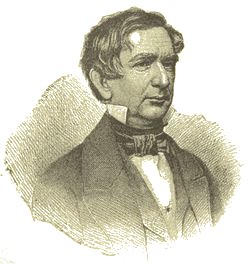
William Henry Seward, the American statesman, was born in Florida, Orange County, N. Y., May 16, 1801, and died at Auburn, in the same State, October 10, 1872. Precocious in his studies, he pursued his preliminary education in his native village, and, at the age of fifteen, entered, as a sophomore, Union College, then under the presidency of Eliphalet Nott, between whom and his pupil a life-long friendship, illustrated by mutual confidence and counsel, was early established. Seward's college course, especially brilliant in rhetoric and the classics, was interrupted in his senior year by a residence of six months, as a teacher, in Georgia, where previous impressions against African slavery were confirmed by observation of its workings. Returning to college, he was graduated with high honors in 1820, the subject of his Commencement oration being "The Integrity of the American Union."
He was admitted to the bar at Utica, in October, 1822, and in January, 1823, settled at Auburn as a partner of Judge Elijah Miller, whose daughter he married in October, 1824. Although certain features of the law—its technicalities and uncertainties—were repugnant to him, he was soon in the full tide of professional success, and, in the opening of the circuit courts to equity jurisprudence, found much that was in harmony with his sense of justice. He was also, from the first, interested in politics, for which he had decided genius. He came upon the stage in the closing days of "The Era of Good Feeling," under President Monroe, when parties were again dividing upon the issues that have mainly obtained throughout the constitutional era. He approved the principles of Hamilton, although his boyish training had been in the Jeffersonian school. Enunciating his views with precision and felicity of diction, his voice and pen were in constant request, and he rapidly rose to distinction until, in 1834, he was the acknowledged leader in the State of the Whig party and its candidate for governor.
Meanwhile he had supported De Witt Clinton, the champion of internal improvements, and in 1824 drafted, for the Republican Convention of his county a trenchant address, detailing the history and criticising the aims of the "Albany Regency," which inspired the hostility to that famous clique that compassed its overthrow fourteen years later. Among his notable utterances of this period were an address on Grecian independence, at Auburn, in 1827; a Fourth-of-July oration, at Syracuse, in 1831, in which Calhoun's dogma of secession was denounced, and an eulogy on La Fayette, at Auburn, in 1834. In 1828 he presided over the Young Men's Convention, at Utica, in behalf of the renomination of President Adams, and declined a congressional nomination. In 1830 he was elected by the Anti-Masons to the State Senate, and was re-elected in 1832. He had a prominent and an influential part in the deliberations of that body, although its youngest member, and in the political minority, whose addresses to the people he wrote at the close of each session. His most notable speeches were those for the common-school and canal systems, the abolition of imprisonment for debt, the amelioration of prison discipline, and the reform of the militia law, and against corporate monopolies, increasing judicial salaries, Governor Marcy's loan law, and the removal of the deposits by President Jackson. The Senate was then a constituent portion of the Court of Errors, the tribunal of last resort, and Seward delivered many opinions which materially enhanced his legal reputation. In one instance he carried, with substantial unanimity, the court with him, against the views of the presiding judge, the eminent Chancellor Walworth. In 1833 he made a rapid tour of Europe, embodying his reflections in letters to the Albany Evening Journal, then edited by Thurlow Weed, between whom and Seward there was, for fifty years, an intimate and unbroken attachment, unique in political annals.
In 1838 he was again the Whig candidate for governor, and defeated Governor Marcy, his former rival, his victory being the precursor of the national Whig triumph in 1840, in which year he was re-elected. He was inaugurated, January 1, 1839, his message to the Legislature embracing, with a masterly exposition of Whig policies, certain suggestions of his own concerning immigration, education, and eleemosynary institutions that revealed the catholic spirit and the philosophical habit which, despite his party fealty, he consistently exhibited. This message outlined the conduct of the administration that succeeded—enlightened in its scope, liberal to all classes, distinctly loyal to the Union, yet jealously guarding against any infringement of the rights of the State. It widened educational privileges, urged the prosecution of the public works, including the enlargement of the Erie Canal, granted franchises to railways, removed imprisonment for debt and the remaining guarantees of slavery from the statute-books, composed the anti-rent troubles and executed the laws within the insurrectionary section, perfected the banking system, and proposed jury trials for fugitive slaves and a constitutional amendment abolishing the property qualification for the colored suffrage.
Governor Seward's regard for the dignity of the State was displayed by his refusal to discharge from custody, without trial, one Alexander McLeod, a citizen of Canada, held for the burning of the steamer Caroline, in New York waters, although the demand of the British government, to that effect, was supplemented by the request of Presidents Harrison and Tyler. His abhorrence of slavery was accentuated in his denial of the application of the Governor of Virginia for the rendition of seamen charged with the abduction of a slave, upon the ground that the offence, if defined as a crime in Virginia, was not so in New York, and he did not hesitate to add that his feelings coincided with his conception of his constitutional prerogative. When a Democratic Assembly subsequently passed resolutions disapproving his action, he declined to transmit them to the Virginia authorities, and he also failed to respond to a similar requisition from South Carolina. His proposition for the employment of Roman Catholic teachers in the common schools showed his independence of partisan behest and popular clamor.
Leaving office in 1843, he passed the next six years in professional labors, varied by occasional addresses of a literary or patriotic cast, and by many Whig speeches in the campaigns of 1844 and 1848. To his practice in the State courts was united that in patent cases, which not only brought him a lucrative clientage, but largely increased his acquaintance with public men at Washington. His gubernatorial service had given him national fame, and he was, although not in public life, esteemed as one of the national leaders of his party. In the courts he commanded respect for the clearness and strength of his arguments, but, even there, he was at his best when his heart inspired his speech with fervor, as in his pleas for Van Zandt and others charged with harboring fugitive slaves. The defence of Greeley, in the Cooper libel suit, and of the Michigan rioters, may be cited as instances of his persuasiveness before juries, but that in the case of William Freeman is celebrated both for its own quality and the intrepidity of its author. Gladstone has characterized it as the greatest forensic effort in the English language, not excluding the masterpieces of Erskine. It is a plea for the life of a brutalized negro who butchered a whole family under circumstances of peculiar atrocity. The deed was without excuse or palliation, save in the insanity of the perpetrator, of which Seward became convinced, and volunteered as counsel amid the surprise, imprecations, and threats of the Auburn community, where the case was at issue. The moment was a supreme one for him, but he did not hesitate. Without reward, or the hope of reward, even in the gratitude of the insensate wretch for whom he risked professional standing and public favor, he worked as indefatigably as though the weightiest honors and emoluments depended thereon, from the impanelling of the jury to the failure of executive clemency; but Freeman's death in prison and the autopsy that disclosed the morbid condition of his brain fully vindicated Seward's analysis and exalted him in public regard.
On March 4, 1849, coincident with the accession of General Taylor to the presidency, Seward entered the United States Senate, having been chosen thereto by a large majority of the Legislature of New York. When he took his seat, the Whig party was already divided upon the slavery question, and Seward, by virtue of his previous utterances and his skill as a politician, became the exponent of the free-soil element, as also the representative of the administration, an unprecedented trust to be confided to a senator in his first term. He thus found himself in opposition to Webster and Clay, and especially to the "Omnibus" bill of the latter, a measure intended to reconcile conflicting claims concerning the admission of new States, the status of slavery in the Territories, and the protection to be accorded it in the free States. On March 11, 1850, he made a speech, generally pronounced to be his ablest, as it is certainly his most noteworthy deliverance, in which he declared that there is a law higher than the Constitution, whose authority may be invoked in legislation for the national domain. The death of General Taylor brought him into collision with President Fillmore, who hailed from New York, and was largely indebted for his vice-presidential nomination to Seward's kindly offices. Fillmore urged the adoption of the compromise scheme and signed the separate bills therefor as they successively passed Congress, thereby incurring censure at the North, while Seward retained his ascendency with the anti-slavery masses throughout the country, as well as with the Whigs of New York.
He was re-elected to the Senate in 1855 by a combination of Whigs and Anti-Nebraska Americans, and on October 12th, of that year, at Albany, formally announced his adhesion to the new Republican party. In the Senate he easily ranked as one of its most polished and effective speakers who, while resolutely maintaining his own convictions, scrupulously preserved the amenities of debate. He especially distinguished himself by his earnest, yet unavailing, resistance to the repeal of the Missouri Compromise. Among his popular addresses of conspicuous merit are those on "The Elements of Empire in America," at Union College, 1843; "Daniel O'Connell," at New York, 1847; "John Quincy Adams," before the New York Legislature, 1848; "The Destiny of America," at Columbus, O., and "The True Basis of American Independence," at New York, 1853; "The Development of the American People," at Yale College 1854, and "The Irrepressible Conflict"—i.e., between freedom and slavery—at Rochester, N. Y., 1858. He made an extended tour in Europe, Egypt, and Palestine, in 1859.
The Republicans met in National Convention at Chicago, in 1860, flushed with anticipated success. Northern opposition to the extension of slavery had combined, and the Democracy was being resolved into antagonistic factions. Seward's nomination for the presidency seemed assured. He was the foremost statesman in his party. He had crystallized its ideas, interpreted its creed, and marshalled its forces. He had an enthusiastic following who believed that the occasion had met the man; but there were others who objected that his very superiority would provoke assault against him, which might hurt the cause for which he stood. They reasoned against his availability, and their argument prevailed. He led on the first two ballots in the convention, but, on the third, Abraham Lincoln, then comparatively unknown, became the Republican standard-bearer. Seward met this reverse tranquilly, rebuked certain manifestations of disaffection, proffered the candidate his hearty support, and, in a series of remarkably able and eloquent speeches, extending from Massachusetts to Kansas, contributed materially to his election.
Seward accepted the portfolio of State in Lincoln's cabinet and immediately assumed the gravest responsibilities. American relations with foreign governments during the Civil War were uniformly serious and sometimes perilous. The duties of the Secretary of State were exacting and delicate. Seward, by his tact and discretion, as well as his courage and wisdom, kept peace with the world, without debasing the honor or forfeiting the rights of the republic. One of the most intricate issues arose in the first year of the war. It is known as the Trent case. Mason and Slidell, Confederate envoys to England and France respectively, were forcibly taken by an American naval commander from a British vessel and lodged in Fort Warren. The American public was exultant over the capture and protested vigorously against their release; but Seward had to decide officially the question of their surrender to the British Government, and, when the demand was duly made, he yielded to it, basing his conclusion, with admirable adroitness, not only upon international comity, but also upon American precedents. The president, at first disposed to take the contrary view, conceded the force of Seward's argument, the people acquiesced, and a war with England was avoided. Seward's state papers and despatches are models of style, and by their frankness of statement and hopefulness of tone did much to sustain the Union cause abroad. In accord with Lincoln in holding that the paramount task of the Government was to subdue rebellion against it and discouraging precipitate movements for the abolition of slavery, he was also in accord with the president in the policy of emancipation, as ultimately formulated, and, on January 1, 1863, attested the proclamation which has made the name of Lincoln immortal. He proclaimed the adoption of the Thirteenth Amendment to the Constitution, by which slavery was abolished, December 18, 1865, and of the Fourteenth, conferring suffrage and civil rights upon the freedmen, July 26, 1868. On February 3, 1865, he attended, with the president, the so-called Peace Conference, in Hampton Roads, with Messrs. Stephens, Hunter, and Campbell, the Confederate commissioners. The conference was fruitless, owing to the inflexible determination of the president not to entertain any proposals that did not involve the complete restoration of the national authority as a condition precedent.
Lincoln began his second term March 4, 1865, Seward remaining in the cabinet. On April 5th, Seward was badly injured by being thrown from his carriage. Nine days thereafter Lincoln visited him in his sick chamber. It was their last meeting. On the same evening Lincoln was assassinated, and the murder of Seward was attempted. He was stabbed in several places in the head and throat, and for several days his life was despaired of, but he slowly recovered, and in June resumed his desk in the State Department, President Johnson having urged him to retain it. He continued in office throughout Johnson's administration, favoring the reconstruction policy of his chief, without, however, incurring the active hostility of his Republican friends. Distinctive events of his second term were his maintenance of the Monroe doctrine, in the refusal to recognize the French empire in Mexico, and the purchase of Alaska, which was in consonance with views long entertained by him as to the propriety of the expansion of the territory of the United States upon the continent of North America. In the best sense of the term he was an advocate of "Manifest Destiny," and was proud of the acquisition of the Russian territory at the Far North. A treaty which he negotiated for the cession of the Danish West India islands of St. Thomas and St. John failed of ratification by the Senate.
He retired to private life March 4, 1869, and within the next three years visited Alaska and Mexico, and made a journey around the world, being everywhere received with official welcome and popular acclaim. The last few months of his life were passed at his home, where he dictated the story of his travels and began his "Autobiography," which, even in its unfinished state, is a charming narrative.
Seward achieved greatness as an executive, a legislator, and a diplomatist; was one of the most accomplished writers of his time, and was second only to Lincoln, among civilians, in conserving American nationality and enlarging American liberties. There is a statue to his memory in Madison Square, New York, and, on November 15, 1888, another was unveiled in front of the Auburn homestead, William M. Evarts delivering the oration. Charles Francis Adams also paid his tribute, in an address at the Capitol, in Albany, 1873, upon invitation of the New York Legislature. Seward published a volume on the "Life and Public Services of John Quincy Adams," 1849. His "Essays, Speeches, and Extracts from his Diplomatic Correspondence," etc., edited by George E. Baker, with a memoir, embrace five volumes. His adopted daughter published his "Travels Around the World," 1873, and his "Autobiography," to 1834, has been supplemented by a "Memoir" by his son, Frederick W. Seward, with extracts from his letters and selections from his "Table Talk."[Back to Contents]

ABRAHAM LINCOLN[13] By Terence Vincent Powderly (1809-1865)
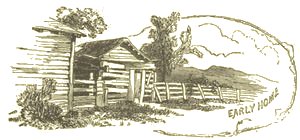
Born in obscurity and poverty, with health and a good disposition as a heritage from nature, and with Christian parents as teachers and guides, Abraham Lincoln—sixteenth president of the United States—entered upon life's journey through toil and vicissitude to fame and immortality.
Abraham Lincoln, grandfather of the president, was born in Union, Pa., and in 1759 removed with his parents to a point near Harrisonburg, Va. John Hanks and Squire Boone, father of Daniel Boone, were neighbors of the Lincolns at Union; the former took up his residence at Harrisonburg, Va., and Squire Boone removed to Holman's Ford, on the Yadkin River, in North Carolina. When he was twenty-one years old, Abraham Lincoln went to North Carolina to visit his old neighbors, the Boones, and while there met and married Mary Shipley. He built a log cabin on the banks of the Yadkin and lived there several years. Here it was that Thomas Lincoln, father of the president, was born. Shortly after his birth his parents, in 1778, removed to Kentucky and settled near Elizabethtown, in Hardin County. In 1784, when Thomas was but six years old, his father was killed by the Indians. There were no schools in that neighborhood, and Thomas Lincoln grew to manhood without receiving an education. Joseph Hanks, son of John Hanks, removed to Kentucky about the time that Abraham Lincoln moved there from North Carolina. His daughter, Nancy Hanks, who was born and educated in Virginia, grew up a playmate of Thomas Lincoln, and in 1806 became his wife. Thomas Lincoln selected a farm near Hodgensville, now the county seat of Larue County, Ky., built a log cabin containing but one room, in which, on February 12, 1809, Abraham Lincoln, the future president, was born. A poor farmer, with no education and no capital other than his labor, Thomas Lincoln found little to encourage his stay in Kentucky. The institution of slavery, which lived on the toil of the black man, threw a dark shadow across the path of the "poor white" who could claim no title to property in human flesh and sinew, and in 1817 he removed from Kentucky to Spencer County, Ind., and settled in the forest at Pigeon Creek, near the town of Gentryville. On October 5, 1818, Mrs. Lincoln died and was laid to rest at the foot of a tree on the farm which her husband had hewed out of the forest with his axe.
Eighteen months after the death of his wife, Mr. Lincoln married Mrs. Sarah Bush Johnston, a widow who had been a neighbor of his in Kentucky. To his stepmother Abraham became very much attached, and he always entertained the greatest respect and affection for her. His education was very simple, his school days few, and his books fewer still. Before leaving Kentucky he learned to read while listening to his mother as she gave lessons to his father. In 1814, a Catholic priest, Zachariah Riney, who travelled through the country, opened a school in an untenanted cabin at Hodgensville, and for a few weeks gave instructions to the youth of the neighborhood. Abraham attended this school during its brief existence. In 1822 Azel Dorsey was employed as teacher at Pigeon Creek, Ind., and during his short stay Abraham Lincoln was his most attentive pupil. Two years after, Abraham went to school for several months, and in 1824 his school days came to an end. His time at school did not exceed twelve months altogether. In the meantime he had read Defoe's "Robinson Crusoe," Bunyan's "Pilgrim's Progress," Æsop's "Fables," The Bible, and Weems's "Life of Washington." In 1824 his father, in need of his assistance as a bread-winner, began to instruct him in the carpenter trade. In 1825 he was employed at $6 a month to manage a ferry across the Ohio River at Gentry's Landing, near the mouth of Anderson Creek. His wages were paid to his father. The first money he earned for himself came in the shape of two half-dollars paid to him by two gentlemen whose trunks he transferred from the shore to a passing steamer. In 1828 Mr. Gentry engaged him to go to New Orleans on a flat-boat with a load of produce. In 1830 John Hanks, who had removed from Kentucky to Illinois, wrote to Thomas Lincoln, urging him to move to that State. Acting on the advice, Mr. Lincoln removed to Illinois and settled at a point some ten miles west of Decatur. Abraham Lincoln drove the ox team which hauled the household effects of the family, and wearing a coon-skin cap, jean jacket, and a pair of buckskin trousers, he entered the State poor, friendless, and unknown. Thirty years later he left Illinois the foremost man in the nation, and known to all the world. He assisted his father in clearing fifteen acres of land, and split the rails with which to build the fence. Although of age, he had no money, and having but a scant supply of clothing, made a bargain with Nancy Miller to make him a pair of trousers. For each yard of cloth required he split four hundred fence-rails, and as he was over six feet in height it took fourteen hundred rails to pay for his trousers. On April 19, 1831, he went to New Orleans with a flat-boat load of pigs, corn, pork, and beef; the pigs refusing to walk, Lincoln carried them aboard in his arms. John Hanks and Lincoln's half-brother, John Johnston, accompanied him on the trip. While in New Orleans he first saw men and women sold as slaves, and as every instinct of his nature revolted at the spectacle, he said to John Hanks: "If ever I get a chance to hit that institution, I'll hit it hard." Returning from New Orleans, he went to New Salem to clerk in the store of Denton Offut. While waiting for a shipment of goods he acted as clerk on a local election board, and thus filled his first political position. During his stay in New Salem he was frequently called on to exercise his great strength in quelling disturbances, and inspired the turbulent element of the place with a wholesome respect for his powers of muscular persuasion. He was not quarrelsome, never engaged in contention, but never hesitated to take his own part or that of another who might need a helping hand. He subscribed for the Louisville Journal, and generously read its contents aloud to those who gathered in the store. During the Black Hawk war he enlisted as private in a company which was raised in the neighborhood, and was at once elected captain. In a short time the company was mustered out, and he re-enlisted in an "Independent Spy Battalion" which continued in service until the end of the war. On returning to New Salem he announced himself an independent candidate for the Legislature, and at a meeting held during the canvass made his first political speech in these words: "Fellow-citizens: I presume you know who I am; I am humble Abraham Lincoln. I have been solicited by many friends to become a candidate for the Legislature. My politics can be briefly stated. I am in favor of the internal improvement system, and a high protective tariff. These are my sentiments and political principles. If elected, I shall be thankful; if not, it will be all the same."
In the winter of 1832 he became a partner of a man named Berry, in the purchase and management of a store. They had no money, but gave their notes. Berry became dissipated, lost interest in the business, and the firm failed. In 1833 President Jackson appointed Lincoln postmaster of New Salem; he remained postmaster until 1836. While holding the office Lincoln voluntarily established the "free delivery" system in New Salem by carrying the letters around in his hat. He began the study of law, and was soon after appointed deputy surveyor. The note he gave on going into partnership with Berry had been sold to a man who wanted his money, and in the fall of 1834 the sheriff levied on and sold his instruments to satisfy the debt. In that year he was elected to the Legislature, and borrowed the money with which to purchase a suit of clothes to go to the State capital at Vandalia. He was re-elected to the Legislature in 1836, and during the canvass declared his principles as follows:
"I go for all sharing the privileges of the government who assist in bearing its burdens; consequently, I go for admitting all whites to the right of suffrage who pay taxes or bear arms, by no means excluding females."
A few years later, when questioned concerning that utterance, he said:
"All questions of social and moral reform find lodgement first with enlightened souls, who stamp them with their approval. In God's own time they will be organized into law, and thus woven into the fabric of our institutions."
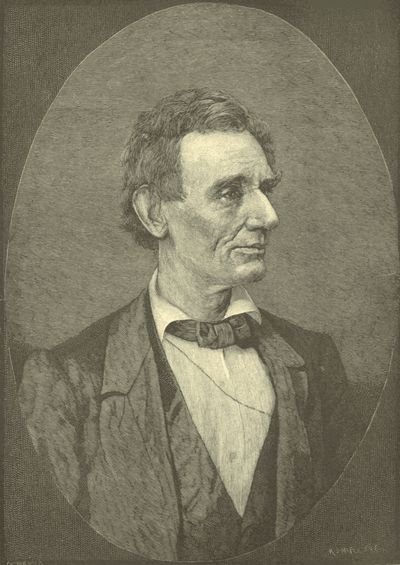
A. Lincoln.
In 1836 he met Stephen A. Douglas for the first time, at the State capital. In 1837 he was admitted to the bar, in 1838 re-elected to the Legislature, and again in 1840. The capital had been removed from Vandalia to Springfield, and in partnership with John T. Stuart he began the practice of law in that city in 1839. On November 4, 1842, he was married to Mary Todd, daughter of Hon. Robert S. Todd. In the presidential campaigns of 1840 and 1844 he canvassed the State as a presidential elector on the whig ticket; and in both campaigns was pitted, in joint debate, against Stephen A. Douglas. In 1846 he was elected to the thirtieth Congress, and was the only whig representative in that body from Illinois. On January 12, 1848, he made his first speech in Congress, on a resolution which he offered calling on the president to provide a statement relating to the war with Mexico. On January 16, 1849, he introduced a bill to abolish slavery in the District of Columbia and to compensate the owners of the liberated slaves. He declined a re-election to Congress, and in 1849 was an unsuccessful candidate for United States senator. In 1850 he refused to accept the appointment as Governor of Oregon, tendered him by President Fillmore. For a few years he gave no attention to political matters, but the introduction in Congress of the bill to admit Nebraska and Kansas to the Union, and the agitation for the repeal of the "Missouri Compromise," aroused his interest, and in a short time he became the leader of a new party in the State. All who opposed the repeal of that compromise, of whatever party, were known as "Anti-Nebraska" in the beginning, but gradually they began to call themselves "Republicans," and as such they carried most of the "Free State" elections of 1854. Senator Douglas, in defending his course on the "Nebraska Bill," made speeches through Illinois. On October 1, 1854, Lincoln, in reply to one of these speeches, in speaking of slavery said:
"I hate it because it deprives our republican example of its just influence in the world; it enables the enemies of free institutions to taunt us as hypocrites; causes the real friends of freedom to doubt our sincerity; is at war with the vital principles of civic liberty; contrary to the Declaration of Independence; and maintains that there is no right principle of action but self-interest.... No man is good enough to govern another man without the other's consent.... I object to the Nebraska Bill because it assumes there can be moral right in the enslaving of one man by another."
He was a candidate for United States Senator in 1855, but his withdrawal from the contest gave the election to Mr. Trumbull. In 1856 he received one hundred and ten votes for vice-president at the first Republican national contention, and canvassed the State as one of the presidential electors. During this canvass he said:
"Sometimes when I am speaking I feel that the time is soon coming when the sun shall shine and the rain fall on no man who shall go forth to unrequited toil.... How it will come about, when it will come, I cannot tell; but that time will surely come."
The Supreme Court of the United States, on March 6, 1857, committed itself to the perpetuation of slavery in the "Dred Scott" decision, and that act, together with the question of admitting Kansas to the Union as a slave or free State, furnished the argument for the legislative campaign of 1858, in which Lincoln was a candidate for United States senator against Stephen A. Douglas. In his speech accepting the nomination he, in referring to the agitation for the abolition of slavery, said:
"In my opinion it will not cease until a crisis shall have been reached and passed. 'A house divided against itself cannot stand.' I believe this Government cannot endure permanently half slave and half free. I do not expect the Union to be dissolved, I do not expect the house to fall, but I do expect it will cease to be divided."
On May 16, 1860, the second Republican national convention met in Chicago, and on the third ballot nominated Lincoln for the presidency over William H. Seward, who was at that time the idol of the radical element of the party. Not many who listened to the clergyman who delivered the prayer at the opening of the convention, gave serious thought to these prophetic words as they fell from his lips:
"We entreat Thee that at some future, but no distant, day the evil which now invests the body politic shall not only have been arrested in its progress, but wholly eradicated from the system."
The Northern Democrats nominated Stephen A. Douglas; the slave-holding, Southern Democrats nominated John C. Breckenridge, and a Constitutional Union party nominated John Bell. The Electoral College gave Lincoln 180 votes, Breckenridge 72, Bell 39, and Douglas 12. In his inaugural address Lincoln said:
"I have no purpose, directly or indirectly, to interfere with the institution of slavery in the States where it exists. I believe I have no lawful right to do so, and I have no inclination to do so."
Although his inaugural breathed peace and conciliation in every line, it had no effect on the hot-headed advocates of secession. The war began with the bombardment of Fort Sumter on April 12, 1861, and ended with his death. On April 15th, he issued his first call for troops, and during his administration the total number called for was 2,759,049. With the exception of Russia, the foreign powers exhibited evidences of hostility to the Union, and when urged to retaliation Lincoln said: "One war at a time, if you please, gentlemen." On May 20, 1862, he signed the Homestead Law, a boon of inestimable value to settlers on land. On January 1, 1863, he issued the "Emancipation Proclamation" which stamped the seal of eternal truth on the Declaration of Independence. On November 19, 1863, at the dedication of the Gettysburg Cemetery, he, in concluding a speech which should be committed to memory by every citizen of the nation, said:
"It is rather for us to be here dedicated to the great task remaining before us.... That we here highly resolve that the dead shall not have died in vain; that the nation shall, under God, have a new birth of freedom; and that government of the people, by the people, and for the people shall not perish from the earth."
On June 8, 1864, he was renominated by the Republican national convention, General McClellan was nominated by the Democrats, and at the election Lincoln received 212 of the 233 electoral votes cast. In concluding his inaugural address, March 4, 1865, he said:
"Both read the same Bible and pray to the same God, and each invokes His aid against the other. It may seem strange that any men should dare to ask God's assistance in wringing their bread from the sweat of other men's faces; but let us judge not, that we be not judged.... Fondly do we hope, fervently do we pray, that this mighty scourge of war may speedily pass away. Yet if God wills that it continue until all the wealth piled by the bondsman's two hundred and fifty years of unrequited toil shall be sunk, and until every drop of blood drawn with the lash shall be paid by another drawn with the sword, as was said three thousand years ago, so, still, it must be said, that the judgments of the Lord are true and righteous altogether. With malice toward none, with charity for all, with firmness in the right as God gives us to see the right, let us finish the work we are in, to bind up the nation's wounds, to care for him who shall have borne the battle, and for his widow and his orphans, to do all which may achieve and cherish a just and a lasting peace among ourselves and with all nations."
On the evening of April 14, 1865, while seated in a box at Ford's Theatre, witnessing the play, "Our American Cousin," he was shot by an actor, J. Wilkes Booth, and at twenty-two minutes past seven on the morning of the 15th his life ended. His body was embalmed and taken, in funeral procession, from Washington through Baltimore, Harrisburg, Philadelphia, New York, Albany, Buffalo, Cleveland, and Chicago to Springfield, and was buried on May 4th at Oak Ridge Cemetery. On October 15, 1874, his remains were taken up and placed in a tomb beneath a magnificent and elegantly designed monument consisting of a statue of the martyred president and an obelisk of imposing appearance.
No pen can do justice to the character of Lincoln, for the world will never know of the trials, embarrassments, and misgivings which beset him from his infancy in the backwoods to his tomb in Springfield. During his administration he never knew a moment free from anxiety. Each day he faced a new problem, and finding no precedent to guide him in its solution, he acted in accordance with his own good common sense, and proved equal to every emergency. Frequently misunderstood by the nation and her foremost men, he removed all doubts by the touch of the statesman when the time was ripe. To fully estimate the statesman we must know the man, and as years go by the full nobility of his private character will be disclosed to the world in all its simple grandeur. His was "a spirit of the greatest size and divinest metal" which no temptation could allure from the course of right. His administration was the most trying that could fall to the lot of man, no other furnished so many opportunities to amass wealth through speculation and intrigue, but greed and avarice were strangers to his nature, and no stain rests upon his memory. He was slow to arrive at conclusions, but when deliberation gave birth to conviction he unfalteringly strove for the right. His education was practical, not theoretical, and was acquired in the school of nature and among men rather than among books. The basis of his life was earnestness. No rhetorical display marked his speech, but his oratory fastened the attention, appealed to reason and carried conviction to the hearts of his listeners. He valued public opinion, for he said:
"With public sentiment nothing can fail; without public sentiment nothing can succeed. Consequently he who moulds public sentiment goes deeper than he who enacts statutes or pronounces decisions."
He opposed the extension of slavery rather than its abolition; but as he divined the real sentiments of its advocates he realized that enduring peace would not bless the nation while the institution lived, a menace to free labor and industrial prosperity. He professed no religion, for his great heart throbbed in sympathy with all humanity, and he would not be separated from even the humblest among men by the artificial barriers of creed. He believed in the gospel of liberty and would guarantee it to all men through constitutional enactment. When he became president he found slavery intrenched behind the bulwarks of constitutional law and judicial decision; he found a united South, resolute in her determination to perpetuate slavery in the nation; a vacillating North, divided in its sentiment on the great question of property in man. He found the nation in the throes of civil war, and died in the triumphal hour of his country's deliverance, with the sceptre of slavery shattered, her fetters broken and in rust, and her power crumbled to ashes.
Public criticism never annoyed him, and he was not averse to taking counsel from the poorest among men. It was love of country, not selfish ambition, which turned his attention to public life, and toward the end of his administration he was rewarded by public confidence and a respect for his honesty and singleness of aim toward the good of the nation. He had a great relish for story-telling and used his fund of anecdote to good advantage in illustrating points in conversation.
His administration stands the guide-post of the centuries, set by the Eternal as the dividing line between the serfdom of the past and the freedom of the future. His monument stands the altar of a nation's fame, and his name will live to guide the world to enfranchisement.[Back to Contents]

HORACE GREELEY[14] By Noah Brooks (1811-1872)
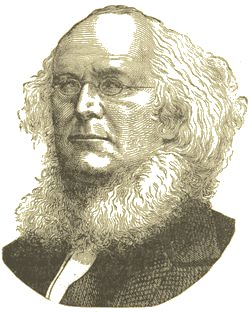
Horace Greeley was one of the few persons whose manhood fulfilled the precocious promise of his youth. He could read before he could speak plainly, and at the age of six he had declared that his purpose in life was to be a printer. At eleven he tried to be apprenticed at the village printing-office and was unsuccessful; at the age of fourteen he was taken on as an apprentice in the office of the Northern Spectator, at East Poultney, Vt.
His family were of Scotch-Irish origin, but had lived in the northern part of New Hampshire for several generations. Horace was born in Amherst, N. H., February 3, 1811. So quick of apprehension was he, and so active was his intellect, that the commonest of common-school education was for him sufficient. His schooling was only that which he could obtain during three or four months in winter; for at other seasons of the year he labored in the field with his father and brothers; and when he went to be an apprentice for five years in the printing-office, he was paid a very slender pittance, the greater part of which he gave to his father, whose income was probably next to nothing.
In June, 1830, the newspaper office in which young Greeley was learning his trade became insolvent, and Greeley, then in his twentieth year, was released from his indentures. He tramped from office to office as a journeyman printer, and his father having removed to the then "new country of western Pennsylvania," the youngster, with ten dollars in his pocket, walking part way and part way earning his passage on a tug-boat, entered the city of New York, August 18, 1831. For days he sought in vain for employment among the printing-offices of the metropolis. He was gawky, poorly clad, and doubtless presented a very grotesque appearance to the cityfied people to whom he vainly applied for employment. Finally he effected an entrance into one of the printing-offices of the city, and, much to the surprise of those who sneered at his ungainly and unpromising figure, he straightway proved himself to be a competent, careful, and skilful printer. For fourteen months or more, he picked up odd jobs in the offices of the newspapers, always making friends and always managing to save a little money.
Finally, at the beginning of 1833, in partnership with Francis V. Story, a printer, he established a penny paper called The Morning Post. This venture failed, but Greeley and Story saved from the wreck two-thirds of their capital, which was $150, all told, and still had on hand their type and materials. They now became master job-printers and made small contracts with persons who had newspaper printing to give out. In his New England boyhood Greeley had occasionally contributed to the columns of the newspapers on which he worked, and now he resumed that employment. He wrote for several of the feeble newspapers of the time, and on the death of his partner, Francis Story, he associated himself with Jonas Winchester. The firm prospered, and in 1834 was strong enough to establish a weekly literary newspaper called The New Yorker. The first number of this paper appeared on March 22, 1834, and it sold one hundred copies; for the three months next succeeding this was the average of its weekly circulation. The paper gradually increased in popularity, and the name of its Editor-in-Chief, Horace Greeley, was now known and respected. He furnished editorials also to the Daily Whig and to other journals, and was selected by William H. Seward and Thurlow Weed for the editorship of a campaign paper called The Jeffersonian, published in Albany. This was a Whig newspaper printed weekly, and the audacity, aggressiveness, and ability with which it was edited commanded the respect of its readers. The Jeffersonian was finally suspended in the spring of 1839, and during the presidential canvass of the following year, Greeley, foreseeing the activity of the campaign, seized upon the opportunity to establish a new campaign paper called The Log Cabin. This journal at once achieved the extraordinary circulation of twenty thousand copies for its first edition. It succeeded beyond the most sanguine expectations of its founders, H. Greeley & Company, and in a few weeks the circulation ran up to sixty thousand, eighty thousand, and even ninety thousand copies, a newspaper circulation in those days absolutely unprecedented. The Log Cabin was characterized by the homely wit, the unsparing logic, and the terseness and vigor of expression which were always Horace Greeley's most marked traits as a journalist.
After the campaign of 1840 The Log Cabin became a family political paper, and on April 10, 1841, its name was supplanted by that of The New York Tribune. Its home was at 30 Ann Street, and Horace Greeley, its editor, promised that it should be "worthy of the hearty approval of the virtuous and refined, and a welcome visitant to family firesides."
As an editor Mr. Greeley was eccentric, and his marked personal traits were perceptible in his management of his newspaper. He was severely temperate, although opposed to prohibition as impracticable; he was in favor of a high protective tariff, opposed to slavery, predisposed to vegetarian diet, and at times manifested a proclivity to the doctrines of Fourier and Prudhomme.
In his management of The Tribune Mr. Greeley made a wide acquaintance with the newspaper men, politicians, and the statesmen of the time. Among those associated with him in the management of his paper was Henry J. Raymond, who afterward became the founder of The New York Times. Those who rendered service to The Tribune were George William Curtis, Charles A. Dana, Margaret Fuller, Bayard Taylor, and others who subsequently achieved renown. Mr. Greeley himself has said that of his first issue of five thousand copies of the paper, nearly all "were with difficulty given away." The Tribune was first sold at one cent a copy; in a month's time it reached a circulation of three thousand, and a month later it had reached the extraordinary circulation of eleven and twelve thousand. The New Yorker and The Log Cabin had all along been managed as weekly issues from the same office; but in September of the first year of the establishment of The Tribune these were merged in what was now The New York Weekly Tribune, which at once leaped to a large circulation and became a great force throughout the country, especially in the rural districts.
In 1842 Mr. Greeley began to print in his paper one column daily of matter on Fourierite topics, written by Albert Brisbane, and occasionally these theories were defended in his editorial columns, and he thereby gained a certain amount of obloquy from which he did not readily recover. The paper had the reputation of being not only extremely radical in its political views, but also committed to many of the "isms" of the times. It paid much attention to the spirit-rappings of the Fox sisters, of Rochester, and investigated the curious phenomena with fearless open-mindedness. The Tribune prospered, though not greatly, and it was evident that Mr. Greeley's business management was never very successful; and it may be said that his greatest success as the editor of a prosperous and profitable newspaper was always achieved by the co-operation of wiser managers than himself. His personal appearance was peculiar, and he very soon became a well-known figure in the public life of New York. He usually wore a broad-brimmed, soft white hat and a light-colored overcoat, and his appearance, although always spotlessly neat, was characterized by a certain disorderliness which instantly attracted attention. He had a shrill, high-keyed voice; he was irascible in temper, and was never the "philosopher" which those who least knew him credited him with being. In an angry letter published in his own newspaper he referred to the editor of The Daily Times as "that little villain, Raymond;" and replying to an offensive charge against him by The Evening Post, he began with, "You lie, villain, wilfully, wickedly, basely lie." Other passages at arms like these occasionally enlivened, if they did not disfigure, the editorial columns of The Tribune, over which Greeley exercised a personal censorship which, in later years, he found it necessary to relax. He was sincerely and ardently devoted to the cause of Protection, to the interests of the farmer and the laboring man, to sound money, and to all the ennobling and refining activities of social life. In spite of a careless personal manner, and a voice not at all agreeable to the ear, he became a popular and greatly sought public speaker. As a lecturer in the lyceums of towns and villages, then greatly in vogue, he was always an acceptable and greatly admired figure.
In 1848 he was elected to the United States House of Representatives to fill a vacancy for three months. With great vigor he charged upon several of the most prominent abuses of the time, and selecting the practice of paying mileage to Congressmen, he assaulted that with a vehemence which ultimately destroyed it. As a member of Congress he also introduced the first bill to give free homesteads to actual settlers on the public lands. He was a candidate in 1861 for United States Senator, but was defeated by Ira Harris, of Albany. In 1864 he was one of the Republican Presidential Electors, and in 1870 was nominated for Congress in a hopelessly Democratic district, and was defeated. He had always been an intense opponent of human slavery, and in 1848 his hostility to the war with Mexico was doubtless inspired by his dread of the extension of the slave system. He was an enthusiastic supporter of John C. Fremont, who was nominated for President by the Republicans in 1856; and he made his newspaper so dreaded and feared by the opposition that he was indicted in Virginia for circulating incendiary documents through its columns. During these years he was an incessant and untiring worker, and produced for the columns of his own and other newspapers a prodigious amount of matter. He had heretofore labored in politics in conjunction with William H. Seward, Governor, and afterward United States Senator. In 1854 the separation between Greeley, Seward, and Thurlow Weed became established, and Mr. Seward's friends prevented the election of Mr. Greeley as a delegate to the Republican Convention which nominated Abraham Lincoln in 1860. Greeley, however, obtained a seat as delegate in the Convention as a representative from the State of Oregon, and in that capacity he, more than any other man, doubtless turned the tide against Mr. Seward and in favor of Abraham Lincoln, who was nominated by the Convention.
At the breaking out of the Civil War Mr. Greeley manifested great trepidation and reluctance to face the issue. He even advised in The Tribune that the "Erring Sisters" be allowed to depart in peace; but later he rallied manfully to the cause of the defence of the Union, and his newspaper rang with impassioned appeals for the freedom of the slaves held in bondage in the South. He incessantly urged a more vigorous prosecution of the war, and called upon President Lincoln to take every possible measure for the emancipation of the Southern bondmen.
In 1864, being convinced that the cause of the rebellion was gradually weakening, he urged upon the President the policy of negotiating with the leaders of the Confederate government for a surrender of their warlike policy, on conditions to be arrived at by commissioners from both sides. This proposition excited much indignation throughout the country, and when, in answer to repeated demands from Mr. Greeley, President Lincoln authorized him to undertake such a conference at Niagara Falls, the people generally applauded the wisdom of the President, as well as the disappointment of Mr. Greeley, when the conference came to naught.
After the final surrender at Appomattox and the capture of the Confederate President, Mr. Greeley visited Richmond and signed the bail bond of Jefferson Davis. This action raised a storm of public censure, and he was for a time overwhelmed by the wrath and indignation of those who had been formerly associated with him in political affairs. He defended himself with great vigor, and fearlessly assailed those who stigmatized him as a sympathizer with the fallen rebel chieftain. He was not friendly to the nomination of General Grant in 1868, and disapproved of many of the schemes that marked his administration. Returning from a visit through the Southern States in the early years of President Grant's term, he brought to his newspaper some vigorous and outspoken denunciations of the "carpet-bag" governments of the formerly rebel States, and denunciations of the "scalawags" who, he said, "were the pests of the reconstructed States of the South." These and similar outgivings attracted the attention of a large element of the Republican party, and he was nominated for the Presidency, against General Grant, in 1872. Mr. Greeley's canvass was one of great picturesqueness and industry. He made a series of speeches extending over a tour from New England to the West, and returning to New York, which were marked by a most wonderful originality, freshness, and brilliance; but nothing could avail to stem the tide of prejudice which rose against him and in favor of General Grant. He had been nominated by the so-called Liberal Republicans and by the Democrats, but he failed to carry any one of the Northern States, and of the other States he carried only Georgia, Kentucky, Maryland, Missouri, Tennessee, and Texas. He was assailed during this canvass in the bitterest terms by those who regarded him as a turncoat and a traitor, and undoubtedly the vituperation and abuse showered upon him had the effect of disheartening him and destroying the zest with which he had theretofore undertaken the multifarious duties of life. He returned to New York from an exhausting campaign, depressed in spirit and weary in body and in mind. The death of his devoted wife added to his sorrows, and on November 29, 1872, only a few weeks after the Presidential election, he died at Pleasantville, N. Y., of mental and nervous prostration. His body lay in state in the City Hall, and his funeral was attended by the notables of the land—President Grant, who had just been re-elected by the people, being numbered among those who mourned at his bier.
In addition to his editorial labors Mr. Greeley was the author of a number of works, among which were "Hints toward Reforms," "Glances at Europe," "History of the Struggle for Slavery Extension," "Overland Journey to San Francisco," "The American Conflict," and "Recollections of a Busy Life." He was also the founder of "The Whig Almanac," a manual of politics, which in later years became known as "The Tribune Almanac," and survived his demise.[Back to Contents]

LOUIS AGASSIZ[15] By Asa Gray (1807-1873)
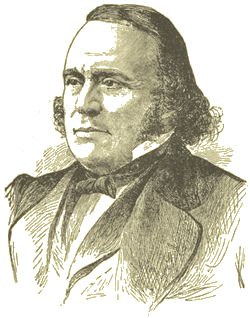
There is no need to give an abstract of the contents of these fascinating volumes, for everybody is reading them. Most are probably wishing for more personal details, especially of the American life; but the editorial work is so deftly and delicately done, and "the story of an intellectual life marked by rare coherence and unity" is so well arranged to tell itself and make its impression, that we may thankfully accept what has been given us, though the desired "fulness of personal narrative" be wanting.
Twelve years have passed since Agassiz was taken from us. Yet to some of us it seems not very long ago that the already celebrated Swiss naturalist came over, in the bloom of his manly beauty, to charm us with his winning ways, and inspire us with his overflowing enthusiasm, as he entered upon the American half of that career which has been so beneficial to the interests of natural science. There are not many left of those who attended those first Lowell Lectures in the autumn of 1846—perhaps all the more taking for the broken English in which they were delivered—and who shared in the delight with which, in a supplementary lecture, he more fluently addressed his audience in his mother-tongue.
In these earliest lectures he sounded the note of which his last public utterance was the dying cadence. For, as this biography rightly intimates, his scientific life was singularly entire and homogeneous—if not uninfluenced, yet quite unchanged, by the transitions which have marked the period. In a small circle of naturalists, almost the first that was assembled to greet him on his coming to this country, and of which the writer is the sole survivor, when Agassiz was inquired of as to his conception of "species," he sententiously replied: "A species is a thought of the Creator." To this thoroughly theistic conception he joined the scientific deduction which he had already been led to draw, that the animal species of each geological age, or even stratum, were different from those preceding and following, and also unconnected by natural derivation. And his very last published works reiterated his steadfast conviction that "there is no evidence of a direct descent of later from earlier species in the geological succession of animals." Indeed, so far as we know, he would not even admit that such "thoughts of the Creator" as these might have been actualized in the natural course of events. If he had accepted such a view, and if he had himself apprehended and developed in his own way the now well-nigh assured significance of some of his early and pregnant generalizations, the history of the doctrine of development would have been different from what it is, a different spirit and another name would have been prominent in it, and Agassiz would not have passed away while fighting what he felt to be—at least for the present—a losing battle. It is possible that the "whirligig of time" may still "bring in his revenges," but not very probable.
Much to his credit, it may be said that a good share of Agassiz's invincible aversion to evolution may be traced to the spirit in which it was taken up by his early associate, Vogt, and, indeed, by most of the German school then and since, which justly offended both his scientific and his religious sense. Agassiz always "thought nobly of the soul," and could in no way approve either materialistic or agnostic opinions. The idealistic turn of his mind was doubtless confirmed in his student days at Munich, whither he and his friend Braun resorted after one session at Heidelberg, and where both devotedly attended the lectures of Schelling—then in his later glory—and of Oken, whose "Natur-Philosophie" was then in the ascendant. Although fascinated and inspired by Oken's à priori biology(built upon morphological ideas which had not yet been established, but had, in part, been rightly divined) the two young naturalists were not carried away by it, probably because they were such keen and conscientious observers, and were kept in close communion with work-a-day nature. As Agassiz intimates, they had to resist "the temptation to impose one's own ideas upon nature, to explain her mysteries by brilliant theories rather than by patient study of the facts as we find them," and that "overbearing confidence in the abstract conceptions of the human mind as applied to the study of nature; although, indeed," he adds, "the young naturalist of that day who did not share in some degree the intellectual stimulus given to scientific pursuits by physio-philosophy would have missed a part of his training." That training was not lost upon Agassiz. Although the adage in his last published article, "A physical fact is as sacred as a moral principle," was well lived up to, yet ideal prepossessions often had much to do with his marshalling of the facts.
Another professor at Munich, from whom Agassiz learned much, and had nothing to unlearn, was the anatomist and physiologist Döllinger. He published little, but he seems to have been the founder of modern embryological investigation, and to have initiated his two famous pupils, first Von Baer, and then Agassiz, into at least the rudiments of the doctrine of the correspondence between the stages of the development of the individual animal with that of its rank in the scale of being, and the succession in geological time of the forms and types to which the species belongs: a principle very fertile for scientific zoölogy in the hands of both these naturalists, and one of the foundations of that theory of evolution which the former, we believe, partially accepted, and the other wholly rejected.
The botanical professor, the genial Von Martius, should also be mentioned here. He found Agassiz a student, barely of age; he directly made him an author, and an authority, in the subject of his predilection. Dr. Spix, the zoölogical companion of Martius in Brazilian exploration, died in 1826; the fishes of the collection were left untouched. Martius recognized the genius of Agassiz, and offered him, and indeed pressed him, to undertake their elaboration. Agassiz brought out the first part of the quarto volume on the "Fishes of the Brazilian Expedition of Spix and Martius" before he took his degree of doctor of philosophy, and completed it before he proceeded to that of doctor in medicine, in 1830. The work opened his way to fame, but brought no money. Still, as Martius defrayed all the expenses, the net result compared quite favorably with that of later publications. Moreover, out of it possibly issued his own voyage to Brazil in later years, under auspices such as his early patron never dreamed of.
This early work also made him known to Cuvier; so that, when he went to Paris, a year afterward, to continue his medical and scientific studies—the one, as he deemed, from necessity, the other from choice—he was received as a fellow-savant; yet at first with a certain reserve, probably no more than was natural in view of the relative age and position of the two men; but Agassiz, writing to his sister, says: "This extreme but formal politeness chills you instead of putting you at your ease; it lacks cordiality, and, to tell the truth, I would gladly go away if I were not held fast by the wealth of material of which I can avail myself." But only a month later he writes—this time to his uncle—that, while he was anxious lest he "might not be allowed to examine, and still less to describe, the fossil fishes and their skeletons in the Museum, ... knowing that Cuvier intended to write a work on this subject," and might naturally wish to reserve the materials for his own use; and when the young naturalist, as he showed his own sketches and notes to the veteran, was faintly venturing to hope that, on seeing his work so far advanced, he might perhaps be invited to share in a joint publication, Cuvier relieved his anxiety and more than fulfilled his half-formed desires.
"He desired his secretary to bring him a certain portfolio of drawings. He showed me the contents: they were drawings of fossil fishes, and notes which he had taken in the British Museum and elsewhere. After looking it through with me, he said he had seen with satisfaction the manner in which I had treated this subject; that I had, indeed, anticipated him, since he had intended at some future time to do the same thing; but that as I had given it so much attention, and had done my work so well, he had decided to renounce his project, and to place at my disposition all the materials he had collected and all the preliminary notes he had taken."
Within three months Cuvier fell under a stroke of paralysis, and shortly died. The day before the attack he had said to Agassiz, "Be careful, and remember that work kills." We doubt if it often kills naturalists, unless when, like Cuvier, they also become statesmen.
But to live and work, the naturalist must be fed. It was a perplexing problem how possibly to remain a while longer in Paris, which was essential to the carrying on of his work, and to find the means of supplying his very simple wants. And here the most charming letters in these volumes are, first, the one from his mother, full of tender thoughtfulness, and making the first suggestion about Neuchâtel and its museum, as a place where the aspiring naturalist might secure something more substantial than "brilliant hopes" to live upon; next, that from Agassiz to his father, who begs to be told as much as he can be supposed to understand of the nature of this work upon fossil fishes, which called for so much time, labor, and expense; and, almost immediately, Agassiz's letter to his parents, telling them that Humboldt had, quite spontaneously and unexpectedly, relieved his present anxieties by a credit of a thousand francs, to be increased, if necessary. Humboldt had shown a friendly interest in him from the first, and had undertaken to negotiate with Cotta, the publisher, in his behalf; but, becoming uneasy by the delay, and feeling that "a man so laborious, so gifted, and so deserving of affection ... should not be left in a position where lack of serenity disturbs his power of work," he delicately pressed the acceptance of this aid as a confidential transaction between two friends of unequal age.
Indeed, the relations between the "two friends," one at that time sixty-three, and the other twenty-five, were very beautiful, and so continued, as the correspondence shows. Humboldt's letters (we wish there were more of them) are particularly delightful, are full of wit and wisdom, of almost paternal solicitude, and of excellent counsel. He enjoins upon Agassiz to finish what he has in hand before taking up new tasks (this is in 1837), not to spread his intellect over too many subjects at once, nor to go on enlarging the works he had undertaken; he predicts the pecuniary difficulties in which expansion would be sure to land him, bewails the glacier investigations, and closes with "a touch of fun, in order that my letter may seem a little less like preaching. A thousand affectionate remembrances. No more ice, not much of echinoderms, plenty of fish, recall of ambassadors in partibus, and great severity toward booksellers, an infernal race, two or three of which have been killed under me."
The ambassadors in partibus were the artists Agassiz employed and sent to England or elsewhere to draw fossil fishes for him in various museums, at a cost which Humboldt knew would be embarrassing. The ice, which he would have no more of, refers to the glacier researches upon which Agassiz was entering with ardor, laying one of the solid foundations of his fame. Curiously enough, both Humboldt and Von Buch, with all their interest in Agassiz, were quite unable to comprehend the importance of an inquiry which was directly in their line, and, indeed, they scorned it; while the young naturalist, without training in physics or geology, but with the insight of genius, at once developed the whole idea of the glacial period, with its wonderful consequences, upon his first inspection of the phenomena shown him by Charpentier in the valley of the Rhône.
It is well that Humboldt's advice was not heeded in this regard. Nevertheless he was a wise counsellor. He saw the danger into which his young friend's enthusiasm and boundless appetite for work was likely to lead him. For Agassiz it might be said, with a variation of the well-known adage, that there was nothing he touched that he did not aggrandize. Everything he laid hold of grew larger under his hand—grew into a mountain threatening to overwhelm him, and would have overwhelmed anyone whose powers were not proportionate to his aspirations. Established at Neuchâtel, and giving himself with ardor to the duties of his professorship, it was surely enough if he could do the author's share in the production of his great works on the fossil and the fresh-water fishes, without assuming the responsibilities and cares of publication as well, and even of a lithographic establishment which he set up mainly for his own use. But he carried pari passu, or nearly so, his work on fossil mollusca—a quarto volume with nearly a hundred plates—his monographs of echinoderms, living and fossil, his investigations of the embryological development of fishes, and that laborious work, the "Nomenclator Zoologicus," with the "Bibliographia," later published in England by the Ray Society. Moreover, of scattered papers, those of the Royal Society's Catalogue, which antedate his arrival in this country, are more than threescore and ten. He had help, indeed; but the more he had, the more he enlarged and diversified his tasks; Humboldt's sound advice about his zoölogical undertakings being no more heeded than his fulminations against the glacial theory.
In the midst of all this, Agassiz turned his glance upon the glaciers, and the "local phenomenon" became at once a cosmic one. So far a happy divination; but he seems to have believed quite to the last that, not only the temperate zones, but whole intertropical continents—at least the American—had been sheeted with ice. The narrative in the first volume will give the general reader a vivid but insufficient conception of the stupendous work upon which he so brilliantly labored for nearly a decade of years.
Cœlum, non animum, mutant who come with such a spirit to a wider and, scientifically, less developed continent. First as visitor, soon as denizen, and at length as citizen of the American republic, Agassiz rose with every occasion to larger and more various activities. What with the Lowell Institute, the college in Charleston, S. C., and Cornell University, in addition to Harvard, he may be said to have held three or four professorships at once, none of them sinecures. He had not been two months in the country before a staff of assistants was gathered around him, and a marine zoölogical laboratory was in operation. The rude shed on the shore, and the small wooden building at Cambridge, developed under his hand into the Museum of Zoölogy—if not as we see it now, yet into one of the foremost collections. Who can say what it would have been if his plans and ideas had obtained full recognition, and "expenditure" had seemed to the trustees, as it seemed to him, "the best investment;" or if efficient filial aid, not then to be dreamed of, had not given solid realization to the high paternal aspirations? In like manner grew large under his hand the Brazilian exploration, so generously provided for by a Boston citizen and fostered by an enlightened emperor; and on a similar scale was planned, and partly carried out, the "Contributions to the Natural History of the United States," as the imperial quarto work was modestly entitled, which was to be published "at the rate of one volume a year, each volume to contain about three hundred pages and twenty plates," with simple reliance upon a popular subscription; and so, indeed, of everything which this large-minded man undertook.
While Agassiz thus was a magnanimous man, in the literal as well as the accepted meaning of the word, he was also, as we have seen, a truly fortunate one. Honorable assistance came to him at critical moments, such as the delicate gift from Humboldt at Paris, which perhaps saved him to science; such as the Wollaston prize from the Geological Society in 1834, when he was struggling for the means of carrying on the "Fossil Fishes." The remainder of the deficit of this undertaking he was able to make up from his earliest earnings in America. For the rest, we all know how almost everything he desired—and he wanted nothing except for science—was cheerfully supplied to his hand by admiring givers. Those who knew the man during the twenty-seven years of his American life, can quite understand the contagious enthusiasm and confidence which he evoked. The impression will in some degree be transmitted by these pleasant and timely volumes, which should make the leading lines of the life of Agassiz clear to the newer generation, and deepen them in the memory of an older one.[Back to Contents]
CHARLES DARWIN Extracts from "Life and Letters of Charles Darwin," by Arch. Geikie, LL.D., F.R.S. (1809-1882)
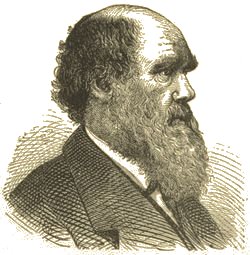
By the universal consent of mankind, the name of Charles Darwin was, even during his lifetime, among those of the few great leaders who stand forth for all time as the creative spirits who have founded and legislated for the realm of science. It is too soon to estimate with precision the full value and effect of his work. The din of controversy that rose around him has hardly yet died down, and the influence of the doctrines he propounded is extending into so many remote departments of human inquiry, that a generation or two may require to pass away before his true place in the history of thought can be definitely fixed. But the judgment of his contemporaries as to his proud pre-eminence is not likely ever to be called in question. He is enrolled among Dii majorum gentium, and there he will remain to the end of the ages. When he was laid beside the illustrious dead in Westminster Abbey, there arose far and wide a lamentation as of personal bereavement. Thousands of mourners who had never seen him, who knew only his writings, and judged of the gentleness and courtesy of his nature from these, and from such hearsay reports as passed outward from the privacy of his country home, grieved as for the loss of a friend. It is remarkable that probably no scientific man of his day was personally less familiar to the mass of his fellow-countrymen. He seemed to shun all the usual modes of contact with them. His weak health, domestic habits, and absorbing work kept him in the seclusion of his own quiet home. His face was seldom to be seen at the meetings of scientific societies, or at those gatherings where the discoveries of science are expounded to more popular audiences. He shrank from public controversy, although no man was ever more vigorously attacked and more completely misrepresented. Nevertheless, when he died the affectionate regret that followed him to the grave, came not alone from his own personal friends, but from thousands of sympathetic mourners in all parts of the world, who had never seen or known him. Men had ample material for judging of his work, and in the end had given judgment with general acclaim. Of the man himself, however, they could know but little, yet enough of his character shone forth in his work to indicate its tenderness and goodness. Men instinctively felt him to be in every way one of the great ones of the earth, whose removal from the living world leaves mankind poorer in moral worth as well as in intellect.
Charles Darwin came of a family which from the beginning of the sixteenth century had been settled on the northern borders of Lincolnshire. Several of his ancestors had been men of literary taste and scientific culture, the most noted of them being his grandfather, Erasmus Darwin, the poet and philosopher. His father was a medical man in large practice at Shrewsbury, and his mother a daughter of Josiah Wedgwood, of Etruria. Some interesting reminiscences are given of the father, who must have been a man of uncommon strength of character. He left a large fortune, and thus provided for the career his son was destined to fulfil. Of his own early life and later years, Darwin has left a slight but most interesting sketch in an autobiographical fragment, written late in life for his children, and without any idea of its ever being published. Shortly before his mother's death, in 1817, he was sent, when eight years old, to a day-school in his native town. But even in the period of childhood he had chosen the favorite occupation of his life: "My taste for natural history," he says, "and more especially for collecting, was well developed. I tried to make out the names of plants, and collected all sorts of things—shells, seals, franks, coins, and minerals. The passion for collecting which leads a man to be a systematic naturalist, a virtuoso, or a miser, was very strong in me, and was clearly innate, as none of my sisters and brothers ever had this taste."
Some of the incidents of his Cambridge life which he records are full of interest in their bearing on his future career. Foremost among them stands the friendship which he formed with Professor Henslow, whose lectures on botany he attended. He joined in the class excursions and found them delightful. But still more profitable to him were the long and almost daily walks which he enjoyed with his teacher, during the latter half of his time at Cambridge. Henslow's wide range of acquirement, modesty, unselfishness, courtesy, gentleness, and piety, fascinated him and exerted on him an influence which, more than anything else, tended to shape his whole future life. The love of travel which had been kindled by his boyish reading, now took a deeper hold of him as he read Humboldt's "Personal Narrative" and Herschel's "Introduction to the Study of Natural Philosophy." He determined to visit Teneriffe, and even went so far as to inquire about ships. But his desire was soon to be gratified in a far other and more comprehensive voyage. At the close of his college life he was fortunate enough, through Henslow's good offices, to accompany Sedgwick in a geological excursion in North Wales. There can be little doubt that this short trip sufficed to efface the dislike of geology which he had conceived at Edinburgh, and to show him how much it was in his own power to increase the sum of geological knowledge. To use his own phrase, he began to "work like a tiger" at geology.
But he now had reached the main turning-point of his career. On returning home from his ramble with Sedgwick he found a letter from Henslow, telling him that Captain Fitz-Roy, who was about to start on the memorable voyage of the Beagle, was willing to give up part of his own cabin to any competent young man who would volunteer to go with him, without pay, as a naturalist. The post was offered to Darwin and, after some natural objections on the part of his father, accepted.
The Beagle weighed anchor from Plymouth on December 27, 1831, and returned on October 2, 1836.
On his return to England, Darwin at once took his place among the acknowledged men of science of his country. For a time his health continued to be such as to allow him to get through a large amount of work. The next two years, which in his own opinion were the most active of his life, were spent, partly at Cambridge, and partly in London, in the preparation of his "Journal of Researches," of the zoölogical and geological results of the voyage, and of various papers for the Geological and Zoölogical Societies. So keen was his geological zeal that, almost against his better judgment, he was prevailed upon to undertake the duties of honorary secretary of the Geological Society, an office which he continued to hold for three years. And at each period of enforced holiday, for his health had already begun to give way, he occupied himself with geological work in the field. In the Midlands he watched the operations of earthworms, and began those inquiries which formed the subject of his last research, and of the volume on "Vegetable Mould" which he published not long before his death. In the Highlands he studied the famous Parallel Roads of Glen Roy; and his work there, though in after-years he acknowledged it to be "a great failure," he felt at the time to have been "one of the most difficult and instructive tasks" he had ever undertaken.
In the beginning of 1839 Darwin married his cousin, daughter of Josiah Wedgwood, and grand-daughter of the founder of the Etruria Works, and took a house in London. But the entries of ill-health in his diary grow more frequent. For a time he and his wife went into society, and took their share of the scientific life and work of the metropolis. But he was compelled gradually to withdraw from this kind of existence, which suited neither of them, and eventually they determined to live in the country. Accordingly, he purchased a house and grounds at Down, in a sequestered part of Kent, some twenty miles from London, and moved thither in the autumn of 1842. In that quiet home he passed the remaining forty years of his life. It was there that his children were born and grew up around him; that he carried on the researches and worked out the generalizations that have changed the whole realm of science; that he received his friends and the strangers who came from every country to see him; and it was there that, after a long and laborious life, full of ardor and work to the last, he died, at the age of seventy-three, on April 19, 1882.
The story of his life at Down is almost wholly coincident with the history of the development of his views on evolution, and the growth and appearance of the successive volumes which he gave to the world. For the first four years his geological tastes continued in the ascendant. During that interval there appeared three remarkable works, his volume on "Coral Islands," that on "Volcanic Islands," and his "Geological Observations on South America."
After working up the geological results of the long voyage in the Beagle, he set himself with great determination to more purely geological details. While on the coast of Chili he had found a curious new cirripede, to understand the structure of which he had to examine and dissect many of the common forms. The memoir, which was originally designed to describe only his new type, gradually expanded into an elaborate monograph on the Cirripedes (barnacles) as a whole group. For eight years he continued this self-imposed task, getting at last so weary of it as to feel at times as if the labor had been in some sense wasted which he had spent over it; and this suspicion seems to have remained with him in maturer years. But when at last the two bulky volumes, of more than one thousand pages of text, with forty detailed plates, made their appearance, they were hailed as an admirable contribution to the knowledge of a comparatively little known department of the animal kingdom. In the interests of science, perhaps, their chief value is to be recognized, not so much in their own high merit, as in the practical training which their preparation gave the author in anatomical detail and classification. He spoke of it himself afterward as a valuable discipline, and Professor Huxley truly affirms that the influence of this discipline was visible in everything which he afterward wrote.
It was after Darwin had got rid of his herculean labors over the "Cirripede" book, that he began to settle down seriously to the great work of his life—the investigation of the origin of the species, of plants and animals. Briefly, it may be stated here that he seems to have been first led to ponder over the question of the transmutation of species, by facts that had come under his notice during the South American part of the voyage in the Beagle—such as the discovery of the fossil remains of huge animals akin to, but yet very distinct from, the living armadillos of the same regions; the manner in which closely allied animals were found to replace one another, as he followed them over the continent; and the remarkable character of the flora and fauna of the Galapagos Archipelago. "It was evident," he says, "that such facts as these, as well as many others, could only be explained on the supposition that species gradually become modified; and the subject haunted me." His first note-book for the accumulation of facts bearing on the question was opened in July, 1837, and from that date he continued to gather them "on a wholesale scale, more especially with respect to domesticated productions, by printed inquiries, by conversation with skilful breeders and gardeners, and by extensive reading."
He now set to work upon that epitome of his observations and deductions which appeared in November, 1859, as the immortal "Origin of Species."
Those who are old enough to remember the publication of this work, cannot but marvel at the change, which, since that day, not yet thirty years ago, has come alike upon the non-scientific and the scientific part of the community in their estimation of it. Professor Huxley has furnished to the biography a graphic chapter on the reception of the book, and in his vigorous and witty style recalls the furious and fatuous objections that were urged against it. A much longer chapter will be required to describe the change which the advent of the "Origin of Species" has wrought in every department of science, and not of science only, but of philosophy. The principle of evolution, so early broached and so long discredited, has now at last been proclaimed and accepted as the guiding idea in the investigation of nature.
One of the most marvellous aspects of Darwin's work was the way in which he seemed always to throw a new light upon every department of inquiry into which the course of his researches led him to look. The specialists who, in their own narrow domains, had been toiling for years, patiently gathering facts and timidly drawing inferences from them, were astonished to find that one who, in their eyes, was a kind of outsider, could point out to them the plain meaning of things which, though entirely familiar to them, they had never adequately understood. The central idea of the "Origin of Species" is an example of this in the biological sciences. The chapter on the imperfection of the geological record is another.
After the publication of the "Origin" Darwin gave to the world, during a succession of years, a series of volumes in which some of his observations and conclusions were worked out in fuller detail. His books on the fertilization of orchids, on the movements and habits of climbing plants, on the variation of animals and plants under domestication, on the effects of cross-and self-fertilization in the vegetable kingdom, on the different forms of flowers on plants of the same species, were mainly based on his own quiet work in the greenhouse and garden at Down. His volumes on the descent of man and on the expression of the emotions in man and animals, completed his contributions to the biological argument. His last volume, published the year before his death, treated of the formation of vegetable mould and the habits of earthworms, and the preparation of it enabled him to revive some of the geological enthusiasm which so marked the earlier years of his life.
Such, in briefest outline, was the work accomplished by Charles Darwin. The admirable biography prepared by his son enables us to follow its progress from the beginning to its close. But higher even than the intellect which achieved the work, was the moral character which shone through it all.[Back to Contents]
LOUIS ADOLPHE THIERS (1797-1877)
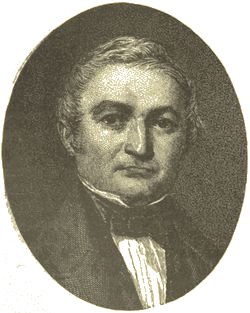
Louis Adolphe Thiers, French historian, politician, and patriot, was born at Marseilles on April 16, 1797. His father, who seems to have belonged to a family in decayed circumstances, was a locksmith. Through the influence of his mother, who was a Chenier, he received a good education, first at the Lycée in his native city, and subsequently (1815) at Aix, whither he was sent to study law. At Aix he made the acquaintance of Mignet, cultivated literature rather than the law, and won a prize for a dissertation on Vauvenargues. Called to the bar at the age of twenty-three, he set off for Paris in the company of Mignet. His prospects did not seem brilliant, and his almost ludicrously squat figure and plain face were not recommendations to Parisian society. His industry and belief in himself were, however, unbounded, and an introduction to Lafitte, of the Constitutionnel, then the leading organ of the French liberals, gave him the chance of showing his capacity as a public writer. His articles in the Constitutionnel, chiefly on political and literary subjects, gained him the entry into the most influential salons of the opposition. At this time he made the acquaintance of Talleyrand, Casimir Périer, the Comte de Flahault, and Baron Louis, the financier. Meanwhile he was rapidly—indeed too rapidly—preparing his "Histoire de la Révolution Française." The first two volumes—there were ten in all—appeared in 1823. This work, although it has been demonstrated to be very untrustworthy and inaccurate, more especially in its estimates of persons, gave its author a prominent place among French politicians and men of letters. About this time, too, the gift by his admirer, Cotta, the German publisher, of a share in the Constitutionnel raised him to comparative affluence. In January, 1830, he, along with Armand Carrel, Mignet, and other friends, started the National, and in its columns waged relentless war on the Polignac administration. The ministry met the opposition it had provoked by the Ordonnances of July. Among the other repressive measures that were taken was the sending of a commissary of police to the office of the National, interdicting its publication. Its conductors, with Thiers at their head, defied the ministry, and the result was the revolution which drove Charles X. into exile.