Volume 4 — LIST OF ILLUSTRATIONS (continued 4)
Reading edition
It is not too much to say that this mode of representing natural phenomena has made it possible to introduce in our most elementary works the broad generalizations derived from the investigations of Humboldt in South America; and that every child in our schools has his mind fed from the labors of Humboldt's brain, wherever geography is no longer taught in the old routine.
Humboldt was born near the court. He was brought up in connection with courtiers and men in high positions of life. He was no doubt imbued with the prejudices of his caste. He was a nobleman of high descent. And yet the friend of kings was the bosom friend of Arago, and he was the man who could, after his return from America, refuse the highest position at the court of Berlin, that of the secretaryship of public instruction, preferring to live in a modest way in Paris, in the society of all those illustrious men, who then made Paris the centre of intellectual culture. It was there where he became one of that Société d'Arceuil, composed of all the great men of the day, to which the paper on "Isothermal Lines" was presented, and by which it was printed, as all papers presented to it were, for private distribution. But from his intimate relations, especially to the court of Prussia, some insinuations have been made as to the character of Humboldt. They are as unjust as they are severe in expression. He was never a flatterer of those in power. He has shown it by taking a prominent position, in 1848, at the head of those who accompanied the victims of the revolution of that year to their last place of rest. But while he expressed his independence in such a manner, he had the kindliest feeling for all parties. He could not offend, even by an expression, those with whom he had been associated in early life; and I have no doubt that it is to that kindliness of feeling we must ascribe his somewhat indiscriminate patronage of aspirants in science, as well as men who were truly devoted to its highest aims. He may be said to have been, especially in his latter years, the friend of every cultivated man, wishing to lose no opportunity to do all the good of which he was capable; for he had a degree of benevolence and generosity which was unbounded. I can well say that there is not a man engaged in scientific investigations in Europe, who has not received at his hands marked tokens of his favor, and who is not under deep obligations to him. May I be permitted to tell a circumstance which is personal to me in that respect, and which shows what he was capable of doing while he was forbidden an opportunity of telling it. I was only twenty-four years of age when in Paris, whither I had gone with means given me by a friend; but was at last about to resign my studies from want of ability to meet my expenses. Professor Mitscherlich was then on a visit to Paris, and I had seen him in the morning, when he asked me what was the cause of my depressed feelings; and I told him that I had to go for I had nothing left. The next morning as I was seated at breakfast in front of the yard of the hotel where I lived, I saw the servant of Humboldt approach. He handed me a note, saying there was no answer and disappeared. I opened the note, and I see it now before me as distinctly as if I held the paper in my hand. It said:—
"My friend, I hear that you intend leaving Paris in consequence of some embarrassments. That shall not be. I wish you to remain here as long as the object for which you came is not accomplished. I enclose you a check of £50. It is a loan which you may repay when you can."
Some years afterward, when I could have repaid him, I wrote, asking for the privilege of remaining forever in his debt, knowing that this request would be more consonant to his feelings than the recovery of the money, and I am now in his debt. What he has done for me, I know he has done for many others; in silence and unknown to the world. I wish I could go on to state something of his character, his conversational powers, etc., but I feel that I am not in a condition to speak of them. I would only say that his habits were very peculiar. He was an early riser, and yet he was seen at late hours in the salons in different parts of Paris. From the year 1830 to 1848, while in Paris, he had been charged by the King of Prussia to send reports upon the condition of things there. He had before prepared for the King of Prussia a report on the political condition of the Spanish colonies in America, which no doubt had its influence afterward upon the recognition of the independence of those colonies. The importance of such reports to the government of Prussia may be inferred from a perusal of his political and statistical essays upon Mexico and Cuba. It is a circumstance worth noticing, that above all great powers, Prussia has more distinguished, scientific, and literary men among her diplomatists than any other state. And so was Humboldt actually a diplomatist in Paris, though he was placed in that position, not from choice, but in consequence of the benevolence of the king, who wanted to give him an opportunity of being in Paris as often and as long as he chose.
But from that time there were two men in him—the diplomatist, living in the Hôtel des Princes, and the naturalist who roomed in the Rue de la Harpe, in a modest apartment in the second story; where his scientific friends had access to him every day before seven. After that he was frequently seen working in the library of the Institute, until the time when the grand seigneur made his appearance at the court or in the salons of Paris.
The influence he has exerted upon the progress of science is incalculable. I need only allude to the fact that the "Cosmos," bringing every branch of natural science down to the comprehension of every class of students, has been translated into the language of every civilized nation of the world, and gone through several editions. With him ends a great period in the history of science, a period to which Cuvier, Laplace, Arago, Gay-Lussac and De Candolle, and Robert Brown belonged.[Back to Contents]
DANIEL O'CONNELL[8] By Justin McCarthy (1775-1847)
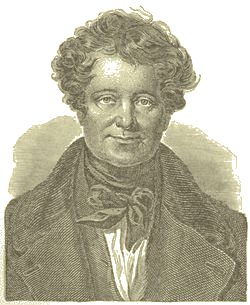
Daniel O'Connell, undoubtedly one of the greatest Irishmen that ever lived, and according to Mr. Lecky perhaps the greatest political agitator that the modern world has known, was born August 6, 1775, in the county of Kerry, in Ireland. His parents were of good family, but comparatively poor, his father being a second son. Later on, Daniel was adopted by an uncle, through whom he came in for the property of Darrynane, made famous by his name. He was sent when a boy—the fact is worth noticing—to the first school kept openly by a Catholic priest since the establishment of the penal laws. Afterward he became a student in France—in St. Omer and in Douay, until the outbreak of the French Revolution made it unsafe for him to remain longer in France—or at all events until his family believed that it would not be safe for him to remain there any longer. The excesses of the Revolution greatly shocked and horrified the young O'Connell, and indeed the effect of that early shock was felt by him all through his career. He became impressed with an almost morbid detestation of all forms of blood-shedding; and for a while after his return to Ireland he firmly believed himself to be a Conservative in politics. But the system of administration which prevailed in Great Britain and Ireland under Conservative governments soon convinced him that he could have nothing to do with Conservatism, and he very soon became—what he ever after continued to be—a Liberal as regarded Imperial policy, and indeed something more than a Liberal—what we should now call a Radical. He studied for the bar, and was, to all appearance, little inclined for anything but law and field sports. He was a keen sportsman, and, like another distinguished Irishman, "all his life long he loved rivers, and poets who sang of rivers." He made rapid way in his profession, and soon became one of the foremost advocates in Ireland. He was a safe, shrewd, keen lawyer as well as a great advocate—the two parts do not always go together. He was a master of the art of cross-examination and he was a magnificent speaker—his speeches were aflame with humor, and pathos, and passion. His voice was one of immense power and sweetness and variety of tone. Mr. Disraeli in one of his books, when praising to the highest the superb voice of the great Sir Robert Peel, says that he had never heard its superior "except indeed in the thrilling tones of O'Connell." The Irish advocate had the advantage, too, of a commanding presence. He was tall and moulded in almost herculean form, and he had eyes which were often compared with those of Robert Burns—the light of genius was in them. There is a full-length picture of him in the Reform Club, London, which enables one to understand how stately and imposing his presence must have been.
The career of O'Connell would appear to have been easily marked out for him. He was the foremost advocate in Ireland; he was making a large income; he had inherited a considerable property—what was there for him but to go on and prosper; make money, hunt, shoot, fish, and be happy. He could not indeed obtain any of the honors or dignities of his profession. He could not even be a king's counsel, and wear a silk gown. His religion cut him off from all such marks of distinction—for he was a member of the Catholic Church. But no penal laws prevented him from addressing juries and winning verdicts and attracting popular admiration and making money. He was very happily married—a genuine love-match, it would seem to have been, and the love lasted. Moreover he was strongly and almost unreasonably opposed to all manner of agitation that bordered on rebellion or even on sedition. He was positively unjust, he was utterly unreasonable, in his estimate of the rebellion of 1798 and Robert Emmet's abortive effort in 1803. He never did full justice even to the brave men who were concerned in these movements. He had an absolute detestation for all manner of secret societies. He knew too well that they only ended in betrayal by some traitor who had contrived to be admitted to their ranks. Under such conditions and with such views what was there to induce the successful and prosperous advocate who loved peace and who hated social disturbance, to mix himself up with political affairs at a time when national politics meant for a patriotic Irishman only social exclusion, danger, poverty, and even ruin?
O'Connell could not help himself. He had to walk, as Carlyle says of a very different man, "his own wild road whither that led him." O'Connell's wild road—the road that he had to walk, led him to the leadership of two great national movements.
To understand what O'Connell fought against we must, of course, understand O'Connell's time. It is not easy for an American reader to understand it without some thought and without the endeavor to grasp the reality of a state of things quite outside his own living experience. When O'Connell began his career in politics the Act of Union had but lately been passed. That Act of Union deprived Ireland of the more or less independent Parliament which she had had for generations and even for centuries. It was indeed a Parliament "more or less" independent—less, perhaps, much rather than more. Still there had been always a recognition of Irish nationality in the existence of any form of Irish Parliament. The troubles between England and her American colonies—between England and France—had led to the concession of what we now know as Grattan's Parliament—the nearest form of Home Rule Ireland had ever enjoyed since her conquest by the descendants of the great Norman kings. But it was a Parliament of Protestants—no Catholic, in a nation of which five-sixths were Catholics, could sit in the National Parliament or even give a vote for a member of that National Parliament. Grattan's Parliament was exclusively Protestant; but yet, with all its imperfections, so nationalist was it in spirit that it was willing, under Grattan's inspiration, to enable Roman Catholics to vote for the election of members of the Irish House of Commons. But Grattan and his friends were anxious to go much farther. They demanded a complete political equality for the Roman Catholics. A society was formed for the purpose of conducting the agitation. Its leaders were almost all Protestants—many of them were Protestants from Ulster. The stupid bigotry of George the Third bluntly refused Catholic Emancipation; and the Society of United Irishmen became a rebellious organization. The rebellion of 1798 broke out and was crushed after terrible bloodshed. Then, when Ireland was wholly at the mercy of England, Pitt brought in his proposal for an Act of Union. After much resistance from all that was patriotic in Ireland and all that was sympathetic in England, the Act of Union was carried—by fraud and force and bribery and purchase. It has to be remembered with satisfaction that some of the noblest Englishmen of the time were as strenuously opposed to such a measure as Grattan himself. Pitt had made liberal promises about Catholic Emancipation while he was striving to carry the Act of Union, but when the Act was passed he dropped all talk about Catholic Emancipation, and pleaded as his excuse that the king would not listen to any further proposals on the subject. O'Connell's first political speech was made in January, 1800, at a meeting of Catholics held in Dublin to protest against the Act of Union.
Something else had to be done, however, before it could be possible in Ireland to encounter the Act of Union with anything like a successful constitutional agitation. The right had to be obtained for a Catholic to sit in Parliament. The Catholic Association had been formed for the purpose, and O'Connell became its recognized leader, and, more than that, the recognized leader of the Irish people. Meanwhile there were constant efforts made in Parliament for the emancipation of the Catholics. Sir Robert Peel, who had begun his career as Chief Secretary to the Lord Lieutenant of Ireland, had become Secretary of State for the Home Department—and it may be well to mention to American readers that the Irish Secretaryship is really a subordinate part of the Home Office. Peel, as Home Secretary, was necessarily kept in constant touch with everything going on in Ireland. He was greatly impressed by some of the debates in the House of Commons. He was especially impressed by an observation which Lord Brougham, then Mr. Brougham, made in a speech supporting Catholic Emancipation, to the effect that not one of those who spoke against emancipation had ventured even to suggest that things could remain as they then were. Something will have to be done, Peel said to himself. What is the something to be? The new king, George the Fourth, in whose succession to the throne O'Connell and Thomas Moore and the Irish people generally had had so much hope, was doggedly opposed to the political relief of the Catholics.
Accident helped to bring about a settlement of the question. A sudden vacancy occurred in the Parliamentary representation of the County of Clare, owing to the fact that the former representative had accepted office in the government, and had therefore to offer himself for re-election. The leaders of the Catholic Association determined on the bold policy of putting forward a candidate to contest the seat. O'Connell, of course, was recognized by everyone as the man to fight the battle. He willingly accepted the responsibility. Even moderate men, partly sympathetic, shook their heads when they heard of this determination. "O'Connell will end his life on the gallows" was the confident prediction of some who passed among their neighbors for sensible persons. The Viceroy of Ireland predicted that O'Connell would take care to maintain good order in Clare during the election. O'Connell's opponent predicted that O'Connell would not dare to come to Clare in person; that he would not run the risk of confronting his enemies. O'Connell ran the risk—he was not a man likely to be afraid of risks. He went to Clare. The enthusiasm was wild, but the order was perfect. O'Connell, the excluded Catholic, was elected by a majority of more than two to one. The result set Peel thinking. What he thought we have in his own words. Was it possible to take no account of "that political and religious excitement which was quickening the pulse and fluttering the bosom of the whole Catholic population—which had inspired the serf of Clare with the resolution and the energy of a freeman?" No, it was not possible. Peel soon made up his mind.
O'Connell presented himself at the bar of the House of Commons later on, but not until after Peel and Wellington had crammed emancipation down the king's throat and compelled him to accept it. Wellington seems to have reasoned much in this way: "I know nothing about the question—Peel knows all about it; Peel thinks it will be for the good of the king and the country to pass Catholic Emancipation; the king, I am sure, does not know any more about the matter than I do, and I am prepared to go with Peel, and the king must come with us. Peel thinks there must be civil war if we don't pass Catholic Emancipation, and I have had too much of war in my time—and I don't propose to stand a civil war—not if I know it." The king had, of course, to give way in the end, and Catholic Emancipation was passed. It was passed rather ungraciously. It was accompanied by a quite superfluous measure suppressing the Catholic Association, which had in fact already dissolved itself, its work being done, and invalidating the election of O'Connell. Perhaps, without these sops to religious bigotry, an act for the emancipation of the Catholics could not then have been carried through the Houses of Parliament. O'Connell presented himself at the bar of the House of Commons and claimed a right to take his seat. He was called upon to swear the old oaths—what we may fairly call the anti-Catholic oaths. Of course he refused. A new writ was ordered for Clare, and O'Connell was triumphantly returned. The struggle was over.
The remainder of O'Connell's life was devoted mainly to the cause of Repeal of the Union—in other words, the cause of Home Rule. He organized the great system of monster meetings—vast out-of-door gatherings, which he swayed as he pleased by the magic of his eloquence, his humor, his passion, and the charm of his wonderful voice. No doubt he sometimes used very strong language; no doubt some of the younger men fully believed that he meant rebellion—that he had rebellion up his sleeve if his demands were not conceded. The meetings were always held on the Sunday; were indeed, regarded as, in a certain sense, religious celebrations. The meeting of October 8, 1843, was to be held on the historic ground of Clontarf, and it was expected to be the greatest of all the assemblages, although some of them had drawn together a crowd of nearly a quarter of a million of men. The Government issued a proclamation prohibiting the meeting, and O'Connell bowed to the prohibition. He sent messengers in every direction countermanding the assembling of men, in order to prevent any chance of that disorder and bloodshed which he had always shrunk from and abhorred. He and some of his friends, Sir Charles Gavan Duffy among the rest, were put on their trial on a charge of sedition. Most of them were found guilty and sentenced to fine and imprisonment. They were confined in Richmond Prison, Dublin. Their incarceration did not last long, and indeed, was what might be called "internment" rather than actual imprisonment. A majority of the law lords in the House of Peers, the final tribunal, annulled the sentences on the ground that the jury had been unfairly chosen—was packed, in fact. O'Connell and his colleagues were set free after a few months; but the leader never recovered his former ascendency over the political movement of Ireland. He was growing old; he had been reckless of his great physical resources, he had been unsparing of his strength; and undoubtedly, the younger men in the agitation fell away from him when he had made it clear that he never meant, under any conditions, to lead them into revolution. A number of his young and brilliant followers set up a party of their own—the Young Ireland Confederation—which after his death drifted into a generous, but hopeless, rebellion. The Young Ireland movement, however, quickened and established a national literature which had an immense effect on subsequent political history in Ireland. The Irish famine of 1846 and 1847 was a terrible blow to O'Connell in his rapidly weakening health. His last speech in the House of Commons was an appeal for a generous help to Ireland, and a prediction, which proved only too true, that if generous help were not given, one-fourth of Ireland's population must perish by starvation. His physicians ordered him to the Continent, and he passionately longed to reach Rome and die under the shadow of the Vatican. He had during some of his years led a wild life, and he had killed a man in a duel—a duel which was literally forced upon him, but for which he always felt deeply penitent. His ultimate longing had come to be a quiet death in the papal city. He was not graced so far. He died in Genoa on May 15, 1847.
As a politician O'Connell was absolutely consistent. He was in favor of liberty for Ireland, but he was in favor of liberty for every other country. His definition of liberty was practical and not merely declamatory. He was in favor of equal rights for all men before the law; he was in favor of a free press, a free vote, and as nearly as possible a manhood suffrage. He was in many ways far in advance of the English liberals of his day. When the question of slavery in the West Indian colonies was under discussion in Parliament, he went farther for abolition than even the professed philanthropists and emancipationists, the Clarksons and the Buxtons, were inclined to go. He was almost fanatically opposed to the advocates of the slave system in the United States, and he refused to receive any help in money from them to carry on his Repeal agitation. He declined to endure any political dictation from the Vatican, although he was a most devoted Roman Catholic. He would take, he said, without question his religion from Rome, but not his politics. There was no great cause of freedom upheld all through the world in his time, but he clung to it and cleaved to it. The writer of this article once talked to Mr. Gladstone about O'Connell, well knowing that in early life Mr. Gladstone had been a great admirer of O'Connell's abilities. Mr. Gladstone told many anecdotes of O'Connell's personal energy in pursuit of any purpose which he believed to be just, and in illustration of his wonderful mastery over even a thoroughly hostile audience. When asked what he believed to be O'Connell's principal characteristic, Mr. Gladstone paused for a while and thought the question out, and then gravely and deliberately answered: "I should think his greatest characteristic was a passion of philanthropy." A passion of philanthropy! Is it possible to have a nobler epitaph pronounced on one than that—and pronounced by such a man? No man in our modern history was ever so bitterly and savagely denounced in England as O'Connell. No words were too rough for him. He was commonly called in English newspapers the "Big Beggarman." He was accused every day, of making a fortune out of the contributions of a half-starving people. The truth was that all and much more than all the money raised by the Irish people, was spent on the agitation for repeal of the Union. The truth was that O'Connell gave up his splendid practice at the bar, for the sake of advocating the Irish national cause. The truth was that he spent his own money and reduced his own property to all but pauperism, for the sake of advancing the same cause. The truth was that he died poor, leaving his children poor. But he had his reward. A man whom Mr. Gladstone could describe as possessed above all other things by a passion of philanthropy, may leave his memory safely in the charge of those whose best interests he honestly strove to serve.[Back to Contents]
SIMON BOLIVAR[9] By Hon. John P. St. John (1783-1830)
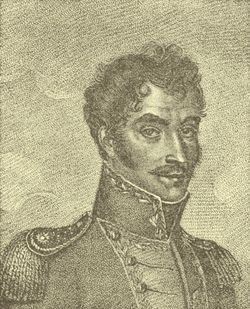
So far as the world knew, the birth of Simon Bolivar at Caracas, Venezuela, on July 24, 1783, was of no greater importance than that of any other child. Perhaps but one person entertained the slightest thought that he would ever be the hero of many battles and the liberator of his countrymen; and that person was his mother. A mother, as a rule, always in her imagination anticipates a brilliant future for her boy. If Bolivar's mother was not an exception to this rule, surely her highest anticipations were fully realized in the wonderful career of her son.
His father, Juan Vincente Bolivar y Ponte, and his mother, Maria Concepcion Palacios y Sojo, were descendants of noble families in Venezuela. Nothing unusual occurred in his school-boy days to distinguish him from others of his age and rank. He was attentive to his studies, warm-hearted, generous, and always a favorite among his associates. When he had made sufficient advancement in his studies at home, and had arrived at the proper age, he was sent to Madrid, where he remained several years, during which time he completed his education.
Bolivar was now a full-grown man, and as a source of needed recreation after years of hard study, he spent some time in visiting places of special interest in the south of Europe. On his journey he stopped for a time at the French capital, where he witnessed the closing scenes of the French revolution. This was the hour of Napoleon's greatest glory. He was the acknowledged military hero of the age. All France bowed at his feet. Is it not probable that here was where Bolivar caught the inspiration that led him to make an effort to be to his own country, what Napoleon was to France? From Paris Bolivar returned to Madrid, where, in 1801, he married the daughter of Don N. Toro, uncle of the Marquis of Toro, in Caracas. He soon sailed with his young bride for his native country, but it was only a little while until she fell a victim to yellow fever. The sudden and unexpected death of his young wife, to whom he was intensely devoted, so shattered his health and frustrated his plans, that he wended his way back to Europe, where he remained until 1809, when he returned through the United States to his own country. His remembrance of the closing scenes of the French revolution, and the realization as he passed through the United States of the blessings of her free institutions, no doubt account in some measure for the fact that, as soon as he reached Venezuela, he joined the movement then crystallizing into an aggressive warfare for independence, and a larger degree of freedom for his own countrymen.
In 1810 he received a colonel's commission from the revolutionary junta, and was associated with Luis Lopez Mendez in a mission to the court of Great Britain, which was rendered fruitless by England announcing her position in relation to the troubles in Venezuela as one of strict neutrality. On July 5, 1811, Venezuela formally declared her independence from the mother-country. This brought on a clash of arms at once.
The Spanish troops under Monteverde, owing to a lack of concert of action on the part of the "patriots," forced Bolivar, with his little band of volunteers, to abandon the important post of Puerto Cabello, and flee to Curaçao, which was reached in safety, while Monteverde at the head of the Spanish troops gained control of Venezuela.
Chafing under defeat, Bolivar, in September, 1812, repaired to Carthagena, where a commission was given him to make war upon the Spanish troops along the Magdalena River. Although his army numbered but 500 men, he succeeded in driving the enemy, not only from the country along the Magdalena River, but entered Venezuela, and forced his way westward to the important towns of Merida and Truxillo, where the people gladly welcomed him and rallied to his support. Encouraged by his success, and embittered by the brutalities of the enemy, as he pressed forward he issued his noted proclamation of "War to the death."
He soon routed Monteverde's army at Lastoguanes, forcing him to take refuge in Puerto Cabello, while Bolivar pushed forward, entering Caracas in triumph August 4, 1813. But the tide of battle soon turned. The Royalists concentrated all their available force, and a number of bloody battles ensued, and finally Bolivar's men, inferior in numbers, were badly defeated near Cura. The fall of Caracas soon followed, and before the close of the year 1814 the Royalists were again in full possession of Venezuela. Though defeated, Bolivar was not dismayed. He had great faith in the righteousness of his cause, and his consciousness of this fact seemed to give him that courage which never knows defeat.
He next went to Tunja, where the revolutionary congress was in session, and notwithstanding the misfortunes of war and the bitter opposition of a few personal enemies, his enthusiastic reception showed that he still retained the confidence and respect of the people. He was soon given command of an expedition against Santa Fé de Bogota, where Don Cundinamarca had refused official recognition of the new union of the provinces, which, without any conflict of arms, was crowned with success by the surrender of the rebellious leaders. For this service Bolivar received the special thanks of Congress. The Royalists having captured Santa Martha, Bolivar was ordered to retake it, but failed in his attempt.
In May, 1814, he resigned his commission, and went to Kingston, Jamaica, where an attempt was made to assassinate him, which resulted, by a mistake, in the murder of another. Later on he went to Aux Cayes, in Hayti, where President Petion assisted him in organizing an expedition which, though it succeeded in reaching the main-land in May, 1816, eventually failed. But Bolivar's past experience had taught him not to go wild over a victory, nor be discouraged by a defeat, so he returned to Aux Cayes, where he secured reinforcements, and in December landed his troops, first at Marguerite, and then at Barcelona. At this point a provisional government was formed and all the available military force was promptly organized, and placed in readiness to resist the invasion of Morillo, who was at the head of a strong, well-disciplined army of Royalists. The opposing forces met on February 16, 1817, and a desperate battle, lasting three days, ensued, resulting in a complete rout of the Royalists, who, while retreating in great disorder, were assailed with such impetuosity by small bands of patriots, as to make their overthrow complete.
Being now the undisputed commander-in-chief, Bolivar seemed irresistible. Victory after victory crowned his efforts, until he established his head-quarters at Angostura, on the Orinoco. From this point, after a thorough reorganization of his forces, he pressed forward over the Cordilleras, and effected a junction with the army headed by General Santander, commander of the Republican forces in New Granada. The armies thus united proved to be invincible. The entire march was characterized by a succession of victories, ending in a complete overthrow of the enemy on August 7, 1819, at Bojaca, which gave him full possession, not only of Bogota, but of all New Granada. This brilliant achievement attracted the attention of the civilized world then, and as we read about it now, it forcibly reminds us, in its conception, the skill and rapidity of its execution, and its results, of the wonderful march of Sherman from Atlanta to the sea. Taking advantage of the great prestige his marvellous victories had given him with the people, he procured the passage of a fundamental law, December 17, 1819, uniting Venezuela and New Granada under one government, to be known as the Republic of Colombia, of which Bolivar was made president.
Bolivar was now at the head of the grandest army he had ever commanded. The Royalists, under Morillo, having been beaten at several points, induced Bolivar, at Truxillo on November 20, 1820, to consent to an armistice for six months, which he did; no doubt with the hope that meantime a treaty of peace might be effected and the war thus brought to an end.
Subsequent events, however, gave strong reasons to believe that the armistice was a mere ruse to gain time while Morillo could be recalled and General Torre placed in command. Bolivar, no doubt incensed by this apparent trick, determined, upon the expiration of the armistice, to strike a blow that would not soon be forgotten; which he did at Carabolo, by attacking and completely routing General Torre's command, compelling the fleeing fragments to seek shelter in Puerto Cabello, where two years after they surrendered to Paez. This practically closed the war in Venezuela. On August 30, 1821, the constitution of Colombia was adopted amid great rejoicing, with Bolivar as president and Santander as vice-president. But there was more work to do, and no one could do it so well as Bolivar. He determined that nowhere should the Royalists have a foothold in the whole country. He attacked them at Pichincha, in Ecuador, and after a desperate struggle they were forced to retreat in disorder, while victorious Bolivar with his enthusiastic followers triumphantly entered Quito, June 22, 1822. Next Lima was taken, but owing to the dissensions among the Republican factions in Peru, Bolivar was compelled to abandon the city, which was again occupied by the Royalists, while he withdrew to Truxillo.
Having thoroughly reorganized his forces, and gotten everything in good condition for an aggressive warfare, he again assaulted the Royalists with unrelenting vigor, driving them before him, and finally administering a crushing defeat on the plains of Junin, August 6th; after which he returned to Lima, leaving Sucre, who had already displayed great military skill and bravery, to complete the work. This he did, by gaining a great victory at Ayacucho, which completely dispersed the Royalists, reducing their possessions in Peru to the Castles of Callao, which Rodil, after a little over a year's successful resistance, was compelled to surrender.
Upper Peru having detached itself from Buenos Ayres, was organized as a separate state under the name of Bolivia, in honor of the man who had accomplished so much for its freedom, and who by the first Congress of the new republic, which convened in August, 1825, was made perpetual Protector, and requested to prepare for it a constitution.
The country having been freed from armed resistance on the part of the Royalists, it next became Bolivar's duty to provide laws for the proper government of the people. Time proved this to be a more difficult task than meeting an open enemy on the field of battle. Many local leaders had been developed during the struggle for independence, among whom no little ill feeling was aroused by their scramble for recognition. Then there were some who were jealous of Bolivar's great popularity and influence with the people. They were busy in trying to turn public opinion against him by telling the people that he would use his power to add to, rather than lighten, their burdens. This feeling was intensified when he presented his plan of government for Bolivia to Congress on May 25, 1826, accompanied by an address in which he doubted the wisdom of extending the right of franchise indiscriminately to the people, and showed clearly his preference for a centralization of power, by proposing a president for life clothed with supreme executive powers, including the right to name his successor. It was charged by his enemies that this would be a monarchy in fact, and a republic only in name.
Meantime Paez, military commander in Venezuela, refused to recognize the constituted authorities, and assumed an attitude of open rebellion. But the presence in a short time of Bolivar, his old commander, followed by a personal interview and a decree of general amnesty, resulted in a complete restoration of peace and loyal adherence to the government. Bolivar and Santander having been re-elected to the respective offices of president and vice-president, Bolivar, before the time fixed by law for him to take the oath of office, resigned the presidency of the republic, with a view to retiring into private life, and thus refuting the charges made against him by personal enemies, that he was simply working in his own interest, and for his own personal aggrandizement.
But in response to Santander's earnest appeal, and a resolution of Congress urging him to resume his position as president, Bolivar went to Bogota, and there took upon himself the oath of office.
He soon issued three decrees: One granting general amnesty, another calling a national convention at Ocana, and a third for the establishment of constitutional order throughout Colombia. All eyes were now turned to the national convention at Ocana, which was to assemble in March, 1828. This was made the more important by the fact that it was to determine whether Bolivar's plan for a strong centralized government, backed up by ample military force, or a government controlled more directly by the great body of the people, should prevail. The events of the past year had served rather to strengthen Bolivar's position, and the action of the convention seems to have crystallized it into law, for a decree soon followed, dated August 27, 1828, giving to Bolivar supreme power over Colombia, which he continued to exercise until his death, which occurred at San Pedro, on December 17, 1830.
Thus closes the life of one of the most remarkable characters the world has ever known. He possessed the intrepid courage and dash of a Sherman, the unrelenting firmness of a Grant, and the tenderness of a Lincoln. Local revolts against lawful authority always yielded to his personal presence and counsel. We fail to find in his history a single act of cruelty recorded against him. His proclamation of "War to the death," was a military necessity. The Royalists had shown no mercy to his soldiers. They had refused to treat them as prisoners of war. They had fired upon his flag of truce. They gave no quarter to revolutionists, but put them to death wherever found. And there was but one alternative left, and that was, unpleasant as it must have been to a man of such kindly nature, to meet such brutalities by a threat of retaliation in kind. The proclamation was not prompted by a spirit of cruelty, but rather by a love for humanity. It had the effect which he no doubt intended it should, and that was to secure the same treatment for his soldiers when captured, that the civilized world acknowledged due to prisoners of war. He was in no sense mercenary. He expended nine-tenths of his fortune for his country's freedom, and when voted a million dollars by Congress he promptly declined it. He was always magnanimous, even to his bitterest enemies. He died comparatively poor. His remains sleep at Caracas, the place of his birth. His soul is with God. Monuments have been erected to his memory, one at Caracas and another at Lima. But his life-work has erected a monument in the hearts of his countrymen that will never perish. He sowed the seed for the harvest of a better government and higher civilization for all Spanish America. The influence of his example is not confined to his own country, but is felt throughout the civilized world. To-day, among the brightest and best of the world's good and great men, may justly be placed the name of Simon Bolivar.[Back to Contents]
JEAN FRANÇOIS CHAMPOLLION[10] By Georg Ebers (1790-1832)
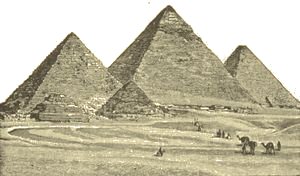
The deciphering of hieroglyphics is one of the greatest achievements of the human race in this century. Jean François Champollion was the man who accomplished this great feat. He is surnamed "le jeune," the younger, to distinguish him from his elder brother, Champollion Figeac, whose life was one of paternal devotion and the most unselfish sacrifice for his younger brother. Both were born in Figeac, in the south of France, François on December 23, 1790. He made his home, however, in the beautiful little town of Grenoble, situated on the hills near the valley of the Isère. It was to this place that Champollion Figeac, who was here engaged as director of the town library, and later on as professor of Greek at the university, drew his twelve years younger brother François, who, at the age of nine, went to live with his elder brother, filled with the proudest hopes for the future, and grateful for the care and devotion bestowed upon him.
At that time, naturally, all eyes were turned toward Egypt, where the First Consul, Bonaparte, had led the army of the Republic, accompanied by a host of celebrated men of science. The newly opened world of monuments on the banks of the Nile excited the greatest interest in everybody; but for few did it have as strong an attraction as for Champollion Figeac, who had occupied himself long previously with the study of the history and language of the ancient Egyptians. Furthermore, he and his brother François came, so to say, into indirect contact with the great expedition. For the famous mathematician Fourier, who had gone out with it, became afterward prefect of Grenoble, and one of Figeac's warmest and most intimate friends.
François, who, at the age of twelve, was already fully master of the classic languages, had, surrounded by the rich collection of books placed in his brother's care, drifted into a territory which is not embraced in the usual high-school curriculum, viz., the Oriental languages. While still at school, and during his leisure hours, he mastered with wonderful energy, aided as it was by an almost phenomenal power for acquiring knowledge, the Hebrew and most other Semitic languages, as also Sanscrit and Persian. As, however, Egypt had the greatest attraction for him, he also studied the Coptic dialect, the language of the Egyptians during the early centuries after Christ, which was written in Greek letters with some few others added. Withal, the remarkable youth was cheerful and companionable, finding time even to practise his poetic gifts; nor did his physical development suffer through the severe exertion of his mind. His portrait, in the Louvre in Paris, represents him in manhood with bronzed skin, easily allowing him to be recognized as a native of the South of France. His nose is slightly bent, his forehead lofty, his hair black and of great abundance. The dark eyes, shaded by heavy brows, express serenity—earnest and profound sincerity—while his well-formed mouth gives evidence of winning manners and the friendliness of his nature.
At the age of seventeen he submitted his first work, a geography of ancient Egypt, to the Academy of Grenoble, which, notwithstanding his extreme youth, conferred upon him the degree of associate. Soon after he followed a course of lectures at the Oriental College of Paris. With youthful zeal he availed himself of the numerous educational advantages at his disposal in this great city, and gained even then the notice of the most prominent men of his profession. After two years' time, not quite twenty years of age, he was called to a position at the University of Grenoble.
When Napoleon rested in this town on his way from Elba to Paris, in 1815, he appointed the elder Champollion as his private secretary.
The close relationship into which this position brought Figeac to the emperor, and his republican ideas after Napoleon's downfall—which ideas were shared by his brother François—were circumstances which, in later years, became great obstacles to their further advancement. They were looked upon as characters dangerous to the state, and were deprived of their positions, while the Institute of France even withheld from François its protection.
The brothers were banished to their old homestead, Figeac, where they found leisure in abundance to complete several unfinished works; and when in 1818, through the influence of the Duke of Decazes, their banishment was pronounced at an end, François had completed his great work, "L'Égypte sous les Pharaons."
This work, of the utmost importance at the time, in the preparation of which the Coptic sources were freely drawn upon, won François his lost chair at the Grenoble University. After he had secured this post he was encouraged to found a home of his own. Rose Blanc was the bride-elect, with whom he was united in a most happy marriage until his death.
Since many years François had occupied himself with the monument which gave promise to the possibility of deciphering hieroglyphics.
During the French expedition, as it happened, the talisman was found which was to become the key to disclose the mystery of the language and the written signs of the Ancient Egyptians—the tablet or the key of Rosetta, a stone-plate made of black granite. Three inscriptions, written in different signs, covered the originally rectangular surface of the tablet. The uppermost one, considerably injured, showed the hieroglyphics, which were familiar through the obelisks and other Egyptian monuments; the second inscription was obscure; while the third and lowest inscription, which had suffered but little injury, consisted of Greek letters clear to every philologist. It proclaimed that the tablet contained a decree of the Egyptian priesthood, in honor of the fifth king of the house of the Ptolemies, and that this was written in the holy language, in that of the people of Egypt, and in Greek, on the same tablet. Here was, therefore, a somewhat extensive text in two of the three modes of writing of the Egyptians of which Clemens of Alexandria makes mention, with a Greek translation of the same. The fortunes of war brought this extraordinary monument into the hands of the English. It was placed in the British Museum, and care was taken that copies of the three inscriptions should reach the various Egyptologists, among them Champollion.
The demotic inscription—that is to say, the text in the writing of the people, was one of the most inviting to decipher, because the signs composing it seemed to be letters representing sound. This was sedulously attempted by several scientists, and with the best results by the great French Orientalist, De Sacy, and by the Swede, Akerblad. But though the former by a mechanical method recognized correctly the meaning of several groups, and though Akerblad had even ascertained most of the signs of the demotic alphabet, still they were both incapable of discerning the elements of which the demotic writing is composed.
The great English physician and naturalist, Thomas Young, who also occupied himself with the three various texts, made better progress. Taking advantage and making use of the parts that had been revealed to him by demotic and hieroglyphic text, he succeeded, in a mechanical way, and by intelligent comparisons in deciphering the names Ptolemaios and Berenike, and in recognizing even the hieroglyphic signs for numbers. Still the true nature of the Egyptian writing was not revealed to him either. In their particulars his ascertainments are untrue, for in the names he had in no way discovered the alphabetic signs of which they were composed.
As to the remainder of the inscription he thought that it consisted of such drawn signs or forms with symbolical significance as might be found interpreted in the "Hieroglyphica of Horapollon."
That those groups of hieroglyphics surrounded by a frame (cartouche) are the names of kings, had been contended long before by the Dane Zoëge, Barthélemy, and others. The framed hieroglyphics on the tablet of Rosetta could, as the Greek text taught, signify but the name of Ptolemaios. Champollion also had originally held the same erroneous opinion as Young and his predecessors. Though he succeeded in defining several groups of characters of the people's writing, like Akerblad, by comparison, he, even as late as 1821, in his essay on hieroglyphics, entitled "De l'Écriture hiératique des Anciens Égyptiens," declares them to be symbolical signs and figures.
But he knew of Young's successful comparisons with Greek names; and when Mr. Bankes brought a small obelisk to England from the island of Philæ, on which the framed group of hieroglyphics were bound to contain the names of Ptolemaios and Cleopatra, because a Greek inscription at the foot of the obelisk mentioned these royal names, a firm starting-point was created by Champollion, from which he was to succeed in removing the mass of obstacles which had stood in the way of all previous explorations and researches.
He made his basis the supposition that the framed names were constructed of alphabetic signs. The name Ptolemaios was known through the tablet of Rosetta. If the second name on Bankes's obelisk were Cleopatra, a comparison of the two names should confirm this. The first letter in the name Ptolemaios being a "p" it should occur as fifth letter in Cleopatra. And this was actually the case. The third letter in Ptolemaios, the "o," was found again as the fourth one in Cleopatra. The fourth sign in Ptolemaios, "l," a lion, occurred correctly as the second one in Cleopatra. By further comparison every sign was correctly found, and when Champollion had deciphered a group of signs which he took to be Alexander, and again found every letter in its right place, he could assure himself that hieroglyphics also were based on the phonetic system.
He soon, with the aid of the letters discovered in the above-mentioned groups, deciphered other well-known names of kings, and in this way acquired a knowledge of the whole hieroglyphic alphabet. But the many hundred forms and signs, of which the holy scriptures of the Egyptians are composed, could not well be of an altogether alphabetic nature, and a further study of the subject brought the explorer to the conclusion that ideographs were interspersed among the alphabetical signs in order to make the alphabetic words more comprehensive. For instance, after a masculine proper name the picture of a man was drawn, and after every word connected with the motion of walking, the picture of two pacing legs. Besides this, he found that some sounds could be represented by different hieroglyphics. With this the most important elements of hieroglyphics were disclosed, and it was all accomplished in one year, from 1821-22. When François, after a period of extraordinary mental exertion, appeared before his brother one morning with all the proofs in his hands, calling to him, "Je tiens l'affaire; vois!" (I have found it; look here!) he fell to the floor fainting, worn out by the immense exertions of the last few months.
It required some time for him to recover his health; but Figeac read, on September 17, 1822, his brother's pamphlet at the Academy in Paris. It appeared under the name of "Lettre à M. Dacier," and contained the details of his discovery.
That day decided Champollion's future career. As early as the year following he published his new work, "Précis du système hiéroglyphique," after which Louis Philippe of Orleans had the discovery officially announced before the Oriental Association, and Louis XVIII. made it his royal duty to lighten Champollion's future work.
The "Précis" embraces the foregoing results of his discovery, and considering the short space of time in which all this was accomplished, it appears marvellous that François could thus early determine the most important elements of the hieroglyphic system in their minute details so correctly. In 1824 the king sent him to Italy, where he profited principally by the splendid collection of Egyptian antiquities in Turin. In 1826 Charles X. appointed him director of the Egyptian Museum in the Louvre, which Champollion founded by purchasing at Liverno the celebrated "Salt Collection."
Soon after his return to France the king sent him on a mission to Egypt, where he remained from August, 1828, till the end of 1829. The Italian Rosellini joined him on the Nile.
His "Lettres écrites d'Égypte et de la Nubie" render his observations and impressions and describe his life and adventures in Egypt, in a most entertaining and instructive style. The many and various inscriptions, copied there by him, are all quoted in his great work on monuments, entitled, "Monuments de l'Égypte et de la Nubie," and in his posthumous work, "Notices descriptives conformes aux manuscrits autographes rédigés sur les lieux."
Soon after his return to Paris (in March, 1830), by which time his health had commenced to fail, he was elected a Member of the Academy, and in March, 1831, was appointed professor at the "College de France." The solidity and instructiveness of his lectures brought the most celebrated leaders in science to hear him, but there were destined to be but few of the lectures, as he all too soon felt himself too weak to continue them. On March 4, 1832, at his old homestead Figeac, a stroke of apoplexy ended his active life of achievement.
His great discovery was at first vigorously attacked. Erring minds declaring the system of the great Frenchman to be wrong, and submitting others of their own, as the Russian Klaproth and the German Seyffarth, disturbed Champollion's peace; still more bitterly, however, was he pursued by the envy and hatred of his political opponents.
Even when the laurel already decorated his brow, they saw to it that the thorns were not wanting in the wreath. Especially in England various efforts were made to have, not him, but Thomas Young, recognized as the discoverer of the science of deciphering hieroglyphics. But though Young had succeeded previously to Champollion in deciphering some hieroglyphic names in a mechanical way, yet the genial Englishman mistook, during the whole course of his activity, the real character of hieroglyphic writing. To Champollion, on the other hand, it was left to recognize their nature and construction, so that science must acknowledge him to be the discoverer of the true nature of the system of hieroglyphical writing.
Shortly before his death it was vouchsafed him to proclaim to his loyal brother, "Voici ma carte pour la postérité," pointing to the manuscript of his "Egyptian Grammar," of which the last chapter was still missing. It contains the germs from which all similar works have sprung, which since have perfected and enlarged that of Champollion; it showed the path in which all subsequent grammarians were to walk. The results of Young's discoveries remain without influence upon the progress of the science, and have found a place long since among old relics.
François Champollion's work is the seed, which even at the present day brings forth the richest fruits. When he died, at the age of forty-two, he left the world not only his "Egyptian Grammar," but also pioneer works in other branches of his science.
His "Panthéon Égyptien" (1823-25) dealt with Egyptian mythology; his excellent knowledge of Coptic is clearly seen in many of his works; and his "Egyptian Dictionary of Hieroglyphics" (1841-44) is, bearing in mind the time when it was written, a work of marvellous accomplishment.
This dictionary, with several other works and manuscripts of his literary estate, which the French Government had purchased for the sum of fifty thousand francs, were faithfully and lovingly edited and published after his death by his elder brother, Figeac. These posthumous works bear witness not only to the overwhelming industry of this great worker and explorer, but also to the loving unselfishness of his brother, who sacrificed a great part of his time and activity in editing and arranging the manuscripts of the departed. The "Grammar," the "Monuments," the "Dictionary," were all published by Figeac. At "Père Lachaise" Cemetery, in Paris, a weather-beaten obelisk and a broken stone tablet indicate the spot where the remains of François Champollion rest.
A monument which was erected in his honor at his native town, Figeac, bears the well-chosen inscription which so frequently occurs among the titles of the Pharaohs in hieroglyphics, "'anch zete," i.e., "everlasting." A beautiful sentence, which Chateaubriand addressed to the faithful brother and co-worker of the great searcher, is also inscribed on the statue of François Champollion, le jeune. It reads: "Ses admirables travaux auront la durée des monuments qu'il nous a fait connaître." (His admirable works will last as long as the monuments which he has taught us to understand.)[Back to Contents]
ANDREW JACKSON[11] By Colonel Thomas Wentworth Higginson (1767-1845)
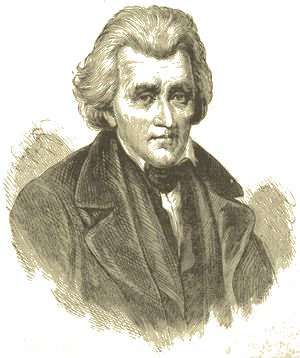
Dr. Von Holst, the most philosophic of historians, when he passes from the period of John Quincy Adams to that of his successor, is reluctantly compelled to leave the realm of pure history for that of biography, and to entitle a chapter "The Reign of Andrew Jackson." This change of treatment could, indeed, hardly be helped. Under Adams all was impersonal, methodical, a government of laws and not of men. With an individuality quite as strong as that of Jackson—as the whole nation learned ere his life ended—it had yet been the training of his earlier career to suppress himself, and be simply a perfect official. His policy aided the vast progress of the nation, but won no credit by the process. Men saw with wonder the westward march of an expanding people, but forgot to notice the sedate, passionless, orderly administration that held the door open and kept the peace for all. In studying the time of Adams, we think of the nation; in observing that of Jackson, we think of Jackson himself. In him we see the first popular favorite of a nation now well out of leading-strings, and particularly bent on going alone. By so much as he differed from Adams, by so much the people liked him better. His conquests had been those of war, always more dazzling than those of peace; his temperament was of fire, always more attractive than one of marble. He was helped by what he had done, and by what he had not done. Even his absence of diplomatic training was almost counted for a virtue, because all this training was necessarily European, and the demand had ripened for a purely American product.
It had been quite essential to the self-respect of the new republic, at the outset, that it should have at its head men who had coped with European statesmen on their own soil and not been discomfited. This was the case with each of the early successors of Washington, and in view of his manifest superiority this advantage was not needed. Perhaps it was in a different way a sign of self-respect that the new republic should at last turn from this tradition, and take boldly from the ranks a strong and ill-trained leader, to whom all European precedent—and, indeed, all other precedent, counted for nothing. In Jackson, moreover, there first appeared upon our national stage the since familiar figure of the self-made man. Other presidents had sprung from a modest origin, but nobody had made an especial point of it. Nobody had urged Washington for office because he had been a surveyor's lad; nobody had voted for Adams because stately old ladies designated him as "that cobbler's son." But when Jackson came into office the people had just had almost a surfeit of regular training in their chief magistrates. There was a certain zest in the thought of a change, and the nation certainly had it.
It must be remembered that Jackson was in many ways far above the successive modern imitators who have posed in his image. He was narrow, ignorant, violent, unreasonable; he punished his enemies and rewarded his friends. But he was, on the other hand—and his worst opponents hardly denied it—chaste, honest, truthful, and sincere. It was not commonly charged upon him that he enriched himself at the public expense, or that he deliberately invented falsehoods. And as he was for a time more bitterly hated than anyone who ever occupied his high office, we may be very sure that these things would have been charged had it been possible. In this respect the contrast was enormous between Jackson and his imitators, and it explains his prolonged influence. He never was found out or exposed before the world, because there was nothing to detect or unveil; his merits and demerits were as visible as his long, narrow, firmly set features, or as the old military stock that encircled his neck. There he was, always fully revealed; everybody could see him; the people might take him or leave him—and they never left him.
Moreover, there was, after the eight years of Monroe and the four years of Adams, an immense popular demand for something piquant and even amusing, and this quality they always had from Jackson. There was nothing in the least melodramatic about him; he never posed or attitudinized—it would have required too much patience; but he was always piquant. There was formerly a good deal of discussion as to who wrote the once famous "Jack Downing's" letters, but we might almost say that they wrote themselves. Nobody was ever less of a humorist than Andrew Jackson, and it was therefore the more essential that he should be the cause of humor in others. It was simply inevitable that during his progresses through the country there should be some amusing shadow evoked, some Yankee parody of the man, such as came from two or three quarters under the name of Jack Downing. The various records of Monroe's famous tours are as tame as the speeches which these expeditions brought forth, and John Quincy Adams never made any popular demonstrations to chronicle; but wherever Jackson went there went the other Jack, the crude first-fruits of what is now known through the world as "American humor." Jack Downing was Mark Twain and Hosea Biglow and Artemus Ward in one. The impetuous President enraged many and delighted many, but it is something to know that under him a serious people first found that it knew how to laugh.
The very extreme, the perfectly needless extreme, of political foreboding that marked the advent of Jackson furnished a background of lurid solemnity for all this light comedy. Samuel Breck records in his diary that he conversed with Daniel Webster in Philadelphia, March 24, 1827, upon the prospects of the government. "Sir," said Mr. Webster, "if General Jackson is elected, the government of our country will be overthrown; the judiciary will be destroyed; Mr. Justice Johnson will be made Chief-Justice in the room of Mr. Marshall, who must soon retire, and then in half an hour Mr. Joseph Washington and Mr. Justice Story will resign. A majority will be left with Mr. Johnson, and every constitutional decision hitherto made will be reversed." As a matter of fact, none of these results followed. Mr. Justice Johnson never became Chief-Justice; Mr. Marshall retained that office till his death in 1835; Story and Washington also died in office; the judiciary was not overthrown, nor the government destroyed. But the very ecstasy of these fears stimulated the excitement of the public mind. No matter how extravagant the supporters of Jackson might be, they could hardly go farther in that direction than did the Websters in the other.
But it was not the fault of the Jackson party if anybody went beyond them in exaggeration. An English traveller, William E. Alexander, going in a stage-coach from Baltimore to Washington in 1831, records the exuberant conversation of six editors, with whom he was shut up for hours. "The gentlemen of the press," he says, "talked of 'going the whole hog' for one another, of being 'up to the hub' (nave) for General Jackson, 'who was all brimstone but the head, and that was aqua-fortis,' and swore if anyone abused him he ought to be 'set straddle on an iceberg, and shot through with a streak of lightning.'" Somewhere between the dignified despair of Daniel Webster, and the adulatory slang of these gentry we must look for the actual truth about Jackson's administration. The fears of the statesman were not wholly groundless, for it is always hard to count in advance upon the tendency of high office to make men more reasonable. The enthusiasm of the editors had a certain foundation; at any rate it was a part of their profession to like stirring times, and they had now the promise of them. After four years of Adams, preceded by eight years of Monroe, any party of editors in America, assembled in a stage-coach, would have showered epithets of endearment on the man who gave such promise in the way of lively items. No acute journalist could help seeing that a man had a career before him who was called "Old Hickory" by three-quarters of the nation, and who made "Hurrah for Jackson!" a cry so potent that it had the force of a popular decree.
There was, indeed, unbounded room for popular enthusiasm in the review of Jackson's early career. Born in such obscurity that it is doubtful to this day whether he was born in South Carolina, as he himself claimed, or on the North Carolina side of the line, as Mr. Parton thinks, he had a childhood of poverty and ignorance. He was taken prisoner as a mere boy during the Revolution, and could never forget that he had been wounded by a British officer whose boots he had refused to brush. Afterward, in a frontier community, he was successively farmer, shopkeeper, law-student, lawyer, district attorney, judge, and Congressman, being first Representative from Tennessee, and then Senator, and all before the age of thirty-one. In Congress Albert Gallatin describes him "as a tall, lank, uncouth-looking personage, with long locks of hair hanging over his brows and face, and a queue down his back tied in an eel-skin; his dress singular, his manners and deportment those of a backwoodsman." He remained, however, but a year or two in all at Philadelphia—then the seat of national government—and afterward became a planter in Tennessee, fought duels, subdued Tecumseh and the Creek Indians, winning finally the great opportunity of his life by being made a Major-General in the United States army on May 31, 1814. He now had his old captors, the British, with whom to deal, and entered into the work with a relish. By way of preliminary he took Pensacola, without any definite authority, from the Spaniards, to whom it belonged, and the English whom they harbored; and then turned, without orders, without support, and without supplies, to undertake the defence of New Orleans.
Important as was this city, and plain as it was that the British threatened it, the national authorities had done nothing to defend it. The impression prevailed at Washington that it must already have been taken, but that the President would not let it be known. The Washington Republican of January 17, 1815, said, "That Mr. Madison will find it convenient and will finally determine to abandon the State of Louisiana we have not a doubt." A New York newspaper of January 30th, quoted in Mr. Andrew Stevenson's eulogy on Jackson, said, "It is a general opinion here that the city of New Orleans must fall." Apparently but one thing averted its fall—the energy and will of Andrew Jackson. On his own responsibility he declared martial law, impressed soldiers, seized powder and supplies, built fortifications of cotton bales, if nothing else came to hand. When the news of the battle of New Orleans came to the seat of government it was almost too bewildering for belief. The British veterans of the Peninsular War, whose march wherever they had landed had heretofore seemed a holiday parade, were repulsed in a manner so astounding that their loss was more than two thousand, while that of the Americans was but thirteen. By a single stroke the national self-respect was restored; and Henry Clay, at Paris, said "Now I can go to England without mortification."
All these things must be taken into account in estimating what Dr. Von Holst calls "the reign of Andrew Jackson." After this climax of military success he was for a time employed on frontier service, again went to Florida to fight Englishmen and Spaniards, practically conquering that region in a few months, but this time with an overwhelming force. Already his impetuosity had proved to have a troublesome side to it; he had violated neutral territory, had hung two Indians without justification, and had put to death, with no authority, two Englishmen, Ambrister and Arbuthnot. These irregularities did not harm him in the judgment of his admirers; they seemed in the line of his character and helped more than they hurt him. In the winter of 1823-24 he was again chosen a Senator from Tennessee. Thenceforth he was in the field as a candidate for the Presidency, with two things to aid him—his own immense popularity and a friend. This friend was one William B. Lewis, a man in whom all the skilful arts of the modern wire-puller seemed to be born full-grown.
There was at that time (1824) no real division in parties. The Federalists had been effectually put down, and every man who aspired to office claimed to be Democratic-Republican. Nominations were irregularly made, sometimes by a Congressional caucus, sometimes by State legislatures. Tennessee, and afterward Pennsylvania, nominated Jackson. When it came to the vote, he proved to be by all odds the popular candidate. Professor W. G. Sumner, counting up the votes of the people, finds 155,800 votes for Jackson, 105,300 for Adams, 44,200 for Crawford, 46,000 for Clay. Even with this strong popular vote before it, the House of Representatives, balloting by States, elected on the first trial John Quincy Adams. Seldom in our history has the cup of power come so near to the lips of a candidate and been dashed away again. Yet nothing is surer in a republic than a certain swing of the pendulum afterward, in favor of any candidate to whom a special injustice has been done, and in the case of a popular favorite like Jackson, this might have been foreseen to be irresistible. His election four years later was almost a foregone conclusion, but, as if to make it wholly sure, there came up the rumor of a "corrupt bargain" between the successful candidate and Mr. Clay, whose forces had indeed joined with those of Mr. Adams to make a majority. For General Jackson there could be nothing more fortunate. The mere ghost of a corrupt bargain is worth many thousand votes to the lucky man who conjures up the ghost.
When it came the turn of the Adams party to be defeated, in 1828, they attributed this result partly to the depravity of the human heart, partly to the tricks of Jackson, and partly to the unfortunate temperament of Mr. Adams. The day after a candidate is beaten everybody knows why it was, and says it was just what anyone might have foreseen. Ezekiel Webster, writing from New Hampshire, laid the result chiefly on the candidate, whom everybody disliked, and who would persist in leaving his bitter opponents in office. The people, he said, "always supported his cause from a cold sense of duty, and not from any liking of the man. We soon satisfy ourselves," he added, "that we have discharged our duty to the cause of any man when we do not entertain for him one personal kind feeling, nor cannot, unless we disembowel ourselves, like a trussed turkey, of all that is human within us." There is, indeed, no doubt that Mr. Adams helped on his own defeat, both by his defects and by what would now be considered his virtues. The trouble, however, lay further back. Ezekiel Webster thought that "if there had been at the head of affairs a man of popular character like Mr. Clay, or any man whom we were not compelled by our natures, instinct, and fixed fate to dislike, the result would have been different." But we can now see that all this would really have made no difference at all. Had Mr. Adams been personally the most attractive of men, instead of being a conscientious iceberg, the same result would have followed, the people would have felt that Jackson's turn had come, and the demand for the "old ticket" would have been irresistible.
Accordingly, the next election, that of 1828, was easily settled. Jackson had 178 electoral votes; Adams but 83—more than two to one. Adams had not an electoral vote south of the Potomac or west of the Alleghanies, though Daniel Webster, writing to Jeremiah Mason, had predicted that he would carry six Western and Southern States. In Georgia no Adams ticket was even nominated, he being there unpopular for one of his best acts—the protection of the Cherokees. On the other hand, but one Jackson elector was chosen from New England, and he by less than two hundred majority.
On the day of his inauguration the president was received in Washington with an ardor that might have turned a more modest head. On the day when the new administration began (March 4, 1829), Daniel Webster wrote to his sister-in-law, with whom he had left his children that winter: "To-day we have had the inauguration. A monstrous crowd of people is in the city. I never saw anything like it before. Persons have come five hundred miles to see General Jackson, and they really seem to think that the country is rescued from some frightful danger." It is difficult now to see what this peril was supposed to be; but we know that the charges of monarchical tendency made against John Adams had been renewed against his son—a renewal that seems absurd in case of a man so scrupulously republican that he would not use a seal ring, and so unambitious that he always sighed after the quieter walks of literature. Equally absurd was the charge of extravagance against a man who kept the White House in better order than his predecessors on less than half the appropriation—an economy wholly counterbalanced in some minds by the fact that he had put in a billiard-table. But however all this may have been, the fact is certain that no president had yet entered the White House amid such choruses of delight; nor did it happen again until Jackson's pupil, Van Buren, yielded, amid equal popular enthusiasm, to another military hero, Harrison.
For the social life of Washington the President had one advantage which was altogether unexpected, and seemed difficult of explanation by anything in his earlier career. He had at his command the most courteous and agreeable manners. Even before the election of Adams, Daniel Webster had written to his brother: "General Jackson's manners are better than those of any of the candidates. He is grave, mild, and reserved. My wife is for him decidedly." And long after, when the president was to pass in review before those who were perhaps his most implacable opponents, the ladies of Boston, we have the testimony of the late Josiah Quincy, in his "Figures from the Past," that the personal bearing of this obnoxious official was most unwillingly approved. Mr. Quincy was detailed by Governor Lincoln, on whose military staff he was, to attend President Jackson everywhere when visiting Boston in 1833; and this narrator testifies that, with every prejudice against Jackson, he found him essentially "a knightly personage—prejudiced, narrow, mistaken on many points, it might be, but vigorously a gentleman in his high sense of honor, and in the natural, straightforward courtesies which are easily distinguished from the veneer of policy." Sitting erect on his horse, a thin, stiff type of military strength, he carried with him in the streets a bearing of such dignity that staid old Bostonians, who had refused even to look upon him from their windows, would finally be coaxed into taking one peep, and would then hurriedly bring forward their little daughters to wave their handkerchiefs. He wrought, Mr. Quincy declares, "a mysterious charm upon old and young;" showed, although in feeble health, a great consideration for others; and was in private a really agreeable companion. It appears from these reminiscences that the president was not merely the cause of wit in others, but now and then appreciated it himself, and that he used to listen with delight to the reading of the "Jack Downing" letters, laughing heartily sometimes, and declaring: "The Vice-President must have written that. Depend upon it Jack Downing is only Van Buren in masquerade." It is a curious fact that the satirist is already the better remembered of the two, although Van Buren was in his day so powerful as to preside over the official patronage of the nation and to be called the "Little Magician."
The two acts with which the administration of President Jackson will be longest identified are his dealings with South Carolina in respect to nullification, and his long warfare with the United States Bank. The first brought the New England States back to him, and the second took them away again. He perhaps won rather more applause than he merited by the one act, and more condemnation than was just for the other. Let us first consider the matter of nullification. When various Southern States—Georgia at first, not South Carolina, taking the lead—had quarrelled with the tariff of 1828, and openly threatened to set it aside, they evidently hoped for the co-operation of the President; or at least for that silent acquiescence he had shown when Georgia had been almost equally turbulent on the Indian question and he would not interfere, as his predecessor had done, to protect the treaty rights of the Indian tribes. The whole South was therefore startled when he gave, at a banquet on Jefferson's birthday (April 13, 1830), a toast that now seems commonplace—"The Federal Union; it must be preserved." But this was not all; when the time came he took vigorous, if not altogether consistent, steps to preserve it.
When, in November, 1832, South Carolina for the first time officially voted that certain tariff acts were null and void in that State, the gauntlet of defiance was fairly thrown down, and Jackson took it up. He sent General Scott to take command at Charleston, with troops near by, and two gunboats at hand; he issued a dignified proclamation, written by Livingston (December 10, 1832), which pronounced the act of South Carolina contradictory to the Constitution, unauthorized by it, and destructive of its aims. So far so good; but unfortunately the president had, the week before (December 4, 1832), sent a tariff message to Congress, of which John Quincy Adams wrote, "It goes far to dissolve the Union into its original elements, and is in substance a complete surrender into the hands of the nullifiers of South Carolina." Then came Mr. Clay's compromise tariff of 1833, following in part the line indicated by this message, and achieving, as Mr. Calhoun said, a victory for nullification, leaving the matter a drawn game at any rate.
The action of Jackson thus accompanied settled nothing; it was like valiantly ordering a burglar out of your house with a pistol, and adding a suggestion that he will find a portion of the family silver on the hall-table, ready packed for his use, as he goes out.
Nevertheless, the burglar was gone for the moment, and the president had the credit of it. He had already been re-elected by an overwhelming majority in November, 1832, receiving 219 electoral votes, and Clay 49, while Floyd had the 11 votes of South Carolina (which still chose electors by its Legislature—a practice now abandoned), and Wirt the 7 of Vermont. Van Buren was chosen vice-president, being nominated in place of Calhoun by the Democratic National Convention, which now for the first time came into operation. The president was now at his high-water mark of popularity—always a dangerous time for a public man. His vehement nature accepted his re-election as a proof that he was right in everything, and he grew more self-confident than ever. More imperiously than ever, he ordered about friends and opponents, and his friends repaid it by guiding his affairs, unconsciously to himself. Meantime he was encountering another enemy of greater power, because more silent, than Southern nullification, and he was drifting on to his final contest with the United States Bank.
Sydney Smith says that every Englishman feels himself able, without instruction, to drive a pony-chaise, conduct a small farm, and edit a newspaper. The average American assumes, in addition to all this, that he is competent to manage a bank. President Jackson claimed for himself in this respect no more than his fellows; the difference was in strength of will and in possession of power. A man so ignorant that a member of his own family, according to Mr. Trist, used to say that the general did not believe the world was round, might easily convince himself that he knew all about banking. As he had, besides all this, very keen observation and great intuitive judgment of character, he was probably right in his point of attack. There is little doubt that the Bank of the United States, under Nicholas Biddle, concentrated in itself an enormous power; and it spent in four years, by confession of its directors, $58,000 in what they called self-defence "against politicians." When on July 10, 1832, General Jackson, in a message supposed to have been inspired by Amos Kendall, vetoed the bill renewing the charter of the bank, he performed an act of courage, taking counsel with his instincts. But when in the year following he performed the act known as the "Removal of the Deposits," or, in other words, caused the public money to be no longer deposited in the National Bank and its twenty-five branches, but in a variety of State banks instead, then he took counsel of his ignorance.
The consequence, immediate or remote, was an immense galvanizing into existence of State banks, and ultimately a vast increase of paper money. The Sub-Treasury system had not then been thought of; there was no proper place of deposit for the public funds; their possession was a direct stimulus to speculation; and the president's cure was worse than the disease. All the vast inflation of 1835 and 1836 and the business collapse of 1837 were due to the fact not merely that Andrew Jackson brought all his violent and persistent will to bear against the United States Bank, but that when he got the power into his own hands he did not know what to do with it. Not one of his biographers—hardly even a bigoted admirer, so far as I know—now claims that his course in this respect was anything but a mistake. "No monster bank," says Professor W. G. Sumner, "under the most malicious management, could have produced as much havoc, either political or financial, as this system produced while it lasted." If the bank was, as is now generally admitted, a dangerous institution, Jackson was in the right to resist it; he was right even in disregarding the enormous flood of petitions that poured in to its support. But to oppose a dangerous bank does not necessarily make one an expert in banking. The utmost that can be said in favor of his action is that the calamitous results showed the great power of the institution he overthrew, and that if he had let it alone the final result might have been as bad.
Two new States were added to the Union in President Jackson's time—Arkansas (1836) and Michigan (1837). The population of the United States in 1830 had risen to nearly thirteen millions (12,866,020). There was no foreign war during his administration, although one with France was barely averted; and no domestic contest except with the Florida Indians—a contest in which these combatants held their ground so well, under the half-breed chief Osceola, that he himself was only captured by the violation of a flag of truce, and that even to this day, as the Indian Commissioners tell us, some three hundred of the tribe remain in Florida. The war being equally carried on against fugitive slaves called Maroons, who had intermarried with the Indians, did something to prepare the public mind for a new agitation which was to remould American political parties, and to modify the Constitution of the nation.
It must be remembered that the very air began to be filled in Jackson's time with rumors of insurrections and uprisings in different parts of the world. The French revolution of the Three Days had roused all the American people to sympathy, and called forth especial enthusiasm in such cities as Baltimore, Richmond, and Charleston. The Polish revolution had excited universal interest, and John Randolph had said "The Greeks are at your doors." All these things were being discussed at every dinner-table, and the debates in Virginia as to the necessity of restricting the growing intelligence of the slaves had added to the agitation. In the session of 1829-30 a bill had passed the Virginia Assembly by one majority, and had failed in the Senate, prohibiting slaves being taught to read or write; and the next year it had passed almost unanimously. There had been, about the same time, alarms of insurrection in North Carolina, so that a party of slaves were attacked and killed by the inhabitants of Newbern; alarms in Maryland, so that fifty blacks had been imprisoned on the Eastern Shore; alarms in Louisiana, so that reinforcements of troops had been ordered to Baton Rouge; and a traveller had written even from Richmond, Va., on February 12th, that there were constant fears of insurrections, and special patrols. Then came the insurrection of Nat Turner in Virginia—an uprising described minutely by myself elsewhere; the remarkable inflammatory pamphlet called "Walker's Appeal," by a Northern colored man—a piece of writing surpassed in lurid power by nothing in the literature of the French Revolution; and more potent than either or both of these, the appearance of the first number of the Liberator, in Boston. When Garrison wrote, "I am in earnest, I will not equivocate, I will not excuse, I will not retreat a single inch, and I will be heard," Andrew Jackson for once met a will firmer than his own, because more steadfast and moved by a loftier purpose. Thenceforth, for nearly half a century, the history of the nation was the history of the great anti-slavery contest.[Back to Contents]
DANIEL WEBSTER By Rev. Dr. Tweedie (1782-1852)
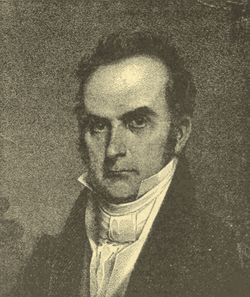
Daniel Webster, the American statesman, was born in the town of Salisbury, in the county of Merrimack, New Hampshire, America, on January 18, 1782. His mother, a woman of deep piety, was his first teacher; his father was a man of singular but quiet energy, and the training of the youthful statesman was well fitted to prepare him, at least in some respects, for the work which it fell to his lot to perform. From his mother's lips were first received the vital truths of the Bible; and the first copy of that book ever owned by Webster was her gift. Long subsequent to this period, and in the full blaze of his fame, he could say that he had never been able to recollect the time when he could not read the Bible, and supposed that his first schoolmistress began to teach him when he was three or four years of age. His first school-house was built of logs, and stood about half a mile from his father's house, not very far from the beautiful Merrimack. All was then humble enough with this great American statesman. He attended school only during the winter months, and assisted his father in the business of his farm and his mill as soon as he had strength for doing so. He was, however, the brightest boy at school; and when the tempting reward of a knife was promised to the scholar who committed to memory the greatest number of verses from the Bible, Daniel came with whole chapters, which the master could not find time to hear him repeat in full. The boy secured the knife, and his delighted teacher subsequently told the father of that child that "he would do God's work injustice" if gifts so promising were not nurtured at college.
But that consummation was not to be very soon realized. For some time Daniel had to assist his father at a saw-mill; but so resolute was he in acquiring knowledge and training the mind while toiling with the body, that the operations at the mill were systematically interspersed with studies well fitted to form and to brace the embryo patriot for his great life-work. The saw took about ten minutes to cleave a log, and young Webster, after setting the mill in motion, learned to fill up these ten minutes with reading. As a patriot, a statesman, an orator, and a scholar, he became famous, and was called the greatest intellectual character of his country; and we see where he laid the foundation of his greatness—by persistent and invincible ardor even in early boyhood. That magnanimous kindliness and tenderness of heart, which entered so largely into his character, was fostered amid such scenes; and of all the men whose memories we are fain to embalm, he ranks among the least indebted to casualty, and the most to indefatigable earnestness, for the position to which he eventually rose. Amid the forest wilds of America his perseverance laid the foundation of power, of learning, of fame, and of goodness.
A simple incident which happened about this period decided his life-pursuit. He discovered a copy of the "Constitution of the United States," as drawn up by some of her ablest statesmen. It was printed upon a cotton handkerchief which he purchased in a country store with what was then his all, and which amounted to twenty-five cents. He was about eight years of age when that took place, and learned then, for the first time, either that there were United States, or that they had a Constitution.
From this date, or about the year 1790, his path through life was decided, not formally, but really, not by any avowal, but by a fostered predilection. Meanwhile other influences were at work. The father of this New Hampshire boy was strict in his religious opinions and observances, and the son had to conform, sometimes with a grudge at the restraint, but with effects of a vitally beneficial nature to the future patriot. His father then kept a place of entertainment, where teamsters halted to bait, and the attractions of the place were increased by the fact that young Webster often regaled those visitors by his readings. The Psalms of David were his favorite, and there, when only about seven years of age, he first imparted that pleasure by his oratory which he afterward carried up to the highest level which an American citizen can reach. To that humble abode Webster once returned in his declining years, and with streaming eyes descanted on the various events of the home of his youth.
The school which he attended during the winter months was about three miles from his father's house, and he had often to travel thither through deep snow. At the age of fourteen he attended a somewhat more advanced academy for a few months, and his first effort at public speaking there was a failure. He burst into tears; his antipathy to public declamation appeared insurmountable, and neither frowns nor smiles could overcome the reluctance. It was overcome, for when young Webster felt the power which was in him, he boldly employed it. At first, however, he was a failure as a public speaker. With all this, he went forward in the acquisition of knowledge and the bracing of his mind; and in his fifteenth year he once undertook to repeat five hundred lines of Virgil, if his teacher would consent to listen.
About this time the elder Webster disclosed to his son his purpose to send him to college. The talents of the boy and the counsels of friends pointed out that as a proper path, and that son himself will describe the effects of his father's information. "I could not speak," he says. "How could my father, I thought, with so large a family, and in such narrow circumstances, think of incurring so great an expense for me, and I laid my head on his shoulder and wept." That boy, however, had further difficulties to surmount. He had to leave one of his schools to assist his father in the hay harvest; he had, moreover, the hindrance of a slender and sickly constitution; but the Bible, side by side with some standard authors, had now become his English classics, while Cicero, Virgil, Horace, Demosthenes, and others, were his manuals in ancient literature. It was knowledge pursued under unusual difficulties, but, in spite of all, acquired to an unusual extent. So indomitable and persistent was the boy that in a few months he mastered the difficulties of the Greek tongue, and finally graduated at Dartmouth when he was eighteen years of age. Incidents are recorded which show that during his residence at college he was determined to hold the first place or none.
It was at Dartmouth that Webster's patriotism first flashed forth with true American ardor, a harbinger to his whole future career. He had now mastered his boyish aversion to oratory, and on July 4, 1800, the twenty-fourth anniversary of American Independence, he delivered an oration full of patriotic sentiment, manifesting the decided bent of his mind, and deserving a place, in the opinion of some, among the works which he subsequently published. He was then only eighteen years of age.
To increase the straitened funds of the family, Daniel Webster for some time kept a school at Freyburg, in Maine. His income there, eked out by other means, which were the wages of indomitable industry, enabled him to send his brother, Ezekiel, to college—the grand object which he had in view in becoming a schoolmaster. He was, however, all the while prosecuting his studies in law, and in the year 1805 entered on the duties of a legal practitioner at Boston. His familiar title in the country where he resided was "All eyes," and he used them with singular advantage. In Boston, at Portsmouth, and elsewhere, he continued these pursuits, and he thus early adopted some of the maxims which guided him through life. "There are evils greater than poverty;" "What bread you eat, let it be the bread of independence;" "Live on no man's favor;" "Pursue your profession;" "Make yourself useful to the world.... You will have nothing to fear." Such were his convictions, and he embodied them in deeds. One instance of his generosity is recorded at this period. His father had become embarrassed; the devoted son hastened to liquidate his father's debt, and he did it with a decision like that which signalized him all his days. He resided as a lawyer at Portsmouth for about nine years.