Act 5 — THE FINE ARTS.
Reading edition
Twenty-Seventh Annual Exhibition of the Pennsylvania Academy of the Fine Arts.—Viewed in all its bearings and relations, we believe this to have been the most important exhibition of this excellent institution. Not that we think the present by any means the best collection of paintings we remember to have seen in these same rooms. We believe it is generally known that for some time past a considerable business has been done in the way of importing paintings, statues, etc., for purposes of speculation. Through the exertions of the individuals engaged in this traffic, scores of foreign pictures have been scattered over the country. With this business it is not our purpose to meddle. Undoubtedly these gentlemen possess the right to invest their money in whatever will yield the largest per centage, and we are glad to perceive that a fondness for art exists to such an extent as tempts shrewd speculators and financiers to enter into operations of this description. But, keeping in view the state of affairs induced by the exertions of these gentlemen, no surprise will exist in the mind of any one at the unparalleled interest created in the public mind by the announcement that the Directors of the Pennsylvania Academy of Fine Arts, impelled by a laudable desire to patronize art and artists, had offered certain “prizes or sums of money,” to be competed for by artists all over the world. The mere announcement put public curiosity on the qui vive. Expectation was on tip-toe. At length, after protracted delay, on the 16th of May last, the Academy was thrown open to the public.
The two galleries—the south-east and the north-east—those usually appropriated to the new works, contained one hundred and eighty pictures, which, with some half dozen scattered through the old collection, made about one hundred and ninety new pictures, by modern artists. Of this number some seventy or eighty were foreign—the majority of these German. How many were submitted for the “prizes or sums of money” we are not informed.
328 of the catalogue—Death of Abel, etc., by Edward du Jardin, is probably, so far as subject is involved, the most important work in the collection. As a whole, we look on these pictures as a failure, as a dead failure. Parts of the works are well drawn, and carefully, even laboriously studied, but what could be more absurd than the habiliments, attitude and expression of the angel in the first of the three? The Adam in the centre is a regular property figure—one of those stock studies which embellish the portfolio of every young artist who has ever been to Europe. The attitude and expression are such as can be purchased by the franc’s worth from any one of the scores of models to be found in almost every city in Europe. The Eve possesses more of the character of a repentant Magdalene than the “mother of mankind.” The third picture is to our mind the best; but, taken all together, the works are barely passable—not by any means what we should have expected from a professor of painting in one of the first schools in Europe. Religious art requires abilities and perceptions of the first order—feelings different from any manifested in this production.
Of a different order is 56—Rouget de Lisle, a French officer, singing for the first time the Marsellaise Hymn, (of which he was the author,) at the house of the Mayor of Strasburg, 1792—Painted by Godfroi Guffens. Every thing here is fire and enthusiasm—the enthusiasm that ought to pervade every work of art—which makes the intelligent spectator feel as the artist felt in its production. We have heard various and conflicting remarks made upon this work, and the general feeling among competent judges is that it is the best of the foreign works. In our opinion it is, perhaps, the best modern picture in the collection. The grouping, actions, and expressions of the figures are in admirable keeping with the subject, and the color is rich, agreeable, and subdued.
Murray’s Defense of Toleration.—P. F. Rothermel. If to the exquisite qualities of color, composition, etc., Mr. Rothermel would add (we know he can) expression, he would unquestionably be the historical painter of America. In a refined, intellectual perception of the general character of his subject, Mr. R. is unsurpassed, perhaps unapproached by any painter in the country. His pictures give evidence of the greatest care and study—no part is slighted—nothing done with the “that will do” feeling, which dreads labor. The picture under consideration embraces a great number of figures—in fact the canvas is literally covered, but not crowded, every inch giving evidence of intelligence and design. Concerning the work, we have heard, from the public press as well as from individuals, but one expression, that of the strongest commendation—in which we heartily concur.
150, from the Midsummer Night’s Dream, Act IV., Scene 1st., also by Mr. Rothermel, is conceived in the true feeling of the great poet. The figures of Bottom, and Titania and the other fairies, are fine conceptions. Some comparatively unimportant defects in drawing might be remedied, without injuring the general effect.
Mr. Winner contributes a large work—Peter Healing the Lame Man at the Beautiful Gate of the Temple. This picture possesses great merit, and evinces a most commendable ambition. The grouping is well managed—the expressions of Peter and John are good—the cripple capital. A stumpy shortness of the figures mars the general character of this otherwise beautiful production. Mr. Winner paints drapery well, and perhaps unconsciously loads his figures with it. This defect is conspicuous in his grand work of “Christ raising the Daughter of Jairus,” now in our Art Union Gallery. The heads and extremities of Mr. Winner’s pictures are perfect studies of color and modeling, and evince a masterly knowledge of anatomy. We should be rejoiced to see the efforts of our artists liberally sustained, as they ought to be, in the higher departments of art.
41, The Happy Moment—105, The Recovery—Carl Hubner. These, no doubt, are popular works—as works of certain classes always will be. We have heard much said in praise of them. They are beautifully, exquisitely painted—especially the “Happy Moment,” in which the color and execution are admirable. But in sentiment, or any of the ideal qualities of such subjects, they are lamentably deficient. Like nearly all the German painters, Carl Hubner possesses much greater executive than imaginative powers—he is more of a mechanic than an artist. He gratifies the eye at the expense of the mind. Surely rustic love is suggestive of something more than any thing hinted at in the “Happy Moment.” “The Recovery” is composed of the usual conventional material of such subjects—a simpering physician, with a nice diamond ring on his finger, friends, with the old, upturned eyes and clasped hands, are mechanically put together—all standing or sitting evidently on purpose to be painted.
In landscape, the best works in the collection are Nos. 35 and 136, by Diday, a Geneva artist—a Moonlight, No. 46, B. Stange, and No. 78, a Roman Aqueduct at Alcala, with caravans of muleteers, F. Bossuet. The two first are grand and imposing representations of scenery in the High Alps—in color they are deep and rich in tone. The Moonlight, by Stange, is the best we have ever seen. The tremulous luminousness of the moonshine is rendered with matchless truth. The Roman Aqueduct, by Bossuet, is, beyond question, the finest landscape in the collection. Sunlight, local color, and texture were never painted with greater truth than in this splendid production. Light and heat pervade every nook and corner of the picture, from the dry, dusty foreground, off to the distant mountains which close the scene. The work furnishes a grand example of artistic execution and detail. No 52—Lake George—Russel Smith—is a beautiful piece of open daylight effect, possessing great truth. A Scene on the North River—Paul Weber—possesses much merit. The color is fresh and natural, and the sky is the best we have seen by this artist.
In the Marine department we have works from Schotel, De Groot, Pleysier, Mozin, and other foreign artists, and from Birch, Bonfield, and Hamilton, American. Hamilton stands preeminent in this department—his “Thunder Storm,” and a poetic subject from Rogers’ Columbus, are the best marines in the Academy. All his works in the present exhibition have been so minutely described in the daily and weekly papers, and so universally commended, that we deem it unnecessary to do more than add our unqualified acquiescence in the favorable judgment thus far expressed concerning them. Not one of our artists is attracting so much attention at the present moment as Mr. Hamilton. We have no doubt he is fully able to sustain the high expectations created by his works within the last two years. Birch and Bonfield, each, maintain their well-earned and well-deserved reputations. Of the foreign marines, those of Pleysier and De Groot are the best—but there is nothing remarkable in either.
A Still Life piece by Gronland, a French artist, is a splendid example of its class—as is, also, one of a similar character by J. B. Ord, the best painter of such subjects in the United States.
Want of space prevents our entering into the discussion of the comparative merits of native and foreign works. We feel no hesitation, however, in saying that our artists, as a body, have every reason to congratulate themselves upon the probable results of the present exhibition.
The Madonna del Velo.—Among the many works of art, which the unsettled state of the Continent has brought into the London market, are a collection formerly the property of the Bracca family of Milan. The gem of the gallery is a remarkably fine and beautifully finished Madonna del Velo by Raffaelle. This attractive picture derives its title from the Virgin being represented as lifting a transparent veil from the face of the sleeping Jesus. She is gazing on the infant with all the devoted love of a mother, and with all a Madonna’s reverence beaming from her eyes and depicted in her countenance and her posture; while the young St. John is standing by, an attentive and interested spectator of the proceeding. The colors are very beautiful, and are blended with the highest taste and judgment. The details of the painting bear the closest examination, and every new inspection brings to view some unobserved charm, some previously undetected beauty. The figures are worthy in all respects of the highest praise, and the landscape forms a delightful and effective back-ground. To mention one little example of the singular skill and finish displayed in this beautiful work, the veil which the Virgin is represented as lifting from the sleeping infant’s face, is marvelously painted. It is perfectly transparent, and seems so singularly fine, filmy and light, that it has all the appearance of what a silken cobweb might be imagined to be. It is a remarkable specimen of the skill of the great artist even in the most difficult and delicate matters. Indeed, the whole painting is a “gem of purest ray.”
“La Tempesta”—a new opera, the joint composition of Halevy and Scribe, has been produced in London, with Sontag as Miranda, Lablache as Caliban, Coletti as Prospero, and Carlotta Grisi as Ariel. Whether its original source, the renown of the author of the libretto, the reputation of the composer, or the combination of artistic talent engaged, be considered, the opera is a work of unprecedented magnitude, and naturally excited unusual interest on the part of all lovers of art. Monsieur Scribe has made legitimate use of Shakspeare’s “Tempest” in its transmutation into a libretto—supernatural agency and music are employed, even Caliban sings, and Ariel, besides being an essentially musical part, heads a band of sprites and elves “who trip on their toes, with mops and mows.” But it was necessary, for lyrical purposes, that a greater intensity of human interest should be added. M. Scribe has found means of drawing these new points from Shakspeare’s own text. He says in a letter to the lessee of Her Majesty’s Theatre, “I have done the utmost to respect the inspirations of your immortal author. All the musical situations I have created are but suggestions taken from Shakspeare’s ideas; and as all the honor must accrue to him, I may be allowed to state that there are but few subjects so well adapted for musical interpretation.” We hope before long to have this last work from Halevy transferred to the boards of the American Opera.
A Drama Thirty Centuries Old Revived.—A recent great theatrical wonder of the hour in Paris, has been the revival of a piece from the Hindoo theatre, “which was performed for the first time” some three thousand years ago, in a city which no longer has an existence on the earth, and written by the sovereign of a country whose very name has become a matter of dispute. The piece was translated from the original Sanscrit by Gerald de Nerval, and met unbounded success. All Paris has been aroused by this curious contemplation of the ideas and motives of these remote ages, and a whimsical kind of delight is experienced at finding the human nature of Hindostan of so many centuries ago, and the human nature of modern Paris, so exactly alike in their puerility and violence, their audacity and absurdity, that the play may verily be called a pièce de circonstance. King Sondraka, the author, seems to have anticipated the existence of such men as Louis Blanc and Proudhon, of Louis Bonaparte and Carlier; so true it is, that there is nothing new under the sun, and that not an idea floats on the tide of human intelligence but what has been borne thither by the waters of oblivion, where it had been already flung.
Statue of Calhoun.—The marble statue of the late John C. Calhoun, executed by Hiram Powers, at Leghorn, for the State of South Carolina, was lost on the coast of Long Island, in July, by the wreck of the brig Elizabeth.
Horace Vernet, the great historical printer, has been to St. Petersburg, having been requested by the Emperor of Russia to furnish several battle pieces illustrative of the principal scenes in the Hungarian campaign.
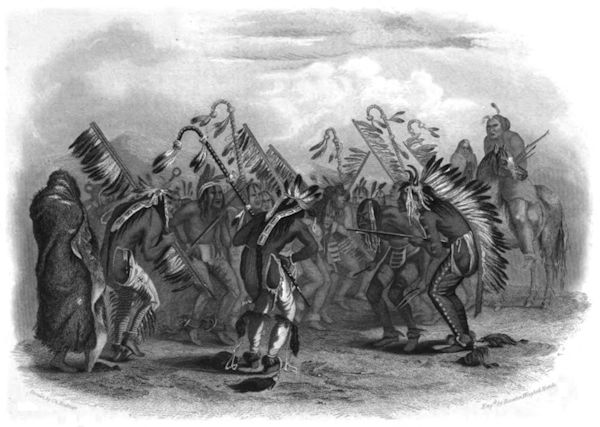
Drawn by Ch. Bodmer Engd by Rawdon, Wright & Hatch Dance of the Mandan Indians.