Act 5 — REVIEW OF NEW BOOKS.
Reading edition
In Memoriam. Boston: Ticknor, Reed & Fields. 1 vol. 16mo.
The author of this exquisite volume, the finest ever laid on the altar of friendship, is Alfred Tennyson, the most subtle and imaginative of living poets. It derives its title from the circumstance of being written in memory of Arthur Hallam, son of the historian of the Middle Ages, friend of the poet, and lover of his sister. In a hundred and eight short poems, all in one peculiar measure, Tennyson expresses not merely his grief for the loss of his friend, but touches on all those topics of sorrow and consolation kindred to the subject, or which the character of young Hallam suggests. It may be said by some that the object of the volume is unnatural and unmanly; that grief does not express itself in verses but in tears; that sorrow vents itself in simple words not in poetic conceits; and that the surest sign of the deficiency of feeling is a volume devoted to its celebration. But if we study the structure of Tennyson’s mind, we shall find that, however much these objections will apply to many mourners, they are inapplicable to him. The great peculiarity of his genius is intellectual intensity. All his feelings and impressions pass through his intellect, and are steadily scanned and reflected upon. In none of his poems do we find any outburst of feeling, scorning all mental control, or rapidly forcing the intellect into its service of rage or love. He has never written any thing in which emotion is not indissolubly blended with thought. There can be no doubt that he loved the person whom he here celebrates, but he loved him in his own deep and silent manner; his loss preyed upon his mind as well as heart, and stung thought and imagination into subtle activity. The volume is full of beauty, but of beauty in mourning weeds—of philosophy, but of philosophy penetrated with sadness. To a common mind, the loss of such a friend would have provoked a grief, at first uncontrollable, but which years would altogether dispel; to a mind like Tennyson’s years will but add to its sense of loss, however much imagination may consecrate and soften it.
This volume, accordingly, contains some of the finest specimens of intellectual pathos, of the mind in mourning, we have ever seen, and, in English literature, it has no parallel. The author is aware, as well as his critics, of the impossibility of fully conveying his grief in verses, and has anticipated their objection in a short poem of uncommon suggestiveness:
I sometimes hold it half a sin
To put in words the grief I feel,
For words, like nature, half reveal
And half conceal the soul within.
But for the unquiet heart and brain
A use in measured language lies;
The sad mechanic exercise,
Like dull narcotics, numbing pain.
In words, like weeds, I’ll wrap me o’er,
Like coarsest clothes against the cold;
But that large grief which these unfold,
Is given in outline and no more.
The following poem touches on the mind and character of young Hallam; and, if a true picture, the world, as well as the poet, has reason for regret at his early death:
Heart-affluence in discursive talk
From household fountains never dry;
The critic clearness of an eye,
That saw through all the Muses’ walk;
Seraphic intellect and force
To seize and throw the doubts of man;
Impassioned logic, which outran
The hearer in its fiery course;
High nature amorous of the good,
But touched with no ascetic gloom;
And passion pure in snowy bloom
Through all the years of April blood;
A love of freedom rarely felt,
Of freedom in her regal seat
Of England, not the school-boy heat,
The blind hysterics of the Celt;
And manhood fused with female grace
In such a sort, the child would twine
A trustful hand, unasked, in thine,
And find his comfort in thy face;
All these have been, and thee mine eyes
Have looked on: if they looked in vain
My shame is greater who remain,
Nor let thy wisdom make me wise.
In the poem which we now extract, we think our readers will recognize the force which pathos receives by its connection with intense and excursive thought:
One writes, that “Other friends remain,”
That “Loss is common to the race,”—
And common is the commonplace,
And vacant chaff well meant for grain.
That loss is common would not make
My own less bitter, rather more:
Too common! Never morning wore
To evening, but some heart did break.
O father, wheresoe’er thou be,
That pledgest now thy gallant son;
A shot, ere half thy draught be done,
Hath stilled the life that beat from thee.
O mother, praying God will save
Thy sailor, while thy head is bowed,
His heavy-shotted hammock-shroud
Drops in his vast and wandering grave.
Ye know no more than I who wrought
At that last hour to please him well;
Who mused on all I had to tell,
And something written, something thought.
Expecting still his advent home;
And ever met him on his way
With wishes, thinking, here to-day,
Or here to-morrow will he come.
O, somewhere, meek, unconscious dove,
That sittest ’ranging golden hair;
And glad to find thyself so fair,
Poor child, that waitest for thy love!
For now her father’s chimney glows
In expectation of a guest;
And thinking “this will please him best,”
She takes a ribbon or a rose;
For he will see them on to-night;
And with the thought her color burns;
And, having left the glass, she turns
Once more to set a ringlet right;
And, even when she turned, the curse
Had fallen, and her future lord
Was drowned in passing through the ford
Or killed in falling from his horse.
O, what to her shall be the end?
And what to me remains of good?
To her, perpetual maidenhood,
And unto me, no second friend.
The ringing of the Christmas bells prompts a grand poem, in which the poet rises out of his dirges into a rapturous prophecy of the “good time coming.” It is altogether the best of many good lyrics on the same general theme:
Ring out wild bells to the wild sky,
The flying cloud, the frosty light:
The year is dying in the night;
Ring out, wild bells, and let him die.
Ring out the old, ring in the new,
Ring, happy bells, across the snow:
The year is going, let him go;
Ring out the false, ring in the true.
Ring out the grief that saps the mind,
For those that here we see no more;
Ring out the feud of rich and poor,
Ring in redress to all mankind.
Ring out a slowly dying cause,
And ancient forms of party strife;
Ring in the nobler modes of life,
With sweeter manners, purer laws.
Ring out the want, the care, the sin,
The faithless coldness of the times;
Ring out, ring out my mournful rhymes,
But ring the fuller minstrel in.
Ring out false pride in place and blood,
The civic slander and the spite;
Ring in the love of truth and right,
Ring in the common love of good.
Ring out old shapes of foul disease,
Ring out the narrowing lust of gold;
Ring out the thousand wars of old,
Ring in the thousand years of peace.
Ring in the valiant man and free,
The larger heart, the kindlier hand;
Ring out the darkness of the land,
Ring in the Christ that is to be.
After these extracts we hardly need to commend the volume to our readers as worthy of the genius of Tennyson. It will not only give sober delight on its first perusal, but it contains treasures of thought and fancy which a frequent recurrence to its pages will alone reveal.
Chronicles and Characters of the Stock Exchange. By John Francis. Boston: Crosby & Nichols. 1 vol. 8vo.
This volume, invaluable to merchants and brokers, should be in the hands of all who have reason to be interested in the secrets of stock-jobbing, or who have a natural curiosity to understand the philosophy of the whole system as now practiced in all civilized countries. It gives a complete history of the National Debt of England, from the reign of William the Third to the present day, with sketches of the most eminent financiers of the Stock Exchange, and large details of the political corruption attending the making of loans. To these are added stock tables from 1732 to 1846; dividends of the Bank of England stock from 1694 to 1847; and descriptions of the various panics in the English money market, with their causes and effects. The sketch of Rothschild is a gem of biography, and while his avarice and cunning are deservedly condemned, more than usual justice is done to the remarkable blending of amplitude with acuteness in his powerful understanding. It is said that on one loan he made £150,000. Though profane, knavish and ferocious, with bad manners, and a face and person which defied the ability of caricature to misrepresent, his all-powerful wealth and talents made him courted and caressed, not only by statesmen and monarchs, but by clergymen and fastidious aristocrats. It was his delight to outwit others, but he himself was very rarely outwitted; and the few cases given by Mr. Francis, of his being overreached by the cunning of other brokers, are probably the only ones that the London Stock Exchange can furnish. Though he lived in the most splendid style, gave expensive entertainments, and occasionally subscribed to ostentatious charities, he was essentially a miser; and his mind never was so busy in calculations, in which millions of pounds were concerned, as to lose the power of estimating within a sixpence, the salary which would enable a clerk to exist.
Some curious anecdotes are given in this volume of the corruption of members of Parliament. It is well known that during the reigns of William the Third, Anne, George I. and George II., and a portion of the reign of George III., a seat in the House of Commons was considered, by many members, as a palpable property, from which a regular income was to be derived by selling votes to the ministry in power. Sir Robert Walpole and the Duke of Newcastle, were the greatest jobbers in this political corruption; but Lord Bute, who entered office on the principle of dispensing with the purchase of Parliamentary support, carried the practice on one occasion to an extent never dreamed of by his predecessors. He discovered that the peace of 1763 could not be carried through the House without a large bribe. Mr. Francis quotes from Bute’s private secretary, a statement of the sum distributed among one hundred and twenty members. “I was myself,” says Mr. Ross Mackay, the secretary in question, “the channel through which the money passed. With my own hand I secured above one hundred and twenty votes. Eighty thousand pounds were set apart for the purpose. Forty members of the House of Commons received from me a thousand pounds each. To eighty others I paid five hundred pounds a piece.” This system has been varied of late years. The mode of purchase at present is by patronage. Offices and pensions are now the price of votes.
It would be impossible in a short notice to convey an idea of the variety of curious information which this book contains. To people who have money to lose, it is a regular treatise on the art of preserving wealth. Every private gentleman, smitten with a desire to speculate in stocks, should carefully study this volume before he makes the fatal investments.
Evangeline; A Tale of Acadia. By Henry Wadsworth Longfellow. Illustrated by forty-five engravings on Wood, from designs by Jane E. Benham, Birket Foster, and John Gilbert. Boston: Ticknor, Reed & Fields. 1 vol. 8vo.
This volume, in paper, binding, and illustrations, is the most beautiful and unique we have seen from an American press. We hardly know, however, if we are right in giving it an American origin, as its illustrations are most assuredly English, and its typographical execution is exactly similar to the English edition. No better evidence is needed of Longfellow’s popularity abroad than the appearance of an edition of one of his poems, embellished like the present, with engravings so beautiful in themselves, and so true to the spirit of the scenes and characters they illustrate. The book is a study to American artists, evincing, as it does, the rare perfection to which their English brethren have carried the art of wood engraving, and the superiority of the style itself to copper-plate in many of the essential requisites of pictorial representation. The poem thus illustrated, is more beautiful than ever, its exquisite mental pictures of life and scenery being accurately embodied to the eye. As a gift-book it will doubtless be very popular among the best of the approaching season, as its mechanical execution is in faultless taste, and as the poem itself is an American classic.
The Rebels. Boston: Phillips, Sampson & Co. 1 vol. 12mo.
Many of our elderly readers will recollect the sensation which this admirable novel created on its original appearance. It was the first work which gave Mrs. Child, then Miss Frances, her reputation as a writer and thinker. The scene is laid in Boston, just before the revolution, and contains a fine picture both of the characters and events of the time. Many scenes are represented with great dramatic effect, and there are some passages of soaring eloquence which the accomplished authoress has never excelled. We cordially hope that the novel is destined for a new race of popularity.
Heloise, or the Unrevealed Secret. A Tale. By Talvi. New York: D. Appleton & Co. 1 vol. 12mo.
We presume that our readers know that “Talvi” is the assumed name of Mrs. Robinson. The present novel is a story of German and Russian life, written by one to whom the subject is familiar, and will well repay perusal. We think, however, that the accomplished authoress appears to more advantage in works of greater value and pretension—such as her late history of the literature of the Slavic nations.
Life of Jean Paul Frederic Richter. Compiled from Various Sources. Together with his Autobiography. Translated by Eliza Buckminster Lee. New York: D. Appleton & Co. 1 vol. 12mo.
This is a second edition of a charming biography, published in Boston a number of years ago, and now very properly reissued. It not only contains an accurate account of the life and works of one of the most remarkable and peculiar of German writers, but its pages throng with interesting allusions and anecdotes relating to his contemporaries. The letters of Jean Paul, especially, are full of life and heartiness. In the following passage, referring to his first introduction to Goethe, we have a living picture painted in few words. “At last the god entered, cold, one-syllabled, without accent. ‘The French are drawing toward Paris,’ said Krebel. ‘Hem!’ said the god. His face is massive and animated, his eye a ball of light. But, at last, the conversation led from the campaign to art, publications, etc., and Goethe was himself. His conversation is not so rich and flowing as Herder’s, but sharp-toned, penetrating and calm. At last he read, that is, played for us, an unpublished poem, in which his heart impelled the flame through the outer crust of ice, so that he pressed the hand of the enthusiastic Jean Paul. He did it again, when we took leave, and pressed me to call again. By Heaven! we will love each other! He considers his poetic course as closed. His reading is like deep-toned thunder, blended with soft, whispering rain-drops. There is nothing like it.” Goethe’s personal effect on his contemporaries, would lead us to suppose that he was, to adopt Mirabeau’s system of nicknaming, a kind of Webster-Wordsworth.
Railway Economy; a Treatise on the New Art of Transport, With an Exposition of the Practical Results of the Railways in Operation in the United Kingdom, on the Continent, and in America. By Dionysius Lardner, D. C. L. New York: Harper & Brothers. 1 vol. 12mo.
This is a very interesting account of the whole system of railways, written by a person who understands it in its facts and principles. The author has collected a vast amount of information, which he conveys in a condensed and comprehensible form. The motto of the work is one of Bacon’s pregnant sentences: “There be three things make a nation great and prosperous: a fertile soil, busy workshops, and easy conveyance of men and things from one place to another.”
Pictorial Field Book of the Revolution. By Benson J. Lossing.
The Harpers have just commenced the issue of this beautiful work, which is to be completed in twenty numbers. The mechanical execution is very neat, and the wood engravings, from sketches by the author, are admirable. Mr. Lossing writes with ardor and elegance, his mind filled with his themes, and boiling over at times into passages of descriptive eloquence. The book, when completed, will contain an account of the localities and action of all the battles of the Revolution, illustrated by six hundred engravings. The enterprise deserves success.
A Discourse on the Baconian Philosophy. By Samuel Tyler, of the Maryland Bar. Second Edition Enlarged. New York: Baker & Scribner. 1 vol. 12mo.
This work is very creditable to American literature as a careful and learned Discourse on a large subject, demanding a knowledge not only of Bacon but of Plato and Descartes. Mr. Tyler evinces a thorough comprehension of the externals of the subject, and few can read his book without an addition to their knowledge; but we think he misses Bacon’s method in his application of it to metaphysics and theology. The peculiar vitality of Bacon’s axioms he often overlooks in his admiration of their formal expression, and occasionally astonishes the reader by making Bacon commonplace, and then lauding the commonplace as the highest wisdom.
The Unity of the Human Races Proved to be the Doctrine of Scripture, Reason, and Science. By the Rev. Thomas Smith, D. D. New York: Geo. P. Putnam. 1 vol.
It is well known that Professor Agassiz, at the last meeting in Charleston of the American Association for the Advancement of Science, startled the audience with an expression of disbelief in the doctrine that all mankind sprung from one original parent. The present book, in some degree the result of his remark, takes strong ground in favor of the common faith on the point. It is worthy of attentive consideration from all readers, especially as it popularises the important subject of Races—a subject generally monopolized by technical savans; in unreadable books.
Arthur’s Gazette.—We take great pleasure in calling the attention of our readers to the prospectus of Mr. Arthur’s newspaper, as set forth in full upon the cover of Graham for this month.
Mr. Arthur’s name is a household word the Union over; his stories have penetrated every village of the country, and are read with delight for their high moral tone and eminently practical character. The title is therefore very fitly chosen, and we shall be much mistaken if the Home Gazette is not welcomed from the start at thousands of firesides, as a chosen and familiar friend.
Capital—a very necessary article in starting a new enterprise—has, we are assured by Mr. Arthur, been abundantly secured, and with the editor’s industry and energy, there can be no such word as fail.
Mr. Arthur has discovered the true secret of success—to charge such a price as will really enable him to make a good paper—to make it so in all respects; and then to advertise so as to let the public know that he has a first-rate article for sale at a fair living price. If he allows no temptation of temporary success to seduce him from the just business ground thus assumed, he is as certain of ultimate and permanent prosperity, as he can be of any problem in mathematics. A simple business secret that a great many publishers we know of, have yet to learn.
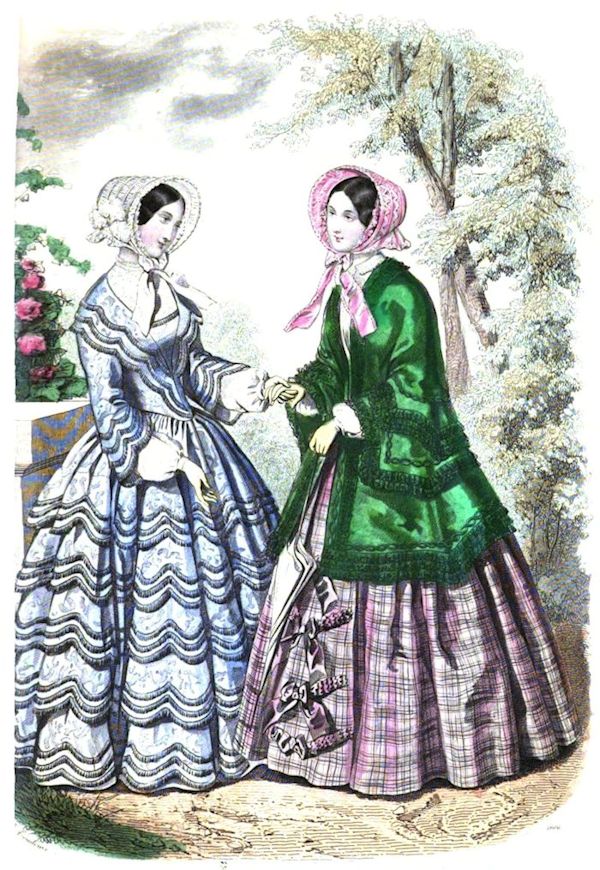
Anaïs Toudouze
LE FOLLET Paris, boult. St. Martin, 69.
Chapeaux de Mme. Baudry, r. Richelieu, 81—Plumes et fleurs de Chagot ainé, r. Richelieu, 73.
Robes et pardessus Mme. Verrier Richard, r. Richelieu, 77—Dentelles Violard, r. Choiseul, 4.
The styles of Goods here represented can be had of Messrs. L.T. Levy & Co. Philadelphia,
and at Stewart’s, New York.
Graham’s Magazine, 134 Chestnut Street.
Transcriber’s Notes:
Archaic spellings and hyphenation have been retained as well as some spellings peculiar to Graham's. Punctuation has been corrected without note. Other errors have been corrected as noted below. For illustrations, some caption text may be missing or incomplete due to condition of the originals used for preparation of the ebook.
page 140, speech of Lenox, ==> speech of Lennox,
page 140, was for Malcom and ==> was for Malcolm and
page 145, at it’s outbreak ==> at its outbreak
page 148, added [To be continued.
page 149, saw in vision ==> saw in a vision
page 149, “to saw the kernels ==> “to sow the kernels
page 153, thread-lace cape ==> thread-lace caps
page 153, in in leaving her ==> in leaving her
page 154, had forsight to arm ==> had foresight to arm
page 154, everybody eat, not ==> everybody ate, not
page 154, hour passsed in ==> hour passed in
page 155, turned to Miss Houton ==> turned to Miss Hauton
page 155, “Its a shameful ==> “It’s a shameful
page 155, “a very powerful ==> “is a very powerful
page 155, get a new troup ==> get a new troupe
page 155, was evident spite ==> was evident in spite
page 155, she could excute ==> she could execute
page 157, sleeping roses heart ==> sleeping rose’s heart
page 157, Our bark floats ==> Our barque floats
page 166, conditon of the ==> condition of the
page 171, nutricious fluids ==> nutritious fluids
page 173, roly-boly globularity ==> roly-poly globularity
page 177, perfect nonchalence ==> perfect nonchalance
page 178, some choice boquet ==> some choice bouquet
page 178, of faded boquets ==> of faded bouquets
page 179, lige a winged ==> like a winged
page 180, herself ununworthy ==> herself unworthy
page 180, and fops,” concontinued ==> and fops,” continued
page 183, to her hapness ==> to her happiness
page 186, in the of midst ==> in the midst of
page 189, her moonlight bark ==> her moonlight barque
page 192, pannicle, and the ==> panicle, and the
page 193, no part slighted ==> no part is slighted
page 193, fact the canvasi ==> fact the canvas is
page 194, musical intepretation ==> musical interpretation
page 195, BY T. HOLLY CHIVRES, M. D. ==> BY T. HOLLEY CHIVERS, M. D.
page 196, our bark to wander ==> our barque to wander
page 199, Longfellow’s popularaity ==> Longfellow’s popularity