Act 5 — RAIL AND RAIL SHOOTING.
Reading edition
———
BY HENRY WILLIAM HERBERT, AUTHOR OF FRANK FORESTER’S “FIELD SPORTS,” “FISH AND FISHING,” ETC.
———
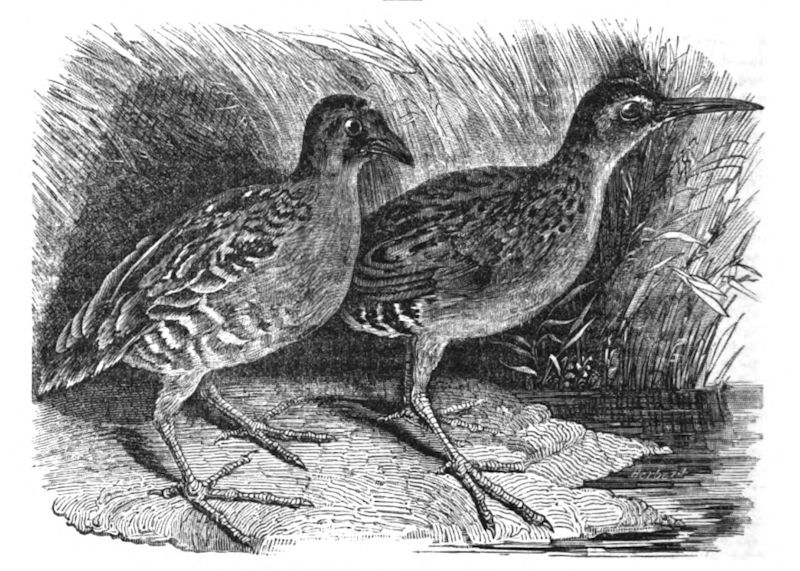
THE VIRGINIA RAIL. (Rallus Virginianus.) THE SORA RAIL. (Rallus Carolinensis.)
With the present month commences the pursuit of this singular and delicious species of game, and, although as a sport it is not to be compared with the bolder and more varied interest of shooting over dogs on the upland, still the great numbers which are killed, and the rapidity with which shot after shot is discharged in succession, render Rail-shooting a very favorite pastime, more especially with the sportsmen of Philadelphia, in the vicinity of which city this curious little bird is found in the greatest abundance.
Of the rallidæ, or Rail family, there are many varieties in America, all of them more or less aquatic in their habits, and none of them being, as the Corncrake, or Land Rail, of Europe, purely terrestrial; though the little Yellow-Breasted, or New York Rail, Rallus Noveboracencis, approaches the most nearly to that type, being frequently killed in upland stubble or fallow fields.
The principal of these species, and those most worthy of notice, are—the Clapper Rail, or great Salt-Water Rail, variously known as the Meadow Hen, or Mud Hen; found very extensively along all the tide morasses, and salt meadows of the Atlantic coast, but more especially on the shores of Long Island, and in New Jersey, at Barnegat and Egg Harbor. This, the scientific name of which is Rallus crepitans, is the largest of the species; it is shot from row boats in high spring tides, when the water has risen so much as to render it impossible for the Rails either to escape by running, which they do at other times with singular fleetness, baffling the best dogs by the celerity with which they pass between the thick-set stalks of the reeds and wild oats, constituting their favorite covert, or to lurk unseen among the dense herbage.
This Rail, like all its race, is a slow and heavy flyer, flapping awkwardly along with its legs hanging down and a laborious flutter of the wings. It is, of course, very easily shot, even by a bungler, and there is little or no sport in the pursuit, though its flesh is tender and delicate, so that it is pursued on that account with some eagerness.
Second to the Clapper Rail, in size, and infinitely superior to it in beauty and excellence of flesh, is the King Rail, Rallus elegans, which is by far the handsomest of the species. It is commonly known as the Fresh-Water Meadow Hen, though it is not with us to the northward a frequent or familiar visitant, the Delaware river being for the most part its northeastern limit, and very few being killed to the eastward of that boundary. A few are found, it is true, from time to time, in New Jersey, and it has occurred on Long Island, and in the southern part of New York, though rather as an exception than as a rule.
Next to these come the Virginia Rail, which is represented to the right hand of the cut at the head of this paper, and the Sora, which accompanies it.
The Virginia Rail, Rallus Virginianus, notwithstanding its nomenclature, which would seem to indicate its peculiar local habitation, is very generally found throughout the United States, and very far to the northward of the Old Dominion. I have myself killed it in the State of Maine, as well as in New York, New Jersey, and Pennsylvania, at the marsh of the Aux Canards river, in Canada East, and on the head waters of the Lake Huron Rivers. In the great wild rice marshes of the St. Clair river, the Virginia Rail, like most of the aquatic birds and waders, is very common. It is rather more upland in its habits than its companion, the Sora, which delights in the wettest tide-flowed swamps where the foot of man can scarcely tread, being frequently killed by the Snipe-shooter in wet inland meadows, which is rarely or never the case with the Sora.
The Virginia Rail is, however, not unfrequently found in company with the other on the mud flats of the Delaware, and, with it, is shot from skiffs propelled by a pole through the reed beds at high water.
The Virginia Rail is a pretty bird, measuring about eight inches in length. The bill is about an inch long, slightly decurved, red at the base and black at the extremity; the nostrils linear. The top of the head is dark-brown, with a few pale yellowish streaks; a blackish band extends from the base of the bill to the eye, and a large, ash-colored spot, commencing above the eye posteriorily, occupies the whole of the cheeks. The throat, breast, and belly, so far as to the thighs, which partake the same color, are of a rich fulvous red, deepest on the belly. The upper parts, back of the neck, scapulars, and rump, are dark blackish-brown, irregularly streaked and dashed with pale yellowish-olive. The wing-coverts are bright bay, the quills and tail blackish-brown. The vent black, every feather margined with white. The legs are red, naked a little way up the tibia. It is a very rapid runner, but flies heavily. It affords a succulent and highly flavored dish, and is accordingly very highly prized, though scarcely equal in this respect to its congener, the Sora, which is regarded by many persons as the most delicious of all game, though for my own part I would postpone it to the Canvas-Back, Fuligula valisneria, the Upland Plover, Totanus Bartramius, and the Pinnated Grouse, or Prairie Fowl, Tetrao cupido.
The Sora Rail, Rallus Carolinus, which is more especially the subject of this paper, is somewhat inferior in size to the last species, and is easily distinguished from it by the small, round head, and short bill, in which it differs from all the rest of its family. This bill is scarcely half an inch in length, unusually broad at the base, and tapering regularly to a bluntly rounded point. At the base and through nearly the whole length of the lower mandible it is pale greenish-yellow, horn-colored at the tip. The crown of the head, nape, and shoulders, are of a uniform pale olive-brown, with a medial black stripe on the crown. The cheeks, throat, and breast, pale rufous brown, fading into rufous white on the belly, which is mottled with broad transverse gray lines. The back, scapulars, wing-coverts, and rump, are olive-brown, broadly patched with black, and having many of the feathers margined longitudinally with white, the quills dark blackish-brown, the tail dark reddish-brown. The lower parts from the tail posteriorily to the vent transversely banded with black and white. The legs long and slender, bare a short way up the tibia, of a pale greenish hue. The iris of the eye is bright chestnut. The male bird has several black spots on the neck.
This bird is migratory in the United States, passing along the sea-coast as well as in the interior; a few breed in New Jersey, on the Raritan, Passaic, and Hackensack rivers; but on the Delaware and its tributaries, which abound with wild rice, it is exceedingly abundant, as it is also in the great northwestern lakes and rivers which are all plentifully supplied with this its favorite food. It is rarely killed in New York or to the eastward, though a few are found on the flats of the Hudson. It winters for the most part to the south of the United States, although a few pass the cold season in the tepid swamps and morasses of Florida and Louisiana. All this is now ascertained beyond doubt, but till within a few years all sorts of strange fabulous tales have been in circulation concerning the habits of this bird; arising from the circumstance of its very sudden and mysterious arrival and disappearance on its breeding-grounds, the marshes being one day literally alive with them, and the next solitary and deserted. Add to this its difficult, short, and laborious flight, apparently so inadequate to the performance of migrations thousands of miles in length, and it will be easy to conceive that the vulgar, the ignorant, and the prejudiced, should have been unable to comprehend the possibility of its aërial voyages, and should have endeavored to account for their disappearance by insisting that they burrow into the mud and become torpid during the winter, as I have myself heard men maintain, incredulous and obstinate against conviction. Audubon has thought it necessary gravely, and at some length, to controvert this absurd fallacy, and in doing so has recorded the existence of a planter on the James River, in Virginia, who is well convinced that the Sora changes in the autumn into a frog, and resumes its wings and plumage in the spring, thus renewing the absurd old legend of Gerardus Cambrensis in relation to the tree which bears shell-fish called barnacles, whence in due season issue barnacle geese.
The Sora Rail arrives in the Northern States in April or May. I saw one killed myself this spring in a deep tide marsh on the Salem creek, near Pennsville, in New Jersey, on the 25th of the former month, which was in pretty good condition. They migrate so far north as to Hudson’s Bay, where they arrive early in June, and depart again for the south early in the autumn. They breed in May and June, making an inartificial nest of dry grass, usually in a tussock in the marsh, and laying four or five eggs of dirty white, with brown or blackish-white spots. The young run as soon as they are hatched, and skulk about in the grass like young mice, being covered with black down. The Sora Rail is liable to a curious sort of epileptic fit, into which it appears to fall in consequence of the paroxysms of fear or rage to which it is singularly liable.
The following account of the habits and the method of shooting this bird, from Wilson’s great work on the Birds of America, is so admirably graphic, truthful, and life-like, that I prefer transcribing it for my own work on Field Sports, into which I copied it entire as incomparably superior to any thing I have elsewhere met on the subject, to recording it myself with, perhaps, inferior vigor.
“Early in August, when the reeds along the shores of the Delaware have attained their full growth, the Rail resort to them in great numbers, to feed on the seeds of this plant, of which they, as well as the Rice-birds, and several others, are immoderately fond. These reeds, which appear to be the Zizania panicula effusa of Linnæus, and the Zizania clavulosa of Willenden, grow up from the soft muddy shores of the tide-water, which are, alternately, dry, and covered with four or five feet of water. They rise with an erect tapering stem, to the height of eight or ten feet, being nearly as thick below as a man’s wrist, and cover tracts along the river for many acres. The cattle feed on their long, green leaves, with avidity, and wade in after them as far as they dare safely venture. They grow up so close together, that except at or near high water, a boat can with difficulty make its way through among them. The seeds are produced at the top of the plant, the blossoms, or male parts, occupying the lower branches of the panicle, and the seeds the higher. The seeds are nearly as long as a common-sized pin, somewhat more slender, white, sweet to the taste, and very nutritive, as appears by their effects on the various birds that feed on them at this season. When the reeds are in this state, and even while in blossom, the Rail are found to have taken possession of them in great numbers. These are generally numerous, in proportion to the full and promising crop of the former. As you walk along the embankment of the river, at this season, you hear them squeaking in every direction, like young puppies. If a stone be thrown among the reeds, there is a general outcry, and a reiterated kuk, kuk, kuk—something like that of a Guinea-fowl. Any sudden noise, or discharge of a gun, produces the same effect. In the meantime, none are to be seen, unless it be at or near high water—for when the tide is low, they universally secrete themselves among the insterstices of the reeds; and you may walk past, and even over them, where there are hundreds, without seeing a single individual. On their first arrival, they are generally lean and unfit for the table, but as the seeds ripen, they rapidly fatten, and from the 20th September to the middle of October, are excellent, and eagerly sought after. The usual method of shooting them in this quarter of the country is as follows.
“The sportsman furnishes himself with a light batteau, and a stout, experienced boatman, with a pole of twelve or fifteen feet long, thickened at the lower end, to prevent it from sinking too deep in the mud. About two hours or so before high water, they enter the reeds, and each takes his post—the sportsman standing in the bow, ready for action, the boatman on the stern-seat, pushing her steadily through the reeds. The Rail generally spring singly as the boat advances, and at a short distance a-head, are instantly shot down, while the boatman, keeping his eye on the spot where the bird fell, directs the boat forward, and picks the bird up, while the gunner is loading. It is also the boatman’s business to keep a sharp look out, and give the word ‘Mark,’ when a Rail springs on either side, without being observed by the sportsman, and to note the exact spot where it falls, until he has picked it up; for this once lost sight of, owing to the sameness in the appearance of the reeds, is seldom found again. In this manner the boat moves steadily through and over the reeds, the birds flushing and falling, the gunner loading and firing, while the boatman is pushing and picking up. The sport continues an hour or two after high water, when the shallowness of the water, and the strength and weight of the floating reeds, as also the backwarkness of the game to spring, as the tide decreases, oblige them to return. Several boats are sometimes within a short distance of each other, and a perpetual cracking of musketry prevails above the whole reedy shores of the river. In these excursions, it is not uncommon for an active and expert marksman to kill ten or twelve dozen in a tide. They are usually shot singly, though I have known five killed at one discharge of a double-barrelled piece. These instances, however, are rare. The flight of these birds among the reeds, is usually low, and shelter being abundant, is rarely extended to more than fifty or one hundred yards. When winged, and uninjured in their legs, they swim and dive with great rapidity, and are seldom seen to rise again. I have several times, on such occasions, discovered them clinging with their feet to the reeds under the water, and at other times skulking under the reeds, with their bills just above the surface; sometimes, when wounded, they dive, and rising under the gunwale of the boat, secrete themselves there, moving round as the boat moves, until they have an opportunity of escaping unnoticed. They are feeble and delicate in every thing except the legs, which seem to possess great vigor and energy; and their bodies being so remarkably thin, and compressed so as to be less than an inch and a quarter through transversely, they are enabled to pass between the reeds like rats. When seen, they are almost constantly jetting up the tail, yet though their flight among the reeds seems feeble and fluttering, every sportsman who is acquainted with them here, must have seen them occasionally rising to a considerable height, stretching out their legs behind them, and flying rapidly across the river, where it is more than a mile in width. Such is the mode of Rail shooting in the neighborhood of Philadelphia.
“In Virginia, particularly along the shores of James River, within the tide-water, where the Rail, or Sora, are found in prodigious numbers, they are also shot on the wing, but more usually taken at night in the following manner:—
“A kind of iron grate is fixed on the top of a stout pole, which is placed like a mast in a light canoe, and filled with fire. The darker the night, the more successful is the sport. The person who manages the canoe, is provided with a light paddle, ten or twelve feet in length; and about an hour before high water, proceeds through among the reeds, which lie broken and floating on the surface. The whole space, for a considerable way round the canoe, is completely enlightened—the birds start with astonishment, and, as they appear, are knocked over the head with a paddle, and thrown into the canoe. In this manner, from twenty to eighty dozen have been killed by three negroes in the short space of three hours.
“At the same season, or a little earlier, they are very numerous in the lagoons near Detroit, on our northern frontier, where another species of reed, of which they are equally fond, grows in shallows, in great abundance. Gentlemen who have shot them there, and on whose judgment I can rely, assure me that they differ in nothing from those they have usually killed on the shores of the Delaware and Schuylkill; they are equally fat, and exquisite eating.”
To this I shall only add, that a very light charge of powder and three-quarters of an oz. of No. 9 shot will be found quite sufficient to kill this slow flying bird. I have found it an excellent plan to have a square wooden box, with two compartments, one holding ten lbs. of shot, with a small tin scoop, containing your charge, and the other containing a quantum suff. of wadding, placed on the thwarts of the boat, before you, and to lay your powder flask beside it, by doing which you will save much time in loading; a great desideratum where birds rise in such quick succession as these will do at times, a couple of hundred being some times killed by one gun in a single tide.
A landing net on a long light pole will be found very convenient for recovering dead birds. No rules are needed for killing rail, as they lie so close and fly so slowly that a mere bungler can scarce miss them, unless he either gets flurried or tumbles overboard. When dead he is to be roasted, underdone, like the snipe, served on a slice of crisp buttered toast, with no condiment save a little salt and his own gravy. If you are wise, gentle reader, you will lay his ghost to rest with red wine—Burgundy if you can get it, if not, with claret. For supper he is undeniable, and I confess that, for my own part, I more appreciate the pleasure of eating, than the sport of slaying him; and so peace to him for the present, of which he surely will enjoy but little after the twentieth of September, until the early frosts shall drive him to his asylums, in the far southern wilds and waters.