THE SUCTION AND PUMPING PROCESS.
Reading edition
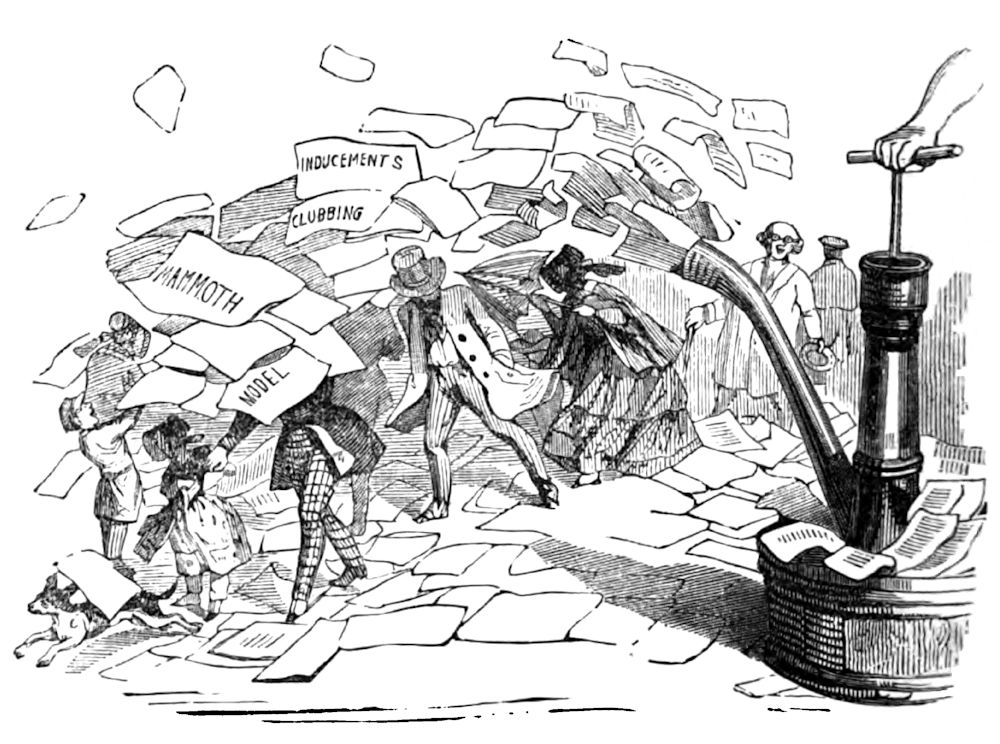
From this party, we shall no doubt be favored, with very extravagant-looking show-bills, and plenty of them—long bills drawn upon the credulity of people who fill an imaginary subscription list, and are very liberal in remittances, and whose wonderful sagacity in waiting until 1850, will be duly heralded, and in type announced. The existence of any periodical of the slightest pretension to elegance or ability, not having been heard of before, and only known among that benighted class, whose urgent literary tastes would not allow them to suffer and to wait.
Having seen our friends of “The Suction and Pumping Process” fairly in the field, let us survey the ground. On the whole, things look rather brilliant; a number of “new volumes with superb inducements,” are already announced, and with the usual cheering before starting, the entertainments for 1850 promise to be rich and various beyond parallel. Ingenuity, it seems, is not exhausted, nor are novelties entirely run out. What have we here?
One of the ladies’ magazines actually promises to “outstrip” all its cotemporaries! A novel sort of assertion, truly, for a genteel ladies’ magazine; yet a proceeding, one would think, that cannot be carried very far with any sort of propriety. The grace of modesty and the delicacy of its position alike forbid it. Such things, if really attempted, will drive the meeker and weaker brethren entirely from the contest. We may—but scarcely can—tolerate the pretty large liberties which have been taken with the dresses of ladies elsewhere in engravings and fashion plates. Let it stop here. Give us models of art, even if they are a little nude; we can stand that—but this is touching on the province of the model artists; and as the elder magazine, we cannot allow it—positively. Jeremy, if you have any influence with these people, stop this thing, I pray you.
Phew!—but what is this?
It appears that under cover of fire-works, with sky-rockets, blue-lights, shooting-stars, or something of that sort, we are to have a grand conflagration, perhaps immolation of fashionable and pretty women; for another ladies’ magazine, audaciously—in order to offset the other, we suppose—promises, “a blaze of beauty throughout the year!”
Heavens! “can these things be,
And overcome us like a summer cloud,
Without our special wonder.”
And this is actually put out in the bills, before a Christian country, in the nineteenth century, and the police look on, and are silent!
Ah! this comes home to “our hearts and our bussums.” What do we read? “All the distinguished writers and authors of this country and Europe are engaged.” The deuce they are? Oh Lord!—Our office then may be closed, during business hours hereafter, we suppose.
Overlooked, by George!—News! news! “The acknowledged Blackwood of America, 1850.” Now is that old vagabond coming back again, after having enjoyed our hospitalities for two seasons—’42 and ’43?
If Blackwood were to come in spirit shape, this I think would be his story, Jeremy:
“You see I was coming along, when a tall fellow, our old friend, cries, ‘How are you, Mr. Blackwood?’
“ ‘Come in here,’ says he, seizing my elbow, and in an instant I found myself deceived, swindled, jostled in among the wrong set. A parcel of puritanical looking dogs, sitting cheek by jowl, with long gowns, play actors, medical students, penny-a-liners, seedy old boys and silly school girls. I suppose they took me for a Mormon or a Shaker, or perhaps a clown, and dragged me in, to add to the novelty of the collection. But Scotch manners wouldn’t allow me to be rude, so I said, very politely, to the tall gentleman, if that is whisky-punch you have on the stove, I’ll take a tumbler of it. Heavens! you should have heard the yell that went up, and seen the horrible faces; so seeing the way the wind set, I gave one or two of them a knock over the skull with ebony—bestowed my parting benediction upon the whole company—ladies excepted—and came at once to head-quarters.”
Now, Jeremy, I don’t know what you may think of this business, but I say I have been silent long enough under various aggressions, and hereafter, I take the cudgel and trounce any son of a gun who poaches on my manor. Why do you know that people have the audacity to say that theirs is the oldest magazine, when the Casket, which we bought, and on which Graham was based, started in 1826, and had its colored fashions and wood engravings printed on tinted paper long before any of them opened their eyes. The mezzotints I was the first to put to magazine use on a large scale; and Burton’s Magazine, which was incorporated with this, gave the first that Sartain ever did for a magazine of large circulation; and yet these young fellows, with the down yet upon their chins, affect the experience of years, and learnedly talk about teaching their grandfather how to snuff. I care nothing about this, but that it has gone far enough; and they will after a while begin to believe their own stories—a bit of self-deception that it is a pity they should be subjected to.
But, Jeremy, we live in a funny world, and even with our criminal code, and prison discipline, I fear me, the moral reformer has a vast work to do. The shades of right and wrong, as worked up in the woof of practical life, are not of colors which contrast very strongly. They form rather the figures of a kaleidoscope. Is there not a little gambling done, in the way of “specimens” in literature, as well as in “specimens” in copper? Do the samples shown as “inducements” always honestly represent the real article afterward put upon the purchaser? Oh! very nice, rigid and self-complacent moralist, “with good fat capon lined,” why are thy hands held up in such affected holy horror at thy brother, who has stumbled and fallen, “because he has done this thing;” when printed records of thy falsified pledges and assertions, fill the post-towns of the country, the Union over! The lie in type and upon record, is it less venal, because multiplied by thousands, than that by word, which palms upon the unsuspecting a sinking fancy stock! Let the canting, praying hypocrite, of all trades, go down into his own heart, and clear it of its “dead men’s bones, and all uncleanness,” before, with bastard honesty, he casts a stone at his most desperate brother.
Ah, Jeremy, is there not a thriving business done, by men professing to be respectable, by “The Suction and Pumping Process,” in most of the trades of life—even in the very honorable business of manufacturing and selling goods? Ay! in the thousand well dressed, painted living lies, that stare at you in the streets, and from behind counters, and impose upon the ignorant—is there no rascality? When goods are put upon the poor and ignorant hired girls at high prices—the remnants of shabby gentility—are the shopkeepers honest do you suppose? In the poisoned rum, that is sold for good (God defend us!) and which sends destitution, misery, and crime into the hovels of the poor—is there no weight of damnation, past finding out? Is every marble palace, with steeds prancing at the door, the monument of a good man’s well spent life; has every stone and carved niche been paid for by money honestly earned? Are the laces, and feathers, and gold and jewels, that flash upon us and glitter in the sun, all, always the well-earned rewards of honest and praiseworthy toil? Much of the money thus lavishly displayed, and on which an insolent pride fattens and corrupts, may it not be the legitimate reward of a sin that would taint the fingers of a thief? Hold up thy head, young brother, and keep thy heart pure; all is not lost! the courage to dare, the power and will to do are thine! Up! and against wrong and oppression of every shade, set thy face as a flint, and with conscious might and truth, press on! The world is before thee where to choose—it is thy battle-ground! Do nobly, and thou art man—meanly, a more creeping thing than a worm a upon whom every coward braggart will set his heel. Aye on! there is yet to come—thank God—a reckoning-day, of motives and of actions, when assumption shall be stript—deceit exposed—the hollow heart laid bare, and when the secret sin of pride and self-complacency, dragged from its hiding-place, shall be thrust, blazing into its face.
My dear Jeremy, there is a consolation in this—we shall see one of these times, every man’s motive for the acts he has committed revealed—whether it is only the poor devils cast down, forsaken, down-trodden and despised, that die in the ditch, who are damned; or whether he only is on his way to heaven—the sleek and lucky moralist who dozes over his wine—who thinks he can pave his way to heaven with ingots, however got, that shall be saved. That will be a sight worth seeing, Jeremy, for it will open the eyes of the Universe, and make all things even. We can afford to wait for even this, can we not? It will not be long.
G. R. G.