A CASE OF GOLD FEVER.
Reading edition
———
BY JOHN JONES.
———
[SEE ENGRAVING.]
Mr. Edwards Perley was not a man of wealth, although, at different periods of his life, he had been the owner of property valued at from one hundred thousand dollars to half a million. But this property being either in Texas land scrip, South Carolina gold mines, Western town lots, Mulberry trees, Maine wild lands, or other people’s promises to pay, Mr. Perley had never been able to realize what was so nearly a splendid fortune within his grasp. The revolution in Texas destroyed the value of Mexican grants, in which he had become largely interested, and the sale of square leagues of the “best cotton land in the world,” not only ceased suddenly, but the bills received for previous sales came back upon him dishonored. This was a sad damper on the golden hopes of the enthusiastic Mr. Edwards Perley. For a couple of years he had been selling land scrip from Bangor to New Orleans; and had been out on the Red River twice, during the time, with a surveying company, whose business it was to locate the little league-square lots. On these expeditions, he had become rather intimately acquainted with alligators and ague, and, on his return, deemed it no more than prudent to keep himself quiet until he regained his complexion, and the healthy roundness of his limbs and features. Mr. Perley worked hard in this matter; but it suited his temperament. He was no plodding genius, content to count sixpences first, then shillings, and so on until dollars began to appear. Not he. In that slow way to wealth he could not walk.
Just as Mr. Perley, who valued his property at hundreds of thousands of dollars in the present, and looked upon it as possessing an annually duplicating quality—just as Mr. Perley had selected a beautiful site for building a palace in New York, and had decided upon the plans submitted by a distinguished architect, the troubles in Texas destroyed the value of his scrip, and down he went to ruin like a collapsed balloon; and dozens of his confiding friends went with him.
But Mr. Edwards Perley had too much native buoyancy of character, too much hope in life, to be put down by ill-natured fortune after this summary manner. In the wreck and ruin in which he was involved, he managed to get hold of a plank on which to float ashore. With a few hundred dollars, which he had contrived to save, under a self-enacted “homestead exemption” law, he opened an exchange office in Wall street, on a very small scale. Though his business operations scarcely reached, for a time, the aggregate of hundreds per day, there were not a few of his acquaintances who believed his transactions to be limited only by thousands; and they were indebted to him for their ideas on the subject. Give a man the reputation of doing a large business, and business will be sure to come. So it was in the case of Edwards Perley. Talking and boasting were of great use to him. In a few years he was getting along, as the saying is, “swimmingly.” But, like the man who, after creeping along for a week in a stage-coach, grows impatient if the cars do not make thirty miles an hour instead of twenty, Mr. Perley, as soon as affairs became prosperous with him again, grew dissatisfied with what appeared a slow accumulation, and began to look around him for some good speculation. He was not long in finding what he sought.
But it is not our purpose to follow Mr. Perley through the various stages of his Carolina gold and Morus Multicaulis fevers; nor to minutely detail his operations in Western lands and town lots. As it had been in Texas land scrip, so it proved in all these. The visionary speculator, who sought wealth for its own sake, and was too eager for its possession to be willing to give back to society an equivalent of useful acts, after running a wild course for a few years, again tripped and fell. This time he found it much more difficult to recover himself. But with an elasticity of feeling that few possess, he went hopefully to work, and by dint of magnifying his own peculiar abilities, and his knowledge of business, induced a shrewd, calculating Yankee, who had a few thousand dollars, to join him in business.
For a year or two, Perley was content to move on slowly. After that, he grew ambitious and restless again. The fire had not burned out; it was only covered for a while. Of Jenkins, his partner, he had no very high opinion. He considered him a mere plodding genius, whose mind was in no way suggestive. He would do for a well beaten track, but for enterprise he was nobody. So he thought. But Jenkins had rather more shrewdness than his partner gave him credit for. He belonged to the class of men who think a great deal before they act, and who, therefore, rarely make mistakes in business matters. He understood Perley “like a book,” and was, therefore, prepared to counteract, judiciously, all his efforts that were not wisely directed. Reactions of this kind becoming, as business grew into importance, more and more frequent, Mr. Perley felt restless under them, and often lamented that affairs were not entirely under his own control.
This was the aspect of things when the golden news from California startled the most sober-minded with its tale of wonder. Perley believed every word of the first account, while Jenkins coolly took the liberty of doubting the whole story.
“It’s preposterous,” said he.
“But look at the official nature of the intelligence,” urged Perley.
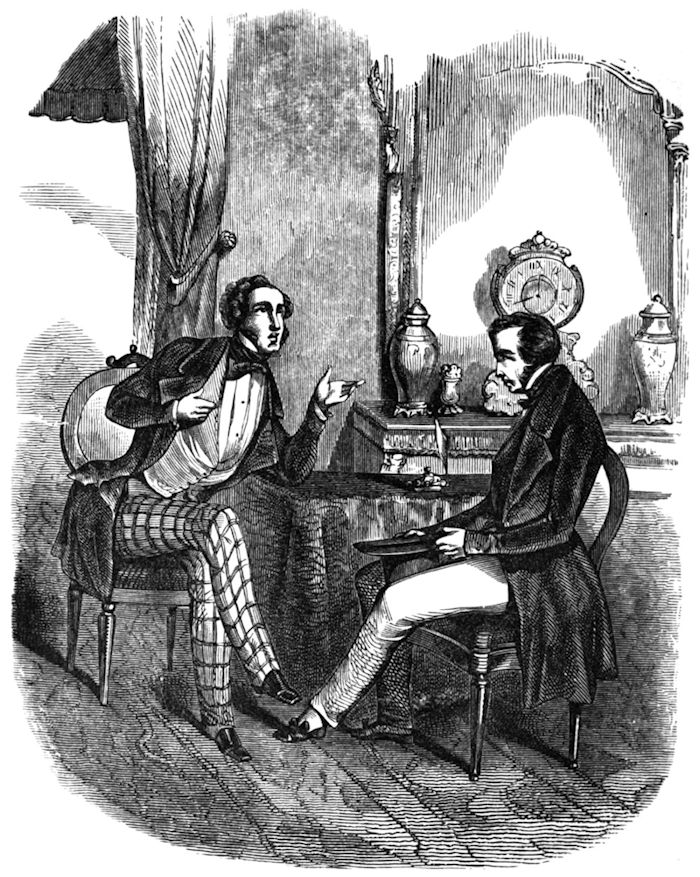
Engraved Expressly for Graham’s Magazine. A CASE OF GOLD FEVER.
“Officials can lie as well as other people. It’s all a speculation to get settlers out there. Don’t tell me of gold scattered about as thick as jack-stones.”
Perley maintained the other side of the question, and soon had the satisfaction of pushing most abundant confirmations into the face of his partner.
“Well,” said Jenkins, “what of it? Suppose there is gold there? It doesn’t make me any better off.”
“But it will make you better off, if you seize the advantage now offered to every energetic and truly enterprising man.”
Mr. Jenkins opened his eyes rather wider than usual; then shrugging his shoulders, he answered:
“My business creed is—‘Let well enough alone.’ ”
“And mine,” replied Perley, “is to seize upon every advantage that offers.”
At this point the conversation was interrupted, and as neither party, for good reasons, thought it advisable to renew it, the subject did not come up between them for several days. During this time Perley could think of little else but California, and the golden harvest it presented; and the more he thought of it, the more fully satisfied was he that an immense fortune might speedily be realized by trading in that region. What was in the way, when blankets sold for ten dollars each, a pair of boots for double that sum, flour for sixty dollars a barrel, and every thing else in proportion?
“The fact is, Jenkins,” said he, renewing the subject not many days after the first conversation, “we must make some of this hay while the sun is shining.”
“The golden hay, you mean.”
“I do.”
“How are we to make it?”
“By going sickle in hand to the field, and reaping with the rest.”
“Suppose the field should be reaped before we get there?”
“That cannot be. The gold region is a thousand miles in length and several hundreds in breadth. There is enough for all who will go for the next ten years.”
“I must beg leave to doubt that,” coolly replied Jenkins. “It’s all a feverish imagination. Gold dazzles the eyes and keeps men from seeing in a clear light.”
“But, my dear man,” said Perley, “look at the facts and judge for yourself. Take Governor Mason’s statement.”
“Very well. Suppose we believe all the governor says, what then? Why, the man who finds an ounce of gold a day has to pay about sixteen prices for the necessaries of life, and, so is no better off than the man here who earns a dollar in the same time. The only way in which he can accumulate gold is to live like a savage.”
“But, I wouldn’t go to dig gold!”
“Go! Surely you do not think seriously of going?”
“I certainly do.”
“I’m sorry to hear you say that, Mr. Perley. We are doing exceedingly well and our business is growing. Last year it doubled, and is in a fair way of doubling itself again this year.”
“But what is such a rate of increase to the golden gains that are now offered? Nothing—nothing.”
Mr. Jenkins could not talk as fluently as his partner, and was in this instance, as he had been once or twice before, silenced but not convinced.
Daily there came some fresh intelligence touching the gold deposits in our new possessions, and the note of preparation for a speedy flight was sounded in all directions. The newspapers teemed with exciting statements, and every man you met in the street, on ’change, or in the social circle, had something to say about California. Daily the fever increased, and particularly with Mr. Edwards Perley, until he began to be slightly delirious. But, though the epidemic raged all around him, Mr. Jenkins remained calm and cool. If any one talked to him about California, he shook his head with an emphasis that left no doubt as to the state of his mind.
“My California is here,” he sometimes replied. “Wait for ten years, and see then who is best off. If gold is so abundant as they say it is, and obtained so easily, I shall benefit as well as those who dig for it. ‘Come easy, go easy,’ you know. The man who picks up a pound of gold wont value it as much as he who earns it by the sweat of his brow, and will part with it far more easily. So, after all, the gold will flow from the hands of those who gather it freely, through all the channels of trade, and we who continue in the pursuit of useful employments, will be likely to reap the most abundant harvest.”
“All this,” Perley said, “was little better than nonsense. ‘Give me a bird in the hand, and you may have two in the bush.’ ”
“Just my own sentiment,” returned Jenkins. “I have the bird in the hand here, I can’t let it go for two in the bush away out on the Pacific.”
Still the fever went on increasing.
“Mr. Jenkins,” said Perley, as he was about leaving the store one afternoon, “I wish you would drop down to my house this evening, I want to have some talk with you.”
“Very well,” replied the partner. So about eight o’clock he called down.
“I want to see you in order to have a more serious talk about California,” said Perley. “I am satisfied that the subject has not had in your mind the consideration it demands, and that if you saw it as I do, you would not be so insensible to the extraordinary advantages that are now offered.”
Jenkins felt in no mood for argument or controversy, though his mind was as clear as a bell, and his purpose as immovable as ever. So he bent his head in a listening attitude, and looked up from under his drooping eyelashes, willing to listen, but firmly resolved not to be started from the rock upon which he had fixed himself.
The first proposition made by Perley, after eloquently setting forth the advantage of turning all their capital and energy into this new field, was to charter a vessel, put their whole stock of goods on board, and take a flight to San Francisco. But the wonderful profit to be made did not in the least tempt his phlegmatic, long-headed partner, who was beginning to calculate the amount of advantage he might gain in the approaching dissolution of co-partnership—for to that he saw it would come.
“You will not go,” said Perley, on receiving a positive negative to this proposal.
“No, not for twice the inducement. I am not going to risk my life, nor abridge my comfort, in a wild enterprise like this, when I am doing well at home.”
Perley leaned back, looked to the ceiling, and mused for some moments.
“Very well,” said he, “if you are unwilling to assume so great a risk, let me go out with an adventure, and you remain at home.”
But Jenkins was growing wider awake every moment. Having once entertained the idea of getting rid of his partner, and coming into the undivided advantage of his business, he had no notion of agreeing to any thing short of that. So he affirmed, in his quiet way, that he would have nothing to do with the gold bubble in any form.
“Then we must dissolve,” said Perley, half fretfully. He was restive under the check-rein of his cool-tempered partner.
“As you like about that,” was imperturbably answered. It would have taken an eye well skilled in the signs of human emotions to have detected, in the immovable face of the calculating Yankee, the smallest indication of pleasure. Yet his pleasure was great.
The proposition thus made and agreed to, was forthwith carried out. As Perley was determined upon a dissolution at all hazards, and, as his partner affected entire indifference, the odds were altogether against him, and he was compelled to accept of any arrangement that suited the other. So excited was he about California, and so eager to get off, that he accepted, as his half of the business, a portion of old, and, to a great extent, unsaleable stock, and shipped it by the first vessel that sailed for Monterey and San Francisco. Its real value in the New York market was about five thousand dollars; its estimated value in the settlement ten thousand, and its prospective value as an adventure at the gold diggings fifty thousand. Above this, three thousand dollars in cash were paid to Mr. Perley. Two thousand were left for the support of his family, and one thousand he took with him.
Three weeks after the vessel in which he had shipped his goods sailed, the impatient Mr. Perley, who neither thought nor dreamed of any thing else but gold, and who already saw himself surrounded with heaps of the precious lumps and scales from Feather River, left New York in a steamer for Chagres. As to what Chagres was really like, and as to the real nature of the journey across the Isthmus, Mr. Perley had no correct notion. He had thought of a town with comfortable accommodations, and when those around him talked of canoes and mules as the means of transportation to Panama, something elegant, like a Venetian gondola, or a richly caparisoned animal, was present to his imagination. A few mud huts, with their naked inhabitants, was all he found, upon being disgorged, with some two hundred others, in the rain, to join a congregation of nearly a hundred others, who had arrived on the day before, and who were awaiting the return of canoes from Cruces.
Mr. Perley, like most men of his class, never gave as much attention to little things as prudence required. The man who couldn’t waste time and precious thought on so insignificant an article as a linchpin, was about as wise as Mr. Perley in many of the affairs of life. His friends had nearly all asked him in regard to his outfit.
“Oh, that is all right!” or, “I’ve taken good care of that,” he would unhesitatingly answer. Yet, on reaching Chagres, he had neither tea, coffee, sugar, bread nor meat in his possession. He had money, and this he knew to be all powerful in procuring supplies of any kind; at least, such had been his experience in life. But he was about coming into some new experiences. Neither food nor lodgings were to be had from the natives at Chagres, for “love or money.” Such a sudden influx of Yankee gold diggers was a thing altogether unanticipated and unprovided for, and those who came had, therefore, to provide for themselves.
A week was spent at Chagres before Mr. Perley was lucky enough to procure passage up the river in a canoe, with one of the five trunks of merchandise he had brought with him in the steamer—the remaining four were left behind, with instructions to have them sent over to Panama as quickly as possible. He never saw or heard of them afterward! During this week the poor man nearly starved, for all he could get to eat was an occasional hard biscuit from some fellow passenger. It rained nearly the whole time, and night and day he was in the open air. Wet to the skin, when affirmed of Mr. Perley, was about as literally true as ever the saying was or will be. In this plight, with a fever of rather a more serious character than the gold fever, our adventurer embarked in a canoe, for the privilege of sitting in one end of which, or lying flat on the bottom, for three or four days, he paid the moderate price of fifty dollars, and then thought himself lucky. For a hundred dollars more he was to share the scanty food of his traveling companion, who, wiser than he, had more accurately counted the cost, and prepared himself for the contingencies of the journey.
On the day after leaving Chagres, the sun came out from beneath a veil of clouds, and poured its hot rays upon the head of Mr. Perley. Under this he wilted down like a leaf before the fire. On the second day he was so ill that he could not hold up his head; and by the time he reached Cruces, instead of being in a condition to take his place on a mule’s back, he was utterly prostrate in body, and delirious with fever. Seeing this, and considering him as good as dead, his companion, after possessing himself of his money and trunk, gave the natives who had brought them up twenty dollars to take him back to Chagres in their canoe.
When distinctly conscious once more, Mr. Perley found himself on shipboard, with the rush of waters around him. He was as weak as an infant in body, and almost as weak as an infant in mind. Ideas came confusedly, and faded ere he was able to separate the tangled mass. In a few days he was enough recovered to connect his thoughts, and to call up events to the period of his embarking from Chagres. Beyond that, his memory did not serve him. He soon after became apprized of the fact that he was on his way to New York, and might expect to be there in less than a week.
On arriving at home, Mr. Perley was as one who had risen from the grave. News of his illness, with a prophecy of his certain death, had reached New York by a previous arrival. Slowly recovered the disappointed man, and as health came flowing once more along his veins, his thoughts were again turned toward El Dorado, whither he had sent an adventure, and from which, he yet hoped to realize a splendid fortune. Of his five trunks and the money he had taken with him no traces remained. Even he had some pretty well grounded doubts of ever seeing them again; and in this matter his doubts only foreshadowed the truth.
A month after Mr. Perley’s return to New York, he was preparing to start again, although thousands and thousands had gone before, and were choking up all the avenues of communication to the Pacific and along the coast. His friends urged him not to risk his life again; but his goods were on the way to San Francisco, and here was his only chance to realize a fortune. So he got himself ready for another flight. But just as he was on the point of starting, the vessel in which he had shipped his goods returned to port, so much damaged by a storm as to be unfit to weather the Cape. When she put to sea she was scarcely equal to the voyage, and insurance could only be effected at very high rates. A heavy leak had damaged, more or less, a great portion of the cargo, among which were the goods of Mr. Perley. This damage, so far as Mr. Perley was concerned, was assessed at one thousand dollars, and paid. The balance of his goods were sold off at auction, in a spirit of recklessness engendered by a temporary despondency, for two thousand dollars more. And thus ended Mr. Perley’s California expedition!
Disappointed, disheartened and almost beside himself, the unfortunate man wandered about the city in a state of irresolution for a month or two; while his old partner, the cool, shrewd Yankee, was rejoicing over the fine business which had come exclusively into his hands, and saying to himself—“It’s an ill wind that blows nobody any good.” At last Mr. Perley’s organ of Hope became again active; and, as intelligence from the gold region came with so many drawbacks, he concluded to try his fortune once more at home, and so, with the three thousand dollars that remained, started his old exchange business in Wall street, where he may now be seen counting his uncurrent money, and sighing over the smallness of his gains.