WIDOWS.
Reading edition
———
BY THOMPSON WESTCOTT.
———
The word widowhood, from whatever angle of observation it maybe viewed, has about it a dull, bleak, uncomfortable aspect. Clouds encompass it. Wo englooms it. Loneliness isolates it from social comfort, and befogs it amidst lowering disquiet. It floats amidst tears on a dusky day, like a solitary buoy on the salt sea.
We speak of widowhood which is really such. There are philosophers, who are willing to wager that the solitary state is the most delightful of existence. To them, wedlock is a fast bind fast find condition, in which two persons are confined by a clerical jailor, who condemns them to imprisonment for life, and then throws away the key. They transform “wedlock” to “padlock;” and though there is no parautopticism about the wards and chambers of affection, they consider the matrimonial lock, one which may bid defiance to the most dexterous Hobbs. Yet we know that to every heart there is a master-key. Lucky is he who keeps it in his own possession without a necessity for its use; and happy is he who needs not the services of some legal lock-picker to release him ere the coming of the great skeleton-key carrier—Death.
But sentimental prosing is not our purpose. Widowhood has its bright side, though many look too steadily at its darkest aspect. Widows are, according to the venerable Weller, gifted with innumerable methods of circumventing unsuspicious men; and the great inquiry is—How do they manage those blandishments?
From the institution of debating societies down to the present era of Spirit Rapping and feminine right conventions, “the influence of woman,” has been a favorite topic with anniversary orators and declamatory speakers. They have spent vast stores of eloquence in showing her influence as a sister. They have proved how, in her days of pinafores, she obligingly devoured her brother’s candies, or took more than her share of his bread and butter. They have pleasantly adverted to the sisterly affection which, in more mature age, was content to accept or demand the ciceronage of brother to parties or concerts, if no other beau was available. With a very delicate touch they have skimmed over that important period when the love for the brother is all given up to the husband, and have judiciously omitted any reference to sisterhood after wifehood commenced. The influence of wives has, of course, been so thoroughly demonstrated, that all that can be said on that subject are axioms. The privileges of a matron to love her husband and adore her baby, are subjects which have been rhapsodized over in glowing poetry, and treated substantially, and with becoming dignity in unimpassioned prose. Rhymers, dreamers, and orators, have devoted words in endless profusion to the influence of woman, as sister, daughter, wife and mother; but there has never been a full crop of elogiums harvested in relation to her influence as a widow. The singular dearth of cotemporary literature upon this subject, will be acknowledged by bibliopoles. The reason is one which cannot be satisfactorily demonstrated. It may be that literary people are disposed to consider that widows are like sturgeons, who have merely leaped out of the placid current of matrimony for a moment or two, and who will, by the gravity of their wo, inevitably fall back into the connubial tide. Such a simile may do in some cases, but will scarcely hold water upon trial. It is a metaphysical sieve, and may catch many widows in its meshes, but some will inevitably pass through its interstices. Some unfortunate “relicts” are for a long time like fish out of the stream; but they have sufficient determination to keep alive, until they manage to become again immersed in matrimony. Nevertheless, the desire to return to their “destined element” does exist, in many cases, and that very desire forms the great constituent in the influence of widows.
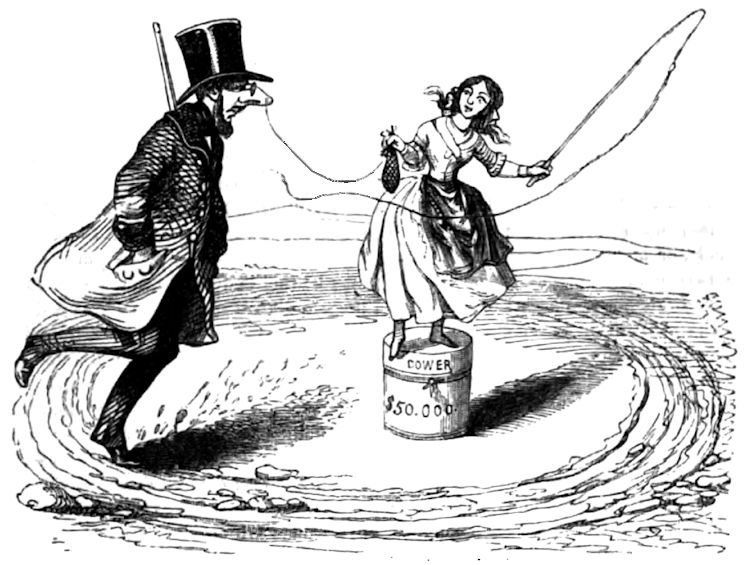
The manner in which this authority is exercised differs according to circumstances. Some of the unfortunate fair ones who have lost their mates have attractions in the shape of weighty dower. Men of a certain age have keen noses for such charms; and when the widow suspects it, she often leads her importunate admirer by that organ, and by a dexterous management of the mystery of courtship, which is called “getting a bean on a string.” Once the gentleman is secured by that means, the widow takes into her hand the whip of management, and compels the poor beau to trot a weary round in an arena which extends its charmed circle about her.
If the French system of espionage, which is now a constituent of society in Louis Napoleon’s dominions, were in vogue here, we are sure that the index of the chief of police would bear opposite to the name of each widow the word “dangerous!” And what can be more threatening to the liberty of a too susceptible man, than a young, accomplished, and fascinating widow? What is bashful maidenhood, with its cherry lips and monosyllabic sentences, to buxom widowhood, with its matured development, sensible ideas, and frank manners? What other witcheries are there about young misses than a taste for ice creams and giddy companionship? Those fascinations fade away when the widow charms us with the certainty that she knows how to make the pot boil, and has a horror of boy beaus. Maidenhood is poetical and theoretical, widowhood is sensible and practical. The young lady, before marriage, is unsteady, indecisive, and capricious. The widow is certain, firm, and self-possessed. The girl scarcely knows her own mind, but the widow not only understands herself but all her male acquaintances. The young lady is greedy of admiration, exacting in her demands, and expects from her lover an obsequiousness of attention which cannot be too excessive. The widow knows that men may admire without adulation, and love fondly without abjectly suing for a return of affection. She knows, also, that those who daring the days of courtship are compelled to excessive complaisance, generally revenge themselves after marriage by neglect and indifference. The fact is, the widow knows something of mankind by actual experience, the maiden has little but romance to tutor her.
Philosophy like this, must have given force to the observations of the venerable parent of Weller the younger—and he was justified by personal experience, in maintaining the position that “widders,” are “werry dangerous.” The world has long since phraseologically settled it, that men “fall in love.” This presupposes that the tender passion is gotten like a broken leg, altogether by accident. The language of Cupid’s surgery is rich in terms which are descriptive of sudden casualties. We know that many a poor fellow has been “shot through the heart” by a pair of eyes, and the records of divers bachelor coroner’s juries held upon unfortunate Benedicts show that woman
May smile, and smile, and murder while they smile,
having committed upon determined celibacy a grievous homicide, or at least a manslaughter. But although love may come to some in the balls of optical revolvers; although, at times, a big whiskered fellow may be charmed out of his single life by the smile of a fair damsel—as a pretty little tomtit is overcome by the glamour of a black-snake—we must not forget, that idiomatic expression hath it, that men “fall in love.” To “fall in love!” what an unhappy catastrophe! To be walking along upon the firm ground of bachelorism, but now, and hey presto! to suddenly find one’s self “over head and ears in love,” like a fly in a cream-jug! Distressing calamity! Who may ever be able to scramble out of such delicious danger; and how many are there that once in are not able to swim a single stroke? There is also this peculiarity about an accident of the sort, that it strongly exemplifies the old adage, that “misery loves company.” The youth who, gazing fondly on Maria Jane, misses his footing, and souses at once in love, cannot help himself. If Maria Jane, pitying his condition, drops him a line, (through the post-office,) or encourages him with hopes—which are generally anchors—it will not do the least bit of good. No! she must be his life-preserver—and unless, in regarding his struggles, she gets too near the brink and herself falls in love, there will be no help for the poor bachelor. But if this casualty does happen, and both are in love, it is wonderful to see how easily they float along. Each helps the other, and in a very short space of time, they are quite comfortable. But it is not every one who “falls in love;” and herein, as we shall shortly show, lies the superiority of widows over spinsters. Some get into the trouble very slowly. At first they survey the ocean of affection with as placid an air as a cosmopolite would gaze upon a mill-pond. Neither admiration nor detestation rules their thoughts. They are altogether indifferent; and although they see many who are treading water, or floating or swimming along with the tide, they feel no anxiety to join in such aquatic feats. But at length the diversion tempts them, and they cautiously take off their shoes and stockings, and venture in a little way. The shore shelves gently, so they think—why should they not venture more? Little by little they progress, until suddenly they step from their sure footing, and are over their heads in a moment without cork or spatterdocks to rely upon. They may struggle against the strong current, but there is no assistance, and they are certain to be carried off by the strong tide.
Difficulties like these are entirely obviated by the widow. She does not suffer a man to fall in love, or to wade in, but she catches the admirer by the hand, drags him at once to deep water, and in a moment he is “out of his pains.” He is not suffered to stand shilly-shally; he is plumped at once souse into Love’s Pacific ocean, and carried along with the billows until he lands at Hymen’s Golden Gate. The maiden may doubt, consider, resolve, and hesitate, whilst the poor fellow who is in love, seeks in vain for a floating timber to support him, but the widow is generally willing to help him out of trouble by getting in it herself, and going along with him hand-in-hand.
These apophthegms may seem too general; and it may be said that there is a tendency in our observations to draw a picture of widowhood by a silhouette of a young widow who is free from incumbrances. This is partly true. There is a marked difference between the widow whose matrimonial interests ended with the grave, and she whose reminiscences of wedlock are daily revived by surviving children. The former is free from earthly ties—she is a girl again, knowing enough about matrimony to have no objection to a second experiment. The latter feels dear bonds which should attach her to her lonely state, and cause her to doubt the policy of prejudicing the interests of her children by rashly assuming new vows. If she is gained, it must be by direct courtship, whilst the young widow is always ready to meet an admirer half way.
But even young widows are of different dispositions. They are all admirers of matrimony, and candidates for second husbands, but they choose various means—according to their inclinations. They may be divided into three great classes—the gay—the sentimental—and the sad.
The gay young widow is like cream candy, a vast improvement upon the crude flour and sugar of maidenhood. The young girl is coy, even in her giddiness; she considers love as an exquisite romance—a mysterious state of happiness—which she desires, yet fears. Hence she is most cautious when she would be most earnest; and whilst she hopes to gain the heart she covets, she often perversely adopts a course which is calculated to alienate that heart forever. With the exception of trifling fops who have not attained the age of maturity—although they may vote and shave—men are earnest, straightforward, and sincere. If they seek the love of a woman, they do so openly and with manly frankness. The young girl may coquette, or flirt with the man who adores her; she may wring his heart with bitter agony; she may show her power, and he may acknowledge it, but he will lose some respect for her—though he bows to her influence. He is honest and sincere. She, perhaps, admits it, but trifles with him. How many young ladies have lost the esteem of those who would have loved and cherished them for life by mere thoughtlessness or caprice. The young widow understands men better. She is rarely a flirt. She can distinguish between the honest lover and the mere admirer. With the latter she may trifle, because she understands him. The former, if not acceptable, will not be allowed to deceive himself; and if he is liked, will be speedily drawn onward to his own happiness. The gay widow is lively, of course. She is fascinating, and she knows human nature. If she “sets her cap” at any particular gentleman, he might as well yield. He cannot hold out against the artillery of charms which are brought against him. He may surrender at discretion, and be led off, a captive, to be confined permanently in silken fetters. All the little fascinations of manner which the belle may possess, but knows not how to use, are by the widow managed with the skill of a veteran. Her eyes are by turns entreating, languishing, merry, or devilish. Her smiles are moulded to bewitch and to mystify. Her manners are easy, and pleasant, and her voice is melodious with rapture, or heart-touching with sincerity. Then, too, she is so lively and yet so sensible, that the “seven senses” of celibacy (two more than the general complement awarded to married people) are quite unable to withstand so many attractions.
The sentimental widow is quite as generous as her livelier sister. She believes in romance and gushing affection. She is lonely after her great loss, and would like another mate. After her first dear man was buried, she felt like a lobster which has parted with a claw, and she retired from gay life until nature, or good luck, should furnish her with the means of reparation. Her heart is buried with her husband, but she considers it only as a seed which in good time will spring up again and blossom. If she weeps, she does it with a gentle sorrow, like a slight sprinkle on a sunshiny day. Her sky has its clouds, but the cerulean of anticipation lies beyond, and gives a pleasant aspect to the mists of sadness. The gay widow laughs as if she had never been married; the sentimental one smiles, but evidently remembers.
The one pretends that she is gay because she is free; the other is cheerful, but hopes to become more cheerful in time. The first audaciously declares that marriage is tyranny, and hopes that no man will ever come near her! the second thinks mournfully upon the past, and wonders whether she “will ever have another Charles Augustus;” yet the sentimentalist mingles with the gay world, a sober votary of pleasure. If she dances, it is but a plain cotillion; and she is shocked when the lively Maria dashes out in a giddy polka. All such things are vanities to the sentimental widow. She thinks how happy she was with her dear departed Charles Augustus, and hopes that she will soon be as happy again.
The sad widow is, for a long time after her bereavement, a sighing pattern of inconsolable grief. The atmosphere of her home is rainy with tears, and when abroad she is cloudy. Yet as time wears on, it is evident that the forty days and forty nights of affliction’s great deluge must go by, and at length the sorrowful widow will look for the appearance of the sun of cheerfulness, and trust that with it will come a rain beau. The gradual assumption of cheerfulness begins to make itself visible in her costume. Half mourning assumes the place of sombre weeds. On her face smiles occasionally chase away the lingering vestiges of regret. The spring of calmness has come, and hyacinthine blossoms of hope struggle up from the sodden desolation of wintry bleakness. Little by little the sad widow becomes resigned to her great loss, and gradually she learns to think that it may be repaired by a new matrimonial gain. Yet she is slow in assuming the garniture of happiness. She may occasionally be coaxed out into the world, and even tempted to attend a party or ball; but she does not forget that she is a widow. She is in the world, but yet not of it. She demeans herself as becomes the lone relict of the late Mr. Sad, and does not like the gayety of Mrs. Lively or the composure of Mrs. Sentiment.
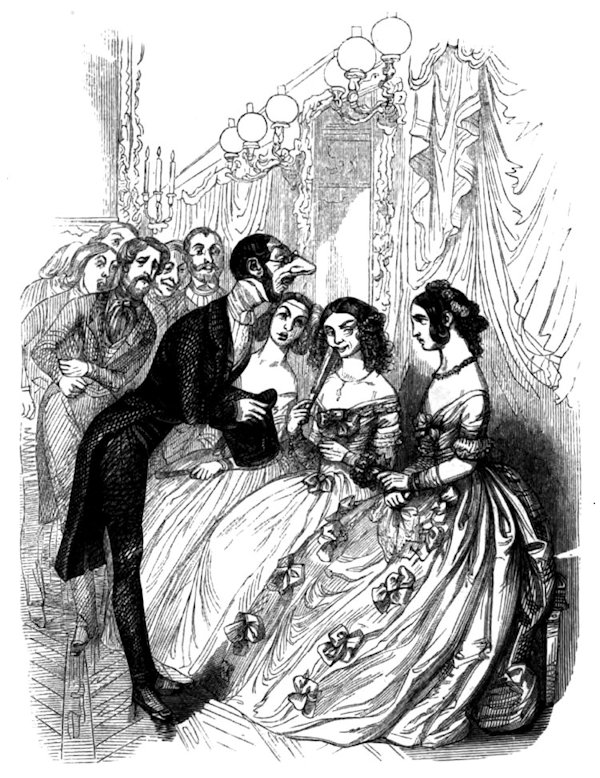
If the persevering Mr. Nosey should approach the trio of widows in the hope of obtaining a partner for the next set, Mrs. Lively may suddenly put on an affectation of grave coyness, Mrs. Sentiment may be gracefully leaning her cheek against her fan whilst thinking of her dear lamented Charles Augustus, but Mrs. Sad will show surprise that the forward Mr. Nosey should dare to presume that they would dance when there are so many “young chits” who have not partners for the dance. But Mrs. L. has no care for these things, and in a very short time she is treading a measure to lively music as if she had never known a single sorrow.
There are so many peculiarities about widowhood, that it would require volumes to treat properly upon the subject. Mathematics might be called in to cipher out the problem of the elder Weller, as to how many times more fascinating is a widow than a maiden—but figures would not satisfy us. We would be sure to continue the subject by the further query—What is a widow like? And the result of all the cogitations might be summed up into the grand deduction—that widows are like gunpowder, always sure to go off when fired by a match.