PRINCE WILLFUL'S THREE LESSONS.
Reading edition

Many years ago there was a young prince named Willful, who was, as his name indicates, a very willful boy. He was lazy and careless, and would not go to school or learn his lessons if he could help it.
His father, whose name was Felix, was a great and good king. He had reigned many years, had filled his treasury with gold, and made many wise laws for the welfare of his people. He was very anxious that his son should grow up an educated and refined man; and he tried by kind words and wholesome advice to show him the necessity of work and the folly of idleness. But Willful paid no heed to his father's words, and daily grew more indolent.
At last the king could bear it no longer; and he said that if the prince would not learn from books, he should be taught in a way not so pleasant. Accordingly he called Willful to him one day and told him that he was going to send him away from home, and that he could not return until by watching the birds, the beasts and the insects he had learned the three lessons most necessary for a prince to know.
He did not say what these lessons were, but left that for the boy to find out himself. Then he gave Willful a golden cross to protect him from harm, a magic glass to magnify even the tiniest creatures, and a curious fan-shaped instrument, by which the languages of the animal-world might be understood.
With these to assist him, Willful started on his journey. He visited many countries and saw many wonderful things, but it was a long time before he learned anything from what he saw, for he was so proud that he thought nothing could teach him.
But one day he was lying down in the shade of a tree, and was looking around for some object of interest, when he saw a number of ants going up and down the tree in great haste. He further noticed that when two ants met they would stop and touch each other with the little horns on their heads, just as people shake hands.
This amused Willful, and he wished to know its meaning, so he took out his hearing fan, and placing it to his lips he found that one ant said to the other, "Good morning, Mr. Ant; fine day. Been to breakfast?" to which the other replied pleasantly, and passed on.
While he was watching these tiny creatures, he saw one which appeared very much excited over something. It stopped one of its friends who was going up the tree, and said, "Have you seen my goats this morning? I went up to milk them a few moments ago; and can not find them anywhere." "Yes," replied the other, "They got over into my pasture; come with me and I will find them for you." Then the two went up the tree and disappeared.
Willful's curiosity was thoroughly aroused; so he climbed the tree, and, crawling out upon one of the branches, took out his magic glass and looked around to see what the ants meant by their "goats."
Soon he found the two ants, with a herd of tiny plant lice feeding on a large leaf. Then he knew what the ant meant by his "goats."
The lost goats were soon picked out, and their master proceeded to milk them.
Willful was so interested by these singular creatures that he determined to study their habits; so, descending from the tree he searched for the anthills. Then he spent hours in watching their occupants, and he learnt many things of benefit to him.
He found that they had a regular government, which was as well organized as any human kingdom; and that in some respects they surpassed mankind, for they had reached the point where everything was held in common, yet quarrels over the right of property were unknown. Each had its own labor to perform and none were allowed to be idle. In fact, Willful thought he had never seen, even in his own country, so peaceable, happy, and contented a people as were these occupants of the sand-hills.
"Surely," thought he, "I know now the value and importance of industry." After this the prince was not so proud as he once had been; but was more ready to learn from whatever he saw.
One day he had the misfortune to tear his cloak, and he was at a loss to mend it, for he had never even seen anyone sew. All his clothes were made for him by the king's tailors, and he had no thought of how it was done.
He was sore perplexed and was wondering what he should do, when he was startled by hearing a sharp, shrill voice utter these words,—
"Come here, children, you are now too large to spend your entire time in play; you must learn to make your house."
WHAT WILLFUL SAW.
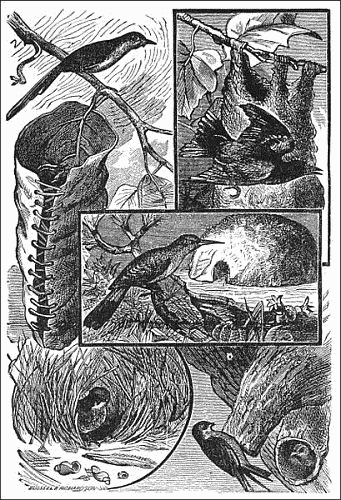
At first Willful thought it was a woman calling,—for he had forgotten that he had his magic fan in his hand—but looking around, he saw a bird perched upon a limb, and several birdlings flitting around her. At the words of their mother, they all clustered around her, and the lesson began.
She first selected some fibers, and then quickly twisted them into a good, stout thread, holding one end with her claws. Then she ran it through a little hole in her beak, and thus she had a needle and thread. With these she proceeded to sew together a few leaves, so as to form a little pocket or nest, and lining it with some moss which was gathered near by, she had a capital nest, large enough for herself and little ones.
Willful watched this queer bird with great interest, the more so because it taught him a valuable lesson.
Following the bird's example he contrived to find a needle and thread, consisting of a sharp, stout thorn, and some long, tough grass, with which he mended his torn garment. Willful thought that he had learned from the habits of these creatures, another and valuable lesson, but he was now anxious to see something of methods of warfare among animals.
He did not have to wait very long, for in a little while after the sewing lesson, he traveled over a very level country, which seemed to be mostly inhabited by large herds of buffalo.
The pest of these creatures was the prairie wolves, which were found in great numbers. Often, driven by hunger, they would scent their prey, and a large pack of them would attack the buffalo in great fury.
When the buffalo herd was approached by these hungry packs, some old bull would give a great bellow of warning and the whole mass would prepare for defense.
The cows, calves, and weaker ones would huddle together and the strong bulls would form a circle around them with their heads outward; their horns making such a defense against attack as soldiers with bayonets.
The wolves would try to break through the circle, but if one came too near, he was sure to be tossed high into the air, howling and bleeding. They would gather in a body and all rush at one bull, but many were sure to be gored by his fierce horns before they could bring him down, and no sooner was he down than his place was filled by another bull, ready to receive the next attack of the wolves.
HID IN THE FOREST.
After awhile the whole pack would get tired of such costly fighting and leave the buffaloes in peace.
Willful witnessed several of these battles, and he was much impressed with the skill and bravery of the horned tribe.
He learned much of great importance on the art of warfare; and this he thought was the last of the three lessons. So he turned his journey homewards and in due season reached his father's palace, where he was welcomed with joy.
On the day after his return he was summoned to a meeting of the wise men of the kingdom, and in their presence was asked by the king what three lessons he had learned.
Then Willful in an humble manner, unlike his former character, replied:—"These, my father, are the lessons that my observation has taught me: First,—That even a prince may learn from the smallest of God's creatures. Second—That a government is strong only when each citizen has some honest means of earning a living, and receives a suitable reward for his labor. Third—That it is best to fight only when attacked, and then to die, if need be, in defense of what we love."
Then the people applauded him, for they saw that he had grown in wisdom and had become a fit king for his people.