"A SNUG LITTLE ISLAND."
Reading edition


If you examine a map of Europe you will notice, not without difficulty, a little speck in the North Sea some thirty-six miles northwest of the mouth of the river Elbe. This little almost invisible speck is an island called Heligoland.
It belongs to Great Britain, having been ceded to this country by the Danes in 1814. Denmark in an evil hour identified herself with the cause of the first Napoleon, and the loss of Heligoland was only one of the results of her misguided policy. The island is to-day known chiefly as the favorite seaside resort of the Hamburghers, and though it is a British possession no English is spoken by the natives. Its name is supposed to mean the Holy Island, tradition affirming that at one period of its existence—many centuries ago—the isle was covered with temples for pagan worship that have long since disappeared. Hel-i-go-land is one mile in length, about half a mile broad, and triangular in shape. It consists of an Upper and Lower Town, and is surrounded on all sides by steep red cliffs, except at the part upon which the Lower Town is built. Nearly a quarter of a mile east of the main island is a long, low-lying, sandy hill or "dune," which affords splendid bathing. Access from the Lower to the Upper Town, on the Cliffs above, is obtained by means of a wooden stair of 190 steps. Naturally enough, since there is constant need to travel between the two "Towns," this stair is a prominent feature in Heligoland existence. It is the test alike of youthful vigour and of failing strength.
The island children cannot conceive of a country without a stair, and the lads of the colony—like boys all the world over—often adopt the dangerous practice of accomplishing the descent by sliding down the balusters, a pastime that is sometimes indulged in by people of maturer years. The flat-topped rock is occupied by a lighthouse, a battery, a powder magazine, and pasture for 200 sheep. From one end to the other there runs a footpath called the "Highway," or "Potato Lane."
The streets, clean and paved with red brick, are excessively narrow, the only vehicles being perambulators and wheelbarrows, while horse or ass is never—or scarcely ever—seen in the island. The two or three cows which supply the milk during the season duly retire with the last of the visitors to Hamburg, 100 miles distant. The houses of the poorer folk resemble ship cabins, the beds being nailed against the wall like berths, or built in recesses in the walls.
The inhabitants love liberty and independence. They are proud of their "right little, tight little" island, and when business calls them away from it, they always weary to get back home. The rhyme which finds most favor amongst the people is one which, being interpreted, asserts that—
"Green is the land, Red is the strand, White is the sand, These are the colors of Heligoland."
This rhyme indeed, Dr. Robert Brown suggests, may be regarded as their "national anthem."
The Heligolanders earn their livelihood from the harvest of the sea, though a fair amount of business is done by letting lodgings during "the season." From June to October hundreds of visitors besiege it, and during this period it may be described as a suburb of Hamburg, the bulk of the strangers hailing from that prosperous city. In winter the natives have the little island all to themselves.
The Heligoland men are tall, strong, with regular features and are superior in build to their relatives on the mainland. The women are rather handsome, with small feet, well-shaped slender hands, and long hair, for which, indeed, they are famous. As compared with the German or Dutch peasant women, they easily bear the palm.
In their dress they rather affect gay colors, the younger ones especially, like the "Rose" whom the artist has depicted on this page. The dress consists of a scarlet skirt, with a "body" and apron, generally of some light brown "stuff." The bonnet is a product peculiar to the island. It is a piece of pasteboard bent in the shape of a bonnet, over which is fastened a square piece of silk, satin or poplin, occasionally embroidered behind with lace.
The population numbers about 3,000 souls. As already noted, the men are fishers and pilots. The yearly value of the fisheries—which comprise mainly lobsters, crabs, herring, cod, and flat fish—amounts to upwards of $25,000. Trade is carried on by barter, the fish being exchanged with the merchants of Hamburg and Bremen for the goods which the Heligolanders require. The natives are keen, shrewd and honest.
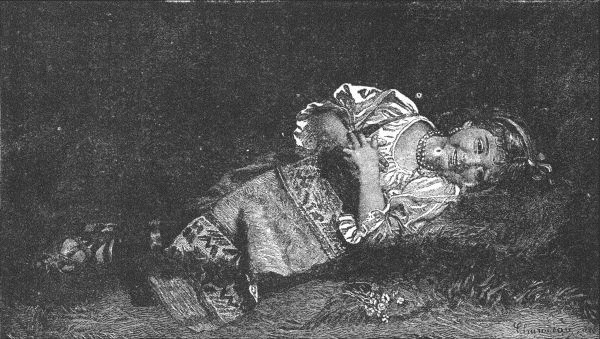
"THE ROSE."
Theft is practically unknown, and the few cases with which the magistrate is troubled arise from the street brawls which now and then take place. The men are usually serious, and rarely joke among themselves or with strangers, and, oddly enough, all the young men are particularly reserved.
Of course the women are not nearly so grave. They are all more lively as well as talkative. Though they are rather good-looking, they get aged and weatherbeaten early, owing to the anxiety of household affairs and other causes. For the men are addicted to the vile habit—common among all uncivilized and too many civilized races—of allowing the women to do very nearly the whole of the manual labor of the house, field and garden. Accordingly we find that the females have to pay in premature age the penalty of their lords' laziness.
The climate is very bracing, but the winters are wet and stormy. The air is so saturated with saline spray that the rain will leave a slight deposit of salt after it has evaporated. During the winter, communication with the mainland is maintained by boat once a week, though the island is often completely isolated for a considerable period by rough weather, drift ice, and various other causes.
Rats and mice are found in Heligoland in plenty, but the oft-quoted story about the rabbits, and the ruin which their burrowing was fast bringing upon the doomed isle is declared by a competent authority to be pure romance. The sea is making rapid inroads upon parts of the Holy Isle, and it is not unlikely that at some far-distant period all that will remain of this out-of-the-world spot will be a wave-lashed rock, the haunt of the gull and the cormorant.