FOR FATHER'S SAKE,
Reading edition
OR, RIGHT AND MIGHT.

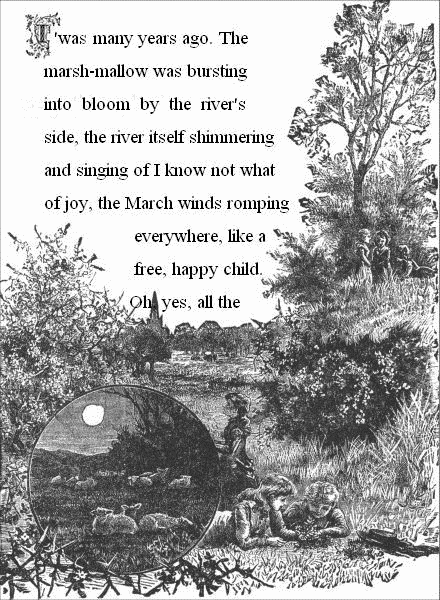
earth seemed glad, though a poor weakling of a lamb lay on the sunny hillside, among its fellows, panting and sighing, as if it would fain sob out its wee life and be at rest. It had been born late; its mother was dead; none of the other ewes took kindly to it: what could the shepherd do but lay it aside in hopeless despair, and attend to the robust and hardy among his large family?
"With powers of tending, I think he'd pull through," said Jasper, his son—or Jep, as he was called—bending over the lamb in boyish pity, and speaking more to himself than to his companions. These were the squire, his master, and John Sharp, his father—both bathed in the radiance of a fair March day.
"Think you so, my lad? Then give the creature powers of tending, and if it pulls through it shall be yours." So spoke Squire Barlow.
"Do ye mean it, squire?"
"Mean it, yes! Did you ever hear me say what I didn't mean?"
Ah! true; squires were great men in those days, and a very great man was Squire Barlow in the village; his word was law. So Jep gathered up the little outcast, and scudded down to the little cottage he called home, where wee Margaret, his sister, and his gentle-faced mother gave him and his charge a warm welcome; lavished their care and love upon the lamb, until, at last, even the shepherd himself said he would live.
"Spottie"—that was the name the children gave him, because of a mark on his forehead—soon learnt to know his master and mistress, and, oh! their life flowed on, as the fair spring days lengthened, like a happy dream. He was such a dear little romp, and yet so gentle, gamboling in the small orchard behind the house among the pink apple-blossoms, as they drifted down on the sunlit air, going and coming as the young folk called him, and never seemingly wishing to join his kind, as they went down from the high pastures to the green meadows. The squire's son, master Ru, as he was called, came to see "Jep's wonder," so he expressed himself.
Master Ru was a spoilt lad of about Jep's age, (eleven years), overbearing and not very generous; still he was prankish, and full of boyish frolics.
"Well, he's more mine than yours, after all, Jep," said he, one day, an envious sneer on his lips, "as t'was my father's lamb in the first place." But Jep replied, "No, he's mine; the squire gave the little chap to me, and I mean to keep him, Master Ru;" to which speech the young gentleman made no reply, but turned on his heel.
One fine day in autumn, Ru strayed away to the sheep-folds; he often visited them, to have some fun with Jep—to run races with him over the downs, or hunt for squirrels and dormice in the old plantation. Then, hard by this miniature wood, there were some old ruins, with a wonderful echo chamber, where all they uttered was wafted hither and thither as by many weird voices. This was a never-failing source of amusement to them. More than once they had decoyed Jep's father across the downs thereby, thinking he was called, and that urgently.
On that day John Sharp was elsewhere; only Jep and Nip, their dog, were left in trust.
"Let's go and have a round with the old echoes this morning, Jep," proposed the young gentleman, a merry twinkle in his eyes.
"Nay, Master Ru, I must mind the sheep."
"Pooh! what minding do they want, gorging themselves with clover as they are?"
"Ay, that's where 'tis, Master Ru; father's afraid they'll gorge too much; he's told me to watch 'em."
"Well, and what will watching do?"
"I must turn 'em into t'other fold in an hour's time—see, he gave me his watch to reckon by," and Jep held up a bumping, old-fashioned ticker, in his pride of possession.
"Well, an hour is a long time; we could have lots of fun in an hour." Ah! there was mighty persuasion in the boy's tone and dark, handsome face, and Jep, like many another before, faltered between duty and his love of fun.
"Come, your father need never know."
It was very plausible, all that Master Ru said that morning, and Jep never divined the half of what lay in the depths of his prankish, perhaps deceitful, heart.
He hung the watch on a hurdle stake, lest he might smash it in his games, by the side of Nip, sitting a pattern of fidelity and wary watchfulness there; then he accompanied his companion up the sunny hillside, and away to the ruins. Who could estimate the length of an hour, amid the excitement of fun and frolics? Not those two lads. Oh! high revel they held that morning; and when the echoes in the weird old chamber seemed furious at the noise they made, what did Ru do but step outside, shoot the rusty springbolt across the door, thus shutting in poor Jep.
"Upon my word I didn't half intend it," he protested; then Jep cried, with sudden compunction, "Oh! master Ru, how could ye; and the sheep there feedin' and feedin'? What shall I do?
"Do—why climb out of the window, like a man of sense," returned the other with selfish coolness.
"You know I can't do it—I'd break my neck."
"Nonsense! try it on."
As well tell poor Jep to fly as to scale a perpendicular wall, and that his tormenter knew. Oh! it was fun to him to hear the poor lad run about and rave, the echoes catching every sorrowful tone, and tossing them out to him, a legion of words. What a strange waywardness is in the half of us, to find amusement in that which is another's suffering! When at last master Ru let his prisoner out, with much ado, pretended or real, the sun was past its meridian, and the sheep—ah! the sheep—one, two, many of them were beyond the shepherd's tending and doctoring.
"They must e'en die," said he before sundown, with tears in his eyes—and that night Jep wept in the dewy orchard, one hand in wee Margaret's, the other stroking Spottie, with a sore smarting back and the squire's angry dismissal making his heart equally sore and smarting. Master Ru received a reprimand, but then he was a spoilt only son, and a gentleman, while Jep was a poor lad, and should have stuck to duty—so said the squire.
This escapade was but the beginning of troubles, for, as the winter deepened, Jep's father fell ill, and the squire frowned and fumed, and never spoke civilly to Jep when he called at the cottage, where the lad hung about in disgraced idleness.
"We shall have to sell Spottie!" said his mother, in her downheartedness at the expense and poverty falling on her, and the words hung like a weight at her son's heart. Sell Spottie! the children's souls clung to him.
"Father, that pet lamb of Jep Sharp's is more mine than his, you know," is what the squire's son said to him about that time.
"No my son, I gave it to him, and a gift is a gift," spoke the squire in his justice.
"Then buy him for me, father."
"I doubt if the lad would sell it," said the squire.
"Yes, he would; you could make him." His son was importunate; this was his cry, morning, noon, and night; and, at last, his indulgent parent walked to the cottage, to see what could be done.
"I want to buy your son's lamb for mine," said the great man, loftily, to Jep's mother.
"I doubt if he'd sell it, squire; 'twould go hard with him if he did," returned she, her motherly heart throbbing fast.
"He's my father's already," put in young Ru.
"Nay, Sir, the creature was a gift to my son."
"And I offer a fair price for it, so it is doubly mine, as it were."
"Yes, but I can't say yes or no without speaking to the lad," pleaded the gentle mother.
"Well, speak to him," returned squire Barlow, which she did, and the boy shed such a torrent of tears over his pet, that night, when he shut him up in the outhouse, as fairly to startle him.
Sorrowful days followed, after sending his refusal to the Hall, while they waited, and dared not mention the matter to the shepherd, sick nigh to death. And oh! frost and snow lay on the ground, but Spottie nestled and revelled in his hay.
"If you refuse to sell the lamb, you quit my cottage," this was the threat the angered squire sent them.
"The lad simply defies me—it is not the first ill turn he has played me," so he reasoned in his blindness and loftiness, while poor Jep's heart was well-nigh breaking. Still he never flinched or yielded, but locked the innocent lamb into the outhouse, and carried the key in his pocket.
"He'll be sending one of these days to take him away, and he shan't have him—he can't know how I love him," so said the poor boy.
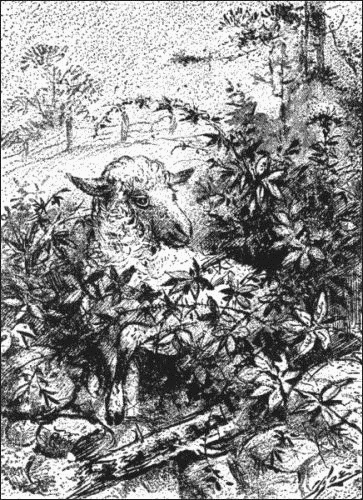
SPOTTIE."
"The squire's servant and Master Ru have been here, lad, for the lamb; and they're coming again to-morrow, and'll burst the outhouse door if ye lock him in. 'Tis all over, lad; ye mustn't resist—surely a roof over your father's head is better than any lamb." These were his mother's tidings, when he came in tired, after a long journey to the doctor's for medicine, one cold spring evening, and Jep bowed his head.
"Mother, I must be with Spottie a while," said he, when it was time for him and wee Margaret to go to bed; and then he stole out into the outhouse, there in the cold and the darkness to weep and ponder over his great trouble. Could he give the darling up? Could he? A sense of wrong, of cruel injustice, made his heart bitter. He had locked himself in, and well he had, for, as he wept, some one tried the outhouse door.
"I'd let it be till to-morrow, Master Ru: 'tis mean, and very like thieving, to steal upon poor folk so, and try to break their locks." It was James, the footman at the Hall, who spoke, and it was Ru who answered him.
"Yes, and he's bound to let me have him, because of his sick father and the house. You see we're offering him a good price, and 'tis my father's lamb, you know."
"Yes; but maybe Jep doesn't think so; still, a fair price is a fair price, and once the money is his, the lamb is yours," returned the servant, and then there was silence again.
"I must e'en bear it like a man, for father's sake," said he, as he stood at the door, under the quiet stars, locking his pet in for the last time. And, on the morrow, before it was light, he led the lamb away over the crisp, frosty grounds, his woolly coat wet with his and Margaret's tears; but the boy was very calm and brave now, with his great sorrow and resolve upon him.
"No, it shall be a free gift; I can't take money for Spottie," said he to the footman, who came out to receive the unconscious animal, and offered him the price of it.
It was very like a miserable dream, that the deed of separation was done; but, anon, the spring smiled itself into bright, glowing days; John Sharpe took to his shepherd duties again, and Jep worked in the garden and longed for he knew not what. He heard that Master Ru had tired of his pet, and that the lamb was to be washed and sheared with the flocks, and then sold. Still, it came to both children as a terrible reality, when they saw him driven down the lane, past their cottage, to the place of shearing—their Spottie, who would be so startled and terrified at rough handling. Their very hearts seemed to cry out in their yearning, as they watched from afar the poor creature's ordeal, his first shearing; and they shivered in the night, as they heard the chill wind of early summer blow, and thought of Spottie bereft of his coat. And on the morrow—ah! those to-morrows, which sadden us or bring us gladness when we least expect it—to-morrow, as they went along the shady lane, what should they espy but Master Ru's pony riderless. No—yes, riderless, for he, poor lad, was being dragged along by one foot in the stirrup, over the hard road.
"Oh, my!" cried Jep, and then he held his breath and felt ready to die. Should he dash in and try to save him—he who had robbed him of Spottie, only to tire of him and cast him off? Yes, yes—all that was noble in the boy's soul cried—yes; and a low, soft voice stealing as from afar whispered—yes; so he sprang to the rescue, as the horse came up.
"Margaret, could ye dare to get near and loose his foot?" said he to his scared little sister—and she dared, like the small brave woman she was.
Once captured, the pony was gentle as a lamb. Jep tied him to a strong hedge-stake, and then came to his prostrate master. The poor fellow was in a sad maze of pain and half insensibility; it was not till the next day that they were sure he was not seriously hurt. And then? Well, the squire walked up to the shepherd's cottage, and made its inmates glad with the words he spoke.
"I thank your children for what they did for my son, and he thanks them also. I bought their lamb and never paid for it, which I do now, and my son gives it back to them, as—as—" the proud man faltered, "as a peace-offering, if you like to call it so; and Jep may take his old place with the sheep."
Oh! the joyful bringing of meek Spottie to his home again. The poor bewildered animal understood not the half of what was happening, but he gazed gratefully around at them when they covered his shorn back with Jep's jacket, thinking he must be cold.
"What did the squire call him, Jep—a peace-offering?" asked wee Margaret.
"Yes, that's about the word."
"And what's that?"
"Some'at as makes all smooth and above board, you know, when everything was wrong."
"Is it like"—an awe crept into the child's eyes and voice—"like Jesus?"
"Ah, like him," returned Jep, soberly.
"Oh! Jep, and He's called a Lamb in the Bible."
Was this lamb of earth shadowing forth to the minds of the simple children somewhat of the heavenly? If so, then the trouble that had come to Spottie's master was not in vain. Certainly he was a bond between the cottage and the Hall, and Jep was Master Ru's head shepherd years afterwards, when John Sharp and his old master had passed away.