RIGGING AND RIGS.
Reading edition
BY W. J. GORDON.
Though steam is now the pride of the ocean, there are a few points in which its advantages over sail have not been great enough to crowd out the clippers, and in long voyages the sailing ship is far from obsolete.
A drawing of one of these clippers affords an opportunity for saying something about a ship's rigging, and thereby meeting the wishes of a large number of amateur sailors.
Let it be clearly understood, however, that we are dealing with one particular class of ship, and that all ships are not rigged exactly alike.
There is a general notion that a full-rigged ship is of the same pattern all the world over, and this notion has been supported by the diagrams usually published which have taken a war ship as an example.
Now a man-of-war has an enormous crew compared to a merchant vessel, and her rigging is set up accordingly. The things that are done on a man-of-war in spar-drill make a merchant sailor's hair stand on end.
The rigging of a merchantman is designed for a much smaller crew to get along with, and in many respects differs from that of a full-rigged man-of-war.
Complicated as a ship's rigging may look, it becomes intelligible enough when attacked in detail. There are three masts and the bowsprit, which is simply the old bowmast that has gradually increased its angle until it is now almost horizontal.
These four spars are built into the ship, and all the other spars and the rigging and sails are fixed on to them.
The three masts, known also as the lower masts, are the foremast, mainmast and mizzenmast, and each of these carries two masts by way of continuations. Thus we have foretopmast, maintopmast and mizzentopmast, and over them foretopgallantmast, maintopgallantmast and mizzentopgallantmast.
The part of the topgallantmast above the topgallant-rigging is called the royal-mast or royal-pole, and the continuation above the royal-rigging, if any, is the skysail-pole. Answering to the topmasts on the three masts is the jibboom on the bowsprit, and in continuation of that the flying-jibboom.
The jibboom and flying-jibboom are generally in one spar, as are the topgallantmast, royal-pole and skysail-pole, but sometimes they are fitted into each other on much the same principle as a fishing-rod, and in some of the newer ships, bowsprit, jibboom and flying-jibboom are all one steel spar.
Crossing the masts are the yards. On the mainmast we have, beginning below, main-yard, lower maintopsail-yard, upper maintopsail-yard, lower maintopgallantsail-yard, upper maintopgallantsail-yard, main royal-yard and skysail-yard; on the foremast we have the fore-yard, then the topsail-yards, topgallantsail-yards and royal; and on the mizzenmast we have a similar series of yards, beginning with the mizzen or crossjack.
Up to the close of the last century, in very old ships, there was no sail hung on this lower yard of the mizzenmast, it having been introduced only for setting the mizzen topsail; and instead of the gaff spanker we now have there was a huge lateen sail which extended some distance forward of the mast and worked under this yard.
This lateen was the crossjack. When the gaff came in, the projecting corner of the lateen disappeared so as to make room for the sail hanging from this lower yard, and the yard took the name of the old lateen boom.
As representing, then, the after half of this huge boom, we have the modern gaff, set at the same angle as the boom used to be; and at the foot of the sail hung on this gaff, now called a spencer or spanker, from the original inventor, we have the spanker boom, the same sort of thing as we should call the mainboom were the vessel a fore-and-aft yacht.
Each mast is held in its place by stays and backstays. The stays reach from the mastheads to the centre line of the ship forward; and the backstays come down to the sides of the ship, just behind the masts.
The stays and backstays are named from the mast-head from which they descend. Thus the forestay comes from the foremast-head to the bows; the foretopmast-stay from the foretopmast-head to the bowsprit-head; the foretopgallant-stay from the foretopgallant-rigging to the jibboom-head; and the foreroyal-stay from the top of the royal mast to the end of the flying-jibboom.
From the bowsprit-head to the vessel's cutwater runs the bobstay, generally of chain, which takes the pull of the foretopmast-stay; and from the bowsprit-head there hangs the spar known as the dolphin-striker, to give the purchase for continuing the pull of the foretopgallant and foreroyal stays round to the cutwater; so that really all the staying starts from the hull, as does the backstay-staying.
Round the lower mastheads are platforms called tops; and round the topmast-heads are skeleton platforms called crosstrees. These platforms are required not only to take the lower ends of the topmast and topgallant rigging, but also to enable the crew to strike and get up the masts and yards and work the sails. The crosstrees are fitted with outriggers pointing outward aft to enable the topgallant-backstays to give a better support to the topgallantmast than they otherwise would do.
Besides stays and backstays, the masts have "shrouds" to strengthen them. The topgallant shrouds come from the head of the topgallant-rigging to the crosstrees, the topmast shrouds come from the hounds just under the crosstrees to the top, and the main, fore or mizzen shrouds, as the case may be, come from just under the tops to the vessel's side.
To take the pull off the tops, the shrouds are continued round to the mast as "futtock" shrouds, on the same principle as the foretopmast-stay finds its continuation in the bobstay.
The shrouds are "rattled down;" that is to say, thin lines are fastened across them to make a ladder for the men to go aloft. These lines are the "rattle-lines" or "ratlines." The foremost shroud of the lower rigging has only a "catch ratline;" that is, one ratline in about six continued to the shroud that lies furthest forward.
And this is one of the signs by which you can tell a man-of-war from a merchantman, for in war-ships the catch ratline is on the aftermost shroud instead of on the foremost. In a man-of-war, too, the topgallant-rigging is never rattled down, as a Jacob's ladder leads from the topgallantmast-head down to the crosstrees; but this Jacob's ladder arrangement is found in many clippers.
Another detail in which a man-of-war differs from a merchantman is in the rigging of the bowsprit, the man-of-war generally having whiskers, and the merchantman taking the pull of the shroud direct from the forecastle along the catheads, the whiskers being the spars across the bowsprit, which take the purchase of the bowsprit shrouds as the dolphin-striker takes the purchase of the stays.
On each mast the lower yard, lower topsail-yard, and lower topgallantsail-yard do not hoist up and down; the others do. The "lifts" by which the yard is hung and "topped" run from the yardarms—the ends of the yards—to the head of the mast which the yard crosses.
From the yardarms also come the "braces," by means of which the yards are swung so as to set the sails at the proper angle. These braces come down to the ship's sides, or to the heads of the masts fore and aft of those on which the yard is swung; all the mizzen-braces working on the mainmast; the maintopgallant, mainroyal and skysail braces working on the mizzenmast; and the foretopgallant and foreroyal braces working on the mainmast, as is clearly shown in our illustration. The yards and jibboom and flying-jibboom are fitted with foot-ropes for the men to stand on.
The sails on the lower yards are the foresail, mainsail and crossjack, or, as they are often called, fore-course, main-course and mizzen-course—the course being the sail, just as a sheet is a rope and not a piece of canvas. Above the courses come the lower topsails, above them the upper topsails, above them the lower topgallant-sails, then the upper topgallant-sails, then the royals, and, on the mainmast, the skysail, though sometimes there are skysails to all masts, and over the main skysail comes a "scraper" or moon-raker. On the outer edges of the plain-sails come the studding-sails spread on booms.
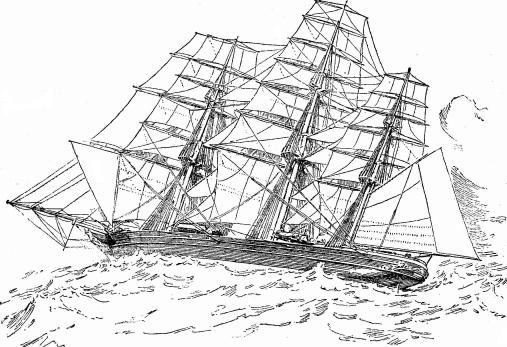
A FULL-RIGGED SHIP.
In our illustration the vessel has set her fore studding-sail, her fore-topmast studding-sail and her fore-topgallant studding-sail—studding-sail being pronounced stu'nsail, just as topgallant-sail is telescoped into topgantsail.
A man-of-war sets her stu'nsails abaft the sail at their side; a merchantman sets hers "before all"—that is, in front of the adjacent sail, as shown in our illustration.
That part of a square sail which is secured to the yard is the "head," the lower part is the "foot," the outer edge is the "leech," the two lower corners are the "clews," the middle of the sail when furled is the "bunt." The "sheet" pulls the sail out to its full extent down to the yard below, the clewlines and buntlines bring it up under the yard for furling.
The courses, having no yards below them, have both "tack" and "sheet," the tack enabling the clew of the sail to be taken forward, and the sheet enabling it to be taken aft. The clewlines for these sails are double, and are called "clew-garnets." A glance at the picture will show the clew-garnets and clewlines coming down to the corners and the buntlines coming straight down the sails.
The sails along the centre line of the ship are the fore-and-aft sails; these are the triangular jibs, staysails and trysails, and the trapezoidal spanker we have already mentioned, which sometimes has a gaff topsail over it and a "ringtail" behind it, as shown in our figure.
"Watersails," by the way, are not carried now; they used to be set below the lower booms, but, as we have seen, there are now no lower booms, the lower stu'nsails being triangular, like the staysails.
These staysails take their names from the stays on which they run. Working from the deck upward, the clipper we show is flying her mizzen staysail, her mizzen topmast staysail, her mizzen topgallantmast staysail and her mizzen royal staysail; and she has a similar series off the main. But on the fore we have the head-sails. The extreme outer one we cannot see; it comes down from the fore-royal and ends half-way down, being a mere "kite;" it is called the "jib topsail." The outer one we can see is the "flying-jib," on the flying-jibboom. Then come the "outer jib" and the "inner jib" and the "foretopmast staysail."
The "trysails" are gaff or jib-headed sails sometimes carried on the fore and main, as the spanker is carried on the mizzen. The gaff is held up by the throat and peak halliards, and kept in position by "vangs," which come down to the rail as shown. The spanker is sheeted home not by a sheet, but by an "outhaul," and kept in position not by a "brace," but by the "sheet," and thereby differs from the square sails.
It will be noticed how neat and clean the ship is. There is nothing outside to catch the wash of the sea or check the speed. The boat's davits and the dead-eyes of the lower rigging are all inside the bulwarks. The cables have been unshackled and stowed in the lockers below, and the hawse-pipes are all plugged; the anchors are all inboard, and everything that could possibly act as a brake on her is removed.
Several large vessels now have four masts, in which case they are called "four-masters." When all the masts are square-rigged, the names are bowmast, foremast, main and mizzen. If the aftermost mast is not square-rigged, the order is foremast, main, mizzen and jigger. In some four-masters the masts are named fore, first-main, second-main and mizzen.
Should the vessel be three-masted, and have yards only on the two front masts, she is a "bark;" and, by-the-way, the spanker of a bark is her "mizzen." Should she have yards only, as the foremast, she is a "barkentine;" should she be a two-master, and have yards on both, she is a "brig;" should she have yards on the foremast only, she is a "brigantine."
With regard to this, however, a few words of explanation are necessary. A century or so ago, a favorite rig was the "snow," pronounced so as to rhyme to "now." The snow was a bark with a lateen mizzen, or rather a brig with the "driver," a lateen one, on a jigger mast, just a little abaft the mainmast.
When this jigger was abolished the sail retained its lateen shape, got on to the mainmast, and became what we may call a main crossjack, thereby rendering a square mainsail impossible.
When the crossjack was replaced by a gaff, the larger vessels started the square mainsail, and became "brigs," while the smaller kept the spanker as their mainsail, and became "brigantines," so that a genuine old brigantine is a brig without a square mainsail.
Soon, however, vessels appeared with no yards at all on their mainmasts, and these were called "hermaphrodite brigs," and were found to be so handy that they crowded the old brigantines off the sea and took their name.
But here a qualification must come in. Perhaps you have seen a two-masted vessel with yards on her foremast and none on her main. She is a "topsail-schooner." In what does she differ from the brigantine? The brigantine has a foremast of three spars from the old snow, and a mainmast of two from the hermaphrodite; the topsail-schooner has both foremast and mainmast of two spars, and the foresail on a gaff instead of on a yard, and in other ways is different, but a glance at the foremast is enough to distinguish her from a brigantine.
A "three-masted schooner" has only lower masts and topmasts, and each mast is rigged for fore-and-aft sails, but more often than not these vessels carry yards at the fore and sometimes at the main.
With the "ketch" begins what has been called the mast-and-a-half division of sailing vessels. The tall mast is the mainmast, the short mast is the mizzen; some ketches carry square sails on the main, some carry a topsail on the mizzen—the distinctive mark of the ketch being that the mizzen is a pole-mast and stepped in front of the stern-post. If the mizzen be stepped abaft the stern-post the vessel becomes a "dandy" or "yawl."
In the cutter the mizzen is dispensed with, and in a sloop of the old rig the difference between the two is that the cutter has two headsails, the jib and foresail, while the sloop has but one, the foresail.
Sometimes the sloop has a standing bowsprit, while the cutter has a running one; but this distinction is not essential. Indeed, the words cutter and sloop have begun to be used indiscriminately, except, perhaps, that a cutter is for pleasure and a sloop for trade.
In a spritsail rig the gaff is at the head of the sail, and works on the mast in cheeks; the sprit runs diagonally across the sail, and is hung on to the mast in what is practically a loop and lashing.
This has also what looks like a mizzen, but it is fixed on to the rudder and is known as a "jigger." Sometimes the jigger is triangular, like the yawl's mizzen, but the shape makes no difference in the name.
The lug is the old sail of the Norsemen. There are two kinds of lugs, "dipping" and "standing."
The dipping lug has a great part of the sail beyond the mast, so that when a tack has to be made the sail has to be lowered, dipped round the mast and rehoisted.
The standing lug projects very little beyond this mast and does not require to be lowered when tacking.
Fishing boats are nearly all rigged with a dipping lug for the mainsail and a standing lug for the mizzen, and they have also a jib, while some of them carry topsails over the lugs.
Luggers may carry any number of masts, but as a rule they have two; some have a gaff mizzen. When the foot of the lug is lashed to a boom it is said to be "balanced."