A FLOCK OF GEESE.
Reading edition
BY W. BERT FOSTER.
"That Al Peck thinks he's so smart," remarked Nat Bascom, coming into the kitchen with a scowl of fearful proportions darkening his face. "Just because he's got a flock of geese, and expects to make some money on them Christmas. I wish I had some geese—or something, father. I'd like to make some money as well as Al."
Mr. Bascom looked up from the county paper, in which he had been reading a political article, and said, curtly:
"You make money, Nat! You haven't a money-making bone in your body. Wish you had. Last spring I gave you that plot of ground back of the orchard to plant, and you let it grow up to weeds; and, a year ago, you had that cosset lamb, and let the animal die. 'Most any other boy around these parts would have made quite a little sum on either of them."
"Oh, well, the weeds got the start of me on that ground, and you know that lamb was weakly. Ma said it was," whined Nat.
"It was after you had the care of it," reminded the elder Bascom.
"Well, pa, can't I have some geese, same as Al Peck has?" at last inquired Nat, desperately.
"You may if you can catch them," answered his father, smiling grimly. "If you can trap a flock of wild ones, I reckon you can have them. I ain't going to waste any more money on your ventures."
Nat flung out of the house in anything but a pleasant frame of mind and went over to stare longingly at Alvin Peck's flock of geese, securely penned behind his father's barn.
Until recently, the two boys, who were about of an age, had been the best of friends. But within a fortnight, Alvin's father had presented his son with a flock of thirteen geese, to fatten for market, and Al had, in Nat's eyes, put on the airs of a millionaire.
Alvin Peck may have had some excuse for being proud of his geese, for they were all fine, handsome birds, but, in his pride, he had filled poor Nat's breast with envy.
Nat wanted some Christmas money as well as his friend, and to hear Al loudly boast of what he intended doing with his was maddening.
Gradually the seeds of discord sown between the two boys had sprouted and taken root, and, being warmed and watered by Nat's jealousy and Al's selfishness, were soon in a flourishing condition, and before Thanksgiving the former chums refused even to speak to each other.
This state of affairs made Nat secretly very lonely, for Alvin was the only other boy within a number of miles, and, being without either brother or sister, Nat was absolutely companionless. But his pride would not allow him to go to his former friend and "make up." Even when Al's dog Towser came over to visit the Bascom's Bose, Nat drove him home with a club, thus increasing the enmity between him and Towser's master.
This deplorable state of affairs continued to grow worse instead of better as the holidays approached. One evening, a week or ten days before Christmas, it commenced raining, but, becoming suddenly very cold in the night, the rain turned to ice, and the following morning the roofs, sheds, fences, trees—everything, in fact—was covered with a coating of ice. With the beams of the rising sun shining over all, it seemed a picture of fairy land.
But Nat Bascom arose that morning with an uglier feeling against Al Peck than ever. Donning his outside garments, he went out to assist his father in feeding the cattle.
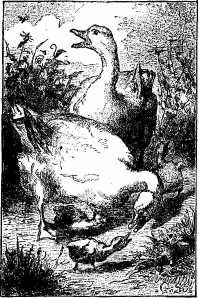
The hay-stack behind the barn had a glittering coat of ice, and, as he approached it, Nat discovered something else about it as well. Close to the ground, on the lea of the stack, were a number of objects which Nat quickly recognized as geese—thirteen of them.
"They're those plaguey geese of Al Peck's!" exclaimed Nat, as one of the birds stretched out its long neck at his approach and uttered a threatening "honk! honk!"
The geese tried to scuttle away as he came nearer, and then for the first time Nat discovered that they, like the inanimate things about them, were completely sheathed in ice; so much so, in fact, that they could not use their wings.
Nat stood still a moment and thought.
"I know what I'll do," he said, aloud, "I'll put them in pound, same as father did old Grayson's cattle last summer, and make Al pay me to get them out."
With this happy thought, he at once set about securing the geese.
One end of an old shed near by had in former times been used by the Bascoms for a hen-house, and there was still a low entrance through which the fowls were wont to go in and out.
Carefully, and so as not to alarm them, Nat drove the thirteen birds into the shed and clapped a board over the opening. The geese objected with continued cries to these proceedings, but they were too thoroughly coated with ice to get away.
"There, now, Mister Al Peck, I think I'll get even with you this time," he said, in a tone of satisfaction.
Hastening through the remainder of his chores, he started off in the direction of the Peck place without saying a word about the matter to either of his parents.
As he approached Mr. Peck's barn, he beheld Al returning from the direction of his goose-pen.
"You needn't look for them, Al Peck," remarked Nat, with a malicious grin, "for you can't find them. You ought to keep your old geese shut up, if you don't want to lose them."
"I haven't lost them," declared Al, with a somewhat puzzled expression of countenance.
"Oh, you haven't?" snapped Nat, angered at the other's apparent coolness. "You needn't think you're going to get them back for nothing. I found them all camped under our haystack this morning, and drove them into the old hen-house. You've just got to pay me ten cents apiece for them before I'll let them out. I bet you'll keep them to home after this."
Al opened his mouth and closed it again like a flash. He was evidently surprised.
Just then Mr. Peck appeared on the scene. Al repeated what Nat had said, to his father's very evident amazement.
"Why, I saw—" began the elder Peck, when Al interrupted him with a gesture, and whispered something in his ear.
A broad grin overspread Mr. Peck's face for a moment; then he said, with becoming gravity:
"I suppose you've got the rights of it, Nat, but seems to me it's a rather mean trick."
Nat had begun to think so, too, by this time, but he refused to listen to the promptings of his better nature and said nothing.
"We'll come right over with the team for them," said Mr. Peck.
And he and Al at once harnessed up, and placing a large, strong coop in the wagon, drove over to the Bascom place.
"I should think you'd have your geese tame enough to drive," said Nat; but the Pecks paid no attention to the remark.
Mr. Peck pulled his cap well down over his eyes, put on a pair of gloves and entered the hen-house.
The ice had by this time melted from their backs and wings, and those thirteen geese were the liveliest flock of birds imaginable.
"Thirteen of them. All right!" said Mr. Peck, passing out the last struggling bird to his son, who clapped it into the coop.
A dollar and thirty cents was handed to Nat by Al's father, with the cutting remark:
"There's your money, young man! I hope you won't grow up to be as mean as you bid fair to be now."
Nat accepted the money, considerably shame-faced, and followed the Pecks back to their place to see them unload the geese; but he was disappointed, in that they were not unloaded, Al flinging some corn into the coop, which was allowed to remain in the wagon.
"Aren't you going to put them into the pen again?" inquired Nat, mildly.
"They've never been in a pen, that I know of," replied Mr. Peck, with a queer smile.
"I don't believe they'd get along very well with any other geese," added Al, reflecting his father's broad grin.
"Why—" began Nat, at last beginning to believe that there was something very peculiar about the whole affair.
"Why, it is just here!" explained Al. "They weren't my geese at all, till I bought them of you. They were a flock of wild ones, that got belated in the storm last evening, I suppose. I should think you'd have known them by their call. For once in your life, Nat Bascom, you've over-reached yourself. I shall clear as much as seventy-five cents on each of those birds."
Nat made for home at once, followed by shouts of laughter from the Pecks, father and son. He felt as though everything stable in the world had been knocked from under him.
Although he never mentioned the matter to his father or mother, the story reached them through other sources, for it soon spread throughout the community, and neither Mr. nor Mrs. Bascom had the least sympathy for him.
All that winter the nickname of "Goose" clung to him, and perhaps the jeers of his fellows did him some good; at least, it made a lasting impression on his mind, and when he was tempted to perform a mean act again, he could not fail to remember how he had once over-reached himself.