QUEER WRINKLES.
Reading edition
—The progress of the fall season is measured by the golden-rod.
—Said an absent-minded school-teacher: "I hear a quiet noise in the right-hand corner of the room. I know very well who the guilty party is, but I will not mention his name. It is Tommy Jones."
—You can hail a street car, but you will be arrested if you stone one.
—Mr. Gummey: "Why do you call your dog 'Hen?' Is it an abbreviation of Henry?" Mr. Glanders: "No; I call him 'Hen' because he is a setter."
—The counterfeiter is satisfied if he can spend money as fast as he can make it.
—Baby choked in his sleep, one day,
Only a harmless choke, 'twould seem.
But Marjorie settled it in her way—
I 'spect," she said, "he swallowed a dream."
—No fiddler ever gets tired of his own music.
—Benny: "Papa, I was playing with the sickle this morning, and I fell down and cut a finger." Papa: "Did you cry?" Benny: "Nope, but Willie did." Papa: "What did Willie cry for?" Benny: "It was Willie's finger I cut."
—One peculiarity of the skin on an animal is, that the fur side is the near side to you.
—Mr. Staggers: "What a gross man McJunkin is!" Mr. Sumway: "Yes, but you ought to see his brother. He is a grocer."
—It is the easiest thing in the world to borrow trouble and return a visit.
—"Now," said the professor, "I want you to illustrate the difference between music and noise." "Your own singing and somebody's else," replied the pupil, confidently.
—"This is a regular sugar loaf," said the candy-store clerk, when business was dull.
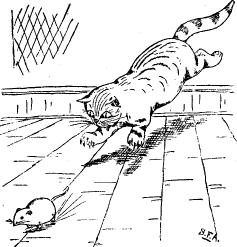
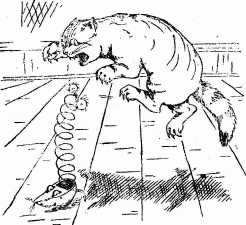
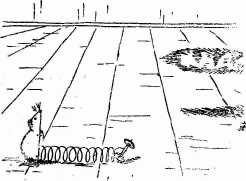
The Fierce Old Cat and the Clockwork Rat.
The boys wound it up and set it going around the room, and old Tom went for it. A little rough handling loosened the spring which took pussy very much by surprise— —and left the rat master of the situation.
A. E. B.—Extract of witch-hazel is made by distilling the leaves of that shrub, the scientific name of which is Hamamelis virginica. To do this, it will be necessary to secure apparatus especially adapted to the purpose.
Carrie N.—Polish the horns according to the directions given in Vol. 5, No. 43. They are very ornamental, but there is no great demand for them. You might be able to dispose of a pair or two among your friends.
J. N. D.—Stamp dealers usually begin as collectors, and thus gain an intimate knowledge of the various issues, colors, varieties and prices of all the stamps issued. Numerous illustrated catalogues are issued by the principal dealers in this country and Europe.
J. H. S.—1. When recharging a battery it is only necessary to remove any parts that may have decomposed and then add water. 2. The outfit requisite for producing the electric light described in Nos. 1 and 2 of the last volume will cost two or three dollars.
Old Subscriber.—Narrow shoulders may be strengthened and straightened by judicious exercise, and by walking and sitting erect, throwing them well back and never allowing them to droop. It is very doubtful, however, if their breadth can be increased to any appreciable degree.
H. B.—Vols. 1, 2, 3 and 4 of this paper cannot be furnished complete either bound or unbound, but from 6 to 12, inclusive, they can be supplied in either shape. A very limited number of bound copies of the fifth volume remain to be sold at the usual rate of $4 each, but in its unbound form it is incomplete, one number being out of print.
E. F. W.—White ink is made by mixing flake white with gum arabic and water. It should be sufficiently fluid to flow easily from the pen. Another mixture, erroneously called white ink, but which is in reality an etching fluid, and can only be used on colored paper, is made by adding 1 part of muriatic acid to 20 parts of starch water. A steel pen must be used.
A. G. D.—1. There is but one way to improve the memory, and that is to concentrate the mind upon but one subject at a time, never allowing it to wander off to some other idea. At first, this is a difficult matter, but in a comparatively short time the mind can be brought under control, and the memory will, in many instances, become far more retentive than ever before. 2. The growth of hair on the face cannot be checked, but can be controlled by the regular use of a razor.
Unus Plurorum.—Pilot charts may be obtained at all the branch hydrographic offices in our large ports, but the coast survey charts are not intended for general distribution. Every Congressman is allowed a limited number, and may, if he pleases, distribute them among his friends, and they are also furnished to schools, scientific associations, libraries and the like, when application is made for any special map. In all other cases they are for sale at stated figures, varying according to the size of the chart desired. A catalogue of all the maps issued by the Coast Survey is procurable from the chief of that office in Washington, D. C.
George C. W.—In mending crockery, one of the strongest cements for the purpose, and one which is easily applied, is composed of lime and the white of an egg. To use it, take a sufficient quantity of the egg to mend one article at a time—easily gauged by the extent of the break—shave off a small quantity of lime, and mix thoroughly. Apply quickly to the edges and place firmly together, when it will soon become set and strong. The reason for mixing a small quantity at once is that it hardens very quickly and then becomes useless.
Tiger Tom.—1. According to the game laws of California deer may be shot, in some parts of that State during the months of July, August, September and October, except in Siskiyou and Nevada Counties, where the open season begins in August and ends on the last day of January. Quail may be killed there in January, February, October, November and December. 2. Each State makes its own laws regulating the term of imprisonment for a specified crime. 3. One series of articles on making traps for small game is out of print. The only numbers in print containing such directions are 52, Vol. 6, and 1, Vol. 7.
Sailor.—The Philadelphia, Newark, Miantonomoh, Kearsarge, Concord, Chicago, Atlanta, Yorktown, Boston, Bennington, Petrel, Baltimore, San Francisco, Yantic, Thetis and Ranger are the United States war vessels that are available at the present time, or could be put in commission in the course of ninety days. A complete list and description of all the vessels comprising our naval force can be obtained from the Secretary of the Navy, Washington, D. C., but we cannot afford the space in which to give in detail such a mass of measurements, the number of guns, etc., as would be required to satisfy your wants.
W. H. K.—1. John Greenleaf Whittier, popularly known as the "Quaker Poet" and the "Bachelor Poet" resides at Amesbury, Mass. "Maud Muller," "Barefoot Boy," "Cobbler Keezar's Vision," "Barbara Frietchie," "In School Days" and "My Psalm" are the most popular of his short poems. "Snow Bound," written in 1866, is undoubtedly the best of all his poems, and is, in one sense, a memorial of his mother and sister, having been written after their death. He was born near Haverhill, Mass., on December 17, 1807. 2. Get a setting of bantam eggs from a local bird dealer.
Constant Reader.—1. All the foremost juvenile writers of the day are engaged on Golden Days; therefore, in our opinion, there are none better or more popular. 2. The various officers in the United States navy rank as follows: Rear admirals, commodores, captains, commanders, lieutenant commanders, lieutenants (two grades), ensigns (two grades), and naval cadets. Rear Admiral Walker is the head of that branch of the service at the present time. 3. They were published in a magazine bearing his name. 4. See the naval pay-table in the Letter Box of No. 15, Vol. 12.
A Jay.—1. Martin, the winner of the six-days' bicycle race at Madison Square Garden, New York city, last October, rode for 127 hours of the 142 allotted to the race, covering 1466 6-10 miles during that time, showing an average speed of 11½ miles an hour. His record is the best ever made, far exceeding any previous attempts in a six-days' match. 2. There are probably several bicycle clubs in your vicinity. Make inquiries, and, if so, you should experience no difficulty in being elected a member of any one of them.
An Aztec Prince.—The largest tunnel in the world is that of St. Gothard, on the railroad line between Lucerne and Milan. The summit of this tunnel is 990 feet below the surface at Andermatt, and 6600 feet beneath the peak at Kastelhorn of the St. Gothard group. The tunnel itself is 26½ feet wide, and 19 feet 10 inches from the floor to the crown of the arched roof. Its length is 9½ miles, while the Hoosac Tunnel, on the Fitchburg Railway, is 4½ miles long. The Mont Cenis tunnel is one and five-eighths miles shorter than that of St. Gothard.
Impatient.—1. All communications intended for this paper should be addressed to "James Elverson, Publisher of Golden Days, Philadelphia, Pa." If they contain queries intended for this department, that fact should be indicated by writing in the lower left hand corner of the envelope the words "Letter Box," and the real name of the writer in addition to the assumed title, should be placed at the end. 2. A chapter on polishing horns, bones, shells and stones was presented in Vol. 5, No. 43. 3. Oiliness of the skin may be remedied by washing with water containing a teaspoonful of borax or a tablespoonful of alcohol.
W. M. R.—Boys ranging in age from fifteen to eighteen years, from any part of the country, may enlist as naval apprentices on the U. S. training-ships, but not on the school-ships Saratoga or St. Mary's, which are, in reality, local institutions, supported by New York city and Pennsylvania. An excellent idea of the requirements in either case may be gained by reading the articles headed "The Nautical School of New York City," in No. 35, Vol. 8, and "Uncle Sam's Ships," in No. 18, Vol. 10. The school-ship boys serve but two years, while the naval apprentices remain until they reach the age of twenty-one, unless sooner discharged for misbehavior or disability.
134.—1. In military or naval parlance, a ration is a portion or fixed allowance of provisions, drink and forage, assigned to a soldier in the army or a sailor in the navy, for his daily subsistence. Its component parts are established by law, but may be varied by the Secretary of War or of the Navy; or, when necessary, by the senior officer present in command. The latter may also diminish the allowance, in case of necessity, but of course the persons whose allowance is thus lessened are reimbursed according to the scale of prices established at the time of such diminution. 2. The regulation chest measurement required of a seventeen-year-old applicant for admission on a training-ship is 29 inches.
F. B. H., Midshipman and W. H. E.—1. As there are but two schoolships in the United States, and none but New York and Pennsylvania boys are admitted on them, non-residents' applications for enlistment would not be considered under any circumstances. Boys desiring to enter the U. S. navy can do so by enlisting on a training ship, which is a government institution, and intended as a means of fitting our youth to perform the duties of sailors and petty officers in the regular navy. The schoolship boys, on the other hand, are trained for the merchant service. The Chief of the Bureau of Equipment and recruiting, Navy Department, Washington, D. C., is the one to whom all applications for enlistment on the training ships should be made. 2. No premium is offered for U. S. pennies coined in 1858.
General Napoleon.—1. A graduate of the schoolship Saratoga might be able to obtain an appointment as quartermaster on an ocean steamship at a salary of about $30 per month. The other officers on these vessels are shipped on the other side of the Atlantic, and have to show a certificate of service before being appointed as mates or to any other official position. The schoolship boys should experience but little trouble in getting some minor berths on coastwise vessels or other crafts sailing under American colors. The chief idea in establishing the two schoolships, St. Mary's and Saratoga, was to fit boys for the mercantile marine, and probably, if ever the trans-Atlantic liners sail under our flag, they will be given appointments on them. 2. The pay of the officers on steamship lines varies so greatly that no general average can be given.
Curious Reader.—1. There are several colleges in this country in which poor boys are afforded an opportunity of putting into practice legitimate plans for raising sufficient money to pay for tuition and other expenses. This subject was treated of in a very interesting and instructive article entitled "Working One's Way Through College," in No. 15 of the volume just ended. In it will be found many such plans, which will prove of great benefit to those intending to thus gain a collegiate training. 2. The Constitution does not require candidates for government positions to possess a college education—in fact, comparatively few heads of departments, commissioners, etc., are thus equipped. 3. There are no "free trade" colleges in the United States. We do not know of the existence of such institutions in any part of the world.
L. G. C. H.—1. In soldering, the edges of the metals to be put together must be perfectly clean, to insure which, as well as to counteract the oxidization which most metals undergo when heated, a flux is used which neutralizes these otherwise serious impediments, securing a firm joint. Borax, rosin, sal-ammoniac, common salt, limestone, glass and several other substances are used for this purpose, according to the nature of the metal used. Rosin or oil is usually employed in soldering tin and lead, while a mixture of muriate of zinc and sal-ammoniac is used with steel. 2. A complete outfit for printing an amateur paper such as that you describe will cost at least $200, and can be purchased from any dealer in printing materials. 3. Construct the camera according to the plans laid down in Vol. 9, No. 34. The cost of that issue will be 6 cents, postage free.
J. H. R.—Numerous articles on how to construct cabinets, bookcases, etc., have been published in previous volumes of this paper. Among these are the following: "How to Make a Refrigerator," "Cabinet-Making for Beginners" and "Screens and How to Make Them." Nos. 35, 47 and 48, Vol. 5; "How to Make a Desk," "Hanging Bookshelves" and "Corner Cabinet," Nos. 7, 15 and 22, Vol. 6; "Hanging Cabinet," No. 16, Vol. 7; "How to Make an Amateur Carpenter's Bench," No. 36, Vol. 8; "How to Make a Portable Bookcase," No. 2, Vol. 10, and "How to Make a Bookcase and Cabinet," No. 8, Vol. 12. These numbers will cost six cents each, no charge being made for postage. It is our intention to publish such articles in this and succeeding volumes, whenever the opportunity is presented of giving the boys novel and useful ideas in the "how to make" line.
M. S. S.—1. The sun's average distance from the earth is about 93,000,000 miles. Since the orbit of the earth is elliptical, and the sun is situated at one of its foci, the earth is nearly 3,000,000 miles further from the sun in midsummer than it is in midwinter in the northern hemisphere. In the southern hemisphere, these conditions are exactly reversed. 2. U. S. Senators are elected by the legislatures of the States they represent, while members of the National House or Representatives are elected by the people. 3. It is not considered improper to write a short message or letter on a half-sheet of paper; in fact, some styles of writing paper consist of but a single sheet. 4. The use of a moderately stiff tooth-brush, clean water and castile soap will keep the teeth white and in good condition. Tooth-powders are injurious. 5. Nickel-plating should not be exposed to dampness, and must be kept bright by wiping with a soft rag.
Captain Chap.—The total population of the earth is estimated at 1,480,000,000—of which Europe has 357,000,000; Asia, 826,000,000; Africa, 164,000,000; America, 122,000,000; Australia, 3,500,000; the Oceanic Islands, 7,500,000. The density of population is greatest in Europe—Belgium standing at the head, followed by the Netherlands, Great Britain and Ireland, Italy, Japan, the German Empire, China, British India, Switzerland, France, Austria, Denmark, Portugal, Spain, West Indies and the United States. More than one-fourth of the human race is found in China and Japan, the former counting 350,000,000 and the latter 40,000,000; more than one-fifth is in India, 324,000,000, of which 286,000,000 belong to British India. The only one of the chief European States that exceeds this country in population is Russia, with 93,000,000. The others range thus: German Empire, 49,000,000: Austria-Hungary, 41,000,000; France, 38,000,000; Great Britain and Ireland, 38,000,000; Italy, 30,000,000; and Spain, 17,000,000.
Lelia and Philip.—1. A high-class eight-wheel passenger locomotive engine costs about $8500. 2. The strength of a steam engine is commonly marked by its horse-power. By one horse-power is meant a force strong enough to raise up 33,000 pounds one foot high in a minute. James Watt, the noted mechanician, engineer and scientist, famous as the improver, and almost the inventor of the steam engine, established the horse-power unit, and the figures were fixed in the following curious manner: He found that the average horse of his district could raise 22,000 pounds one foot a minute, and that this was the actual horse-power. At that time, however, Watt was employed in the manufacture of engines, and customers were so hard to find that it was necessary to offer extra inducements. So, as a method of encouraging them, he offered to sell engines reckoning 33,000 foot-pounds to a horse-power. Thus he was the means of giving a false unit to one of the most important measurements in the world, as, in reality, there are no horses to be found that can keep at work raising 33,000 pounds one foot a minute.
Inez and C. A. S. H.—Miles Standish was a Puritan soldier, who came to New England in the Mayflower in 1620. He was born in Lancashire, England, about 1584, and served as a soldier in the Netherlands. He was chosen captain of the New Plymouth settlers, though not a member of the church. In stature he was small, possessed great energy, activity and courage, and rendered important service to the early settlers by inspiring Indians, disposed to be hostile, with awe for the English. In 1625, Standish visited England as agent for the Plymouth Colony, and returned with supplies the next year. His wife, Rose Standish, was one of the victims of the famine and fever of 1621. Five years later, he settled at Duxbury, Mass., where he lived the remainder of his days, administering the office of magistrate, or assistant, until his death on October 8, 1656. A monument to his memory was erected several years ago on Captain's Hill, in Duxbury. Longfellow has written a beautiful poem describing the captain's second wooing, when he desired to make Priscilla Mullens his wife, entitled the "Courtship of Miles Standish."
District Columbia.—No vessel has ever been built that exceeded the Great Eastern in size. Her dimensions were: Length, 680 feet, between perpendiculars, or 692 feet upper deck; breadth, 83 feet, or 118 feet over paddle-boxes: height of hull, 60 feet, or 70 feet to the top of the bulwarks. The paddle-wheels were 56 feet in diameter by 13 feet in depth, with 30 spokes in each wheel, and the coal-bunkers, to supply all the engines, could contain 14,000 tons. Her propeller-shaft was 160 feet long, with a screw propeller at one end 24 feet in diameter. She had 6 masts, carrying 7000 yards of sail, as auxiliary to the steam power: 10 cables, some of which weighed 10 tons each. She had facilities for accommodating 800 saloon passengers, 2000 second class, 1200 third class and 400 officers and crew; or 5000 might have been placed on her, if emigrants or troops. She was used for several purposes, serving as a troop ship in 1861, as a passenger vessel, and then was permanently chartered for laying the Atlantic cable, all of the passenger fittings being removed in 1867. In this she proved a success, having been used, not only for the laying of the cable named, but also for several other important lines, in the Mediterranean, in the Red Sea, across the Indian Ocean and elsewhere. Then she was laid up, and the last report concerning her was that, after being run for a short time as a coal ship, she was sold and broken up, having outlived her usefulness. The enormous expense attendant upon the maintenance of such an ocean monster proved a drawback to continued success from the day she was launched, at Millwall, England, January 31, 1858.
Harry and Jay. Two exchange notices from one person are allowed in each volume, thus giving all our readers an equal chance.—Henry M. S. Your query was answered in No. 51, Vol. 12, in its regular turn.—F. H. G. Addresses of any description are never given in this department.—Billy. Commodore George Dewey is Chief of the Bureau of Equipment and Recruiting, Navy Department. Washington, D. C.—Inquis I. Tive. "Electro-Motors and How to Make Them," No. 3. Vol. 12.—W. R. No premium.—Student. The book may be procured from a local dealer.—H. G. B. It is supposed to be a reliable institution.—Chas. McG. 1. The course pointed out is the only one to pursue. If you allow a false modesty to deter you, nothing remains to be done but suffer. 2. The exchange notice is too trivial.—Weekly Buyer. Stove trimmings are nickel-plated in the regular way. Read the article on electro-plating in Vol. 11, No. 23.—Edward B. Selling cheap jewelry and novelties on the street corners may net a living income in large cities to those who are experienced in such work, usually called "faking." It is not at all probable that it could be made a profitable calling in Texas.—X. Y. Z. Perpetual motion stands at the head of the absolute impossibilities of life; therefore, the government has never offered a prize for the solution of this mythical problem.—Ranger. Nitro-glycerine is one of the most dangerous explosives known; consequently, we cannot conscientiously describe its manufacture in this place, thus jeopardizing the lives of thoughtless persons who might attempt to make it if such a formula was furnished.—E. C. S. If in first-class condition, the three-dollar gold-piece of 1878 might be sold for $3.40.
Several communications have been received which will be answered next week.

To balance the page, some testimonial letters and exchange notices have been repositioned.
Not a Local Disease Because Catarrh affects your head, it is not therefore a local disease. If it did not exist in your blood, it could not manifest itself in your nose. The blood now in your brain is, before you finish reading this article, back in your heart again, and soon distributed to your liver, stomach, kidneys, and so on. Whatever impurities the blood does not carry away, cause what we call diseases. Therefore, when you have catarrh in the head, a snuff or other inhalant can at most give only temporary relief. The only way to effect a cure is to attack the disease in the blood, by taking a constitutional remedy like Hood's Sarsaparilla, which eliminates all impurities and thus permanently cures Catarrh. The success of Hood's Sarsaparilla as a remedy for Catarrh is vouched for by many people it has cured. N. B. Be sure to get Hood's. Hood's Sarsaparilla Sold by all druggists, $1; six for $5. Prepared only by C. I. HOOD & CO., Apothecaries, Lowell, Mass 100 Doses One Dollar Sold by all druggists, $1; six for $5. Prepared only by C. I. HOOD & CO., Apothecaries, Lowell, Mass 100 Doses One Dollar
The Dancing Skeleton. A jointed figure of a skeleton. Dances to music and performs various tricks. When placed in a chair or on a table it will begin to move, stand up, lie down, &c., to the great astonishment of all. More fun than a box of monkeys. Just the thing for social gatherings. Sample by mail, 10 cents, three for 25 cents, one dozen 50 cents. Stamps taken. Address HOME NOVELTY Co., Providence. R. I. In Luck Certain. After trying to sell books, pictures and wringers, and nearly every contrivance imaginable, I became discouraged and thought there was no chance for a poor man to earn a living. There was nothing to do on the farm, and I could not get a job in town, when I happened to see how a teacher made money selling platers, and thought I would try my luck. I bought a $5 Lightning Plater from H. F. Delno & Co., Columbus, Ohio, and from that day my luck seemed to change. I carried the plater from house to house and plated knives, forks and spoons right before the folks, and it is surprising how many want their things plated. I made $3.70 the first day, and in one week $28. I can plate with nickel, silver or gold. The work is fine, my customers are pleased and I am happy. I hope some other fellow who is down on his luck will see this, and do as I have done and get up in the world. William Evans. From Uncle Sam, El Dorado Springs, Mo. Our opinion of Golden Days is very plain and straight as follows: It is one of the purest publications to be found in the hands of the reading young people of the present day. It is full of short sketches that are interesting and instructive to the young and the old as well. The serial stories are all perfectly pure and are very interesting, besides setting good examples and morals for all who read them. I have read Golden Days more or less for seven or eight years, and I unhesitatingly pronounce it pure and instructive enough to be in the home circle of every family in the reading world. One fine feature is the International Sunday-School Lesson to be found in each number, about one week or so in advance of the time when it is to be used, thus giving an opportunity for thorough study. From the Christian Advocate, Richmond, Va. Any boy's or girl's days must be golden who reads that charming paper, published in Philadelphia, styled Golden Days. The day it comes, and every day after while its contents are not exhausted, will be golden with the charming adventures, incidents of travel and thrilling stories of childhood and youth. The children of every family should have it. Parents cannot make a better investment than to subscribe for Golden Days for their young folks. It is sent to any address for $6 per year. James Elverson, Publisher, Philadelphia, Pa. From The Argus, Ashton, Dakota. To the young people of Spink County who enjoy first class reading we can truthfully recommend Golden Days, published by James Elverson, Philadelphia. It is a weekly publication, and filled with the purest of reading matter, and yet the well-known desire of the young for stories of adventure is not forgotten, for while the interest of the reader is held by the power of the writers, yet there is nothing at any time that could offend the most fastidious, while the youthful mind is led on to emulate the good acts portrayed. Write for sample copies. From the West Philadelphia Press. Golden Days is far ahead of any weekly paper published in the United States having for its object the culture and amusement of the youthful mind. Now, in its Twelfth Volume, it exhibits every sign of strength, permanency and progression. Mr. Elverson, the proprietor and editor, is one of those men who believe it a duty to do what they can for their race, and wisely he is doing for the "rising generation" a work which, for him, is "a work of love." Aiming to benefit our youth, through history, science, philosophy, geography, mechanics, etc., in a manner easily comprehended, he has made his journal the efficient instrument of his noble purpose. Could he see the anxiety on the faces of his young friends awaiting the arrival of Golden Days by the mail or the news agent, he would feel that his efforts to please them were not in vain, and that the running of his great presses, day and night, at Ninth and Spruce Streets, was indeed to them a gratification and blessing. From the Teachers' Journal, York, Pa. Golden Days.—One of the most perfectly beautiful weekly magazines for boys and girls we have ever seen. It is published weekly and bound monthly. You can get the four weeklies bound together, if you prefer. Each monthly contains eighty large four-column pages, beautifully illustrated, with illuminated covers and the very best reading matter for the young. It is heartily indorsed by the best religious papers, and should take the place in our households of the injurious stuff that will find an entrance, if nothing better is supplied. From the Maryland School Journal. Golden Days (Elverson, Philadelphia) has fulfilled its promise, and is in every respect a suitable weekly paper to put into the hands of young boys and girls. We have carefully watched each number since the start, and have seen in it nothing to censure and much to praise. From the Michigan City Dispatch, Ind. We can unhesitatingly say that the Golden Days, published at Philadelphia by James Elverson, is the finest publication for boys and girls in America. The matter is first-class and of a high standard. If you are not a subscriber send for a sample copy. From the Gazette, Charlotte Court-House, Virginia. Golden Days.—Of all the publications for little boys and girls, Golden Days stands most conspicuous to the front, while its columns abound with stories and tales well calculated to entertain, amuse and please the youthful reader. There is a moral in its articles well calculated to make the young reader better for having read its columns. The subscription price is $3 per year, two copies for $5. Send for specimen copy, and you will be sure to take it. From The Tribune, Maxwell, Iowa. Of all the publications for little boys and girls, Golden Days stands most conspicuous to the front, while its columns abound with stories and tales well calculated to entertain, amuse and please the youthful readers. There is moral in its articles well calculated to make the young reader better for having read its columns. The subscription price is $3 per year; two copies for $5. Send for specimen copy, and you will be sure to take it. Notices of Exchange. The publisher will positively take no responsibility concerning exchanges effected by means of this department, neither will the reliability of exchangers be guaranteed. To avoid any misunderstanding in the matter, it would be advisable for those contemplating exchanging to write for particulars to the addresses before sending the articles desired. Exchange notices containing offers of or for shot-guns, air-guns, pistols, rifles, poisons, dangerous chemicals, animals, odd numbers of papers, valueless coins and curiosities, birds' eggs, or "offers," will not be inserted. Exchange Notices conforming with the above rules are inserted free of charge.


BAD COMPLEXIONS, WITH PIMPLY, blotchy, oily skin, Red, Rough Hands, with chaps, painful finger ends and shapeless nails, and simple Baby Humors prevented and cured by Cuticura Soap. A marvelous beautifier of world-wide celebrity, it is simply incomparable as a Skin Purifying Soap, unequalled for the Toilet and without a rival for the Nursery. Absolutely pure, delicately medicated, exquisitely perfumed, Cuticura Soap produces the whitest, clearest skin and softest hands, and prevents inflammation and clogging of the pores, the cause of pimples, blackheads and most complexional disfigurations, while it admits of no comparison with the best of other skin soaps, and rivals in delicacy the most noted and expensive of toilet and nursery soaps. Sale greater than the combined sales of all other skin soaps. Sold throughout the world. Price, 25c. Send for "How to Cure Skin and Blood Diseases." Address Potter Drug and Chemical Corporation, Proprietors, Boston, Mass. Aching sides and back, weak kidneys, and rheumatism relieved in one minute by the celebrated Cuticura Anti-Pain Plaster. 25c. C. Willard, Box 707, Claremont, N. H., a volume of "Youth's Companion" and a book for a volume of Golden Days. G. H. Barker, Shickley, Neb., a collection of foreign and U. S. stamps for a B-flat cornet or a silver watch. J. N. Dodd, Box 181, Middletown, Del., a $20 zither and a complete printing outfit for a typewriter. G. J. Frick, 2903 Fairhill St., Philadelphia, Pa., a cornet, 6 volumes of Golden Days, a lot of books, a pair of opera glasses, a watch, a pair of skates and 2 penknives for a clarionet, a bicycle or a "tuck-up" boat. U. M. Reymar, 132 Academy Ave., Middletown, N. Y., 3 vols. of Golden Days, 3 books on athletic sports and other reading matter for a high-wheel bicycle or a banjo. G. K. Mears, 128 West Jersey St., Elizabeth, N. J., a nickel-plated watch, an album with 250 stamps, 9 books, a polyopticon and a 2¼x4 press for a large self-inking press. P. McNabb, 2208 2d Ave., N. Y. city, a pair of 2-pound Indian clubs, a pack of trick cards and 2 books on magic for dry plate holders for a 4x5 camera. A. G. Randall, Tekonsha, Mich. a $20 typewriter for a watch, a photo outfit, books, a magic lantern or gymnastic goods. G. A. Taylor, 469 Prospect St., Cleveland, Ohio, a self-inking press with 20 fonts of type, cabinet, leads and entire outfit for a Safety bicycle. L. Spatz, 10½ Oswego St., Jersey City, N. J., a 48-inch bicycle, a pair of skates, a camera, 2 albums and a few stamps for a Safety or a 58 or 60 inch Ordinary (city offers preferred). T. Fesmire, 802 Judson St., Phila., Pa., Vol. 10 or 11 Golden Days for a telegraph outfit (city offers preferred). R. B. Gedye, La Salle, Ill., a 5x8 self-inking press and outfit for a watch or a Detective camera. C. F. Ball, Irwin, Pa., 4 vols. of "The Argosy" and 1 vol. of Golden Days for a snap-shot camera. H. V. Bisgood, Jr., 641 Prospect Ave., Buffalo, N. Y., a pair of patent lever skates for a collection of stamps. W. Dorland, Hamden, N. J., a 52-inch bicycle for a screw-cutting lathe. J. D. Saurman, 202 E. Jacoby St., Norristown, Pa., a violin, bow and case for a guitar or mandolin. C. Ehrlich, 332 E. 51st St., N. Y. city, a $50 gold-filled watch for a 52-inch Ordinary and a Safety. F. G. McNally, 47 Lincoln St., Lawrence, Mass., a small hand-printing-press with a lot of type and 200 stamps for a scroll saw, a pair of fencing foils or a pair of opera glasses. DELICATE CHILDREN MADE STRONG BY SCOTT'S EMULSION E. A. Snape, Box 240, Gordonsville, Va., a Kodak camera for 2 telegraph keys and 2 sounders. C. E. Cluckner, Box 215, Buena Vista, Colo., 700 U. S. and foreign stamps for a card press and outfit. C. W. Bennett, 51 Ashford St., Brooklyn, N. Y., a gold watch, a vol. of "Once a Week" and a number of books for a collection of foreign and U. S. stamps. D. Calhoun, 174a 6th Ave., Brooklyn, N. Y., a $10 physical exerciser and instruction book for a foot-power printing press. E. E. Bullinger, 336 E. 84th St., N. Y. city, a 13½-foot canvas canoe for best offer of sporting goods. C. M. Berger, 3342 Waterloo St., Phila., Pa., a telephone with 50 feet of wire, a stamp album and a lot of books for a typewriter or a camera worth at least $5. J. F. Phillips, Box 186, Catasauqua, Pa., a typewriter, 750 foreign stamps, a combination square, rule and compass, a harmonica, a students' lamp and a pair of skates for a scroll saw and outfit. C. Pierce, 740 N. 24th St., Phila., Pa., a 10-foot canoe for a scroll saw (city offers only). R. Wilcox. Box 66, Chester, Conn., a lot of books for a Safety bicycle lantern. S. L. Evans, 911 Bedford Ave., Brooklyn. N. Y., a scroll saw with outfit, a pair of skates, a magnifying glass and a wood-carving outfit for a collection of minerals, a desk or a cabinet. E. K. Hampton, 237 W. Decatur St., Decatur, Ill., an electric motor, a 1-cell bichromate battery, a pair of skates, an achromatic lens and 2 fonts of type for a photo-camera lens, etc. H. Howard, 37 Howard St., Pittsfield, Mass., a 48-in. bicycle and a fishing rod, with reel and line, for books and tools of any description. L. Jeffrey, N. W. cor. 5th and Federal Sts., Phila., Pa., a lot of scientific works on all subjects and 6 grammars in 6 different languages, with the dictionaries for each, for a camera and outfit or a telescope. F. W. Fahnestock, 5 Main St., Cohoes, N. Y., a pair of foils, a pair of opera glasses, a photo camera, a fountain pen, 3 electric batteries, with lamp, and a pair of fencing foils, for a steam engine and boiler worth $20. E. M. Evans, 340 S. 21st St., Phila., Pa., a scroll saw for a pair of ball-bearing pedals or a club lamp. H. S. Clark, 34 Rookery Bldg., Chicago, Ill., a camera with rising front, swing back, 3 double holders, tripod and carrying case, and a scroll saw, with nickel-plated tilting table and emery wheel for a Detective camera. S. F. Neely, Mount Ayr, Iowa, vols of Golden Days, "Once a Week," "Scientific American", "Home Magazine", "Home Journal", and 30 books for a bicycle, a typewriter or books. F. H. Rouff, 303 S. Main St., Providence, R. I., Vols. 1, 2, 7, 8, 10 and 11 Golden Days, and 2 vols. of "The Argosy" and some books for Vols. 3, 4 and 6 same paper. J. E. Woolverton, 123 Stockton St., Trenton, N. J., Vols. 9 and 10 Golden Days for Vol. 12, same paper. Any man that puts an article in reach of over-worked women to lighten her labor is certainly a benefactor. Cragin & Co. surely come under this head in making Dobbin's Electric Soap so cheap that all can use it. You give it a trial.


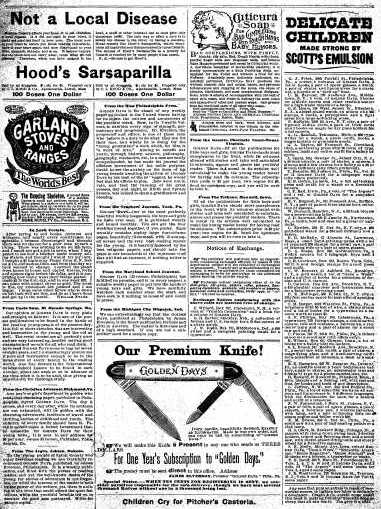
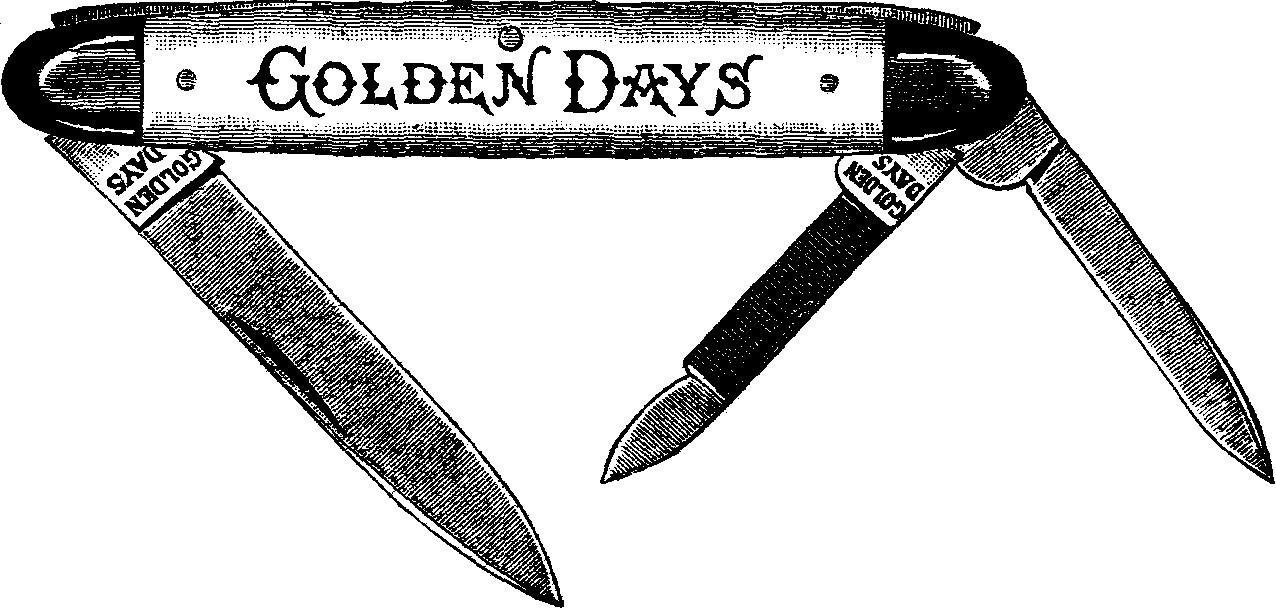
Our Premium Knife! Ivory handle, beautifully finished, Exactly as Illustrated. Made to our own order, and can only be had by subscribing to "Golden Days." We will make this Knife a Present to any one who sends us THREE DOLLARS For One Year's Subscription to "Golden Days." The money must be sent direct to this office. Address JAMES ELVERSON, Publisher "Golden Days," Phila., Pa. Special Notice.—WHEN TEN CENTS FOR REGISTERING IS SENT, we consider ourselves responsible for the safe delivery, though we have sent several thousand Knives without one in a thousand being lost. Children Cry for Pitcher's Castoria
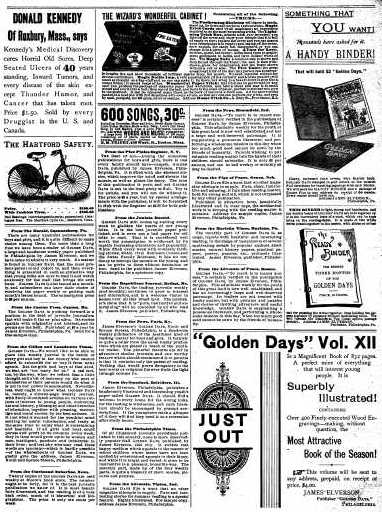
THE WIZARD'S WONDERFUL CABINET! Containing all of the following —TRICKS—. The Performing Skeleton will dance to music, stand up, lie down and perform various tricks. Magic Trick Cards used by all magicians; no experience required to do the most perplexing tricks: The Lightning Trick Box, neatest trick ever invented; you take off the cover and show your friends that it is full of candy or rice; replace the cover and you can assure your friends that it is empty; and taking off the cover, sure enough, the candy has disappeared, or you can change it to a piece of money. A Cure for Love, curious, queer, but funny; ladies hand them to gentlemen; gentlemen to ladies, and have dollars' worth of fun. The Magic Nail; a common nail is shown and then forced through the finger; the nail is then withdrawn, given for examination and the finger shown without a cut or scar. The Fire Eater, the great sensational trick of the day; any person can apparently breathe fire and blow thousands of brilliant sparks from the mouth. We send material enough for several exhibitions. Magic Bottle Imp, a very amusing trick; it is a curiosity and a brain puzzler; will stand as straight as a flag-staff and no one can make it lie down, but when you take it down it goes like a sleepy kitten; it causes heaps of fun. Wonderful Paper Trick; this trick can be performed by any one; you produce the package of cigarette paper that we furnish, and take a sheet and tear it in small pieces and roll it into a ball; then unroll the ball, and there is the sheet of paper, perfect in size and not torn in the slightest. It can be repeated many times, as the book of leaves is a thick one. All the above tricks packed in a neat box with full directions with every article, so that any one can perform the tricks, and sent by mail, postpaid, for 25 cents, silver or stamps. Address Home Trick Co., 4. Eddy St., Providence, R. I.
DONALD KENNEDY Of Roxbury, Mass., says Kennedy's Medical Discovery cures Horrid Old Sores, Deep Seated Ulcers of 40 years standing, Inward Tumors, and every disease of the skin except Thunder Humor, and Cancer that has taken root. Price $1.50. Sold by every Druggist in the U. S. and Canada. The Hartford Safety. Price $100.00 With Cushion Tires $105.00 Ball Bearings; interchangeable parts; guaranteed. Catalogues free. The Hartford Cycle Co., Hartford, Conn. From The Herald, Cannonsburg, Pa. There are many excellent publications for boys and girls, and it is quite difficult to make choice among them. For more than a long time we have been a reader of Golden Days, a large and handsome weekly paper published in Philadelphia by James Elverson, and we have come to admire it very much. No matter is found in Golden Days that the most prudent parent could object to, and then everything is presented in such an attractive way that young folks are sure to read it and watch anxiously for the mail that brings the next Issue. Golden Days is also issued as a monthly, and subscribers can have their choice of receiving the paper weekly or getting each month's issues bound. The subscription price is $3 per annum. From the Canton Press, Canton, Mo. The Golden Days is pushing forward to a position in the field of juvenile journalism that will make it the ne plus ultra. Its stories sparkle with originality and interest, and its poems are the best. Published at $3 a year by James Elverson, Philadelphia, Pa. Send for a free sample copy. From the Clifton and Lansdowne Times. Golden Days.—We would like to be able to place this weekly journal in the hands of every girl and boy in the county who cannot afford to subscribe for or buy it from news agents. But the girls and boys of that kind, we fear, are "too many for us." A sad fact, too, by-the-way, when we reflect that a little thought and a bit of economy on the part of themselves or their parents would do what it is not in our power to accomplish. Nevertheless, they ought to know what Golden Days is, namely, a sixteen-page weekly journal, with finely-illustrated articles on various subjects of interest to young people, embracing natural history, philosophy and other branches of education, together with pleasing, instructive and moral stories by the best authors. It is just what is wanted for the youthful mind seeking for useful information, and ready at the same time to enjoy what is entertaining and healthful. If all girls and boys could peruse and profit by its columns every week, they in time would grow up to be women and men, intelligent, patriotic and influential in their lives; and lest any who may read these words are ignorant—which is hardly possible—of the whereabouts of Golden Days, we gladly give the address, James Elverson, Ninth and Spruce Streets, Philadelphia. From the Cincinnati Suburban News. Twenty copies of the Golden Days are sold weekly at Moore's book store. The number ought to be forty, for it is the best juvenile publication we know of. It is most beautifully illustrated, and the reading is of a very high order, much of it historical and biographical. The price is only six cents per week. 600 SONGS, 30c. Including Comrades, Mary and John, Sweet Katie Connor, Little Fisher Maiden, Rock-a-bye, Baby, Love's Old Sweet Song, In Old Madrid, That is Love, Playmates, Leonore, etc., all with WORDS AND MUSIC complete. A large book of 256 pages, containing all of above, mailed on receipt of thirty cents, stamps or silver. Address B. M. TRIFET, 408 Wash. St., Boston, Mass. From the Pine Plains Register, N. Y. The Best of All.—Among the numerous publications for boys and girls, there is one every family should have—namely, Golden Days, published by James Elverson, Philadelphia, Pa. It is filled with the choicest stories, which improve the mind and elevate the morals, as well as please the fancy. The tone of this publication is pure, and yet Golden Days is not in the least prosy or dull. Try it for awhile, and you will not do without it. The price is $3 a year, but by special arrangements with the publisher, it will be furnished in club with the Register at $3.50 for both publications. From the Juniata Herald. Golden Days still comes up smiling every week to gladden the hearts of our young folks. It is the best juvenile paper published, and is even not a bad paper for old folks to read. That it is considered well worth the subscription is evidenced by its rapidly increasing circulation and popularity. While filled every week with intensely thrilling stories, which rival Robinson Crusoe and the Swiss Family Robinson, it has no tendency to corrupt the morals of the young, and can be given to them without hesitation or fear. Send to the publisher, James Elverson, Philadelphia, for a specimen copy. From the Republican Journal, Belfast, Me. Golden Days, the leading juvenile weekly (and monthly) continues to grow in interest and circulation, and is a welcome visitor to homes over all this broad land. The publisher's claim that it is "pure, instructive and entertaining" will be conceded by all who read it. James Elverson, publisher, Philadelphia. From the News, Paris, Ky. James Elverson's Golden Days, Ninth And Spruce Streets, Philadelphia, is a handsome weekly publication of the healthiest kind of reading matter for boys and girls. It furnishes quite a relief from the usual trashy productions which are placed in reach of the youthful reader. The pictorial features are far in advance of similar journals, and one worthy feature which should recommend it to parents is that it contains only the purest of reading. Nothing that would prove derogatory to the best moral or religious life ever finds the light through colums its. From the Standard, Belvidere, Ill. James Elverson, Philadelphia, publishes a handsomely illustrated and interesting youth's paper called Golden Days. It should find a welcome in every home for the young folks, for the reading is wholesome, and such literature should be encouraged by prompt subscriptions. If the youngsters catch a glimpse of it they will find they need it as a recreation after study hours. From the Philadelphia Times. Of all illustrated Juvenile periodicals published in this country, none is more deservedly popular than Golden Days, published by James Elverson, this city. It strikes that happy medium which appeals to the masses of school children whose tastes have not been spoiled by overstrained appeals to their fancy, and while it is bright and varied, it aims to be instructive in a pleasant, homelike way. The monthly part, made up of the four weekly parts, is quite a treasury of short stories, pictures and puzzles. From the Advocate, Tipton, Ind. Golden Days fills a want that no other magazine attempts to supply. Pure and interesting stories for summer reading is a special feature. Highly illustrated. For sample copy, address James Elverson, Philadelphia.

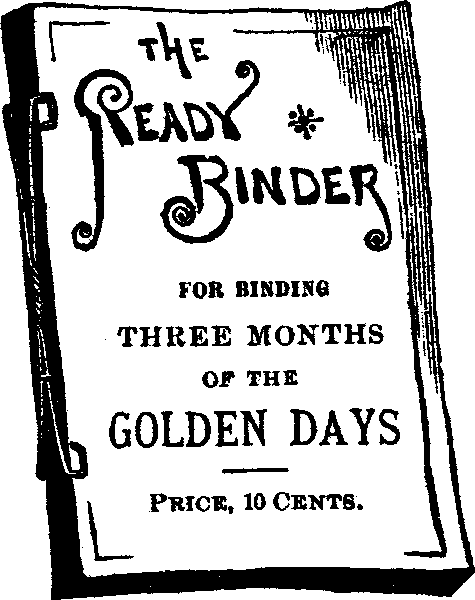
From the News, Bloomfield, Ind. Golden Days.—"To merit is to insure success" is certainly verified in the publication of Golden Days, by James Elverson, Philadelphia. This admirable weekly for the youth of this great land is now well established and has a large and well-deserved patronage. It is supplanting a poisonous literature, and performing a wholesome mission in this day when too much good seed cannot be sown by the friends of humanity. Parents wishing to put valuable reading matter into the hands of their children should subscribe. It is only $3 per annum, and can be had weekly or monthly as may be desired. From the Pipe of Peace, Genoa, Neb. Golden Days fills a want that no other magazine attempts to supply. Pure, clean, instructive and amusing, it furnishes reading matter, both for young and old, which is not surpassed by any other publication. Published in attractive form, beautifully illustrated and in clear type, the mechanical work is in keeping with the reading matter it contains. Address for sample copies, James Elverson, Philadelphia, Pa. From the Marietta Times, Marietta, Pa. The monthly part of Golden Days is, as usual, replete with healthful and interesting reading, in the shape of instalments of several captivating serials by popular authors, short stories, natural history papers, practical papers, poetry, puzzles, etc., profusely illustrated. James Elverson, publisher, Philadelphia. From the Advocate of Peace, Boston. Golden Days.—"To merit is to insure success," is certainly verified in the publication of Golden Days, by James Elverson, Philadelphia. This admirable weekly for the youth of this great land is now well established, and has an increasingly large and well-deserved patronage. Its readers are not treated with trashy matter, but with pictures and puzzles and stories of thrilling adventure and useful knowledge. Golden Days is supplanting a poisonous literature, and performing a wholesome mission in this day, when too much good seed cannot be sown by the friends of humanity. SOMETHING THAT YOU WANT! Thousands have asked for it. A HANDY BINDER! That will hold 52 "Golden Days." Heavy, embossed cloth covers, with flexible back. Golden Days stamped in gold letters on the outside. Full directions for inserting papers go with each Binder. We will send the HANDY BINDER and a package of Binder Pins to any address on receipt of 50 cents. Every reader should have one. Address JAMES ELVERSON, Philadelphia, Pa. THIS BINDER is light, strong and handsome, and the weekly issues of Golden Days are held together by it in the convenient form of a book, which can be kept lying on the reading-table. It is made of two white wires joined together in the centre, with slides on either end for pressing the wires together, thus holding the papers together by pressure without mutilating them. We will furnish the Binders at Ten Cents apiece, postage prepaid. Address JAMES ELVERSON, Publisher, Philadelphia, Pa.
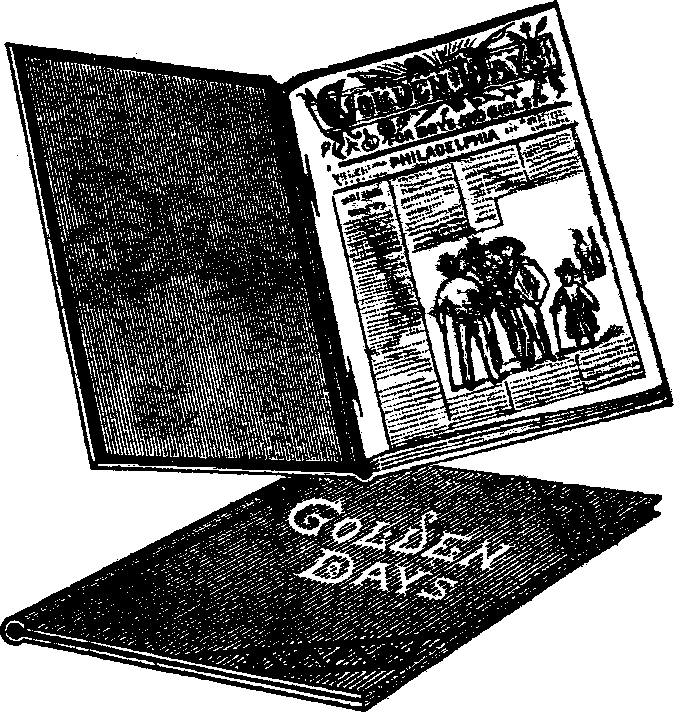
"Golden Days" Vol. XII Is a Magnificent Book of 832 pages. A perfect mine of everything that will interest young people. It is Superbly Illustrated! CONTAINING Over 400 Finely-executed Wood Engravings—making, without question, the Most Attractive Book of the Season! This volume will be sent to any address, prepaid, on receipt of price, $4.00. JAMES ELVERSON, Publisher "Golden Days," Philadelphia

Some older browsers may have trouble displaying interlocking text and graphics. Affected areas:
Title Page Vol. XIII—No. 1. November 28, 1891. PHILADELPHIA: JAMES ELVERSON, PUBLISHER.
The North Avenue Archingtons WHAT WAS THAT BY THE TELESCOPE? A WHITE, TALL FIGURE STOOD BY THE INSTRUMENT. At the western end of the third floor there was a stairway leading up to a room at the top of the building, which was occasionally used as an observatory. A telescope was mounted there, but, as it was not very powerful, the astronomy classes generally used one at the private residence of their professor instead.
The Black Hound THE DOG DID NOT RELAX ITS HOLD, AND THE COMBATANTS SEEMED BOUND TOGETHER. The animal swam straight to the island and landed there. At my hiding-place I waited for it to appear on the opposite side of the island and swim across the bay. When it got well out into the open water I could catch it with my boat. But the deer seemed contented to remain on the island, for it did not again show itself. It evidently thought it could thus baffle the nose of the pursuing hound, and escape the danger incurred by swimming across the bay. I made up my mind that in order to capture the deer, I must in some way get into the narrow channel between the island and the main shore; but with the deer watching me from the island, this would be almost impossible.