PART I.
Reading edition
EXPERIENCES IN GLACIÈRES.
EXPERIENCES IN GLACIÈRES.

SUBTERRANEAN ICE IN KING’S RAVINE.
Subterranean ice was brought to my notice by a mere accident, late in the month of September, 1877, while on a descent of King’s Ravine, on Mount Adams, in the White Mountains of New Hampshire. We had just descended the rock wall of the mountain and had reached the head of the gorge, when my companion, Mr. Charles E. Lowe, the well-known Appalachian guide of Randolph, suddenly said to me, “Would you like a piece of ice? I can get you some presently.” I answered, “Certainly,” wondering where he would find any. When we got among the big boulders, which form so rough a path for the traveler at the bottom of the ravine, Mr. Lowe climbed down under one of the biggest, and presently reappeared with a good sized lump of ice. I was much impressed at finding ice at the end of the summer in this gorge, when for months past no ice or snow had been visible on the surrounding mountains. I noticed also the peculiar, flaky formation of the ice, and saw at once that it was something new to me, and in fact it was a piece of what I have since learned to know as “prismatic ice.”
GLACIÈRE NEAR BRISONS.
In the summer of the year 1880, I traveled through the Alps, with a friend from Philadelphia. On the 17th of September, we drove from Geneva to Bonneville. Thence we started on foot without a guide, and as a result got lost in the woods, from which we only extricated ourselves at nightfall. After retracing our steps to Bonneville, we were glad to find a man to show us the way we should have taken, and finally reached the little village of Brisons in France, where we slept. The next day we took a guide and made our way across the mountains to Annecy, at one spot going out of our direct route to see a place spoken of by the natives as a glacière. It was a little pit, and at the base of one side thereof was the mouth of a small cave into which we could not see any distance. At the bottom of the pit lay a mass of dirty snow and ice to which we did not descend, as the sides of the pit were sheer and smooth, and there was no ladder. This pit seemed to be more of the nature of a gully filled with winter snow, than a true rock cave containing ice.
THE GLACIÈRE DE L’HAUT-D’AVIERNOZ.
Three days after this, on Tuesday, the 21st of September, 1880, we visited the two largest glacières on the Mont Parmelan, near Annecy, France. At Annecy we inquired at the hotel for a man who knew the Mont Parmelan; and, after finding one, we made our way to Les Villaz, where we spent the night in an auberge. Our companion was an odd personage. He was small, about fifty years of age, and looked meek, crushed and hungry. He wore a long black frock coat and black trousers, thin boots and a linen shirt, certainly not the ideal outfit for a cave explorer. Under his care we started early in the morning and toiled up a mountain path some eight hundred or a thousand meters,[1] through woods and pastures, to the higher plateau of Mont Parmelan, in which was situated the first glacière. This was in a great pit, at the bottom of which, on one side, was a big cave. On the side of the pit opposite to the opening, there was a steep rock slope, forty or fifty meters long, whose lower portion was covered with snow. Down this slope we descended with but little difficulty, reaching at the bottom an almost level ice floor which spread over the entire cave and was formed throughout of thick, solid ice. A second and much smaller pit in the roof of the cave opened directly over the ice floor; and under this pit rose a small cone of ice, some two meters high, the only one in this glacière.
The glacière itself was approximately round in shape, and some twenty meters in diameter. At one place the rock wall was broken and we could look into a much smaller inner cave or chamber. Into this we could not penetrate on account of a long, narrow crack or hole which yawned in the ice floor for a distance of some five or six meters and continued through the opening into the second chamber. We tried to cut our way along the side of the hole, but had to give it up, finding the ice too hard and our time too short. The crack or hole, whose sides were solid ice, proved conclusively that the ice in this glacière was many meters in thickness, for we could look a long way down into the hole, certainly for ten or twelve meters, until the ice sides disappeared in darkness, without any visible bottom. The hole cannot be spoken of as a crevasse, for, besides not looking like a crevasse, it was certainly formed by other causes than those which form the crevasses in glaciers, since there is, as a rule, no perceptible movement in subterranean ice. Doubtless, the hole was due to the drainage of the cave, which undoubtedly passed off through the hole. There may be, nevertheless, some little motion in the ice of this glacière, for it is evident that it is fed principally directly by the winter snows; which, whether as frozen or melted snow, descend gradually, by the force of gravitation, from the slope of the pit into the glacière.
As for any possibility of this great mass of ice melting away and forming again in any one year, it passes belief; there must be at least the cubic contents of a dozen ordinary houses in the cave, and such a mass could hardly be destroyed or formed again in any such short space of time as a fall or spring. This is, therefore, probably a permanent or perennial glacière.
THE GLACIÈRE DE CHAPUIS.
Starting out from the Glacière de l’Haut-d’Aviernoz we walked across the plateau of the Mont Parmelan, en route for the second glacière. This plateau is a curious rock formation, consisting of what the natives call lapiaz, which might be translated “stone-heaps.” The plateau is full of great projecting rocks; and myriads of cracks and crevices everywhere rend the surface, and over these crevices one sometimes has to jump. Still, I do not remember any particular difficulty. It was certainly not nearly as bad walking as the taluses of loose rocks one meets at the base of many mountains.
Our guide led us for about an hour across the plateau in a southerly direction, and then, looking over the side of the Parmelan, with a sweep of the arm covering south, west and north, he told us that the glacière lay between those points, but he did not know exactly where. This seemed a rather hopeless prospect, so, as we had no clue to the whereabouts of our prospective hole, we descended to a couple of châlets we saw some two hundred meters below, but which at least were in the direction of Annecy. We followed a goat-herd’s path which led to the châlets from the plateau, one of those dangerous grass tracks, where nothing would be easier than to make a slip, and where a bad slip might have unpleasant results. This is, however, just the kind of place where every one is particularly careful not to slip. We were careful and so reached the châlets all right, and there we found a strong, intelligent boy, who at once pointed out the place where the glacière was, about half way up the slope we had just come down. So we took him with us, leaving our guide at the châlets to await our return.
The entrance to the glacière was in a wall of rock, set at an angle of some thirty-five degrees; at the bottom of this there was some grass. An easy chimney some fifteen meters high led up to the glacière. Up this chimney we climbed. At the top we entered a little cave about two meters deep, by a sort of portal about two meters wide. The cave made an elbow to the right, and passing this we found that it turned to the left and pointed directly into the mountain. The rock went down vertically in front of us, but the boy said we could get down, so having first lowered a candle by a string to see the depth, which turned out to be a perpendicular drop of some four or five meters, with the help of the rope we all climbed down. We were already almost entirely away from the daylight and a few steps took us into complete darkness, except for the light we had from the candle each of us held in his hand.
The fissure led straight into the mountain. It was a couple of meters wide at places, and there we moved along the bottom. In one place it narrowed below to a wedge, and there we progressed either by climbing along one side or by placing one foot on one side and the other foot on the other. The fissure led downwards as well as inwards. It would have been nothing in daylight to go through it; but in the semi-darkness it was not easy.
After a descent of some twenty-five meters or thereabouts, we arrived at the glacière, and I have certainly never seen a weirder place. There was a great arched rock dome, perhaps six meters in height, and some twelve in diameter; the floor was a sheet of smooth, slippery ice, at one end curling over, gently at first, afterwards more steeply, to a lower depth; and on the sides were seven or eight ice columns streaming from cracks in the rocks to the floor. Each of these columns was some three or four meters high, and, small at the top and in the middle, spread out at the base into the shape of fans. In the dim candle light and the cold damp atmosphere, the columns loomed up like so many ghosts, and the landscape impression was strange and solemn. The air here seemed perfectly still.
There was another curiosity. The fissure we had come down, at this point some three meters wide, was filled, just beyond the glacière, with pure, transparent water, which formed a little lake: this was perhaps one meter deep, and extended across the fissure, barring further progress. It certainly seems strange that in the same cavern, under nearly the same conditions of temperature, there should be one place covered with a flooring of ice and another filled with water. The explanation, however, is perhaps not far to seek. Over the lake there was a distinct draught of air. The draught probably melts the ice in summer, if indeed it does not prevent any from forming in winter. There are, so far, no winter observations reported of this cave, yet it would seem to be one which would well repay the trouble.
THE GLACIÈRE DE CHAUX-LES-PASSAVANT.
On the 17th of August, 1894, my brother and I arrived at Besançon, the Vesontio of the Romans, bent on seeing the Glacière de Chaux-les-Passavant or de la Grâce-Dieu, which is not far distant from the town. The hotel we stopped at was pretty bad; the beds were surmounted with those old-fashioned curtains which were of use before the invention of glass windows, but which now only serve to exclude air and ventilation. However, I learnt something of the manners and customs of the country, for on getting down at six o’clock the next morning for breakfast, the first question the waiter asked was: Quel vin monsieur prendra-t-il? At seven o’clock we sallied forth in a little open one-horse victoria, with a dull gray sky overhead. Besançon is well down in a valley, so the first five miles of the road were a slow, gradual rise to the surrounding levels. The scenery as we drove along reminded us of Turner’s pictures: distant vistas of hills and valleys with factories blowing off their smoke and with tumble-down old houses ensconced in picturesque nooks, just those long-distance effects that Turner loved to paint and which, for some reason, the artists of the present generation have generally neglected and usually speak of as unpaintable or unpicturesque. There was a row of trees, the whole way, on each side of the road, a bit of practical forestry, the wisdom of which it would be well for Americans to recognize. After our poor horse had pulled us up the long hills, we had an almost level road running in a straight line as far as the eye could see. We saw at least a hundred little hawks, who live on field mice and other rodents, and whose preservation is another evidence of French wisdom. The last four miles of the drive was up a ravine in the woods, near the beginning of which we passed the Trappist convent of la Grâce-Dieu.
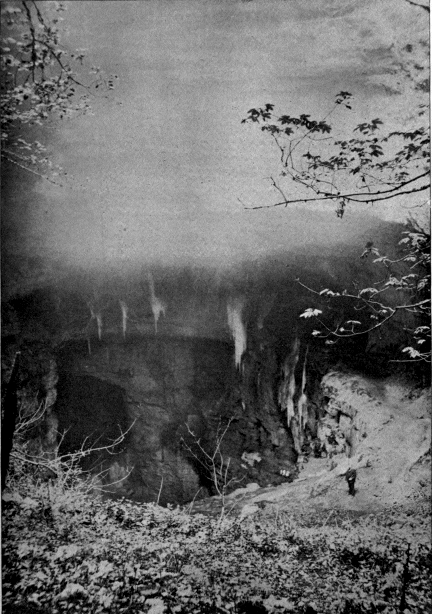
GLACIÈRE DE CHAUX-LES-PASSAVANT.
From a Photograph by E. Mauvillier.
Opposite the entrance of the glacière, there is a little restaurant where the peasants come to dance and picnic, and where the few travellers who get to these parts, can obtain a tolerable déjeuner. They keep a fair vin du pays there, and we had some trouble on the way home in consequence. Our driver, a talkative specimen of the genus and an old soldier of Bourbaki’s, told us, on the way out, many things about Besançon during the Franco-German war and of the retreat of the French army into Switzerland; but on the way home, he showed that he evidently was not a member of the blue ribbon army. He first seemed desirous of not taking us back to Besançon, preferring to go in the other direction towards Bale; and afterwards he evinced a violent inclination to go to sleep. We thought we should have to request him to change seats with us, and drive back ourselves, but we obviated the difficulty by plying him with questions as soon as he began to nod on his box. Eventually, we reached Besançon all right, only once bumping a passing cart, and only once nearly capsizing into a ditch. If Americans can learn some points from Europeans about forestry, I think the latter might get some equally valuable information from us concerning the use of water, externally and internally.
The good lady at the restaurant acts the part of the old-fashioned cave dragon, and we had to appease her by handing over four sous as a preliminary to exploration. She also had a sign up, saying that no one is allowed to break off or take away any ice, which must sadly interfere with the tourists’ privilege of bringing away specimens.
The entrance of the glacière was surrounded by woods, which formed a natural rampart to anything like wind. As we stood facing the glacière a great pit opened before us, with a slope about one hundred and thirty-five meters long leading to the bottom. This slope is at first gentle in its gradient, but lower down it steepens to an angle of some thirty degrees so that we were glad to resort to the trail which descends in regular Alpine zigzags. In one place, on the right hand, there were the remains of a stone wall with a door, and local tradition relates that in former times there was a sort of fortified habitation there, which was used in war times as a place of retreat. The lower part of the slope is covered by a protecting roof of rock which, thin at the rim where it is edged with forest, gradually slopes downward overhead so that at the mouth of the glacière we looked back and up what might be described as an immense tunnel. The lower part of the slope was a mixture of broken rocks, mud and ice: the last, however, seemed to be all on the surface, although it was impossible to determine whether it went to any depth.
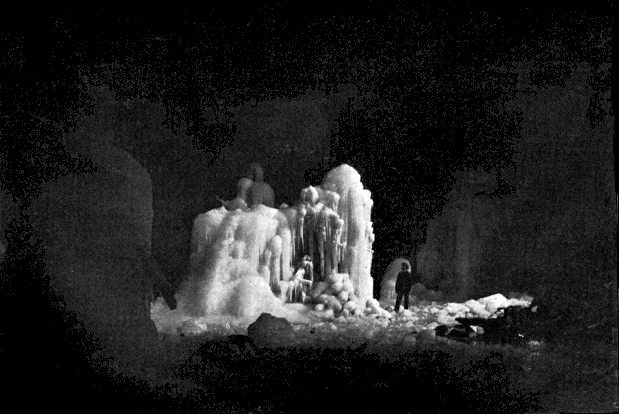
ICE STALAGMITES, CHAUX-LES-PASSAVANT.
From a Photograph by E. Mauvillier.
At the base of the tunnel we found ourselves on the threshold of an immense, almost circular cave, with a diameter of some fifty meters, rising overhead into a regular vault or dome about twenty-seven meters in height. The entrance to the cave is so large that plenty of daylight is admitted, and the whole cave easily examined. The rocks are of a yellowish brown hue, and I could not help thinking of Nibelheim in Richard Wagner’s Rheingold.
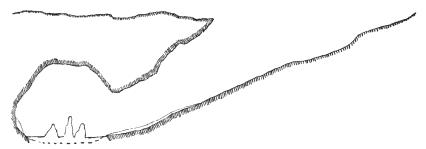
Fig. 1.[2] Vertical Section of Chaux-les-Passavant.
The bottom of the cave was entirely covered with a flooring of ice. How thick this flooring was there was no means of judging, as there were no holes, but it must have been at least two or three meters thick in places. At the back of the cavern, directly facing the entrance, one magnificent frozen water fall streamed from a fissure. It was perhaps five meters high, and began to take the fan shape from its origin. The base was about four meters wide, and did not rest on the ice floor, but on a sloping rock extending out from the side of the cave.
Perhaps the most remarkable feature of all, were six or seven great ice stalagmites, shaped like cones or rough pyramids, which rose on the floor of the cave. One of these was at least five meters in diameter and six in height, and seemed perfectly solid. In the case of two of the others, however, the cones were broken on one side, revealing in each the stem and branches of a young pine tree. These evidently had been planted in the ice and round them the columns had grown. Whether all the ice cones were thus artificial in their origin I could not determine, but it seemed probable that they were the result of years of undisturbed accretion and growth. In both the cones where the break on the side gave a view into the interior, the dark blue-green color of deep glacier crevasses was present.
A pool of water, perhaps thirty centimeters in depth and three or four meters in diameter, lay at one place on the ice floor. The whole cave was damp and the ice in places decidedly slushy, in fact all the signs showed that it was thawing. In the case of this glacière as well as in those of the Mont Parmelan, it seemed clear that it must be in the winter months that the formation of ice takes place.
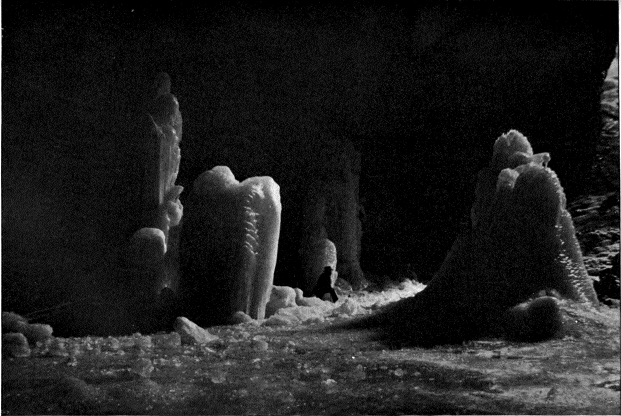
ICE STALAGMITES, CHAUX-LES-PASSAVANT.
From a Photograph by E. Mauvillier.
DÓBSINA JEGBARLANG.
The cavern of Dóbsina, in the Carpathian Mountains, is easily reached either from Poprád to the north, or from Dóbsina to the south. The hotel at Poprád is better, however, than the inn at Dóbsina, where my brother and I spent two nights. It was decidedly primitive. The food was not so bad, but the pigs ran round in the courtyard, and one morning a gypsy band woke us at half-past three o’clock by playing in front of our windows, in dreadful wailing tones, which were most irritating at that hour. At the proper time, however, Hungarian gypsy music,—despite the fact that none of the players ever seem to look at the leader, and that each man appears to play the tune he likes the best,—is strangely fascinating.
Dóbsina itself lies in a hollow, surrounded with well-wooded hills, the general appearance much resembling some of the valleys of the White Mountains of New Hampshire. My brother and I started from Dóbsina on the morning of the 27th of July, 1895, at half-past seven o’clock, in a little open carriage with excellent horses and a Hungarian driver in national costume. He was a nice fellow, but he did not understand a word of German. The road reminded us of some of our own mountain roads, as it was rough, full of holes and partly washed away by the rains. We first ascended to the crest of the surrounding hills and then descended to the Stracena Thal, a wild limestone valley covered with fine forest. Two hours and a half driving landed us at the hotel-restaurant near the cave, at which I should certainly stop on another visit. It was half an hour’s stroll thence, through beautiful woods, to the cavern’s entrance. Northwards in the distance the Tátra Range was visible, a set of sharp bare rock peaks, at whose base, ensconced in pine forests, is situated the famous Hungarian summer resort of Tátra Füred, which much resembles Bar Harbor.
The entrance to the cavern is enclosed by a fence with a gate, and here the Dóbsina people have a high tariff and take toll from tourists. At the gate, we waited for half an hour, until a sufficient number of persons had arrived to form a party. This mode of visiting the cave rather detracts from the pleasure, even though it does away with all difficulty and makes the beauties of Dóbsina accessible to everyone. It was also necessary to wait long enough to cool off thoroughly before entering, on account of the icy air of the cavern, where heavy winter clothes are indispensable.
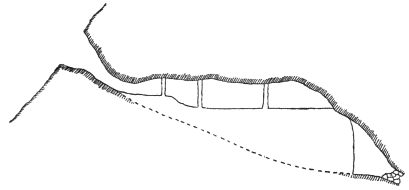
Fig. 2. Vertical Section of Dóbsina.
The entrance to Dóbsina faces nearly due north. It is small, perhaps two meters wide and three meters high, and is perfectly sheltered from any wind. The sudden drop in temperature at the entrance was startling; in fact it was the most extreme change I have noticed in any cave. Within the length of an ordinary room, say in a distance of five meters, we passed from an extremely hot summer morning to the chill of a mid-winter afternoon. A slight air current, perhaps, issued from the entrance, as we observed a faint mist there. At the rock portal there was ice on the rocks overhead, and underfoot was the beginning of the huge mass of ice which almost fills the cavern. A descent down eighteen wooden steps landed us at the beginning of a great ice floor, in what is called the Grosser Saal. It is a magnificent cave. The floor is a sheet or rather a mass of solid ice, the surface of which is level enough in one place to permit of skating; in other spots it is sloping and covered with small ice hillocks. The ice is solid throughout, without any holes or cracks. Several fissure columns stream to the floor from cracks in the sides. Joining the roof to the floor are numerous big ice stalactites, which form frozen pillars and columns. These are from eight to eleven meters in height, and some two to three meters in average breadth and width. Nearly translucent, they are covered with all sorts of icy ornaments hanging about them in tufts and fringes; they are beautiful in their shapes, as well as in their white and blue colors. One of these columns is called the Brunnen, because until about ten years ago, a small stream dribbled continuously from the roof and cut a channel across the ice floor; but now the stream has solidified into the pillar, and the channel is filled up, although it can still be traced in the ice.
The cavern is lighted by electricity, which has the merit, even if it brings in an element of artificiality, of clearly revealing one of the chief glories of Dóbsina. This is the rime or hoar frost, which in the shape of ice or snow crystals, covers the entire limestone roof, and, reflecting the electric light, shines like frosted silver. Some of these frost crystals seem to be precipitated to the floor, and in one place I found a small sheet of them, perhaps two meters in width each way, which looked and felt like genuine snow. The general color effect of all this upper cave is white, although there is some blue in the ice, and gray and brown in the rocks and shadows. It would not be much of a misnomer to call Dóbsina “the great white cave.”
The ice extended to the sides of the cave except in two places. Here there were holes in the ice, bridged by low rock arches. We passed through one of these and descended by a wooden staircase some eighty steps, afterwards returning up through the other arch by another staircase. At the bottom we stood in a magnificent gallery named the Korridor, formed by a solid wall of ice on one side and by a wall of limestone rock on the other. The ice wall is the lower portion of the ice floor; the rock wall is the continuation of the roof. For the entire distance the ice wall rises almost perpendicularly some fifteen meters in height, while the rock wall arches overhead.
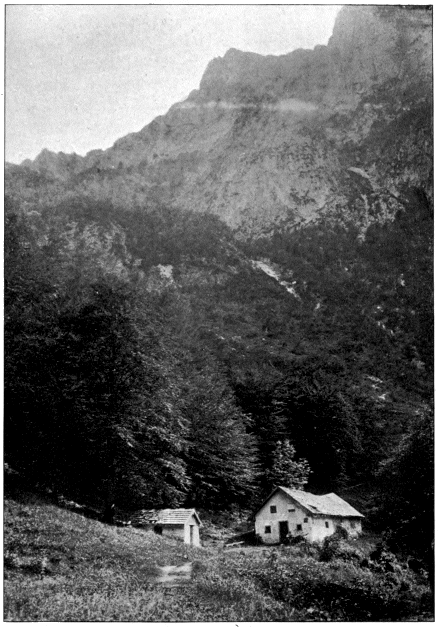
THE LOWER ROSITTEN ALP AND THE UNTERSBERG.
The bottom of the Korridor was filled with blocks of fallen limestone, through which any water drains off, and on which there was a wooden walk, so that we circled round the ice with the greatest ease. At one place on the limestone wall hung a cluster of big icicles, which, from their shape really deserved the name they bear, of the Orgel. At another place a hole, some six or seven meters deep, was hewn, in the form of a small chamber, directly into the ice mass. This is the Kapelle, where we performed our devotions by leaving our visiting cards on the floor. Near the middle of the Korridor the ice mass bulges out and extends to the limestone wall, breaking the whole Korridor into two parts, the western portion about eighty meters, and the eastern about one hundred and twenty meters long. This necessitated cutting a tunnel about eight meters long in the ice to get through. The color of the Korridor is a darkish gray and is much more sombre than that of the Grosser Saal. A remarkable feature of the ice wall is the fact that distinct bands of stratification are visible in the ice in many places. Why the Korridor is not filled up with ice and why the ice is perpendicular for such a distance are questions I am unable to answer satisfactorily; but it is probable that the temperature of the rock walls is sufficiently high to prevent ice from forming in winter or to melt it in summer if it does form in winter.
The air in Dóbsina seemed still, and scarcely felt damp. In one or two places in the Grosser Saal there was a slight sloppiness, showing incipient signs of thaw. In the Korridor it was freezing hard.
THE KOLOWRATSHÖHLE.
The Kolowratshöhle is situated on the north slope of the Untersberg, near Salzburg, at an altitude of 1391 meters. My brother and I visited it on the 2d of August, 1895. We had one of the patented guides of the district, Jacob Gruber by name, in regular Tyrolese dress, with gray jacke and black chamois knee breeches. We left Salzburg in the early morning in an einspänner and drove to the foot of the Untersberg in about an hour, whence, by a rough path passing by the Rositten Alp, we ascended to the cave in about three hours. The last hundred and sixteen meters of the path were cut across some moderately steep rock slabs and a perfectly unnecessary iron hand-railing affixed.
The entrance faces northeast. Here there must have been a slight draught of cold air moving outwards, the effect of which was perceptible to the eye, as at the point where the cold inside air met the quiet warm outside air, a faint mist was visible. From the entrance, a sharp slope, set at an angle of about forty degrees, led to the lowest point of the cave. The upper half of this slope was still covered with the winter snow which had blown or had slid in. We descended on the right hand edge of the snow by means of some steps cut in the rock by the Deutschen-Oesterreichischen Alpen Club. These steps were covered with a sticky, red mud, which left almost ineradicable stains on our clothing, and as there was also ice in places, they were decidedly slippery.
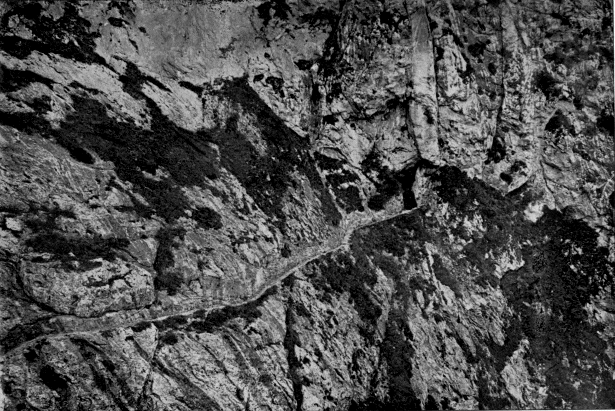
THE ENTRANCE OF THE KOLOWRATSHÖHLE.
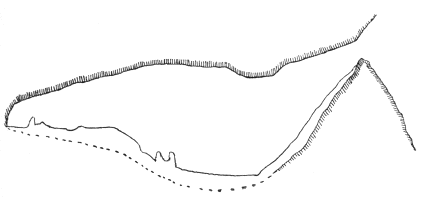
Fig. 3. Vertical Section of the Kolowratshöhle.
At the bottom of the slope we were at the lowest point of the cave, to which all the water flowed, and where it drained off into a crack with a loud gurgling noise. Back of us was the daylight streaming through the entrance; opposite to us was first an ice floor, then a great ice slope, which came down from the further end of the cave. The ice was transparent and of a pale ochre-greenish hue, and filled the entire width of the cave. There is a streak of iron, probably, through the limestone, which in places tints the rocks a dull red. The color impression is a dull green-red, and, on account of the size of the entrance, the light effect is only semi-subterranean.
The ice floor was covered with a layer of slabs of ice, eight or ten centimeters thick, which, earlier in the year, had evidently had water under them. The ice wall or ice slope consisted of two big waves, one above the other, the lower set at an angle of about ten degrees, the upper set at an angle of about twenty-five degrees. To get up the upper wave required about twelve steps cut with the axe. Behind the upper wave, five or six fissure columns streamed out to the beginning of the ice. One ice stalactite, at least two or three meters long, overhung the ice floor, and Gruber said about this: “Well, I wonder it has not fallen yet: they seldom last as late in the year,” a confirmation of what was clearly evident, namely, that the whole cave was in a state of thaw.
In two places there was a strong, continuous drip from the roof to the ice floor, which formed, in each case, what I can only call an ice basin. These basins were nearly circular; one was about four meters, the other about two, in diameter. Around about two-thirds of the rim of the larger one, ice rose in a surrounding ring two or three meters high, suggesting that earlier in the year this basin was a cone, and possibly a hollow cone. The depth in the ice floor, in both cases, was about one and a half meters, and each basin contained some thirty centimeters in depth of water. They reminded me of the rock basins one sees in mountain torrents, where an eddying current has worn smooth all the edges of the rocks. From the larger of these basins, a channel as deep as the basin ran to the lowest point of the cave. This channel was cut out by the overflow, which ran through it in a tiny stream.[3]
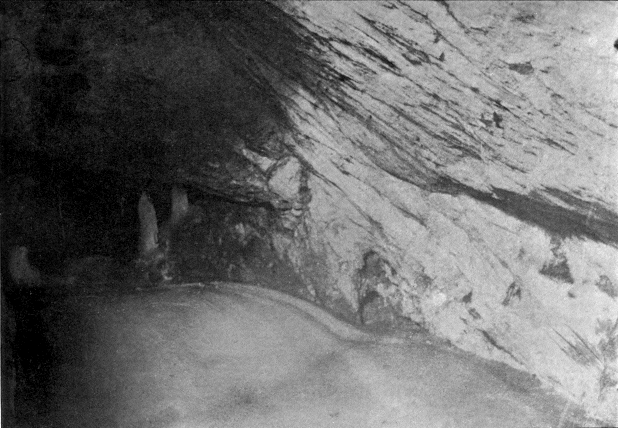
TOP OF ICE SLOPE, KOLOWRATSHÖHLE.
THE SCHAFLOCH.
The Schafloch, on the Rothhorn, near the Lake of Thoune, is one of the biggest glacières in the Alps. On the 15th of August, 1895, after early coffee, made by the portier of the Hotel Belvedère at Interlaken, I drove to Merligen, on the north shore of the lake, with Emil Von Allmen, an excellent guide. We left Merligen on foot at a quarter before seven, and, making no stops on the way, reached the Schafloch at ten minutes past ten. The path mounts gently up the Wüste Thal, which higher up is called the Justiz Thal. The track through the latter is almost on a level, over grassy alps. On the right hand rise the steep, almost dolomitic, limestone cliffs of the Beatenberg. On the left is the range of the Rothhorn, with steep grass and forest slopes below, and limestone cliffs above. The last hour of the walk was up these slopes, by what Baedeker calls a “giddy path.” By leaving the word “giddy” out, his description is accurate. The cavern is at the base of the limestone cliff, and the grass slope extends up to it.
The entrance to the Schafloch is at an altitude of 1752 meters: it is a fine archway, and a low wall is built partly across it. In front of this, we sat down and consumed our chicken and cheese, and that best of a traveller’s drinks, cold tea. The day was windless, and when I lighted a cigar, to see whether there was any draught at the entrance, the smoke rose straight up, showing that the air was perfectly still. When we were sufficiently cooled off, we entered the cave. The entrance faces east-south-east, but after about ten meters the cavern takes a sharp turn to the left, forming a sort of elbow, and runs about due south, constantly descending in an almost straight line. For the first eighty meters or so, the floor was covered with blocks of fallen limestone, among which we had to carefully pick our way. Then we began to find ice, which, a few meters further on, spread out across the entire width of the cave, with a gentle slope towards the left. The surface of the ice was rather soft, and the whole cave was evidently in a state of thaw. A few scratches with the axe—the most invaluable friend in an ice cave—were necessary at one place to improve our footing. It would have been impossible to move here without a light, and I carried our torch, made of rope dipped in pitch, which occasionally dropped black reminders on my clothes. We were in the middle of a great ice sheet to which several fissure columns streamed. On the right hand a beautiful ice stalactite flowed from the roof to the floor; it was some five meters high, and perhaps seventy-five centimeters in diameter, and swelled out slightly at the base. On the left hand were three or four ice stalagmites, shaped like pyramids or cones.
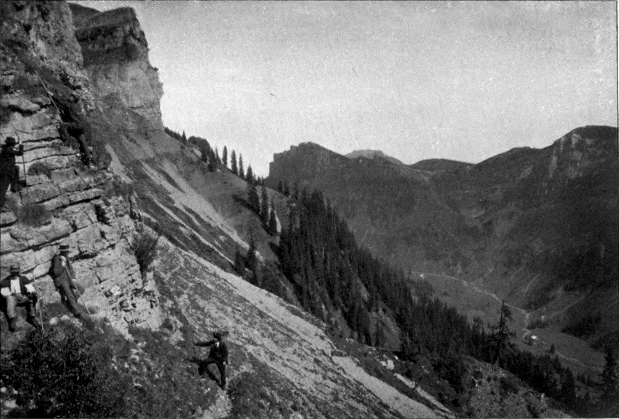
AT THE ENTRANCE OF THE SCHAFLOCH.
One of these cones was especially remarkable. It was at least five meters high—Von Allmen said eight—and at the bottom was about four meters in diameter. The base of this cone was entirely hollow. There was a break on one side by which we could enter, and we then stood on a rock floor with a small ice dome or vault overhead. I have seen no other hollow cone like this. The guide lighted a red Bengal fire inside, when the whole pyramid glowed with a delicate pink light, resembling Alpenglühn. Near this cone stood the half of another ice cone. It was quite perfect, and the missing half was cut off perpendicularly, as if with a huge cleaver. A hollow in the base of the remnant showed that this cone must have been originally also a hollow cone, and its destruction was probably due to the change in the temperature of the drip from the roof, at the setting in of the summer thaw.
Just beyond the cones, the ice floor steepens and curls over into a big ice slope, one of the finest I have seen. Von Allmen spoke of this as der gletscher, an expression I never heard applied elsewhere to subterranean ice. On the right side, the slope would be difficult to descend in the darkness. On the left, the slope is gentle and a rock juts out a little way down. Von Allmen insisted on roping—an unnecessary safeguard—but he said: “If you slip, you will probably break an arm or a leg, and then we shall be in a nice mess.” He then cut about twelve steps in the ice, down to the rock, while I shed light on the performance with our torch. We were so completely away from daylight that black was the predominating color; and even the ice was a dark gray, and only appeared white in the high lights. Below the rock, we found a narrow strip on the left side of the ice slope free from ice and blocked with boulders, over which we carefully picked our way down. At the bottom, the ice expanded into a level surface, stretching nearly to the end of the cave. There were only a few fissure columns in this part of the cavern, where the most remarkable feature was the cracks in the rock walls, which were so regular in formation that they almost looked like man’s handiwork. The rocks are free from stalactites, and in fact stalactites seem a good deal of a rarity in glacières.
On retracing our steps, we saw, when the first glimmers of daylight became perceptible, the rocks assume a brilliant blue color, as if they were flooded with moonlight. This effect lasted until near the mouth of the cavern.
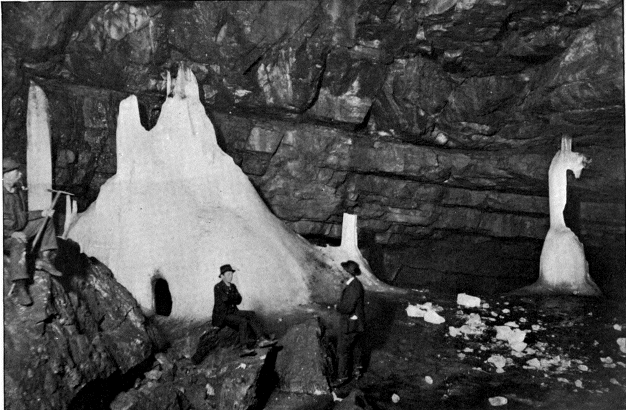
HOLLOW CONE AND FISSURE COLUMNS, SCHAFLOCH.
DÉMÉNYFÁLVA JEGBARLANG.
A little west of Poprád, in Northern Hungary, on the railroad between Sillein and Kassa, is the village of Liptós Szt Miklós, to which place I journeyed on the 12th of June, 1896. The conductor was the only man on the train or at any of the stations who would admit that there was a glacière at Déményfálva, and that it was feasible to get into it: every one else professed entire ignorance on the subject. It is perhaps, worth noting at this time that it is always difficult to get any information about glacières; in fact, the advice about cooking a hare might well be applied to glacière hunting: first catch your glacière.
The scenery between Sillein and Miklós was picturesque. The hills were covered with forest. In one place, the railroad ran through a beautiful mountain gorge alongside a river, where a number of rafts were floating down. There were also some primitive ferries, where a rope was stretched across the river, and the force of the current carried the ferryboat across, once it was started. Many peasants were at work in the fields; often in squads. White, blue, brown, and a dash of red were the predominating colors in their dress. The men wore white trousers, made of a kind of blanket stuff, and a leather, heelless moccasin of nearly natural shape. Almost all the women had bare feet; those of the older ones were generally shaped according to Nature’s own form, while those of the younger ones were generally distorted from wearing fashionable shoes. We went past several villages of huts with thatched roofs, something like the Russian villages one sees beyond Moscow, only less primitive.
The inn at Miklós was poor, and as at Dóbsina, the pigs lived in the yard and occasionally came for an interview under the covered doorway. Inquiries elicited the information that Déményfálva could be reached by carriage, so I engaged one at the livery stable. The owner told me that about twenty years before, he leased the glacière and carried on a regular business in supplying Buda-Pest with ice. He had thirty lamps put in to give light to the workmen, who brought up the ice in baskets on their backs.
At half past five o’clock next morning the carriage, which was innocent of paint, lined with a sort of basket work and without springs, but certainly strongly built, stood at the door. A boy of about eighteen years of age, who could speak German, went along as interpreter. The morning was dismal, and, every quarter of an hour or so, a shower of thick mist fell and gradually made us damp and uncomfortable. After about twenty minutes on a pretty bad road, we came to a place where there was a fork, and the driver turned to the left, over a track which consisted of two deep ruts through the fields. Soon after, we heard some shouting behind us, and a fierce-looking man, in a leather jacket and carrying a large axe, came up and abused the driver. He was not an agreeable person; however, presently he simmered down and began to smile. It turned out that he was a wächter, that is, a guardian of the fields, and that we were trespassing. The driver meekly promised to return by the other route, and we went on our way in peace. After awhile, we drove into some woods and then into a mountain gorge, with forest-covered slopes at the base and with limestone cliffs jutting out above. Here we came to the cottage of the wächter or förster of the surrounding woods, who also acted as guide to the cave, for the few tourists who came to see it; and when he heard of our destination, he at once slipped on a second ragged coat, took a woodman’s axe and started on foot, going much faster than the carriage. This was not surprising, for the road resembled nothing but the bed of a mountain brook, a mass of boulders with ruts between them. This highway was made by the peasants driving their carts over the plain in the same place, and as the soil was cut away, the boulders appeared; and over and among these we went banging along, and we were jolted about and bumped into each other, until every bone in my body ached.
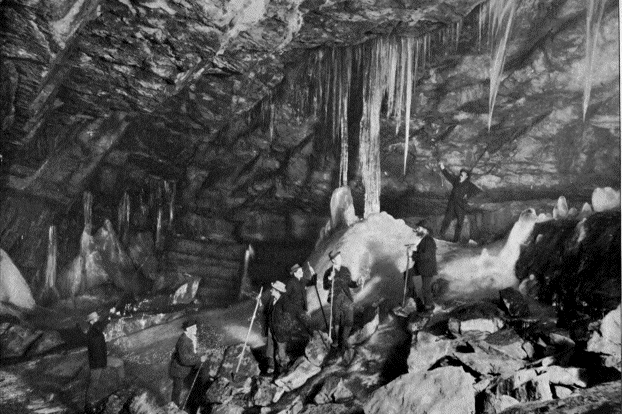
ON THE ICE SLOPE, SCHAFLOCH.
At a quarter past seven o’clock we came to another house in a little glade, where the carriage stopped; and on asking the förster for his name, he wrote down in my note book, in a clear well formed hand:—Misura, Franz. From the glade, ten minutes’ walk on a mountain path, up an easy slope, took us to the entrance of Déményfálva. It is about two meters wide by three quarters of a meter high. We passed through and entered a large chamber, well lighted from the right by another opening, which is higher up and bigger than the entrance. The air in this chamber was at about the same temperature as that of the outside air, and, on our return from the nether world, it seemed positively balmy. In the floor at the end of the chamber, a small pit yawns open. It is perpendicular on three sides and set at a sharp angle on the fourth. A wooden staircase of some two hundred steps, many of which are sadly out of repair, leads nearly straight down this slope to the glacière.
After descending about eighty steps of the staircase, bits of ice appeared on the walls and floor and after some thirty steps more, a lateral gallery opened to the right, and into this we turned. This may be called the upper cave or story, for in Démenyfálva—besides the entrance chamber—there are practically two stories, the upper one of which is mainly ornamented with stalactites, the lower one with ice. There was a little ice on the floor from which rose some small ice columns, perhaps fifty centimeters in height. The cave or gallery had a gentle downward slope and turned towards the left. After some little distance, we came to another wooden staircase, of ten or twelve steps, quite coated over with thick, solid ice. Misura had to cut away at it for several minutes, before he could clear the steps enough to descend. This was in fact the beginning of an ice wall, the Eiswand or Eismauer, which, turning to the right, flowed through a rock arch to the lowest cave. The rock arch or portal was some three meters wide and two meters high, and a fringe of beautiful organ-pipe like icicles hung on it on the right hand. Just beyond the portal the ice sloped steeply for a couple of meters; then it became level and on it rose a little pyramid, a meter and a half in height perhaps, and a column; then the ice sloped away again to the lower cave.
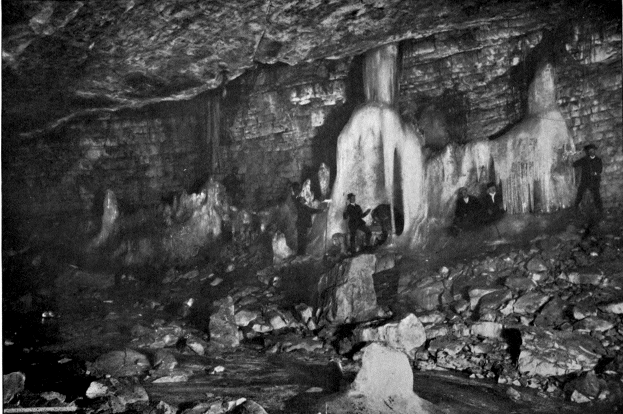
IN THE REAR OF THE SCHAFLOCH.
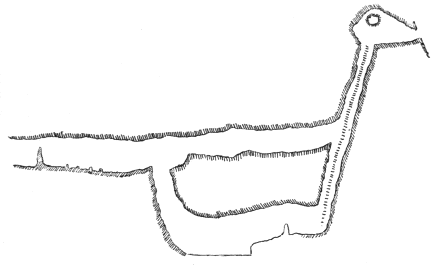
Fig. 4. Vertical Section of Démenyfálva.
We then continued our course beyond the rock portal along the upper cavern for about two hundred meters. It was a fine large gallery or passage and during the first fifty meters or so, we found numerous small ice cones, perhaps a hundred of them, from tiny little ones to some about forty centimeters in height. Many of these were columnar in form, nearly as large at the top as at the base: in some cases the top was flat, and the columns then looked almost as if an upper portion were sawn off. I have seen this shape of column nowhere else. In places there were slabs and bits of ice on the floor. The last hundred meters of this upper cave was free from ice and was exceptionally dry. It was formed of a pale yellow limestone rock, almost dolomitic in color, and many stalactites, in their thousand various shapes, hung from the roof and on the sides. In one spot, one big limestone stalagmite towered up directly in the middle of the gallery. We did not go to the end of the cave, where ice has never been found.
Retracing our course past the rock portal to the entrance pit, we descended on the long staircase for some eighty steps more, the amount of ice on the rocks steadily increasing. In places, frost crystals had formed in small quantities on the roof and walls. At the bottom of the pit, another lateral gallery, directly under the upper gallery, opened to the right. Entering this, we passed over broken limestone débris, which seemed to overlie a mass of ice. Limestone stalactites were noticeable all through this lower cavern, and frost and icicles had sometimes formed over them, in which case the ice stalactite assumed the form of the limestone stalactite. Advancing a few meters, we went by, on our right hand, an ice pyramid of a couple of meters in height. Just beyond this, the cave turned to the left like the upper cave, and we descended to a level floor of transparent ice, into which we could see some distance. At this spot, numerous icicles, generally of inconsiderable size, hung from the roof and on the sides of the cavern.
At the further end of this ice floor or ice lake we reached an ice slope, the Eiswand, which flowed to the ice floor from the upper cave in several waves. It was some six meters wide and twenty-five meters long; and it was not steep, perhaps fifteen degrees in the steepest portions. On the slope some old, nearly obliterated steps were visible, and at these Misura proceeded to cut, and with torch in one hand and axe in the other, gradually worked his way up, until he once more reached the level spot whence we had looked down the ice slope. Here he stood waving his torch, a proceeding indeed he did constantly throughout the trip, for he seemed exceedingly proud of the beauties of his cavern. This waving of torches, however, is exceedingly foolish, as their smoke quickly blackens stalactite, and in fact nothing but candles and magnesium wire should be carried for lighting purposes underground. The ice of the ice slope was hard, gray and opaque, quite different from that of the ice lake. The ice floor is formed of new ice, which is gradually refilling the place from which Misura said the ice for Buda-Pest was taken out twenty-five years ago. To prove this assertion, he called my attention to the side of the lake directly opposite the ice slope. At that spot, under the limestone rubbish over which we came, there was an outcrop of perpendicular opaque ice about a meter high. Misura said that the workmen began to cut at the ice slope and that they dug out a couple of meters in depth from the ice lake, until they had cut back to where the vertical outcrop was standing.
The explanation seemed to be in accord with the facts, and if so, it would go to show that the ice in this cave is of slow formation and great permanency; as seems also proved by the steps on the ice wall, which—we were the first party in the cave in 1896—had remained over from the preceding summer. Misura told me he had never seen so much ice nor seen it so hard as during our visit, and he added that there was generally water on the ice lake, and he thought there would be some in two or three weeks more. The greatest quantity of ice in the upper cave was at the head of the ice-slope, and it would seem as though there must be cracks or fissures in the overhead rocks there, through which the water is supplied to feed the ice, not only that of the upper cave, but also the larger portion of that of the lower cave.
The heavy winter air would naturally sink down into the entrance pit to the lower cavern, and some of it diverge into the beginning of the upper cavern, which at first is distinctly a down slope. A little beyond the portal at the head of the ice slope, the upper cave is either horizontal or in places slightly ascending. Probably this prevents the cold air from entering further, and probably also, the heat of the earth neutralizes the cold air of winter beyond a definite spot.
The air in the cave seemed absolutely still throughout; it was also extremely dry, undoubtedly because melting had not yet begun. The icicles evidently were formed by the slow drip freezing as it descended, and there were no perceptible cracks nor fissures in the rocks underneath them. The facts seem to me to prove that neither evaporation nor regelation can be the factors at work in making the ice and we may deduce an important rule therefrom. When a cave is dry, then the air is dry; when a cave is wet, then the atmosphere is damp. In other words, the state of dryness or dampness of glacière atmosphere depends on how much the ice is thawing and parting with its moisture.
On our return to the base of the long staircase, and while we ascended it, we had an exquisite moonlight effect, much resembling the one at the Schafloch.
THE FRAINER EISLEITHEN.
About two hours by rail, north of Vienna, is the village of Schoenwald, to which I journeyed on June the 15th, 1896. At the railroad station there was a K. K. Post Omnibus in waiting, which, when it was packed with passengers and luggage, drove over to Frain in an hour. The admirable road lies across a rolling plain, until it reaches the brink of the valley of the Thaya, to which it descends in long Alpine zigzags. On the bluff overlooking the opposite side of the river, there is a fine schloss.
I secured the seat next to the driver and questioned him about the Eisleithen. Although he had driven on this road for five years, without visiting the Eisleithen, yet he was positive that they were warm in winter, but cold in summer. He said more than once: Desto heisser der Sommer, desto mehr das Eis, and in fact was an emphatic exponent of the notions generally held by peasants, which some savants have adopted and tried to expound. At Frain, I applied at the little hotel for a guide, and was entrusted to the care of the hotel boots. He was an intelligent, talkative youth, but he insisted also that “the hotter the summer, the more ice there is.” However, he was polite, and made up for any shortcomings by always addressing me as der gnädige Herr.
The day was hot, so it took us three-quarters of an hour on foot, along the valley of the Thaya, to reach the base of the bluff where the Eisleithen are situated, at an altitude of about four hundred meters. The hillside is covered with patches of scrubby forest; and towards the summit, the entire mass of the hill is honey-combed with cracks and the rocks are much broken up. After about ten minutes’ ascent up a little path, we came to small holes, from each of which a current of cool air poured out; these holes seemed fairly horizontal, and the temperatures were high enough to prove that there was no ice within. A little further on, we came to a hole or tiny cave among a pile of rocks, where there was a painted sign: Eisgrube. It went down from the mouth, and I put my hand well in, but, beyond the length of my arm, I could neither see nor measure its shape or depth. The air felt cold, but was nowhere near freezing point; nor was it possible to determine whether there was a draught: it may or may not be a wind cave. Not far from this, there were two gullies, each terminating in a small cave. The first gully was planned somewhat like certain traps for wild animals, that is, it narrowed gradually from the entrance, then became covered over; and then dwindled, after some four meters more, into a small descending hole, the end of which we could not reach. But we got in far enough, to come to large chunks or slabs of ice plastered about on the floor and sides. In this cave, which was sheltered against sun and wind, the air, as tested by the smoke of a cigar, was motionless, and the cave seemed unconnected with any air current. The second gully terminated in a somewhat larger cave, whose floor was well below the entrance; no ice was visible, however, although the air was still and the temperature low. This cave may or may not be a glacière; but surely it is not a cold current cave.
These Frainer Eisleithen certainly offer an interesting field to anyone studying subterranean ice, from the fact that there are, in the same rocks, caves without apparent draughts in summer and containing ice, and caves with distinct draughts and no ice. The problem seems more intricate than is usually the case, but the solution is simply that the two classes of caves happen to be found together.
THE EISHÖHLE BEI ROTH.
The Eifel is one of the bleakest districts of Central Europe, and to one entering it from the vineyards and the well-inhabited basin of the Rhine, the contrast is impressive. The railroad rises gradually to a land of comparatively desert appearance, with rocks and trees on the heights and a sparse cultivation in the valleys. But, if the country is unattractive to the agriculturist, it is interesting to the geologist, on account of the great number of extinct volcanoes. Almost in the centre of the Eifel is the little town of Gerollstein, famed for the Gerollsteiner Sprudel, which gives forth an effervescence undreamed of by anyone, who has not visited the birth place of some of these German table waters.
About an hour’s walk from Gerollstein, on the side of a small hill, is situated the little Eishöhle bei Roth, named after a neighboring village. I went to this place, on the 25th of June, 1896, with a young boy as guide. The cave is sheltered from the wind by a wood around it, among which are many large trees. It is at the base of a wall of piled up lava, or at least volcanic, rocks which form a sort of cauldron. The entrance is a small tunnel some five meters long, which goes straight down at an angle of about twenty-five degrees and then turns sharply to the left. At the turn, the cave may be perhaps one meter in height. We did not go beyond this spot, where the air was icy and the temperature sub-normal, as the tunnel was blocked up by a large boulder, which had evidently recently fallen from the rocks in front. There was no ice, as far as we went, and the boy said it began three or four meters further in. He told me that there was no ice in the cavern in winter, but admitted that he had not entered it at that season, so that was hearsay. He had heard also that the ice was sometimes taken out for sick people, but otherwise it was not used.
It seemed to me that the conditions at Roth show that the ice is formed by the cold of winter alone: the cave is well below the entrance; it is the lowest point of the surrounding cauldron of rocks and all the cold air naturally gravitates to it; it is sheltered by rocks and trees from wind or exposure to the rays of the sun; the tunnel faces nearly due north; and the water necessary to supply the ice, easily soaks between the lava blocks.
THE FRAUENMAUERHÖHLE.
Eisenerz, in Eastern Tyrol, is a picturesquely situated little town. It is at the bottom of a great valley, with mountains all around it. Two of these are bare, gaunt limestone peaks, which are decidedly dolomitic in form and color. The sharpest of these is to the north. It is called the Pfaffenstein and is the beginning of the range culminating in the Frauenmauer. On a mountain to the east of the town, one sees the iron mines and works, whence the town takes its name “Ironore,” and whence quantities of iron are taken out every year. The mines are said to have been in operation for over a thousand years, since about A. D. 800. After the ore is taken from the mine and roughly prepared, it is run down in small cars through a covered way to the railroad station to be shipped; and at certain times there is a seemingly endless procession of these cars, each bearing, besides its load of ore, a miner, with clothes and person entirely begrimed to the yellow-brown color of the iron.
As I walked out of the Eisenerz railroad station, an old man in Tyrolese costume asked me if I wanted a träger and a guide, so, while he was carrying my valise to the hotel, we came to terms. He was one of the patented guides of the district and wore the large badge of the Austrian guides. If the size of the badge made the guide, one should be safe with Tyrolese, but for difficult excursions, it will not do to trust to a guide simply because he happens to be “patented”; that is, not if one values the safety of one’s neck. Next morning, July the 9th, 1896, the old guide arrived betimes at the hotel and roused me by tapping on the wall below my window with his stick. We left at half past five o’clock. My companion, who should have known better, had not breakfasted, so by the time we reached the Gsoll Alp at a quarter-past seven, he was almost tired out. He wore the regulation black chamois knee breeches and a gamsbart in his hat. He picked many flowers en route, ostensibly because they were pretty; but in reality, I think, because it gave him the opportunity to recover his wind. He told me he was sixty-three years old, and he certainly went up hill with some difficulty, and for the first time in my life, I fairly succeeded in showing a clean pair of heels to a patentirter führer on a mountain side. At one place he found a large snail in the road. This he wrapped up in leaves and placed on a rock, and on our return he picked the leaves and snail up, and rammed the whole bundle into his pocket, informing me that it was excellent Arznei, although he did not mention for what complaint.
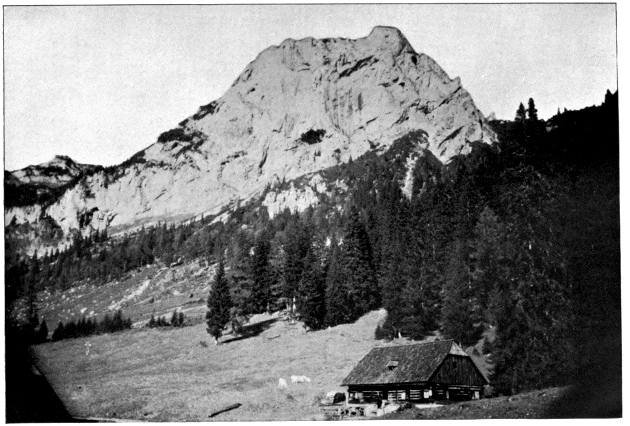
THE FRAUENMAUER AND THE GSOLL ALP.
The road led up a wooded valley, in a sort of series of steps, bits of even ground interspersed by steeper ones, with the Pfaffenstein-Frauenmauer limestone peaks poking up their jagged summits on the left. The sky was clear at starting, except in the west, where clouds were forming, and these gradually overspread the whole sky, and finally turned to rain. Just before we reached the Gsoll Alp, we went by a huge snow avalanche, which had fallen in February and torn a lane clear through the pines, bringing down numbers of them with it. The remains of the avalanche were banked up on the side of the road, which was cut out, and many of the pines were still piled on and in the snow. Stopping ten minutes at the alp to allow my guide to recuperate on some bread and milk, we then crossed the pastures and pushed up a rather steep slope by a small path, at one place crossing the remains of another avalanche. We also came near having the attentions of a little bull which was screaming viciously. My guide said it was an extremely disagreeable beast, but he did not think it would attack him, as he always made a point of giving it bread when at the châlet. We reached the entrance of the cave at a quarter-past eight.
A man and a boy from Eisenerz, who had heard I was going to the cavern and who wished to profit by my guide, caught up with us here. They were much disappointed when I told them I should visit only the Eiskammer. They went into the cave at the same time that we did, and eventually we left them pushing up one of the side chambers, with only one torch in their possession. My guide said he thought they were risking their lives, as there were many holes they might fall into, besides the probability of their finding themselves in total darkness. He told me that once, while in the cavern, he heard distant yells, and, going up the gallery whence they proceeded, found a man half dead, who said he had tried to come through the mountain by himself, had broken his lantern and had remained in the darkness an indefinite number of hours; a situation, the horror of which could not be realized by anyone who has not been underground without a light and felt the absolute blackness of a cavern.
The Frauenmauer is a limestone peak, 1828 meters in height, one of several forming a horseshoe round the Gsoll Alp. It presents on that side a sheer wall of rock, in which there are two holes close together, at an altitude of 1335 meters. These are the lower openings of the Frauenmauerhöhle, of which the higher and biggest one is used for an entrance. They are some thirty or forty meters from the base of the rock wall, and a flight of wooden steps leads up to the entrance opening, which is narrow and high. At the top of the steps, we stood in the mouth of the cave; and, going in four or five meters, saw the other opening to the left, below us. About five meters further, there was one small lump of ice, as big as a pumpkin, lying on the ground, but this may have been carried there from within. The cavern went nearly straight for some twenty-five meters from the entrance, rising all the time gently. Then came a steep little drop, of some four or five meters, in the rock floor, and here a small wooden staircase was placed. A gallery opened to the right and this was the cavern proper, which leads through the mountain. It rose considerably and contained no ice as far as we went, which was for some distance. The walking was bad, as the floor was covered with geröll, that is broken detritus.
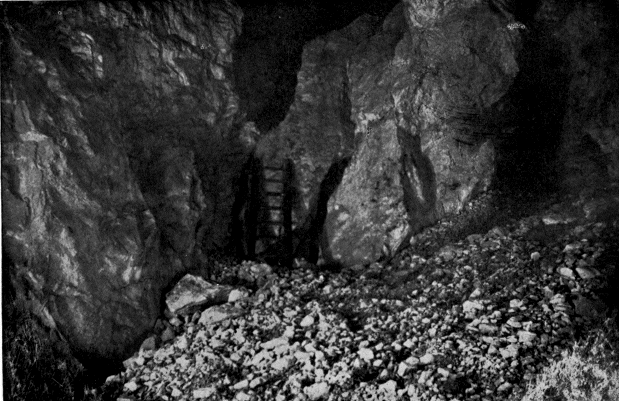
IN THE FRAUENMAUERHÖHLE.
From a Photograph by A. Kurka.
Returning and continuing towards the freezing chamber, the floor of the cavern began to rise once more, continuing for some forty-five meters to its highest point, which is lower, however, than the top of the entrance, an important fact to notice. For, although the floor of the cave is considerably higher, at a distance of seventy meters within, than the level of the bottom of the entrance; still, that highest spot is below the level of the top of the entrance. This fact, and also the size of the gallery, unquestionably explains why the cold air can get in as far as it does. At this highest spot we found a considerable mass of ice, a couple of cartloads in bulk perhaps, which the guide said would melt away later in the summer. This was, perhaps, the remains of a fallen stalactite. This mass of ice is an interesting point in connection with the Frauenmauerhöhle, for it shows that ice in a cave sometimes forms, even if in small quantities, above the level of the base of the entrance. There seems no reason why it should not do so, provided there is the necessary water supply. Such ice would, however, suffer more, as soon as the outside air was over freezing point, than would ice which was below the level of the entrance. It would probably disappear early in the year, unless the cave were in a latitude or at an altitude where snow remained in the open during most of the year.
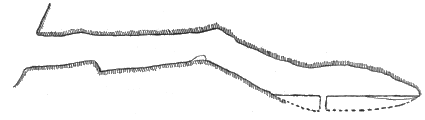
Fig. 5. Vertical Section of the Frauenmauerhöhle.
From this highest point, the cave turns somewhat to the left, and the floor begins to slope downward, sinking gradually to some six meters below the level of the entrance. Ten meters or so from the highest point, we began to find icicles and fissure columns, and about twenty meters further, we reached an almost level ice floor, stretching across the entire width of the cave—some seven meters—and extending about fifty meters more to the end of the cave. In several places there was much frozen rime on the rock walls. There were also a number of columns and icicles, though none of any special beauty. I broke a piece off one of them, and the ice was transparent and free from prisms, showing that this column was probably of fairly recent origin. Letting a bit melt in my mouth, the water tasted pure and sweet.
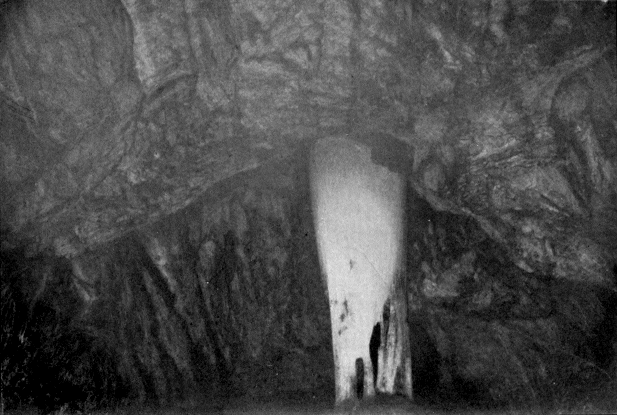
ICE STALACTITE, FRAUENMAUERHÖHLE.
From a Photograph by A. Kurka.
In two places, there were abgrunds, that is, holes in the ice. One of these was a wide, deep hole on the left side of the cave, between the rock and the ice floor. The other was a great hole in the ice floor itself. As the edges of both holes sloped sharply, it was impossible to get near enough to look into either, but I threw in lumps of ice, and from the sound should judge that the holes were about three meters deep. The hole in the ice floor seemed to be cut by drip, and I think they both carried off the drainage.
The ice floor was sloppy and thawing rapidly. At the furthest point we reached, within about fifteen meters from the end of the ice chamber, we were stopped by an accumulation of water lying on the ice. I poked into it with my ice axe and found it about twenty centimeters in depth. There was a crust of ice on top in places. The lake was cold, but I am sure the water was not freezing, as I held my hand in it at least a minute without pain. The guide assured me that in two weeks or so the lake would be completely frozen, provided there was some fine, warm weather; but, if there was rain, he said that it would not freeze. By this statement, he unintentionally explained, what he asserted was true, namely, that the cave froze harder in August than in July. The explanation of course is, that in fine, dry weather, water does not run into the cavern, and then the lake gradually drains off, leaving the ice floor free from water; and this the natives interpret to mean that the water has frozen up.
At the edge of the lake there was a fissure in the left hand rock wall, in which my companion assured me that a column would shortly form. I absolutely doubt this statement, as, if it were true, it would be contrary to everything I have seen; still, I wish I could have returned in August, to verify the matter. I poked my torch up the fissure, also felt in with my hand. It was cold, and on the rocks inside there was much hoar frost, but I could neither see nor feel any ice mass, nor am I sure how far the fissure extended.
The air was still, damp and over freezing point throughout the Eiskammer, and all the signs showed that the cave was in a state of thaw. Although the rocks are limestone and scarcely blackened by smoke anywhere, yet as our torches did not give much light, the color impression was black and gray, like the Schafloch.
At the hotel the landlord confirmed in every particular the story of the cave freezing hardest in August or September. He had never been there himself, but stated that everyone said the same thing, and that many people had “broken their heads” trying to account for it. At eight o’clock in the evening, my guide came to let me know that the man and boy, whom we left trying to penetrate the cave, had just turned up after making all their relatives extremely anxious. They were nearly lost, and had in general an extremely uncomfortable time. It is scarcely to be wondered at that accidents occur in caves and on mountains when people, with neither knowledge nor proper preparation, go wandering off by themselves into the unknown.[4]
THE MILCHHÄUSER OF SEELISBERG.
The summer of 1896, will long be remembered by Alpine climbers for the pitiless rain storm, which kept coming steadily down during the vacation months. It was in the midst of this that I arrived at Trieb, on the Lake of Lucerne, on the 6th of August, to see whether I could find the windholes which were reported near Seelisberg. At the landing place I found Herr J. M. Ziegler, the owner of the Hotel Bellevue at Seelisberg, who promptly secured a nice, blond bearded young fellow, a relative of his and his knecht, as a guide. It was pouring when we started, a proceeding which kept on during our entire excursion. We tramped up a narrow road, paved with great stones in the old Swiss fashion, and, as my guide truly said, awfully steep for horses.
Half an hour from the boat landing, took us to the first milkhouse, which belonged to Herr Ziegler. It was in a small patch of woods, and was placed against a cliff, where rocks had fallen down and formed a talus of broken detritus. The side walls of the house were built out from the cliff and roofed over, and the front wall had a doorway closed with a wooden door. At the back the detritus or geröll was built into a vertical, unplastered wall between most of the interstices of which, cool air came forth. Several of these interstices were fairly large holes of uncertain depth. It was a cool day and the air currents were only a little cooler than the temperature outside.
Another half an hour of uphill walking, partly on roads and partly over soaking meadows, took us to Seelisberg, where we stopped at the house of the owner of the second milkhouse, to get the key. The owner could not go with us because he had damaged his foot, by wearing great wooden shoes or sabots armed with enormous spikes, while cutting grass on steep slopes. He was hospitable enough: unlike his dog, who was exceedingly anxious to attack us. The owner said—in the intervals of the dog’s howls—that ice formed during the winter in the rear wall of his milkhouse and remained until about June. The milkhouse was in a little patch of woods against a small cliff, at the bottom of which were broken rocks. We had some difficulty in getting in, working for at least ten minutes at the lock, while drops of rain-water would occasionally drip into our coat collars. Just as I had given up hope, my companion succeeded in getting the key to turn. There were several pans, full of milk, placed to cool, and several barrels of potatoes; and, as at the first milkhouse, we found that the rear wall consisted simply of heaped up detritus built into a vertical position. Gentle air currents flowed from several large holes and from the cracks between the stones.
From here we went by a path through woods and over meadows down to the lake, coming to the shore some distance to the west of the steamboat landing. Everything was soaking wet, and as we proceeded, I felt my clothes getting wetter and my shoes absorbing water like sponges until, when we came to an overflowing brook, wading through seemed rather pleasant. There is one advantage of getting thoroughly wet feet in the mountains: it makes crossing streams so much easier, as one does not delay, but simply steps right in.
The lower milkhouse was on the shore of the lake, near the house of a fisherman, whose wife opened the door for us. There was some milk in pans and several barrels of wine; and on a board were a number of ferras from the lake; the result of two days’ catching in nets. This was the largest of the three milkhouses; although it did not have as many big holes in the rock wall as the others, but only the interstices between the blocks of rock, whence we could feel cool air flowing out. The woman said that the ice melted away by April or May, but that in winter the wine barrels were all covered with frost. She also said that the air coming from the clefts in summer was colder when the weather was warm, than when it was rainy. Doubtless the temperature of the draughts remains the same during the summer, but the air feels cooler to the hand when the outside air is hot.
A walk of another half hour, through more soaking wet grass, brought us back to the steamboat landing at Trieb, where I touched my guide’s heart with the gift of a five franc piece, and had a talk with Herr Ziegler. He said that there were a number of places in the neighborhood whence cold air came forth during the summer from cracks in the rocks: that there were also other milkhouses, notably one at Tell’s Platte, on the lake: and that the milkhouses were not generally used in winter, when the doors were left open, to allow the cold air to penetrate as much as possible through the rocks behind. During the winter the draughts were reversed, and poured in instead of out of the openings, and Herr Ziegler thought that at that time the interior of the rock cracks became chilled, and that possibly ice formed in them which helped to chill the summer currents, when the draughts poured out from the holes.
THE GLACIÈRE DE LA GENOLLIÈRE.
On Tuesday, the 11th of August, 1896, a cool and rainy day, I left Geneva and went by train to Nyon, where I found at the station a little victoria, in which I drove up to Saint-Cergues. The road lay across the plain to the base of the slopes of the Jura, and then up these in long zigzags; it was admirably built and on the hill slopes passed the whole way through a beautiful thick forest, principally beeches and birches. At Saint-Cergues, I went to the Pension Capt, where the landlady soon found a guide in the shape of the gendarme of the district, a right good fellow, Amy Aimée Turrian by name. He was in uniform, with an army revolver in a holster at his belt. We then drove about half an hour beyond Saint-Cergues, the road rising but little, and the thick forest giving place to a more open wood of evergreens, with patches of pasturage. As a forest sanitarium, Saint-Cergues seems unsurpassed in the whole of Europe. The carriage turned up a little country road, which soon became too rough for driving, so we proceeded on foot for about another half hour, through pine woods and pastures, to the glacière. Turrian enlivened the way with an account of his life as a gendarme, of the long solitary six hour patrols in the woods in winter, and of how he lay in ambush for poachers. He said he would not take long to fire on anyone resisting arrest, as that was sérieux.
The glacière is in the middle of a pasture, with several pine trees overhanging it. It is surrounded by a wall, built to prevent the cows from falling in. There are two pits, side by side and about three meters apart: they are some thirteen meters in depth, with a width of five or six meters. They open into one another at the bottom; the rock separating them, forming a natural bridge overhead. One of the pits is vertical on all sides. The other is vertical all around, except on the side furthest away from the natural bridge. Here the side of the pit is in the shape, so usual in glacières, of a steep slope. Down this slope we descended. It was slippery and muddy, owing to the recent heavy rains, and my ice axe proved invaluable and probably saved me some unpleasant falls. Under the bridge, the floor was covered with a mass of shattered limestone debris, among which there was neither ice nor snow; both of which my guide said he had found in abundance the preceding June. A little limestone cavern opened on one side below the bridge. A great, flat limestone slab formed a natural lintel, and, lighting our candles, we stooped down and passed under it into the cave, which was about the size of a room and in which we could just stand up. At the entrance and over most of the floor there was ice, in one place thirty or forty centimeters in depth, as I could see where a drip from the roof had cut a hole. There were no signs of icicles or columns. My guide said he had never penetrated into this chamber, which he thought, on his earlier visit, was blocked with ice and snow. I did not see any limestone stalactites anywhere, and I am inclined to think that the low temperatures of glacières have a tendency to prevent their formation.
After our visit, we went to the Châlet de La Genollière close by, where there were some thirty cows and calves. The intelligent berger or manager said that most of the ice from the glacière was used for butter making during the hot weather; and that between the inroads thus made upon it and from other causes, the ice disappeared every year before autumn, but that it formed afresh every winter; pretty good evidence to show that the ice in this cave has nothing to do with a glacial period. He also stated that when he first entered the inner chamber in the spring there were four ice columns there.
The glacière de La Genollière is a clear exemplification of the theory that the cold of winter is the sole cause for the ice. The whole glacière is rather small and is fairly well protected against wind. Although snow cannot fall directly under the rock arch, yet I should imagine it drifts under, or after melting, runs in and refreezes. To the inner cave snow, as snow, could hardly reach; and the cavern is probably filled, like most cave glacières, from frozen drip. The inner cave is, therefore, a true cave glacière, while the outer pits and the bridge are something between a gorge and a cave. La Genollière should, I think, be visited about the end of June, when the ice formations are certainly larger and more interesting than in August.
THE FRIEDRICHSTEINER OR GOTTSCHEER EISHÖHLE.
A little to the east of, and in about the same latitude as Trieste, is the small town of Gottschee, now reached by a branch railroad from Laibach. Gottschee is a German settlement almost in the centre of the district known as the Duchy of Krain, Austria, which is mainly inhabited in the north by Slavonians and in the south by Croatians. Gottschee lies directly at the western base of the Friedrichsteiner Gebirge, one of whose peaks is the Burgernock. On the eastern slopes of this mountain is situated the Friedrichsteiner or Gottscheer Eishöhle, at an altitude of about nine hundred meters.
On the 24th of June, 1897, I left Gottschee at half past six o’clock in the morning with Stefan Klenka, a nice little man. I had asked to have him come at six o’clock, but he did not turn up and I had to send for him. His excuse was, that tourists always ordered him for six o’clock, but when the time came, they were still in bed. He had taken a German officer and his wife to the cave the year before, and after keeping him waiting three hours, they started at nine o’clock. The result was that they did not get to the cave until two o’clock, and returned to Gottschee just at nightfall.
We reached the cave at half past eight o’clock. The steep and rough path went uphill through a fine forest, which my guide said was Urwald, i. e., primeval forest; and there were certainly some big trees and many fallen ones, and much underbrush. He assured me that bears were still plentiful in the neighborhood, and that Prince Auersperg, who owns the shooting, does not allow them to be killed, preferring to pay for any damage they may cause to the peasants’ fields or for any cattle they may dine on, rather than to have these interesting animals exterminated from his woods. He also said that there was a two meter snowfall in Gottschee in winter: a sufficient quantity to account for the glacières. At one place on the road we stopped before a small crack in the rocks, and Klenka dropped in some small stones, which we could hear strike two or three times a long distance below. There is surely an unexplored cavern at this spot.
The Friedrichsteiner Eishöhle is a large pit cave, well lighted by daylight. It is sheltered from any winds by the great trees which grow all around it and even over the rock roof. A long, steep slope leads straight into the pit and from the top the ice floor is in full sight. On both sides of the slope the rocks are almost sheer. Over the bottom of the slope the rock roof projects at a great height. The sides of the cave rise perpendicularly at least forty meters, and in fact, the cave suggests an unfinished tunnel set on end.
Some years ago, the Deutschen und Oesterreichischen Alpen Verein built a wooden staircase, in a series of zigzags, on the slope. This staircase should have been cleared off earlier in the year, but, of course, the matter was neglected. Down these steps we descended until they became covered with snow, and lower down with hard ice. All this was winter’s snow which fell directly on to the slope and gradually melted and froze again, so this was really a miniature glacier. It was not subterranean ice at all. We cut down the snow, but had to stop when we came to the ice, as it would have involved a couple of hours at least of the hardest kind of step cutting; and this my guide did not care to undertake, especially as he was nearly killed on this slope the week before. He had reached, with some tourists from Trieste, a place above that where we stopped, when he slipped and fell down the slope, shooting clear across the cave, where he remained until ropes were procured, and he was dragged out. He afterwards showed me the numerous cuts and bruises he had received on his perilous glissade.
We had to stop also for another reason. I had unwisely brought as wrap, a thick overcoat reaching to the knees, and this was such an impediment on the icy staircase, that I took it off, and soon began to feel long shivers creeping down my spine. This question of extra clothing for glacière exploration is hard to arrange. One must guard against most trying changes of temperature. For, on entering a big glacière, the heat of a July day without, will, at a distance of only a few meters, give place to the cold of a January day within, and nothing could be better devised than a big glacière to lay the seeds of rheumatism. It is difficult to plan a garb suitable to meet all the varying conditions, but the dress must be cool and warm, and light enough to permit free motion. The clothes I have found most practical are a thin waistcoat and thick trousers, and two short sack coats, one of them a heavy winter one. The coats should button at the throat, and it is well to place straps round the bottom of the trousers. Thick kid gloves should always be worn in caves, to save cutting the hands on rocks or ice in the darkness, and hobnails may prevent some unpleasant slips.
From the point where we stopped, some ten meters away from the ice floor, the largest portion of the cave was visible. The finest object was a big ice curtain or vorhang, as my guide called it, which, from a height of five or six meters, flowed down from fissures to the ice floor, and which covered the rocks on the eastern side. Under one point of this curtain, Klenka said that there was a deep hole in the ice. Smaller fissure columns also streamed from the rear wall to the ice floor. The ice floor itself was flat, of an ochre greenish tinge, and was covered with broken ice fragments. We could not see the western portion of the cavern, as the rocks jutted out in a sort of corner. Klenka said that there were several small pyramids there; a large one which he spoke of as the Altar; and a small ice slope, plastered on the side rocks.
The sides of the cave were of a dark gray limestone rock, and from the top of the slope they assumed a decidedly bluish tone, and I am inclined to think that there was already—we were there from eight-thirty A. M. until ten A. M.—a faint mist in the cavern. This is the most interesting phenomenon connected with the Friedrichsteiner Eishöhle. The cavern faces due south, and about midday, in clear weather, the sun shines directly into it, causing a mist or cloud to form in the cave on warm days; a mute witness that evaporation is connected with the melting, not with the forming, of the ice. The air at every point seemed still.
On my return to Gottschee, I called on one of the professors of the K. K. Gymnasium, and he told me many interesting facts about the surrounding country. Among other things he said that no traces of a glacial period or indeed of glaciers were found in the Krain; and as this district is particularly rich in glacières, this fact is a strong proof against the glacial period theory. He assured me also that many bears still existed in the neighborhood; that one family was known to inhabit the woods round the Friedrichsteiner Eishöhle, and that he had often seen bear tracks on his own shooting, some ten kilometers to the south.
THE SUCHENREUTHER EISLOCH.
On the 25th of June, 1897, I left Gottschee at six-thirty A. M. in an einspänner, and drove thirteen kilometers southward, over a good road, albeit hilly in places, to Mrauen, which we reached in about two hours. The weather was exceedingly hot. I took Klenka along, as he spoke German, and he entertained me on the drive by telling me that there were many poisonous snakes in the country, of which the kreuzotters or vipers were the worst, and that three or four persons were bitten every year.
Mrauen is in Croatia, and I could see a slight difference in the people and their dress from those of Gottschee. From Mrauen, the landlord of the Gasthaus Post, Josef Sirar, led us to the Grosses Eisloch. This is sometimes spoken of as the Eisloch bei Skrill, but as it lies in a patch of woods below the village of Suchenreuth, the Suchenreuther Eisloch seems the correct name. At least that was what Sirar called it. It took us about an hour on foot from Mrauen to get into the woods. On the way we met two guards in uniform, carrying Männlicher carbines with fixed bayonets, and it was agreeable to feel that the strong arm of the Austrian government extended over this semi-wild land. In the woods, following Sirar’s able guidance, we took a short cut—always a mistake—and were lost temporarily in a maze of bushes and brambles, in which I thought of the kreuzotters. After that, Sirar at first could not find the cave and had to hunt around for it, while I sat on a stone and waited impatiently.
At the cave a rather steep slope of wet mud, covered with dead leaves, led down through a rock arch. Sirar had to cut several steps in the mud with his hatchet, or we should probably have sat down suddenly. The archway opened into a moderately large cavern, which was about twenty meters deep, almost round and some fifteen meters in diameter. The slope continued right across the cave, and on some parts of it were logs of wood and much débris. On the wall hung a few limestone stalactites. In the roof of the cave was a great hole, and under this was a big cone of old winter snow, which had become icy in its consistency, and on which there was much dirt and many leaves. The temperature in the cave was several degrees above freezing point, and there was no ice hanging anywhere. Sirar said that when the weather got hotter, the ice would come; but as he said also, that he had been only once before in the cave, some ten years ago, his opinion was not worth much. Both men said that the preceding winter was unusually warm.
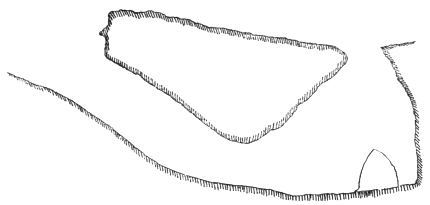
Fig. 6. Vertical Section of the Suchenreuther Eisloch.
THE NIXLOCH.
Near Hallthurm in Bavaria, a railroad station between Reichenhall and Berchtesgaden, is a well known congeries of windholes, called the Nixloch. I visited it on Friday, July the 2d, 1897, with a railroad employee, whom I found at the peasants’ gasthaus.
The Nixloch is ten minutes distant in the forest, on the slopes of the Untersberg. It is among a mass of big limestone blocks, and close by are the remains of the walls of an old castle or fortification. The Nixloch descends from the entrance for about two meters nearly sheer, and there is just room to get through. As I sat within the outside edge of the mouth of the cave, the smoke of my cigar was slowly carried downward into it.
Dropping down through the hole, we found ourselves in a small cavern formed of rough limestone blocks overhead and underfoot. It is possible to go still further down and my companion said that formerly it was possible to go through the cave and come out at a lower opening; this exit, however, was destroyed when the railroad was built. The draught, as tested by the flame of a candle, was still drawing in some seven or eight meters from the entrance. There is a second cavity immediately next to the entrance, and at the bottom of these holes, the inward draught was so violent as to blow the candle out. The thermometer outside in the shade was 28°C.; inside the cave, where the draught was still perceptible, it was about 20°C. Within the cave I noticed two large, dark brown spiders.
On returning to the gasthaus, I had a talk with some peasants who were dining there, and they told me that it was warm in winter in the Nixloch, and that ice never formed there.
THE DORNBURG.
If one draws a line northeast from Coblentz and another northwest from Frankfort-on-the-Main, they will intersect nearly at the Dornburg. The railroad from Frankfort goes, via Limburg and Hadamar, to Frickhofen and Wilsenroth, from either of which villages the ice formations of the Dornburg are easily reached on foot in half an hour.
I arrived at Wilsenroth on the 26th of July, 1897, and soon found an old forester, who said he had lived in the neighborhood for over fifty years, to show me the way. The Dornburg is a low hill, perhaps a hundred meters high and a kilometer long. It is basaltic and covered with sparse woods. The forester said that on top were the remains of the foundations of an old castle, and that this was possibly the origin of the name Dornburg. We circled round the eastern base of the hill for some ten minutes, when we came to a little depression, filled with basalt debris, among which were several small holes, out of which came currents of cool air.
Ten minutes further in the woods, we arrived at the Dornburg Restauration and then almost immediately at the glacière. It is at the bottom of a talus of broken basaltic rocks and has been much affected by the agency of man. In it are two eislöcher or stollen, as the forester called them. These are little artificial pits or cellars, dug into the talus. They are side by side, opening about southeast, and each is about one and a half meters wide, three meters long, and two meters high. The sides are built up with wooden posts and overhead is a thick roof of logs strewn with dirt. The day was cool and at the mouth of each eisloch, a faint outward current of air was discernible at nine-thirty A. M. I could not find any currents coming into the eislöcher. Inside it was cold and damp, and evidently thawing. There was a good heap of ice in each eisloch; it was clear, and I could detect no trace of prisms.
By much questioning, I dug out something of the history of these stollen from the forester. Formerly the ice was found at this spot, among the boulders at the base of the slope. But the people gradually took many of these basaltic blocks away, to break up for road making, and then the ice diminished. About 1870, a brewery, since burnt, was built at the Dornburg and the brewer had these stollen built, a sort of semi-natural, semi-artificial ice house. Every winter, the present owner of the stollen throws a quantity of snow into them, and this helps materially in forming the mass of ice.
Just below the restaurant there is a spring, which was said to be extremely cold, but there was nothing icy nor apparently unusual about it.
Under the restaurant itself is an interesting cellar. It was closed by wooden doors. First there was a passage way which turned steadily to the right, and which we descended by some ten steps. This was about two meters wide and was full of beer bottles and vegetables. On the left of the passage was a large double chamber where meat is kept. At eleven-thirty A. M. a faint draught blew down the passage and into the hall, the outside door being then open. The double hall was perhaps six meters each way, and I could detect no air currents coming into it at any place, except from the passage way. Both passage and halls were, as far as I could see, entirely built over with masonry. There was no ice and the temperature was some 7° or 8° above freezing point.