The Third Day
Reading edition
CANNONADE AT DAWN: CULP’S HILL AND SPANGLER’S SPRING.
Night brought an end to the bloody combat at East Cemetery Hill, but this was not the time for rest. What would Meade do? Would the Union Army remain in its established position and hold its lines at all costs? At midnight Meade sought the advice of his Council of War in the east room of his headquarters. The corps commanders—Gibbon, Williams, Sykes, Newton, Howard, Hancock, Sedgwick, and Slocum—without exception advised holding the positions established. Meade, approving, turned to the officer whose division held the Union center, and said, “Gibbon, if Lee attacks me tomorrow it will be on your front.”
Meade on the following morning began to fortify Cemetery Ridge by shifting all units that could be spared from the line at Culp’s Hill, and those in reserve at the Round Tops and on Cemetery Hill. General Hunt, Chief of Artillery, brought up reserve batteries to hold in readiness for replacement of front line guns. Throughout the forenoon of the third day, Meade not only developed a strong front at the stone walls on the crest of the ridge, but he also strengthened his reserve power to an extent which rendered the Union center almost impregnable.
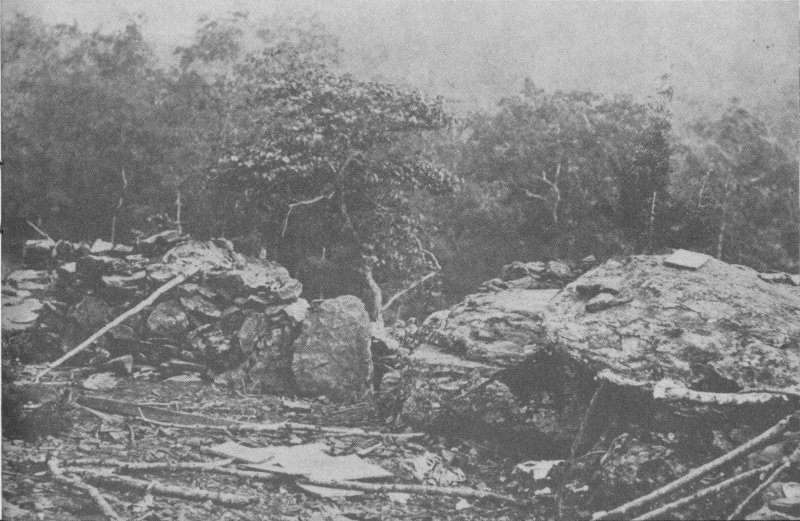
Interior of breastworks on Little Round Top. (Brady photograph.)
Meanwhile, important movements were occurring elsewhere on the field. Ruger’s division and Lockwood’s brigade, which had been called from their lines on the south slope of Culp’s Hill the previous evening to help defend Sickles’ position at the Peach Orchard, were now countermarching, under cover of darkness, to reoccupy their ground. Geary, 20 who had misunderstood orders and had marched down the Baltimore Pike, was also returning to his works. Ruger’s men, upon reaching the Pike, learned from scouts that their entrenchments south of Culp’s Hill and at Spangler’s Spring had been occupied by the Confederates. Ruger, resolving upon an attack at daybreak, organized his forces along the Pike. Powerful artillery units under Muhlenberg were brought into place along the road; Rigby’s Maryland battery was stationed on Power’s Hill, a prominent knoll a half mile to the south; and another battery was emplaced on McAllister Hill.
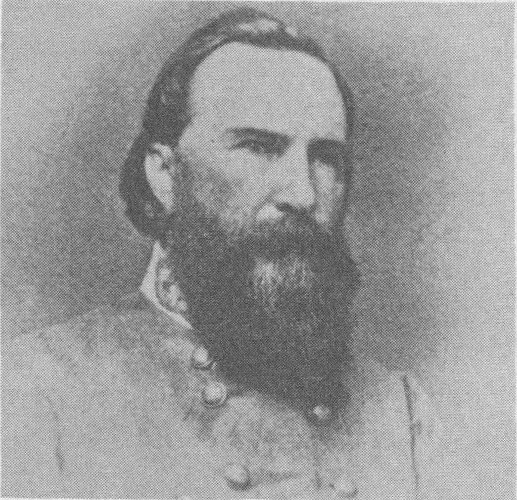
Lt. Gen. James Longstreet. Courtesy National Archives.
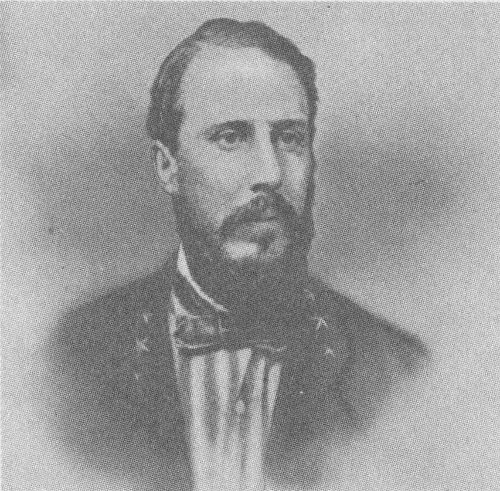
Col. Edward Porter Alexander. Courtesy National Archives.
As dawn broke on July 3, Union guns on the Baltimore Pike opened with a heavy cannonade on Johnson’s Confederates at Spangler’s Spring. The heavily wooded area about the Confederate lines prevented them from bringing guns into position to return the fire. Union skirmishers began streaming across the field toward the Confederate entrenchments. The full force of Ruger’s and Geary’s brigades followed closely. Throughout the forenoon the Union troops struck again and again.
It was about 10 o’clock that Ruger, believing that a flank attack might break the resistance of Johnson’s men, ordered Col. Silas Colgrove to strike the Confederate left flank near the spring. The troops of the 2d Massachusetts and the 19th Indiana regiments started across the swale from the cover of the woods on the little hill south of the spring. A withering fire slowed their pace, but they charged on, only to have their ranks decimated by the Confederates in strong positions back of a stone wall. Colonel Mudge, inspiring leader of the Massachusetts regiment, fell mortally wounded. Forced to fall back, the men soon learned their efforts had not been in vain. On Ruger’s and Geary’s front the Confederates were now giving way and soon had retired across Rock Creek, out of striking range. By 11 o’clock, the Union troops were again in possession of their earthworks; again they could quench their thirst in the cooling waters of the spring.
21
LEE PLANS A FINAL THRUST.
General Lee must have learned by mid-forenoon, after the long hours of struggle at Culp’s Hill and Spangler’s Spring, that his troops could not hold the Union works which they had occupied with so little effort the previous evening. He had seen, also, that in the tremendous battling during the preceding afternoon no important gains had been made at Little Round Top and its vicinity. Longstreet had gained the advantageous ridge at the Peach Orchard and had brought his batteries forward from Pitzer’s Woods to this high ground in preparation for a follow-up attack. Wright’s brigade, the last unit to move forward on July 2 in the echelon attack begun by General Law, had charged across the open fields at dusk and pierced the Union center just south of the copse of trees on Cemetery Ridge. Wright’s success could not be pressed to decisive advantage as the brigades on his left had not moved forward to his support, and he was forced to retire. Again, lack of coordination in attack was to count heavily against the Confederates.
The failure to make any pronounced headway on July 2 at Culp’s Hill and Little Round Top, and the momentary success of Wright on Cemetery Ridge, doubtless led Lee to believe that Meade’s flanks were strong and his center weak. A powerful drive at the center might pierce the enemy’s lines and fold them back. The shattered units might then be destroyed or captured at will. Such a charge across open fields and in the face of frontal and flank fire would, Lee well understood, be a gamble seldom undertaken. Longstreet strongly voiced his objection to such a move, insisting that “no 15,000 men ever arrayed for battle can take that position.”
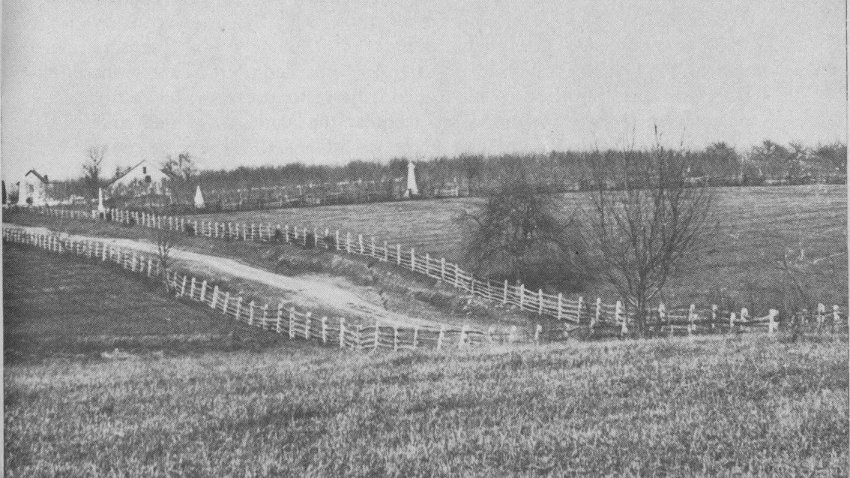
View of the Peach Orchard and the Emmitsburg Road in 1890. The Wentz farm buildings appear at the left. (Tipton photograph.)
22
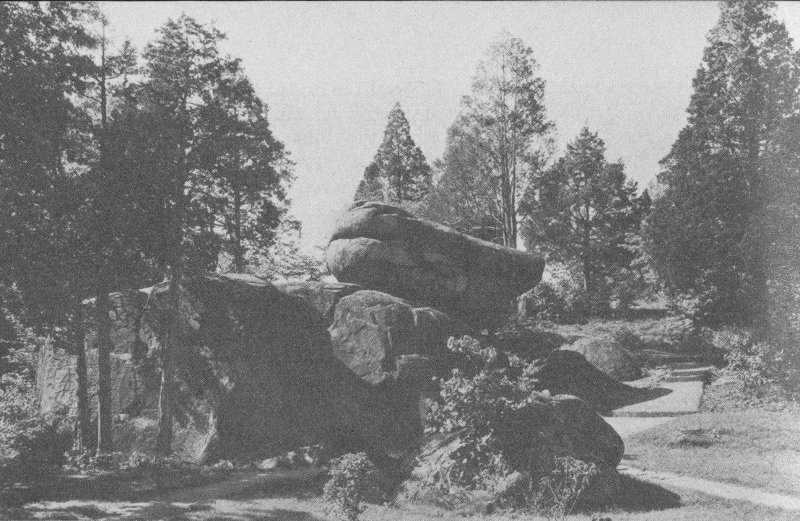
Devil’s Den, a formation of large granite boulders, used as defense positions by Confederate sharpshooters.
Time now was the important element. Whatever could be done must be done quickly. Hood’s and McLaws’ divisions, who had fought bravely and lost heavily at Round Top and the Wheatfield, were not in condition for another severe test. Early and Johnson on the left had likewise endured long, unrelenting battle with powerful Union forces in positions of advantage. The men of Heth’s and Pender’s divisions had not been heavily engaged since the first day’s encounter west of Gettysburg. These were the men, along with Pickett’s division, whom Lee would have to count on to bear the brunt of his final great effort at Gettysburg.
LEE AND MEADE SET THE STAGE.
Late in the forenoon of July 3, General Meade had completed his plan of defense in rear of the Union center by the concentration of all available infantry units. General Hunt, sensing the danger, placed a solid line of batteries in position on the crest of the ridge and brought others to the rear for emergency use. As a final act of preparation, Meade inspected his front at the stone wall, then rode southward to Little Round Top. Here, with General Warren, he could see the long lines of Confederate batteries and the massing of troops, a sure indication of attack. Meade rode back to his headquarters.
Lee, on his part, had observed in the forenoon the enemy in the process of concentration on Cemetery Ridge. Having reached his decision to strike the Union center, he had already begun the movement of batteries from the rear to points of advantage. By noon, 138 guns were in line from the Peach Orchard northward to the Seminary buildings, many 23 of them only 800 yards from the Union center. To Colonel Alexander fell the lot of directing the artillery fire and informing the infantry of the best opportunity to advance.
Massed to the west of Emmitsburg Road, on low ground which screened their position from the Union lines, lay Gen. George Pickett’s three brigades commanded by Kemper, Armistead, and Garnett. Pickett’s men had arrived the previous evening from Chambersburg, where they had guarded Lee’s wagons on July 1 and 2. As the only fresh body of troops on the field, they were now to spearhead the charge. On Pickett’s left, the attacking front was fast being organized. Joseph Pettigrew, a brigadier, was preparing to lead the division of the wounded Major General Heth and Maj. Gen. Isaac Trimble took the command of Pender. More than 10,000 troops of these two divisions—including such units as the 26th North Carolina whose losses on the first day were so heavy that the dead marked their advance “with the accuracy of a line at a dress parade”—now awaited the order to attack. Many hours earlier, the Bliss farm buildings, which lay in their front, had been burned. Their objective on the ridge was in clear view. The brigades of Wilcox and Lang were to move forward on the right of Pickett in order to protect his flank as he neared the enemy position.
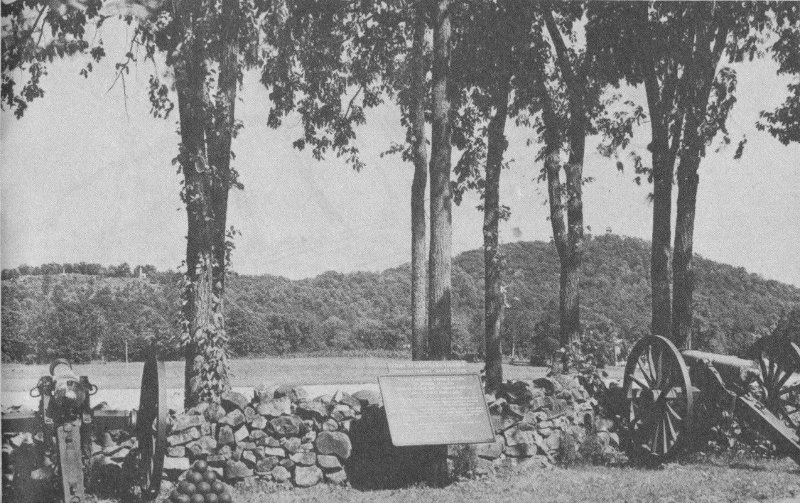
The Round Tops as they appear from Longstreet’s battle line one mile away.
General Stuart, in the meantime, had been out of touch with Lee. Moving northward on the right flank of the Union Army, he became involved in a sharp engagement at Hanover, Pa., on June 30. Seeking to regain contact with Lee, he arrived at Carlisle on the evening of July 1. As he began shelling the barracks, orders arrived from Lee and he at once marched for Gettysburg, arriving north of the town the next day. Lee now decided to employ his cavalry to cut off Union retreat which might result from a successful attack on the center. Stuart was instructed to swing eastward and then south around Gettysburg the morning of July 3 in order to arrive in the rear of the Union lines at the time Pickett was expected to charge the center.
24
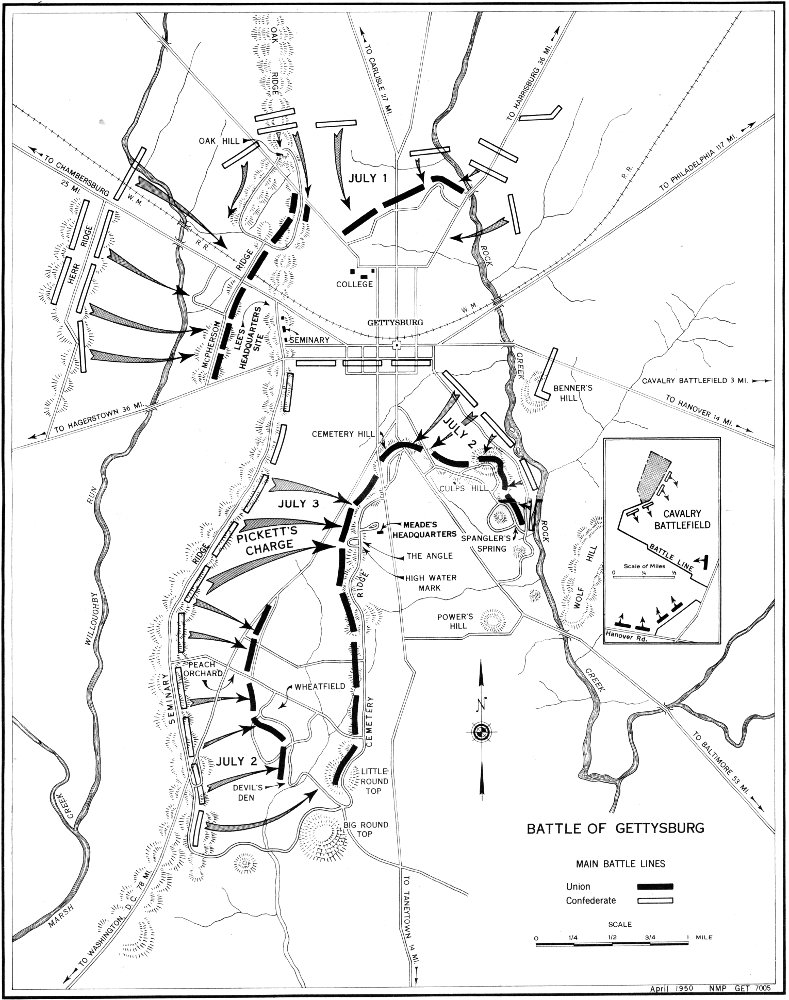
BATTLE OF GETTYSBURG
26
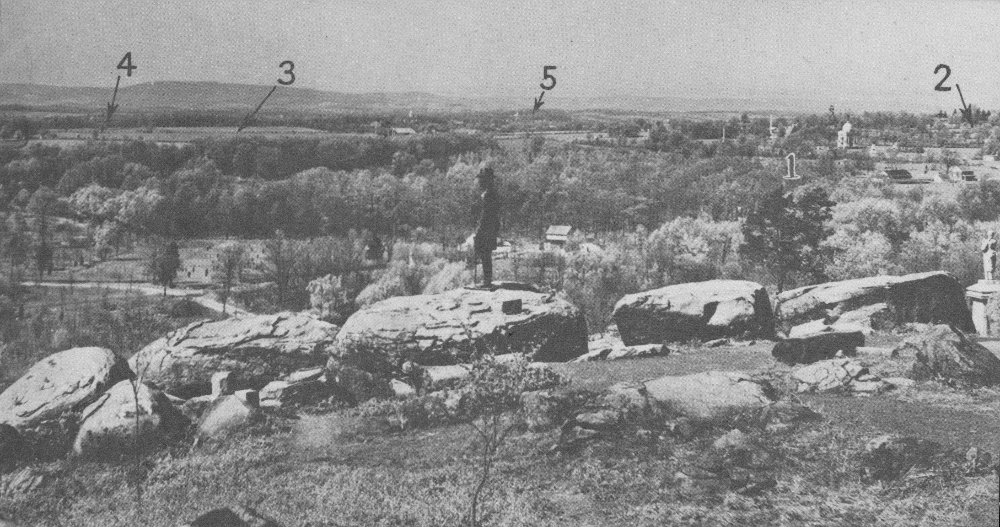
View northward from Little Round Top. 1. Cemetery Ridge. 2. Cemetery Hill. 3. Field of Pickett’s Charge. 4. Seminary Ridge. 5. Oak Hill. The statue of G. K. Warren appears in the foreground.
27
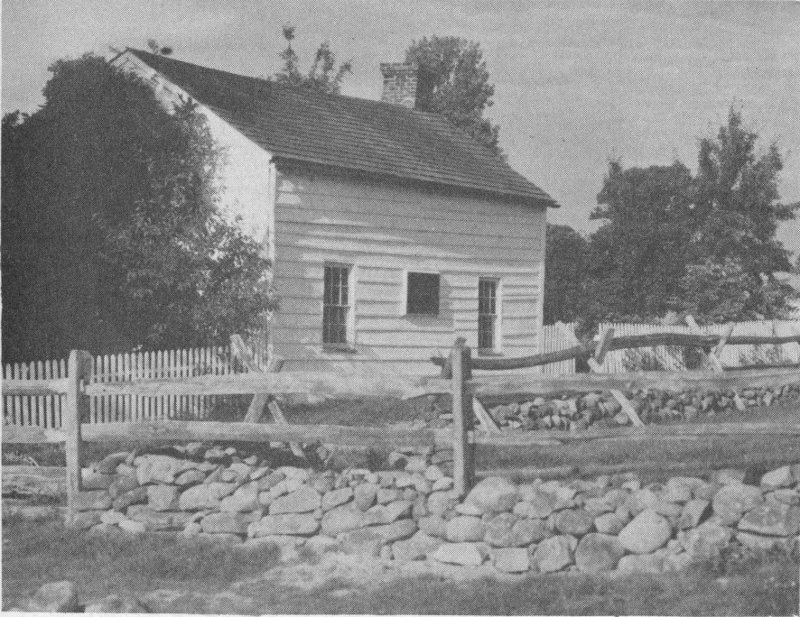
Meade’s headquarters as it appears today.
Except for the intermittent sniping of sharpshooters, an ominous silence prevailed over the fields. The orders had now been given; the objective had been pointed out. Men talked of casual things. Some munched on hard bread, others looked fearfully to the eastward, where, with the same mixed feelings, lay their adversary.
Far to the south, on another crucial front, General Pemberton was penning a letter to General Grant asking terms for the surrender of Vicksburg. In Richmond, the sick and anxious Jefferson Davis looked hopefully for heartening word from his great field commander at Gettysburg. The outcome of this bold venture would count heavily in the balance for the cause of the Confederacy.
ARTILLERY DUEL AT ONE O’CLOCK.
At 1 o’clock two guns of Miller’s Battery, posted near the Peach Orchard, opened fire in rapid succession. It was the signal for the entire line to let loose their terrific blast. Gunners rushed to their cannon, and in a few moments the massed batteries 28 shook the countryside. Firing in salvos and in succession, the air was soon filled with smoke and heavy dust, which darkened the sky. Union gunners on Cemetery Ridge waited a few minutes until the positions of the Confederate batteries were located; then 80 guns, placed it close order, opened fire. For nearly 2 hours the duel continued, then that Union fire slackened. Hunt had ordered a partial cessation in order to cool the guns and to replace broken carriages.
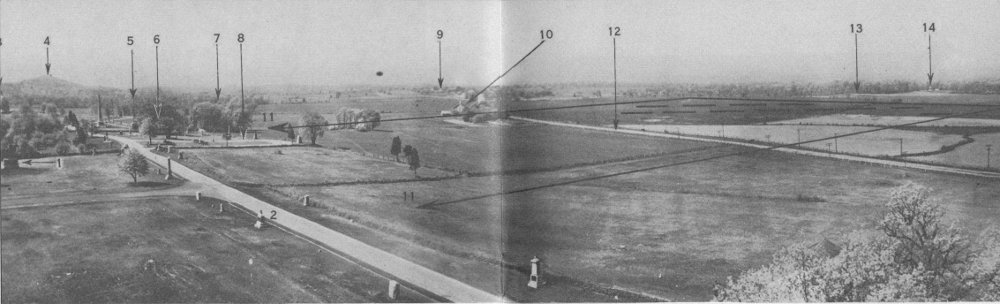
Panorama of the battlefield from Cemetery Ridge. 1. General Meade statue. 2. Cemetery Ridge (Union position). 3. Little Round Top. 4. Big Round Top. 5. Devil’s Den. 6. High Water Mark—farthest advance of Pickett’s Charge. 7. The Wheatfield. 8. The Angle. 9. The Peach Orchard. 10. Codori Buildings. 11. Field of Pickett’s Charge. 12. Emmitsburg Road. 13. Seminary Ridge (Confederate position). 14. Virginia Memorial.
Colonel Alexander, in position on the Emmitsburg Road near the Peach Orchard, could observe the effectiveness of his fire on the Union lines and also keep the Confederate troops in view. To him, it appeared that Union artillery fire was weakening. His own supply of ammunition was running low. Believing this was the time to attack, Alexander sent a message to Pickett who in turn rode over to Longstreet. General Longstreet, who had persistently opposed Lee’s plan of sending 15,000 men across the open ground, was now faced with a final decision. Longstreet merely nodded approval and Pickett saluted, saying, “I am going to move forward, sir.” He rode back to his men and ordered the advance. With Kemper on the right, Garnett on the left, and Armistead a few yards to the rear, the division marched out in brigade front, first northeastward into the open fields, then eastward toward the Union lines. As Pickett’s men came into view near the woods, Pettigrew and Trimble gave the order to advance. The troops of the Carolinas, Tennessee, and Mississippi, comprising the brigades of Mayo, Davis, Marshall, and Fry in front, followed closely by Lane and Lowrance, now moved out to 29 attack. A gap of half a mile between Pickett’s left and Pettigrew’s right would be closed as the advance progressed. The units were to converge as they approached the Union lines so that the final stage of the charge would present a solid front.
CLIMAX AT GETTYSBURG.
Billows of smoke lay ahead of the Union men at the stone wall, momentarily obscuring the enemy. But trained observers on Little Round Top, far to the south, could see in the rear of this curtain of smoke the waves of Confederates starting forward. Pickett, finding his brigades drifting southeastward, ordered them to bear to the left, and the men turned toward the copse of trees. Kemper was now approaching on the south of the Codori buildings; Garnett and Armistead were on the north. Halted momentarily at the Emmitsburg Road to remove fence rails, Pickett’s troops, with Pettigrew on the left, renewed the advance. Pickett had anticipated frontal fire of artillery and infantry from the strong Union positions at the stone walls on the ridge, but now an unforeseen attack developed. Union guns as far south as Little Round Top, along with batteries on Cemetery Hill, relieved from Confederate fire at the Seminary buildings, opened on the right and left flanks. As Pickett’s men drove toward the Union works at The Angle, Stannard’s Vermont troops, executing a right turn movement from their position south of the copse, fired into the flank of the charging Confederates. The advancing lines crumbled, re-formed, and again pressed ahead under terrific fire from the Union batteries.
30
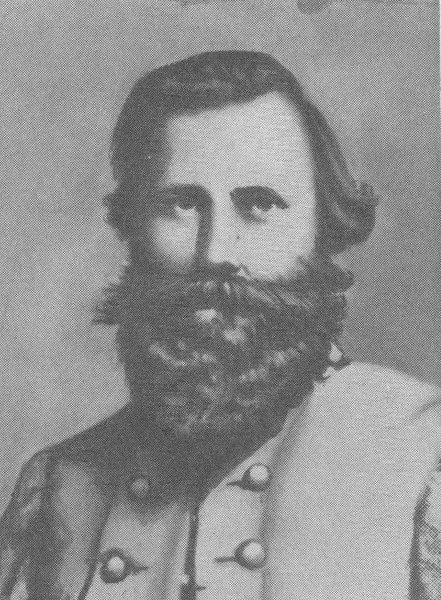
Maj. Gen. J. E. B. Stuart. Courtesy National Archives.
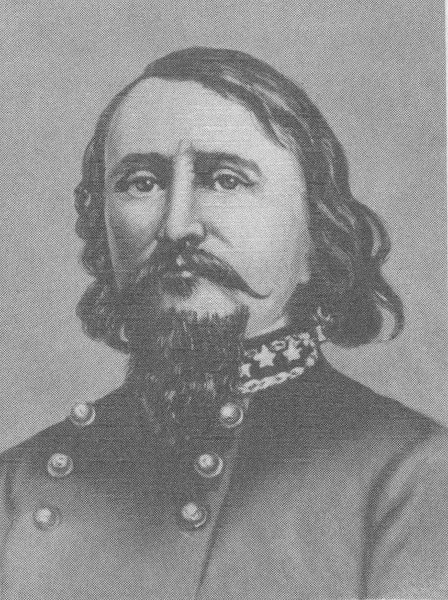
Maj. Gen. George E. Pickett. Courtesy National Archives.
A hundred yards from the stone wall, in the tall grass, they encountered Union skirmishers who fired and hastily withdrew. But all along the wall the Union infantry opened with volley after volley into the depleted ranks of Garnett and Fry. Armistead closed in, and with Lane and Lowrance joining him, made a last concerted drive. At this close range, double canister and concentrated infantry fire cut wide gaps in the attacking front. Garnett was mortally wounded; Kemper was down, his lines falling away on the right and left. Armistead reached the low stone fence. In a final surge, he crossed the wall with 150 men and, with his cap on his sword, shouted “Follow me!” At the peak of the charge, he fell mortally wounded. From the ridge, Union troops rushed forward and Hall’s Michigan regiments let loose a blast of musketry. The gray column was surrounded. The tide of the Confederacy had “swept to its crest, paused, and receded.”
Two of the divisions in the charge were reduced to mere fragments. In front of the Union line, 20 fallen battle flags lay in a space of 100 yards square. Singly and in little clumps, the remnants of the gray columns that had made the magnificent charge of a few minutes earlier now sullenly retreated across the fields toward the Confederate lines. Lee, who had watched anxiously from Spangler’s Woods, now rode out to meet his men. “All this has been my fault,” he said to General Wilcox who had brought off his command after heavy losses. “It is I that have lost this fight, and you must help me out of it in the best way you can.” And again that night, in a moment of contemplation, he remarked to a comrade, “Too bad! too bad! Oh! too bad!”
31
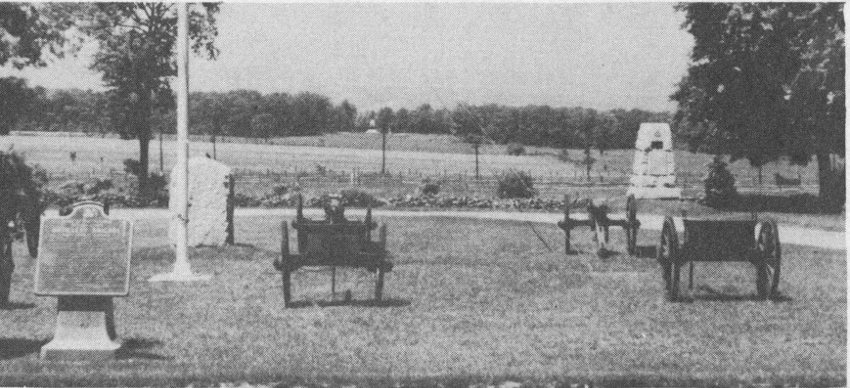
The Angle, showing the stone wall and the fields’ over which Pickett’s troops charged. The Virginia Memorial appears in the background on Seminary Ridge.
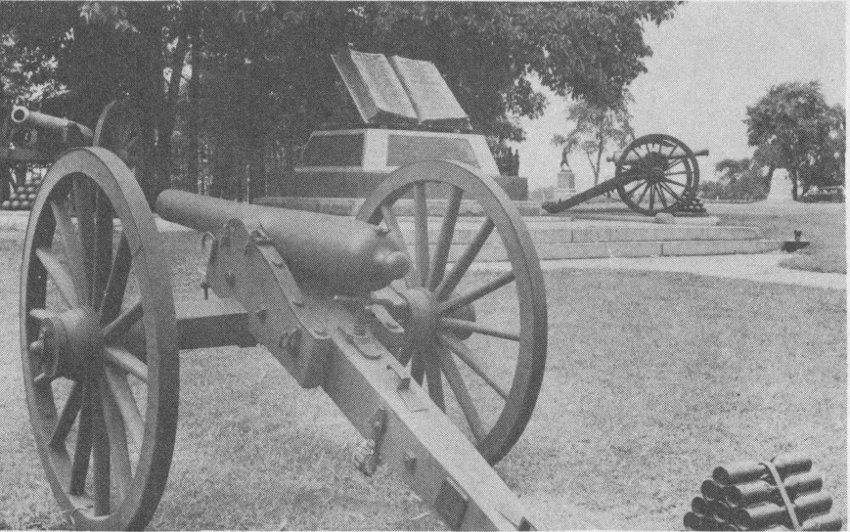
The High Water Mark Monument, which marks the farthest advance made by the Confederates against the Federal position in Pickett’s Charge.
CAVALRY ACTION.
As the strength of Lee’s mighty effort at The Angle was ebbing and the scattered remnants of the charge were seeking shelter, action of a different kind was taking place on another field not far distant. Early in the afternoon, Stuart’s cavalry was making its way down the valley of Cress Run, 3 miles east of Gettysburg. The brigades of Hampton and Fitzhugh Lee, at the rear of the line of march, momentarily lost the trail and came out into open ground at the north end of Rummel’s Woods. Stuart, soon learning of the mistake, attempted to bring them into line and to proceed southward. But at this point, Gen. D. M. Gregg’s Union cavalry, in position along the Hanover Road a mile southeast, saw the Confederates. Gregg prepared at once to attack, and Stuart had no choice but to fight on this ground. As the two forces moved closer, dismounted men opened a brisk fire, supported by the accurate shelling of artillerists.
32
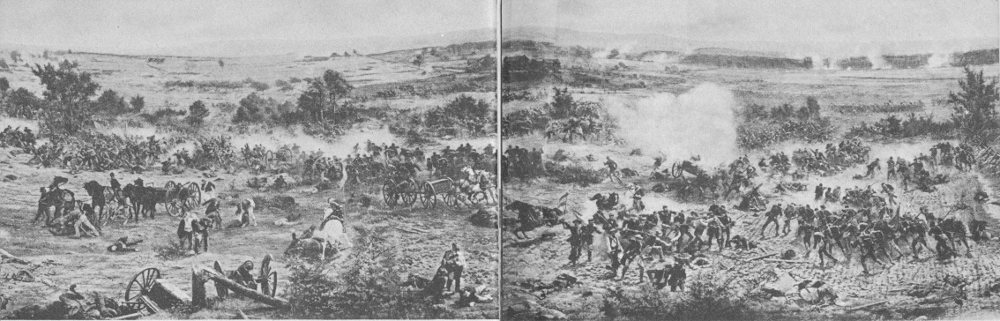
Section of the Cyclorama painting of Pickett’s Charge by Paul Philippoteaux. Courtesy Times and News Publishing Company.
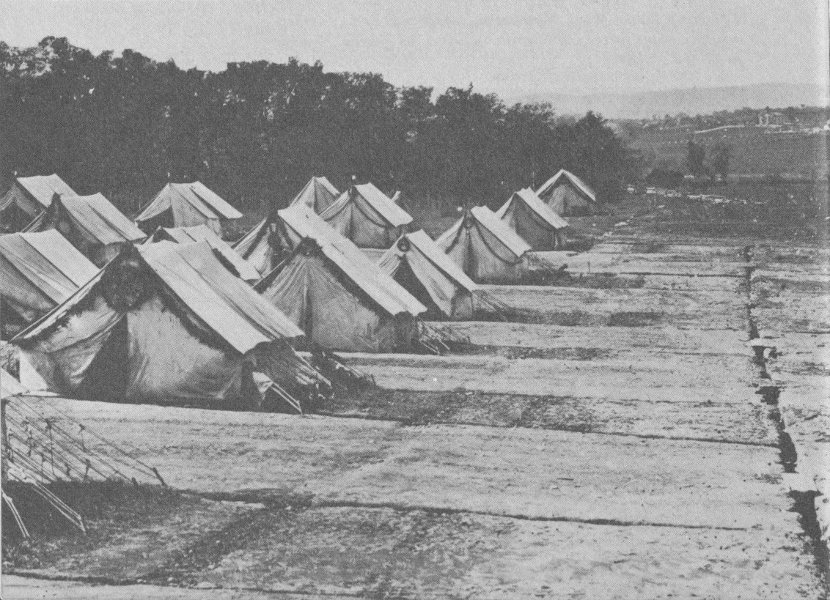
The General Hospital one mile east of Gettysburg. A few weeks after the battle the Union and Confederate wounded were removed to this place from field hospitals in the rear of the battle lines. (Brady photograph.)
33
Then came the initial cavalry charge and countercharge. The Confederate Jenkins was forced to withdraw when his small supply of ammunition became exhausted. Hampton, Fitzhugh Lee, and Chambliss charged again and again, only to be met with the equally spirited counterattack of McIntosh. Custer’s Michigan regiments closed in on a flank movement against the right of the charging Confederate troopers, and Miller’s squadron of the 3d Pennsylvania, disobeying orders to hold its position, struck opportunely on the Confederate left. The thrusts of the Union horsemen, so well coordinated, stopped the onslaught of Stuart’s troopers. After 3 hours of driving assaults, the Confederates left the field and retired to the north of Gettysburg. The Union horsemen, holding their ground, had successfully cut off the prospect of Confederate cavalry aid in the rear of the Union lines on Cemetery Ridge.