The First Day
Reading edition
THE TWO ARMIES CONVERGE ON GETTYSBURG.
The men of Heth’s division, leading the Confederate advance across the mountain, reached Cashtown on June 29. Pettigrew’s brigade was sent on to Gettysburg the following day to obtain supplies, but upon reaching the ridge a mile west of the town, they observed Union cavalry scouts posted along the roads. Not having orders to bring on an engagement, Pettigrew withdrew to Cashtown.
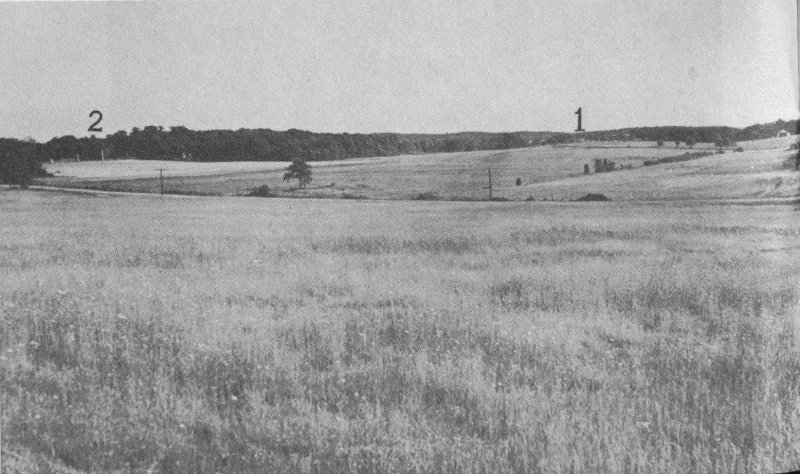
Scene of the initial engagement on the morning of July 1. 1. McPherson Ridge. 2. Oak Ridge.
In the intervening 2 days since he had assumed command of the Union forces, General Meade had moved his troops northward and instructed his engineers to survey a defensive battle position at Pipe Creek, near Taneytown, in northern Maryland. Buford’s cavalry, which had effectively shadowed Lee’s advance from the mountaintops of the Blue Ridge was ordered to make a reconnaissance in the Gettysburg area. It was 7 these troops that Pettigrew’s men saw posted on the roads leading into the town. Neither Lee nor Meade yet foresaw Gettysburg as a field of battle. Each expected to take a strong defensive position and force his adversary to attack.
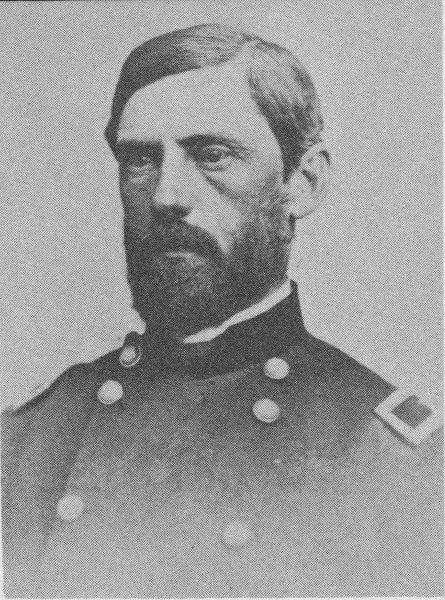
Maj. Gen. John F. Reynolds. (Courtesy National Archives.)
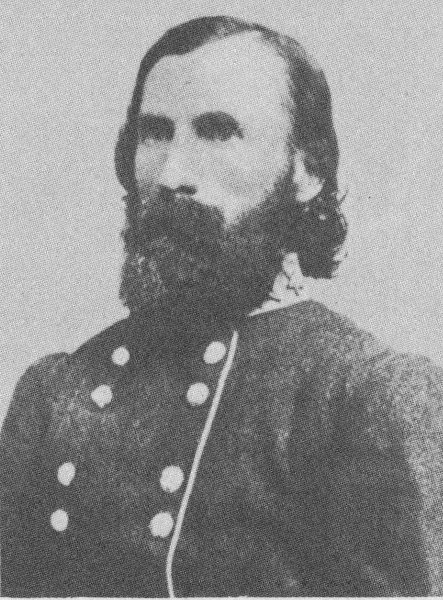
Lt. Gen. Ambrose P. Hill. (Courtesy National Archives.)
A. P. Hill, in the absence of Lee, who was still beyond the mountains, now took the initiative. At daybreak of July 1, he ordered the brigades of Archer and Davis, of Heth’s division, to advance along the Chambersburg Road to Gettysburg for the purpose of testing the strength of the Union forces. As these troops reached Marsh Creek, 4 miles from Gettysburg, they were fired upon by Union cavalry pickets who hurriedly retired to inform their commander of the enemy’s approach. In the meantime, Buford’s division of cavalry had moved from their camp just southwest of Gettysburg to McPherson Ridge, a mile west of the town. Buford prepared to hold out against heavy odds until aid arrived. Thus, subordinate field commanders had chosen the ground for battle.
It was 8 a. m., July 1, when the two brigades of Archer and Davis, the former to the right and the latter to the left of the Chambersburg Road, deployed on Herr Ridge. Supported by Pegram’s artillery, they charged down the long slope and across Willoughby Run against Buford’s men. The Union troopers had recently received an issue of Spencer repeating carbines. Dismounted, and fighting as infantrymen, they held their ground against the spirited attacks of Heth’s superior numbers. At 10 o’clock timely aid arrived as troops from Gen. John F. Reynolds’ First Infantry corps began streaming over Seminary Ridge from the south and relieved Buford’s exhausted fighters. Calef’s battery, one of whose guns had fired the first shot at Gettysburg, was replaced by Hall’s Maine artillery. But, in a few moments, Union joy at receiving aid was offset by tragedy. Reynolds, close to the front lines, was killed instantly by a sharpshooter’s bullet.
8
The struggle increased in scope as more forces reached the field. When Archer’s Confederates renewed the attack across Willoughby Run, Union troops of Meredith’s Iron Brigade, arriving opportunely, struck the flank of the Confederates and captured the greater part of the force, including General Archer. Relieved from the threat south of the Chambersburg Pike, the 14th Brooklyn and 7th Wisconsin regiments shifted to the north of the Pike where the Confederates had captured a part of Cutler’s troops in the railroad cut. With renewed effort, these troops, joined by Dawes’ 6th Wisconsin, drove the Confederates steadily back, capturing two Mississippi regiments in the defile. The Confederates then withdrew beyond striking distance. There was a lull in the fighting during the noon hour. The first encounter had given Union men confidence. They had held their ground against superior numbers and had captured Archer, a brigadier general, the first Confederate general officer taken since Lee assumed command.
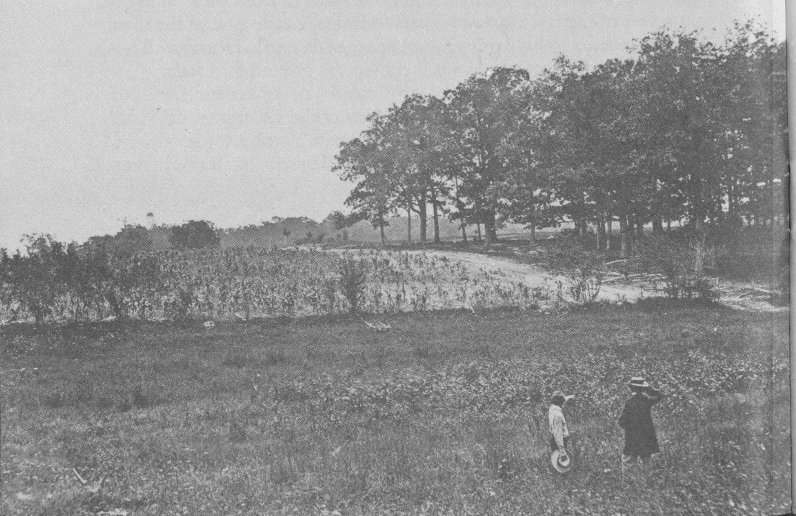
McPherson Ridge and Woods, the Federal position on July 1. In the woods at the right, General Reynolds was killed. The cupola of the Theological Seminary appears in the background. (Brady photograph.)
THE BATTLE OF OAK RIDGE.
While the initial test of strength was being determined west of Gettysburg by advance units, the main bulk of the two armies was pounding over the roads from the north and south, converging upon the ground chosen by Buford. Rodes’ Confederates, hurrying southward from Carlisle to meet Lee at Cashtown, received orders at Biglerville to march to Gettysburg. Early, returning from York with 9 Cashtown as his objective, learned at Heidlersburg of the action at Gettysburg and was ordered to approach by way of the Harrisburg Road.
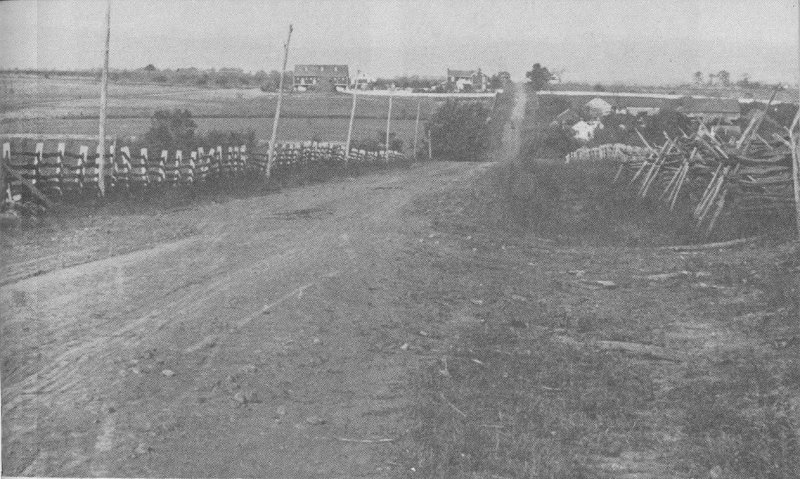
Chambersburg Pike, looking westward from the Federal position toward Herr Ridge, where the Confederate attack began.
Employing the wooded ridge as a screen from Union cavalry north of Gettysburg, Rodes brought his guns into position on Oak Ridge about 1 o’clock and opened fire on the flank of Gen. Abner Doubleday, Reynolds’ successor, on McPherson Ridge. The Union commander shifted his lines northeastward to Oak Ridge and the Mummasburg Road to meet the new attack. Rodes’ Confederates struck the Union positions at the stone wall on the ridge, but the attack was not well coordinated and resulted in failure. Iverson’s brigade was nearly annihilated as it made a left wheel to strike from the west. In the meantime, more Union troops had arrived on the field by way of the Taneytown Road. Two divisions of Howard’s Eleventh corps were now taking position in the plain north of the town, intending to make contact with Doubleday’s troops on Oak Ridge.
Doles’ Confederate brigade charged across the plain and was able to force Howard’s troops back temporarily, but it was the opportune approach of Early’s division from the northeast on the Harrisburg Road which rendered the Union position north of Gettysburg indefensible. Arriving in the early afternoon as the Union men were establishing their position, Early struck with tremendous force, first with his artillery and then with his infantry, against General Barlow. Soon he had shattered the entire Union force. The remnants broke and turned southward through Gettysburg in the direction of Cemetery Hill. In this headlong 10 and disorganized flight General Schimmelfenning was lost from his command, and, finding refuge in a shed, he lay 2 days concealed within the Confederate lines. In the path of Early’s onslaught lay the youthful Brigadier Barlow severely wounded, and the gallant Lieut. Bayard Wilkeson, whose battery had long stood against overwhelming odds, mortally wounded.
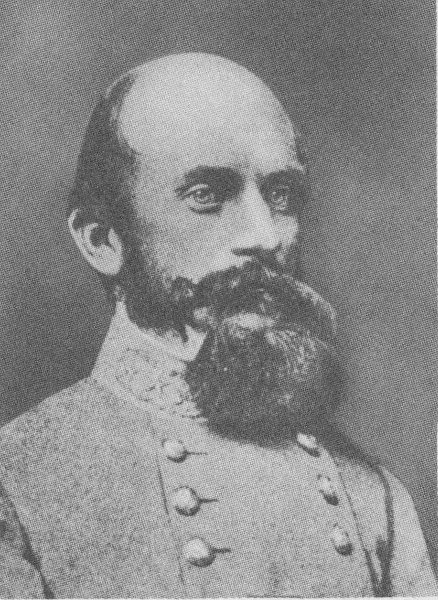
Lt. Gen. Richard S. Ewell. Courtesy National Archives.
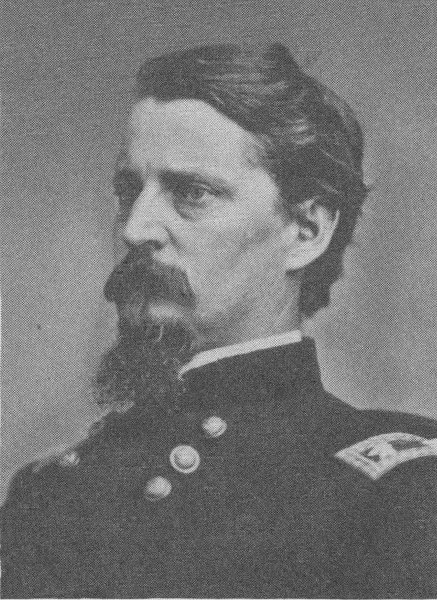
Maj. Gen. Winfield S. Hancock. Courtesy National Archives.
The Union men on Oak Ridge, faced with the danger that Doles would cut off their line of retreat, gave way and retired through Gettysburg to Cemetery Hill. The withdrawal of the Union troops from the north and northwest left the Union position on McPherson Ridge untenable. Early in the afternoon, when Rodes opened fire from Oak Hill, Heth had renewed his thrust along the Chambersburg Pike. His troops were soon relieved and Pender’s division, striking north and south of the road, broke the Union line. The Union troops first withdrew to Seminary Ridge, then across the fields to Cemetery Hill. Here was advantageous ground which had been selected as a rallying point if the men were forced to relinquish the ground west and north of the town. Thus, by 5 o’clock, the remnants of the Union forces (some 6,000 out of the 18,000 engaged in the first day’s struggle) were on the hills south of Gettysburg.
Ewell was now in possession of the town, and he extended his line from the streets eastward to Rock Creek. Studiously observing the hills in his front, he came within range of a Union sharpshooter, for suddenly he heard the thud of a minie ball. Calmly riding on, he remarked to General Gordon at his side, “You see how much better fixed for a fight I am than you are. It don’t hurt at all to be shot in a wooden leg.”
A momentous decision now had to be made. Lee had reached the field at 3 p. m., and had witnessed the retreat of the disorganized Union 11 troops through the streets of Gettysburg. Through his glasses he had watched their attempt to reestablish their lines on Cemetery Hill. Sensing his advantage and a great opportunity, he sent orders to Ewell by a staff officer to “press those people” and secure the hill (Cemetery Hill) if possible. However, two of Ewell’s divisions, those of Rodes and Early, had been heavily engaged throughout the afternoon and were not well in hand. Johnson’s division could not reach the field until late in the evening, and the reconnaissance service of Stuart’s cavalry was not yet available. General Ewell, uninformed of the Union strength in the rear of the hills south of Gettysburg, decided to await the arrival of Johnson’s division. Cemetery Hill was not attacked, and Johnson, coming up late in the evening, stopped at the base of Culp’s Hill. Thus passed Lee’s opportunity of July 1.
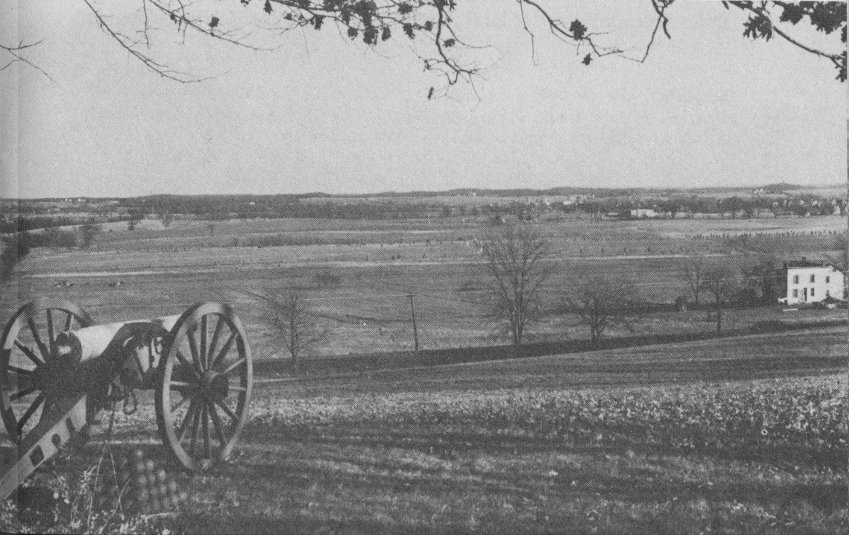
Scene north of Gettysburg from Oak Ridge. The Federal position may be seen near the edge of the open fields in the middle distance.
When the Union troops retreated from the battleground north and west of the town on the evening of July 1, they hastily occupied defense positions on Cemetery Hill, Culp’s Hill, and a part of Cemetery Ridge. Upon the arrival of Slocum by the Baltimore Pike and Sickles by way of the Emmitsburg Road, the Union right flank at Culp’s Hill and Spangler’s Spring and the important position at Little Round Top on the left were consolidated. Thus was developed a strong defensive battle line in the shape of a fish hook, about 3 miles long, with the advantage of high ground and of interior lines. Opposite, in a semicircle about 6 miles long, extending down Seminary Ridge and into the streets of 12 Gettysburg, stood the Confederates who, during the night, had closed in from the north and west.
The greater part of the citizenry of Gettysburg, despite the prospect of battle in their own yards, chose to remain in their homes. Both army commanders respected noncombatant rights to a marked degree. Thus, in contrast with the fields of carnage all about the village, life and property of the civilian population remained unharmed, while the doors of churches, schools, and homes were opened for the care of the wounded.
General Meade, at Taneytown, had learned early in the afternoon of July 1 that a battle was developing and that Reynolds had been killed. A large part of his army was within 5 miles of Gettysburg. Meade then sent General Hancock to study and report on the situation. Hancock reached the field just as the Union troops were falling back to Cemetery Hill. He helped to rally the troops and left at 6 o’clock to report to Meade that in his opinion the battle should be fought at Gettysburg. Meade acted on this recommendation and immediately ordered the concentration of the Union forces at that place. Meade himself arrived near midnight on July 1.
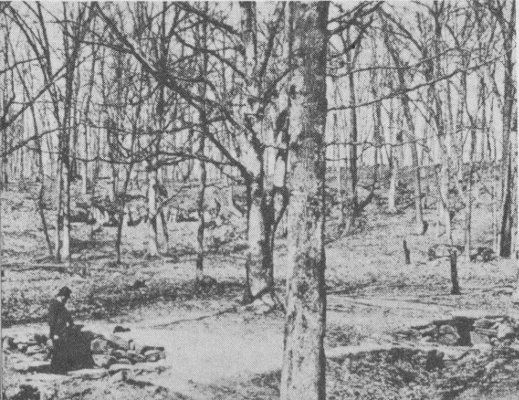
Spangler’s Spring, the right of the Federal battle line of July 2 and 3. This view, made in 1870, shows the wartime appearance of the spring. (Tipton photograph.)
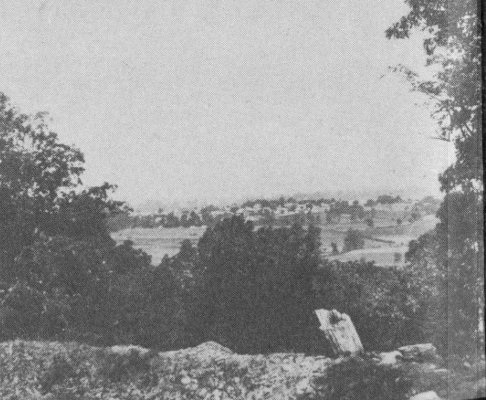
View of Culp’s Hill, taken about 1890, showing earthworks on the crest of the hill. Gettysburg, one-half mile northwest, may be seen through the vista. (Tipton photograph.)