Lincoln and Gettysburg
Reading edition
ESTABLISHMENT OF A BURIAL GROUND.
For the residents of Gettysburg the aftermath of battle was almost as trying as the 3 days of struggle that had swirled about them. The town’s 2,400 inhabitants, and the nearby country folk, bore a heavy share of the burden of caring for the 21,000 wounded and dying of both sides, who were left behind when the armies moved on. Spacious rooms in churches and schools and hundreds of homes were turned over to the care of the wounded; and kindly folk from neighboring towns came to help those of Gettysburg in ministering to the needs of the maimed and shattered men.
Adequate attention to the wounded was an immediate necessity, but fully as urgent was the need of caring for the dead. Nearly 6,000 had been killed in action, and hundreds died each day from mortal wounds. In the earlier stages of the battle, soldiers of both armies performed the tasks of burying their fallen comrades, but the struggle had reached such large proportions and the scene of battle had so shifted that fallen men had come within enemy lines. Because of the emergencies of battle, therefore, hundreds of bodies had been left unburied or only partially covered. It was evident that the limited aid which could be offered by local authorities must be supported by a well-organized plan for disinterment of the dead from the temporary burial grounds on the field and reburial in a permanent place at Gettysburg or in home cemeteries.
A few days after the battle, the Governor of the Commonwealth, Hon. Andrew Curtin, visited the battlefield to offer assistance in caring for the wounded. When official duties required his return to Harrisburg, he appointed Attorney David Wills, of Gettysburg, to act as his special agent. At the time of his visit, the Governor was especially distressed by the condition of the dead. In response to the Governor’s desire that the remains be brought together in a place set aside for the purpose, Mr. Wills selected land on the northern slope of Cemetery Hill and suggested that the State of Pennsylvania purchase the ground at once in order that interments could begin without delay. He proposed that contributions for the purpose of laying out and landscaping the grounds be asked from legislatures of the States whose soldiers had taken part in the battle.
Within 6 weeks, Mr. Wills had purchased 17 acres of ground on Cemetery Hill and engaged William Saunders, an eminent landscape gardener, to lay out the grounds in State lots, apportioned in size to the number of graves for the fallen of each State. Each of the Union States represented in the battle made contributions for planning and landscaping.
The reinterment of 3,512 bodies in the cemetery was accomplished only after many months. Great care had been taken to identify the bodies on the field, and, at the time of reinterment, remains were readily identified 36 by marked boards which had been placed at the field grave or by items found on the bodies. Even so, the names of 1,664 remained unknown, 979 of whom were without identification either by name or by State. Within a year, appropriations from the States made possible the enclosure of the cemetery with a massive stone wall and an iron fence on the Baltimore Street front, imposing gateways of iron, headstones for the graves, and a keeper’s lodge. Since the original burials, the total of Civil War interments has reached 3,706. Including those of later wars, the total number now is 4,399.
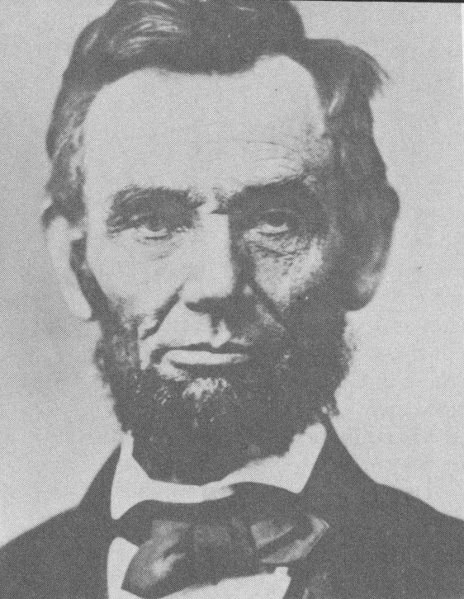
Photograph of Lincoln taken a few days before he left Washington en route to Gettysburg, November 1863. (Gardner photograph.)
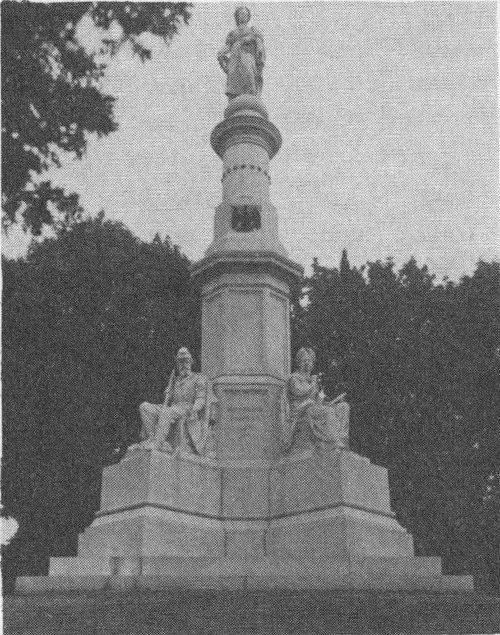
The Soldiers’ National Monument, commemorating the Federal dead who fell at Gettysburg, was dedicated July 1, 1869. It is located at the place where Lincoln delivered his Gettysburg Address.
The removal of Confederate dead from the field burial plots was not undertaken until 7 years after the battle. During the years 1870-73, upon the initiative of the Ladies Memorial Associations of Richmond, Raleigh, Savannah, and Charleston, 3,320 bodies were disinterred and sent to cemeteries in those cities for reburial, 2,935 being interred in Hollywood Cemetery, Richmond. Seventy-three bodies were reburied in home cemeteries.
The Commonwealth of Pennsylvania incorporated the cemetery in January 1864. The cemetery “having been completed, and the care of it by Commissioners from so many states being burdensome and expensive,” the Board of Commissioners, authorized by act of the General Assembly of Pennsylvania in 1868, recommended the transfer of the cemetery to the Federal Government. The Secretary of War accepted title to the cemetery for the United States Government on May 1, 1872.
37
DEDICATION OF THE CEMETERY.
Having agreed upon a plan for the cemetery, the Commissioners believed it advisable to consecrate the grounds with appropriate ceremonies. Mr. Wills, representing the Governor of Pennsylvania, was selected to make proper arrangements for the event. With the approval of the Governors of the several States, he wrote to Hon. Edward Everett, of Massachusetts, inviting him to deliver the oration on the occasion and suggested October 23, 1863, as the date for the ceremony. Mr. Everett stated in reply that the invitation was a great compliment, but that because of the time necessary for the preparation of the oration he could not accept a date earlier than November 19. This was the date agreed upon.
Edward Everett was the outstanding orator of his day. He had been a prominent Boston minister and later a university professor. A cultured scholar, he had delivered orations on many notable occasions. In a distinguished career he became successively President of Harvard, Governor of Massachusetts, United States Senator, Minister to England, and Secretary of State.
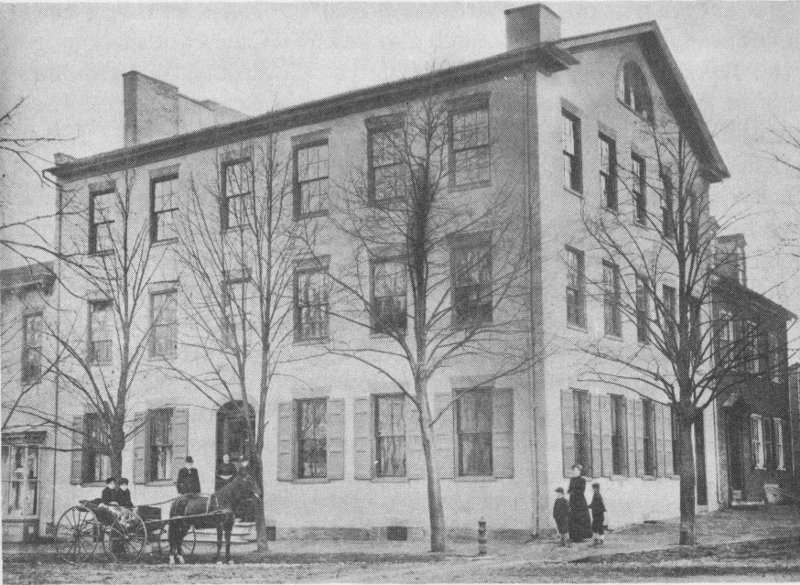
The Wills house where Lincoln was a guest when the national cemetery was dedicated.
The Gettysburg cemetery, at the time of the dedication, was not under the authority of the Federal Government. It had not occurred to those in charge, therefore, that the President of the United States might desire to attend the ceremony. When formally printed invitations were sent to a rather extended list of national figures, including the President, the acceptance from Mr. Lincoln came as a surprise. Mr. Wills was thereupon 38 instructed to request the President to take part in the program, and, on November 2, a personal invitation was addressed to him.
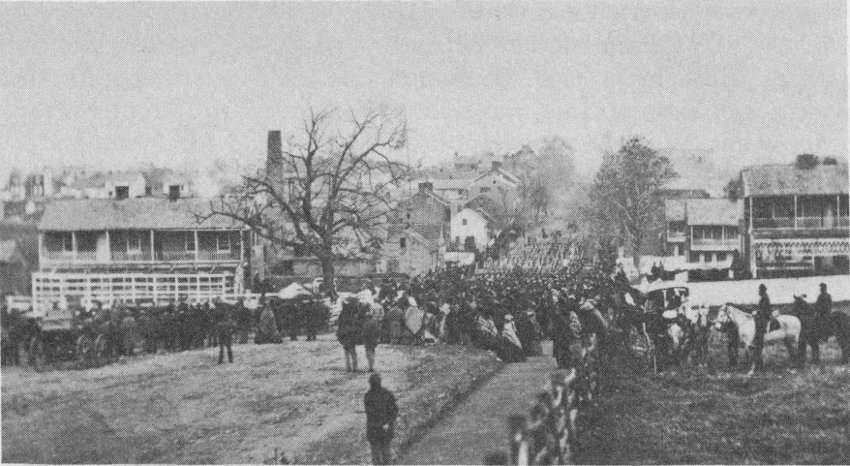
The procession on Baltimore Street en route to the cemetery for the dedicatory exercises, November 19.
Throngs filled the town on the evening of November 18. The special train from Washington bearing the President arrived in Gettysburg at dusk. Mr. Lincoln was escorted to the spacious home of Mr. Wills on Center Square. Sometime later in the evening the President was serenaded, and at a late hour he retired. At 10 o’clock on the following morning, the appointed time for the procession to begin, Mr. Lincoln was ready. The various units of the long procession, marshaled by Ward Lamon, began moving on Baltimore Street, the President riding horseback. The elaborate order of march also included Cabinet officials, judges of the Supreme Court, high military officers, Governors, commissioners, the Vice President, the Speaker of the House of Representatives, Members of Congress, and many local groups.
Difficulty in getting the procession under way and the tardy return of Mr. Everett from his drive over the battleground accounted for a delay of an hour in the proceedings. At high noon, with thousands scurrying about for points of vantage, the ceremonies were begun with the playing of a dirge by one of the bands. As the audience stood uncovered, a prayer was offered by Rev. Thomas H. Stockton, Chaplain of the House of Representatives. “Old Hundred” was played by the Marine Band. Then Mr. Everett arose, and “stood a moment in silence, regarding the battlefield and the distant beauty of the South Mountain range.” For nearly 2 hours he reviewed the funeral customs of Athens, spoke of the purposes of war, presented a detailed account of the 3-days’ battle, offered tribute to those who died on the battlefield, and reminded his audience of the bonds which are common to all Americans. Upon the conclusion of his address, a hymn was sung.
39
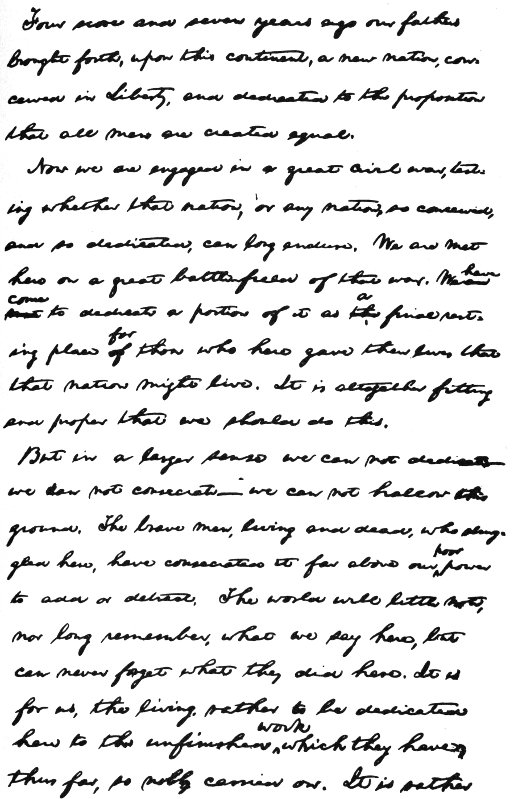
First page of the second draft of the Gettysburg Address. This copy, made by Lincoln on the morning of November 19, was held in his hand while delivering his address. Reproduced from the original in the Library of Congress.
40
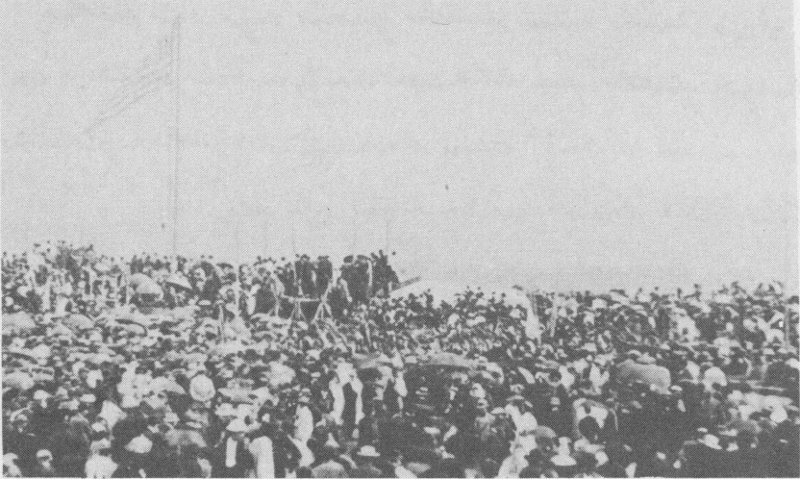
This photograph is the only known close-up view of the rostrum (upper left) at the dedication of the national cemetery. The view shows a part of the audience which was estimated at 15,000. (Bachrach photograph.)
Then the President arose and spoke his immortal words:
Four score and seven years ago our fathers brought forth on this continent, a new nation, conceived in Liberty, and dedicated to the proposition that all men are created equal.
Now we are engaged in a great civil war, testing whether that nation, or any nation so conceived and so dedicated, can long endure. We are met on a great battle field of that war. We have come to dedicate a portion of that field, as a final resting place for those who here gave their lives that that nation might live. It is altogether fitting and proper that we should do this.
But, in a larger sense, we cannot dedicate—we cannot consecrate—we cannot hallow—this ground. The brave men, living and dead, who struggled here, have consecrated it, far above our poor power to add or detract. The world will little note, nor long remember what we say here, but it can never forget what they did here. It is for us the living, rather, to be dedicated here to the unfinished work which they who fought here have thus far so nobly advanced. It is rather for us to be here dedicated to the great task remaining before us—that from these honored dead we take increased devotion to that cause for which they gave the last full measure of devotion—that we here highly resolve that these dead shall not have died in vain—that this nation, under God, shall have a new birth of freedom—and that government of the people, by the people, for the people, shall not perish from the earth.
A hymn was then sung and Rev. H. L. Baugher pronounced the benediction.
41
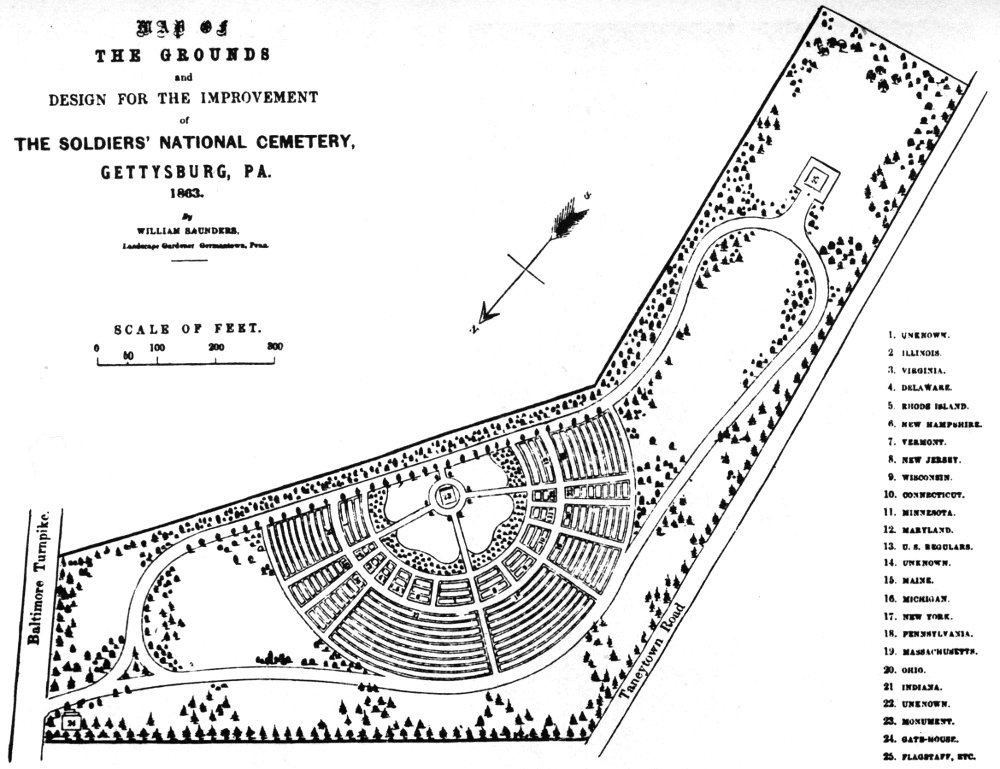
Plan of the national cemetery drawn in the autumn of 1863 by the notable landscape gardener, William Saunders.
MAP OF THE GROUNDS and DESIGN FOR THE IMPROVEMENT of THE SOLDIERS’ NATIONAL CEMETERY, GETTYSBURG, PA. 1863. By WILLIAM SAUNDERS, Landscape Gardener Germantown, Penn.
1. UNKNOWN.
2. ILLINOIS.
3. VIRGINIA.
4. DELAWARE.
5. RHODE ISLAND.
6. NEW HAMPSHIRE.
7. VERMONT.
8. NEW JERSEY.
9. WISCONSIN.
10. CONNECTICUT.
11. MINNESOTA.
12. MARYLAND.
13. U. S. REGULARS.
14. UNKNOWN.
15. MAINE.
16. MICHIGAN
17. NEW YORK.
18. PENNSYLVANIA.
19. MASSACHUSETTS.
20. OHIO.
21. INDIANA.
22. UNKNOWN.
23. MONUMENT.
24. GATE-HOUSE.
25. FLAGSTAFF, ETC.
42
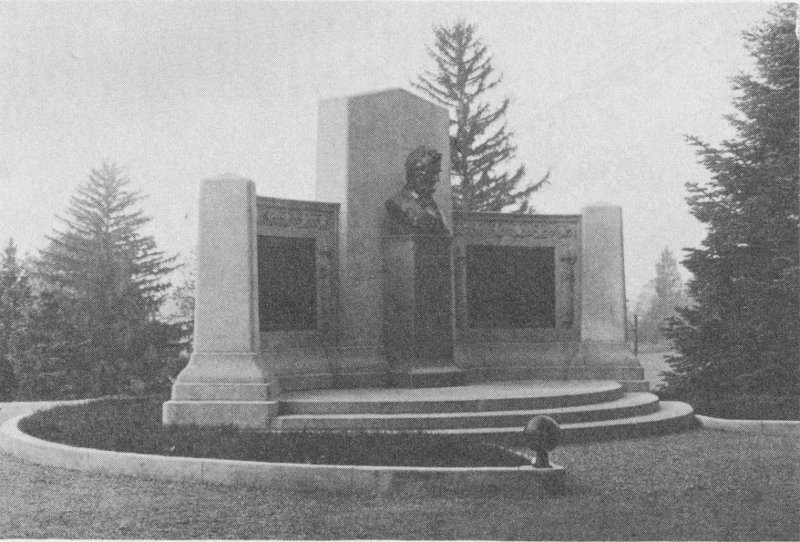
The Lincoln Address Memorial, the only monument ever erected to commemorate an address, stands near the west gate of the national cemetery.
GENESIS OF THE GETTYSBURG ADDRESS.
The theme of the Gettysburg Address was not entirely new. “Must a government, of necessity, be too strong for the liberties of its people,” Lincoln had once asked, “or too weak to maintain its own existence?” Speaking of war aims, he said, “We shall nobly save, or meanly lose, the last best hope of earth.” When he referred at Gettysburg to “the unfinished work which they who fought here have thus far so nobly advanced,” he had in mind the high purpose of the preservation of the Union and the welfare of all the people. More than a year after Gettysburg, Lincoln in his Second Inaugural address uttered words which might very well be considered a companion sentiment to those expressed at Gettysburg: “With malice toward none; with charity for all; with firmness in the right as God gives us to see the right.” This profession of faith came from the heart of a man of humility who sought then, as he did throughout the war, to assuage suffering and anxiety everywhere.
Rather than accept the address as a few brief notes hastily prepared on the route to Gettysburg (an assumption which has long gained much public acceptance), it should be regarded as a pronouncement of the high purpose dominant in Lincoln’s thinking throughout the war. Habitually cautious of words in public address, spoken or written, it is not likely that the President, on such an occasion, failed to give careful thought to the words which he would speak. After receiving the belated invitation on November 2, he yet had ample time to prepare for the occasion, and 43 the well-known correspondent Noah Brooks stated that several days before the dedication Lincoln told him in Washington that his address would be “short, short, short” and that it was “written, but not finished.”
THE FIVE AUTOGRAPH COPIES OF THE GETTYSBURG ADDRESS.
Even after his arrival at Gettysburg the President continued to put finishing touches to his address. The first page of the original text was written in ink on a sheet of Executive Mansion paper. The second page, either written or revised at the Wills residence, was in pencil on a sheet of foolscap, and, according to Lincoln’s secretary, Nicolay, the few words changed in pencil at the bottom of the first page were added while in Gettysburg. The second draft of the address was written in Gettysburg probably on the morning of its delivery, as it contains certain phrases that are not in the first draft but are in the reports of the address as delivered and in subsequent copies made by Lincoln. It is probable, as stated in the explanatory note accompanying the original copies of the first and second drafts in the Library of Congress, that it was the second draft which Lincoln held in his hand when he delivered the address.
Quite opposite to Lincoln’s feeling, expressed soon after the delivery of the address, that it “would not scour,” the President lived long enough to think better of it himself and to see it widely accepted as a masterpiece. Early in 1864, Mr. Everett requested him to join in presenting manuscripts of the two addresses given at Gettysburg to be bound in a volume and sold for the benefit of stricken soldiers at a Sanitary Commission Fair in New York. The draft Lincoln sent became the third autograph copy, known as the Everett-Keyes copy, and it is now in the possession of the Illinois State Historical Library.
George Bancroft requested a copy in April 1864, to be included in Autograph Leaves of Our Country’s Authors. This volume was to be sold at a Soldiers’ and Sailors’ Sanitary Fair in Baltimore. As this fourth copy was written on both sides of the paper, it proved unusable for this purpose, and Mr. Bancroft was allowed to keep it. This autograph draft is known as the Bancroft copy, as it remained in that family for many years. It has recently been presented to the Cornell University Library. Finding that the copy written for Autograph Leaves could not be used, Mr. Lincoln wrote another, a fifth draft, which was accepted for the purpose requested. It is the only draft to which he affixed his signature. In all probability it was the last copy written by Lincoln, and because of the apparent care in its preparation it has become the standard version of the address. The fifth draft, which long remained in the hands of the family of Col. Alexander Bliss, publisher of Autograph Leaves, is known as the Bliss copy. It was purchased in 1949 by Oscar B. Cintas, of Havana, Cuba.
SOLDIERS’ NATIONAL MONUMENT.
As a fitting memorial to the Union dead who fell at Gettysburg, the Commissioners arranged for the erection 44 of a monument in the center of the semicircular plot of graves. A design submitted by J. G. Batterson was accepted and the services of Randolph Rogers, a distinguished American sculptor, were secured for the execution of the monument. Projecting from the four angles of the gray granite shaft are allegorical statues in white marble representing War, History, Peace, and Plenty. Surmounting the shaft is a white marble statue representing the Genius of Liberty. Known as the Soldiers’ National Monument, the cornerstone was laid July 4, 1865, and the monument dedicated July 1, 1869.
THE LINCOLN ADDRESS MEMORIAL.
The “few appropriate remarks” of Lincoln at Gettysburg came to be accepted with the passing of years not only as a fine expression of the purposes for which the war was fought, but as a masterpiece of literature. An effort to have the words of the martyr President commemorated on this battlefield culminated with the inclusion in the act approved February 12, 1895, which established Gettysburg National Military Park, of a provision for the erection of such a memorial. Pursuant to this authority, the Park Commission erected the Lincoln Address Memorial, in January 1912, near the west gate of the national cemetery.
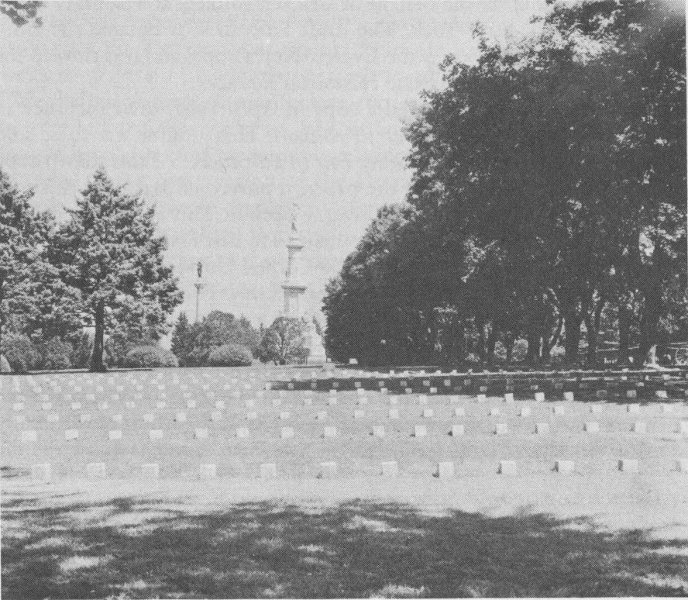
The national cemetery.
45