MISCELLANEOUS ACTIVE GAMES (continued 4)
Reading edition
This game is an adaptation from one played by the Cree Indians. For it the author is indebted to Mr. Stewart Culin's Games of the North American Indians.
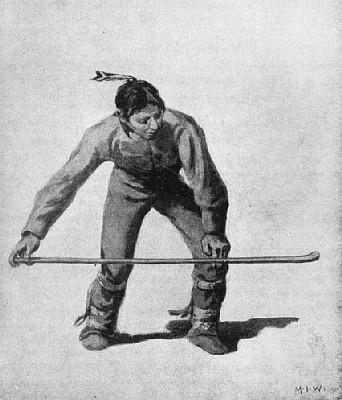
SNOW SNAKE Menominee Indian holding snow snake preparatory to throwing. From Hoffman. Reproduced from "Games of the North American Indians," by Stewart Culin; with kind permission of the author and of the Bureau of Ethnology, Washington, D.C.
SNOW SNAKE
2 to 10 or more players.
For the snow.
This game is played by skimming or skipping sticks over the hard surface of the snow, as stones are skipped over the water. Each player is provided with from three to five small sticks. These may be especially whittled, or they may be pieces of branches. A perfectly smooth stick is best, and one that has some weight to it. Each stick is notched, one notch on the first, two on the second, three on the third, etc.
The players stand at a given line and take turns in skimming their sticks over the surface of the snow, each player throwing but one stick at a time. When each player has thrown, the stick that has gone the farthest scores for the thrower according to the number of notches on it. For instance, if the stick had but one notch, it scores one point for the player; a three-notched stick scores three points, etc. The sticks are then gathered up and put to one side, and each player in turn throws the next stick in his bunch, the successful player of the first round having the first throw in the second round, and scoring in similar manner. This is continued until all of the sticks have been thrown. This may close the game, which is won by the highest scorer, or it may be repeated indefinitely, either with a time limit or until a certain score is reached.
This game is an adaptation of one played by the Wabanaki Indians. The Northern Indians have many games belonging to the Snow Snake class.
SPANISH FLY
5 to 30 or more players.
Playground; gymnasium.
This is a game of leapfrog in which the leader (first over) sets feats for the others to perform, as in Follow the Leader, any player who fails taking the place of the back. The following feats are popular:—
The jumper leaps over, touching the back with one hand only and waving his cap with the other.
The jumper leaps over without touching the back.
The jumper makes a quarter turn while going over.
HATS ON DECK.—The leader, as he vaults, places his cap on the back, and must clear without touching it. Each player, in turn, adds his hat to the pile, the last player having to jump over all. If any one knocks over the pile, he must become back, and the game begins over again. If all jump successfully, the last one over then jumps again, removing his hat as he goes over without disturbing the others, and so on until all have been removed.
HATS FULL OF WATER.—The jumper places his own hat on his head upside down and balances it there while leaping over the back.
SPANS
2 to 10 players.
Out of doors; indoors.
This is a game played by snapping buttons against a wall, their landing point determining a score. Each player has a button. One of the players lays his button on the ground near a wall or fence. The others, in turn, snap their buttons against the wall so as to rebound near to that of the first player. Should the button snapped drop within one hand reach or span (i.e. the distance between stretched thumb and fingers) of the button first laid down, it scores two points for the player throwing it. If it comes within two such spans of the first button, it scores one point. Should it hit this button and bounce away within but one span, it counts four points. Should it so bounce within two spans, it scores three points; and should it go farther than this, it scores but one point. The number of points in the game, twenty-five or fifty, is agreed on at the outset. The players take regular turns, and the first to score the required number wins the game.
SPIN THE PLATTER
(See also My Lady's Toilet)
10 to 30 or more players.
Parlor; schoolroom.
All the players are numbered and seated in a circle, except one, who stands in the center and twirls a platter, tray, or some other round object. As he starts it spinning, he calls any number that he chooses, and the player bearing that number must at once spring forward and try to catch the platter before it ceases to spin and falls to the floor. If successful, he returns to his place in the circle. If not successful, he takes the place of the spinner and pays a forfeit. The forfeits are all redeemed at the end of the game.
This game may also be played by calling the players by name instead of numbering them.
SPOONING
10 to 30 players.
Children's party; adult house party.
All but one of the players stand in a circle. The odd player is blindfolded and placed in the center. He is given two silver tablespoons. The players in the circle clasp hands and move around until the blindfolded player clicks the spoons together, at which signal the circle must stand still.
The blindfold player then goes up to any one in the circle, and by feeling over the face and head with the bowls of the spoons must identify the player. He may not feel on the shoulders or around the neck, only on the face and head. A player may stoop to disguise his height for this, but otherwise may not evade the touch of the spoons. If the blindfold player correctly identifies the one before him, they exchange places. If incorrect in his guess, the play is repeated.
This may be a very amusing game for either children or adults. The author has seen it played with great success under both conditions.
SQUIRREL AND NUT
10 to 60 players.
Schoolroom.
All of the pupils but one sit at their desks with heads bowed on the arms as though sleeping, but each with a hand outstretched. The odd player, who is the squirrel, and carries a nut, runs on tiptoe up and down through the aisles, and at his or her discretion drops the nut into one of the waiting hands. The player who gets the nut at once jumps up from his seat and chases the squirrel, who is safe only when he reaches his nest (seat). Should the squirrel be caught before he reaches his nest, he must be squirrel the second time. Otherwise the player who received the nut becomes the next squirrel.
It is scarcely necessary to say that the other players wake up to watch the chase.
SQUIRREL IN TREES
10 to 100 players.
Schoolroom; playground; gymnasium.
This game is very like Hound and Rabbit, but is a little less exciting, and under some circumstances better adapted to very young children.
Most of the players stand in groups of three, with hands on each other's shoulders, forming hollow trees. In each tree is a player representing a squirrel, and there is also one odd squirrel without a tree. The teacher or leader claps her hands, when all of the players must run for other trees, and the odd squirrel tries to secure a tree, the one who is left out being the odd squirrel next time.
STAGE COACH
10 to 60 or more players.
Parlor; schoolroom; gymnasium.
A leader is chosen who has a faculty for telling a story. This leader gives to each of the players the name of some part of a stage coach or of its contents. Thus, one may be the whip, one the wheels, one the cushions, one the windows, others the brake, driver, harness, horses, passengers, including specifically the fat old gentleman, the woman with the bandbox, etc.
Where there are many players, several may be given the same name, though it is desirable that these should not all be seated near together. The leader then tells a story in which the various parts of a stage coach are mentioned, and whenever he names one of these parts or articles, the player or players bearing that name must get up instantly, whirl around once, and sit down again. Any player failing to do this must pay a forfeit. Whenever the story teller says "Stage Coach!" all of the players must get up and turn around. At the end of this story he will manage to have the stage coach meet with a catastrophe, and as soon as he says "The stage coach upset!" all of the players must change seats. The leader takes this opportunity to secure one for himself, and the player who is left without a seat becomes leader for the next game, or must distribute the forfeits. For large numbers there should be several more players than chairs.
The leader may say, for example: "It being a beautiful spring day, the old lady with the bandbox [here the old lady must get up and turn around] decided to visit her daughter, and so took a seat in the stage coach [everybody turns around]; she found the cushions [cushions turn around] very comfortable until the fat old gentleman [fat old gentleman turns around] got in, when the place seemed to her very crowded, and she was glad to open the windows; the driver cracked his whip, the wheels creaked, the horses strained at the harness, and away they started on their journey," etc.
The interest of the game may be enhanced by connecting the stage coach, its passengers, and journey with some well-known story, as of Mr. Pickwick and Sam Weller, or Rebecca of Sunnybrook Farm.
STAKE GUARD
(See also Duck on a Rock.)
10 to 30 players.
Playground; gymnasium.
This game is one of the forms of Duck on a Rock, and in this form is well adapted to use indoors as well as out of doors. The game differs from the ordinary games of Duck on a Rock chiefly in the limited territory to which the guard is confined.
A stake is driven in the ground (or if in a gymnasium, an Indian club is placed) in the center of a square plainly marked, and measuring from eight to twelve feet. A throwing line is drawn twenty or more feet from the stake. The game is played with bean bags, and begins with the choice of a guard. This choice is made by all of the players standing on the throwing line and throwing their bags at the stake. The player whose bag falls farthest away from the stake becomes the first guard.
The stake guard places his bag on top of the stake (or club). The other players line up on the throwing line. Upon a given signal from a leader or captain, all of the players throw their bags simultaneously at the stake, trying to displace the bag on top of it. Knocking over the club accomplishes the same purpose. Each player must then try to regain his bag, but in doing this he may be tagged by the guard. If this be done, he changes places with the guard. The guard may only tag a player, however, within the limits of the square surrounding the stake, beyond which he may not go; and he may do this only after he has replaced his own bag on top of the stake.
Stake Guard
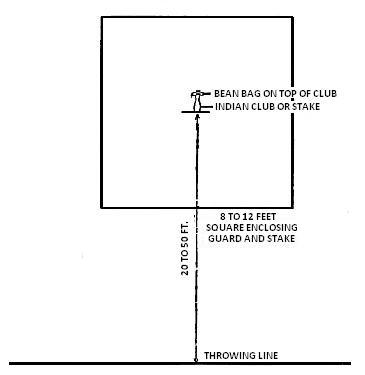
Any player failing to recover his bag at once will watch for an opportunity to do so when the guard is next occupied in replacing his own bag. Any player thus waiting for his bag may linger near the boundaries of the center square.
Should the guard succeed in tagging a player within the square, that player must at once place his own bag on the stake; and the guard must try to get his bag and escape from the square before this new guard can place his bag and tag him. As soon as a player recovers his bag and escapes from the center square, he should go at once to the starting line, and may throw again immediately for the center bag. The game progresses better, however, if all of the throwing be done simultaneously, the returning players waiting for a signal from the leader before throwing.
As players become proficient, the game may be made more skillful and interesting by increasing the distance between the throwing line and the stake, and also by lessening the size of the square drawn around the stake, in which the guard is confined.
STEALING STICKS
(See also Prisoner's Base.)
10 to 30 or more players.
Playground; gymnasium.
Stealing Sticks
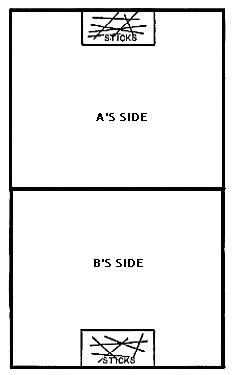
The ground is divided into two equal parts, with a small goal marked off at the rear of each part, in which six sticks are placed. Each player who reaches the enemy's goal safely may carry one stick back to his own goal, and may not be caught while carrying it back. If caught in the enemy's territory before reaching the goal, a player must remain a prisoner in the goal until touched by one of his own side; neither may be caught while returning. Any player may catch any opponent, except under the rules just stated. No stick may be taken by a side while any of its men are prisoners. The game is won by the side gaining all of the sticks.
This game is known also by the name of Scots and English and probably originated in border warfare. The players sometimes contribute some article of wearing apparel to the pile of property that is to be stolen instead of using sticks for the purpose. Caps and coats are the usual donations.
STEP
5 to 30 or more players.
Playground; gymnasium.
The ground is marked off by two parallel lines from fifty to two hundred feet apart. One player, who is chosen to be counter, stands on one of these lines with his back to the other players, who line up on the opposite line.
The object of the game is for the players who are lined up in the rear to advance forward until they cross the line where the counter is stationed. They may only advance, however, by short stages, during which the player in front counts ten.
The game starts by this forward player counting ten loudly and rapidly, the other players moving forward while he does this, but immediately that he says "Ten!" they must stand still, and he at once turns to look at them. He will call the name of any player or players whom he sees moving, and any so called must go back to the starting line and begin over again. This counting of ten by the one player and moving forward of the others continues until all have crossed the line where the counter stands. The last one over changes places with him for the next game.
This game is a great favorite, especially with girls, though the writer has known many boys to play it persistently. The players will learn to use much caution in moving forward, often stopping before the count of ten, to be sure that they shall not be caught in motion. The progress thus made may seem slower than that of those who dash forward to the last moment, but as with the famous hare and tortoise, this slower but continuous method often wins.
STILL POND; NO MORE MOVING!
(Still water, still water, stop!)
5 to 30 or more players.
Parlor; gymnasium; playground.
One player is blindfolded; the others scatter promiscuously. The blindfolded player is led to the center of the playground, and asked:—
"How many horses has your father in his stable?"
He replies, "Three."
"What color are they?"
"Black, white, and gray."
"Turn around three times and catch whom you may."
The blindfolded player is then spun around so as to confuse his sense of direction. He then says, "Still pond; no more moving!" whereupon the other players must stand still, being allowed only three steps thereafter. The blindfolded player begins to grope for the others. When he catches one, he must guess by touching the hair, dress, etc., whom he has caught. If he guesses correctly, the player changes places with him. If incorrectly, he must go on with his search. The players may resort to any reasonable devices for escaping the hands of the groping blind man, such as stooping or dodging, so long as they do not take more than three steps. When caught, a player may try to disguise his identity by making himself shorter, etc.
STONE
10 to 30 or more players.
Playground; gymnasium.
A large circle is drawn on the ground or floor in the center of the play space. At either end of the ground a goal is marked off. One player, chosen to be stone, sits on the floor in the circle. The other players stand around outside the circle, taunting the stone by stepping over into his territory. Suddenly, and the more unexpectedly the better, the stone rises and runs for the other players, who are only safe from tagging when behind one of the goals. Any one so tagged becomes a stone and joins the first stone in sitting near the center of the circle. They also join him in chasing the other players whenever he gives the signal. This continues until all the players have been tagged.
STOOP TAG
("Squat" Tag)
4 to 60 or more players.
Indoors; out of doors.
One player is It and chases the others, trying to tag one of them. A player may escape being tagged by suddenly stooping or "squatting"; but each player may stoop but three times. After the third time of stooping, the player may resort only to running to escape being tagged. Any player tagged becomes It.
For large numbers of players there should be several taggers.
SUN DIAL
2 to 10 players.
Gymnasium; playground; seashore.
A circle from twelve to twenty feet in diameter is drawn on the ground. This is intersected with straight lines, like the spokes of a wheel, which divide it into twelve sections, numbered consecutively from one to twelve.
Sun Dial
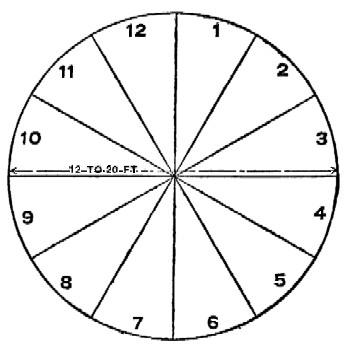
One player is blindfolded, placed in the center (on the hub of the wheel), and turned around several times to confuse his sense of direction. He then walks around inside the rim while counting twelve, or repeating the verse:—
"Dickery, dickery, dock; The mouse ran up the clock; The clock struck ten He ran down again, Dickery, dickery, dock."
He stops on the last word, and the number of the space in which he stands is scored to his credit; for instance, if he stops in section eight, it scores eight points for him; if in section three, it scores three points, etc. Should he stop with one foot on a line or outside the circle, he scores nothing. The players take turns, each having but one trial at a turn. The game is won by the player first scoring twenty-five or fifty points, as may be decided.
TAG
The game of plain, old-fashioned Tag may be made great sport, especially if suddenly and unexpectedly commenced in a group of players when other interests seem to lag.
The game has many variations, a considerable number of which are here given, each variation making practically a different game.
This game is found in all countries and is prehistoric. It is supposed to have arisen from the idea of fleeing from an evil spirit, and in those forms from which immunity is found by touching wood or iron or taking some particular position, that especial feature is supposed to have originated in the idea of breaking the spell of the pursuing evil.
The following tag games will be found in their alphabetical order:—
Cross TagHang Tag
Fence TagHome Tag
French TagJapanese Tag (Over)
Maze Tag (Line Tag; Right Face) Shadow Tag
Old Man TagStoop Tag (Squat Tag)
Partner TagTag
Schoolroom TagWhip Tag
TAG
4 to 60 players.
Indoors; out of doors.
Tag in its simplest form may be started by any one of a group of players suddenly turning to another, touching (tagging) him and saying "You're It!" when all must flee from the one who is It.
The player who is It may chase and tag any other player whom he chooses, but will aid his own ends by suddenly turning his attention from one player to another, or by doubling back on his course, or resorting to any of the other feints that give an unexpected turn to a game of chase.
The players who are being chased will add to the zest of the game by venturing as close as possible to the one who is It, calling to him and taunting him with their proximity, and suddenly dodging away. When a player is hard pressed or breathless, or does not wish to play, he may become immune from tagging by crossing any one finger over its neighbor on either hand, as the forefinger over the middle finger. It is considered "babyish," however, to resort to this unless there is some very good reason. A player who has had a good fair chase ought to be willing to be It if caught.
Any player whom the chaser tags immediately becomes It, but the chaser, in touching him, must say "You're It!" At his own discretion he may add "No fair," which means that the one who has just become It may not turn at once and tag him. A venturesome player, however, will omit this, especially if he should tag another player from behind, and trust to his own powers of dodging for getting safely away. Where there are a large number of players, two or more may be chosen to be It.
TAG THE WALL RELAY
10 to 60 players.
Schoolroom.
The players should all be seated, an even number in each row of seats. At a signal, the last player in each line runs forward and tags the front wall. As soon as this player is out of the aisle, the others all move backward one seat. This leaves the front seat vacant, and the runner having touched the wall returns immediately and takes this vacant front seat. As the player sits he raises his hand, which is a signal for the player who is now the last one in the line to run forward, the line moving backward one place as soon as he is out of the aisle. He, in turn, having touched the wall, takes the vacant front seat. The play is continued in this way until every one in the row has run.
The line wins whose player, sitting at the start in the front seat, first returns to his seat.
As in all schoolroom games where there is running, the seated players should be very careful to keep their feet under the desks, so there will be nothing in the aisles over which the runners may trip.
This is one of the best class room games and is very popular.
TEN STEPS
10 to 30 or more players.
Playground; indoors.
This is a game of hide and seek and like all such games is best played where there is plenty of space and many hiding places. The distinctive feature of this game is the peculiar limitation put on the opportunity to hide, which may even free the blinder from his task. The one who is It, or hunter, blinds his eyes and counts ten while the other players run for hiding places. As soon as the one who is blinding says "Ten!" the players must all stand motionless whereever they happen to be, while he turns at once to look for them. Any player whom he sees moving must come back to the goal and start over again. The hunter repeats this five times, and any player not entirely out of sight the fifth time the hunter turns must change places with him, the original hunter becoming a spectator of the game. Having called "Ten!" and turned to look for moving players five times, the hunter (or the one taking his place, as explained above) counts one hundred, to give the players time to reach final hiding places, and the game proceeds as in regular I Spy.
THIMBLE RING
10 to 30 or more players.
Indoors; out of doors.
All of the players but one stand in a circle, each one clasping with his left hand the right wrist of his left-hand neighbor. This leaves all of the right hands free and all of the left hands occupied. The odd player stands in the center of the circle, and tries to detect who holds the thimble that is passed from hand to hand. Each player in the circle places his right hand first in the hand of his neighbor on the right and then in the hand of the neighbor on the left, keeping this movement going rhythmically, while the entire circle repeats the lines:—
"The thimble is going, I don't know where; It is first over here and then over there."
When the player in the center thinks he knows who has the thimble, he goes up to him and says: "My lady's lost her thimble. Have you it?" If correct, these two players change places. If incorrect, the one who is It demands of the player addressed to find it. This player, in turn, has one guess. If correct, he takes the place of the one who has the thimble, the one who was It taking the vacant place in the circle, and the one who held the thimble going to the center. Should the player be incorrect in his guess, he changes places with the one in the center.
THIRD MAN
(See also Three Deep and Last Man.)
15 to 100 players.
Playground; gymnasium.
This game is another form of the game commonly known as Three Deep, but instead of being played in the circular formation, the players are scattered irregularly over the playground.
All of the players but two take partners and scatter in any irregular way. The players forming each couple stand facing each other, with the distance of a long step between them. To make a success of the game, the distance should be considerable between the various couples.
Of the two odd players, one is runner and the other chaser, the object of the latter being to tag the runner. The runner may take refuge between any two players who are standing as a couple. The moment that he does so, the one toward whom his back is turned becomes third man, and must in his turn try to escape being tagged by the chaser. Should the chaser tag the runner, they exchange places, the runner immediately becoming chaser and the chaser being liable instantly to tagging.
THIRD SLAP
5 to 30 or more players.
Playground; gymnasium; schoolroom.
The players should be divided into groups of from five to ten each. One in each group is chosen to be It; the others line up in front of him, all standing at a distance of from thirty to fifty feet from a goal previously decided on. The players in the line hold their hands extended forward the length of the forearm, the elbows being bent and touching the sides; the palms should be turned downward.
The one who is It tries to slap the hands of any of the players, who may evade him by bending the hands downward, upward, or sideways, at the wrist, but may not withdraw the arm or change the position of the elbow. Any player who receives three slaps, whether on one or both hands, immediately upon receiving the third slap, chases the one who is It toward the goal. Should the slapper be caught before he reaches the goal, he must continue as before, but if he succeeds in reaching the goal in safety, he changes places with his pursuer, who becomes It, or slapper, for the next round.
This game may have much sport in it if the one who is taking the part of slapper be very alert and agile in his movements, dodging quickly from one player to another, and making many false moves to throw the players off their guard as to where he is going to strike next. This game is very popular with children, and is an amusing diversion for young people for house parties.
THREE DEEP
(See also Third Man and Last Man.)
15 to 60 players.
Playground; gymnasium.
This game is one of the standard favorites for both children and adults.
All of the players but two form in a double ring, facing inward; that is, in two concentric circles, with one player directly behind another.
There are several methods of getting players into this formation. One method is to have the players march in column two abreast, form in a circle, and all face inward. Another method is to have the players form in a circle in single file; one player steps in front of his neighbor on the right, and each alternate player in quick succession around the circle does the same, thus accomplishing the end of bringing all of the players in couples one behind another.
The two odd players, one of whom is runner and the other chaser, start outside of the circle, generally one of them being on one side of the circle and the other opposite. The object of the game is for the chaser to tag the runner. The runner may save himself by stopping in front of any couple standing in the circle, whereupon, that file having been made "three deep," the outer player or third man becomes at once liable to tagging, and in his turn becomes runner and tries to evade the chaser. He may seek refuge in the same way in front of a couple.
Three Deep
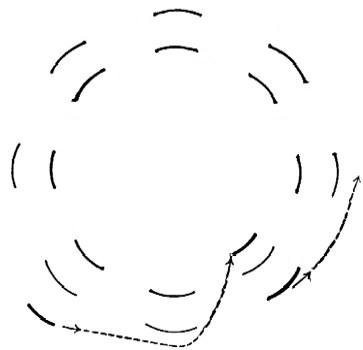
Should the chaser tag the runner, they exchange places, the runner immediately becoming chaser, and the chaser being liable instantly to tagging.
It will thus be seen that great alertness is necessary on the part of any one standing on the outside of the circle, as at any moment the runner may take refuge in front of his file or couple, making him the third man and liable to be tagged. It is not permissible for any third man to take refuge in front of the couple standing immediately on his right or left when he becomes third man.
Both runner and chaser may dash through the circle, but may not pause for a moment within the circle, except when the runner claims refuge in front of some couple. When players are inclined to confuse the play by hesitating while running through the circle, this privilege of running through is sometimes forbidden, all the chasing being confined to the outside of the circle.
VARIATION.—This game may be varied by having the players who form the circle stand face to face, with a distance of one long step between each two, instead of all facing toward the center of the circle. In this form of the game the runner takes refuge between the two forming the couple, the one toward whom his back is turned being the third man. Both runner and chaser may run between the two circles of players.
This may be made one of the jolliest games possible, and also one of the best for making slow and dull players alert and active. The author has seen many a class of slow-minded children waken to much quicker mental action as well as greater physical agility by this game. For adult players it may be thoroughly delightful. The writer recalls a class of adult business men in a Y. M. C. A. gymnasium who resorted even to leapfrog tactics in the strenuous sport they put into this game.
TOMMY TIDDLER'S GROUND
5 to 30 or more players.
Playground; gymnasium.
The ground is divided by a line into two equal parts. One of these belongs to Tommy Tiddler, who stands on his side of the line and may not cross it. All of the other players are on the other side of the line, and venture across the line into Tommy Tiddler's ground, taunting him with the remark,—
"I'm on Tommy Tiddler's ground, Picking up gold and silver!"
Tommy may tag any one on his ground, and any one so tagged changes places with him. The players will learn to add to the interest of the game by venturing as near Tommy Tiddler as possible and being very tantalizing in inducing him to run after them. Tommy Tiddler, on his part, will find opportunity for considerable finesse, such as in appearing to give his attention entirely to one player, then suddenly turning and dashing for another.
TOSSING WANDS
10 to 60 or more players.
Gymnasium; playground; schoolroom.
This game is played in two forms, line form and circle form.
LINE FORM.—The players stand in two lines or ranks facing each other, all those in one line being provided with gymnasium wands about three feet in length. A leader is appointed who either counts or commands as a signal for tossing the wands back and forth from one line to the other: as, "One, two, three—toss!" This is even more effective if gymnastic movements be taken on the three counts, as bending the trunk forward with the wand downward, stretching the arms upward with the wand overhead, extending it forward at shoulder height, and then tossing backward over the head. The signals for this would be "Bend! Stretch! Out! Toss!"
The wands should first be held in the hand with the palms upward, and caught with the hands in the same position. Later, the hand position should be reversed, the wand being grasped with the downward-turned palms.
CIRCLE FORM.—When players are proficient in catching in opposite lines or ranks, they should form a circle, facing around in single file, each player being provided with a wand which is tossed backward over the head and caught by the player behind. This may be done best rhythmically with the exercises and commands mentioned above, "Bend! Stretch! Out! Toss!" The wand should be caught with the palms outward.
Any player failing to catch a wand drops out of the game. With a little practice, however, this usually resolves itself into a quick drill rather than a game; but it is a most interesting, skillful, and diverting play.
TRADES
10 to 60 or more players.
Indoors; out of doors.
This game is the boys' form of the game played by girls as "Old Woman from the Woods." The players divide into two equal parties. One party retires and decides on some trade or occupation, whereupon they advance toward the second party, saying:—
"Here are some men from Botany Bay. Got any work to give us to-day?"
The second party asks, "What can you do?" The first party answers, "Anything." The second party says, "Set to work, then!" whereupon they go through pantomimic motions descriptive of the occupation chosen, such as planing, sawing, or hammering, for the carpenter; the motions of the bricklayer, tailor, cobbler, motor-man, etc. The second party guesses what this pantomime indicates. Should they guess correctly, they have a turn at representing a trade. Should they fail, the first party has another trial.
When played in a playground or gymnasium, where there is a good running space, a successful guess should be followed by a chase of the actors by the guessing party, any players caught before a designated goal line is reached having to join the party of their captors. The party wins which secures all of the players.
The following activities and occupations were shown by one class of city boys: milking cows, grinding coffee, hanging wall paper, traveling salesmen (displaying and measuring goods), rooting a baseball team, Marathon race, picking cherries, basket-ball game, oiling sewing machine, blowing up bicycle tires, running a lawn mower, bricklaying.
TREE PARTY
5 to 60 players.
Out of doors.
In these days of nature study this game is especially appropriate. It may be used on any ground or strip of woodland where there is a variety of trees, the game consisting in identifying the trees.
A tag or card is fastened on one or more trees of each variety within certain prescribed limits. These cards may be made as fanciful or as rustic as desired. Birch bark is very appropriate for them, and for either birch bark or a conventional card a pretty element may be added by writing some appropriate quotation or verse, after the Japanese custom. The main object of each card, however, is to bear a number. Each player is provided with a card or slip of paper containing a list of numbers corresponding to those on the trees. Thus, if fifteen trees be numbered, there should be fifteen numbers on each player's card.
The players, having been provided each with a card and pencil, wander at will over the designated territory. Whenever a number is discovered on a tree, the player, if he knows the name of the tree, writes it on his own card opposite the corresponding number. For most companies, popular rather than botanical names of the trees are permissible. At a signal—a bell, whistle, horn, or call—the players all assemble. The host or hostess then reads a correct list, each player checking the card that he holds. The player wins who has the largest number of names correct.
The writer has known this game to be a most beautiful diversion for a lawn party on a large estate, and has a feeling appreciation of how many trees most people will find it hard to name in even a familiar strip of woodland.
A CITY PLAYGROUND
TRIPLE CHANGE
10 to 60 or more players.
Playground; gymnasium; parlor.
The players form a circle, with the exception of three who stand in the center. Those forming the circle and those in the center number off in threes. The players in the center take turns in calling each his number, as "One!" "Two!" or "Three!" whereupon all of the players in the circle who hold that number quickly change places with each other, the one who called the number trying to catch one as he runs to a new place. Any player so caught changes places with the caller. For instance, the center player may call "Three!" whereupon all of the Numbers Three in the circle must change places. They may do this by changing with a near neighbor, or tantalize the one who called by running across the circle.
The center players take turns in calling numbers. For instance, if the first one fails to secure a place, then the second of the center group calls. Should the first succeed in catching one of the other players, the player so caught will await his turn in the center until Numbers Two and Three have each had a turn at calling before he calls a number.
TUG OF WAR
(See Catch and Pull Tug of War and Wand Tug of War; also Contests for Two, under "Feats and Forfeits.")
UNDER THE CUCKOO'S NEST
5 to 30 players.
House party; out of doors.
One player is chosen as leader, and stands up, generally with his back against a wall or post, while a second player, who is the cuckoo, bends down, as for leapfrog, with his head against the leader. The other players stand around in a circle, each placing a finger on the back of the cuckoo. The leader then "counts off" the fingers of the players with the following rhyme, indicating a finger for each accent of the rhyme:—
"The wind blows east, the wind blows west, The wind blows under the cuckoo's nest. Where shall this or that one go? Shall he go east or shall he go west? Or shall he go under the cuckoo's nest?"
The player whose finger is indicated by the last word of the rhyme must then go to any place directed by the cuckoo, who, if he has any intimation of the identity of the player, may use considerable tact in choosing a difficult or interesting place; as on some high point to which it is difficult to climb, or under some low object under which it is hard to crawl, some distant place, etc. One player, however, must be directed to hide under the cuckoo's nest, and this player takes a position at the feet of the cuckoo. This is a favored position. When all of the players have been thus disposed, the leader calls, "Pom, pom, cooketty coo!" As soon as this call is heard, the players run back and pound the cuckoo on the back until the last one is in. This last one becomes the cuckoo for the next repetition of the game.
VAULTING SEATS
10 to 60 players.
Schoolroom.
This game is played the same as Changing Seats, except that the pupils vault over the seats instead of sitting in them. The game may be played anywhere above the third year.
The teacher gives the order "Right, jump!" whereupon all of the pupils jump over their seats toward the right-hand side of the room. The row that is displaced, now standing in the right-hand aisle, runs at once around the room to the left-hand aisle. The teacher then repeats her command. The directions for the vaulting should be varied and unexpected, several being given to the right, then several to the left, etc.
The method of vaulting is to place one hand on the edge of the desk at the back of the seat to be vaulted over, and one hand on the desk that goes with the seat to be vaulted over. The hand should preferably be placed halfway between the two aisles, to assist both the jump and the landing. While placing the hands, pupils should crouch in a position ready to spring, with the heels raised, knees spread outward, and back straight and erect. They should land in the same position, as the bend of the ankle, knee, and hip joints breaks the jar of landing.
WAND RACE
10 to 30 or more players.
Gymnasium; playground; schoolroom.
An objective line, fence, or wall is chosen, and from ten to twenty feet from it and parallel with it a starting line is drawn. The players stand behind this line and toe it. If there be a large number, they form in competitive files as for a relay race, the leaders of each division toeing the line. Each leader balances on the forefinger a gymnasium wand, the other hand being placed on the hip, and walks forward to the objective line, all starting at a given signal. Should the wand be dropped, it must be picked up and the effort resumed from the place where this happened.
The first one to reach the objective line wins; or, if a relay, scores for his division. The division wins that gets the largest score. If desired, the winners, i.e. those scoring for the different lines, may "play off" against each other, after all of the other players have had their turn.
WAND TUG OF WAR
10 to 100 players.
Playground; gymnasium.
This game is played with wooden gymnastic wands, from three to five feet in length, and not less then one inch in diameter. There should be half as many wands as there are players. A line is drawn across the center of the floor or playground. The players are divided into two divisions, one standing on each side of the dividing line, so that each player faces an opponent. These grasp each the end of a wand, held horizontally between them. At a signal a tug of war begins, each player trying to pull his opponent across the line. Any one who puts a foot on the ground of the opponent's territory ceases the struggle and must come across the line. The division wins which has the greatest number of players on its side of the line at the end.
The game is best played in two or three five-minute intervals, with rests between.
WATER SPRITE
10 to 30 or more players.
Playground; gymnasium.
The players stand in two lines facing each other, with a large open space representing a river between. One player, representing the water sprite, stands in the middle of the river and beckons to one on the bank to cross. This one signals to a third player on the opposite bank or side of the river. The two from the banks then run across to exchange places, the water sprite trying to tag one of them. If the water sprite be successful, he changes places with the one tagged.
This is a Chinese game, reported by Miss Adèle M. Fielde, and is based upon the superstition that a water sprite waits in the middle of a stream to entice people into it, probably an outgrowth of spring freshets.
WEATHER COCK
10 to 60 players.
Schoolroom.
This game, besides offering much sport, may be made to serve a useful purpose in familiarizing children with the points of the compass.
The class having learned which directions are north, east, south, and west, one player, who represents the weather bureau, stands in front of the others (or the teacher may take this part), and calls out which way the wind blows. For instance, when he says, "The wind blows north" the players turn quickly toward the north; if he says "west," the players turn to the west; whenever he says "whirlwind," the players all spin around quickly three times on the right heel.
The interest will depend very largely on the rapidity and variety with which the leader calls the various points of the compass. For older children, halfway points may be named, as northwest, southeast, etc.
WEE BOLOGNA MAN
2 to 60 or more players.
Parlor; playground; schoolroom.
"I'm the wee Bologna Man. Always do the best you can, To follow the wee Bologna Man."
A leader who can be very brisk in movement and resourceful in ideas stands in front of the other players and repeats this verse rapidly, imitating each time he repeats the verse some one action characteristic of the members of a band. For instance, the first time he may go through the pantomime of playing a fife; the next time, without any pause between, he may imitate the beating of a drum; the next, playing a fiddle, trombone, flute, cymbals, triangle, imitate the drum major, etc. All of the other players follow his movements.
The sport will depend largely upon the rapidity of the time and the vivacity that is put into the movements.
FOR THE SCHOOLROOM.—The head players in the different lines of seats should take turns in being the Bologna Man, and the movements should be such as will afford effective exercise. For instance, the first player will stand and repeat the verse while hopping on one foot, the entire class joining in the hopping. The moment he is through, the leader of the next row should jump up, face the class, and repeat the verse, going through some other motion, such as hopping on the other foot; he, in turn, to be succeeded by the next leader, etc. Many gymnastic movements will suggest themselves, such as jumping on both feet, jumping forward down the aisle frog fashion, jumping high in place, running in place, stretching the arms out sideways and bending sideways like a walking beam, whirling both arms around like a windmill, taking a dance step, etc.
This is one of the Scotch plays, and like most Scotch things of the sort, should be done in brisk time.
WHIP TAG
(Light the Candle; Beetle-goes-Round)
10 to 30 or more players.
Playground; gymnasium.
This game may be played with a knotted towel, though it is perhaps more skillful and interesting when played with a "beetle," a small cylindrical sack about twenty inches long, stuffed with cotton, and resembling in general proportions a policeman's club.
All but one of the players stand in a circle with hands behind their backs. The odd player runs around the outside carrying the beetle, which he drops in the hands of any player in the circle. That player immediately turns to chase his right-hand neighbor, beating him as much as he can find opportunity for while he chases him around the circle and back to his place. It is obviously to the interest of this neighbor to outrun the beetle and escape a buffeting.
The one holding the beetle then takes the place of the first outside player, that one joining the ring. The new beetle man, in turn, runs around on the outside and drops the beetle in any hands which he chooses.
The sport of this game depends on the alertness of the players, as not only the one who receives the beetle but his right-hand neighbor must know when and where the beetle lands, and turn quickly for the chase. The player running around the outside will add to the zest of the game by trying to deceive the ring players as to where he is going to place the beetle, quickening or slowing his pace, or resorting to other devices to keep them on the alert.
WHO GOES ROUND MY STONE WALL?
10 to 30 or more players.
Indoors; out of doors.
There are two ways of playing this game. The one first described is better suited to schools and general playground conditions; the second is quite distinct, and may have better sport for parlor use.
The players stand in a circle, numbering preferably twenty or less, with a little space between each two players, and not holding hands. They represent a sheepfold, but later, as each is chosen from the circle, he takes the part of a sheep. One player is chosen to be Jacky Lingo, who walks around outside of the circle. Another, who is the shepherd or owner of the sheep, stands in the center of the circle.
The owner says, "Who goes round my stone wall?" The outside player answers, "Nobody; only little Jacky Lingo."
"Pray don't steal any of my fat sheep."
Jacky Lingo answers: "Unless I take one-by-one, two-by-two, three-by-three! Follow me!"
As Jacky Lingo says his last line, he taps three different players on the back, one for "one-by-one," another for "two-by-two," and a third for "three-by-three." If a large number be playing, he may tap two for each count instead of one, making six in all. As the players are tapped, they step out from the sheepfold and line up back of Jacky Lingo, each one in the line placing his hands on the shoulders of the one next in front. This is continued until all the players are taken by Jacky Lingo, who then runs off around the ground with them. The owner goes after them, faces Jacky Lingo, and says, "Have you seen anything of my black sheep?"
"Yes; I gave them a lot of bread and butter and sent them up there" (pointing to left or right).
"Then what have you got behind you?"
"Only a few poor black sheep."
"Well, let me see! Here's my black sheep!"
The owner then tries to catch the sheep, and this Jacky Lingo tries to prevent. Any sheep in the line may be touched by the owner, and when so touched he steps out of the line and stands aside until all are caught.
VARIATION.—When played indoors or on the turf, the game may be played by the owner being blindfolded and taking a position on hands and knees—"all fours." The dialogue is the same as given above, and the gathering in of the sheep by Jacky Lingo the same, except that the players do not line up behind him. They simply stray over the ground when he takes them from the fold. When all are scattered in this way, they begin to cry, "Baa-a! baa-a!" and the owner, still on all fours and blinded, tries to catch them. The first one caught becomes shepherd the next time.
WINK
9 to 25 players.
House party.
An uneven number of players are required for this game. Enough chairs are placed in a circle to allow one chair to each two players and one for the odd player, that is, half as many chairs as there are players, with one player over. A player sits in each chair, all facing inward. Behind each chair stands a second player, who acts as guard. There should be one empty chair with a guard behind it. This odd player winks at some one sitting in the circle, who at once tries to slip out of his chair without being tagged by his guard and take his place in the empty chair. He may not go if he be tagged by his guard. The object of the guards should be to avoid being the keeper of an empty chair, and therefore the one who has to wink. The players try to evade the vigilance of the guards by the quickness and unexpectedness of their movements. The guards may not keep their hands on their prisoners, but must have them hanging at their sides until they see their players winked at. They may not dash around the sides of the chairs which they guard, but must stay all the time behind them.
Nodding the head may be used instead of winking, but is more apparent to the guards.
WOLF
5 to 30 or more players.
Out of doors.
This is an admirable hide and seek game where there are many hiding places, as in a village or the country.
One player is chosen for the wolf, who goes off and hides. The rest of the players are sheep, with one of their number as leader. A place is chosen for a pen where the sheep must stay and blind their eyes while the wolf is hiding. This pen may be a tree or rock or a square or circle drawn on the ground. The leader counts one hundred, to give the wolf time to hide. The sheep then start out, but must all follow their leader "like sheep," looking for the wolf in each place where the leader may search for him. This game differs from most other hiding games in that the searchers are the ones who have to flee for safety when the hider is discovered. As soon as the wolf is spied, the leader cries:—
"All my sheep Gather in a heap; For I spy the woolly, woolly wolf!"
The sheep at once stand still until the wolf has taken a jump toward them, which he must do before he may chase them; but immediately that the wolf has made his leap, the sheep all turn and run for the sheep pen, the wolf following. As the wolf may not run until he hears the word "wolf" at the end of the leader's lines, the latter often tantalizes the wolf by saying, "I spy the woolly, woolly—lamb!" or "the woolly, woolly—cat!" or names any other animal he chooses, with a pause before the name, to prolong the suspense of the impatient wolf, finally ending up with "the woolly, woolly—wolf!"
Any sheep tagged by the wolf becomes a wolf and joins the wolf the next time, hiding either in the same den with him or in a separate den. When there is more than one wolf, the leader halts his sheep whenever he spies a wolf, whether it be the original wolf or not, and all of the wolves join in the chase when the sheep run back to the pen. The game ends when all of the sheep have been caught.
The wolf has several resources at his command for catching sheep in addition to a simple chase. If at any time while in hiding he spies the sheep before they spy him, and considers their position in relation to the goal advantageous to himself, he may call, "Stand your ground, three feet!" whereupon the sheep must instantly stand still and then take three steps toward the wolf and stand again until he jumps toward them, when the chase for the sheep pen begins. The wolf may also exercise considerable finesse by running directly for the pen if he be in a position to reach it quicker or more directly than by chasing the sheep. Should he reach the pen first, he may then tag the sheep as they run in. One sheep may act as a decoy to engage the attention of the wolf while the others run into the pen.
WOOD TAG
3 to 30 or more players.
Out of doors; gymnasium.
This is a game of tag. When there are more than thirty players, it is desirable to have two or more who are It, or taggers. The players venture as near as possible to the one who is It, taunting him by crying, "Ticky, ticky, touch wood!" Any player may seek immunity from being tagged by touching a piece of wood. No growing thing, however, such as a tree or shrub, is to be considered as wood. No player may stay very long in any place of safety, and the moment his hand or foot be taken from the wood he is liable to be tagged. A player who is not near wood may gain a few minutes' respite by calling out "Parley!" but he must stand perfectly still in the place where he then is, the tagger being able to tag him if he makes the slightest move of any part of his body. When such a player decides to run again, he calls out, "Parley out!"
This game affords opportunity for a great deal of sport through the making of false starts and the daring approach to the one who is It, who, in turn, may make sudden and unexpected sorties in different directions.
Like Iron Tag, this game is very ancient, and has evidently come from an old superstition that to touch iron or some other particular substance gave immunity from the spell of evil spirits.
WRESTLING
(See "Contests for Two" under "Feats and Forfeits.")
YARDS OFF
3 to 30 or more players.
Out of doors.
This is a form of I Spy or Hide and Seek, and seems indigenous to New York. All players properly caught by the spy become prisoners, but may be freed in a prescribed way. The procedure which gives time for hiding is also distinctive.
Two players are chosen, one to be It and one for stick thrower. All the players stand grouped around a goal, and the stick thrower throws a stick as far away from the goal as he can. As soon as the stick touches the ground, all of the players, including the thrower, but not the one who is It, scatter and hide. The one who is It must walk to the stick (never run), take it up, bring it back, and stand it up, resting against the goal. He then starts to hunt for the hidden players. He must run back and touch the goal for any player whom he discovers, saying, "One, two, three, for—!" naming the player. Any one caught in this way becomes a prisoner at the goal. Any player who has not been detected by the spy may run in to the goal at any time and throw the stick away, whereby all of the prisoners, i.e. those who have been spied and previously caught, become free and hide again. Whenever this freeing of prisoners happens, the spy must return to the goal, walk to the stick, pick it up, walk back with it to the goal again, and go on with the play as before. This continues until the spy has touched the goal for all of the players, though they need not all be prisoners at once. Any player spied who reaches the goal before the spy, is thereafter free; i.e. out of the game. The last one caught becomes spy for the next game.