MISCELLANEOUS ACTIVE GAMES (continued 3)
Reading edition
Parlor; playground; gymnasium; schoolroom.
The players stand in a large circle and are numbered consecutively. One player takes his place in the center. He calls two numbers, and the players whose numbers are called must change places while the center player tries to secure one of their places. The one who is left without a place changes places with the center player.
FOR THE SCHOOLROOM.—This game may be adapted by selecting two players as chasers, who take their places in the front of the room. These players are not blindfolded, as in the parlor form of the game. All of the other players are seated, having been numbered. The teacher calls two numbers, when the players bearing those numbers must rise at once and exchange seats, the two chasers trying to catch them before they can get to their seats.
When a game is played under these circumstances, it is not permissible for the chaser to take a vacant seat; he must catch the player who is running for it. No player, having once left his own seat, may return to it, but must keep up the chase until he is caught or reaches the seat for which he is running.
This game gives opportunity for some very lively chasing, with good running and dodging up and down the aisles. As in all running games in the class room, the seated players should keep their feet out of the aisles.
For young children it may be found desirable to have only one chaser. It generally adds to the interest of the game to have a general exchange of seats at the opening of the game, immediately after the numbers have been assigned, and before the chasing is commenced, as then the person who calls the numbers is at a loss to know how near or distant those called may be in relation to each other, and this element adds much to the sport of the game.
OBSERVATION
5 to 60 players.
Parlor; schoolroom.
This game is a test of visual memory. When played in a parlor, all the players are seated except one, who passes around a tray or a plate, on which are from six to twenty objects, all different. These may include such things as a key, spool of thread, pencil, cracker, piece of cake, ink bottle, napkin ring, small vase, etc. The more uniform the size and color of the objects the more difficult will be the test. The player who carries the tray will pass at the pace of an ordinary walk around the circle, giving each player an opportunity to look at the objects only so long as they are passing before him. It is not allowable to look longer than this. The observer must then at once write down on a slip of paper the names of as many of the objects as he can remember. The player wins who writes correctly the longest list.
It is sometimes more convenient to have the articles on a table and the players all pass in a line before them.
IN THE SCHOOLROOM.—The objects should be placed on the teacher's desk, so shielded that pupils cannot see them except as they march past the desk. This they should do, returning at once to their seats and writing the list. Used in this way, the game may be made to correlate with nature study, the objects to be observed being grasses, shells, leaves, stones, woods, etc.
ODD MAN'S CAP
10 to 30 or more players.
Playground; gymnasium.
Twelve players make the best-sized group for this game; where there are more players, they should be divided into small groups. All but one of the players stand in a circle with considerable space between each two. The odd man stands in the center. Each player is provided with a stick about two feet in length; canes or wands may be used as a substitute, but the shorter sticks are better; they may be whittled from branches or bits of wood, and should not be pointed at the ends. The odd man tosses his cap or a cloth bag toward the circle. The players endeavor to catch it on their sticks, and keep it moving from one to another, so as to evade the odd man, who tries to recover his property. Should he succeed, he changes places with the one from whom he recovered it. The sticks must be kept upright in the air. A dropped cap may be picked up only by hand, not on a stick. The sticks must always be held upright. An old stiff hat, or a cap or bag wired around the edge to keep it spread open, makes the best game.
This game holds the interest of the players intently and is full of sport.
OLD BUZZARD
5 to 30 or more players.
Playground.
This is one of the old dramatic games, probably better known in America than any other of this type.
One player is chosen to represent the "Old Buzzard"; another player represents a hen, and the remainder are chickens. All the players circle around the buzzard, saying in chorus:—
"Chickany, chickany, crany crow; I went to the well to wash my toe; And when I came back a chicken was gone."
The hen finishes by asking alone, "What o'clock is it, old buzzard?" The buzzard crouches on the ground during the repetition of the verse, going through the pantomime of building a fire with sticks, and in answer to the question may name any hour, as eight o'clock, nine o'clock, ten o'clock. So long as the buzzard does not say twelve o'clock, the players continue to circle around, repeating the verse, the final question being asked each time by a different player, until the buzzard finally says, "Twelve o'clock!" When this occurs, the ring stands still, and the following dialogue takes place between the buzzard and the hen:—
Hen. Old buzzard, old buzzard, what are you doing? Buz. Picking up sticks. Hen. What do you want the sticks for? Buz. To build a fire. Hen. What are you building a fire for? Buz. To broil a chicken. Hen. Where are you going to get the chicken? Buz. Out of your flock!
The buzzard, who keeps a crouching attitude with face downcast during this dialogue, suddenly rises on the last words and chases the players, who scatter precipitately. When a player is captured, the buzzard brings him back, lays him down, and dresses him for dinner, while the rest of the players group around. The buzzard asks of the captured chicken, "Will you be picked or scraped?" and goes through the motions of picking feathers or scaling fish, as the chicken decides. The buzzard then asks, "Will you be pickled or salted?" "Will you be roasted or stewed?" each time administering to the recumbent chicken the appropriate manipulations. At the end he drags the victim to a corner, and the game goes on with the remainder of the players.
OLD MAN TAG
10 to 60 players.
Schoolroom.
The players are in groups of two rows each, which play together. These two rows face away from each other. Thus the first and second row will turn respectively to the right and left, with their feet in the aisles, toward which they then face. This will leave a free aisle between them, in which the "old man" may run about. The third and fourth rows play together, facing away from each other, and leaving a free aisle for their old man or tagger. This will bring the second and third rows with their feet in the same aisle.
Old Man Tag
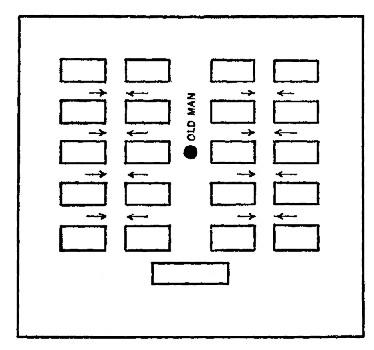
For each group one player is selected to be old man or tagger. The teacher gives a signal, whereupon all of the players stand. The object of the game is for the old man to tag any player who is standing. The players may avoid this by sitting whenever the old man approaches them. Should he succeed in tagging any player, that player must remain seated until the end of the game, but any player who sits to escape tagging must rise again as soon as the old man has moved away from his vicinity. The player is considered to have won who longest avoids the old man.
Children are very fond of this game in many grades, and it may be made very lively, the old man dodging rapidly up and down his aisle, and the other players bobbing quickly up and down from their seats.
OLD WOMAN FROM THE WOOD
(For boys, see Trades.)
10 to 60 or more players.
Parlor; playground; schoolroom.
The players are divided into two even parties, which face each other from a short distance. One party advances toward the other, remarking, "Here comes an old woman from the wood." The second party answers, "What canst thee do?" whereupon the old woman replies, "Do anything!" The second party then says, "Work away!" whereupon all the players in the first party proceed to imitate some occupation in which an old woman might engage, and which they have previously agreed on among themselves, such as sewing, sweeping, knitting, digging a garden, chopping wood, kneading bread, stirring cake, washing, ironing, etc. The opposite party tries to guess from this pantomime the occupation indicated. Should they guess correctly, they have a turn to perform in the same way. Should they be unable to guess correctly, the first party retires, decides on another action, and returns. This form of the game is generally played by girls. Boys play the same game with different dialogue under the name of "Trades."
When played in a playground or gymnasium, where there is free space for running, a successful guess should be followed by a chase of the actors by the guessing party, any players caught before a designated goal line is reached having to join the party of their captors. The party wins which secures all of the players.
OYSTER SHELL
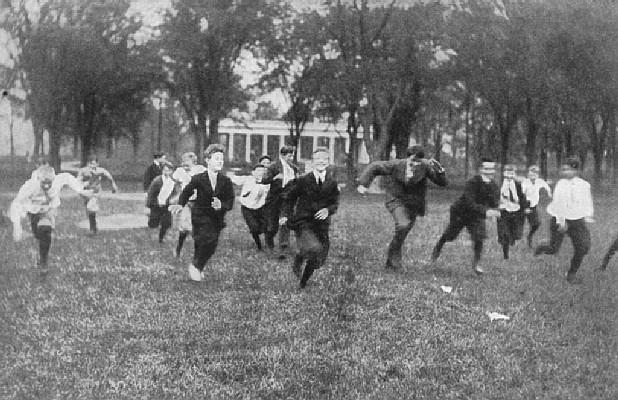
OYSTER SHELL
10 to 100 players.
Playground; gymnasium.
Two parallel lines are drawn across the center of the playground, with a space of ten feet between them, which is neutral territory. At a considerable distance beyond each line, and parallel to it, a second line is drawn, the space beyond being a refuge for any players of the party belonging to that side. This second line should preferably be at a considerable distance from the starting line, so as to give plenty of opportunity for a good chase during the game.
The players are divided into two equal parties, which take place one on either side of the neutral territory. Each party chooses a color, light or dark, corresponding to the light or dark side of an oyster shell or some other small object which is used in the game.
A neutral odd player who acts as leader takes his place in the center of the neutral territory and tosses the oyster shell into the air. If there be no such leader available, the parties may choose captains to toss the shell alternately. The shell is allowed to fall on the ground. If the light side falls upward, the light party must turn and run for the goal at the opposite end of the ground, the other party chasing them. Any one captured (tagged) must carry his captor back to his home goal on his back. A party scores one point for each prisoner caught. These may be easily counted, as the prisoners carry their victors home pick-a-back. The party first scoring fifty or one hundred points (according to the number of players) wins the game; or the winners may be determined by the largest score when the game ends.
Because of the carrying home of the victors by the players who are caught, it is advisable that some means be adopted to have opponents of nearly equal size. This is easily done by having the players line up according to size at the opening of the game and assigned alternately to the different sides. In any event, the tall players should be placed opposite each other, and the smaller players vis-a-vis.
This game is from the ancient Greeks, and is said to have arisen from a custom of exiling wrangling political opponents by writing their names on an oyster shell and sending from the city the one whose name fell uppermost when the shell was tossed. Some modern adaptations are here given.
PAR
10 to 30 or more players.
Playground; gymnasium.
This is a leapfrog game in which the distance of the back from the jumping line is advanced after each round a "foot and a half," measured in a certain way called a "par." The game starts with the back at a given distance from the line. After each player has "overed," the back places one foot with the outer edge on the line on which he has been standing, puts the heel of the other foot against the instep so that the second foot will be at right angles to the first, and marks a new line at the point where the toes come. The new line is thus the length of one foot in advance of the first line, plus the width of the other foot at the instep. The players then leap again from the starting line, and as the back moves farther away, they add to their leaps each time, as becomes necessary for the greater distance, as follows: (1) leap; (2) hop and leap; (3) hop twice and leap; (4) hop three times and leap; (5) hop, skip, jump, and leap.
Any player failing to "over" changes places with the back.
PARTNER TAG
4 to 100 players.
Indoors; out of doors; schoolroom.
All of the players but two hook arms in couples. Of the two who are free, one is It or chaser, and the other the runner. The runner may save himself by locking arms with either member of any couple he chooses. Whenever he does so, the third party of that group becomes runner and must save himself in like manner. If the runner be tagged at any time, he becomes It or chaser; and the chaser becomes runner.
To get the proper sport into this game, the couples should run and twist and resort to any reasonable maneuver to elude the runner, who is liable at any time to lock arms with one of them and so make the other a runner.
For large numbers there should be more than one runner and chaser.
PEBBLE CHASE
5 to 30 or more players.
Gymnasium; playground; out of doors.
One player, who is the leader, holds a small pebble between the palms of his hands, while the others stand grouped around him, each with his hands extended, palm to palm. The leader puts his hands between the palms of each player, ostensibly to drop therein the pebble which he holds, as in the game called "Button, button." The player who receives the pebble is chased by the others, and may only be saved by returning to the leader and giving the pebble to him. This chase may begin as soon as the players suspect who has the pebble. Each player should therefore watch intently the hands and faces of the others to detect who gets it, and immediately that he suspects one, start to chase him. It is therefore to the interest of the player who gets the pebble to conceal that fact until the attention of the group is distracted from him, when he may slip away and get a good start before he is detected. He may do this whenever he sees fit, but may not delay after the leader has passed the last pair of hands. The leader will help to conceal the fact of who has the pebble by passing his hands between those of the entire group, even though he should have dropped the pebble into the hands of one of the first players.
If the pebble holder gets back to the leader and gives him the pebble before being tagged, he continues with the group. If the pebble holder is caught before he can get back to the leader, he must pay a forfeit or change places with the leader, whichever method is decided on before the game opens.
In a crowded playground it is well to require that the chasers follow over exactly the same route as the pebble man. Under such conditions, the game is more successful if limited to ten players to a group.
This game is from the modern Greeks. It is found to bear transplanting excellently, being full of interest and sport.
PINCH-O
5 to 30 or more players.
Gymnasium; playground.
This is a game of chase, an advancing line (rank) of players turning and fleeing from an odd player in front of them when a signal is given. The players in the advancing line pass a "Pinch" (hand pressure) from one to another along the line, the end players calling out "Pinch!" and "O!" respectively at the start and finish of this performance. The "O" is the signal for the chaser to start. The chaser therefore watches the hands carefully to detect the pressure and know when it is approaching the end; the other players naturally try to conceal this passing of hand pressure, delaying or hastening it to take the chaser unaware.
The player who is It walks backward, being about ten feet in front of the others, who advance slowly forward in a line, holding hands. The player on one end of the line calls "Pinch!" and at once squeezes or pinches the hand of the player standing next. This player slightly presses the hand of the one on his other side, and so on across the line until the pressure is felt by the last player on the opposite end, who at once calls out "O!" Immediately that the "O" is heard, the entire line is liable to be tagged by the one who is walking backward in front of them, and they therefore instantly turn and run for "home," a place determined beyond certain boundaries at one end of the ground. The one who is It gives chase, and any one tagged by him must join him in tagging the players when the game is repeated. The game ends when all are caught, the last player to be caught being the winner, and taking the part of the odd player for the next round.
PITCH PEBBLE
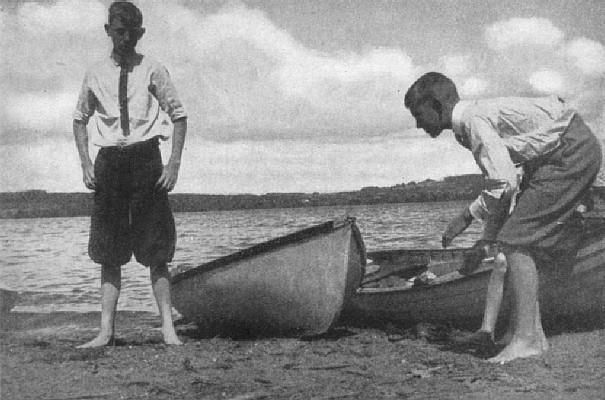
PITCH PEBBLE
4 to 10 players.
Out of doors; seashore.
This game may be played with pebbles, shells, or nuts, each player having two or four of such articles. The object of the game is to throw these pebbles into a hole about four inches in diameter, which should be made in the ground. The first part of the game is concerned with determining the order in which the players shall take turns. Ten feet from the hole a place is marked, from which the players throw in turn until each has had enough turns to have thrown all of his pebbles. The one who has succeeded in landing a pebble nearest the hole becomes the first player, and takes his stand on a second mark drawn one fourth nearer the hole, all the players meanwhile having gathered up their pebbles again. These are all given to the successful player, and he pitches them in a mass toward the hole, becoming the owner of as many as fall into the hole. Any pebbles that do not go in the hole are gathered up by the player who in the original throwing came out second in trying to get near the hole, and he, in turn, throws these in mass, standing also at the nearer throwing point from which his predecessor threw. All of the players take turns in this way until all of the pebbles have been appropriated. The player wins who gets the most pebbles. Pebbles won are not thrown again, but kept for score.
For good players the distances from the hole may be increased.
POISON
10 to 30 or more players.
Gymnasium; playground; seashore.
Poison
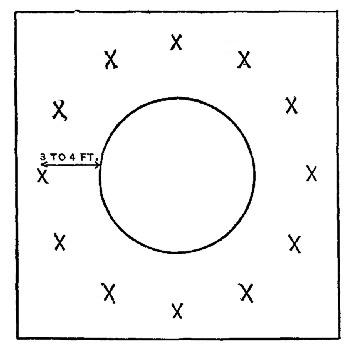
A circle is marked on the floor or ground considerably smaller than an outer circle formed by the players, clasping hands. Each player tries, by pulling or pushing, to induce the others to step within the smaller circle, but endeavors to keep out of it himself. Any one who touches the ground within the inner circle, if only with one foot, is said to be poisoned. As soon as this happens, the player or players so poisoned become catchers; the other players shout "Poisoned!" and at once break the circle and run for safety, which consists in standing on wood. The merest chip will answer, and growing things are not counted wood. If played in a gymnasium, iron may give immunity instead of wood. Any one caught before reaching safety, or in changing places afterward, joins the catchers, and when all have been caught, the ring is once more surrounded.
POISON SNAKE
10 to 30 or more players.
Gymnasium; playground.
Poison Snake
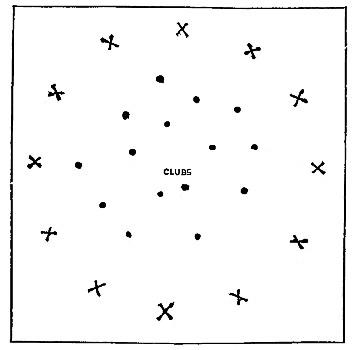
The players join hands to form a circle. About fifteen Indian clubs or tenpins are placed in the center of the circle, with spaces between them in which a player might step. The players then try, by pushing or pulling their comrades by means of the clasped hands, to make them knock over the clubs. Any player who overturns a club or who unclasps hands must at once leave the circle, the club being replaced. The first players so leaving start a "scrub" circle; players disqualified in the scrub circle start another in their turn, etc. The player wins who is left in the original circle. Where several circles have been formed, the several winners may form a circle at the close and play to determine the final winner.
This game has possibilities for much sport and skill. The agility with which players leap over or pass between the clubs is as important a part of the game as the pulling and pushing. The clubs should be sufficiently scattered to make it possible for a player to save himself in this way. Children may need to have this feature of the game pointed out to them. The game is equally interesting to children or adults, but obviously requires gymnasium suits for girls or women.
POM POM PULLAWAY
5 to 30 or more players.
Out of doors.
This game is often played between the curbings of a city street, but is suitable for any open play space which admits of two lines drawn across it with a space of from thirty to fifty feet between them. All players stand on one side behind one of the dividing lines, except one player who is It and who stands in the center of the open ground. He calls any player by name and adds a formula, as below:—
"John Smith, Pom Pom Pullaway! Come away, or I'll fetch you away!"
Whereupon the player named must run across the open space to the safety line on the opposite side, the one who is It trying meanwhile to catch him before he reaches that line. If he gets over safely, he remains there until all of his comrades have joined him or have been caught. Any one caught by the one who is It joins the latter in helping to catch other players as they dash across the open space, but the one originally It remains the caller throughout the game. After all of the uncaught players have crossed to one side, they try in the same way to return to their first goal. The first one to be caught is It for the next game.
Players should give the chaser as much difficulty as possible in catching them by making feints in one direction and suddenly running in another, or by running diagonally instead of straight across, etc.
POOR PUSSY
5 to 20 players.
Parlor.
The players sit in a circle, except one who is chosen for Poor Pussy. Pussy kneels in front of any player and miaous. This person must stroke or pat Pussy's head and say, "Poor Pussy! Poor Pussy! Poor Pussy!" repeating the words three times, all without smiling. If the player who is petting Puss smiles, he must change places with Puss. The Puss may resort to any variations in the music of the miaou, or in attitude or expression, to induce the one who is petting to smile.
This may be made one of the most amusing games for adults at a house party. The writer has seen some of the most dignified professional people laughing until the tears came while playing this simple little game.
POTATO RACES
Four forms of Potato Race are here given as follows:—
Potato Race I. Individual competition; rules of Amateur Athletic Union of the United States. Placing potatoes on marked spots; gathering them up not a part of the game.
Potato Race II. Team competition. One player places the potatoes on spots; the next gathers them up, etc.
Potato Shuttle Relay. Rules of Girls' Branch, Public Schools Athletic League, New York City. Alternate placing and gathering up.
Potato Spoon Race. Only gathering up of potatoes.
POTATO RACE—I
(For individual competitors)
2 to 60 or more players.
Playground; gymnasium.
The simpler and usual Potato Race is played in two forms: (I), the players competing as individuals; and (II), competing as teams. The following description is for individual competition; the team game is described as Potato Race II. There are other forms of playing the individual game; the one given here is according to the rules of the Amateur Athletic Union.
The competitors should each wear a large number pinned across the shoulders on the back, where it may be read plainly by the judges. The competition is carried on in heats, as many players as the playing space will allow playing in each heat. Potatoes should be used, or blocks of wood are officially permissible. These wooden blocks may be secured of potato shape, and are better than those of cubical form, as the latter are apt to land on the corners and bound.
A starting line is drawn across the ground. At right angles to it a row of potatoes is placed for each player in the heat. The potatoes should be two yards apart and eight in number. (This is the official number and distance for the Amateur Athletic Union; the number varies in unofficial games, but should be equal for the different rows.) The first potato should be two yards from the receptacle, which is usually placed on the starting line, one beside each competitor. This receptacle should be a pail, basket, box, or can. The official dimensions of the A. A. U. call for its being not over two feet in height, with an opening not over thirty-six inches in circumference. In handicap events the starting mark is paid from the rear of the can. The potatoes are replaced on the marks before the beginning of each heat, the game in this form consisting solely of gathering them up, not in placing them. There is no rule against tossing a potato into the receptacle, but it is poor policy to do so, as it increases the risks of failure.
The contestants start, as for a race, in response to the starter's signals, "On your marks!" "Get set!" "Go!" The game consists in picking up the potatoes one at a time and placing them in the receptacle. The potatoes may be picked up in any order desired. A potato dropped, however, must be picked up before another potato be touched, or the player is disqualified. Similarly, a potato missing the receptacle or bounding out of it must be placed in it before the next potato be touched, or the player is disqualified. When all the potatoes have been placed in the receptacle, the player finishes by dashing across a finish line, a tape, or strand of worsted, stretched five feet back of the receptacle. As in all races in athletic form, a player is disqualified for interfering with any other competitor, or for touching the finish tape with the hands or arms: the tape should be breasted. The winners in each heat play a final race; or, with large numbers competing, semi-finals before the finals. Where small numbers are competing, those finishing first, second, and even third, may be entered for the final trials. In case of a tie, both competitors are entered for the next (final, or semi-final) heat, or, if tied in the final heat, the tied competitors play again.
POTATO RACE—II
(Team competition)
10 to 100 players.
Playground; gymnasium; seashore.
The first description here given is for an informal game. This is followed by the rules for strict athletic procedure.
The ground is marked off with a starting line. At right angles to it are marked two or more rows of spots according to the number of teams competing, the spots being from three to six feet apart, each row containing from six to ten. On each spot is placed a potato; or a stone, block of wood, or any other object may be substituted; on the seashore bathing slippers may be used. Potato-shaped blocks of wood may be had as substitutes for potatoes, and are better than cubical blocks, which are apt to land on the corners and bound.
The players are divided evenly into competing groups which line up in single file behind the starting line, each file being in line with one of the rows of potatoes. Beside the leader of each file is a box or basket; or a circle may be drawn on the ground instead. At a signal each leader runs forward, picks up a potato, brings it back and puts it in the box, goes for another, etc., until all the potatoes in his row have been gathered in. He may pick them up in any order that he chooses. Immediately that the last potato is placed, this player touches the outstretched hand of the next player in his file, and at once leaves the playing space; he should not line up again with his team. The next player in the file starts out immediately on receiving the "touch off," replaces the potatoes one at a time, and touches off the next player, who gathers them in, and so on, alternately, until each player has had his turn. The team wins whose last player is the first to dash back over the starting line.
For an athletic contest for adults, the following rules are typical:—There should be eight potatoes for each team, placed two yards apart, the first potato two yards from the receptacle. The receptacle should be either a pail, basket, box, or can, not over two feet in height, having an opening not over thirty-six inches in circumference. The finish line is a "tape" (strand of worsted) stretched parallel with the starting line and five yards back of the receptacle. There should be a judge of fouls for each team and two judges at finish. Fouls are:—
1. Not placing a potato accurately on the spot.
2. Leaving a potato outside the receptacle instead of in it, whether it be dropped there or bound out.
3. Starting over the line without or before the "touch off."
A foul corrected before the next step in the game be taken does not score as a foul. The teams win first, second, third, and fourth places in the order of finishing, if there be no fouls. Where fouls have been scored, the team finishing first, with the fewest number of fouls, has first place, etc. In case of a tie, the tied teams must play again to determine the winner.
TeamsOrder of FinishingFoulsOrder of Winning
A20 First place
B14 Third place
C46 Fourth place
D33 Second place
POTATO SHUTTLE RELAY
20 to 100 players.
Playground; gymnasium; seashore.
This first description is for an informal game. This is followed by rules for an athletic contest.
This is a form of potato race suitable for large numbers. The ground is marked off with two starting lines, one at either end of the ground. At even intervals between these two lines a row of from four to ten spots should be clearly marked on the ground, each row forming a line at right angles to the starting lines. There should be as many rows of this kind as there are teams.
On the first spot of each row should be placed a box, basket, or pail, and in it three or more potatoes, according to the number of spots. Stones may be used, blocks of wood, or any other uniform objects as a substitute for potatoes, but the latter are best.
The players are divided into two or more equal groups, and each group is subdivided as for a shuttle relay into two divisions. One division of each group stands in single file behind the starting line at one end of the ground, the other division facing it in single file behind the opposite starting line. Between the two divisions should stretch the row of spots. The receptacle should be on the spot near the first runner.
At a signal, the first runner of each team starts over the line, takes a potato from the box, places it on the first spot, returns, gets another potato, places it on another spot, and so on until all are placed; he need not observe strictly the consecutive order of the spots. He then runs forward and touches the outstretched hand of the first runner in the opposite file of his team. This runner must pick up the potatoes and replace them in the box one at a time, and then "touch off" the player facing him in the opposite file. Each player, as he finishes his part ("touches off" the next runner), should leave the running space entirely and not line up with his team. The line nearest the box serves as a finish line, and the team wins whose last runner, having replaced the last potato, is first to get over this line.
If a potato be dropped, the runner must pick it up and replace it in the box or on the spot, then make his play over again.
The above description is for a comparatively informal game. For a strict athletic contest for junior players the following rules, used by the Girls' Branch of the Public Schools Athletic League, New York City, are given:—
The laying out of the grounds should be for four spots in each row, two yards between each, with the starting lines two yards back of the first and fourth spots. The receptacle is placed on the spot nearest the first runners, and should be a pail, basket, box, or can, not over twenty-four inches in circumference at the opening. Three potatoes are used.
The first runners start on signals, "On your marks!" "Get set!" (or "Get ready!") "Go!" There should be a judge to score fouls for each division of each team, and two judges at the finish.
In case of a tie, the tied teams play again.
Fouls consist in: 1. Placing a potato otherwise than on the mark. 2. Leaving a potato outside the receptacle instead of in it, whether it be dropped outside or bound out. 3. Starting over the line without the "touch off." Any foul corrected before going on with the next step in the game does not score as a foul. Teams win in the order of finishing, plus consideration of the record on fouls. Thus, a team finishing fourth, with no fouls, would get first place, if the teams finishing first, second, and third all had fouls.
TeamsOrder of FinishingNumber of FoulsOrder of Winning
A18 Fourth place
B33 Third place
C40 First place
D23 Second place
POTATO SPOON RACE
6 to 60 players.
Parlor; playground; gymnasium.
This is a form of potato race that may afford much amusement, especially for indoor companies. The players are divided into two or more groups which compete against each other. Each group lines up in single file, so that the leaders all toe a starting line. Placed on the floor in front of each group, and stretching ahead in the same direction, should be a row of potatoes at intervals of two or three feet apart, one for each player in the file. The larger and the more irregular in shape the potatoes the better. There should be from six to ten potatoes for each row. Each leader should be furnished with a teaspoon, and beside the leader of each file should be a pan, box, or basket, in which the potatoes are to be placed. At a signal each leader starts forward, takes up a potato on the spoon, carries it to the box or basket beside his first standing position, and places the potato in it; he then hands the spoon to the next player, and passes off the playing field, not lining up again with his team. The second player picks up the next potato, puts it in the box, and so on, until all have played, the last one standing beside the box with the spoon held aloft as a signal that he has finished.
It is not allowable to touch the potato with anything but the spoon. Should a potato be touched otherwise, the player must replace it and pick it up again on the spoon. Should a potato drop from the spoon, it must be picked up on the spoon where it dropped, and the play continued from that point.
PRISONER'S BASE
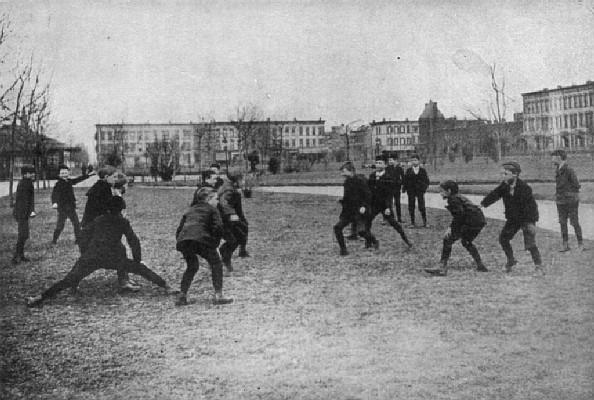
Prisoner's Base is one of the most popular games for both boys and girls who are beginning to care for team organization, and is capital for adults. It gives opportunity for vigorous exercise for all of the players, for the use of much judgment, prowess, and daring, and for simple team or coöperative work.
The game is found under many different forms. Several, which offer marked or typical differences, each possessing distinct playing values, are given here. These differences are in (1) the arrangement of the ground, and (2) the rules governing the players and game.
The differences in the grounds may be classed as follows:—
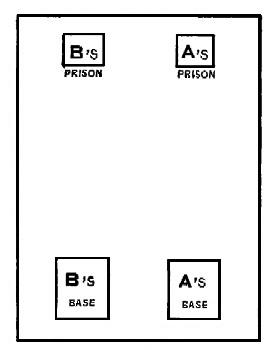
I. The entire playground divided in two divisions, one belonging to each party, each division having a small pen for prisoners at the rear. (Diagram I.)
II. The main part of playground neutral territory, with home goals for the opposing parties at opposite ends, with prisons in, near, or attached to them. (Diagrams II, V.)
III. The main part of playground neutral territory, with home goals for both parties at the same end, attached or separate, and prisons at the opposite end, either (1) on the same side of the ground as the home goal, or (2) on the enemy's side of the ground. (Diagrams III-IV.)
The rules for play for the second and third types of ground are fundamentally the same, though differing in details, and they differ from those for Diagram I. The playing qualities of the games for the last three diagrams, however, are very distinct because of the different methods of the enemies' approach to each other (which make differences in the risk of "dares"), and because of the differing risks in rescuing prisoners and taking the enemy's goal by entry.
It has seemed best to make a selection of the typical forms, and leave the leader of games free to choose his own. The first form is the simplest for beginners and younger players, and makes a good introduction to the game for such players.
Stealing Sticks is still another form of Prisoner's Base. The main difference lies in the carrying away of the enemy's property.
Prisoner's Base and related games are supposed to have descended from the days of border warfare. They are very old, and Strutt mentions a "Proclamation at the head of the Parliamentary proceedings early in the reign of Edward the Third, ... where it [Prisoner's Base] is prohibited in the avenues of the palace at Westminster during the sessions of Parliament, because of the interruption it occasioned to the members and others in passing to and fro." The game at that time was played by adults.
PRISONER'S BASE—I
10 to 30 or more players.
Playground; gymnasium.
Prisoner's Base—I
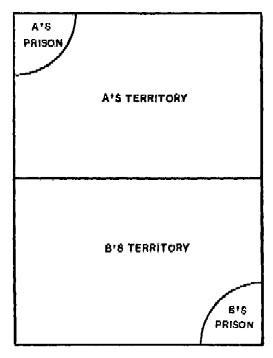
The ground is divided into two equal parts, with a small base or prison marked off at the farther end of each division. From five to fifteen players guard each side. They venture into the enemy's ground, and, if caught, are put into the prison, where they must remain until tagged by one of their own side who is free. Both prisoner and rescuer may be tagged and brought back to prison before reaching their own ground. The game is won when one side makes prisoners of all of its opponents, or when a free man enters the opponents' prison, but this last may be done only when there are no prisoners there.
This form of Prisoner's Base differs from others in greater simplicity, both as to the arrangement of the ground and the rules of play. It is therefore better for younger players or beginners in the game.
The differences in detail consist in:—
1. The ground being divided by a line through the center into two opposing territories. In other forms, the main playground is neutral territory, each party having a small home goal marked within it.
2. In this game (No. I) a player cannot "give a dare" without venturing into the opponents' territory, and any opponent may tag him. In other forms, the tagging, being on neutral territory, is controlled by limitations as to which player was last to leave his home goal, and makes a more complex game.
The rules about (1) a prisoner and his rescuer both being liable to capture on the way home, and (2) to winning by entering the enemy's prison, with the restriction that no prisoners must be there, are also distinctive features.
PRISONER'S BASE
PRISONER'S BASE—II
10 to 30 or more players.
Playground; gymnasium.
Prisoner's Base—II
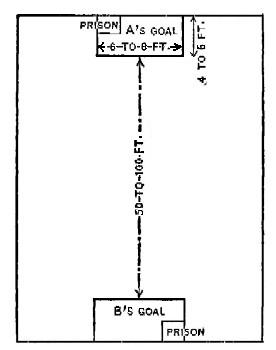
Two captains are chosen who select players alternately until all are disposed in two parties of equal numbers. A large goal is marked off at each end of the ground, with a small base or prison in one rear corner of it. The wide, open space between the goals is neutral territory. The objects of the game are to enter the opponent's goal or to make prisoners of all of his men. The entrance of one player within the enemy's home goal means victory for his side. As one player advances for this purpose, or "gives a dare," the opponents send out a player to tag him, when the first side immediately sends out a second player to "cover" or protect the darer by trying to tag his opponent. The first side then sends out a second player to "cover" their first man. He is at liberty to tag either of the other two players. In this way any or all of the players may be out at one time, though it is unwise to leave the goal unguarded. Any player may tag any man from the opposite side who left his goal before he did, but none who came out after he did. Whenever a player returns to his home goal, which he may do at any time, the man who went out to cover him must return also, and of course the man who went out to cover this second one, etc. The issuing forth of players, or their return to the home goal, is subject at all times to the direction of the captain, though much independence of judgment should be exercised by the various players. The captain may also designate one player to guard the home goal and one to guard the prisoners whenever he chooses.
Any player caught (tagged) is placed in the opponents' prison ("prisoner's base"), where he must remain until rescued by one of his own side. The prisoner may reach as far out of the prison as possible, so long as one foot is within it. When there are several prisoners, they may take hold of hands or otherwise touch each other, as by the feet (this is optional with the prisoners), and reach forward as far as possible, to be tagged by a rescuer, so long as one of them (the last caught) keeps one foot within the prison goal. In such a line the first one caught should be farthest from the prison, the next one caught holding his hand, and so on in the order of capture. A guard should always be at hand to intercept any attempts at rescue. A prisoner and his rescuer may not be tagged while returning home, but the rescuer may be tagged before he touches the prisoner. One rescuer may free only one prisoner at a time. Whenever a player is caught, all of the others return to their home goals (except prisoners), and a fresh start is made in the game.
Much finessing is possible by engaging the enemy on one side of the ground, while a good runner is held in reserve to dash into the enemy's goal on the other side. Or one player may, by a wide detour, creep around unnoticed to the rear of the enemy's goal and enter it from that side.
Each side should have a captain to maintain discipline, to take general direction of the game, and to decide with the opposing captain any disputed points.
This game is more complicated than the one of the same name previously described. It is well for beginners to start with the first game. The author can testify from vivid recollections the hold which this form of the game may have for successive seasons on its devotees. Sometimes a "dare line" is drawn a few feet in front of each home goal, which challenges the opponents to a special thrill of venturesomeness. The game in this form, as a small boy said to the author, is "the national game of Minneapolis."
PRISONER'S BASE—III
6 to 30 or more players.
Playground; gymnasium.
Prisoner's Base—III
The ground is divided according to the accompanying diagram; the players, who are divided into two equal parties, with a captain for each party, being stationed respectively in the goals marked A and B, which are at the same end of the ground instead of at opposite ends, as in Prisoners' Base II. In the present form of the game, the prison belonging to each side is located directly opposite its own home goal at the farther end of the ground, instead of near its own goal, as in II. Rescue of a prisoner is by entry of the opponent's prison, not by tagging the prisoners; so there is no object in the prisoner's reaching out of the prison, as in the previous forms of the game.
The two parties decide by counting out, holders, drawing lots, or some other form of choice, which shall commence. One member of this side then runs out to the middle of the ground and gives a "nominy," or "dare," calling, "Chevy, chevy, chase! One, two, three!" As soon as he has called this (but not before), he is liable to be tagged by the opponents, who try to catch him before he can run home again. Should he reach home in safety, the opponents take their turn in sending a man to the middle to give a "dare" in the same way. A player need not run home, however, but may remain at large, another player from his side running out to cover or protect him by trying to tag the opponent. Several players from each team may be out in this way at one time. A player may be caught by any man who left his home goal after he did, but by none who left before him. Each player must therefore keep a sharp watch on his opponents to know which of them may tag him and which he may tag. This is continued until a prisoner is caught, when he is taken by his captor to the prison belonging to the side capturing him. A captor may not be tagged while taking a prisoner to prison, and is allowed to go back to his goal afterward without tagging. If a player can reach the opponents' prison without being tagged by an opponent, he releases the first prisoner taken there. Both may return home without being tagged. The object of the game is to place all of the players of the opponents' side in prison, and when that is accomplished, to take possession of the opponent's home goal. When this is done, the two parties change sides and begin again, the losing side being first to send a man into the field.
PRISONER'S BASE—IV
Prisoner's Base—IV
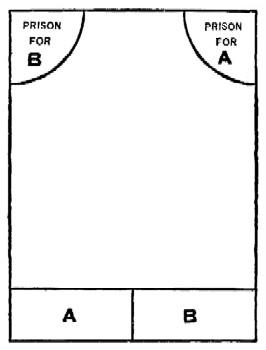
This differs from the preceding game only in the laying out of the ground, the prison for each party being on the opponent's side of the ground instead of on the side of the home goal. This arrangement decreases the risk in rescuing prisoners. All of the rules for the game are the same as in III.
PRISONER'S BASE—V
10 to 30 or more players.
Playground; gymnasium.
Prisoner's Base—V
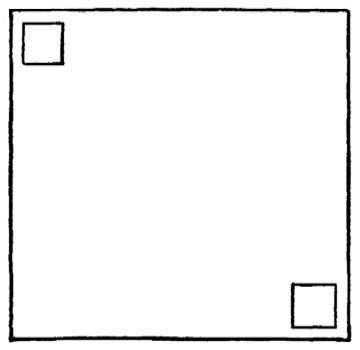
In this form of prisoner's base the ground is marked out in a square or oblong, the dimensions varying with the number of players and their age or ability as runners. For average players a ground measuring 60 × 60 feet is recommended. The two end boundaries serve as base lines, the territory beyond each belonging to the party on that side. In this respect the game differs from those previously described, in which a limited home goal is marked for each team. About ten feet from the base line, near the left-hand corner of the square or oblong, a small prison is marked for each team.
The first object of the game is to make prisoners of all the opponents. The second object of the game is to make runs into the enemy's territory and back again without being caught (tagged). Three such runs entitle the player making them to select a player from the opposing team as a prisoner, or to free one prisoner from his own team. Should a player be made a prisoner, any runs he may have made into the enemy's territory up to that time are lost in his account, and when freed, he must begin his score of runs over again to count three. A player returning home after a run into the enemy's territory may not capture a prisoner, or free one of his own men from prison on the way. A player may not be tagged after crossing the opponents' base line until he starts back. In returning home after such a run, a player may be tagged by any opponent who left his own goal after the runner left his own goal (not the enemy's goal), but not by any who started out before the runner started. This rule applies to the capture of opponents at any time, any player, for instance, on team A, being liable to capture by any opponent on team B who left his base line after the A man, but not any who left it before he left his own. Similarly, he may capture any player on team B who ventured forth before he did, but must be on his guard against any who came out after he did. Stepping over the side lines while being chased is equivalent to being caught; but this does not apply when escorting a prisoner or at any other time.
Prisoners may stretch out of the prison as far as possible so long as one foot is within it. As the number of prisoners increases, they may stretch out in one long file from the prison, provided each touches a hand or foot, or some other part of the next player. In such a file, the first prisoner captured should be the farthest away from the prison, the last one captured with at least one foot in the goal, and the others in relative order. After the first prisoner is caught, the game centers more on freeing or preventing the freeing of prisoners than on runs into the enemy's goal.
This is the form of Prisoner's Base preferred by Mr. Joseph Lee of Boston, and described by him in Playground (No. 8). Mr. Lee says:—
"The interest of the game depends very much on locating the prison in such a way as to give the right balance between the forces of offense and defense. If it is placed close to the base line of the side by which the capture has been made, it is almost impossible to free the prisoner if there is any defense at all. The game is often spoiled by this mistake. On the other hand, it must not be placed too far out, for if it is, it becomes impossible to win the game, because the line of prisoners, when the side is nearly all caught, then extends to a point so much nearer their own base line than to that of their opponents that even the slowest runner on the losing side can get down and free a prisoner before the fastest runner on the opposite side can get out to stop him. The art of laying out the ground is to have the prison placed far enough out to make the freeing of the first prisoner reasonably easy, without being so far out as to make the catching of the last one impossible. In general, the game can be made lively and comparatively unscientific by making the distance between the base lines (the lines on which the two sides are lined up) short, the field wide, and the prisons far out; and can be made more difficult and less eventful by making it long and narrow, with the prisons close in. If this latter tendency is carried too far, however, freeing prisoners and making runs become at last impossible, and the game is entirely stopped.... The game, of course, is at its best when there is most going on and of the most thrilling sort,—a lot of players making runs and freeing and defending prisoners,—with flight and rally, charge and rout, and triumph and despair."
PUSS IN A CORNER
5 to 30 or more players.
Schoolroom; playground; gymnasium.
All of the players but one are disposed in the corners or at convenient goals that will answer the same purpose. The odd player goes from one to another, saying, "Pussy wants a corner!" The player to whom this is addressed replies, "Go to my next-door neighbor." Any two of the other players meanwhile watch their opportunity to beckon to one another for exchanging places. They try to make this exchange of signals and to dash across from place to place when the attention of Puss is attracted in some other direction, as Pussy must try to secure a corner by rushing to any place that is vacant when the players thus exchange.
The sport of the game consists very largely in tantalizing Puss by making many exchanges, or, on the other hand, in Puss suddenly dashing for some vacant place without giving previous evidence of knowing of it. Whenever Puss secures a corner, the odd player left out becomes Puss.
Puss, when not succeeding in getting a corner as soon as desirable, may call "All change!" when all of the players must exchange places, and in the general flurry Puss should secure a place.
Out of doors.—This game may be very delightfully adapted to outdoor play by each player taking a tree as a "corner," when the dodging and running may be much more varied and interesting than in the open space of a parlor or gymnasium.
PUSS IN THE CIRCLE
10 to 30 or more players.
Playground; gymnasium.
A large circle is marked on the ground or floor. One player, who is Puss, stands in the center of this circle; the other players stand outside of the circle surrounding it. These players may be tagged by Puss whenever they have a foot inside of the circle. They will make opportunity for this by stepping in and out of the circle, teasing Puss in every possible way to tag them. Any one whom Puss touches becomes a prisoner and is another Puss, joining the first Puss in the circle to help tag the others. The last one tagged is the winner of the game.
This is one of the games particularly suited to make a timid child courageous, and a teacher or leader using the game with little children should urge such timid children to take an active part in the game.
RAILROAD TRAIN
10 to 100 players.
Parlor; schoolroom; out of doors.
Each player is named for some object on a train, such as engine, baggage car, dining car, smokestack, boiler, cylinders, wheels, oil, coal, engineer, porter, conductor, etc. One person is chosen to be the train master. He says in narrative form: "We must hurry and make up a train to go to Boston. I will take Number One engine and some coal; have the bell rope in order; be sure that the cushions are brushed in the sleeping car," etc. As he names these objects, the player bearing each name runs to the starter and lines up behind him, each putting his hands on the shoulders of the one in front, the first one placing his on the shoulders of the starter. When all are on the train, the starter gives the signal for going, and the whole train moves out on its journey, which at the discretion of the starter will be up hill over obstacles, down hill from others, around loops and curves, etc.; and he may, under suitable circumstances, find a convenient place for a grand "smash-up" at the end.
For large numbers there should be several starters, starting several trains at once, and these may race for a given point at the end.
RED LION
5 to 30 or more players.
Playground; gymnasium.
A place is marked out at one side or end of the ground called the den. In this stands one player who is called Red Lion. The other players choose one of their number as a chief, who does not run, but stands at one side and directs the movements of the others. The chief calls "Loose!" to the Red Lion. After hearing this signal, the lion is free to run out whenever he chooses. The players venture near to the den, taunting the lion with the lines:—
"Red Lion, Red Lion, come out of your den! Whoever you catch will be one of your men."
When the Red Lion thinks the players are sufficiently near to give him a good opportunity to catch one, he makes a sudden sortie and catches any player that he can. The player is not his prisoner until the Lion has held him and repeated three times "Red Lion!" Both the Lion and his prisoner must hurry back to the den, as all of the other players may turn upon them at once to drive them back with blows. This is generally restricted to hitting with caps. Thereafter, when the Red Lion issues forth, he must take the prisoner with him, hand in hand, both of them endeavoring together to catch one of the other players by putting their arms over his head.
The Red Lion and his man may not issue, however, from their den until the chief calls "Cow catcher!" or some other signal, as explained below. As in the previous case, when a prisoner is caught, he and his captors hurry to the den to avoid the buffeting of the other players. Each time that the Red Lion goes forth, all of his prisoners must go with him. The method in which they go, however, and in which they capture their prey, will be determined by the signals of the chief. When he calls "Cow catcher!" they must all run out in a long string, hand in hand, and capture their prisoner by any two in the line slipping their clasped hands over his head. If the chief calls "Tight!" the Red Lion and his men go forth in the same way, holding hands, and try to capture a player by surrounding him and so take him to the den. Should the chief call "Doubles!" then the Red Lion and his men come forth two by two, and try to capture their prisoners. The order in which these varied commands are given is entirely at the discretion of the chief.
At any time when the Red Lion and his men are out on the hunt, any of the other players may try to break apart the clasped hands of the hunters. Whenever this is done, the lions must rush back to their den, being driven back and buffeted by the outside players. The game ends when all of the men have been captured by the Red Lion's party. The last man to be caught is the winner, and becomes Red Lion for the next game.
RING-A-LIEVIO
(Ring-a-lee-ve-o)
10 to 30 or more players.
Out of doors.
This is a form of Hide and Seek in opposing parties. Players who are caught are prisoners and may be freed as described. The method of capture also differs from that in some other forms of Hide and Seek.
A small goal or den about five feet square is drawn at some central point.
Two leaders are chosen who alternate in choosing players, until all are disposed in two groups. Lots are drawn or counting out resorted to between the captains to determine which side shall start out first. The remaining group takes its place in the den while the opponents go to some distant point, from which they call "Ready!" and immediately scatter and hide.
The group in the den, as soon as they hear the call "Ready!" start out for the chase, leaving one of their number to guard the den. Whenever a player is caught (tagging is not enough; the player must be firmly secured), the catcher calls "Caught! Caught! Caught!" and leads his prisoner to the den. The object of the game is to make prisoners of all of the hiding team. A prisoner may be freed from the den by one of the players from his group running out from his hiding place and tagging him. This may only be done, however, by the rescuer getting both feet in the den. Should this be accomplished, the rescuer calls "Ring-a-lievio!" as he dashes through the den, and both run for safety. The den keeper tries to catch them as they run away, but may not chase them beyond certain boundaries, which must be determined beforehand. Only one prisoner may be freed at a time. Prisoners are most easily freed when there are several in the den at once and the den keeper's attention is distracted to one side of the den while the prisoners are freed from the other.
This game, like all hiding games, is especially adapted to open spaces, offering many hiding places, such as the edge of a wood, a garden, park, or playground having considerable shrubbery, or to a village street.
RINGMASTER
10 to 60 players.
Playground; gymnasium; parlor.
This may be made a very amusing game for young children. One is chosen for ringmaster and stands in the center. If he can flourish a whip like a true ringmaster in the circus, the interest of the game will be enhanced. The other players form a circle around him without clasping hands.
The ringmaster turns and moves around in a circle, snapping his whip at each flourish, and calling the name of some animal. The players in the circle immediately imitate the animal, both as to its movements and cries. For instance, for a bear they claw or run on "all fours," or climb and at the same time growl; for a frog they may hop or swim and croak. The list may include the hopping kangaroo, the snarling and springing tiger, the humped and swaying camel, the balking and braying donkey, the flopping and barking seal, the scratching and cackling hen, the ponderous and mooing cow, the neighing and galloping horse, etc.
The ringmaster at his discretion may announce, "We will all join the circus parade!" whereupon all of the animals should gallop around the circle in characteristic movements, each choosing an animal that he likes to represent.
ROBBERS AND SOLDIERS
10 to 100 players.
Out of doors.
This game is best played in the country, where there are woods in which the robbers may hide.
The players are divided between robbers and soldiers, there being about ten robbers to fifty soldiers (the proportion of one to five). The larger and stronger players are usually selected for the robbers. The soldiers have one General who directs their movements, and the robbers a Captain. The robbers are given five or ten minutes' start from the prison. The soldiers stand at this place, marked as their fort or prison, until the General gives the command for the search to begin. The object of the robbers is to hide so that the soldiers may not find them, and when found, to resist capture if possible. They may hide by climbing trees or dodging behind them, conceal themselves in underbrush, under dead leaves, etc. If played aright, the game should be a very strenuous one, the resistance offered by the robbers requiring several soldiers to overcome. A robber may resist all of the way to prison. A guard is appointed by the General for the prison, and prisoners may run away at any time if not prevented by the guard.
The soldiers, in attempting to locate the robbers, will use many devices besides a simple hunt. For instance, they will form a large circle and gradually work in toward the center, thus surrounding any robbers who may be hidden within the territory so covered. The game is won when all of the robbers have been made prisoners. Old clothes are quite in order for this game.
The soldiers will find whistles of advantage for signaling each other for help.
This game has been a favorite one for many generations with the boys at a large school near Copenhagen.
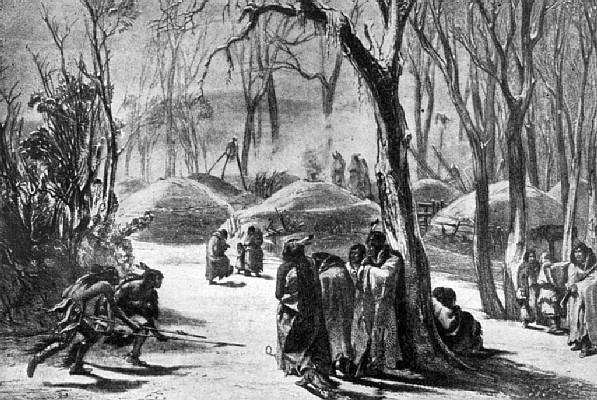
ROLLING TARGET AS PLAYED BY THE HIDATSA INDIANS, FORT CLARK, NORTH DAKOTA From painting by Maximilian, Prince of Wied. Reproduced by kind permission of the Bureau of Ethnology, Washington D.C., from "Games of the North American Indians," by Stewart Culin.
ROLLING TARGET
2 to 30 players.
Gymnasium; playground.
This game consists in shooting or hurling through a rolling hoop a stick or gymnasium wand. The hoop may be from six inches to two feet in diameter. The smaller hoop is adapted only to expert players; it is well to begin with a hoop the size of a barrel hoop.
Where there are numerous players, they are divided into opposing teams, which alternate in throwing at the target (hoop). These players take places at intervals of about five feet along one side of the playground, each holding a spear (stick) to hurl at the hoop as it passes him. Another player stands at one end of the ground and sends the hoop rolling the full length of the space covered by the playing team; its course should be from ten to twenty feet distant from the line-up of the team and parallel to the latter.
As the hoop passes him, each player in turn hurls his spear at it. This is best done with the spear held horizontally at a height of about the middle of the hoop. Each spear that successfully goes through the hoop scores one point for its team. Each team has three rounds, and then gives place to the opponents. The team first scoring one hundred points wins the game.
When there are not enough players to put into teams, each player scores independently, the first to make twenty points winning.
For obvious reasons of safety, no player should be allowed on the side toward which the spears are hurled. This game may be played capitally with bean bags instead of sticks.
This is an adaptation of one of the hoop and pole games played by the North American Indians, and is almost the only game of theirs that has not been previously adopted by the whites. The instant success of the game with boys, who ask to stay after school to play it, would indicate a valuable acquisition. Different tribes of Indians play with different sized hoops, the illustration showing a very small one. The author is indebted for this to the remarkable collection, Games of the North American Indians, by Mr. Stewart Culin.
ROUND AND ROUND WENT THE GALLANT SHIP
4 to 30 or more players.
Indoors; out of doors.
This is a simple little game for very little children, consisting simply in dancing around in a circle with clasped hands as the following verse is recited, and "bobbing" down quickly as the ship goes to the bottom of the sea:—
"Three times round went our gallant ship, And three times round went she; Three times round went our gallant ship, Then she sank to the bottom of the sea."
A tumble as the ship goes down adds much to the spirit of the play.
RUN, SHEEP, RUN!
10 to 30 or more players.
Out of doors.
This is a form of hide-and-seek, but the hiding and the seeking are done by parties instead of individually, each party acting under the direction of a captain. Any number of players may take part, but from four to six on a side are perhaps best.
Two captains are chosen, who in turn alternately choose players until all the players are divided into two parties. One party becomes a searching party (chosen by lot, "holders," or counting out between the captains) and remains at the goal, while the other party goes out with its captain, who directs the various individuals where to hide, after agreeing with his party on a series of signals to be used, as described below. When all are hidden, this captain goes back to the searchers, who at once start out on the hunt under the direction of their captain, who may divide or dispose of his party as he sees fit. The captain of the hiding party remains with the searchers, calling out signals to his hidden men which shall enable them to approach nearer to the goal by dodging from one hiding place to another, always trying to keep out of sight of the searchers. Neither party, however, may run for the goal until its own captain shouts "Run, sheep, run!" The captain of the hiding party is generally the first one to give this signal, and he does so whenever he thinks his men are well placed to make the goal. The captain of the searchers naturally gives the signal to his players as soon as he hears his competitor calling it, as the game is won by the party of which one player first reaches the goal.
Should any member of the searching party catch sight of an opposing player before all run for the goal, he tells his captain, who at once shouts, "Run, sheep, run!"
Any signals may be agreed on between the captain of the hiding party and his men; the following are examples:—
"Red!" meaning "Danger."
"Green!" meaning "Go around the house to the left."
"Blue!" meaning "Go around the house to the right."
"Purple!" meaning "Stand still."
"Yellow!" meaning "Keep on going in the same direction and get nearer to the goal."
SADDLE THE NAG
6 to 30 or more players.
Playground; gymnasium.
This is a game of leapfrog. The players are divided into equal parties, with a chief for each. One of the chiefs stands with his back to a wall or fence, and all of his party bend their backs as for leapfrog, the first with his head against the chief, and the others, one behind the other, in a line stretching out in front of him. Each player in the line braces his shoulder against the stooping player next in front, or each may grasp the forward player around the waist. The heads should all be turned to the same side. One of the opposite side then leaps on the back of the player farthest from the wall, and tries to make his way over the backs of the entire line to the chief to "crown" him; that is, to place his hand on his head. The players who are making "backs" try in every way, without rising to a standing position, to throw this player off and so prevent his crowning their chief. Each player of the "out" side tries in turn to crown the chief. Should they be unsuccessful the sides change. If one or more players succeed in crowning the chief, each successful player has a second chance before the sides change. The side that succeeds in oftenest crowning its opponent's chief wins the game. The limit of the game is usually placed at six trials for each side.
SARDINES
10 to 30 or more players.
Playground; house party.
This is a game of hide and seek that reverses some of the usual methods of playing the game. The player chosen to be It, instead of blinding goes out himself to hide, while all of the other players stay at the goal. While one of their number counts one hundred, they must all either blind their eyes or be shut in one room to give the hider a fair chance. After counting, they shout "One hundred!" and all start out to hunt for the hider. Any player discovering him must, after making sure that none of the others observe him, hide in the same place with the hider. If necessary, he must linger near until there is opportunity to do this without being discovered. If there should not be room to hide in the same place, the finder must take a seat in plain sight near the hiding place. Sometimes a large number of players will be seated in a room or in a group out of doors, while the last unfortunate hunters try to locate some clever hiding place which is obviously near but hard to detect. Of course it is better for the players to actually hide with the first hider, if practicable, which probably suggested, on occasion, being "packed in like sardines."
This is one of the most interesting house party games for young people for either out of doors or within.
SCHOOLROOM TAG
10 to 60 players.
Schoolroom.
A circle about three feet in diameter is drawn on the floor in the front of the room and serves as a goal. One player is chosen to be It, and stands ten feet from the goal. The other players sit at their desks. The one who is It calls the name of some player, who must at once rise and try to run through the goal and return to his seat without being tagged. In order to do this, he may have to make quite a detour before passing through the goal, or he may be able to run through it at the opening of the chase. The chaser must also run through the goal before he may tag the runner. If the chaser succeeds in tagging the runner, he continues to be chaser, and calls the name of another player to run. If the runner gets to his seat without being tagged, he changes places with the other and becomes It.
This game is printed with the kind permission of the Alumni Association of the Boston Normal School of Gymnastics, from the book entitled One Hundred and Fifty Gymnastic Games.
SHADOW TAG
4 to 60 players.
Out of doors.
This is a very pretty form of tag, suitable for little children, and they delight in playing it. It hardly need be said that it requires a sunny day.
The player who is It tries to step or jump on to the shadow of some other player, and if successful, announces the fact by calling the name of the player. That player then becomes It.
The teacher or leader will need to encourage the children to venture boldly into the open spaces, where the shadows become apparent, rather than to huddle on one side of the ground, where the chaser cannot reach the shadows.
SHUTTLE RELAY
(Double Relay)
20 to 100 players.
Playground; gymnasium.
This form of relay race is especially adapted to large numbers in limited space. The action is more rapid than in the single relay, although each runner runs only half as far.
The players are divided into two or more groups of equal numbers. Each group in turn is divided into two divisions, which stand facing each other in single file, with the leader of each division toeing a starting line. There should be from fifty to one hundred and fifty feet between the starting lines. At a signal, the leaders on one side of the ground run forward, but instead of touching a goal or terminal line at the opposite end of the ground, the runner "touches off" (touches the outstretched hand of) the leader of the line facing him, and passes at once away from the playing space. He should not line up again with his team.
The player thus touched dashes forward in his turn and touches the first player in the file facing him, from which Number One came, and passes off the game limits. Each player thus runs only in one direction, instead of in two, as in a single relay race. The team wins whose last player first dashes across the starting line opposite him.
As in the single relay race, this may be played by handing a flag from one runner to the next, instead of "touching off." If a flag be used, it should not be on a stick because of danger to the eyes.
This game may also be played with strict observance of athletic rules. The first runners should then be started with the signals, "On your mark!" "Get set!" (or "Get ready!") and "Go!" There should be a judge to watch fouls for each division of each team, and two judges at the finish. Fouls consist in starting over the line, even with part of the foot, before being touched off, or in a failure to actually touch. The teams win in the order of finishing, plus consideration of the number of fouls, as described for the Potato Shuttle Relay.
SIEGE
10 to 30 players.
Out of doors; barn.
This game is suitable for a barn; the greater the number of open doors and windows available in the barn the better.
The players are divided into two equal parties, one of which personate defenders, and take their places in the barn, with the doors and windows open. The other party are the besiegers, and are stationed outside the barn. The fighting is done by means of weeds specially prepared for the purpose. The weeds commonly called redroot or iron-weed are very good for this. The stems, measuring about a foot and a half in length, are stripped except for a small leaf or tuft of leaves at one end. On the opposite end the root is cut away so as to leave only a small knob which will serve to weight the missile.
The game opens with each party provided with a pile of this ammunition, which is thrown at the opponents through the doors and windows of the barn. A player hit once with a dart is considered "wounded," but may keep on playing. A player hit twice is "killed," and is out of the game. Each party must keep within its own bounds.
The party wins which has the fewest killed at the end of the game.
This was a favorite game with a group of Long Island boys, from one of whom the author obtained it.
SINGLE RELAY RACE
10 to 100 players.
Playground; gymnasium.
This game differs from the track event known as a Relay Race. The form here given is one of the best for engaging in strenuous exercise all of a large number of players in a limited playing space.
A wall or fence is chosen for a goal, or a line may be drawn across the ground for this purpose, or a goal object may be placed for each team, around which each player on the team must run. From fifty to a hundred feet back of this goal, or objective point, and parallel to it, a line is drawn to serve as a starting line.
The players are divided into two or more groups of equal numbers. Each group lines up in single file behind the starting line. If possible, there should be at least five feet distance sideways between the files. The first player of each file stands toeing the starting line, and at a signal runs forward to the goal, touches it with his hand if it be a wall or fence, or with his foot if it be a line on the ground, or runs around it if it be an object. He then runs back to his line and touches the outstretched hand of the next player (called "touching off"), who should have moved forward to toe the starting line. As soon as this touch is received, this player in turn runs forward, touches the goal, and returns in the same way. Each player as he returns leaves the playing space at the rear. The file moves up one place each time that a runner starts, so that the next player will toe the starting line.
The file wins whose last runner is first to dash across the starting line on his return run. If desired, each runner may hold a flag in his hand and pass it to the next player, instead of merely touching the hand. This flag should not be on a stick, which is dangerous for the runner receiving it.
Starting over the line before being touched by a returning runner is a foul. Where athletic procedure is not observed, this starting over the line may be penalized by having the transgressor go back and start over again. In an athletic event it disqualifies the team, unless the competing teams have made an equal or greater number of fouls.
Where this game is played in strict athletic form, the first start is made in response to the usual signals: (1) "On your mark!" (2) "Get set!" (or "Get ready!") (3) "Go!" In competitive events of this sort, crossing the starting line before being touched off is a foul; also touching a goal object around which the players may have to run. There should be a judge of fouls for each team and two judges at the finish. The team wins which finishes first with the fewest number of fouls, as explained for the Potato Race. The simple "touch-off," and not the handing of flags, is customary in athletic procedure.
SKIN THE GOAT
6 to 20 or more players.
Playground; gymnasium.
This is a game of leapfrog, differing from Saddle the Nag in the gradual lengthening of the line of backs, though there are similar features in the two games. The players in this game are not divided into opposing parties.
One player stands with his back against a wall or fence. Another player stoops, with his head against the breast or stomach of this first player. A third player jumps upon the back thus made and tries to "crown" the player standing against the wall, that is, to place his hand on his head. The player, who is making the "back" tries in every way (except by straightening up) to throw the player off his back and so prevent his crowning of the standing player. If the "back" succeeds in doing this, the one whom he throws off takes his place behind this stooping player in the same general position, grasping him around the waist and bending his head to one side or against the forward player, thus lengthening the line of backs. Another player then jumps on the backs, tries to make his way to the one who is upright and crown him. Any player who succeeds in crowning the upright player changes places with him, the one winning who has done this the most times when the play ends.
SKYTE THE BOB
2 to 10 players.
Playground; seashore.
Note.—The word "skyte" means a sharp, glancing blow, and as here used indicates the way in which the stones are thrown at the "bob."
This game is played with buttons and stones. Each player is provided with one or more buttons called "men." A small, flat stone about the size of a quarter may be used as a man in place of a button. In addition, each player is provided with a flat stone called a "pitcher." A flat stone, small, but somewhat larger than the pitchers, is placed on the ground as a base on which the men are piled, and is called the "bob." The game consists in hitting the bob with a pitcher so as to knock over the pile of men, the men becoming the property of the thrower or not, according to their position as they fall.
From fifteen to twenty-five feet from the pile of men a line is drawn from which the players throw. Each player in turn toes the line and throws his pitcher so as to strike the bob or base under the pile of men, his object being to make these men fall off. Any men that are knocked off, and lie nearer to the pitcher where it fell than to the bob, become the property of the player who threw the pitcher. The second player then takes his turn, but his play is more difficult than that of the first player, as any men that he drives nearer to the first player's pitcher belong to the latter. Any man which lies nearer to the second player's pitcher, however, than to the bob or to the first player's pitcher, belongs to this second player. This is continued by the different players in succession, the player winning who has the largest number when all of the men are disposed of, or when all have thrown.
SLAP CATCH
(Hands Up)
10 to 30 or more players.
Playground; gymnasium; schoolroom.
The players stand in a circle, with one in the center. Those in the circle bend their elbows, which should touch the sides, and extend their hands in front, with palms downward. The object of the one in the center is to slap the hands of any player in the circle while thus extended. The circle players may bend the hands downward or sideways at the wrist, but may not withdraw the arms, or change the position of the elbow. Any one slapped in this way changes places with the one in the center.
The success of this game will depend upon the alertness of the one who is in the center, who should dodge quickly and unexpectedly from one part of the circle to another, with many feints and false moves that will keep the circle players uncertain where he is going to slap next. Played in this way, the game calls for much alertness on the part of all concerned. The circle should not be too large, or the action will be too slow to be interesting.
SCHOOLROOM.—In the schoolroom this is played in groups with the players seated instead of in a circle. Two rows face each other to form a group, with feet drawn well under the seats. The one who is It walks up and down the aisle.
SLAP JACK
(Herr Slap Jack; Skipaway)
10 to 30 or more players.
Playground; gymnasium; parlor.
The players stand in a circle, clasping hands. One player runs around the outside of the circle and tags another as he runs. The player tagged immediately leaves his place and runs in the opposite direction. The object of both runners is to get back first to the vacant place. Whoever succeeds wins, and remains in that place, the one left out becoming runner the next time.
This is sometimes varied by having the players bow and shake hands as they meet. This adds an element of self-control, but detracts from the vigor and sport of the game. This game is one of the standard favorites for little children.
SCHOOLROOM.—In the schoolroom this game is played with all of the pupils seated except one. The odd player walks or runs through the aisles, touches some player, and runs on around the room in the direction he is going. The one touched at once leaves his seat and runs around the room in the opposite direction. The one wins who first gets back to the vacant seat. Dodging through aisles to shorten distance is not allowed; the run must be around the outer aisles of the room.
SLIPPER SLAP
10 to 30 or more players.
Indoors; out of doors.
This game is played with a slipper, or a piece of paper folded in several thicknesses to present a surface of about three by eight inches, firm but flexible. This may be crumpled at one end to form a sort of handle, if desired.
One player is chosen to stand in the center. The others stand in a circle, shoulder to shoulder, so that the center player cannot see what goes on behind their backs. The players then pass the slipper from hand to hand behind their backs, taking every favorable opportunity to slap the one in the center with it; but instantly that this is done the player holding the slipper must put it again behind his back and pass it to the next player, to avoid being caught with the slipper in his hand. The one in the center should try to catch any player who thus slaps him before the slipper is passed to another player.
Very rapid action and much sport may be had from this game. It is rulable to hit the center player with nothing but the slipper, but the players will use any other feints they choose to mislead him as to who holds the slipper, pretending to pass it, or making a false move as though to hit him, etc. The center player must catch one of the circle men with the slipper actually in his hands to have it count. Should this be done, he changes places with that player.
This game may be played in the schoolroom, the class being divided into groups of ten or twelve players each. It is also an excellent parlor game, and is full of sport if played by quick, alert players.
This game is from Denmark.
SMUGGLING THE GEG
10 or 30 to more players.
Out of doors.
This is an old Scotch game, evidently an outgrowth of smuggling. The "geg" is a small treasure or object easily handled, such as a pocket knife, key, marble, etc.
The players are divided into two even parties, one called the "Outs" and the other the "Ins." A den about four feet by six in size is marked on the ground in some central place. Both parties agree on boundaries beyond which it is unfair to go, though the space available for play should be very considerable. It is determined by lot or by counting out which of the parties shall be the first Outs, or smugglers, this being the more desirable position. The Outs have the geg, or treasure, which they give to one of their number in a manner that leaves his identity unknown to the Ins. They may do this by going out of sight around a corner of a building and choosing one of their number to take the geg, or by standing in a row within sight of the Ins, with their backs to a wall or fence, and pass the geg from hand to hand behind their backs, making many feints and passes intended to deceive the onlookers.
When the geg has been deposited with one of their number, the Outs run and hide, but before reaching their final hiding place, must give a call of "Smugglers!" This is the signal for the Ins to start on the chase. The object of the Ins is to catch the one player among the Outs who is custodian of the geg. The identity of this player may be a sheer matter of surmise on their part, when they will have to challenge any player whom they may catch. If the player holding the geg can return to the den without being caught, his party wins, and again goes out for the next game. But if the holder of the geg be caught before he gets to the den, the Ins win the game, and become the Outs for the next round.
Whenever one of the Ins catches one of the Outs, the latter is not a prisoner until he is "crowned"; that is, the pursuer must hold him, take off his cap, and place the palm of his hand on the prisoner's head, when he must cease to struggle. The pursuer then demands, "Deliver up the geg!" which must be done at once should this particular smuggler be the one who holds it. This fact is then shouted aloud, and all of the players return to the den. If the player caught should not have the geg, he is allowed to go free.
Of course it is to the interest of the Outs to engage the attention of the Ins as much as possible upon players who do not hold the geg, thus to give the holder of it a chance to make the den and so win for his party.
SNOW DART
2 to 10 players.
For the snow.
This game is played with a wooden dart about eight inches long, whittled out of wood about the size of a broomstick, pointed abruptly at one end, and sloping gradually to the other. A narrow track or slide is made down the side of a hill or inclined place, about sixty feet in length. At four different points in this track snow barriers or bumpers are made. The track is iced by throwing water over it and letting it freeze.
Snow Dart

The dart is started at a point at the top of the track. It is not rulable to shove it; it must simply be placed on the track and move of its own weight. The object of the game is to pass the dart in this way over as many of the barriers as possible without its leaving the track. Each player scores one point for each barrier, over which the dart passes without leaving the track, the one having the highest score at the end of the playing time winning. The players take turns in sliding the dart. Any player who can successfully pass his dart over all four barriers four times in succession, wins, irrespective of other scores. If desired, the players may play in partners.