BEAN BAG AND OAT SACK GAMES
Reading edition
BAG PILE
10 to 100 players.
Gymnasium; playground; schoolroom.
Bean bags; oat sacks.
The players are divided into two or more equal parties which line up in ranks. Near the front end of each rank is a pile of from ten to fifteen bean bags or oat sacks, which are to be passed down the line. At a signal the first player in each rank takes a bag and passes it down the line, sending the others in succession as rapidly as possible. The last player in the line when he receives the bean bag lays it on the floor in front of him; and as each bean bag reaches him, he piles it on the first one, making a stack. Only the first bag must touch the floor. The stack must be able to stand without assistance, and the player who stacks the bags must have no help in his task. Should the bags fall over at any time, the player who stacked them must pick them up and pile them over again. The line scores one which first succeeds in getting all of its bags stacked. The last player, the one who stacked the bags, then carries them up to the front of the line and becomes the first passer for the next round of the game.
The line wins which first scores five or ten, as may be decided beforehand. The play should be very rapid.
BEAN BAG AND BASKET RELAY
10 to 60 players.
Schoolroom.
Each player is provided with a bean bag. A waste-paper basket or a box is placed on the floor near the blackboard in front of each aisle. In line horizontally with the forward edge of each front desk, a chalk line is drawn on the floor at the end of each aisle, which serves as a throwing line, from which players throw their bean bags into the baskets.
The game is a competition of skill rather than of speed. At a signal from the teacher, the first pupil in each row stands, places his toe even with the throwing line, and tosses his bean bag toward the basket. If the bag goes into the basket, it scores five. Should it lodge on the edge of the basket, it scores three. Should it fall outside, there is no score.
As soon as these first players have thrown they return to their seats and the second row across the room steps forward and throws. This is continued until each player has thrown, and the line wins which has the highest score. There should be one score keeper for the entire game, who should draw a diagram on the board in which to write the score.
BEAN BAG BOARD
(Faba Gaba)
2 to 30 or more players.
Playground; gymnasium; schoolroom.
This game consists in throwing bean bags through holes in an inclined board. The board should be preferably eighteen inches wide by three feet long. Near the lower end of it should be cut a square hole about the size of the bean bags. Higher up in the board a second hole about three inches larger should be cut. The board should be slanted by resting it against a wall or fence, or bracing one end of it in some other way, so that it is at an angle of about forty-five degrees.
The players stand at a throwing line from ten to fifteen feet from the board. Each player has five bags—or five may be used for the entire group of players, the bags being recovered for each thrower in turn. A bag thrown into the larger hole counts five; into the smaller hole ten. The player wins who first scores one hundred.
Where there are a large number of players, it is desirable to have more than one board, so that the players may be divided into several groups and make the game more rapid.
BEAN BAG BOX
2 to 20 or more players.
Playground; gymnasium; schoolroom.
A small box measuring not less than six inches square should be fastened inside of one about twice the size and that in a third, leaving at least six inches margin between the boxes. This is set up on a slight incline with a stone or other object under its further end, or tipped up against the wall. From ten to twenty feet away from this a throwing line is drawn. Each player is provided with five bean bags and takes his place in turn on the throwing line, throwing all five bags at each turn. A bag thrown into the smallest box scores five points, one into the middle box ten points, and into the outside box fifteen points. The player who first scores one hundred wins.
This is a very popular game, and the paraphernalia for it may be easily improvised.
BEAN BAG CIRCLE TOSS
10 to 30 or more players.
Gymnasium; playground; schoolroom.
Bean bags; balls.
There should be a bean bag for each of the players except one. All of the players form a circle, separated from each other by a small space. At a signal from a leader, each player turns toward his right-hand neighbor and tosses his bean bag to him, turning at once to receive the bag which is coming to him from the left. The game should move rapidly, but of course this is a matter of skill and may have to be acquired. With very little children it may be advisable to first play the game with a fewer number of bean bags, till they grow accustomed to tossing and turning quickly to catch. Balls may be used instead of bean bags if desired.
When the tossing has gone once or twice around the circle to the right, the direction should be changed to the left. It is well to have one of the bean bags of a different color from the others, so as to know when the circle has been completed. Any player failing to catch a bag must pick it up and toss it regularly to his neighbor.
BEAN BAG RING THROW
10 to 60 or more players.
Playground; seashore; gymnasium; schoolroom.
Bean bags; blocks of wood; stones; shells.
This game may be played with bean bags, or when out of doors, especially at the seashore, with small blocks of wood, stones or shells. The players should be divided into groups of equal numbers, which compete against each other. A small ring should be drawn on the ground or floor measuring from twelve to eighteen inches in diameter, one ring opposite each group of players, who should be lined up in single file. The leader of each row should toe a starting line drawn across the ground at from ten to fifteen feet from the row of circles. Each row should be provided with six bean bags or other objects for throwing, as indicated above.
At a signal, the leader of each row throws each of his bags in succession toward the circle, and scores one point for each bag that lands within the circle. Any bag that touches the line does not count. The player then takes up his bags and runs back to the rear of the line, giving the bags as he passes to the front player of his row, who should have moved up to the starting line. These second players, in turn, all begin throwing on a signal. The line wins which has the highest score when all have thrown.
It is advisable to have some one to act as scorer for all of the lines; though it is practicable for the first player in each line to act as scorer for his line.
IN THE SCHOOLROOM.—When this game is played in the schoolroom a circle should be drawn on the floor near the front blackboard opposite each aisle; across the end of each aisle, and even with the front row of desks, should be drawn a throwing line. The game should start with the six bean bags on each front desk. At a signal the front pupil in each row steps forward to the throwing line and throws the six bags in succession for his circle. Each bag that lands fully within the circle scores one point for him. No score is made for a bag that touches a line. He then steps to the blackboard in front of his aisle, and writes down his score; then gathers up the bags, places them on the front desk, and takes his seat. When he is seated the player next behind him steps forward to the throwing line and repeats the play; or, if desired, the next row of players across the room may wait for the teacher's signal for doing this, as the game is played for a score and not on time limits.
The row wins which has the highest score when each of its players has thrown.
CATCH BASKET
10 to 60 players.
Schoolroom.
Bean bags; gas ball.
The class stands in a circle around the room, each half constituting a team with a leader at one end. On a desk in the center of the room is placed a waste-paper basket. The game consists in throwing a bean bag or a ball (large, light gas ball preferable) into the basket, the teams alternating their turns. There is no interference, but an umpire stands in the center who returns the ball to the next player after each throw. The leaders throw first and each player in turn thereafter. Each time the ball lodges in the basket it scores one for the team throwing. A bean bag lodged on the edge of the basket scores as a goal. A player may throw but once at each turn. The game may be limited by time, the team winning which has the highest score at the end of ten or fifteen minutes; or it may end when each player has had a turn. The former method leads to quicker and more expert play, which should be encouraged.
CRISS-CROSS GOAL
10 to 60 players.
Schoolroom.
The class is divided into two teams. Each team is divided into two lines, which stand facing each other, as shown in the diagram.
A waste basket is placed on the teacher's desk or hung higher if possible in the front of the room. Each team has one bean bag.
Player No. 1 holds the bean bag in each team.
At a signal each No. 1 tosses his bag to No. 2, No. 2 to No. 3, and so it continues to pass in a zigzag line till it reaches No. 14. No. 14, on receiving the bag, tries to throw it into the basket. If he misses, he runs forward, picks up the bag, runs back to his place, and tries again; he continues trying until he or his opponent gets a bag in, which event finishes the inning.
The team in which No. 14 first receives the bag, scores three points; and the team making the goal first scores one; so one team may score four, or one three, and the other one, point. The team wins which has the highest score at the end of the playing time.
Criss-cross Goal
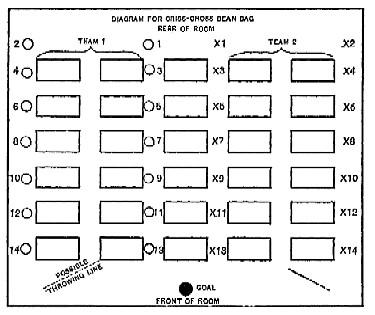
If the distance from the basket seems too long, No. 14 may come forward a given distance to a chalk line and throw from that.
In order to pass around the privilege of throwing goal, the goal thrower in one game passes down to the other end of the line, the line moves up one place, and the next player in order throws for the goal in the next game. When every one in one line has thrown for goal, the privilege passes to the other line.
Sometimes it is necessary to have umpires to watch for fouls, such as skipping a player in passing the bag.
This game was originated by Dr. J. Anna Norris and received honorable mention in a competition for schoolroom games conducted by the Girls' Branch of the Public Schools Athletic League of New York City in 1906. It is here published by kind permission of the author, and of the Girls' Branch, and of Messrs. A. G. Spalding & Brothers, publishers of the handbook in which the game first appeared.
DESK RELAY
20 to 60 players.
Schoolroom.
Bean bags.
The pupils sit on their desks facing the rear of the room and with the toes caught under the seats. The rear player on each line holds a bean bag. At a signal, the bag is passed over the head backward to the next player, who in turn passes it, and so on until it reaches the player at the front, who jumps down from the desk and hops on one foot to the rear of the room. As soon as this player has reached the rear seat, all the players in the line stand and move forward one desk. The rear player takes the desk thus vacated and starts the bean bag again.
The line wins whose bean bag first reaches the front of the room after the pupils have all changed seats until original places are resumed.
The teacher should indicate which foot is to be used in hopping, so that in successive playing of the game, each pupil will hop alternately on the right and left foot.
This game was originated by Mr. James J. Jardine of New York City, and received honorable mention in a competition for schoolroom games conducted by the Girls' Branch of the Public Schools Athletic League of New York City in 1906. It is here published by kind permission of the author, and of the Girls' Branch, and of Messrs. A. G. Spalding & Brothers, publishers of the handbook in which the game first appeared.
FETCH AND CARRY
10 to 60 players.
Schoolroom; playground.
Bean bags.
Fetch and Carry Relay
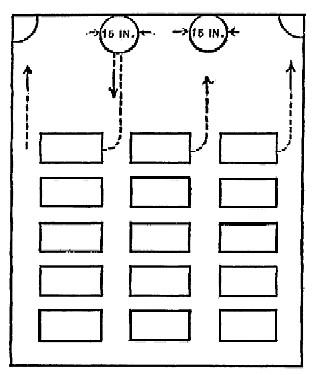
Each pupil is provided with a bean bag. A circle about fifteen inches in diameter is drawn with chalk on the floor directly in front of each aisle and close up to the front blackboard. At a signal from the teacher the first pupil in each row of seats runs forward, places his bean bag in the circle in front of his aisle, and runs back to his seat. As soon as he is in his seat, the pupil back of him runs forward, places his bean bag in the circle, and returns to his seat. This is continued until every pupil in the row has deposited his bean bag, the signal for each player to start being the seating of the player in front. The row which gets all of its bags first into the circle wins, and scores one.
The play is then reversed. The last player in each row runs forward, picks up a bean bag, and returns to his seat. As he sits, he touches the player in front on the shoulder, who then starts forward, but must wait for this signal. The row which first gets back to its seats, each player with a bean bag, wins and scores one.
As in all schoolroom games in which the players run through the aisles, those who are seated must be very careful to keep their feet under their desks, and never to start before the proper signal is given for their turn.
HAND OVER HEAD BEAN BAG
10 to 60 players.
Schoolroom.
This is a relay passing race, the different rows of pupils competing with each other in passing bean bags backward over the head.
The players should all be seated, there being the same number in each row of seats. On each front desk a bean bag should be laid. At a signal the first player in each row lifts the bean bag over his head and drops it (it should not be thrown) toward the desk behind him, immediately clasping his hands on his own desk. The next player catches or picks up the bean bag from his desk and passes it backward in the same manner. It is thus passed quickly to the rear of the line. When the last pupil receives it, he runs forward at once to the front of the line. As soon as he reaches the front desk, the entire row of players move backward one seat, and the player who ran forward takes the front seat, immediately passing the bag backward to the player next behind him.
The play thus continues until the original occupant of the front seat has again returned to it. Immediately that he is seated, he should hold the bean bag up with outstretched arm, as a signal that his row has finished. The row wins whose leader first does this.
JUMP THE BEAN BAG
10 to 60 players.
Schoolroom.
The class is divided into two equal divisions or teams. The teams stand in opposite outside aisles and face the center of the room. The game consists in a contest between the two divisions as to which shall finish first in the following relay, here described for one team.
The leader at the head or front of the line, having the bean bag in his hand, runs down the first aisle toward the rear, places the bean bag on the center seat of the row to his left (second row from standing line), vaults over the seat, and runs up the next aisle to the front of the room and so to the head of his division. He tags the player standing at the head of the line and passes behind the line to the rear, taking his place at the foot.
The player who has been tagged at the head of the line immediately runs down the first aisle, takes the bean bag from the seat, vaults over the seat, and passes down the next aisle to the rear of the room, and so to the foot of his line. He hands the bean bag to the player next to him, who passes it to his neighbor, and so it is passed up to the head of the line.
The player at the head of the line, immediately upon receiving the bean bag, runs down the first aisle, places it on the seat, vaults over the seat to the next aisle, and so to the head of his line, where he tags the player who has moved up to his place.
The game thus consists in an alternate placing and taking of the bag from the seat. The player who places the bag returns to the head of the line to tag the player standing there, and then passes behind the line to the foot; the player taking the bean bag returns to the rear of his line and passes the bean bag up the line.
The division whose original leader first gets back to his starting place wins the game.
This game was originated by Miss Alice R. Young of Brooklyn, N.Y., and received honorable mention in a competition for schoolroom games conducted by the Girls' Branch of the Public Schools Athletic League of New York City in 1906. It is here published by the kind permission of the author, and of the Girls' Branch, and of Messrs. A. G. Spalding & Brothers, publishers of the handbook in which the game first appeared.
PASSING RELAYS
There are several forms of this game, some of which are suited only to young children; others may be full of sport and interest for adults. The games may be adapted to comparatively small numbers or very large numbers. Several passing races will be found among the ball games. For bean bags, see:—
Bag Pile. Passing Race. Pass and Toss Relay (single line). Pass and Toss Relay (double line).
PASSING RACE
10 to 100 players.
Playground; gymnasium; schoolroom.
Bean bags; dumb-bells.
The players stand in ranks, and bags are passed from one to another player down each line, starting on a signal for the first bag. Each rank should have about ten bags. The line wins which finishes first; that is, passes all of its bags to the end of the line.
The game may be varied by having each player pass the bags from one hand to the other before handing it to his neighbor, or by raising the bags overhead, or touching them to the floor, first with one hand, then with the other, before passing.
This makes an especially interesting game when dumb-bells are used instead of bean bags, as they are harder to pass.
PASS AND TOSS RELAY (SINGLE LINE)
16 to 60 players.
Gymnasium; playground; schoolroom.
Bean bags; oat sacks.
Pass and Toss Relay (Single Line)
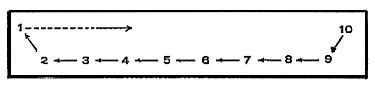
The players stand in two or more even ranks, facing sideways. The players at either end step one long pace forward of the ranks, to the points marked 1 and 10 respectively, as they are to catch the bag tossed from some other player. Player Number One has a bag and at the signal for starting runs toward the rear, and as he runs tosses the bag to Number Ten. The line immediately moves forward one place, Number Two stepping into the place vacated by Number One. As soon as Number Ten has caught the bag, he takes his place in line with the rank and passes the bag to his next neighbor, Number Nine. The bag is then passed rapidly up the line until it is received by Number Three, who tosses it to Number Two. Number Two, in his turn, as soon as he receives the bag, dashes for the rear, tossing the bag as he goes to the player standing at 10, who in this instance will be Number One. The line again moves up, Number Three now stepping out to the place marked 1.
This play is continued until Number One is back in his original position. The rank which first gets the bag around to Number One after he returns to his original position wins the game. Number One should hold the bag up at arm's length as soon as he gets it as a signal that his rank has completed its play. As this feature adds much to the facility with which an umpire may judge of the winning rank, it may well be a required part of the play, the rank winning whose Number One is first to raise aloft his bag.
It adds much to the interest of the game to have a general umpire and scorekeeper who shall decide which is the winning line, and post the score where the players may see it.
PASS AND TOSS RELAY (DOUBLE LINE)
16 to 60 players.
Playground; gymnasium; schoolroom.
Bean bags; oat sacks.
The players are divided into two equal groups which compete against each other. Each group is divided into two lines or ranks which stand facing each other. There should be from ten to twenty feet of space between the two ranks.
Pass and Toss Relay (Double Line)
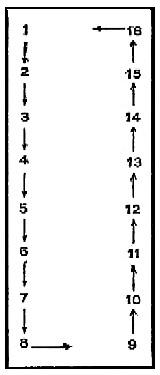
The game consists of passing a bean bag up one of these lines to the end, when the last player runs across to the opposite line, tossing the bag as he goes to the end man in that line, who catches it and passes it down the line. The same play is performed at the other end, the last player running across to the opposite line, tossing the bag as he goes to the last player there. The lines move up or down one place each time a player runs across to the opposite rank. The game in detail will be as follows:—
Number One has a bag, and at a signal passes it down the line to Number Eight, who runs across toward Number Nine, tossing the bag to Number Nine as he does so. It must be tossed before he has gone halfway across the space between. Number Nine immediately passes the bag to Number Ten, and so on up the line to the last player, Number Sixteen. The moment that he receives the bag, he runs across toward Number One in the opposite rank, making a running toss as he does so. At the same time the entire line from Nine to Fifteen moves up one place to make room for Number Eight, who should take his place at the foot of the line next to Number Nine. As soon as Number One receives the bag, he passes it down the line to his neighbor, Number Two, and so on till it reaches the end of the line, which at the same time should be moving down one place to make room for Number Sixteen, who should take his place at the head of the line next beyond Number One.
This play is repeated until Number One reaches his original position again, and the bag is passed to him there. Immediately on receiving it, he should lift it high, as a signal that the play is completed in his group. The group wins whose first player is first to do this.
The game may be made a little more definite by Number One having some distinguishing mark, as a handkerchief, tied on his arm.
When players have some proficiency in the game, as prescribed, they may play with two bags instead of one, keeping both in play at once. In this form of the game the diagonal opposites start each a bag at the same time, that is, Number One and Number Nine. The game becomes thus just twice as rapid. The team wins whose Numbers One and Nine first succeed in both returning to their original positions, where they should hold the bags aloft.
A score should be kept, each team scoring two points for winning a game and one point for every time that its opponents' bags touch the floor, either through poor throwing or bad catching.
The writer is indebted to Mr. Chesley's Indoor and Outdoor Gymnastic Games for several points of description or of play for this game. Mr. Chesley has found it a very interesting gymnasium game, with possibilities for much sport and skill.
TARGET TOSS
10 to 60 players.
Playground; seashore; gymnasium; schoolroom.
Bean bags; stones; shells.
Three concentric circles should be drawn on the ground or floor, after the idea of a target. Their size will depend somewhat on the skill of the players, but for the youngest players the inner circle should be not more than two feet in diameter and the outer circle six feet in diameter. For those more skilled, smaller circles may be used. From ten to thirty feet from the outer rim of the largest circle a straight line is drawn on the ground, to serve as a throwing line. Where there is a small number of players, all may use one target. Where there is a large number, several targets should be drawn and the players divided into as many groups. Each group has three bean bags, or if out of doors, small blocks of wood, stones, or shells may be used. Each player throws in turn, throwing each of the three bags or other objects at each turn. The thrower stands with his toe on the throwing line and tosses a bag toward the target. If the bag stops within the center circle, it scores fifteen points; if between the center circle and the next larger one, it scores ten points; and if between the middle circle and the largest or outer one, it scores five points. For very little children a bag that lands on a line may score for the larger circle which it touches. For more expert players, a bag landing on a line does not score at all. The player wins who has the highest score in five rounds of the game.
TEACHER AND CLASS
5 to 60 players.
Playground; gymnasium; class room.
Bean bags; balls.
This game may be played with either bean bags or balls, and is one of the simplest and earliest tossing games, being generally used when pupils are first acquiring skill in handling a ball. With very rapid play and greater distance between the "teacher" and the "class," it may become very interesting, however, for older players.
One player is chosen for the "teacher." The others stand in a line side by side, facing her, at an interval of from five to twenty feet. Where there are many players, there should be several groups of this kind, with a distinct interval between groups to avoid mistakes or confusion. It is desirable to have from six to ten players for each "teacher."
The teacher starts the game by tossing the ball to each pupil in turn, and it is immediately tossed back to her. Each pupil missing goes to the foot of the line. If the teacher misses, the player at the head of the line takes her place, the teacher going to the foot. The action should be as rapid as possible.
VAULTING RELAY
10 to 60 players.
Schoolroom.
Bean Bags.
Vaulting Relay
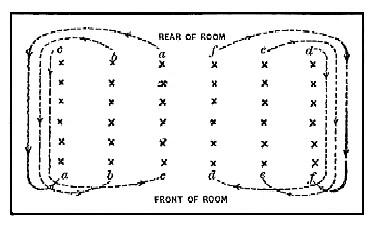
The players stand in line in the aisles between the desks, all facing to the right or left (facing open windows preferred). The first player at the front of each line will hold a bean bag in his right hand, if facing left, or in his left hand, if facing right. At the command "Start!" the bean bag must be passed toward the rear to each player, in turn, until the player at the end of the line receives it. Each player, after passing the bean bag, must place one hand on his desk and the other on the back of his chair, jump over his chair, turn, jump back again, and take his position in the aisle by the next seat, moving back one seat toward the rear of the line each time the bean bag has been passed, and so on until he returns to his place in line. The player receiving the bean bag at the end of the line must run to the head of the line, as shown in the diagram, and pass the bag to the next player. This continues until each player returns to his place in line. The line wins whose original leader first gets back to his own place.
This game was originated by Mr. James J. Jardine, of New York City, and received honorable mention in a competition for schoolroom games conducted by the Girls' Branch of the Public Schools Athletic League of New York City in 1906. It is here published by the kind permission of the author, and of the Girls' Branch, and of Messrs. A. G. Spalding & Brothers, publishers of the handbook in which the game first appeared.
BALL GAMES SUITABLE FOR BEAN BAGS
All run
Arch Ball
Ball Chase
Ball Puss
Ball Tag
Call Ball
Center Catch Ball
Circle Ball
Club Bowls
Center Club Bowls
Circle Club Bowls
Line Club Bowls (Single)
Line Club Bowls (Double)
Corner Spry
Dead Ball
Dodge Ball
Home Run
Line Ball
Over and Under Relay
Overtake
Pig in a Hole
Ring Call Ball
Roley Poley
Round Ball
Russian Hole Ball
Schoolroom Dodge Ball
Spud
Stride Ball
Toss Ball
Tree Ball
Zigzag Games
Circle Zigzag
Line Zigzag I, II, III
Zigzag Overhead Toss