Part 5 — THE BATTLES OF FLANDERS
Reading edition
I
BREAKING THE SALIENT
July 31
The battle which all the world has been expecting has begun. After weeks of intense bombardment, not on our side only, causing, as we know, grave alarm throughout Germany and anxiety in our enemy's command, we launched a great attack this morning on a front stretching, roughly, from the River Lys to Boesinghe. We have gained ground everywhere, and with the help of French troops, who are fighting shoulder to shoulder with our own men, in the northern part of the line above Boesinghe, we have captured the enemy's positions across the Yser Canal and thrust him back from a wide stretch of country between Pilkem and Hollebeke. He is fighting desperately at various points, with a great weight of artillery behind him, and has already made strong counter-attacks and flung up his reserves in order to check this sweeping advance. Many Tanks have gone forward with our infantry, sometimes in advance and sometimes behind, according to the plan of action mapped out for them, and have done better than well against several of the enemy's strong points, where, for a time, our men were held up by machine-gun fire.
So far our losses are not heavy, and many of these are lightly wounded, but it is likely that the enemy's resistance will be stronger as the hours pass, because he realizes the greatness of our menace, and will, beyond doubt, bring up all the strength he has to save himself from a complete disaster. During the past few weeks the correspondents in the field have not even hinted at the approach of the battle that has opened to-day, though other people have not been so discreet, and the enemy himself has sounded the alarm. But we have seen many of the preparations for this terrific adventure in the north, and have counted the days when all these men we have seen passing along the roads, all these guns, and the tidal wave of ammunition which has flowed northwards should be ready for this new conflict, more formidable than any of the fighting which raged along the lines since April of this year.
I am bound to say that as the days have drawn nearer some of us have shuddered at the frightful thing growing ripe for history as the harvests of France have ripened. Poring over maps of this northern front, and looking across the country from the coast-line and newly taken hills, like those of Wytschaete, the difficulty of the ground which our men have to attack has been horribly apparent. Those swamps in the north around Dixmude, the Yser Canal, which must be bridged under fire, the low flats of our lines around Ypres, like the well of an amphitheatre, with the enemy above on the Pilkem Ridge, were so full of peril for attacking troops that optimism itself might be frightened and downcast.
As I have written many times lately, the enemy has massed great gun-power against us, and has poured out fire with unparalleled ferocity in order to hinder our preparations. Our bombardments were more terrific, and along the roads were always guns, guns, guns, going up to increase the relative powers of our own and the German artillery. There was little doubt that in the long run ours would be overwhelming, but meanwhile the enemy was strong and destructively inclined. All the time he was puzzled and nerve-racked, not knowing where our attack would fall upon him, and he made many raids, mostly unsuccessful, to find out our plans, while we raided him day and night to see what strength he was massing to meet us. Russia lured him, and in spite of our threat he has sent off some six divisions, I believe, to his Eastern theatre of operations, but at the same time he relieved many of the divisions which had been broken by our fire in the lines, replacing them by his freshest and strongest troops. They did not remain fresh, even after only a few hours, for our guns caught some of them during their reliefs, as late as two o'clock this morning in the case of the 52nd Reserve Division, so that they stepped straight into an inferno of fire.
The Passchendaele ridge
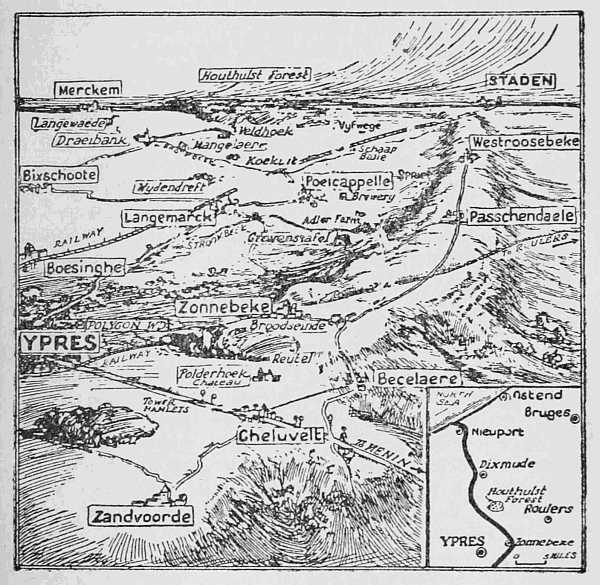
The weather was against us, as many times before a battle. Yesterday it was a day of rain and heavy, sodden clouds, so that observation was almost impossible for our flying men and kite-balloons, and our artillery was greatly hampered. The night was dark and moist, but luck was with us so far that a threatening storm did not break, and our men kept dry. The darkness was in our favour, and the assaulting troops were able to form up for attack very close to the enemy's lines—lines of shell-craters in fields of craters from which our storms of fire had swept away all trenches, all buildings, and all trees. The enemy held these forward positions lightly by small groups of men, who knew themselves to be doomed, and waited for that doom in their pits like animals in death-traps. In their second-line defences, less damaged, but awful enough in wreckage of earthworks, the enemy was in greater strength, and from these positions flares went up all through the night, giving a blurred white light along the barriers of mist, and rising high into the cloudy sky. Scores of thousands of our men, lying on the wet earth in puddles and mud-holes, watched those flares and hoped they would not be revealed before the second when they would have to rise and go forward to meet their luck. They lay there silently, never stirring, nor coughing, nor making any rattle of arms, while German shells passed over them or smashed among them, killing and wounding some of those who lay close. Enemy aircraft came out in the night bolder than by day, since they have been chased and attacked and destroyed in great numbers by British flying men, determined to get the mastery of the air, and to blind the enemy's eyes before this battle, and beyond any doubt successful as far as this day goes. The night-birds swooped over places where they thought our batteries were hidden and dropped bombs, but as they could see nothing their aim was bad, and they did no important damage, if any at all. So the hours of the night crept by, enormously long to all those men of ours waiting for the call to rise and go. Our gun-fire had never stopped for weeks in its steady slogging hammering, but shortly after half-past three this ordinary noise of artillery quickened and intensified to a monstrous and overwhelming tumult. It was so loud that twelve miles behind the lines big houses moved and were shaken with a great trembling. People farther away than that awakened with fear and went to their windows and stared out into the darkness, and saw wild fireballs in the sky, and knew that men were fighting and dying in Flanders in one of the great battles of the world. This morning I watched the fires of this battle from an observation-post on the edge of the salient. I knew what I should have seen if there had been any light, for I saw those places a day or two ago from the same spot. I should have seen the ghost-city of Ypres, and the curve of the salient round by Pilkem, St.-Julien, and Zillebeke, and then Warneton and Houthem below the Messines Ridge. But now there was no light, but hundreds of sharp red flashes out of deep gulfs of black smoke and black mist. The red flashes were from our forward batteries and heavy guns, and over all this battlefield, where hundreds of thousands of men were at death-grips, the heavy, smoke-laden vapours of battle and of morning fog swirled and writhed between clumps of trees and across the familiar places of death round Ypres, hiding everything and great masses of men. The drum-fire of the guns never slackened for hours. At nine o'clock in the morning it beat over the countryside with the same rafale of terror as it had started before four o'clock. Strangely above this hammering and thundering of two thousand guns or more of ours, answered by the enemy's barrage, railway whistles screamed from trains taking up more shells, and always more shells, to the very edge of the fighting-lines, and in between the massed batteries, using them as hard as they could be unloaded.
Over at Warneton and Oostaverne, in the valley below the Messines Ridge, the enemy was pouring fire along our line, shells of the heaviest calibre, which burst monstrously, and raised great pillars of white smoke. It was a valley of death there, and our men were in it, and fighting for the slopes beyond.
It is a battle, so far, of English, Scottish, and Welsh troops, with some of the Anzacs—New-Zealanders as well as Australians—and all along the line they have fought hard and with good success over ground as difficult as any that has ever been a battlefield, because of the canal and the swamps and the hollow cup of the Ypres area, with the enemy on the rim of it.
Among the battalions who fought hardest were the Liverpools, the South and North Lancashires, the Liverpool Scottish and Liverpool Irish, the Lancashire Fusiliers, Lancashire Regiment, the King's Royal Rifles, West Kents, Surreys, Durham Light Infantry, the Cheshires, Warwicks, Staffords, Sussex, Wiltshires and Somersets, the Royal Irish Rifles, the Black Watch, Camerons, Gordons and Royal Scots, the Welsh battalions, and the Guards. From north to south the Divisions engaged were the Guards, the 38th (Welsh), the 51st (Highland), the 39th, the 55th, the 15th (Scottish), the 8th, 30th, 41st, 19th, and Anzacs on the extreme right.
One can always tell from the walking wounded whether things are going ill or well. At least, they know the fire they have had against them, and the ease or trouble with which they have taken certain ground, and the measure of their sufferings. So now, with an awful doubt in my mind, because of the darkness and the anxiety of men conducting the battle over the signal-lines, and that awful drum-fire beating into one's ears and soul, I was glad to get first real tidings from long streams of lightly wounded fellows coming along from the dressing-station. They were lightly wounded, but pitiful to see, because of the blood that drenched them—bloody kilts and bloody khaki, and bare arms and chests, with the cloth cut away from their wounds, and bandaged heads, from which tired eyes looked out. One would not expect good tidings from men who had suffered like these, but they spoke of a good day, of good progress, of many prisoners, and of an enemy routed and surrendering. "A good day"—that was their first phrase, though for them it meant the loss of a limb or sharp pain anyhow, and remembrance of the blood and filth of battle. They were eager to describe their fighting, and I saw again the pride of men in the courage of their comrades, forgetting their own, which had been as great. These lads told me how they lay out in the night, and how the German planes came over, bombing them; how they rose and went forward in attack. The enemy was quickly turned out of his front line of shell-craters, and there were not many of him there. In the second line he was thickly massed, but some of them threw up their hands at once, crying "Mercy!"
The Scots came up against a strong emplacement fitted with machine-guns, and here the German gunners fired rapidly, so that our men were checked. They rushed the place, and at the last a German hoisted a white flag, but even then others fired, and I met one young Scot to-day who had a comrade killed after that sign of surrender.
Beyond Ypres, on the way to Menin, there was a big tunnel where our English lads expected trouble, as it could hold hundreds of Germans. But when they came to the tunnel and ferreted down it they only found forty-one men, who surrendered at once. Some of the enemy's troops were quite young boys of the 1918 class, but most of them were older and tougher men. The success of the day is shared by English troops, including the Guards, with the Welsh, who fought abreast of them with equal heroism, and with Scottish and Anzacs. The Welsh have wiped out the most famous German regiment of the Third Guards Division, known as the "Cockchafers."
Fighting with us, the French troops kept pace with their usual gallantry, carrying all their objectives according to the time-table. In one great and irresistible assault, these troops of two nations swept across the enemy lines and have reached heights on the Pilkem Ridge, as I hope to tell to-morrow in greater detail. For the day, it is enough to say that our success has been as great as we dared to hope.
II
FROM PILKEM RIDGE TO HOLLEBEKE
August 1
The weather is still abominable. Heavy rain-storms have water-logged the battlefields, and there are dense mists over all the countryside. It is bad for fighting on land, and worse for fighting in the air. But fighting goes on. Yesterday the enemy made strong counter-attacks at many points of our new line, and especially to the north of Frezenberg, west of Zonnebeke, where, at three in the afternoon, his infantry advanced upon the 15th (Scottish) Division after a violent bombardment. They were swept down by artillery and machine-gun fire. At five o'clock they came on again, moving suddenly out of a dense smoke-barrage, and gained 300 yards of ground. Our guns poured shells on to this ground, and at nine o'clock last night our men went behind the barrage and regained this position. The enemy's gun-fire is intense over a great part of the country taken from him, and his long-range guns are shelling far behind the lines. Generally the situation is exactly the same as it stood at the end of the first day of battle, when our advance was firm and complete at the northern end of the attack, where the Guards and the Welsh had swept over the Pilkem Ridge without great trouble, and where farther south the troops who had advanced beyond St.-Julien had to fall back a little, partly under the pressure of counter-attacks, but chiefly in order to get into line with their right wing, which had been engaged in the hardest fighting, and had not reached the same depth of country. That was in the wooded ground south-east of the salient, where the enemy had a large number of machine-guns in the cover of Glencorse Copse, Inverness Wood, and Shrewsbury Forest, and repulsed the very desperate attacks of the 8th and 30th Divisions.
Outside one copse there was a very strong position, known to our men as Stirling Castle. It was once a French château, surrounded by a park and outbuildings, long destroyed but made into a strong point with concrete emplacements. Rapid machine-gun fire poured out of this place against our men, but it was captured after several rushes. The trenches in front of it were also gained by the Royal Scots and Durham Light Infantry of the 8th Division. Later a counter-attack was launched against them by the Germans of one of the young classes, and here at least these lads, who do not seem to have fought very well elsewhere, came on like tiger cubs and gained some of their trenches back. From all the woods in this neighbourhood there was an incessant sweep of machine-gun bullets, and, as I have already said in earlier dispatches, many small counter-attacks were launched from them, without much success, but strong enough to make progress difficult to our men, now that the weather had set in badly, so that our guns were hampered by lack of aeroplane observation. All through the night and yesterday the enemy's barrage-fire was fiercely sustained, and our men dug themselves in as best they could, and took cover in shell-holes.
Hard fighting had happened that day southward and on the right of our attack past Hollebeke and the line between Oostaverne and Warneton. Opposite Hollebeke there were English county troops of the 41st Division—West Kents, Surreys, Hampshires, Gloucesters, Oxford and Bucks, and Durham Light Infantry—and they went "over the bags," as they call it, in almost pitch-darkness, like the men on either side of them. This was the reason of an accident which was almost a tragedy. As they went forward over that shell-destroyed ground they left behind them Germans hidden in shell-pits, who sniped our men in the rear, and picked off many of them until later in the day they were routed out. Beyond this open country the ruins of Hollebeke were full of cellars, made into strong dug-outs, and crowded with Germans who would not come out. They will never come out. Our men flung bombs down into these underground places, and passed on to the line where they stay on the east side of the village. At a little bit of ruin there was some delay because of the machine-guns there, and for some time it was uncertain whether we held the place, as a messenger sent down to report its capture was killed on his journey. Along the line of the railway here there was a row of concrete dug-outs, and a bomber of the Middlesex went up alone climbed the embankment, and dropped bombs through their ventilator. So there was not much trouble from them.
In some of the dug-outs in this neighbourhood about a score of bottles of champagne were found, for a feast by German officers. But our soldiers drank it; indeed, one—a Canadian fellow—drank a whole bottle to himself, being very thirsty, and after that he found one of the officers for whom the drink was meant, but for the fortune of war. He was lying on his truckle bed below ground, hoping, perhaps, to be asleep when death should come to him out of the tornado of fire which had swept over him for days. "Come out of that," shouted the Canadian, and then, having left his arms behind him, dragged him out by the hair.
South of Hollebeke three little rivers run. One of them is the Rozebeek, and another is the Wambeek, and the third is the Blawepoortbeek, and there is a small ridge between each of them, and a copse between them. Two bodies of English troops of the 19th and 37th Divisions—Lancashires, Cheshires, Warwicks, Staffords and Wiltshires, Somersets, Bedfords, South Lancashires, and Royal Fusiliers—attacked these positions, those on the right making their assault four hours later than those on the left. They had already pushed out by small raids and rushes half-way to the copse before the attack, and when the signal to go forward came they made the rest of the way very quickly, so that the copse fell. The enemy here fought hard, and had cover in concrete emplacements, with underground entries. Beyond he held out stoutly under machine-gun and rifle barrage. Meanwhile, on the extreme right of attack were the Australians and New-Zealanders in the ground below Warneton. It was difficult country. The enemy had gone to great trouble to wire his hedges and camouflage the shell-holes with wire netting, below which he hid machine-guns and snipers. The village of La Basseville, like all the places we call villages, a mere huddle of broken bricks, had already been taken once and lost in a counter-attack. Now it was the New-Zealanders who took it. The same thing happened as at Hollebeke. The enemy refused to leave his dug-outs and was bombed to death in them. "Can't make any use of the cellars," came a message through, "as they are choked with dead." Not far from La Basseville was the stump of an old windmill standing lonely on a knoll. Because of its observation it was important to get, and it was the Australians who captured it after hard fighting. At 9.30 in the morning the Germans came out in waves across the Warneton-Gapaard road and so encircled the windmill that the Australians had to draw back and leave it. But at midnight, after it had been shelled for several hours, they went back, routed out the garrison, and now hold it again. At half-past three the same afternoon the New-Zealanders were counter-attacked at La Basseville, but the Germans were beaten back.
So the fortunes of the day were alternating, but at the end of it the position became clear. We had made and held all the ground that we intended. Then our men dug in, and the rain, which had begun on the afternoon of the battle, grew heavier. It has rained ever since. The ground is all a swamp and the shell-holes are ponds. The Army lies wet, and all the foulness of Flemish weather in winter is upon them in August. Through the mist the enemy's shell-fire never ceases, and our guns reply with long bombardments and steady barrages. The walking wounded come back over miles of churned-up ground, dodging the shells, and when they get down to the clearing-stations they are caked with mud and very weary. War is not a blithe business, even when the sun is shining. In this gloom and filth it is more miserable.
The weather has been bad for flying men. Impossible, one would say, looking up at the low-lying storm-clouds. Yet on the day of battle our airmen went out and, baulked of artillery work, flew over the enemy's country and spread terror there. It was a flying terror which, when told in the barest words of these boys, is stranger than old mythical stories of flying horses and dragons on the wing. Imagine one of these winged engines swooping low over one as one walks along a road far from the lines, and above the roar of its engine the sharp crack of a revolver with a bullet meant for you. Imagine one of these birds hovering above one's cottage roof and firing machine-gun bullets down the chimneys, and then flying round to the front and squirting a stream of lead through the open door, and, after leaving death inside, soaring up into a rain-cloud. That, and much more, was done on July 31. These airmen of ours attacked the German troops on the march and scattered them, dropped bombs on their camps and aerodromes, flying so low that their wheels skirted the grass, and were seldom more than a few yards above the tree-tops. The narrative of one man begins with his flight over the enemy's country, crossing canals and roads as low as thirty feet, until he came to a German aerodrome. The men there paid no attention, thinking this low flier was one of theirs, until a bomb fell on the first shed. Then they ran in all directions panic-stricken. The English pilot skimmed round to the other side of the shed and played his machine-gun through the open doors, then soared a little and gave the second shed a bomb. He flew round and released a bomb for the third shed, but failed with the fourth, because the handle did not act quickly enough. So he spilt his bomb between the shed and a railway train standing still there. By this time a German machine-gun had got to work upon him, but he swooped right down upon it, scattering the gunners with a burst of bullets, and flew across the sheds again, firing into them at twenty feet. His ammunition drum was exhausted, and he went up to a cloud to change, and then came down actually to the ground, tripping across the grass on dancing wheels, and firing into the sheds where the mechanics were cowering. Then he tired of this aerodrome and flew off, overtaking two German officers on horses. He dived at them and the horses bolted. He came upon a column of 200 troops on the march, and swooped above their heads with a stream of bullets until they ran into hedges and ditches. He was using a lot of ammunition, and went up into a cloud to fix another drum. Two German aeroplanes came up to search for him, and he flew to meet them and drove one down so that it crashed to earth. German soldiers gathered round it, and our fellow came down to them and fired into their crowd. A little later he flew over a passenger train and pattered bullets through its windows, and then, having no more ammunition, went home.
There was a boy of eighteen in one of our aerodromes the night before the battle, and he was very glum because he was not allowed to go across the German lines next day on account of his age and inexperience. After many pleadings he came to his squadron commander at night in his pyjamas and said, "Look here, sir, can't I go?" So he was allowed to go, and set out in company with another pilot in another machine. But he soon was alone, because he missed the other man in a rain-storm. His first adventure was with a German motor-car with two officers. He gave chase, saw it turn into side roads, and followed. Then he came low and used his machine-gun. One of the officers fired an automatic pistol at him, so our boy thought that a good challenge and, leaving go of his machine-gun, pulled out his own revolver, and there was the strangest duel between a boy in the air and a man in a car. The aeroplane was fifty feet high then, but dropped to twenty just as the car pulled up outside a house. The young pilot shot past, but turned and saw the body of one officer being dragged indoors. He swooped over the house and fired his machine-gun into it, and then sent a Very-light into the car, hoping to set it on fire. Presently he was attacked by a bombardment from machine-guns, "Archies," and light rockets, so he rose high and took cover in the clouds. But it was not the last episode of his day out. He saw some infantry crossing a wooden bridge and dived at them with rapid bursts of machine-gun fire. They ran like rabbits from a shot-gun, and when he came round again he saw four or five dead lying on the bridge. From the ditches men fired at him with rifles, so he stooped low and strafed them, and then went home quite pleased with himself.
There were scores of flying men who did these things. The pilots of two units alone flew an aggregate of 396 hours 25 minutes, and fired 11,258 rounds of machine-gun bullets at ground targets, to say nothing of Very-lights. Those machines were not out in France for exhibition purposes, as gentlemen now abed in England are pleased to think. All this sounds romantic, and certainly there is the romance of youthful courage and fearless spirit. But apart from human courage, the ugliness and foulness of war grow greater month by month, and if anybody speaks to me of war's romance I will tell him of things I have seen to-day and yesterday and make his blood run cold. For the sum of human agony is high.
III
THE BEGINNING OF THE RAINS
August 1
A violent rain-storm began yesterday afternoon after our advance across the enemy's lines to the Pilkem Ridge and the northern curve of the Ypres salient, and it now veils all the battlefield in a dense mist. It impedes the work of our airmen and makes our artillery co-operation with the infantry more difficult, and adds to the inevitable hardships of our men out there in the new lines where the ground has been cratered by our shell-fire into one wild quagmire of pits. To the enemy it is not altogether a blessing. His airmen get no observation of our movements, and his gunners do not find their targets, while his poor, wretched infantry, lying out in open ground or in woods where they get no cover from our fire, must be in a frightful condition, unable to get food because of our barrages behind them, and wet to the skin.
The enemy's command has been unable to organize any effective counter-attacks, and so far has sent forward small bodies of storm troops moving vaguely to uncertain objectives and smashed by our fire before they have reached our lines. There were many of these attacks yesterday. Against the Lancashire regiments of the 15th and the Scots of the 55th Division they were repeated all through the day, beginning at three o'clock in the afternoon, and coming again at eleven o'clock, 1.45, and 7.15 this morning.
The Lehr Regiment, whom the Kaiser called his brave Coburgers during the battles of the Somme, were very severely mauled yesterday and suffered heavy losses. Both the 235th Division and the Third Guards Division, engaged by our men on the Steenbeek line, have been shattered. So great has been the alarm of the enemy at the menace to his line that he has been rushing up reserves by omnibuses and light railways to the firing-line over tracks which are shelled by us day and night. The suffering of all the German troops, huddled together in exposed places, must be as hideous as anything in the agony of mankind, slashed to bits by storms of shells and urged forward to counter-attacks which they know will be their death.
I saw this morning large numbers of prisoners taken during the past twenty-four hours and just brought in. They had the look of men who have been through hell. They were drenched with rain, which poured down their big steel helmets. Their top-boots were full of water, which squelched out at every step, and their sunken eyes stared out of ash-grey faces with the look of sick and hunted animals. Many of them had cramp in the stomach through long exposure and hunger before being captured, and they groaned loudly and piteously. Many of them wept while being interrogated, protesting bitterly that they hated the war and wanted nothing but peace. They have no hope of victory for their country. An advance into Russia fills them with no new illusions, but seems to them only a lengthening of the general misery. They do not hide the sufferings of their people at home, and say that in the towns there is bitter want, and only in the rural districts is there enough to eat. In the field they are filled with gloomy forebodings, and live in terror of our tremendous gun-fire. The older men, non-commissioned officers who have come back after wounds, and other soldiers of long training, say that the boys of the young classes who are now filling up the ranks have no staying power under shell-fire and no fighting spirit. Among the prisoners I saw to-day I think about a quarter of them, or perhaps a little less, were these young boys, anæmic-looking lads, with terror in their eyes. The others were more hardy-looking men, though pale and worn. It is certain that they made no great fight yesterday when our men were near them, except when they still had cover in concrete emplacements. And it is no wonder that all fight has gone out of them. Some even of our own men were startled and stunned by the terrific blast of our gun-fire. Some of these men have told me that when they went forward to get into line before the attack, they had to pass through mile after mile of our batteries, the heavy guns behind, and gradually reaching the lighter batteries forward, until they arrived at the field-guns, so thickly placed that at some points they were actually wheel to wheel. The night was dark, but there was no darkness among these batteries. Their flashes lit up their neighbourhood with lurid torches, blinding the eyes of the troops on the march, and all about the air rocked with the blast of their fire and the noise was so great that men were deafened. As the troops went forward for five or six miles to the assembly-lines flights of shells passed over their heads in a great rush through space, and it was terrifying even to men like one of those I met to-day, who has become familiar with the noise of gun-fire since the early days of Ypres and the fury of the Somme. But the worst came when the field-guns began their rapid fire before yesterday's dawn. It was like the fire of machine-guns in its savage sweep, but instead of machine-gun bullets they were 18-pounder shells, and each report from thousands of guns was a sharp, ear-splitting crack.
An Irish fellow who described his own adventures to me as he lay wounded and told his tale as vividly as a great orator, because of the perfect truth and simplicity of each phrase, said that he and all his comrades hurried to get away from their own lines when the signal of attack came in order to escape from the awful noise. They preferred the greater quietude of the enemy's positions. They went across blasted ground. It had been harrowed by the sweep of fire. Trenches had disappeared, concrete emplacements had been overturned, breastworks had been flung like straws to the wind. The only men who lived were those who were huddled in sections of trench which were between the barrage-lines of our fire. Our men had no fear of what the enemy could do to them. They went forward to find creatures eager to escape from this blazing hell. It was only in redoubts like the Frezenberg Redoubt which had escaped destruction that the German machine-gunners still fought and gave trouble. Many of the enemy must have been buried alive with machine-guns and trench-mortars and bomb stores. But there were other dead not touched by shell-fire, nor by any bullet. They had been killed by our gas attack which had gone before the battle. Rows of them lay clasping their gas-masks, and had not been quick enough before the vapour of death reached them. But others, with their gas-masks on, were dead. One of our men tells me that he came across the bodies of a group of German officers. They belonged to a brigade staff, and they were all masked, with tin beast-like nozzles, and they were all stone dead. It is the vengeance of the gods for that gas, foul and damnable, which they used against us first in the second battle of Ypres and ever since. It is the worst weapon of modern warfare, and has added the blackest terror to all this slaughter of men.
Because there was not great fighting with infantry yesterday, it must not be thought that our men had an easy time. The enemy was quick to put down his barrage, and although it was not anything like our annihilating fire, it was bad enough, as any shell-fire is. I met some young Scots of the Gordons and Camerons to-day, who had been through an episode of a thrilling kind, which was horrible while it lasted. When the signal for attack came yesterday, they were a little mad, like some of their comrades, because they said they saw the Germans running away on the other side of our wall of shells. Without waiting for the barrage to creep forward, these Scots ran forward right among our own shells, and, by some miracle, many of them escaped being hit, and went forward in pursuit. A party of about a hundred went right beyond their goal and found themselves isolated and out of touch with the main body. They were heavily shelled and attacked by bombing parties. They sent runners back asking for reinforcements, but none came because of their far-flung position. They tried to signal for an artillery barrage to protect them, but this call was not seen. They ran out of ammunition, and saw that death was coming close to them. It touched some men with great chunks of hot shell, and they fell dead in their shell-craters. Other men were buried by the bursts of 5·9's. These boys of the 8/10th Gordons were proud. They did not want to retire, though they knew they had gone too far, but at last, when all their officers had been killed but one, the order was given to this little remnant of men to save their lives and get back if they could. They went back through heavy fire, and I talked with two of them this morning, happy to find themselves alive and bright-eyed fellows still. It is extraordinary what escapes many of them have had. A group of them in the farthest line of advance lay down in craters under a rapid sweep of machine-gun fire from a redoubt in front of them. They watched over the edge of their craters how two Tanks came up, heaving and lurching over the tossed earth, until they were within gun-range of the redoubt. Then they opened fire. But the enemy's gunners had seen them, and tried to get them with direct hits. Most of the shells fell short all around those English lads hiding in the craters. Some of these were buried and some killed. But the others held on to their ground, which is still in our hands.
The stretcher-bearers were magnificent, and worked all day and night searching out the wounded and carrying them back under fire. Many of the German prisoners gladly lent a hand in this work on their way back. At the dressing-stations to-day I saw them giving pickaback to men—ours—who were wounded about the legs and feet. They prefer this work to fighting.
After yesterday's battle our line includes the whole of the Pilkem Ridge and the ground in the valley beyond to the line of the Steenbeek river, and southwards in a curve that slices off the old Ypres salient. It has been a heavy blow to the enemy. Now it is all rain and mud and blood and beastliness.
IV
PILL-BOXES AND MACHINE-GUNS
August 3
The weather is still frightful. It is difficult to believe that we are in August. Rather it is like the foulest weather of a Flemish winter, and all the conditions which we knew through so many dreary months during three winters of war up here in the Ypres salient are with us again. The fields are quagmires, and in shell-crater land, which is miles deep round Ypres, the pits have filled with water. The woods loom vaguely through a wet mist, and road traffic labours through rivers of slime. It is hard luck for our fighting men. But in spite of repeated efforts the enemy has not succeeded in his counter-attacks, after our line withdrew somewhat at the end of the first day south and south-east of St.-Julien. In my first accounts of the battle I did not give full measure to the hardness of the fighting in which some of our troops were engaged, nor to the stubbornness of the enemy's resistance. It is now certain that, whereas many of the German infantry, terror-stricken by our bombardment, surrendered easily enough, others made good use of strong defences not annihilated by our fire, and put up a desperate defence. Fresh troops, like the 221st Division, were flung in by the German command in the afternoon of the first day and made repeated attacks, under cover of the mist, against our men, who were tired after twenty-four hours in the zone of fire, who in some sectors had suffered heavily, but who fought still with a courage which defied defeat. A commanding officer of a Lancashire battalion went to meet some of his men coming back yesterday. They were wet and caked with mud and unshaven and dead-beat, and they had lost many comrades, but they had the spirit to pull themselves up and smile with a light in their eyes when the commanding officer said he was proud of them, because they had done all that men could, and one of them called out cheerily, "When shall we go on again, sir?" An officer who was left last out of his battalion to hold out in an advanced position said to the padre, who has just visited him in hospital, "I hope the General was not disappointed with us." The General, I am sure, was not disappointed with these men of the 55th Division. No one could think of them without enthusiasm and tenderness, marvelling at their spirit and at the fight they made in tragic hours. Because it was a tragedy to them that after gaining ground they had been asked to take, and not easily nor without losses, they should have to fall back and fight severe rear-guard actions to cover a necessary withdrawal.
These Lancashire men, with many men of the Liverpool battalions, had to attack from Wieltje through successive systems of trenches. This ground is just to the right of St.-Julien and to the left of Frezenberg, below the Gravenstafel Spur, Zonnebeke, and Langemarck. The way lay past a number of German strong points—Beck House, Plum Farm, Pound Farm, and Square Farm—once small farmsteads, long blown to bits, but fortified by concrete strongholds with walls of concrete two yards thick. Our gun-fire wrecked all the ground about them and toppled over a few of these places, but left a number untouched, and that was the cause of the trouble. Each one had to be taken by a separate action led by our young platoon commanders, and it was a costly series of small engagements—costly to officers, especially, as always happens at such times. These young subalterns of ours handled their men not only gallantly, but skilfully, and the men followed their lead with cunning as well as pluck, and got round the concrete works by rifle-fire and bombing until they could rush them at close quarters. In this way two strongly held farms were taken, while from the right the Lancashire men were swept by enfilade fire from a third farm until its garrison was routed out and 160 of them captured. There was hard fighting farther on for a line of trenches where some of the wire was still uncut, with machine-gun fire rattling from the left flank.
But the fiercest fighting came after that against another series of those concrete forts, among them the Pommern Redoubt, where separate actions had again to be made by little groups of men under platoon commanders. The enemy's machine-gunners served their weapons to the last. In this ground, too were five batteries of German field-guns, who fired upon our men until they were within 500 yards. The gunners had to be shot down, and our men streamed past the guns in perfect order just as they had rehearsed the attack beforehand, sending back reports, carrying through the whole operation as though on a field-day behind the lines. Yet by that time their strength had been ebbing away, and many of them had fallen. They reached the extreme limit of their advance with outposts at two more fortified farms—Wurst and Aviatik Farms—from which two days later a delayed report came back from the last remaining officer of the party that he had reached this high ground in front of Wurst Farm, and that his battalion was badly depleted. That was an heroic little message, but a few hours later that ground was no longer in our hands. The troops of the 39th Division on the left of the Lancashire men had found some trouble with uncut wire, and the enemy developed a strong counter-attack from the north, taking advantage of that exposed flank. They prepared for attack by a heavy artillery barrage, controlled by low-flying aeroplanes and co-operating with the infantry. At the same time another counter-attack came down from the high ground on the right to strike between the Lancashire men of the 55th Division and the Scottish troops of the 15th on their right. It was decided to withdraw to a better defensive line, and 160 Lancashire Fusiliers got into Schuler Farm, and held it against heavy odds in order to cover this movement. They stayed there, using machine-guns and rifles until only thirty of them were left standing, and all around them were dead and dying. Their work was done, for they had held out long enough to protect the withdrawing lines, and the thirty survivors decided to fight their way back through an enemy fast closing in upon them. So they left the farm, and of the thirty ten reached the new line. Since then the enemy has made repeated attacks from the high ground on the right, and especially against the Pommern Redoubt, but every time he has been cut up by the fire of our guns and rifles. I hear that this afternoon he is again massing for another attempt, according to the orders given to the German troops that they must get back all the ground they have lost, and at all costs, by August 3, which is to-day.
I have already told in a general way in previous dispatches how the Scots of the 15th Division farther south than the Lancashire men fought their way up to the Frezenberg Redoubt, coming under a blast of machine-gun fire from a neighbouring farm until they captured its garrison, and then going on to two other enemy redoubts. They had the same trouble as the Lancashire men with these concrete forts, but attacked them with stubborn courage, and put them out of action. One of my good friends was wounded in front of one of these emplacements in command of his battalion of 8/1Oth Gordons, and it was by an odd chance that I saw him as he lay wounded in a casualty clearing-station a few hours later. "I hear my men have done well," he said. They did as well as they have always done in many great battles, and not only well, but wonderfully, and they went as far as they were allowed to go, and held on in their old grim way when things were at their worst. The whole line of the Scottish troops below the Langemarck-Zonnebeke road was attacked at two in the afternoon, or thereabouts, and their advanced line gradually withdrew under a fierce fire. At six o'clock the enemy slightly penetrated the advance line, driving the Gordons back a hundred yards, but the Camerons drove them out and away. This was on a front to the east of St.-Julien and south of Zonnebeke.
The general position remains the same. The weather remains the same, and the mud and the discomfort of men living under incessant rain and abominable shell-fire do not decrease: nevertheless, they have smashed up attack after attack, and their spirit is unbreakable. The enemy is suffering from the same evil conditions, and his only advantage is that perhaps he has better cover in which to assemble his men, and that, owing to his defeat, he is nearer to his base, so that they have not so far to tramp through the swamps in order to get up supplies of food for guns and men. As usual, we have behind us a wide stretch of shell-broken ground, which, in foul weather like this, becomes a slough.
August 5
For the first time for four days and nights the rain has stopped, and there is even a pale gleam of sunshine, though the sky is still heavy with rain-clouds. Oh, foul weather! What a curse it has been to our men! But the guns have never ceased their fire because of the rain and the mist, and all last night again and to-day there has been tremendous gunning. Our gunners have been working at high tension for several weeks, and the admiration of the infantry goes out to these men who, though they do not go over the top, are under heavy fire from German counter-battery work and bombed by German aeroplanes and strained by the enormous responsibility of protecting the infantry and keeping up barrage-fire without rest. In this battle the gunners have done marvellously, to the very limit of human endurance. As for the infantry, words are not good enough to describe the grit of them all. Apart from all the inevitable beastliness of battle, they have had to fight in this filthy weather, and it has made it a thousand times worse. In August men don't expect to get drowned in shell-holes, nor to get stuck to the armpits in mud before they reach the first German line. It was not as bad as that everywhere, but exactly that in parts of the line even before the heavy rains came on. The men of the 8th and 30th Divisions who attacked over ground like this east of Zillebeke went through abominable adventures. It was almost pitch-dark when they went forward, and the first thing that happened was that battalions became hopelessly mixed because of the darkness and the nature of the ground; and the second thing that the barrage went ahead of them so that they had to struggle behind in the morass unsupported by its fire, and shot at by Germans on their flanks.
Two lines of trenches known to our men as Jackdaw Support and Jackdaw Reserve were captured without much difficulty as far as the enemy was concerned, about eighty prisoners being taken in them, but with enormous difficulty on account of the boggy ground. Imagine these men, loaded up with packs and rifles and sand-bags and shovels, slipping and falling among the shell-pits, which were full of mud, water, and wire. Fellows stopped to pull out their comrades and were dragged in after them. It took them three-quarters of an hour to get over two lines of undefended trenches, whole platoons getting bogged in them and slipping back when they tried to climb out. It was a trying time for the officers who saw the barrage of our guns getting away ahead. Beyond them was high ground, from which German machine-gun and rifle fire swept them, and not far away German snipers potted our men, and especially our officers, as they climbed in and out of shell-craters. Two officers of the Manchesters had been killed by one of these fellows when a private crept out alone on his flank, stole round him very quietly, pounced and killed him. It took two and a half hours to get to Jackdaw Reserve Trench in Sanctuary Wood, and the enemy's riflemen who had been firing at close range then ran back, or as our men say, "hopped it." The Menin road from Ypres runs through the high ground just here, and it was about here that the hardest time came for the 30th Division, because of the fierce machine-gun fire. It was here, also, that many gallant deeds were done by men who had lost their officers, and by the officers who had lost their men but collected stragglers and groups from mixed units to get on with the attack. A young private soldier of a machine-gun company advanced with his Lewis gun and by rapid fire put a German machine-gun out of action, so that a bombing party could get on. A lance-corporal of the Manchesters rallied up stragglers, organized groups, and rushed some of the German strong points. A captain behaved throughout the battle with the most fearless gallantry, and when his men wavered and fell back before the blast of machine-gun bullets that drove across the Menin road, rallied them and gathered up lads from other units, and captured two strong points with these storming parties. He was wounded in this action, but paid no heed to that, and continued to lead his men. It was here that the great tunnel ran across the Menin road, from which forty-one Germans were taken. To the right of the road this side of Inverness Copse and the Dumbarton Lakes stood Stirling Castle on the high ground of a semi-circular ridge surrounded by deep shell-pits. The "castle" itself was just a heap of broken bricks on this commanding ground, and behind those bricks were German machine-gunners, who served their weapons until our men were close to them. Then they "hopped it" again, but stayed on the other side of the ridge, firing at any men who showed themselves over the crest. Our men fought round the castle for hours, heavily shelled as soon as the enemy's gunners knew it was in our hands, and meeting counter-attacks which developed later.
A thousand and more acts of courage were done in those hours by men who knew that their comrades' lives and their own depended upon "getting on with the job," as they call it. It was necessary to get reports back to brigade headquarters at all costs, so that supplies and supports might be sent up, and to get into touch with battalion and company commanders from the advanced line. It was not easy either to write or to send down these messages. Wires were cut and runners killed. But it had to be done. A company sergeant-major, though lightly wounded first and then badly wounded after leading his men up under a sweep of machine-gun bullets, sat down in the mud and scribbled out his report. There was a young Irish private in these Manchesters who did wonderful work as a runner with these messages. He volunteered whenever there was a dangerous bit of work to do, exposing himself over and over again, and gathering up stragglers to fill up gaps in the line of defence. A sergeant acted as runner when two of his own had been killed, and got through under intense fire. And one of these runners had a great adventure all to himself on his journey under fire. This young private was going up with a message when he saw something move outside a dug-out. He went forward cautiously, and saw a German soldier disappear into the dark entry. The Manchester lad was all alone, but he followed the German into the hole, down a flight of mud stairs and into an underground cave. He stood face to face with eighteen men. One of them was a non-commissioned officer. They stared back at him with brooding eyes, as though wondering whether they should kill him. He shouted at them, "Now then, come out, and look sharp about it," and made a sign to the door. They put their hands up and said, "Kamerad." "Well, then, get out," said the boy. They filed out past him, and he waited till the last had gone. Then he went up the mud stairs to open ground again, and saw that the eighteen men had scattered, finding that he was all alone. He shouted to them and fired his rifle over their heads, so that they thought twice of escape, and then came back to him meekly. So he formed them up, and marched behind them down to the prisoners' cage, where he took his receipt for eighteen prisoners.
There was now great shelling, and the enemy was massing for a counter-attack. Through this fire a young Irish officer in the machine-gun section brought up nine out of his twelve guns in order to meet the attack, and without that great courage of his the position would have been very bad. A sergeant of machine-gunners stood in a bit of a trench with his team when a shell burst, killing two men and wounding others. He stood there, splashed with blood and in great danger of death, without losing his nerve or his spirit, and after helping the wounded he "carried on" and kept his guns in action.
Meanwhile, down at brigade headquarters the situation was very obscure; so obscure that the brigadier sent up a young captain, his brigade major, to find out the situation and report on it. Not a safe and easy job to do at such a time; but this officer, whom I met to-day, went up to Stirling Castle, where he found mixed units still under heavy machine-gun fire, and only one or two officers without knowledge of the general situation owing to the difficulty of getting communications. The brigade major reorganized the situation with a cool head and a fine courage, collected parties of mixed riflemen, and took them to the high ground, where there was a good field of fire, and then, with his orderly, moved across the Menin road, which was at that time unprotected. He organized the support of this, and on the way came across the entrance to the tunnel under the road. He stopped and listened. It seemed to him that he could hear movements and voices. He went into the tunnel, and heard and saw a German there. He covered him with a revolver, and the man put his hands up. But the German was not alone. There was a shuffling of feet farther down, and the German said, "There are four of us farther in the tunnel." The brigade major went farther down, with his revolver ready, and met the four men and told them in French and English that he would kill them if they moved a step. They surrendered, two of them speaking good English, and the brigade major's orderly took one of their rifles, not being armed himself, and with that weapon escorted them back. They were men of the 238th Regiment, and had only been in that line twenty-four hours. It was the brigade major's report that cleared up the situation from his headquarters and made it more easy of control.
Some Scottish troops who fought alongside the Manchesters at Stirling Castle behaved with equal valour. They endured long and intense shelling, while through the murk and smoke enemy aeroplanes flew very low, firing their machine-guns at the troops, batteries, and mule convoys, with a good imitation of our own air pilots. What I have told so far covers only a small section of the Front, but I have now given a broad picture of all the length of battle, and these episodes I have just described will give a closer idea of the way in which all our soldiers have been fighting in this country around Ypres, and of all they have suffered in the foulest weather I have ever seen in summer.
August 4
The Tanks have justified themselves again, and won their spurs—spurs as big as gridirons—in the battle of Flanders. They had plenty of chance to show what they could do.
As I described yesterday, the way of our advance was hindered by a number of little concrete forts built in the ruin of farmsteads which had withstood our gun-fire. At Plum Farm and Apple Villa, and in stronger, more elaborate, fortified points, like the Frezenberg and Pommern Castle and Pommern Redoubt, the enemy's machine-gunners held out when everything about them was chaos and death, and played a barrage of bullets on our advancing men. Platoons and half-platoons attacked them in detail at a great cost of life, and it was in such places that the Tanks were of most advantage. It was at Pommern Castle, east of St.-Julien, that one of the Tanks did best. Don't imagine the castle as a kind of Windsor, with big walls and portcullis and high turrets, but as slabs of concrete in a huddle of sand-bags above a nest of deep dug-outs. On the other side of it was Pommern Redoubt, the same in style of defence. Our men were fighting hard for the castle, and having a bad time under its fire. The Tank came to help them, and advanced under a swish of bullets to the German emplacement, lurching up the piled bags over the heaped-up earth, and squatting on top like a grotesque creature playing the old game of "I'm the King of the Castle; get down, you dirty rascals." The dirty rascals, who were German soldiers, unshaven and covered in wet mud, did not like the look of their visitor, which was firing with great ferocity. They fled to the cover of Pommern Redoubt beyond. Then the Tank moved back to let the infantry get on, but as soon as it had turned its back the Germans, with renewed pluck, took possession of the castle again. The men who were fighting round about again gave a signal to the Tank to get busy. So it came back, and with the infantry on its flanks made another assault, so that the enemy fled again. Pommern Redoubt was attacked in the same way with good help from the Tank.
The Frezenberg Redoubt was another place where the Tanks were helpful, and they did good work at Westhoek, the remnant of a village to the right of that. One of them attacked and helped to capture a strong point west of St.-Julien, from which a good many Germans came out to surrender, and afterwards some Tanks went through the village, but had to get out again in a hurry to escape capture in the German counter-attacks. It was not easy to get back in a hurry, as by that hour in the afternoon the rain had turned the ground to swamp, and the Tanks sank deep in it, with wet mud half-way up their flanks, and slipped and slithered back when they tried to struggle out. Many of the officers and crews had to get out of their steel forts, risking heavy shelling and machine-gun fire to dig out their way, and in the neighbourhood of St.-Julien they worked for two hours in the open to de-bog their Tank while German gunners tried to destroy them by direct hits. In a farm somewhere in this neighbourhood no fewer than sixty Germans came out with their hands up in surrender as soon as the Tank was at close quarters, and a story is told, though I haven't the exact details, that in another place the mere threat of a Tank's approach was enough to decide a party of eight to give in. It is certain beyond all doubt that the enemy's infantry has a great fear of these machines, and does not see any kind of humour in them. In this battle there is not a single case of an attack upon a Tank by infantry, though we know that they have been given special training behind their lines with dummy Tanks according to definite rules laid down by the German Command.
One fight did take place with a Tank, and it is surely the most fantastic duel that has ever happened in war. It was queer enough, as I described a day or two ago, when one of our airmen flew over a motor-car, and engaged in a revolver duel with a German officer, but even that strange picture is less weird than when a German aeroplane flew low over a Tank, and tried to put out its eyes by bursts of machine-gun bullets. Imagine the scene—that muddy monster crawling through the slime, with sharp stabs of fire coming from its flanks, and above an engine, with wings, swooping round and about it like an angry albatross, and spattering its armour with bullets. It was an unequal fight, for the Tank just ignored that waspish machine-gun fire, and went on its way with only a scratch or two. The Tanks were in action around the marshes and woodlands by Shrewsbury Forest. Here, as I have already said, there was very severe infantry fighting, in which the Leicesters, Northamptons, and above all the Middlesex Regiment had desperate engagements, and the enemy made many counter-attacks, so that the progress of our men was slow and difficult. The Tanks helped them as best they could.
So goes the tale of the Tanks on the first day of the battle of Flanders. It will be seen from what I have written that they gave good help to the troops. The pilots and crews behaved with splendid gallantry, and not only took great risks, but endured to the last extremity of fatigue in that narrow, hot space where they work their engines and their guns.
V
THE SONG OF THE COCKCHAFERS
August 8
One of the most bitter blows to Germany, if she has heard the news, must be the destruction of the famous regiment of "Maikaefer," or Cockchafers, by our Welsh troops. The Kaiser called them his brave Coburgers. In Germany the very children sang in the streets about them. And proud of their own exploits, they had their own soldier poets who wrote songs about the regiment, to which they marched through Belgium and France and Galicia. I saw one of these songs yesterday, picked up on the battlefield near Pilkem. It was written by one Paul Zimmermann of theirs, and was printed in a leaflet sold at ten pfennigs (a penny). It tells how the Cockchafers come out in the spring and how the children sing when they come. They are ready for battle then, wherever it may be. The call comes for them wherever there is the hardest fighting, so the Cockchafers swarmed through Belgium, and taught the French a lesson, and pressed after the wicked English, who—so the lying legend goes—used dumdum bullets, and swept back the Russians through Galicia. Old Hindenburg calls for them every time when there are brave deeds to be done. I have copied out two verses for those who read German:
Der Mai der bringt uns Sonnenschein, Er bringt uns Bluhtenpracht; Der Mai der bringt uns Kaeferlein Viel tausend über Nacht; Und von der Kinderlippen klingts: "Maikaefer, fliege, flieg" Und durch den Frühlingesjubel dringts: "Dein Vater ist im Krieg." Uns Garde Fusiliere nennt Maikaefer jeder Mund, Weil unser stolzes Regiment Im Mai stets fertig stand.
Well, old Hindenburg will call in vain now for his Cockchafers, the Guard Fusilier Regiment of the 3rd Guards Division, for nearly six hundred of them are in our hands and others lie dead upon the ground near Pilkem. They had relieved the 100th Infantry Reserve Regiment on the night of July 29, and lay three battalions deep in their trench systems across the Yser Canal north-east of Boesinghe, scattered thinly in the shell-craters which were all that was left of the trenches in the front lines, more densely massed in the support lines, and defending a number of concrete emplacements and dug-outs behind. The 9th Grenadier Regiment and a battalion of the Lehr Regiment reinforced the Cockchafers and lay out in the open behind the Langemarck-Gheluvelt line, and in the support lines a battalion of the Lehr of the 3rd Guards Division had already relieved a regiment of the 392nd Infantry Reserve Regiment. Some sections of the 3rd Battalion of the 9th Grenadier Regiment had been sent forward from Langemarck to act as sniping posts, and two special machine-gun detachments were also pushed up to check our assault. They were enough to defend this part of the Pilkem Ridge, and the ground itself was in their favour as our men lay in the hollow with their backs to the Yser Canal, across which all their supports and supplies had to pass.
What was in the favour of the Welsh was that they knew the ground in front of them in every detail from air photographs and from night and day raids, having lived in front of it for several months, digging and tunnelling so as to get cover from ceaseless fire, and storing up a great desire to get even with the enemy for all they had suffered. They had suffered great hardships and great perils, intensified before the battle because of violent shelling by high explosives and gas-shells, so that when the hour for attack came they had been hard tried already. It made no difference to the pace and order of their assault. Our bombardment had been overwhelming, and the heavy barrage which signalled the assault was, according to all these Welshmen, perfect. They followed it very closely, so closely that they were on and over the Cockchafers before they could organize any kind of defence. Many of the enemy's machine-guns had been smashed and buried. Those still intact were never brought into action, as their gunners had no time to get out of the concrete shelters in which they were huddled to escape from the annihilating fire.
It was in these places that most of the prisoners were taken—there and in a big trench, ten feet wide and twelve deep, on the outskirts of Pilkem village, where there is no village at all. The Cockchafers came out dazed, and gave themselves up mostly without a show of fighting. In some of their concrete shelters, like those at Mackensen Farm—don't imagine any buildings there—and Gallwitz Farm and Boche House and Zouave House, there were stores of ammunition, with many shells and trench-mortars.
So the Welsh went on in waves, sending back the prisoners on their way, through Pilkem to the high ground by the iron cross beyond, and then down the slopes to the Steenbeek stream. On the left were the Royal Welsh Fusiliers, who took the ground of Pilkem itself. On the right were men of the Welsh Regiment. In the ground beyond Pilkem they found the regimental headquarters in finely built dug-outs, but the staff had fled to save their skins. There was another big dug-out near by used by the enemy as a dressing-station. It had room enough for a hundred men. There were fifty men. The Welsh swarmed round it—thirty wounded and twenty unwounded Germans. The doctor in charge was a good fellow, and, after surrendering his own men, attended to some of the wounded Welsh. Two machine-guns and sixteen prisoners were taken out of a place called Jolie Farm, and thirty prisoners out of Rudolf Farm—concrete kennels in a chaos of craters—and three officers and forty-seven men came out of the ruins of a house somewhere near the Iron Cross. All the Welsh troops behaved with great courage, and a special word is due to the runners, who carried messages back under fire, and to the stretcher-bearers, who rescued the wounded utterly regardless of their own risks. Afterwards the mule drivers and leaders were splendid, bringing up supplies under heavy barrage fire. Wales did well that day, and the Welsh miners, who had already proved themselves as great diggers and great tunnellers and very brave men, showed themselves cool and fearless in the assault.
August 6
I am now able to mention more of the troops whose adventures I have described in previous dispatches, in addition to the Guards and the Welsh, who in a great assault, hardly checked by the enemy, captured the heights of Pilkem and went down the slopes beyond to the Steenbeek stream.
The Manchesters, with Royal Scots, Royal Irish Rifles, and Durham Light Infantry of the 8th Division, were amongst those who attacked Stirling Castle below Inverness Copse, as I narrated in full detail yesterday, with the incident of the runner who captured eighteen prisoners in a dug-out and of the young brigade major who reorganized the position and found five Germans in the great tunnel under the Menin road.
As I have already said, it was the men of Lancashire with battalions of the Liverpool Regiment of the 55th Division who went up from Wieltje against the concrete forts, where they fought in many independent little actions under platoon commanders, who shot down the gunners of five German batteries, and went forward as though on the drill-ground, in spite of heavy losses and great fire, to Wurst Farm and the high ground below the Gravenstafel, until they were forced to fall back somewhat under a heavy German counter-attack, when 160 men covered the withdrawal, and ten alone got back.
Farther south, they were Scots of the 15th Division who attacked the Frezenberg—Gordons and Camerons among them—and farther south still on their right were Sherwood Foresters and others of the 39th Division, who had some of the hardest fighting of the day, up through Hooge, that place of old ill-fame, round Bellewaerde Lake and across the Menin road to the Westhoek Ridge.
It was these Scots and these English who bore the brunt of the great German counter-attack on the afternoon of August 1. After fighting their way forward past the pill-box emplacements or concrete redoubts with a stiff and separate fight at the ruin of an estaminet on the cross-roads at Westhoek, where a sergeant and ten or twelve men captured forty of the enemy, the Sherwood Foresters and their comrades took "cover" during the night, exposed to fierce shell-fire and drenched in the rain, now falling steadily, and filling the shell-craters with mud and water, so that men were up to their waist in them. It was at about 2.30 on the following afternoon that the enemy developed his counter-attack from the direction of Bremen Redoubt and the high ground beyond our line, taking advantage of the mist to assemble and get forward. It was the critical hour of the battle.
The enemy's attack was preceded by a heavy artillery barrage, and by an incessant and wide-stretching blast of machine-gun fire. His assaulting troops drove first at the Midland men south of the Roulers railway, and the Sherwoods and Northamptons tried to hold their line by rifle-fire, Lewis-gun fire, and bombs. When officers fell wounded the non-commissioned officers and men carried on and fought a soldiers' battle. One Lewis-gunner drove the enemy back from a gap in the lines and others held back the enemy's storm troops long enough to give their comrades time to get into good order as far as was possible in a fight of this kind. The Germans forced their way forward among the shell-craters and ruins hoping to surround the Sherwoods and the men of Nottingham and Derby, who were steadily firing and fighting, so that the enemy's losses were not light. Meanwhile the Scots of the 15th Division on the left were meeting the attack and found their flank exposed owing to these happenings on their right. It became more and more exposed as the attack proceeded, and just before three o'clock the Gordons, who were in this perilous position, had to swing back. This movement uncovered the battalion headquarters, where one of the officers, acting as adjutant, had turned out his staff, which fought to defend the position. He then gathered all the Gordons in his neighbourhood and held on to the station buildings. Meantime the left of the Gordons had been swung back to form a defensive flank, and with two Vickers guns they swept the rear lines of the storm troops with deadly fire. The enemy fell in great numbers, but other waves came on and nearly reached the top of the crest upon which our men had formed their line. There a young officer of the Gordons seized the critical moment of the battle and by his rapid action proved himself a great soldier. With some of the Camerons he led his men forward down the slopes towards the advancing enemy, each man firing with his rifle as he advanced, making gaps in the German wave. The enemy stood up to this for a minute or two, but when the Highlanders were within fifty yards of them they broke and ran. As they fled our gunners, who had not seen the first S O S signals owing to the mist, came into action and inflicted great losses upon the retreating men. But the day was saved by the action of the Scottish infantry, who had learned the use of the rifle in open warfare, and who had been trained for this kind of action in small groups, acting largely on individual initiative. Many of the enemy were surrounded by fire, and one officer and seven men gained our line in safety, while the others were caught in a death-trap. There were moments when, but for the courage and discipline of our troops, the enemy's counter-attack had a great chance of success, and the history of this battle might have been less victorious for us.
VI
WOODS OF ILL-FAME
August 12
There was violent fighting yesterday. After our successful advance at dawn across the Westhock Ridge, when more than 200 prisoners were taken, the right of our attack in Glencorse Wood, or Schloss Park as the Germans call it, and among the tree-stumps which were once woods south of that, was heavily engaged with an enemy concealed in the usual concrete emplacements, and defending himself with well-placed machine-guns.
Among our troops who had the hardest struggle were the Irish Rifles, Cheshires, Lancashire Fusiliers, North Lancashires, and Worcestershires of the 25th Division against Glencorse Wood, and the Bedfords and Queen's of the 18th Division against Inverness Copse.
As on the ridge, the infantry came to close quarters and fought with bombs and rifles and bayonets, but it was mainly gun-fire again which decided the issues of the day and caused most losses on both sides. As I have said many times, since the battle of July 31 the enemy has massed a great power of artillery against us, and has apparently no immediate lack of ammunition. For miles the horizon was seething with the smoke of heavy shells. The enemy's barrage-fire was great. Ours was greater. Between Glencorse Wood and Inverness Copse, and all about Stirling Castle and the Frezenberg, he made a hell of fire, and many of our men had to pass through its fury, and not all passed or came back again. But afterwards the enemy's turn came, and masses of his men, thick waves of them, sent forward with orders to counter-attack, were caught under the fire of our guns and smashed to pieces.
The enemy attempted five separate counter-attacks yesterday, and in spite of all his losses renewed his efforts this morning with great determination, so that, after the exhaustion and ordeal of the night under continual fire, our men were compelled to give way in Glencorse Wood. That was necessary, because farther south the enemy had held their ground, and the copse was a salient exposed to harassing fire from large numbers of guns in the neighbourhood of Polygon Wood and the country east. It is a favourite device of the enemy to withdraw his guns on to the flanks of our advance, as soon as we have penetrated his lines, in order to check further progress, and he did this as soon as the battle of July 31 was fought, though he had to leave many of his field-guns in the mud of No Man's Land, where they still lie.
This method of defence did not ensure the success of his counter-attacks, though it had made the progress of our men hard south of Glencorse Wood. It was at about midday yesterday that our troops, who had made good their ground along Westhoek Ridge, had to call for further help from the guns. At the same time aeroplanes, taking advantage of wonderful visibility after the rains, were above the German lines, and saw a great gathering of German troops in Nuns' Wood and Polygon Wood. The calls were answered by large groups of batteries over a stretch of country miles deep. The heavies, far behind the lines, answered with 15-inch and 12-inch shells. The 9·2's heard the call in the quiet fields, where wild flowers grow over old shell-holes. Their 8-inch brothers heard the call and came quick into action. Six-inch and 4·2's made reply, and from them broke out one great salvo, followed by long rolls of drum-fire. Among the shell-craters of Nuns' Wood there were hundreds of men lined up for attack. They had their rifles at the slope, and they were hung round with bombs and trench-spades and cloth bags with iron rations, and they began to move forward just as that bombardment opened upon them. All the shell-fire burst over them and into them. They were swept by it. They were killed in heaps. Afterwards one of our airmen flew low over that stricken wood where they had been, and he came back with his report. Never before, he said, had he seen so many dead men. The German soldiers were lying there in great numbers. Other attempts were made to get forward, but it was only on the right, where there was close fighting, that the enemy made any progress.
At about six in the evening there was another call on our gunners, and this time the report came that the enemy was assembling in the valley of the Hanebeek. Two battalions of them were able to advance into the open towards our lines before our guns found their target. Then they flung themselves down under this new storm of fire or tried to escape from it by running or plunging into shell-craters. There were not many who escaped.
One of them who became a prisoner in our hands said that two battalions were annihilated—he used the phrase "wiped out." Perhaps that was an exaggeration. There are always some men who slip through, but in this case whole ranks of men were blown to bits.
I talked to-day with some of our own wounded who came limping through the casualty clearing-stations. They were men of the Worcesters and Bedfords and Queen's, whose battalions I have met before after battles. One of them told me how he lay out all night waiting for the attack in the dawn on Glencorse Wood and Inverness Copse. There are only tree-stumps there in the great white stretch of shell-craters, and the enemy was holding the place lightly with machine-guns in those pits that had been made by our fire. Our men were upon them quick after the barrage, and they were routed out of their holes before they had time to put up a strong defence. By bad luck, as sometimes happens, owing to the eagerness of our men to cover as much ground as possible, the Irish Rifles and the North Lancashires of the 25th Division went at least 200 yards beyond their goal, and were caught in our barrage, which was preventing supports coming up to the enemy. As soon as they realized their deadly error they fell back again, carrying their wounded.
Later
There was sharp hand-to-hand fighting on the Westhoek Ridge by the Lancashire Fusiliers, North Lancashires, and Cheshires. Both sides at last came into the open, the enemy standing about his concrete houses as our men advanced upon them, and using machine-guns and rifles. Most of these Germans were men of the 54th Reserve Division, and bold fellows who did not surrender so easily as I first imagined, in spite of the intense and prolonged barrage that had swept over them and wrecked their ground. In a strong point at the south end of the ridge, one of those concrete blockhouses which shelter machine-guns, they held out for three hours, and it was only taken when it had been battered by trench-mortars brought up into action at close range by some gallant men of ours, and when it was rushed from the flanks while the ground was still being swept by bullets. After that the ridge was ours on its forward slopes, at the northern end dropping below the western slopes southwards.
In Glencorse Wood the Lancashire men were enfiladed by machine-guns when a large part of the wood was no longer in our hands. It is on high ground, and with other slopes beyond, like those of Nuns' Wood and Polygon Wood, forms the barrier guarding the vital centres of the German position in the north, so that he fights to hold it with the full weight of his power in men and guns. Both are powerful, and his fire on Friday and Saturday was the fiercest ever faced by men who have fought through the Somme and later battles.
But his counter-attacks have failed against our Westhoek positions, and everything I have heard shows that his battalions, above all the 27th Regiment, were massacred by our artillery. Those Germans did not all die by shell-fire. The Lancashire Fusiliers and the North Lancashires fired their rifles all through Friday and Saturday at human targets they could not fail to hit. German reserves hurried up to relieve the shattered battalions and flung straight into the counter-attacks, wandered about in the open, ignorant of our men's whereabouts, like lost sheep. They were in full field kit, and as they came into the open our men shot at them with deadly effect. The first sign of the first great counter-attack on Friday was when seventy men or so came forward on the left and tried to rush an old German gun-emplacement. They were seen by the Lancashire Fusiliers, and the commanding officer, believing that an attack was imminent, sent through the call for the guns which led to the bombardment I have described in my earlier message.
We also opened a widespread barrage of machine-gun fire, and this caused heavy slaughter. All the country was aflame throughout the afternoon of Friday, and it was before the attack, at 6.40 in the evening, that the enemy's artillery concentrated in full and frightful fury. This artillery-fire has never ceased since then, though slackening down a little from time to time, and to-day it was in full blast again. It is a day of wonderful light, so that every tree and house and field of standing corn is seen for miles from any height in a stereoscopic panorama below a fleecy sky with long blue reaches between the cloud mountains. There was a lot of air fighting this morning because of this light across the landscape, and wherever I motored to-day there was the loud drone of the flying engines, and little fat bursts of shrapnel trying to catch German planes who came over on bombing adventures above our camps and villages. The enemy is all out, and it seems to me likely that he wishes to make this battle a decisive one of the war. I do not see how he can hope to decide it in his own favour after the loss of the Pilkem and Westhoek Ridges, but he is out to kill regardless of his own losses.
VII
THE BATTLE OF LANGEMARCK
August 16
This morning our troops made a general advance beyond the line of our recent attacks and gained about 1500 yards of ground on a wide front, which includes the village of Langemarck, and goes southward in the region of Glencorse Copse and Polygon Wood. From north to south the divisions engaged were the 29th, 20th, 11th, 48th, 36th (Ulster), 16th (Irish), 8th, and 56th.
On the left of our troops the French went forward also, and struck out into the swampy neck of ground which they call the Peninsula or Presqu'ile, surrounded on three sides by deep floods. On the right of our attack the fighting has been most violent, and the enemy has made strong and repeated counter-attacks over all the high ground which drops down to Glencorse Wood from the Nuns' Wood to the Hanebeek. His losses have been high, for although the weather is still stormy, making the ground bad for our men, there is light for our flying men and artillery observers, and at various parts of the Front his assembly of troops has been signalled quickly, so that our guns have smashed up his formations and caused great slaughter.
The Germans used to call the battles of the Somme the "blood-bath." Their diaries and their letters revealed the horror they had of the shambles into which they were driven. In the early days of this year they made a strategic retreat, under the guidance of Hindenburg, with the one object of escaping from our intense artillery-fire, but their methods of defence have been entirely changed by holding the front lines lightly by weak troops and scattered machine-gun emplacements, and concentrating their best troops behind for counter-attacks, in order to save man-power and lessen the tide of casualties. It is a sound system of defence, but it is the policy of an army fighting a retreat and giving up ground at the highest possible cost, never getting back by counter-attack to quite the same line over which the enemy had flowed. As a life-saving policy, however, the success has not been great, for it is certain that the German troops are suffering hideously from our shell-fire, and their counter-attacks have been costly in blood.
I suppose these words of mine convey nothing to people who read them. How could they when for three years we have been talking in superlatives without exaggerating the facts, but without understanding them, as minds are numbed by colossal figures? But out here, seeing the flame of shell-fire night after night stretching away round a great horizon, and hearing from near and from afar the ceaseless hammer-strokes of great guns, and watching the starlit sky, as I watched it last night from quiet cornfields, all red and restless with winking lights leaping up in tongues and spreading lengthwise in a sullen glare, one does realize a little the monstrous scale of all this and the destruction that is being done among the masses of men in the dark and in the hiding-places of the woods and trenches.
Experts are wrangling over the numbers of the German reserves. Fantastic figures are given of the millions of Germans still under arms. Well, there is no exact data, and all we know with any certainty is that the enemy is still outwardly strong—strong at least in defence. But the magnitude of his losses during three years is revealed by the fact of to-day's fighting and the place in which it happened. It was in the autumn of 1914, during the first battle of Ypres, that the Germans attacked our Third Brigade at Langemarck, where our English troops made a great and victorious assault to-day. Three years ago they were the German lads of the 1914 class who marched up to our lines, linked arm in arm to be mowed down by the most deadly rifle-fire in the world, because those men of our old Army were the finest marksmen. Yesterday at Lens, or rather at Hill 70, there were boys of the 1919 class who helped to hold the German lines, and that fact is one great tragedy of German hopes and the great proof of her defeat.
Last night our English troops who were going to attack the village of Langemarck, the old ghost-village which has been wiped out of all but history, went across the Steenbeek stream and lay there waiting for the hour of their assault. They were all light-infantry men, the King's, the Duke of Cornwall's, Somerset, the "Koylies" (King's Own Yorkshire Light Infantry), the King's Royal Rifles, and the Rifle Brigade of the 20th Division.
As we know now from captured orders a German regiment was ordered to attack our lines at 3.45 this morning. Only forty men of that regiment were seen advancing and they were annihilated. Our men went forward when there was light enough. Immediately on their right, in front of them, was the ruin of an old estaminet called Au Bon Gîte, made into a fortified emplacement and defended by machine-guns. It was a nasty place, and our men avoided it, and swept both sides of it and beyond, so that its garrison of gunners had to surrender. Keeping a steady line as much as possible over bad ground, they went forward, leaving the waves that followed them to deal with batches of prisoners who had been left alive after our bombardment of the night, and made their way toward Langemarck. Here they were in real trouble, but not from the enemy. It was the state of the ground that threatened them with the worst disaster. All round Langemarck the floods were out, and the heavy rains of the week had filled old shell-holes to the brim and made a bog everywhere. Men sank up to their waists as in the worst days of the fighting during the winter on the Somme. It was not water but wet mud that made their cold bath, and they had to use their rifles to keep themselves from sinking deep, and men on little islands of more solid ground had to haul out their comrades. All this meant loss of time, so that our barrage would sweep ahead of them and the German gunners would be able to do dirty work.
On the left of Langemarck the men were delayed by these bogs. On the right they were able to push up with great difficulty, but still to get on and work up to the village. The enemy ran as soon as they saw that our men were near. There were some spasmodic bursts of machine-gun fire, but the defence was feeble, and here, anyhow, the enemy had been demoralized by our frightful gun-fire.
A regimental commander, a full colonel, was taken here, and that is a rare bird to catch, as in most cases German officers of that rank are well behind the line. He was dejected and nerve-shaken, and spoke freely of the great losses of his men. They were men of the 79th Reserve Division who had been holding Langemarck, and they have suffered most severely, having lost large numbers of men in the previous attacks. Other prisoners came from the 214th Division, holding the line north of the Staden Railway—the railway to the ground above Bixschoote. The regiment which perhaps suffered worst of all was a battalion of the 262nd, which was broken to pieces in the British attack across the Steenbeek.
To the right of the attack on Langemarck our light-infantry men were successful, and in spite of concrete blockhouses and some deadly machine-gunning, won all the ground they had been asked to get. The men report that they saw large numbers of German dead, and that little groups of men fled before them as they advanced. Later in the morning the enemy rallied, and came back in counter-attacks, one of which seems to have come within ten yards of our men before it withered away under rifle and machine-gun fire.
It was on the right centre of the attack that, as I have said, the fighting was most uncertain. The Irish Divisions were heavily engaged here working towards Polygon Wood and the high ground thereabouts. They had to advance over frightful ground, and against the enemy in his greatest strength, because he is determined to defend these high slopes if he loses all else.
VIII
CAPTURE OF HILL SEVENTY
August 15
This morning, at dawn, the Canadians captured Hill 70, attacked and gained a maze of streets and trenches forming the mining colonies of St.-Laurent and St.-Emilie, and are now fighting on the outskirts of Lens. A fair number of prisoners have been taken—I saw parties of them marching down under escort an hour or two ago. Some of the enemy's troops were seen running away from the wreckage of the red houses in the suburbs of Lens as soon as Hill 70 was taken, but in some parts of the outer defences north and west of the city the garrison is fighting fiercely. The Canadians have, at any rate, gained most of the outward bastions of Lens formed by the separate colonies, or cités, as they are called, made up of blocks of miners' cottages and works united in one big mining district.