Part 3 — THE BATTLE OF ARRAS
Reading edition
I
ARRAS AND THE VIMY RIDGE
April 9
To-day at dawn our armies began a battle which, if Fate has any kindness for the world, may be the beginning of the last great battles of the war. Our troops attacked on a wide front including the Vimy Ridge—that grim hill which dominates the plain of Douai and the coalfields of Lens—and the German positions around Arras. In spite of bad fortune in the weather at the beginning of the day, so bad that there was no visibility for the airmen, and our men had to struggle forward in a heavy rain-storm, the first attacks have been successful, and the enemy has lost much ground, falling back in retreat to strong rear-guard lines where he is now fighting desperately.
The line of our attack covers a front of some twelve miles southwards from Givenchy-en-Gohelle, and is a sledge-hammer blow threatening to break the northern end of the Hindenburg line, already menaced round St.-Quentin. As soon as the enemy was forced to retreat from the country east of Bapaume and Péronne, in order to escape a decisive blow on that line, he hurried up divisions and guns northwards to counter our attack there, while he prepared a new line of defence known as the Wotan line, as the southern part of the Hindenburg line, which joins it, is known as the Siegfried position, after two great heroes of old German mythology. He hoped to escape there before our new attack was ready, but we have been too quick for him, and his own plans were frustrated. So to-day began another titanic conflict which the world will hold its breath to watch, because of all that hangs upon it.
I have seen the fury of this beginning, and all the sky on fire with it, the most tragic and frightful sight that men have ever seen, with an infernal splendour beyond words to tell. The bombardment which went before the infantry assault lasted for several days, and reached a great height yesterday, when coming from the south I saw it for the first time. I went up in darkness long before light broke to-day to watch the opening of the battle. It was very cold, with a sharp wind blowing from the south-east and rain-squalls. The roads were quiet until I drew near to Arras, and then onwards there was the traffic of marching men going up to the fighting-lines, and of their transport columns, and of many ambulances. In darkness there were hundreds of little red lights, the glow of cigarette ends. Every now and then one of the men would strike a match, holding it in the hollow of his hands and bending his head to it, so that his face was illumined—one of our English faces, clear-cut and strong. The wind blew sparks from cigarette ends like fireflies. Outside one camp a battalion was marching away, a regiment of shadow-forms, and on the bank above them the band was playing them out with fifes and drums, such a merry little tune, so whimsical and yet so sad also in the heart of it, as it came trilling out of darkness. On each side of me as I passed by men were deeply massed, and they were whistling and singing and calling out to each other. Away before them were the fires of death, to which they were going very steadily, with a tune on their lips, carrying their rifles and shovels and iron rations, while the rain played a tattoo on their steel hats.
I went to a place a little outside Arras on the west side. It was not quite dark, because there was a kind of suffused light from the hidden moon, so that I could see the black mass of the cathedral city, the storm-centre of this battle, and away behind me to the left the tall, broken towers of Mont-St.-Eloi, white and ghostly looking, across to the Vimy Ridge. The bombardment was now in full blast. It was a beautiful and devilish thing, and the beauty of it and not the evil of it put a spell upon one's senses. All our batteries, too many to count, were firing, and thousands of gun-flashes were winking and blinking from the hollows and hiding-places, and all their shells were rushing through the sky as though flocks of great birds were in flight, and all were bursting over German positions, with long flames which rent the darkness and waved sword-blades of quivering light along the ridges. The earth opened, and pools of red fire gushed out. Star-shells burst magnificently, pouring down golden rain. Mines exploded east and west of Arras, and in a wide sweep from Vimy Ridge to Blangy southwards, and voluminous clouds, all bright with a glory of infernal fire, rolled up to the sky. The wind blew strongly across, beating back the noise of guns, but the air was all filled with the deep roar and the slamming knocks of single heavies and the drum-fire of field-guns.
The first attack was at 5.30. Officers were looking at their wrist-watches as on a day in July last year. The earth lightened. In rank grass, looking white and old, scrubs of barbed wire were black on it. A few minutes before 5.30 the guns almost ceased fire, so that there was a strange, solemn hush. We waited, and pulses beat faster than second-hands. "They're away," said a voice by my side. The bombardment broke out again with new and enormous effects of fire and sound. The enemy was shelling Arras heavily, and black shrapnel and high explosives came over from his lines. But our gun-fire was twenty times as great. Around the whole sweep of his lines green lights rose. They were signals of distress, and his men were calling for help. It was dawn now, but clouded and storm-swept. A few airmen came out with the wind tearing at their wings, but they could see nothing in the mist and driven rain. I went down to the outer ramparts of Arras. The eastern suburb of Blangy was already in our hands. On the higher ground beyond our men were fighting forward. I saw two waves of infantry advancing against the enemy's trenches, preceded by our barrage of field-guns. They went in a slow, leisurely way, not hurried, though the enemy's shrapnel was searching for them.
"Grand fellows," said an officer lying next to me on the wet slope. "Oh, topping!"
Fifteen minutes afterwards groups of men came back. They were British wounded and German prisoners. They were met on the roadside by medical officers, who patched them up there and then before they were taken to the field-hospitals in ambulances. From these men, hit by shrapnel and machine-gun bullets, I heard the first news of progress. They were bloody and exhausted, but claimed success.
"We did fine," said one of them. "We were through the fourth lines before I was knocked out."
"Not many Germans in the first trenches," said another, "and no real trenches either, after our shelling. We had knocked their dug-outs out, and their dead were lying thick, and living ones put their hands up."
There were Tanks in action. Some of the men had seen them crawling forward over the open country, and then had lost sight of them. In the night the enemy had withdrawn all but his rear-guard posts to the trenches farther back, where he resisted fiercely with incessant machine-gun fire. The enemy's trench system south of Arras was enormously strong, but our bombardment had pounded it, and our men went through to the reserve support trench, and then on to the chain of posts in front of the Hangest Trench, which was strongly held, and after heavy fighting with bombs and bayonets to the Observatory Ridge, from which for two years and a half the enemy has looked down, directing the fire of his batteries against the French and British positions. Our storm troops in this part of the line were all men of the old English county regiments—Norfolks, Suffolks, Essex, Berkshires, Sussex, Middlesex, Queen's, Buffs, and Royal West Kents of the 12th Division. There was fierce fighting in Tilloy, to the south of Arras, by the Suffolks, Shropshire Light Infantry, and Royal Welsh Fusiliers of the 3rd Division, and afterwards they were held up by machine-gun fire from two formidable positions called the "Harp" and "Telegraph Hill," the former being a fortress of trenches shaped like an Irish harp, the latter rising to a high mound. These were taken by English troops and the Scots of the 15th Division, with the help of Tanks, which advanced upon them in their leisurely way, climbed up banks and over parapets, sitting for a while to rest and then waddling forward again, shaking machine-gun bullets from steel flanks, and pouring deadly fire into the enemy's positions, and so mastering the ground.
North of the Scarpe (north-east of Arras) the whole system of trenches was taken; and north again, along the Vimy Ridge, the Canadians and Highlanders of the 51st Division achieved a heroic success by gaining this high dominating ground, which was the scene of some of the fiercest French battles in the first part of the war, and which is a great wall defending Douai. It was reckoned up to noon to-day that over 3000 prisoners had been taken. They are streaming down to prisoners' camps, and to our men who pass them on the roads they are the best proofs of a victorious day.
Those of us who knew what would happen to-day—the beginning of another series of battles greater perhaps than the struggle of the Somme—found ourselves yesterday filled with a tense, restless emotion. Some of us smiled with a kind of tragic irony, because it was Easter Sunday. In little villages behind the battle lines the bells of French churches were ringing gladly because the Lord had risen; and on the altar steps priests were reciting the old words of faith, "Resurrexi et adhuc tecum sum! Alleluia!" The earth was glad yesterday. For the first time this year the sun had a touch of warmth in it—though patches of snow still staved white under the shelter of the banks—and the sky was blue, and the light glinted on wet tree-trunks and in the furrows of the new-ploughed earth. As I went up the road to the battle lines I passed a battalion of our men—the men who are fighting to-day—standing in a hollow square with bowed heads, while the chaplain conducted the Easter service. It was Easter Sunday, but no truce of God. I went to a field outside Arras, and looked into the ruins of the cathedral city. The cathedral itself stood clear in the sunlight, with a deep black shadow where its roof and aisles had been. Beyond was a ragged pinnacle of stone—the once glorious town hall and a French barracks—and all the broken streets going out to the Cambrai road. It was hell in Arras, though Easter Sunday. The enemy was flinging high explosives into the city, and clouds of shrapnel burst above, black and green. All around the country too, his shells were exploding in a scattered, aimless way, and from our side there was a heavy bombardment all along the Vimy Ridge, above Neuville-St.-Vaast, and sweeping round above St.-Nicholas and Blangy, two suburbs of Arras, and then south-west of the city on the ridge above the road to Cambrai. It was one continuous roar of death, and all the batteries were firing steadily. I watched our shells burst, and some of them were monstrous, raising great lingering clouds above the German lines.
There was one figure in this landscape of war who made some officers about me laugh. He was a French ploughman who upholds the tradition of war. Zola saw him in 1870, and I have seen him on the edge of the other battlefields; and here he was again driving a pair of sturdy horses and his plough across the sloping field—not a furlong away from the town where the German shells were raising rosy clouds of brick-dust. So he gave praise to the Lord on Easter morning, and prepared the harvests which shall be gathered after the war.
All behind the front of battle was a great traffic, and all that modern warfare means in the organization and preparation of an enormous operation was here in movement. I had just come from our outpost lines down south from the silence of that great desert which the enemy has left in the wake of his retreat, east of Bapaume and Péronne, and from that open warfare with village fighting, where small bodies of our infantry and cavalry have been clearing the countryside of rear-guard posts. Here, round about Arras, was the concentration for the old form of battle attack upon entrenched positions, fortified hills and strong natural fortresses, defended by massed guns as before the battles of the Somme. For miles on the way to the front were great camps, great stores, and restless activity everywhere. Supply columns of food for men and guns moved forward in an endless tide. Transport mules passed in long trails. Field-batteries went up to add to the mass of metal ready to pour fire upon the German lines. It was a vast circus of the world's great war, and everything that belongs to the machinery of killing streamed on and on. Columns of ambulances for the rescue, and not for that other side of the business, came in procession, followed by an army of stretcher-bearers, more than I have ever seen before, marching cheerily as though in a pageant. In some of the ambulances were Army nurses, and men marching on the roads waved their hands to them, and they laughed and waved back. In the fields by the roadsides men were resting, lying on the wet earth, between two spells of a long march or encamped in rest, the same kind of men whom I saw on July 1 of last year, some of them the same men—our boys, clean-shaven, grey-eyed, so young-looking, so splendid to see. Some of them sat between their stacked rifles writing letters home. And the tide of traffic passed them and flowed on to the edge of the battlefields, where to-day they are fighting.
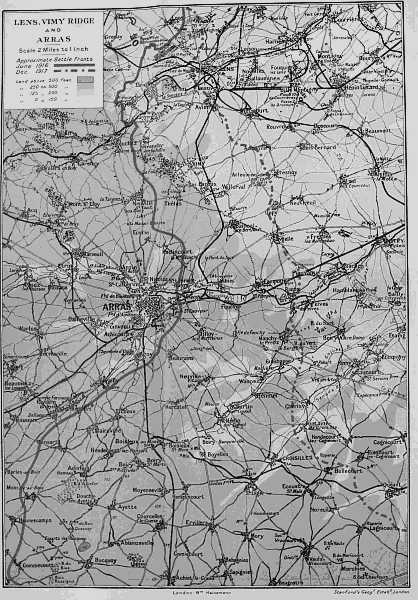
LENS, VIMY RIDGE AND ARRAS London: Wm. Heinemann Stanford's Geog^l. Estab^t., London
April 10
The enemy has lost already nearly 10,000 prisoners and more than half a hundred guns, and in dead and wounded his losses are great. He is in retreat south of the Vimy Ridge to defensive lines farther back, and as he goes our guns are smashing him along the roads. During the night the Canadians gained the last point, called Hill 145, on the Vimy Ridge, where the Germans held out in a pocket with machine-guns, and this morning the whole of that high ridge, which dominates the plains to Douai, is in our hands, so that there is removed from our path the high barrier for which the French and ourselves have fought through bloody years. Yesterday before daylight and afterwards I saw this ridge of Vimy all on fire with the light of great gun-fire. The enemy was there in strength, and his guns were answering ours with a heavy barrage of high explosives. This morning the scene was changed as by a miracle. Snow was falling, blown gustily across the battlefields, and powdering the capes and helmets of our men as they rode or marched forward to the front. But presently sunlight broke through the storm-clouds and flooded all the countryside by Neuville-St.-Vaast and Thélus and La Folie Farm, up to the crest of the ridge, where the Canadians and Highlanders of the 51st Division had just fought their way with such high valour. Our batteries were firing from many hiding-places, revealed by short, sharp flashes of light, but few answering shells came back, and the ridge itself, patched with snowdrift, was quiet as any hill of peace. It was astounding to think that not a single German stayed up there out of all these who had held it yesterday, unless some poor wounded devils still cower in the deep tunnels which pierce the hill-side. It was almost unbelievable to me, who have known the evil of this high ridge month after month and year after year, and the deadly menace which lurked about its lower slopes. Yet I saw proof below, where all Germans who had been there at dawn yesterday, thousands of them, were down in our lines, drawn up in battalions, marshalling themselves, grinning at the fate which had come to them and spared their lives.
The Canadian attack yesterday was astoundingly successful, and carried out by high-spirited men, the victors of Courcelette in the battles of the Somme, who had before the advance an utter and joyous confidence of victory. On their right were the Highland Brigades of the 51st Division who fought at Beaumont-Hamel, and who shared the honour of that day with the Canadians, taking as many prisoners and gaining a great part of the ridge. They went away at dawn, through the mud and rain which made scarecrows of them. They followed close and warily to the barrage of our guns, the most stupendous line of fire ever seen, and by 6.30 they had taken their first objectives, which included the whole front-line system of German trenches above Neuville-St.-Vaast, by La Folie Farm and La Folie Wood, and up by Thélus, where they met with fierce resistance. The German garrisons were for the most part in long, deep tunnels, pierced through the hill as assembly ditches. There were hundreds of them in Prinz Arnault Tunnel, and hundreds more in Great Volker Tunnel, but as the Canadians and Scots surged up to them with wave after wave of bayonets German soldiers streamed out and came running forward with hands up. They were eager to surrender, and their great desire was to get down from Vimy Ridge and the barrage of their own guns. That barrage fell heavily and fiercely upon the Turco Trench, but too late to do much damage to our men, who had already gone beyond it. The Canadian casualties on the morning of attack were not heavy in comparison with the expected losses, though, God knows, heavy enough, but the German prisoners were glad to pay for the gift of life by carrying our wounded back. The eagerness of these men was pitiful, and now and then grotesque. At least the Canadian escorts found good laughing matter in the enormous numbers of men they had to guard and in the way the prisoners themselves directed the latest comers to barbed-wire enclosures, and with deep satisfaction acted as masters of the ceremony to their own captivity. I have never seen such cheerful prisoners, although for the most part they were without overcoats and in a cold blizzard of snow. They were joking with each other, and in high good humour, because life with all its hardships was dear to them, and they had the luck of life. They were of all sizes and ages and types. I saw elderly, whiskered men with big spectacles, belonging to the professor tribe, and young lads who ought to have been in German high schools. Some of their faces looked very wizened and small beneath their great shrapnel helmets. Many of them looked ill and starved, but others were tall, stout, hefty fellows, who should have made good fighting men if they had any stomach for the job. There were many officers standing apart. Canadians took over two hundred of them, among whom were several forward observing officers, very bad tempered with their luck, because the men had not told them they were going to bolt and had left them in front positions. All officers were disconcerted because of the cheerfulness of the men at being taken. I talked with a few of them. They told me of the horrors of living under our bombardment. Some of them had been without food for four days, because our gun-fire had boxed them in.
"When do you think the war will end?" I asked one of them.
"When the English are in Berlin," he answered, and I think he meant that that would be a long time.
Another officer said, "In two months," and gave no reason for his certainty.
"What about America?" I asked one of them. He shrugged his shoulders, and said, "It is bad for us, very bad; but, after all, America can't send an army across the ocean."
At this statement Canadian soldiers standing around laughed loudly, and said, "Don't you believe it, old sport. We have come along to fight you, and the Yankees will do the same."
By three o'clock in the afternoon the Canadians and the Highland Brigades had gained the whole of the ridge except the high strong post on the left of Hill 145, captured during the night. Our gun-fire had helped them by breaking down all the wire, even round Heroes' Wood and Count's Wood, where it was very thick and strong. Thélus was wiped utterly off the map. This morning Canadian patrols pushed in a snow-storm through Farbus Wood, and established outposts on the railway embankment. Some of the bravest work was done by forward observing officers, who climbed to the top of Vimy Ridge as soon as it was captured, and through the heavy fire barrages reported back to the artillery all the movements seen by them in the country below.
In spite of the wild day, our flying men were riding the storm and signalling to the gunners who were rushing up their field-guns. "Our 60-pounders," said a Canadian Officer, "had the day of their lives." They found many targets. There were trains moving in Vimy village and they hit them. There were troops massing on sloping ground and they were shattered. There were guns and limber on the move, and men and horses were killed.
Above all the prisoners taken yesterday by the English, Scottish, and Canadian troops the enemy's losses were frightful, and the scenes behind his lines must have been hideous in slaughter and terror. On the right of Arras there was hard and costly fighting in Blangy and Tilloy and onwards to Feuchy. On this side the Germans fought most fiercely, and the Shropshires, Suffolks, Royal Fusiliers, and Welsh Fusiliers of the 3rd Division were held up near Feuchy Chapel and other strong points until our gun-fire knocked out these works and made way for them. Fifty-four guns were taken here on the east side of Arras, and to-day the pursuit of the beaten enemy continues.
II
LONDONERS THROUGH THE GERMAN LINES
The Londoners' attack at dawn was one of the splendid episodes of the battle. They went through the German lines in long waves, and streamed forward like a living tide, very quick and very far, taking a thousand prisoners on their way through Neuville-Vitasse and Mercatel. Later in the day they were held up in their right flank by enfilade fire, as the troops on their right were in difficulties against uncut wire and machine-guns, and from that time onwards the London men of the 56th Division had perilous hours and hard, costly fighting. They were forced to extend beyond their line on the left to join up the gap between themselves and the troops to their north, and to work down with bombing parties on the right to gain ground in which the Germans were holding out desperately and inflicting many casualties on our men. In the centre the 56th Division was ordered to attack fortified villages from which machine-gun bullets swept the ground and where our assault was checked by stout belts of wire with unbroken strands. It was in those hours on April 9 and 10 that many young London men showed the highest qualities of spirit, risking death, and worse than death, with most desperate gallantry.
A young subaltern of the Middlesex Regiment saw those wire traps in the centre of Neuville-Vitasse, and led the way to them with a party of bombers and Lewis-gunners, smashed them up, and jumped on the machine-guns beyond. It opened the gate to all the other Londoners—Kensingtons, Rangers, and London Scottish—who swept through this village and beyond. Many officers fell, but there was always some one to take command and lead the men—a sergeant with a cool head, a second lieutenant with a flame in his eyes.
It was a boy of nineteen who took command of one company of the Middlesex Regiment when he was the only one to lead. He had never been under fire before, and had never seen all this blood and horror. He was a slip of a fellow, who had been spelling out fairy-tales ten years ago, which is not far back in history. Now, he led a company of fighting men, who followed him as a great captain all through that day's battle, and from one German line to another, and from one village to another, until all the ground had been gained according to the first plan. This gallant boy was afterwards reported missing, and his comrades believe that he was killed.
It was a battle of second lieutenants of London, owing to the heavy casualties of commanding officers. One of them was wounded in the head early in the day, but led his men until hours later he fell and fainted. Another young officer went out with three men in the darkness, when the infantry was held up by serious obstacles, and under heavy fire brought back information which saved many lives and enabled the whole line to advance.
There was a second lieutenant of the London Rangers who behaved with a quick decision and daring which seemed inspired by something more than sound judgment. The enemy was holding out in a trench and sweeping men down with that death-rattle of bullets which is the worst thing in all this fighting. In front of them was uncut wire, which is always a trap for men. Our London lieutenant did not go straight ahead. He flung his platoon round to the flank, smashed through the wire here, and sprang at the German gun-team with a revolver in one hand and a bomb in the other. The whole team was destroyed except one man, who fell wounded, and above those dead bodies the second lieutenant waved his revolver to his men and said, "Let's get on."
The London men went on for nine days, which is like ninety years on such a battlefield. They went on until they were checked and held by the enemy, who had time to rush up strong reserves and bring up new weight of guns. But they smashed through the Cojeul Switch and broke the Hindenburg line at Héninel.
Shell-fire increased hour by hour. From many hidden places machine-guns poured bullets across the ground. German snipers lay out in shell-holes picking off our men. This sniping was intolerable, and a second lieutenant and sergeant crawled out into No Man's Land to deal with it. They dragged three snipers out of one hole, and searched others and helped to check this hidden fire. One London rifleman went forward to kill a machine-gun with its hideous tat-tat-tat. It was a bolder thing than St. George's attack on the dragon, which was a harmless beast compared with this spitfire devil. The rifleman armed himself with a Lewis gun, carried at his hip, and fired so coolly that he scattered the German team and captured the gun.
All through those nine days, and afterwards in a second spell worse than those, the London men lived under great fire, those that had the luck to live, and though their nerves were all frayed with the strain of it, and they suffered great agonies and great losses, they never lost courage and kept their pride—London Pride.
One medical officer's orderly never tired of searching for stricken men, and seemed to have some magic about him, with shells bursting everywhere round about his steps and bullets spitting on each side of him. He organized stretcher-bearer parties, gave some of his own magic to them, and saved many lives. A captain of the R.A.M.C. went out under heavy fire and dressed the wounds of men lying there in agony and brought them back alive. A London private remained out looking after the wounded in an exposed place, and in his spare time saved other men attacked by small parties of Germans, by killing nine of them and taking one man prisoner. Another second lieutenant, one of those boys who have poured out the blood of youth upon these battlefields, took two Vickers guns with their teams through two barrages—only those who have seen a barrage can know the meaning of that—and by great skill and cunning brought his men through without a single casualty, so that the infantry followed with high hearts.
Out of a burning billet and out of an exploding ammunition dump, a transport driver brought out some charges urgently needed for the battle. A man who entered a cage of tigers to draw their teeth would not want greater nerve than this.
When the blinds were drawn across the windows of many little London houses, when dusk crept into Piccadilly Circus and shadows darkened down the Strand, when the great old soul of London slept a while in the night, these boys who had gone out from her streets were fighting, and are fighting still, in the greatest battle of the world, and as they lie awake in a ditch, or wounded in a shell-hole, their spirit travels home again, through the old swirl of traffic, to quiet houses where already, perhaps, there is the scent of may-blossom.
III
THE STRUGGLE ROUND MONCHY
April 11
This morning our men advanced upon the villages of Monchy-le-Preux and La Bergère, on each side of the Cambrai road, beyond the ruins of Tilloy-les-Mofflaines, and occupied them after heavy fighting. British cavalry were first into Monchy, riding through a storm of shrapnel, and heavily bombarded in the village so that many of their horses were killed and many men wounded.
I saw the whole picture of this fighting to-day, and all the spirit and drama of it. It was a wonderful scene, not without terror, and our men passed through it alert and watchful to the menace about them. Going out beyond Arras through suburbs which were in German hands until Monday last— they had scribbled their names and regiments on broken walls of strafed houses, and men of English battalions who captured them had scrawled their own names above these other signatures—I came to the German barbed wire which had protected the enemy's lines, and then into three systems of trenches which had been the objectives of our men on the morning when the battle of Arras began. Here was Hangest Trench, in which the enemy had made his chief resistance, and Holt Redoubt and Horn Redoubt, where his machine-guns had checked us, and a high point on the road to Tilloy, to which a Tank had crawled after a lone journey out of Arras to sweep this place with machine-gun fire, so that our men could get on to the village. It is no wonder that the Germans lost this ground, and that those who remained alive in their dug-outs surrendered quickly, as soon as our men were about them. The effect of our bombardment was ghastly. It had ploughed all this country with great shell-craters, torn fields of barbed wire to a few tattered strands, and smashed in all the trenches to shapeless ditches.
Tilloy still had parts of houses standing, bits of white wall having no relation to the wild rubbish-heaps around. The Germans had torn up the rails to make barricades, and had used farm carts, ploughs, and brick-heaps as cover. But they could have given no protection when the sky rained fire and thunderbolts. Dead bodies lay about in every shape and shapelessness of death. I passed into Devil's Wood—well named, because here there had been hellish torture of men—and so on to Observatory Ridge and ground from which, not far away, I looked into Monchy and across the battlefields where our men were fighting then. The enemy was firing heavy shells. They fell thick about Monchy village and on the other side of the Cambrai road, roaring horribly as they came and flinging up volumes of black earth and mud. The enemy's gunners were scattering other shells about, but in an aimless way, so that they found no real target, though they were frightening, especially when some of these crumps spattered one with mud.
Flights of British aeroplanes were on the wing, and German aeroplanes tried to fight their way over our lines. I saw several with the swish of machine-gun bullets and the high whining shells of British "Archies" about them. I have never before seen so great a conflict in the skies. It was a battle up there, and as far as I could see we gained a mastery over the enemy's machines, though some of them were very bold.
On the earth it was open warfare of the old kind, for we were beyond the trenches and our men were moving across the fields without cover. Some of our machine-gunners were serving their weapons from shell-holes, and the only protection of the headquarters staff of the cavalry was a shallow ditch in the centre of the battlefield sheltered by a few planks, quite useless against shell-fire, but keeping off the snow, which fell in heavy wet flakes. There the officers sat in the ditch, shoulder to shoulder, studying their maps and directing the action while reports were called down the funnel of a chimney by an officer who had been out on reconnaissance.
"It is villainously unhealthy round here," said this officer, who spoke to me after he had given his news to the cavalry general. He looked across to Monchy, and said, "Old Fritz is putting up a stiff fight." At that moment a German crump fell close, and we did not continue the conversation.
Across the battlefield came stretcher-bearers, carrying the wounded shoulder high, and the lightly wounded men walked back from Monchy and Guémappe very slowly, with that dragging gait which is bad to see. I spoke to a wounded officer and asked him how things were going.
"Pretty hot," he said, and then shivered and said, "but now I feel cold as ice."
Snow fell all through the afternoon, covering the litter of battle and the bodies of all our dead boys, giving a white beauty even to the ugly ruins of Tilloy and changing the Devil's Wood by enchantment to a kind of dream-picture. Through this driving snow our guns fired ceaselessly, and I saw all their flashes through the storm, and their din was enormous. Away in front of me stretched the road to Cambrai, the high road of our advance. It seemed so easy to walk down there—but if I had gone farther I should not have come back.
In a hundred years not all the details of this battle will be told, for to each man in all the thousands who are fighting there is a great adventure, and they are filled with sensations stronger than drink can give, so that it will seem a wild dream—a dream red as flame and white as snow.
For this amazing battle, which is bringing to us tides of prisoners and many batteries of guns, is being fought on spring days heavy with snow, as grim as sternest winter except when in odd half-hours the sun breaks through the storm-clouds and gives a magic beauty to all this whiteness of the battlefields and to trees furred with bars of ermine and to all the lacework of twigs ready for green birth. Now as I write there is no sun, but a darkness through which heavy flakes are falling. Our soldiers are fighting through it to the east of Arras, and their steel helmets and tunics and leather jerkins are all white as the country through which they are forcing back the enemy.
While the battle was raging on the Vimy heights English and Scottish troops of the 15th, 12th, and 3rd Divisions were fighting equally fiercely, with more trouble to meet round about Arras. Beyond the facts I have already written there are others that must be recorded quickly, before quick history runs away from them.
Some day a man must give a great picture of the night in Arras before the battle, and I know one man who could do so—a great hunter of wild beasts, with a monocle that quells the human soul and a very "parfit gentil knight," whose pen is as pointed as his lance. He spent the night in a tunnel of Arras before getting into a sap in No Man's Land before the dawn, where he was with a "movie man," an official photographer (both as gallant as you will find in the Army), and a machine-gunner ready for action. Thousands of other men spent the night before the battle in the great tunnels, centuries old, that run out of Arras to the country beyond, by Blangy and St.-Sauveur. The enemy poured shells into the city, which I watched that night before the dawn from the ramparts outside, but in the morning they came up from those subterranean galleries and for a little while no more shells fell in Arras, for the German gunners were busy with other work, and were in haste to get away. The fighting was very fierce round Blangy, the suburb of Arras, where the enemy was in the broken ruins of the houses and behind garden walls strongly barricaded with piled sand-bags. But our men smashed their way through and on. Troops of those old English regiments were checked a while at strong German works known as the Horn, Holt, Hamel, and Hangest positions, and at another strong point called the Church Work. It was at these places that the Tanks did well on a day when they had hard going because of slime and mud, and after a journey of over three miles from their starting-point knocked out the German machine-guns, and so let the infantry get on. Higher north at a point known as Railway Triangle, east-south-east of Arras, where railway lines join, Gordons, Argylls, Seaforths, and Camerons of the 15th Division were held back by machine-gun fire. The enemy's works had not been destroyed by our bombardment, and our barrage had swept ahead of the troops. News of the trouble was sent back, and presently back crept the barrage of our shell-fire, coming perilously close to the Scottish troops, but not too close. With marvellous accuracy the gunners found the target of the Triangle and swept it with shell-fire so that its defences were destroyed. The Scots surged forward, over the chaos of broken timber and barricades, and struggled forward again to their goal, which brought them to Feuchy Well, and to-day much farther. A Tank helped them at Feuchy Chapel, cheered by the Scots as it came into action scorning machine-gun bullets. The Harp was another strong point of the enemy's which caused difficulty to King's Own Liverpools, the Shropshire Light Infantry, Royal Fusiliers, East Yorks, Scottish Fusiliers, and Royal Scots, as I have already told, on the first day of battle, and another Tank came up, in its queer, slow way, and the gallant men inside served their guns like a Dreadnought, and so ended the business on that oval-shaped stronghold.
So English and Scottish troops pressed on and gathered up thousands of prisoners. "So tame," said one of our men, "that they ate out of our hands." So ready to surrender that a brigadier and his staff who were captured with them were angry and ashamed of men taken in great numbers without a single wounded man among them. Fifty-four guns were captured on this eastern side of Arras, and six were howitzers, and two of these big beasts were taken by cavalry working with the troops. Some of the gunners had never left their pits after our bombardment became intense four days before, and were suffering from hunger and thirst. Trench-mortars and machine-guns lay everywhere about, in scores, smashed, buried, flung about by the ferocity of our shell-fire. German officers wearing Iron Crosses wept when they surrendered. It was their day of unbelievable tragedy. A queer thing happened to some German transport men. They were sent out from Douai to Fampoux. They did not know they were going into the battle zone. They drove along until suddenly they saw British soldiers swarming about them. Six hours after their start from Douai they were eating bully-beef on our side of the lines, and while they munched could not believe their own senses. Our troops treated them with the greatest good humour, throwing chocolates and cigarettes into their enclosures and crowding round to speak to men who knew the English tongue. There seemed no kind of hatred between these men. There was none after the battle had been fought, for in our British way we cannot harbour hate for beaten enemies when the individuals are there, broken and in our hands. Yet a little farther away the fighting was fierce, and there was no mercy on either side.
April 12
In spite of the enemy's hard resistance and the abominable weather conditions which cause our troops great hardships, we are making steady progress towards the German defensive positions along the Hindenburg line.
North of Vimy Ridge this morning his lines were pierced by a new attack, delivered with great force above Givenchy; and south of the village of Wancourt, below Monchy-le-Preux, we have seized an important little hill-top.
Monchy itself is securely in our hands this morning, after repeated counter-attacks yesterday and last night. In my last dispatch I described in the briefest way how I went up towards Monchy yesterday across the crowded battlefield and looked into that village, where fierce fighting was in progress. Then the village was still standing, hardly in ruins, so that I saw roofs still on the houses and unbroken walls, and the white château only a little scarred by shell-fire. Now it has been almost destroyed by the enemy's guns, and our men held it only by the most resolute courage. It is a small place that village, but yesterday, perched high beyond Orange Hill, it was the storm-centre of all this world-conflict, and the battle of Arras paused till it was taken. The story of the fight for it should live in history, and is full of strange and tragic drama.
Our cavalry—the 10th Hussars, the Essex Yeomanry, and the Blues—helped in the capture of this high village, behaving with the greatest acts of sacrifice to the ideals of duty. I saw them going up over Observation Ridge, and before they reached that point; the dash of splendid bodies of men riding at the gallop in a snow-storm which had covered them with white mantles and crowned their steel hats. Afterwards I saw some of these men being carried back wounded over the battlefield, and the dead body of their general, on a stretcher, taken by a small party of troopers through the ruins of another village to his resting-place. Many gallant horses lay dead, and those which came back were caked with mud, and walked with drooping heads, exhausted in every limb. The bodies of dead boys lay all over these fields.
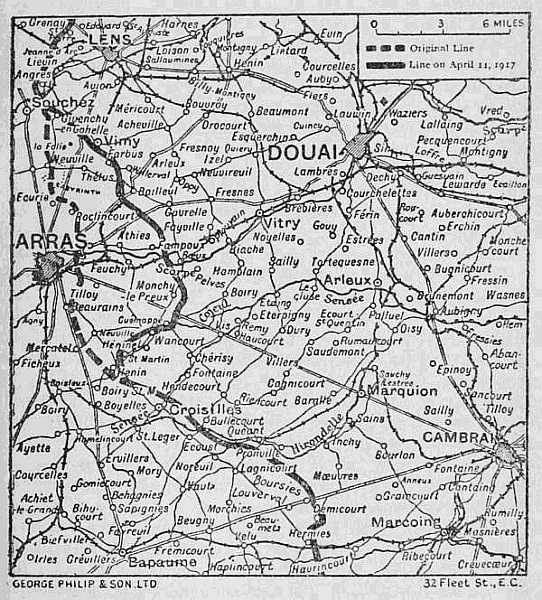
Map of the Arras front GEORGE PHILIP & SON LTD 32 Fleet St., E.C.
But the cavalry rode into Monchy and captured the north side of the village, and the enemy fled from them. It is an astounding thing that two withered old Frenchwomen stayed in this village all through this fighting. When our troopers rode in these women came running forward, frightened and crying "Camarades," as though in face of the enemy. When our men surrounded them they were full of joy, and held up their withered old faces to be kissed by the troopers, who leaned over their saddles to give this greeting. Yet the battle was not over, and the shell-fire was most intense afterwards.
The women told strange stories of German officers billeted in their houses. After the battle of Arras began on Monday these officers were very nervous; but, although the sound of gun-fire swept nearer they did not believe that the English troops would get near Monchy for some days. Late on Wednesday night, after preparing for the defence of the village, they went to bed as usual, looking exhausted and nerve-racked, and told the women to wake them at six o'clock. They were awakened by another kind of knocking at the door. English and Scottish soldiers were firing outside the village, and the German officers escaped in such a hurry that they had no time to pull down the battalion flag outside their gate, and our men captured it as a trophy.
The attack on Monchy was made by English and Scottish troops—the Scots of the 15th Division—who fought very fiercely to clear the enemy out of Railway Triangle, where they were held up for three hours. Afterwards they fought on to Feuchy Redoubt, where they found that the whole of the German garrison had been buried by our bombardment, so that none escaped alive. At Feuchy Weir they captured a German electrical company, a captain and thirteen men, who were unarmed. The enemy shelled Feuchy village after our troops had passed through and gone far forward, where they dug in for the night under heavy shelling. Here they stayed all day on Tuesday close by a deep square pit, where four eight-inch howitzers had been abandoned to our cavalry.
Meanwhile English troops of the 37th Division—Warwicks and Bedfords, East and West Lancashire battalions, and the Yorks and Lanes—were advancing on the right and linking up for the attack on Monchy in conjunction with the Jocks. On the left bodies of cavalry assembled for a combined attack with Hotchkiss and machine guns; and at about five o'clock yesterday morning they swept upon the village. The cavalry went full split at a hard pace under heavy shrapnel-fire, and streamed into the village on the north side. They saw few Germans, for as they went in the enemy retreated to the southern side, hoping to escape by that way. Here they found themselves cut off by our infantry, the English battalions mixed up with Scots before the fight was over. It was hard fighting. The enemy had many machine-guns, and defended himself from windows and roofs of houses, firing down upon our men as they swarmed into the village streets, and fought their way into farmyards and courtyards. It was a house-to-house hunt, and about two hundred prisoners were taken, though some of the garrison escaped to the trench in the valley below, where they had machine-gun redoubts. At about eight o'clock yesterday morning, twenty Scots and a small party of English went forward from Monchy with a Tank which had crawled up over heavy ground and shell-craters, and now trained its guns upon bodies of Germans moving over the ridge beyond. By this time English troops had a number of machine-guns in position for the defence of the village against any counter-attacks that might come. Some of our men had already explored the dug-outs and found them splendid for shelter under shell-fire. Under the château was a subterranean system furnished luxuriously and provided with electric light. Half an hour after the capture of the village some English and Scottish officers were drinking German beer out of German mugs.
The peace of Monchy did not last long. At nine o'clock the enemy shelled the place fiercely, and for a long time, with 5·9 guns, as I saw myself at midday from Observation Ridge, which was also under fire.
German airmen, flying above, watched our cavalry and infantry, and directed fire upon them. They were terrible hours to endure, but our men held out nobly; and when the enemy made his counter-attacks in the afternoon and evening, advancing in waves with a most determined spirit, they were hosed with machine-gun bullets and fell like grass before the scythe. Our 18-pounders also poured shell into them. This morning our men are in advance of the village, and the enemy has retreated from the trench below. The night was dreadful for men and beasts. Snow fell heavily, and was blown into deep drifts by wind as cold as ice. Wounded horses fell and died, and men lay in a white bed of snow in an agony of cold, while shells burst round them. As gallant as the fighting men were the supply columns, who sent up carriers through blizzard and shell-fire. At four o'clock in the morning a rum ration was served out, "And thank God for it," said one of our officers lying out there in a shell-hole with a shattered arm. Strange and ironical as it seems, the post came up also at this hour, and men in the middle of the battlefield, suffering the worst agonies of war, had letters from home which in darkness they could not read.
That scene of war this morning might have been in Russia in midwinter, instead of in France in spring-time. Snow was thick over the fields, four foot deep where it had drifted against the banks. Tents and huts behind the lines were covered with snow roofs, and as I went through Arras this poor, stricken city was all white. Stones and fallen masonry which have poured down from great buildings of mediæval times were overlaid with snow—until, by midday, it was all turned to water. Then our Army moved through rivers of mud, and all our splendid horses were pitiful to see.
IV
THE OTHER SIDE OF VIMY
April 13
The enemy's Headquarters Staff is clearly troubled by the successes gained by our troops during these first days of the battle of Arras, and all attempts to repair the damage to his defensive positions upon which his future safety depends have been feeble and irresolute. It is certain that he desired to make a heavy counter-attack upon the northern edge of the Vimy Ridge. Prisoners taken yesterday all believed that this would be done without delay. The 5th Grenadiers of the Prussian Guards Reserve were hurriedly brought up to relieve or support the Bavarian troops, who had suffered frightfully, and massed in a wood, called the Bois d'Hirondelle, or Swallows' Wood, in order to steal through another little wood called Bois-en-Hache to a hill known by us as the Pimple, and so on to recapture Hill 145, taken by the Canadians on Monday night after heavy and costly fighting. This scheme broke down utterly. Swallows' Wood was heavily bombed by our aeroplanes, so that the massed Prussians had an ugly time there, and yesterday morning Canadian troops made a sudden assault upon the Pimple, which is a knoll slightly lower than Hill 145, to its right, and gained it in spite of fierce machine-gun fire from the garrison, who defended themselves stubbornly until they were killed or captured. At the same time Bois-en-Hache, which stands on rising ground across the little valley of the River Souchez, was attacked with great courage by the 24th Division, and the enemy driven out.
It was difficult work for our infantry and gunners. The ground was a bog of shell-craters and mud, and there was a blizzard of snowflakes. The attack was made with a kind of instinct, backed with luck. Our men stumbled forward in a wake of snow-squalls and shells, fell into shell-holes, climbed out again, and by some skill of their own kept their bombs and rifles dry. Machine-gun bullets whipped the ground about them. Some fell and were buried in snow-drifts; others went on and reached their goal, and in a white blizzard routed out the enemy and his machine-guns. It was an hour or two later that German officers, directing operations at a distance and preparing a counter-attack on the Vimy Ridge, heard that the Pimple and Bois-en-Hache had both gone—the only places which gave observation on the south side of Vimy and made effective any attack. Their curses must have been deep and full when that message came over the telephone wires. They ordered their batteries to fire continuously on those two places, but they remain ours, and our troops have endured intense barrage-fire without losing ground. Now we have full and absolute observation over Vimy Ridge to the enemy's side of the country reversing all the past history of this position, and we are making full and deadly use of it. The enemy still clings to Vimy village on the other side of the slopes, and to the line of railway on the eastern side of Farbus, but it is an insecure tenure, and our guns are making life hideous for the German soldiers in those places, and in the villages farther back in the direction of Douai, and along the road which he is using for his transport. In the village of Bailleul down there are a number of batteries which the enemy has vainly endeavoured to withdraw. We are smothering them with shell-fire, and he will find it difficult to get them away, though he can ill afford the loss of more guns. The enemy has been in great trouble to move his guns away rapidly enough owing to the dearth of transport horses. Even before the battle of Arras began the German batteries had to borrow horses from each other because there were not enough for all, and some of his guns have been abandoned because of that lack. He cannot claim that he has left us only broken and useless guns.
When the Scottish and South African troops of the 9th Division made the great attack on Monday last the South-Africans were led forward by their colonels, and took the first German line without a single casualty. Afterwards they fought against wicked machine-gun fire, but, sweeping all before them, and gathering in hundreds of prisoners, they seized a number of guns, including several 5·9 howitzers. A vast amount of ammunition lay about in dumps, and our men turned the guns about, and are using them against the enemy. To South-Africans who fought in Delville Wood—I have told the story of this tragic epic in the battle of the Somme—this is a triumph that pays back a little for old memories under German gun-fire. Their revenge is sweet and frightful, and they call the captured guns, those monstrous five-point-nines, their trench-mortar battery.
During this fighting our airmen have flown with extraordinary valour, and have done great work. They flew in snow-storms, as I saw them and marvelled, on the east side of Arras, and circled round for hours taking photographs of the enemy's positions and spotting his batteries so accurately, in spite of weather which half blinded them, that the German gunners who are now our prisoners say that they were terrorized by being made targets for our fire.
Farther south yesterday and to-day we have made new breaches in the Hindenburg line by the capture of Wancourt and Héninel, villages south of Monchy. The fighting here has been most severe, and our men of the 14th and 56th Divisions—London Rangers, Kensingtons, Middlesex, London Scottish, and King's Royal Rifles—lying out on open slopes in deep snow and under icy gales at night, swept by machine-gun barrages from Guémappe and with the sky above them flashing with shrapnel bursts and high explosives, have had to endure a terrible ordeal. They have done so with a noble spirit, and young wounded men to whom I spoke yesterday, in the great crypt to which they had crawled down from the battlefield, all spoke of their experience as though they would go through as much again in order to ensure success, without bragging, with a full sense of the frightful hours, but with unbroken spirit.
"I am not out here to make a career," said a Canadian; "I am out to finish an ugly job."
It is to end this filthy war quickly that our men are fighting so grimly and with such deadly resolution. So the Londoners have fought their way into Wancourt and Héninel, and there were great uncut belts of wire before them—the new wire of the Hindenburg line—and trenches and strong points from which machine-guns gushed out waves of bullets. One of the strong points hereabouts is called the Egg, because of its oval hummock, which was hard to hatch and crack, but as one of our officers said to-day, the Egg gave forth two hundred prisoners.
In the fighting for the two villages the Londoners were held up by those great stretches of wire before them and were menaced most evilly by the enfilade fire of machine-guns from Guémappe and a high point south. Two Tanks came to the rescue, and did most daring things.
"Romped up," said an officer, though I have not seen Tanks romping.
Anyhow, they came up in their elephantine way, getting the most out of their engines and most skilfully guided by their young officers and crews, who were out on a great and perilous adventure. Climbing over rough ground, cleaving through snow-drifts and mud-banks with their steel flanks, thrusting their blunt noses above old trenches and sand-bag barricades, they made straight for the great hedges of barbed wire, and drove straight through, leaving broad lanes of broken strands. One cruised into Wancourt, followed from a distance by the shouts and cheers of the infantry. It wandered up and down the village like a bear on the prowl for something good to eat. It found human food and trampled upon machine-gun redoubts, firing into German hiding-places. The second Tank struck a zigzag course for Héninel, and in that village swept down numbers of German soldiers, so that they fled from this black monster against which bombs and rifles were of no avail. For forty hours those two Tanks—let me be fair to the men inside and say those officers and crews—did not rest, but went about on their hunting trail, breaking down wire and searching out German strong points, so that the way would be easier for our infantry.
Even then our men had no easy fighting. The enemy defended themselves stubbornly in places. Their snipers and bombers and machine-gunners did not yield at the first sight of the bayonets. While some of our troops bombed their way down trenches towards Wancourt, others worked up from the south, and at last both parties met exultantly behind this section of the Hindenburg line, greeting each other with cheers. Nearly two hundred prisoners were taken hereabout, all Silesian mechanics, like those I met at Loos in September 1915—rather miserable men, with no heart in the war, because, as Poles, it is none of their making.
It is true to say—utterly true—that all the prisoners we have taken this week, Prussians, Bavarians, Hamburgers, have lost all spirit for this fighting, hate it, loathe it as a devilish fate from which they have luckily escaped at last with life. Not one prisoner has said now that Germany will win on land. Their best hope is that the submarine campaign will force an early settlement. Their pockets are stuffed with letters from wives, sisters, and parents telling of starvation at home. It is not good literature for the spirit of an army. The prisoners themselves come to us starving. It is not because their rations in the trenches are insufficient. They are on short commons, but have enough for bodily strength. It is because our bombardment prevented all supplies from reaching them for three or four days. In one prisoners' enclosure, when our escort brought food, the men fought with each other like wild beasts, ravenous, and had to be separated by force and threats. The officers in charge of these prisoners' camps are overwhelmed by the masses of men. In one of them, where 4000 were gathered, they broke the barriers. A captain and subaltern of ours were alone to deal with this situation; but their own non-commissioned officers helped to restore order.
The position of the enemy now is full of uncertainty for him. It is possible that he will try to avoid any disaster by falling back farther to the Drocourt-Quéant line, and by slipping away farther north. The Hindenburg line is pierced, but he has established a series of switch-lines which will enable him to stand until our guns are ready again to make those positions untenable. The weather so far is in his favour, except that his troops are suffering as much as ours from cold and wet.
V
THE WAY TO LENS
April 14
The capture of the Vimy Ridge by heroic assault of the Canadians and Scots, and their endurance in holding it under the enemy's heavy fire, have been followed swiftly by good results. Our troops have pushed forward to-day through Liévin, the long and straggling suburb of Lens, clearing street after street of German machine-gunners and rear-guard posts, and our patrols are on the outskirts of Lens itself, the great mining town, which is famous in France as the capital and centre of her northern mine-fields.
The retaking of this city of mine-shafts and pit-heads, electrical power stations, and great hive of mining activity, where a population of something like 40,000 people lived in rows of red-brick cottages, under a forest of high chimneys and mountainous slag-heaps, would cause a thrill through all France, and be one of the greatest achievements of the war—a tremendous feat of arms for the British troops. I looked into the city to-day, down its silent and deserted streets, and I saw a body of our men working forward to get closer to it. They attacked the little wooded hill called the Bois de Riaumont, just to the south of the city, and with great cunning and courage encircled its lower slopes, and made their way into the street of houses behind the line of trees which is the southern way towards Lens. From the western side, up through Liévin, the other troops were advancing cautiously. The enemy was still there in machine-gun redoubts, which will be very troublesome to our men. But they are only rear-guards, for the main body of the enemy has already retreated. When the Canadians swept over the Vimy Ridge, capturing thousands of prisoners, and when yesterday our 24th Division and Canadian troops seized the Bois-en-Hache and the Pimple, two small ridges or knolls below Hill 145, at the northern end of the Vimy Ridge, the enemy saw that his last chance of successful counter-attack was foiled, and at once he was seized with fear and prepared for instant retreat in wild confusion. Lens and Liévin had been stacked with his guns. Both towns had been fortified in a most formidable way, and were strongholds of massed artillery. It is certain that the enemy had at least 150 guns in that great network of mines and pit-heads. But they were all threatened by an advance down the northern slopes of Vimy, and the Canadians were not likely to stay inactive after their great triumph. They were also threatened by the British advance from the Loos battlefields by way of that great pair of black slag-hills called the Double Crassier, famous in this war for close, long, and bloody fighting, where since September of 1915 our men have been only a few yards away from their enemy, and where I saw them last a month or two ago through a chink of wall in a ruined house. German staff officers knew their peril yesterday, and before. From prisoners we know that wild scenes took place in Lens, frantic efforts being made to get away the guns and the stores, to defend the line of retreat by the blowing up of roads, to carry out the orders for complete destruction by firing charges down the mine-shafts, flooding the great mine-galleries so that French property of enormous value should not be left to France, and withdrawing large bodies of troops down the roads under the fire of our long-range guns. Up to dawn yesterday the enemy in Lens hoped that the British pursuit would be held back by the German rear-guards in Vimy and Petit-Vimy villages. But that hope was flung from them when the Canadians swept down the ridge and chased the enemy out of those places on the lower slopes towards Douai.
To-day, as I went towards Lens over Notre-Dame-de-Lorette and the valley beyond, I met a number of those men coming back after their victorious fighting. Amongst them were Nova-Scotians and young lumbermen and fishermen from the Far West. They came in single file, in a long procession through a wood—the Bois de Bouvigny—where once, two years ago, young Frenchmen fought with heroic fury and died in thousands to gain this ground, so that even now all this hill is strewn with their relics.
The boys of Nova Scotia came slowly, dragging one foot after another in sheer exhaustion, stumbling over loose stones and bits of sand-bags and strands of old wire. They were caked with clay from head to foot. Even their faces had masks of clay, and they were spent and done. But through that whitish mud their eyes were steel-blue and struck fire like steel when they told me of the good victory they had shared in, and of the enemy's flight before them—all this without a touch of brag, with a fine and sweet simplicity, with a manly frankness. They have suffered tragic hardships in those five days since the battle of Arras began, but there was no wail in them. When they first emerged from the tunnels on the morning of the great attack they had been swept by machine-gun fire, but by good luck escaped heavy casualties, though many fell.
"Our losses were not nearly so high as we expected," said one lad, "but it was pretty bad all the same. Old Heine had an ugly habit of keeping one hand on his machine-gun till we were fifty paces from him, and then holding up the other hand and shouting 'Mercy! Mercy!' I don't call that a good way of surrendering."
The enemy surrendered in hundreds on that day, as I have already described, and the worst came afterwards for the Canadians. The enemy's barrage was heavy, but even that was not the worst. It was difficult to get food up, more difficult to get water. I met lads who had been without a drop for three days. One of them, a fine, hefty fellow, strong as a sapling, could hardly speak to me above a whisper. All of them had swollen tongues and licked their dry lips in a parched way. Some of them had been lucky enough to find French wine in the German dug-outs. Then a wild snow-storm came. "I thought I should die," said one man, "when for hours I had to carry wounded through the snow over ground knee-deep in mud and all slippery. All my wounded were terribly heavy."
But, in spite of all this, those brave, weary men went down the Vimy slopes at dawn yesterday with the same high, grim spirit to clear "Old Heine," as they call him, out of Vimy and Little Vimy villages.
"They didn't wait for us," said a young Canadian officer. "One would think that the war would be over in a month by the way they ran yesterday."
"Old Heine was scared out of his wits," said another lad. "He ran screaming from us. In a dug-out I found two Germans too scared even to run. They just sat and trembled like poor, cowed beasts. But there was one fellow we took who got over his fright quick, and spoke in a big way. He had been a waiter and spoke good English.
"'When will the war end?' we asked.
"'Germany will fight five years,' he said, 'and then we will win.
"'Don't you believe it, old sport,' said we, 'you're done in now, and it's only the mopping up we have to do.'"
Down in the Bois-en-Hache one of our English soldiers of the 24th Division on the Canadians' left had a grim adventure, which he describes as "a bit of orl rite." His way was barred by a burly German, but not for long. After a tussle our lad took him inside, and there found the dead body of a German officer lying by the side of the table, which was all spread for breakfast. It was our English lad who ate the breakfast, keeping one eye vigilant on his living prisoner and not worrying about the dead one.
There was another soldier of ours, one of the Leinsters, also of the 24th Division, who ate his breakfast in Angres, but he was in jovial company. He came across a German at the entrance and fought with him, but in a friendly kind of way. After knocking each other about they came to an understanding, and sat down together in a dug-out to a meal of German sausage, cheese, black bread, and French wine. They found a great deal of human nature in common, and were seen coming out later arm in arm, and in this way the Irishman brought back his prisoner.
The colonel of the Leinsters told another queer tale of an Irishman in the outskirts of Lens. The colonel saw him after the battle of Bois-en-Hache, which was a terrible affair and a fine feat of arms in the mud and snow, bringing back a German horse under machine-gun fire and shrapnel. He was guiding this poor lean beast over frightful ground, round the edge of monstrous shell-craters, through broken strands of barbed wire, and across trenches and parapets. "What are you doing with that poor brute?" asked the commanding officer. "Sure, sir," said the Irishman, "I'm bringing the horse back for Father Malone to ride." The horse was in the last stages of starvation, and the padre weighs nineteen stone, according to the popular estimate of the men, who adore him, and that is part of the story's humour, though the Irish soldier was very serious. It is a tribute, anyhow, to the affection of the men for this Irish padre-a laughing giant of a man—who is always out in No Man's Land when there are any of his lads out there, going as far as the German barbed wire to give the last rites to dying men. To-day, when I called on the Leinster battalion, he was away burying the poor boys who lie in the mud of the battlefield. There is no humour in that side of war, though Irish soldiers, and English soldiers too, refuse to be beaten by the foulest conditions until the last strength is out of them. In addition to the ordeal of battle they are enduring now a weather so abominable, when it is in the fields of battle, that men fight for days wet to the skin, lie out at night frozen stiff, and struggle after the enemy up to the knees in mud. So it was in this little battle of Bois-en-Hache, an historic episode in the battle of Arras, because it broke the enemy's last hope of a counter-attack against Vimy Ridge. Through the blinding blizzard of snow, the English and Irish troops attacked this hill above the River Souchez, and had to cross through a quagmire, so that numbers of them stuck up to the waist and could go neither forward nor backward, while they were swept by machine-gun and rifle fire. From that other hill, called the Pimple, to their right, which was not yet taken by the Canadians, one man came back wounded over that abominable ground under rifle-fire which spat bullets about him. He stumbled into shell-holes and crawled out again, and just as he reached the trench, fell dead across the parapet. Nearly all our men were hit in the head and body, none in the legs. That was because they were knee-deep in mud. Our men came back from this fighting like figures of clay, and so stiff at the joints that they can hardly walk, and with voices gone so that they speak in whispers.
All over this lower slope of the Vimy Ridge is a litter of enormous destruction caused by our gun-fire. German guns and limbers, machine-guns and trench-mortars lie in fragments and in heaps in infernal chaos of earth, which is the graveyard of many German dead. The first hint that the Germans were in retreat from Liévin, near Lens, was given by the strange adventure of two of our airmen. They had to make a forced landing near Lens, and one of them was wounded in the leg. Our observing officers watching through glasses expected them to be made prisoners, but they were seen afterwards smoking cigarettes and slapping themselves to keep warm. It now turns out that the German soldiers did not wait to take them, and finding one man wounded left the other to look after him. The next sign that the enemy was about to go was when the fires and explosions went up in Liévin and Lens, and when he began to shell his own front lines outside those places. All through the night the sky was aflame with these fires, and this morning I saw that the enemy was making a merry little hell in Lens and all its suburbs and dependent villages. I had no need to guess the reason of all this. On the way I had met two young Alsatian prisoners just captured. They had been left with orders and charges to blow up mine-shafts, but had been caught before they had done so. They had no heart in the job anyhow, being of Alsace, and with their comrades had already petitioned to fight on the Eastern instead of the Western Front. They described the panic that reigned in Lens, and the fearful haste to destroy and get away. For hours to-day I watched that destruction while our troops were working forward through Liévin to get the better of the nests of machine-gun redoubts at the entrance to Lens, from which intense fire still came.
I had an astounding view of all this work in Lens, and it was as beautiful as a dream-picture and weird as a nightmare. The snows had melted, and the wind had turned south, and the sun was pouring down under a blue sky across which white fleece sailed. Below, outspread, was a wide panorama of battle, from Loos to Vimy, the great panorama of French mining country, with all its slag-hills casting black shadows across the sun-swept plain, and thousands of miners' cottages, "corons" as they are called, all bright and red as the light poured upon them, all arranged in straight rows and oblong blocks of streets in separate townships. Not one of these houses was without shell-holes and broken walls, for the war has swept round them and over them for two years and more, but they looked strangely new and complete. Between them and beyond them and all about them tall chimneys stood and enormous steel girders and gantries of pit-head and power stations. To the left of Lens the tower of the main waterworks was crowned with a white dome like a Grecian temple, and to the right was Lens Church, behind a hill where I saw our men fighting. It was like looking at war in Bolton or Wigan, but more beautiful than those towns of ours, because the walls were not black and there was a bright, fine light over all this mining country. The Double Crassier on the edge of the Loos battlefields was to the left of where I stood, curiously white and chalky as the sun flung its rays upon those two close hillocks. Moving forward towards Lens I looked straight down the streets of that city. If a cat had moved across one of those roads I should have seen it. If Germans had come out of any of those houses I should have seen them. But nothing moved up the streets or down them. All those straight streets were empty. It looked as if those thousands of red houses were uninhabited. But all the time I watched enormous explosions rose in Lens and Liévin, sending up volumes of curly smoke. The enemy was destroying the city and its priceless mining works. As the mines exploded it looked as if the earth had opened among all this maze of works and cottages, letting forth turbulent clouds of fire and smoke. It was mostly smoke with a stab of flame in the heart of it. Some of these thick, rising clouds were richly coloured with the red dust of cottages, but others were of absolute black, spreading out in mushroom shape monstrously.
The explosions continued all the morning and afternoon, and after seeing those Alsatian prisoners I could imagine the German pioneers under the same orders going about with charges in the cellars of the houses and deep down in the mine-shafts and galleries setting their fuses and touching them off from a safe distance. It was dirty work. Meanwhile, our men advancing from Liévin, and through it, were having a hard and costly task to rout out the machine-gun emplacements, especially in two terribly strong redoubts known to us as Crook and Crazy Redoubts, defending the western side of Lens. But though these were strong, fortified positions, there were machine-guns in many other places among all those groups of miners' cottages.
I ought to explain that each group or collection of streets in the square blocks is called a "cité." In the northern part of Lens there are the Cité St.-Pierre, the Cité St.-Edouard, the Cité St.-Laurent, the Cité Ste.-Auguste, and the Cité Ste.-Elisabeth. Westward there are the Cité Jeanne-d'Arc and the Cité St.-Théodore. South there are the Cité du Moulin and the Cité de Riaumont. Each one of these places had its own separate defences of barbed wire and sand-bag barricades, and each a nest of machine-guns. It is clear that when these guns were served by rear-guard posts, ordered to hold on to the last, a quick advance through Lens would have been at great and needless sacrifice of life. When our men were checked a while by the terrible sweep of bullets in the northern and western cités our artillery opened heavy fire and poured in shells, which I watched from ground below Notre-Dame-de-Lorette. I had walked on from that ridge and was looking into Lens when I saw a movement of men below an embankment to the right of the small hill in the south of the city called Bois de Riaumont. Between the embankment and the hill was a sunken road leading just below the hill to a long straight street of ruined houses lined with an avenue of dead trees. There were belts of wire fixed down the hill-side from the wood on the crest. This ground, swept by sunlight, was the scene of a grim little drama which I watched with intense interest. At first I thought our men were about to make a direct assault upon the hill-side. They came swarming across the open ground in small groups widely scattered, but in two distinct waves. For a while they took cover under the embankment, while other groups crept up to them; then, after half an hour or so, they advanced again, half-left, at the double, led by an officer well in advance of all his men. They crossed the sunken road and went up the slope on the south side of the hill; but, instead of pressing up to the crest, suddenly disappeared into the long, straight street fringed with trees. No sooner had they gone down that sinister street then the enemy flung a barrage right along the embankment where they had first assembled. If they had still been there it would have been a tragic business, and I felt joyful that they had not waited longer. Other men crept up from the ground below where I stood, steered an erratic course, took cover in old German trenches, and then made short, sharp rushes till they dropped also into the sinister street. Later in the afternoon the enemy barraged his old line of trenches with heavy crumps—which is a way he has when he leaves a place—and presently shells began to fall unpleasantly near to where I stood, getting closer as time passed. I found it wise to shift three times, but on scaling the high ridge of Notre-Dame-de-Lorette again I lingered to look at the great picture of war outspread below—that long seven-mile stretch of miners' villages crowding densely up to Lens—the great outbursts of red and black smoke between the slag-heaps and chimneys away to the battlefield of Loos, across which sunlight and shadows chased in long bars—and our shell-fire heavy around Lens church and far beyond where enemy's troops and transport were hurrying in retreat. Overhead there was the loud droning of many aeroplanes and flights of invisible shells, shrill-voiced as they travelled with frightful speed.
Later
The weather has changed again since yesterday, and there is no blue in the sky to-day and no sunshine, but cold rain-storms, cloaking all the line of battle in shrouds of mist. Fires are still burning in Lens, the grey smoke is drifting across the mine-fields, and every hour there are big explosions, showing that the German pioneers are still busy destroying all the wealth of machinery in the city and blowing up the roads before leaving. New prisoners describe all this frankly enough. Down one mine-shaft they flung 20,000 hand-grenades. They have enormous stores of explosives of every kind for this purpose, because this mining district was crammed with German stores. They had to leave Liévin in such haste that they could neither carry away this ammunition nor destroy all of it, and vast quantities of bombs, trench-mortars and shells have fallen into our hands.
Yesterday the English and Irish troops who had taken Bois-en-Hache with such fine courage, in spite of the most severe conditions of weather and ground, worked farther forward through Liévin. Explosions from concealed charges burst around them, and machine-gun fire from many redoubts swept down the long, straight streets of miners' cottages; but they worked their way up under cover, rushed several of the concrete emplacements, and took heroic risks with a most grim spirit. During the evening the enemy recovered from his first panic and sent supporting troops back into Lens to hold the line of trenches and machine-gun forts on the western side in order to delay our advance on to Lens until he has had more time to make ready his positions in the Drocourt-Quéant line, the Wotan end of the Hindenburg line, upon which we are forcing him to withdraw. It makes a difference to a number of poor souls expecting deliverance. According to prisoners there are about 2000 people, mostly women, old men, and children, living in the district of Lens, and waiting to break their way through to our side of the lines.
I set out to find them this morning, as there were reported rumours that they had escaped through Liévin. But this is untrue. Owing to the German rally they are still hemmed in by the enemy's machine-gun redoubts, and I am told that they are down in the cellars of a neighbouring village, taking cover from the shell-fire which we are pouring on the hostile strong points located in their cités.
Meanwhile our guns are finding human targets for slaughter. The sufferings of our men are great, their courage is tested by fire; but the fate of the enemy's soldiers is atrocious beyond all imaginings. I have seen with my own eyes the effect of our gun-fire during the last fortnight, and it is annihilating. Owing to our destruction and capture of many batteries and the necessity of the German retreat to save further disaster, the enemy's infantry have been in desperate plight and have suffered torture. We have smashed their trenches, broken their telephone wires, imprisoned them in barrages through which no food can come. In captured letters and memoranda we find cries for rescue, pitiful in their despair. Here is a message from the 3rd Battalion, 51st Infantry Regiment:
"Since the telephone connexion is so inadequate it becomes doubly necessary to call on the artillery by light signals. These are only of use if attended to. Failing to get artillery reply to the enemy's fire I sent up red star-shells. The artillery took no notice. The artillery should be bound to reply to such signals.
"For our infantry, which since the Somme battles has been on the defensive, it is, from the point of view of moral, of importance to count on artillery support with certainty. The infantry that comes to regard itself morally as a target for the hostile artillery must in the long run give way."
Here is an extract from a memorandum sent by a German machine-gunner:
"The relief of this detachment is earnestly requested. We have already spent seven days in the greatest tumult. One section of trench after another gets blown in. The detachment, which now consists of three men, has eaten nothing since yesterday morning. To-morrow what remains of the front trenches will probably be shattered. If the position were not so frightfully serious, I would not have written this report."
Yesterday I spent half an hour with one of our own batteries of 60-pounders, those long-nosed beasts which have a range of five miles and have helped in this great slaughter of the enemy. The commanding officer, once a judge-advocate of Johannesburg, was a man whose joviality covered a grim, resolute spirit.
"My beauties," he said, "fired 1000 high-velocity shells at Old Fritz before breakfast on Monday morning. We did some very pretty work on the German lines."
I saw his store of shells—monstrous brutes—in spite of all this expenditure; and listened to details of destruction in a wooden hut, provided with a piano—made by a Paris firm and captured recently in a German dug-out.
"Don't your gunners get worn out?" I asked.
He laughed and said, "They stick it till all's blue, night and day. What they hate are fatigues and carrying up the shells for other batteries. They'll work till they drop, serving their own guns."
He looked over to Lens and said, "We'll soon have old Fritz out of that." I think they were some of his shells that I saw bursting behind the Bois de Riaumont.
All through this battle our airmen have been untiring, too. Two of our men, a pilot and an observer, were attacked by a squadron of twenty-eight hostile machines, and the pilot was grievously wounded. He was badly hit in the leg, and one of his eyes hung only by a thread. But, with a supreme act of courage, he kept control of his machine and landed safely. He was dying when he was helped on to a stretcher and brought home to camp; but he made his report very clearly and calmly until he was overcome by the last faintness of death.
Our men have still most bloody fighting before them. The enemy is still in great strength. We shall have to mourn most tragic and fearful losses. But the tide of battle seems to be setting in our favour, and beating back against the walls of the German armies, who must hear the approach of it with forebodings, because the barriers they built have broken and there are no impregnable ramparts behind.
VI
THE SLAUGHTER AT LAGNICOURT
April 16
What happened at Lagnicourt yesterday is one of the bloodiest episodes in all this long tale of slaughter. At 4.30, before daybreak, the enemy made a very heavy attack upon our lines, where we are far beyond the old system of trenches and for a time in real open warfare of the old style, which I, for one, never believed would come again. The enemy's lines were protected with a new belt of barbed wire, without which he can never stay on any kind of ground; but it was this which proved his undoing. His massed attack against Australian troops had a brief success. Battalions of Prussian Guards, charging in waves, broke through our forward posts, and drove a deep wedge into our positions. Here they stayed for a time, doing what damage they could, searching round for prisoners, and waiting, perhaps, for reserves to renew and strengthen the impetus of their attack. But the Australian staff officers were swift in preparing and delivering the counter-blow, which fell upon the enemy at 7.30. Companies of Australians swept forward, and with irresistible spirit flung themselves upon the Prussians, forcing them to retreat. They fell back in an oblique line from their way of advance, forced deliberately that way by the pressure and direction of the Australian attack. At the same time our batteries opened fire upon them with shrapnel as they ran, more and more panic-stricken, towards their old lines. The greatest disaster befell them, for they found themselves cut off by their own wire, those great broad belts of sharp spiked strands which they had planted to bar us off.
What happened then was just appalling slaughter. The Australian infantry used their rifles as never rifles have been used since the first weeks of the war, when our old regulars of the first expeditionary force lay down at Le Cateau on the way of their retreat and fired into the advancing tide of Germans, so that they fell in lines.
Yesterday, in that early hour of the morning, the Australian riflemen fired into the same kind of target of massed men, not far away, so that each shot found the mark. The Prussians struggled frantically to tear a way through the wire, to climb over it, crawl under it. They cursed and screamed, ran up and down like rats in a trap, until they fell dead. They fell so that dead bodies were piled upon dead bodies in long lines of mortality before and in the midst of that spiked wire. They fell and hung across its strands. The cries of the wounded, long tragic wails, rose high above the roar of rifle-fire and the bursting of shrapnel. And the Australian soldiers, quiet and grim, shot on and on till each man had fired a hundred rounds, till more than fifteen hundred German corpses lay on the field at Lagnicourt. Large numbers of prisoners were taken, wounded and unwounded, and five Prussian regiments have been identified. The Prussian Guard has always suffered from British troops as by some dire fatality. At Ypres, at Contalmaison, in several of the Somme battles, they were cut to pieces. But this massacre at Lagnicourt is the worst episode in their history, and it will be remembered by the German people as a black and fearful thing.
VII
THE TERRORS OF THE SCARPE
April 23
The battle of Arras has entered into its second phase—that is to say, into a struggle harder than the first days of the battle on April 9, when by a surprise, following great preparations, we gained great successes all along the line.
This morning, shortly before five o'clock, English, Welsh, and Scottish troops made new and strong assaults east of Arras upon the German line between Gavrelle, Guémappe, and Fontaine-lez-Croisilles, which is the last switch-line on this part of the Front between us and the main Hindenburg line. It has been hard fighting everywhere, for the enemy was no longer uncertain of the place where we should attack him. As soon as the battle of Arras started it was clear to him that we should deliver our next blow when we had moved forward our guns upon this "Oppy" line, as we call it, which protects the Hindenburg positions north and south of Vitry-en-Artois. His troops were told to expect our attack at any moment, and to hold on at all costs of life. To meet our strength the enemy brought up many new batteries, which he placed in front of the Hindenburg line, and close behind the Oppy line, and massed large numbers of machine-guns in the villages, trenches, and emplacements, from which he could sweep our line of advance by direct and enfilade fire. These machine-guns were thick in the ruins of Rœux, just north of the River Scarpe; in Pelves, just south of it, in two small woods called Bois du Sart and Bois du Vert, immediately facing Monchy, on the slope of the hill; and in and about the village of Guémappe, which we had assaulted and entered twice before. Many German snipers, men of good marksmanship and tried courage, were placed all about in shell-holes with orders to pick off our officers and men, and the enemy's gunners had registered all our positions so that they were ready to drop down a heavy barrage directly our men made a sign of attacking. For some days after the second day of the battle of Arras they had fired a great many shells along and behind our front lines in order to shake the nerve of our troops, and had poured fire into Monchy-on-the-Hill after its capture by our cavalry and infantry during those deadly hours of fighting already described. It was only to be expected that this second phase of the battle of Arras should be extremely hard. For our men it is a battle to the death. Fighting is in progress at all the points attained by our troops, and there is an ebb and flow of men—beaten back for a while by intensity of fire, but attacking again and getting forward. It is certain that Gavrelle is ours (thus breaking the Oppy line north of the River Scarpe); that our men are beyond Guémappe, on the south of the Scarpe, though the enemy is still fighting at this hour of the afternoon in or about that village; and that on the extreme right of the attack the enemy has suffered disaster north of Croisilles, and has lost large numbers of men in killed and prisoners.
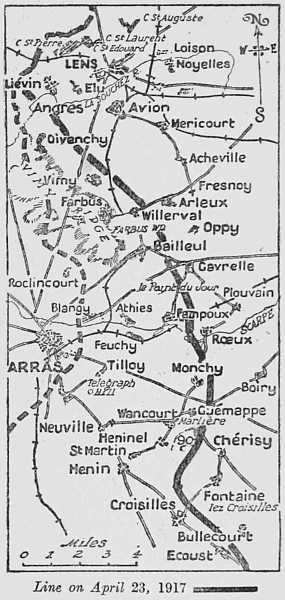
At the outset of the attack the enemy showed himself ready to meet it with a fierce resistance. Last night was terribly cold, and our troops lying out in shell-holes or in shallow trenches dug a day or two ago, suffered from this exposure. The Scottish troops of the 15th Division on the south of the Scarpe had fought in the first days' battles of Arras, and, with English troops of the 37th, had gone forward to Monchy and into the storm-centre of the German fire. Some of the men I met to-day had been buried by German crumps, and had been dug out again, and as they lay waiting for the hour of attack shells fell about them and the sky was aflame with flashes of our bombs. The men craved for something hot to drink. "I would have given all the money I have for a cup of tea," said one of them. But they nibbled dry biscuits and waited for the dawn, and hoped they would not be too numb when the light came to get up and walk. The light came very pale over the earth, and with it the signal to attack. Our bombardment had been steady all through the night, and then broke into hurricane fire. As soon as our men left the trenches our gunners laid down a barrage in front of them, and made a moving wall of shells ahead of them—a frightful thing to follow, but the safest if the men did not go too quick or fail to distinguish between the line of German shells and our own. It was not easy to distinguish, for our men had hardly risen from the shell-holes and ditches before the enemy's barrage started, and all the ground about them was vomiting up fountains of mud and shell-splinters. At the same time there came above all the noise of shell-fire a furnace-blast of machine-guns. Machine-gunners in Rœux and Pelves, in the two small woods in front of Monchy, and in the ground about Guémappe were slashing all the slopes and roads below Monchy-on-the-Hill.