Part 5 — THE BATTLES OF FLANDERS (continued 3)
Reading edition
But it was in the cellars that the pitiful drama had been—in those cellars down which I peered wondering whether any poor bodies lay there still. The shells had pierced down to some of the women hiding in them. Poison-gas came to choke some of them. Rescue parties of our R.A.M.C. went into Armentières immediately to get the poor creatures away, and risked their lives a score of times on each journey they made. It is an amazing thing that even then, in spite of their terror and their agony and their wounds, many of the old women could hardly be made to leave the town, and clung desperately to their homes, though these had fallen down on top of them.
Outside Armentières yesterday I met one of the R.A.M.C. lads who had helped in this rescue work—he has been given a Military Medal for it—and he told me of his trouble with two old ladies when things were at their worst. Neither had a rag of clothing on except the blankets he wrapped round them as they lay on stretchers; but when his attention wandered from them, owing to shells which burst close to the ambulance, one of these old dames scrambled up and ran off naked down the street. He went after her, and on his return found that the other old lady had given him the slip.
He had astounding experiences, this Wessex boy who is an expert in bandaging wounds, and through many days of dreadfulness and many nights he worked in Armentières under heavy fire, and did not turn a hair. He was such a Mark Tapley that when everything was falling about him and Hell was let loose he became more and more cheerful and refused to take things seriously.
"I don't think I ever laughed so much," he told me yesterday. "I don't know how it was, but I couldn't help seeing the comical side of it all, in spite of the ghastly sights." I suppose this boy's sense of humour was touched by the monstrous idiocy of the shell-fire, which produced effects like those on a music-hall stage when the funny man breaks all the crockery and brings the roof down over his head. He laughed like anything when he was shelled out of his makeshift dressing-station on one side of the street, and had to establish his quarters on the other side of another street.
"How's it going, my lad!" asked his officer, who came to visit the aid post.
"Well, sir," he answered, "it's rather hotter than the last place, except for direct hits."
He laughed "like anything" again when a shell came through the kitchen and smashed up the stove, and failed to kill an old lady, already covered with bruises but very talkative. He laughed again when they had to pack up traps in a hurry, with the stiff body of a small dead child on the top of the kit and a barrage down the street.
"This is the funniest old show I ever did see," was the comment of the boy from Wessex, and certainly, when one comes to think of it, it is a funny thing that such things should happen in this civilized world of ours and in this Christian age. But the boy from Wessex, and others like him, did not let their sense of humour get the better of their pity or their work of rescue. They crawled out and dragged in the bodies of dead or wounded people.
Down below in the cellars was a crowd of poor people, mostly women and girls, and when the shell-fire was at its height their wailing and their prayers were rather troublesome to the Wessex boy and his comrades upstairs bandaging the wounded. The R.A.M.C. men, at most deadly risk to themselves, managed to clear most of the cellars, carrying out the people on shutters, and taking them away in ambulances to hospitals. To one of these casualty clearing-stations was brought a boy of nineteen, who had been gassed. He was a life-long paralytic and wizened like an old man, and deaf and dumb. Nobody knew where he had come from or to whom he belonged, but he had one creature faithful to him. It was a small dog, who came on the stretcher with him, sitting on his chest. It watched close to him when he lay in the hospital, and went away with him, sitting on his chest again, when he was sent farther away to another clearing-station. This dog's fidelity to the paralysed boy, who was deaf and dumb and gassed, seems to men who have seen many sights of war and this agony in Armentières the most pitiful thing they know.
Yesterday, apart from the knocking of anti-aircraft guns and the drone of our planes, it was all quiet there, and I walked through the silent streets over the broken bricks and glass, and was startled by the utter death of the town. For this quietude and ruin of a place that one has seen full of life gives one a sinister sensation, and one is frightened by one's loneliness.
XV
THE BATTLE OF MENIN ROAD
September 20
Our troops attacked this morning before six o'clock on a wide front north and south of the Ypres-Menin road, and have gained important ground all along the line. It is ground from which during the past six weeks there has been that heroic and desperate fighting which I have described as best I could in my daily messages, giving even at the best only a vague idea of the difficulties encountered by those men of ours who made great sacrifices in great endeavours. It is the ground which in the centre rises up through the sinister woodlands of Glencorse Copse and Inverness Wood to the high ground of Polygon Wood and the spurs of the Passchendaele Ridge, which form the enemy's long defensive barrier to the east of the Ypres salient. Until that high land was taken progress was difficult for our troops on the left across the Steenbeek, as the enemy's guns could still hold commanding positions. The ground over which our men have swept this morning had been assaulted again and again by troops who ignored their losses, and attacked with a most desperate and glorious courage, yet failed to hold what they gained for a time, because their final goal was attained with weakened forces after most fierce and bloody fighting. The Empire knows who those men were—the old English county regiments, who never fought more gallantly; the Scots, who only let go of their forward positions under overwhelming pressure and annihilating fire; the Irish divisions, who suffered the most supreme ordeal, and earned new and undying honour by the way they endured the fire of many guns for many days. As long as history lasts, the name of these woods, from which most of the trees have been swept, and of these bogs and marshes which lie about them, will be linked with the memory of those brave battalions who fought through them again and again. They are not less to be honoured than those who with the same courage, just as splendid, attacked once more, over the same tracks, past the same death-traps, and achieved success. By different methods, by learning from what the first men had suffered, this last attack has not as yet been high in cost, and we hold what the enemy has used all his strength and cunning to prevent us getting. He used much cunning and poured up great reserves of men and guns to smash our assaulting lines. For the first time on July 31 we came up against his new and fully prepared system of defence, and discovered the power of it. Abandoning the old trench system which we could knock to pieces with artillery, he made his forward positions without any definite line, and built a large number of concrete blockhouses, so arranged in depth that they defended each other by enfilade fire, and so strong that nothing but a direct hit from one of our heavier shells would damage it. And a direct hit is very difficult on a small mark like one of those concrete houses, holding about ten to twenty men at a minimum, and fifty to sixty in their largest. These little garrisons were mostly machine-gunners and picked men specially trained for outpost work, and they could inflict severe damage on an advancing battalion, so that the forward lines passing through and beyond them would be spent and weak. Then behind in reserve lay the German "Stosstruppen," specially trained also for counter-attacks, which were launched in strong striking forces against our advanced lines after all their struggle and loss. Those blockhouses proved formidable things—hard nuts to crack, as the soldiers said who came up against them. There are scores of them whose names will be remembered through a lifetime by men of many battalions, and they cost the lives of many brave men. Beck House and Borry Farm belong to Irish history. Wurst Farm and Winnipeg, Bremen Redoubt and Gallipoli, Iberian and Delva Farm, are strongholds round which many desperate little battles, led by young subalterns or sergeants, have taken place on the last day of July and on many days since. English and Scots have taken turns in attacking and defending such places as Fitzclarence Farm, Northampton Farm, and Black Watch Corner in the dreadful region of Inverness Copse and Glencorse Wood. To-day the hard nut of the concrete blockhouse has been cracked by a new method of attack and by a new assault, planned with great forethought, and achieved so far with high success.
Among the troops engaged on the 2nd Army front were the Australians and South-Africans, Welsh and Scottish battalions, and many of the old English regiments, including the Cheshires, Warwicks, Worcesters, Staffords, Wiltshires, Gloucesters, Berkshires, Oxford and Bucks, York and Lancashires, Sherwood Foresters, and Rifle Brigade. The Divisions to which they belonged were, from north to south, the 2nd Australians, 1st Australians, the 23rd and 41st (with the 21st and 23rd in reserve), the 39th, the 19th, the 30th, 14th, and 8th.
I should like to give the full details of the preparations which have made this success possible and the methods by which some at least of the terrors of the blockhouse have been laid low, but it cannot yet be done, and it is enough now that good results have been attained. One thing was against us as usual last night. After several fine days the weather turned bad again, and last night many men must have looked up at the sky, groaned, and said, "Just our luck." At half-past ten it began to rain heavily, and all through the night there was a steady drizzle. It was awful to think of that ground about the woodlands, already full of water-holes and bogs, becoming more and more of a quagmire as the time drew near when our men have to rise from the mud and follow the barrage across the craters. All through the night our heavy guns were slogging, and through the dark wet mist there was the blurred light of their flashes. Before the dawn a high wind was raging at thirty miles an hour across Flanders, and heavy water-logged clouds were only 400 feet above the earth. How could our airmen see? When the attack began they could not see even when they flew as low as 200 feet. They could see nothing but smoke, which clung low to the battlefields, and they could only guess the whereabouts of German batteries. Later, when some progress had been made at most points of the attacking line, the sky cleared a little, blue spaces showed through the black storm-clouds, and there were gleams of sun striking aslant the mists.
This sky on the salient was a strange vision, and I have seen nothing like it since the war began. It was filled with little black specks like midges, but each midge was a British aeroplane flying over the enemy's lines. The enemy tried to clear the air of them, and his anti-aircraft guns were firing wildly, so that all about them were puffs of black shrapnel. Behind, closely clustered, were our kite-balloons, like snow-clouds where they were caught by the light, staring down over the battle, and in wide semicircles about the salient our heavy guns were firing ceaselessly with dull, enormous hammer-strokes, followed by the shrill cry of travelling shells making the barrage before our men, and having blockhouses for their targets and building walls of flying steel between the enemy and our attacking troops. In the near distance were the strafed woods of old battle-grounds like the Wytschaete Ridge and Messines, with their naked gallows-trees all blurred in the mist.
Our men had lain out all night in the rain before the attack at something before six. They were wet through to the skin, but it is curious that some of them whom I saw to-day were surprised to hear it had been raining hard. They had other things to think about. But some of them did not think at all. Tired out in mind and body under the big nervous strain which is there, though they may be unconscious of it, they slept. "I was wakened by a friend just before we went over," said one of them. The anxiety of the officers was intense for the hours to pass before the enemy should get a hint of the movement. It seemed that in one part of the line he did guess that something was in the wind and in the mist. This was on the line facing Glencorse Wood. An hour or two before the attack he put over a heavy barrage, but most of it missed the heads of the battalions. There were many casualties, but the men stood firm, never budging, and making no sound. They all thought that some of their comrades must have been badly caught, but, as far as I can find, it did not do great damage.
All along the line the experience of the fighting was broadly the same. Apart from local details and difficulties, the ground was not quite so bad as had been expected, though bad enough, being greasy and boggy after the rain, but not impassable. The shell-holes were water-logged, and they were dangerously deep for badly wounded men who might fall in, but for the others there was generally a way round over ground which would hold, and our assaulting waves who led the advance were lightly clad, and could go at a fair pace after the barrage. "I saw wounded men fall in the shell-holes," said a Warwickshire lad to-day, "and God knows how they got out again, unless the stretcher-bearers came up quick, as most of them did; but as for me, I had lain in a shell-hole all night up to the waist in mud, and I was careful to keep out of them." The barrage ahead of them was terrific—the most appalling fence of shells that has ever been placed before advancing troops in this war. All our men describe it as wonderful. "Beautiful" is the word they use, because they know what it means in safety to them.
In the direction of Polygon Wood the plan of attack seems to have worked like clockwork. The Australians moved forward behind the barrage stage by stage, through Westhoek and Nonne Boschen, and across the Hanebeek stream on their left, with hardly a check, in spite of the German blockhouses scattered over this country. In those blockhouses the small garrisons of picked troops had been demoralized, as any human beings would be, by the enormous shell-fire which had been flung around them. Some, but not all, it seems, of the blockhouses had been smashed, and in those still standing the German machine-gunners got their weapons to work with a burst or two of fire, but then, seeing our troops upon them, were seized with fear, and made signs of surrender. At nine o'clock this morning the good news came back that the Australians were right through Glencorse Wood. Later messages showed that our troops were fighting their way into Polygon Wood. They swept over the strong points at Black Watch Corner, Northampton Farm, and Carlisle Farm. There was stiff fighting round a blockhouse called Anzac Corner, east of the Hanebeek stream, and it was necessary to organize two flank attacks and work round it before the enemy machine-gun fire could be silenced by bombs. In another case near here the enemy came out of a blockhouse ready to attack, but when they saw our men swarming up, they lost heart and held up their hands. It is difficult to know how many prisoners were taken here in these woods and strong points. The men's estimates vary enormously, some speaking of scores and others of hundreds.
All this time the enemy's artillery reply was not exceptionally heavy, and, though it was prompt to come after the first SOS signals went up from his lines, it was erratic and varied very much in the success of our counter-battery work, which all through the night and for days past has been smothering his guns. South of the attack in Glencorse Copse and Polygon Wood the assault in Inverness Copse and Shrewsbury Forest, across the bog-lands round the Dumbarton Lakes, was made by English battalions, including the Queen's, the East and West Kents, the Northumberland Fusiliers, Sherwood Foresters, the King's Royal Rifles, and the West Riding battalions. It was the vilest ground, low-lying and flooded, and strewn with broken trees and choked with undergrowth, but the troops here kept up a good pace, and flung themselves upon the blockhouses which stood in their way. At an early hour our men were reported to be on a ridge south-east of Inverness Copse and going strong towards Veldhoek. The enemy's barrage came down too late, and one officer, who was wounded by a shell-splinter, led his men, 160 of them, to their first position with only nine casualties.
Most of our losses to-day were from machine-gun fire out of the blockhouses, and that varied very much at different parts of the line. There was some trouble at Het Pappotje Farm in this way, where a party of German machine-gunners put up a desperate resistance, shutting themselves in behind steel doors before they were routed out by a bombing fight. Southward from a strong point called Groenenburg, or "Green Bug" Farm, to Opaque Wood by the Ypres-Comines Canal, the attack by the Cheshires, Wiltshires, Warwicks, Staffords, and Gloucesters was successful, though the enemy still holds out up to the time I write in Hessian Wood, where he is defending himself in a group of blockhouses against the Welsh Regiment and Royal Welsh Fusiliers.
I have dealt so far with the centre of the attack, and I know very little as to the fighting on the north by the 5th Army, except that the Highlanders, London Territorials, Lancashire and Liverpool battalions, and Scots and South-Africans have swept past a whole system of blockhouses, like Beck House and Borry Farm, running up through Gallipoli, Kansas Cross, and Wurst Farm, across the Langemarck-Zonnebeke road. All through the morning our lightly wounded men came filtering down to the safer places in the Ypres salient and then to the quiet fields behind, and they were in grand spirits in spite of the mud which caked them and the smart of their wounds. Some of them were brought down on the trolley trains, which go almost as far as the battle-line, and some in open buses, and some by German prisoners, but there were many Germans among the wounded—some of them with very ghastly wounds, and these took their place with ours and mingled with them in the dressing-stations, and were given the same treatment. Our wounded told some strange tales of their experiences, but there was no moan among them, whatever they had suffered.
One man of the Cheshires described to me how he saw a German officer run out of a dug-out, which had been a blockhouse blown in at each end by our heavy shell-fire, and make for another one which still stood intact. With some of his comrades, our man chased him, and there was a great fight in the second blockhouse before the survivors surrendered, among them the officer, who gave to my friend a big china pipe and a case full of cigars as souvenirs. He was killed afterwards by one of his own men, who sniped him as he was walking back to our lines. In another strong point there was a great and terrible fight. The Prussian garrison refused to surrender, and a party of ours fought them until they were destroyed. "It was more lively than Wytschaete," said a man who was in this fight. "It was less tame-like, and the Fritzes put up a better show." They fought hard round Prince's House and Jarrock's Farm and Pioneer House, not far from Hollebeke Château.
The prisoners I saw to-day were shaken men. Most of them were young fellows of twenty-one, belonging to the 1916 class, and there were none of the youngest boys among them. But they were white-faced and haggard, and looked like men who had passed through a great terror, which indeed was their fate. They belonged mostly to the 207th Prussian Division, and had suffered before the battle from our great shell-fire, which had caused many casualties among their reliefs and ration parties. Many other prisoners belonged to the 121st Division. I can only give this glimpse or two of the crowded scenes and the many details of to-day's battle. To-morrow there will be time perhaps to write more, giving a deeper insight into this day of good success, which is cheering after so much desperate fighting—over the same fields, although never to so far a goal.
September 21
In spite of many German counter-attacks yesterday and many vain and costly attempts to counter-attack to-day, we hold all the ground gained by our men yesterday, except at one or two strong points, after their victorious progress. This morning when I went again among the men who have been fighting—there was a blue sky over the rags and tatters of the City of Ypres, and behind the tall, solitary tree-stumps on the ridge that goes up to Polygon Wood by way of Glencorse Copse, and all the air was filled with the song of many aeroplanes—all that I learned yesterday about the battle was made more certain by the narratives of these young soldiers, who are proud and glad of what they call a real good show. The wounded men walking down over the wide stretch of fields, which are still under gun-fire, weak with loss of blood, suffering the first pain of their wounds, and shaken by their experiences under shells and machine-gun fire, spoke with a quiet enthusiasm of the day's success, and said "It was easy" behind such a colossal barrage as our guns rolled in front of them. Some of them in their eagerness went too fast for the barrage in order to chase the enemy, and I have met Australians here and there and some men of the Welsh Regiment, who fought farther south, wounded because they ran in front of the barrage-lines, and were caught in our shell-splinters. But that was a rare episode, and along the whole line of attack the men followed the moving walls of shells, vast shells that fling up masses of earth like suburban villas, and the smaller shells that fell like confetti, all glinting in the wet mist, and felt sure that the enemy in front of them, would have lost all his fight when they reached his hiding-places, if any lived. Many Germans died on that ground, so that the shell-holes between the blockhouses are wet graves in which their bodies lie, and many of the blockhouses which resisted so long in former attacks are smashed, or at least so battered that the garrisons inside were dazed and demoralized by the fearful hammering at their walls.
There was a broad belt of death across that mile deep of woods and ridges and barren fields, but here and there, as I have already told, men stayed alive in the concrete houses and fought with their machine-guns to the last, and even kept sniping from shell-holes in which they had escaped, up to the time our troops reached them. They were brave men, most of them, for it needs great courage to show any fighting spirit after such a fury of gun-fire, and 50 per cent. of our prisoners are wounded, as I have seen myself, and the others are haggard and spent after their frightful adventure. An hour or two ago I met a column of them on the road, marching down slowly through a ruined village, and staring hollow-eyed at all the movement of our troops, at all the transport behind our lines, at all our whistling, busy Tommies, who glance back at them without any malice now that the battle is over. In a dressing-station a young wounded German sprang to his feet as I came in, and said, "Good day, sir," very politely, but the pallor of his face was that of a dead man. The German officers who are prisoners show the same kind of eagerness to salute, which is a rare thing for them, and I hear that they do not disguise that yesterday was a day of great defeat for themselves, and of great victory for us. The completeness and quickness of it staggered them, and they speak of our barrage-fire as an awful phenomenon that has undone all their plans and destroyed the new method of defence which they believed could save them to the end. As wounded men or prisoners they see things darkly, and we should be deep in folly if we believed that all the enemy's strength of resistance is destroyed. But at least this is clear after yesterday, that the new German method of holding his lines lightly by small garrisons in blockhouses, with reserves behind for counter-attacks, has broken down, and by reverting to the old system of strong front lines he would suffer again as he suffered in the Somme under the ferocity of our artillery.
The German officers have hard words to say about their Higher Command which has led them into this tragedy, and their own pride is broken. Yesterday the reserve divisions, which were brought up in buses and then assembled in places near our new front, to be flung against our advanced lines, had a dreadful time, and must have suffered great losses. After the rain of the night and the mist of the morning, the weather cleared in time for our airmen to go out reconnoitring, as I saw them in swarms in yesterday's sky, and they were quick to report the massing of the enemy. Our guns were quick to fire at these human targets. These counter-attacks developed several times against the English and Highland troops, who were fighting across the Zonnebeke-Langemarck road, north-west of the Gravenstafel and Abraham Heights, at a place called the Schreiboom, north of Langemarck. Some of the Rifle Brigade and King's Royal Rifles, with other light-infantry troops, failed at first to get a certain trench, and very hard fighting took place during the day in a pocket with desperate courage. At the same time the Highlanders south of them were fighting very hard also round about the blockhouses by Rose House, Pheasant Farm, and Quebec Farm beyond the Pilkem Ridge, into which I looked a week or two ago, when things were quiet on the line. The Highlanders were driven back for a while, and the enemy's counter-attacks were made in strong force at about ten o'clock in the morning, and several times later. But they were broken up each time by the rifle-fire of the Scottish troops, and by our field-batteries.
Large numbers of the enemy were killed here in our first attack and afterwards. Besides the artillery, a heavy bombardment was made before the men went out by trench-mortars, which raked a small area of shell-holes so thoroughly that the German snipers in them were destroyed, and an important trench was taken by the Scots with hardly any casualties. A good deal more than 100,000 rounds of shells must have gone over from the guns before the battle, and afterwards the German storm troops who tried to recover the ground were smothered with fire. Six times they came on with much determination, and six times their waves were broken up. Some London Territorials had to repel part of the assaulting waves, after a gallant struggle for their objectives, and one young officer among them earned special honour by gathering a company of men together and leading them against the advancing enemy, whom they scattered with bombs and rifles.
Most of the Germans here in this district round Wurst Farm, east of Winnipeg, were men of the 36th and 208th Divisions, and were a mixture of Prussians and Poles, who seem to have been stout-hearted fellows. Their local reserves were quickly exhausted, and in the afternoon, when they threw in further reserves, these were broken up in the same way. A frightful fate met a German division which was brought up in the afternoon near Roulers to be hurled against the Londoners and Highlanders. Our guns broke up their columns, and when they rallied and re-formed, broke them again. Our aeroplanes flew low over them, strafing them with machine-gun fire, and at intervals gas clouded about them, so that they had to put on their masks, if they had time to put them on before they fell, and marched blindly forward to another doom, for some of those who came within range were shot down by the London men, little fellows, some of them, with the Cockney accent which makes me homesick for the Fulham Road when I hear it along the roads of Flanders, but with big, brave hearts. Three of the German battalions deployed and drove against the Highlanders at Delva Farm and Rose House, and fought so hard that they could only be driven back when the Highlanders rallied, and at eight o'clock in the evening swept them out and away. Strong counter-attacks were made between six and seven in the evening in the neighbourhood of Hill 37 and the country round Bremen Redoubt, against the King's Liverpools, where the South-African Scots held their line.
There were a great many blockhouses in this district, some of them damaged and some still intact, and in those undamaged forts little parties of men, who fired their machine-guns to the last moment before death or surrender. Hill 37 was a hard place to attack, as the Irish found it, and here Lancashire men fought their way up and round in spite of the waves of machine-gun bullets that swept the ground about them. The Bremen Redoubt, which had been so costly to the Irishmen on July 31, was carried by the South-Africans in a fine assault, while Scottish troops were gaining other strong points and drawing tight nets round any blockhouse from which came any fire. Out of these places, in all that part of the line, many prisoners were taken, and they made their way down anxiously through their own shell-fire, which was barraging these fields. A great party of Germans, white-faced and afraid, were found in the long galleries running out of a fortified place called Schuler Farm.
South of all this the Australians were fighting in the centre of yesterday's great attack where the ground rises to the foul heights of Polygon Wood. The Australian lads were in their most perfect form. They had had some rest since the hard, bad days at Bullecourt and in the dreadful valley of Noreuil, where I went to see them outside the Quéant-Drocourt line. Since then I had seen them in the harvest-fields of France, in the market squares of Flemish towns, along the dusty roads which lead up to the Front. Always I felt it good to see those easy-going fellows in their flap hats, so lithe, so clean-cut, so fresh. It was an honour to get a salute from them now and then, for they are not great at that sort of thing, and one could see with half an eye that they have not lost any of their quality since some of them fought their great epic at Helles and Suvla Bay, and afterwards at Pozières gained and held their ground under months of great shell-fire, and then at Bullecourt fought with the grim endurance of men who will not yield to any kind of hammering if their pride is in the job. They are boys, many of them, and simple-looking fellows who were not cut to the model of barrack-room soldiers. They have a wildish gipsy look when one sees them camped in the fields, and free-and-easy manners in the village estaminets. When I heard they were going to attack Polygon Wood I knew that we should get it, if human courage could have the say, for the Australians are not easily denied if they set their mind on a thing, and for all their boyishness—though they have middle-aged follows among them too—they have a grim passion in them at such times. Yet they are free-and-easy always, even on the battlefield, and a bit impatient of checks and restraints. Knowing them, and the heart and soul of them, one of their commanding officers arranged a method of preventing them from getting bored with the long strain of a two hours' wait, which was ordered when they should have gained their first objective. He sent up to them by the carrying parties bundles of the previous day's papers, all the picture papers especially, and large quantities of cigarettes. The idea worked beautifully, and it was the strangest thing that has happened in any great battle. The Australian lads got at the papers, and on the ground which they had just captured spread them out and studied the news of the day and smoked their cigarettes with quiet enjoyment, while ahead of them rolled a stupendous barrage, with thousands of heavy shells that came screaming over their heads from our guns behind them, answered by other shells that came the other way, and burst farther back on the battlefield. So they were seen by one of our airmen, who was surprised by what he saw.
The going had been pretty bad before then, as I was told to-day by some of the men whom I met slightly wounded along the Menin road. The enemy seemed to smell danger in the night and put over a heavy barrage just before the attack started. It was on the tail of the Australians, and might have demoralized them if they had not been so high in heart. They got away in good order, and kept going to keep pace with the travelling storm of shells which broke before them. One queer thing happened near Clapham Junction. The enemy had apparently planned a raid with "flammenwerfer," or flame-jets as we call these devilish engines, at the very time of the attack and they were met by the Australian shock of assault, and fell before it. While some of the Australians worked round Glencorse Copse and Nonne Boschen or Nuns' Wood, others fought up by Westhoek across the Hanebeek towards the post called by a curious coincidence Anzac Corner. After heavy fighting for a little while at one of the blockhouses the Australian flag was planted at Anzac Corner and waves there still. In Nonne Boschen the ground was marshy and encumbered with fallen trees, but the boys struggled through somehow, and then started for the Polygon Wood, where there is no wood, as there seldom is in these places when our artillery has done its work, but only some blasted trunks and stakes. In Glencorse Wood and round about it there were a good many Germans, and they fought hard. Fifty of them were killed in hand-to-hand fighting, or fighting at close quarters, and a blockhouse on the north-west of the wood, where the garrison would not surrender, but kept his machine-guns going, was taken by a bombing attack. So after a two hours' wait at the end of the first lap the Australians flung away their cigarettes and the assaulting waves passed on to the ridge of Polygon Wood. They could not take all the line they had been asked to take in the first attempt, and were checked on the right by machine-gun fire. So they dug in on a crescent, which had its right ear somewhere by Carlisle Farm to the north of Black Watch Corner, until supports came up to make good their losses on the way, and they were able to go forward and straighten out. After that the counter-attacks began. All of them were broken up by artillery-fire, and when one of the German divisions was flung in, the only men who reached our lines were those who tried to escape from the barrage which our guns put over their assembly position. I should like to give a fuller history than I did yesterday about the taking of Inverness Copse and the bogs of the Dumbarton Lakes, and the tangled ground of Shrewsbury Forest, but I have no time, as the wires wait, except to pay a tribute to the men who fought there over most difficult country, crowded with blockhouses, and under severe fire from the enemy's guns. Men from Surrey and Kent, from the Midlands, from Wales, from the North, the battalions of the 8th and 14th Divisions, all fought and won with equal courage and success.
September 23
The enthusiasm of the troops who fought in Thursday's battle of the Menin road is good enough proof that they achieved success that morning without those great losses which take the heart out of victory. All the men I have seen are convinced that the enemy's losses are heavy. Not so much in the actual attack, where he held his blockhouse system with small garrisons, as afterwards, when he tried to counter-attack.
I have already put on record some of the attempts he made to regain ground on the afternoon of the battle. Yesterday and to-day he has continued his efforts with even more disastrous results to his unhappy troops. About midday yesterday a German regiment was sent up in motor-omnibuses to a point behind the enemy's lines to make a new assault upon our positions in Polygon Wood. The three battalions then took to the road, and were seen very quickly by our observers. The artillery made that road a way of fire, and the German soldiers were caught in it and dispersed. Odd companies of them worked their way forward by other tracks, but lost themselves in the chaos of shell-craters, where other heavy shells burst among them. They were no longer battalions or companies, but a terror-stricken collection of individual soldiers, taking cover in holes and without guidance or command. An officer collected fifty of them and led them back to reorganize. He had no notion of what had happened to the rest of the regiment, except that it was broken and ineffective, in this wild turmoil of crater earth. He went forward again on reconnaissance, and walked into a body of Australians, who took him prisoner.
So it happened with another column at Zandvoorde. One of our aerial observers watched the long trail of men marching up the road and sent a message to the guns. They were the heavy guns which found the target with 9·2 shells and with twelve-inchers, which are monstrous and annihilating. Down there at Zandvoorde it must have been hell. We can only guess how many men were blown to pieces, and it is not a picture on which the imagination should care to linger. It was a bloody shambles.
Along the Menin road later in the day came another long column of marching men. They were men of the Sixteenth Bavarian Division, who had been sent up in urgent haste without knowledge of the ground, without maps, and with officers who seem to have had no definite instructions except to fling their men in an attack somehow and anyhow. Over their heads in the darkness under the stars flew a British aeroplane with a bomb of the heaviest kind. When our airman saw these hostile troops advancing, flying low like a great black bat he dropped his frightful thing on the head of the column. It burst with a deafening roar and scattered the leading company. Flying in the same sky-space as the big aeroplane was a number of other night raiders of ours. They also flew low above the marching troops, and all down the road dropped their explosives. Our guns added their help, and they fired many rounds down the Menin road, bracketing the ditches. It is a dreadful thing to walk along a road which is being "bracketed," and with those birds of prey above them the Bavarians must have suffered the worst kind of horror. They did not get near to our lines with any counter-attack.
None of these counter-attacks has reached our lines near Polygon Ridge, which is the ground most wanted by the enemy, and the nearest seems to have been yesterday afternoon, when some of the Australian boys with whom I talked to-day saw the movement of men and the glint of bayonets in a little wood on an opposite spur. They saw the movement of men for a minute of two, and after that a fury of shells which fell into the wood and filled it with flame and smoke.
"I don't know how a mortal man could have lived through that," said one of these lads. "If any Fritz got out of that without being cracked he must have had the luck of Old Harry."
There were many of these Australian boys among whom I went to-day before they had cleaned themselves of the dirt of battle, and while they were still on fire with the emotion of their amazing adventure. Some of them had escaped only by enormous luck. I talked with one stretcher-bearer, a fine, big, bullet-headed fellow with an unshaven chin and a merry smile, who was astounded to find himself alive. He had spent the day and night bandaging wounded, and, with his mates, carrying them down to the dressing-station, a mile and more back. All the time he walked and worked with bursting shells about him. They knocked out several of his mates, but left him untouched. They killed two or three of the wounded on his stretchers going down, but did not scratch him. They blew up dug-outs just as he had gone out of them, and trenches through which he made his way. He was buried in earth flung up by heavy shells, and he fell many times into deep craters, and men dropped all round him, but to-day he still had a whole skin and a queer, lingering smile, in which there is a look of wonderment because of his escape.
An Australian officer, who was through the Dardanelles and the Somme and Bullecourt, a slim, small-sized Australian, with a delicate, clean-cut face, thoughtful and grave, with a fine light in his eyes, was helping a wounded lad on to a stretcher when a shell came over his head, killed the boy, but left the officer unscathed. It was this officer, this slight, delicate-looking man, who captured, with three lads, sixty men and a German battalion staff in their headquarter dug-outs below Polygon Wood.
"Where is your revolver?" he said to the captain. The German hesitated, and said: "You will shoot me if I fetch it." "I will shoot you if you don't," said the little Australian. And he meant what he said, as I could see by the set of his lips when he told me the tale. But the German captain handed over his revolver quietly, and his maps, which were very useful.
It was a wonderful scene to-day among all these Australian lads, who had just been relieved and were talking over the scenes of yesterday's history in small groups while they scraped off the mud and shaved before bits of broken mirror, and polished up German rifles and machine-guns and handled their souvenirs, found in the dug-outs and blockhouses. Many of them were stripped to the waist, some of them wore German caps, some of them slept like drugged men in spite of all the noise about them. After taking the first objective they had to wait for two hours before they went on, and there were queer scenes about the blockhouses and in the felled woods. They had found the German rations, and besides the sausages and bread and gallons of cold coffee in petrol-tins, which the boys shared among themselves, quantities of long, fat, and excellent cigars. Hundreds of Australians smoked these cigars while they waited for the barrage to lift, and when they went on again hundreds of them were still puffing them as they trudged on to Polygon Wood. They had a good day. I have met some of them, who said they enjoyed it, and would not have missed it for worlds. The excitement of it all kept them going. The battlefield was a wild pandemonium of men, and the imagination of people who have never seen war will hardly visualize such scenes, with lads laughing and smoking while others lay dead, with groups fighting and falling round blockhouses while others were eating German sausages and joking in captured emplacements, with stretcher-bearers carrying men back under heavy shell-fire and German prisoners dodging their own barrage-fire on their way to our lines. An Australian doctor had his arm smashed, but stayed among the boys, regardless of his own hurt. A V.C. officer of the Dardanelles was killed as he went back wounded on a stretcher. German wounded lay crying for help, and our men rescued them. So about Glencorse Wood and Polygon Wood human agony and the wild spirits of Australian youth, death, and the vitality of boyhood in the passion of a great adventure were queerly mixed, and one side of this picture of war would be hopelessly untrue if it left out the other side.
One enthusiasm of the Australians was about the English soldiers who fought on their right, the Yorkshire boys and others who went through Inverness Copse. Again and again yesterday I heard them loud in praise of the Tommies.
"By gosh, they'll do for me! They went ahead in grand style. They couldn't be stopped anyhow, though they came up against a durned lot of machine-gun fire. They were just fine."
Far north of all this, above the Zonnebeke, were the Londoners of the 58th Division and the Highlanders of the 51st Division, and, as I have already written in previous messages, they had severe fighting and had to bear the brunt of great counter-attacks. The ground in front of the London Territorials was bad and difficult—bad because it was intersected with swamps and cut up by weeks of shell-fire, and horribly difficult because of a ridge rising up on the left to the German strong point of Wurst Farm.
The London boys swung left in order to attack Wurst Farm, and, avoiding a frontal assault, worked left-handed all the time till they reached the ridge, and then rushed the blockhouse from the rear. The garrison was surprised and caught. They fought desperately, but the Londoners overpowered them. The surviving Germans complained bitterly, and said it was impossible to use their machine-guns on every side at once. "It is not a fair way of fighting," said a German officer, and the Londoners laughed and said, "Not half!" and "I don't think!" and other ironical words.
In a big dressing-station up there they captured two doctors and sixty men, of whom many were wounded. The German doctors said, "Have you any wounded we can help? We are not fighting men." And they made themselves useful, and were good fellows.
Down in the valley the Londoners came face to face with a party of Germans who showed fight, but the Londoners—little fellows some of them—walked through them and over dead bodies who had fallen before their rifle-fire. There was a lot of musketry both then and afterwards when the enemy counter-attacked, and they fired like sharpshooters. Down below them and almost behind them the line dropped away to the fort of Schuler Farm, where the enemy still held out. "There are a lot of Boches down there," said an officer on the brigade staff of the London Territorials. "No," said the brigade major, and then: "Yes, and, by the Lord, there's a German officer staring at me. The blighter is telling one of his men to take a pot at me. See!" The brigade major ducked down his head as a bullet flattened against the blockhouse wall.
It was an awkward situation for the Londoners, but they formed a defensive flank and sent some lads to help the troops who were attacking the position. "Domine dirige nos" is the London motto, and there were many London boys who had it in their hearts that day, and said with the dear old Cockney accent, "Gord 'elp us." That was when the German counter-attacks developed, but were smashed by gun-fire.
In all this fighting, as far as I can find, the Highland Territorials of the 51st Division upon the left had the bloodiest fighting. They gained their ground with difficulty, because a battalion of the Royal Scots was badly held up by wire and bogs and machine-gun fire at a stream called the Lekkerbolerbeek. They had to fall back, reorganize, and attack again, which they did with splendid gallantry, and held their ground only by most grim endurance, because the enemy counter-attacked them violently all day long after the objectives had been gained.
The enemy's losses were certainly appalling to him. Officers in this fighting, who have been through many of our great battles, tell me that they have never seen before so many dead as lie upon this ground. In one section of Pheasant Trench a hundred yards long there are nearly a hundred dead. Before the attack our barrage rolled forward slowly, like a devouring fire. Instantly all along the German line green lights rose as SOS signals, but as the barrage swept on, followed by the Scots, the lights went out. They rose again from the farther lines, and then those ceased as the shells reached them. Only in the blockhouses and the dug-outs down by the Lekkerbolerbeek were any Germans left alive.
The blockhouses were dealt with by small parties of Highlanders, who had been in training to meet them, and went like wolves about them, firing their machine-guns and rifles through the loopholes if the garrisons would not come out. So they swept on to their final goal, which was at Rose House and the cemetery beyond Pheasant Farm. These men had some terrible hours to face. By ill-luck their left flank was utterly exposed, and hostile aeroplanes, flying very low, saw this and flew back with the news. The enemy was already developing a series of counter-attacks by his "Stosstruppen," or storm troops, of the 234th Division, which from three o'clock in the afternoon till seven o'clock that evening made repeated thrusts against the Highlanders' front, and the heaviest weight of two and a half battalions was sent forward against this flank. It was preceded by the heaviest German barrage ever seen by these Scots, who have had many experiences of barrage-fire. Officers watching from a little distance were horrified by that monstrous belt of fire, and the garrison of Gordons seemed lost to them for ever. It was not so bad as that. Eventually this flank fell back from Rose House to Pheasant Farm Cemetery and other ground, where they were rallied by a battalion commander, one of the youngest men of his rank in the British Army, who supplied them with fresh ammunition and directed them to hold up the German infantry advancing under cover of their bombardment. In spite of their losses our men fought their way back and regained part of the ground by desperate valour. Our guns wiped out the other counter-attacks one by one, inflicting frightful losses on the enemy. They were caught most horribly as they came along the road. Thirty machine-guns played a barrage-fire on his lines where German soldiers tried to escape across the shell-craters. The Highlanders used their rifles effectively, one man firing over 500 rounds. And a gun was brought into action from a Tank which had come up as far as an advanced blockhouse, in spite of the boggy ground.
There was great slaughter among the enemy that day. Since then the slaughter has gone on, for his counter-attacks have not ceased. His guns have been very active, bombarding parts of our line intensely, and in the air his scouts and raiders have been flying over our lines in the endeavour to observe and destroy our troops and batteries, flying low with great audacity, and using machine-guns as well as bombs. But we hold all the important ground gained last Thursday.
XVI
THE WAY TO PASSCHENDAELE
September 26
During the past forty-eight hours there has been hard and prolonged fighting north and south of the Menin road, and in spite of formidable counter-attacks by the enemy which began early yesterday morning and still continue, our troops have made a successful advance in the neighbourhood of Zonnebeke and southward beyond the Polygon Wood racecourse, which now belongs to the Australians.
It is south of that, by Cameron House and the rivulet called the Reutelbeek, that the enemy's pressure has been greatest, and where the battalions of the 33rd and 39th Divisions on the right of the Australians, including the Queen's, have had the hardest time under incessant fire and attack since dawn yesterday, but on their right Sherwood Foresters and Rifle Brigade men, also severely tried, have swept across the Tower Hamlets Ridge in the direction of Gheluvelt.
It was fully expected that any new endeavour of ours to advance beyond the ground gained in the battle of September 20 would be met by the fiercest opposition. The capture of Polygon Wood and Westhoek seriously lessened the value of Passchendaele Ridge, which strikes northward and forms the enemy's great defensive barrier, and it was certain that in spite of the heavy losses he has already suffered in trying to get back that high ground above Inverness Copse he would bring up all his available reserves to hinder our further progress at all costs.
For two days before yesterday he made no sign of movement in his lines, and was kept quiet by the breakdown of all his previous counter-attacks, which our men repulsed with most bloody losses to the enemy, so that their divisions were shattered and demoralized. The German Command used that time to drag the broken units out of the line and to replace them or hurry up to their support the reserves who had been waiting in the rest areas behind. These men were rushed up by motor-omnibus and railways to points where it was necessary to take to the roads and march to the assembly positions ready for immediate counter-attacks. Those were in the Zandvoorde and Kruiseik neighbourhood, south-east of Gheluvelt, ready to strike up to the Tower Hamlets Ridge while others could be assembled behind the Passchendaele Ridge.
No doubt our attack for this morning did not leave out of account the strength of resistance likely to be offered. The enemy showed signs of desperate anxiety to check us on the Polygon Wood line, and the ground going south of it to the Gheluvelt Spur, and he made a great effort by massed artillery to smash up the organization behind our lines, and by a series of thrusts to break our front. On Monday afternoon, increasing to great intensity yesterday, he flung down his barrage-fire in Glencorse Wood and Inverness Copse, fired large numbers of heavy long-range shells over Westhoek Ridge, Observatory Ridge, Hooge, and other old spots of ill-fame, and concentrated most fiercely on the ground about Cameron House, Black Watch Corner, and the Tower Hamlets.
At six o'clock yesterday morning, supported by this terrific fire, he launched his first attack on the Surreys, Scottish Rifles, Middlesex Regiment, and other troops around the Tower Hamlets, and owing to their losses they were obliged to fall back some little way in order to reorganize for an assault to recapture their position. These fought through some awful hours, and several of their units did heroic things to safeguard their lines, which for a time were threatened.
While they were fighting in this way the 4th and 5th Australians, on the high ground this side of Polygon Wood racecourse and the mound which is called the Butte, also had to repel some fierce attacks which opened on them shortly after eight o'clock in the morning. The enemy was unable to pierce their line, and fell back from this first attempt with great losses in dead and wounded. It was followed by a second thrust at midday and met the same fate. At two o'clock in the afternoon the Australians sent some of their men to help the Surreys and the English troops on their right, who were passing through a greater ordeal owing to the storm of fire over them and the continued pressure of the enemy's storm troops, who were persistent through the afternoon in spite of the trails of dead left in their tracks. It was a serious anxiety on the eve of a new battle, but it failed to frustrate our attack. All the area through which the enemy was trying to bring up his troops was made hideous by artillery-fire and the work of the Royal Flying Corps.
It was a clear moonlight night, with hardly a breath of air blowing, and all the countryside was made visible by the moon's rays, which silvered the roofs of all the villages and made every road like a white tape. Our planes went out over the enemy's lines laden with bombs, and patrolled up and down the tracks and made some thirty attacks upon the German transport and his marching columns. All his lines of approach were kept under continual fire by our guns of heavy calibre, and for miles around shells swept the points which marching men would have to pass, so that their way was hellish. Our aircraft went out and flew very low, and dropped bombs wherever they saw men moving through the luminous mists of the night. Behind our own lines air patrols guarded the countryside. They carried lights, and as they flew in the starlit sky they themselves looked like shooting stars until they dropped low, when their planes were diaphanous as butterfly's wings in sunlight. On the battlefield then was no unusual gun-fire for several hours after dark. Guns on both sides kept up the usual night bombardment in slow sullen strokes, but at least on the Australian front it was not until about 4.45 in the morning that the enemy opened a heavy barrage in Glencorse Wood. The Australian troops were already massed beyond that ground for the attack which was shortly due. On the north, up by Wurst Farm, on the lower slopes of the Gravenstafel, our London Territorials were also waiting to go "over the bags," as they call it. Against them the German guns put over a heavy barrage, but that line of explosives failed to stop or check the assault.
It was almost dark when our London lads went forward through a thick ground mist, which was wet and clammy about them. Our artillery had opened before them the same monstrous line of barrage-fire which they had followed on the 20th. and they went after it at a slow trudge, which gave them time to avoid shell-craters and get over difficult ground without lagging behind that protecting storm. That violence of fire was as deadly and terrifying this morning as on that other day. Through the mist our men saw the Germans running and falling, and many of them did not stay in the blockhouses, though it was almost certain death to come out into the open before the barrage passed. There were dead men in many shell-craters before our men reached them, and others afterwards, as they passed through clumps of ruin which had once been hamlets and farms. There was such a mess of brickwork and masonry at Aviatik Farm, where Germans hiding in concrete walls fired machine-guns and rifles for a time until the British troops closed on them.
Something like 150 prisoners were taken in this section of the attack, and one of them was a queer bird who belonged to the sea. That is to say, he had been a sailor on the Dresden and was in the battle of Falkland Island and off Coronel, where he was picked up by a Swedish boat and taken back to Germany. To his disgust he was put in the 10th Ersatz Division, and now, after his soldier life, wants to work in a British shipyard. He was surprised at the food given to him, and thought it was a bribe to get information from him, believing that England is agonizing with hunger.
About a hundred and fifty prisoners were taken also, by the troops on the right of this section, belonging mostly to the 23rd Reserve Division, with some of the 3rd Guards. Our men who attacked in the direction of Zonnebeke village were Leicesters, Notts and Derbys, East Yorks, Royal Scots, Gordons, and King's Own, and they had some stiff fighting on the way to the Windmill Cabaret and Hill Forty, which seems to be the key to the position. Here they came against some of the blockhouses at Toronto Farm and Van Isackere Farm, but did not meet great trouble there. Some of them had been so badly knocked by shell-fire that the garrisons inside were killed, by concussion, and from others men came out to surrender as soon as our men were near them. Near the village of Zonnebeke the fight was more serious against the Royal Scots and East Yorks, and the enemy's gun-fire, which had not been very heavy on the other ground of attack, smashed along the line of the railway embankment.
The Australian advance across the racecourse of Polygon Wood and northward across the spur to below Zonnebeke Château was steady and successful. There was a regular chain of blockhouses on the way, but there again the old black magic of the pill-box failed. The men rallied inside them, many of them being Poles of the 49th Regiment, who hate the Prussians in a fierce way and ask us to kill as many as possible for their sake. Most of them were quick and glad to surrender. A platoon of them were taken in some wooden dug-outs below the high mound of Polygon Wood, that old Butte which is supposed to be the burial-place of a prehistoric chief, though by the Australians it is believed to be the observation-post of Sir Douglas Haig in 1914.
The enemy's gun-fire was heavy over part of the ground, and there was a nest of machine-guns along a road which gave some trouble, but in the main attack the losses of the Australians were not heavy up to the time they gained the last objective. It was our aircraft which brought back the first news of the Anzacs on the racecourse in Polygon Wood, and later they had reached the farthest goal, where prisoners were surrendering freely. On the left of their front the Australians were quite satisfied with their position. On the right they had great anxiety because of the check to the troops below them. At one time it was found advisable for the Australians to swing back their flank a little in order to avoid its exposure. But the Australians are full of confidence and are sure that they can handle any counter-attack which may be launched against them. It has been a hard day for all our men, especially for those who bore the brunt of the enemy's fire, and I believe will be counted as one of the biggest days of fighting in this war. Its decision is of vital importance to the enemy and to ourselves, and so far it is in our favour.
XVII
THE BATTLE OF POLYGON WOOD
September 27
The battle which began yesterday morning, after a whole day of counter-attacking by the enemy, in great numbers and by great gun-fire, lasted until nightfall, and, as I told yesterday, did not pass without anxious hours for those in command, and trying hours for some of our fighting men.
From the left above Zonnebeke down to the Australian front on the heights of the Polygon Wood Racecourse the advance was made with fair ease through the blockhouse system and without severe losses, as they are reckoned in modern warfare, in spite of difficult bits of ground and the usual snags, as our men call them, in the way of unexpected machine-gun fire, odd bits of trench to which small groups of Germans clung stubbornly, dirty swamps which some of our men could not cross quickly enough to keep up with the barrage, and danger zones upon which the enemy heaped his explosives.
There were incidents enough for individual men to be remembered for a lifetime, hairbreadth escapes, tight corners in which men died after acts of fine heroism, and strong points like Hill 40, on the left of the ruins of Zonnebeke, around which some of our troops struggled with fortune.
The Ypres salient
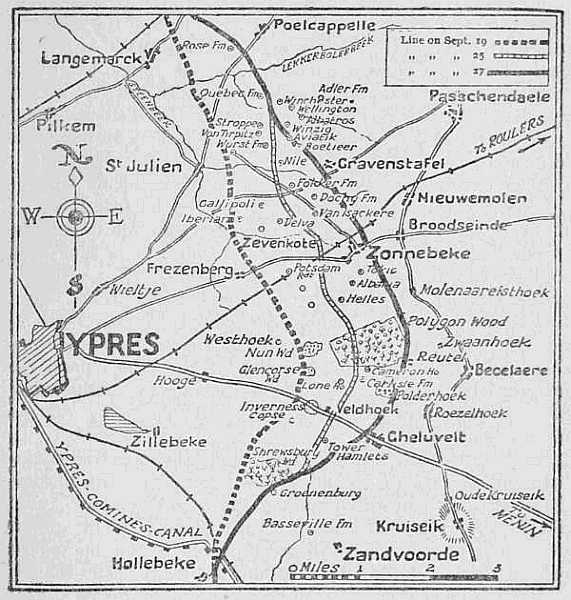
Apart from local vicissitudes here and there during those first hours of the battle it became clear by midday, or before, that from the extreme left of the attack down to the vicinity of Cameron House, on the right of the Australians, the general success of the day was good. The critical situation was on the right of the 4th and 5th Australians, and involving their right because of the enemy's violent pressure on British troops there during the previous day, and again when our new attack started, so that their line had been somewhat forced back and the Australian right flank was exposed.
Hour after hour reports coming from this part of the field were read with some anxiety when it was known how heavily some of our battalions were engaged. This menace to our right wing was averted by the courage of men of the Middlesex and Surrey Regiments of the 33rd Division, with Argylls and Sutherlands and Scottish Rifles, and by the quick, skillful, and generous help of the Australian troops on their left. It is an episode of the battle which will one day be an historic memory when all the details are told. I can only tell them briefly and in outline.
After terrific shelling, on Tuesday last, the enemy launched an attack at six o'clock against our line by Carlisle Farm and Black Watch Corner, south of Polygon Wood, and forced some of our English troops to fall back towards Lone House and the dirty little swamp of the Reutelbeek. These boys of Middlesex and Surrey suffered severely. For some time it was all they could do to hold out, and the enemy was still pressing. A body of Scottish Rifles was sent up to support them, and by a most brave counter-thrust under great gun-fire restored part of the line, so that it was strong enough to keep back any advancing wave of Germans by rifle and machine-gun fire.
Another body of men, the Argyll and Sutherland Highlanders, held out on exposed ground, isolated from the main line, and threatened with being cut off by the enemy's assault troops. Sir Douglas Haig has mentioned them specially in his message yesterday, and they deserve great honour for the heroic way in which they held on to this ground for many hours that day and night under harassing fire from coal-boxes, or 5·9's, which threatened to wipe out their whole strength. Yesterday they had strength and spirit left to renew the attack, and to make another attempt to get back the lost ground into which the enemy had driven a wedge.
At the same time the Australians had realized the dangerous situation which exposed their right flank, and they directed a body of their own troops to strike southward in order to thrust back the German outposts. Those Australian troops shared the peril of their comrades on the right, and withstood the same tornado of shelling which was flung over all the ground here; but in spite of heroic sacrifice did not at first wholly relieve the position of the Australian right, which remained exposed. After the great attack by the Anzacs in the morning their line was thrust right out beyond Cameron House, but the English and Scottish troops of the 33rd Division, who had also gone forward in the new attack south of them, were again met by a most deadly barrage-fire and checked at a critical time. I was with some of the Australians yesterday when all this was happening, and when there was cause for worry. They were unruffled, and did not lose confidence for a moment.
"Give us two hours," said one of them who had a right to speak, "and we will make everything as sound as a bell." In those two hours they drew back their flank to get into line on a curve going back towards Lone House, and established defensive posts which would hold off any attack likely to be launched against them.
"It is hard luck on the English boys down there," said the Australians, "but they have had a bad gruelling, and they will come along in spite of it. There is not an Australian in France who doesn't know how the Tommy-Boys fought on the 20th, and that will do for us."
The "Tommy-Boys," as the Australians call them, fought as they have fought in three years of great battles, and in spite of the ordeal through which they had passed—and it was not a light one—they saved the situation on that ground below Polygon Wood, and made it too dangerous and too costly for the enemy to stay. Early this morning the survivors of the Germans who had thrust a wedge between our lines past Cameron House crawled out again and our line was straightened.
How the Australians established themselves on Polygon Wood Racecourse and beyond the big mound called the Butte I told in my message yesterday. Farther north the Leicesters, Notts and Derbys, Royal Scots, Gordons, and King's Own of the 59th and 3rd Divisions had attacked north of the Ypres-Roulers railway, running at right angles to the Langemarck-Zonnebeke road. On that road, barring the way, was the station of Zonnebeke, now a mass of wreckage, fortified with machine-gun redoubts, and farther south the ruins of Zonnebeke church and village. Across the road was the Windmill Cabaret, an old inn which has been blown off the map on the high ground of Hill 40, which rises gradually to a hump a hundred yards or so north of the station. It was bad ground to attack, and strewn with little blockhouses of the new type, though they are still called pill-boxes after an older and smaller type. The blockhouses did not give much trouble. Our new form of barrage, the most frightful combination of high explosives and shrapnel that has yet appeared in war, rolled backwards and forwards about them, so that the garrisons huddled inside until our men nipped behind them and thrust rifles or bombs through the machine-gun loopholes, if they had not previously escaped to shell-craters around where they might have more chance of escape.
And here I might say in passing that the enemy has already modified his methods of holding the blockhouses, and while only a few men remain inside, distributes the rest of the garrison in shell-holes on either side, with their machine-guns in the organized craters. Some of them were found by our men, and though many of them had been killed by our gun-fire, others remained shooting and sniping until they were routed out.
The worst part of the ground on this line of attack was around a blockhouse called Bostin Farm, where there was a dismal, stinking swamp so impassable that the Royal Scots, Scottish Fusiliers, and East Yorks of the 3rd Division who tried to make their way through it lost touch with the barrage, which rolled ahead of them, and had to work round and up towards Hill 40. Here they came under machine-gun fire, and although some men forced their way up the slope of the knoll on which the Windmill Cabaret stood, they did not quite reach the crest.
Meanwhile men of the Gordons, Suffolks, and Welsh Fusiliers were attacking round about Zonnebeke, where the ground was swept by machine-gun bullets, and seized the ruin of the church and the outskirts of the station yard. There was heavy shelling from the enemy all day, which caused the line to fall back a little, and at six o'clock yesterday evening the enemy launched two counter-attacks from Zonnebeke and another around Hill 40. Half an hour later the Royal Scots and Royal Scottish Fusiliers moved forward to thrust the enemy back, and at exactly the same time another counter-attack of his advanced in their direction. Each body of men were protected by barrage-lines of heavy shell-fire, and our shells and the German shells mingled and burst together in a wide belt of fury, and sometimes neither side could cross it.
Farther north South Midland men did well. They advanced from Zevenkote on the right and Schuler Farm on the left to Van Isackere Farm and Dochy Farm and other blockhouses on each side of the high road between Langemarck and Zonnebeke with hardly a check. They found many of the blockhouses badly damaged after the heavy fire that had been poured on each one of them, and if they were not damaged the men inside were so nerve-shaken that they were eager to surrender. Apparently they had not expected the attack to follow the hurricane bombardment, because there had been other shoots of this kind before, and they made no real attempt to get their machine-guns into action. It was from the slopes of the Gravenstafel and the Abraham Heights beyond that machine-gun fire fell upon the Midland men, and the enemy's guns were shooting down the gullies between these ridges. But the ground in this part of our attack yesterday was taken without grave trouble and without great losses.
Most of the prisoners taken on this ground were Saxons, and those I have seen marching down to a captivity which they prefer to the field of battle are men of a good physique, and smart, soldierly look. It is astonishing how quickly they recover from the effect of bombardment and the great horror of battle as soon as they get beyond the range of shell-fire. But they are gloomy and disheartened. The officers especially acknowledge that things are going badly for Germany, and say that there is, for the time at least until the new class is ready, a dearth of men of fighting age, so that the drafts they get are miserable and unfit. They are overwhelmed with the thought of the monstrous gun-power which we have brought against them to counteract their own artillery, which once had the mastery, and they are struck by the audacity of our air service.
Certainly our flying men have been doing all in their power to make life intolerable on the German side of the lines. I have already described how they went out on Tuesday night and broke up the columns of men marching to attack us. One of these birds found a different kind of prey. It was opposite the Australian front where a team of German gunners were getting a gun away. Our airman flew low over the heads of the gunners and played his machine-gun on to them and dropped bombs. He smashed up the gun-limber and laid out the gunners, and the gun remains there still, with the bodies of men and horses around it. To-day out beyond Ypres I saw flights of our men going out again beyond the German lines for that battle in the air which has never ceased since the battle of Flanders two months ago.
The weather is still in our favour, and there is a blue sky to-day and a soft, golden light over all this Flemish countryside where our troops go marching up to the lines with their bands playing, or lie resting in the hop-fields on the way. That old place of horror, the Yser Canal, reflected the blue above, and in the air there was that sense of peace which belongs to the golden days of autumn. But the guns were loud, and the flight of their shells went crying through the sky.
October 2
Through the haze which lies low over Flanders, though above there is still a blue sky, the noise of great gun-fire goes on, rising and falling in gusts, and, like the beat of surf to people who live by the sea, it is the constant sound in men's ears, not disturbing their work unless they are close enough to suffer from the power behind the thunder-strokes. The trees are yellowing into crinkled gold, and there is the touch and smell of autumn in the night air, and the orchards of France are heavy with fruit. Wonderful weather, the soldiers say. The artillery battle is endless, and on both sides is intense and widespread. It was followed yesterday by five German counter-attacks, which did not reach our lines. In a very desperate way the enemy is trying to push us back from positions which are essential to the strength of his defence. All his guns are at work. Is it the last phase of the war? Does the enemy know that he must win or lose all? Our men have that hope in their hearts, and fight more grimly and with higher spirit because of it. The success of the last two battles has deepened the hope, and men come back from the line, back to the rest-billets, with the old conviction newly revived that at last they have the enemy down and under and very near hopelessness. In the rest-billets are the men who come back. They come marching back along the dusty roads from the fire-swept zone, first across ground pitted with new-made shell-holes, with the howl of shells overhead, and then through broken villages on the edge of the battlefields, and then through standing villages where only a gap or two shows where a haphazard shell has gone, and then at last to the clean, sweet country which no high explosives reach, unless a hostile airman comes over with his bombs.
In any old billet in Flanders one hears the tale of battle told by men who were there, and it is worth while, as yesterday, when I sat down at table with the officers of a battalion of Suffolks in a Flemish farmhouse. The men were camped outside, and as I passed I liked the look of these lads, who had just come out of one of the stiffest fights of the war. They looked amazingly fresh after one night's rest, and they stood in groups telling their yarns in the good old dialect of their county, laughing as though it had all been a joke, though it was more than a joke with death on the prowl.
"Your men look fit," I said to the colonel of the Suffolks, and he smiled as though he liked my words, and said, "You couldn't get their tails down with a crowbar. It was a good show, and that makes all the difference. They have been telling the Australian boys that you have only got to make a face at the Hun and he puts his hands up. They knocked the stuffing out of the enemy."
Inside the farmhouse there was the battalion mess, at one long table and one short, because it was felt better for all the officers to be together instead of splitting up into company messes. I looked down the rows of faces, these clean-cut English faces, and was glad of the luck which had brought so many of these young officers back again. They told the tale of the battle, and each of them had some detail to add, because that was his part of the show, and it was his platoon, and they had left the fighting-line the night before. They spoke as though all the things had happened long ago, and they laughed loudly at episodes of gruesome interest and belonging to those humours of war which are not to be written.
There was a thick mist when they went away at dawn, so dense that they could not see the line of our barrage ahead, though it was a deep belt of bursting shells. They had been told to follow close, and they were eager to get on. They went too fast, some of them almost incredibly fast, over the shell-craters, and round them, and into them, and out of them again, stumbling, running, scrambling, not turning to look when any comrade fell.
"I was on the last position three-quarters of an hour before the barrage passed," said a young officer of the Suffolks. He spoke the words as if telling something rather commonplace, but he knew that I knew the meaning of what he said, a frightful and extraordinary thing, for with his platoon he had gone ahead of our storm of fire and had to wait until it reached and then passed them. Some of their losses were because of that, and yet they might have been greater if they had been slower because the enemy was caught before they could guess that our men were near. They put up no fight in the pill-boxes, those little houses of concrete which stank horribly because of the filth in them, and from the shell-craters where snipers and machine-gunners lay men rose in terror at the sight of the brown men about them, and ran this way and that like poor frightened beasts, or stood shaking in an ague of fear. Some ran towards their own lines with their hands up, shouting "Kamerad," believing they were running our way. They were so unready for attack that the snipers had the safety-clip on their rifle-barrels, and others were without ammunition.
In one shell-hole was an English-speaking German. "I saved him," said one of the young Suffolk officers. "He was a downhearted fellow, and said he was fed up with the war and wanted nothing but peace."
Near another shell-hole was a German who looked dead. He looked as if he had been dead for a long time, but an English corporal who passed close to this body saw a hand stretch out for a bayonet within reach, and the man raised himself to strike. Like a man who sees a snake with his fangs out, the corporal whipped round, grabbed the German's bayonet and ran him through. The way to the last objective was easy on the whole, and the enemy was on the run with our men after them until they were ordered to stop and dig in. The hardest time came afterwards, as it nearly always comes when the ground gained had to be held for three more days and nights without the excitement of attack and under heavy fire. That is when the courage of men is most tried, as this battalion found. The enemy had time to pull themselves together. The German gunners adapted their range to the new positions and shelled fiercely across the ways of approach, and scattered 5·9's everywhere. It was rifle-fire for the Suffolk men all the time. They had not troubled to bring up a great many bombs, for the rifle has come into its own again, now that the old trench warfare is gone for a time, or all time, and with rifle-fire and machine-gun fire they broke down the German counter-attacks and caught parties of Germans who showed themselves on the slopes of the Passchendaele Ridge, and sniped incessantly. They used a prodigious quantity of small-arms ammunition, and the carriers risked their lives every step of the way to get it up to them. They fired 30,000 rounds and then 16,000 more. There was one officer who spent all his time sniping from a little patch of ground that had once been a garden. He lay behind a heaped ruin and used his field-glasses to watch the slopes of rising ground on his left, where human ants were crawling. Every now and then he fired and picked off an ant until his score reached fifty. German planes came flying over our troops to get their line, flying very low, so that their wings were not a tree's height above the shell-craters, and our boys lay doggo not to give themselves away. Some of the hostile planes were red-bellied, and others which came searching the ground were big, porpoise-like planes. They dropped signal-lights and directed the fire of the 5·9's. A private of the Suffolks, lying low but watchful, saw a light rise from the ground as one of these machines came over, and it was answered from the aeroplane. "That's queer," he thought; "dirty work in that shell-hole." He crept out to the shell-hole from which the signal had come, and found three German soldiers there with rockets. They tried to kill him, but it was they who died, and our man brought back their rifles and kit as souvenirs.
More rifle ammunition was wanted as the time passed, and the carriers took frightful risks to bring it. The drums of the Suffolks did well that day as carriers and stretcher-bearers, passing up and down through the barrage-fire, and there was a private who guided a party with small-arms ammunition—ten thousand rounds of it—to the forward troops, with big shells bursting over the ground. Twice he was buried by shell-bursts, which flung the earth over him, but on the way back he helped to carry a wounded man 800 yards to the regimental aid post under hot fire. He was a cool-headed and gallant-hearted fellow, and went up again as a volunteer to the forward positions, and on the same night crawled out on a patrol with a young lieutenant to reconnoitre a position on the left which was still in German hands. From farther left, on rising ground, the Germans sprinkled machine-gun fire over the battalion support lines, and the earth was spitting with those bullets. But in their own lines the German soldiers were moving about with Red Cross flags picking up their wounded, and they did not fire at our stretcher-bearers, apart from the barrage-fire of 5·9's through which they had to make their way. Only once did they play a bad trick. Under the Red Cross flag some stretcher-bearers went into a pill-box which had been abandoned, and shortly after machine-gun fire came from it. That is the kind of thing which makes men see red.
XVIII
ABRAHAM HEIGHTS AND BEYOND
October 4
Another great battle has opened to-day, and in a wide attack from the ground we captured on September 26, north and south of the Polygon Wood crest, our troops have advanced upon the Passchendaele Ridge, and have reached the Gravenstafel and Abraham Heights, which crown a western spur of the ridge, and Broodseinde, which is the high point and keystone of the enemy's defence lines beyond Zonnebeke. South of that they are fighting between Cameron House and Becelaere, across the Reutelbeek and its swampy ground, and down beyond Polderhoek to the south end of the Menin road. The divisions engaged, from north to south, were the 29th, 4th, 11th, 48th, New Zealand, 3rd, 2nd, and 1st Australians.
This morning I saw hundreds of prisoners trailing back across the battlefield, and crowds of them within the barbed-wire enclosures set apart for them behind our lines. Our lightly wounded men coming down the tracks for walking wounded speak, in spite of their blood and bandages, of a smashing blow dealt against the enemy and of complete victory. "We have him beat," say the men, and they are sure of this, sure of his enormous losses and of his broken spirit, although the fighting has been bloody because of the great gun-fire through which our men have had to pass. It has been a strange and terrible battle—terrible, I mean, in its great conflict of guns and men—and the enemy, if all goes well with us, may have to remember it as a turning-point in the history of this war, the point that has turned against him with a sharp and deadly edge. For, realizing his great peril if we strengthened our hold on the Passchendaele Ridge, and knowing that we intended that—all signs showed him that, and all our pressure on these positions—he prepared an attack against us in great strength in order to regain the ground he lost on September 26, or, if not that, then so to damage us that our advance would be checked until the weather choked us in the mud again. His small counter-attacks, or rather his local counter-attacks, for they were not weak, had failed. Even his persistent hammering at the right wing by Cameron House, below Polygon Wood, had failed to bite deeply into our line, though for a time on September 25 it had been a cause of grave anxiety to us and made the battle next day more difficult and critical. But these attacks had failed in their purpose, and now the German High Command decided for a big blow, and it was to be delivered at seven o'clock this morning. It was a day and an hour too late. Our battle was fixed for an hour before his.
And so it happened that our men had to pass through a German barrage to follow their own, a barrage which fell upon them before they leapt up to the assault, and it happened also most terribly for the enemy that our men were not stopped, but went through that zone of shells, and on the other side behind our barrage swept over the German assault troops and annihilated their plan of attack.... They did not attack. Their defence even was broken. As our lines of fire crept forward they reached and broke the second and third waves of the men who had been meant to attack, caught them in their support and reserve positions, and we can only guess what the slaughter has been. It is a slaughter in which five German divisions are involved.
This battle of ours, which looks like one of the greatest victories we have had in the war, was being prepared on a big scale as soon as the last was fought and won. No words of mine can give more than a hint of what those preparations meant in the scene of war. For several days past the roads to the Front have been choked with columns of men marching forward, column after column of glorious men, hard and fit, and hammering a rhythm on the roads with the beat of their feet, and whistling and singing, in tune and out of tune, with the fifes and drums far ahead of them. Always, night and day, there was the sound of this music, always in the stillness of these moonlight nights the thud, thud of those tramping feet, always, along any track that led towards the salient, the vision of these battalions led forward by young officers with their trench sticks swinging and a look of pride in their eyes because of the fellows behind them. Their steel helmets flashed blue in the sun so that a column of them seen from a distance was like a blue stream winding between the hop-fields, or the broken ruins of old villages, or the litter of captured ground. With them and alongside of them went the tide of transport—lorries, wagons, London buses, pack-mules, guns and limbers, and the black old cookers with their trailing smoke. Everywhere there has been a fever of work, Tommies, "Chinkies," coloured men piling up mountains of ammunition to feed the guns. Under shell-fire, bracketing the roads on which they worked, pioneers carried on the tracks, put down new lengths of duck-board, laid new rails. The enemy's artillery came howling over to search out all this work, which had been seen by aeroplanes, and at night flocks of planes came out in the light of the moon to drop bombs on the men and the work. Now and again they made lucky hits—got a dump and sent it flaming up in a great torch, killed horses in the wagon-lines or labouring up with the transport, laid out groups of men, smashed a train or a truck; but the work went on, never checked, never stopping in its steady flow of energy up to the lines, and the valour of all these labourers was great and steady in preparing for to-day. Knowing the purpose of it all, the deadly purpose, the scene of activity by any siding filled one with a kind of fear. It was so prodigious, so vastly schemed. I passed a dump yesterday, and again to-day, in the waste ground on the old battlefield near Ypres and saw the shells for our field-batteries being unloaded. There were thousands of shells, brand-new from the factories at home, all bright and glistening and laid out in piles. The guns were greedy. Here was food for a monstrous appetite. We watched all this—the faces of the men going up so bright-eyed, so splendid in their youth, so gay, and all these shells and guns and materials of war, and all this movement which surged about us and caught us up like straws in its tide, and then we looked at the sky and smelt the wind, and studied a milky ring which formed about the moon. Rain was coming. If only it would come lightly or hold another day or two—one night at least.
Rain fell a little yesterday. The ground was sticky when I went up beyond Wieltje to look at the Passchendaele Ridge to see some boys getting ready for the "show" to-day, and to watch the beginning of the great bombardment.... Curse the rain! It would make all the difference to our fighting men, the difference perhaps between great success and half a failure, and the difference between life and death to many of those boys who looked steadily towards the German lines which they were asked to take. What damnable luck it would be if the rain fell heavily! Last night the moon was hidden and rain fell, but not very hard, though the wind went howling across the flats of Flanders. And this morning, when our men rose from shell-holes and battered trenches and fields of upheaved earth to make this great attack, the rain fell still but softly, so that the ground was only sticky and sludgy, but not a bog. The rain was glistening on their steel helmets, and the faces of our fighting men were wet when they went forward. They had passed already through a fiery ordeal, and some of them could not rise to go with their comrades, and lay dead on the ground. Along the lines of men, these thousands of men, the stretcher-bearers were already busy in the dark, because the enemy had put over a heavy barrage at 5.30, and elsewhere later, the prelude to the attack he had planned. His old methods of defence and counter-attack had broken down in two battles. The spell of the pill-box, which had worked well for a time, was broken, so that those concrete blockhouses were feared as death-traps by the men who had to hold them. The German High Command hurried to prepare a new plan, guessing ours, and moved the guns to be ready for our next attack, registered on their own trenches, which they knew they might lose, and assembled the best divisions, or the next best, ready for a heavy blow to wind us before we started and to smash our lines, so that the advance would be a thousand times harder. The barrage which the Germans sent over was the beginning of the new plan. It failed because of the fine courage of our troops first of all, and because the German infantry attack was timed an hour too late. If it had come two hours earlier it might have led to our undoing—might at least have prevented anything like real victory to-day. But the fortune of war was on our side, and the wheel turned round to crush the enemy.