FRANK REYNOLDS. IV.
Reading edition
Of Reynolds' exquisite refinement in the art of character drawing, his pictures of life in Paris afford excellent examples. Impressions of Paris through English eyes are familiar enough; but too often they are distortions. The artist is too concerned with the obtaining of an "effect" to be troubled by a strict adherence to truth. No such charge can be levelled against "Pictures of Paris and Some Parisians," as the series of drawings which Frank Reynolds contributed to the Sketch in 1904 was entitled. He viewed Paris through eyes which magnified, perhaps, but never distorted; and his impressions, as set down on paper, carry that instant conviction, even to those who have never crossed the Channel, which is the hallmark of truth.
In some cases these Paris drawings, many of which are reproduced in the present volume, are literal portraits from life. But for the most part they are the result of that close and absorbent observation which has been mentioned as characteristic of the artist's method. The "Pictures of Paris" were no hurried impressions received during a flying visit, but the outcome of a long stay in the French capital, which gave opportunities for a close study of manners, and a sympathetic insight into men. Accompanied by two brother artists, Reynolds, commissioned by his editor to depict Paris, betook himself thither, and established himself for a considerable period in a studio, whence he could watch and record. Under the guidance of Mr. John N. Raphael, well known amongst Paris correspondents, who contributed the clever literary sketches which the drawings by Reynolds nominally illustrated, explorations were made not only to those familiar haunts of which the names are known to the veriest tripper, but into the heart of that Paris which is terra incognita to the casual stranger.
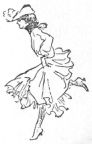
FRIVOLITY. Time Sketch: London Sketch Club.
Thus we have in these drawings a true Paris and the true Parisian—not the traditional caricature which, though founded possibly on fundamental facts, has been so elaborated as to bear no more resemblance to the real thing than the libellous figure with lantern jaws, protruding front teeth, and side whiskers, generally beloved of the French artist, bears to the typical Englishman. Take, for example, the drawing of French workpeople at dinner (page 8), made from a sketch in a Belleville café. There is no exaggeration here, but a literal transcript from life, which reveals, as it were, in one flash, a whole epitome of town life in working France.
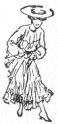
Consider again his drawings of Parisian types. No portrait could more nicely hit off the characteristic slouch of the piou-piou (as Tommy Atkins is called in France), nor catch with more delicate charm the personality of the French grisette of a certain type, than the pencil drawing "Vive l'Armée" (page 49). Not less clever are the pen-and-ink sketches of familiar types which surround the larger figures on this last-named page—like them, the result of humorous observation of many individuals. Reynolds tells quaint stories of his adventures with the sketch-book in the pages of which are to be found the hurried notes—often but a few strokes and scratches intended to serve as a mnemonic—upon which his finished drawings and sketches were based. Frequently he would stalk an imposing Sergent de Ville, or Cuirassier with resplendent helmet and flowing horse-hair plume, for miles along the boulevards, making furtive notes, when opportunities presented themselves and conditions were favourable, of the details of epaulettes, buttons, cuffs, and all the other paraphernalia. In the same way his many sketches of the Paris cocher necessitated frequent drives in an open carriage, during which careful studies could be made of the ample back of the typical French cabman, and of the flowing folds of his usually voluminous neck.
HAVING THE TIME OF HER LIFE. Sketched in a Paris Café
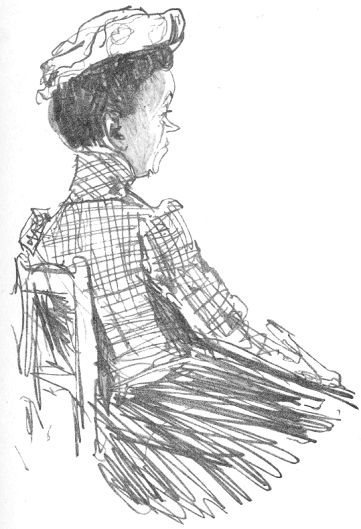
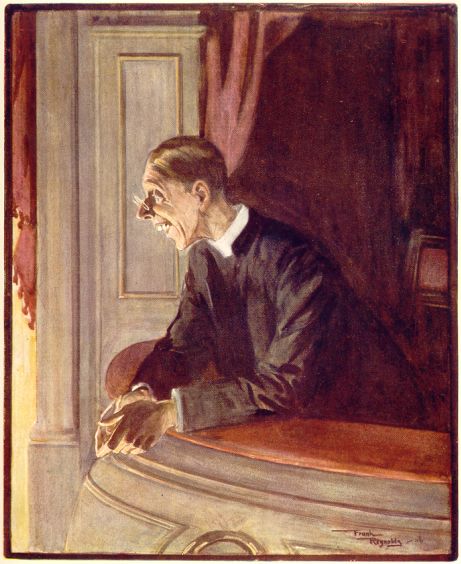
Allusion has already been made to the progressive method by which Frank Reynolds evolves a finished drawing, step by step, from an initial idea roughly jotted down with a few strokes of the pencil. His draughtsmanship depends, as must of course all draughtsmanship, very largely upon memory. But it is his practice, whenever possible, to obtain notes on the spot for later use. This was especially the case with his work in Paris, where a pocket sketch-book was his inseparable companion. A few pages of the latter are reproduced here, illustrating the artist's quick perception and the instant sureness with which, notwithstanding the leisurely pace of his work under normal conditions, he conveys the spirit of his subject by means of a few lines. An excellent example of this faculty is the sketch of the fat priest (page 53) and his hirsute companion, admirable in the spontaneity of expression with which the fleeting impression of a moment has been set down on paper. Equally vivid is the impression conveyed by the hurried sketch of an old woman (page 22) made at the stage door of a theatre. The boulevards of Paris are excellent places from which to study the comedy of life: and as an example of the peculiar flavour of Frank Reynolds' humour, it would be hardly possible to better the irresistible sketch from life, furtively made whilst sitting amongst the audience at a café chantant, which, with a nice sense of the absurd, is labelled in the sketch-book "Having the Time of her Life."
Montmartre, as might be expected, yielded excellent "copy," to employ a journalistic phrase. In the cafés and cabarets artistiques were made some of the portraits from life already referred to. But though portraits of actual individuals, the models from which they were made are in every case so characteristic, so closely in keeping with their surroundings, that they serve nevertheless as types, and the drawings in consequence make as direct an appeal to the stranger as to one who might happen to be familiar with the originals of them. In the famous Cabaret des Quat'-z-Arts was drawn the exquisite pen-and-ink portrait on page 32, previously alluded to, of "Georgette de Bertigny": under which name, for the purposes of the sketch, the identity of a figure at one time very familiar to habitués of the Quat'-z-Arts is concealed. As comment upon the depth of feeling which the drawing reveals, one may read the pen picture which accompanied it:
Then Georgette de Bertigny steps out through the haze, and stands, a tragic little figure, on the platform by the piano. Her hair and eyes are ebon black; her face, thin lipped and pale, is like a mask of ivory. There is no life whatever in it. She stands there like a tragedy in miniature, her hands behind her back, unseeing, motionless. Then, to a low, monotonously modulated melody, she sings a song of utter misery and passion, and, as she sings, her eyes and face light up. The mask of ivory gleams as though there were living light behind it, and the sweet, low voice stirs us as but few singers can. The music ceases. And the light behind the ivory goes out again as Georgette bows her thanks for our enthusiasm.
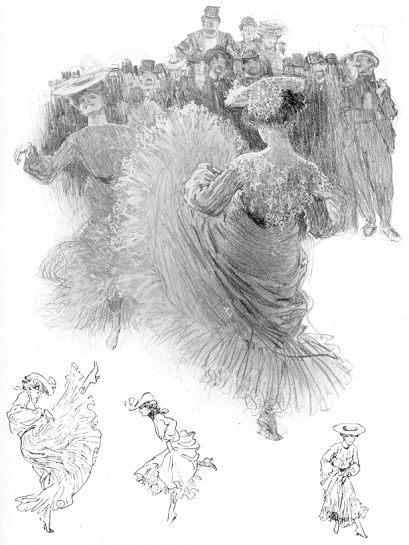
LE 'IGH KICK. At the Moulin Rouge. From "Paris and Some Parisians"
It is trite to remark that comedy is akin to tragedy, and it is in the natural order of things that an artist of so keen a perception of the comedy of life should be able to strike with such truth and precision the note of pathos or of tragedy.
A SPEECH AGAINST THE GOVERNMENT. From "Paris and Some Parisians"
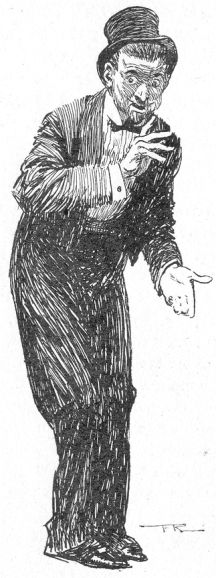
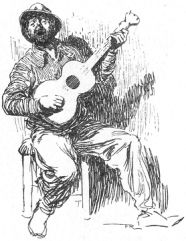
The "Lapin Agile," a strange little café in that "other Montmartre" which the tourist knoweth not, yielded abundance of material to Frank Reynolds' pencil. Needless to say, the curious may search all Paris and find no such sign as that of "The Sprightly Rabbit," but it is not impossible that some may recognise, under his disguise, "Felix," the ruffianly but accomplished host, who was the model for the sketch upon page 43, one of the happiest examples in the present volume of the artist's skill in portraiture, as well as of his rare technique in pen-and-ink. Equally happy is the sketch which depicts "'Chacun' with his 'Chacune'" at the Moulin de la Galette (page 13), in which the pose of the figures and the expression upon their faces exhibit, if one may put it so, the very perfection of naturalness. For a study of expression, again, it would be difficult, or indeed impossible, to better the further of the two figures in the drawing of "Le 'Igh Kick," made one night at the Moulin Rouge. As to pose, could there be anything more exactly right than the attitude of the gentleman "with bright-blue goggle eyes, and a dress-shirt front in accordion pleats," who, on the occasion when his portrait was made, had been to the races and backed a winner, and was delivering "a long and extremely incoherent speech."
FELIX OF THE "LAPIN AGILE". From "Paris and Some Parisians"