FRANK REYNOLDS. II.
Reading edition
Frank Reynolds is yet another in the long list of artists who have arrived at their true vocation by devious routes. There are certain tendencies of mind which, when a man has them, refuse to be suppressed. The journalistic instinct is one of them. Do what you will with the man in whom it is planted, he can never keep his fingers from the pen. Make him a doctor and you will find him scribbling columns for the press on hygiene in the house and the benefits of breathing through the nose. Send him into the army and he will fill his leisure by writing tales of tiger-shoots and essays on the art of pig-sticking. So with the artist. The man born with the gift to draw finds as irresistible a fascination in pencil or brush as the man with the power of narrative discovers in ink and paper. Whether he serves before the mast as an A.B., or cattle-ranches out west, sooner or later he is certain to drift into his proper sphere of activity. It may take long to get there, but eventually he is bound to arrive.
In the case of Frank Reynolds the period of bondage was comparatively brief. Entering at first upon a business career, he had originally no prospect, nor intention, of developing his artistic impulses. He had scarcely, indeed, a suspicion of his own powers—certainly no proper knowledge of their latent possibilities. But commerce had little interest for him, and circumstances which offered an opportunity of escape combining with a happy chance which suggested a higher artistic (and monetary) value for that faculty for drawing which previously he had regarded in the light of a mere hobby, caused him to throw up his earlier plans and devote himself entirely to black-and-white illustration.
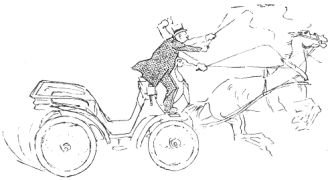
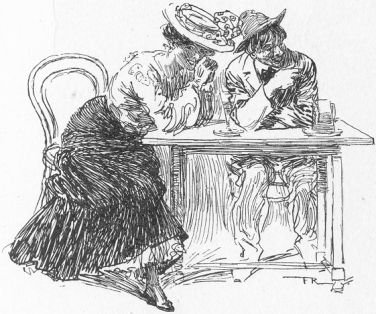
There had been preparation for this, however. The son of an artist, Frank Reynolds inherited his native talent, and this was developed in no small measure during boyhood under his father's guidance. It was the chief delight of Reynolds junior to "mess about" (as he himself succinctly puts it) with the palette and tools of Reynolds "CHACUN" WITH HIS "CHACUNE". From "Paris and some Parisians" senior, and the licence thus permitted enabled him to discover for himself much of the rudiments of the craft of the draughtsman and painter. More was learned from long and absorbed contemplation of his father at work.
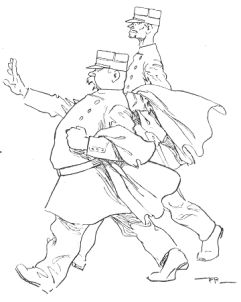
If early inclinations were of more lasting duration than is their wont, it is likely that Frank Reynolds would now be known to fame as a painter of martial types and gory battlefields. With him the fascination which soldiers and all things military have for the boyish mind took the form of an intense eagerness to reproduce in colour and line the gay pageant of the march. The skirl of the fife and the tattoo of the drum inspired him with a desire, not to shoulder a gun, but to seize a pencil. There was a shop in Piccadilly where water-colour sketches of military types might frequently be seen displayed to view, and to Reynolds junior a tramp thither of several miles from the far west of London was as nothing, could he but have the ecstatic joy of gazing, with nose flattened against the window-pane, upon these transcendent works of art, for an hour or more on end.
This early training, to be regarded as the sure foundation upon which the artist's later education was to rest, owed not a little, perhaps, of its effectiveness to its casual and desultory nature. The natural bent was allowed to reveal itself: development was gradual, and (as it were) automatic. Individuality was neither crushed nor cramped. On the contrary, it was given full play, and that the work of Frank Reynolds is invested with so definite a quality of personality is due in no small degree to the special circumstances of his youthful training.
Heatherley's, in Newman Street, London, was his only school. Here, for some time after his final abandonment of commerce for art as the serious business of his life, Reynolds was a close and persistent student. That conscientious care which presents itself to those who are cognisant of his method of work (and, indeed, to any intelligent critic of his finished drawings) as one of his most salient characteristics was a feature of his days of apprenticeship at Heatherley's. Delight at emancipation from uncongenial occupation was balanced by a sober ambition and a steady purpose. He lived laborious days, laying to heart the lessons of his craft, but he laboured always con amore.
BETHNAL GREEN. From "Sunday Clothes"
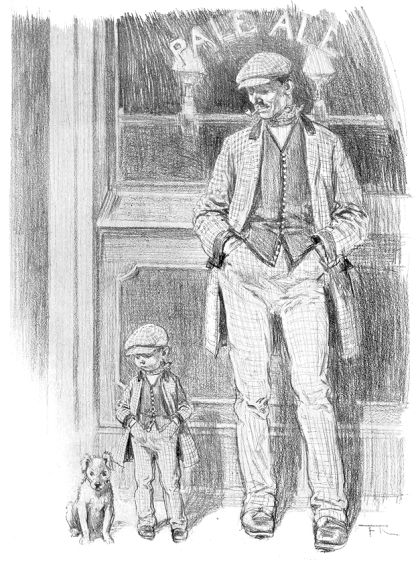
In his student days at Heatherley's Frank Reynolds received much valuable help from Professor John Crompton. On the vital importance of drawing, the latter was especially insistent: this was the dominant note of his teaching, markedly made manifest in the work of his pupil. In the matter of draughtsmanship, few men have so sure a hand, an instinct so unerring.
Leaving Heatherley's, Frank Reynolds set out, armed with a sharp pencil, and a yet sharper sense of humour, to make a living out of black-and-white illustration. His work quickly obtained recognition, and his drawings were soon appearing with regularity in the illustrated press. It would have been strange if Pick-Me-Up, then in its sunniest and most audacious days, had not opened its arms to so keen an observer of life's little comedies, and Frank Reynolds speedily became one of that clever band which, including at different times such artists in jest as Raven Hill, S. H. Sime, Dudley Hardy, J. W. T. Manuel, Eckhardt, and others, succeeded in making, for a brief but brilliant period, the satirical little sheet in the blue wrapper the most talked of periodical, perhaps, of its day. One recalls with relish many of the quaint conceits that were illustrated in its pages by Reynolds' mirth-provoking line, and thinks, with regrets for opportunities lost, how admirable a successor he would have been to Raven Hill and "the man Sime" as collaborator with Arnold Goldsworthy in those shrewdly flippant theatrical critiques which the latter contributed over the familiar signature of "Jingle."
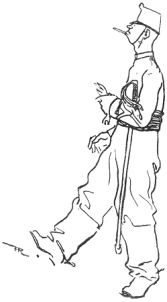
THE REAL ARTIST. From "Paris and Some Parisians"
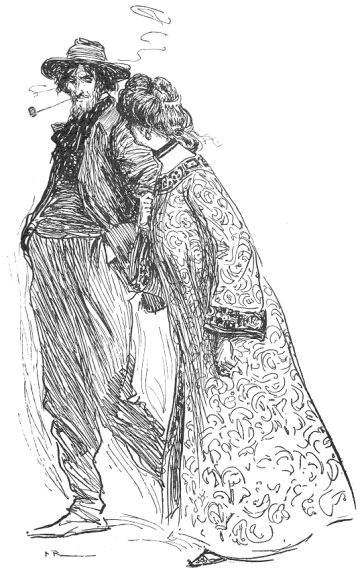
It is by his work for the Sketch, however, that Frank Reynolds is best known to the public. Credit is due to that enterprising journal not only for the discrimination which has caused prominence to be given to his drawings in its pages, but for the nice appreciation of the artist's peculiar vein of humour which has given him a free hand to produce those exquisitely subtle studies of character which are his especial province. As examples of what a humorous drawing should be they are well-nigh perfect. To Reynolds it is not enough merely to depict a laughable situation or superficially comic types. The humour of his drawings is inherent, not extraneous; his pictorial jests are self-contained, so to speak, and the printed legend beneath them is incidental only. Frank Reynolds produces a comedy where other men succeed only in perpetrating a farce.
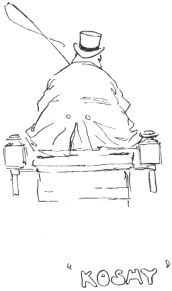
NOTE FROM A PARIS SKETCH-BOOK
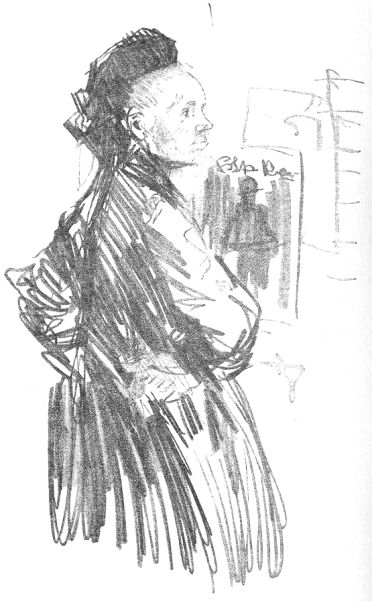
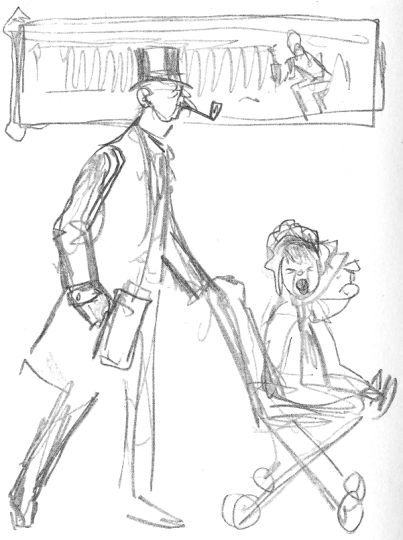
FIRST SKETCH FOR "THE SUBURBANITE"
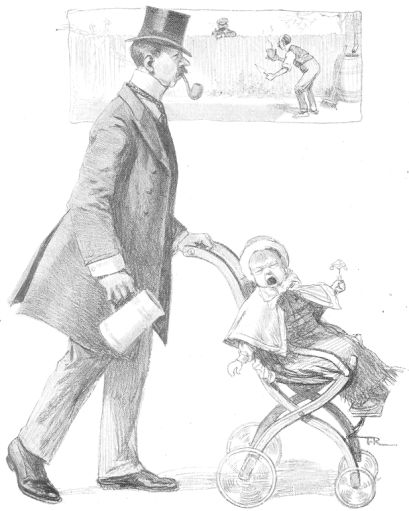
THE SUBURBANITE. A Sunday Morning Study. From "Social Pests"
FRANK REYNOLDS. III. How does one portray a type? What are the rules that govern the selection of those separate distinctive features which are to form, A GOOD STUDY. From "Paris and Some Parisians" when blended together, one harmoniously characteristic whole? Frank Reynolds, surely, of all people should be able to answer. But if the question be asked him, he will reply that he does not know. The process is unconscious, or almost so. The portrait "comes" of its own accord. Reflection shows that this must be so. If the artist were to try deliberately to copy this or that feature from concrete personalities, the result would fail to carry conviction. The portrait of a type must be the presentment of an abstract personality—a print, as it were, from a composite negative comprising the likenesses of many individuals, so welded together as to reproduce only that which is common to all: a collective portrait which is like all but resembles none.
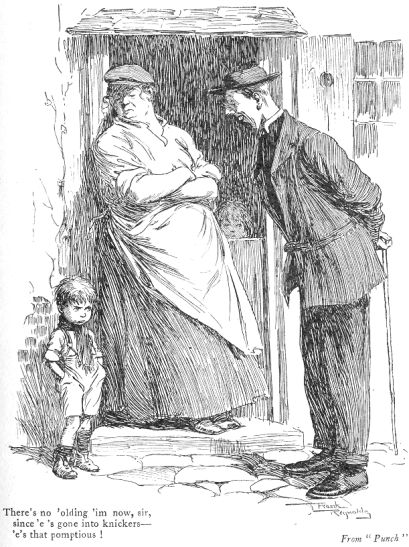
It is related of Charles Dickens that the creation of many of his famous characters was inspired by a chance remark overheard in the street. A single telling sentence, uttering some quaint sentiment, perhaps in quaint idiom, would set up a train of ideas ultimately resulting, after much meditative elaboration, in a Mrs. Gamp or a Dick Swiveller. The process is not dissimilar, one imagines, from that by which the artist evolves a character sketch: with this difference, that whereas a solitary trait, accidentally revealed, was to Dickens sufficient foundation upon which to construct his fanciful portrait, such studies of types as Frank Reynolds excels in must be the outcome, not of one "thing seen," but of reiterated observation of the same thing in identical or closely similar guise. The results in either case vary as the method employed. Mrs. Gamp, the outcome of a single observation, is a type certainly, but exaggerated and "founded on fact" rather than true to life. "The Suburbanite" (see p. 24), though an equally imaginary portrait, is the real thing—the absolute personification of a type or class.

In the case of Reynolds, his studies of types are the result of an exceptional power of observation coupled with a very retentive memory. His keen eye notes—often unconsciously, as he admits—the small eccentricities by which character is revealed; his sense of humour emphasises them, and his memory retains them. As a result, when he essays to portray a type, there rises before his mental vision, not the figure of this individual or that, but a hazy recollection of all its representatives that he has ever come into contact with. The misty impression materialises as he works, and there grows under his hand a portrait which draws from us an instant smile of recognition, broadening as we perceive the veiled humour and satire that lurk beneath the skilful emphasis which has been laid upon the subject's salient characteristics.
But though his character studies are so largely the result of memory, it must not be supposed that his drawings are hastily conceived or carried out. As a discerning critic can guess Frank Reynolds is slow and careful in his method, and though the central idea of a drawing is frequently the inspiration of the moment, its elaboration is a matter which occupies time, and the picture passes through many stages before attaining in the artist's mind completion. To lay readers it may be of interest to be initiated into the mystery of the gradual development from germ to finished drawing. For their p. 24) the initial rough sketch made for the portrait of "The Suburbanite," to which allusion has been made above. It will be seen that all the essentials are there in a raw state, and a comparison of this rough sketch with the finished reproduction will give some hint of the patient labour and careful thought which has gone to the making of the latter.
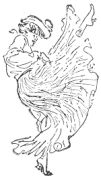
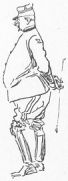
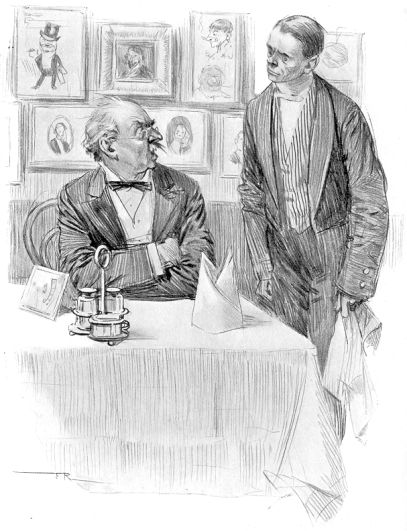
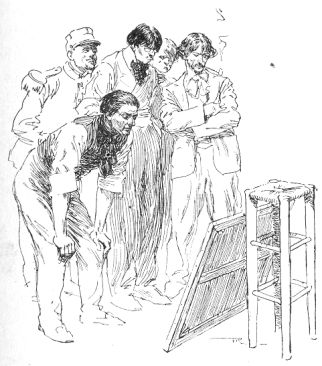
To mix as an observer in all ranks of society—especially the lower and more interesting ones—has always been to Frank Reynolds a matter of reflective amusement. The comedy of life affords him never-failing entertainment, for the world can never be dull to the man with the saving grace of humour and a quizzical interest in his fellow men. All is fish that comes to his net, for whether he touches off the foibles of Belgravia or records the broader humours of Bethnal Green he is equally happy. In the well-remembered series of "Dinners with Shakespeare," for instance, he illustrated with genial humour in half a dozen cartoons as many mannerisms of the dinner-table. The drawing which is reproduced opposite to page 56 portrays types that are familiar to all who know the small restaurants of Soho. The historian of the future, I sometimes think, who may wish to describe society in the early part of the twentieth century, will be fortunate if he contrives to illustrate his volume with a collection of contemporary drawings by Frank Reynolds. They will speak more eloquently than any narrative which he may compile from the most diligent searching of written records.
A TRAGEDY IN MINIATURE. From "Paris and Some Parisians"
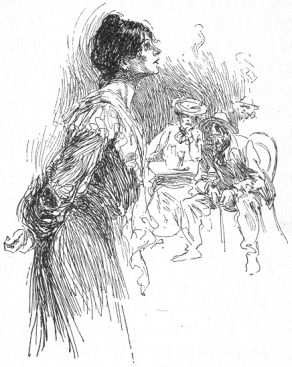
OUR CLUB. IMPATIENT MEMBER.—Aren't there any waiters in the Club? WAITER (politely). Yessir. How many would you like?